displaying their Samoan tattoos and legs
p. 50 · Read in the full issue
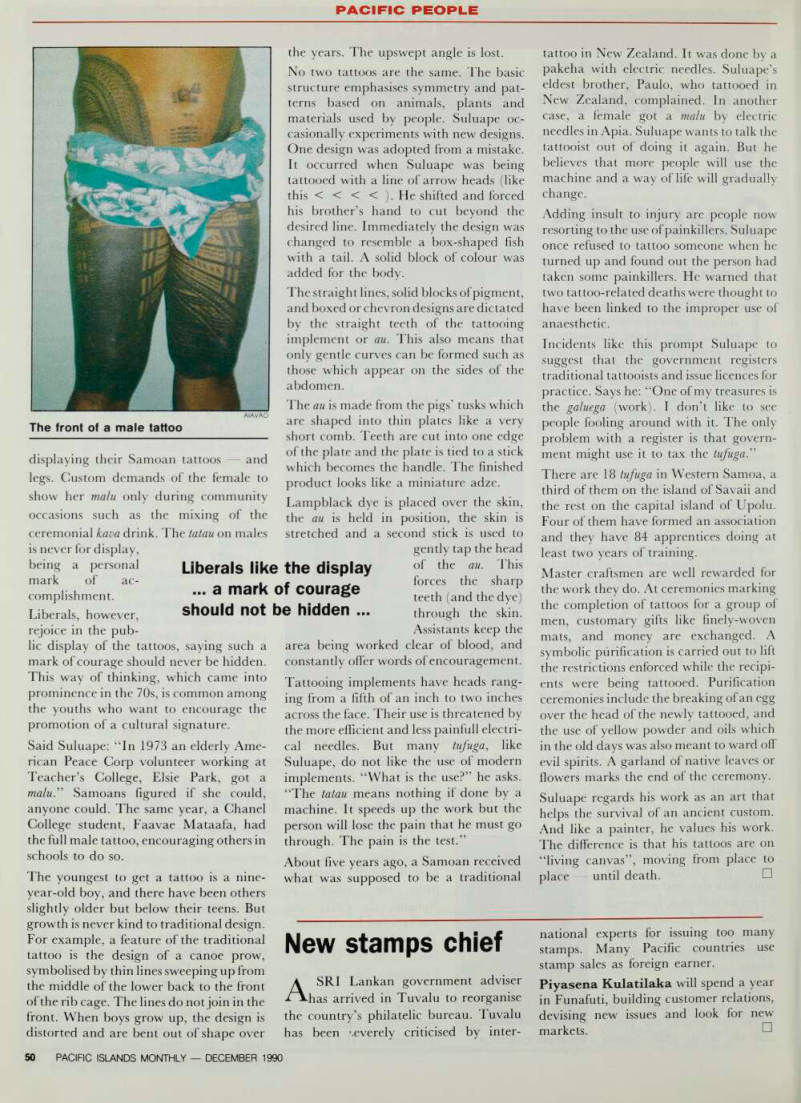
legs. Custom demands of the female to
show her malu only during community
occasions such as the mixing of the ceremonial kava drink. The tatau on males
is never for display, being a personal mark of ac complishment.
Liberals, however, rejoice in the pub
lic display of the tattoos, saying such a mark of courage should never be hidden.
This way of thinking, which came into prominence in the 70s, is common among the youths who want to encourage the promotion of a cultural signature.
Said Suluape: “In 1973 an elderly Ame rican Peace Corp volunteer working at Teacher’s College, Elsie Park, got a malu .” Samoans figured if she could, anyone could. The same year, a Chanel College student, Faavae Mataafa, had the full male tattoo, encouraging others in schools to do so.
The youngest to get a tattoo is a nine year-old boy, and there have been others slightly older but below their teens. But growth is never kind to traditional design.
For example, a feature of the traditional tattoo is the design of a canoe prow, symbolised by thin lines sweeping up from the middle of the lower back to the front of the rib cage. The lines do not join in the front. When boys grow up, the design is distorted and are bent out of shape over
the years. The upswept angle is lost.
No two tattoos are the same. The basic structure emphasises symmetry and pat terns based on animals, plants and
materials used by people. Suluape oc
casionally experiments with new designs.
One design was adopted from a mistake.
It occurred when Suluape was being tattooed with a line of arrow heads (like this <<<), He shifted and forced his brother’s hand to cut beyond the desired line. Immediately the design was changed to resemble a box-shaped fish with a tail. A solid block of colour was added for the body.
The straight lines, solid blocks of pigment, and boxed or chevron designs are dictated by the straight teeth of the tattooing implement or au. This also means that only gentle curves can be formed such as those which appear on the sides of the abdomen.
The au is made from the pigs’ tusks which are shaped into thin plates like a very short comb. Teeth are cut into one edge of the plate and the plate is tied to a stick which becomes the handle. The finished product looks like a miniature adze.
Lampblack dye is placed over the skin, the au is held in position, the skin is stretched and a second stick is used to
Liberals like the display a mark of courage 3 marK 0T c ° ura 8 e Should not be hidden ...
gently tap the head of the au. This forces the sharp teeth (and the dye) through the skin.
Assistants keep the
area being worked clear of blood, and constantly offer words of encouragement.
Tattooing implements have heads rang ing from a fifth of an inch to two inches across the face xheir use is threatened by the more efficient and less painfull electri cal needles. But many tufuga , like Suluape, do not like the use of modern implements. “What is the use?” he asks.
“The tatau means nothing if done by a machine. It speeds up the work but the person will lose the pain that he must go through. The pain is the test.”
About five years ago, a Samoan received what was supposed to be a traditional
tattoo in New Zealand. It was done by a pakeha with electric needles. Suluape’s eldest brother, Paulo, who tattooed in New Zealand, complained. In another case, a female got a malu by electric needles in Apia. Suluape wants to talk the tattooist out of doing it again. But he believes that more people will use the machine and a way of life will gradually
change.
Adding insult to injury are people now resorting to the use of painkillers. Suluape once refused to tattoo someone when he turned up and found out the person had taken some painkillers. He warned that two tattoo-related deaths were thought to have been linked to the improper use of anaesthetic.
Incidents like this prompt Suluape to suggest that the government registers traditional tattooists and issue licences for practice. Says he: “One of my treasures is the galuega (work). I don’t like to see people fooling around with it. The only problem with a register is that govern ment might use it to tax the tufuga .”
There are 18 tufuga in Western Samoa, a third of them on the island of Savaii and the rest on the capital island of Upolu.
Four of them have formed an association and they have 84 apprentices doing at least two years of training.
Master craftsmen are well rewarded for the work they do. At ceremonies marking the completion of tattoos for a group of men, customary gifts like finely-woven mats, and money are exchanged. A symbolic purification is carried out to lift the restrictions enforced while the recipi ents were being tattooed. Purification ceremonies include the breaking of an egg over the head of the newly tattooed, and the use of yellow powder and oils which in the old days was also meant to ward off evil spirits. A garland of native leaves or flowers marks the end of the ceremony.
Suluape regards his work as an art that helps the survival of an ancient custom.
And like a painter, he values his work.
The difference is that his tattoos are on “living canvas”, moving from place to place until death. □
Aiavao
The front of a male tattoo