Interview
pp. 51-53 · Read in the full issue
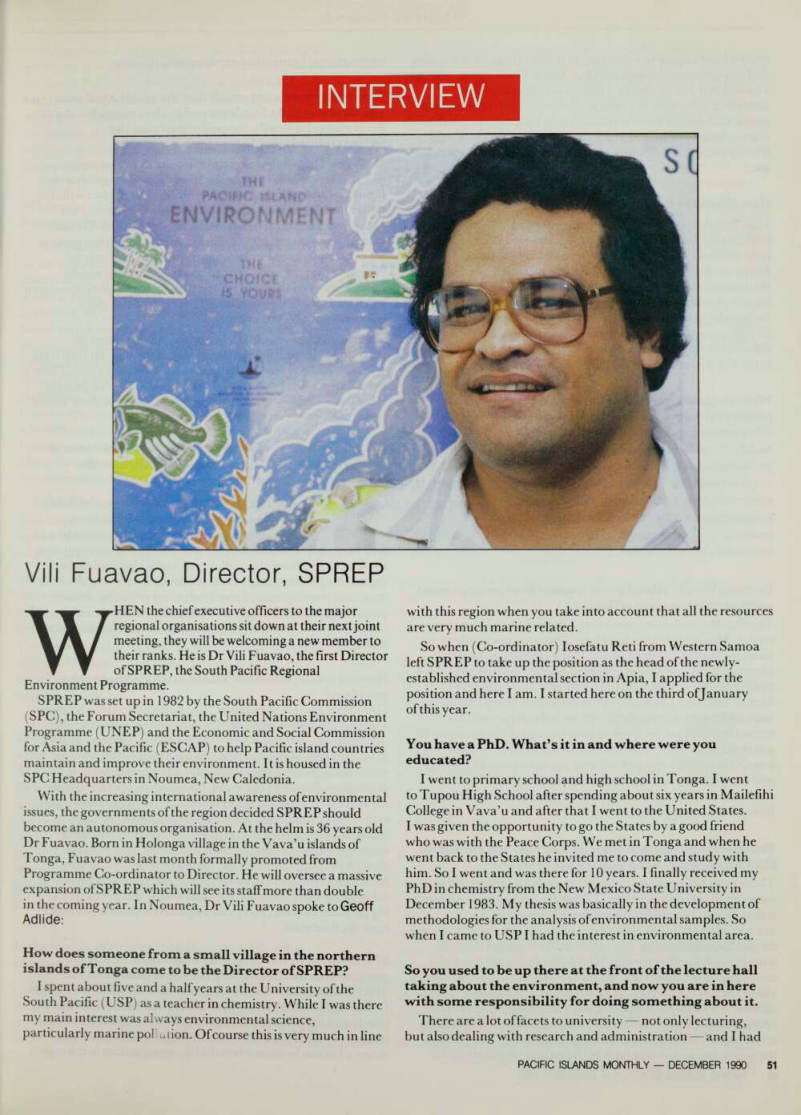
Vili Fuavao, Director, SPREP
WHEN the chief executive officers to the major regional organisations sit down at their next joint meeting, they will be welcoming a new member to their ranks. He is Dr Vili Fuavao, the first Director of SPREP, the South Pacific Regional Environment Programme.
SPREP was set up in 1982 by the South Pacific Commission (SPC), the Forum Secretariat, the United Nations Environment Programme (UNEP) and the Economic and Social Commission for Asia and the Pacific (ESCAP) to help Pacific island countries maintain and improve their environment. It is housed in the SPC Headquarters in Noumea, New Caledonia.
With the increasing international awareness ofenvironmental issues, the governments of the region decided SPREP should become an autonomous organisation. At the helm is 36 years old Dr Fuavao. Born in Holonga village in the Vava’u islands of Tonga, Fuavao was last month formally promoted from Programme Co-ordinator to Director. He will oversee a massive expansion of SPREP which will see its staff more than double in the coming year. I n Noumea, Dr Vili Fuavao spoke to Geoff Adlide: How does someone from a small village in the northern islands of Tonga come to be the Director of SPREP?
I spent about five and a halfyears at the University of the South Pacific (USP) as a teacher in chemistry. While I was there my main interest was always environmental science, particularly marine pol L *tion. Of course this is very much in line
with this region when you take into account that all the resources are very much marine related.
So when (Co-ordinator) losefatu Reti from Western Samoa left SPREP to take up the position as the head of the newly established environmental section in Apia, I applied for the position and here I am. I started here on the third ofjanuary of this year.
You have a PhD. What’s it in and where were you educated?
I went to primary school and high school in Tonga. I went to Tupou High School after spending about six years in Mailefihi College in Vava’u and after that I went to the United States.
I was given the opportunity to go the States by a good friend who was with the Peace Corps. We met in Tonga and when he went back to the States he invited me to come and study with him. So I went and was there for 10 years. I finally received my PhD in chemistry from the New Mexico State University in December 1983. My thesis was basically in the development of methodologies for the analysis ofenvironmental samples. So when I came to USPI had the interest in environmental area.
So you used to be up there at the front of the lecture hall taking about the environment, and now you are in here with some responsibility for doing something about it.
There are a lot of facets to university not only lecturing, but also dealing with research and administration and I had
Pacific People
quite a lot of experience speaking to the Forum and conferences and workshops and things like that. When I took up the position, I looked at it as a challenge. I feel quite lucky, and quite honoured, to be here at a time when the Pacific is beginning to realise that the environment is not something to be ignored, it is something to be looked at seriously if we are to manage our limited resources for the sake of the future inhabitants ofour area.
How green are Pacific island governments?
I can’t really speak for the countries, but I can say that if the interest they have shown in the programme (SPREP) is an indication ofhow ‘green’ or ‘ungreen’ the region is, I feel quite happy with the fact that they show a lot of interest. For example, the amount of projects and requests that my office has received is quite phenomenal. Obviously it’s a two-edged sword it means a lot of work for us but at the same time it shows there’s a lot of awareness out there among the governments. That’s also reflected in the way the environment has taken the fore not only in the Forum, but also in the South Pacific Conferences.
What requests have come in this year? What sort of projects are governments interested in?
The proposals sent to us by the countries vary widely, from climatic change and sea-level rise, to coastal management to conservation matters protected areas. There’s a lot of requests for awareness programmes like workshops, radio programmes and assistance with material production for environmental education to be used in school curriculums.
Do most Pacific island governments have environment units or environment officers?
That has been a development that is quite noticeable in the region. Most countries at least have an environment officer, or someone has the responsibility to look at the environmental aspects of all the development plans. Some countries have gone further and have their own unit, and some have gone even further and have a Ministry of Conservation. Some countries have an integrated approach with an inter-departmental committee with people from various sections of the government which takes on the evaluation of the environment. I think that’s a very, very good approach because the environment is a huge and integrated area. You need more than just an environmentalist to look at the environment, you need people from all areas of expertise.
You mentioned climatic change and the rising sea-level.
How much is that of an immediate problem?
There’s still a big debate... a lot of argument on the model to use to predict the sea-level rise. I think the problem for our region is that we can’t afford to be complacent about this. The uncertainties of the scientific community should not be an excuse for not doing something. It’s a reality. But to what extent the sea will rise is another matter. I think the small atoll countries in our region are quite right in taking it seriously. You’re talking about their very existence. It’s far more than just a piece ofland sinking, it’s whole cultures, languages and ways oflife. So the implications are not just from a land mass point of view, but the social impact ofit is going to be quite devastating. I’m glad that the region has woken up and is participating effectively in the
international forums that are discussing this issue.
But really there’s not much that the small Atoll countries can do about it. As I understand it, the reason for the sea level rise is basically the pollution from the industrialised world.
Well, yes. The point has been made quite clear that carbon dioxide is responsible for the sea-level rise and I hope that the industrialised nations take responsibility. But the fact is that we dynamite the reefs, we cut down our forests, we destroy the mangroves, and all of these things are inter-related. Climatic change is not caused by one specific thing. I think that perhaps we can slow it down by changing our ways. Obviously we recognise that the cause of all the carbon dioxide is mainly outside ofour control, but it’s worth pointing out that in our own small way we can do something There is also a lot more information to be gathered.
There is an argument that because you have these atolls surrounded by reef, maybe the growth of the reef can keep track with the sea-level rise. There’s a great debate about that. There’s a certain growth rate of coral. It’s definitely not a fast process, but ifit can keep up with the sea-level rise, perhaps there’s some hope. But I’m not an expert in sea-level rise.
‘Like the rest of the world we produce more waste than we know what to do with it’
What about your particular area of interest and research, marine
pollution?
I’m very much into marine production in the coastal areas: the pollution from agricultural practices the pesticides and
how they effect the quality of the water and eventually get into the food chain. Sewerage pollution is also a big problem in the region. And because, rightly so, countries are moving towards economic development, there’s industrial pollution. In some parts of the region the body of water surrounding the residential areas has been effected by the disposal of both domestic and non domestic waste.
Human waste, domestic waste why is that such a
problem?
One major cause is population. The population growth rate in some areas ifquite alarming. The other thing is there is great urbanisation movement people from rural areas moving to the urban area because ofjobs and the flavour oflife they see there. Some areas in this region have amongst the highest population density in the world. Of course most ofour urban areas are on the coast and this has magnified the problem. Our way oflife has changed. We are no longer based just on subsistence eating fish and dalo and when we go to the store and buy something it comes in a plastic bag. What do you do with the plastic which is not biodegradable? So our way of life has changed and as a consequence, like the rest of the world, we produce more waste than we know what to do with. It’s a big problem because, except for Papua New Guinea, we don’t have the land mass.
SPREP is the newest regional organisation, but the programme has been going for some time hasn’t it?
SPREP was set up in 1982 by four bodies the SPG, the Forum, UNEP and ESCAP. So we have always had the status of not purely an SPG programme, but one jointly sponsored by four bodies. I think SPREP is a symbol of regional co-operation. It shows what can be done when the big organisations in the region
work together. And now the decision of the last inter governmental meeting on SPREP, which has been endorsed by the South Pacific Conference, is to make SPREP an autonomous body housed here at the SPG but have as its sovereign body an inter-governmental meeting and still report to Conference and the Forum on an annual basis. To me, that’s a recognition by the governments that the programme must be strengthened to cope with the needs and the services expected of us.
What sort of changes can we expect now that SPREP has become autonomous?
Well I think there’s a danger of a new body like us being put up in the market to be the shopping list of someone else. I’m always ofthe view that I will do what the governments ask or direct us to do. There have been some new staff positions approved, but I don’t really see any change in our programmes.
We already have something like 11 components in our work programme that cover the whole spectrum of the environment.
What we have done is have one programme officer looking after three or four of those and of course that put a lot of strain on the officers. Now when we have the new staff, what we’ll do is have an environmental impact assessment officer, someone else who will simply look at marine pollution, and so on. In that way there’s a chance to go into things in depth, rather than have one officer skim the surface of three or four areas of
the environment.
SPREP is funded on voluntary contributions from the member countries and if they all paid up you’re talking about a sum less than half a million dollars which is not much. At the
moment we have four programme officers and two support staff and we barely get to the end of the year. The only reason we manage is because some countries contribute over and above their so-called voluntary contributions and that’s kept our heads above water. What we have been doing is spending a lot of our time fundraising for the projects, because the money that comes from the governments is basically for salaries and administration.
We are beginning to look out for staff paid by donor agencies and lending agencies. The fourth programme officer, who joined us (in Septeember), is fully funded for two and half years by the ADB (Asian Development Bank). UNDP (United Nations
Development Programme) is seriously considering providing
assistance to enable us to hire an environmental impact assessment officer and hopefully we’ll have that money early next year. New Zealand has indicated they will fund two positions. France and several other countries have indicated they will also assist, Greenpeace has said they will assist in strengthening our unit. So we’re beginning to expand our
funding base.
Is there a lot of money floating around for the environment?
Yes. There’s a lot of money going around, but there’s still a reluctance by the donors to recognise that it’s not enough to just give money for projects. In order to make sure the project is implemented effectively there’s also a need for administration.
So far, AIDAB (Australian International Development Assistance Bureau) has been very good to us; they’re more lenient and more open than most donors to requests to redirect some ofthe assistance to cover particular needs. I hope other donors take that position and don’t have a fixed direction because the bottom line is we have to be careful that our priorities are set by the member countries, not set by the donors.
One ofmy major tasks is to make sure that just because the donor’s money is there, we don’t deviate and become a donor driven organisation rather than an organisation that gets it direction and priorities from the island governments. I’ve always held the view that the governments know best what their needs are, and ifwe stick to that principle there shouldn’t be any conflict of interest with the donors.
Is there another possible conflict of interest? You mentioned that one of your main donors in France. Now one of the longest standing environmental issue in the region is the French nuclear testing programme in
French Polynesia.
There’s been a lot of things said about nuclear testing and a lot ofarguments. It’s been discussed at the highest level at the Forum Heads ofthe Government meetings. It’s not for SPREP to speak for the countries, to take a position. We have to tread very carefully and respect the sovereign
We have to tread very car efully, respect the 0 take their OWD Stand
right of countries to take their own stand.
Ifwe are requested to provide information we will provide it, but SPREP doesn’t take a position. We provide technical data and information for
governments to make up their own minds. The same thing happened with Johnston Atoll. When a government asked us, we provided all the information and let them make up their own mind.
Do you have a particular ambition for your time as SPREP Director, something you would like to achieve in your time here?
I have two more years before my time is up. The ambition I have is that I would like to leave this place realising that SPREP has increased its capacity to deal effectively with the needs of the region. At the same time it’s certainly not my wish to build a very bureaucratic organisation. I think the main strength of SPREP is that we are in touch with our governments on a regular basis. We have a maintain that line of communication.
I want to see the programme strengthened to a position where it has an identity that is well recognised internationally and, of course, regionally. Because when you have a status and identity then funds are easier to secure. I want SPREP to be authoritative. I want to work very closely with other institutions I have no illusion that I can head an organisation that will deal with every single aspect of the environment. That would be impossible and not cost-effective; but I hope that as SPREP increases its staff and strengthens its capabilities, we will be in a position to really co-ordinate the activities in the region and work very much in partnership with universities, non governmental organisations, and other regional and international organisations. If we have all these things, we will be looking at a very effective SPREP. □