Courage
p. 49 · Read in the full issue
People
Needles of Courage
By Ulafala Aiavao
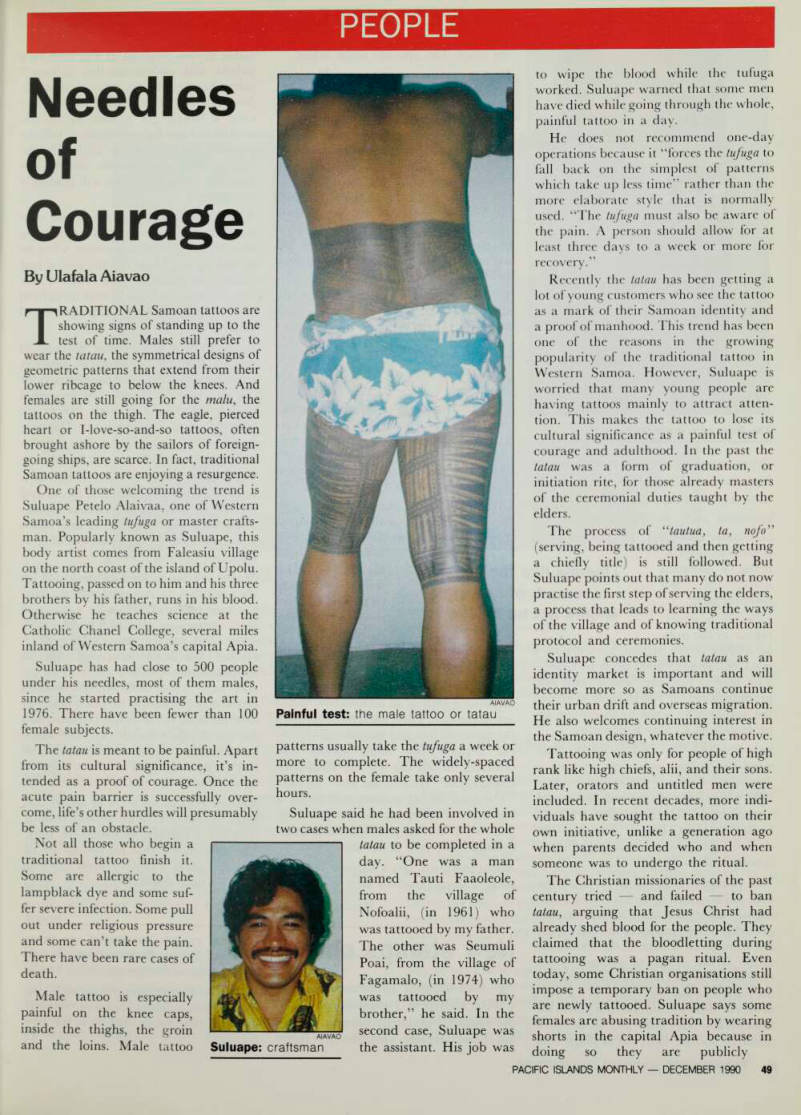
TRADITIONAL Samoan tattoos are showing signs of standing up to the test of time. Males still prefer to wear the tatau, the symmetrical designs of geometric patterns that extend from their lower ribcage to below the knees. And females are still going for the main, the tattoos on the thigh. The eagle, pierced heart or I-love-so-and-so tattoos, often brought ashore by the sailors of foreign going ships, are scarce. In fact, traditional Samoan tattoos are enjoying a resurgence.
One of those welcoming the trend is Suluape Petelo Alaivaa, one of Western Samoa’s leading tufuga or master crafts man. Popularly known as Suluape, this body artist comes from Faleasiu village on the north coast of the island of Upolu.
Tattooing, passed on to him and his three brothers by his father, runs in his blood.
Otherwise he teaches science at the Catholic Chanel College, several miles inland of Western Samoa’s capital Apia.
Suluape has had close to 500 people under his needles, most of them males, since he started practising the art in 1976. There have been fewer than 100
female subjects.
The tatau is meant to be painful. Apart from its cultural significance, it’s in tended as a proof of courage. Once the acute pain barrier is successfully over come, life’s other hurdles will presumably be less of an obstacle.
Not all those who begin a traditional tattoo finish it.
Some are allergic to the lampblack dye and some suf fer severe infection. Some pull out under religious pressure and some can’t take the pain.
There have been rare cases of death.
Male tattoo is especially painful on the knee caps, inside the thighs, the groin and the loins. Male tattoo
patterns usually take the tufuga a week or more to complete. The widely-spaced patterns on the female take only several hours.
Suluape said he had been involved in two cases when males asked for the whole
tatau to be completed in a day. “One was a man named Tauti Faaoleole, from the village of Nofoalii, (in 1961) who was tattooed by my father.
The other was Seumuli Poai, from the village of Fagamalo, (in 1974) who was tattooed by my brother,” he said. In the second case, Suluape was the assistant. His job was
to wipe the blood while the tufuga worked. Suluape warned that some men have died while going through the whole, painful tattoo in a day.
He does not recommend one-day operations because it “forces the tufuga to fall back on the simplest of patterns which take up less time” rather than the more elaborate style that is normally used. “The tufuga must also be aware of the pain. A person should allow for at least three days to a week or more for recovery.”
Recently the talau has been getting a lot of young customers who see the tattoo as a mark of their Samoan identity and a proof of manhood. This trend has been one of the reasons in the growing popularity of the traditional tattoo in Western Samoa. However, Suluape is worried that many young people are having tattoos mainly to attract atten tion. This makes the tattoo to lose its cultural significance as a painful test of courage and adulthood. In the past the tatau was a form of graduation, or initiation rite, for those already masters of the ceremonial duties taught by the elders.
The process of “tautua, ta, nofo” (serving, being tattooed and then getting a chiefly title) is still followed. But Suluape points out that many do not now practise the first step of serving the elders, a process that leads to learning the ways of the village and of knowing traditional protocol and ceremonies.
Suluape concedes that tatau as an identity market is important and will become more so as Samoans continue their urban drift and overseas migration.
He also welcomes continuing interest in the Samoan design, whatever the motive.
Tattooing was only for people of high rank like high chiefs, alii, and their sons.
Later, orators and untitled men were included. In recent decades, more indi viduals have sought the tattoo on their own initiative, unlike a generation ago when parents decided who and when someone was to undergo the ritual.
The Christian missionaries of the past century tried and failed to ban tatau , arguing that Jesus Christ had already shed blood for the people. They claimed that the bloodletting during tattooing was a pagan ritual. Even today, some Christian organisations still impose a temporary ban on people who are newly tattooed. Suluape says some females are abusing tradition by wearing shorts in the capital Apia because in doing so they are publicly
Aiavao
Suluape: craftsman
Aiavao
Painful test: the male tattoo or tatau