Covering
pp. 47-48 · Read in the full issue
Books
Covering the war
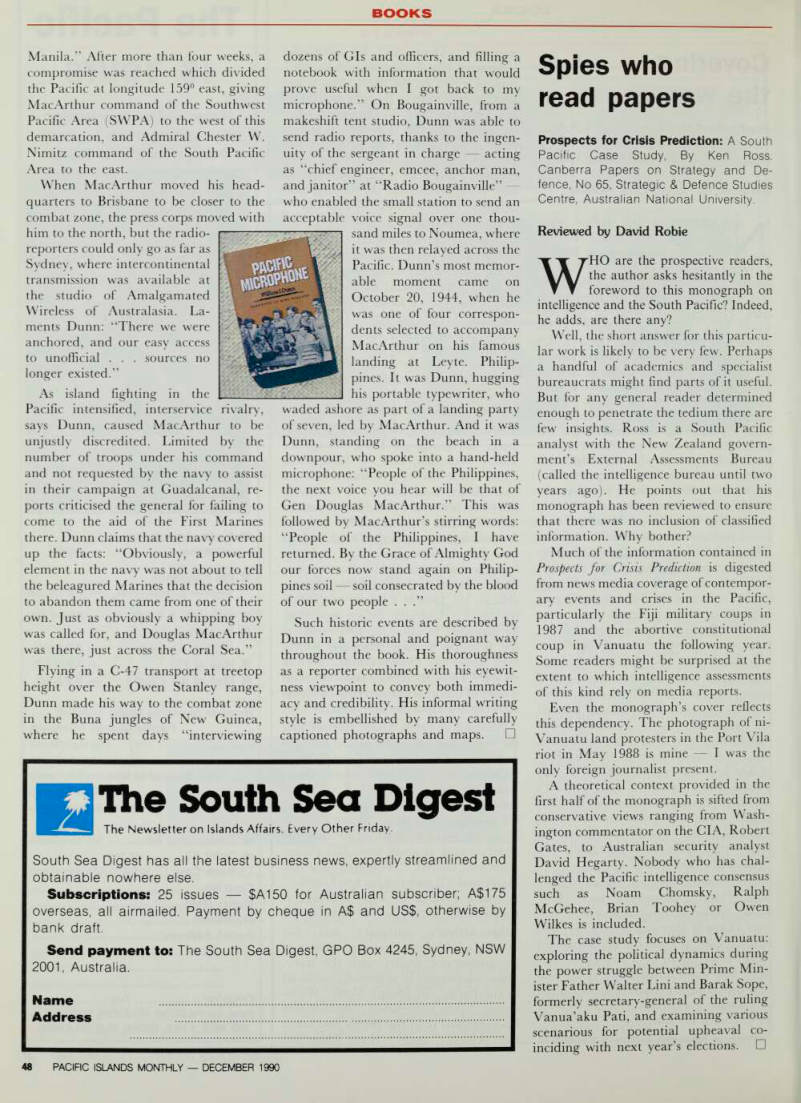
Pacific Microphone. By William J. Dunn, Texas A & M University Press. 1988. 399 pages. [ISBN 0-89096-339-8. U 5519.95.
Reviewed by Harvey Zane Helfand NEARLY one year before Ame rica’s entry into World War 11, CBS radio correspondent William J. Dunn was sent to the Far East to establish news reporting arrangements and seek information about the situation in Asia. Embarking on what he was told would be a “90-day assignment”. Dunn arrived in the Philippines then a US Commonwealth, by Pan American clipper via Midway, Wake and Guam in January 1941. Dunn’s work soon extended beyond three months, as he was sent to various destinations, assuring the presence of a CBS reporter on the scene when the anticipated war broke out. Pacific Micro phone is Dunn’s story of this assignment, which resulted in his being the first American radio journalist to cover the Pacific war from beginning to end.
Working first out of Manila, Dunn found the American residents there living “the good life” without apparent feelings of vulnerability: “Despite the thunder heads mounting to the north, the Manila of 1941 was truly the Pearl of the Orient, a city whose rising prosperity made even the thought of total war impossible for the average person to comprehend.”
It was here he first met Douglas MacArthur, who was then serving as a military adviser to Philippines President Manuel Quezon. This meeting marked the beginning of a friendship with MacArthur, who soon took command of the US Armed Forces in the Far East (USAFE), that placed Dunn in the trusted inner circle of the general’s command throughout the war. In fact, Dunn’s admiration, and sometimes de fence, of the soldier is so strong, that the book might have been subtitled “My Years with MacArthur”.
Overcoming difficult travel restric tions, Dunn managed to reach Hong Kong, Shanghai, Saigon, Rangoon, and even Tokyo in May and June of 1941 and enabled CBS to make the first broadcast report from Japan by a staff correspon dent, but, more importantly, it satisfied “my own curiosity concerning the capital of a nation I was certain would soon be at war with my own.”
With a Japanese offensive appearing
imminent, Dunn and his colleagues speculated that Singapore and the Phil ippines would be the likely targets, and they never “gave a thought to Hawaii and Pearl Harbor”. In December, when his military friends in Rangoon alerted him to the news of the attack, Dunn thought they were joking: “I was being taken in. I had been to Pearl Harbor and had been briefed on the impregnable defenses. I’d never swallow that one.”
Sobered by the realisation that he was now a war correspondent, rather than just a foreign correspondent, Dunn had to find out not only what was happening, but also a way to send a radio report to San Francisco. “I found myself seques tered in a colonial backwater of the infant Pacific war, minus a viable microphone and with little ‘newsworthy material’ to file by cable.” Though he had made some broadcasts, most facili ties were not equipped for reliable trans pacific communications.
With Guam captured and Japanese forces advancing on Hong Kong, the Malay Peninsula, and the Philippines, Dunn made his way to Batavia in the Netherlands East Indies: “I wanted a story to report and I found one. I wanted radio facilities to reach CBS and the American public, and the Dutch in Java gave me facilities as fine as could be found anywhere in 1941.” But by early March, Dunn, retreating from Japanese attacks, left Java in a hectic evacuation by ship for Australia. Before departing, he managed to radio the first report of the invasion to San Francisco which, even under the circumstances, left him elated: “To be the first, worldwide, with a story of this importance is the ambition of every correspondent-reporter.”
Arriving at Perth, Dunn learned that the only trans-Pacific broadcast facilities were located in Melbourne and Sydney.
In Melbourne, he re-established contact with CBS News and also had a reunion with MacArthur, who was establishing his headquarters there. When he saw Dunn he was surprised to see that the reporter had escaped from the Philip pines and offered: “ You stay with me, Dunn, and I’ll take you back to Manila.”
It was a promise he kept, although it required the better part of three years.
MacArthur’s authority was not quickly established, however, because of an interservice rivalry with the navy, about who should be in overall command in the Pacific. In Dunn’s words, Wash ington “spent more time trying to define his command than the enemy had taken to occupy both Hong Kong and
Manila.” After more than four weeks, a compromise was reached which divided the Pacific at longitude 159° east, giving MacArthur command of the Southwest Pacific Area (SWPA) to the west of this demarcation, and Admiral Chester W.
Nimitz command of the South Pacific Area to the east.
When MacArthur moved his head quarters to Brisbane to be closer to the combat zone, the press corps moved with
him to the north, but the radio reporters could only go as far as Sydney, where intercontinental transmission was available at the studio of Amalgamated Wireless of Australasia. La ments Dunn: “There we were anchored, and our easy access to unofficial . . . sources no
longer existed.”
As island fighting in the
Pacific intensified, interservice rivalry, says Dunn, caused MacArthur to be unjustly discredited. Limited by the number of troops under his command and not requested by the navy to assist in their campaign at Guadalcanal, re ports criticised the general for failing to come to the aid of the First Marines there. Dunn claims that the navy covered up the facts: “Obviously, a powerful element in the navy was not about to tell the beleagured Marines that the decision to abandon them came from one of their own. Just as obviously a whipping boy was called for, and Douglas MacArthur was there, just across the Coral Sea.”
Flying in a C-47 transport at treetop height over the Owen Stanley range, Dunn made his way to the combat zone in the Buna jungles of New Guinea, where he spent days “interviewing
dozens of Gls and officers, and filling a notebook with information that would prove useful when I got back to my microphone.” On Bougainville, from a makeshift tent studio, Dunn was able to send radio reports, thanks to the ingen uity of the sergeant in charge acting as “chief engineer, emcee, anchor man, and janitor” at “Radio Bougainville” who enabled the small station to send an acceptable voice signal over one thou-
sand miles to Noumea, where it was then relayed across the Pacific. Dunn’s most memor able moment came on October 20, 1944, when he was one of four correspon dents selected to accompany MacArthur on his famous
landing at Leyte. Philip
pines. It was Dunn, hugging his portable typewriter, who
waded ashore as part of a landing party of seven, led by MacArthur. And it was Dunn, standing on the beach in a downpour, who spoke into a hand-held microphone: "People of the Philippines, the next voice you hear will be that of Gen Douglas MacArthur.” This was followed by MacArthur’s stirring words: “People of the Philippines, I have returned. By the Grace of Almighty God our forces now stand again on Philip pines soil soil consecrated by the blood of our two people . .
Such historic events are described by Dunn in a personal and poignant way throughout the book. His thoroughness as a reporter combined with his eyewit ness viewpoint to convey both immedi acy and credibility. His informal writing style is embellished by many carefully captioned photographs and maps. □