Fishing in Kiribati
p. 46 · Read in the full issue
Stamps
WHEN Robert Louis Stevenson passed through the Gilbert Islands just over a hundred years ago, he was struck by the superb ocean climate, ‘the days of blinding sun and bracing wind and nights of a heavenly brightness’. He likened life on the coral atolls to that on board a ship where the elements of sky and sea dominate. Even in Stevenson’s time, the traditional ways of life were nearly gone in the face of the ‘fatal impact’ of European settlement but the overwhelming influence of the sea on Kiribati (as it is now called) will remain for ever.
The new defini tive series from Kiri bati features some of the fish that have been found since time immemorial in the waters around
the Republic.
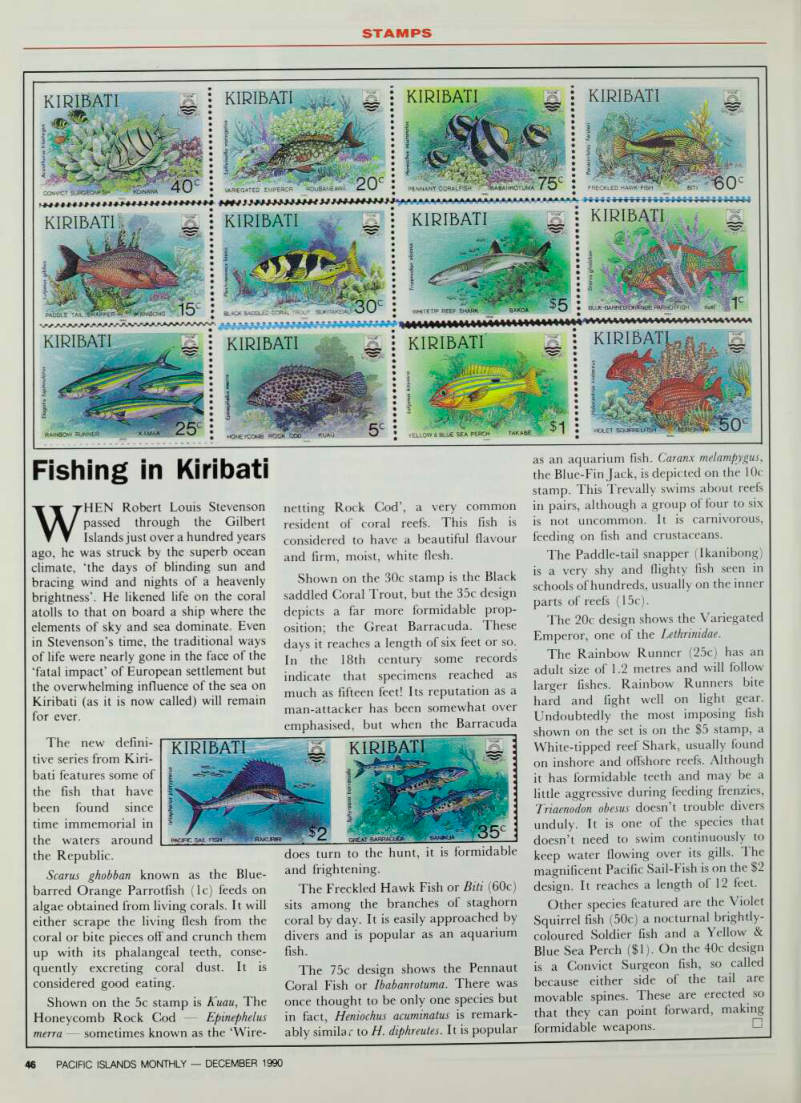
Scarus ghobban known as the Blue barred Orange Parrotfish (1c) feeds on algae obtained from living corals. It will either scrape the living flesh from the coral or bite pieces off and crunch them up with its phalangeal teeth, conse quently excreting coral dust. It is considered good eating.
Shown on the 5c stamp is Kuau, The Honeycomb Rock Cod Epinephelus merra sometimes known as the ‘Wire
netting Rock Cod’, a very common resident of coral reefs. This fish is considered to have a beautiful flavour and firm, moist, white flesh.
Shown on the 30c stamp is the Black saddled Coral Trout, but the 35c design depicts a far more formidable prop osition; the Great Barracuda. These days it reaches a length of six feet or so.
In the 18th century some records indicate that specimens reached as much as fifteen feet! Its reputation as a man-attacker has been somewhat over emphasised, but when the Barracuda
does turn to the hunt, it is formidable
and frightening.
The Freckled Hawk Fish or Biti (60c) sits among the branches of staghorn coral by day. It is easily approached by divers and is popular as an aquarium fish.
The 75c design shows the Pennaut Coral Fish or Ibabanrotuma. There was once thought to be only one species but in fact, Heniochus acuminatus is remark ably similar to H. diphreutes. It is popular
as an aquarium fish. Caranx melampygus , the Blue-Fin Jack, is depicted on the 10c stamp. This Trevally swims about reefs in pairs, although a group of four to six is not uncommon. It is carnivorous, feeding on fish and crustaceans.
The Paddle-tail snapper (Ikanibong) is a very shy and flighty fish seen in schools of hundreds., usually on the inner parts of reefs (15c).
The 20c design shows the Variegated Emperor, one of the Lethrinidae.
The Rainbow Runner (25c) has an adult size of 1.2 metres and will follow larger fishes. Rainbow Runners bite hard and fight well on light gear.
Undoubtedly the most imposing fish shown on the set is on the $5 stamp, a White-tipped reef Shark, usually found on inshore and offshore reefs. Although it has formidable teeth and may be a little aggressive during feeding frenzies, Triaenodon obesus doesn’t trouble divers unduly. It is one of the species that doesn’t need to swim continuously to keep water flowing over its gills. The magnificent Pacific Sail-Fish is on the $2 design. It reaches a length of 12 feet.
Other species featured are the Violet Squirrel fish (50c) a nocturnal brightly coloured Soldier fish and a Yellow & Blue Sea Perch (SI). On the 40c design is a Convict Surgeon fish, so called because either side of the tail are movable spines. These are erected so that they can point forward, making formidable weapons.