Magic
pp. 42-45 · Read in the full issue
The Arts
Magic of the Kanaks
In Paris, a great show reawakens the spirits of the past
By Nicholas Rothwell
FAR from his resting place in New Caledonia, Jean-Marie Tjibaou, the as sassinated Kanak independence leader, broods like a guardian spirit over a distant corner of Paris this autumn. Here, in the monumental National Museum of African and Oceanian Arts, the greatest exhibition of Kanak art ever staged in Europe is on view a display that marks and com memorates in poignant style France’s new found regard for its Pacific territory.
The exhibition, De Jade et de Nacre Patrimoine Artistique Kanak (Jade and Mother-of-Pearl Kanak Artistic Patri mony on view through January next year), is both a tribute to the riches of the Kanak past and a devout expression of the hope that the ancient culture will continue to flourish in New Caledonia’s future. It has been lavishly promoted across Paris, and large crowds of visitors are passing through the museum’s galleries, which are filled with the voices of Kanak song, and film-stills capturing the island’s cultural life.
The leading ethnographic museums of Europe have lent their choicest Kanak pieces many of them objects collected by early western visitors in the 18th and 19th century and a group of master works from the Noumea Museum, where this exhibit was staged earlier this year, are also included.
A splendid, scholarly catalogue, writ ten by the foremost experts from French and New Caledonian museums and centres of learning, completes the spec tacle. In the ante-chamber to the exhibition, a text records the tribute to
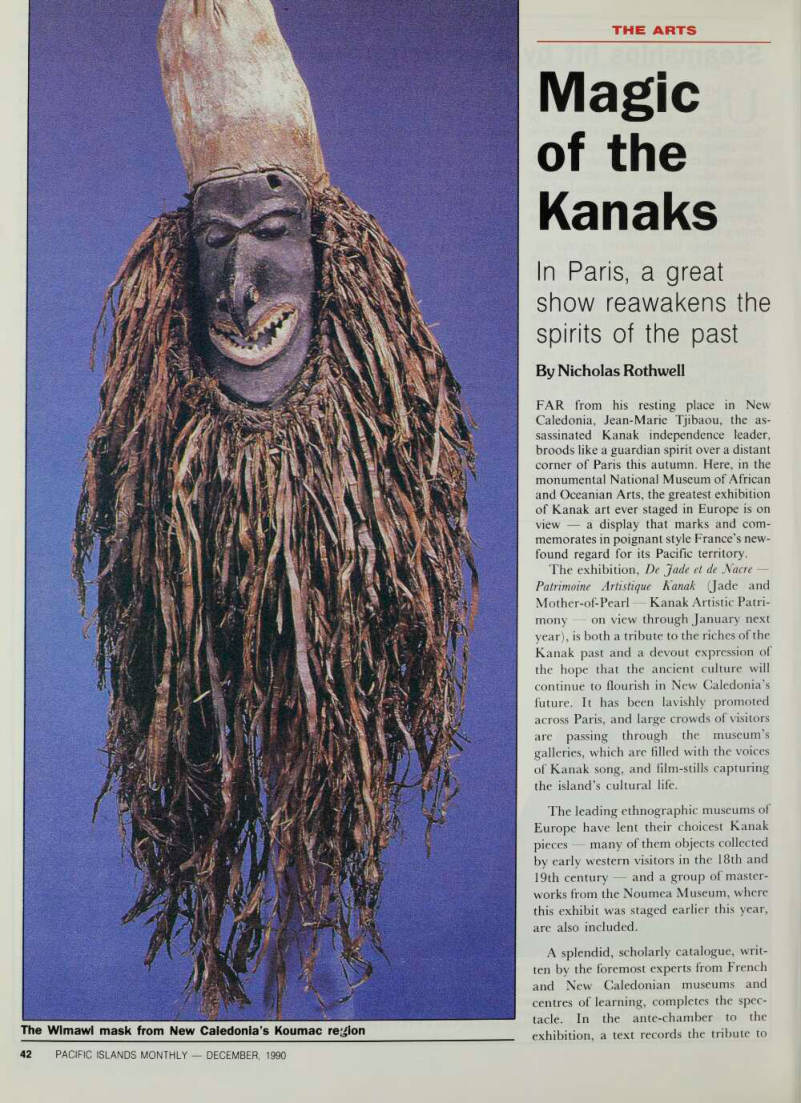
The Wimawi mask from New Caledonia’s Koumac region
the slain Kanak political leader from Aime Cesaire, the famous Martinique poet: “No one in my eyes incarnates better at the end of this century, and in a more moving fashion, true nobility and grandeur placed in the service of a small people struggling for its survival and the survival of a civilisation.”
France’s Minister of Culturre, Jack Lang, whose Socialist Government nego tiated with Tjibaou the 1988 Matignon Accords that pave the way for possible Kanak independence, explains that he has been developing De Jade et de Nacre for the past two years, in the hope of showing that the artistic heritage of New Caledonia “does not consist only of some sculptures and bracelets but also com prises a very beautiful oral literature, music, song, and dances.”
Lang also pays tribute to Jean-Marie Tjibaou and Yeiwene Yeiwene, his close
colleague who was assassinated together with him in 1989: “They knew how to integrate into their hopes, for more than 20 years, the cultural dimension from which tradition would be nourished and the future would be invented let them guide us through the testimonies of their civilisation,”
Clearly, then, the staging of this exhibition represents a major affirmation by the French Government of its support
for the Kanak cause, for the survival of indigenous values, during the diffi cult years of transition that lies ahead for all New Caledonia’s peoples. In its thoroughness, it high lights one aspect of France’s engagement with New Caledonia that often goes overlooked.
Visitors to Noumea tend only to see the more evident traces of French life the recreation of small-town Gallic ways by the Caldoche settlers. But New Cale donia has served, ever since its colonis ation, as a magnet for French anthropol ogists and thinkers, from Maurice Leenhardt down to the eminent con tributors to this exhibition’s catalogue such as Alban Bensa. Kanak culture acted as a mirror in which France refined
its understanding of other traditions; the contact between the two lands was a two way affair.
De Jade et de Nacre aims at providing no less than an inclusive dictionary of the Kanak world, cover ing archaeology, art
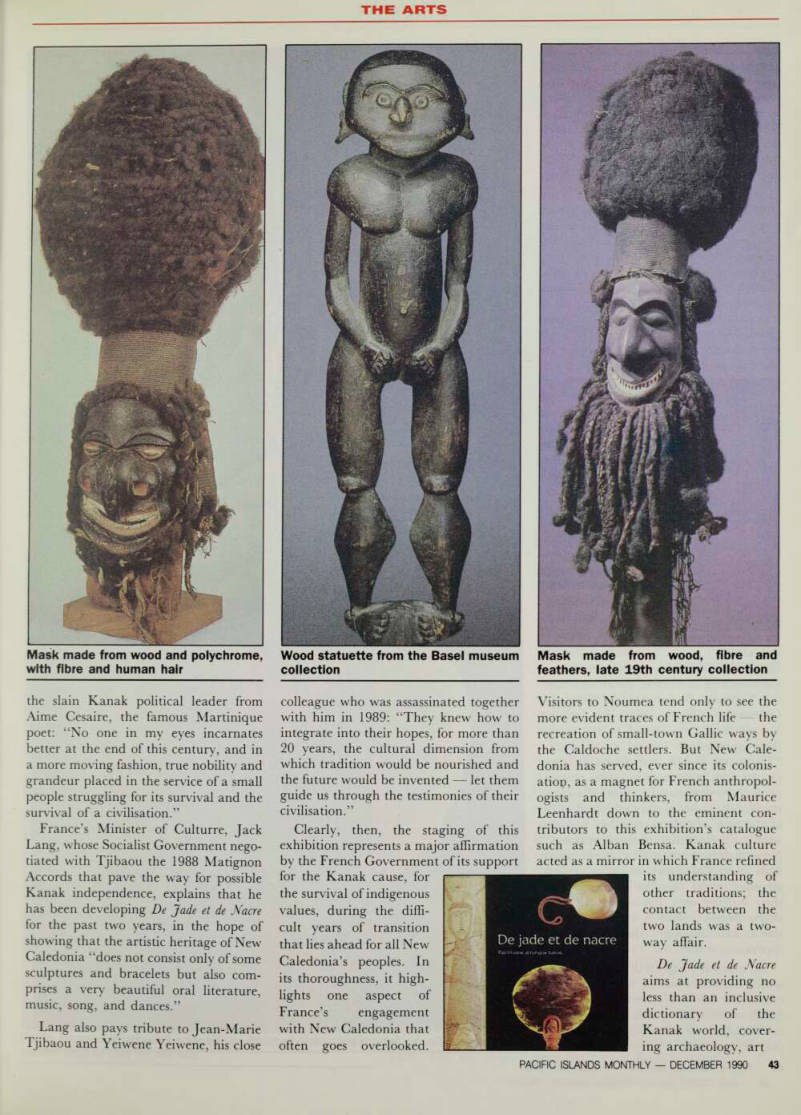
Mask made from wood and polychrome, with fibre and human hair
Wood statuette from the Basel museum collection
Mask made from wood, fibre and feathers, late 19th century collection
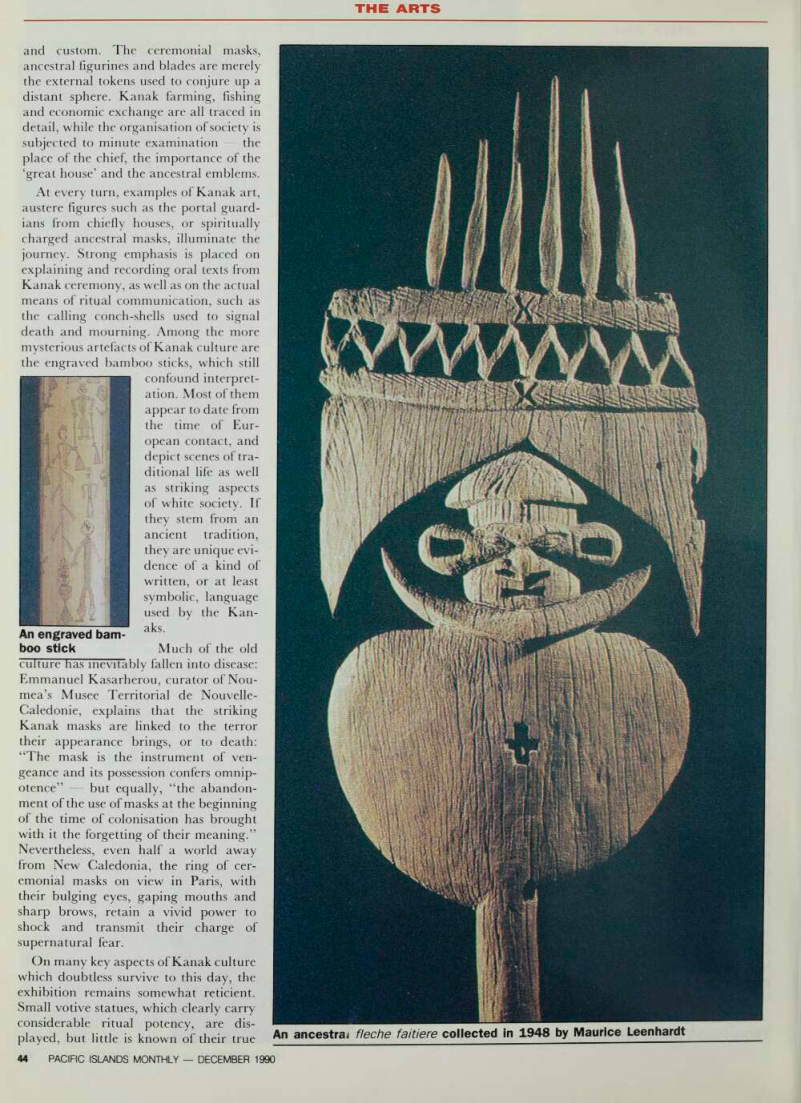
and custom. The ceremonial masks, ancestral figurines and blades are merely the external tokens used to conjure up a distant sphere. Kanak farming, fishing and economic exchange are all traced in detail, while the organisation of society is subjected to minute examination the place of the chief, the importance of the ‘great house’ and the ancestral emblems.
At every turn, examples of Kanak art, austere figures such as the portal guard ians from chiefly houses, or spiritually charged ancestral masks, illuminate the journey. Strong emphasis is placed on explaining and recording oral texts from Kanak ceremony, as well as on the actual means of ritual communication, such as the calling conch-shells used to signal death and mourning. Among the more mysterious artefacts of Kanak culture are the engraved bamboo sticks, which still
confound interpret
ation. Most of them appear to date from the time of Eur opean contact, and depict scenes of tra ditional life as well as striking aspects of white society. If they stem from an ancient tradition, they are unique evi dence of a kind of written, or at least symbolic, language used by the Kan aks.
Much of the old
culture has inevitably fallen into disease: Emmanuel Kasarherou, curator of Nou mea’s Musee Territorial de Nouvelle- Caledonie, explains that the striking Kanak masks are linked to the terror their appearance brings, or to death: “The mask is the instrument of ven geance and its possession confers omnip otence” but equally, “the abandon ment of the use of masks at the beginning of the time of colonisation has brought with it the forgetting of their meaning.”
Nevertheless, even half a world away from New Caledonia, the ring of cer emonial masks on view in Paris, with their bulging eyes, gaping mouths and sharp brows, retain a vivid power to shock and transmit their charge of supernatural fear.
On many key aspects of Kanak culture which doubtless survive to this day, the exhibition remains somewhat reticient.
Small votive statues, which clearly carry considerable ritual potency, are dis played, but little is known of their true
An engraved bam boo stick
An ancestral fleche faitiere collected in 1948 by Maurice Leenhardt
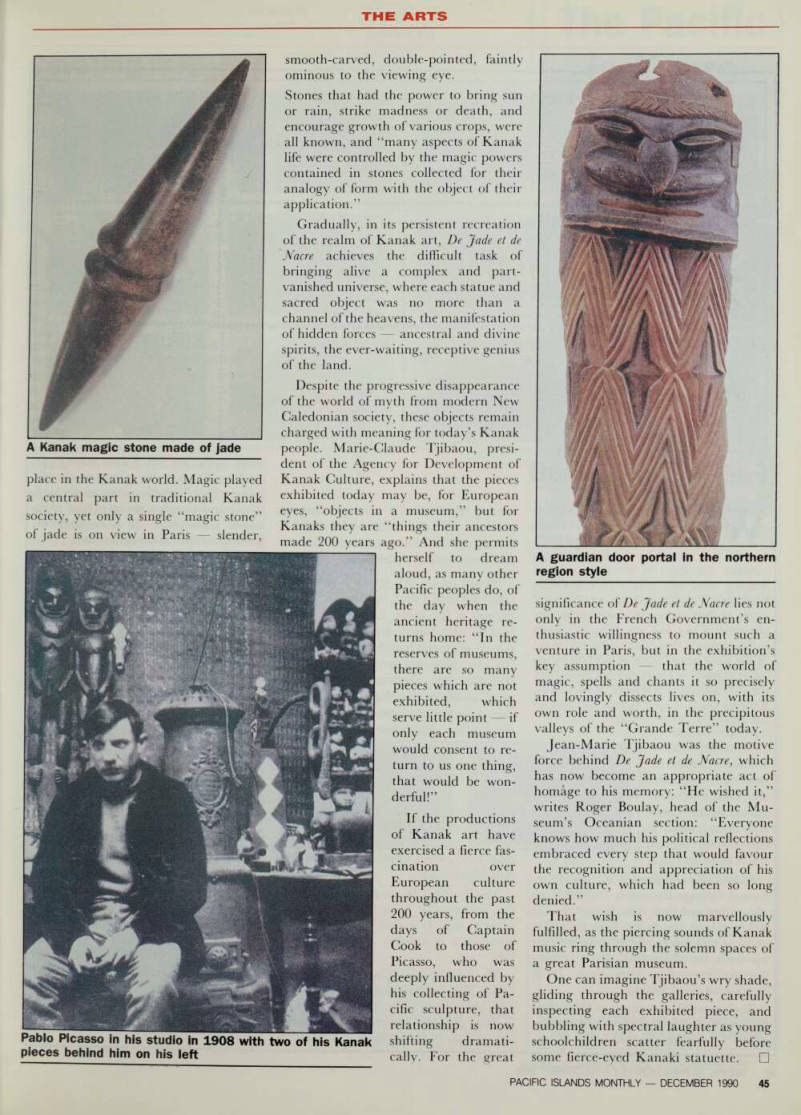
place in the Kanak world. Magic played a central part in traditional Kanak society, yet only a single “magic stone” of jade is on view in Paris slender,
smooth-carved, double-pointed, faintly ominous to the viewing eye.
Stones that had the power to bring sun or rain, strike madness or death, and encourage growth of various crops, were all known, and “many aspects of Kanak life were controlled by the magic powers contained in stones collected for their analogy of form with the object of their application.”
Gradually, in its persistent recreation of the realm of Kanak art, De Jade et de Nacre achieves the difficult task of bringing alive a complex and part vanished universe, where each statue and sacred object was no more than a channel of the heavens, the manifestation of hidden forces ancestral and divine spirits, the ever-waiting, receptive genius of the land.
Despite the progressive disappearance
of the world of myth from modern New Caledonian society, these objects remain charged with meaning for today’s Kanak people. Marie-Claude Tjibaou, presi dent of the Agency for Development of Kanak Culture, explains that the pieces exhibited today may be, for European eyes, “objects in a museum,” but for Kanaks they are “things their ancestors made 200 years ago.” And she permits
herself to dream aloud, as many other Pacific peoples do, of the day when the ancient heritage re turns home: “In the reserves of museums, there are so many pieces which are not exhibited, which serve little point if only each museum would consent to re turn to us one thing, that would be won derful!”
If the productions of Kanak art have exercised a fierce fas cination over
European culture
throughout the past 200 years, from the days of Captain Cook to those of Picasso, who was deeply influenced by his collecting of Pa cific sculpture, that relationship is now
shifting dramati
cally. For the great
significance of De Jade et de Nacre lies not only in the French Government’s en thusiastic willingness to mount such a venture in Paris, but in the exhibition’s key assumption that the world of magic, spells and chants it so precisely and lovingly dissects lives on, with its own role and worth, in the precipitous valleys of the “Grande Terre” today.
Jean-Marie Tjibaou was the motive force behind De Jade et de Nacre, which has now become an appropriate act of homage to his memory: “He wished it,” writes Roger Boulay, head of the Mu seum’s Oceanian section: “Everyone knows how much his political reflections embraced every step that would favour the recognition and appreciation of his own culture, which had been so long denied.”
That wish is now marvellously fulfilled, as the piercing sounds of Kanak music ring through the solemn spaces of a great Parisian museum.
One can imagine Tjibaou’s wry shade, gliding through the galleries, carefully inspecting each exhibited piece, and bubbling with spectral laughter as young schoolchildren scatter fearfully before some fierce-eyed Kanaki statuette. □
A Kanak magic stone made of jade
Pablo Picasso in his studio in 1908 with two of his Kanak pieces behind him on his left
A guardian door portal in the northern region style