history
pp. 49-51 · Read in the full issue
People
The keeper of history
A lone battler toils on in in the Cook Islands to save a decaying archive
By Angela McCarthy
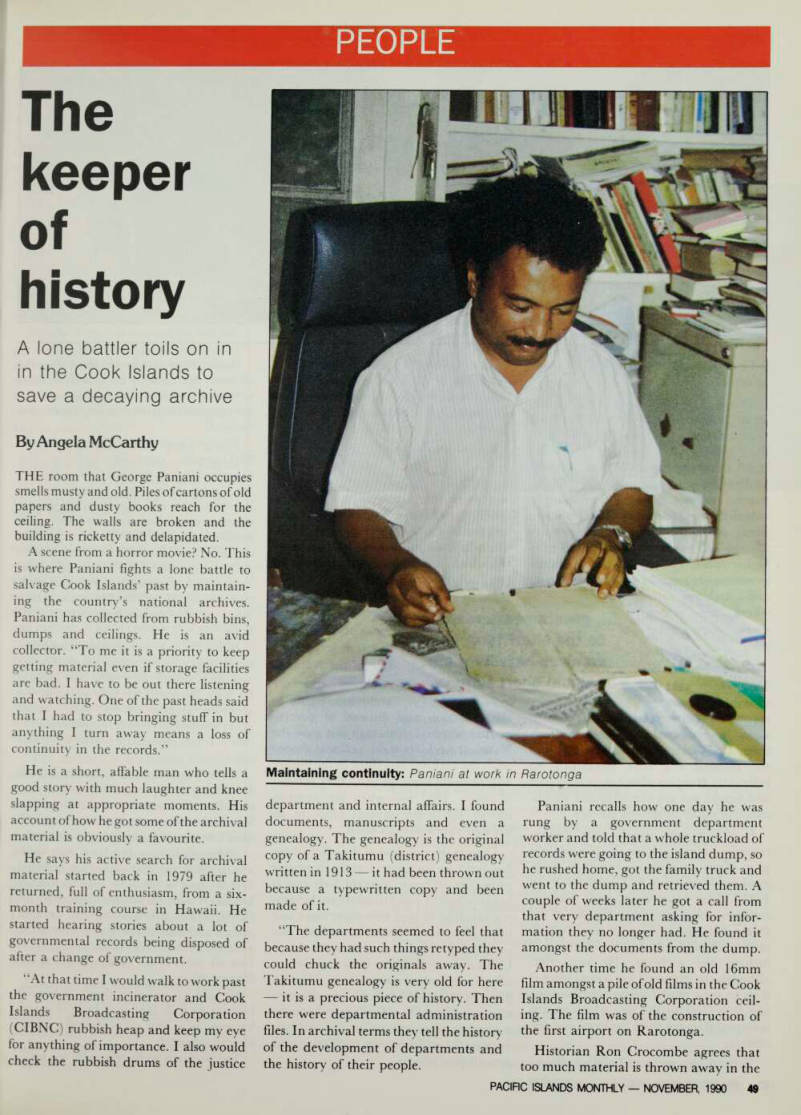
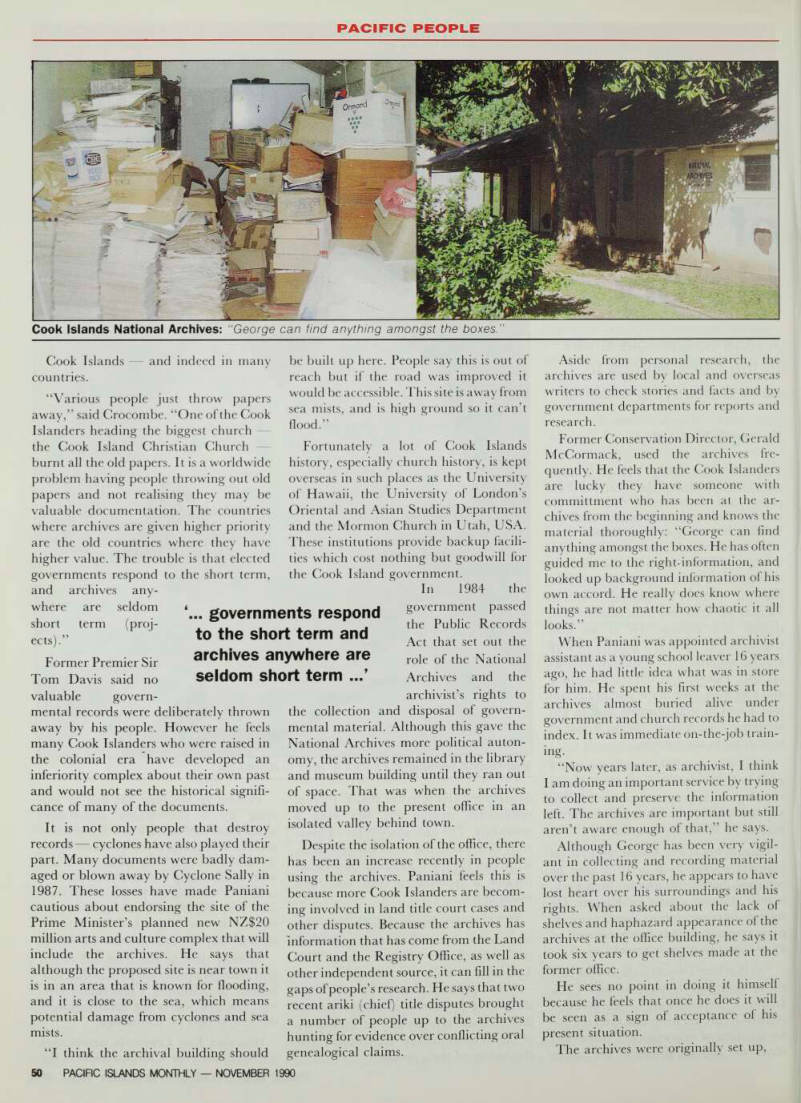
THE room that George Paniani occupies smells musty and old. Piles of cartons of old papers and dusty books reach for the ceiling. The walls are broken and the building is ricketty and delapidated.
A scene from a horror movie? No. This is where Paniani fights a lone battle to salvage Cook Islands’ past by maintain ing the country’s national archives.
Paniani has collected from rubbish bins, dumps and ceilings. He is an avid collector. “To me it is a priority to keep getting material even if storage facilities are bad. I have to be out there listening and watching. One of the past heads said that I had to stop bringing stuff in but anything I turn away means a loss of continuity in the records.”
He is a short, affable man who tells a good story with much laughter and knee slapping at appropriate moments. His account of how he got some of the archival material is obviously a favourite.
He says his active search for archival material started back in 1979 after he returned, full of enthusiasm, from a six month training course in Hawaii. He started hearing stories about a lot of governmental records being disposed of after a change of government.
At that time I would walk to work past the government incinerator and Cook
Islands Broadcasting Corporation
(CIBNC) rubbish heap and keep my eye for anything of importance. I also would check the rubbish drums of the justice
department and internal affairs. I found documents, manuscripts and even a genealogy. The genealogy is the original copy of a Takitumu (district) genealogy written in 1913 it had been thrown out because a typewritten copy and been made of it.
“The departments seemed to feel that because they had such things retyped they could chuck the originals away. The Takitumu genealogy is very old for here it is a precious piece of history. Then there were departmental administration files. In archival terms they tell the history of the development of departments and the history of their people.
Paniani recalls how one day he was rung by a government department worker and told that a whole truckload of records were going to the island dump, so he rushed home, got the family truck and went to the dump and retrieved them. A couple of weeks later he got a call from that very department asking for infor mation they no longer had. He found it amongst the documents from the dump.
Another time he found an old 16mm film amongst a pile of old films in the Cook
Islands Broadcasting Corporation ceil
ing. The film was of the construction of the first airport on Rarotonga.
Historian Ron Crocombe agrees that too much material is thrown away in the
Maintaining continuity: Paniani at work in Rarotonga
Cook Islands and indeed in many countries.
“Various people just throw papers away,” said Crocombe. “One of the Cook Islanders heading the biggest church the Cook Island Christian Church burnt all the old papers. It is a worldwide problem having people throwing out old papers and not realising they may be valuable documentation. The countries where archives are given higher priority are the old countries where they have higher value. The trouble is that elected governments respond to the short term, and archives any
where are seldom short term (proj ects).”
Former Premier Sir Tom Davis said no valuable govern
mental records were deliberately thrown away by his people. However he feels many Cook Islanders who were raised in the colonial era have developed an inferiority complex about their own past and would not see the historical signifi cance of many of the documents.
It is not only people that destroy records cyclones have also played their part. Many documents were badly dam aged or blown away by Cyclone Sally in 1987. These losses have made Paniani cautious about endorsing the site of the Prime Minister’s planned new NZS2O million arts and culture complex that will include the archives. He says that although the proposed site is near town it is in an area that is known for flooding, and it is close to the sea, which means potential damage from cyclones and sea mists.
“I think the archival building should
be built up here. People say this is out of reach but if the road was improved it would be accessible. This site is away from sea mists, and is high ground so it can’t flood.”
Fortunately a lot of Cook Islands history, especially church history, is kept overseas in such places as the University of Hawaii, the University of London’s Oriental and Asian Studies Department and the Mormon Church in Utah, USA.
These institutions provide backup facili ties which cost nothing but goodwill for the Cook Island government.
In 1984 the
‘... governments respond to the short term and archives anywhere are seldom short term ...’
government passed
the Public Records Act that set out the role of the National Archives and the archivist’s rights to
the collection and disposal of govern mental material. Although this gave the National Archives more political auton omy, the archives remained in the library and museum building until they ran out of space. That was when the archives moved up to the present office in an isolated valley behind town.
Despite the isolation of the office, there has been an increase recently in people using the archives. Paniani feels this is because more Cook Islanders are becom ing involved in land title court cases and other disputes. Because the archives has information that has come from the Land Court and the Registry Office, as well as other independent source, it can fill in the gaps of people’s research. He says that two recent ariki (chief) title disputes brought a number of people up to the archives hunting for evidence over conflicting oral
genealogical claims.
Aside from personal research, the archives are used by local and overseas writers to check stories and facts and by government departments for reports and research.
Former Conservation Director, Gerald McCormack, used the archives fre quently. He feels that the Cook Islanders are lucky they have someone with committment who has been at the ar chives from the beginning and knows the material thoroughly: “George can find anything amongst the boxes. He has often guided me to the right-information, and looked up background information of his own accord. He really does know where things are not matter how chaotic it all looks.”
When Paniani was appointed archivist assistant as a young school leaver 16 years ago, he had little idea what was in store for him. He spent his first weeks at the archives almost buried alive under government and church records he had to index. It was immediate on-the-job train ing.
“Now years later, as archivist, I think I am doing an important service by trying to collect and preserve the information left. The archives are important but still aren’t aware enough of that,” he says.
Although George has been very vigil ant in collecting and recording material over the past 16 years, he appears to have lost heart over his surroundings and his rights. When asked about the lack of shelves and haphazard appearance of the archives at the office building, he says it took six years to get shelves made at the former office.
He sees no point in doing it himself because he feels that once he does it will be seen as a sign of acceptance of his present situation.
The archives were originally set up,
Cook Islands National Archives: “George can find anything amongst the boxes."
within a cultural division, in 1974 by the first Cook Island Premier Albert Henry. He set up a division called Tumu Korero (Keepers of History). The div ision’s job was to record the old people’s information for future generations and store it in a Cook Islands Archives along with collected governmental records.
The idea to include record of oral tradition as well as governmental ma terial was an innovative one, but the change of government in 1978 resulted in more than departmental clean-outs.
The Premier at the time, Sir Tom Davis, decided to disband the Tumu Korero division in late 1979. Why?
Says Sir Tom: “It was costing $BO,OOO per annum but had no publications, and although I offered my own services in terms of writing up papers, they never took me up on it. To me the end production needed to be down on paper and in journals etc.”
The disbandment of Tumu Korero meant the end of the archive’s official channel for oral material, and it ap peared from there on that the archives lost a lot of impetus. 1990 has seen things begin to change with the National Archives now coming under the administrative umbrella of the new Ministry of Cultural Develop ment or Tauranga Vananga whose role is to promote and sustain Cook Islands art and culture. The Secretary of Tauranga Vananga, Jon Jonassen, has promised to give more priority to the archives.
Already the department has held a conference to record some of the outer islands’ oral stories about old traditions and migration. This information is now in the archives.
“The archives is a national resource that is safekeeping our heritage and yet most people don’t use it because they don’t know what is in there,” says Jon.
“We also have to make people realise that what is rubbish to them isn’t to others and that archivist assistance is needed to guide record disposal. We are hoping to run workshops that will educate people about materials. Really I see the overall role of the ministry should be to help with the collection and availability of material the storage is over to the archives.”
Later this year the archives is getting an unused micro-fiche system from another government department to facilitate the production of microfilm.
This will ease storage and improve retrievals. □