Interview
pp. 51-53 · Read in the full issue
PAPUA New Guinea’s Foreign Minister, Sir Michael Somare, was in Suva in the last week of last month on a private visit. He was invited by Fiji Prime Minister, Ratu Sir Kamisese Mara, a close friend, to launch the Ratu Mara Education Trust Fund for Ratu Mara’s province, the Lau Group in
eastern Fiji.
While it was a private visit, Sir Michael used the opportunity in Suva to talk with Forum Secretariat Secretary General Henry Naisali and talk some business with the Fiji Prime Minister.
On talks with Ratu Sir Kamisese: I raised the question of how best we can all combine to ask the Americans for more opened-up markets for Pacific goods in the United States (Papua New Guinea’s) emphasis has been Australia and Japan and South-East Asian countries because we are closer to South-East Asia and we are now placing more emphasis on trade with that part of the world.
But I think it’s also important that we have access to American markets. Asian countries have their own marketing arrangements but we feel that we should also have access to American markets.
On the Papua New Guinea embassy in Suva: There has been some question about our mission (in Suva).
Y es, we have had budget cuts, we recalled one of our officers, but that does not mean we will downgrade our mission. Fiji is one of our oldest posts and we will still have an ambassador
Sir Michael Somare: Foreign Minister, Papua New Guinea
in the republic. We have no intention of withdrawing or downgrading our mission to charge d’affairs. Fiji is our big post in the region and we will maintain it at ambassadorial level. We will not downgrade Fiji.
On Papua New Guinea’s participation at the World Trade Show in Spain next year: I told Naisali that the Papua New Guinea Cabinet has allocated KBOO,OOO and we have appointed a Commissioner General to coordinate that particular project. My discussion with the Secretary General was for the Secretary General to get in touch with other Forum leaders, those who are members of AGP, to advice their ambassadors to take that matter up. 11 will be good for the Pacific countries to expose themselves.
On the situation with Bougainville and the closure of the Bougainville copper mine: Yes, we have problems. We have closed down Bougainville Copper which gives us one third ofour revenue, but Bougainville Copper in two years’ time will just be one of those mines. 11 has played a very important role in Papua New Guinea’s economy. 11 has given Papua New Guinea and its people revenue for things we want to do. The mine is closed now. It’s history. We hope that next year we will get the mine open again. But apart from Bougainville we have Pogera, we have Misima, we have Ok Tedi, and by 1992 we will have oil flowing. Bougainville becomes a small segment in two years time. Ifcommodity prices were not bad, ifcoffee prices were not down, we could carry on. A lot of people are predicting that the economy is going in a bad way but you have these recessions, you have the period when your household may not be good, you may not have everything in your house that you want.
People on the island of Buka have laid down their arms, particularly the rebels. There were something like 700 weapons (surrendered), two-thirds ofit were handmade, some I don’t know how they got them in, some people might have been stealing and selling to them. The people on the island of Buka are coming back to ask for services to be brought back to the island. Everything has come to a standstill. Buka used to be the administrative centre in the colonial days. We shifted to Arawa when we found copper on Bougainville. We have opened up again in Buka. We have a defence force for communication purposes there now and they are helping the people to rebuild the place. The villages are still okay but there is still threat from rebel elements. On the whole, things are moving very slowly. We have a shipping link back on to the island. Next year we hope we will open up all the schools again. The health services and other things
are going.
On the secessionist movement on Bougainville: Well that’s a question that will be raised from time to time.
Buka island people quite categorically said to us, “we don’t
want secession. What’s the point? We belong to the greater Papua New Guinea. We want more autonomy.” 11 was a little bit of mixture with the cult movement and all sorts of things ... talking about ethnic groupings that they are totally different from the rest of Melanesia, brownskin or blackskin people. But we have been able to convince them that your colour cannot do everything that you want to do you belong to the greater part of the country and that’s how it should be. The majority of the people do not like the idea ofsecession. It’s only a handful of people who are promoting that concept.
So far we have been trying to get the message across to (the rebels’ chief negotiator Joseph) Kabui and all the leaders that we need another meeting but so far we have not got our message across. They are demanding that we should withdraw our forces but we don’t believe them now. We believe that when we withdraw our forces their own people will cause more damage and carry out more atrocitiues on the island. (The problem is being created by) the young people, it’s gone out of hand, there’s no control. The BRA (Bougainville Republican Army) does not have the command anymore over these militants.
We are hoping the talks will come up but the problem is that we have no communication. The only communication we have is with the Catholic Mission and through our VHS system. I hope that Mr (Bernard) Narokobi, our Attorney- General, will get a message across for us to have a meeting.
I’m hoping to have another round of talks with them. There is no tentative date because we have not got in touch with them to set the date.
‘lf commodity prices were not bad, if coffee prices were not down we could carry on’
On the Endeavour Accord: The concept of the Endeavour Accord was first to initiate the peace agreement and to make sure
that services were returned. Once the services were returned then we could talk about having more autonomy for the island. The question of secession did not come up because we did not want to put this one down as a priority. I think what we were concenred about was the 130 to 140,000 people who were not getting the national government services. That was why we had to first establish dialogue. Once we established dialogue then we could talk to them.
On the Soviets setting up an embassy in Papua New Guinea: They are the same as any other embassy. Of course, we have signed a fishing aghreement with them. At the moment I think they are trying to establish their office. They have put up their establishment. I think they arc mainly concentrating on trade and how best we can trade with them. There have questions on why we signed a fishinbg agreement with them because they could use that as a form of espionage. So far they have been quiet. Perhaps something can happen later but I
don’t see it that way. Their representative is a very good man. He understands. He’s a serving diplomat and he’s been around.
On the revival of the Michael Somare-Ratu Mara Cup golf championship between Fiji and Papua New Guinea: We discussed that with Ratu Mara and it will be revived next year when players come to Papua New Guinea for the South Pacific Games. The tournament was last played in 1984 in Port Moresby and Fiji won it then. We hope to win next year.
On next year’s South Pacific Games in Port Moresby and Lae and worries over the security of the
participants:
What the people have been talking about is all artificial.
There are crime problems everywhere. The Games will go on despite the crime problems that people are talking about.
We are in full swing in the preparation for the South Pacific Games. The stadiums in Port Moresby and Lae are going well and will be completed on time before the Games start. I don’t think there will be any obstacle.
Law and order problems are problems that develop in any society. When you don’t satisfy a lot of people with employment young people get out and do things which are not in the interest of society. The places where we’ll be conducting the South Pacific Games are quite
safe. You have to go and live there to really know. V\ e have a lot offoreigners. I’m very glad to see you have all the Fijians here writing. We have some people who try to exaggerate, even some of our own journalists.
On tribal clashes: Up in the Western Highlands they have got these trible clashes. It’s always over pig or over land or over something.
People have seen the missionaries come and go, they have seen aircraft landing, yet they still maintain their tradition.
So we’ve had one group going down to one village and burning down their coffee garden, their houses.
They don’t interfere and you mark my word if you were there reporting they won’t touch you. They’re not interested in you. The fact that you’re a foreigner makes them not interested in you. It’s among themselves. We coastal people if we go up there and try to observe, they won’t hurt us, they’re hurting their own kind, those who went and destroy their garden or those who went and destroy their houses.
Trouble fight is a traditional kind ofthing, it happens all the time. It will take some time before this kind of mentality
changes.
On the future of Papua New Guinea: I would like to see PNG as a big influence in national relations with friends it has in the Pacific. We want to see developement in our part of the world and I think we are doing the right thing. Now we’re thinking of going into industrialisation and providing opportunities for our people, particularly in education, training, and also providing employment opportunities for our people. Ours is larger than Fiji, our population is big, we have the problem ofhaving to educate everybody. We only have places for 35,000 students out 0f40,000 students. We only take 5000 to 6000 who go into secondary schools and go into universities and we still have the problem offinding opportunities for this type of people.
We’ve embarked on putting more money into technical training. In that way we can keep a percentage of our people instead of seeing them leave earlier. We want them to mature and leave by the time they are 18 or 20. At the moment the rate is about 15, 16. Some ofour young are
leaving at grade six.
It’s going to cost us money and it’s the price one has to pay to do that.
Yes, we want to prosper, progress. 1 he opportunities are coming good for us in PNG, with the five gold mines the prospects for the country looks very bright. And, ofcourse, we hope to be able export oil. I think for the first year and second year it will only be for our own use. But once we start exporting oil we will create more opportunities for others.
On future regional relations: What we have embarked upon, like in the relationship I have established with my friend Ratu (Sir Kasmisese) Mara, I hope that people who come after Ratu Mara, people who come after me and the other Pacific leraders will be able to maintain that kind of rapport and relationshisp for the next decade. The Pacific will need each other. There are smaller Pacific states who have to work harder, much harder to allow their economies to grow. They don’t have the resources like Papua New Guinea and Fiji. So to maintain better rapport in the region is for everyone to work together and help one another. □
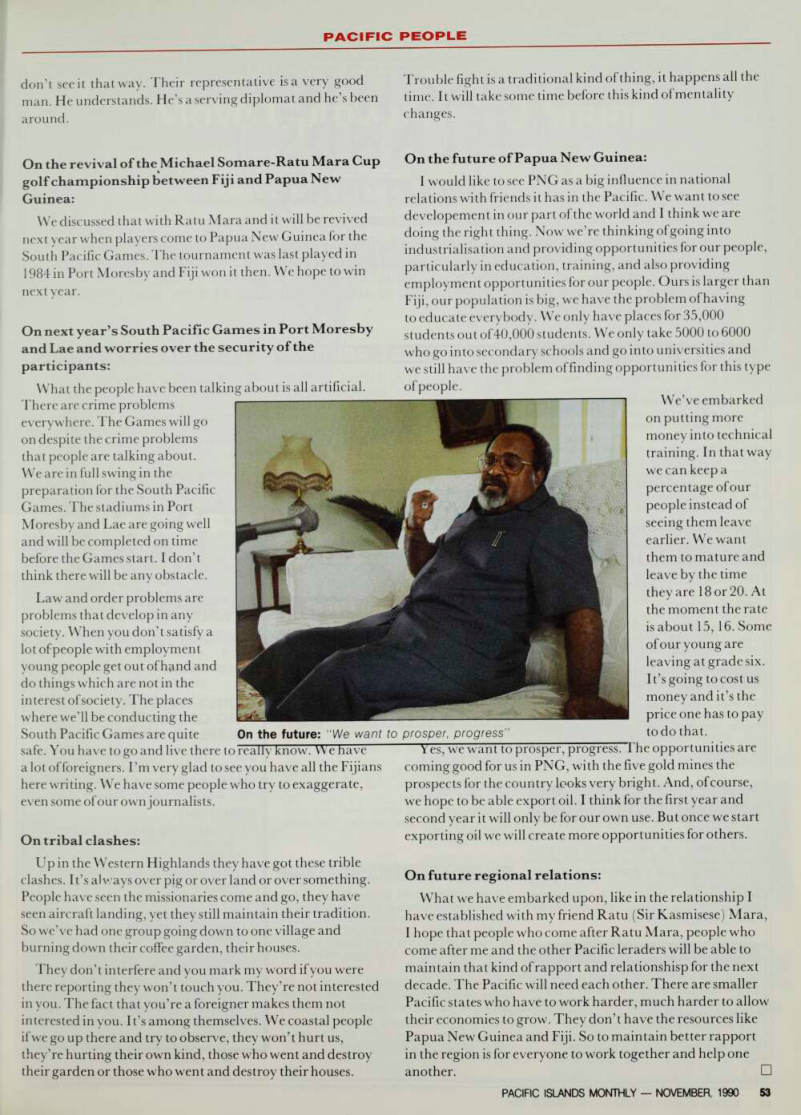
On the future: “We want to prosper, progress"