Of matyrs and
pp. 47-48 · Read in the full issue
Books
Of matyrs and nationalism
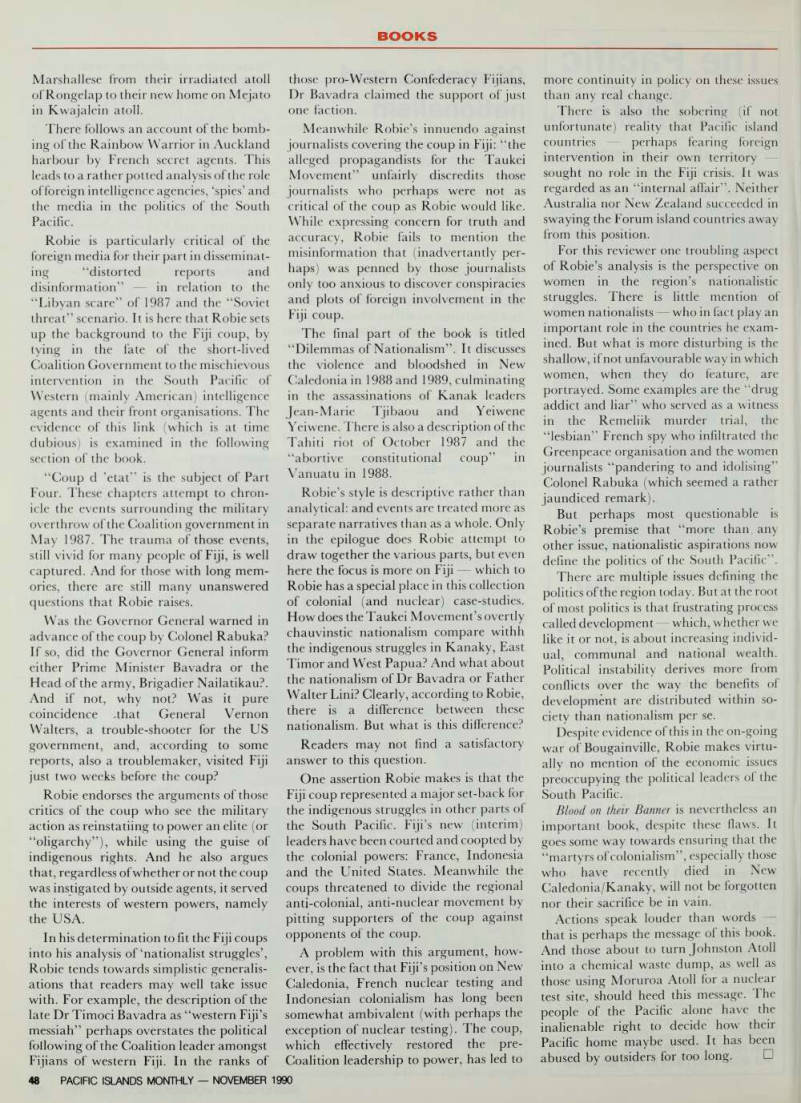
Blood on their Banner: Nationalist Struggles in the South Pacific by David Robie, Pluto Press, 1989,300 pages, illustrated paperback.
Reviewed by Sandra Tarte
BLOOD on their banner by New Zealand journalist David Robie is the blood of martyrs. It is the blood shed by nationalists in their struggle against colonialism; split on their banner of inde pendence. This is a provocative title, for a book dealing with very provocative issues.
Subtitled “Nationalist Struggles in the South Pacific”, this book addresses the powerful phenomenon of nationalism, in its various manifestations and guises.
Robie’s analysis
places present-day
conflicts in the South Pacific in the context of colonialism and its antithesis, nationalism.
Events such as the assassination of Belau’s President Remeliik, the 1988/89 consti tutional crisis in Vanuatu and Fiji’s coup are, accord ing to Robie, part of the same process: “the legacy of trau matic colonialism”.
This “legacy”
defines today’s
conflicts in the South Pacific. And it has thrown up the dilemma of competing nationalisms: the reactionary, ethnocen tric variety as opposed to the progressive, nation-building variety.
In Robie’s book, the case of Fiji highlights this dilemma most acutely. The Taukei Movement supported by the army espoused a reactionary nationalism while the Coalition Party represented a progressive “new nationalism”. On the other hand, New Caledonia/Kanaky manifests an indigenous struggle that is both ethnocentric and progressive. The violence that has scarred the otherwise tranquil Pacific Islands in recent years, argues Robie, is the consequence of
“nationalism confronting existing col onial structures”.
Blood on their Banner is divided into five parts, each made up of between three and four chapters. Part One, titled “Colonial Aggression”, examines the French nu clear testing programme at Moruroa Atoll, the “forgotten wars” ofWest Papua and East Timor (where indigenous people continue to confront Indonesian colonialism) and Vanuatu’s bumpy pass age to independence 10 years ago when a secessionist movement on Espiritu Santo threatened to split the country.
Part Two, “Kanaky in Revolt”, focusses on the anti-colonial revolt in New Caledonia and the violent, at times brutal, repression of Kanaks by the French administration. Based on Robie’s own experience in New Caledonia as a reporter in the 1980 s, these chapters provide graphic accounts of some of the darkest moments in the Kanak struggle
for independence.
Particularly grue some is the massacre of Hienghene in 1984 when 10 Kanaks were murdered by anti
independence
caldoches. Also de scribed is the “martyr dom of (Eloi) Marchoro”, a leading
independantiste, who
Robie calls the “inspi ration” of his book. In neither instance, ac cording to Robie, has justice been done: to convict those respon sible for the Hienghene massacre or to bring to light the events sur rounding the death of Marchoro.
“Nuclear Colonialism” is the subject of Part Three. This is a rather complex mix of issues and events. Covered in these Chapters are the nuclear-free Pacific movement and the history of the nuclear free zone concept. The Treaty of Rarotonga is examined and its limitations highlighted.
There is a chapter on Belau (Palau) a tiny country at odds with a superpower (the United States) over the terms of Belau’s nuclear-free constitution. The associated tensions of this conflict have led to the “gangland style” assasination of one Belauan president and the suicide of another. A final chapter deals with the last mission of the Greenpeace flagship, Rainbow Warrior: the evacuation of
Marshallese from their irradiated atoll of Rongelap to their new home on Mejato in Kwajalein atoll.
There follows an account of the bomb ing of the Rainbow Warrior in Auckland harbour by French secret agents. This leads to a rather potted analysis of the role offoreign intelligence agencies, ‘spies’ and the media in the politics of the South Pacific.
Robie is particularly critical of the foreign media for their part in disseminat ing “distorted reports and disinformation” in relation to the “Libyan scare” of 1987 and the “Soviet threat” scenario. It is here that Robie sets up the background to the Fiji coup, by tying in the fate of the short-lived Coalition Government to the mischievous intervention in the South Pacific of Western (mainly American) intelligence agents and their front organisations. The evidence of this link (which is at time dubious) is examined in the following section of the book.
“Coup d ’etat” is the subject of Part Four. These chapters attempt to chron icle the events surrounding the military overthrow of the Coalition government in May 1987. The trauma of those events, still vivid for many people of Fiji, is well captured. And for those with long mem ories, there are still many unanswered questions that Robie raises.
Was the Governor General warned in advance of the coup by Colonel Rabuka?
If so, did the Governor General inform either Prime Minister Bavadra or the Head of the army, Brigadier Nailatikau?.
And if not, why not? Was it pure coincidence .that General Vernon Walters, a trouble-shooter for the US government, and, according to some reports, also a troublemaker, visited Fiji just two weeks before the coup?
Robie endorses the arguments of those critics of the coup who see the military action as reinstatiing to power an elite (or “oligarchy”), while using the guise of indigenous rights. And he also argues that, regardless of whether or not the coup was instigated by outside agents, it served the interests of western powers, namely the USA.
In his determination to fit the Fiji coups into his analysis of‘nationalist struggles’, Robie tends towards simplistic generalis ations that readers may well take issue with. For example, the description of the late Dr Timoci Bavadra as “western Fiji’s messiah” perhaps overstates the political following of the Coalition leader amongst Fijians of western Fiji. In the ranks of
those pro-Western Confederacy Fijians, Dr Bavadra claimed the support of just one faction.
Meanwhile Robie’s innuendo against journalists covering the coup in Fiji: “the alleged propagandists for the Taukei Movement” unfairly discredits those journalists who perhaps were not as critical of the coup as Robie would like.
While expressing concern for truth and accuracy, Robie fails to mention the misinformation that (inadvertantly per haps) was penned by those journalists only too anxious to discover conspiracies and plots of foreign involvement in the Fiji coup.
The final part of the book is titled “Dilemmas of Nationalism”. It discusses the violence and bloodshed in New Caledonia in 1988 and 1989, culminating in the assassinations of Kanak leaders Jean-Marie Tjibaou and Yeiwene Yeiwene. There is also a description of the Tahiti riot of October 1987 and the “abortive constitutional coup” in Vanuatu in 1988.
Robie’s style is descriptive rather than analytical: and events are treated more as separate narratives than as a whole. Only in the epilogue does Robie attempt to draw together the various parts, but even here the focus is more on Fiji which to Robie has a special place in this collection of colonial (and nuclear) case-studies.
How does the Taukei Movement’s overtly chauvinstic nationalism compare withh the indigenous struggles in Kanaky, East Timor and West Papua? And what about the nationalism of Dr Bavadra or Father Walter Lini? Clearly, according to Robie, there is a difference between these nationalism. But what is this difference?
Readers may not find a satisfactory answer to this question.
One assertion Robie makes is that the Fiji coup represented a major set-back for the indigenous struggles in other parts of the South Pacific. Fiji’s new (interim) leaders have been courted and coopted by the colonial powers: France, Indonesia and the United States. Meanwhile the coups threatened to divide the regional anti-colonial, anti-nuclear movement by pitting supporters of the coup against opponents of the coup.
A problem with this argument, how ever, is the fact that Fiji’s position on New Caledonia, French nuclear testing and Indonesian colonialism has long been somewhat ambivalent (with perhaps the exception of nuclear testing). The coup, which effectively restored the pre- Coalition leadership to power, has led to
more continuity in policy on these issues than any real change.
There is also the sobering (if not unfortunate) reality that Pacific island countries perhaps fearing foreign intervention in their own territory sought no role in the Fiji crisis. It was regarded as an “internal affair”. Neither Australia nor New Zealand succeeded in swaying the Forum island countries away from this position.
For this reviewer one troubling aspect of Robie’s analysis is the perspective on women in the region’s nationalistic struggles. There is little mention of women nationalists who in fact play an important role in the countries he exam ined. But what is more disturbing is the shallow, if not unfavourable way in which women, when they do feature, are portrayed. Some examples are the “drug addict and liar” who served as a witness in the Remeliik murder trial, the “lesbian” French spy who infiltrated the Greenpeace organisation and the women journalists “pandering to and idolising”
Colonel Rabuka (which seemed a rather
jaundiced remark).
But perhaps most questionable is Robie’s premise that “more than, any other issue, nationalistic aspirations now define the politics of the South Pacific”.
There are multiple issues defining the politics of the region today. But at the root of most politics is that frustrating process called development which, whether we like it or not, is about increasing individ ual, communal and national wealth.
Political instability derives more from conflicts over the way the benefits of development are distributed within so ciety than nationalism per se.
Despite evidence of this in the on-going war of Bougainville, Robie makes virtu ally no mention of the economic issues preoccupying the political leaders of the South Pacific.
Blood on their Banner is nevertheless an important book, despite these flaws. It goes some way towards ensuring that the “martyrs of colonialism”, especially those who have recently died in New Caledonia/Kanaky, will not be forgotten nor their sacrifice be in vain.
Actions speak louder than words that is perhaps the message of this book.
And those about to turn Johnston Atoll into a chemical waste dump, as well as those using Moruroa Atoll for a nuclear test site, should heed this message. The people of the Pacific alone have the inalienable right to decide how their Pacific home maybe used. It has been abused by outsiders for too long.