The Army has landed
pp. 43-44 · Read in the full issue
Assistance
ives. After lunch the explosives were detonated then the breaking up of the coral and removal begun. Most of the coral was loaded on to a truck by the local men using their hands and a ditch digger.
Many of the islanders, including fishermen who had been out most of the night, turned up to help.
This is not the first visit by the New Zealand Army to Mitiaro. In 1986, a concrete landing ramp was made from the shore to the channel by Army engineers and earlier this year the Airforce flew in hurricane relief stores after Cycone Ofa.
These previous contacts have prompted visits to the local community groups and youth clubs at night to lecture on New Zealand. Any such visit is made twice, once to the Catholic Church-run groups and once to the Cook Islands Church-run groups.
The engineers spent some time doing community aid tasks, like building a cookhouse for a grandmother who is bringing up two children on her own. The material for this was paid for by a New Zealander, Marlene Whiteside, of Wellington, who was on holiday with friends in the Cook Islands. Other tasks
THE New Zealand army landed on the tiny island of Mitiaro and used 90 kilograms of exposives to blast open a channel in the reef. When they withdrew MV o '* and fn , T e the people of Mitiaro, a small flat island in the southern Cooks Group, were sailing in and out of the lagoon with so much ease.
Mitiaro, with a population of about 280, relies heavily on imports which are either flown in at considerable expense or shipped in on an island trader Cargo from the trader is transferred to shore by small landing boats through a very narrow reef channel on the western side of the island. This five-metre wide channel was so narrow that only one small boat could enter at a time. The boat had to be unloaded then pulled up onto the beach to turn it around before it could head out to sea again Ihe New Zealand army engineers widened the channel at the shore end, and now three landing boats can enter at one time and turn round without been
dragged out of the water. They also collapsed a coral underwater bridge at the entrance to the channel which was too sha llow for traflick.
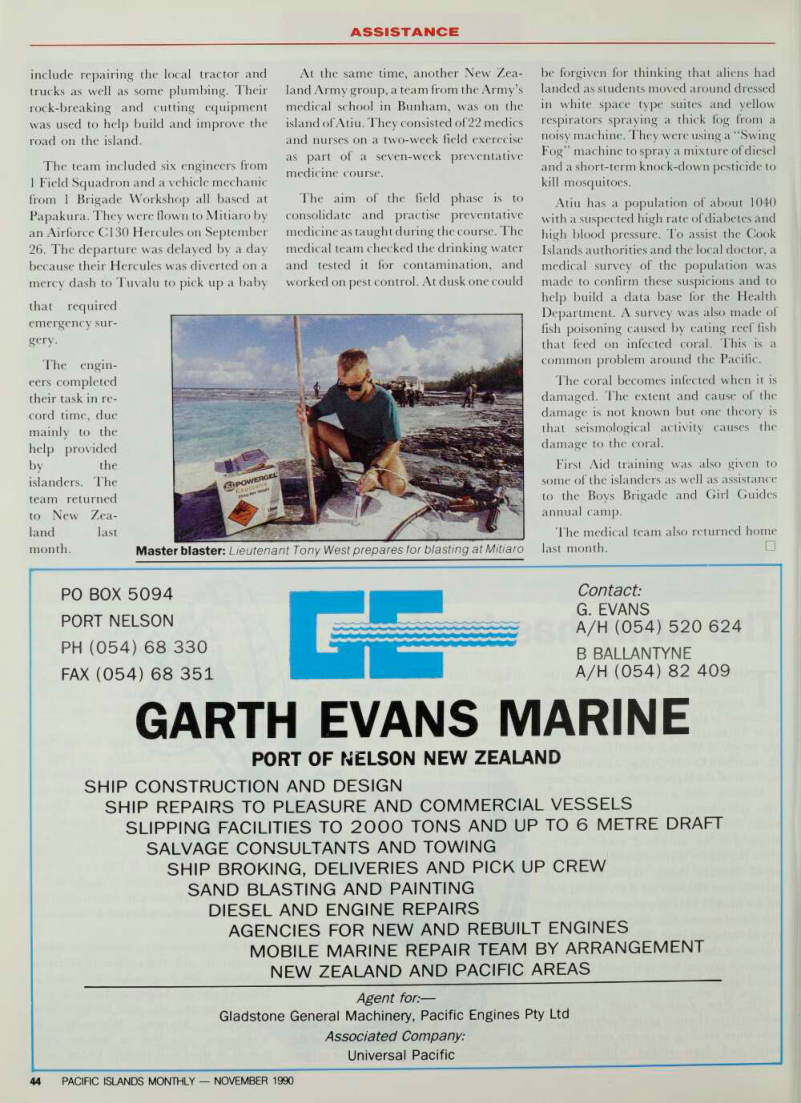
Lieutenant Tony West, the team r , leade C said that 90 ktlograms of exp os- IVCS WCTe US f*? wlth a PP roxlmatel y 120 tOnS ° n COra bemg removed - Work on the reef was done in accordance with a recent ecol °g ical im pac:t
assessment recently completed by
Auckland University. This included a mlx of ex P loslves and d, ff erent sizes to mmlm ‘ ze dama S e to tke reef and deton atlon of lexplosions 1 explosions at the same time each day ’° UtS l de okthe flsh [ eed '"S 50 a * £ m,nim,ze effects on the fish population, IK KIT su P ervlsor - VVarrant Officer Ckrls Whekatape, said the fish knew when the explosions were and moved off just prior to them.
Work began each morning at 7.30 and finished at 5 in the evening. The work schedule, which depended mainly on the tide, consisted of drilling holes for explos-
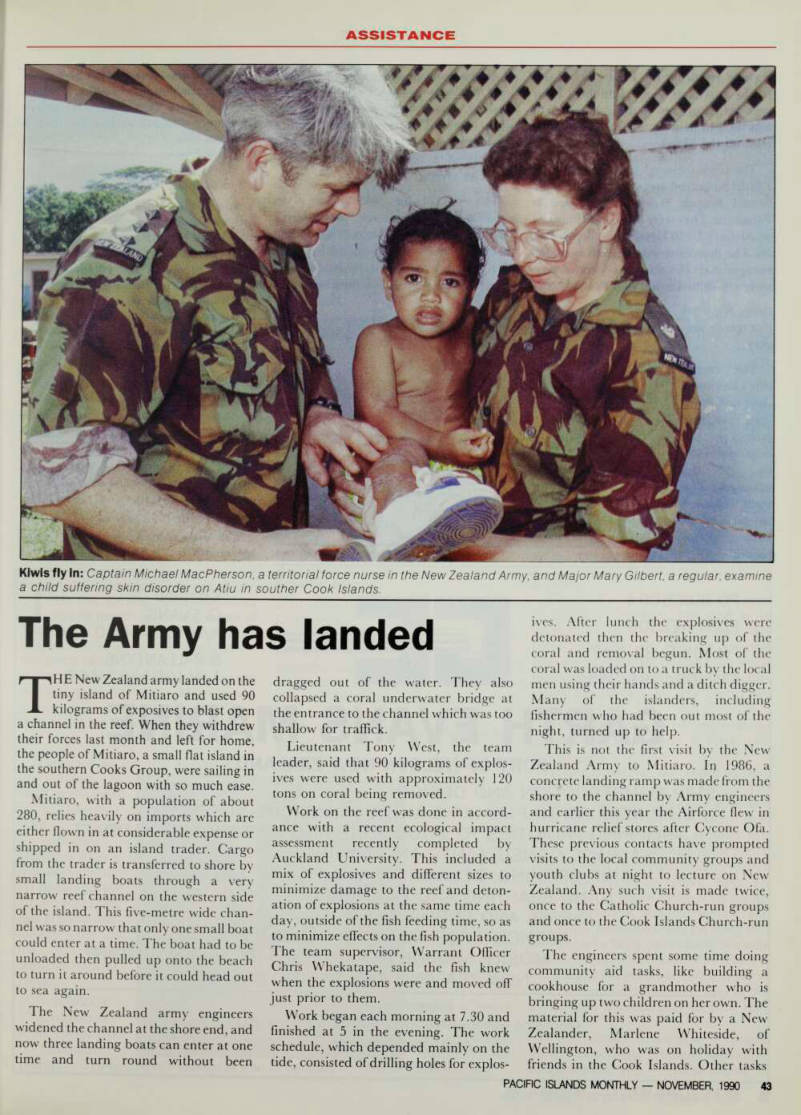
Kiwis fly In: Captain Michael MacPherson, a territorial force nurse in the New Zealand Army, and Major Mary Gilbert, a regular, examine a child suffering skin disorder on Atiu in souther Cook Islands.
include repairing the local tractor and trucks as well as some plumbing. Their rock-breaking and cutting equipment was used to help build and improve the road on the island.
The team included six engineers from 1 Field Squadron and a vehicle mechanic from 1 Brigade Workshop all based at Papakura. They were flown to Mitiaro by an Airforce Cl3o Hercules on September 26. The departure was delayed by a day because their Hercules was diverted on a mercy dash to Tuvalu to pick up a baby
that required
emergency sur gery.
The engin
eers completed
their task in re cord time, due mainly to the
help provided
by the islanders. The team returned to New Zea land last month.
At the same time, another New Zea land Army group, a team from the Army’s medical school in Bunham, was on the island of Atiu. They consisted 0f22 medics and nurses on a two-week field exerecise as part of a seven-week preventative medicine course.
The aim of the field phase is to
consolidate and practise preventative
medicine as taught during the course. The medical team checked the drinking water and tested it for contamination, and worked on pest control. At dusk one could
be forgiven for thinking that aliens had landed as students moved around dressed in white space type suites and yellow respirators spraying a thick fog from a noisy machine. They were using a “Swing Fog” machine to spray a mixture of diesel and a short-term knock-down pesticide to
kill mosquitoes.
Atiu has a population of about 1040 with a suspected high rate of diabetes and high blood pressure. To assist the Cook Islands authorities and the local doctor, a medical survey of the population was made to confirm these suspicions and to help build a data base for the Health Department. A survey was also made of fish poisoning caused by eating reef fish that feed on infected coral. This is a common problem around the Pacific.
The coral becomes infected when it is damaged. The extent and cause of the damage is not known but one theory is that seismological activity causes the damage to the coral.
First Aid training was also given to some of the islanders as well as assistance to the Boys Brigade and Girl Guides annual camp.
The medical team also returned home last month.
Master blaster: Lieutenant Tony West prepares for blasting at Mitiaro