The eye team that’s making
pp. 45-46 · Read in the full issue
Health
The eye team that’s making people see in the islands
By Irene Nisbet TAULU Isaako couldn’t see properly.
He was worried, particularly when the 50 people on his tiny island of Niulakita, in Tuvalu, depended so much on him. He was the island’s schoolteacher. He was going blind.
“In April this year, I started to notice that something was wrong. My eyes were getting watery all the time, and I found that I couldn’t see things properly,” he said.
Isaako waited for help at Niulakita’s
tiny clinic. It came in the form of a four-man team of opthalmic specialists from a remarkable medi cal project which is bringing expert care at senior con sultant level to the island countries of the Pacific.
Aspect
(Australian South Pacific Eye Consultant
Teams) was
formed following visits, since 1971, of Australian opthalmic urgeons to the Solomon Islands.
In 1984, the Australian International Development Assistance Bureau (AIDAB) decided that it wanted to provide multi-country medical aid pro gramme, and so ASPECT was born, largely with the existing team members who had been involved in the original Solomons project. The programme in volved Vanuatu, Solomons, Kiribati and Tuvalu.
Since that time, the Solomons has
taken on its own eye specialist, and the programme has been ex tended to cover Tonga and the Cook Islands.
The team that arrived at Niulakita con sisted of two senior consult ant eye sur geons, a junior surgeon and a senior anaes thetist. Ac
companying
them were Dr Tiliga and Senior Nurse Lau Pulaka, of Funafuti’s Princes Margaret Hospital. “Tuvalu is different for us because of the geography,” said team leader Dr David Kaufman, a senior consultant at Royal Melbourne Hospital.
“The logistical problems of travelling in the Pacific on a trip like this are enormous ... each island group demands a specific form of transport.
“There are no airstrips here, apart from Funafuti, so you obviously need to take a ship round the islands. Each island group also demands a specific form of transport ing all our equipment.”
The team packs clinical equipment on experience gained from the past 15 years, and over that time, each logistical wrinkle has been progressively ironed out. The modifications, for instance, for Tuvalu mean that everything has to be packed in waterproof drums and hermetically sealed cases, so that even if the team gets soaked, at least their equipment will be safe.
Isaako was found to have cataracts.
The doctors asked him to go to Funafuti with them for surgery. Within the hour, Isaako, his wife Maseiga, daugther Moenanatu and the family dog were packed and making their way across the reef to the ship to begin their journey to Funauti.
Says Dr Kaufman: “Cataracts happen to people everywhere, but tend to be accelerated by age, sunlight and hard living conditions. For instance, someone who got cataracts in Australia, say at 70, might be expected to develop the con dition here by age 60. It’s accelerated aging.”
Cataracts have to be removed by surgery and the patient is fitted with special glasses.
Next stop was Nui, the central island of the gioup with a larger population. The clinic was busy. Spectacles were dispensed from the selection the team had. Other conditions, like Pterygium, required sur gery. The disease is common in the region and is directly related to sunlight, to high ultra-violet exposure areas. Says Dr Kaufman: “It leaves fleshy scars on the surface of the eye, and they irritate, and look awful. Sometimes they get so big that they actually block your vision. We only operate, though, when the Pterygium is irritating or has grown to sufficient size to warrant removal. But once they’re re moved and appropriately treated, they stay away.”
What about prevention? “Simple things like wearing brimmed sunhats or
sunglasses will help you’re talking
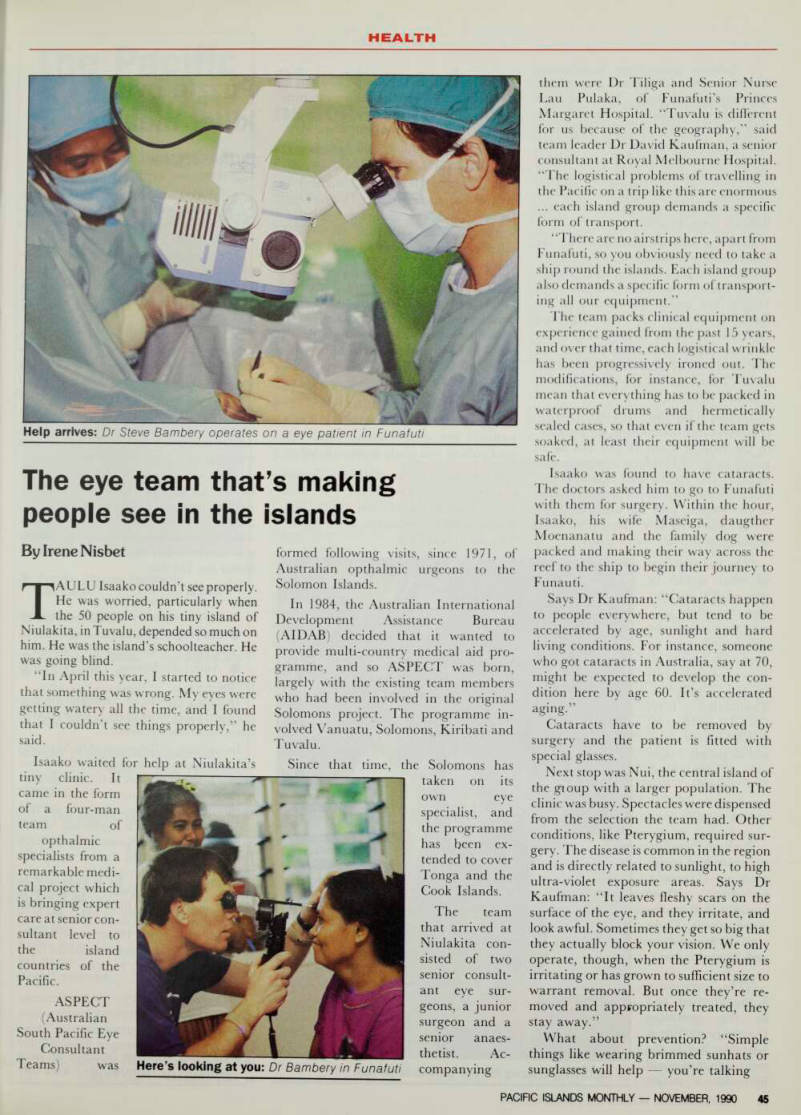
Help arrives: Dr Steve Bambery operates on a eye patient in Funafuti
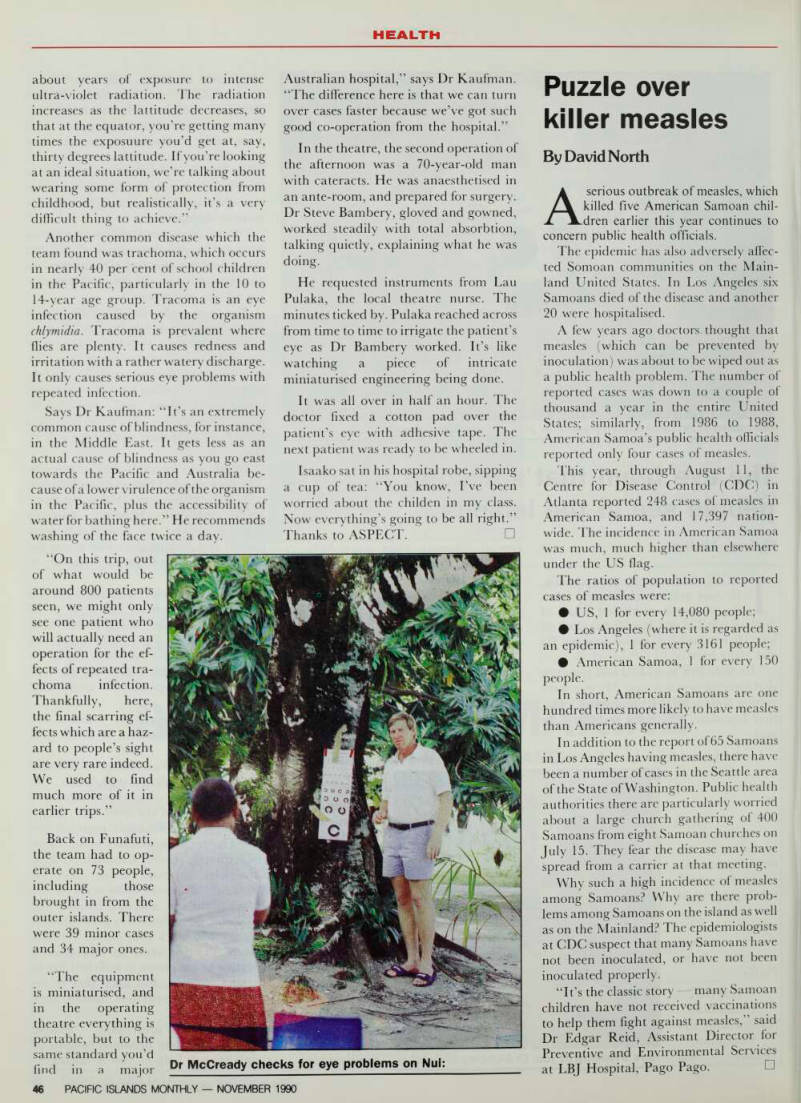
Here’s looking at you: Dr Bambery in Funafuti
about years of exposure to intense ultra-violet radiation. The radiation increases as the lattitude decreases, so that at the equator, you’re getting many times the exposuure you’d get at, say, . . . , 1 T f , , , • thirty degrees lattitude. 11 you re looking ~■, ' . at an ideal situation, we re talking about r r • c wearing some form ot protection from childhood, but realistically, it’s a very difficult thing to achieve.” ' ~, . , , Another common disease which the „ . ... team found was trachoma, which occurs in nearly 40 per cent of school children in the Pacific, particularly in the 10 to 14-year age group. Tracoma is an eye infection caused by the organism chlymidia. Tracoma is prevalent where flies are plenty. It causes redness and irritation with a rather watery discharge.
It only causes serious eye problems with repeated infection. r Says Dr Kaufman: “It’s an extremely common cause of blindness, for instance, in the Middle East It gets less as an actual cause of blindness as you go east towards the Pacific and Australia because of a lower virulence of the organism in the Pacific, plus the accessibility of water for bathing here.” He recommends washing of the face twice a day.
“On this trip, out of what would be around 800 patients seen, we might only see one patient who will actually need an operation for the ef fects of repeated tra choma infection.
Thankfully, here, the final scarring ef fects which are a haz ard to people’s sight are very rare indeed.
We used to find much more of it in earlier trips.”
Back on Funafuti, the team had to op erate on 73 people,
including those
brought in from the outer islands. There were 39 minor cases and 34 major ones.
“The equipment is miniaturised, and in the operating theatre everything is portable, but to the same standard you’d find in a major
Australian hospital,” says Dr Kaufman.
“The difference here is that we can turn over cases faster because we’ve got such good co-operation from the hospital.”
T ,., , • r In the theatre, the second operation ot . r nr , r the afternoon was a 70-year-old man , . TT , • , • with cateracts. He was anaesthetised in an ante-room, and prepared for surgery, Dr Steve Bambery, gloved and gowned, worked steadily with total absorbtion, . , ... , , talking quietly, explaining what he was , .
He requested instruments from Lau Pulaka, the local theatre nurse. The minutes ticked by. Pulaka reached across from time to time to irrigate the patient’s eye as Dr Bambery worked. It’s like watching a piece of intricate
miniaturised engineering being done.
T n . , , r , It was all over in half an hour. Ihe doc(or fixed a cotton pad over the tient > s with adhe sive tape. The nex( atient was ready t 0 be wheeled in.
Isaako sat in his hospital robe, sipping a cup of tea: “You know, I ve been worried about the childen in my class, Now everything’s going to be all right.”
Thanks to ASPECT. □
Dr McCready checks for eye problems on Nui: