India vs Fiji
pp. 14-16 · Read in the full issue
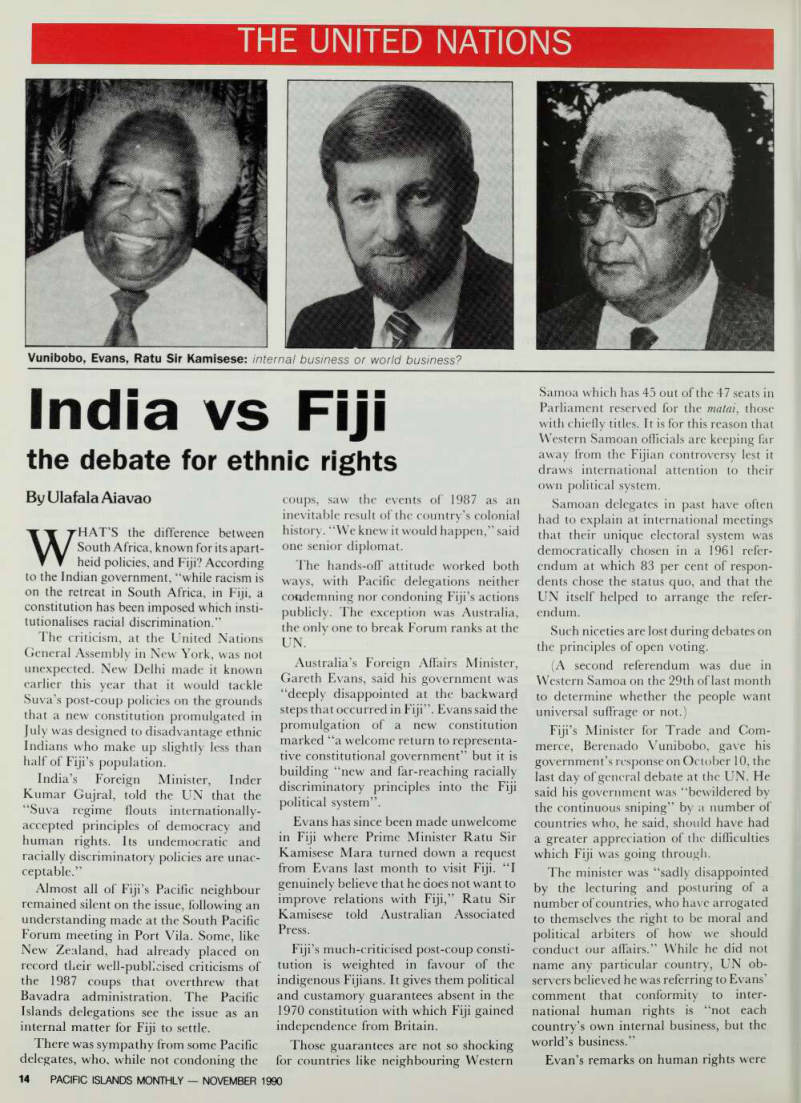
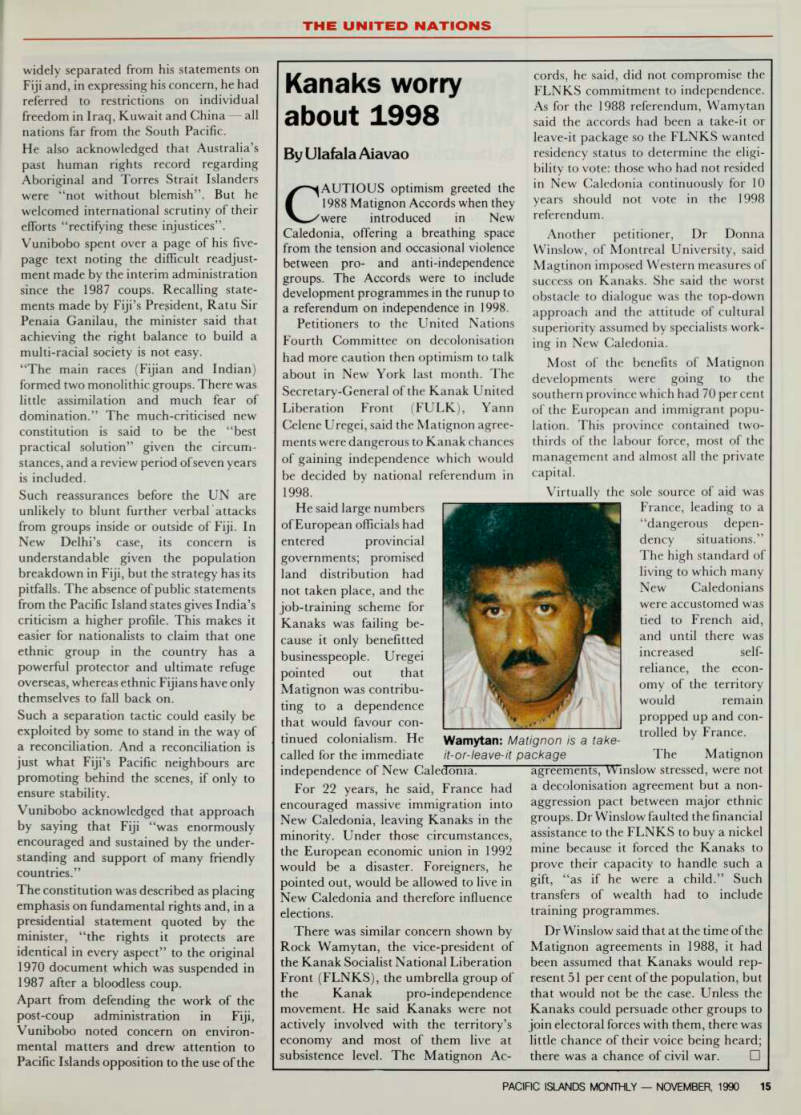
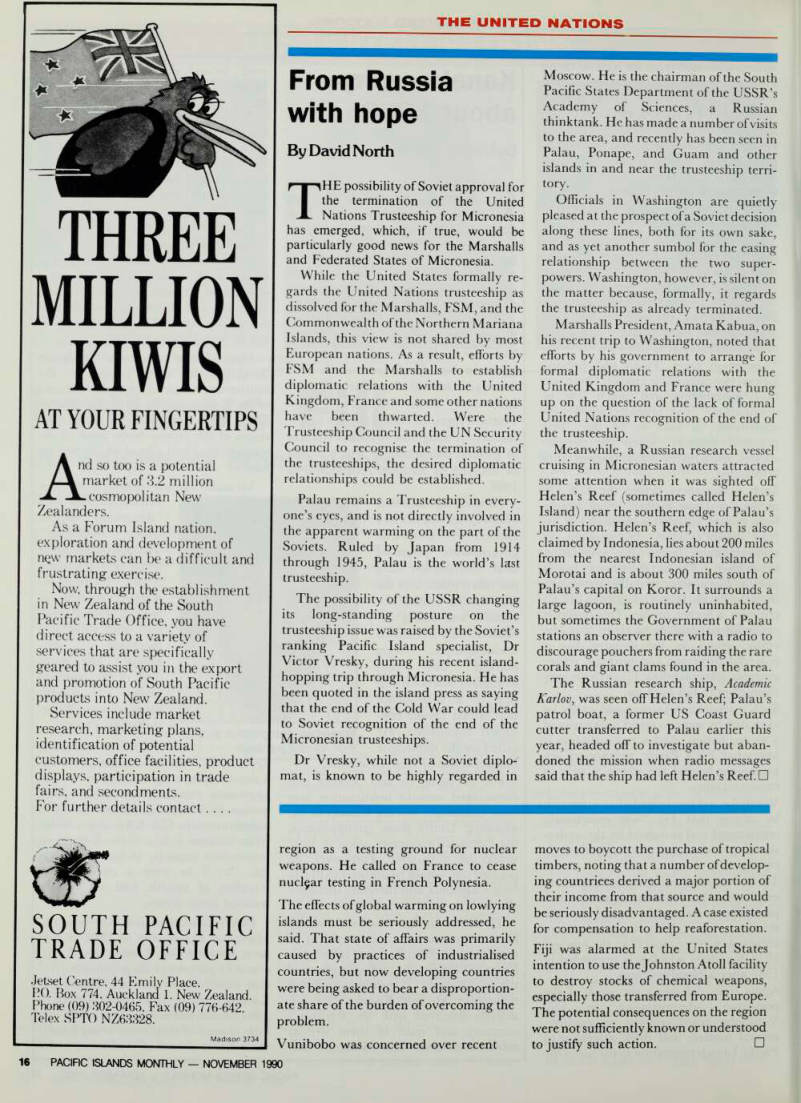
the debate for ethnic rights
By Ulafala Aiavao
WHAT’S the difference between South Africa, known for its apart heid policies, and Fiji? According to the Indian government, “while racism is on the retreat in South Africa, in Fiji, a constitution has been imposed which insti tutionalises racial discrimination.”
The criticism, at the United Nations General Assembly in New York, was not unexpected. New Delhi made it known earlier this year that it would tackle Suva’s post-coup policies on the grounds that a new constitution promulgated in July was designed to disadvantage ethnic Indians who make up slightly less than half of Fiji’s population.
India’s Foreign Minister, Inder Kumar Gujral, told the UN that the “Suva regime flouts internationally accepted principles of democracy and human rights. Its undemocratic and racially discriminatory policies are unac ceptable.”
Almost all of Fiji’s Pacific neighbour remained silent on the issue, following an understanding made at the South Pacific Forum meeting in Port Vila. Some, like New Zealand, had already placed on record their well-publicised criticisms of the 1987 coups that overthrew that Bavadra administration. The Pacific Islands delegations see the issue as an internal matter for Fiji to settle.
There was sympathy from some Pacific delegates, who, while not condoning the
coups, saw the events of 1987 as an inevitable result of the country’s colonial history. “We knew it would happen,” said one senior diplomat.
The hands-off attitude worked both ways, with Pacific delegations neither condemning nor condoning Fiji’s actions publicly. The exception was Australia, the only one to break Forum ranks at the UN.
Australia’s Foreign Affairs Minister, Gareth Evans, said his government was “deeply disappointed at the backward steps that occurred in Fiji”. Evans said the promulgation of a new constitution marked “a welcome return to representa tive constitutional government” but it is building “new and far-reaching racially discriminatory principles into the Fiji political system”.
Evans has since been made unwelcome in Fiji where Prime Minister Ratu Sir Kamisese Mara turned down a request from Evans last month to visit Fiji. “I genuinely believe that he does not want to improve relations with Fiji,” Ratu Sir Kamisese told Australian Associated Press.
Fiji’s much-criticised post-coup consti tution is weighted in favour of the indigenous Fijians. It gives them political and custamory guarantees absent in the 1970 constitution with which Fiji gained independence from Britain, Those guarantees are not so shocking for countries like neighbouring Western
Samoa which has 45 out of the 47 seats in Parliament reserved for the matai , those with chiefly titles. It is for this reason that Western Samoan officials are keeping far away from the Fijian controversy lest it draws international attention to their own political system.
Samoan delegates in past have often had to explain at international meetings that their unique electoral system was democratically chosen in a 1961 refer endum at which 83 per cent of respon dents chose the status quo, and that the UN itself helped to arrange the refer endum.
Such niceties are lost during debates on the principles of open voting. (A second referendum was due in Western Samoa on the 29th of last month to determine whether the people want universal suffrage or not.) Fiji’s Minister for Trade and Com merce, Berenado Vunibobo, gave his government’s response on October 10, the last day of general debate at the UN. He said his government was “bewildered by the continuous sniping” by a number of countries who, he said, should have had a greater appreciation of the difficulties which Fiji was going through.
The minister was “sadly disappointed by the lecturing and posturing of a number of countries, who have arrogated to themselves the right to be moral and political arbiters of how we should conduct our affairs.” While he did not name any particular country, UN ob servers believed he was referring to Evans’ comment that conformity to inter national human rights is “not each country’s own internal business, but the world’s business.”
Evan’s remarks on human rights were
widely separated from his statements on Fiji and, in expressing his concern, he had referred to restrictions on individual freedom in Iraq, Kuwait and China all nations far from the South Pacific.
He also acknowledged that Australia’s past human rights record regarding Aboriginal and Torres Strait Islanders were “not without blemish”. But he welcomed international scrutiny of their efforts “rectifying these injustices”.
Vunibobo spent over a page of his five page text noting the difficult readjust ment made by the interim administration since the 1987 coups. Recalling state ments made by Fiji’s President, Ratu Sir Penaia Ganilau, the minister said that achieving the right balance to build a multi-racial society is not easy.
“The main races (Fijian and Indian) formed two monolithic groups. There was little assimilation and much fear of domination.” The much-criticised new constitution is said to be the “best practical solution” given the circum stances, and a review period of seven years is included.
Such reassurances before the UN are unlikely to blunt further verbal attacks from groups inside or outside of Fiji. In New Delhi’s case, its concern is understandable given the population breakdown in Fiji, but the strategy has its pitfalls. The absence of public statements from the Pacific Island states gives India’s criticism a higher profile. This makes it easier for nationalists to claim that one ethnic group in the country has a powerful protector and ultimate refuge overseas, whereas ethnic Fijians have only themselves to fall back on.
Such a separation tactic could easily be exploited by some to stand in the way of a reconciliation. And a reconciliation is just what Fiji’s Pacific neighbours are promoting behind the scenes, if only to
ensure stability.
Vunibobo acknowledged that approach
by saying that Fiji “was enormously
encouraged and sustained by the under standing and support of many friendly countries.”
The constitution was described as placing emphasis on fundamental rights and, in a presidential statement quoted by the minister, “the rights it protects are identical in every aspect” to the original 1970 document which was suspended in 1987 after a bloodless coup.
Apart from defending the work of the post-coup administration in Fiji, Vunibobo noted concern on environ mental matters and drew attention to Pacific Islands opposition to the use of the
region as a testing ground for nuclear weapons. He called on France to cease testing in French Polynesia.
The effects of global warming on lowlying islands must be seriously addressed, he said. That state of affairs was primarily caused by practices of industrialised countries, but now developing countries were being asked to bear a disproportion ate share of the burden of overcoming the problem.
Vunibobo was concerned over recent
moves to boycott the purchase of tropical timbers, noting that a number of develop ing countriees derived a major portion of their income from that source and would be seriously disadvantaged. A case existed for compensation to help reaforestation.
Fiji was alarmed at the United States intention to use the Johnston Atoll facility to destroy stocks of chemical weapons, especially those transferred from Europe.
The potential consequences on the region were not sufficiently known or understood to justify such action. □