The time to go private
pp. 12-13 · Read in the full issue
By Dykes Angiki
SOLOMON Islands Prime Minister, Solomon Mamaloni, celebrating a political rout that 4 shook his country, is determined to continue to pursue changes initiated by the Alliance govern ment he led to power and broke up late last month. These include the sale of govern ment assets and a selected number of state owned companies. The new administration will also continue to seek ways of streamlin ing the public service.
Mamaloni sees the current public service as a legacy of British colonialism and needed to be changed to meet the aims and objectives of the government.
Changes in the pub lic service so far in clude making the posts of permanent secretaries contrac tual with attractive terms and con ditions of service and salary package.
A number of people earlier expressed reservations about the likelihood of the contracted officers being subjected to
political influence. The idea was con ceived by the Alliance Party to enhance the speed with which permanent secretaries and their staff responded to political directives. However, in an nouncing the names of the new contrac ted permanent secretaries, the Chairman of the Solomon Islands Public Service Commission, Dennis Lulei, said the com mission was not interested in the political interest or affiliations of those who ap plied. He said the 15 new permanent secretaries were selected on merit based on academic qualifications, work experi ence, ability to motivate the workers and
leadership.
There has also been a general upgrad-
ing of line posts within the service and the seven provinces have been encouraged to set up their own public services with public service commissions. Mamaloni has also announced the appointment of Solomon Islands’ first puisne judge, Pub lic Solicitor John Muria. He said more key posts in the judiciary will be localised, including that of Chief Justice.
Privatisation is an area in which Mamaloni has met open resistence from public officers. But the Prime Minister is confident privatisation is one way in which the government can rid itself of many liabilities. He listed as an example the Ministry of Transport, Works and Utilities where it can private services like Government Supplies, the water unit, the marine division, mechanical and hard ware, housing and furniture, transport, and heavy plants and vehicles. Mamaloni
said that if these functions are privatised, it will remove a burden from the govern ment and encour age direct partici
pation by private
businesses who can provide an ef ficient service.
The Ministry of Transport can be scaled down to deal only with
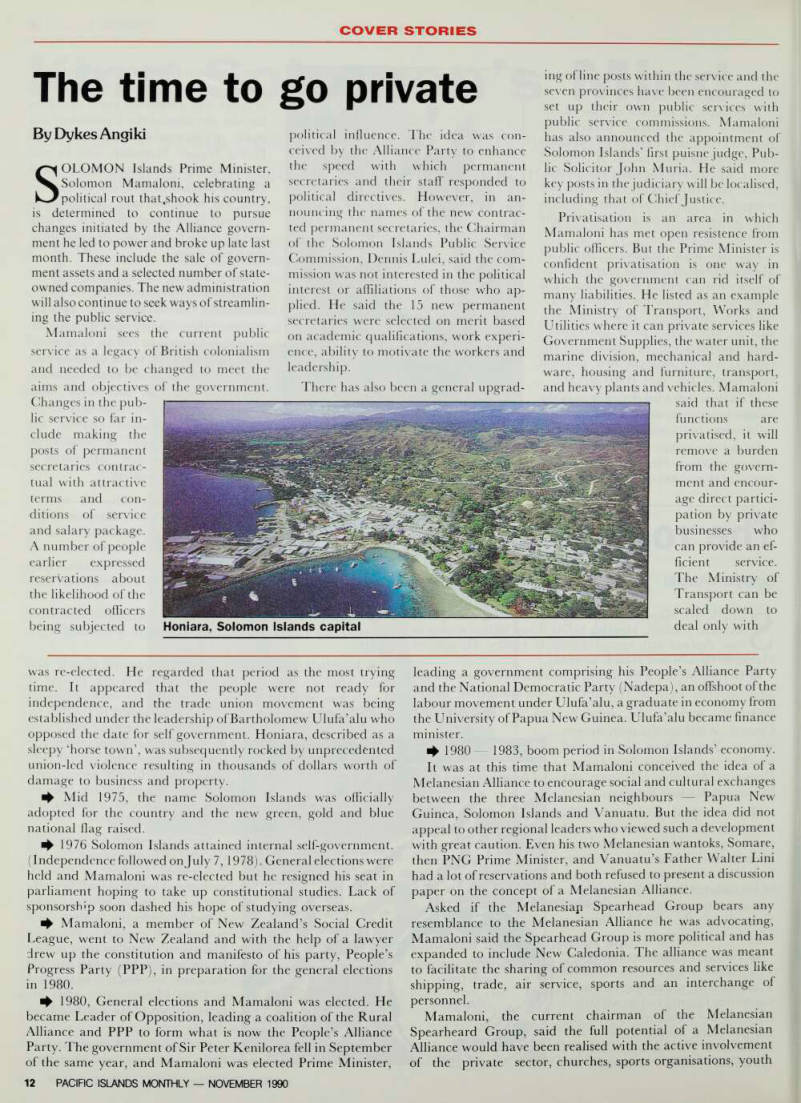
Honiara, Solomon Islands capital
civil aviation and a small fleet of government vehicles.
Shipping is of prime importance for the socio-economic development of Solomon Islands. In a country where the islands are so scattered, an adequate and efficient shipping service is important for the Solomon Islands to be able to convert from a subsistence to a market economy, increase exports and optimise import substitution.
The diverse and
widely scattered
islands create a sig nificant problem for the shipping in dustry since it re quires the collec
tion of numerous small consignments of cargo. Only the three bigger provinces, Western, Malaita and Guadalcanal with larger populations have attracted private sector shipping operators to run regular passenger and cargo services on trunk routes between them. Cargo and passen ger services to most other provinces where the people live by a mixture of subsistence farming and the production of cash crops especially copra, cocoa and numerous other marketable commodities are being left to the mercy of the government’s ailing fleet which at present operates at a loss of SIS 1.5 million a year while receipts are only 5350,000 and costs S 2 million.
Under the government’s privatisation
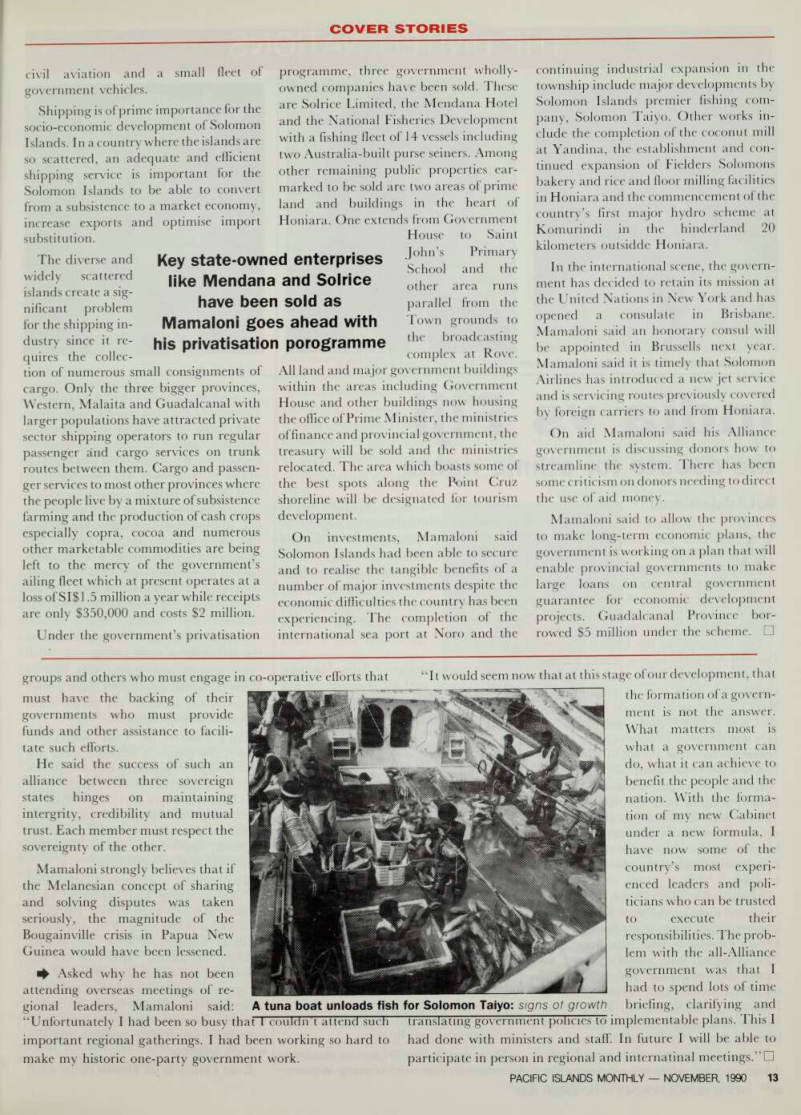
programme, three government wholly owned companies have been sold. These are Solrice Limited, the Mendana Hotel and the National Fisheries Development with a fishing fleet of 14 vessels including two Australia-built purse seiners. Among other remaining public properties ear marked to be sold are two areas of prime land and buildings in the heart of Honiara. One extends from Government House to Saint
Key state-owned enterprises like Mendana and Solrice have been sold as Mamaloni goes ahead with his privatisation porogramme
John’s Primary School and the other area runs parallel from the Town grounds to the broadcasting complex at Rove.
All land and major government buildings within the areas including Government House and other buildings now housing the office of Prime Minister, the ministries offmance and provincial government, the treasury will be sold and the ministries relocated. The area which boasts some of the best spots along the Point Cruz shoreline will be designated for tourism development.
On investments, Mamaloni said Solomon Islands had been able to secure and to realise the tangible benefits of a number of major investments despite the economic difficulties the country has been experiencing. The completion of the international sea port at Noro and the
continuing industrial expansion in the township include major developments by Solomon Islands premier fishing com pany, Solomon Taiyo. Other works in clude the completion of the coconut mill at Yandina, the establishment and con tinued expansion of Fielders Solomons bakery and rice and floor milling facilities in Honiara and the commencement of the country’s first major hydro scheme at Komurindi in the hinderland 20 kilometers outsidde Honiara.
In the international scene, the govern ment has decided to retain its mission at the United Nations in New York and has opened a consulate in Brisbane.
Mamaloni said an honorary consul will be appointed in Brussells next year.
Mamaloni said it is timely that Solomon Airlines has introduced a new jet service and is servicing routes previously covered by foreign carriers to and from Honiara.
On aid Mamaloni said his Alliance government is discussing donors how to streamline the system. There has been some criticism on donors needing to direct the use of aid money.
Mamaloni said to allow the provinces to make long-term economic plans, the government is working on a plan that will enable provincial governments to make large loans on central government guarantee for economic development projects. Guadalcanal Province bor rowed $5 million under the scheme. □