The road to power
pp. 11-13 · Read in the full issue
By Dykes Angiki
SOLOMON Mamaloni was educated at King George VI Secondary School, Honiara before doing further studies in New Zealand with special interest in history. He admires Mahatma Gandhi and John F Kennedy. ln 1966 he joined the British colonial administration as an administrative clerk in Honiara. He was transferred to the Secretariat and became assistant clerk to the Legislative Council. While on the post, he was
sent to Papua New Guinea and attached to the Papua New Guinea House of Assembly. He met and befriended Michael Somare. 1970, Mamaloni successfully contested the national elections and won the seat for Eastern Inner Islands, now Makira-Ulawa Prov ince. He entered politics on the urging of his father, the late Sunaone who was a member of the former Advisory Council of the British Solomon Islands Protectorate. 1970 73 Mamaloni remained a backbencher but actively served in a number of committees under a Governing Council system which had replaced the legislative council and the governing council under a new constitution. He was a member of a committee that reviewed the
country’s constitution and later became chairman of a committee that amalgamated the country’s many local councils, laying down the foundation for provincial government. + 1973, Mamaloni moved a motion to change the Governing Council system to Legislative Assembly. General elections were held and Mamaloni was re-elected.
April 1974 a new constitution was introduced effectively changing the Governing Council system to a national legis lature.
July 1974, Mamaloni was elected Solomon Islands’ first Chief Minister. His first task was to begin the process of negotiations with the British government for self-government and eventual independence. He led a delegation to London for
the first constitutional talks with the British government resulting in a tentative timetable for indepen dence. The British government however advised that the question of independence be a subject of a national referendum.
Mamaloni aggressively pursued the idea of independence but was determined to have a national parliament building built first. He met a guy from California, who talked him into the minting com memorative cpins depicting Mamaloni’s head to raise money for the project. Mamaloni was told the action was illegal so he resigned as Chief Minister over what be came known as the Letcher Mint Affair.
Cabinet held an election to find a replacement and Mamaloni
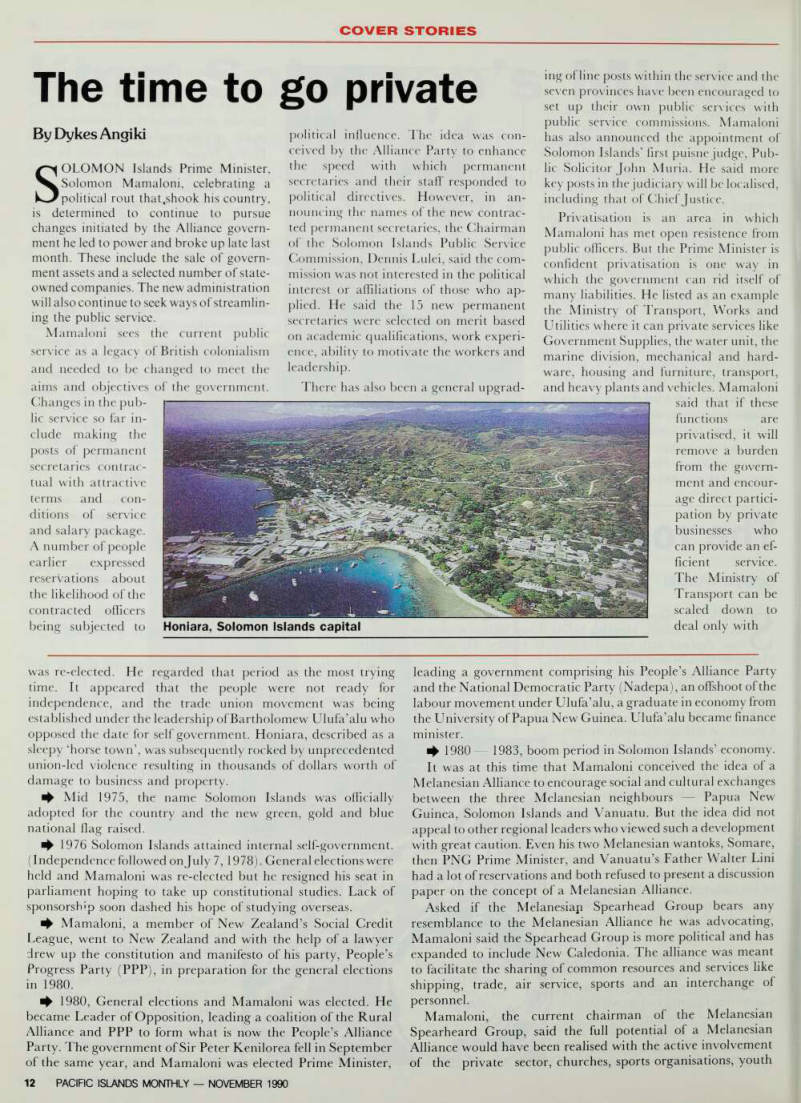
Solomon Islands
was re-elected. He regarded that period as the most trying time. It appeared that the people were not ready for independence, and the trade union movement was being established under the leadership ofßartholomew Ulufa’alu who opposed the date for self government. Honiara, described as a sleepy ‘horse town’, was subsequently rocked by unprecedented union-led violence resulting in thousands of dollars worth of damage to business and property.
Mid 1975, the name Solomon Islands was officially adopted for the country and the new green, gold and blue national flag raised. (Independence followed on July 7, 1978). General elections were held and Mamaloni was re-elected but he resigned his seat in parliament hoping to take up constitutional studies. Lack of sponsorship soon dashed his hope of studying overseas. + Mamaloni, a member of New Zealand’s Social Credit League, went to New Zealand and with the help of a lawyer drew up the constitution and manifesto of his party. People’s Progress Party (PPP), in preparation for the general elections in 1980. became Leader of Opposition, leading a coalition of the Rural Alliance and PPP to form what is now the People’s Alliance Party. The government of Sir Peter Kenilorea fell in September of the same year, and Mamaloni was elected Prime Minister,
leading a government comprising his People’s Alliance Party and the National Democratic Party (Nadepa), an offshoot of the labour movement under Ulufa’alu, a graduate in economy from the University of Papua New Guinea. Ulufa’alu became finance minister.
It was at this time that Mamaloni conceived the idea of a Melanesian Alliance to encourage social and cultural exchanges between the three Melanesian neighbours Papua New Guinea, Solomon Islands and Vanuatu. But the idea did not appeal to other regional leaders who viewed such a development with great caution. Even his two Melanesian wantoks, Somare, then PNG Prime Minister, and Vanuatu’s Father Walter Lini had a lot of reservations and both refused to present a discussion paper on the concept of a Melanesian Alliance.
Asked if the Spearhead Group bears any resemblance to the Melanesian Alliance he was advocating, Mamaloni said the Spearhead Group is more political and has expanded to include New Caledonia. The alliance was meant to facilitate the sharing of common resources and services like shipping, trade, air service, sports and an interchange of
personnel.
Mamaloni, the current chairman of the Melanesian Spearheard Group, said the full potential of a Melanesian Alliance would have been realised with the active involvement of the private sector, churches, sports organisations, youth
groups and others who must engage in co-operative efforts that
must have the backing of their governments who must provide funds and other assistance to facili tate such efforts.
He said the success of such an alliance between three sovereign states hinges on maintaining intergrity, credibility and mutual trust. Each member must respect the sovereignty of the other.
Mamaloni strongly believes that if the Melanesian concept of sharing and solving disputes was taken seriously, the magnitude of the Bougainville crisis in Papua New Guinea would have been lessened.
Asked why he has not been attending overseas meetings of re gional leaders, Mamaloni said:
“Unfortunately I had been so busy that 1 couldn't attend such important regional gatherings. I had been working so hard to make my historic one-party government work.
“It would seem now that at this stage ofour development, that
the formation of a govern ment is not the answer.
What matters most is what a government can do, what it can achieve to benefit the people and the nation. With the forma tion of my new Cabinet under a new formula, I have now some of the country’s most experi enced leaders and poli ticians who can be trusted to execute their
responsibilities. The prob
lem with the all-Alliance government was that I had to spend lots of time briefing, clarifying and
translating government policies to implementable plans. This I had done with ministers and staff. In future I will be able to participate in person in regional and internatinal meetings.” □
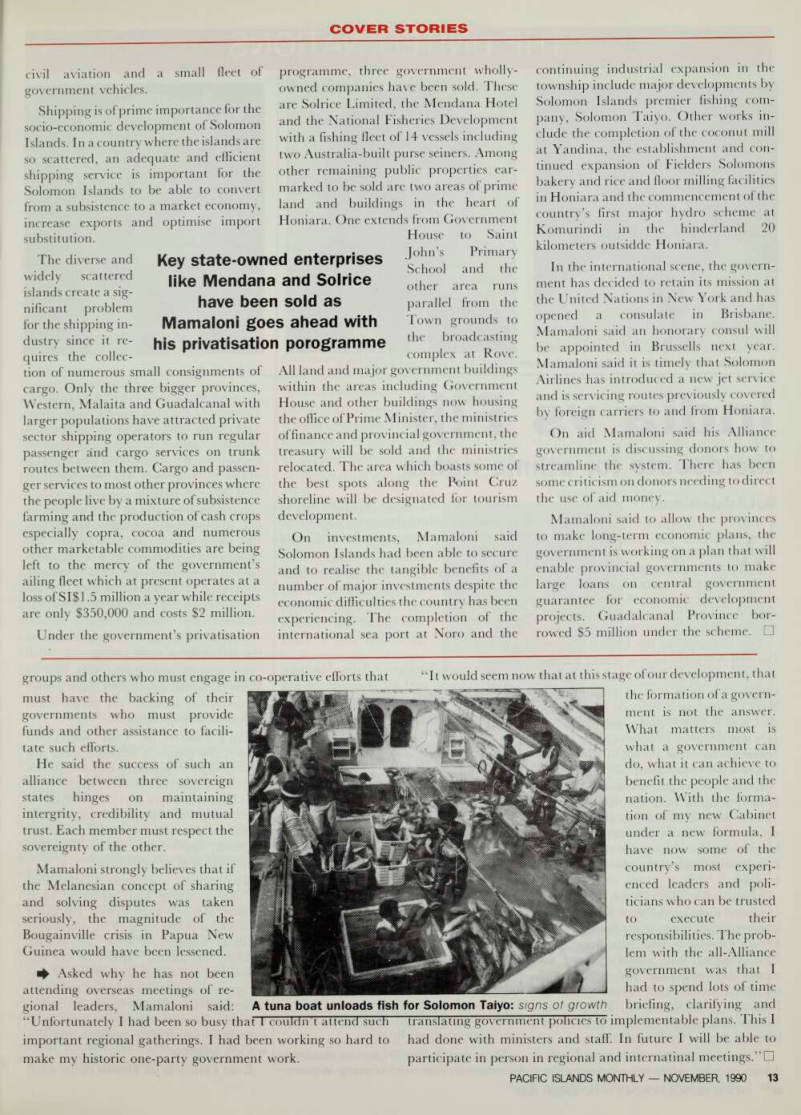
A tuna boat unloads fish for Solomon Taiyo: signs oF growth