King Solomon’s Mind
pp. 10-11 · Read in the full issue
Cover Stories
Mamaloni splits open Solomons’ party system with an amazing manouevre that puts him firmly in control
By Dykes Angiki
THE 19-month-old reign of Solomon Islands first ever single-party government came to an end October 9 when Prime Minister Solomon Mamaloni resigned from his ruling Alliance Party to form a government of national unity. He did this by dropping five ministers in his all-Alliance Cabinet and appointed five replacements, four from among the ranks of the Opposition group, and Alliance backbencher Job
Tausiga.
Among the new ministers is former Prime Minister Sir Peter Kenilorea, who takes over Foreign Affairs.
Another former Prime Minister, Ezekiel Alebua, declined the offer to join the govern ment. Mamaloni also convinced an other prominent
Opposition mem
ber, the leader of the Liberal Party, Bartholomew Ulufa’alu, that the best way to serve the country is not to entangle in par
liamentary debate
but to resign from parliament and join the govern ment as a consult ant. The remain ing Liberal Party
member, George
Luialamo, has been sworn is as
Minister for Agriculture and Lands.
The move by Mamaloni stunned the nation, weakened the Opposition and broke up political parties. The concept of a government of national unity was put to him last year and again this year by the Leader of Opposition, Andrew Nori, and his Opposition colleagues, some of whom have now accepted to serve in a govern ment which was formed as a result of hard
bargaining and convincing negotiations
by a man regarded as the most experi enced and calculating of all Solomon
Islands politicians.
None had been more intrigued by such fast political manoeuvering than Nori who had had the support of
some of the country’s more senior poli ticians and elite members of the national parliament. This support had prompted him on several occasions to call for the resignation of the then all-Alliance
government which in his view lacked the required experience and flair. But the ease with which Mamaloni handpicked the cream of the Opposition group raised questions over the loyalty of the Oppo sition members to their leader.
Asked, for example, if it was difficult to get Sir Peter, once a strong rival, to join his government, Mamaloni said: “No sweat ... it was automatic. He told reporters that he had killed two birds with one stone. One, by appointing four ministers from Malaita Province, he had appeased feeling in that powerful region which had not been represented in Cabinet. Two, his resignation from the Alliance Party has freed him from the constraints of strict party policies and created flexibility in leadership.
The new 15-member Cabinet consists of four ministers from Malaita, three from Guadalcanal, three from Western Prov ince, and one each from the four smaller provinces and Honiara.
Mamaloni shrugged off a petition by the parliamentary wing of his former Alliance Party which demanded his resignation.
Commenting on an issue which had led to an unsuccessful motion of no confi dence against him last year, Mamaloni said he had no regret about his involve ment in negotiations for Solomon Islands to borrow US$25O million from an Italian source. He said he has documents which show that the money is available if Solomon Islands wants it. This, he said, he will discuss with his new Cabinet.
Mamaloni has pledged to push on with his programme to revitalise the economy, pointing out that recovery is being achieved, although at not very substantial
The move by Mamaloni stunned the nation, weakened the Opposition and broke up political parties
level. He said the weak Solomon dol lar has shown slight improvement against the Australian and New Zealand
currencies and the level of foreign reserves has improved. He justified the vast amount of time spent on restructuring and reviewing the 15 government minis tries and the public services as essential
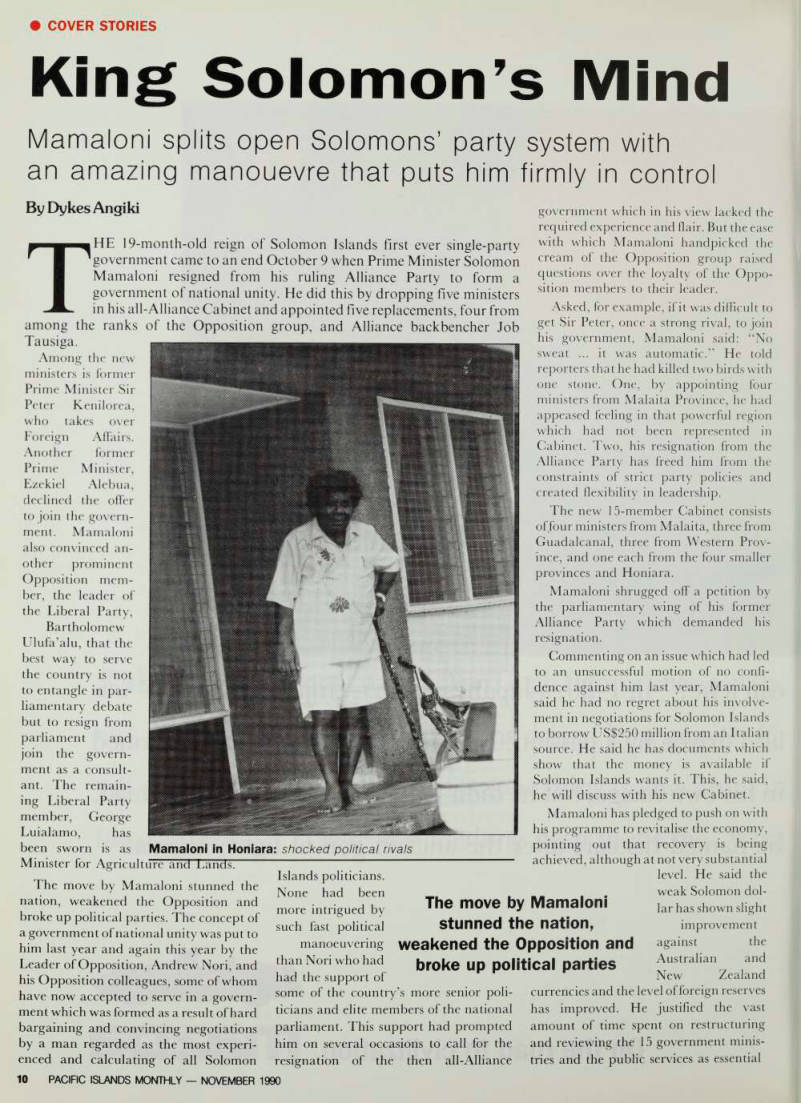
Mamaloni in Honiara: shocked political rivals
and a pre-requisite to sound political and economic management.
Mamaloni, a founder of one of the country’s first political parties, the Peoples Progressive Party (PPP), said the creation of his Government of National Unity, will not end the party system. He. in fact, plans to revive the PPP which had merged with the Rural Alliance to form what is now the Solomon Islands People Alliance (SIPA).
But the most shattering aspect of Mamaloni’s latest political moves was the return of a coalition government. His landslide victory in last year’s general elections brought to power Solomon Islands’ first single- party government since independence 12 years ago. His popular victory brought new political expectations. But, alas, it did not last.
Mamaloni conceded that politics in the Solomons evolves around personalities rather than party affiliations.
Of the five sacked ministers, the most bitter was Deputy Prime Minister Danny Philip, of Home Affairs. He had virtually
been Solomon Islands Prime Minister the past 19 months, appearing for Mamaloni at home and abroad on many occasions like the meetings of the Commonwealth heads of government and the South Pacific Forum. Mamaloni said he was grooming Philip for leadership. I asked Philip if Mamaloni told him why he was fired. Yes, Mamaloni said: “Mi sakim you bicos you good friend blong mi." Philip said he doesn’t think he can understand the whole thing.
The remaining Alliance group and the Opposition arc arm-in-arm in their con demnation of Mamaloni’s political moves. They have called on the Governor-General to call an early meet ing of parliament to debate a joint motion of no confidence in the Prime Minister.
Mamaloni went on nationwide radio broadcast assuring everyone that every thing is under control and he has overwhelming support in parliament.
One thing is for sure, Mamaloni is certainly firmly in control. □
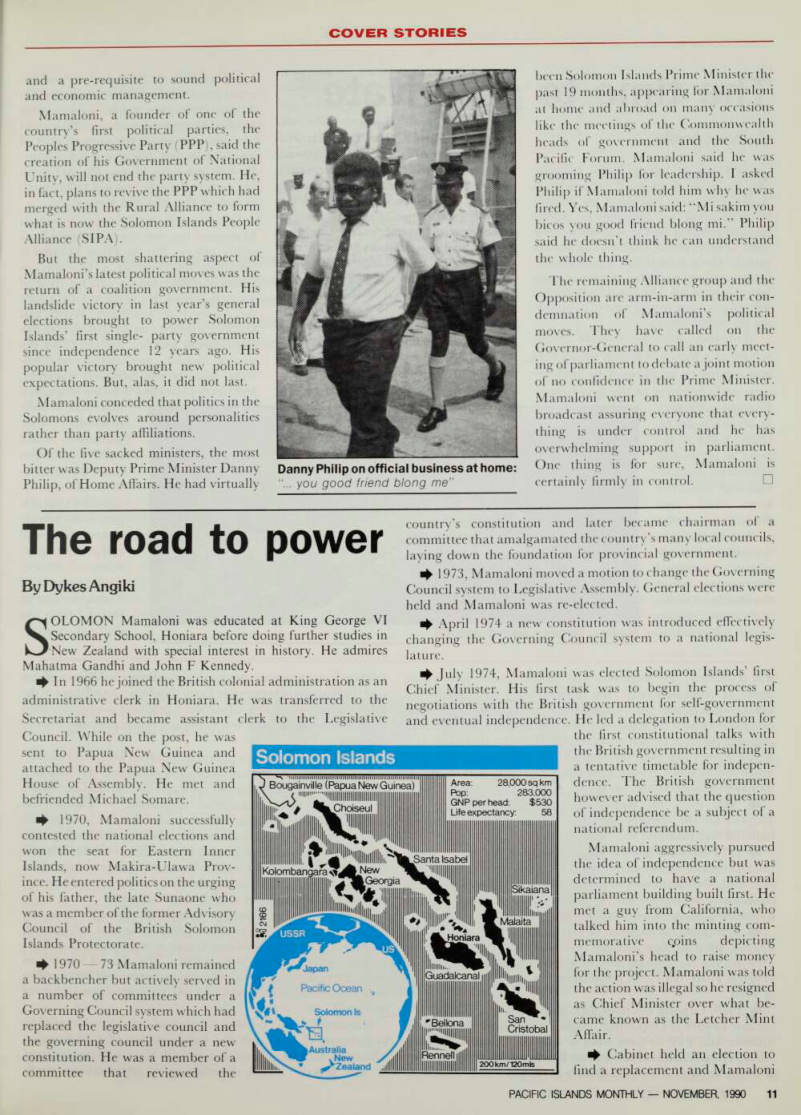
Danny Philip on official business at home: "... you good friend blong me"