about 1998
p. 15 · Read in the full issue
Kanaks worry about 1998
By Ulafala Aiavao
CAUTIOUS optimism greeted the 1988 Matignon Accords when they were introduced in New Caledonia, offering a breathing space from the tension and occasional violence between pro- and anti-independence groups. The Accords were to include development programmes in the runup to a referendum on independence in 1998.
Petitioners to the United Nations Fourth Committee on decolonisation had more caution then optimism to talk about in New York last month. The Secretary-General of the Kanak United Liberation Front (FULK), Yann Celene Uregei, said the Matignon agree ments were dangerous to Kanak chances of gaining independence which would be decided by national referendum in 1998.
He said large numbers of European officials had entered provincial
governments; promised
land distribution had not taken place, and the job-training scheme for Kanaks was failing be cause it only benefitted
businesspeople. Uregei
pointed out that Matignon was contribu
ting to a dependence
that would favour con tinued colonialism. He called for the immediate
independence of New Caledonia.
For 22 years, he said, France had encouraged massive immigration into New Caledonia, leaving Kanaks in the minority. Under those circumstances, the European economic union in 1992 would be a disaster. Foreigners, he pointed out, would be allowed to live in New Caledonia and therefore influence elections.
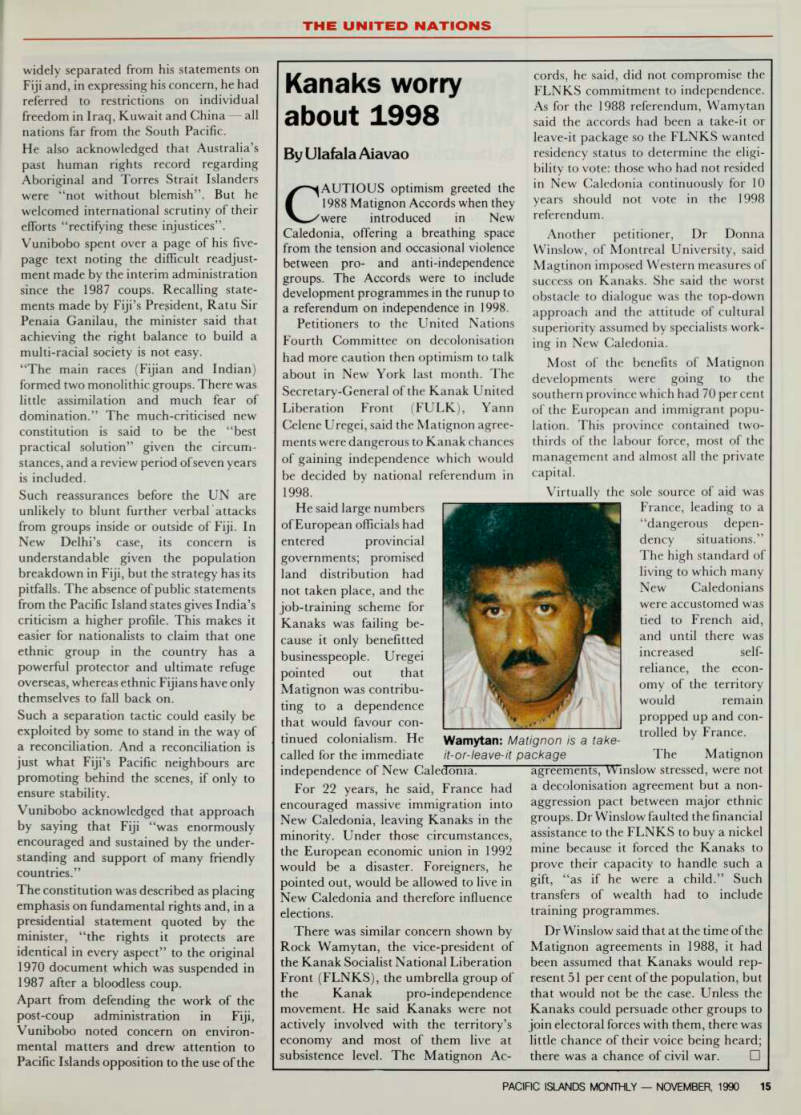
There was similar concern shown by Rock Wamytan, the vice-president of the Kanak Socialist National Liberation Front (FLNKS), the umbrella group of the Kanak pro-independence movement. He said Kanaks were not actively involved with the territory’s economy and most of them live at subsistence level. The Matignon Ac
cords, he said, did not compromise the FLNKS commitment to independence.
As for the 1988 referendum, Wamytan said the accords had been a take-it or leave-it package so the FLNKS wanted residency status to determine the eligi bility to vote: those who had not resided in New Caledonia continuously for 10 years should not vote in the 1998 referendum.
Another petitioner, Dr Donna Winslow, of Montreal University, said Magtinon imposed Western measures of success on Kanaks. She said the worst obstacle to dialogue was the top-down approach and the attitude of cultural superiority assumed by specialists work ing in New Caledonia.
Most of the benefits of Matignon developments were going to the southern province which had 70 per cent of the European and immigrant popu lation. This province contained two thirds of the labour force, most of the management and almost all the private
capital.
Virtually the sole source of aid was
France, leading to a “dangerous depen dency situations.”
The high standard of living to which many New Caledonians were accustomed was tied to French aid, and until there was increased self reliance, the econ omy of the territory would remain propped up and con trolled by France.
The Matignon
agreements, Winslow stressed, were not a decolonisation agreement but a non aggression pact between major ethnic groups. Dr Winslow faulted the financial assistance to the FLNKS to buy a nickel mine because it forced the Kanaks to prove their capacity to handle such a gift, “as if he were a child.” Such transfers of wealth had to include training programmes.
Dr Winslow said that at the time of the Matignon agreements in 1988, it had been assumed that Kanaks would rep resent 51 per cent of the population, but that would not be the case. Unless the Kanaks could persuade other groups to join electoral forces with them, there was little chance of their voice being heard; there was a chance of civil war. □
Wamytan: Matignon is a take it-or-leave-it package