Troubled
pp. 14-16 · Read in the full issue
testimonies
The eye witness accounts, published in Testimonies last month, like most authentic human stories, contain some discrepancies and contradictions.
Some of the people interviewed were talking of events that happened more than two decades ago and the secrecy surrounding the tests makes it difficult to verify some incidents described. Many of the names of the witnesses have been changed to protect their
identity.
Excerpts:
TAMATOA was interviewed in an air craft en route from Mangareva to Papeete, where his son was going to have a medical check-up: * I don’t want to give my name because I’m scared there might be reper cussions. My son is eight. He is the jewel of my life . . . He is handicapped, I think because of the testing. Before the testing started there were no handicapped chil dren on Mangareva. In the beginning the nuclear tests brought money but now all they bring is illness. I am a farmer, I’ve seen how the animals also seem to be sick now, and the banana trees no longer bear their usual crop. The bananas fall off before they ripen. I’m against the tests . . . I think they should stop them now. 5 HINANO lives on Mangareva: CThe military first arrived in the Gambier islands in 1963. About 20 of them, including some French legion naires, settled in Taku, at the north end of the main island, and built houses, roads and a bunker. Later, they moved to Totegegie, where the airstrip was built.
More and more people were brought here until, at one stage, there were about 1000 foreigners working ... In the beginning, when the first military people arrived, we were happy to welcome them. We had never seen so many white people and their arrival meant work, money and cheaper goods because suddenly transport was free . . . With legionnaires and locals
getting drunk, there were a To! of fights. Before the testing started, a lot of VIPs came to the islands scientists, admirals, generals and the professor who constructed the bomb. They . . . talked to the people, telling us not to worry, that there were no problems . , . Most people were so impressed by these important visitors that they believed everything they said and they didn’t ask questions.
The bunker that had been built in Taku was very impressive, with walls and a roof a metre thick. It was designed to accommodate all the military and the local people but they soon discovered it was much too small.
When they moved to Totegegie, they built another shelter but it was quite different from the first one. It was built from tin and a sort of plastic . . .
In Rikitea, a large inflatable tent was set to use as a fallout shelter.
It looked rather like a turtle and was kept inflated by generators which ran day and night . . . (During a bomb test) fresh air was pumped into the shelter continuously through big filters and a sprinkler system was con stantly washing down the roof.
We all wore our day clothes but the military people who ac companied us has to wear protec tive clothing and masks and gloves whenever they left the
shelter to do any work outside . . .
Looking back, I’m appalled at the way in which we were treated. For instance, I had a premature baby which was taken by military plane to hospital in Tahiti.
The following day, I got a message to say the baby had died. Her body was never returned to us and we never received a death certificate which means that officially the baby is still alive.
Even now, years after it happened, I have nightmares about it. 5 ROLAND, a gendarme, was sent to
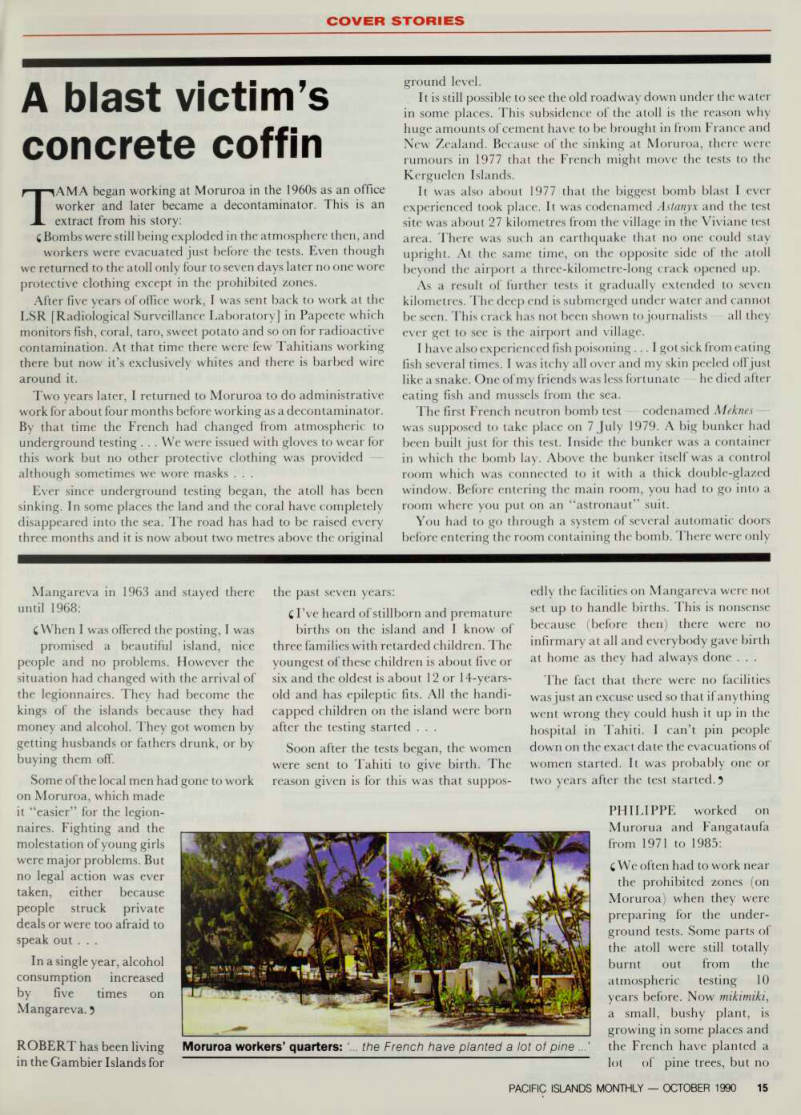
French Polynesia
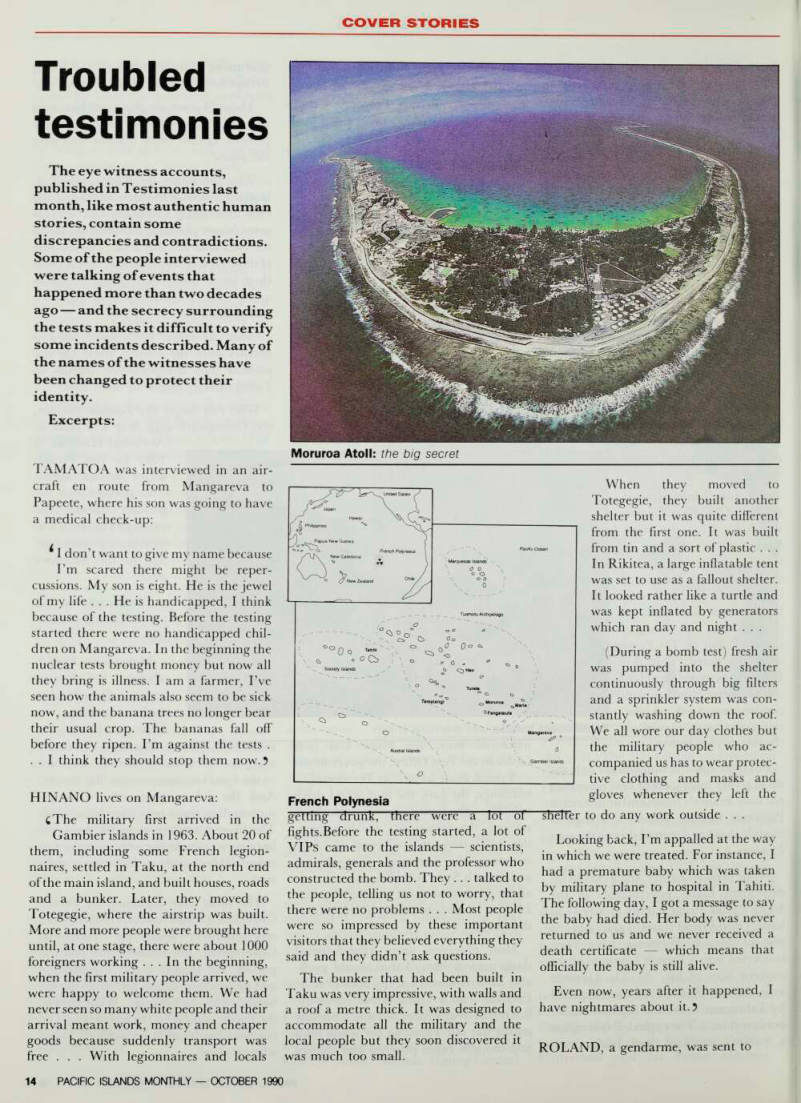
Moruroa Atoll: the big secret
Mangareva in 1963 and stayed there until 1968: C When I was offered the posting, I was promised a beautiful island, nice people and no problems. However the situation had changed with the arrival of the legionnaires. They had become the kings of the islands because they had money and alcohol. They got women by getting husbands or fathers drunk, or by buying them off.
Some of the local men had gone to work
on Moruroa, which made it “easier” for the legion naires. Fighting and the molestation of young girls were major problems. But no legal action was ever taken, either because people struck private deals or were too afraid to speak out . . .
In a single year, alcohol consumption increased by five times on
Mangareva.s
ROBERT has been living in the Gambier Islands for
the past seven years: Cl’ve heard of stillborn and premature births on the island and I know of three families with retarded children. The youngest of these children is about five or six and the oldest is about 12 or 14-years old and has epileptic fits. All the handi capped children on the island were born after the testing started . . .
Soon after the tests began, the women were sent to Tahiti to give birth. The reason given is for this was that suppos-
edly the facilities on Mangareva were not set up to handle births. This is nonsense because (before then) there were no infirmary at all and everybody gave birth at home as they had always done . . .
The fact that there were no facilities was just an excuse used so that if anything went wrong they could hush it up in the hospital in Tahiti. I can’t pin people down on the exact date the evacuations of women started. It was probably one or two years after the test started. 5
PHILIPPE worked on Murorua and Fangataufa from 1971 to 1985: C We often had to work near the prohibited zones (on Moruroa) when they were preparing for the under ground tests. Some parts of the atoll were still totally burnt out from the atmospheric testing 10 years before. Now mikimiki, a small, bushy plant, is growing in some places and the French have planted a lot of pine trees, but no
Moruroa workers’ quarters: '.. the French have planted a lot of pine...'
coconut trees seem to grow there anymore. Since the tests went under ground there are fissures all over the place. I’m sure these fissures prove that the tests are dangerous, but no one warns the workers of this when they first arrived.
In some areas we had to wear badges to measure the degree of radiation we were exposed to, and we had annual medical checkups but never got any feedback. 5 TETUAHAU worked on Moruroa from 1967 to 1985, first as a painter, then as a
storeman and eventually driving bull dozers and trucks: C During the atmospheric tests we were usually evacuated onto boats which travelled about five kilometres away from Moruroa, From this distance, we could see the rising fireballs quite clearly . . .
There would be a lot of damage to repair when we returned.
Although the bomb was exploded between five and 10 kilometres from the village (usually attached to a balloon
flying 10 metres above a two-metre-high platform), houses sometimes had their roofs blown off and often tidal waves swept through the living areas on the atoll. There were always a lot of dead fish lying around afterwards, decaying and
stinking terribly ...
On Moruroa, there are many contami nated zones and people often had to work very close to the prohibited areas. If people spoke up and refused to work so close to the radioactive zones they were dismissed and sent back to Tahiti.
After working for 18 years on Moruroa and Fangataufa and having my health destroyed by working on those sites, I am being treated like a dog. And I am not the only one. There are more and more people who have worked on the test sites for 18 to 20 years or more and are now not able to continue working because of
health problems.
A friend of mine who had worked on Moruroa for about seven years, started to lose his hair and got very sick. He had to be evacuated and was first sent to Jean Prince (hospital) in Tahiti and then to France where he died. 5
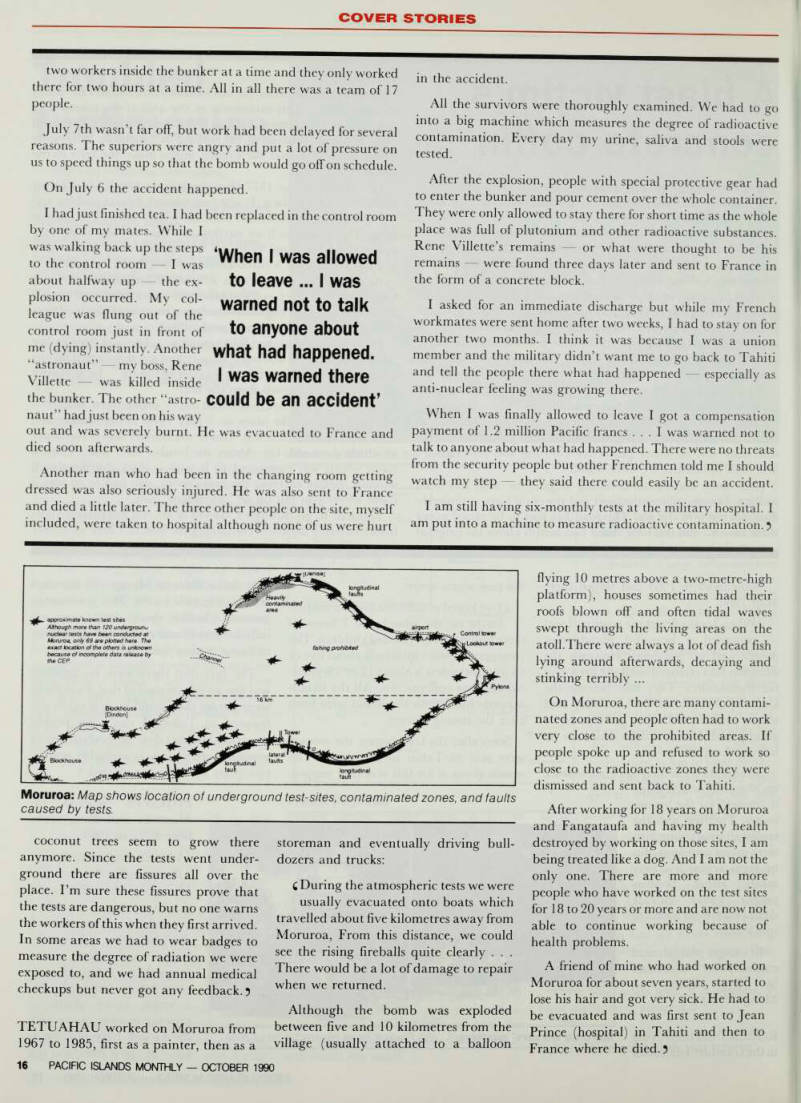
Moruroa: Map shows location of underground test-sites, contaminated zones, and faults caused by tests.