Bounty to
pp. 12-13 · Read in the full issue
From the Bounty to nuclear economy
By Al Prince
AN MGM crew from Hollywood arrived in Tahiti on the eve of Thanksgiving Day in November 1960 after a flight by seaplane that took more than 24 hours from Los Angeles. As
the crew that would
begin shoot
ing the film Mutiny on the Bounty landed, Tahitian men were spear
fishing in
the lagoon.
Six months later on May 5, 1961, the Tahiti- Faaa Inter national
Airport was
inaugur ated, open
ing Tahiti to the outside world. The volume of tourists between 1960 and 1961 more than doubled from 4087 to 8553. By 1962, Tahiti’s previous trade surplus became a trade deficit of one billion French Pacific francs, but Territorial Government officials optimistically looked at tourism as the means of reducing that deficit.
But the yearly volume of tourists fell far short off optimistic goals set for 1962 and subsequent years, a phenomenon that would almost regularly occur more than 20 years later.
Then on March 29, 1963, the first edition of the French daily newspaper Le Journal de Tahiti announced on the front page of its 12-page publication that the installation of the French Centre
d’Experimentation du Pacifique” (the
CEP, or Pacific Nuclear Testing Centre)
was about to become a reality.
More than three years later, on July 2, 1966, France conducted its first nuclear explosion on the Tuamotu atoll of Moruroa, 1250 kilometres (776 miles) south-southeast of Tahiti. The plutonium device was exploded in the atmosphere above Moruroa at 5.34 am.
Thus, in the short period of five years, Tahiti not only entered the jet age, but also the atomic age. And 24 years later, what had been a sleepy, South Pacific backwater with a charming paradise reputation is still trying to adapt and adjust to the dramatic changes brought about by Tahiti’s accelerated entry into the modern world.
There was no celebration on July 2, 1990, of France’s 24th anniversary of nuclear testing in this French Overseas Territory. Six days earlier, on June 26,
t rance conducted its third nuclear test ol this year. The 100 kiloton underground explosion occurred on the atoll of
Fangataufa, 37 kilometres (23 miles)
southeast of Moruroa.
After some 44 atmospheric tests be tween 1966 and 1974, France has reportedly conducted some 114 under ground tests between 1975 and this past June 26. As France enters the last year of a quarter century of nuclear testing in French Polynesia, the same criticism and the same speculation that have been heard for the past 24 years are still being voiced.
The big question today, however, is: how much longer will France continue to conduct nuclear tests at Moruroa and Fangataufa? No one probably knows the answer, and French President Francois Mitterrand and his Prime Minister,
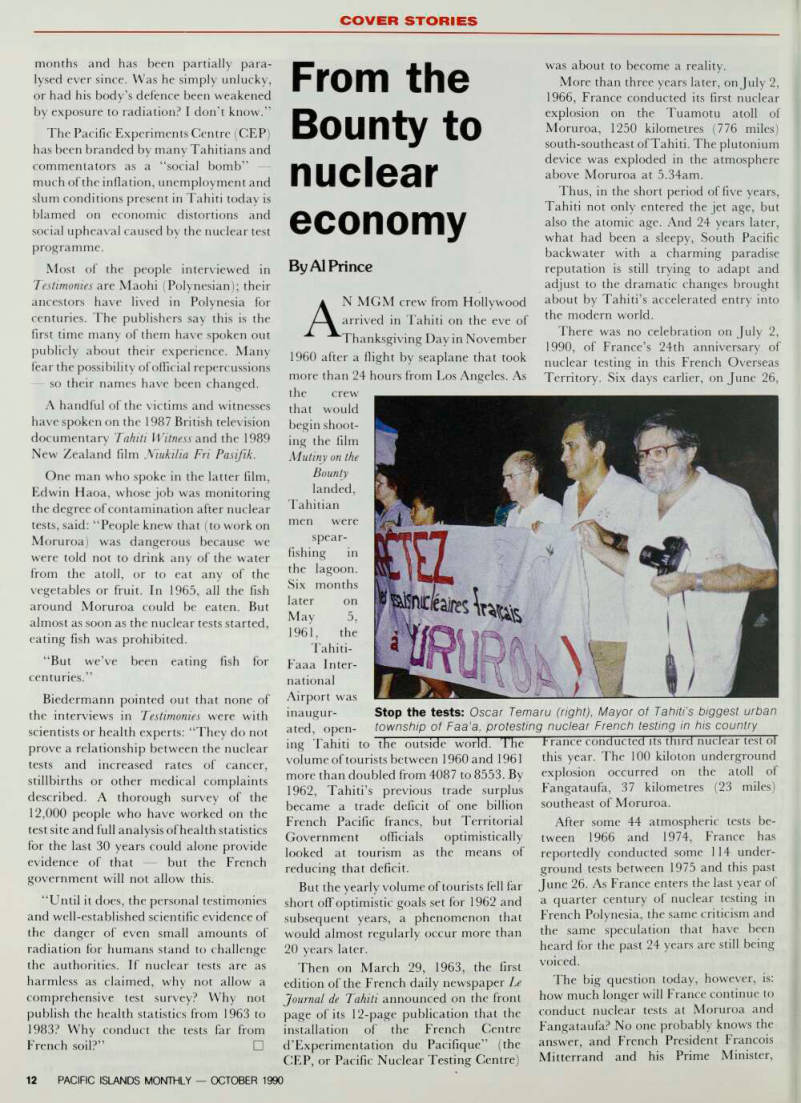
Stop the tests: Oscar Temaru (right), Mayor of Tahiti's biggest urban township of Faa’a, protesting nuclear French testing in his country
Michel Rocard have not supplied any.
The closest they came to supplying an answer was the announcement France would reduce the number of yearly tests this year from eight to six. That means three more tests are expected to be conducted this year.
But for the countries of the Pacific, six tests a year are six too many. Those countries have spent most of recent time voicing strong objections to France’s nuclear testing in the South Pacific.
However, with the United States and the Soviet Union headed toward increased nuclear and military disarmament, much world press opinion believe in the possi bility of France shutting down its nuclear testing operations in French Polynesia.
The weekly British news magazine The Economist reported in its May 19 edition: “Even the French are worried that Moruroa is in danger of being shaken to
bits, and may use the excuse of the peace dividend to end
testing there.”
The July 2 international edition of TIME magazine reported: “In the new Europe a cornerstone of Gaullism, namely France’s
independent nuclear
defense policy, may have to be modified as a result of disarmament nego tiations.” But as The Econ omist also noted “only the Polynesians would be sad to see Muroroa closed down; construction work at the testing site has given work to thousands of islanders.”
But those construction jobs are only the tip of a very huge iceberg that represents not only France’s involvement in French Polynesia but the complete change in lifestyle that has occurred during the past 24 years.
While predominantly Angol-Saxon in dependent island governments in the South Pacific struggle daily to survive as basic Third World states, Tahiti and the rest of French Polynesia have been converted into a French boutique of the modern way of life. As The Economist article noted: “Visitors are often surprised by Tahiti; not because it is paradise, but because it isn’t. The capital, Papeete, has a parking problem, and prices seem
outrageously high. But France loves it, even though last year (a typical one) it had to meet French Polynesia’s trade deficit of $753m. You cannot put a price
Nuclear testing has put Tahiti on the world map
on myth, or on la gloire of keeping the Tricolour fly ing among the palms.”
Officially,
the French State spent 59.427 billion French Pacific francs (about U 55574.27 million) in French Polynesia last year.
That covers all military and civilian expenses.
Even a superficial look around Tahiti does not fail to detect the overwhelming influence of the French State over the past 24 years.
The port of Papeete, the city’s Fare Ute
industrial zone, fTTe Motu CJta port" facilities, the Post Office, the government French State as well as Territorial buildings, the cars, the four-wheel drive vehicles, the two colour television stations, the restaurants, the boutiques, the traffic jams, the pollution, the false economy, the Territorial Government and French State subsidies, etc, etc., are all the direct or indirect result of France’s 24 years of nuclear testing in this part of the world.
Most observers agree that without those nuclear tests, Tahiti would prob ably have remained a sleepy South Pacific Paradise with a Third World economy.
But the 24-year history of French nuclear testing has put Tahiti on the world map
and brought rapid progress and change
that many of its residents are still trying to cope with, and not always successfully.
Those 24 years are also a rich history in terms of events. Who can forget the many protests against those nuclear tests over the years?
Who can forget the Radio New Zea land interviews in the early 1970 s with the crew members of a New Zealand Govern ment frigate planning a protest voyage to the Moruroa test site area? The families of those crew members where certain that their loved ones risked being contami nated with radioactivity from a French
atmospheric test.
Who can forget the United Nations debates over the French tests? Or the protests and independence threats in Tahiti directly linked to those tests?
Who can forget the Rainbow Warrior , the Greenpeace ship that was sunk in
Auckland Harbour in 1985 by two French secret service agents who planted two ex plosives aboard the vessel just before it was to make a protest voy age to the Moruroa area?
The list goes on and on, just like the nuclear tests.
Meanwhile, French officials, the French and non-French news media continue to
incorrectly identify the
major testing site as ‘Mururoa,’ instead of using its correct name, ‘Moruroa,’ which in the local language means ‘Big Secret.’
And the lid to some of the secrets surrounding those tests have been lifted.
The biggest attempt to break down the barriers was made last year with the first round-table discussion of all aspects of the tests.
The talks were organised by French Government and military officials for representatives from the Territorial Government, the Church, the political parties, the human rights organisation and the union in Tahiti. But removing the barriers only isn’t enough. What most in the Pacific want is for the test to stop. The big question is: what happens to Tahiti when it does? □
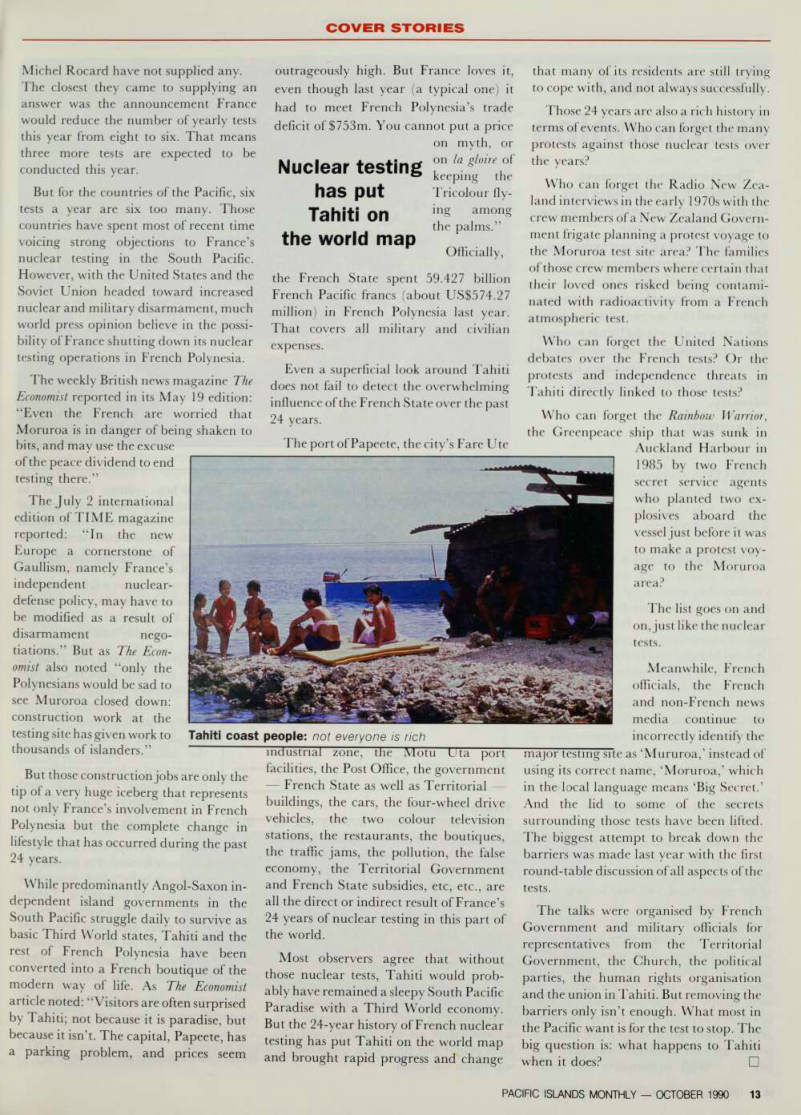
Tahiti coast people: not everyone is rich