Moruroa
pp. 10-12 · Read in the full issue
Cover Stories
Moruroa timebomb
A new study
challenges French
claims and predicts early disaster at the nuclear test site
By David Robie
FIVE, Four, Three, Two, One! The earth shudders. A column of white water bursts from the horizon, rising almost 70 metres into a cloudless blue sky; the sea boils.
ItisdawnonJune2l,l9B7, and French marine biologist Jacques Cousteau’s ship Calypso rests 40 miles offshore from Moruroa Atoll in the Tuamotus. And this is how the Cousteau Society’s magazine, Calypso Log , described the detonation of a nuclear test witnessed by the Calypso team.
Although Cousteau’s official report highlighted extensive damage to the coral of the atoll, including fissures down to a depth of 230 metres, it concluded that “at least for the near future, the tests pose no
danger to Polynesian populations”.
The French government endorsed the report and used the results to vindicate its own assurances that the underground tests were safe. But now a new scientific report had seriously challenged the claims from Paris. It reveals that radioactive waste leaking from the atoll could take less than six years after each test to reach the open sea.
The report, a fresh evaluation of the Calypso water samples prepared by Ame rican scientist Norm Buske for Search Technical Services, an independent en vironmental lobby group, was released last month and prompted widespread response in the Pacific. It urged the French government to allow independent investigators to examine the atoll
thoroughly and to resolve the controversy New Zealand’s Disarmament Minister Fran Wilde promptly called for a study off the Search report while France rejected the finding as “false infor mation”, France’s Suva-based Ambassa dor to the South Pacific, Henri Jacolin, described the nuclear testing programme as environmentally safe. Unconvincced, the 15-nation South Pacific Forum urged the French government to halt nuclear testing at Moruroa.
Greenpeace nuclear tests campaigner Stephanie Mills said her organisation would lobby a United Nations meeting on nuclear testing in January in a bid to get an underground test ban. She called on New Zealand and other Pacific nations to also lobby for a complete ban.
“The burden of proof now rests clearly with the French,” she added, “France must now stop testing immediately and provide full access for an independent and comprehensive study to determine the extent of the environmental problems at Moruroa and Fangataufa.”
According to the influential British magazine New Scientist , Buske’s alle gations cast doubt on the repeated claims by France that contaminated debris from its Pacific tests do not leak into the ocean.
“The new allegations are a cause for concern,” it added, “because in addition to being radioactive, many of the prod ucts of nuclear explosions are poisonous and do not decay for thousands of years.”
Following the 44 atmospheric nuclear tests, more than 120 underground tests
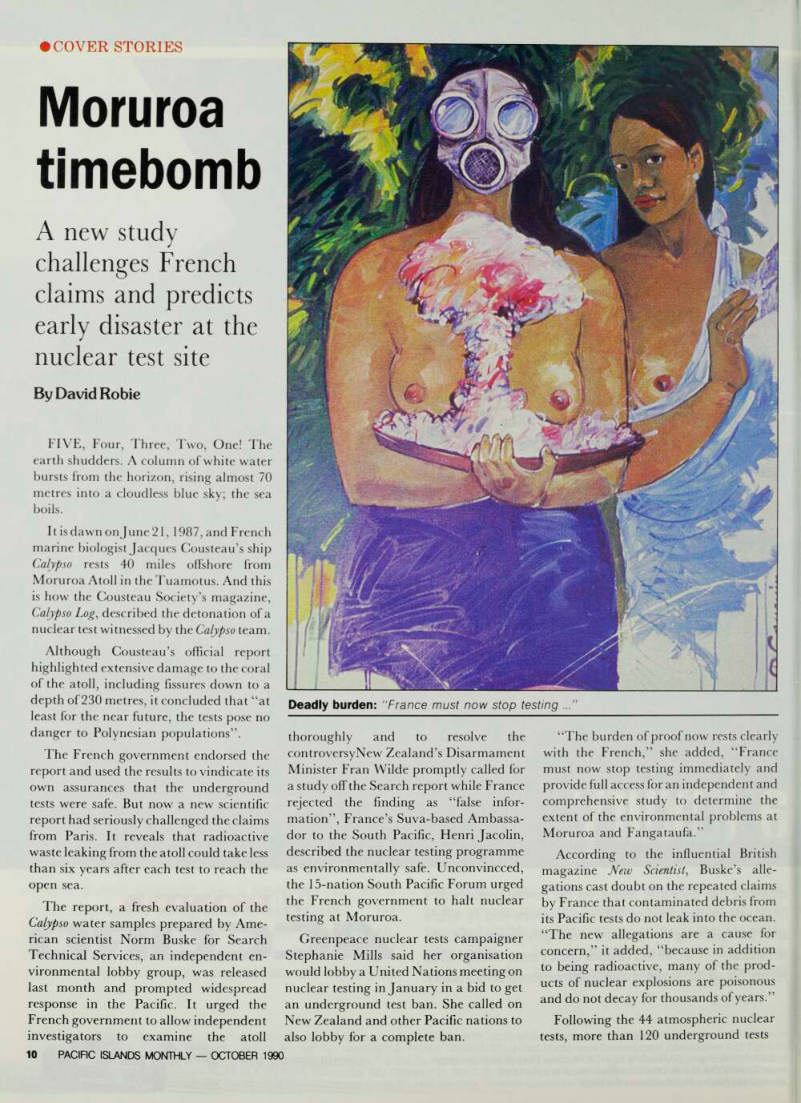
Deadly burden: "France must now stop testing ...”
have been detonated on Moruroa atoll.
The total yield of these tests have been approximately 2500 kilotons the equivalent of more than 200 Hiroshima bombs.
This year there have been four nuclear tests, with two further ones planned.
There have been three at Moruroa and one at Fangataufa.
When Cousteau visited Moruroa in the Calypso during 1987 he collected water samples from the lagoon. However, the French Defence Ministry limited Cousteau to two days for sampling and restricted his sampling zones. While some of Cousteau’s samples were contaminated with radioactive isotopes, French authorities insisted they came from atmospheric tests which began in 1966 and ceased in 1974.
Buske was a scientist on board Eitanin, a ship conducting a hydrographic survey in the South Pacific which was dusted with fallout from Moruroa test in July 1967. He focused much of his analysis on two of Cousteau’s water samples which contained the radioactive isotope caesium -134.
He argues that the only possible source of this isotope was leakage from under ground tests. Caesium-134 has a half-life of just two years so any atmospheric fallout would have decayed by the time Cousteau took samples. Only two out of the samples collected by Cousteau con tained the isotope. Buske believes the isotopes leaked from a 15-kiloton ex plosion in December 1981.
Although another radioactive isotope,
caesium-137, was also present in the samples, this could have been produced by earlier tests because it has a half-life of 30 years.
Other scientists than Buske have also alleged that radioactive leakage from the atoll is far faster than the French claim.
For example, New Zealand’s Professor Manfred Hochstein, diector of the Auckland University Geothermal Insti tute, recently claimed that leakage could come to the surface in about 30 years. He has also used Cousteau data as well as a computer “reservoir model” of the atoll which the institute has developed.
Before reaction to the Buske report quietened, the international environment group Greenpeace fuelled the controversy by publishing a book called Testimonies a 72-page publication recording inter views with people who have worked at Moruroa and Fangataufa atolls, or live on islands near the nuclear testing zone. It describes the impact of the nuclear test
programme on their lives, and the lives of their families and friends.
The interviews were made in secret during 1987 by Dr Andy Biedermann, a Swiss doctor and crew member of the Greenpeace campaign ship Rainbow War
people were so sick, they had to be taken out’
rior which was bombed by French agents in May 1985. He made two trips
to Polynesia, visiting Tahiti and some of the outer islands. Authorities expelled Biedermann from the territory at the end of his stay for alleged “interference” in French defence affairs.
Among many incidents, the book tells of an accident on Moruroa on July 6, 1979 the day before the scheduled test of France’s first neutron bomb (see box). A decontamination worker, identified only as ‘Tama’, said; “My colleague was flung out of the control room just in front of me
dying instantly.”
His French boss, Rene Villette, was killed inside the bunker and two others later died of their injuries. Plutonium and other radioactive substances were said to have scattered and cement was poured
over the bomb container.
While French authorities have con firmed two deaths in the accident, they have consistently claimed no radioac tivity was involved. A statement by the France’s Atomic Energy Commission (CEA) at the time said the explosion was caused when acetone fumes ignited dur ing a cleaning operation.
However, the Paris daily Le Matin also reported that the accident was the result of an explosion during a detonation experiment.
Oscar Temaru, mayor of Tahiti’s biggest urban township of Faa’a and leader of the Tavini Huiraatira party, said a “psychosis of fear” had spread over Moruroa atoll. Recalling visits in 1969 and 1970 he said: “Some people were so sick that they had to be taken off the atoll and later people heard that some of them had died.
Temaru’s party and Protestant church leaders vigorously oppose the nuclear tests. “I have six children aged from three to 15 years,” he said. “My first child was lost at seven months, stillborn for no apparent reason. Another of my sons probably contracted meningitis at six
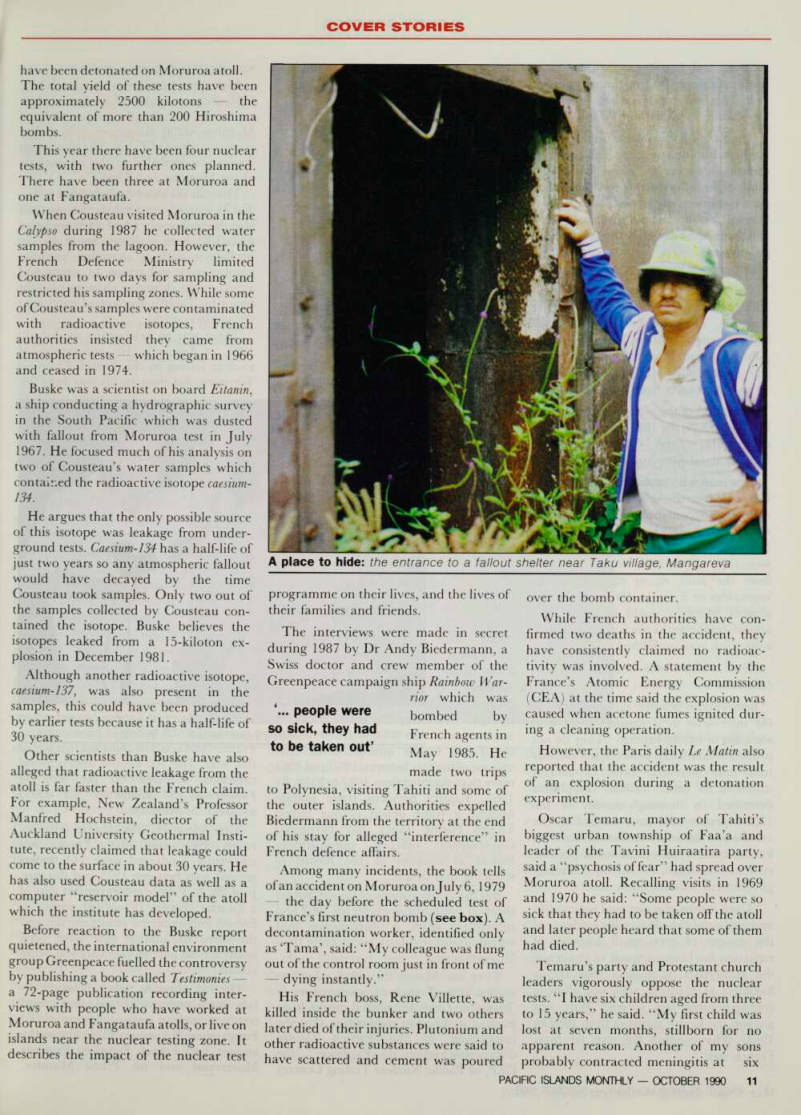
A place to hide: the entrance to a fallout shelter near Taku village, Mangareva
months and has been partially para lysed ever since. Was he simply unlucky, or had his body’s defence been weakened by exposure to radiation? I don’t know.”
The Pacific Experiments Centre (CEP) has been branded by many Tahitians and commentators as a “social bomb” much of the inflation, unemployment and slum conditions present in Tahiti today is blamed on economic distortions and social upheaval caused by the nuclear test programme.
Most of the people interviewed in Testimonies are Maohi (Polynesian); their ancestors have lived in Polynesia for centuries. The publishers say this is the first time many of them have spoken out
publicly about their experience. Many
fear the possibility of official repercussions so their names have been changed.
A handful of the victims and witnesses have spoken on the 1987 British television documentary Tahiti Witness and the 1989 New Zealand film Niukilia Fri Pasifik.
One man who spoke in the latter film, Edwin Haoa, whose job was monitoring the degree of contamination after nuclear tests, said: “People knew that (to work on Moruroa) was dangerous because we were told not to drink any of the water from the atoll, or to eat any of the vegetables or fruit. In 1965, all the fish around Moruroa could be eaten. But almost as soon as the nuclear tests started,
eating fish was prohibited.
“But we’ve been eating fish for centuries.”
Biedermann pointed out that none of the interviews in Testimonies were with scientists or health experts; “They do not prove a relationship between the nuclear tests and increased rates of cancer, stillbirths or other medical complaints described. A thorough survey of the 12,000 people who have worked on the test site and full analysis of health statistics for the last 30 years could alone provide evidence of that but the French government will not allow this.
“Until it does, the personal testimonies and well-established scientific evidence of the danger of even small amounts of radiation for humans stand to challenge the authorities. If nuclear tests are as harmless as claimed, why not allow a
comprehensive test survey? Why not
publish the health statistics from 1963 to 1983? Why conduct the tests far from French soil?” □