Pacific consciousness?
pp. 6-7 · Read in the full issue
Does Australia have a Pacific consciousness?
THE interest and debate provoked by the Fiji coups and the events in New Caledonia in early 1988 promoted many to suggest that Australians had finally discovered the South Pacific; that they had gone beyond the tourist images to understand something of the diversity of the region’s politics and its importance to Australia. But have Australians developed an awareness of themselves as an integral part of the South Pacific?
For the swelling tides of Australian tourists who visit the Pacific islands each year in their tens of thousands, a “discovery holiday” more often than not means lazy days at a big resort, safely secluded from the reality ofdaily life in the Pacific.
Australian business has been quick to take advantage of the massive tax concessions offered by post-coup Fiji and is expanding beyond its traditional areas into new ones. Witness Westpac’s move into New Caledonia and the growing number ofsmall manufacturing concerns interested in moving offshore to take advantage oflow wage rates.
During its seven years in office the Hawke government has presided over big changes in Australia’s approach to the Pacific,
increasing aid and opening or
upgrading diplomatic missions
in all but the smallest island states.
Australia’s Governor- General, Bill Hayden, during his five years as Foreign Minister, made just two trips to the South Pacific. Since then the pace of high level interaction has quickened. The current minister, Senator Gareth Evans, has made five trips and has another planned. He has used these to establish warm personal relations with many leaders.
Evan’s policy of“constructive commitment” announced in late 1988 marked a turning point. It placed the South Pacific as the government’s highest foreign relations priority, drawing together the different strands ofdiplomacy, aid and defence co operation in a co-ordinated approach.
But still ordinary Australians know little of the region.
Australia by far the biggest nation in the region and the only one with major commitments outside can also find herself an uncomfortable member of the South Pacific Forum.
That discomfort was seen at the August Forum in Port Vila
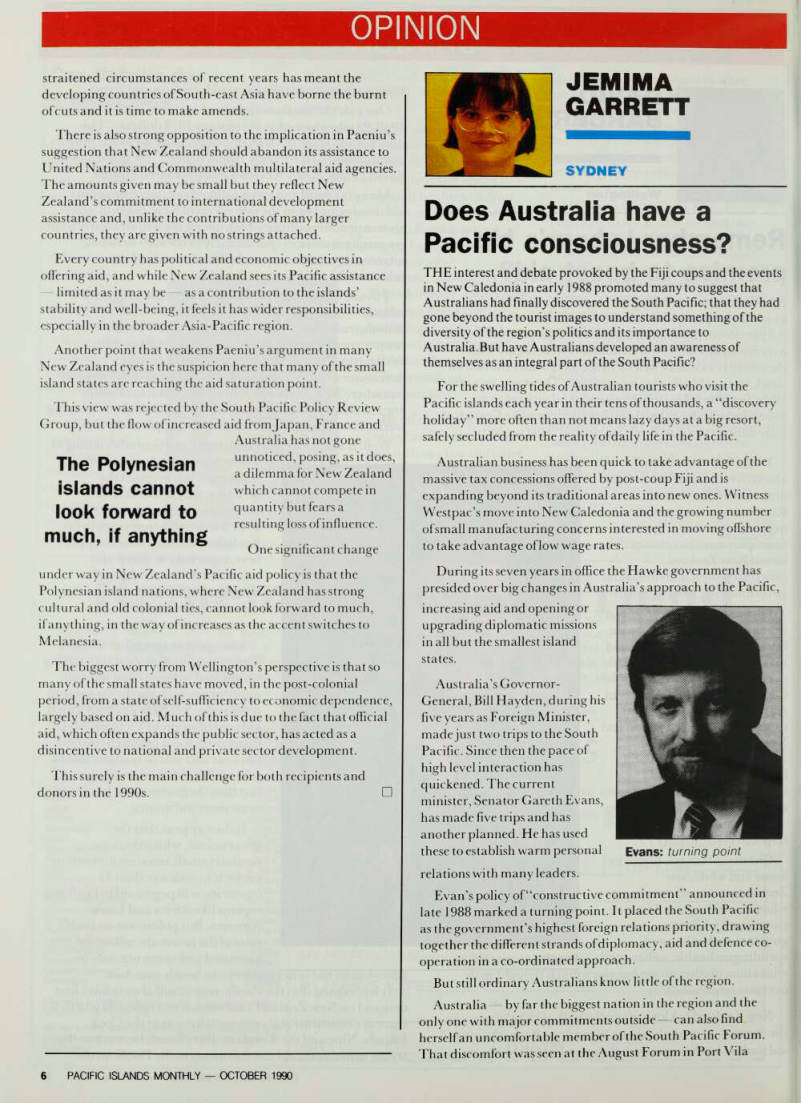
Jemima
Garrett
Sydney
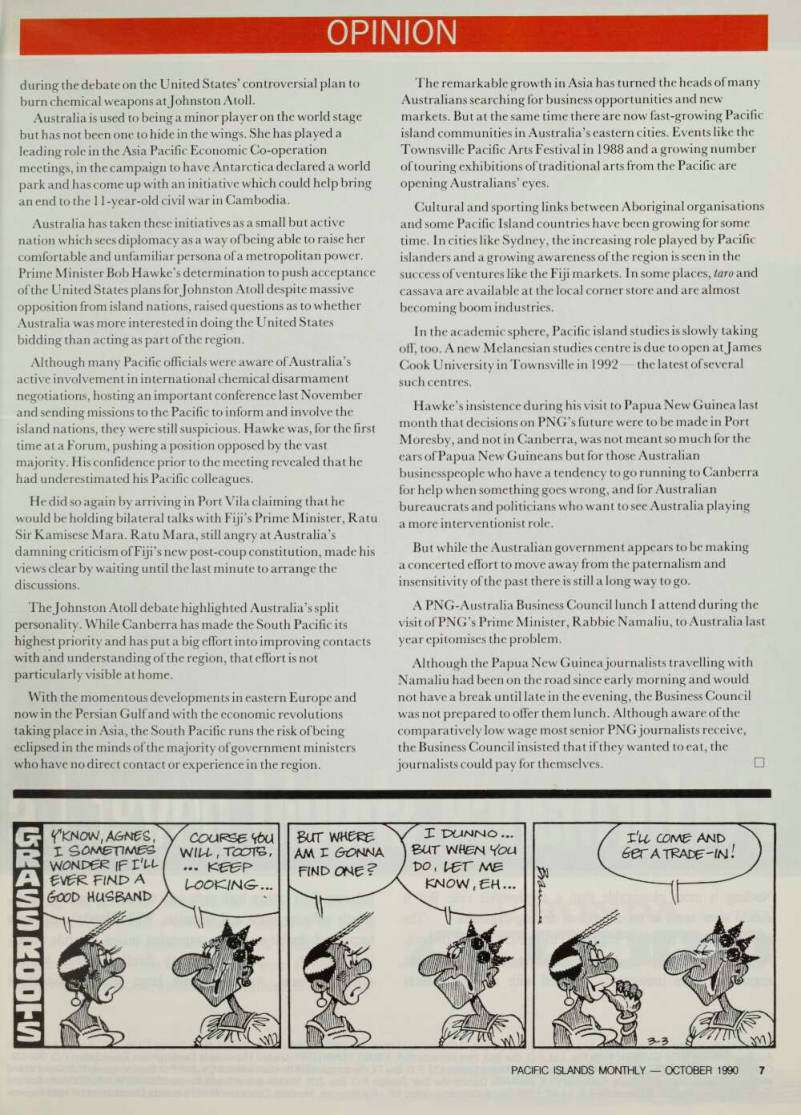
Evans: turning point
during the debate on the United States’ controversial plan to burn chemical weapons at Johnston Atoll.
Australia is used to being a minor player on the world stage but has not been one to hide in the wings. She has played a leading role in the Asia Pacific Economic Co-operation meetings, in the campaign to have Antarctica declared a world park and has come up with an initiative which could help bring an end to the 11 -year-old civil war in Cambodia.
Australia has taken these initiatives as a small but active nation which sees diplomacy as a way of being able to raise her comfortable and unfamiliar persona of a metropolitan power.
Prime Minister Bob Hawke’s determination to push acceptance of the United States plans for Johnston Atoll despite massive opposition from island nations, raised questions as to whether Australia was more interested in doing the United States bidding than acting as part of the region.
Although many Pacific officials were aware of Australia’s active involvement in international chemical disarmament negotiations, hosting an important conference last November and sending missions to the Pacific to inform and involve the island nations, they were still suspicious. Hawke was, for the first time at a Forum, pushing a position opposed by the vast majority. His confidence prior to the meeting revealed that he had underestimated his Pacific colleagues.
He did so again by arriving in Port Vila claiming that he would be holding bilateral talks with Fiji’s Prime Minister, Ratu Sir Kamisese Mara. Ratu Mara, still angry at Australia’s damning criticism of Fiji’s new post-coup constitution, made his views clear by waiting until the last minute to arrange the discussions.
Thejohnston Atoll debate highlighted Australia’s split personality. While Canberra has made the South Pacific its highest priority and has put a big effort into improving contacts with and understanding of the region, that effort is not particularly visible at home.
With the momentous developments in eastern Europe and nowin the Persian Gulf and with the economic revolutions taking place in Asia, the South Pacific runs the risk of being eclipsed in the minds of the majority of government ministers who have no direct contact or experience in the region.
The remarkable growth in Asia has turned the heads of many Australians searching for business opportunities and new markets. But at the same time there are now fast-growing Pacific island communities in Australia’s eastern cities. Events like the Townsville Pacific Arts Festival in 1988 and a growing number of touring exhibitions of traditional arts from the Pacific are opening Australians’ eyes.
Cultural and sporting links between Aboriginal organisations and some Pacific Island countries have been growing for some time. In cities like Sydney, the increasing role played by Pacific islanders and a growing awareness of the region is seen in the success of ventures like the Fiji markets. In some places, taro and cassava are available at the local corner store and are almost becoming boom industries.
In the academic sphere, Pacific island studies is slowly taking off, too. A new Melanesian studies centre is due to open at James Cook University in Townsville in 1992 the latest of several such centres.
Hawke’s insistence during his visit to Papua New Guinea last month that decisions on PNG’s future were to be made in Port Moresby, and not in Canberra, was not meant so much for the ears of Papua New Guineans but for those Australian businesspeople who have a tendency to go running to Canberra for help when something goes wrong, and for Australian bureaucrats and politicians who want to see Australia playing a more interventionist role.
But while the Australian government appears to be making a concerted effort to move away from the paternalism and insensitivity of the past there is still a long way to go.
A PNG-Australia Business Council lunch I attend during the visit of PNG’s Prime Minister, Rabbie Namaliu, to Australia last year epitomises the problem.
Although the Papua New Guinea journalists travelling with Namaliu had been on the road since early morning and would not have a break until late in the evening, the Business Council was not prepared to offer them lunch. Although aware of the comparatively low wage most senior PNG journalists receive, the Business Council insisted that if they wanted to eat, the journalists could pay for themselves. □