Opinion
pp. 5-6 · Read in the full issue
Remember Labour’s big promise to boost aid?
BACK in the early 19705, Norman Kirk’s Labour government pledged to raise New Zealand’s overseas aid to 0.7 per cent of the country’s gross domestic product. 11 was a commitment most New Zealanders were happy with they were reasonably well off in the days before the first oil shock and could afford to be generous. There was an active lobby in favour of giving developmental assistance to countries less advantaged and organisations like Corso had little difficulty raising funds for aid and relief projects.
We haven’t heard much about overseas aid for a decade or so now and as the pain of Rogernomics has intensified over recent years and record
unemployment has changed the
face ofNew Zealand, generosity, both individual and governmental, has dwindled.
Last year, the ratio of official development assistance (as the bureaucrats now like to call aid) to GDP was down to a fraction over 0.2 per cent, well below the OECD average 0f0.36 per cent.
Australia and Canada spent twice as much, and Sweden and
Norway —Scandanivian
countries that New Zealand likes to think of as blood brothers in terms of their attitude to international affairs three and four times as much
respectively.
Charity, ofcourse, begins at
home and while New Zealanders can still give freely when stirred by good domestic causes, and while the government has boosted spending on health, welfare and
education, neither group has given much thought to its overseas responsibilities.
New Zealand has long given the bulk of its aid money to the Pacific currently about 70 per cent. But as the overall aid budget has been pegged, the money available for the
Pacific region has declined considerably in real terms.
One calculation shows it halved between 1982-83 and 1988-89 when looked at in constant 1979 dollars. “The diminishing levels ofODA do not measure up to our priority commitment to the Pacific Island region,” the government’s South Pacific Policy Review Group declared bluntly.
Many off the island states suffered not only from a cut in aid monies, but from the side effects of New Zealand’s own economic restructuring which forced the withdrawal of some government services (particularly in the civil aviation, meteorology, education and scientific research areas) and substantial rises in charges for others.
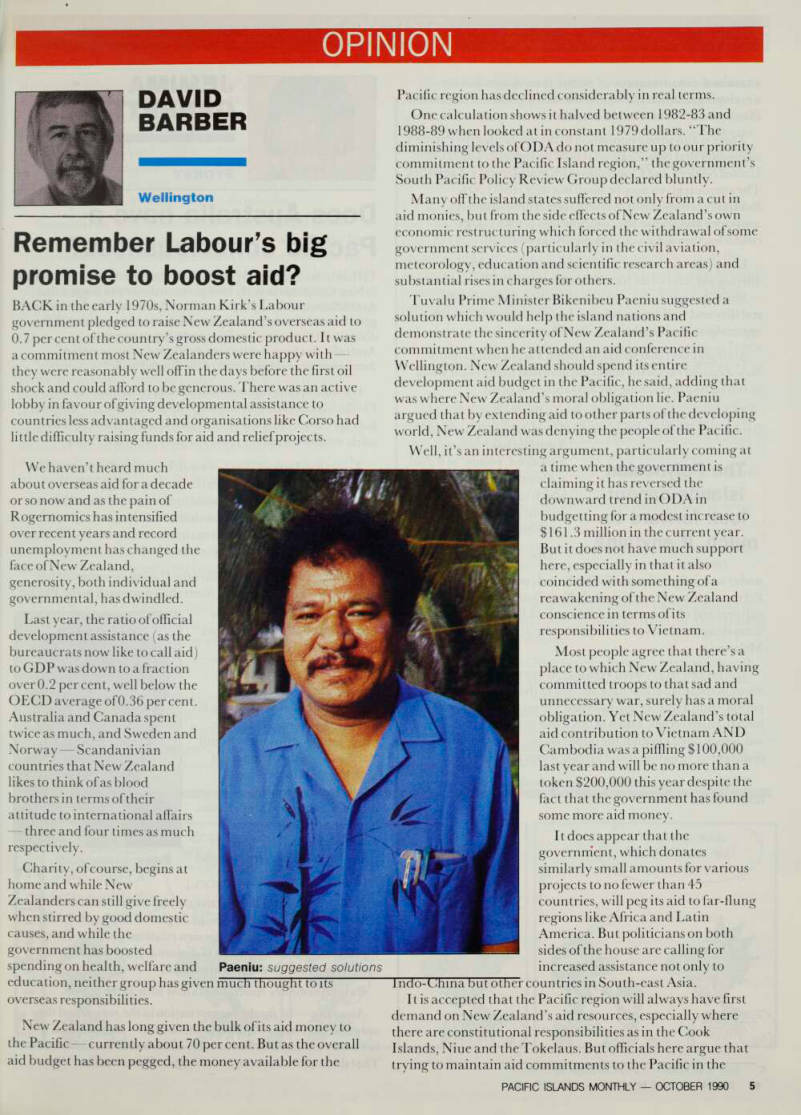
Tuvalu Prime Minister Bikenibeu Paeniu suggested a solution which would help the island nations and demonstrate the sincerity of New Zealand’s Pacific commitment when he attended an aid conference in Wellington. New Zealand should spend its entire development aid budget in the Pacific, he said, adding that was where New Zealand’s moral obligation lie. Paeniu argued that by extending aid to other parts of the developing world, New Zealand was denying the people of the Pacific.
Well, it’s an interesting argument, particularly coming at
a time when the government is claiming it has reversed the downward trend in ODA in budgetting for a modest increase to $161.3 million in the current year.
But it does not have much support here, especially in that it also coincided with something of a reawakening of the New Zealand conscience in terms of its responsibilities to Vietnam.
Most people agree that there’s a place to which New Zealand, having committed troops to that sad and unnecessary war, surely has a moral obligation. Yet New Zealand’s total aid contribution to Vietnam AND Cambodia was a piffling $ 100,000 last year and will be no more than a token $200,000 this year despite the fact that the government has found some more aid money.
It does appear that the government, which donates similarly small amounts for various projects to no fewer than 45 countries, will peg its aid to far-flung regions like Africa and Latin America. But politicians on both sides of the house are calling for increased assistance not only to
lndo-(Jhma but other countries in South-east Asia.
It is accepted that the Pacific region will always have first demand on New Zealand’s aid resources, especially where there are constitutional responsibilities as in the Cook Islands, Niue and the Tokelaus. But officials here argue that trying to maintain aid commitments to the Pacific in the
David
Barber
Wellington
Paeniu: suggested solutions
straitened circumstances of recent years has meant the developing countries of South-east Asia have borne the burnt ofeuts and it is time to make amends.
There is also strong opposition to the implication in Paeniu’s suggestion that New Zealand should abandon its assistance to United Nations and Commonwealth multilateral aid agencies.
The amounts given may be small but they reflect New Zealand’s commitment to international development assistance and, unlike the contributions of many larger countries, they are given with no strings attached.
Every country has political and economic objectives in offering aid, and while New Zealand sees its Pacific assistance limited as it may be as a contribution to the islands’ stability and well-being, it feels it has wider responsibilities, especially in the broader Asia-Pacific region.
Another point that weakens Paeniu’s argument in many New Zealand eyes is the suspicion here that many of the small island states are reaching the aid saturation point.
This view was rejected by the South Pacific Policy Review Group, but the flow ofincreased aid fromjapan, France and
The Polynesian islands cannot look forward to much, if anything
Australia has not gone unnoticed, posing, as it does, a dilemma for New Zealand which cannot compete in quantity but fears a resulting loss ofinfluence.
One significant change
under way in New Zealand’s Pacific aid policy is that the Polynesian island nations, where New Zealand has strong cultural and old colonial ties, cannot look forward to much, ifanything, in the way ofincreases as the accent switches to Melanesia.
The biggest worry from Wellington’s perspective is that so many of the small states have moved, in the post-colonial period, from a state ofself-sufFiciency to economic dependence, largely based on aid. Much of this is due to the fact that official aid, which often expands the public sector, has acted as a disincentive to national and private sector development.
This surely is the main challenge for both recipients and donors in the 19905. □