concrete coffin
pp. 15-16 · Read in the full issue
A blast victim’s concrete coffin
TAMA began working at Moruroa in the 1960 s as an office worker and later became a decontaminator. This is an extract from his story: C Bombs were still being exploded in the atmosphere then, and workers were evacuated just before the tests. Even though we returned to the atoll only four to seven days later no one wore protective clothing except in the prohibited zones.
After five years of office work, I was sent back to work at the LSR [Radiological Surveillance Laboratory] in Papeete which monitors fish, coral, taro, sweet potato and so on for radioactive contamination. At that time there were few Tahitians working there but now it’s exclusively whites and there is barbed wire around it.
Two years later, I returned to Moruroa to do administrative work for about four months before working as a decontaminator.
By that time the French had changed from atmospheric to underground testing . . . We were issued with gloves to wear for this work but no other protective clothing was provided although sometimes we wore masks . . .
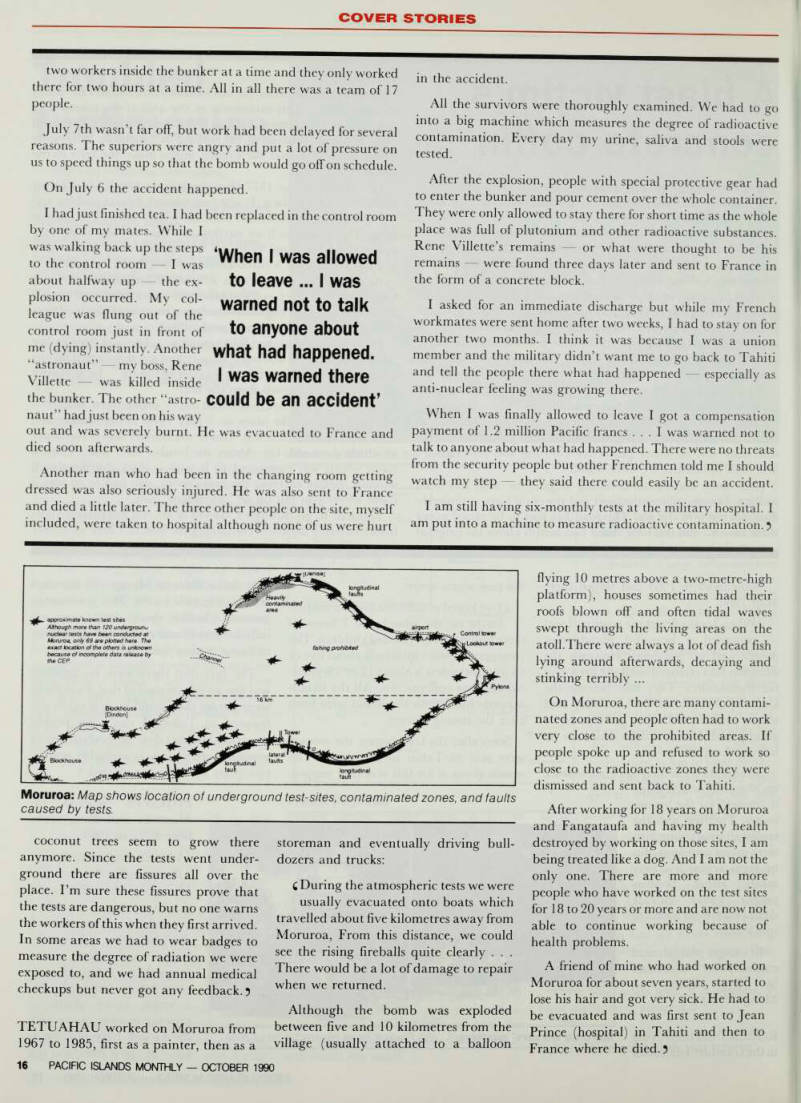
Ever since underground testing began, the atoll has been sinking. In some places the land and the coral have completely disappeared into the sea. The road has had to be raised every three months and it is now about two metres above the original
ground level.
It is still possible to see the old roadway down under the water in some places. This subsidence of the atoll is the reason why huge amounts of cement have to be brought in from France and New Zealand. Because of the sinking at Moruroa, there were rumours in 1977 that the French might move the tests to the
Kerguelen Islands.
It was also about 1977 that the biggest bomb blast I ever experienced took place. It was codenamed Astanyx and the test site was about 27 kilometres from the village in the Viviane test area. There was such an earthquake that no one could stay upright. At the same time, on the opposite side of the atoll beyond the airport a three-kilometre-long crack opened up.
As a result of further tests it gradually extended to seven kilometres. The deep end is submerged under water and cannot be seen. This crack has not been shown to journalists all they ever get to see is the airport and village.
I have also experienced fish poisoning ... I got sick from eating fish several times. I was itchy all over and my skin peeled off just like a snake. One of my friends was less fortunate he died after eating fish and mussels from the sea.
The first French neutron bomb test codenamed Meknes was supposed to take place on 7 July 1979. A big bunker had been built just for this test. Inside the bunker was a container in which the bomb lay. Above the bunker itself was a control room which was connected to it with a thick double-glazed window. Before entering the main room, you had to go into a room where you put on an “astronaut” suit.
You had to go through a system of several automatic doors before entering the room containing the bomb. There were only
two workers inside the bunker at a time and they only worked there for two hours at a time. All in all there was a team of 17 people.
July 7th wasn’t far off, but work had been delayed for several reasons. The superiors were angry and put a lot of pressure on us to speed things up so that the bomb would go off on schedule.
On July 6 the accident happened.
I had just finished tea. I had been replaced in the control room
by one of my mates. While I was walking back up the steps to the control room I was about halfway up the ex plosion occurred. My col league was flung out of the control room just in front of
me (dying) instantly. Another
“astronaut” my boss, Rene Villette was killed inside the bunker. The other “astro naut” had just been on his way
‘When I was allowed to leave ... I was warned not to talk to anyone about what had happened.
I was warned there could be an accident’
out and was severely burnt. He was evacuated to France and died soon afterwards.
Another man who had been in the changing room getting dressed was also seriously injured. He was also sent to France and died a little later. The three other people on the site, myself included, were taken to hospital although none of us were hurt
in the accident.
All the survivors were thoroughly examined. We had to go into a big machine which measures the degree of radioactive contamination. Every day my urine, saliva and stools were tested.
After the explosion, people with special protective gear had to enter the bunker and pour cement over the whole container.
They were only allowed to stay there for short time as the whole place was full of plutonium and other radioactive substances.
Rene Villette’s remains or what were thought to be his remains were found three days later and sent to France in the form of a concrete block.
I asked for an immediate discharge but while my French workmates were sent home after two weeks, I had to stay on for another two months. I think it was because I was a union member and the military didn’t want me to go back to Tahiti and tell the people there what had happened especially as anti-nuclear feeling was growing there.
When I was finally allowed to leave I got a compensation payment of 1.2 million Pacific francs ... I was warned not to talk to anyone about what had happened. There were no threats from the security people but other Frenchmen told me I should watch my step they said there could easily be an accident.
I am still having six-monthly tests at the military hospital. I am put into a machine to measure radioactive contamination. 5