Talat Mehmood
pp. 46-47 · Read in the full issue
New Zealand
Big challenge for the islanders
By Lito Vilisoni
PACIFIC Islanders are asking with increasing zeal what their place is in New Zealand society. The question is a prickly one because at the heart of the issue is the Maori challenge: Do Pacific Islanders support the Treaty of Waitangi and Maori efforts to have Pakeha honour it? If so, what are they doing about it?
Last month, 150 leaders from all the country got their teeth into the subject at a conference in Auckland organised by the Race Relations Office. They con cluded it was a privilege for Pacific islan ders to be in Aotearoa, and that the Treaty was important to the well-being of all New Zealanders. Leaders called for Pacific Islanders to actively support Maori in their effort to have the Treaty honoured, and for the Crown to recog nise the Maori version of the 150-year old document ahead of its own.
But there were conflicting opinions on the subject, especially over what the Paci fic island “support” for Maori sovereign ty meant in practical terms, and whether it would be compatible with Pacific Is land aspirations. Like all Immigrants, Pacific Islanders came to New Zealand in search of opportunity and believe it to be his or her right to build what he can for himself or herself. Yet, Maori have accused them of “making it on the backs of Maori” and have castigated them for settling here without first seeking the blessing of tangata whenua.
Tupe Tai, a teacher at Auckland Girls Grammar, said Pacific Islanders shouldn’t apologise for their success.
“The bottom line for Pacific Islanders is this: We must make good in this society otherwise we will always be an immigrant and at the bottom of the heap”. Tai, born in Western Samoa and educated in New Zealand, said Pacific Islanders should tread with caution on the Treaty.
It was an emotive issue and Pacific Islan ders didn’t know enough about it yet to conduct an informed debate. Those who had been exposed to the issue, such as the young, had conflicting opinions. And key groups, such as parents, had been isolated from the subject so the confer ence could not speak for them.
She supported the “Maori struggle to find their place in society and to regain their mana” and appreciated they had special needs as tangata whenua . But she didn’t think Maori should get preferen tial treatment. Everyone should have ac cess to resources, “I don’t think we, or our children, should be held back. I see ourselves (Maori and Pacific Islanders) as
equal in competing for resources, parti
cularly in education. I don’t think for one minute we should take a back seat.”
Mua Strickson-Pua, a minister with the social services agency, Presbyterian Sup port Services, agreed with Tongan speaker Litia Foliaki, a lecturer at the School of Social Work at the Auckland College of Education, who said the Trea ty was a moral issue. “We must support the Treaty if we are the moral Pacific person people we have been told we are
today,” said the 32-year-old.
Born in New Zealand, Strickson-Pua said Pacific Islanders were the natural ally of Maori. What Maori gained, Pacific Islanders would benefit from, as it had in the past. He said Pacific Islanders couldn’t help but support Maori once they put themselves in Maori shows.
“What if this was, say Samoa, and Niueans were trying to take over? And what if the Samoans couldn’t speak their own language, had lost their land, and most of them were in jail? What then?”
Pacific Islanders sympathise with Maori and believe past injustices should be corrected. But the fear that the injus tices of the past will be righted with new wrongs leaves some uneasy. Today, more than 125,000 Pacific Islanders make their home in New Zealand. With the new “Asian Invasion”, a very visible mul ticultural community has destroyed the idea of a bicultural society. Yet, Maori and Pakeha remain committed to a bicultural agenda, even as it celebrates its 150th birthday this year and talks of one nation.
In June, the New Zealand Ethnic Council held a similar conference to the
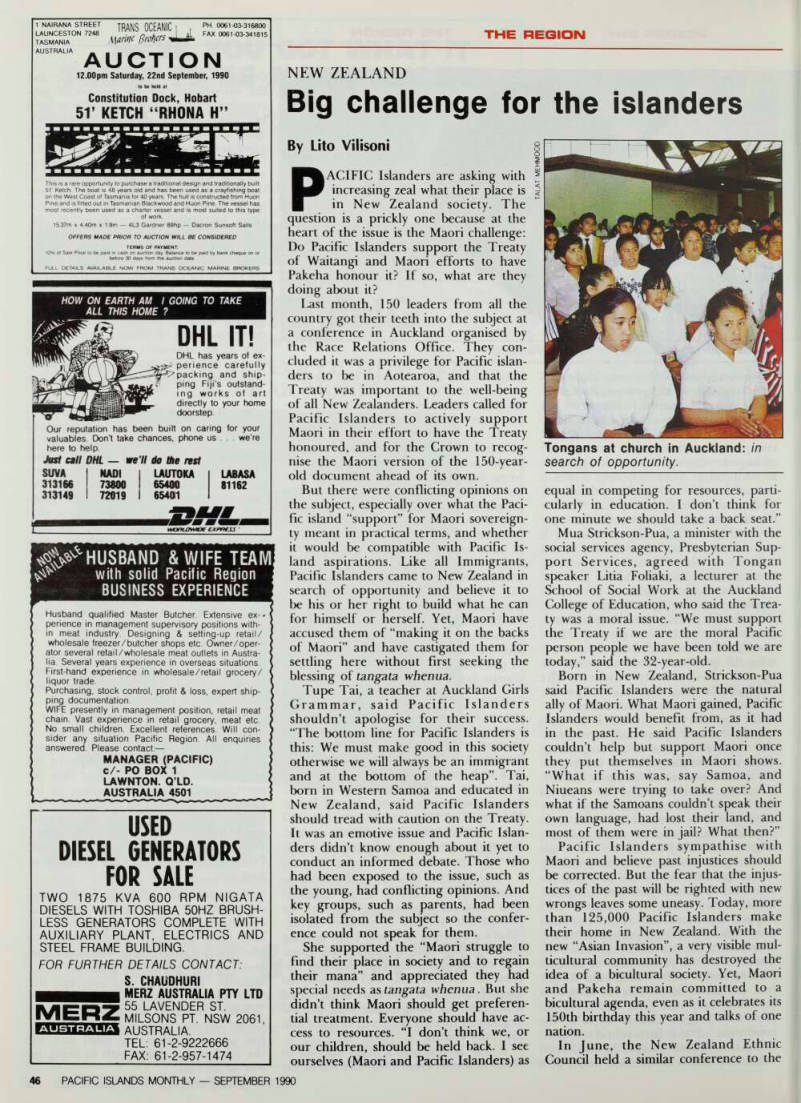
Tongans at church in Auckland: in search of opportunity.
Talat Mehmood
Pacific Island with the theme “Multiethnic New Zealand: A Commitment for the Future.” The council called on New Zealanders to meet the challenge of formulating a national policy which responded to everyone’s culture while refleeting the special status of Maori as tangata whenua, and their special rights under the Treaty. The council outlined
an eight-point policy proposal which in-
eluded the principle “. . . Everyone should enjoy equal life chances and have equitable access to and an equitable
share of the resources which the Govern ment manages on behalf of the com
munity.”
The conference discussed fears that biculturalism as created by the Treaty, excluded non-Maori ethnic groups from decisions about New Zealand’s future, Auckland Ethnic Council president, Phi lip Khouri, said: “We think the term biculturalism is confusing because it means two cultures when the Treaty is not about culture at all. It is about an ageement between Maori and Crown.”
Emele Duituturaga, director of com munity development for the Wellington City Council, agrees with Khouri’s analy sis. She said the Treaty was the only way to redress injustices, but she didn’t agree with the belief Maori had to be under stood ahead of other groups. “I don’t agree with the view that we must go through biculturalism to reach multir acialism. I object to being left out of any definition of biculturalism because I think we have put our best into this country.”
Duituturaga, who urged Maori and Pacific Islanders to work together, was concerned about the next generation.
She said home for her was Fiji, but her children who had been born and raised in Aotearoa, may not feel the pull of Fiji as she did. She wanted to secure a place for them ... to make sure they were not
“displaced”.
Whether Maori want to work with Pacific Islanders remains unclear. Earlier this year, the Auckland District Maori Council supported a call by the synod of the Anglican Maori Church to stop all immigration to New Zealand until Maori
were accorded joint decision-making
powers in immigration policy. The synod
said immigration posed a serious threat to the livelihood, status and mana of tan gata whernia: The synod’s call was reiterated at the ethnic council in June with lawyer Peter
Rikys saying a Human Rights Commis
sion report showed up to 17,000 jobs
were occupied by illegal migrant work
ers, depriving Maori of work.
One of the first Western Samoans to settle in New Zealand, Tanuvasa Yandall (64), said he believed Maori did not want a partnership with Pacific Islanders. He said Maori had deliberately severed ties with the Pacific Immigrants because the latter were a burden to them. “Maori are claiming biculturalism for a specific pur pose ... so that two people only can settle the grievances.” Tanuvasa said the issue was a minefield for Pacific Islan ders.
“1 advise our young people to keep away from it all, to let it be settled first.
We have no right. This is not our home land. We should mind our own business.
I say to our young people ‘Don’t put your neck on the chopping block. If
something goes wrong, they might turn
around and blame us. We’ve got to keep out of criticism, be neutral and just do our work.”
The Race Relations Office plans a second conference in Wellington early next year. Leaders who attended the first, said they welcomed the chance to voice their concerns, although one said the “real debate” between Maori and Pacific Islanders had yet to take place. It would be several conferences before peo ple “really cut loose.” □