Ulafala Aiavao
pp. 48-49 · Read in the full issue
Western Samoa
AIDS on tiptoe
By Ulafala Aiavao
WESTERN Samoa has finally in formed the World Health Organisation of its first official case of Acquired Immune Deficiency Syndrome (AIDS), months after the vic tim died this year and months after WHO’s Apia office knew of it unofficial ly. The delayed notification reflects the
“tiptoe tactics” being adopted by health
officials in its AIDS awareness campaign.
This approach has both been criticised and praised, with the critics insisting in formation on what’s happening and whafs available must be made known to the general population. Yet the cautious approach has been the tactic of those careful not to cause alarm.
The first hint from official sources that Western Samoa had a diagnosed AIDS case came last year when there was a subtle shift in the publicity mode to stress “compassion and respect” for those with the disease. The victim found understanding and support from family members and the small support group which knew of the case.
To continue to educate the public is not easy in Western Samoa where cultu ral and social taboos are posing difficult obstacles. For example, it is culturally difficult to broadcast or publicise in the Samoan language the dangers of anal intercourse or the benefits of using con doms when such intimate topics them selves cannot be discussed by men in the presence of women. International agen cies like the Red Cross and the Family Health Association (FHA) are trying to solve the communication problem by talking to small, segregated groups at work in town, in schools, in the villages and at the gatherings of chiefs. Field workers have found that it is difficult to generate discussions in a gathering where both men and women are present.
The message being spread to the Sa moans is simple: AIDS is incurable but preventable. And so the Samoans,
living in a supposed tropical paradise,
are consistently being told: no homosex uality, no dirty needles, no intimacy with
infected people. Mosquitoes, however,
cannot carry the AIDS virus so don’t worry about that. Officials are checking on tatooists, ear piercers and acupunc turists to remind them to boil those nee dles.
“With AIDS we can’t sidestep,” said FHA Executive Director Lemalu Faumuina. “We must tell the truth and break a barrier because flowery language is no use. FHA prefers to use the term “family health” and not “sex education”
when on an AIDS awareness campaign because many Samoans associate sex purely with the physical act of intercourse. The target groups are 15 to 24year-olds and 25 to 60-year-olds. Education covers other areas like nutrition,
health, hygiene and family budgeting.
A suggestion by former health director-general Dr Walter Vermullen for the AIDS campaign to be blunt in its approach was easier said than done.
Some English language programmes on radio and posters have been viewed as being to sexually descriptive to be translated into the Samoan language. One good example was the radio plug: “Advice from officials is to avoid anal intercourse, avoid multiple partners or wear a condom. AIDS can be contracted through contaminated transfusions or from an infected mother to her baby.”
While this was able to run on national radio 2AP in English, no one dared
translate it into Samoan for the ver nacular programme. The plug was drop ped after two years when it was finally considered too blunt. Similarly an attempt by a government agency to edu cate village youths on AIDS some years ago failed when a detailed feature in the English language Samoan Times news paper, showing publicly for the first time intimate descriptions of body functions and fluids, was never translated into Sa moan.
The root of the problem is the lack of sex education in schools. An attempt at some form of sex education was made last year when the Education Depart ment released the text book Making More Of Me to form five. But some teachers refused to use the text book, saying it was difficult to discuss sex with the class, male teachers were reluctant to talk about women-related problems like menstruation, and some were just opposed to having a text book with clear
illustrations of the human body But school examination results last year showed that students did well in subjects covered by Making More of Me, a proof that students were reading the book, AIDS and how it’s seen in Western Samoa has had some effect in the local blood donation programmes. Some
donors stopped giving blood fearing it
could expose them to the AIDS virus, Others feared tests on blood samples might prove positive, thus exposing them as AIDS carriers. Of the 3000 units of blood tested so far by the National Hospital’s laboratory, there has only been one confirmation, the victim who died this year. Ten other positive tests were later returned negatives after further tests in Australia. The hospital collects nearly 1400 units of blood a year locally. A small amount, like frozen plas ma, is imported. Ten per cent of the blood donated are rejected because of
the presence of Hepatitis B antigens, said Consultant Pathologist Dr Asaua Vaasilifiti. Some blood contains syphilis, but very little, he said. The donors are mostly family members of the sick. Some blood is given by Red Cross volunteers and others often respond to appeal broadacast on radio for the rare blood type “AB”.
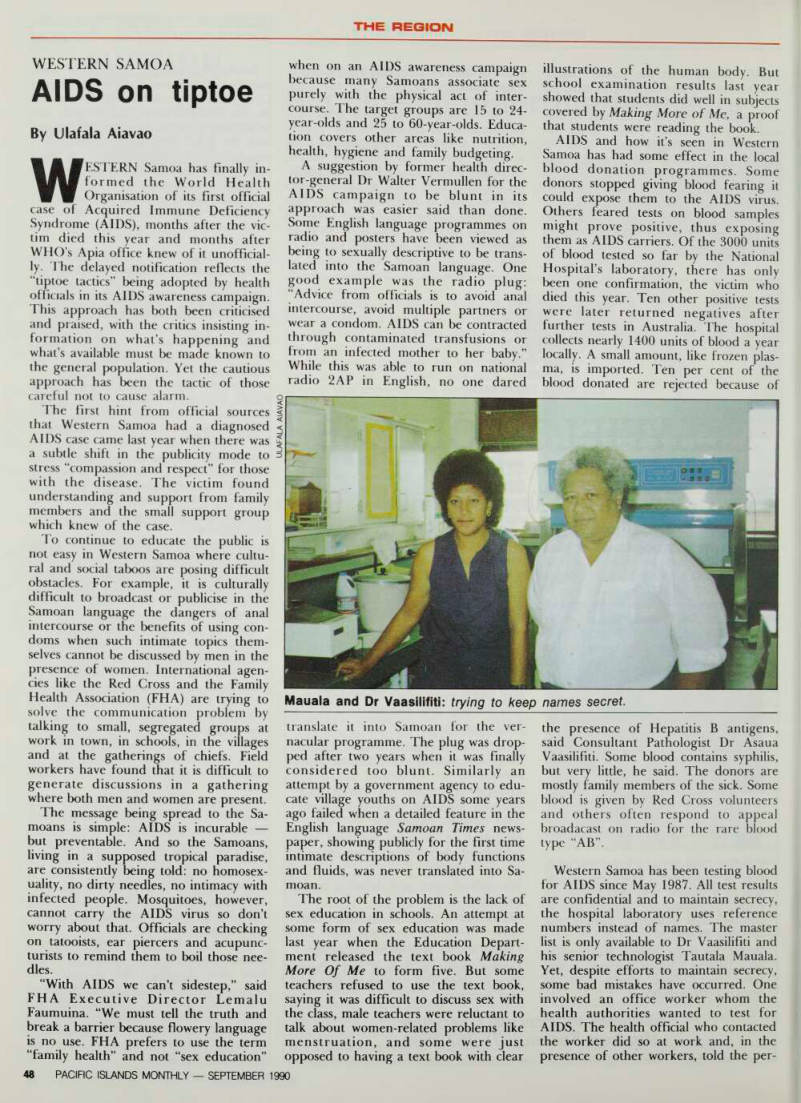
Western Samoa has been testing blood for AIDS since May 1987. All test results are confidential and to maintain secrecy, the hospital laboratory uses reference numbers instead of names. The master list is only available to Dr Vaasilifiti and his senior technologist Tautala Mauala.
Yet, despite efforts to maintain secrecy, some bad mistakes have occurred. One involved an office worker whom the health authorities wanted to test for AIDS. The health official who contacted the worker did so at work and, in the presence of other workers, told the per
Mauala and Dr Vaasilifiti: trying to keep names secret.
Ulafala Aiavao
son he was a suspected AIDS carrier, “Could you come in for a test?” The person was horrified, refused to go to the clinic and flew overseas for tests. His
tests proved negative.
Another case involved an American man who went to Western Samoa and said he had AIDS and that his doctor advised him to go and live in a tropical country. When the man’s short-term visa expired, he was told to go to American Samoa because he had to apply for a new visa from outside the country. The man left and the Department of Im migration issued an advisory to airlines
and shipping companies, telling them
the man had AIDS and was not allowed to re-enter Western Samoa.
Today, the Australian Government re quires all Western Samoan applying for permanent residency to have an AIDS test. The Western Samoa Government protested and tried to resist when the new regulation was introduced last De cember, saying the AIDS test was purely a medical process and should not be used to discriminate against people. But by last June a Samoan applicant for permanent residency in Australia underwent blood test for AIDS.
Insurance companies have also intro duced a screen for AIDS. Western Samoa Life Assurance Corporation is asking customers if they have ever been asked not to be a blood donor, if they have had a blood transfusion since 1980, if they suffer from AIDS or an AlDS related condition, or if they are engaged in activities that expose them to a greater risk of contracting AIDS or an AlDS related condition. This anti-AIDS clause is almost watertight. Even those who slip through the screening process and are found at death to have died from AIDS or an AIDS-related condition, lose all be nefits and their benefectors are paid only a refund of the premiums paid.
World Health Organisation officials and Western Samoa’s National AIDS commit tee are opposing such discriminatory procedures, because, as they argue, some people tested positive for AIDS don’t get sick and can live a normal life. The other argument is that insurance com panies always had a checklist for illnesses like diabetes, insanity, high blood press ure and obesity, and AIDS is just another addition to the list.
While most of the attention is being focussed on the victims of AIDS and its prevention, the population is hardly edu cated on the role of the health workers.
This issue has been raised by the 252member Western Samoa Registered Nurses Association (WSRNA) which is concerned about its frontline role in the treatment of AIDS patients. “We will still treat them, but some nurses need to pre pare psychologically to overcome their reluctance,” said association president
Faamanatu Nielsen. The association has opened a Nurses’ Hall for in-service training and to facilitate the study of issues like AIDS-related work.
The under-reporting of the Western Samoa AIDS campaign is coupled with the little information available on sexual ly transmitted diseases to make the awareness programme difficult. “We are not able to get a true picture of sexually transmitted diseases (STD) because some
patients are seen by private doctors,”
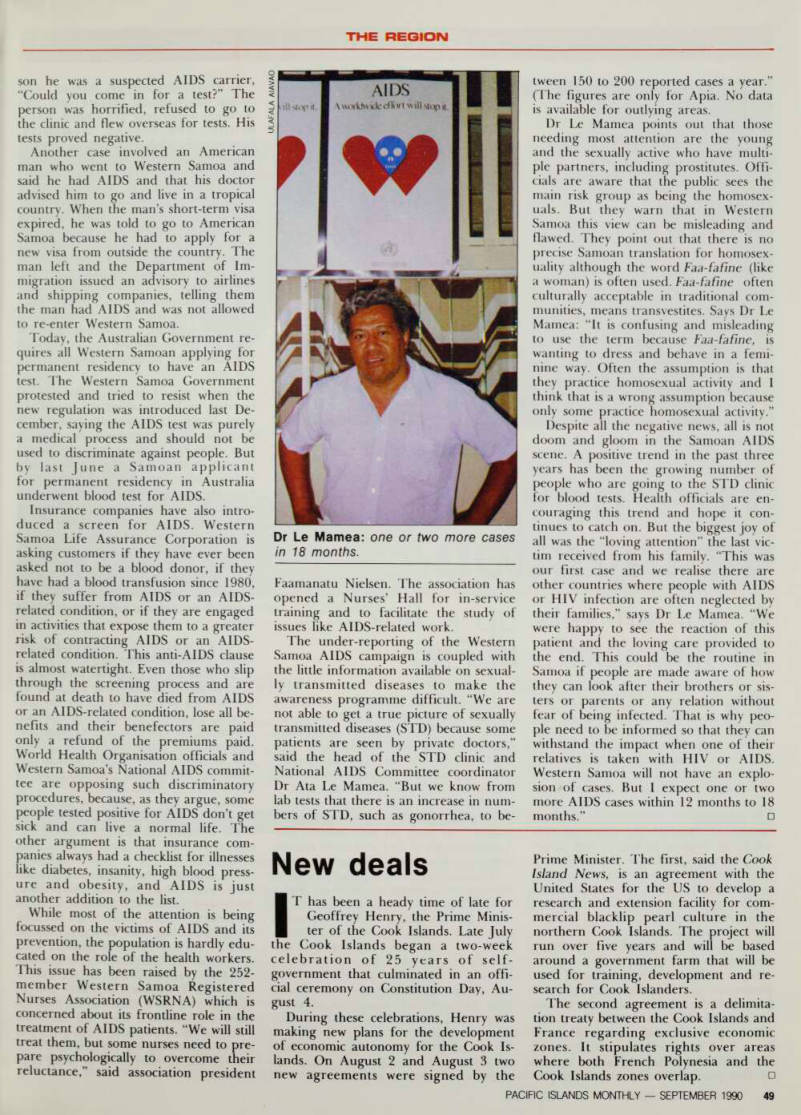
said the head of the STD clinic and National AIDS Committee coordinator Dr Ata Le Mamea. “But we know from lab tests that there is an increase in num bers of STD, such as gonorrhea, to be
tween 150 to 200 reported cases a year.” (The figures are only for Apia. No data is available for outlying areas.
Dr Le Mamea points out that those needing most attention are the young and the sexually active who have multi ple partners, including prostitutes. Offi cials are aware that the public sees the main risk group as being the homosex uals. But they warn that in Western Samoa this view can be misleading and flawed. They point out that there is no precise Samoan translation for homosex uality although the word Faa-fafine (like a woman) is often used. Faa-fafine often culturally acceptable in traditional com munities, means transvestites. Says Dr Le Mamea: “It is confusing and misleading to use the term because Faa-fafine, is wanting to dress and behave in a femi nine way. Often the assumption is that
they practice homosexual activity and I
think that is a wrong assumption because
only some practice homosexual activity.”
Despite all the negative news, all is not doom and gloom in the Samoan AIDS scene. A positive trend in the past three years has been the growing number of people who are going to the STD clinic for blood tests. Health officials are en couraging this trend and hope it con tinues to catch on. But the biggest joy of all was the “loving attention” the last vic tim received from his family. “This was our first case and we realise there are other countries where people with AIDS or HIV infection are often neglected by their families,” says Dr Le Mamea. “We were happy to see the reaction of this patient and the loving care provided to the end. This could be the routine in Samoa if people are made aware of how they can look after their brothers or sis ters or parents or any relation without fear of being infected. That is why peo ple need to be informed so that they can withstand the impact when one of their relatives is taken with HIV or AIDS.
Western Samoa will not have an explo sion of cases. But I expect one or two more AIDS cases within 12 months to 18 months.” □
Dr Le Mamea: one or two more cases in 18 months.