Men with
pp. 43-45 · Read in the full issue

The Region
Papua New Guinea
Men with a mission
Somare praised for Bougainville accord
By Wally Hiambohn
WHEN Foreign Minister Michael
Somare returned to Port Moresby after a week of nego tiations with Bougainvillean rebel lead ers, he was met by a small group of Bougainvilleans who sang and danced at Jackson Airport to welcome him. “This is a small but special geature to welcome you for accomplishing an important mis sion,” the group’s spokesman, Gordon Mamis, told Sir Michael as a mother, weeping, embraced him. “Thank you for what you have achieved. We understand it is a difficult task and much more has to be done but we praise you for what you have achieved so far. We have been anxious ... we were hurt and worried, but you have done so well again.” The occasion, although in itself small and wit
nessed by no more than 50 curious bys tanders as dusk set in, was by no means small in heralding the feelings of Papua New Guinea and its people, more so those of the Government and Bougain villeans.
After two years of fighting, bloodshed, tears and economic pains, people were eager for an end to the whole crisis which rocked the nation more violently than any other event since independence 15 years ago. None demonstrated this anxiety for peace better than the nation’s daily, the Post-Courier, when it reported the signing of the Endeavour Accord, aboard the New Zealand Naval ship HMNZS Endeavour, agreeing for the restoration of security and basic services to Bougainville. The paper which had journalist Angwi Hriehwazi fulltime on board the Endeavour to cover the talks,
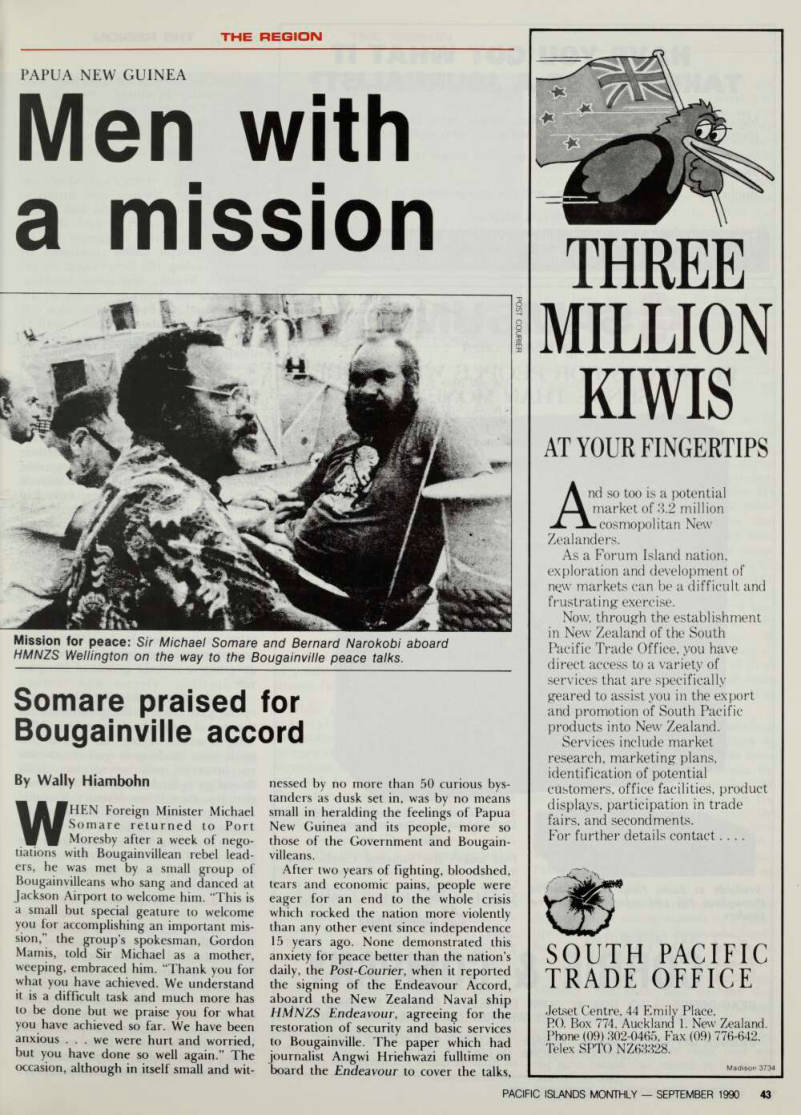
Mission for peace: Sir Michael Somare and Bernard Narokobi aboard HMNZS Wellington on the way to the Bougainville peace talks.
Post Courier
splashed the story on the front page with a screaming headline: “PEACE AT LAST”. Though it may have declared
peace rather prematurely, considering
the main issues have yet to be grappled with, PEACE was awaited almost impa tiently by all.
Sir Michael’s delegation which in cluded Justice Minister and Attorney- General Bernard Narokobi and senior bureaucrats had after a week of talks
with a Bougainville delegation led by
Premier Joseph Kabui concluded an accord binding the Government to re establish health, education, banking, transport and electricity services to the main island of Bougainville, shut off from the rest of the world since April 17 when rebel leaders unilaterally declared independence for the island. While the main issues of contention secession, and the future of the CRA-controlled Bougainville copper mine were defer red to another date and venue to be decided, many were contended with the fact that at least a start had been made by the two parties to thrash but their differences across the conference table, through word of mouth rather than in the jungles with guns. These talks had been long in coming, after three false starts. At the signing ceremony aboard the Endeavour , Sir Michael said: “It’s a great success, God has in his own way
brought us together.”
Prime Minister Rabbie Namaliu said the accord was one of the most impor tant agreements signed in the country since independence: “This accord estab lishes at long last the basis for a con tinuing relationship between the national government and the people of Bougain ville.”
For the first time, the Opposition openly gave credit to the government for the breakthrough. Its leader, Paias Wingti, whilst saying the accord had made some headway in resolving the cri sis, however, maintained that credit should go to Sir Michael and not anyone else, not even Prime Minister Namaliu.
And almost giving credibility to the Opposition’s criticisms of the govern ment’s handling of the crisis from the start, Sir Michael and Narokobi held a joint press conference the next day en dorsing this view. Despite the embarrass ment it must have caused their Prime Minister, the two ministers went on re cord to say the Government had erred in its handling of the Bougainville crisis.
They admitted that the use of security forces, appointment of various commit tees, the imposition of a curfew, and the declaration of a state of emergency had not been based on proper analysis. They said the issue became a protracted, bloody crisis because of initial misguided attempts to resolve the problem. “We addressed it as a mere law and order
problem and made the wrong diagnosis,”
Narokobi said. In the process, he added, there was almost a total collapse of the nation’s constitution on the island. Naro kobi said even the withdrawal of the troops from the island was poorly arranged, leading to the Bougainville Revolutionary Army believing it was a victory for them. Namaliu praised the Endeavour Accord, saying that “for the first time since the present crisis erupted there is a real chance of reaching a negotiation and lasting settlement of our differences.” Reading between the lines, it meant everything else in the past had offered no scope of success. Of course, Opposition leader Paias Wingti was out the next day patting himself. “I told you, didn’t I?” he said rather cheekily. “Bold admissions of misguided attempts to re solve the problems based on wrong di agnosis now merely confirms the Opposition’s misgivings about how the situation was handled from the start.”
But for every start there is an end, and Sir Michael’s next task, most prob ably the testing time of his negotiating skills, is to complete what he has begun.
His most important advantage is himself.
His status, experience and above all his charisma have given him the edge above the others to be accepted by the rebels to negotiate from across the table. Looming large in his mind before he meets the rebels again this month is his approach to the question, if not the demand, for
secession. The Bougainville delegation
made it clear from the moment they stepped on board the Endeavour that they wanted nothing less than secession.
Members of the delegation expressed the same view. One representative, Seventh Day Adventist Jeffrey Paul, said 99 per cent of his devotees were in favour of secession, and that God had a special plan for Bougainvilleans. Even at the conclusion of the first round of talks, delegation leader Joseph Kabui hinted that the question of secession would be a
tough one to negotiate. He told the gov ernment that its philosophy of “unity in diversity” must in Bougainville’s case be considered in the “wider context of grea ter Melanesia”. Said Kabui of the alleged atrocities by the security forces; “Consid eration must be given to these violations when considering political solutions. As far as the war is concerned, what the people of Bougainville will most starkly remember will be nothing but the in humane treatment received at the hands of your security forces. For the sake of future stability and peaceful co-existence, whatever solution is reached must reflect the misery suffered by the people of Bougainville. Our door is open for further dialogue. Our people have been so hardened by a racially-oriented war and the blockade, they need honest signs of goodwill on your part before they can discuss further dialogues.”
While the government has and will maintain that secssion is “non negotiable” it has indicated it is prepared to even consider the possibility or a re ferendum to determine if it is the major ity’s wish for Bougainville to break way.
But when saying that the government may consider this option, deputy Prime Minister Ted Diro was rather vague ab out whether the government would accept the result of a referendum which agreed on secession.
“The question of a referendum will be considered by Cabinet if the situation gets that far,” he said. “Whether we accept the verdict is another thing.
That’s a separate decision. I am praying that the BRA will not pursue the ques tion of secession too hard.” Another op tion Sir Michael has, and the govern ment is prepared to offer, is increased autonomy for Bougainville with the ex ception of foreign relations, defence and currency control.
It was Bougainville’s initial attempt in 1975 to secede from PNG that led to the
decentralisation of other functions and the introduction of the provincial gov ernment system. Now with this second but more violent attempt, Bougainville again champions the cause of increased autonomy to the provinces. And in the forefront to negotiate terms, as he did in 1975 as Chief Minister, is none other than Sir Michael Somare. The question many pose is whether the Chief can again successfully bring about an ulti mate peaceful solution to Bougainville.
For many it’s a foregone conclusion. He is the only PNG leader Bougainvilleans are prepared to talk to and will listen to.
They have his trust, and he has theirs.
As he established with the Bougainvil leans at the start of the first talk: “If my delegation is to be realistic and concilia tory in its approach, then I appeal to you to match us, and make an equally reasonable approach to the subjects we will discuss.”
He adds: “For the first time we are in a position to talk face to face. I appeal to each person taking part in these talks to
honestly recognise what we are doing.
Bougainvilleans asked for me and Ber nard Narokobi to attend these talks. We have long been familiar with the prob lems of Bougainville. We know that many of these problems have not been addressed over the years, and we accept part of the blame for this. We are an xious to do what we can to open real dialogue with you, and to listen to your points of view. But this must be a two way road. There is far too much at stake for all of us. All of us are humans ... all of us make mistakes. That is part of being human. At the same time, all of us can learn from our mistakes and make them work for us, rather than against us.”
Sir Michael certainly has too much at stake to afford mistakes or failure in these talks because to do so would leave PNG with very little or no options for negotiations. Observers expect that the government’s only other option in the event of a deadlock is to redeploy the security forces, an option the Govern ment wants to keep as a last resort.
Would they succeed the next time?
Prime Minister Namaliu likes to think so.
Says he:
“Our men are well trained, they were deployed in a wrong manner in a police operation. A military approach would have been different.” Asked last month whether the government would consider sending troops back, Deputy Prime Minister Ted Diro, who was the first PNG Defence Force commander, said: “That’s still a long way down the track,”
Closer up the track is Sir Michael who has won one battle. He must now win the next round this month to bring the war to an end. □
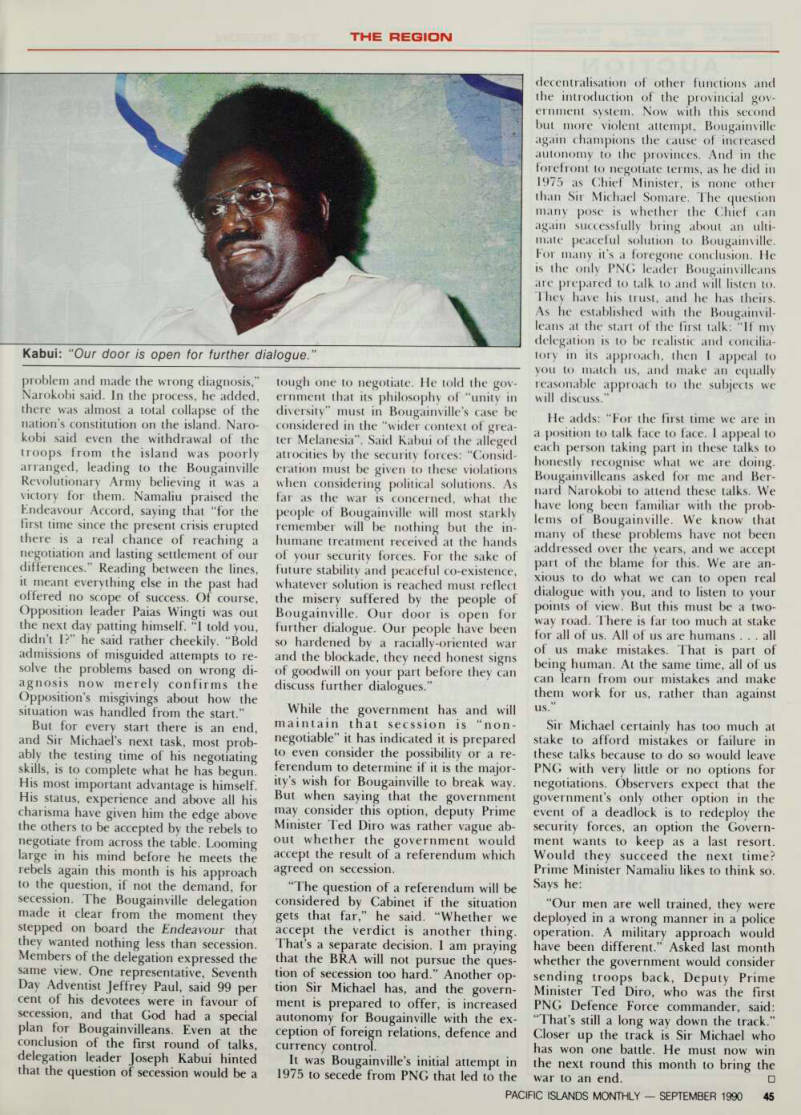
Kabul: “Our door is open for further dialogue."