A new direction
pp. 18-21 · Read in the full issue
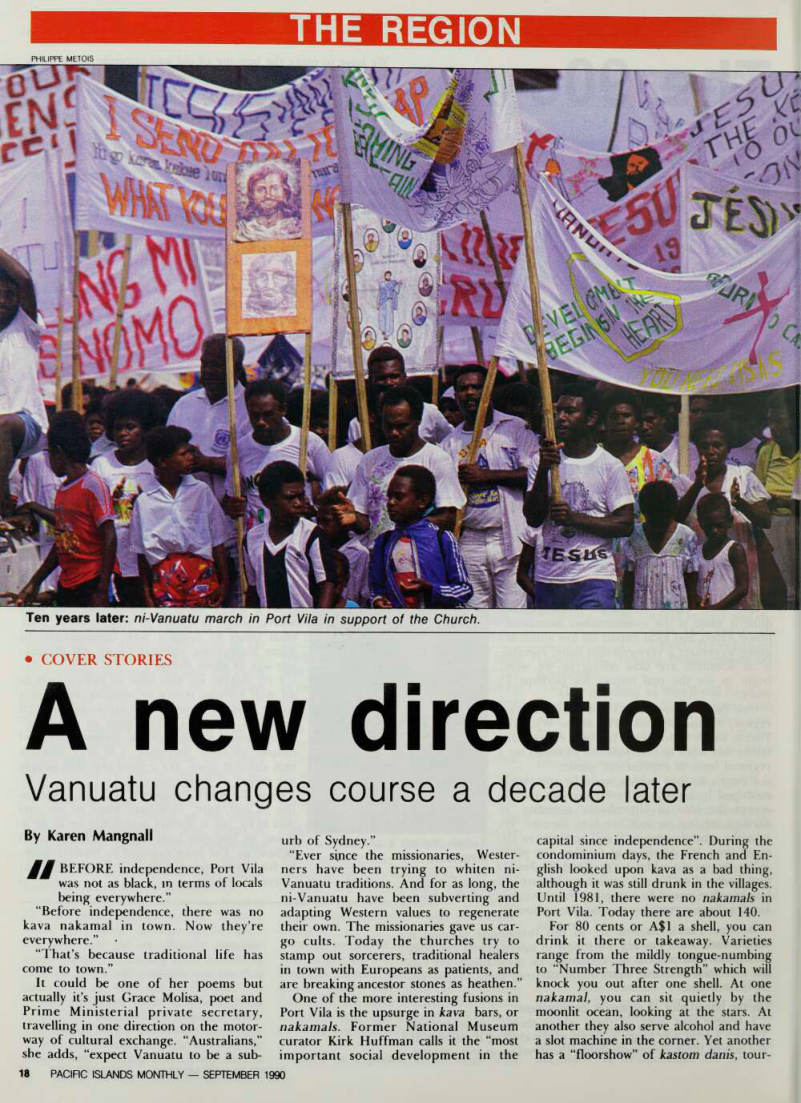
Cover Stories
Vanuatu changes course a decade later
By Karen Mangnall
// BEFORE independence, Port Vila was not as black, in terms of locals
being everywhere.”
“Before independence, there was no kava nakamal in town. Now they’re
everywhere.” •
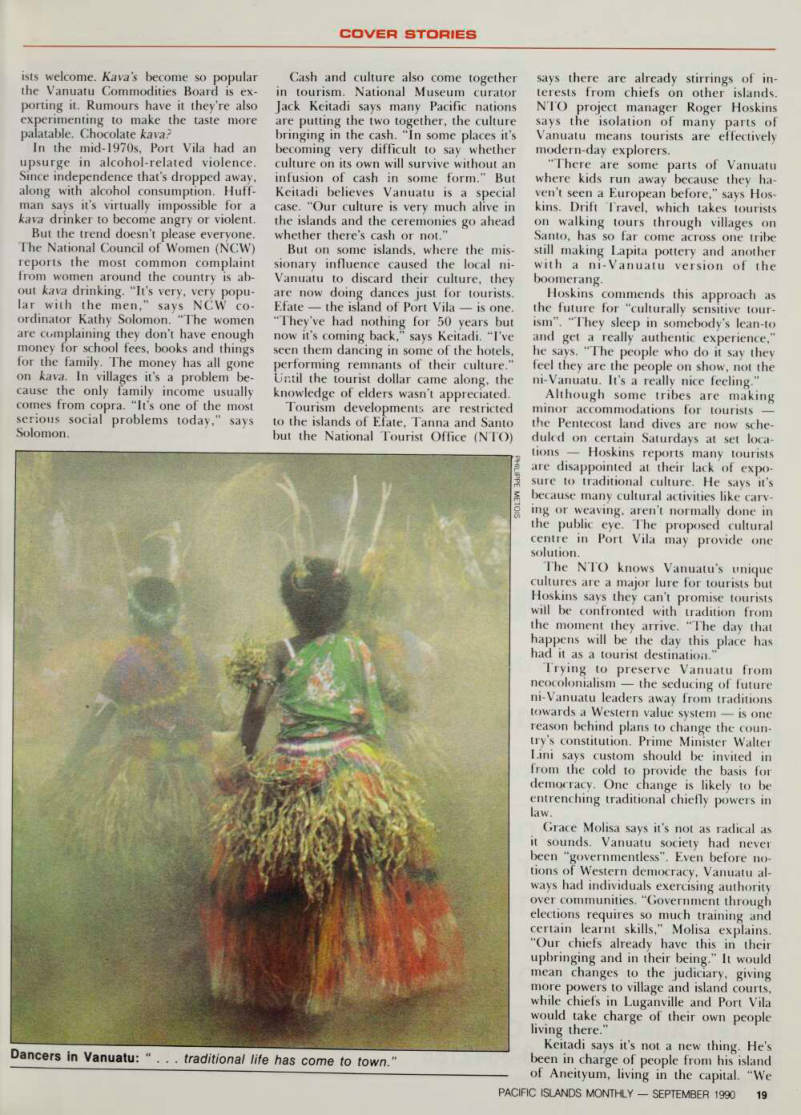
“That’s because traditional life has come to town.”
It could be one of her poems but actually it’s just Grace Molisa, poet and Prime Ministerial private secretary, travelling in one direction on the motor way of cultural exchange. “Australians,” she adds, “expect Vanuatu to be a sub
urb of Sydney.”
“Ever since the missionaries, Westerners have been trying to whiten ni- Vanuatu traditions. And for as long, the ni-Vanuatu have been subverting and adapting Western values to regenerate their own. The missionaries gave us cargo cults. Today the Churches try to stamp out sorcerers, traditional healers in town with Europeans as patients, and are breaking ancestor stones as heathen.”
One of the more interesting fusions in Port Vila is the upsurge in kava bars, or nakamals. Former National Museum curator Kirk Huffman calls it the “most important social development in the
capital since independence”. During the
condominium days, the French and En glish looked upon kava as a bad thing, although it was still drunk in the villages, Until 1981, there were no nakamals in Port Vila. Today there are about 140.
For 80 cents or A|l a shell, you can drink it there or takeaway. Varieties range from the mildly tongue-numbing to “Number Three Strength” which will knock you out after one shell. At one nakamal, you can sit quietly by the moonlit ocean, looking at the stars. At another they also serve alcohol and have a slot machine in the corner. Yet another has a “floorshow” of kastom danis, tour
ists welcome. Kava’s become so popular the Vanuatu Commodities Board is exporting it. Rumours have it they’re also experimenting to make the taste more palatable. Chocolate kava?
In the mid-19705, Port Vila had an upsurge in alcohol-related violence.
Since independence that’s dropped away, along with alcohol consumption. Huffman says it’s virtually impossible for a kava drinker to become angry or violent.
But the trend doesn’t please everyone.
The National Council of Women (NCW) reports the most common complaint from women around the country is about kava drinking. “It’s very, very popular with the men,” says NCW coordinator Kathy Solomon. “The women are complaining they don’t have enough money for school fees, books and things for the family. The money has all gone on kava. In villages it’s a problem be-
cause the only family income usually
comes from copra. “It’s one of the most serious social problems today,” says Solomon.
Cash and culture also come together in tourism. National Museum curator Jack Keitadi says many Pacific nations are putting the two together, the culture bringing in the cash. “In some places it’s becoming very difficult to say whether culture on its own will survive without an infusion of cash in some form.” But Keitadi believes Vanuatu is a special case. “Our culture is very much alive in the islands and the ceremonies go ahead whether there’s cash or not.”
But on some islands, where the mis sionary influence caused the local ni- Vanuatu to discard their culture, they are now doing dances just for tourists, Efate the island of Port Vila is one.
“They’ve had nothing for 50 years but now it’s coming back,” says Keitadi. “I’ve seen them dancing in some of the hotels, performing remnants of their culture.”
Until the tourist dollar came along, the knowledge of elders wasn’t appreciated, Tourism developments are restricted to the islands of Efate, Tanna and Santo but the National Tourist Office (NTO)
says there are already stirrings of in terests from chiefs on other islands.
NTO project manager Roger Hoskins says the isolation of many parts of Vanuatu means tourists are effectively
modern-day explorers.
“There are some parts of Vanuatu where kids run away because they ha ven’t seen a European before,” says Hos kins. Drift Travel, which takes tourists
on walking tours through villages on
Santo, has so far come across one tribe still making Lapita pottery and another with a ni-Vanuatu version of the
boomerang.
Hoskins commends this approach as the future for “culturally sensitive tour
ism”. “They sleep in somebody’s lean-to
and get a really authentic experience,” he says. “The people who do it say they feel they are the people on show, not the ni-Vanuatu. It’s a really nice feeling.”
Although some tribes are making minor accommodations for tourists the Pentecost land dives are now sche duled on certain Saturdays at set loca tions Hoskins reports many tourists are disappointed at their lack of expo sure to traditional culture. He says it’s because many cultural activities like carv ing or weaving, aren’t normally done in the public eye. The proposed cultural centre in Port Vila may provide one solution.
The NTO knows Vanuatu’s unique cultures are a major lure for tourists but Hoskins says they can’t promise tourists will be confronted with tradition from the moment they arrive. “The day that happens will be the day this place has had it as a tourist destination.”
Trying to preserve Vanuatu from neocolonialism the seducing of future ni-Vanuatu leaders away from traditions towards a Western value system is one reason behind plans to change the coun try’s constitution. Prime Minister Waller Eini says custom should be invited in from the cold to provide the basis for democracy. One change is likely to be entrenching traditional chiefly powers in law.
Grace Molisa says it’s not as radical as it sounds. Vanuatu society had never been “governmentless”. Even before no tions of Western democracy, Vanuatu al ways had individuals exercising authority over communities. “Government through elections requires so much training and certain learnt skills,” Molisa explains.
“Our chiefs already have this in their upbringing and in their being.” It would
mean changes to the judiciary, giving
more powers to village and island courts, while chiefs in Luganville and Port Vila would take charge of their own people
living there.”
Keitadi says it’s not a new thing. He’s been in charge of people from his island of Aneityum, living in the capital. “We
Dancers in Vanuatu: "... traditional life has come to town.”
solve the cases we don’t want to take to the police,” he explains. “Little problems like fighting between friends, inter-island
fighting or somebody racing off with
someone’s wife.”
But Keitadi worries legalising these powers will entrench the automatic suc cession of chiefly titles from father to son, as proclaimed by the Council of Chiefs, the Malvatumauri. Keitadi says automatic succession is only practised in four places in Vanuatu. Everywhere else, he says, “everyone is born equal”. One must kill pigs to rise up in grade. “I feel it destroys the value of the pig killing system.”
But Keitadi is keen to see the constitu tion changed to give Island Courts, rather than the Supreme Court, the final say on land disputes. He says the Sup reme Court judges don’t take into account legends relating to land own ership, and rely solely on often dubious documentary proofs. “In one case, the Supreme Court decided one chief owned all this land and all the other people with tribal lands had to pay rent to re turn.” About 1500 people lived on that part of Aneityum, and acknowledged 10 chiefs. “It created a big fuss,” say Keita di. “There’s no way people are going to pay rent for land that their grandfathers
have been sitting on for ages.”
“It got the people very annoyed so they went and burned everything,” he says. None went to prison because the courts decided they were fighting for their traditional rights, but no-one took it a step further to discover whether they could get the land back. The Supreme Court’s made several similar decisions, says Keitadi, and with so much alienated land under dispute, there’s potential for more trouble.
Another group in ni-Vanuatu society is also dissatisfied about land but their quarrel is with tradition not Western jus tice. In many areas, ni-Vanuatu women have little or no say regarding their family’s land. “When you’re born a woman, that’s the end of yourself,” says Kathy Solomon. She says her only brother died so she remains resolutely single as it’s the only way to retain her rights to the family land. “As soon as I marry that’s the end.”
“That is wrong. Land is very pre cious,” she continues. “As long as you have land you’re rich.” But on Malekula, if a woman marries a man without land, she can’t return to her family land if a male relative disagrees.
The status of women is often the lit mus test of a society’s development. But in Vanuatu it’s also an indicator of the new pressures on tradition from West ern-inspired values. Grace Molisa be lieves ni-Vanuatu women have been in
adequately repaid for being the back
bone of the independence struggle.
Asked for details and she directs you to her book Colonised People , where she writes in the title poem: Vanuatu Womenfolk half the population remain colonised by the Free men of Vanuatu The same book lists official statistics showing women make up 36 per cent of the workforce, but overwhelmingly pre dominate as typists, cleaners, teachers, health workers and “other service workers”.
Kathy Solomon says men are “still blockades” but more women are begin ning to “climb the steps”. A few women are running their own businesses and
reaching middle-management positions
in the private sector. But the civil service remains the ground of greatest advances.
“The key to getting ahead is educa tion, nothing else,” says Solomon. The government provides equal access to education, but it’s still a struggle for many rural girls. “The families think the girl is going to get married and their money or investment will leave the fami-
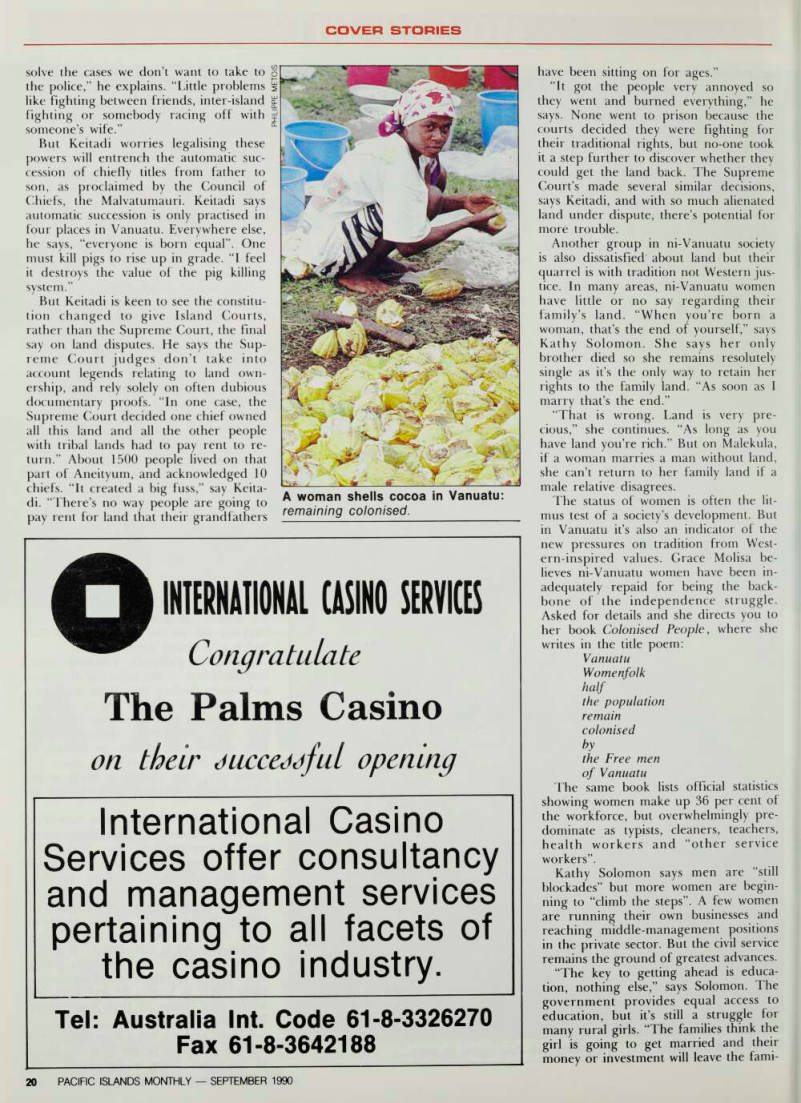
A woman shells cocoa in Vanuatu: remaining colonised.
Philippe Metois
ly,” she explains. “But a boy always helps the family if he gets a good job.”
The NCW is also taking aim at two other bulwarks of ni-Vanuatu tradition: bride prices and the associated problem of domestic violence. Solomon says when a ni-Vanuatu man “buys” a wife for a bride price, he then assumes he can do what he wants with her. “If she doesn’t do what he wants, he beats her.”
Solomon says most ni-Vanuatu women who go to hospital with injuries have been victims of domestic violence. The police rarely take action, unless the in juries are serious. “Even if she runs home, they’ll say it’s the husband’s right to beat her up.” The NCW is lobbying for legislation to deal with such domestic violence.
Women have come off on the losing end of a breakdown in traditional ways.
Solomon says there’ve been many com plaints from women that the men are no longer prepared to shoulder their share of work in the village. “The husband gets up thinking of breakfast and then goes off to drink kava, she says. “The woman goes to the garden, plants, cuts wood, comes home and cooks and so on.
Women do everything.” Solomon says in her childhood, her father and mother
worked together in the family garden.
Solomon says there’s a dilemma in the NCW setting up projects to bring women into the cash economy while they’re already carrying so much of the burden of the subsistence economy. One trial project is a credit scheme giving women no-interest loans to start their own businesses; rural or urban.
The NCW is Vanuatu’s biggest gras sroots organisation with 77 local bran ches and 13 regional councils. Solomon says they’ve trained more than 3000 women community leaders. Many are
holding positions in their villages which
would have been unthinkable 10 years ago, but Solomon says they still come up against their lack of customary status.
The main churches have also been bar riers.
But things are changing. Recently two women were elected to local government and Hilda Lini became the sole woman MP. All outpolled their male rivals.
“Now women leaders from the islands are asking what’s the point of voting for all these men,” says Solomon. “They’re saying we have to think twice.”
But the encroachment of outside influ ences into even the remotest villages is steadily eroding many cultural traditions.
One area already hit by irrevocable change is language. Vanuatu has 105 distinct languages; in effect, 105 diffe rent nations. Jack Keitadi says some of the languages are destined to die out in the next decade.
More people are using just the com monest local languages, or bislama.
“There are some languages with only half a dozen people who know them,” says Keitadi. By the middle of the next century, the number of languages will probably drop to about 80.
Keitadi says their loss is sad but un avoidable. “The only thing we can do is record them before they die out,” he says. “They will be very important in fu
ture for researchers linking up lan guages across the Pacific.”
The death knell’s also sounded for the village co-operative. The Vanuatu Co operative Federation has ceased trading after accumulating debts of nearly Asl million. The decline in the number of village co-ops has been matched by the rise in the number of ni-Vanuatu village stores. The book Vanuatu: 10 Years of Independence notes it’s now socially acceptable for individual ni-Vanuatu to accumulate visible wealth.
While the village is still the place where 80 per cent of adult ni-Vanuatu work their own land, it is also becoming a trap for a generation of young, unem ployed ni-Vanuatu. “Five years ago you’d find very few high school leavers in the village,” says Solomon of her own village on Malekula. “Today you go back and find a lot of them, just sitting around.”
Many have spent so much time away at school or in town that they no longer know how to cope with village life.
“One of the problems with our young generation is as soon as they come out of school, they all think of coming to Vila,” says Solomon. Some get jobs, others don’t. They live with relatives, a signifi cant drain on family finances.”
It’s a trend which will worsen. By the end of the century more than half the ni-Vanuatu population will be under the age of 20. Many won’t want to return to their villages but the towns won’t provide
enough jobs. The National Planning
Office says economic growth hasn’t kept
pace with population growth. Principal
planning officer Gerald Haberkorn says Vanuatu’s urban growth rate is the high est in the Pacific.
If Port Vila’s population expands at the same rate as in the past four years, it will reach 55,000 by the end of the cen tury. Luganville’s population is also rock eting. It’s likely to rise further with the establishment of the Santo Industrial Estate, a five-year Asian Development Bank project to set up 54 enterprises.
Haberkorn says his studies show many
ni-Vanuatu youth regard “unemploy
ment in Port Vila as a real alternative to rural un-and underemployment.”
They’re reluctant even to work on the coconut plantations on the capital’s
periphery.
The signs are already there. More young men hanging around lamp posts in the capital’s streets. And lately, a few wandering in public drinking cans of the new local beer. One can find teenagers in seaside slums who say they left the village as much as to escape the chiefs authority as to find a job. Port Vila’s petty crime rate is on the rise.
Haberkorn says Port Moresby’s recent troubled development should “serve as a timely reminder of what can happen in a very short period here in Vanuatu”. □
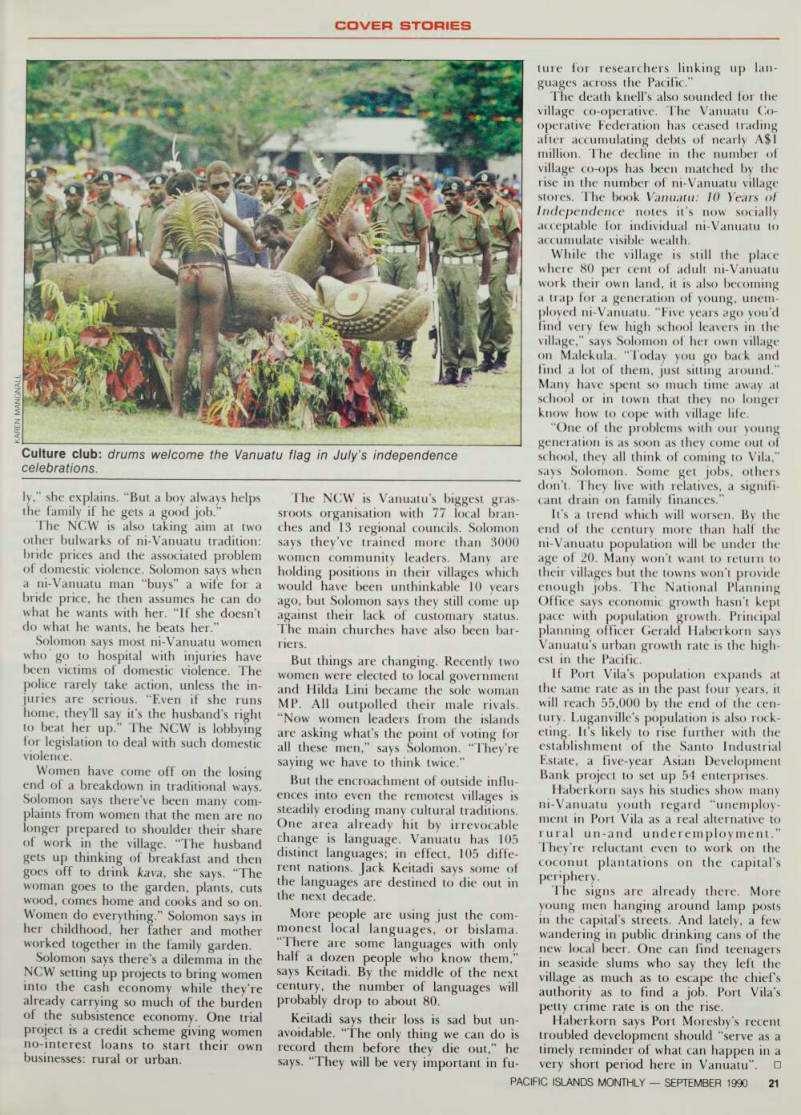
Culture club: drums welcome the Vanuatu flag in July’s independence celebrations.