The 90s
p. 17 · Read in the full issue
By Karen Mangnall
PRESIDENT leremia Tabai, of Kiribati, is about to end two terms as Kiribati’s President. As he commented in a much-appreciated aside to the Pacific Island leaders breakfast, he can’t try to change Kiribati’s constitution to allow a third term because he was its author. President Tabai is being widely promoted as a leading contender for the job of Forum secretary-general next year. President Tabai won’t con firm his intention to apply, but he spoke to Pacific Islands Monthly of his visiion of the region in the last decade of the century.
On the Forum: One thing is certain, the Forum has achieved real recogni tion in this part of the world and internationally. The turning point has been the Dialogue. It’s somehow formalised the relationship between the Forum and the other Dialogue coun tries. Many more countries are keen to take part in the Dia logue. The Forum will no longer be the same one we knew in the past. It’s becoming a very big organisation. The Forum will also become more assertive. It’s happening already and
that’s a good thing.
What issues are likely to be on the agenda of the 90s?
Our agenda has been on the same issues in the last few years but over time the agenda will change. In the past it was very dominated by New Caledonia. Now the issue is being looked after by the Matignon Accords. It’s no longer a central issue of the Forum meeting, we’re only monitoring. Between now and 1998 it may be come a major issue again but only time will tell.
One issue which will be on the books for quite a while is the environment: the Green house Effect and local impact on low atolls. It’s going to remain a very relevant issue, especial ly as scientists are now telling us we won’t begin to see the real impact for perhaps 15 years.
One fact we know is it’s not caused by our region, it’s the big industrial areas. What the Forum needs to do now is not only express our stance but work in international meetings on a regional basis to express our stance.
Even in Kiribati (which could be completely swamped by rising sea levels) it is not easy to accept the idea of Greenhouse warming. In Kiribati we feel we will live here forever. We take the attitude now we’ll still be there in 100 years time. We continue to develop our place.
What do we do when we’re flooded? Find a
new home. But it’s not something we are planning for now because that would be accepting the inevitability of the thing.
I still believe something can be done about it.
Because Pacific nations are in this threatened position it means the Forum can argue strongly in international meetings and speak with passion and conviction on these issues. We can get a positive response that’s required from these (industrial ised) countries.
On the importance of economic development I believe that over all these issues should be economics.
There’s a long way to go in terms of developing these islands.
We accept ultimate responsibility for developing our country.
We have to make the best use of aid and organise ourselves in a way conducive to that objective. We have a shift in emphasis now. We try not only to talk about aid but also overseas investment in a real way.
It is very hard to attract overseas investment to Kiribati.
We’ve got all the formulas prescribed in the text books but still waiting for the knock on the door. Most of the investment is going to the easiest countries like Vanuatu or Fiji, which have resources to exploit. They’re getting the roads, telecom munications and so on.
Was this behind the Forum highlighting the difficulties small island states have in building infrastructures for economic de velopment?
Yes. We have to start somewhere. Most of the infrastructure is financed by aid. Our airport was to have been funded out of the regional allocation from Lome II and when it comes to regional allocations everyone’s for themselves, those countries already better off are getting projects funded. We’re trying to get the Chinese to fund the airport because we can’t wait another five years (it’s been rolled over into Lome III) to have this resolved. A Chinese team was just in Kiribati looking at
possible funding.
There’s a body of opinion in Rim governments, development organisations and among some regional academics that the Pacific nations will never break aid dependency and achieve any real measure of self-sufficiency. Do you agree?
I hope he’s wrong. South Pacific countries follow the Western economic model which is very much into commerce and private enter prise. In Africa, it’s more a socialist model where everything is run by the Government.
They have real dictators there. We have more of a chance of success. You have to look at how long it took the developed countries, with resources, to get where they have. How long it took Europe to create the Common Market.
About the invasion of Western standards and cultural resilience We’ll see it more in towns with the very individualistic problems of employment. That what tends to happen with urbanisation. In many institutions, cultural values will discour age any of these things.
I try to take my kids once or twice a year to an atoll without power or running water or a fridge and we have to fish every day to feed ourselves. Why has Japan been so successful?
They have a strong cultural system there and despite all their successes, it is very much a rich cultural place. It’s a good side that people are proud of their culture.
I hope the South Pacific will be a good place to live in and, sure, we’ll have more of the cars and hi-fis, but it doesn’t necessarily mean we’re going to lose our basic island nature. I don’t believe so. I’ve been exposed to Western socie ty for many, many years but I still value our
culture. It is a force of stability.
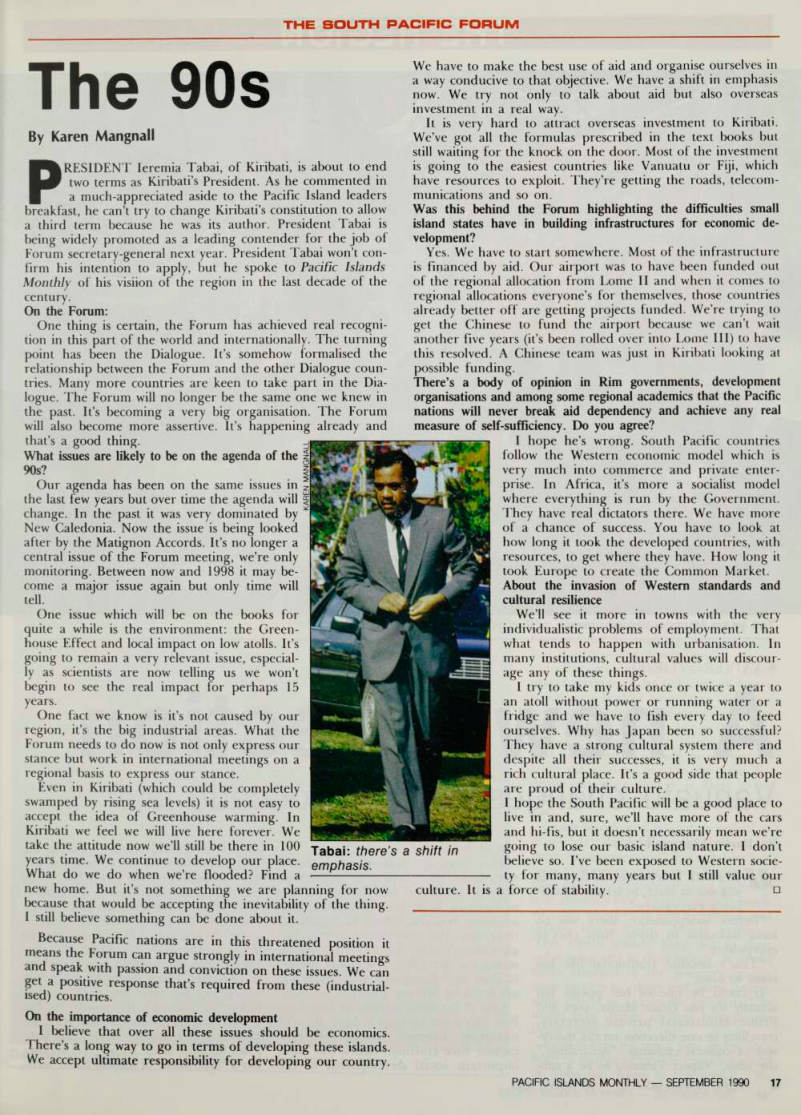
Tabai: there’s a shift in emphasis.