Muller battles on
p. 16 · Read in the full issue
By Karen Mangnall
FISHERIES development in the
Pacific is likely to remain a key item on Forum agendas in the next decade, although the issue may lose most of its media sex-appeal. Forum Fisheries Agency (FFA) director Phillipp Muller believes the 1990 s will demand “Nuts and bolts” work on fisheries issues, work that’s nevertheless crucial to ensure the well-being of Pacific peoples.
With the decision by Japan, Taiwan and Korea to stop driftnetting in the South Pacific a year ahead of the United Nations deadline, fisheries was a bit of a non-issue at last month’s South Pacific Forum in Port Vila. Muller says the ma jor remaining hurdle in the multilateral fisheries agreement with Japan which has been getting nowhere for the past three years.
“Just because we’re promoting it,
they’re suspicious,” says Muller. “They’ll
soon reason it out that they’ve shot themselves in the foot.” The next chance to restart negotiations comes in October when the FFA meets Japan over drifnet
ting.
The Japanese driftnet announcement was timed for maximum plaudits at the Forum. But the October meeting may see more FFA scepticism after a recent announcement that Japan is “testing” a new driftnet in the North Pacific this season. They say it leaves a gap of sever al metres between the surface and the top of the net. Japan claims tests so far show the dolphin catch has dropped by 25 per cent, although the nets still catch cuttlefish. Japan believes its modified driftnets fit in with United Nations re solution 225’s call for driftnet regulation under an albacore management regime.
Despite its driftnet ban, Japan still got a rap over the knuckles from the Forum for dragging its feet on multilateral ac cess. Japan’s Ambassador to the Forum
Dialogue meeting, Takehiro Togo, de
nies his country’s stalling on the multi lateral negotiations. He says Japan is
“seriously and constructively conducting
dialogue” but still wants to “clarify” which issues are best dealt with within multilateral or bilateral frameworks.
All of this merely adds to the burden of what Muller predicts will be “a lot of heavy hack work” to clear up the drift net issue and get an albacore manage ment regime. “It’s going to be extremely difficult and I will probably not see that one out in my year left on the job.”
Muller says the major hurdle is trying to link two “diametrically opposed” sides.
The coastal Pacific states want sovereign ty over the albacore in their waters while distant-water fishing nations say they’re
not bound by any regulation on the high seas. “No trade-offs are possible,” he says. We would be giving away sovereignty of the resources and they would be giving away what they already have freedom to do what they like in international waters.
Despite this, Muller remains optimistic of achieving an albacore regime which includes international water! “Human
beings are good for producing unique
bits of compromise,” he says. But the Pacific nations must be careful not to make mistakes with the albacore regime which could create a precedent to prejudice the region’s interests in other tuna species. “We have to work out what we want for the other species - yellowfin, skipjack arid blackeye - and work backwards.”
In the meantime, Muller enters his last year in the job worried about the FFA’s
financial security, particularly to employ
expert staff. The general economic downturn will make it harder for Forum members and international bodies alike to fund regional organisations like the
Ffa.
“We’ll be expected to do more with
less,” Muller worries.
“And the experts hold the key. Fortu
nately, it’s not only
the money that attracts them. It’s more the mission.”
In addition, the agency needs money to meet people,
“eyeballing each
other”, as he calls it.
“We can’t co-operate
by letter.”
The future of two key FFA staff the senior economist and the fisheries develop ment officer is still up in the air after funding was uncere
moniously cut by the
Food and Agricul
ture Organisation
and the United Na
tions Development
Programme (UNDP).
Muller says now the FAO funding is “gone forever” be cause the organisa tion refused to fund anything which could be confrontational to donor countries, like Japan. The UNDP has just decided to slice 6 per cent of its world budget and di vert the funds to Least Developed
Countries, taking from regional or
ganisations.
“They’re telling us they’ll still fund re gional projects that don’t compete with Asia and southeast Asia,” Muller says.
“But when you talk about the Pacific with so few people, any one of the Asian countries would dwarf us.”
In the meantime, the two staff are being paid for by Australian and New Zealand funds diverted from elsewhere in the budget. Muller says although the FFA has a funding shortfall for staffing, it’s got a budget surplus for consultancy and meetings; thanks to money saved on driftnet issues. The FFA is “begging” donors to let it shift this surplus, Muller says, “otherwise we can’t meet our com mitments.”
Despite the gloomy skies ahead, Mul ler admits to a tremendous amount of satisfaction when he looks back over the FFA’s achievements. Fisheries, he be lieves, is the one sector in the region where there’s been co-operation. “All other areas have had trouble. We’ve the highest level of co-operation in a sector not noted for its openness.” □
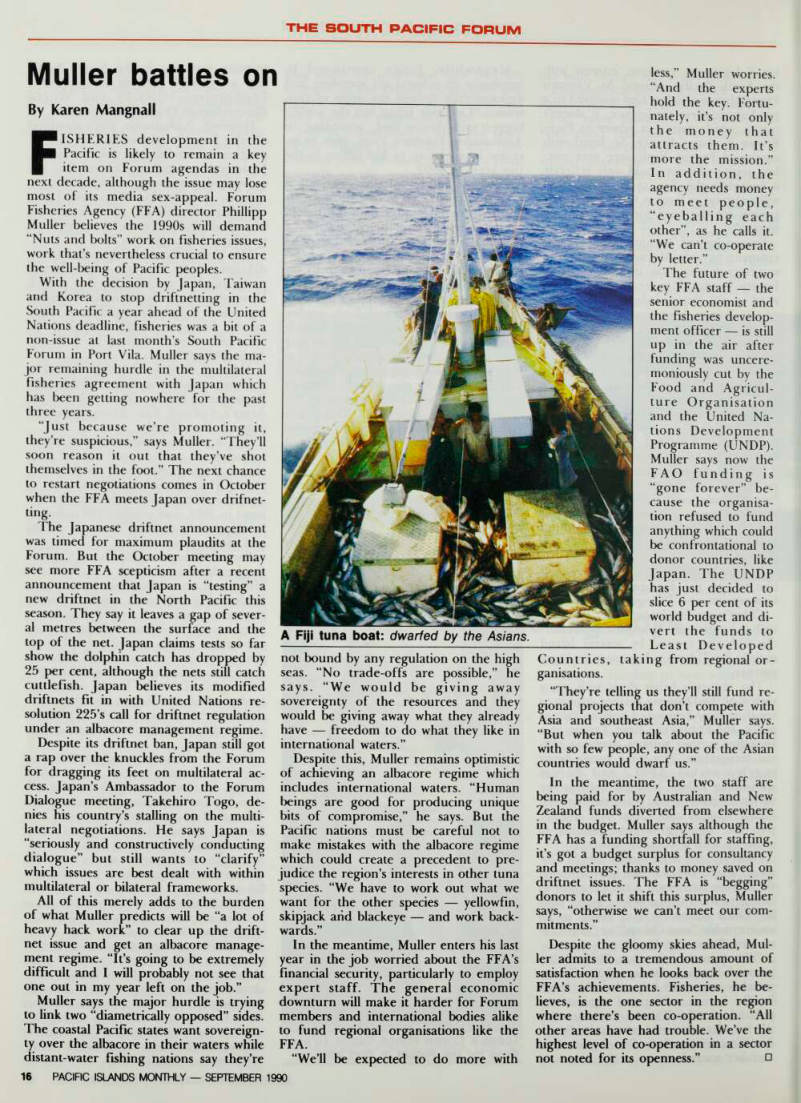
A Fiji tuna boat: dwarfed by the Asians.