Dialogue with the big boys
pp. 14-15 · Read in the full issue
By Karen Mangnall
THERE’S little doubt the post- Forum dialogue is a roaring suc cess. In only its second year, the “Forum Plus 6” dialogue is promising to become Plus 8, at least, with the prospect of adding Germany and Taiwan to the list of partners.
The dialogue partners can be easily divided into those with friendly agendas and those providing friction. Canada, the United Kingdom and China are in the first category, while Japan and the United States are definitely in the latter.
France is still trying to get into the
friendly camp by deliberately broadening
the dialogue agenda beyond the historic
al points of friction nuclear testing and New Caledonia.
Canada’s relations with the region are dominated by its substantial and* careful ly targetted aid programme. Last year, Canada gave $lB million in development aid to the South Pacific and assured the Forum its commitment won’t diminish in favour of supporting the emerging democracies of Eastern Europe. Fisheries and an advisory service for South Pacific
entrepreneurs are two areas Canada is looking at funding in new ways in the
coming years.
Britain is another which has fairly low key ties with the region. It’s also promis ing its aid won’t be affected by events in Eastern Europe. Well aware of regional concerns about the Greenhouse warm ing, the British delegation stressed their Government’s plan to spend $45 million on environmental research this year, in cluding how to reduce carbon dioxide emissions in Eastern Europe.
Unlike France and the United States, the British delegation could appeal for an unprecedented degree of internation al cooperation on the environment, with out risking accusations of hypocrisy: “This is not a matter of the developed world hawking its conscience round preaching environmental morality to de veloping countries. It is unacceptable for the developed world to say that now we
have become wealthy through exploiting
the world’s natural resources, we will pull up the ladder behind us and deny economic development to others.”
France, however, remains handicap ped in its efforts to present itself as hav
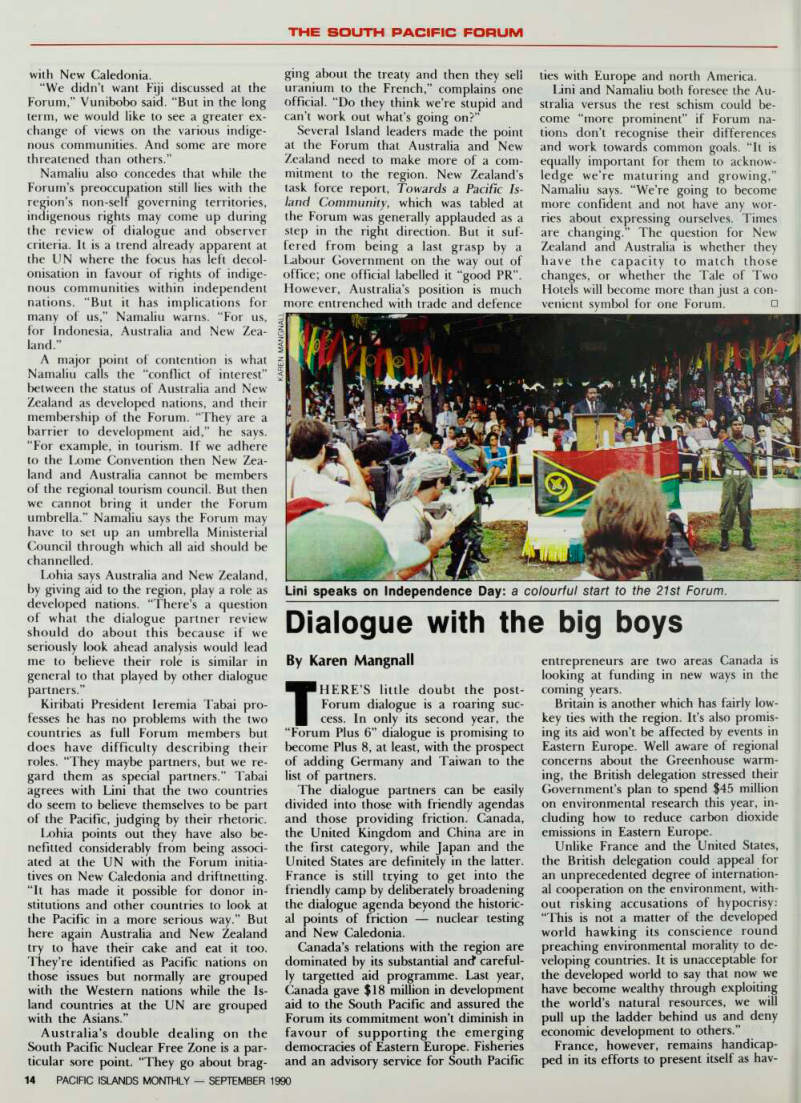
Lini speaks on Independence Day: a colourful start to the 21st Forum.
ing a legitimate common interest with the South Pacific nations. As Vanuatu Prime Minister Walter Lini observed to a pre-Forum press conference, it doesn’t matter which party’s in power in Paris, France is always France. So faced with continued Forum displeasure over nuc lear testing, France could only reiterate it considers the tests to be “safe”, and will continue as long as the other super powers see the need for a “nuclear de terrent”.
France invited Forum heads of gov ernment to visit Moruroa; the Forum secretary-general was invited to Paris; Forum heads of government were in vited to visit New Caledonia, individually or as a Forum delegation. It’s all part of French President Francois Mitterrand’s new policy of “openness”, which includes
inviting everyone possible virtually any
where, including taking relatives of Tahitian workers on day trips to Morur oa to prove its safety.
France also extended to all Pacific na tions the offer to provide surveillance for Exclusive Economic Zones (EEZ), to be arranged on a bilateral basis.
The French delegation leader, Phillip pe Baude, said France was eager for a “sensible solution” to enable New Cale donia, French Polynesia, Wallis and Futuna and France itself to join the South Pacific Geoscience Commission
(Sopac).
Baude also revealed that France would like to see the European Community Commission as a Dialogue partner.
China’s so far low-profile relations with the region are facing their first hur dle with the request by several Island nations for Taiwan to become a Dialogue partner.
The request’s being dealt with via a review of the Dialogue partner criteria to see if, as New Zealand’s Geoffrey Palmer put it, the Forum can have Taiwan as a Dialogue partner without implying offi cial recognition. The same issue’s being juggled within APEC, and Forum spokesman Rabbie Namaliu believes the variety of political and trade ties between Pacific nations and China and Taiwan puts the region in a good position to come up with a workable solution.
However, the move clearly caught Chi na off guard and Namaliu later admitted the Forum had made a tactical error in failing to warn China before going pub lic. China warned it may result in an unacceptable “two Chinas” or “one Chi na, one Taiwan” policy.
“We appreciate the One China policy pursued by the majority of the Forum member states and hope that the South Pacific Forum will guard against any
political plot by Taiwan to undermine
the friendly relations between the Pacific Rim Countries and the Forum and all its member states.”
Meanwhile, Japan continued to emphasise its colossal aid spending and diplomatically fudged the areas of con tention. Last year Japan was the world’s biggest aid donor and, according to Ambassador Takehiro Togo, aims to in crease its spending to $5O billion in the five years to 1992.
Grant aid and technical co-operation is central to Japan’s aid to the South Pacific and is increasing faster than the rise in overall overseas development aid.
Ambassador Togo promised Japan’s
aid to the region “will on the whole” remain unaffected by financial help for
Eastern Europe.
Japan deliberately stressed its intention to get its environmental back garden cleaned up by reducing carbon dioxide emissions and spending $2.2 billion over three years on environmental aid for tro
pical forest and ozone layer protection.
It also asked for the Forum’s stamp of approval for the United Nations to de signate Japan’s Centre of Global En vironment Technology as the central body for the transfer of technology to
developing nations.
Japan will look favourably on requests to help in expanding the tropical cyclone
warning networks in the South Pacific run as United Nations Development Programme (UNDP) and World
Metereological Organisation projects.
However, Ambassador Togo shrugged off the Forum’s criticism of the lack of progress on multilateral fisheries access.
Japan was not stalling, he said, but was committed to seriously conducting nego tiations. Ambassador Togo said Japan still wants to “clarify” which issues are best dealt with bilaterally or under a multilateral arrangement.
The United States dialogue delegation did not release the text of its formal presentation to the Forum panel.
However, reports from inside the meet ing, which lasted about one hour, indi cated it focussed virtually exclusively on chemical weapons disposal at Johnston Atoll (JACADS).
Although the US delegation was led by a deputy assistant secretary of the State Department, Marilyn Mayers, it was the Army’s Colonel Eric Azuma who did most of the talking.
The Americans confirmed they intend to incinerate nearly 7 per cent of their chemical weapons stocks at Johnston Atoll. That includes 1800 tonnes of weapons already moved there from Oki nawa in 1971, and another 400 tonnes to be shipped from West Germany by the end of the year.
Forum dialogue spokesman, Vanuatu
Justice Minister Donald Kalpokas, said afterwards the Americans hadn’t been forthcoming with much specific informa tion; most questions ran up against a “top secret” classification. “But we don’t need those details to make the decision that we don’t want them here.” Although Australia copped most of the Island flak over JACADS, for being what one leader called the Americans’ “bagman”, the United States was widely and bitterly criticised for its lack of consultation with in the region.
The US delegation suggested Forum scientists should inspect the JACADS facility in November. Only Australia is showing any enthusiasm. As one senior Island diplomat commented, the Forum’s already had its fingers burnt over scientific missions to Moruroa.
Despite widespread anger that the Americans have presented JACADS as a fait se accompli, the Forum still believes it has a chance of reversing the decision to ship chemical weapons to Johnston Atoll from West Germany. The Amer ican officials say any talks must be before the year’s end if they’re to take place before the weapons leave Europe. The details are still being worked out with Washington. In the meantime, Papua New Guinea is considering taking the issue to the United Nations, as JACADS falls within the scope of the South Pacific Nuclear Free Zone Treaty. □
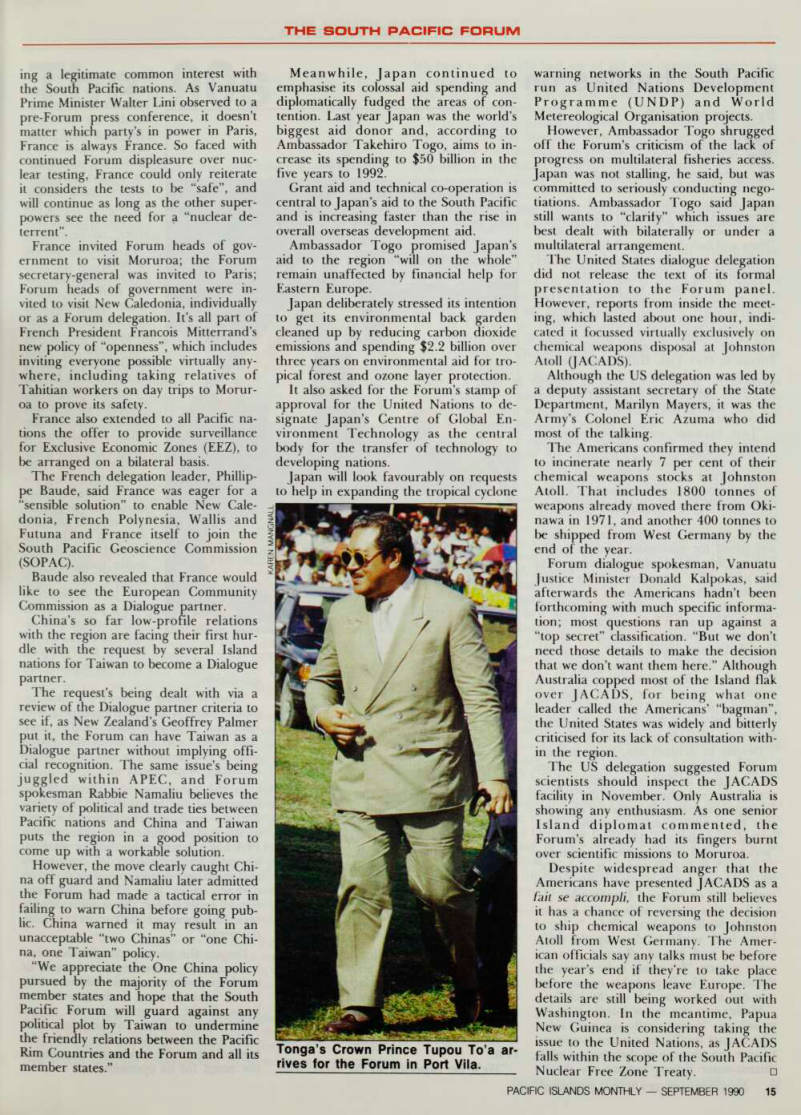
Tonga’s Crown Prince Tupou To’a ar rives for the Forum in Port Vila.