10 years
pp. 22-23 · Read in the full issue
‘A constitution must be practical not
10 years smarter
By Karen Mangall
Minister Walter Lini is heading a move to review Vanuatu’s Constitution to reflect the new direction of his 10-year-old independent nation. He said the present Constitution “was written at a time when we were trying to get Britain and France to leave and give us our independence . . . that constitution did not fully take into consideration how an independent Vanuatu would like to continue in the future”. Lini said that he is proud 10 years down the road to see the ni-Vanuatu is more confident in himself and herself. “It’s a clear indica tion . . . that there is self-confidence at almost every level
throughout the community.”
In the 10 years since Vanuatu’s independence, what achievements give him the greatest pride? 1 am proud that the ni-Vanuatu person feels more con fident in himself and in herself. I think that it’s a clear indication to me as Prime Minister and to the Government that there is self-confidence at almost every level through out the community.
That has been achieved because we do not have a di vided class of people in the community. People who are educated in universities and so on mix fairly well with people who have never had those opportunities. The separation between the village person and the academic people from university and even between them and any European officers in Vanuatu, is much reduced. There is very little consciousness of the differences because of education and the background that they come from. The community in Vanuatu is good in as far as we accept each other as people and it is something I can say proudly that we have done very well in the last 10 years.
Secondly, associated with that, we have also made the people of Vanuatu become more proud of their identity, especially in cultural and traditional terms. The values and culture m Vanuatu are very much a common thing right across the nation, more than it was 10 years ago. Because some of us, like myself and my other Ministers and the President, believe tnat it’s very important to make sure that we have our own identity as a nation. One part of that identity is to make sure that we encourage our culture to continue and not to be regarded as archaic, as a living culture not a dead culture. I think that has helped us.
I am also proud that we have been able to achieve a evel of unity of that culture, especially through bislama, even though we know English and French and we have many different languages. Culture and bislama have made Vanuatu really united.
On his Independence Day call to keep the “independence spirit” alive: The spirit is still there with people still involved with the struggle but it’s not there among the young people. My
children today do not know the full story of what hap pened when we were struggling for independence. That statement was made deliberately to enable the young ni- Vanuatu to understand and ask questions and know exact ly what happened and how we became involved in the struggle with France and England.
The young people today they don’t know England and France were here before. Only the old people. If we do not encourage that spirit in the young people, so they can decide for tnemselves how to continue the spirit in the future, then the whole of the independence spirit will wane and disappear. In the Government we have con tinued that spirit.
We have tried to get a clear stance, an independent stance on regional, national and international politics to make sure there is integrity and respect for our sovereign ty. But I don’t think tne people understand that. But if that can really be made clear to the people, it will rekindle the fire of the independence and they will feel they are continuing to contribute to the independent stance we have taken up to now.
If that spirit dies a lot of people will be directionless.
There will be a lack of leadership, new people who may want to adopt outside thinking and influences. I think it is verv important for Vanuatu to be continually regarded as an independent nation. I think we have done that very well in the last 10 years. It has been difficult and some times we have been criticised for it. We have been able to do that because we’ve been able to think out each stance properly and how we can express it internally and interna tionally. It was good what we did in the last 10 years.
On plans to change Vanuatu’s constitution: The constitution was written at the time when were trying to get Britain and France to leave and give us our independence. So that constitution did not fully take into
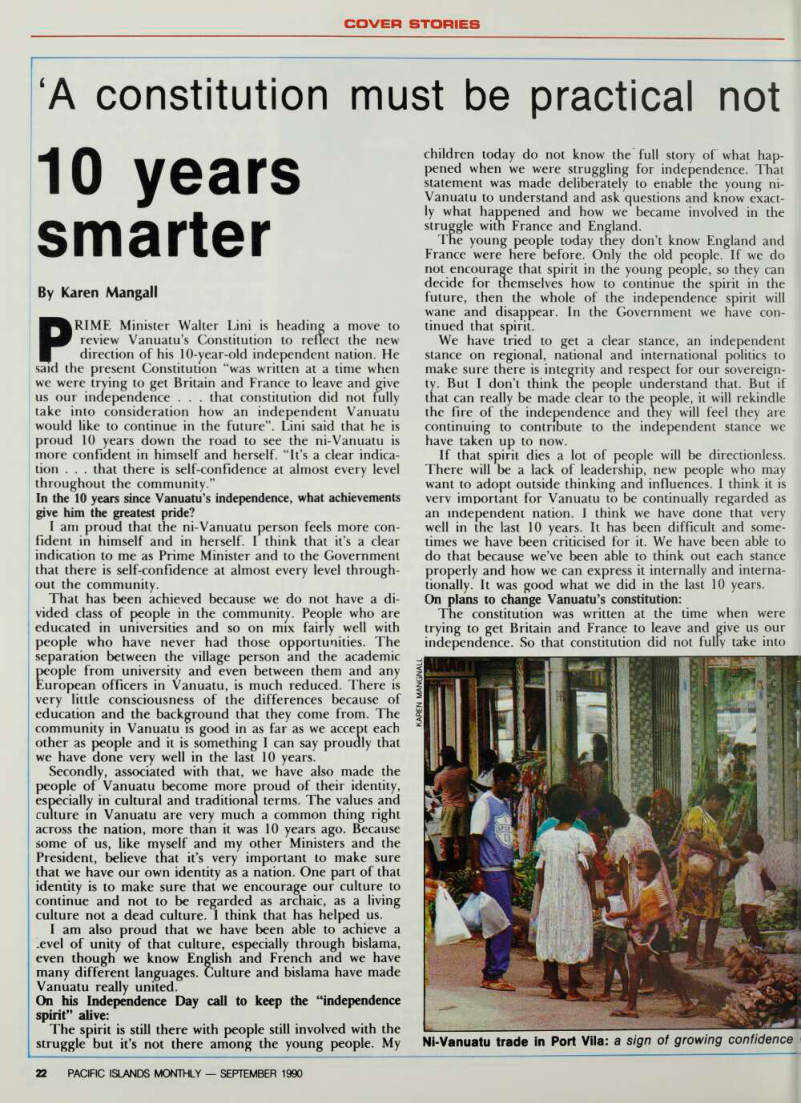
Ni-Vanuatu trade in Port Vila: a sign of growing confidence
consideration how an independent Vanuatu, but at the same time a democratic Vanuatu, would like to continue in the future. Or what problems an independent Vanuatu would have to face even in administrative terms in car rying out its services to the people.
I think it’s possible to redefine the relationship that we have between central government and local government; the government has with the churches; and trie churches with each denomination. We have accepted freedom of worship but in the last 10 years we have faced a lot of problems. We also have freedom of expression which is a principle that we believe in but in the last 10 years had to grow with that and understand how best to use freedom of expression at different levels externally and internally and even affecting each different family, village and commun ity. Because freedom of speech is good but sometimes one has to work out what they want to say publicly about anything that might affect a member of a different family or another person. Our community is not like Australia or New Zealand or a European community with a lot of people. We are only very few. You say something about an individual he’s hurt, his family’s hurt and the whole
community.
Also the authority which the customary chiefs have.
How our legal system and our police can actually help to uphold that chiefly authority in the village. At the moment there’s confusion between legal, constitutional rights that the chief and every person has, and the distinct authority of the chief, which doesn’t have the support of the con stitution or the legal system.
What we’re concerned about is if we really want to make sure that democracy continues in Vanuatu we should make sure that we review all these areas and really get all our people to see clearly and decide for themselves whether these are the kind of amendments we can live with (for)
many years to come.
We don’t want to be forced into a situation like Fiji which had its constitution for such a long time and every one thought that it was really the best solution for the Pacific to have Indians and Fijians living together. Today people are criticising Fiji for what it has done. But maybe what it should have done before they had the coup (was to) amend the constitution in a democratic way, so there would be no coup.
A constitution must be practical even in 20 years from today and not an archaic piece of law like the Bible. The constitution is not a Bible, it should be produced to help people understand and live by it.
On constitutional changes regarding the churches: The constitution should define what we mean by Christ ian churches in Vanuatu and what we would mean by the other religious beliefs. Because our constitution talks about our identity as based on customary and traditional and Christian principles, we think it’s very important to make sure that if there are any new religious influences from outside there would be a way of controlling them in Vanuatu. To be able to say yes come or no, don’t come into Vanuatu.
It will depend very much on whether the National Christian Council has put their proposal very clearly to the Government. Even though we want to do it, 1 think it’s best for the Vanuatu Christian Council to propose these amendments. And they will be doing so very soon to the committee which is being set up.
On the comment that culture ana traditions must be “invited out of the cold” to provide the basis of democracy. Can the two ways be reconciled?
It can be done because in our constitution we have proportional representation and that is the basis of the democracy we nave. If that was taken away then people will have uncertainty (as to) whether demoracy will con tinue. We’re not teaching that at all.
Most of the traditional ways are more democratic than the constitutional democracies. Some of the constitutional democracies are much more dictatorial than the traditional democracies that we know in the South Pacific. It is possi ble to bring the traditional aspect of democracy that we know here, to be the fundamental basis of our democracy.
We would have no difficulty at all in future in regards to coups, for example. It will not be possible for Vanuatu to have a coup, I hope, because we are only a very few people and for any leader to organise a coup in Vanuatu ne would spend many years to get the support of the
population.
Ni-Vanuatu people do not like to fight, do not like war.
If someone is going to want a coup here which is going to be involving the life of a lot of people, no ni-Vanuatu will be backing that.
If Christianity and culture are brought into the constitu tion it will set up the basis to continue democracy, which we think is the best system. We would like to start in Vanuatu even if other Governments don’t wish to start it.
If the chiefs are agreeable to democracy and have a hand in preparing the amendments, then everyone will be bound by the constitution which will be identified as the Vanuatu constitution not a condominium constitution made for Britain and France to leave Vanuatu and let it stand as an independent state. □
‘Ni-Vanuatu people do not like to fight, do not like war. If some one is going to want a coup here which is going to be in volving the life of a lot of peo ple, no ni- Vanuatu will be backing that.’