Interview
pp. 50-52 · Read in the full issue
Mililani Trask: activist, Hawaii
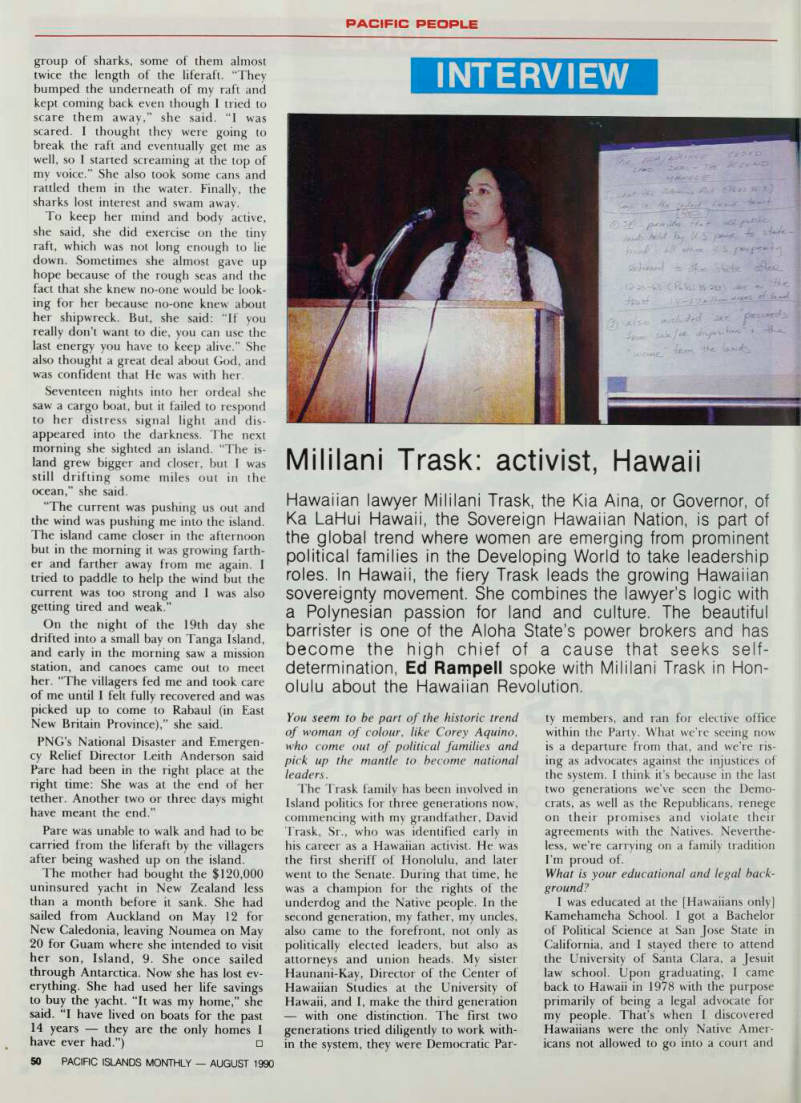
Hawaiian lawyer Mililani Trask, the Kia Aina, or Governor, of Ka LaHui Hawaii, the Sovereign Hawaiian Nation, is part of the global trend where women are emerging from prominent political families in the Developing World to take leadership roles. In Hawaii, the fiery Trask leads the growing Hawaiian sovereignty movement. She combines the lawyer’s logic with a Polynesian passion for land and culture. The beautiful barrister is one of the Aloha State’s power brokers and has become the high chief of a cause that seeks self determination, Ed Rampell spoke with Mililani Trask in Hon olulu about the Hawaiian Revolution.
You seem to be part of the historic trend of woman of colour, like Corey Aquino, who come out of political families and pick up the mantle to become national leaders.
The Trask family has been involved in Island politics for three generations now, commencing with my grandfather, David Trask, Sr., who was identified early in his career as a Hawaiian activist. He was the first sheriff of Honolulu, and later went to the Senate. During that time, he was a champion for the rights of the underdog and the Native people. In the second generation, my father, my uncles, also came to the forefront, not only as politically elected leaders, but also as attorneys and union heads. My sister Haunani-Kay, Director of the Center of Hawaiian Studies at the University of Hawaii, and I, make the third generation with one distinction. The first two generations tried diligently to work with in the system, they were Democratic Par
ty members, and ran for elective office within the Party. What we’re seeing now is a departure from that, and we’re ris ing as advocates against the injustices of the system. I think it’s because in the last two generations we’ve seen the Demo crats, as well as the Republicans, renege on their promises and violate their agreements with the Natives. Neverthe less, we’re carrying on a family tradition I’m proud of.
What is your educational and legal back ground?
I was educated at the [Hawaiians only] Kamehameha School. I got a Bachelor of Political Science at San Jose State in California, and I stayed there to attend the University of Santa Clara, a Jesuit law school. Upon graduating, I came back to Hawaii in 1978 with the purpose primarily of being a legal advocate for my people. That’s when I discovered Hawaiians were the only Native Amer icans not allowed to go into a court and
to litigate and protect their trust land entitlements. With that, I began a politic al career as a lobbyist and advocate in the legislative format and also before
Congressional committees.
Without the ability to go to court, you’re unable to resolve some of these historic problems and we were looking for judicial relief, but because we were barred from the courts, we had to resort
to political lobbying and legislative work.
Tell us about your early legal work and Hawaiian activism.
At the time I was studying for the bar, I went as a legal researcher to work at the State Constitutional Convention for the Hawaiian Affairs committee. The Democratic Party initiated its plan to cre ate a new State bureaucracy for purposes of maintaining government control over the Native s(f) Ceded Land trust assets.
I was right there in the thick of it when the Office of Hawaiian Affairs (OHA)
was created by the powers that be. They were con cerned with Native advo cates who were lobbying for segregation of Native lands. We wanted to set aside the Native trust lands and to allow the Native people to be self
governing.
The coalition involved many of the current lead ers of OHA and was
spearheaded by the current
Governor, John Waihee, who is a part-Hawaiian.
Their intent was to seize permanent control and estabjish themselves fore ver as land managers, lunas, of these trust lands,
land s , which are, in fact, the most wealthy and valuable trust lands of any Nalive people in this country. So I was there to see that born, and in my heart there was born a commitment to resist that kind of bureaucratic control over the lives of Native peoples. And to this day we continue to be advocates in opposition to some of the planning and legislative scheming OHA has proposed f° r us - What other rights do the rest of the Nafive Americans have that Hawaiians don’t have?
Primarily, Native Hawaiians have been excluded from the Federal policy providing other Native Americans the rights to control their lands, to be self-governing, and, in fact, to write constitutions. We have been left in a time capsule. On the Mainland the Federal policy acknowledges the right of Native people ... to have taxing power. In addition, the Federal government has a national systern maintained for Indians, Eskimoes, Aluits, Inuits, that provides them with
health care services; Hawaiians are ex cluded from that. It provides them with the ability to get Federal funding for housing on Native trust lands we are denied access to that. In addition, direct Federal funding to sustain these Native governments Hawaiians are excluded.
What this means is that in 1990 Native Hawaiians remain the only Native people who are actually wards of a State govern ment. In all other instances the Native
people are self-governing or astriving to
achieve self-governance under estab lished Federal procedures, which we’re excluded from.
Discuss the Native Hawaiian land trusts Basically, two Native Hawaiian land trusts exist that are pursuant to Federal and State law. The first arose in 1920, it was the result of US Congressional ac tion. 200,000 acres of very arid and bar ren land were set aside allegedly for the purposes of homesteading Native
Hawaiians. The land was set aside by act of Congress as the result of lobbying by Prince Kuhio, who went to Congress pointing out Native people were landless throughout the State, and that they were suffering and dying from poverty. He had to face great opposition from the sugar planters who were seizing large tracts of land for agricultural purposes.
Congress looked at lands already dis carded by the sugar industry and set these lands aside for Native Hawaiians.
At the present time, we have only settled 5500 families; approximately 30,000 Na lives have died waiting since 1920, Roughly 20,900 families wait now for these entitlements. But these lands are very far away, rural lands, not accessible by roads, without water or electricity.
This is the Hawaiian Homelands Trust.
Then, in 1959, when Hawaii became a State, the Federal government transfer red to the State about 1.4 million acres for the purposes of providing for public improvements and education, and also the betterment of conditions of Native
Hawaiians of 50 per cent blood. These lands have always been under the con trol of the State, they’ve never been set tled by Native people, and have never been segregated. Every acre is utilised by the public for public purposes. OHA, a State agency, is currently working to obtain financial benefits for the mainte nance of its own bureaucracy, but the Natives have never profited either from revenues or the lands of this Ceded Land Trust, and that is a primary poli tical issue here. The Ceded Land Trust arose because of the joint resolution of annexation, when America moved to take Hawaii as a territory, it took control of all non-fee lands.
The loss of the land is the crucifix which Hawaiians have been impaled on. Please discuss the alienation of the Aina.
The Great Mahele, in 1848, was the result of a historical trauma Hawaiians experienced early in the 19th century.
Western influences came in with their ideas of private land ownership. These ideas of fee simple own ership were alien to our people. The term Mahele means to share and it was in that spirit the Great Mahele was proposed.
There was never any Na tive understanding that private property rights would come to the fore, and that Natives would be expelled from their lands, prohibited from gathering and use of waters. But Western Law interpreted Mahele as introducing con cepts of private property, and by the time the Mahele
was completed, we saw the dispossession of 99 per cent of our people.
As a result of the Mahele, one per cent of Native people secured title to their land. What follows was a tragic period of our history. Families were broken up, people wandered from place to place, the rise of vagrancy laws be cause Hawaiians had no home, no place to go, so they wandered on the streets, lived on the beaches and mountains. To this day, Hawaii is the only State where you still have a population of cave dwel lers. These are homeless people, who are looking for shelter.
When we look at what’s occurring to day with the Native trusts, we’re calling today's legislative move the Second Mahele. Because it’s another political, well engineered attempt to deprive Na tives of the remnants of their claims to Trust lands.
On February 8, Gov. Waihee and OHA reached a historic settlement on the Ceded Lands dispute, giving OHA US$7 million extra per year, plus a retroactive
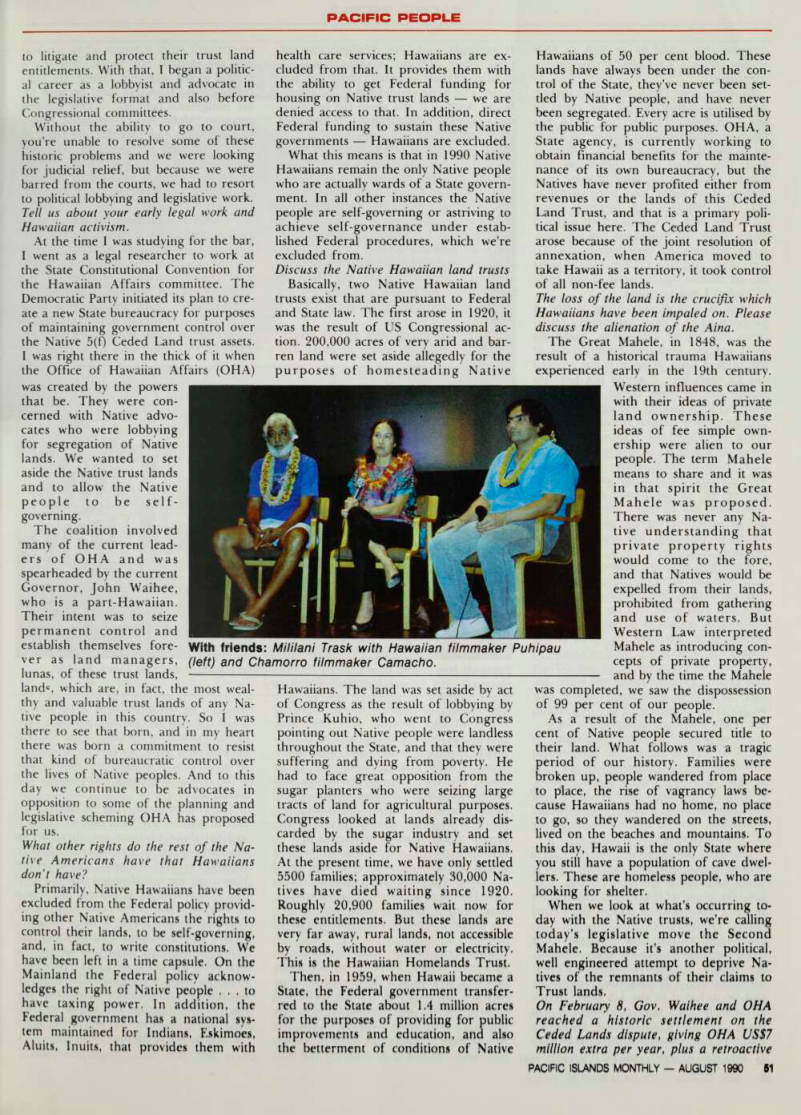
With friends: Mililani Trask with Hawaiian filmmaker Puhipau (left) and Chamorro filmmaker Camacho.
payment that could be as high as $lOO million. What’s Ka LaHui’s view on the agreement?
Number one, OHA has permanently waived for Native people any claim to any land base. Number two, OHA has taken a dollar tabulation based on a for mula that’ll give them $8.5 million a year. The actual lands themselves and natural resources . . . none of these trust corpus, trust assets, have been inventor ied. The Waihee-OHA formula giving OHA one fifth of Ceded Lands assets is faulty. The s(f) provisions has five pur poses, but only two beneficiaries, the Na tive and public. Hence, Hawaiians should receive half, instead of one fifth, of Ceded Land revenues.
What is very disconcerting is that it purports to be a final, permanent settle ment for Native Hawaiians, based on what are the projected landholdings at the present time. Now, if it was worked out 15 years ago, it would not have in cluded geo-thermal, ocean thermal re
sources, deep mining leasing, because at
that time those natural resources weren’t being developed in Hawaii. We don’t know what will be developed in the fu ture, consequently, these entitlements will be eradicated. But the greatest loss is the loss of the land base itself. Native Hawaiians, like all other indigenous peo ple in order to survive, need to have access to the land for our traditional
practices.
When you separate Natives from their land, you put them on the path to even tual extinction. What’s being achieved here will guarantee that the Natives will continue to decline in population. At the present time, we have the worst health statistics in America. If we don’t secure a land base so we can practice our culture and return to our traditional ways, for sure we’ll see a continued decline. For us, it’s really a matter of life and death.
It’s really a survival question for us.
We’re near the hundredth anniversary of the 1893 overthrow of the independent Hawaiian Kingdom, annexed by the U.S. in 1898. As a land Trust settlement nears, is your programme that revenues and land should be given directly to individual Hawaiians, instead of collectively to the OHA bureaucracy?
The goal and objective of Ka LaHui Hawaii is to segregate out the Native Trust lands from the public lands. The 200,000 acres of Hawaiian Homelands and not less than one half of the Ceded Lands, 750,000 acres, should be set aside for Native control. And our right to be self-governing should be acknowledged.
We should be allowed to conduct our own business, develop our resources, and be included in the US policy which affords all other Native Americans that right. With the Office of Hawaiian Affairs, the Department of Hawaiian
Homelands, and Gov. Waihee’s current plan, their opinion is that Hawaiians should remain colonial wards of the State. The State should hold title to our lands, develop it and share the revenues with its own bureaucracies to maintain their own system.
When you look at OHA, in the 10 years since their creation, they’ve never raised a claim for even a single acre of Ceded
Lands, they’ve always been preoccupied
with revenue claims, and they’ve greatly undervalued the Native Trusts. We’re talking about 1.4 million acres of land in the State with the highest land values in America, and OHA is asking for US$B.5 million. Estimations for the housing needs for our people, for the 20,900 families on the waiting list, are at US$l.4 billion.
There’s no way a State agency receiving $8.5 million is going to make any
appreciable difference in the housing needs of our people. But the State bureaucracy is not concerned with that, they’re primarily concerned with main taining their stranglehold over these lands, and it’s common knowledge that the business and investment atmosphere in Hawaii is very tightly controlled, and there is, in fact, more incentive for Japanese and Oriental businesses here in this State than there are for Americans.
Recently, the Governor’s economic advis er, Greg Pai, said his Japanese clients view Hawaii as a colony of Japan, rather, than being a State in the Union.
Ka LaHui prefers to get land, instead of money?
That’s right. The truth is we know we’ll need capital. But our attitude about how that land base is developed to bring forward that capital is very different from the State. We have to consider the impact of geo-thermal energy on the Na tive right to worship. We have to consid
er seriously what it means when we des troy the tropical rain forest, how that’ll
impact global warming. These are con
cerns Pacific Islanders have because we are indigenous people . . . Our cultural tenet is “Aloha Aina”, “Malama Aina”, the provision and care for the land, in return the land provides and nourishes the people. It’s that cultural basis from which we spring, as opposed to the basis of Western law and economics: exploita tion and capitalism, Ka LaHui Hawaii calls for the creation of a nation within a nation, with a gov ernment-to-government relationship with Washington. Are you advocating giving Hawaiians something similar to the American Indian reservation system?
What we’re really advocating is loose inclusion in Federal policy similar to what Indians have. We are not [red] In dians and we don’t want to be viewed by
America as being Indians. We’d like to avoid some of the pitfalls that they have to experience in dealing with the US bureaucracy. What we feel we’re entitled to is self-determination, the bottom line is the ability to control and develop our trustlands.
The Indian situation is the majority of Indian nations are Federally recognised and for those who are not, there are at least procedures to allow them to achieve recognition and national status. Native Hawaiians are not afforded that but we’d like to be included in these policies in a general way. But at the same time, we do not want to be viewed as being Indians, we are Pacific Islanders, and I think that is the greatest stereotype that we have to deal with when we go to Congress and even the State legislature. There’s a ra cist tendency in America to lump all Na tive peoples together and to call us Indi ans, and nothing could be further from the truth. We’re Hawaiians.
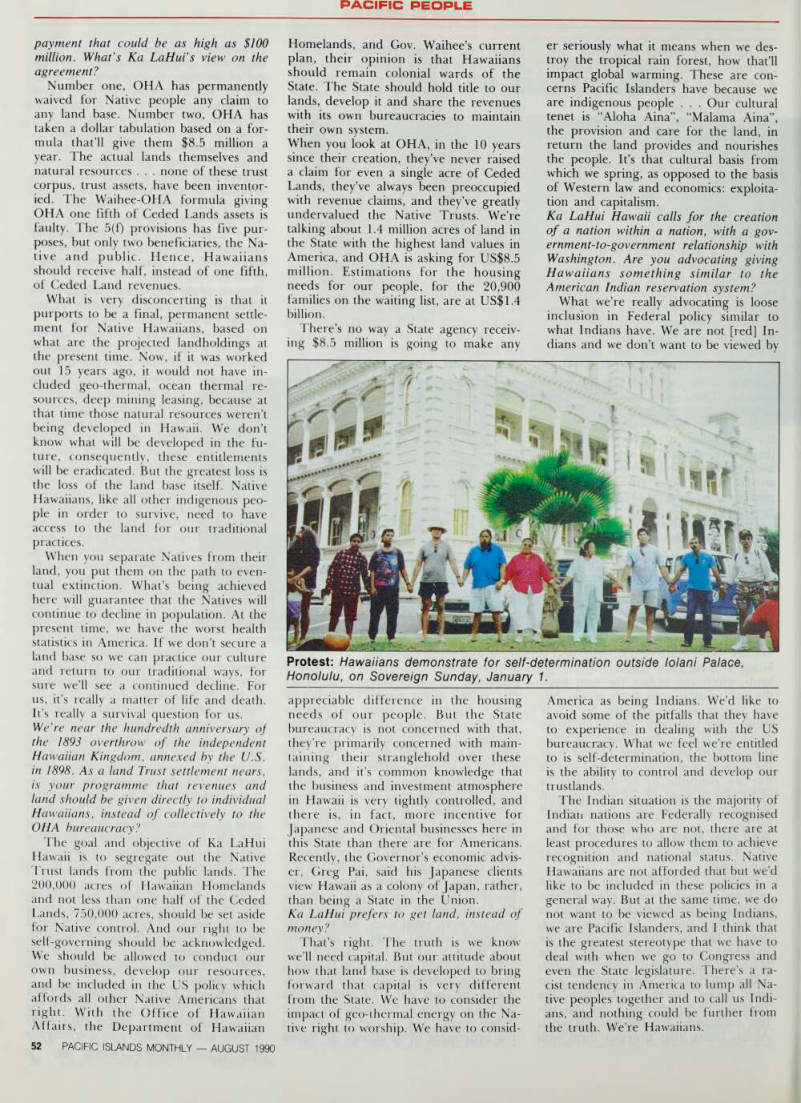
Protest: Hawaiians demonstrate for self-determination outside lolani Palace, Honolulu, on Sovereign Sunday, January 1.