Interview
p. 53 · Read in the full issue
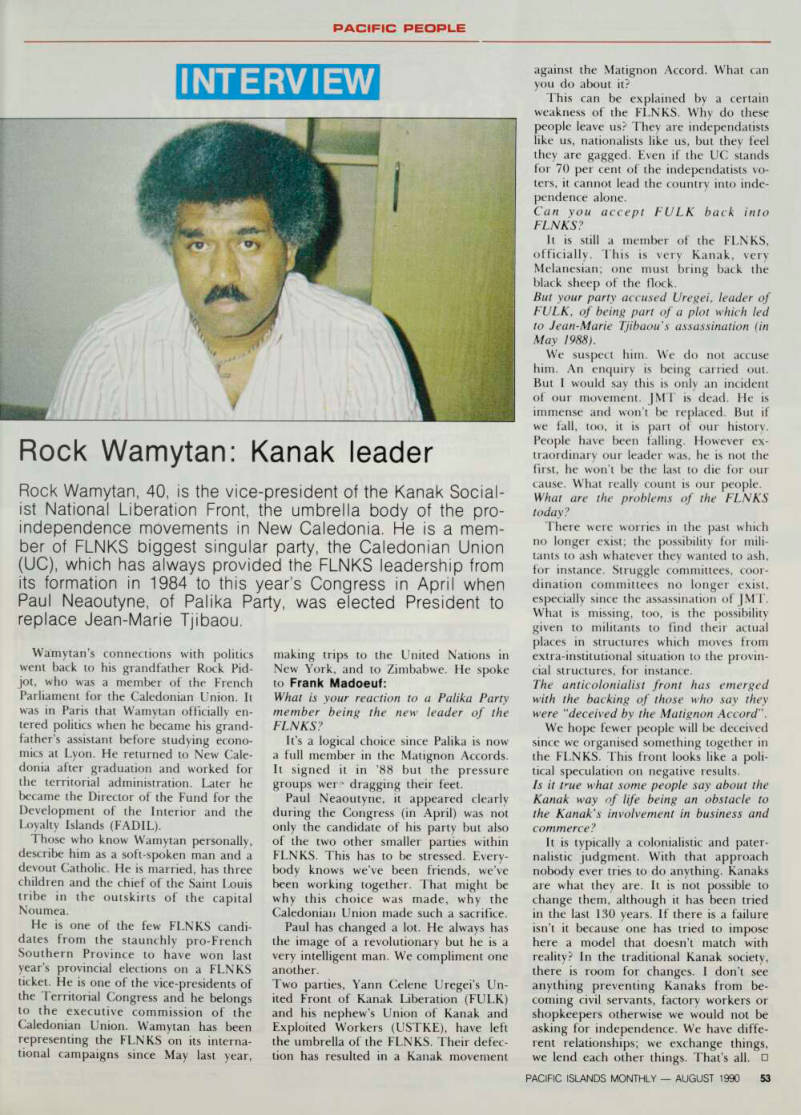
Rock Wamytan: Kanak leader
Rock Wamytan, 40, is the vice-president of the Kanak Social ist National Liberation Front, the umbrella body of the pro independence movements in New Caledonia. He is a mem ber of FLNKS biggest singular party, the Caledonian Union (UC), which has always provided the FLNKS leadership from its formation in 1984 to this year’s Congress in April when Paul Neaoutyne, of Palika Party, was elected President to replace Jean-Marie Tjibaou.
Wamytan’s connections with politics went back to his grandfather Rock Pidjot, who was a member of the French Parliament for the Caledonian Union. Ii was in Paris that Wamytan officially entered politics when he became his grandfather’s assistant before studying economics at Lyon. He returned to New Caledonia after graduation and worked for the territorial administration. Later he became the Director of the Fund for the Development of the Interior and the Loyalty Islands (FADIL).
Those who know Wamytan personally, describe him as a soft-spoken man and a devout Catholic. He is married, has three children and the chief of the Saint Louis tribe in the outskirts of the capital Noumea.
He is one of the few FLNKS candidates from the staunchly pro-French Southern Province to have won last year’s provincial elections on a FLNKS ticket. He is one of the vice-presidents of the Territorial Congress and he belongs to the executive commission of the Caledonian Union. Wamytan has been representing the FLNKS on its international campaigns since May last year,
making trips to the United Nations in New York, and to Zimbabwe. He spoke to Frank Madoeuf: What is your reaction to a Palika Party member being the new leader of the
Flnks?
It’s a logical choice since Palika is now a full member in the Matignon Accords, It signed it in ’BB but the pressure groups wer" dragging their feet,
Paul Neaoutyne, it appeared clearly
during the Congress (in April) was not only the candidate of his party but also of the two other smaller parties within FLNKS. This has to be stressed. Every body knows we’ve been friends, we’ve
been working together. That might be
why this choice was made, why the Caledonian Union made such a sacrifice.
Paul has changed a lot. He always has the image of a revolutionary but he is a very intelligent man. We compliment one another.
Two parties, Yann Celene Uregei’s Un ited Front of Kanak Liberation (FULK) and his nephew’s Union of Kanak and Exploited Workers (USTKE), have left the umbrella of the FLNKS. Their defec tion has resulted in a Kanak movement
against the Matignon Accord. What can you do about it?
This can be explained by a certain weakness of the FLNKS. Why do these people leave us? They are independatists like us, nationalists like us, but they feel they are gagged. Even if the UC stands for 70 per cent of the independatists vo ters, it cannot lead the country into inde pendence alone.
Can you accept FULK back into
Flnks?
It is still a member of the FLNKS, officially. This is very Kanak, very Melanesian; one must bring back the black sheep of the flock.
But your party accused Uregei, leader of FULK, of being part of a plot which led to Jean-Marie Tjibaou’s assassination (in May 1988).
We suspect him. We do not accuse him. An enquiry is being carried out.
But I would say this is only an incident of our movement. JMT is dead. He is immense and won’t be replaced. But if we fall, too, it is part of our history.
People have been falling. However ex traordinary our leader was, he is not the first, he won’t be the last to die for our cause. What really count is our people.
What are the problems of the FLNKS today?
There were worries in the past which no longer exist; the possibility for mili tants to ash whatever they wanted to ash, for instance. Struggle committees, coor dination committees no longer exist, especially since the assassination of JMT.
What is missing, too, is the possibility given to militants to find their actual places in structures which moves from extra-institutional situation to the provin cial structures, for instance.
The anticolonialist front has emerged with the backing of those who say they were “deceived by the Matignon Accord”.
We hope fewer people will be deceived
since we organised something together in
the FLNKS. This front looks like a poli tical speculation on negative results.
Is it true what some people say about the Kanak way of life being an obstacle to the Kanak’s involvement in business and commerce?
It is typically a colonialistic and pater nalistic judgment. With that approach nobody ever tries to do anything. Kanaks are what they are. It is not possible to change them, although it has been tried in the last 130 years. If there is a failure isn’t it because one has tried to impose here a model that doesn’t match with reality? In the traditional Kanak society, there is room for changes. I don’t see anything preventing Kanaks from be coming civil servants, factory workers or shopkeepers otherwise we would not be asking for independence. We have diffe
rent relationships; we exchange things,
we lend each other things. That’s all. □