In God’s Hands
pp. 49-50 · Read in the full issue
People
Woman, 42, survives 20 days adrift in open sea
By Wally Hiambohn
A 42-YEAR-OLD French woman’s belief in God and her strong will to live led to her survival after a 20-day struggle between life and death in the Pacific Ocean off Papua New Guinea in late June. Claudine Pare, a resident of Noumea, New Caledonia, clinging to a tiny life raft finally beached on the shores of Tanga Island in PNG’s New Ireland Province where she was taken in and cared for by friendly islan ders. She had survived on a tiny provi sion of water and food, and even at one stage caught a fish with her bare hands
and ate it raw.
Her ordeal began on May 30 when her $120,000 yacht, Excitable Boy, hit a reef and sank about 200 nautical miles north-east of Bougainville. She was on a lone voyage from Noumea to Japan via Guam when disaster struck. In the hands of Tanga islanders she had recovered fast.
In an interview with the Post-Courier in Rabaul in East New Britain where she was flown to from Tanga Island, Pare told of how she screamed and rattled empty cans to scare off hungry sharks that bumped her tiny liferaft in the northern waters of PNG. She recalled
how her willpower and her faith in God sustained her during her 20-day ordeal at sea in the 1.5 metre raft. Her yacht, Excitable Boy, which she considered home, drove on a reef and sank on May 30.
“I thought I saw the reef in front of me,” she said, “but I was not sure until a huge wave lifted the yacht and threw it on to the reef. At first I thought the knock was not serious but then I realised that water was coming in very quickly and I was not going to be able to save the boat. So I jumped on to the liferaft with a few packets of noodles and some water and managed to paddle out to
deep water.”
For the first three days the wind was quiet and the sea was like a mirror. But then a wind came up and she managed to rig a makeshift sail. A couple of days later the wind dropped and she tried to
paddle.
One day, when her noodles had gone rotten, she caught a fish with her bare hands and ate it raw. When she threw the remains overboard they attracted a
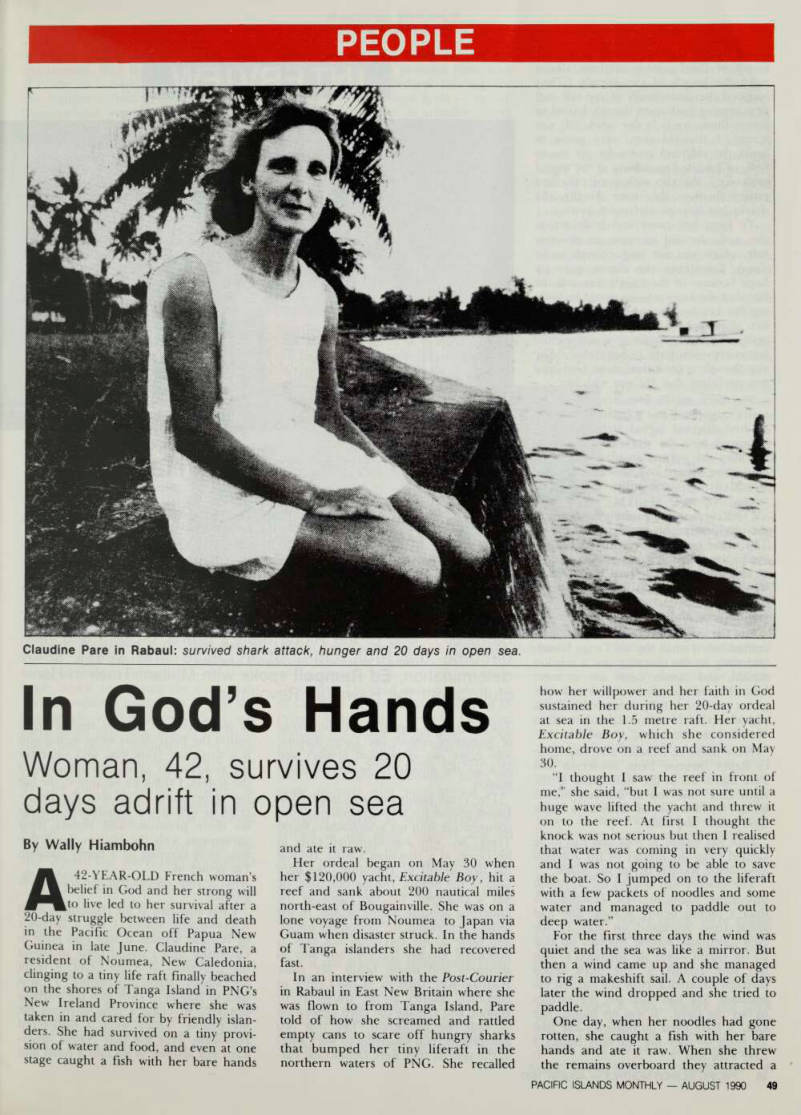
Claudine Pare in Rabaul: survived shark attack, hunger and 20 days in open sea.
group of sharks, some of them almost twice the length of the liferaft. “They bumped the underneath of my raft and kept coming back even though I tried to scare them away,” she said. “I was scared. I thought they were going to break the raft and eventually get me as well, so I started screaming at the top of my voice.” She also took some cans and rattled them in the water. Finally, the sharks lost interest and swam away.
To keep her mind and body active, she said, she did exercise on the tiny raft, which was not long enough to lie down. Sometimes she almost gave up hope because of the rough seas and the fact that she knew no-one would be look ing for her because no-one knew about her shipwreck. But, she said: “If you really don’t want to die, you can use the last energy you have to keep alive.” She also thought a great deal about God, and was confident that He was with her.
Seventeen nights into her ordeal she saw a cargo boat, but it failed to respond to her distress signal light and dis appeared into the darkness. The next morning she sighted an island. “The is land grew bigger and closer, but I was still drifting some miles out in the ocean,” she said.
“The current was pushing us out and the wind was pushing me into the island.
The island came closer in the afternoon but in the morning it was growing farth er and farther away from me again. I tried to paddle to help the wind but the current was too strong and I was also getting tired and weak.”
On the night of the 19th day she drifted into a small bay on Tanga Island, and early in the morning saw a mission station, and canoes came out to meet her. “The villagers fed me and took care of me until I felt fully recovered and was picked up to come to Rabaul (in East New Britain Province),” she said.
PNG’s National Disaster and Emergen cy Relief Director Leith Anderson said Pare had been in the right place at the right time: She was at the end of her tether. Another two or three days might have meant the end.”
Pare was unable to walk and had to be carried from the liferaft by the villagers after being washed up on the island.
The mother had bought the $120,000 uninsured yacht in New Zealand less than a month before it sank. She had sailed from Auckland on May 12 for New Caledonia, leaving Noumea on May 20 for Guam where she intended to visit her son, Island, 9. She once sailed through Antarctica. Now she has lost ev erything. She had used her life savings to buy the yacht. “It was my home,” she said. “I have lived on boats for the past 14 years they are the only homes I have ever had.”) □