Rosslandfotopacific
pp. 10-11 · Read in the full issue
France pays, France controls
By Karen Mangnall
A DISGRUNTLED Les Nouvelles headline farewelled Francois Mit terrand from Tahiti last month after three days of relentless feting: “A Presidential Visit to Polynesia for No thing?” On the surface, an unexpected plaint from a francophone bastion after only the third visit to the territory by a French head of state, and Mitterrand’s first as President.
The customarily overwhelming Tahi tian welcome was matched by the politic al wattage of Mitterrand's entourage.
The President was joined by Prime Minister Michel Rocard and eight other Ministers of the Republic for the second meeting of the South Pacific Council.
Mitterrand himself was chief attraction at the inauguration of Papeete’s Hotel de Ville, a US$l4.5 million rose-and-cream replica of Queen Pomare IV’s Palace.
Mayor Jean Juventin said Papeete de served a town hall to match its ambi tions, which in this capital obviously run to Imperial chic parquet floors, hand
painted wallpapers, chandeliers, palest
green leather couches, satin drapes and wood panelling. The inauguration kick ed off a month of celebrating Papeete’s centenary, a marathon of dances, cultu ral festivals, sports and exhibitions cost
ing an extra US$6 million. Not bad for a town of only 25,000 residents.
This widening gap between lavish ex penditure and modest resources was Mit terrand’s public focus, although he di plomatically avoided highlighting Pape ete’s own excesses. Reidents who’d hoped for promises of more State sub sidies to bail out French Polynesia’s deepening economic recession, hoped in vain. What they got was a blunt econo
mic diagnosis:
• Exports cover at most 10 per cent of
imports;
• Rapid urban drift has sidelined agri culture and industry remains feeble;
• The burgeoning tertiary sector, with attractive salaries, thanks to massive met ropolitan subsidies, has stimulated an “economy of consumption” with rocket
ing imports;
• The social cost is 15 per cent unem ployment, the vast majority of the unem
ployed being young Tahitians, particu
larly those recently arrived on Tahiti nui from the islands; This disruptive threat is accentuated by demographics. The estimated popula tion of 190,000 is growing rapidly and three-quarters live on Tahiti itself, many in the insanitary slums of bidonvilles, around Papeete, and Faa’a. Half this population is aged under 20.
Mitterrand acknowledged the wide ning gap between rich and poor is re sented all the more as Tahiti is touted as having one of the region’s highest per capita incomes. The state is contributing US$25 million over the next five years to build 200 low-cost houses a year. Mitter rand sees education as the key to dealing with Tahiti’s young workforce and de
veloping the territory’s agriculture,
fisheries and tourism. But his lauding of education (to be subsidised to the tune of tens of millions of dollars in the short term) as “the best chance for every indvi dual to get a job”, begs the question;
what job?
Tahiti is estimated to need 2300 new jobs annually to meet demand but can expect only 1000, at most, as long as the
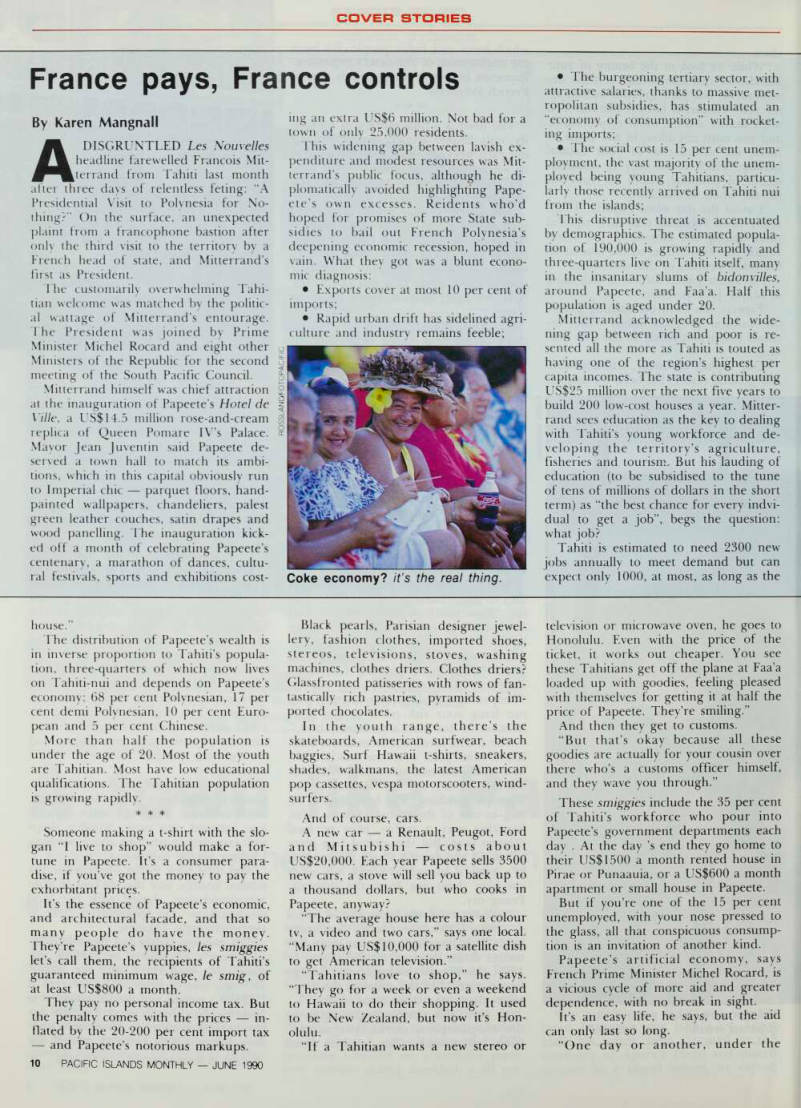
Coke economy? it’s the real thing.
Rosslandfotopacific
economy improves. Tourism is in a ma jor slump, imports rose 5 per cent last year to USS92O million while exports amounted to US$lO3 million, of which
only US$46 million was locally produced,
mostly from sales of black pearls.
Agribusiness, fisheries and acquacul
ture haven’t shown any signs of becom ing big employers or export earners de spite millions spent in recent years on world-class R & D. And this exposes the gaping flaw in Mitterrand’s economic di
agnosis: the totally distorting effect of
the Centre d’Experimentation du Pacific que (CEP) and the Commission d’Ener gie Atomique (CEA). To keep its nuclear force up with the superpowers, France pours about US$55 million per month directly into Tahiti’s economy. The CEP alone provides 12.5% of local jobs, 55 per cent of all the territory’s external financial aid, accounts for 28 per cent of imports and 22 per cent of the GDP.
The crushing impact of the CEP/CEA can be seen in the employment figures over the past 25 years. In 1962, before the CEP moved to French Polynesia, the primary sector provided 54 per cent of jobs and the tertiary only one third. To
day the service sector provides nearly
three-quarters of all jobs and the prim ary sector only 11 per cent.
Today French Polynesia’s main busi ness is government. More than a third of employees are in the public sector (22 per cent in France), recycling metropoli
tan subsidies, particularly by spending inflated wages on imported goods sold by the rest of the tertiary sector at noto rious markups. Tahiti’s high cost struc ture caused by le smig, a guaranteed minimum wage of US$BOO/month (on a par with France), its welfare system, and import taxes ranging from 20-200 per cent poses a daunting disincentive to potential investors.
So Francois Mitterrand struck at the core of French Polynesia’s handout men tality by strongly suggesting the Terri tory soon adopt a direct tax on incomes.
“The Polynesian tax system,” he said, “based almost exclusively on consump tion, can hardly respond to the obliga tion to distribute wealth more fairly.”
French Polynesia, he added, couldn’t continue to be an exception within the Republic.
It sent a shiver through the middle class achelons of government and private salaried workers. Personal income taxes would hit the most, rather than the small proportion of extremely wealthy businesspeople. The main political par ties rely on the middle class salaried vo ters so, with a difficult territorial election looming next March, it was no surprise that Territorial President Alexandre Leontieff indicated it would be politically expedient to leave the issue for the next Parliament.
The Territory raises about 80 per cent of its annual budget US$75O million
this year from import taxes, so Leon tieff s evasion was understandable. But it was precisely the attitude which Mitter rand addressed in his speech calling on
the Territory to apply some rigorous
accounting controls, and live within its budget. Leontieff insisted the 1990 budget would be balanced: a feat only possible after he’d squeezed Paris for a multimillion dollar to pup to compensate for a drop in revenue from the CEP’s cutback in staff and imported materials.
Mitterrand said Tahiti, with the con stant support of the State, now enjoyed “responsibility for its own affairs, the mastery of its own destiny”. The terri tory should settle down to explore its existing powers under the 1984 Statute (and modifications soon to be ratified by the French Parliament), exploring auton omy “to its limits”.
Asked if this meant progress from autonomy to independence, Mitterrand’s replies suddenly became vague, with the changes in Eastern Europe, France had already indicated it would take part in any disarmament moves, including what Mitterand obviously views as the re motest chance of a test ban. France “won’t be the last to disarm”, he said, if there’s a widespread agreement. “But until then, the CEP will continue its work.”
As the French say: he who pays, con trols. And, Tahiti hopes, vice versa. □