Pacific




Islands
Monthly
June 1990
Ratu Mara turns 70
Behind the love
image
Tahiti has become a land of fast cars, soaring prices and insatiable sex appeal
American Samoa US$2 50
Australia As 2 50
Cook Islands ”""“ZZZ”“"“""nzs3'oo
S' ”, Vv. ' F 51.75
rb of Micronesia US$3 00
■ ’ USs3ioo
J®*® 1 ' Us$3.Oo
Nauru ; A 52.50 New Caledonia CFPS2 50 New Zealand (incl GST) NZ$3 45 N K Nth Marianas US$3.OO Paoua New Guinea i/to nn
Somolon Islands A 53.00 lahitlI ahitl CFP3OO
Hca^ 3 P 3 00
Sa Us$3.Oo
Vanuatu VT2OO - Samoa ’ ’ 13.25
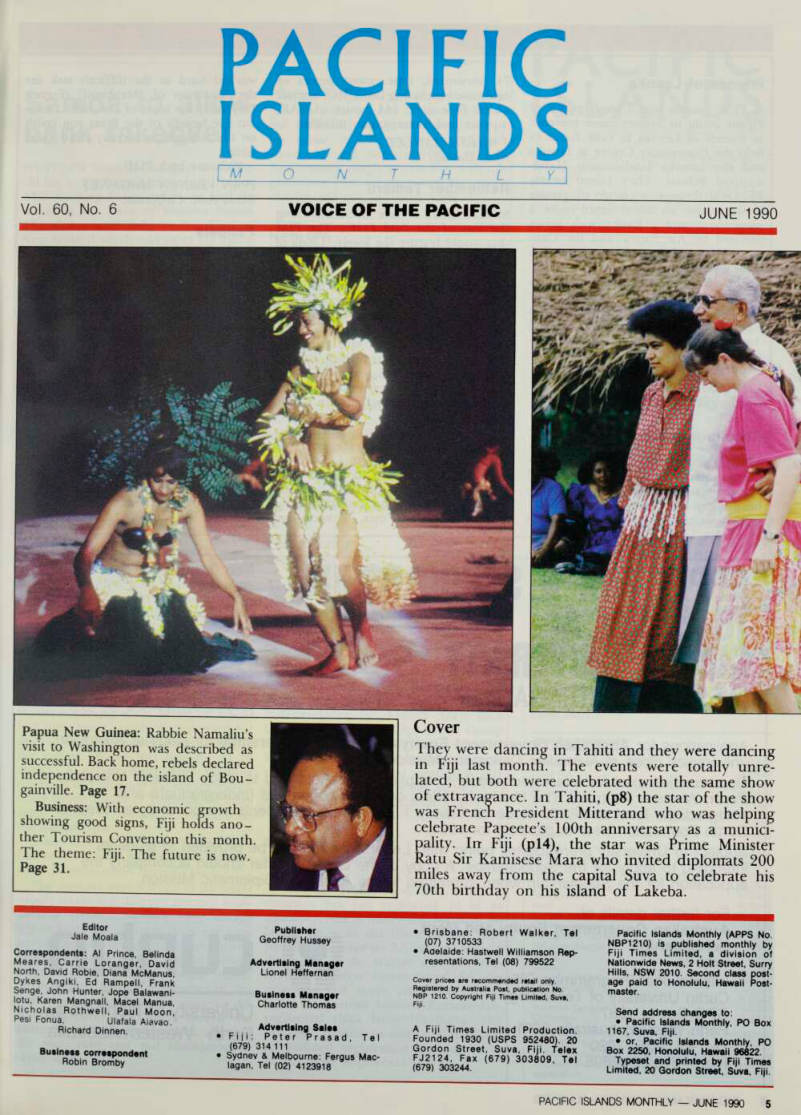
Cover They were dancing in Tahiti and they were dancing in Fiji last month. The events were totally unre lated, but both were celebrated with the same show of extravagance. In Tahiti, (p 8) the star of the show was French President Mitterand who was helping celebrate Papeete’s 100th anniversary as a munici pality. In Fiji (p!4), the star was Prime Minister Ratu Sir Kamisese Mara who invited diplomats 200 miles away from the capital Suva to celebrate his 70th birthday on his island of Lakeba.
Advertisements & other items, pp. 2-4 (1 item)
Performance that
becomes a Legend
The quiet authority, elegant appearance and impeccable road manners of the Legend Sedan represent a culmination of Honda's commitment to providing today's discerning driver with the peak of motoring performance That commitment finds expression in a classic integration of design, craftsmanship and technological excellence qualities which are universally recognized as the Honda hallmark. To drive the Legend is to experience them all together: the exhilaration that comes from powerful performance, the dependability that belongs to precision engineering and the distinction conferred by meticulous attention to quality.
AUSTRALIA: Honda Australia Pty., Ltd. Lot 95 Sharps Road, Tullamarine, Victoria 3043/NEW ZEALAND: Honda New Zealand Ltd. P.O. Box 97-340, So Auckland/PAPUA NEW GUINEA: Toba Pty., Ltd. P.O. Box 503, Port Moresby/U.S. TRUST TERRITORY: United Micronesia Development Association P.O, Box 2 CHRB Saipan CM 96950/COOKISLAN DS: Cook Islands Motor Centre Ltd. P.O. Box 74, Rarotonga/GUAM: Mark’s Motor Co., Inc. P.O. Box DV. Agana/FIJI: Coral Isl I Motors Ltd. P.O. Box 12052 Suva Fiji/NORFOLK ISLAND: Duncombe Bay Garage P.O. Box 220, Norfolk Island South Pacific 2899/NEW CALEDONIA: Soc: nonoralo n’lmnnrfatinn Ai itnmnhila C A 1 1 DT 1 DIC nnmc.rnmnlQva Halrn RP 1 /IfiA.Mm imoa r I ! Honda Distribution BP 1 665 PaP<l
The Legend's styling is a masterpiece >f aerodynamics, ensuring a whisper- |uiet ride even at high speeds. Its com- ►rehensively equipped cockpit promises ffortless command of every function.
Lnd its spacious, elegant interior and ower-adjustable front seats* invite you ) relax in comfort all the way to )urne/s end.
Honda's Formula One experience is Elected in the highly advanced features f the Legend's 2.7-liter V 6 24-valve — features like the computer- Dntrolled Programmed Fuel Injection ’GM-FI) system, which optimizes the awer output/fuel consumption ratio xording to the driving conditions, ne dual-mode automatic transmission operates with incredible smoothness, while double wishbone suspension and 3-channel Anti-Lock Brakes on all four wheels make handling consistently easy, driving consistently pleasurable. And still another new refinement is optional incorporation of Honda's widelyacclaimed SRS airbag system**, developed to enhance driver protection.
The Honda Legend Sedan, in short, is designed for drivers who appreciate a genuine synthesis of power, prestige and performance. ’Passenger power seat availability varies in some countries ’’Not available in some countries Specifications and equipment may vary in some countries >B9, Hqnda engines powered the HONDA Marlboro McLaren team ctory in the Formula One Constructors' Championships. is the fourth consecutive year Honda has won this honor.
The
largest bank in PNG
ANGCO
m K> :■*» y r ' T J.
is the
bank that knows PNG
business best
For enquiries,call: Col Cavanagh Executive Manager - Corporate & International (675) 22 9731 Jim Forrester Manager - International Francis Gubag Assistant Manager - International (675) 22 9731 The Papua New Guinea Banking Corporation is not only PNG’s large bank, it’s also the only one with branch representation in all 19 provinces.
When you're looking at doing business in PNG, we can help with tra finance and foreign exchange facilities, business introduction, mone) transfers, travellers requirements and the comprehensive range of services you expect from an international bank.
Whatever your business or personal banking needs, come to the
PNGBC.
We're the bank that knows PNG best.
IPUA NEW GUINEA BANKING CORPORATION!
P.0.80x 78, Port Moresby. Telephone 21 1999. Fax 22 9867 / 21 1954
Pacific
Islands
M O Nthly
Vol. 60, No. 6
Voice Of The Pacific
June 1990
Papua New Guinea: Rabbie Namaliu’s visit to Washington was described as successful. Back home, rebels declared independence on the island of Bou gainville. Page 17.
Business: With economic growth showing good signs, Fiji holds ano ther Tourism Convention this month.
The theme: Fiji. The future is now.
Page 31.
Editor Jale Moala Correspondents: Al Prince, Belinda Meares, Carrie Loranger, David North, David Robie, Diana McManus, Dykes Angiki, Ed Rampell, Frank Senge, John Hunter, Jope Balawani lotu, Karen Mangnall, Macel Manua, Nicholas Rothwell, Paul Moon Pesi Fonua, Ulafala Aiavao, Richard Dinnen.
Business correspondent Robin Bromby
Publisher Geoffrey Hussey Advertising Manager Lionel Heffernan Business Manager Charlotte Thomas Advertising Sales • Fiji; Peter Prasad, Tel (679) 314 111 • Sydnev & Melbourne: Fergus Mac lagan, Tel (02) 4123918
• Brisbane: Robert Walker, Tel (07) 3710533 • Adelaide: Hastwell Williamson Representations, Tel (08) 799522 Cover price# are recommended retail only Registered by Australia Post, publication No.
NBP 1210. Copyright Fiji Times Limited, Suva, Fiji.
A Fiji Times Limited Production.
Founded 1930 (DSPS 952480). 20 Gordon s j reet ’ Suva ' F 'ji- Telex [L^ 1 24 Fa* (eyg) 303809, Tel (679) 303244.
Pacific Islands Monthly (APPS No.
NBP1210) is published monthly by Fiji Times Limited, a division of Nationwide News, 2 Holt Street. Surry Hills, NSW 2010. Second class post age paid to Honolulu, Hawaii PoBt master Send address changes to: • Pacific Islands Monthly, PO Box 1167, Suva Fiji • or. Pacific Islands Monthly. PO Box 2250, Honolulu. Hawaii 96822.
Typeset and printed by Fiji Times Limited, 20 Gordon Street, Suva, Fiji.
Penpals
Letters
Friends of Levuka A FEW months ago a small group of Fijians living in Sydney came together as friends of Levuka to raise funds to help the Community Centre at Levuka and the Levuka Intellectually Hand icapped School. They raised nearly F 520,000 through a couple of private home parties, an island dance night, a picnic lovo and a lottery with prizes donated by Air Pacific and the Cast away Island Resort. The money has been given to Levuka.
The Historical and Cultural Society of Levuka and the Levuka Intellectually Handicapped School wish to thank Vetinia Fotofili (secretary), Don and Agnus Mitchell (treasurers) and com mittee members Lily Rae, Allan Rick etts, Richard Petterson and Jo Madden.
Victor Carrell
Northmead, Australia.
Rescue mission I READ your article, Uncle Sam to the rescue, (March 1990) and was surprised that the activity of the Joint Task Force headed by US Army Western Com mand was not mentioned. It included
74 personnel, nine major pieces of equipment including two UH6O aircraft which flew over 144 hours of SAR, support and humanitarian missions.
J Walsh Hanley
Hilo, Hawaii.
Remember Temaru SINCE 1987, I have been mourning the loss of the “old PIM". The PIM that would feature the lovely “Linda of Ponape (Pohnpei)” in Nov 1979, not much more than a decade ago. The new PIM is slick, to impress potential investors to the region from Japan, USA and Europe, but often betraying the warmth and uniqueness of “The Pacific Way”. However with the 1990 s comes new hope. I was thrilled with the coming of an “indigenous” editor.
The new inexpensive ad section in the back and penpal ads are a most welcomed touch.
I almost feel bad having to end on a criticism. But I fail to see how you could leave Tahiti’s Oscar Temaru out of your “Decades Top 10” list of Janu ary 1990. Filling the massive void left by the deaths of John Teariki and the great Povana’a O’opa, Temaru has
worked hard at the difficult task for the liberation of “Maohinui” (French Polynesia) for most of the 1980 s, with out the benefit of the Press you lavish on the struggle in Kanaky (New Cale dinia).
Welcome back PIM!
Ivan Vernon Mckinney
Santa Ana, California.
Penpals • Joseph Passinggan, 20. Likes: Col lecting stamps, exchanging postcards and photographs, Pacific culture.
Address: Robos Artifact Shop, PO Box 105, Goroka, Eastern Highlands Pro vince, Papua New Guinea. • Martlyne Agui Reunion, 17. She is a high school student who “loves” sing ing, fishing, dancing, collecting stamps, exchanging photos and writing letters.
Address: Robos Artifact Shop, PO Box 105, Goroka, Eastern Highlands Pro vince, Papua New Guinea. • Aqua-vitae Santos Reunion, 23.
Likes: writing, photography, reading, Pacific culture. Address: Robos Artifact Shop, PO Box 105, Goroka, Eastern Highlands Province, Papua New Guinea.
Advertisements & other items, p. 6 (1 item)
»y cuntin
APPLY FOR A SCHOLARSHIP
10 STUDY AT
CURTIN UNIVERSITY
(WESTERN AUSTRALIA)
Applications for Australian Government Equity and Merit Scholarships for study at Australian universities close at Australian Diplomatic Missions in June 1990.
Opportunities exist for interested people to apply for a Scholarship to study at Curtin University in Perth, Western Australia. The University offers over 200 courses at undergraduate and postgraduate level to 17,500 students. Nearly 1,300 overseas students are currently enrolled. A Curtin Foundation Year is planned for 1991.
Subject to University prerequisites being met, Letters of Offer will be provided to students intending to apply for the Scholarships. A copy of the Letter of Offer should accompany the application for the Scholarship when submitted to the Australian Diplomatic Mission.
For further details of Australian Government Equity and Merit Scholarships write to International Programmes Office Curtin University of Technology
GPO Box U 1987
Perth Western Australia 6001 Tel +619 351 7320 Fax +619 351 2605
»y cuntin
University of Technology
Perth Western Australia
Samoa to allow
bank takeover
Headlines
WESTERN Samoa is to repeal a 30-year old law in Parliament this month to allow ANZ Banking Group take over half the shares in the Bank of Western Samoa.
The shares were held by the Bank of New Zealand which sold all its Fiji opera tions and shares in Western Samoa to ANZ last March. But a 1959 Bank of Western Samoa Ordinance prevented the immediate sale of the Bank of West ern Samoa shares which the government had a pre-emptive right to. Government holds the other 50 per cent of the Bank of Western Samoa.
Finance Minister Tuilaepa Sailele said government would offload its shares to statutory organisations and the public af ter the ANZ takeover. The move is aimed at encouraging private invest ment. ANZ has guaranteed the employ ment of all the workers including the four expatriate staff.
Western Samoa’s only other commer cial bank is the Pacific Commercial Bank which holds 25-30 per cent of the mar ket. The Bank of Western Samoa held assets worth WS$B6.6 million at the end of December 1988. These were in prop erty, loans deposit with the Central Bank, government stock, coins and notes and overseas accounts. The liabilities were W5|72.9 million, bringing net assets to WS$l3.7 million.
Don’t drink that water SOME villages on the south coast of Western Samoa’s main island of Upolu had their water supply disconnected for several weeks when raw sewage entered the system. Water was brought in by
trucks. A private septic tank cleaning
company had dumped the sewage near a water supply intake at Togigiga, 14 miles south, across a mountain range, from the capital Apia.
Solid waste on the bank of the river had to be cleared physically to prevent more contamination during rain.
The workers were warned of the water
supply intake but dumped anyway, high
lighting Western Samoa’s loose sewage regulations. The country does not have any largescale sewage treatment plant.
Sewage disposal carried out by private
contractors are therefore based mainly on ingenuity. Some dig trenches in iso lated areas and allow the waste to de compose naturally. Others spread the waste over a large surface area, allowing the sun, rain and soil absorption to break it up.
In 1987, Apia’s water supply was shut in some areas because an insecticide cal led AMBUSH was poured upstream of the intake to kill prawns. Three men were charged and convicted. While Apia’s water supply system has been up graded, a part of town and the outer districts still get untreated water.
New law for islands HAWAII Congresswoman Patricia Saiki has sought the approval of the House of Representatives to transfer six nationally administered US Pacific islands to the State of Hawaii and one to the Territory of Guam.
She proposed that Kingman Reef, Baker and Howland islands near Kiriba ti, and Midway, Jarvis and Palymyra and their territorial waters be incorporated in the State of Hawaii. Wake, closer to the Marshalls, be incorporated in the terri tory of Guam. Midway, on the northern tip of the Hawaiian Islands chain, and Wake are being used for military pur pose. These islands and their territorial waters cover thousands of square miles.
Forum bid’s
too tough
A CALL by the Melanesian Spearhead Group for the Kanak Socialist National Liberation Front (FLNKS) to be granted observer status at next month’s Forum is tough to fulfil, says Forum Secretary- General Henry Naisali. He pointed out that regulations allow only countries and not organisations to be observers at the Forum meetings. The FLNKS, seeking independence for French-ruled New
Caledonia, had sought Spearhead Group
support for its official presence at the Forum in Port Vila beginning next month. The Pre-Forum meeting is July 23-25; South Pacific Forum August 1-2; Post Forum Dialogue August 4-5.
Marshalls ship
registry booms
A LARGE Taiwanese-owned shipping company has just registered 14 of its container vessels under the Marshall Is lands flag in one move thereby trip pling the tonnage (to 3.6 million) now on the books of the Majuro maritime reg istry. Evergreen International SA de cided on the move after the United States authorities banned Panamanian registered ships from US ports. The Marshall Islands recently cut fees and
streamlined registration procedures to
attract more shipowners.
Advertisements & other items, p. 7 (1 item)
Pacific
SLANDS
IMONT H L Y
FIJI: Distribution, subscriptions and advertising: Fiji Times Limited, GPO Box 1167, Suva, Fiji Phone 31-4111, telex FJ2124 FRENCH POLYNESIA Distribution: Hachette Pacifique 10 Ave Bruat, Papeete Phone 25-610 HAWAII: UNITED STATES: Distribution: PIM Hawaii, PO Box 22250, Honolulu Hawaii, 96822 Advertising: Brian C Asgill Apt 1308, 1676 Ala Moana Blvd , Honolulu, Hawaii, 96815 Phone (808) 955-9718 JAPAN: Advertising and subscriptions: Universal Media Corporation, GPO Box 46, Tokyo Phone 666-3036, cable UNIMEDIA Tokyo, telex 2524665 MALAYSIA; Advertising and subscriptions: Worldwide Media Services. 57-B Komplex Damai, Jm Dato Haji Eusoff, Kuala Lumpur Phone 63-9340, cables WORLDMEDIA Kuala Lumpur, telex 31533 VANUATU: Distribution; The Vanuatu Stationery and Book Centre, PO Box 557 Port Vila Advertising; Nor man Bros Bookshop Port Vila Phone 2232 NEW CALEDONIA Distribution: Depot Centre de Presse Michel Pentecost CBP2, Noumea Phone 27 2434, 27-4729 NEW ZEALAND: Distribution: Gordon & Gotch, PO Box 584 2 Carr Road, Mt Roskill, Auckland 4 Advertising: McKay International Media Reps Ltd, C/- Albany PO, Auckland 10, New Zealand Phone 413-9119 Telex NZ22701, FAX 413-9110 WELLINGTON: Ross Quaid Media 1 Scholes Lane Petone (04) 68-7593. PO Box 38699, Petone PAPUA NEW GUINEA; Distribution: Gordon & Gotch PO Box 3395 Port Moresby Phone 25-4551 25-4855 Advertising: Robert Walker, PO Box 600, Indooroopilly, Old Australia 4068 Phone (07) 371-0533 SOLOMON ISLANDS: Distribution and Advertising: The Bookshop, (Norman Bros ) PO Box 503, Honiara PHILIPPINES: Advertising. The GF Group, 12 San Ignacio St, Uroaneta Village, Makati, Metro Manila Phone 817-7299, telex 45950 and 4233 UNITED KINGDOM: F A Smyth and Associates, 23A Aylmer Parade, London N2OPO, England Phone (01 )340 5088, fax (01)341 9602 UNITED STATES MAINLAND. Advertising: Joshua B Powers Jr , Powers International Inc , Suite 708, 271 Madison Ave , New York, NY 10016 Phone 867-9580, Subscriptions PIM, Hawaii, PO Box 22250, Honolulu Hawaii, 96822
SUBSCRIPTIONS
American Samoa US$45 Australia AUSS3O Canada US$45 Cook Islands AUSS46 Fiji F $24 French Polynesia US$45 Guam US$45 Hawaii US$45 Japan US$3B Kiribati AUSS46 Micronesia US$35 Nauru AUSS42 New Caledonia US$32 New Zealand AUSS42 Niue AUSS46 Norfolk Island AUSS42 Northern Marianas US$36 Papua New Guinea AUSS42 Solomon Islands AUSS46 Tonga AUSS46 Tuvalu AUSS46 United Kingdom Stg£2B US (Mainland) US$45 Vanuatu AUSS42 Western Samoa AUSSSO Elsewhere AUSS63 Payments to Pacific Islands Monthly Subscriptions Dept, GPO Box 1167, Suva, Fiji Subscriptions rates includes the cost of airspeeding to all destinations set out above Direct airmail rates on application
A town like Papeete
Cover Stories
• Cover Stories
There is no other place like this
By Karen Mangnall
The French President Francois Mitter and, his Prime Minister Michel Rocard and eight, count them, eight French Cabinet Ministers. Outrigger canoe teams from New Zealand, dancers from California and the Pacific Islands.
You didn’t manage to make it? well, you probably wouldn’t afford it. And Papeete is beginning to wonder whether it can afford it, too. A town of 25,000 spending USS2OM on a birthday party with tourism sliding downhill, a 90 per
DID you get to the party in Pape ete last month? Papeete, capital of French Polynesia, the pearl of the Pacific, the island of love, entred its second century as a town.
The 100th birthday party was stupendous. Five weeks of dancing, sing
ing, eating, drinking, sports, music and
cultural exhibitions. All the best people were there.
cent trade deficit, an estimated USSBO million territorial debt rising by US$5 million a month and 10,000 mainly young Tahitians jobless.
“It’s true,” said a local businessman.
“Everybody fears for the future.” * * * When President Mitterand inaugu rated Papeete’s new USSI4.SM Town Hall, his words were captured in the ceremony of Apora’a Parau and placed forever in a closed umete, or carved
Karen Mangnall
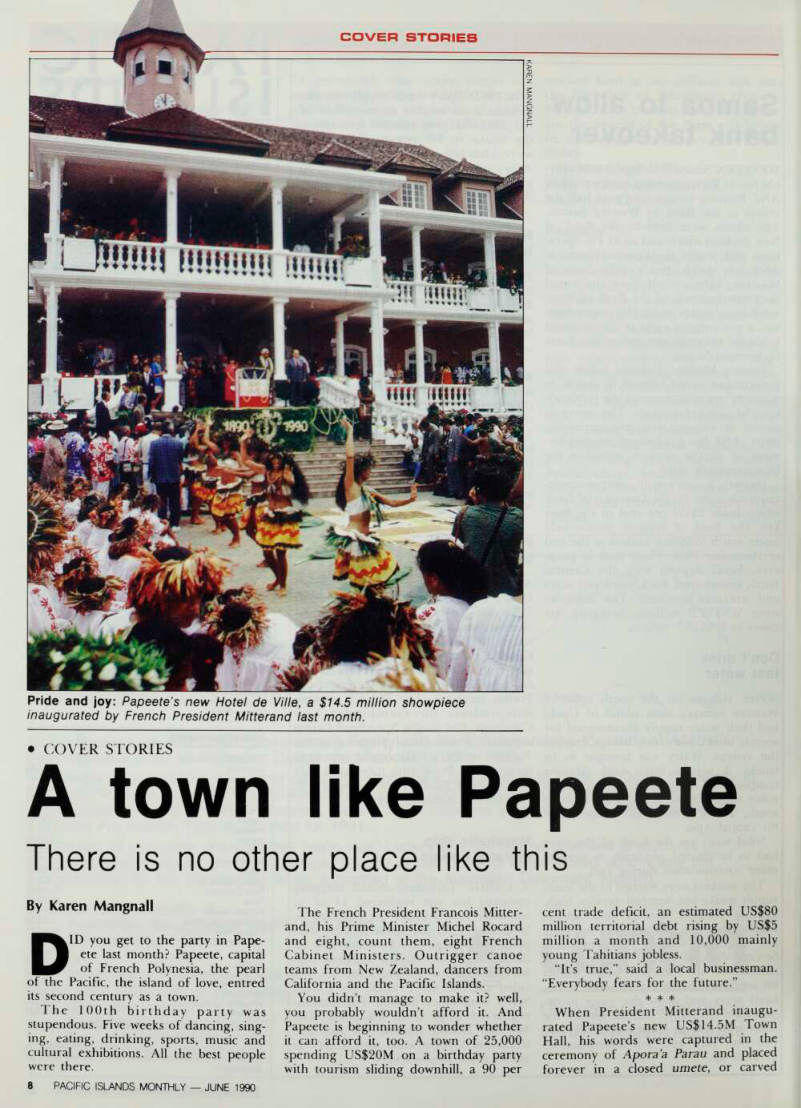
Pride and joy: Papeete’s new Hotel de Ville, a $14.5 million showpiece inaugurated by French President Mitterand last month.
chest.
“While we look at the beauty of your islands, we can also dream of their de velopment. But your greatest wealth, af ter your people, is beauty. Nature. You must master nature while respecting it, and you must not allow, in any shape or form, the destruction of your natural heritage which is not only an immense source of potential wealth for you, but for the whole of humanity.
“I await the day when Papeete, Tahiti and French Polynesia take their rightful place among the nations of the South Pacific . . . forward as equals among all the other peoples of this vast ocean.”
The umete joined his words with those of Mayor Jean Juventin: “Papeete has been the melting pot of the cultural progress which today ce ments Polynesian firmly to the 21st cen tury.
“Our capital, economic, administrative and political centre, has been the magnet
which lures and holds people. It’s been the engineroom of Polynesia’s expansion.
Papeete’s history is merged with that of
French Polynesia.”
* * * The town is a tidal estuary of human ity, only 25,000 actually live in Papeete but each weekday twice as many pour in to work. Tahiti has about 60,000 cars, not counting commercial vehicles, and the übiquitous Vespas.
The distant rumble begins about 5.30 each morning. By rush hour it’s nose-to tail along the Boulevard Pomare. Pape ete is the only Pacific Island country where you can sit for an hour in a traffic jam, to make a trip of a few kilometres.
A brown haze coalesces above the main routes.
A French military census in 1847 re corded Papeete as having 1444 residents, 1045 chickens, 834 pigs and 102 horses. A decade later, the French Gov ernor ordered: “It is forbidden to gallop horses between Camp Uranie and Papeava bridge.” Offenders were liable for a 20 franc fine and any civil dam ages.
In Papeete, the way you drive is a cultural statement. “There’s a speed limit in Tahiti of 60km,” says one local. “But that’s not fast enough, so everybody does 90km an hour and still someone is pas sing you.” It’s the same on the motorway link, where the limit’s higher. Every day the two newspapers fill a column each with road accidents and deaths.
“Did you count how many traffic lights they’ve got?” asked an official Fijian visi tor. “How many in Suva? Three? And one of those is a pedestrian crossing
light.”
Once you’ve made it into Papeete, you park. “They have parking metres in Papeete,” says our motoring expert.
“They’re beautiful parking metres: you can hang your fish on it or dry your shirt on it. But there’s no money in it.”
The traffic levels out from about 9am, hits a mini peak over the lunch hour, and tapers off mid-afternoon. Whatever the time of day, the main preoccupation is people watching. The best place is sit ting in one of the many sidewalk cafes, lingering over a coffee, juice or local Hinano beer. But the second best place is behind the driving wheel. Every driv er’s head is turned to check out who’s checking them out from the sidewalk.
Prang city.
Even the relatively high price of petrol about US9Bc4itre doesn’t discourage locals from hopping in the car to go 200 metres down the road to the shops. In 1865, the French Assemblyman George Perrin noted: “In this country, the Euro peans don’t take three steps on foot.”
At 4pm, the rumble begins again as the shopkeepers, clerks, bureaucrats, bank tellers and office workers head
home to their villas in Pirae or Punaania, or their lodgings in Faa’a. As the roar bounces off the waterfront buildings, and the oily haze filters up into the tree canopies, it wakes the old men who’ve slept the day away on a park bench in the shade of a banyan. They straighten their baseball caps and sit a bit dopily, backs to the traffic, quietly watching the ocean turn silver at dusk. ♦ * * The map of Papeete is an anatomy of Tahiti’s power, wealth and race. Along the Pomare are the highrise shops and office complexes, the bastions of the Chinese and the demis, descendnats of the Tahitians who married into Euro
pean capital.
Behind are the government buildings,
where the predominantly European
bureaucrats multiply their tasks and budgets. Their business is recycling the US$5 million in direct French subsidies each month into wages, construction and services; the parasite industries of aid
dependence.
Even two or three blocks behind the wealthy waterfront face, the elegant, solid concrete buildings leach quickly into battered, two storey wooden shops with crowded apartments above, washing hanging on the balconies.
And then back to the foothills are the modest houses, and the pockets of slum accommodation, dotted with the local minimarkets. The population here is
overwhelmingly Tahitian.
The average family has five children.
“There’s a subsidy of US$5O per month for each child until the age of 18,” says one observer. “If your rent is US$6OO a month and the car payment is US$5OO, then there’s every incentive for low income families to have more chil dren to get a little extra to pay off the
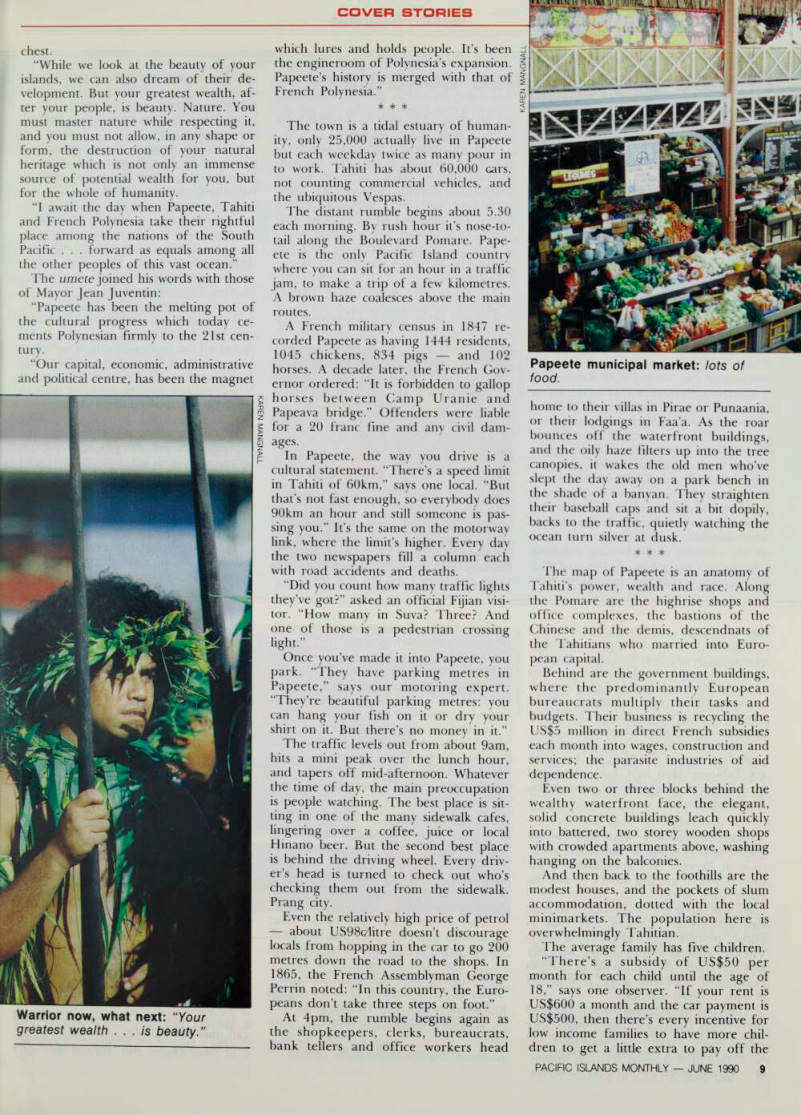
Warrior now, what next: "Your greatest wealth...is beauty."
Karen Mangnall
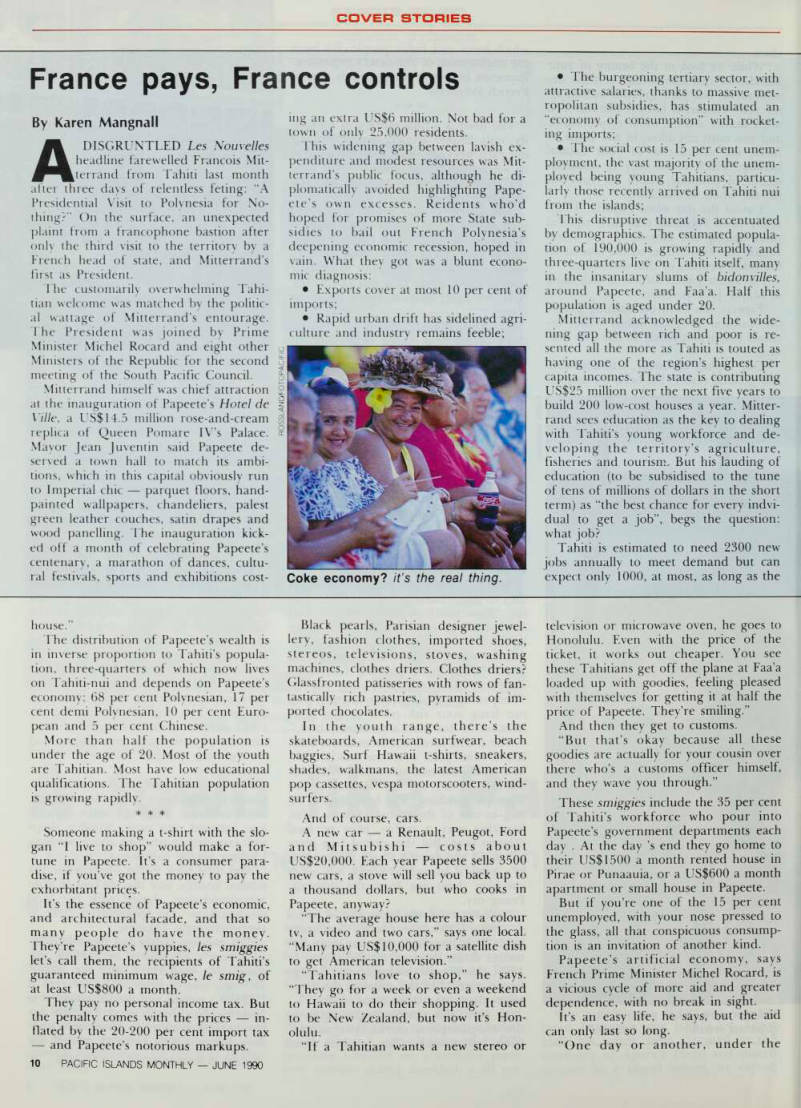
Papeete municipal market: lots of food.
Karen Mangnall
house.”
The distribution of Papeete’s wealth is in inverse proportion to Tahiti’s popula tion, three-quarters of which now lives on Tahiti-nui and depends on Papeete’s economy: 68 per cent Polynesian, 17 per cent demi Polynesian, 10 per cent Euro pean and 5 per cent Chinese.
More than half the population is under the age of 20. Most of the youth are Tahitian. Most have low educational
qualifications. The Tahitian population
is growing rapidly.
Someone making a t-shirt with the slo gan “I live to shop” would make a for tune in Papeete. It’s a consumer para dise, if you’ve got the money to pay the
exhorbitant prices.
It’s the essence of Papeete’s economic, and architectural facade, and that so many people do have the money.
They’re Papeete’s yuppies, les smiggies
let’s call them, the recipients of Tahiti’s guaranteed minimum wage, le smig, of at least US$BOO a month.
They pay no personal income tax. But the penalty comes with the prices in flated by the 20-200 per cent import tax and Papeete’s notorious markups.
Black pearls, Parisian designer jewel lery, fashion clothes, imported shoes, stereos, televisions, stoves, washing machines, clothes driers. Clothes driers?
Glassfronted patisseries with rows of fan
tastically rich pastries, pyramids of im
ported chocolates.
In the youth range, there’s the skateboards, American surfwear, beach baggies, Surf Hawaii t-shirts, sneakers, shades, Walkmans, the latest American pop cassettes, vespa motorscooters, wind surfers.
And of course, cars.
A new car a Renault, Peugot, Ford and Mitsubishi costs about USS2O,OOO. Each year Papeete sells 3500 new cars, a stove will sell you back up to a thousand dollars, but who cooks in Papeete, anyway?
“The average house here has a colour tv, a video and two cars,” says one local.
“Many pay USSIO,OOO for a satellite dish to get American television.”
“Tahitians love to shop,” he says.
“They go for a week or even a weekend to Hawaii to do their shopping. It used to be New Zealand, but now it’s Hon olulu.
“If a Tahitian wants a new stereo or
television or microwave oven, he goes to Honolulu. Even with the price of the ticket, it works out cheaper. You see these Tahitians get off the plane at Faa’a
loaded up with goodies, feeling pleased
with themselves for getting it at half the
price of Papeete. They’re smiling.”
And then they get to customs.
“But that’s okay because all these goodies are actually for your cousin over there who’s a customs officer himself, and they wave you through.”
These smiggies include the 35 per cent of Tahiti’s workforce who pour into Papeete’s government departments each day . At the day’s end they go home to their USSISOO a month rented house in Pirae or Punaauia, or a USS6OO a month apartment or small house in Papeete.
But if you’re one of the 15 per cent unemployed, with your nose pressed to the glass, all that conspicuous consump tion is an invitation of another kind.
Papeete’s artificial economy, says French Prime Minister Michel Rocard, is a vicious cycle of more aid and greater dependence, with no break in sight.
It’s an easy life, he says, but the aid can only last so long.
“One day or another, under the
weight of inequality and its accumulated violence, there s going to be an explosion, he said.
Like the one in October 1987, when all the tensions of Tahiti s growing social mequahties, came together during a dockworkers’ strike. In central Papeete, near the market, one empty shell of a
shop stands as the sole reminder of the night of burning, looting and rioting which left Papeete looking like a war zone, The outburst destroyed eight build ings, damaged more than 100 others at a cost of US$5O million, Tahiti’s consumption-based economy,
warns President Francois Mitterand, can not redistribute wealth fairly. Papeete’s politicians should urgently consider tax
ing income, slowing down the spend,
spend, spend of the smiggies, and en couraging investment in productive acti vities. Low cost housing and job training schemes are short term measures. What Papeete needs is jobs.
But Territorial President Alexandre Leontieff is preparing for a tough elec tion in March so the tax debate is off until next year, if ever. Meanwhile, Papeete will soon get something new to spend money on lotto. Leontieff ex pects Tahitians will spend US$lO million on it annually. * * * A parable of neocolonial consumerism.
“Most of our cars are from Europe so they have yellow fog headlights. We have no fog here. And when it rains, as it does in Papeete, it’s very hard to see at
night with these yellow fog lights.”
* * ♦ Papeete is a Chinese kind of town. Ab out 100 Chinese labourers came to the town in the late 1860 s when the Ati maono cotton plantation went bust. They
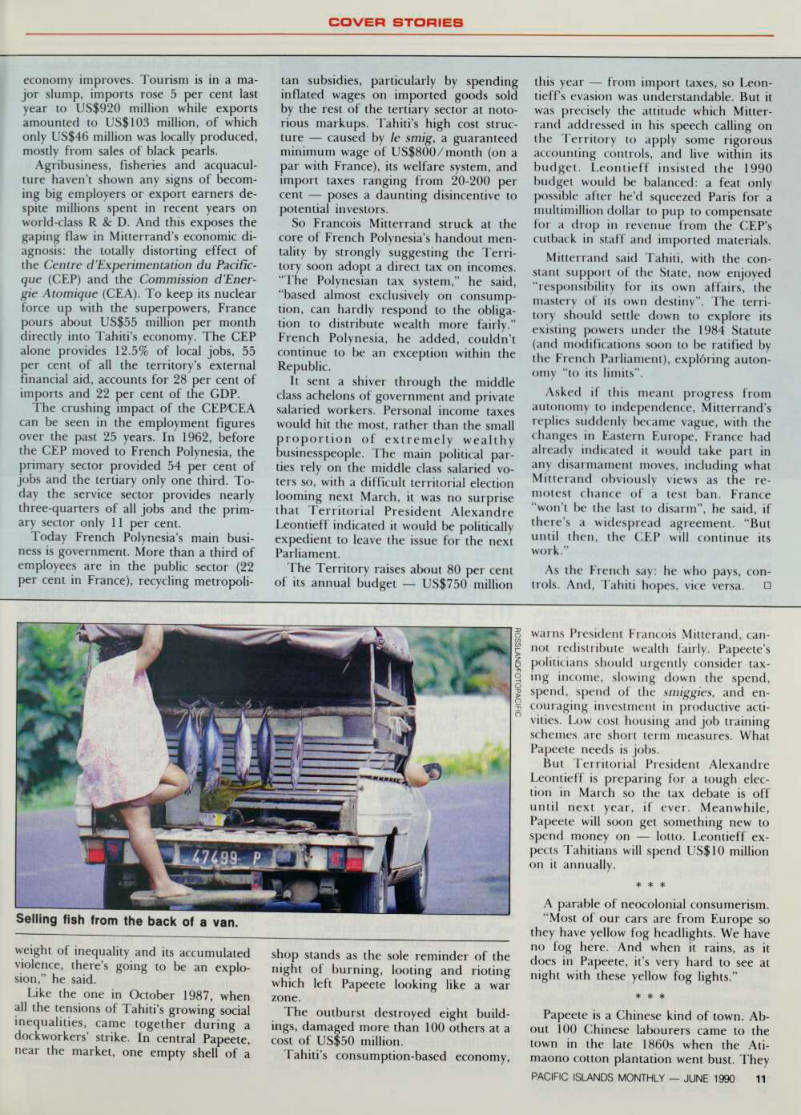
Selling fish from the back of a van.
started as peddlars and market garden ers but within a decade had begun buying up land around Papeete’s mar ket. They became butchers, shopkeepers and restauranteurs and erected a new type of building: a groundfloor shop or restaurant with living quarters above, and awnings to protect clients from rain and sun.
By 1900, there were almost 80 li cenced Chinese traders their popula tion boosted by the California expulsions and the wave of migrations from China.
Over the last years, they’ve Frenchfied their names (count the Yongues in the phone book) and taken over Papeete’s commerce.
Robert Tanseau is one of the new breed of Chinese entrepreneurs. Amer ican educated, at 38 he owns three Shop Tahiti clothing outlets, a business he started himself. He wears a solid gold watch and chain, has an office in the plush Valma Centre, and when asked how he’s doing, shrugs: “Not too bad, that’s all.”
Tonseau’s grandmother migrated to
Tahiti from China about 70 years ago.
His parents were born in Tahiti and still run a grocer’s shop in Papeete.
“If you go around town you’ll see a lot of Chinese stores,” he says. “There are a few Chinese in the islands but the agglomeration is in downtown Papeete.”
Tanseau says the Chinese make up at most 6 per cent of the population, but they hold a lot of economic power: “They’re very hard workers and work on
The Chinese have the power but they don’t have the people
a family basis.”
Despite the inevitable jealousy such success brings, Tangseau doubts it will ever cause racial conflict like in Fiji or New Caledonia.
“In Tahiti, the Chinese have the power but they don’t have the people. So that Tahitians are still living in their own country because they’re a majority.”
He attributes racial hostility in New Caledonia and Fiji to the fact that the major races “didn’t have the chance to live together”. The Chinese in Tahiti had abandoned their belief in living as a closed community: the younger genera tion was mixing more with the other races, French and Polynesian.
“Today you see a lot of Chinese living well with the French or Polynesians,” he says. “But in Fiji, it is very very rare to see a Fijian and Indian married.”
Such integration was inevitable, given Tahiti’s Polynesian cultural roots and the French dominance of the education system.
“It is very difficult for today’s genera tion to understand the past very clearly.
My generation didn’t get the chance to learn the Chinese language, roots or cul ture because it was a French education
system and we didn’t have the choice.”
Tanseau describes himself as Polyne sian with Chinese thinking. “The Chinese thinking makes the whole difference: it’s more detailed than the Polynesians,” he says.
But the Polynesian culture has taught the hardworking Chinese “happiness of living”.
The older Chinese generation didn’t know how to enjoy life because of their sheer drive for survival, Tanseau says.
“But the Polynesians, being in their own land, enjoy living more. Integration is very good. The more integration you have, the more life goes easy.” * * ♦ Some occasional observations on Pape ete from its connoisseurs: “It has to be one of the most subsi dised places in the world. There’s not much prostitution here, they give that for free. But there’s a prostitution men tality; how much money will you give me for this? How much money will France give me?” And: “The French and Tahitians are very similar in some ways. Papeete combines some of the worst characteristics: you put the Tahitian attitude of flu with the French laisser faire and it’s terrible. * ♦ * Hollywood and the nuclear bomb can be considered the parents of modern Papeete.
In 1961, Hollywood’s MGM studio de cided to remake their 1930 s blockbuster Mutiny on the Bounty, with Marlon Brando starring as Fletcher Christian. It coincided with the opening of Tahiti’s new international airport at Faa’a and by November that year, MGM had more than 100 staff on location. Hundreds of Tahitians were on the MGM payroll as extras or technicians.
The unheard of payrates knocked the bottom out of the local labour market. “I used to get my trees aluminium-banded for five francs each,” complained one plantation owner. “Now I offer 10 or 20 francs but nobody’s interested. They’re working for MGM.”
Production squables dragged the film ing on for a year. By the end, MGM’s largesse had filtered into virtually every Tahitian home. The filming and a new burst of tourist had placed a premium on accommodation, pushing rents and property prices through the roof. Agri culture was abandoned as Tahitians be gan the exodus to Papeete and its en virons which continues to this day. The service industry cafes, restaurants, hotels, shops boomed and prices rock eted.
Then the film crews departed, leaving Papeete desperate for something to take up the slack. They didn’t have long to wait.
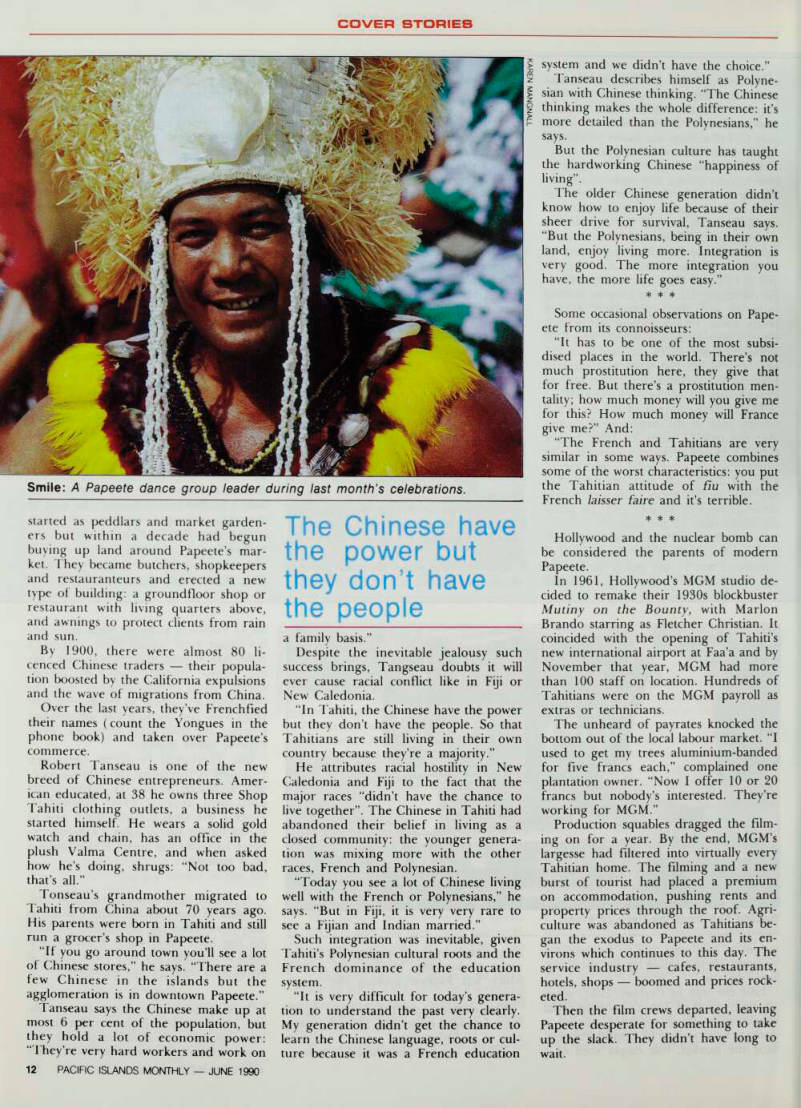
Smile: A Papeete dance group leader during last month’s celebrations.
Karen Mangnall
In 1963, President Charles De Gaul announced Tahiti, and Mururoa in par ticular, would host France’s nuclear test programme. Local politicians had barely drawn breath to object when Papeete was flooded with 5000 soldiers, Foreign Legionnaires, and technicians.
There were no houses ready for them so they set up tents and then moved into hastily built shacks with no sanitation.
Out of 35 acres of reclaimed coral reef, they created the Port of Papeete, a white claw dominating the town’s harbour.
The expansion drew a huge workforce from the outer islands and a new wave of business people came out from France to cash in on the service industry boom.
Papeete’s population exploded to 15,000 people, creating insurmountable problems for the municipal council. * * ♦ The arrival of the Contra d’Experi mentation du Pacifique (CEP), polarised politics. At first the opponents of nuclear testing, Pouvanaa’s fellow activists for in ternal economy, were in the ascendant.
Through the 19705, the pendulum swung over to Pouvanaaa’s nominal suc cessors whose agenda focussed on tap ping into the massive French subsidies to mitigate rather than oppose the socio economic impact of the CEP.
In 1977, Jean Juventin led Pupu Here Aia to a sweeping victory in the Papeete municipal elections and the new majority settled down to old preoccupations: “Reconcile the town with its more dis advantaged citizens, correct the mistakes
Ponpp+Q
' Imcuaco
fho
Lmc J •
It HP Q Q Ho7on
Il . ' ' D Uuz.Um
niClhtClUbS
created by massive urbanisation, invent a new lifestyle and social interaction, renew the old and rundown areas, ease traffic flows and encourage a true collaboration with the town’s residents.”
The formula, actually delivered by Juventin at the May 16, 1990 Town Hall opening, has been a constant throughout
Papeete’s history.
Back in the 1880 s, after King Pomare V finally ceded Tahiti to France, the Col ony’s General Council complained no thing was being done to help the chiefs of Pare to cope with the huge technical and financial demands of Papeete, a port of some 3000 residents, On May 20, 1890, Papeete became a French Commune or municipality and the leader of the General Council, Fran cois Cardella, also became mayor set ting a trend of cross-fertilisation between territorial and municipal politics which continues today.
In 1891, a fellow councillor, Victor Raoulx, railed against Papeete’s “infested hovels”, its “piles of excrement” breeding infections, and the danger to public health by having abattoirs within the township. Raoulx caustically drew a con trast with the large sums of municipal
funds devoted to entertainment and dances.
In 1950, Robert Auzelle drew up Papeete’s first town plan while deploring its overcrowded and rundown buildings, built on swamy ground often soaked with excrement because of bad sanitation sys tems.
Last month, Juventin said: “Only 100 years ago, Papeete was mere swampland.
A century has not been long enough to overcome this great handicap.”
The priorities? A new sewage system, a new road flanking the town to relieve traffic congestion, and a five-year State sponsored programme to replace the bidonvilles, or slum areas, with low-cost
housing.
♦ ♦ ♦ Says a local politician on the problems
of independence:
“Our problem is we live beyond our means. But it’s done. There’s nothing we can do about it. It’s just too bad we’ve become a totally subsidised country. It’s too late to say we wish it wasn’t like this.
“The average Tahitian family is very, very materialistic. We cannot ask them to forget their video, their colour tv, their cars. If we ask people to sacrifice their material standard of living, to go back 20 years, there would be a riot.
“What we must do is prevent the infla tion of this materialistic mentality. But it’s true, we must stop somewhere.” * * ♦ Everyday when you open the newspap er, at every festival or public ceremony, they’re there. Les Miss. The beauty queens. Dozens of them. Virtually every company worth its promotions budget sponsors a Miss.
The French sailors on R & R like to have their photos taken beside a Miss.
“You see her,” points one, a white line between his sunburn and new crew-nut.
“That’s a Miss Tahiti. I’m Mr Tahiti.”
And rushes off with his instamatic.
“I’ve never been chased as hard or as deliberately by women as I have since I got here,” says a New Zealander posted to Papeete by his company. “It’s practi cally the national sport here. I’ve heard it described like that as a joke, but it’s
actually true.”
Papeete makes the chase easy. It has more than a dozen nightclubs not to mention the late-night bistros, bars and restaurants. Then there’s the stroll. On an evening, you wander along the Boule vard Pomare, or to eat at dozens of roulottes, food vans, lined up with their neon singls along the waterfront.
It’s a ritual almost as old as Papeete, writers earlier this century described it, only half jokingly, as the meat market.
Papeete has had 15 Aids deaths, with about 80 carriers diagnosed so far. D
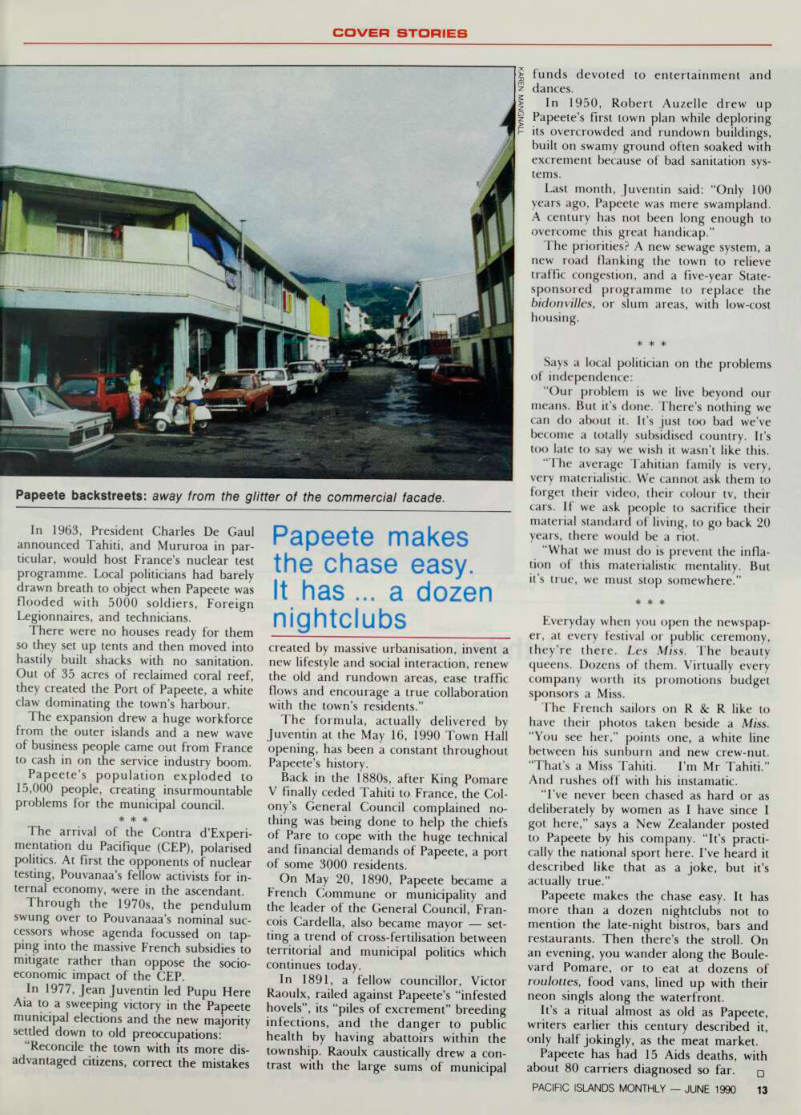
Papeete backstreets: away from the glitter of the commercial facade.
Karen Mangnall
Rosslandfotopacific
France pays, France controls
By Karen Mangnall
A DISGRUNTLED Les Nouvelles headline farewelled Francois Mit terrand from Tahiti last month after three days of relentless feting: “A Presidential Visit to Polynesia for No thing?” On the surface, an unexpected plaint from a francophone bastion after only the third visit to the territory by a French head of state, and Mitterrand’s first as President.
The customarily overwhelming Tahi tian welcome was matched by the politic al wattage of Mitterrand's entourage.
The President was joined by Prime Minister Michel Rocard and eight other Ministers of the Republic for the second meeting of the South Pacific Council.
Mitterrand himself was chief attraction at the inauguration of Papeete’s Hotel de Ville, a US$l4.5 million rose-and-cream replica of Queen Pomare IV’s Palace.
Mayor Jean Juventin said Papeete de served a town hall to match its ambi tions, which in this capital obviously run to Imperial chic parquet floors, hand
painted wallpapers, chandeliers, palest
green leather couches, satin drapes and wood panelling. The inauguration kick ed off a month of celebrating Papeete’s centenary, a marathon of dances, cultu ral festivals, sports and exhibitions cost
ing an extra US$6 million. Not bad for a town of only 25,000 residents.
This widening gap between lavish ex penditure and modest resources was Mit terrand’s public focus, although he di plomatically avoided highlighting Pape ete’s own excesses. Reidents who’d hoped for promises of more State sub sidies to bail out French Polynesia’s deepening economic recession, hoped in vain. What they got was a blunt econo
mic diagnosis:
• Exports cover at most 10 per cent of
imports;
• Rapid urban drift has sidelined agri culture and industry remains feeble;
• The burgeoning tertiary sector, with attractive salaries, thanks to massive met ropolitan subsidies, has stimulated an “economy of consumption” with rocket
ing imports;
• The social cost is 15 per cent unem ployment, the vast majority of the unem
ployed being young Tahitians, particu
larly those recently arrived on Tahiti nui from the islands; This disruptive threat is accentuated by demographics. The estimated popula tion of 190,000 is growing rapidly and three-quarters live on Tahiti itself, many in the insanitary slums of bidonvilles, around Papeete, and Faa’a. Half this population is aged under 20.
Mitterrand acknowledged the wide ning gap between rich and poor is re sented all the more as Tahiti is touted as having one of the region’s highest per capita incomes. The state is contributing US$25 million over the next five years to build 200 low-cost houses a year. Mitter rand sees education as the key to dealing with Tahiti’s young workforce and de
veloping the territory’s agriculture,
fisheries and tourism. But his lauding of education (to be subsidised to the tune of tens of millions of dollars in the short term) as “the best chance for every indvi dual to get a job”, begs the question;
what job?
Tahiti is estimated to need 2300 new jobs annually to meet demand but can expect only 1000, at most, as long as the
Coke economy? it’s the real thing.
Rosslandfotopacific
economy improves. Tourism is in a ma jor slump, imports rose 5 per cent last year to USS92O million while exports amounted to US$lO3 million, of which
only US$46 million was locally produced,
mostly from sales of black pearls.
Agribusiness, fisheries and acquacul
ture haven’t shown any signs of becom ing big employers or export earners de spite millions spent in recent years on world-class R & D. And this exposes the gaping flaw in Mitterrand’s economic di
agnosis: the totally distorting effect of
the Centre d’Experimentation du Pacific que (CEP) and the Commission d’Ener gie Atomique (CEA). To keep its nuclear force up with the superpowers, France pours about US$55 million per month directly into Tahiti’s economy. The CEP alone provides 12.5% of local jobs, 55 per cent of all the territory’s external financial aid, accounts for 28 per cent of imports and 22 per cent of the GDP.
The crushing impact of the CEP/CEA can be seen in the employment figures over the past 25 years. In 1962, before the CEP moved to French Polynesia, the primary sector provided 54 per cent of jobs and the tertiary only one third. To
day the service sector provides nearly
three-quarters of all jobs and the prim ary sector only 11 per cent.
Today French Polynesia’s main busi ness is government. More than a third of employees are in the public sector (22 per cent in France), recycling metropoli
tan subsidies, particularly by spending inflated wages on imported goods sold by the rest of the tertiary sector at noto rious markups. Tahiti’s high cost struc ture caused by le smig, a guaranteed minimum wage of US$BOO/month (on a par with France), its welfare system, and import taxes ranging from 20-200 per cent poses a daunting disincentive to potential investors.
So Francois Mitterrand struck at the core of French Polynesia’s handout men tality by strongly suggesting the Terri tory soon adopt a direct tax on incomes.
“The Polynesian tax system,” he said, “based almost exclusively on consump tion, can hardly respond to the obliga tion to distribute wealth more fairly.”
French Polynesia, he added, couldn’t continue to be an exception within the Republic.
It sent a shiver through the middle class achelons of government and private salaried workers. Personal income taxes would hit the most, rather than the small proportion of extremely wealthy businesspeople. The main political par ties rely on the middle class salaried vo ters so, with a difficult territorial election looming next March, it was no surprise that Territorial President Alexandre Leontieff indicated it would be politically expedient to leave the issue for the next Parliament.
The Territory raises about 80 per cent of its annual budget US$75O million
this year from import taxes, so Leon tieff s evasion was understandable. But it was precisely the attitude which Mitter rand addressed in his speech calling on
the Territory to apply some rigorous
accounting controls, and live within its budget. Leontieff insisted the 1990 budget would be balanced: a feat only possible after he’d squeezed Paris for a multimillion dollar to pup to compensate for a drop in revenue from the CEP’s cutback in staff and imported materials.
Mitterrand said Tahiti, with the con stant support of the State, now enjoyed “responsibility for its own affairs, the mastery of its own destiny”. The terri tory should settle down to explore its existing powers under the 1984 Statute (and modifications soon to be ratified by the French Parliament), exploring auton omy “to its limits”.
Asked if this meant progress from autonomy to independence, Mitterrand’s replies suddenly became vague, with the changes in Eastern Europe, France had already indicated it would take part in any disarmament moves, including what Mitterand obviously views as the re motest chance of a test ban. France “won’t be the last to disarm”, he said, if there’s a widespread agreement. “But until then, the CEP will continue its work.”
As the French say: he who pays, con trols. And, Tahiti hopes, vice versa. □
More than a birthday
The Region
Fiji
By Jale Moala
THE last planeload of visitors had just landed when the tall, imposing figure of Ratu Sir Kamisese Mara strode across the village square, hands swinging lazily by his sides. He took his time, listening to the sounds of the vil lage. All around him, a thousand people watched their paramount chief approach, and with awe, sank slowly to the ground to sit with respect.
Installed nearly 20 years ago as para mount chief of the sprawling Lau Group of islands in Eastern Fiji, Mara has be come the most influential man in the country, having led Fiji for 23 years from before independence to after the coup. As he walked across the village square to meet his guests, many more people were working at home to prepare for his 70th birthday feast, the biggest birthday celebration in Fiji at any time.
That was Friday, May 11. On Satur day, the main event of this big birthday bash culminated with a big feast and en ded a week-long celebration of dances,
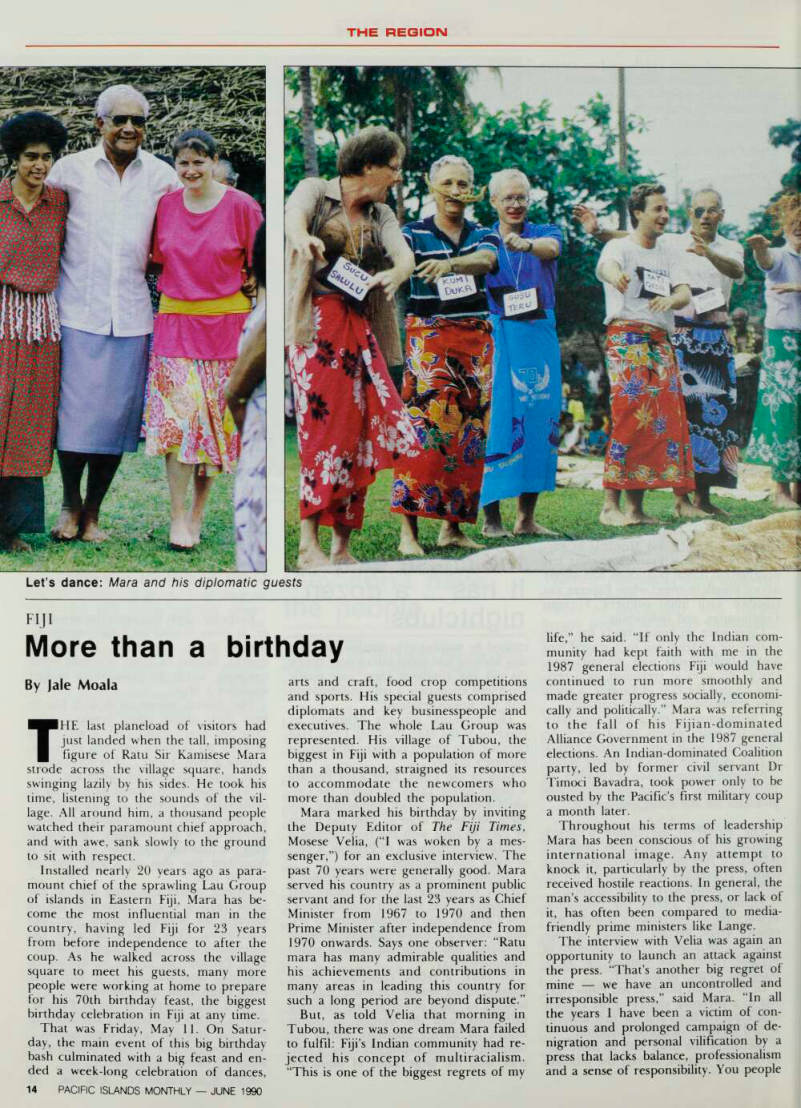
arts and craft, food crop competitions and sports. His special guests comprised
diplomats and key businesspeople and
executives. The whole Lau Group was represented. His village of Tubou, the biggest in Fiji with a population of more than a thousand, straigned its resources to accommodate the newcomers who more than doubled the population.
Mara marked his birthday by inviting
the Deputy Editor of The Fiji Times, Mosese Velia, (“I was woken by a mes senger,”) for an exclusive interview. The past 70 years were generally good. Mara served his country as a prominent public servant and for the last 23 years as Chief Minister from 1967 to 1970 and then Prime Minister after independence from 1970 onwards. Says one observer: “Ratu mara has many admirable qualities and his achievements and contributions in many areas in leading this country for such a long period are beyond dispute.”
But, as told Velia that morning in Tubou, there was one dream Mara failed to fulfil; Fiji’s Indian community had re jected his concept of multiracialism.
“This is one of the biggest regrets of my
life,” he said. “If only the Indian com munity had kept faith with me in the 1987 general elections Fiji would have continued to run more smoothly and made greater progress socially, economi
cally and politically.” Mara was referring
to the fall of his Fijian-dominated Alliance Government in the 1987 general elections. An Indian-dominated Coalition party, led by former civil servant Dr Timoci Bavadra, took power only to be ousted by the Pacific’s first military coup a month later.
Throughout his terms of leadership Mara has been conscious of his growing international image. Any attempt to knock it, particularly by the press, often received hostile reactions. In general, the man’s accessibility to the press, or lack of it, has often been compared to media friendly prime ministers like Lange.
The interview with Velia was again an opportunity to launch an attack against the press. “That’s another big regret of mine we have an uncontrolled and irresponsible press,” said Mara. “In all the years I have been a victim of con tinuous and prolonged campaign of de nigration and personal vilification by a press that lacks balance, professionalism and a sense of responsibility. You people
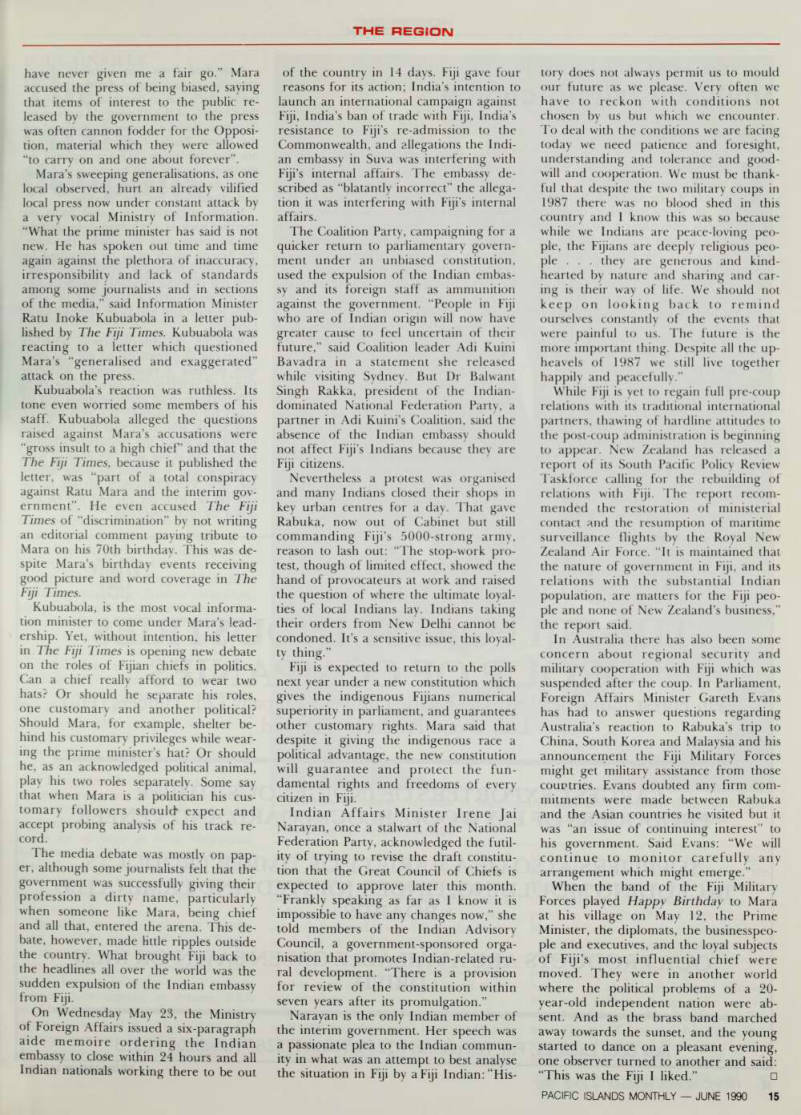
Let’s dance: Mara and his diplomatic guests
have never given me a fair go.” Mara accused the press of being biased, saying that items of interest to the public re leased by the government to the press was often cannon fodder for the Opposi tion, material which they were allowed “to carry on and one about forever”.
Mara’s sweeping generalisations, as one local observed, hurt an already vilified local press now under constant attack by a very vocal Ministry of Information.
“What the prime minister has said is not new. He has spoken out time and time
again against the plethora of inaccuracy,
irresponsibility and lack of standards among some journalists and in sections of the media,” said Information Minister Ratu Inoke Kubuabola in a letter pub lished by The Fiji Times. Kubuabola was reacting to a letter which questioned
Mara’s “generalised and exaggerated”
attack on the press.
Kubuabola’s reaction was ruthless. Its tone even worried some members of his staff. Kubuabola alleged the questions raised against Mara’s accusations were “gross insult to a high chief’ and that the The Fiji Times, because it published the letter, was “part of a total conspiracy against Ratu Mara and the interim gov ernment”. He even accused The Fiji Times of “discrimination” by not writing an editorial comment paying tribute to Mara on his 70th birthday. This was de
spite Mara’s birthday events receiving
good picture and word coverage in The
Fiji Times.
Kubuabola, is the most vocal informa tion minister to come under Mara’s lead ership. Yet, without intention, his letter in The Fiji Times is opening new debate on the roles of Fijian chiefs in politics.
Can a chief really afford to wear two hats? Or should he separate his roles, one customary and another political?
Should Mara, for example, shelter be hind his customary privileges while wear ing the prime minister’s hat? Or should he, as an acknowledged political animal, play his two roles separately. Some say that when Mara is a politician his cus tomary followers should* expect and accept probing analysis of his track re cord.
The media debate was mostly on pap er, although some journalists felt that the government was successfully giving their profession a dirty name, particularly when someone like Mara, being chief and all that, entered the arena. This de bate, however, made little ripples outside the country. What brought Fiji back to the headlines all over the world was the sudden expulsion of the Indian embassy
from Fiji.
On Wednesday May 23, the Ministry of Foreign Affairs issued a six-paragraph aide memoire ordering the Indian embassy to close within 24 hours and all Indian nationals working there to be out
of the country in 14 days. Fiji gave four reasons for its action; India’s intention to launch an international campaign against Fiji, India’s ban of trade with Fiji, India’s resistance to Fiji’s re-admission to the Commonwealth, and allegations the Indi an embassy in Suva was interfering with Fiji’s internal affairs. The embassy de scribed as “blatantly incorrect” the allega tion it was interfering with Fiji’s internal affairs.
The Coalition Party, campaigning for a quicker return to parliamentary govern ment under an unbiased constitution, used the expulsion of the Indian embas sy and its foreign staff as ammunition
against the government. “People in Fiji
who are of Indian origin will now have greater cause to feel uncertain of their future,” said Coalition leader Adi Kuini Bavadra in a statement she released while visiting Sydney. But Dr Balwant Singh Rakka, president of the Indian dominated National Federation Party, a partner in Adi Kuini’s Coalition, said the absence of the Indian embassy should not affect Fiji’s Indians because they are
Fiji citizens.
Nevertheless a protest was organised and many Indians closed their shops in key urban centres for a day. That gave Rabuka, now out of Cabinet but still
commanding Fiji’s 5000-strong army,
reason to lash out: “The stop-work pro test, though of limited effect, showed the hand of provocateurs at work and raised the question of where the ultimate loyal ties of local Indians lay. Indians taking their orders from New Delhi cannot be condoned. It’s a sensitive issue, this loyal
ty thing.”
Fiji is expected to return to the polls next year under a new constitution which
gives the indigenous Fijians numerical
superiority in parliament, and guarantees other customary rights. Mara said that despite it giving the indigenous race a political advantage, the new constitution will guarantee and protect the fun damental rights and freedoms of every citizen in Fiji.
Indian Affairs Minister Irene Jai Narayan, once a stalwart of the National Federation Party, acknowledged the futil ity of trying to revise the draft constitu tion that the Great Council of Chiefs is expected to approve later this month.
“Frankly speaking as far as I know it is impossible to have any changes now,” she told members of the Indian Advisory Council, a government-sponsored orga nisation that promotes Indian-related ru ral development. “There is a provision for review of the constitution within seven years after its promulgation.”
Narayan is the only Indian member of the interim government. Her speech was a passionate plea to the Indian commun ity in what was an attempt to best analyse the situation in Fiji by a Fiji Indian; “His
tory does not always permit us to mould our future as we please. Very often we have to reckon with conditions not chosen by us but which we encounter.
To deal with the conditions we are facing today we need patience and foresight, understanding and tolerance and good will and cooperation. We must be thank ful that despite the two military coups in 1987 there was no blood shed in this country and I know this was so because while we Indians are peace-loving peo ple, the Fijians are deeply religious peo ple . . . they are generous and kind hearted by nature and sharing and car ing is their way of life. We should not keep on looking back to remind ourselves constantly of the events that were painful to us. The future is the more important thing. Despite all the up heavels of 1987 we still live together
happily and peacefully.”
While Fiji is yet to regain full pre-coup relations with its traditional international partners, thawing of hardline attitudes to the post-coup administration is beginning to appear. New Zealand has released a report of its South Pacific Policy Review Taskforce calling for the rebuilding of relations with Fiji. The report recom mended the restoration of ministerial contact and the resumption of maritime
surveillance flights by the Royal New
Zealand Air Force. “It is maintained that the nature of government in Fiji, and its relations with the substantial Indian population, are matters for the Fiji peo ple and none of New Zealand’s business,” the report said.
In Australia there has also been some concern about regional security and
military cooperation with Fiji which was
suspended after the coup. In Parliament, Foreign Affairs Minister Gareth Evans has had to answer questions regarding Australia’s reaction to Rabuka’s trip to China, South Korea and Malaysia and his announcement the Fiji Military Forces might get military assistance from those countries. Evans doubted any firm com mitments were made between Rabuka and the Asian countries he visited but it was “an issue of continuing interest” to his government. Said Evans: “We will continue to monitor carefully any
arrangement which might emerge.”
When the band of the Fiji Military Forces played Happy Birthday to Mara at his village on May 12, the Prime Minister, the diplomats, the businesspeo ple and executives, and the loyal subjects of Fiji’s most influential chief were moved. They were in another world where the political problems of a 20year-old independent nation were ab sent. And as the brass band marched away towards the sunset, and the young started to dance on a pleasant evening, one observer turned to another and said: “This was the Fiji I liked.” □
Unity on island choice

University Of The South Pacific
By Angela McCarthy
T HE University of the South Pacific Council’s appointment of a Pacific Islands Citizen, Fiji’s Savenaca Siwatibau, as Vice-Chancellor designate signals fresh commitment to the uni versity as a unified regional institution. 1 he council says Siwatibau is a Pacific Islander with experience in both admi mstrative and academic fields, regionally and internationally. He is currently the Director of ESCAP, the United Nations programme, in Port Vila.
In 1989 the university council decided that as part of its policy of regionalism the Vice-Chancellor position should be taken over by a Pacific Islander when British-born Geoffrey Caston s term en ded in 1991. The difficulty was finding the right person for the position. A com mittee consisting of three Senate mem bers, five Council members, and the President of the Student Council was set up earl\ this year to begin processing applications. Eight nominations were re ceived after worldwide advertising that
stipulated the applicants should be from the Pacific Region. Siwatibau, Salofa Isakea, of Western Samoa, and Dr John Roughan, and American citizen of the Solomon Islands, were shortlisted, being the only Pacific citizen applicants.
Council Chairman Henry Naisali said Siwatibau “is one of the best resource persons in the region and I respect him for he's a committed and dedicated man.
I find it difficult at this time to see others of Siwatibau’s level in the region.
The region and university will benefit a lot from his past experiences when he takes the job”. James Saliga, Solomon Is land Permanent Secretary of Education, like most Council members, agrees: “It is time to have someone who knows the region and the people and understands our problems as an insider. He is a re gional man and a man of high standing in the region academically and adminis tratively. He is also a man of internation al reputation. His strength is that he will be able to pull everybody together. He
can unify.”
A unified front was certainly shown over the second major decision council made which was to organise an indepen dent review of the 22-year-old university.
Atanraoi Baiteke, Secretary General of the South Pacific Commission, pointed out that the review, like any regional in stitutional review, will be concerned with broad issues such as objectives, structures and directions for the nineties.
Naisali suggested an initial focus on specifics such as irregularities in staffing appointments and dismissals. However, the Senate which must be consulted by the Council members on academic mat ters, felt that the incidents mentioned in the recommendation were not of a se rious nature and had been resolved satis
factorily.
With all the dissatisfaction, whether blown out of proportion or not, the deci sion to have a review under whatever terms of reference is seen as the right way to clear up all apprehensions and set policy for the nineties. “It is very timely,” says Saliga, who adds that the Solomons is worried about the university adminis tration. “All is not well. We have to have a review and it should be done before the new Vice-Chancellor arrives so he can get on with his job and not be tied down by past problems.” □
Advertisements & other items, p. 16 (1 item)
The Fiji Forest Industries
W >•
GROUP OF COMPANIES
Fiji Forest Industries Ltd, The Pacific Lumber Company Ltd, Timbers (Fiji) Ltd, Wood Products (Fiji) Ltd.
LARGEST EXPORTERS OF INDIGENOUS TIMBER
PRODUCERS OF PLYWOOD. BLOCKBOARD AND VENEER
SUPPLIERS ALSO OF A VARIETY OF TIMBER PRODUCTS
INCLUDING MOULDING, FINGER JOINTED AND LAMINATED
BOARDS
OUR PRODUCTS ARE AVAILABLE GREEN SAWN OR KILN
DRIED
Box 608, Lautoka, Fiji. Telephone; 61255 Telex; FJ5280 Facsimile: 60323
WiLSOW-ADOtSOH 103.30*
deepens
Bougainville
The crisis deepens
By Frank Senge
THE Bougainville crisis came to a head in May. As Waigani, the hub of Papua New Guinea Govern ment, in Port Moresby, tried to govern its North Solomons province, the oppor tunity for any form of peace negotiation slipped further and further away.
At time of writing, there was no reli able source of information from Bougainville except those that the Bougainville Republican Army (BRA) re leased. There was a total communication black-out, the result of a Government economic blockade of the island. The Bougainville Republican Army had de clared the island independent but de spite appeals to foreign Governments within and outside the region, there had been no public recognition of it. Mean while, the sanctions were digging in deep. Fuel supplies were short. Kerosene had run out and other basic necessities were running out, as shipping dwindled.
One group, the Nissan islanders, pledged to break away from Bougainville.
Now, the PNG Defence Force under a call-out order is amassing troops on Nis san for what its command claims is a “reconciliation, reconstruction, and re habilitation” exercise and disclaim any plans to retake Bougainville militarily.
The island and its mentor were slipping wider and wider apart. It seemed, in March and April that finally peace and some form of compromise was around the corner when the Government and the Bougainville Republican Army agreed to negotiate. Although, each side maintained that secession was non negotiable for opposite reasons, there was a lot of hope at what Melanesian
consensus could bring through negotia
tion. Then, something very petty such as the location for the negotiation wedged itself in between the two and failed to come unstuck.
The BRA maintained that all negotia tions would be conducted at the Pangu na mine, the Government opted for more neutral ground. Eventually, both the Solomon Islands and Vanuatu offered their capitals as venues. BRA would not budge and the Government steadfastly refused the BRA’s choice for “security reasons”. In the meantime nor mal activity on Bougainville began to
close down or withdraw. Bank closed down, then the post office. Basic necessities fell short as shipping into the area dwindled. On May 2, Papua New Guinea Cabinet issued an order to all mariners operating in and around Bougainville island that an exclusive 50-mile zone was in force around the province. All unauthorised vessels operating within the exelusive zone would be fired upon without warning.
The exclusion included airspace of up to 20,000 feet. One week later, on May 9 the Government announced selective sanctions against Bougainville island.
Only those ships bearing very bare
essentials mainly to the hospital on the island were to pass through. On May 17, the Bougainville Republican Army re plied by declaring Papua New Guinea’s North Solomons Province a republic, Rebel chief Francis Ona was appointed President of the new republic. The more popular and public figure of Sam Kauona was appointed Defence Minister in a new cabinet. Bougainville was re tained as the name North Solomons Pre mier, Joseph Kabui and his agriculture minister, Michael Laimo were given senior ministries in the new republic. It
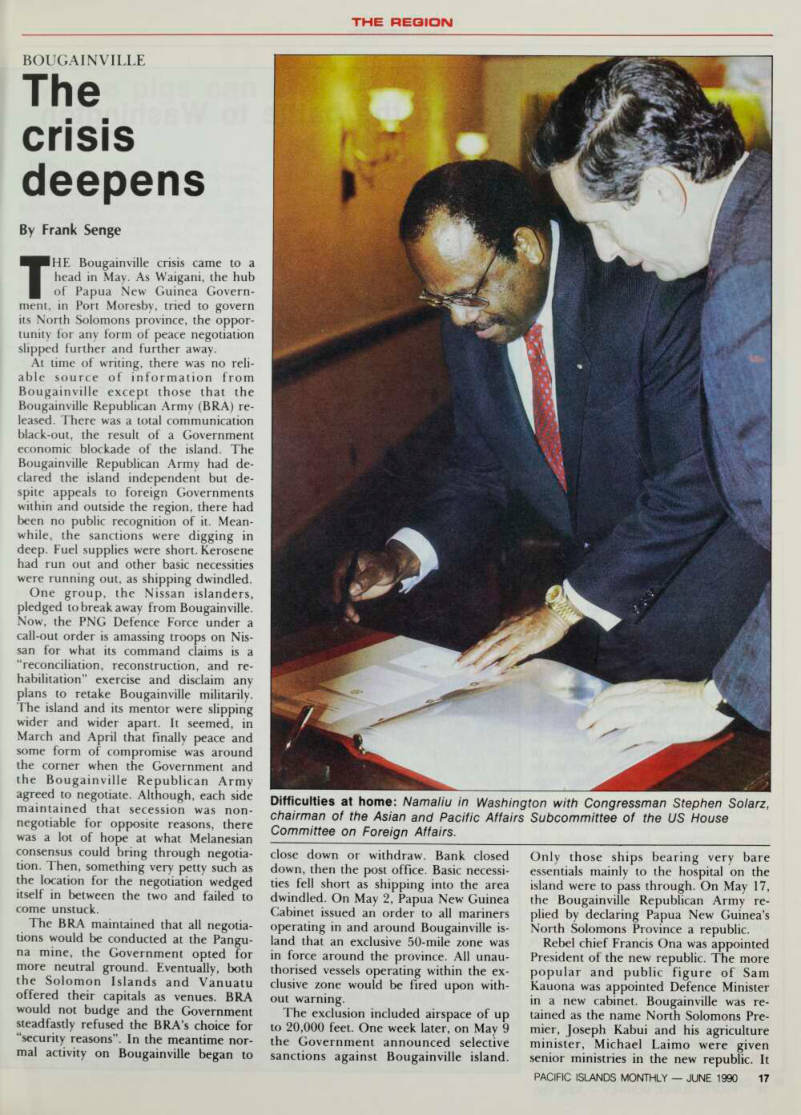
Difficulties at home: Namaliu in Washington with Congressman Stephen Solarz, chairman of the Asian and Pacific Affairs Subcommittee of the US House Committee on Foreign Affairs.
finally confirmed allegations that Kabui had been an active collaborator of the BRA throughout the uprising. On July 2, 1989, Papua New Guinean riot squad policemen attacked Kabui and Laimo.
Kabui was beaten with rifle butts and had his car tyres and wind screens shot out. Laimo is blind in one eye as a result of that assault. The incident looked like a payback for the wounding of six policemen by militants that weekend.
The security force command expressed concern and promised an investigation.
The beating started a nationwide and international outcry against the security forces. The forces kept quiet and it is not certain if the promised investigation got off the ground at all.
PNG intelligence officers intercepted
several letters written by the Bougainville Republican Army and countersigned by Premier Kabui requesting foreign Gov ernments to recognise Bougainville as an
independent state.
Kabui was also party to efforts by the BRA to print passports in Singapore.
However, no nation has openly recog nised the declaration by the BRA. Both Solomon Islands and Vanuatu, members of the Melanesian Spearhead Group, have told Papua New Guinea that they would not support any push to fragment Melanesian solidarity. Solomon Islands has agreed to monitor its borders and to seal it off to traditional border crossers until the Boungainville crisis is resolved.
Can it be resolved?
Waigani has adopted a wait and see attitude, hoping that the blocade will cause internal dissent and that dissent will eventually sort things out on the is land of Bougainville. The PNG Defence Force in mid-May recommended in a secret brief that the island ought to be retaken in a military invasion. The brief stated that any such move should be aimed at capturing or killing Kauona who is seen as the strongest supporter of secession. The report was leaked to the BRA which circulated it to media orga nisations.
Defence Force Minister, Benias Sabumei, was furious and ordered an in ternal investigation but again ruled out any military invasion of the island. Yet military invasion is the next likely alternative if the blockade does not suc ceed. There is a fear that the blockade may have the opposite effect to its ori ginal intention and that those people who may have wanted to remain with PNG may eventually join the BRA.
The biggest question is how an inde pendent Bougainville will fare? Will Au stralia and Papua New Guinea support its rebuilding process? Will the Solomon Islands and Vanuatu accept it into their fold? Will another multi-national be will ing to take on Boungainville Copper? □
Taking the battle to Washington
Papua New Guinea
By David North
WHEN Papua New Guinea Prime Minister Rabbie Namaliu visited the United States he touched all the bases a meeting with President Bush, dinner with former Democratic Presidential candidate Walter Mondale, chats with Congressman, the environ mentalists and Texas investors and two press conferences.
PNG has been independent for 15 years, but this was the first time that a sitting Prime Minister had made the trip and it went well for him and his small entourage.
His motives were dual: first, to assure American investors that the Port Mores by Government was in charge, and that mineral investments were safe; and, secondly, to build stronger contacts for his country at the highest levels in
Washington.
The morning after his meeting with President Bush and Secretary of State James Baker he reported that the three of them spent three-quarters of an hour covering a number of matters of mutual interest. They discussed “ . . . defense, the continuing and valuable role played by the [US] Peace Corps in Papua New Guinea . . . and the possibility of educa tional scholarships at all upper levels of the Papua New Guinea Educational
System.”
In the first of his press conferences he sounded upbeat about the prospects for a peaceful solution of the stand-off in Bougainville. He blamed the underlying difficulties with landowners as being based on “arrangements made in colo nial times,” and said that his government will not accept secession for Bouganivlle.
He reported in detail the results of the economic blockade of the area, saying that some schools were open and some closed, and that “only certain hospital services were operating.”
The Prime Minister, who had stopped in Houston, Texas, to talk with mining investors, said that Chevron was submit ting a proposal to the PNG government about an oil field in the Highlands, which would, if successful, lead to the construction of a pipeline to the sea. He was also optimistic about off-shore ex ploration of what he called “substantial resources of natural gas.”
On other economic matters he talked about the Government’s decision to cut the budget from K 1.3 billion to K 1.2 billion, both to reduce the budgetary de ficit as well as the trade deficit; he said that, if need be, the Government would
consider increasing taxes, but saw no need for that in the immediate future.
One of the techniques for increasing revenue he cited are “assets sales”; in cluded in that category are the sales of “certain ventures . . . which are not paying dividends . . . and lands and buildings owned by the Government which are no longer needed . . He also said that PNG and the International Monetary Fund were in agreement about a line of credit, to help stabilise the PNG currency.
Following the first press conference, which was principally attended by Au stralian journalists, the Prime Minister moved on to Capitol Hill, and to his meetings with Congressman. He talked, among others, with Stephen J. Solarz (Democrat, New York), the chairman of the Asian and the Pacific Affairs sub committees of the House Foreign Affairs Committee, as well as the ranking Re publican on the full Committee, William
Broomfield (Republican Michigan),
and the delegates from Guam and American Samoa, Ben Blaz (Republican) and Eni F.H. Faleomavaega (Democrat).
The Prime Minister’s second press conference was held at the offices of the World Wildlife Fund and Conservation Foundation which was pleased with the recent PNG decision to place a morator ium on new logging licenses for the next two years. Conservation organisations
are currently placing great emphasis on
retaining the world’s rain forests, which are seriously threatened, worldwide, by economic development, and the PNG de cision was an important one for the en vironmentalists.
Namaliu took advantage of the con servation forum to call upon the nations that consume tropical lumber to restrict imports, saying: “If we are to effectively improve the management of our forests and to better conserve our natural re sources, we will need the fullest support of the consuming countries to better control the activities of their own timber trade.”
Saying that PNG’s timber industry had been “running amok”, the Prime Minis ter explained: “We will need the fullest support from these countries in controll ing trading fraud, such as transfer pric ing and misrecording of shipments . . .
It would be a major benefit if these countries could . . . impose their own restrictions upon tropical timber not sup
plied from genuine sustainable yield pro
jects.” □
Where pigs can swim
Tokelau
By Irene Nisbet
PIGS can’t fly but on Tokelau, they swim. On Fakaofo, the first of the three atolls which make up the group, space is at such a pre mium that there’s just no-where else to keep the pigs except on the reef adjoin
ing the main village.
Overcrowding, a thorny problem for the islanders, has been partially solved by re-settling some of the community on the nearby island of Fenua Fala, a few minutes across the reef by boat. The school and the hospital are now at Fenua Fala, and with lots of space available, it seems surprising that more people don’t make the move.
Heavily dependent on New Zealand aid, and on remittances from Toke lauans living overseas, and having vir tually no natural resources of their own, the Tokelauan’s views and expectations from life are altering drastically. The cash economy has wrought a very visible desire for concrete housing and western consumer goods. Gone are the days of the dugout canoe. Aluminium motor boats proliferate now, and very few households do not have a fridge, video or cassette player.
In the wake of Cyclone Ofa last Febru ary, the islanders are still making run ning repairs. From the second floor win dow of the administration building, one sees stumps of several breadfruit trees which were cut to prevent them falling on the office building. In fact, there were many mature trees which had to be felled for safety’s sake, resulting in a loss which will take years to replace.
Nukunonu, the central island of the group, is also the largest in land area and lagoon size. It’s not overcrowded.
The island is dominated by the vast bulk of the whitewashed Catholic church, a couple of miles out to sea. Nukunonu has fewer trees compared to the other atolls, partly because of Cyclone Ofa, and partly because trees were cut to clear space for new buildings. There is hardly any natural shade left. The heat comes down from the sky, shimmers up from the coral and comes in from all sides of the concrete housing. As in Fakaofo, concrete housing is the norm.
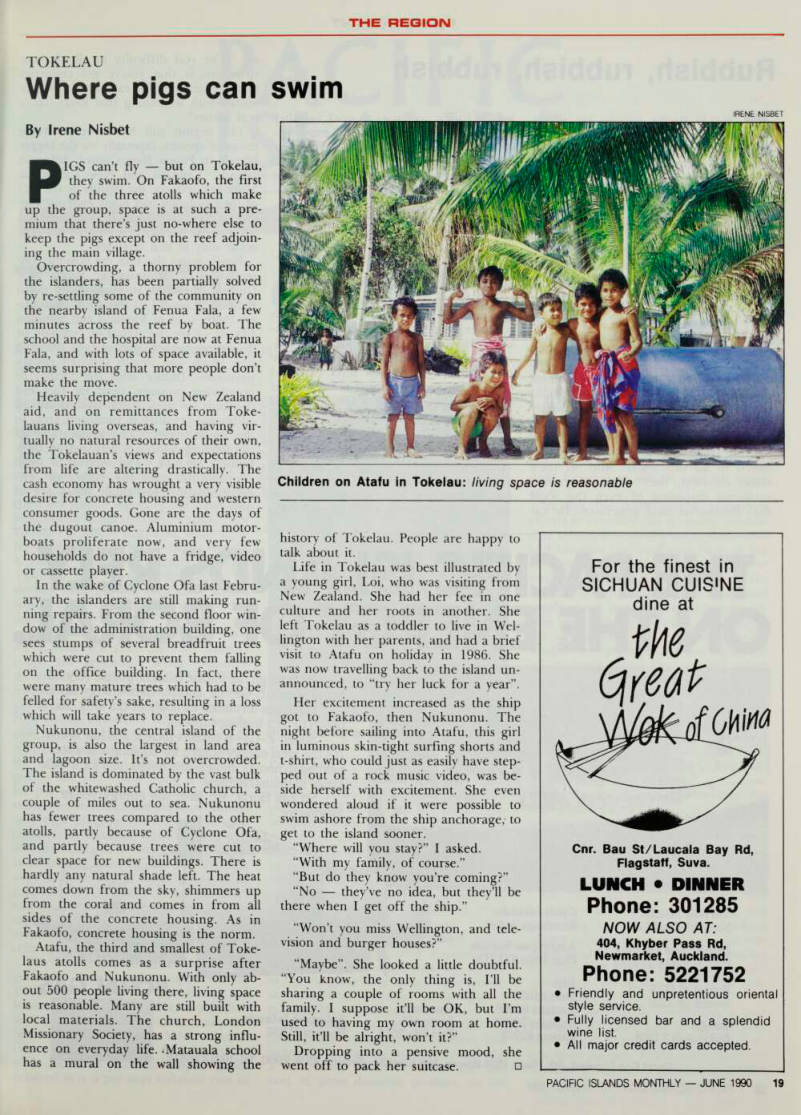
Atafu, the third and smallest of Toke laus atolls comes as a surprise after Fakaofo and Nukunonu. With only ab out 500 people living there, living space is reasonable. Many are still built with local materials. The church, London Missionary Society, has a strong influ ence on everyday life. <Matauala school has a mural on the wall showing the
history of Tokelau. People are happy to talk about it.
Life in Tokelau was best illustrated by a young girl, Loi, who was visiting from New Zealand. She had her fee in one culture and her roots in another. She left Tokelau as a toddler to live in Wel lington with her parents, and had a brief visit to Atafu on holiday in 1986. She was now travelling back to the island un announced, to “try her luck for a year”.
Her excitement increased as the ship got to Fakaofo, then Nukunonu. The night before sailing into Atafu, this girl in luminous skin-tight surfing shorts and t-shirt, who could just as easily have step ped out of a rock music video, was be side herself with excitement. She even wondered aloud if it were possible to swim ashore from the ship anchorage, to get to the island sooner.
“Where will you stay?” I asked.
“With my family, of course.”
“But do they know you’re coming?”
“No they’ve no idea, but they’ll be there when I get off the ship.”
“Won’t you miss Wellington, and tele vision and burger houses?”
“Maybe”. She looked a little doubtful.
“You know, the only thing is, I’ll be sharing a couple of rooms with all the family. I suppose it’ll be OK, but I’m used to having my own room at home.
Still, it’ll be alright, won’t it?”
Dropping into a pensive mood, she went off to pack her suitcase. □
Irene Nisbet
Children on Atafu in Tokelau: living space is reasonable
Advertisements & other items, p. 19 (1 item)
6 reap
For the finest in
SICHUAN CUIS'NE
dine at m
6 reap
Cnr. Bau St/Laucala Bay Rd, Flagstaff, Suva.
LUNCH • DINNER
Phone: 301285
NOW ALSO AT:
404, Khyber Pass Rd, Newmarket, Auckland.
Phone: 5221752
• Friendly and unpretentious oriental style service. • Fully licensed bar and a splendid wine list. • All major credit cards accepted.
Rubbish, rubbish, rubbish
Environment
SOUTH Pacific nations are under increasing pressure from the northern hemisphere countries to become a dumping ground for hazar dous waste and this pressure will grow even faster as the major industrial nations run out of alternatives for waste disposal, New Zealand’s Associate En vironment Minister Peter Dunne told the Environment ’9O conference held in Syd ney. The main attraction for Pacific na tions was that becoming a garbage dump was a means to earn much-needed money, just as the Marshall Islands had been tempted last year to accept huge quantities of commercial and household refuse from the United Slates mainland.
The irony of this, as Dunne pointed out, is that many of the South Pacific states have not had even a chance to reap the material benefits the industrial ised and heavily polluting countries had earned from the processes which re sulted in all this waste. And, as these states develop, they will face greater problems disposing of even the waste they themselves have generated. He cal
led on Pacific countries to work together because collective action could prove vit al to the region’s survival. “While we have contributed relatively little to global environmental damage, the fact is that we reap an unequal amount of the con sequences of social, economic and en vironmental disruption and harm,” he said.
Proposals to dump hazardous and sup posedly safe municipal waste are con stantly being made to island govern ments. But most do not have the technic al capacity to evaluate the effects of such schemes; the Marshall Islands Govern ment was attracted by the idea of build ing the height of an island using garbage to offset the rising sea level expected because of the Greenhouse effect but did not take into account the damage caused by the garbage leaching into water sup plies and marine ecosystems.
"I think the Pacific will become in creasingly targeted not only because it’s a vast isolated area with plenty of space but because it is going to become a ma jor area of economic activity,” said Dun
ne. “The real difficulty in all of these situations is that you’ve got countries that are strapped for cash suddenly pre sented with something that looks like a real earner”.
The region still has a very diverse range of species, especially on the bigger islands in Papua New Guinea, Solomon Islands, Vanuatu and New Caledonia.
More importantly, the islands by the fact of their isolation had many endemic spe cies New Caledonia, for example, has 3250 native species of which 76 per cent occur only in that territory.
Pacific states also face the possible con sequences of deforestation. Papua New Guinea is belatedly moving to slow down the destruction of its trees, but landown ers there as in Vanuatu and Solomon Islands see the arrival of Japanese or Taiwanese timber companies as bringing new roads and wealth through royalty payments. Dunne adds the factors of population pressure, need for fuel and demands for agricultural land as adding additional pressure to rainforest areas in the island states. “The implications of stopping agro-forestry activities are pro found,” he said. “The survival of small communities and the rights of self determination for small states are at stake”. □
Advertisements & other items, p. 20 (1 item)
The Pacific Islands Rely
ON THE ENERGY OF BORAL
t It ■ .
All through the Pacific Islands, people rely on Boral Speed-E-Gas LP Gas for their energy needs.
Boral has terminals throughout the area, and is proud to be a leading supplier.
Speed-E-Gas is clean, efficient and low in cost.
It’s the ideal energy source for cooking and water heating in homes, motels and hotels, and for a wide range of industrial uses.
So call Boral. We have the energy you’re looking for. r - « % fj&'m * Cook Islands Rarotonga 24460 Norfolk Island Norfolk Island 2419 Papua New Guinea Port Moresby 214248 Lae 42 2574 Rabaul 921225 Wewak 862125 Tonga Nukualofa 21388 American Samoa Pago Pago 633 2170 Fiji Suva 24035 Lautoka 60088 Sigatoka 50578 Labasa 82973
BORAL GAS
Vanuatu Santo 455 Port Vila 2046 Solomon Islands Honiara 21833 Boral Gas Limited, Bth Floor, IBM House, 168 Kent St., Sydney, NSW 2000. Tel: (02) 278512.
Mi
Pacific
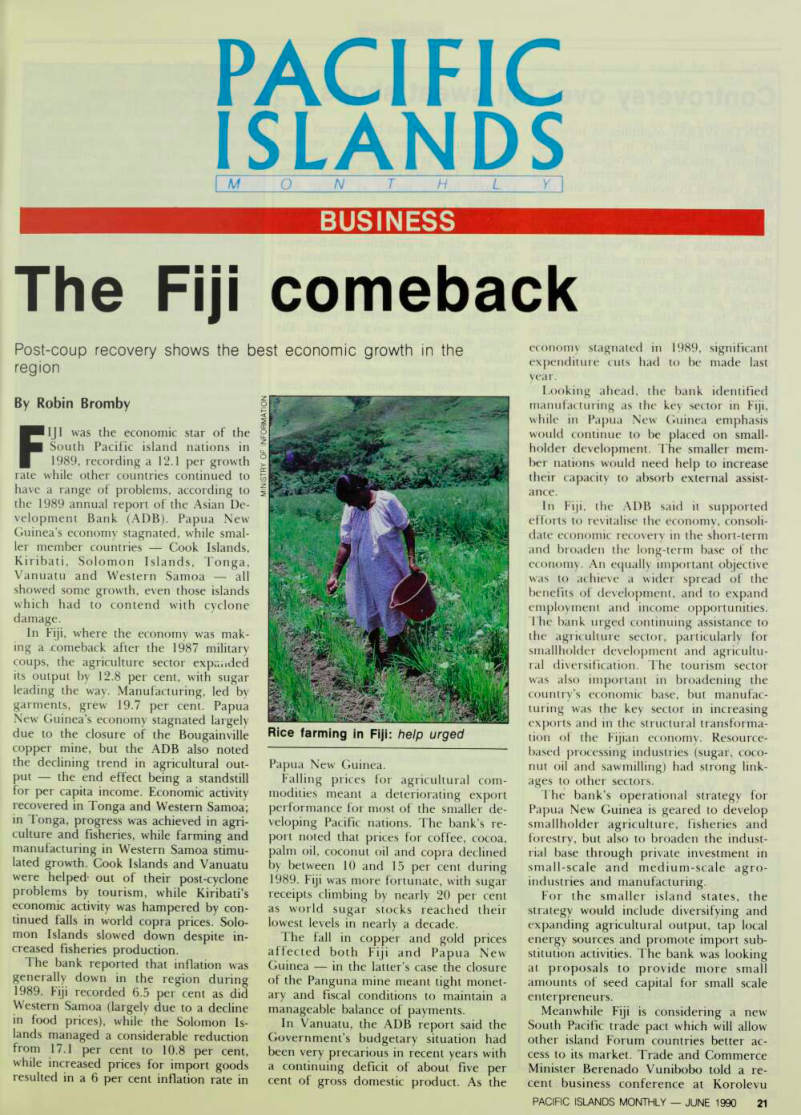
Islands
Monthly
Business
The Fiji comeback
Post-coup recovery shows the best economic growth in the region
By Robin Bromby
FIJI was the economic star of the South Pacific island nations in 1989, recording a 12.1 per growth rate while other countries continued to have a range of problems, according to the 1989 annual report of the Asian De velopment Bank (ADB). Papua New Guinea’s economy stagnated, while smal ler member countries Cook Islands, Kiribati, Solomon Islands, Tonga, Vanuatu and Western Samoa all showed some growth, even those islands which had to contend with cyclone
damage.
In Fiji, where the economy was mak ing a .comeback after the 1987 military coups, the agriculture sector expanded its output by 12.8 per cent, with sugar
leading the way. Manufacturing, led by
garments, grew 19.7 per cent. Papua New Guinea’s economy stagnated largely due to the closure of the Bougainville copper mine, but the ADB also noted the declining trend in agricultural out put the end effect being a standstill for per capita income. Economic activity recovered in Tonga and Western Samoa; in Tonga, progress was achieved in agri culture and fisheries, while farming and manufacturing in Western Samoa stimu lated growth. Cook Islands and Vanuatu were helped- out of their post-cyclone problems by tourism, while Kiribati’s
economic activity was hampered by con
tinued falls in world copra prices. Solo mon Islands slowed down despite in creased fisheries production.
The bank reported that inflation was generally down in the region during 1989. Fiji recorded 6.5 per cent as did Western Samoa (largely due to a decline in food prices), while the Solomon Is lands managed a considerable reduction from 17.1 per cent to 10.8 per cent, while increased prices for import goods resulted in a 6 per cent inflation rate in
Papua New Guinea.
Falling prices for agricultural com
modities meant a deteriorating export performance for most of the smaller de veloping Pacific nations. The bank’s re port noted that prices for coffee, cocoa, palm oil, coconut oil and copra declined by between 10 and 15 per cent during 1989. Fiji was more fortunate, with sugar receipts climbing by nearly 20 per cent as world sugar stocks reached their lowest levels in nearly a decade.
The fall in copper and gold prices affected both Fiji and Papua New Guinea in the latter’s case the closure of the Panguna mine meant tight monet ary and fiscal conditions to maintain a manageable balance of payments.
In Vanuatu, the ADB report said the Government’s budgetary situation had been very precarious in recent years with a continuing deficit of about five per cent of gross domestic product. As the
economy stagnated in 1989, significant expenditure cuts had to be made last year.
Looking ahead, the bank identified manufacturing as the key sector in Fiji, while in Papua New Guinea emphasis would continue to be placed on small holder development. The smaller mem ber nations would need help to increase their capacity to absorb external assist ance.
In Fiji, the ADB said it supported efforts to revitalise the economy, consoli date economic recovery in the short-term and broaden the long-term base of the
economy. An equally important objective
was to achieve a wider spread of the benefits of development, and to expand
employment and income opportunities.
The bank urged continuing assistance to the agriculture sector, particularly for
smallholder development and agricultu
ral diversification. The tourism sector was also important in broadening the country’s economic base, but manufac turing was the key sector in increasing exports and in the structural transforma tion of the Fijian economy. Resource based processing industries (sugar, coco nut oil and sawmilling) had strong link ages to other sectors.
The bank’s operational strategy for Papua New Guinea is geared to develop smallholder agriculture, fisheries and forestry, but also to broaden the indust rial base through private investment in small-scale and medium-scale agro industries and manufacturing.
For the smaller island states, the strategy would include diversifying and expanding agricultural output, tap local energy sources and promote import sub stitution activities. The bank was looking at proposals to provide more small amounts of seed capital for small scale enterpreneurs.
Meanwhile Fiji is considering a new South Pacific trade pact which will allow other island Forum countries better ac cess to its market. Trade and Commerce Minister Berenado Vunibobo told a re cent business conference at Korolevu
Ministry Of Information
Rice farming in Fiji: help urged
that such an agreement could work along the lines of the South Pacific Re gional Trade and Economic Co operation Agreement (Sparteca) under which Forum nations have almost free access to the Australian and New Zea land markets.
“There are those in the region and in New Zealand who feel that Fiji is not committed to this region,” Vunibobo said. “Nothing could be further from the truth.”
It was Fiji’s hope that there would eventually be a regional free trade zone, but the first step was to set up free trade between the island countries.
But his government would also be pushing for other major nations to join Sparteca, and thus allow the Pacific Is land nations access to their markets along the same lines, and he nominated Canada as one possibility. Vunibobo said even though Fiji was a new and still very small player in the global apparel market it was clear that trade liberalisation was crucial to Fiji’s economic interests. “The interests of Fiji and we believe that of New Zealand and Australia lie in streng thening the GATT (General Agreement on Tariffs and Trade) process and attempting to avoid the rise of protec tionism,” he said.
The conference was also told that mer chandise trade between New Zealand and Fiji has increased by more than 200 per cent since 1987, and reached Fs23B million (U 55157.9 million) last year. New
Zealand External Affairs Ministry official Graham Ansell said from his country’s viewpoint Fiji had now become one of New Zealand’s fastest growing export destinations and an important market in its own right. Of the F|23B million, FsB7 million was accounted for by merchan dise exported from New Zealand, the ba lance being goods flowing out of Fiji.
“Fiji as an economy and as an export market is clearly in a different category for New Zealand from other Pacific Is land countries,” Ansell said. “Over 50 per cent of the value of all of New Zea land’s trade with Forum island countries is with Fiji.” Fiji now outranked trading partners such as Indonesia, Thailand, Saudi Arabia, India and Spain. □
Controversy over Fiji sweat shops
CONTROVERSY continues to surround the garment industry in Fiji, with the
industry attacking unscrupulous oper
ators and the union concerned calling for a council to monitor wages and con ditions.
Garment Manufacturers Association chairman Padam Lala said “a handful of
unscrupulous operators” were tarnishing
the image of the entire industry. He was commenting on revelations that some workers in the clothing factories were re ceiving as little as 9 cents an hour. A survey by the Ministry of Employment and Industrial Relations showed that in 63 per cent of factories surveyed, work ers were receiving less than 51c an hour and, in 81 per cent of cases, no overtime rates were paid. Rates varies from 9 to 13c an hour for beginners, 50c for machinists and up to F 53.50 an hour for foreman and supervisors.
Lala said the news came as a dis appointment. “I have repeatedly been
given assurances verbally, and in writing,
by members of my association that the minimum rate prevailing is 60c an hour for unskilled and new employees,” he
said. The 60c rate had been agreed to by manufacturers in the absence of any for mal training programme for garment workers. Lala described the low wages revealed by the survey as “unfair and irrational”.
The Fiji Association of Garment Work ers, in calling for a wages council, said about a third of garment manufacturers in Fiji had honoured commitments on wages. Association secretary Ema Druavesi said the garment industry had agreed in 1986 to a minimum wage of 50c. One worker involved in piece work received just Fss a week after tax. She urged that the wages council should in clude representatives from the Govern ment, workers and employers.
The union said some workers com plained that they received less than the amounts on their payslips but when they
questioned the employer they were told
nothing could be done about it. Others said they missed tea breaks because they had not completed enough work. Most factories had improper seating ben ches rather than chairs, and many factor ies had inadequate ventilation. □
Honey production increases ALL honey consumed in the Solomon Islands will be produced domestically by the end of the year, replacing the 20 tonnes imported from Australia and New Zealand each year. Honey is now being produced in most provinces, with the main concentrations in Western and Malaita. The Solomons is now also manufacturing hives and has received orders from New Zealand.
Labour deregulation considered PRIVATE employers may be allowed to offer more competitive wages for work ers with specialised skills, under labour deregulation proposals now being consi dered by the Fiji Government. The Secretary to the Government Poseci Bune said the move was part of the Gov ernment’s strategy of developing and maintaining skilled manpower resources resources which have been hit badly by the large-scale emigration of skilled workers since the military coups.
Bune said there would also be upgrad ing and re-orienting of major training institutions to become more responsive to employer needs.
Advertisements & other items, p. 22 (1 item)
Australia
STUDY IN
■ NATUROPATHY
■ ACUPUNCTURE
■ 3 Year Diploma ■ 4 Year Degree ■ Fully Accredited ■ Overseas Students Registered College Apply to:
ACADEMY of
Natural Therapies P.O. Box 6619 Gold Coast Mail Centre, Bundall 4217 Queensland, AUSTRALIA.
Phone: 075 388141 Fax: 075 384908
HOW ON EARTH AM I GOING TO TAKE
ALL THIS HOME ?
DHL IT!
DHL has years of experience carefully packing and shipping Fiji’s outstanding works of art directly to your home doorstep.
Our reputation has been built on caring for your valuables. Don’t take chances, phone us we’re here to help.
Just call DHL we ll do the rest 81162 wonLQwux '
Palau’s slsom deal
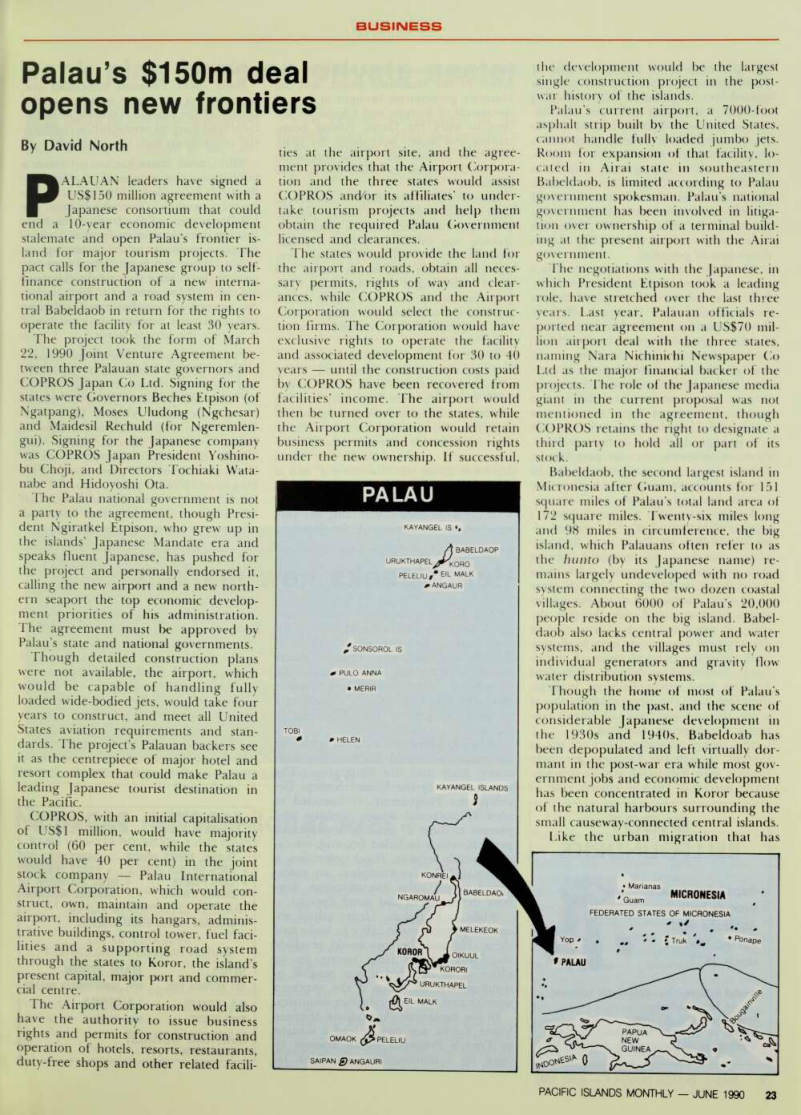
opens new frontiers
Palau
By David North
PALAUAN leaders have signed a US$l5O million agreement with a Japanese consortium that could end a 10-year economic development stalemate and open Palau’s frontier is land for major tourism projects. The pact calls for the Japanese group to self finance construction of a new' interna tional airport and a road system in cen tral Babeldaob in return for the rights to operate the facility for at least 30 years.
The project took the form of March 22, 1990 Joint Venture Agreement be tween three Palauan state governors and COPROS Japan Co Ltd. Signing for the states were Governors Beches Etpison (of Ngatpang), Moses Uludong (Ngchesar) and Maidesil Rechuld (for Ngeremlen gui). Signing for the Japanese company was COPROS Japan President Yoshino bu Choji, and Directors Tochiaki Wata nabe and Hidoyoshi Ota.
The Palau national government is not a party to the agreement, though Presi dent Ngiratkel Etpison, who grew up in the islands’ Japanese Mandate era and speaks fluent Japanese, has pushed for the project and personally endorsed it, calling the new airport and a new north ern seaport the top economic develop ment priorities of his administration.
The agreement must be approved by Palau’s state and national governments.
Though detailed construction plans
were not available, the airport, which
would be capable of handling fully
loaded wide-bodied jets, would take four years to construct, and meet all United States aviation requirements and stan dards. The project’s Palauan backers see it as the centrepiece of major hotel and resort complex that could make Palau a leading Japanese tourist destination in the Pacific.
COPROS, with an initial capitalisation of US$l million, would have majority control (60 per cent, while the states would have 40 per cent) in the joint stock company Palau International Airport Corporation, which would con struct, own, maintain and operate the
airport, including its hangars, adminis
trative buildings, control tower, fuel faci lities and a supporting road system through the states to Koror, the island’s present capital, major port and commer cial centre.
The Airport Corporation would also have the authority to issue business rights and permits for construction and operation of hotels, resorts, restaurants, duty-free shops and other related facili
ties at the airport site, and the agree
ment provides that the Airport Corpora
tion and the three slates would assist COPROS anchor its affiliates' to under take tourism projects and help them obtain the required Palau Government licensed and clearances.
The states would provide the land for the airport and roads, obtain all neces sary permits, rights of way and clear ances, while COPROS and the Airport Corporation would select the construc tion firms. The Corporation would have exclusive rights to operate the facility and associated development for 30 to 40 years until the construction costs paid by COPROS have been recovered from facilities’ income. The airport would then be turned over to the states, while the Airport Corporation would retain business permits and concession rights under the new ownership. If successful.
the development would be the largest single construction project in the post war history of the islands.
Palau’s current airport, a 7000-foot asphalt strip built by the United States, cannot handle fullv loaded jumbo jets.
Room for expansion of that facility, lo cated in Airai stale in southeastern Babeldaob, is limited according to Palau government spokesman. Palau’s national government has been involved in litiga tion over ownership of a terminal build ing at the present airport with the Airai government.
The negotiations with the Japanese, in which President Etpison took a leading role, have stretched over the last three years. Last year, Palauan officials re ported near agreement on a US$7O mil lion airport deal with the three slates, naming Nara Nichinichi Newspaper Co Ltd as the major financial backer of the projects. The role of the Japanese media giant in the current proposal was not mentioned in the agreement, though COPROS retains the right to designate a third party to hold all or part of its stock.
Babeldaob, the second largest island in Micronesia after Guam, accounts for 151 square miles of Palau’s total land area of 172 square miles. Twenty-six miles long and 98 miles in circumference, the big island, which Palauans often refer to as the hunto (by its Japanese name) re mains largely undeveloped with no road system connecting the two dozen coastal villages. About 6000 of Palau’s 20,000 people reside on the big island. Babel daob also lacks central power and water systems, and the villages must rely on individual generators and gravity flow water distribution systems.
Though the home of most of Palau’s population in the past, and the scene of considerable Japanese development in the 1930 s and 19405, Babeldoab has been depopulated and left virtually dor mant in the post-war era while most gov ernment jobs and economic development has been concentrated in Koror because of the natural harbours surrounding the small causeway-connected central islands.
Like the urban migration that has
affiliated most of the Pacific, the shift of Palau’s post-war population to Koror has
caused over-population and crowding
and led to the usual social and environ mental problems. Palauan leaders look to the resettlement of Babeldaob as both a short term safety valve for Koror’s prob lems as well as a long term solution to the development of the islands. Though the United States funded construction of a US$5 million concrete bridge, joining Koror and Babeldaob in 1979, Palau has been unable to unlock the big island’s
development potential.
The Palau Constitution requires that a new capital be built in Babeldaob’s Mele kiok state, close to the proposed airport development. The Compact of Free Association requires the United States to build a major road system on Babeldaob and assist in the construction of the capital. But those developments have been stalled by the political status impas se over Palau’s nuclear-free Constitution and the Compact of Free Association, in which the United Stales requires port and passage rights for its nuclear Navy.
In seven plebiscites over the past decade.
Palauan voters have not provided the 75 percent majority needed to waive the nuclear ban and approve the Compact.
Because it is still a United Nation’s trust territory (the last of 11 created af ter World War II), Palau lacks the com
plete sovereignty to negotiate state to
state economic development aid with its
Asian-Pacific neighbours. Though some
small-scale business and tourist invest ments have occurred over the past de cade, no major investors or large private development agreements have been initi ated while the political status of the is lands remained undecided. President Etpison and other Palauan leaders, therefore, view the airport project also as a way through the horns of Palau’s eco nomic development dilemma.
The airport investors’ views are not as
evident, though the Japanese are quite
familiar with Babeldaob and its develop ment potential. During Japan’s rule of
Micronesia, Palau was the administrative center of the Mandated island, and the Mandate government brought in tens of thousands of Korean and Okinawan set tlers to work the farms, fishing boats, mining and timber operations. By 1940, the Palau islands has a total population of 35,000, which included about 7500 Palauans.
Babeldoab hosted major commercial
agricultural projects, including pineap
ple, sugar cane and coconut plantations.
Bauxite was mined in northern Babel daob, timber was extracted from the cen tral rain forests and oyster farms and pearl beds ringed the big island. The Japanese also built a road system on the big island connecting the villages to the major agricultural and extraction opera tions.
Koror’s Malakal Harbour was a bust ling Japanese fishing port and Koror town had a population of 20,000 (about 1600 of whom were Palauans) boasting all the amenities, including thousands of Japanese style wooden houses, central power and water systems, a daily news paper, and geisha houses. For many Japanese, Palau was “the Riviera” and at the height of the islands’ development, a Shinto Shrine was dedicated in Koror with great ceremony, including the pre sence of a monument of the Japanese
royal family.
Many older Palauans remember the Japanese era with great nostalgia as the apogee of the islands’ economic develop ment and long to reestablish a commer cial relationship with the Japanese.
The United States has not yet taken a
position on the proposed development.
Because Palau has been in transition from trusteeship to Free Association, the US Department of the Interior has been turning over most of its fiscal and admi nistrative authority to the ‘emerging’ re public. While the State Department ob jects to direct stale to stale development aid while Palau remains a trust, it has encouraged foreign business investment and third party development assistance if it is from the private sector.
President Etpison believes the airport tourism project meets these guidelines and therefore represents a way around the state aid problem. However, recent US Congressional criticism of Interior for not providing sufficient oversight of Palau, especially in connection with US$5O million debt incurred by the is land’s government for a controversial 16megawatt power plant, spurred the federal agency to recently announce that it would be reassuming some fiscal and administrative oversight for Palau. □
Henry seeks new markets
COOK Island government leaders have been busy over recent weeks looking for new markets and alternative sources of development assistance. Prime Minister Geoffrey Henry has now announced his country together with several other unnamed Pacific states is examining a proposal to set up a trade office in Hawaii.
Henry has recently led a delegation to Canada, the United States, West Ger many, Italy and the Philippines. The trip, funded by the United Nations De velopment Programme, is intended to identify potential donor agencies and present to them 27 priority development projects, which included housing, educa tion, health services, flood protection, a national fisheries complex, an inter island vessel, solar electrification, har bour development and waste disposal.
While in Honolulu, Henry talked ab out the possible trade office to be located there. He said the cost would preclude the Cook Islands from setting up an office of its own but it was possible to maintainsuch an office if the expenses were shared with several other countries.
In the meantime, Agriculture Minister Vaine Tairea was due to lead a mission to French Polynesia in an attempt to open up a market there for Cook Is
lands’ produce exports. Talks would focus on quota for exports to Tahiti of citrus, coconut cream and pawpaw pure e; the amounts set would be at a level manageable by Cook Island growers, The Government is spending US$7OO,OOO to build a cool store at the island’s airport which will allow vegetable and fruit growers to store their produce until time of shipment. The country has faced a problem in recent years of
ruined produce, with vegetables having
to be dumped. □
Advertisements & other items, p. 24 (2 items)
Bellfoundries
BAGOT
Postal Address: Box 421, North Adelaide, SA 5006, Australia Telephone: (08) 267 1306 Office: 147 Ward St, North Adelaide, SA Workshop: 346 Carrington St, Adelaide, SA
Supplying tuned
bronze bells In Australia and Pacific Islands since 1977 0
Martin Fabrics
FIJI’S ONLY HOUSE OF FASHION WEAR
* FLORAL DRESS PRINTS a HABUTAE SILK A 100% COTTON PRINTS a FANCY FABRICS ★ TAPA PRINTS a MENS SUITING &
a ISLAND PRINTS SHIRTING MATERIAL
LARGEST SELECTION IN FIJI OF
a CURTAIN FABRIC FROM SWEDEN
AVAILABLE AT ALL
MARTIN FABRICS RETAIL OUTLET
SUVA
281 VICTORIA PRO.
BA TOWN
MAIN STREET
NADI TOWN
OPP. NAMOTOMOTO VILLAGE
LAUTOKA
BILA STREET
MARTINS CORNER
4 MILES NABUA
Bank pins hope on private sector
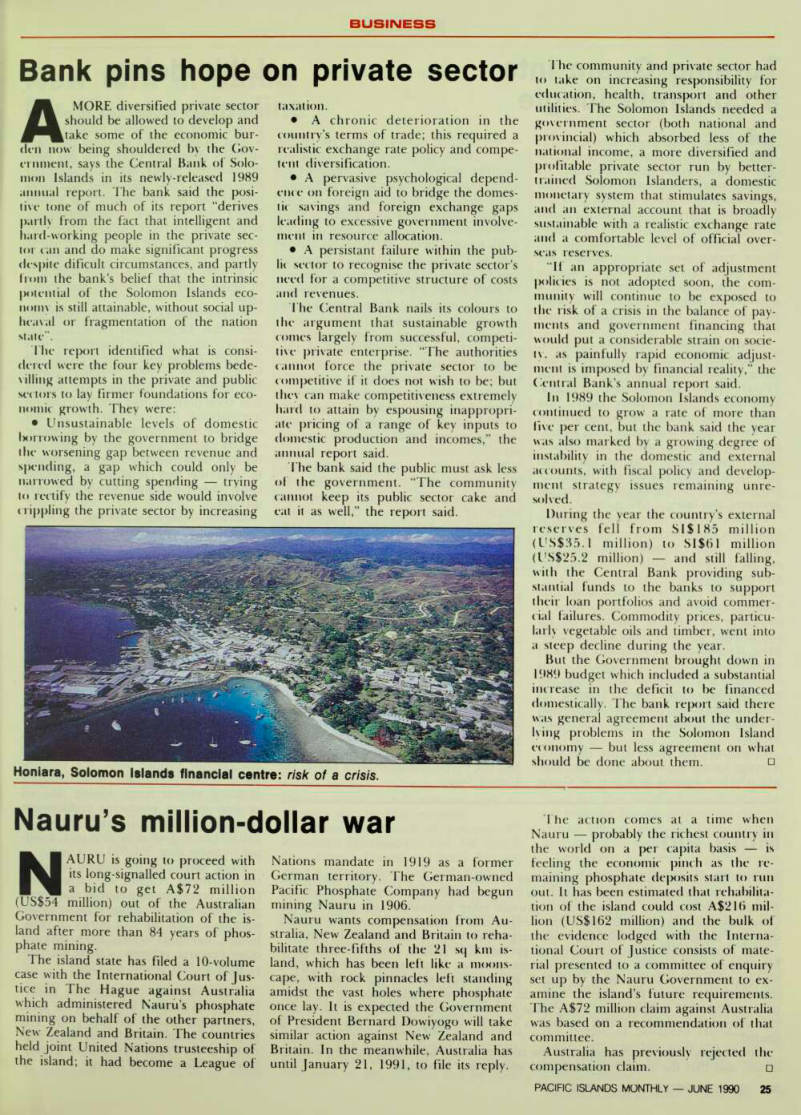
A MORE diversified private sector should be allowed to develop and take some of the economic bur den now being shouldered bv the Gov ernment, says the Central Bank of Solo mon Islands in its newly-released 1989 annual report. The bank said the posi tive lone of much of its report “derives partly from the fact that intelligent and
hard-working people in the private sec
tor can and do make significant progress despite dificult circumstances, and partly from the bank’s belief that the intrinsic potential of the Solomon Islands eco nomv is still attainable, without social up heaval or fragmentation of the nation stale”.
The report identified what is consi dered were the four key problems bede villing attempts in the private and public sectors to lay firmer foundations for eco nomic growth. They were: • Unsustainable levels of domestic
Ixirrowing by the government to bridge
the worsening gap between revenue and spending, a gap which could only be
narrowed by cutting spending trying
to rectify the revenue side would involve
crippling the private sector by increasing
taxation. • A chronic deterioration in the country’s terms of trade; this required a realistic exchange rate policy and compe tent diversification.
• A pervasive psychological depend
ence on foreign aid to bridge the domes tic savings and foreign exchange gaps leading to excessive government involve ment in resource allocation. • A persistant failure within the pub lic sector to recognise the private sector’s need for a competitive structure of costs and revenues. file Central Bank nails its colours to the argument that sustainable growth comes largely from successful, competi tive private enterprise. “The authorities cannot force the private sector to be competitive if it does not wish to be; but they can make competitiveness extremely hard to attain by espousing inappropri ate pricing of a range of key inputs to domestic production and incomes,” the annual report said.
The bank said the public must ask less of the government. “The community cannot keep its public sector cake and eat it as well,” the report said.
Hie community and private sector had to lake on increasing responsibility for education, health, transport and other utilities. The Solomon Islands needed a government sector (both national and provincial) which absorbed less of the national income, a more diversified and profitable private sector run by better trained Solomon Islanders, a domestic monetary system that stimulates savings, and an external account that is broadly sustainable with a realistic exchange rate and a comfortable level of official over seas reserves.
“If an appropriate set of adjustment policies is not adopted soon, the com munity will continue to be exposed to the risk of a crisis in the balance of pay ments and government financing that would put a considerable strain on socie ty as painfully rapid economic adjust ment is imposed by financial reality,” the Central Bank’s annual report said.
In 1989 the Solomon Islands economy continued to grow a rate of more than five per cent, but the bank said the year was also marked by a growing degree of instability in the domestic and external accounts, with fiscal policy and develop ment strategy issues remaining unre solved.
During the year the country’s external reserves fell from SIS 185 million (US$35.l million) to SISbl million (U 5525.2 million) and still falling, with the Central Bank providing sub stantial funds to the banks to support their loan portfolios and avoid commer cial failures. Commodity prices, particu larly vegetable oils and timber, went into a sleep decline during the year.
But the Government brought down in 1989 budget which included a substantial increase in the deficit to be financed domestically. The bank re)M>rt said there was general agreement about the under- Iving problems in the Solomon Island economy but less agreement on what should be done about them. □
Honiara, Solomon Islands financial centre: risk of a crisis.
Nauru’s million-dollar war
NAURU is going to proceed with its long-signalled court action in a bid to get As 72 million (US$54 million) out of the Australian Government for rehabilitation of the is land after more than 84 years of phos
phate mining.
The island state has filed a 10-volume case with the International Court of Jus tice in The Hague against Australia which administered Nauru’s phosphate mining on behalf of the other partners, New Zealand and Britain. The countries held joint United Nations trusteeship of the island; it had become a League of
Nations mandate in 1919 as a former German territory. The German-owned
Pacific Phosphate Company had begun
mining Nauru in 1906.
Nauru wants compensation from Au stralia, New Zealand and Britain to reha bilitate three-fifths of the 21 sq km is land, which has been left like a moons cape, with rock pinnacles left standing amidst the vast holes where phosphate once lay. It is expected the Government of President Bernard Dowiyogo will take similar action against New Zealand and Britain. In the meanwhile, Australia has until January 21, 1991, to file its reply.
The action comes at a time when Nauru probably the richest country in the world on a per capita basis is feeling the economic pinch as the re
maining phosphate deposits start to run
out. It has been estimated that rehabilita tion of the island could cost AS2lb mil lion (US$l62 million) and the bulk of the evidence lodged with the Interna tional Court of Justice consists of mate rial presented to a committee of enquiry set up by the Nauru Government to ex amine the island’s future requirements.
The As 72 million claim against Australia was based on a recommendation of that committee.
Australia has previously rejected the compensation claim. □
Turning Guam into
a concrete jungle
F AST-moving land development
which in recent years has transformed Guam from backwater to a bustling tourist destination has had one downside effect: Much of what gave the island its character has disappeared under concrete. With 600,000 Japanese tourists visiting Guam last year and the figure rising beyond one million for 1991 (let alone from other countries such as Australia and South Korea), it is a matter of moving quickly to save what remains from the condominium and
hotel developers.
An Agana based consultancy company, Transpacific Associates Inc, claims it has . r, , come up with the answer the Regional Private Land Development Project Chairman Marvin Goolsby said it was aimed at finding ways landowners could inrrMtp • • * * ? , increase their income other than bv sell- • tU ■ . n “ “ mg their property, usually to Japanese buyers thus having much of the island end up in foreign hands. And the temptation to sell is great: A two hectare property can bring US$2 million.
Guam’s present development phase is much like that which occurred in Hawaii 20 years ago: Tourists will this year spend US$4OO million on the UScontrolled island.
Goolsby’s plan is to turn land into tourist attractions by looking for ways to exploit its natural state. Investors put up the money to take a share in the enterprise, the landowners keep their title and share the income and Transpacific earns a living as the consultant and by training staff. If the scheme works, Goolsby intends to expand through Micronesia, particularly Saipan, Truk, Palau and Kosrae.
Planning has started on the first scheme, known as the Guamamozan Project which is located in a part of Guam
not touched during the Second World War. Three landowners are involved, and the project once completed will feature a river tour to an archaeolo gical site (via land that grows wild orchids, palm trees and bamboo with wildlife such as deer and wild pigs as well), an ornamental horticultural planta tion producing for export, a botanical garden based on existing and largely un touched jungle area and fruit farming, -ru , . r u r part of the operation fits ln T , wlth TranspacPtc s o her arm - US lOCa tour business. Goolsby is now uf ' h he around the Pacific; he has the landowners co •,, r , °P erat,on ’ now , he needs flnd com ‘ P an ‘« preparedto put up the money m 11, f 2 °‘ year leaSe j The , m ° st difficult part is getting people to take the .° r „ , time to go and look at the proiect, he 5 F J ‘ Goolsby told Pacific Islands Monthly that the lsland of Guam > 48km long by 24km wlde > is beginning to show the stram of the enorm °us tourist influx wlthout having the benefit of an overall develo pment plan. His interest is archae °logical, a "d he complains impor tant s * tes which contain artefacts and bones § oin S back 6000 y ears have been bulldozed before they could be properly examined - One particular site near the mam hotel area could have been de ‘ velo P ed as a museum. Soon, he said, all sltes would be B one takin S with them a valuable tourist attraction value, “Real estate is the biggest industry in Guam now,” said Goolsby. “There’s a lack of vision these people know the price of everything, the value of no thing,” Development could wait Guam had the lowest unemployment rate in the United States. □
More aid
ADDITIONAL aid will flow to Papua New Guinea to help the country lessen the effects of the current economic crisis. Both the International Monetary Fund and the Australian Government have agreed to provide more short-term assistance, but the Government in Port Moresby has acknowledged that it must seek alternative sources of money in light of Australia’s professed eargerness to lighten its part of the burden.
The International Monetary Fund will provide KBB million (US$9O.6 million) to help Papua New Guinea shore up its overseas reserves. In addition, the World Bank has approved a K 48.9 million (US$5O.3 million) loan toward the Government’s structural adjustment programme, Australia has agreed to additional aid of As2o million (U 5515.23 million) even though that country’s foreign minister, Gareth Evans, has warned Port Moresby that Australia’s capacity to help Papua New Guinea is limited.
Prime Minister Rabbie Namaliu said the country would be looking for new sources of aid, and that the shift from traditional sources was inevitable. □
Lihir delay
DELAYS face the rich Lihir Island gold project after internaional bankers made it clear to the project partners that they are wary of lending money for any mine in troubled Papua New Guinea. The Bougainville crisis and other bad news coming out of the country has soured Papua New Guinea’s investment image, as the Lihir partners realised when they started sounding out bankers who will be required to lend at least US$5OO million possibly as high as SUS7OO million to develop the gold mine to operational stage.
Niugini Mining Ltd (20 per cent) and Kennecott Explorations (Australia) Ltd (80 per cent) are now planning to have the SUSI billion gold mine in production by some time in 1993. Niugini’s corpo rate development manager, Rex Adams, said both partners had sounded out the international financial markets and the response had not been enthusiastic.
Adams said the production timetable had become “very rubbery” since Bougainvil le, and the new production timetable took the financing problems into account.
Earlier, Niugini chairman Geoffrey
Loudon said the banks were not refusing outright to lend money for the Lihir pro ject, but they were “just being coy. There are not too many banks wanting to lend to Papua New Guinea at the moment.”
He said people read of the Papua New Guinea troubles, including the recent coup threats, and became alarmed.
The latest blow to the resource hopes of Papua New Guinea comes on top of demands by several local parties for local control of an old pipeline which the Chevron Niugini Pty Ltd-led consortium will build to tap the lagifu oil field.
With the loss of 17 per cent of its national budget after the closure of the Bougainville copper mine, the Govern ment in Port Moresby is desperately
awaiting several large mining and oil
projects to start producing replacement
revenue. Lihir’s planned output is 250,000 oz of gold in its first year, build ing to more than 700,000 oz a year.
While mining on an isolated island in the northern reaches of Papua New Guinea poses communications and trans
port problems, the mining companies are
unlikely to face the civil unrest or land holder demands which have plagued other resource projects there are few er than 10,000 people on Lihir.
Meanwhile, the companies are under taking final detailed drilling on the areas where initial mining will take place. The
project’s feasibility study has been sub
mitted to the Papua New Guinea Depart ment of Minerals and Energy. □
for Kutubu pipeline
New turn in battle for Kutubu pipeline
MOVES to reduce the influence of foreign companies in Papua New Guinea has taken a new turn with the country’s top lawyer now campaigning to have a planned pipeline taken out of oil company hands. Papua New Guinea Law Society president Peter Donigi is standing by his campaign urging that the 270 km pipeline to be built for the Kutubu oil development be tween lagifu and the Gulf of Papua should be controlled by national interests in the form of a local equity venture.
The significance of the Donigi interven tion is that it followed just weeks after the then deputy Prime Minister Akoka Doi came out publicly for nationalisation
of large foreign companies operating in
Papua New Guinea.
Doi has since been demoted, but in his new role as Minister of State he has sig nalled publicly he supports local own ership of the pipeline, and was joined by two other junior ministers, Fisheries and Marine Resources Minister Allan Ebu and Lands Minister Kala Swokin; together with MP Alfred Kaiabe, these two ministers released a statement asking the Government to consider allowing a local company to make a bid for pipeline ownership, adding: “We will not allow benefits from our resources to go to a very few members of the elite class.”
Their support appears to be more for landowner and provincial government ownership rather than a national equity and venture company. Trade and Indus try Minister John Giheno is also believed to support the local ownership proposal.
While the Cabinet is expected to reject the plan, the involvement of such prom inent local people can only further shake already battered investor confidence among foreign firms operating in the country. Local resource companies have also pressed the government to stick by the current deals, pointing out that fore ign investors cannot be expected to put millions of kina into projects and have the rules changed on them halfway
through.
Energy Minister Patterson Lowa and acting Finance Minister Karl Stack have said the Donigi proposal was made too late to be considered, and there is no doubt that Prime Minister Rabbie Nama liu will be anxious to put a quick finish to any further talk about nationalisation or localisation. Lowa and Stack said the country was already getting a 22.5 per cent share of the Kutubu project (includ
ing the pipeline) through state equity,
and that additional equity was available to interested national investors by means
Ok Tedi’s record result OK Tedi Mining Ltd recordedan increased profit of K 24.2 million U 5524.2 million) for the year to December 31, 1989,its biggest ever.
The company said the healthy financial results a high production rate in the second half of the year after problems in the first six months with the failure of the copper and gold mine’s ore
delivery system.
ON palm growers’ plea OIL palm growers in West New Britain Province are demanding K 46 million (U 5547.3 million) in compensation for hardships resulting from low commodity prices over the past four years. Grower
representatives told Agriculture Minister
Galen Lang that New Britain Palm Oil
Development Pty Ltd, the only buyer
and exporter in the province, had failed to pay smallholders proper prices for their produce. The minister offered K 350,000 as an interim compensation payment and promised to investigate the
complaints.
of purchasing shares in the participating companies several of which are listed on the Australian stock exchange.
Consortium leader Chevron Niugini Pty Ltd is meanwhile proceeding with its plans and hopes to have Papua New Guinea Government approval within four months for the development of the Kutubu field, which has proven reserves of more than 120 million barrels. It is planned that the pipeline will run from the lagifu/Hedinia field southwards across the South Highland and Gulf pro vinces to Pa’ia Inlet in the Gulf of Papua, where it will connect with an offshore ship loading terminal.
Chevron, on behalf of partners BP Petroleum Development Ltd, Oil Search Ltd, Merlin Petroleum/Bond Energy, Ampol Exploration Ltd and BHP Pet roleum of PNG, has now applied to the government for a petroleum develop ment licence (PDL) and, under the country’s Petroleum Act, this allows the consortium priority to operate any associated pipeline.
Donigi, a prominent constitutional lawyer, wants the law changed. He said the law was drafted before Independ ence and offer greater protection to foreign companies than local commercial interest. The pipeline should, he argues, have a maximum 30 per cent participa tion level by any investor and be oper
ated as a common carrier that is, the pipeline would be available to more than one oil producer.
He is urging that private firm to be called PNG Pipeline Co Control 51 per cent of the pipeline, raising the esti mated K4OO million (U 55407.9 million) needed for construction from local shareholders and foreign borrowing. He said ownership of the oil and of the pipeline were separate issues, with the latter being of strategic importance to the country. Donigi is one of the princip als behind a company, Monticello Enter prises Pty Ltd; this company itself would not be involved in the pipeline own ership but would promote such a com pany and local ventures for other ma jor projects as well.
Chevron Niugini managing director
Morley Dupre said he was confident the pipeline project would remain in the hands of the consortium. “The Papua New Guinea Government wants stabil ity,” he said. “We’ll sit and wait, and take the challenges as they come.”
The move to throw open the pipeline ownership question could not have come a worse time for the consortium. They have just submitted their request for a PDL and now want to fast-track the
whole project.
The basic flaw in the Donigi proposal is the problem of a Papua New Guinea owned company raising anything like the money needed. His own estimate of local equity capital of about KBO million (US$Bl.5 million) would be an extraordi narily difficult task, given the history of floats in Papua New Guinea. Oil industry officials also believe it would be impossi ble to raise the rest of the money through loans without a Government guarantee, and this would mean that the Namaliu administration would have to forgo borrowing powers for other pro jects in the country. The consortium de veloping Papua New Guinea’s first com mercial oilfield has also ad to fight off continuing demands from local politi cians that they build a full-scale oil refin ery near the Kutubu project, the recently coined title to cover the lagifu/Hedinia and Agogo oil fields.
Last week Southern Highlands pre mier Yaungtine Korombe, on hearing the consortium had decided to proceed with the pipeline and not build a large refinery, demanded te foreign oil ven ture “pack up its equipment and helicop ter and leave the province.” Korombe, who faces the electors later tis year, has predicted Kutubu will become “another Bougainville” unless local demands are met. “I want to also tell the Minerals and Energy Minister not to play around with the people of Southern Highlands be cause, put together with the people of Gulf (Province), we are bigger tan the Bougainvilleans.”
Advertisements & other items, pp. 28-29 (1 item)
Toyota
Wm MM The Toyota Hilux is the world’s most popular pick-up.
And the Hilux 4X4 is the best-selling Hilux of them all. Which stands to reason. People around the world respect Toyota’s attention to style. Hilux’s car-like comfort. Rugged reliability. And as you might expect from Toyota, power. This, of course, is the most important asset for a truck. And happily, the Hilux 4X4 offers a choice of four powerful engines: 2.8 and 2.4-litre diesel engines. Plus 2.2 and 1.8-litre petrol engines. When it comes to power and good looks, nobody can beat Toyota. Nobody.
m
\ ■ V V 1 a
Isolomons
Trade Winds
s3m in loans overdue LOAN arrears on the books of the De velopment Bank of Solomon Islands now amount to Sls3 million (US$l.23 mil lion), including loans for agricultural projects which may be written off as bad debts. The bank has recently reviewed its lending policies but the Central Bank has said there is a pressing need for the Government to increase the Develop
ment Bank’s working capital.
Copra production rises INCREASED activity by smallholders led to a rise in Solomon Island copra pro duction in 1988, according to figures just released. But the industry still has major problems: the latest report of the Cen tral Bank of Solomon Islands says that substantial amounts of copra are lying dried but unshipped in rural areas poor ly served by boats.
Bank opens at Auki THE National Bank of Solomon Islands has expanded its provincial branch net
work with a new office at Auki, in Malaita Province. The new branch cost 515200,000 (U 5597,940), replaces rented premises, and represents another exten sion of the bank’s computerisation of national operations.
New rice sales NEW Zealand and Papua New Guinea importers are to begin buying rice from the Solomon Islands, and there have also been enquiries from Western Samoa, Kiribati and Vanuatu. The rice will be sold by Filders Industries (SI) Ltd, which has just obtained additional protection because the Government considers it an important source of local employment.
Fiji
Emigrant numbers still high
NUMBERS of people leaving Fiji have
continued to rise over the last two years.
The annual rate of emigration went up 7.8 per cent in 1988. There was a furth er increase of 1.5 per cent in the first nine months of 1989, to 4153 for the period ended September 30. The emigration of teachers leaving the coun try also rose markedly in the first nine months of last year.
Airline eyes new planes FIJI Air is planning to upgrade its fleet with the acquisition of a 24-seat Casa turbo-prop aircraft, and will sell the two long-serving 16-seat Herons. The Case will be employed flying out of Nausori on internal routes to Labasa and Rotu ma, as well as its one international ser vice to Funafuti in Tuvalu.
Tonga
Handbags leave for Auckland WITHIN a month of the start of manu
facturing, Tonga’s Sky High Bags Co
Ltd has shipped its first consignment of 3000 handbags to Auckland. The Have luloto-based factory is a joint Australian- Tongan venture. The company plans to build production to 200,000 bags a year which will be worth about US$l.2 mil lion, and to employ about 300 people.
Trade deficit falls TONGA has reported that its trade de ficit fell 6.7 per cent in 1989 to T 556.1 million (U 5542.5 million), with the main export declines being in consumer goods, food and chemicals. There were increased sales of pumpkin, vanilla beans, knitted garments and live animals.
New Zealand was both main buyer and supplier to Tonga during 1989, with Au stralia the next larget market for Ton gan exports.
Advertisements & other items, p. 30 (1 item)
Economic Planning Officer
FORUM SECRETARIAT
VACANCY
Applications are invited from suitably qualified and experienced persons, who must be citizens of a *member country of the South Pacific Forum, for the above position.
The Forum has sought to give greater emphasis to economic analysis and planning capacity. It has established an Economic Services Division which has responsibility for providing to Forum Island countries comprehensive economic analysis and planning advice as well as to seek greater regional coordination of aid to the South Pacific. The appointee will undertake economic analysis and planning together with detailed research on issues identified by the Committee on Regional Economic Issues and provide advice to Forum member governments accordingly, assist FIC governments in economic analysis and planning activities to support national economic development and more effective utilization of aid; preparation/formulation of regional project profiles and in the evaluation of completed projects: undertake analysis and assessment of regional projects and provide appropriate reports to donor governments and organisations.
This appointment will carry an attractive remuneration package, payable in Fiji dollars. For non-Fiji citizens this is tax free and includes housing or housing allowance, education and child allowances. Other benefits for all employees include superannuation payments and medical, life and travel insurance coverage. The appointee will be based at the Secretariat’s Headquarters in Suva, Fiji, but will be required to undertake periodic duty travel. Appointment would be for three years initially, renewable by mutual agreement.
Applicants should provide full information on education and career background and should list names, addresses and telephone numbers of at least three referees with whom the applicant has been associated in a professional capacity. Applications should be addressed to: The Secretary General Forum Secretariat G P O Box 856 Suva, Fiji Telephone; 312600 Telex: 2229 FJ Fax: 302204 Applications close on 18 June 1990 and all enquiries should be made to Ms Karen Sorby, Acting Head of Management Services on 312600 ext. 219.
Member countries: Australia, Cook Islands, Federated States of Micronesia, Fiji, Kiribati. Marshall Islands, Nauru, New Zealand, Niue, Papua New Guinea, Solomon Islands, Tonga, Tuvalu, Vanuatu and Western Samoa.
Luring the Tourists
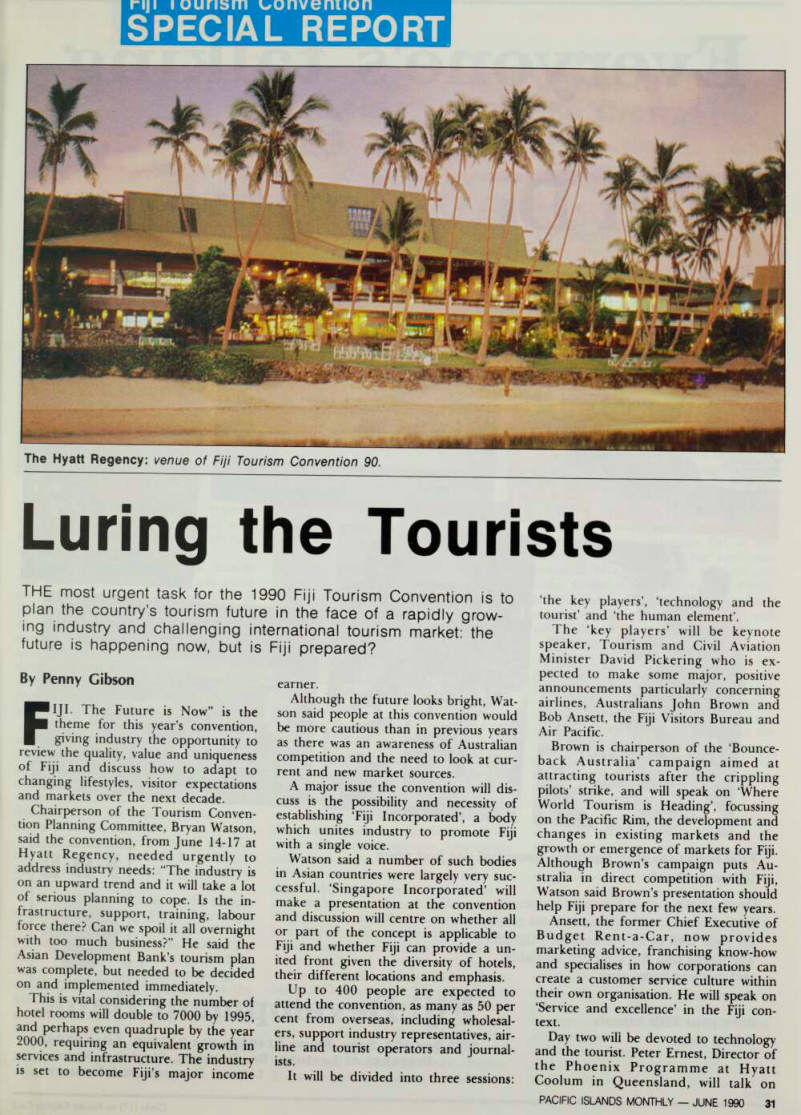

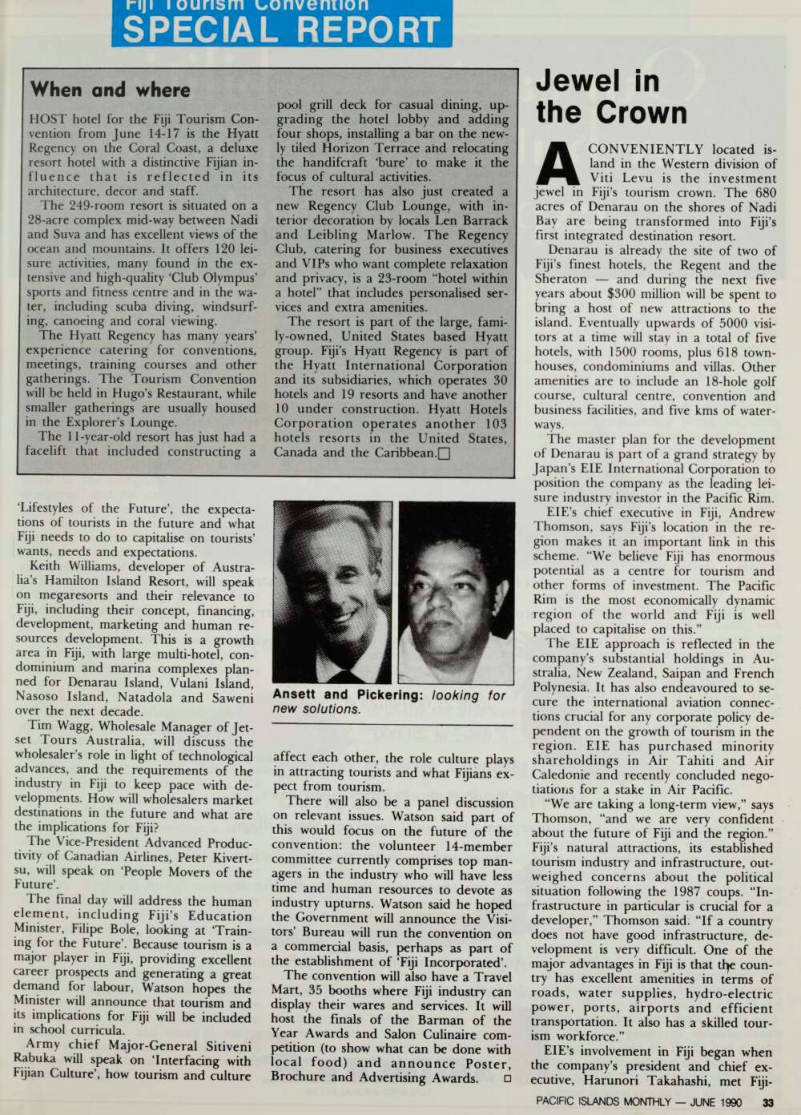
Fiji Tourism convetion
Special Report
THE most urgent task for the 1990 Fiji Tourism Convention is to plan the country’s tourism future in the face of a rapidly grow ing industry and challenging international tourism market: the future is happening now, but is Fiji prepared?
By Penny Gibson
FIJI. The Future is Now” is the theme for this year’s convention, giving industry the opportunity to review the quality, value and uniqueness of Fiji and discuss how to adapt to
changing lifestyles, visitor expectations
and markets over the next decade.
Chairperson of the Tourism Conven tion Planning Committee, Bryan Watson, said the convention, from June 14-17 at Hyatt Regency, needed urgently to address industry needs: “The industry is on an upward trend and it will take a lot of serious planning to cope. Is the in frastructure, support, training, labour force there? Can we spoil it all overnight with too much business?” He said the Asian Development Bank’s tourism plan was complete, but needed to be decided
on and implemented immediately.
This is vital considering the number of hotel rooms will double to 7000 by 1995, and perhaps even quadruple by the year 2000, requiring an equivalent growth in services and infrastructure. The industry is set to become Fiji’s major income
earner.
Although the future looks bright, Wat son said people at this convention would be more cautious than in previous years as there was an awareness of Australian competition and the need to look at cur rent and new market sources.
A major issue the convention will dis cuss is the possibility and necessity of
establishing ‘Fiji Incorporated’, a body
which unites industry to promote Fiji with a single voice.
Watson said a number of such bodies in Asian countries were largely very suc
cessful. ‘Singapore Incorporated’ will
make a presentation at the convention and discussion will centre on whether all or part of the concept is applicable to Fiji and whether Fiji can provide a un ited front given the diversity of hotels, their different locations and emphasis.
Up to 400 people are expected to attend the convention, as many as 50 per cent from overseas, including wholesal ers, support industry representatives, air line and tourist operators and journal ists.
It will be divided into three sessions:
‘the key players’, ‘technology and the
tourist’ and ‘the human element’.
The ‘key players’ will be keynote
speaker, Tourism and Civil Aviation Minister David Pickering who is ex
pected to make some major, positive
announcements particularly concerning
airlines, Australians John Brown and Bob Ansett, the Fiji Visitors Bureau and Air Pacific.
Brown is chairperson of the ‘Bounce back Australia’ campaign aimed at attracting tourists after the crippling pilots’ strike, and will speak on ‘Where World Tourism is Heading’, focussing on the Pacific Rim, the development and changes in existing markets and the growth or emergence of markets for Fiji.
Although Brown’s campaign puts Au stralia in direct competition with Fiji, Watson said Brown’s presentation should help Fiji prepare for the next few years.
Ansett, the former Chief Executive of
Budget Rent-a-Car, now provides
marketing advice, franchising know-how
and specialises in how corporations can create a customer service culture within their own organisation. He will speak on ‘Service and excellence’ in the Fiji con text.
Day two will be devoted to technology and the tourist. Peter Ernest, Director of the Phoenix Programme at Hyatt Coolum in Queensland, will talk on
The Hyatt Regency: venue of Fiji Tourism Convention 90.
‘Lifestyles of the Future’, the expecta tions of tourists in the future and what Fiji needs to do to capitalise on tourists’ wants, needs and expectations.
Keith Williams, developer of Austra lia’s Hamilton Island Resort, will speak on megaresorts and their relevance to Fiji, including their concept, financing, development, marketing and human re sources development. This is a growth area in Fiji, with large multi-hotel, con dominium and marina complexes plan ned for Denarau Island, Vulani Island, Nasoso Island, Natadola and Saweni over the next decade.
Tim Wagg, Wholesale Manager of Jet set Tours Australia, will discuss the wholesaler’s role in light of technological advances, and the requirements of the industry in Fiji to keep pace with de velopments. How will wholesalers market destinations in the future and what are the implications for Fiji?
The Vice-President Advanced Produc tivity of Canadian Airlines, Peter Kivert su, will speak on ‘People Movers of the Future’.
The final day will address the human element, including Fiji’s Education Minister, Filipe Bole, looking at ‘Train ing for the Future’. Because tourism is a major player in Fiji, providing excellent career prospects and generating a great demand for labour, Watson hopes the Minister will announce that tourism and its implications for Fiji will be included in school curricula.
Army chief Major-General Sitiveni Rabuka will speak on ‘lnterfacing with Fijian Culture’, how tourism and culture
affect each other, the role culture plays in attracting tourists and what Fijians ex pect from tourism.
There will also be a panel discussion on relevant issues. Watson said part of this would focus on the future of the convention: the volunteer 14-member committee currently comprises top man agers in the industry who will have less time and human resources to devote as industry upturns. Watson said he hoped the Government will announce the Visi tors’ Bureau will run the convention on a commercial basis, perhaps as part of the establishment of ‘Fiji Incorporated’.
The convention will also have a Travel Mart, 35 booths where Fiji industry can display their wares and services. It will host the finals of the Barman of the Year Awards and Salon Culinaire com petition (to show what can be done with local food) and announce Poster, Brochure and Advertising Awards. □
Ansett and Pickering: looking for new solutions.
Advertisements & other items, p. 32 (1 item)
Everyone’s talking
about the
Fiji Development
Bank
li H J i s» - , sa«*S C
fe«A’*£?i
SigVjrW-'. -“i f rc 4 >J «S
SSW? “ ■ ■• *
B FDB banks on your business potential not Just your balance sheet.
Do you have a good business proposal?
Do you want that proposal to mint money for you? Call in at the nearest FDB office.
The funds and the staff are available and ready to make your dream come true.
FDB
Give your FDB branch A Call Now.
OR 124
Fiji Development Bank.
GPO Box 104, Suva. Phone 314866;. Fax 314866; Telex 2578 F.
Branches at Lautoka, Ba, Rakiraki. Sigatoka, Nausori.
Labasa, Seaqaqa and Savusavu.
Circle (17) on Reader Enquiry Card
When and where
HOST hotel for the Fiji Tourism Con vention from June 14-17 is the Hyatt Regency on the Coral Coast, a deluxe resort hotel with a distinctive Fijian in fluence that is reflected in its architecture, decor and staff.
The 249-room resort is situated on a 28-acre complex mid-way between Nadi and Suva and has excellent views of the ocean and mountains. It offers 120 lei sure activities, many found in the ex tensive and high-quality ‘Club Olympus’ sports and fitness centre and in the wa ter, including scuba diving, windsurf ing, canoeing and coral viewing.
The Hyatt Regency has many years’
experience catering for conventions,
meetings, training courses and other gatherings. The Tourism Convention will be held in Hugo’s Restaurant, while smaller gatherings are usually housed in the Explorer’s Lounge.
The 11-year-old resort has just had a facelift that included constructing a
pool grill deck for casual dining, up
grading the hotel lobby and adding
four shops, installing a bar on the new ly tiled Horizon Terrace and relocating the handifcraft ‘bure’ to make it the focus of cultural activities.
The resort has also just created a new Regency Club Lounge, with in terior decoration by locals Len Barrack and Leibling Marlow. The Regency Club, catering for business executives and VIPs who want complete relaxation and privacy, is a 23-room “hotel within a hotel” that includes personalised ser vices and extra amenities.
The resort is part of the large, fami ly-owned, United States based Hyatt group. Fiji’s Hyatt Regency is part of the Hyatt International Corporation and its subsidiaries, which operates 30 hotels and 19 resorts and have another 10 under construction. Hyatt Hotels Corporation operates another 103 hotels resorts in the United States, Canada and the Caribbean.□
Jewel in

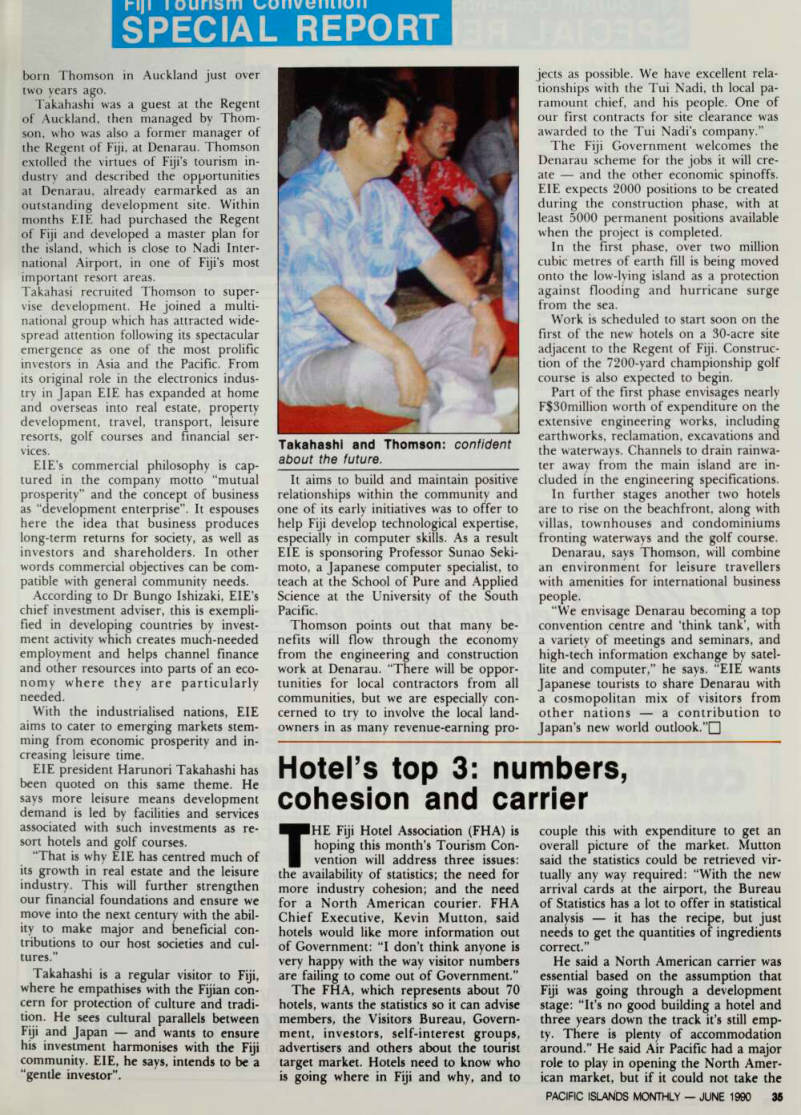
the Crown
A CONVENIENTLY located is land in the Western division of Viti Levu is the investment jewel in Fiji’s tourism crown. The 680 acres of Denarau on the shores of Nadi Bay are being transformed into Fiji’s first integrated destination resort.
Denarau is already the site of two of Fiji’s finest hotels, the Regent and the Sheraton and during the next five years about $3OO million will be spent to bring a host of new attractions to the island. Eventually upwards of 5000 visi tors at a time will stay in a total of five hotels, with 1500 rooms, plus 618 town houses, condominiums and villas. Other amenities are to include an 18-hole golf course, cultural centre, convention and business facilities, and five kms of water ways.
The master plan for the development of Denarau is part of a grand strategy by Japan’s EIE International Corporation to position the company as the leading lei sure industry investor in the Pacific Rim.
ElE’s chief executive in Fiji, Andrew Thomson, says Fiji’s location in the re gion makes it an important link in this scheme. “We believe Fiji has enormous potential as a centre for tourism and other forms of investment. The Pacific Rim is the most economically dynamic region of the world and Fiji is well placed to capitalise on this.”
The EIE approach is reflected in the company’s substantial holdings in Au stralia, New Zealand, Saipan and French Polynesia. It has also endeavoured to se cure the international aviation connec tions crucial for any corporate policy de pendent on the growth of tourism in the
region. EIE has purchased minority
shareholdings in Air Tahiti and Air Caledonie and recently concluded nego tiations for a stake in Air Pacific.
“We are taking a long-term view,” says Thomson, “and we are very confident about the future of Fiji and the region.”
Fiji’s natural attractions, its established tourism industry and infrastructure, out weighed concerns about the political situation following the 1987 coups. “In frastructure in particular is crucial for a developer,” Thomson said. “If a country does not have good infrastructure, de velopment is very difficult. One of the major advantages in Fiji is that tfye coun try has excellent amenities in terms of
roads, water supplies, hydro-electric
power, ports, airports and efficient transportation. It also has a skilled tour ism workforce.”
ElE’s involvement in Fiji began when the company’s president and chief ex ecutive, Harunori Takahashi, met Fiji
born Thomson in Auckland just over two years ago.
Takahashi was a guest at the Regent of Auckland, then managed by Thom son, who was also a former manager of the Regent of Fiji, at Denarau. Thomson extolled the virtues of Fiji’s tourism in dustry and described the opportunities at Denarau, already earmarked as an
outstanding development site. Within
months EIE had purchased the Regent of Fiji and developed a master plan for the island, which is close to Nadi Inter national Airport, in one of Fiji’s most important resort areas.
Takahasi recruited Thomson to super vise development. He joined a multi national group which has attracted wide
spread attention following its spectacular
emergence as one of the most prolific investors in Asia and the Pacific. From its original role in the electronics indus try in Japan EIE has expanded at home and overseas into real estate, property development, travel, transport, leisure resorts, golf courses and financial ser vices.
ElE’s commercial philosophy is cap tured in the company motto “mutual prosperity” and the concept of business as “development enterprise”. It espouses here the idea that business produces long-term returns for society, as well as investors and shareholders. In other words commercial objectives can be com
patible with general community needs.
According to Dr Bungo Ishizaki, ElE’s chief investment adviser, this is exempli fied in developing countries by invest ment activity which creates much-needed employment and helps channel finance and other resources into parts of an eco nomy where they are particularly needed.
With the industrialised nations, EIE aims to cater to emerging markets stem ming from economic prosperity and in creasing leisure time.
EIE president Harunori Takahashi has been quoted on this same theme. He says more leisure means development demand is led by facilities and services associated with such investments as re sort hotels and golf courses.
“That is why EIE has centred much of its growth in real estate and the leisure industry. This will further strengthen our financial foundations and ensure we move into the next century with the abil ity to make major and beneficial con tributions to our host societies and cul tures.”
Takahashi is a regular visitor to Fiji, where he empathises with the Fijian con cern for protection of culture and tradi tion. He sees cultural parallels between Fiji and Japan and wants to ensure his investment harmonises with the Fiji community. EIE, he says, intends to be a “gentle investor”.
It aims to build and maintain positive relationships within the community and one of its early initiatives was to offer to
help Fiji develop technological expertise,
especially in computer skills. As a result EIE is sponsoring Professor Sunao Seki moto, a Japanese computer specialist, to teach at the School of Pure and Applied Science at the University of the South Pacific.
Thomson points out that many be nefits will flow through the economy from the engineering and construction work at Denarau. “There will be oppor tunities for local contractors from all communities, but we are especially con cerned to try to involve the local land owners in as many revenue-earning pro
jects as possible. We have excellent rela tionships with the Tui Nadi, th local pa ramount chief, and his people. One of our first contracts for site clearance was awarded to the Tui Nadi’s company.”
The Fiji Government welcomes the Denarau scheme for the jobs it will cre ate and the other economic spinoffs.
EIE expects 2000 positions to be created during the construction phase, with at least 5000 permanent positions available when the project is completed.
In the first phase, over two million cubic metres of earth fill is being moved onto the low-lying island as a protection against flooding and hurricane surge from the sea.
Work is scheduled to start soon on the first of the new hotels on a 30-acre site adjacent to the Regent of Fiji. Construc
tion of the 7200-yard championship golf
course is also expected to begin.
Part of the first phase envisages nearly Fs3omillion worth of expenditure on the
extensive engineering works, including
earthworks, reclamation, excavations and the waterways. Channels to drain rainwa ter away from the main island are in cluded in the engineering specifications.
In further stages another two hotels are to rise on the beachfront, along with villas, townhouses and condominiums fronting waterways and the golf course.
Denarau, says Thomson, will combine an environment for leisure travellers with amenities for international business
people.
“We envisage Denarau becoming a top convention centre and ‘think tank’, with a variety of meetings and seminars, and
high-tech information exchange by satel
lite and computer,” he says. “EIE wants Japanese tourists to share Denarau with a cosmopolitan mix of visitors from other nations a contribution to Japan’s new world outlook/’^
Takahashi and Thomson: confident about the future.
Advertisements & other items, pp. 33-34 (2 items)
Special Report
33
riji lounsm v^onveniion
PACIFIC ISLANDS MONTHLY JUNE 1990
are buttoning up huge
Our caroo capabilities
export markets.
Our new 8767 will help our export industries more than ever. Not only can we carry a full passenger load of 212 people and their luggage, but we can uplift 21,000 shirts at a time, or 20,000 pineapples or 8,000 deep water snapper. That’s good news for everyone.. .the city worker, the village farmer and the fisherman. And it’s just one more way that Air Pacific is m playing its part in helping the Fiji Economy grow. Air Pacific, the rainbow from Fiji.
AIR PACIFIC
FIJI'S INTERNATIONAL AIRLINE
Hotel’s top 3: numbers,
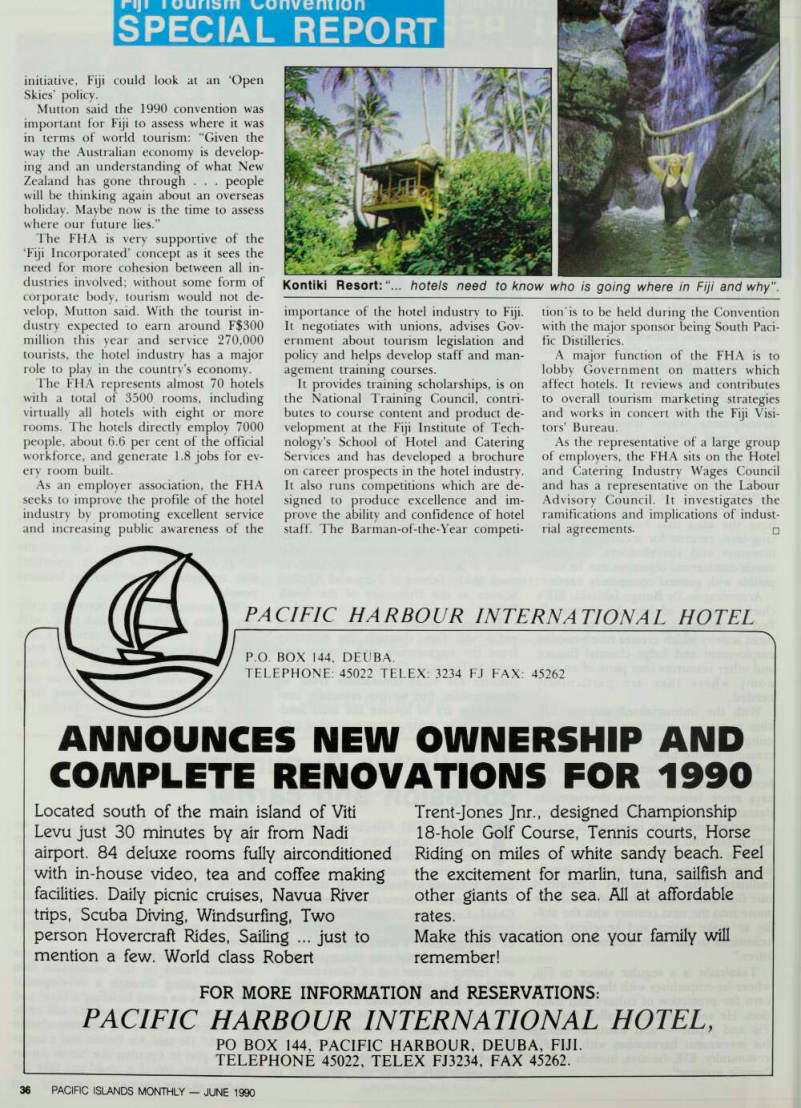
cohesion and carrier
THE Fiji Hotel Association (FHA) is hoping this month’s Tourism Convention will address three issues: the availability of statistics; the need for more industry cohesion; and the need for a North American courier. FHA Chief Executive, Kevin Mutton, said hotels would like more information out of Government: “I don’t think anyone is very happy with the way visitor numbers are failing to come out of Government,”
The FHA, which represents about 70 hotels, wants the statistics so it can advise members, the Visitors Bureau, Government, investors, self-interest groups, advertisers and others about the tourist target market. Hotels need to know who is going where in Fiji and why, and to
couple this with expenditure to get an overall picture of the market. Mutton said the statistics could be retrieved vir tually any way required: “With the new arrival cards at the airport, the Bureau of Statistics has a lot to offer in statistical analysis it has the recipe, but just needs to get the quantities of ingredients correct,”
He said a North American carrier was essential based on the assumption that
Fiji was going through a development
stage: “It’s no good building a hotel and three years down the track it’s still emp ty. There is plenty of accommodation around.” He said Air Pacific had a major role to play in opening the North Amer ican market, but if it could not take the
initiative, Fiji could look at an ‘Open
Skies’ policy.
Mutton said the 1990 convention was important for Fiji to assess where it was in terms of world tourism: “Given the way the Australian economy is develop ing and an understanding of what New Zealand has gone through . . . people will be thinking again about an overseas holiday. Maybe now is the time to assess where our future lies.”
The FHA is very supportive of the ‘Fiji Incorporated’ concept as it sees the need for more cohesion between all in dustries involved; without some form of corporate body, tourism would not de velop, Mutton said. With the tourist in dustry expected to earn around Fs3oo million this year and service 270,000 tourists, the hotel industry has a major role to play in the country’s economy.
The FHA represents almost 70 hotels with a total of 3500 rooms, including virtually all hotels with eight or more rooms. The hotels directly employ 7000 people, about 6.6 per cent of the official workforce, and generate 1.8 jobs for ev ery room built.
As an employer association, the FHA seeks to improve the profile of the hotel industry by promoting excellent service and increasing public awareness of the
importance of the hotel industry to Fiji.
It negotiates with unions, advises Gov ernment about tourism legislation and policy and helps develop staff and man agement training courses.
It provides training scholarships, is on the National Training Council, contri butes to course content and product de velopment at the Fiji Institute of Tech nology’s School of Hotel and Catering Services and has developed a brochure on career prospects in the hotel industry.
It also runs competitions which are de signed to produce excellence and im prove the ability and confidence of hotel staff. The Barman-of-the-Year competi
tion'is to be held during the Convention with the major sponsor being South Paci fic Distilleries.
A major function of the FHA is to lobby Government on matters which affect hotels. It reviews and contributes to overall tourism marketing strategies and works in concert with the Fiji Visi tors’ Bureau.
As the representative of a large group of employers, the FHA sits on the Hotel
and Catering Industry Wages Council
and has a representative on the Labour Advisory Council. It investigates the ramifications and implications of indust rial agreements. □
Kontlki Resort:"... hotels need to know who is going where in Fiji and why”.
Advertisements & other items, pp. 35-36 (3 items)
Special Report
35
ri]i luurism uuMvtfMuuii
PACIFIC ISLANDS MONTHLY JUNE 1990
Special Report
36
nji luuribm convention
PACIFIC ISLANDS MONTHLY JUNE 1990
Announces New Ownership
PACIFIC HARBOUR INTERNATIONAL HOTEL
P.O. BOX 144, DEUBA.
TELEPHONE: 45022 TELEX: 3234 FJ FAX: 45262
ANNOUNCES NEW OWNERSHIP
COMPLETE RENOVATIONS FOR
A
AND
1990 Located south of the main island of Viti Levu just 30 minutes by air from Nadi airport. 84 deluxe rooms fully airconditioned with in-house video, tea and coffee making facilities. Daily picnic cruises, Navua River trips, Scuba Diving, Windsurfing, Two person Hovercraft Rides, Sailing ... just to mention a few. World class Robert Trent-Jones Jnr., designed Championship 18-hole Golf Course, Tennis courts, Horse Riding on miles of white sandy beach. Feel the excitement for marlin, tuna, sailfish and other giants of the sea. All at affordable rates.
Make this vacation one your family will remember!
FOR MORE INFORMATION and RESERVATIONS:
PACIFIC HARBOUR INTERNATIONAL HOTEL,
PO BOX 144, PACIFIC HARBOUR, DEUBA, FIJI.
TELEPHONE 45022, TELEX FJ3234, FAX 45262.
Pickering’s trump card

THE announcement that a North American carrier will begin servic ing Fiji is likely to be made by the Minister for Tourism, Civil Aviation and Energy, David Pickering, in his keynote address to the Fiji Tourism Convention this month at the Hyatt Regency. Picker ing said a North American carrier was one of the immediate needs to ensure continued growth in Fiji’s tourism in dustry.
Other pressing issues the industry must address are increasing the amount of hotel accommodation available and making Fijians aware of how important the industry is to Fiji and its people.
Pickering said the interim Government placed high priority on tourism as one of the most important sources of foreign exchange earning. This was made evi dent after 1987; when most ministries had budget cuts, tourism didn’t, and in the last three years has been given funds additional to budget allocations, largely for the Fiji Visitors Bureau. “The Gov ernment has tried to be the catalyst in pursuing hotel development to ensure sufficient accommodation. There are several hotels now in the pipeline.” As
part of this support, the Government has agreed to put $2 million into the Saweni project and $lO million into Natadola for infrastructure development such as water and roads,” he says.
“1 hope the convention will allow opportunities for people within all walks in the industry to discuss ways and means of improving the industry as a whole, particularly for the transporters, hoteliers and wholesalers involved. The convention generally tends to be an opportunity for Government during the keynote speech to set the form for some aspects to assist industry and the indus-
try as a whole to suggest ways and means the Government may assist.”
With the theme of the convention, Fiji.
The Future is Now, Pickering said tour ism in Fiji certainly would be ready for the 21st Century when it came. He said the Government had already supported the effort to improve tourism and the interim Government would continue to do so. At present, the Government has a steering committee of all relevant minis tries and infrastructure bodies to smooth the way once new hotel projects using off-shore capital have been approved.
Developers of any new project or ex
isting project undergoing expansion set
off 55 per cent of approved capital ex
penditure on buildings against tax, writ
ten out over six years. The hotels have
duty concessions on imported goods for
use in hotels and overseas hotel chains are allowed to remit money off-shore.
Pickering said his ministry was aware of the necessity to preserve, maintain and encourage awareness of culture among Fijians. Current projects include running jingles on radio to raise local awareness of the importance of culture to tourists and the need to maintain the culture and friendliness. This is to be supplemented by posters and a video, funded by Australian aid. □
Saweni Resort: a signboard and government promise.
Advertisements & other items, p. 37 (1 item)
& Greens (Fiji) Ltd.
COLD STORAGE SEAFOOD
IMPORTERS , EXPORTERS AND WHOLESALERS
P.O. Box 9252 Nadi Airport Fiji Islands Phone: 72758, 72288
A/H: 72459 Telex: FJ 5372 SEAFOOD
SUPPLIERS OF QUALITY IMPORTED
• SEAFOOD • BEEF • POULTRY • FROZEN FRUITS • DESSERT WHIP • CHEESE • WATTIES FRENCH FRIES and other delicacies • LOCAL FISH • WALU • LOBSTERS • PRAWNS '.£® : COLD STORAGE SEAFOOD & GREENS (FIJI) LTD
NAMAKA NADI AIRPORT
Bainimara sets
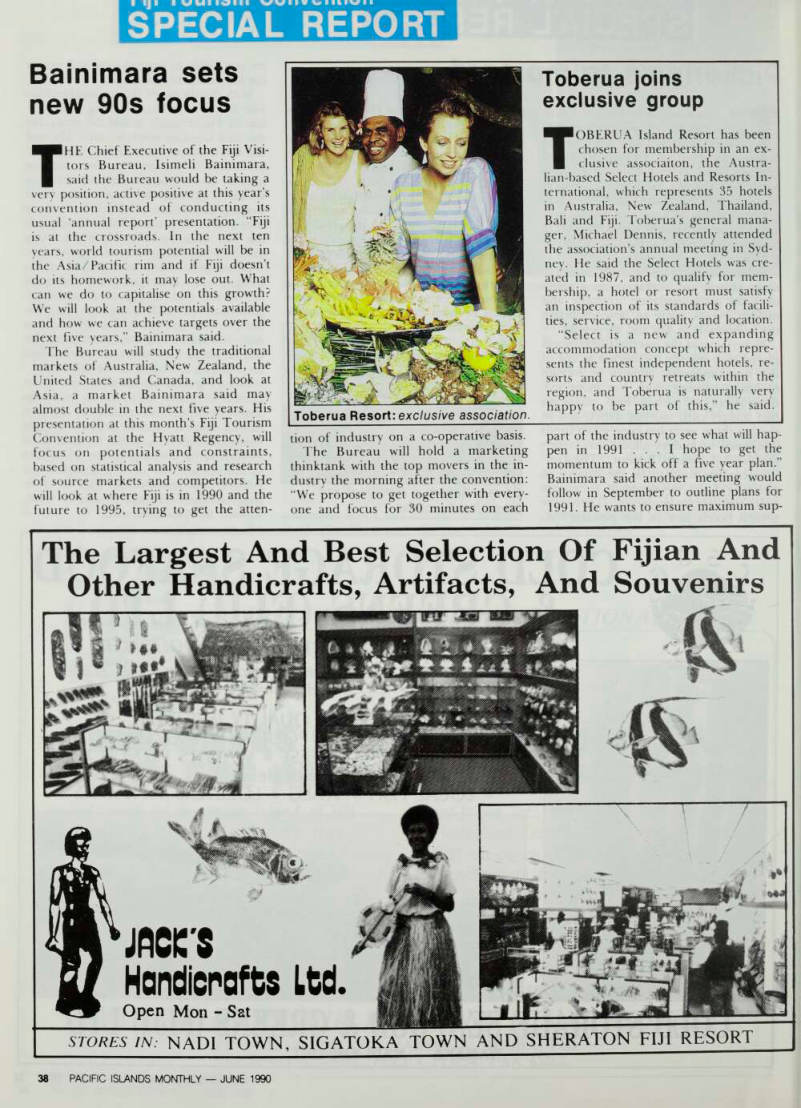
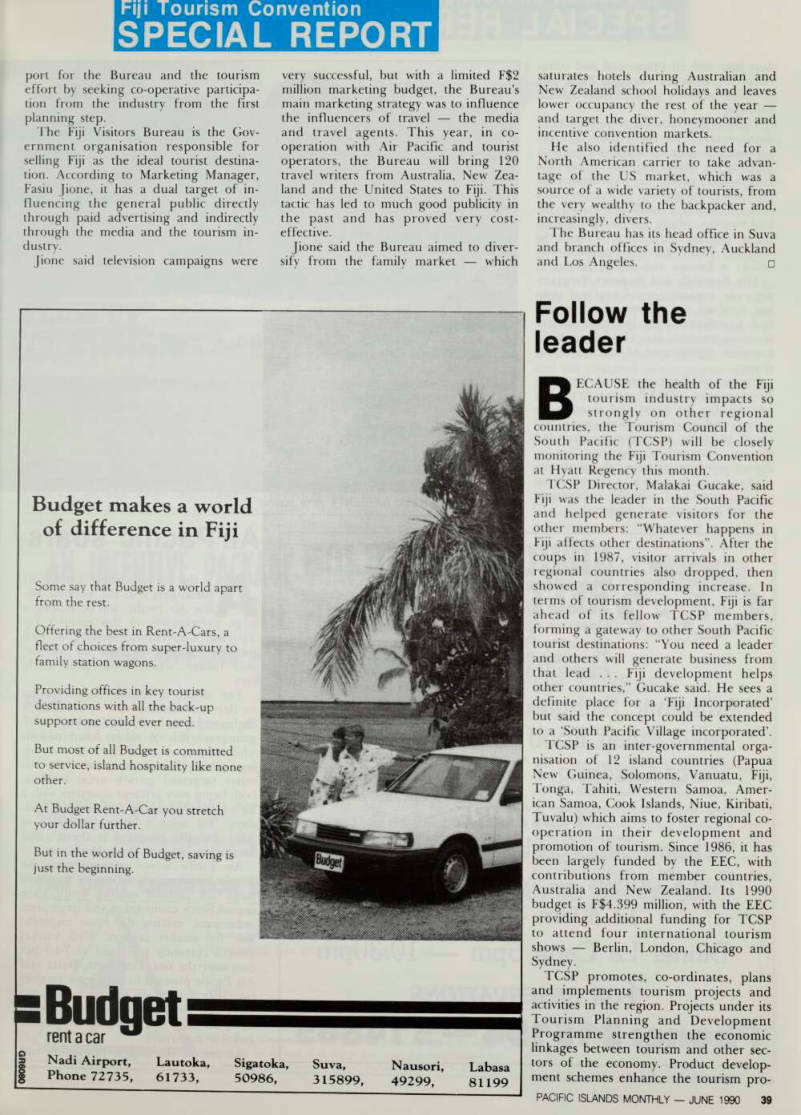
new 90s focus
THE Chief Executive of the Fiji Visi tors Bureau, Isimeli Bainimara, said the Bureau would be taking a very position, active positive at this year’s convention instead of conducting its
usual ‘annual report’ presentation. “Fiji
is at the crossroads. In the next ten years, world tourism potential will be in the Asia/Pacific rim and if Fiji doesn’t do its homework, it may lose out. What can we do to capitalise on this growth?
We will look at the potentials available and how we can achieve targets over the next five years,” Bainimara said.
The Bureau will study the traditional markets of Australia, New Zealand, the United States and Canada, and look at Asia, a market Bainimara said may almost double in the next five years. His presentation at this month’s Fiji Tourism Convention at the Hyatt Regency, will focus on potentials and constraints, based on statistical analysis and research of source markets and competitors. He will look at where Fiji is in 1990 and the future to 1995, trying to get the atten
tion of industry on a co-operative basis.
The Bureau will hold a marketing thinktank with the top movers in the in dustry the morning after the convention: “We propose to get together with every one and focus for 30 minutes on each
part of the industry to see what will hap pen in 1991 ... I hope to get the momentum to kick off a five year plan.”
Bainimara said another meeting would follow in September to outline plans for 1991. He wants to ensure maximum sup
port for the Bureau and the tourism effort by seeking co-operative participation from the industry from the first planning step.
The Fiji Visitors Bureau is the Government organisation responsible for selling Fiji as the ideal tourist destination. According to Marketing Manager, Fasiu Jione, it has a dual target of influencing the general public directly through paid advertising and indirectly through the media and the tourism industry.
Jione said television campaigns were
very successful, but with a limited Fs2 million marketing budget, the Bureau’s main marketing strategy was to influence the influencers of travel the media and travel agents. This year, in co operation with Air Pacific and tourist operators, the Bureau will bring 120 travel writers from Australia, New Zea land and the United States to Fiji. This tactic has led to much good publicity in the past and has proved very cost effective.
Jione said the Bureau aimed to diver sify from the family market which
saturates hotels during Australian and New Zealand school holidays and leaves lower occupancy the rest of the year and target the diver, honeymooner and incentive convention markets.
He also identified the need for a North American carrier to take advan tage of the US market, which was a source of a wide variety of tourists, from the very wealthy to the backpacker and,
increasingly, divers.
The Bureau has its head office in Suva and branch offices in Sydney, Auckland and Los Angeles. □
Toberua joins
exclusive group
TOBERUA Island Resort has been chosen for membership in an ex clusive associaiton, the Austra lian-based Select Hotels and Resorts In ternational, which represents 35 hotels in Australia, New Zealand, Thailand, Bali and Fiji. Toberua’s general mana ger, Michael Dennis, recently attended the association’s annual meeting in Syd ney. He said the Select Hotels was cre ated in 1987, and to qualify for mem bership, a hotel or resort must satisfy an inspection of its standards of facili ties, service, room quality and location.
“Select is a new and expanding accommodation concept which repre sents the finest independent hotels, re sorts and country retreats within the region, and Toberua is naturally very happy to be part of this,” he said.
Toberua Resort: exclusive association.
Advertisements & other items, pp. 38-39 (2 items)
Special Report
II IJ I I VUII4MI V/VM V WllilVM
Jack's
The Largest And Best Selection Of Fijian And
Other Handicrafts, Artifacts, And Souvenirs
WW S * m ■ % I v 4 rntim %. H A_ t
JACK'S
Handicrafts Ltd
Open Mon - Sat STORES IN: NADI TOWN, SIGATOKA TOWN AND SHERATON FIJI RESORT
Budget makes a world
of difference in Fiji
Some say that Budget is a world apart from the rest.
Offering the best in Rent-A-Cars, a fleet of choices from super-luxury to family station wagons.
Providing offices in key tourist destinations with all the back-up support one could ever need.
But most of all Budget is committed to service, island hospitality like none other.
At Budget Rent-A-Car you stretch your dollar further.
But in the world of Budget, saving is just the beginning. ■
a Budget
rentacar w
Nadi Airport, Lautoka, Sigatoka, Suva, Nausori, Labasa Phone 72735, 61733, 50986, 315899, 49299, 81199
Follow the leader
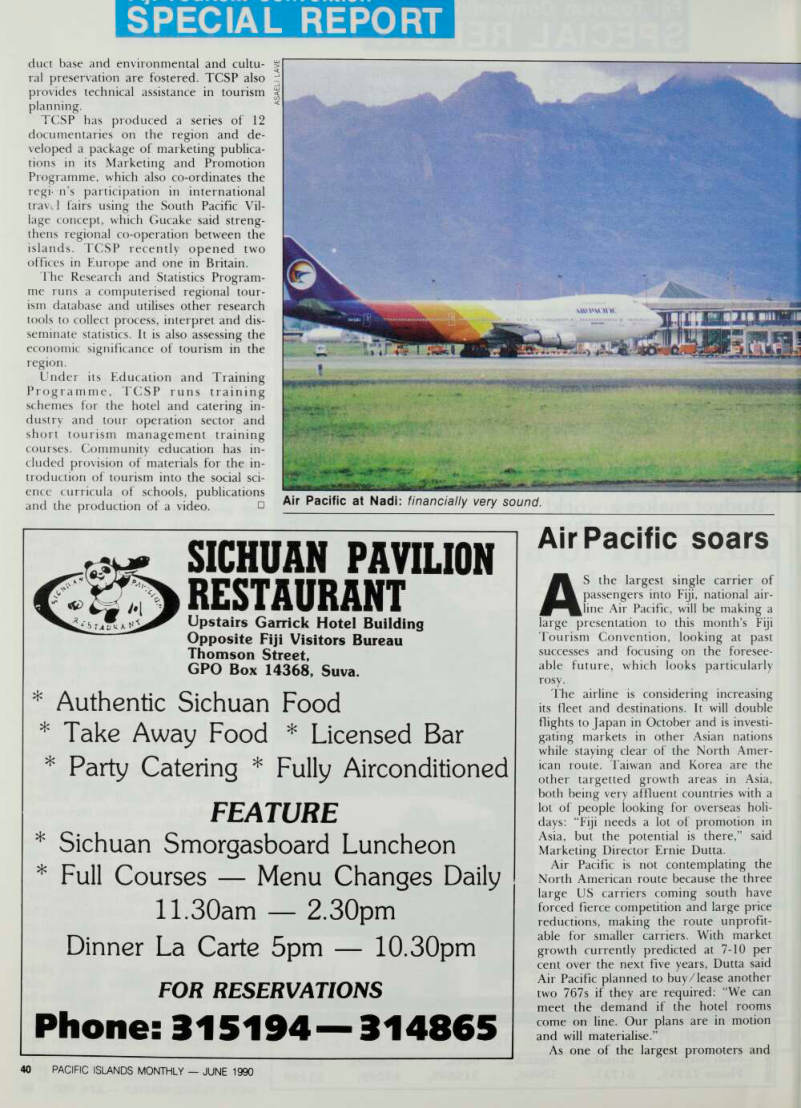
leader
BECAUSE the health of the Fiji tourism industry impacts so strongly on other regional countries, the Tourism Council of the South Pacific (TCSP) will be closely monitoring the Fiji Tourism Convention at Hyatt Regency this month.
TCSP Director, Malakai Gucake, said Fiji was the leader in the South Pacific and helped generate visitors for the other members: “Whatever happens in Fiji affects other destinations”. After the coups in 1987, visitor arrivals in other regional countries also dropped, then showed a corresponding increase. In terms of tourism development, Fiji is far ahead of its fellow TCSP members, forming a gateway to other South Pacific tourist destinations: “You need a leader and others will generate business from that lead . . . Fiji development helps other countries,” Gucake said. He sees a definite place for a ‘Fiji Incorporated’ but said the concept could be extended to a ‘South Pacific Village incorporated’.
TCSP is an inter-governmental orga nisation of 12 island countries (Papua New Guinea, Solomons, Vanuatu, Fiji, Tonga, Tahiti, Western Samoa, Amer ican Samoa, Cook Islands, Niue, Kiribati, Tuvalu) which aims to foster regional co operation in their development and promotion of tourism. Since 1986, it has been largely funded by the EEC, with contributions from member countries, Australia and New Zealand. Its 1990 budget is F 54.399 million, with the EEC providing additional funding for TCSP to attend four international tourism shows Berlin, London, Chicago and Sydney.
TCSP promotes, co-ordinates, plans and implements tourism projects and activities in the region. Projects under its
Tourism Planning and Development
Programme strengthen the economic linkages between tourism and other sec tors of the economy. Product develop ment schemes enhance the tourism pro
duct base and environmental and cultu ral preservation are fostered. TCSP also provides technical assistance in tourism
planning.
TCSP has produced a series of 12 documentaries on the region and de
veloped a package of marketing publica
tions in its Marketing and Promotion Programme, which also co-ordinates the regr n’s participation in international travel fairs using the South Pacific Vil lage concept, which Gucake said streng thens regional co-operation between the islands. TCSP recently opened two offices in Europe and one in Britain.
The Research and Statistics Program me runs a computerised regional tour ism database and utilises other research tools to collect process, interpret and dis seminate statistics. It is also assessing the economic significance of tourism in the region.
Under its Education and Training Programme, TCSP runs training schemes for the hotel and catering in dustry and tour operation sector and short tourism management training courses. Community education has in cluded provision of materials for the in troduction of tourism into the social sci ence curricula of schools, publications and the production of a video. □
Asaeli Lave
Air Pacific at Nadi: financially very sound.
Advertisements & other items, p. 39 (1 item)
Special Report
39
Fiji Tourism Convention
PACIFIC ISLANDS MONTHLY JUNE 1990
Air Pacific soars
AS the largest single carrier of
passengers into Fiji, national air line Air Pacific, will be making a large presentation to this month’s Fiji Tourism Convention, looking at past successes and focusing on the foresee able future, which looks particularly rosy.
The airline is considering increasing its fleet and destinations. It will double flights to Japan in October and is investi gating markets in other Asian nations while staying clear of the North Amer ican route. Taiwan and Korea are the other targetted growth areas in Asia, both being very affluent countries with a lot of people looking for overseas holi days: “Fiji needs a lot of promotion in Asia, but the potential is there,” said Marketing Director Ernie Dutta.
Air Pacific is not contemplating the North American route because the three large US carriers coming south have
forced fierce competition and large price
reductions, making the route unprofit able for smaller carriers. With market
growth currently predicted at 7-10 per
cent over the next five years, Dutta said Air Pacific planned to buy/lease another two 767 s if they are required: “We can meet the demand if the hotel rooms come on line. Our plans are in motion and will materialise.”
As one of the largest promoters and
advertisers of Fiji as a destination, Dutta said Air Pacific was fully supportive of the concept of ‘Fiji Incorporated’: “It’s an excellent idea and happened after the coup for a time when a lot of people pooled their resources, put aside their own interests and did things together which ended up with today’s success. We want to pick the eyes out of this con cept.”
Air Pacific is financially very sound, with a record 1988/89 financial year operating profit of over Fs9 million. In the 12 months to April 1990, passenger numbers increased by 16.1 per cent over the previous year to 344,400. Its fleet includes a 747 on lease from Qantas, two ATR-42s which travel the immediate Pacific and a 737, which will be sold when a 767 comes on stream shortly.
The 767 will do the shuttle run to New Zealand and open a big market in south ern Australia.
From July, Air Pacific will increase its capacity from Sydney by 22 per cent to 1830 seats. The larger 767 aircraft and extra flights will almost double present seat capacity out of Melbourne to 624 and seats from Brisbane will increase from 270 to 624. From New Zealand, there will be a 10 per cent increase to 832 seats. D
Advertisements & other items, p. 40 (1 item)
Restaurant
SICHUAN PAVILION
Upstairs Garrick Hotel Building Opposite Fiji Visitors Bureau Thomson Street, GPO Box 14368, Suva. * Authentic Sichuan Food * Take Away Food * Licensed Bar * Party Catering * Fully Airconditioned * Sichuan Smorgasboard Luncheon * Full Courses Menu Changes Daily 11.30 am —2.30 pm Dinner La Carte spm —10.30 pm
FOR RESERVATIONS
Phone: 315194—314865
FEATURE
The Taiwan Connection
AIR New Zealand is hoping to in troduce a flight from Taiwan through Fiji to New Zealand within the next 12 months, making two weekly flights from the Asian tourism growth area through Nadi. Route Mana ger for Orient and Short-haul Pacific, Bob Wallace, said bi-lateral negotiations were still underway, but plans for a 767 service were promising. The airline will also extend another of its four Auck
land/Nadi/Hawaii flights through to
Los Angeles around July and possibly add another flight into Fiji.
“The increase is an indication of the importance of Nadi’s position in the Pacific and recognises Fiji’s tourist attrac tion. We see the South Pacific as an overall destination, and while we strong ly boost New Zealand, we also sell the area because when people come this far, many want to see more than one destina tion,” Wallace said. “We believe that this sort of development is vital to general tourism in the South Pacific.”
Air New Zealand currently has eight services through Nadi to the United States West Coast, one to Japan, two ter minators in Nadi and still runs the
famed “Coral Route” established in the days of flying boats. Fiji Manager, Rob Fullerton, said Fiji and New Zealand had very similar markets for the tourism pro duct and Fiji was important as both a transit point and destination. He said the Tourism Convention was important to establish where Fiji fitted into the inter national scene, which is integral to the airline’s promotion activities through its offices world wide.
Air New Zealand has just celebrated its 50th anniversary in the Pacific. Its fore runner, TEAL (Tasman Empire Airways Limited) began flying in 1940. New Zea land’s post-war Government policy dic tated that there be an air link with Fiji and the country’s tourist appeal made it a commercial success. The famous flying boat ‘Coral Route’ from Auckland to Papeete via Suva and Aitutaki in the Cook Islands both maintained regular communication links and created a uni que tourist experience.
The airline now has 220 flights be tween 46 airports in 16 countries and is
looking at another period of expansion
which will double the size of its fleet. It will be investing in extended range 7675,
Advertisements & other items, p. 41 (2 items)
Special Report
41
■ Fiji Tourism Convention
PACIFIC ISLANDS MONTHLY JUNE 1990
An Incentive Package That Takes You To The Next Century;
THE FIJI TAX FREE ZONE
FIJI OFFERS •
Plus
* No withholding tax on interest, dividend and royalty for 13 years.
Freedom to repatriate profits and capital. * Freedom to import specialist personnel.
Banking and financial services of international standard.
TAX HOLIDAY FOR 13 YEARS
IMPORT DUTY WAIVER FOR 13 YEARS
Plus Plus
Market access for your products to * An educated, English-speakin U 0.A., Canada, Japan, E.E.C. Countries, Australia and New Zealand either duty-free or at substantially reduced duties under perferential trade agreements Fiji has with these countries. ig, easily fc trainable and cheaper labour force.
Minimum red tape and the services of one-stop government agency (F.T.1.8.) to cut out bureaucratic red tape.
A consistent government economic policy favouring private enterprise and foreign investment. * Reliable and well-developed infrastructure including good international air THE OMLY COMDmON IS THAT 9SS OF YOUR OUTPUT BE FOR EXPORT For more information, fill in the coupon below and sent to: The Director, Fiji Trade and Investment Board, • P.O. Box 2303, Government Buildings, Suva, FIJI.
Phone: 315988, Telex: 2355 FJ, Fax: 301783, Suva, FIJI
FI I B
We cut out the red tape at no cost to you Company: Address: Phone: Telex Fiji Trade & Investment Board, Government’s one-stop agency for investors. and feel proud about it too!
Fax
Love story island style

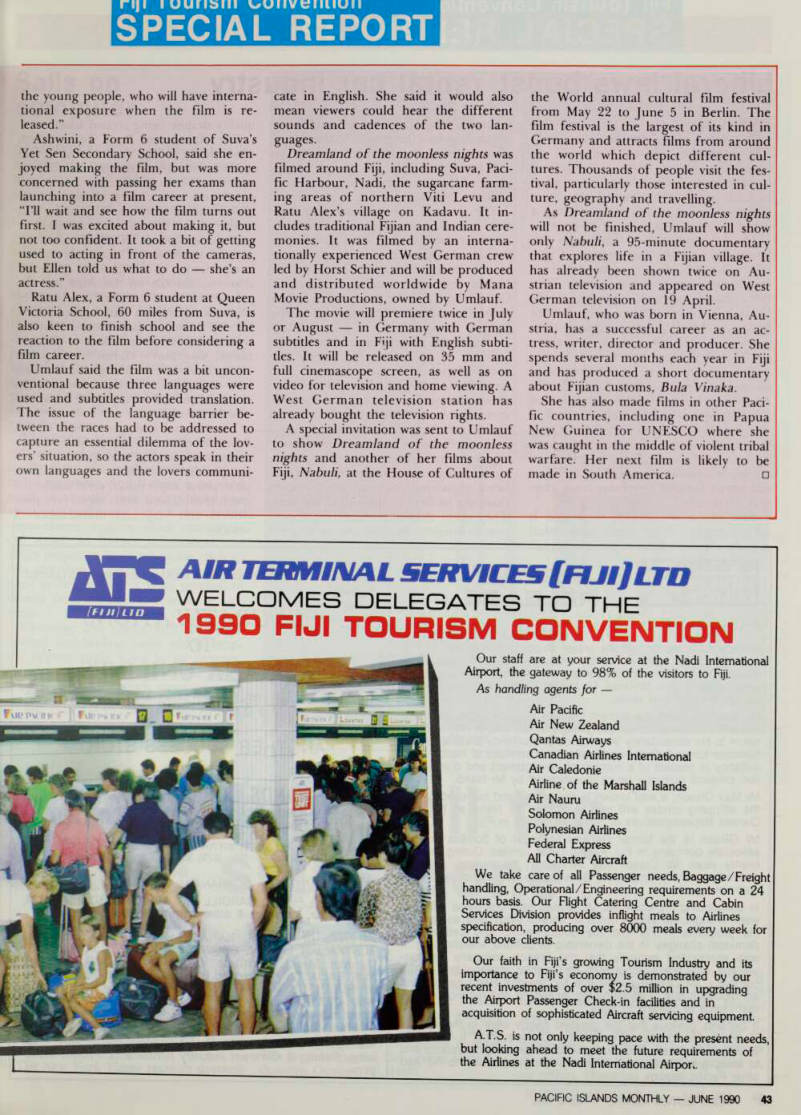
FIJI’S first full-length feature film will be a classic love story based on the traditions and culture of the country’s two major races, and the dilemma young people face when mod ern and traditional values conflict. Film ing of the F 5600,000 Dreamland on the moonless nights finished in April and will be produced in Germany for worl dwide distribution by Mana Movie Pro ductions in July or August.
The film’s Austrian writer, director and producer, Ellen Umlauf, said the film was based on the relationship be tween a Fijian boy and an Indian girl who wish to get married but face family objections and vast cultural differences.
The heroine, played by student Ashwi ni Singh, of Suva, is trapped between living in a modern society with modern expectations and obeying her traditional Indian father who wishes her to marry a man of his choice. Ratu Alex Soqosoqo, from Kadavu Island, plays her lover, who has to reconcile strong ties to his family and Melanesian heritage with breaking tradition to marry an Indian.
Ashwini said the film showed that peo ple should not hold customs and tradi tions against a person and portrayed the good and bad aspects of both cultures, which led to some tragic scenes as well as
happy ones.
While Dreamland of the moonless
nights looks at Indian and Fijian culture, the theme is an international one where two people of different backgrounds fall in love. It explores emotions and morals that are felt by people of all races, and concentrates on the dilemmas young people face when living in a modern society conflicts with traditional values.
UNESCO and the Better World Associa tion, which is based in New York, have both supported the film for its cultural
depictions.
The actors are local with no previous
acting experience but according to Uma
luf, bring a natural freshness, talent and enthusiasm to the screen: “It may be the beginning of successful acting careers for
Asaeli Lave
Ashwini Singh: Dreamland on the moonless nights
the young people, who will have interna tional exposure when the film is re leased.”
Ashwini, a Form 6 student of Suva’s Yet Sen Secondary School, said she en joyed making the film, but was more concerned with passing her exams than launching into a film career at present, “I’ll wait and see how the film turns out first. I was excited about making it, but not too confident. It took a bit of getting used to acting in front of the cameras, but Ellen told us what to do she’s an actress.”
Ratu Alex, a Form 6 student at Queen Victoria School, 60 miles from Suva, is also keen to finish school and see the reaction to the film before considering a film career.
Umlauf said the film was a bit uncon ventional because three languages were used and subtitles provided translation.
The issue of the language barrier be tween the races had to be addressed to capture an essential dilemma of the lov ers’ situation, so the actors speak in their own languages and the lovers communi
cate in English. She said it would also mean viewers could hear the different sounds and cadences of the two lan guages.
Dreamland of the moonless nights was filmed around Fiji, including Suva, Paci fic Harbour, Nadi, the sugarcane farm ing areas of northern Viti Levu and Ratu Alex’s village on Kadavu. It in cludes traditional Fijian and Indian cere monies. It was filmed by an interna tionally experienced West German crew led by Horst Schier and will be produced and distributed worldwide by Mana Movie Productions, owned by Umlauf.
The movie will premiere twice in July or August in Germany with German subtitles and in Fiji with English subti tles. It will be released on 35 mm and full cinemascope screen, as well as on video for television and home viewing. A West German television station has
already bought the television rights.
A special invitation was sent to Umlauf to show Dreamland of the moonless nights and another of her films about Fiji, Nabuli, at the House of Cultures of
the World annual cultural film festival from May 22 to June 5 in Berlin. The film festival is the largest of its kind in Germany and attracts films from around the world which depict different cul tures. Thousands of people visit the fes tival, particularly those interested in cul
ture, geography and travelling.
As Dreamland of the moonless nights will not be finished, Umlauf will show only Nabuli, a 95-minute documentary that explores life in a Fijian village. It has already been shown twice on Au strian television and appeared on West German television on 19 April.
Umlauf, who was born in Vienna, Au stria, has a successful career as an ac tress, writer, director and producer. She spends several months each year in Fiji and has produced a short documentary about Fijian customs, Bula Vinaka.
She has also made films in other Paci fic countries, including one in Papua New Guinea for UNESCO where she was caught in the middle of violent tribal warfare. Her next film is likely to be made in South America. □
Advertisements & other items, pp. 42-43 (2 items)
Fiji Tourism Convention
SPECIAL REPORT
1990 Fiji Tourism Convention
AIR TERMINAL SERVICES [FIJIJ LTD
WELCOMES DELEGATES TO THE
a s rr— 3. * r ¥ A rfLJ Our staff are at your service at the Nadi International Airport, the gateway to 98% of the visitors to Fiji.
As handling agents for Air Pacific Air New Zealand Qantas Airways Canadian Airlines International Air Caledonie Airline of the Marshall Islands Air Nauru Solomon Airlines Polynesian Airlines Federal Express All Charter Aircraft We take care of all Passenger needs, Baggage/Freight handling, Operational /Engineering requirements on a 24 hours basis. Our Right Catering Centre and Cabin Services Division provides inflight meals to Airlines specification, producing over 8000 meals every week for our above clients.
Our faith in Fiji’s growing Tourism Industry and its importance to Fiji’s economy is demonstrated by our recent investments of over $2.5 million in upgrading the Airport Passenger Check-in facilities and in acquisition of sophisticated Aircraft servicing equipment.
A.T.S. is not only keeping pace with the present needs, but looking ahead to meet the future requirements of the Airlines at the Nadi International Airpor..
Liberal laws boost rental car industry

THF rental car industry has bal looned in the past few years, with a plethora of local companies en tering the market. From a handful of companies, including three major inter national rental car organisations, there are now over 15 companies offering a range of vehicles at a range of prices.
The increase in local companies fol lowed Government liberalisation of per mits which brought second-hand and re conditioned cars onto the market. They fill a market niche by catering to the “walk-in” tourist with a very limited budget, and have generated intense com petition which benefits the travelling
public with cheaper prices.
The international and larger local companies which run new cars, with sub sequent higher costs, have also recorded a steady increase in custom, including the established market from pre bookings, where tourists know the com panies and their standards, a factor local companies cannot compete with. These companies are also benefiting from over
seas marketing.
The range of vehicles requested is wide-ranging, from small economical
sedans to large family and luxury cars.
By tapping into the growth in the leisure market, there has been an upsurge in 4x4 softtops which give people some thing different and exciting to drive while on holiday.
The demand for corporate car hire for both short and long-term lease has also increased, as has local demand, a factor of cheaper prices and more money in the economy. The owner of one of Fiji’s first rental car companies, Gulab Khan, said the industry has shown as much as 30 per cent increase in the last two years* One of the major issues affecting the industry at present is the use of the second-hand and reconditioned cars from Japan. As part of its policy to im prove the quality of cars, the Govern ment announced earlier this year that all future rental cars must be new.
However, there seems to be conflicting advice from industry, with some oper ators saying reconditioned cars are still being registered; one company intends doubling its fleet by the end of the year.
They claim that with industry competi
tion so intense, the cars have to be good
quality despite being second hand.
The Manager of Rosie Tours, which runs Thrifty in Fiji, Vivek Mudaliar, said quality control was not just a factor of new cars, but monitoring their road worthiness more closely. He said the in dustry should continue to grow as long as the quality of cars was maintained.
A major concern of all operators are traffic hazards on the roads, particularly
road humps in villages and potholes,
domestic animals on the road and the amount of loose stone left on roads by workers. Although the hazards have been discussed at past tourism conven tions and resolutions taken to Govern ment, operators claim nothing has changed and, if anything, the situation has worsened. Thrifty now advises clients about the hazards and warns not to drive at night.
The General Manager of Avis in Fiji, Bryan Watson, said the number of acci dents was worrying, with policing a ma jor problem. Accidents resulted from poor police supervision, poor roads, too much traffic, poor street signs, very poor drivers and very bad maintenance of vehicles. 1 Q
Advertisements & other items, p. 44 (2 items)
Special Report
44
nji luuribm convention
PACIFIC ISLANDS MONTHLY JUNE 1990
Congratulations
rr Li Monday, May 14 Sofrana Unilines, one of the major shipping companies in Fiji, announced changes in its top management and operational strategy in Fiji. This announcement was made by the Managing Director of Sofrana Unilines, Mr Michel Laveau who has been in Fiji for the past one week.
Mr Shardha Nand the current Owners Representative in Fiji is expected to complete his assignment by the end of May and will return to his consultancy firm, Nands Consultancy & Management Services Limited. Sofrana will retain the services of Nands Consultancy in respect of a number of development and diversification projects currently being investigated by Mr Nand.
Mr Max Olsson, a well known businessman and top executive in the shipping circles will take over from Mr Nand as the next Owners Representatives of Sofrana Unilines in Fiji.
Mr Olsson is the former General Manager of Sofrana and its associate company in Fiji, Pacific Lines Limites. During the last twenty years Mr Olsson has served on the various shipping committees of Fiji Employers Consultative Association and Government agencies.
In announcing the changes, Mr Laveau said that these changes were brought out after* months of careful study and analysis of the problems in Fiji and the South Pacific and certain fundamental changes in the ownership of Sofrana shareholding. It was announced recently that the French company Delmasvieljeux now holds about 80% of the total shareholding in the company. Mr Laveau added that Mr Shardha Nand had played an important role in investigating, analysing and highlighting the real needs of Sofrana in Fiji.
It became obvious that the greatest needs were in the area of marketing and shipping operations. Consequently, it had been decided to intensify and strengthen the marketing operations and to bring greater cohesion in the shipping schedules to Fiji and other Pacific Islands.
NANDS CONSULTANCY & MANAGEMENT SERVICES LIMITED
CONGRATULATIONS
TO
SOFRANA UNILINES
ON ITS PROPOSED RE-STRUCTURING AND STRENGTHENING
OF MARKETING AND SHIPPING OPERATIONS IN FIJI AND THE
PACIFIC.
ANOTHER SUCCESS STORY
FROM
NANDS CONSULTANCY &
MANAGEMENT SERVICES LIMITED
PO BOX 1360, SUVA, FIJI.
TEL; (679) 301704 FAX: (679) 300061
(After 28 May TEL: (679) 351004 FAX: (679) 351161)
CONSULTANTS TO : SOFRANA UNILINES
AGENTS in Fiji of : CARGILL INC. MINEAPOLIS, MINESOTA, USA. Sugar, molasses & other commodity traders.
AGENTS in Fiji of : KARABELLA PTY LTD trading as AUSTRALIAN LAND & BUSINESS ADVISERS, 3rd Level, 31 Duncan Street, Fortitude Valley, Brisbane, Queensland, AUSTRALIA. Duly accredited Business Migration Agent, holder
of BUSINESS MIGRATION PROGRAMME LICENCE NO.
BMA-077 issued by the Commonwealth of Australia, Department of Immigratin, Local Government and Ethnic Affairs.
Management, marketing, project & financial consultants. Shipping, Fishing & Garment industry consultants. Project managers.
Shipping
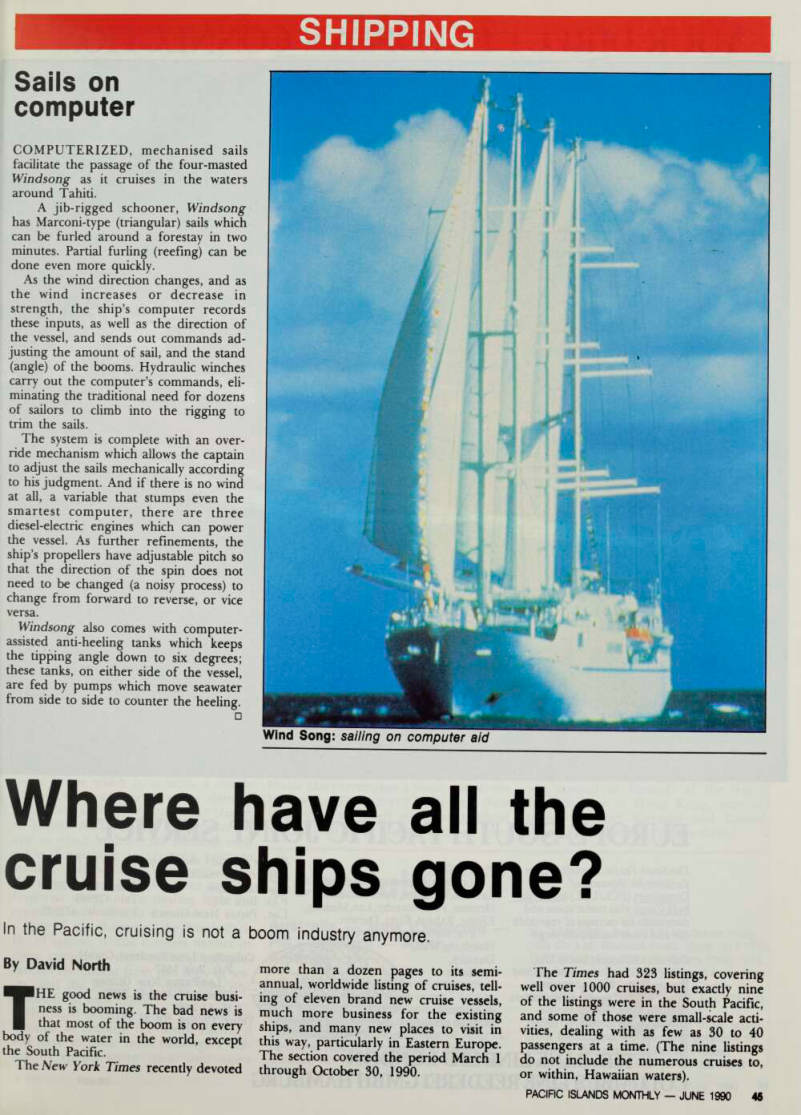
Sails on computer
COMPUTERIZED, mechanised sails facilitate the passage of the four-masted Windsong as it cruises in the waters around Tahiti.
A jib-rigged schooner, Windsong
has Marconi-type (triangular) sails which can be furled around a forestay in two minutes. Partial furling (reefing) can be done even more quickly.
As the wind direction changes, and as the wind increases or decrease in strength, the ship’s computer records these inputs, as well as the direction of the vessel, and sends out commands ad justing the amount of sail, and the stand (angle) of the booms. Hydraulic winches carry out the computer’s commands, eli minating the traditional need for dozens of sailors to climb into the rigging to trim the sails.
The system is complete with an over ride mechanism which allows the captain to adjust the sails mechanically according to his judgment. And if there is no wind at all, a variable that stumps even the smartest computer, there are three diesel-electric engines which can power the vessel. As further refinements, the
ship’s propellers have adjustable pitch so
that the direction of the spin does not need to be changed (a noisy process) to change from forward to reverse, or vice versa.
Windsong also comes with computer assisted anti-heeling tanks which keeps the tipping angle down to six degrees; these tanks, on either side of the vessel, are fed by pumps which move seawater from side to side to counter the heeling.
Wind Song: sailing on computer aid
cruise ships gone?
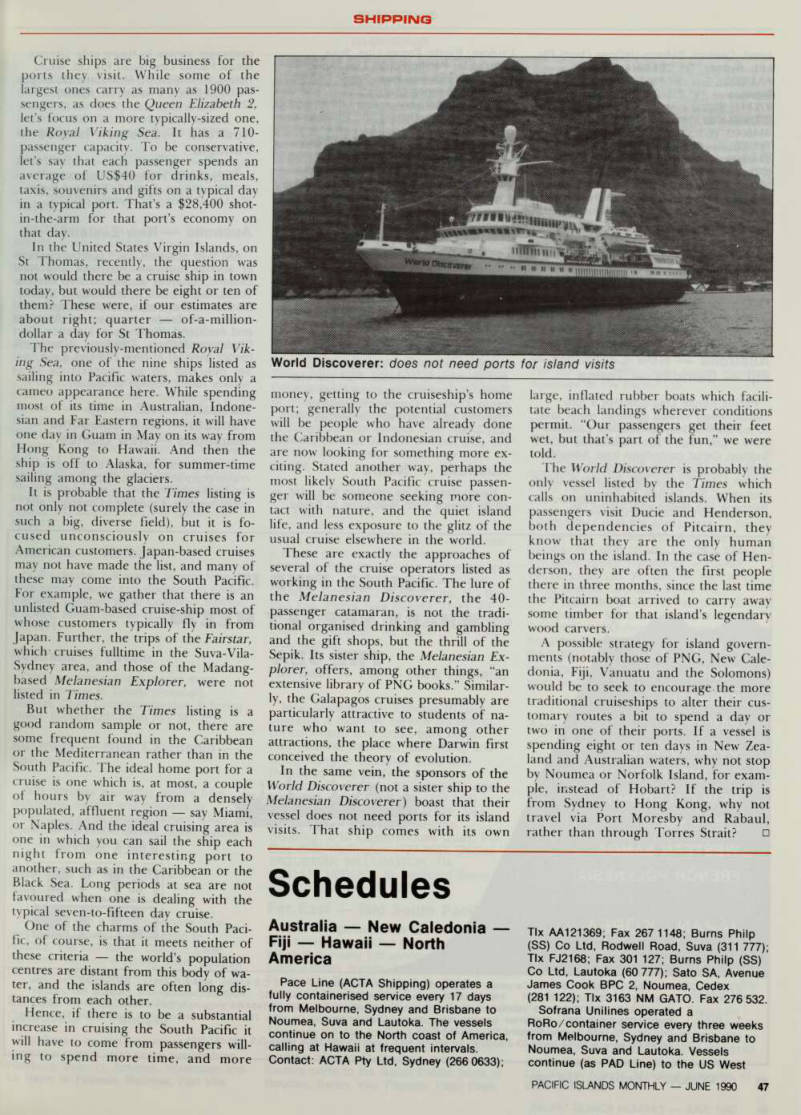
Where have all the cruise ships gone?
In the Pacific, cruising is not a boom industry anymore.
By David North
THE good news is the cruise busi ness is booming. The bad news is that most of the boom is on every body of the water in the world, except the South Pacific.
The New York Times recently devoted
more than a dozen pages to its semi annual, worldwide listing of cruises, tell ing of eleven brand new cruise vessels, much more business for the existing ships, and many new places to visit in this way, particularly in Eastern Europe, The section covered the period March 1 through October 30, 1990.
The Times had 323 listings, covering well over 1000 cruises, but exactly nine of the listings were in the South Pacific, and some of those were small-scale acti vities, dealing with as few as 30 to 40 passengers at a time. (The nine listings do not include the numerous cruises to, or within, Hawaiian waters).
Cruise ships are big business for the ports they visit. While some of the largest ones carry as many as 1900 pas sengers, as does the Queen Elizabeth 2, let’s focus on a more typically-sized one, the Royal Viking Sea. It has a 710passenger capacity. To be conservative, let’s say that each passenger spends an average of US$4O for drinks, meals, taxis, souvenirs and gifts on a typical day in a typical port. That’s a $28,400 shot in-the-arm for that port’s economy on that day.
In the United States Virgin Islands, on St Thomas, recently, the question was not would there be a cruise ship in town today, but would there be eight or ten of them? These were, if our estimates are about right; quarter of-a-million dollar a day for St Thomas.
The previously-mentioned Royal Vik ing Sea, one of the nine ships listed as sailing into Pacific waters, makes only a cameo appearance here. While spending most of its time in Australian, Indone sian and Far Eastern regions, it will have one day in Guam in May on its way from Hong Kong to Hawaii. And then the ship is off to Alaska, for summer-time
sailing among the glaciers.
It is probable that the Times listing is not only not complete (surely the case in such a big, diverse field), but it is fo cused unconsciously on cruises for American customers. Japan-based cruises may not have made the list, and many of these may come into the South Pacific.
For example, we gather that there is an unlisted Guam-based cruise-ship most of whose customers typically fly in from Japan. Further, the trips of the Fairstar, which cruises fulltime in the Suva-Vila- Sydney area, and those of the Madang based Melanesian Explorer, were not listed in Times.
But whether the Times listing is a good random sample or not, there are some frequent found in the Caribbean or the Mediterranean rather than in the South Pacific. The ideal home port for a cruise is one which is, at most, a couple of hours by air way from a densely populated, affluent region say Miami, or Naples. And the ideal cruising area is one in which you can sail the ship each night from one interesting port to another, such as in the Caribbean or the Black Sea. Long periods at sea are not favoured when one is dealing with the typical seven-to-fifteen day cruise.
One of the charms of the South Paci fic, of course, is that it meets neither of these criteria the world’s population centres are distant from this body of wa ter, and the islands are often long dis tances from each other.
Hence, if there is to be a substantial increase in cruising the South Pacific it will have to come from passengers will ing to spend more time, and more
money, getting to the cruiseship’s home port; generally the potential customers will be people who have already done the Caribbean or Indonesian cruise, and are now looking for something more exciting. Stated another way, perhaps the most likely South Pacific cruise passenger will be someone seeking more contact with nature, and the quiet island life, and less exposure to the glitz of the usual cruise elsewhere in the world.
These are exactly the approaches of several of the cruise operators listed as working in the South Pacific. The lure of the Melanesian Discoverer, the 40passenger catamaran, is not the traditional organised drinking and gambling and the gift shops, but the thrill of the Sepik. Its sister ship, the Melanesian Explorer, offers, among other things, “an extensive library of PNG books.” Similar-
ly, the Galapagos cruises presumably are
particularly attractive to students of nature who want to see, among other attractions, the place where Darwin first conceived the theory of evolution.
In the same vein, the sponsors of the World Discoverer (not a sister ship to the Melanesian Discoverer) boast that their vessel does not need ports for its island visits. That ship comes with its own
large, inflated rubber boats which facili tate beach landings wherever conditions permit. “Our passengers get their feet wet, but that’s part of the fun,” we were told.
The World Discoverer is probably the only vessel listed by the Times which calls on uninhabited islands. When its passengers visit Ducie and Henderson, both dependencies of Pitcairn, they know that they are the only human beings on the island. In the case of Hen derson, they are often the first people there in three months, since the last time the Pitcairn boat arrived to carry away some timber for that island’s legendary wood carvers.
A possible strategy for island govern ments (notably those of PNG, New Cale donia, Fiji, Vanuatu and the Solomons) would be to seek to encourage the more traditional cruiseships to alter their cus tomary routes a bit to spend a day or two in one of their ports. If a vessel is spending eight or ten days in New Zea land and Australian waters, why not stop by Noumea or Norfolk Island, for exam ple, instead of Hobart? If the trip is from Sydney to Hong Kong, why not travel via Port Moresby and Rabaul, rather than through Torres Strait? □
World Discoverer: does not need ports for island visits
Advertisements & other items, p. 46 (1 item)
Your Direct European Connection
. •u* f K tism *•-
EUROPE-SOUTH PACIFIC JOINT SERVICE
The South Pacific Specialists offer facilities for shipment of: Containers (FCL/LCL) and Breakbulk Cargo plus reefer space and deeptanks for carriage of vegetable oils and other liquid bulk cargo.
Carriers also accept heavy lifts, overlength and cumberj some parcels.
Ports of Service: Loading: Papeete, Apia, Suva, Lautoka, Noumea, Port Vila, Santo, Honiara, Port Moresby, Lae,Madang, Kimbe, Rabaul, Kieta, Darwin.
For: Rotterdam, Antwerp, Hamburg, Hull, Dunkirk, U Havre.
- ROUND THE WORLD SERVICE -
Please contact our regional offices for further information: The Bank Line, Telex: NE44265 P.O. Box 952, Tel: 422988 Lae. Papua New Guinea Facsimile: 422925 s-rr-v Columbus Line Reederei GmbH \\\ P.O. Box 1667 Additional ports on enquiry.
Lae/Papua New Guinea Phone: 42 3466/42 3287 A.H. 42 2481 Telex: Colline NE 44 171
THE BANK LINE LTD LONDON
COLUMBUS LINE REEDEREI GMBH HAMBURG
COL0024
Schedules
Australia New Caledonia FIJI Hawaii North America Pace Line (ACTA Shipping) operates a fully containerised service every 17 days from Melbourne, Sydney and Brisbane to Noumea, Suva and Lautoka. The vessels continue on to the North coast of America, calling at Hawaii at frequent intervals.
Contact: ACTA Pty Ltd, Sydney (266 0633);
Tlx AA121369; Fax 267 1148; Burns Philp (SS) Co Ltd, Rodwell Road, Suva (311 777); Tlx FJ2168; Fax 301 127; Burns Philp (SS) Co Ltd, Lautoka (60 777); Sato SA, Avenue James Cook BPC 2, Noumea, Cedex (281 122); Tlx 3163 NM GATO. Fax 276 532.
Sofrana Unilines operated a Roßo/container service every three weeks from Melbourne, Sydney and Brisbane to Noumea, Suva and Lautoka. Vessels continue (as PAD Line) to the US West
coast. Contact; Sofrana-Unilines (Aust) Pty Ltd., Sydney. Tel. 264 8944; Telex AA170090; Fax 267 6547. Sofrana Unilines, Noumea Tel 275191; Telex NM3048; Fax 272611. Wiltrans Agency, Melbourne Tel (03) 6144788; Telex AA30163; Fax (03) 6145909. Wiltrans Agency. Melbourne Tel (03) 6144788 Telex AA30163 Fax (03) 6145909. Wiltrans Agency, Brisbane Tel (07) 8541855 Telex AA40712 Fax (07) 2524953. Carpenters Shipping, Suva.
Tel 25141 Telex FJ2IBB Fax 301572.
Australia Samoas Tonga
Warner Pacific Lines operates a regular container service from Sydney, Brisbane and Melbourne to Nukualofa, Pago Pago, Apia and Vava’u with transhipment to Rarotonga. Contact; Hetherington Westfarmers Shipping Agency, 37-49 Pitt St. Sydney (223 1600).
Australia New Caledonia
Fiji Samoas Tonga
Pacific Forum Line operates a fully containerised service (general, reefer and ro-ro) from Sydney to Noumea, Lautoka, Suva, Apia, Pago Pago, Nukualofa, Sydney. Cargo centralised from Adelaide, Melbourne, Brisbane. Contact: Pacific Forum Line, PO Box 796, Auckland; Union Bulkships, 333 George St, Sydney, Brisbane and Melbourne; Union Co,
Lautoka; Pacific Forum Line, Suva, Nukualofa; Pacific Forum Line, Apia; Polynesia Shipping, Pago Pago.
Sofrana Unilines operated a Roßo/container service every three weeks from Melbourne, Sydney and Brisbane to Noumea, Suva and Lautoka with transhipment to the Samoas and Tonga.
For details see above.
Australia Norfolk Island
Lord Howe Island
Sofrana-Unilines (Australia) Pty Ltd operates a regular monthly service with MV Capitaine Wallis. Contact: Sofrana-Unilines, Sydney (02) 2648944; Telex AA170090 Fax 2676547.
Australia New Caledonia
Vanuatu Campagnie Generale Maritime operates a monthly service from Sydney, Melbourne and Brisbane to Noumea, Port Vila and Santo, for containerised and break-bulk cargo. Contact: Compagnie Generale Maritime 12 Castlereagh St, Sydney (231 3700).
Australia Nauru
Nauru Pacific Line operates a regular cargo service from Melbourne to Nauru,
passenger service to Nauru only. Contact: Nauru Pacific Line (Aust) Pty Ltd, Nauru House, 80 Collins St, Melbourne (653 5709), Nedlloyd Swire, 8 Spring St, Sydney, (20 522).
Australia Solomon Islands Vanuatu NGAL/PNGL joint service operates a monthly service. Contact: Nedlloyd Swire Pty Ltd, 6 Spring St, Sydney (20 522).
Australia New Zealand ANL Ltd operates the Tranztas contain er service between Australia and New Zealand, offering access to five vessels.
These vessels call at Melbourne, Sydney, Brisbane (Tasmania, Adelaide and Fre mantle via feeder services) in Australia and Auckland, Wellingtoin, Lyttelton, Port Chalmers, Nelson, Tauranga (Napier via feeder service) in New Zealand. Each ves sel operates on an approximate three weekly round voyage schedule.
Australia NZ Fiji Vanuatu New Caledonia Solomons New Guinea Sitmar Cruises operates a year-round cruise programme from Sydney to include the better-known ports in the above countries plus a number of unspoilt, and
largely unknown, island paradises. Contact: Sitmar Cruises, 39 Martin Place, Sydney (239 9000) for NSW; reservations and inquiries (008 42 2277); rest of Australia, reservations and enquiries (088 22 2277).
Australia NZ Fiji Tonga
Vanuatu New Caledonia Solomons Samoas Tahiti P&O Liners call at Auckland, Bay of Islands, Honiara, Lautoka, Noumea, Nuku’alofa, Pago Pago, Papeete, Port Moresby, Santo, Savusavu, Suva, Vava’u and Vila on cruises from Australia.
Contact: P&O Booking Centre, Thomas Cook Pty Ltd, 33 Bligh St, Sydney (237 0333).
Australia PNG Solomons Vanuatu A consortium of NGAL/PNG and CONPAC has four vessels operating a joint service from east coast Australian ports to Port Moresby, Lae, Alotau, Madang, Wewak, Rabaul, Kavieng-Kimbe, Kieta, Honiara, Vila, Santo. Contact: Burns Philp & Co Ltd, PO Box R 124, Royal Exchange, Sydney (20 547); Nedlloyd Swire, 8 Spring St, Sydney (20 522); New Guinea Express Lines, 37 Pitt St, Sydney (241 3991); Vila Agents, PO Box 27, Port Vila (2456), Tlx
Nhioii.
Australia Kiribati CCS operates a 6 weekly service from Melbourne, Sydney and Brisbane to Kiribati (Tarawa). Contact: Chief Container Service, 8 Spring Street, Sydney (251-2699) Fax 251-2271.
Australia Tuvalu CCS operates a direct service every second voyage to Tuvalu (Funafuti).
Contact; Chief Container Service, 8 Spring Street, Sydney (251-2699) Fax 251-2271.
Australia New Caledonia Vanuatu CCS operates a monthly service from Melbourne, Sydney and Brisbane to Noumea, Vila and Santo. Contact: Chief Container Service, 8 Spring Street, Sydnev (251-2699) Fax 251-2271.
Australia Solomons Vanuatu CCS operates a monthly service from Melbourne, Sydney and Brisbane to Honiara, Vila and Santo. Contact: Chief Container Service, 8 Spring Street, Sydnev (251-2699) Fax 251-2271.
Europe Tahiti New
Caledonia Vanuatu
The Bank Line and Columbus Line operate a regular joint cargo service from Hamburg, Bramen, Antwerp, Rotterdam and Le Havre to Papeete. Noumea, Port Vila
and Santo. Contact: The Bank Line, PO Box 952, Lae, Papua New Guinea. Telex: NE 44265, Tel; 421235, Fax: 422925; Columbus Line, Lae (423466). Tlx NE44171; Ets A.M. Fare UTE, Papeete: Ets Ballande, Noumea and other local agents.
Sofrana Europe Australia Line “Sofeal” operates a regular three-weekly service from North European ports including Felixstowe to Papeete from Noumea.
Contact: from McArthur Shipping Agency Co Pty Ltd., Tel (02) 5502222 Telex AA24045 Fax 5191382.
Europe PNG Solomons The Bank Line & Columbus Line operate a regular joint cargo service from Hamburg, Bramen, Antwerp, Rotterdam and Le Havre to Port Moresby, Lae, Madang, Kimbe, Rabaul, Kieta and Honiara and on inducement to Yandina. Contact: The Bank Line, PO Box 952, Lae, Papua New Guinea.
Telex: NE 44265, Tel: 421235, Fax: 422925; Columbus Line, Lae (423466), Tlx NE44171; or lines’ local agents.
Rarotonga Line operates regular services to Tonga and the Samoas from New Zealand. Contact Sofrana Unilines (NZ) Ltd.
Tel (09) 773279 Telex NZ2313 Fax (09) 393874.
Europe W. Samoa Tonga
Fiji
The Bank Line & Columbus Line operate a regular joint cargo service from Hamburg, Breman, Antwerp, Rotterdam and Le Havre to Apia, Nukualofa, Suva and Lautoka. Contact: The Bank Line, PO Box 952, Lae, Papua New Guinea. Telex: NE 44265, Tel; 421235, Fax: 422925; Columbus Line, Lae (423466), Tlx NE44171; or lines’ local agents.
Far East Fiji New Zealand New Zealand Unit Express (NZUE) operates a monthly service accepting containerised and break-bulk cargo from Manila, Keelung, Kaohsiung and Hong Kong to Lautoka, Suva and thence to New Zealand ports.
Contact: Carpenters Shipping, Private Mail Bag, GPO Suva, Fiji (312-244), Fax: (679) 301-572, Tlx FJ2199; New Zealand Unit Express, Maritime Building, 2-10 Customhouse Quay, PO Box 890, Wellington (727 865), Cables
Enzueman Wellington, Tlx
NZ31340 NEDLNZ, or Nedlloyd Swire Pty Ltd. Sydney (20 522).
Far East Mid South Pacific China Navigation’s New Guinea Pacific Line operates a regular container and Break Bulk-Heavy Lift service from Hong Kong, Taiwan, Manila, Singapore, Malaysia, Thailand to Port Moresby, Lae, Rabaul, Kieta and Honiara with 18 days frequency.
Wewak and Madang will receive four direct calls a year or more on inducement. A T/service via Lae to these and other PNG ports connecting with monthly sailings is available at cost. Cargo from the same Eastern ports to the South Pacific ports of Noumea, Santo, Vila, Papeete, Pago Pago,
Apia, Nukualofa, Rarotonga and Tarawa will be shipped via Japan or Busan on the monthly Bali Hai service. Contact Steamships Shipping, PO Box 634, Port Moresby (220 283 or 220 289).
Kyowa Shipping Ltd operates monthly services from Japan to Guam, Saipan, Solomons, New Caledonia, Fiji, Western and American Samoa, Tahiti, Cook Islands, Tonga and Vanuatu. Contact; Hetherington Wesfarmers Shipping Agency, 37-49 Pitt St Sydney (223 1600); Carpenters Shipping, Suva (312 244), Tlx FJ2199.
Guam Northern Marianas Saipan Shipping Co operates a weekly service via barge carrying containers and conventional cargo between Guam and Saipan and Tinian. Contact: Saipan Shipping Co. Inc, PO Box 8, Saipan CM 96950 (322 9706 or 322 9707). Tlx 783619; Fax (670) 322 3183; Guam agents Maritime Agencies of the Pacific Ltd.
Hawaii Samoas Tonga Cook Islands Hawaii-Pacific Line operates a monthly container service between Honolulu, Pago Pago, Apia, Nukualofa and Avatiu (Rarotonga). Contact: Hawaii-Pacific Maritime. Inc.. PO Box 3264. Honolulu HI (9860)-32641 (808 531 4841). Apia Pacific Forum Line, PO Box 655, Apia, Western Samoa, Tel (685) 20345, Tlx (793) 2345 x, Fax (685) 22343; Rarotonga Hawaii Pacific Lines Ltd, PO Box 54, Rarotonga Cook Islands. Tel (682) 21780, Tlx (717) 6202 MARTINA RG. Fax (682) 24780; Pagopago Kneubuhl Maritime Service Corporation, PO Box 39, Pagopago, American Samoa 96799, Tel (684) 6335121/6335122. Tlx (682) 505
Kneubuhl Sb, Fax (684) 6335100;
Nukualofa.
Japan Fiji Island Ports
Kyowa Shipping Coperates a monthly containerised service from main ports of Japan io Suva, Lautoka, thence to island ports. Contact; Carpenters Shipping, Neptune House, 3/4 Floor, Tofua St, Walu Bay. Suva (31 2244); Fax (679) 301 572 Tlx FJ2199.
Japan Micronesia
The NYK Shipping Line operates a monthly cargo service from Japan to Micronesia, calling at Yoko, Nagoya, Kobe, Guam, Saipan, Truk, Ponape and Majuro, returning via Yoko, Nagoya and Kobe.
Contact: Burns Philp & Co Ltd, 51 Pitt St, Sydney (259 1000).
Saipan Shipping Co operates a monthly service from Japan to Saipan, Guam, Truk, Ponape, Majuro (Kosrae and Ebeye on inducement). Contact: Saipan Shipping Co, PO Box 8. Saipan, CM 96960 (322 9706 or 322 9707). Tlx 783619, Fax (670) 322 3183.
Japan agents; Kyowa Shipping Company Ltd; Guam Agents: Maritime Agencies of the Pacific Ltd.
Advertisements & other items, p. 48 (1 item)
Hai Service
TONGA
KIRIBATI
VANUATU
COOK ISLAND
SOLOMON ISLANDS
NEW CALEDONIA
U.S. SAMOA
WESTERN SAMOA
FRENCH POLYNESIA
JAPAN . KOREA
YOU’LL FIND IT,
WHERE THE SKY MEETS
THE SEA
RORO. CONTAINER &
B.BULK SHIPPING
BALI
HAI SERVICE
AGENTS
and
PHONE
SUVA:Burns Philp(B P) 311777 Carpenter Shipping (C S) 312244 LAUTOKArB P 60777 C S 63988 APIA:B P 22611 PAGOPAGO :Polynesia Shipping Services Ltd. 633-1211 PAPEETE:Compagnie Maritime Polynesienne 42 84 02 NOUMEA:Etablissements Ballande 687-283384 VILA:B P 2456 SANTO:B P 230 HONlARA:Sullivans (Solomon Islands) Ltd 21645 TARAWA;Shipping Corporation of Kiribati 26195 NUKUALOFA:B P 21500 BUSAN:for general cargo Young Chang Shipping Co., Ltd 753-0451 for vehicle Pan Continental Shipping Co , Ltd 778-7680 Soyang Shipping Co.. Ltd 752-7755 JAPANdor general cargo Swire 03-230-9245 for vehicle NYK Lines 03-284-5506 Mitsui O S.K 03-587-7123
The surrender of the tuna packers
Environment
By David North
BECAUSE of America’s love affair with dolphins, more tuna boats will work the Western Pacific, and island governments will receive higher fees under the United States tuna treaty.
StarKist Tuna, America’s largest tuna packer, announced in April that it would stop buying tuna from boats that fish “on dolphin” in the Eastern Tropical Pacific. It is in these waters that dolphins or porpoises (for reasons which mystify all observers) swim above schools or yel lowfin tuna and have historically been killed by the purse seines. Two rival firms, Bumblebee and Chicken of the Sea, immediately followed suit saying that they, too, would buy only “dolphin safe” tuna; All three firms want to be able to claim that no harm is done to dolphins in their tuna fishing operations; the in cidental killing of dolphins has seen vehemently attacked by American en vironmentalists for years.
Since the dolphin-tuna connection only exists in the Eastern Tropical Paci fic, the tuna packers can make their claims by buying fish caught in other waters. Some of the tuna boats now in the Eastern Pacific will move to the Atlantic, and others will move into the Western Pacific. These expectations were discussed in detail at the recent meeting of the Forum Fisheries Committee (the governing body to the Forum Fisheries Agency) at its 18th meeting, held in Nauru.
The winners in this development, be sides some of the island governments, are; America’s environmentalists, Star- Kist, which reaped a public relations bonanza; and, of course the dolphins.
The losers are some of the American tunaboat operators, whose patterns will be changed, and who may face greater costs, as well as foreign-owned tuna fleets who will be under pressure to fol low the StarKist precedent.
For the last couple of years, US purse seiners working island yvaters have been covered by the US Tuna Treaty. While the US Government pays the island na tions as flat US $lO million a year under the treaty, the total amount of money paid by the industry to the island gov ernments rises marginally as does the number of tuna boats fishing in the Ex clusive Economic Zones (EEZs) of the is land nations. (The tuna industry also supplies some $250,000 worth of tech nical assistance each year to the island nations).
Currently, according to David Birney
of the US Tuna Foundation, there are
32 American boats licensed under the treaty; each of these pays USSSO,OOO a year for the license. Additional boats are expected to buy these licenses, at USSSO,OOO each until the number goes over 40; licensed beyond that number come to US$6O,OOO each. There are a total of 63 US purse seiners but there is a upper limit of 50 boats that may be licensed under the treaty. Although it is clear that the number of licensed boats yvill increase, the size of that increase is not known.
The U.S. government grant of $lO million and the $1.6 million (to date) in license fees are paid to t-he Forum Fisheries Agency (FFA) in Honiara; the moneys are then divided by FFA among the signatory governments. First, 15 per cent of the total income is divided equal ly among the 16 signatories, giving them about US$100,000: then the other 85 per cent is allocated according to the size of the tuna harvest in each nation’s yva ters. At last count, some 77 per cent of the US tuna treaty catch yvas in PNG yvaters, 19 per cent yvas in FSM’s FEZ, and the remaining 4 per cent elseyvhere.
Thus “dolphin-safe” tuna yvill bring additional revenues primarily to PNG and FSM.
The “dolphin-safe” decision of the
three major tuna packers was regarded
as a major victory by American environ mentalists, who have been struggling
with the tuna industry for two decades.
It was particularly satisfying because there was an element of totality about it; this was not one of those incremental steps in which, for example, water pollu tion is better controlled or toxic wastes are buried more carefully, the stuff of so many environmental negotiations here was a total surrender of a major American industry. In previous years the environmentalists had pushed the Marine Mammals Act through Congress, and caused dolphin-protecting observers to be placed on all US tunaboats, but these were only partial victories.
The tuna packers were eventually con vinced that enough of their customers were worried about dolphins to cause them to change their practices. A grow ing number of American families had boycotted tuna over the dolphin issue and well-placed members of Congress were pressing a bill calling for the man datory labelling of canned tuna as either
“dolphin-safe” or “dolphin-unsafe”.
Given recent environmental victories on other issues in the current Congress such as air pollution, the tuna packers were worried about the labelling bill intro duced in the Senate by Joseph Biden (Democrat, Delaware), a presidential contender during the run-up to the 1988 election.
To give an idea of the power of the environmentalists, and the widespread American affection for dolphins, there is the ongoing controversy about four sea side pools in Hawaii and Florida. The owners of these tourist attractions allow paving guests to swim and frolic with the dolphins under the watchful eves of dol
phin-keepers. Dolphin-rights groups,
however, have sharplv criticised these
operations on the grounds that though
the tourists mean no harm, no one really knows what prolonged contact with hu man beings will do to dolphins. At the moment the swim-with-the dolphins attractions are being allowed to operate, but onlv on an experimental basis.
Another big winner in the dolphin and-tuna situation was StarKist which came out smelling like a rose. Of the major plavers in the US tuna market, StarKist is the only one owned bv Amer ican interests; it is a wholly-owned sub sidiary of H.J. Heinz and Co., the Pitt
sburgh-based food giant. (Its principal
rivals are Chicken of the Sea, oyvned by an Indonesian firm, and Bumblebee, the property of a Thai firm.)
Apparently all the major tuna packers
had been thinking about a “dolphin safe” tuna purchasing strategy for some time, but StarKist made its announce ment first, totally overshadoyving lollow on announcements bv its rivals. □
Interview
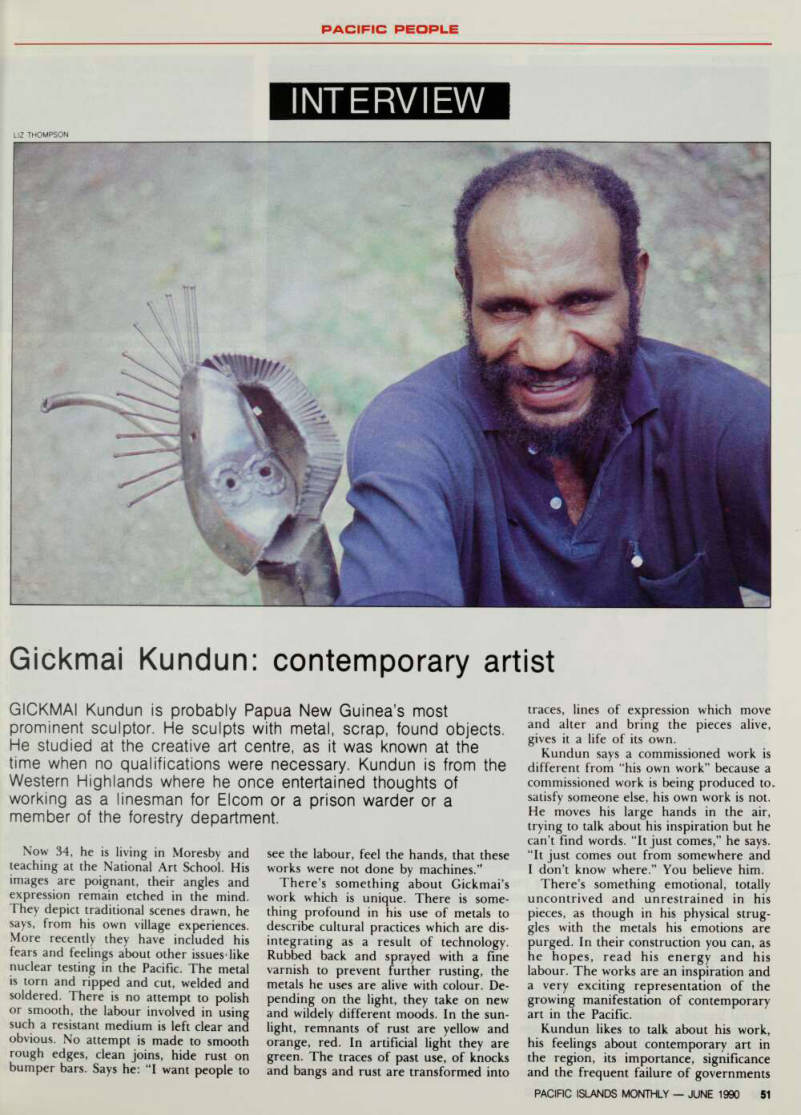
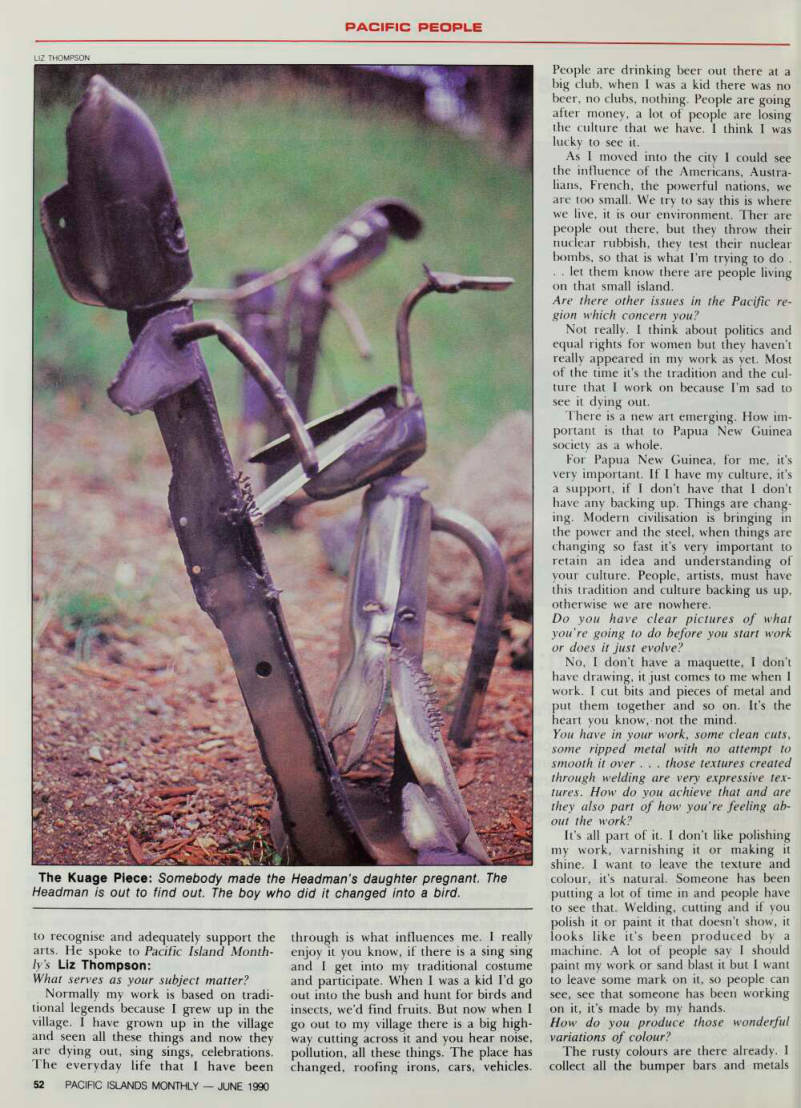
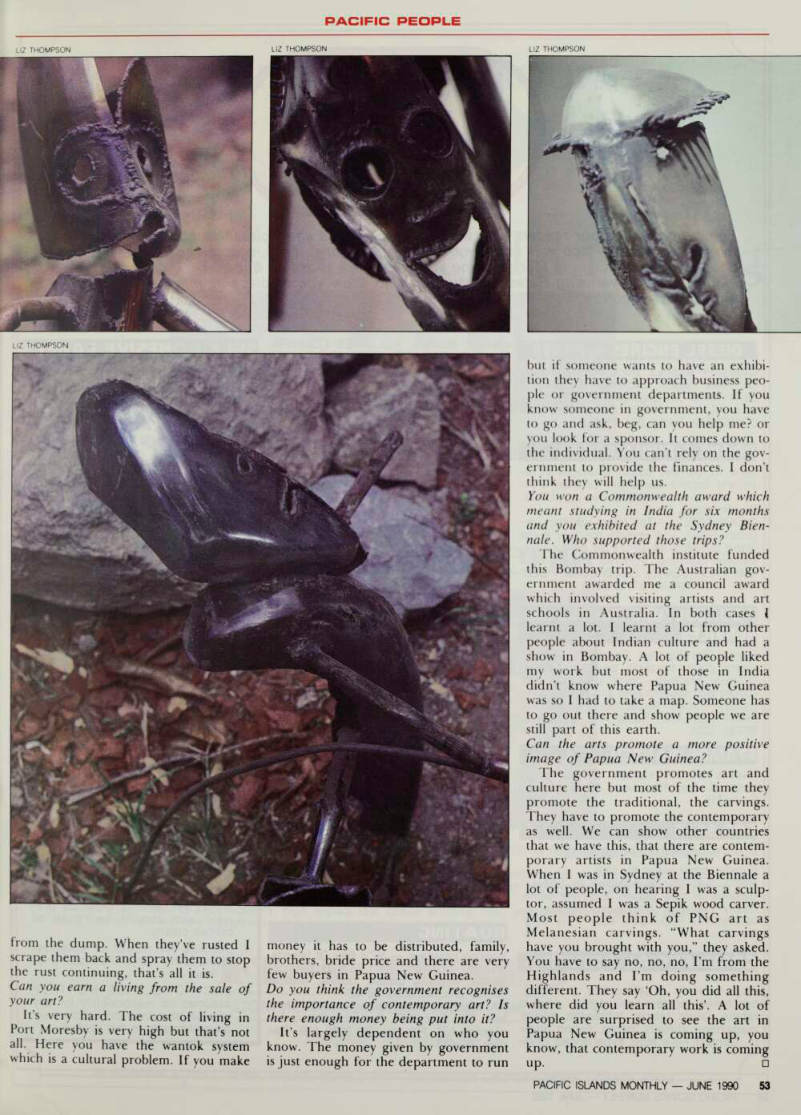
Pacific People
Gickmai Kundun: contemporary artist
GICKMAI Kundun is probably Papua New Guinea’s most prominent sculptor. He sculpts with metal, scrap, found objects.
He studied at the creative art centre, as it was known at the time when no qualifications were necessary. Kundun is from the Western Highlands where he once entertained thoughts of working as a linesman for Bloom or a prison warder or a member of the forestry department.
Now 34, he is living in Moresby and teaching at the National Art School. His
images are poignant, their angles and
expression remain etched in the mind.
They depict traditional scenes drawn, he says, from his own village experiences.
More recently they have included his fears and feelings about other issues* like nuclear testing in the Pacific. The metal is torn and ripped and cut, welded and soldered. There is no attempt to polish or smooth, the labour involved in using such a resistant medium is left clear and obvious. No attempt is made to smooth rough edges, clean joins, hide rust on bumper bars. Says he: “I want people to
see the labour, feel the hands, that these works were not done by machines.”
There’s something about Gickmai’s work which is unique. There is some thing profound in his use of metals to describe cultural practices which are dis integrating as a result of technology.
Rubbed back and sprayed with a fine varnish to prevent further rusting, the metals he uses are alive with colour. De pending on the light, they take on new and wildely different moods. In the sun light, remnants of rust are yellow and orange, red. In artificial light they are green. The traces of past use, of knocks and bangs and rust are transformed into
traces, lines of expression which move and alter and bring the pieces alive, gives it a life of its own.
Kundun says a commissioned work is different from “his own work” because a commissioned work is being produced to satisfy someone else, his own work is not.
He moves his large hands in the air, trying to talk about his inspiration but he can’t find words. “It just comes,” he says.
“It just comes out from somewhere and I don’t know where.” You believe him.
There’s something emotional, totally
uncontrived and unrestrained in his pieces, as though in his physical strug gles with the metals his emotions are purged. In their construction you can, as he hopes, read his energy and his labour. The works are an inspiration and a very exciting representation of the growing manifestation of contemporary art in the Pacific.
Kundun likes to talk about his work, his feelings about contemporary art in
the region, its importance, significance
and the frequent failure of governments
Liz Thompson
to recognise and adequately support the arts. He spoke to Pacific Island Month ly’s Liz Thompson: What serves as your subject matter?
Normally my work is based on tradi tional legends because I grew up in the village. I have grown up in the village and seen all these things and now they
are dying out, sing sings, celebrations.
The everyday life that I have been
through is what influences me. I really enjoy it you know, if there is a sing sing and I get into my traditional costume and participate. When I was a kid I’d go out into the bush and hunt for birds and insects, we’d find fruits. But now when I go out to my village there is a big highl way cutting across it and you hear noise, pollution, all these things. The place has changed, roofing irons, cars, vehicles.
People are drinking beer out there at a big club, when I was a kid there was no beer, no clubs, nothing. People are going after money, a lot of people are losing the culture that we have. I think I was lucky to see it.
As I moved into the city I could see the influence of the Americans, Austra lians, French, the powerful nations, we are too small. We try to say this is where we live, it is our environment. Ther are people out there, but they throw their nuclear rubbish, they test their nuclear bombs, so that is what I’m trying to do . . . let them know there are people living on that small island.
Are there other issues in the Pacific re gion which concern you?
Not really. I think about politics and equal rights for women but they haven’t really appeared in my work as yet. Most of the time it’s the tradition and the cul ture that I work on because I’m sad to see it dying out.
There is a new art emerging. How im portant is that to Papua New Guinea society as a whole.
For Papua New Guinea, for me, it’s very important. If I have my culture, it’s a support, if I don’t have that I don’t have any backing up. Things are chang ing. Modern civilisation is bringing in the power and the steel, when things are changing so fast it’s very important to retain an idea and understanding of your culture. People, artists, must have this tradition and culture backing us up, otherwise we are nowhere.
Do you have clear pictures of what you’re going to do before you start work or does it just evolve?
No, I don’t have a maquette, I don’t have drawing, it just comes to me when I work. I cut bits and pieces of metal and put them together and so on. It’s the heart you know, not the mind.
You have in your work, some clean cuts, some ripped metal with no attempt to smooth it over . . . those textures created through welding are very expressive tex tures. How do you achieve that and are they also part of how you’re feeling ab out the work?
It’s all part of it. I don’t like polishing my work, varnishing it or making it shine. I want to leave the texture and colour, it’s natural. Someone has been putting a lot of time in and people have to see that. Welding, cutting and if you polish it or paint it that doesn’t show, it looks like it’s been produced by a machine. A lot of people say I should paint my work or sand blast it but I want to leave some mark on it, so people can see, see that someone has been working on it, it’s made by my hands.
How do you produce those wonderful variations of colour?
The rusty colours are there already. I collect all the bumper bars and metals
Liz Thompson
The Kuage Piece: Somebody made the Headman’s daughter pregnant. The Headman is out to find out. The boy who did it changed into a bird.
from the dump. When they’ve rusted I scrape them back and spray them to stop the rust continuing, that’s all it is.
Can you earn a living from the sale of your art?
It’s very hard. The cost of living in Port Moresby is very high but that’s not all. Here you have the wantok system which is a cultural problem. If you make
money it has to be distributed, family, brothers, bride price and there are very few buyers in Papua New Guinea.
Do you think the government recognises the importance of contemporary art? Is there enough money being put into it?
It’s largely dependent on who you know. The money given by government is just enough for the department to run
but if someone wants to have an exhibi tion they have to approach business peo ple or government departments. If you know someone in government, you have to go and ask, beg, can you help me? or you look for a sponsor. It comes down to the individual. You can’t rely on the gov ernment to provide the finances. I don’t think they will help us.
You won a Commonwealth award which meant studying in India for six months and you exhibited at the Sydney Bien nale. Who supported those trips?
The Commonwealth institute funded this Bombay trip. The Australian gov ernment awarded me a council award which involved visiting artists and art schools in Australia. In both cases I learnt a lot. I learnt a lot from other people about Indian culture and had a show in Bombay. A lot of people liked my work but most of those in India didn’t know where Papua New Guinea was so I had to take a map. Someone has to go out there and show people we are still part of this earth.
Can the arts promote a more positive image of Papua New Guinea?
The government promotes art and culture here but most of the time they promote the traditional, the carvings.
They have to promote the contemporary as well. We can show other countries that we have this, that there are contem porary artists in Papua New Guinea.
When I was in Sydney at the Biennale a lot of people, on hearing I was a sculp tor, assumed I was a Sepik wood carver.
Most people think of PNG art as
Melanesian carvings. “What carvings
have you brought with you,” they asked.
You have to say no, no, no, I’m from the Highlands and I’m doing something different. They say ‘Oh, you did all this, where did you learn all this’. A lot of people are surprised to see the art in Papua New Guinea is coming up, you know, that contemporary work is coming up. □
Liz Thompson
Liz Thompson
Liz Thompson
Advertisements & other items, pp. 53-56 (2 items)
Pacific People
Old DVd
'MUId 13HU0W
I A 7 H 1 N Q W
SCNVISI
Old DVd
For the benefit of our readers who would like to place a small classified advertisement in our magazine, Market Place will assist you in selling personal items, accommodation, real estate boating or a service ... in fact anything you would like to sell to our over 50,000 readers.
Market Place Advertising Rates are structured to allow you to place as many advertisements as you wish, economically.
mercial Printers. FIJI TIMES COMMER- CIAL PRINTING. P.O. Box 1167, Suva. Fiji.
Phone: 314111. Fax. 301521.
DISTRIBUTORS WANTED":-
“Distributors/Agents wanted all areas for stainless steel and wire rope fittings, shackles, turnbuckles etc etc for marine and commercial uses. Also deck fittings, aluminium and copper swages etc. For further information contact Bridge & Company Pty Ltd, 20 Fifth Avenue, Palm Beach, Queensland 4221, Australia. Fax 61 075 98 1797, ‘Phone 61 075 98 1088.”
WANT TO BUY
Oceanfront Island Properties Wanted to purchase. Dobry, Box 388 Lihue, Hawaii 96766, USA.
SCRAP METAL
Good prices paid for your clean scrap Aluminium, Brass, Copper, Lead, etc.
Contact Nonferral Pty. Ltd. 23 Davis Rd.
Wetherill Park NSW 2164 Australia. Fax 61 2 604 1304 for prompt reply. Our Company is a long established and leading metal buyer and smelter. Telephone 61 2 604 8855.
"INTERNATIONAL
We have 1000’s of friends worldwide who would like to write to you, their interests are many and varied. Why not join our happy group of friends and broaden your horizons. Wite to; — Julia, P.O. Box 7419 GCMG Bundall. OLD. Australia.
BOATING
Boating Holidays NZ’s Bay Of Islands, Hauraki Gulf and Fiji. Bare boat, skippered, learn & cruise, flotilla, charter yachts and launches 26’-42' All available from Rainbow Yacht Charters, P.O. Box 8327, Symonds Street, Auckland, NZ. Phone; (09)3089-419. Fax (09) 790-457.
DIESEL ENGINES & PARTS
Caterpillar engines. Truck, Marine, Industrial New. Rebuilt. Exchange. All genuine parts Write Cat Engines, P.O 319 Nambour Q.L D 4560, Australia Fax 071 421249 Phone 071 421647 ai
BOOKS & PUBLICATIONS
Send for our free colour catalogue of revealing expose books on: Science, Politics. Medicine, Magnetic Healing, UFOs, Pyramidology, Etc.
"MOONGATE” The latest addition, exposes NASA and reveals the real truths about the Moon & UFO's 20 colour illustrations. Stunning VERITAS PRESS, BOX
636. PALM BEACH, GOLD COAST, OLD.
4221 AUSTRALIA 075-345070. A 2
AQUACULTURE CONSULTIN'
SERVICES
Project Development. Feasibility Studies, (giant clam, topshell, pearls, abalone, oysters, shrimp). Joint ventures also sought with governments and private companies Pacific Aquaculture Consulting, 14431 Holt Ave., Santa Ana, California,
92705, USA A 3
STAMPS WANTED
Pacific Islands stamps on exchange basis. J. Lai, 19 Lovoni Rd, Tamavua, Suva, Fiji. A 4
FOR SALE
PORT VILA VANUATU U 55350,000
Popular small resort for sale.
Restaurant/Bar/Bungalows in tropical gardens on quiet lagoon. Excellent return.
Easily managed by couple. Further information: P.O Box 400, Port Vila, Vanuatu. as
COMMERCIAL PRINTING
Top quality four colour printing, brochures, posters, packaging, product labels, fabric labels, billboards, books, magazines, stickers, books. Export quality. Contact Fiji's most experienced Com-
SELF ADHESIVE LABELSI
FORUM LABELS (FIJI) LTD
P-O. Box 1167, Suva., Fiji. Phone; 314111.
We print self-adhesive labels in rolls, multi-coloured labels with hot foil, and die cut to shape, tickets and tags in rolls. We also supply labelling machines and fabric labels.
PACIFIC
SLANDS
IMONJ H L Y
MRRKCT PLRCC CRN UJORK
WONDERS FOR VOU ...
Promote your business, or service, sell your household
items, cars or heavy machinery
etc.
ONLY AUSSI PER WORD.
NO COMPANY LOGO. NO
DISPLAY. NO BOLD TYPE.
Just forward your Advertisement together with payment to: PACIFIC ISLANDS MONTHLY “Market Place”, P.O. Box 1167, Suva, Fiji.
CONDITIONS:
1/ All Advertisements are subject to acceptance and approval of publisher. 2. Advertisements are published as space permits: we cannot guarantee date of insertion. 3. All advertisements must be prepaid and should be typed or printed clearly. 4. Deadline for receipt of advertisements is the 10th of the month prior to issue.
5. PACIFIC ISLANDS MONTHLY
assumes no responsibility for any service other than publishing paid advertisements in this section.
Four Basic Colours
YELLOW
CYAN BLACK
Plus
Fiji Times Commercial Printing
I J| LJTHROrg_ aB
Sill IN
Equals
Printing Excellence
ms > ' It is quite amazing what our experienced master printers, with the latest in printing technology, can produce from four basic colours. 91 r Full colour packaging and food labels that look good enough to eat; award winning full colour brochures and posters: magazines, calendars, books, stickers, fabric labels and billboards with pictures that leap right out of the printed pages * v your ?ro6uCt requires export-quality, high impact four colour printing, then you should be talking to us first.
You II find our prices very competitive and our paper stock quite extensive.
FIJI TIMES
COMMERCIAL PRINTING DIVISION
Printing Excellence
2O GOR DON STREET, SUVA. PHONE: SUVA 314111. Fax: 301521 LAUTOKA 60352. LABASA 81644.
Of
Created as Livings
0 :IP^- V/ .4 V Mitsubishi’s full-time four-wheel drive, a corner-stone of the diverse technologies that results in their organic performance, is beautifully simple. As any truly advanced idea should be. Linking a viscous coupling unit, a sort of torque transfering devise with the center differential puts smooth, forceful acceleration and stable cornering under the wheels of their new organically inspired vehicles.
The idea behind organic performance is that a car should really operate the way you want it to rather than the driver having to accommodate the various quirks of the vehicle. Both the driving conditions and the vehicle’s operation are monitored by the vehicle itself. In this way the car constantly fine-tunes its drive systems for the optimum operation while also adjusting its performance according to the external conditions.
Concern for your safety is why we make cars that perform as an extension of your will. You can’t be expected to anticipate every traffic situation any more than you can pay attention to every mechanical detail.
So we’ve made cars that share some of the work load with you. With less time spent worrying about the running of the vehicle, you can spend more enjoying the drive.
Because when you drive a Mitsubishi, you’re driving technology you can trust.
MITSUBISHI QHLHNT
A
MITSUBISHI
MOTORS
AMERICAN SAMOA: MORRIS SCANLAN SERVICE INC. PO Box 367. Pago Pago, Tel 633-5520/AUSTRALIA; MITSUBISHI MOTORS AUSTRALIA LTD. Box 1284, South Road, Clovelly Park, South Australia 5042, Tel [08) 275-7223/FUI: NIVIS MOTOR & MACHINERY CO.. LTD G PO Box 150, Suva. Tel 383411/FRENCH POLYNESIA (TAHITI): ETS-BREDIN FRERES ETFILS PO Box 21, Papeete, Tahiti, Tel 4-202-58/NEW CALEDONIA: SOCIETE D AUTO DU PACIFIQUE SUD SA B P 438 Rond Point du Pacifique, Noumea, Tel 274144/NEW ZEALAND: MITSUBISHI MOTORS NEW ZEALAND LTD. Todd Park, Heriot Drive, Pnvate Bag. Porirua, Tel 370-109/ NORFOLK ISLAND: BORRYS LTD PO Box 169, Norfolk Island, Tel 21 14/PAPUA NEW GUINEA: TOBA PTY LTD PO Box 503, Port Moresby. Tel 21-7874/SOLOMON ISLANDS: HARVEST PACIFIC LTD G PO Box 88, Honiara.
Guadalcanal, Tel 30128/TONGA SITANI MAFI CO , LTD. PO Box 83, Nuku ALOFA, Tel 21 044/VANUATU; SOCOMETRA B P 06 Route de Lagon, Port-Vila, Tel 2314/WESTERN SAMOA; A M MACDONALD HOLDINGS LTD PO Box 576, Apia, Tel 22022/SAIPAN/POHNPEI/MAJURO/KOSRAE/TRUK/YAP/BELAU: MICRONESIAN MOTORS, INC 997 South Manne Drive, Tamumng, Guam 96911, Tel 646-6827