Pacific
Islands
Monthly
Tonga
angels, devils and no coup
May 1990
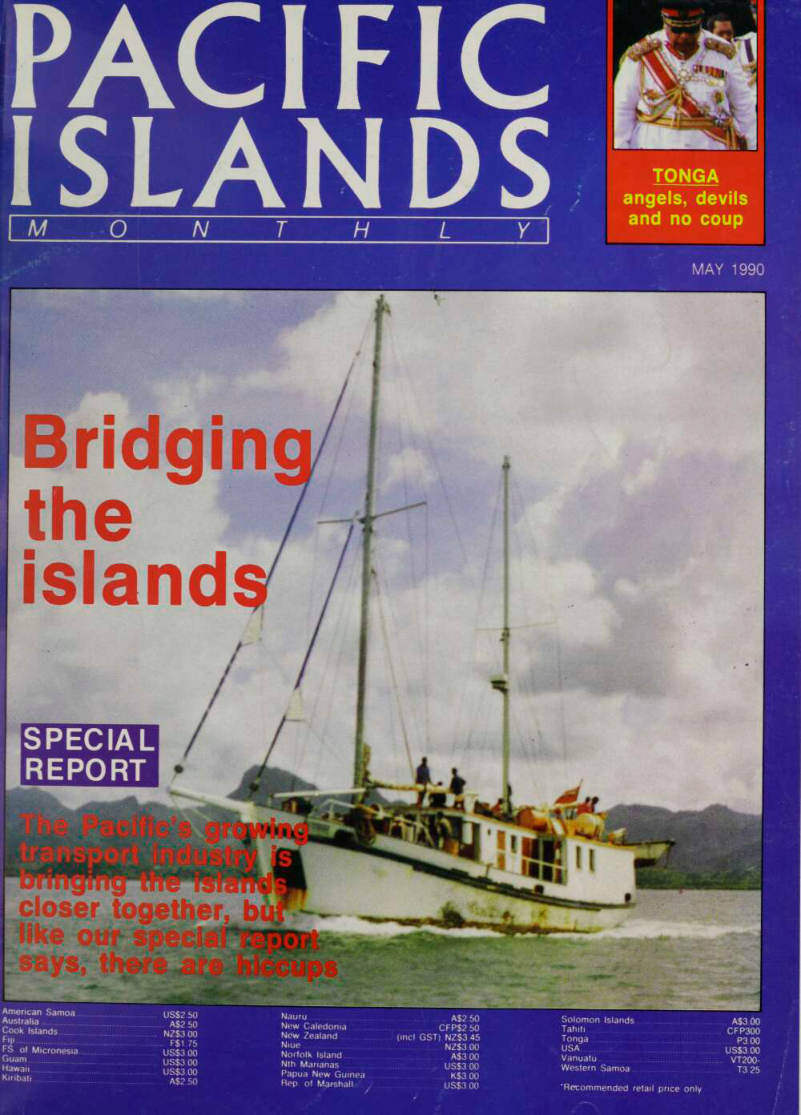
Bridging the / islands
Special
Report
uijs s frqpxi.iijij closer together, tike otrr nsra? says, there*ab K3§i
American Samoa US$2 50
Australia As 2 50
Cook Islands NZ$3 oo F$l 75 hS of Micronesia US$3 00 S uafn US$3 00 ” a * a " US$3 00
K,r,bal ' As 2 50
Nauru As 2 50 New Caledonia CFPS2 50 New Zealand (mcl GST) NZ$3 45 N, ue NZ$3 00 Norfolk Island As 3 00 Nth Marianas , US$3 00 Papua New Guinea Ks 3 00 Rep of Marshall , US$3 00
Solomon Islands A 53.00 Tahiti CFP3OO Tonga R 3 00
Usa Us$3 00
Vanuatu VT2OO - Samoa T 3 25 ■Recommended retail price only
Advertisements & other items, pp. 2-4 (1 item)
The new 3235.
Not just
two of a kind.
A pair of true individuals.
While most manufacturers offer different engine sizes and options, their new models usually look as simi- But here’s a set of twins you’ll have no trouble tell- The new Mazda 3235.
Not just variations on a theme. Two totally different cars. satility and sporty performance in an unexpectedly graceful silhouette. The sleek, agile profile turns heads as easily as the Astina turns corners. Precise han- The 323 4-door Sedan is the ultimate in affordable style. Seductive contours and energetic performance belie this car’s functional beauty. The well-appointed cabin fits a family in comfort. And, the spacious trunk fits all their luggage, too.
Jake a look at the new Mazda 3235. Drive one. homogenized moulds of automotive design. % lar as peas in a pod. mg apart.
The 323 5-door Astina combines rugged verdling and enthusiastic response make even drive a
sheer delight.
Then the other. Break away from the humourless, Fhese are the shapes of things to come.
This warranty is valid only in Australia.
mazDa
© Mazda Motor Corporation
W
CMX23O
STEREO CASSETTE DECK
WITH FM-STEREO/MW TUNER
& CD CHANGER CONTROL
O IB
CMX23O the trend-setting in-car sound player offered by Clarion, that front runner in the car audio field. Visit new sound frontiers with the amazing CMX23O, a masterpiece in human engineering. i Mon / / / J, jp a c z /
clario
For further information Australia; AWA Distribution Limited Dept. 112-118 Talavera Road North Ryde NSW 2113 / New Zealand; AWA New Zealand Limited, P.O. Box 50-248 J... ' ’ & Co., Ltd., G.P.O. Box 362, Suva Tahiti: HI FI., VAIRAATOA. Avenue Chef Vairaatoa B.P. 1128, Papeete / New Caledonia: Caldis, 8.P.M1, Noumea Cedex / Guam. Micropa , Inc., P.O. Box 3478, Agana, Guam 96910, U.S.A. Tel; 472-8091, Cable Code; HIFI AUDIO AGANA / Vanuatu: The Sound Centre, P.O. Box 434, Vila / Cook Islands, boutm Intfirnatirmal I trl PD Rnv 4Q Rarntnnna / Panna New Guinea; Hanemever fPN.G.I Rv. Ltd., P.O. Box 1428, Boroko, Port Moresby
Pacific
Islands
Monthly
Vol. 60, No. 5
Voice Of The Pacific
May 1990
Cover /10 From canoes to big jets. That’s how the transport system has evolved in the Pacific Islands. The region is smaller. 1 b 8
The Region Tonga: the kingdom is uuiet
again after gaining wide publicity
outside the country during a month in which the crown was said to have been threatened. But
what really happened? pis
Vanuatu: Has Walter Lini sanc tioned the resettlement of Viet namese refugees? At least one memo from the Prime Minister’s Office in Port Vila suggested a change in attitude in Vanuatu. pl 6
Ethics/23
Guam bans abortion and raises old questions
Business / 32
After 10 years a clam experiment finds success
People/ 56
The women of Tuvalu find a champion
Stamps 54
Departments
Letters o Headlines 7 Arts 21 Ethics 26
Stamps 54 Books 55 Pacific People 56 Marketplace 58
Editor Jale Moala Correspondents: Al Prince, Belinda Meares, Carrie Loranger, David North, David Robie, Diana McManus Dykes Angiki, Ed Rampell, Frank Senge, John Hunter, Jope Balawani lotu, Karen Mangnall, Macel Manua, Nicholas Rothwell, Paul Moon Pesi Fonua, Ulafala Aiavao, Richard Dinnen.
Business correspondent Robin Bromby
Publisher Geoffrey Hussey Advertising Manager Lionel Heffernan Business Manager Charlotte Thomas Advertising Sales • Fiji; Peter Prasad, Tel (679) 314 111 • Sydney & Melbourne: Fergus Mac lagan. Tel (02) 4123918
• Brisbane: Robert Walker, Tel (07) 3710533 • Adelaide: Hastwell Williamson Rep resentations, Tel (08) 799522 Cover prices are recommended retail only Registered by Australia Post, publication No NBP 1210 Copyright Fiji Times Limited. Suva.
Fiji.
A Fiji Times Limited Production.
Founded 1930 ('JSPS 952480). 20 Gordon Street, Suva, Fiji. Telex FJ2124, Fax (679) 303809, Tel (679) 303244.
Pacific Islands Monthly (APRS No.
NBP1210) is published monthly by Fiji Times Limited, a division of Nationwide News, 2 Holt Street, Surry Hills, NSW 2010. Second class post age paid to Honolulu, Hawaii Post master Send address changes to; • Pacific Islands Monthly, PO Box 1167, Suva, Fiji. • or, Pacific Islands Monthly, PO Box 2250, Honolulu, Hawaii 96822.
Typeset and printed by Fiji Times Limited, 20 Gordon Street, Suva, Fiji.
Letters
The Bounty debate GREAT ghosts of Pitcairn Island! Even
William Bligh himself rarely displayed
the fury which now emanates from the wounded egos of consulting psycholog ists with pretensions to historical scho larship. I refer to the letter in PlM’s April issue in which Sven Wahlroos (PhD) takes me to task for failing to take his book Mutiny and Romance in the South Seas: A Companion to the Bounty Adventure , a product of what he refers to as “lifelong research”, seriously. In truth it was hard to do, although I did say that the production was first class and (he book “enviably attractive”.
However, since the good doctor ac cuses me of being “unfair”, “inaccurate”, “uninformed”, “misinformed”, “inconsis tent” and “petty” (Have I left some thing out? At least I am not described as “unstable and psychologically thin skinned”, like poor old Fletcher Christ ian) it seems appropriate to respond.
In doing so though 1 am at a slight dis advantage, since 1 no longer have Dr Wahlroos’ book in front of me. PlM's editor wanted it back and 1 more than happily complied with his request.
Let me lake the accusations in that order. Apart from my failing to give the work an unqualified rave, my unfairness appears to relate to the use of the term “trivia” in reference to part not all, notice of the “companion”. Trivia I said and trivia I meant. Given the usual application of the term, many entries in the companion could not be described any other way. Dr Wahlroos’ airy dismis sal of my objection to his casual handling of Fijian orthography as “minutiae”, apart from being offensive to speakers and writers of the language, reveals that it is he who is being inconsistent, since the section in which it appears places great importance on the significance of place names and similar details.
It was not Dr Wahlroos’ evident en thusiasm for collecting facts which 1 was referring to in questioning his “scho
larship”. Read the review again, Sven.
What I said was that I doubted the cause of scholarship would benefit from his psychological diagnoses. I still do, and so do a number of other Pacific scholars to whom I mentioned them. At least one of them is still laughing. Unfortunately, there is also evidence in this paragraph and in the book that Dr Wahlroos like many zealous amateur, historians may think that accumulations of fact consti tute history. How else does one interpret the phrase “. . . one single inaccuracy of history or fact?” As to my not being able to come up with a convincing explana tion of the mutiny, I was unaware that reviewers were under an obligation to produce a counter-thesis, especially to “explanations” which are so patently fee ble in the first place. Library shelves are
already bulging with explanations far
more convincing than the one in the book.
The inaccuracy, inconsistency and so on evidently relate to my comments on the Australian films of the Bounty story where I am also said to be misinformed. 1 regret to say that it is Dr Wahlroos who is both inconsistent and misin formed here. Filming for the 1916 film
by Raymond Longford was also carried
out in Tahiti, besides New Zealand and Norfolk Island. So say newspapers of the period, at least, although New Zealand Maoris were later chosen for acting parts. Whether the Tahitian footage was ever used is another matter, since no
Letters To The Editor Must In
clude writer’s full name, address and home telephone number. All letters may be edited for purposes of clarity or space.
Letters should be addressed to: Pacific Islands Monthly PO Box 1167 Suva
Fiji Islands
Fax: (679) 302011
print of the film is known to exist.
Charnel's film was not only shot in part on Tahiti, but included scenes of Tahitian dancers which originally caused the Australian censor great concern since in some scenes the female dancers were bare-breasted. To suggest that they were actually Tongans is fatuous: Tongans don’t dance that way, and then as now would not have been likely to display their breasts for a film. In any event, most of the first Hollywood film of the Bounty was shot on Catalina Island off the Californian coast, yet it is mentioned in the book. Inconsistent . . .?
As to Bligh and the “discovery” of Fiji, Dr Wahlroos is attempting a double take here. Commemorative stamp issues not withstanding, the words in the book which are quoted in my review read “as the principal discoverer”, not “the prin cipal European discoverer" as Dr Wah lroos has it in his letter. Even amateur historians should be aware of the differ ence, since it is considerable.
But it is the last paragraph of Dr Wah lroos’ letter which really gives the show away. My real sin is that my review is “unappreciative of romance and adven ture and humour.” Oh dear! Presumably these are qualities which Dr Wahlroos possesses in abundance. I must say it did not occur to me to displav my fondness for romance and adventure in the re view, but my ex-wives and my passports could attest to some of it. As for the humour. Dr Wahlroos may be assured that the review occasioned quite a bit of mirth among readers of PIM. so I am told. But in case I did not make the point clearly enough the first time, let me make it again, briefly. For all his professed lifetime of research. Dr Wah lroos has not written a very good book, and all his fantasising about adventure and romance and his self-inflicted Huz zahing for Otaheite will not alter that. As far as 1 am concerned, this correspond ence is now closed.
Norman Douglas
Alstonville , NSW.
Advertisements & other items, p. 6 (1 item)
Martin Fabrics
HOW ON EARTH AM I GOING TO TAKE
ALL THIS HOME ?
DHL IT!
DHL has years of experience carefully packing and shipping Fiji’s outstanding works of art directly to your home doorstep Our reputation has been built on caring for your valuables Don't take chances, phone us we’re here to help Just call DHL we ll do the rest
WORLDWIDE EXPRESS
MARTIN FABRICS
FIJI’S ONLY HOUSE OF FASHION WEAR
* FLORAL DRESS PRINTS * HABUTAE SILK * 100% COTTON PRINTS * FANCY FABRICS * TAPA PRINTS * MENS SUITING &
* ISLAND PRINTS SHIRTING MATERIAL
LARGEST SELECTION IN FIJI OF
* CURTAIN FABRIC FROM SWEDEN
AVAILABLE AT ALL
MARTIN FABRICS RETAIL OUTLET
SUVA
281 VICTORIA PRO.
BA TOWN
MAIN STREET
NADI TOWN
OPP NAMOTOMOTO VILLAGE
LAUTOKA
BILA STREET
MARTINS CORNER
4 MILES NABUA
God is One
Not Three
"True worshippers shall worship the Father in spirit and in truth ; for the father seeketh such to worship him" John 4:23.
INTERESTED!
For a copy of this FREE booklet write to
THE CHRISTADELPHIAN
BIBLE MISSION
BOX 881 GPO
ADELAIDE
SOUTH AUSTRALIA 5001
Cruiseship finds
Headlines
Cruiseship finds century-old wreck
AS part of its cruise to Pitcairn, Henderson and Ducie Islands, the World Discoverer planned to raise the anchor from the long-sunk Acadia near Ducie and present it to the people of Pitcairn Island.
The Acadia’s anchor, due to arrive in Pitcairn in March, was to be mounted next to the anchor of the Bounty which is placed just outside Pitcairn’s little wooden court house in Adamstown, the
island’s only village.
The World Discoverer, on a previous voyage last November, found the wreck of the sailing vessel Acadia lying in 40 feet of water near Ducie, an uninhabited dependency of Pitcairn, some 350 miles east of that island. Expedition leader and dive master Jack Grove made the discov ery while checking out appropriate snorkeling locations for his passengers.
The Acadia’s dead eye (part of the rig ging) had been located lying on the atoll’s leeward shore on an earlier cruise, but the wreck itself had not been located at the time.
According to the ship’s owner, Seattle
based Society Expeditions, they con
ducted a search through Lloyd’s of Lon don and confirmed that the wreck is that of the Acadia which ran aground off Ducie while carrying a cargo of wheat from San Francisco to Queensland, Ire land, on June 5, 1881. (Sounds like they were well off course at the time). Cap tain S. George and all the members of the crew of 21 survived the experience, making the trip to Pitcairn in lifeboats.
The World Explorer planned to raise the one-ton principal anchor of the Aca dia (they were to leave three smaller ones in the water) by using air-filled lift bags to bring it to the surface. The whole event coincided with the 200th anniversary of the settlement of Pitcairn by the Bounty mutineers. Pitcairn, and its dependencies, constitute the only re maining British colony in the Pacific. □ Successor for Pa Ariki Pa Tepaeru Ariki’s eldest daughter Marie Napa has been chosen as the suc cessor to the title of Pa Ariki, one of the ariki (chief) titles on the Cook Islands.
Pa Tepaeru Ariki died on a visit to New Zealand last February.
Marie Napa’s family say she is the rightful successor in accordance to his torical precedents, as she is the eldest of the nine children and the only one living
in Rarotonga. The Takitumu tribe’s leaders the rangatiras and mataiapos have endorsed Marie Napa’s selection.
However another party has now de clared their challenge to the role. They
are asserting rights basing their claims
on oral traditions that say the More family created the Pa Ariki title in pre contact times. At this stage Marie is still considered to be the rightful successor and formal investiture will take place September this year.
Marie is 43 years old and has four children. She is married to the son of an ariki from the Arorangi district where she lives. However in accordance to the wishes of the Takitumu people she will move back to her tribal area this year.
She says that although her new re sponsibilities will not change her life style too much, she has a lot to do says she: “I will continue with my mother’s work especially with her dream of re building the Takitumu palace. I am thankful to the Takitumu people for accepting me. My mother was a very clever woman but I will do my best to follow on from her.”
Succession according to the senior family line and Marie Napa is the eldest child of the previous Pa Ariki. The title was one of primogeniture succession be fore Christianity. □ Closer ties FIJI and New Zealand are working to improve relations after their traditional links were strained after the military coup of 1987. Fiji Prime Minister Ratu Sir Kamisese Mara said relations between the two countries should improve from now. He made the comment while speaking at a lunch in Suva which Fiji hosted for a New Zealand taskforce re viewing New Zealand’s South Pacific policies. Mara said the visit should help New Zealand understand the aspirations of Fiji’s various ethnic groups. But he
emphasised the protection of indigenous
Fijian rights was absolutely fundamental.
Consular reopened
FIJI has announced it will reopen the consular office in Auckland and has appointed Radio Fiji general manager Ahmed Ali as the new consular general.
The office was closed three years ago.
Ali was Information Minister in the Alliance Government of Ratu Sir Kamisese Mara which lost the 1987 general elections to a coalition of the Fiji Labour Party and the National Federa tion.
Foreign help
ARMY commander Major General Sitiveni Rabuka, who visited China last month, said French aid was being sought for a US|7.7 million maintenance work shop in Suva for the Fiji Military Forces.
Said Rabuka: “We are forever grateful to some countries that are prepared to cooperate with our government such as the French government who are pre pared to go into a joint venture with us in the establishment, construction, man ning and running of a proper mainte nance unit. 1 believe it’s a very current topic in the Prime Minister’s agenda of work.’’
Rabuka left for China on April 22 for a nine-day official visit. The invitation came from the Chinese Government and it gave Rabuka his first overseas trip since staging Fiji’s first military coup on May 14, 1987. He was accompanied by his wife, Sulueti, and three army body guards, one report said.
Healing Move
FRANCE is expected to renew relations with Vanuatu by appointing a new ambassador in Port Vila in time for the South Pacific Forum in July. A diploma tic row in 1987 resulted in the expulsion of the French ambassador in Port Vila.
Joe Natuman, who is secretary to Vanuatu Prime Minister Waller Lini, voiced “strong possibilities” of the appointment of a new French ambassa dor before the Forum. He explained as “pretty encouraging” talks with the French government and said “things should move fast from here”. The French Embassy in Port Vila has been headed by a charge d’affaires in the abs ence of an ambassador.
Constitutional review THE Federated States of Micronesia will review its constitution during a conven tion scheduled for July in Pohnpei. The convention will be attended by 31 dele gates, including tradition leaders, from the four states of Kosrae, Chuuk (formerly Truk), Yak and Pohnpei. The constitution, which was promulgated in 1980, is subject to review every 10 years.
New relations SOLOMON Islands and the Federated States of Micronesia established formal diplomatic relations on April 5. FSM’s ambassador to Fiji, the Suva-based Alik Alik, will be accredited to Honiara.
The Republic of the Marshall Islands and Chile have also established formal
diplomatic relations.
Guilty verdict
THE 24 villagers charged with the mur der of six people on the remote atoll of Fa’aite in French Polynesia were found guilty. The accused were charged with the burning to death of fellow church members in a bout of religious hysteria.
All were jailed with group leader Fran cois Mauati getting the longest sentence of 14 years imprisonment. The six de
fence lawyers pleaded for acquittal on
the grounds of collective insanity, saying
the atoll, known as “Little bit of Para dise”, went mad with fear after a Roman Catholic lay preacher said the end of the world was near. An appeal has been
lodged.
Vitamin deficiency
CHILDREN in Kiribati between the age of six months and six years are some of the most defficient in Vitamin A, shows a survey by the Kiribati Ministry of Health and the United States-based Foundation for the Peoples of the South Pacific. The survey was carried out on six of the country’s most populated is lands. It found that of more than 4000 children examined, 15 per cent had one or more active signs of Vitamin A de ficiency. The deficiency could cause
night blindness.
Games venue FRENCH Polynesia will host the 1995 South Pacific Games. This was decided by the South Pacific Games Council in Port Moresby, on a vote of 16-12 last month. The unsuccessful bid came from Guam, which hosted the games in 1975, and the Solomon Islands, which hosted the Mini games in 1981. Next year’s South Pacific Games is being held in Papua New Guinea with the venues being split between Port Moresby and Lae. French Polynesia hosted the games of 1971.
Advertisements & other items, pp. 7-9 (1 item)
qreaP
For the finest in
SICHUAN CUISINE
dine at m
qreaP
6(iW Cnr. Bau St/Laucala Bay Rd, Flagstaff, Suva.
LUNCH • DINNER
Phone: 301285
NOW ALSO AT:
404, Khyber Pass Rd, Newmarket, Auckland.
Phone: 5221752
• Friendly and unpretentious oriental style service. • Fully licensed bar and a splendid wine list. • All major credit cards accepted.
THE PACIFIC ISLANDS RELY
ON THE ENERGY OF BORAL
r - ,1 a ** V* f " V- ' 2 « * Norfolk Island Norfolk Island 2419 Papua New Guinea Port Moresby 214248 Lae 42 2574 Rabaul 921225 Wewak 862125 Tonga Nukualofa 21388 Cook Islands Rarotonga 24460 American Samoa Pago Pago 633 2170 Fiji Suva 24035 Lautoka 60088 Sigatoka 50578 Labasa 82973 Vanuatu Santo 455 Port Vila 2046 All through the Pacific Islands, people rely on Boral Speed-E-Gas LP Gas for their energy needs.
Boral has terminals throughout the area, and is
proud to be a leading supplier.
Speed-E-Gas is clean, efficient and low in cost.
It's the ideal energy source for cooking and water heating in homes, motels and hotels, and for a wide range of industrial uses.
So call Boral. We have the energy you’re
looking for.
Solomon Islands Honiara 21833
BORAL GAS
Boral Gas Limited, Bth Floor, IBM House, 168 Kent St., Sydney, NSW 2000. Tel; (02) 278512.
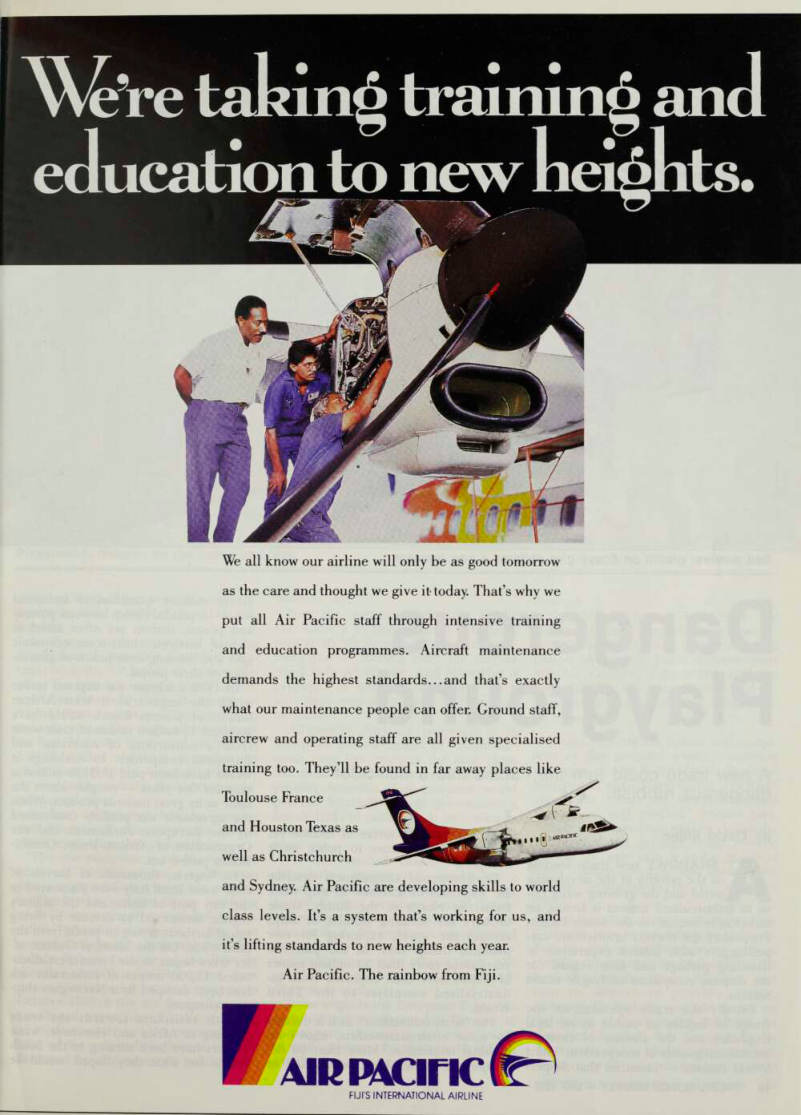
W4re taking training and
education to new hefimts.
/mV ■■ X
ere
♦ir* We all know our airline will only be as good tomorrow as the care and thought we give it- today. That’s why we put all Air Pacific staff through intensive training and education programmes. Aircraft maintenance demands the highest standards...and that’s exactly what our maintenance people can offer. Ground staff, aircrew and operating staff are all given specialised training too. They’ll be found in far away places like Toulouse France and Houston Texas as well as Christchurch and Sydney. Air Pacific are developing skills to world class levels. It’s a system that’s working for us, and it’s lifting standards to new heights each year.
Air Pacific. The rainbow from Fiji.
V if
W AIR IWCIf 1C (?
FIJI'S INTERNATIONAL AIRLINE
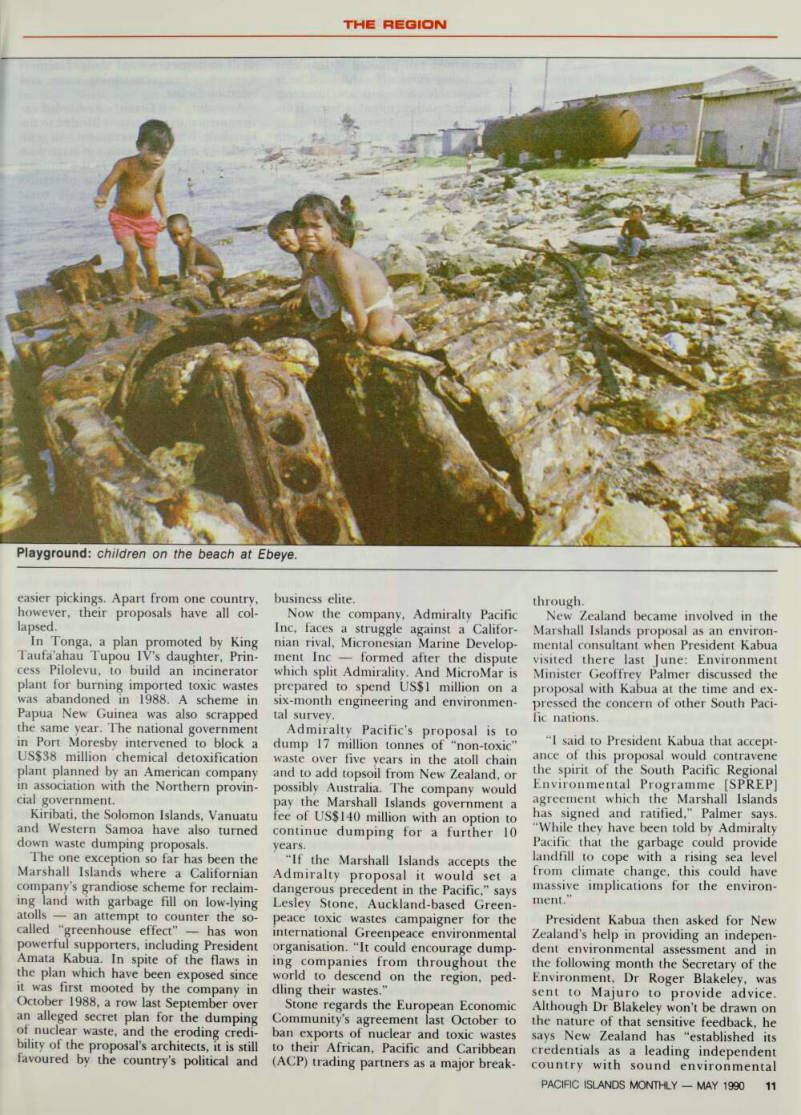
Playground

The Region
Dangerous Playground
A new trade could turn the Pacific into a dump for dangerous rubbish.
By David Robie
A SHADOWY new trade feeding on the poverty of the developing world and the growing waste cri sis in industrialised nations is having an unwelcome impact on the South Pacific.
Frequently the brokers involved are car petbaggers with limited experience in handling garbage and little regard for the delicate ecosystems of fragile island nations.
Usually the trade operates on the fringe of legality or cashes in on legal loopholes and the absence of environ mental safeguards in independent Third World nations countries that desper
ately need fresh sources of income yet lack the infrastructure to police waste
dumpers.
Environmental campaigners describe an “explosion of schemes” to ship waste from the North to the South. Waste brokers are sending flotillas of ships around the world, exploring for new potential dump sites. In the past two years alone more than 3.1 million tonnes of wastes have been exported from in dustrialised countries to the Third World.
The “toxic colonialism”, as it is dubbed by some environmentalists, knows no national boundaries. More than 80 de veloping countries have been asked to
accept massive quantities of industrial waste. In painful choice between poverty and poison, nations are often asked to choose between short-term economic gain and the long-term health of genera tions of their people.”
In 1988 a scheme was exposed under which the impoverished West African nation of Guinea-Bissau would have accepted 15 million tonnes of toxic waste from a consortium of American and European companies. In exchange it would have been paid US$l2O million a year for five years roughly about the same as its gross national product. When the agreement was publicly condemned by the European Parliament and the Organisation of African Unity, Guinea- Bissau pulled out.
In Nigeria, thousands of barrels of toxic waste from Italy were discovered in the tiny port of Koko and the military regime threatened to execute by firing squad anybody trying to profit from the illicit trade. On the island of Guinea, af ter trees began to die researchers disco vered 15,000 tonnes of incinerator ash had been dumped by a Norwegian ship ping company.
With resistance towards the trade growing in Africa and elsewhere, waste brokers have been turning to the South Pacific for what they hoped would be
Sad movies: graffiti on Ebeye give children a new message.
easier pickings. Apart from one country, however, their proposals have all col
lapsed.
In Tonga, a plan promoted by King Taufa’ahau Tupou IV’s daughter, Prin cess Pilolevu, to build an incinerator
plant for burning imported toxic wastes
was abandoned in 1988. A scheme in Papua New Guinea was also scrapped the same year. The national government in Port Moresby intervened to block a USS3B million chemical detoxification plant planned by an American company in association with the Northern provin cial government.
Kiribati, the Solomon Islands, Vanuatu and Western Samoa have also turned
down waste dumping proposals.
The one exception so far has been the Marshall Islands where a Californian company’s grandiose scheme for reclaim ing land with garbage fill on low-lying atolls an attempt to counter the so called “greenhouse effect” has won powerful supporters, including President Amata Kabua. In spite of the flaws in the plan which have been exposed since it was first mooted by the company in October 1988, a row last September over an alleged secret plan for the dumping of nuclear waste, and the eroding credi bility of the proposal’s architects, it is still favoured by the country’s political and
business elite.
Now the company, Admiralty Pacific Inc, faces a struggle against a Califor nian rival, Micronesian Marine Develop ment Inc formed after the dispute which split Admirality. And Micro Mar is prepared to spend USsl million on a six-month engineering and environmen tal survey.
Admiralty Pacific’s proposal is to dump 17 million tonnes of “non-toxic” waste over five years in the atoll chain and to add topsoil from New Zealand, or possibly Australia. The company would pay the Marshall Islands government a fee of US$l4O million with an option to continue dumping for a further 10 years.
“If the Marshall Islands accepts the Admiralty proposal it would set a dangerous precedent in the Pacific,” says Lesley Stone, Auckland-based Green peace toxic wastes campaigner for the international Greenpeace environmental organisation. “It could encourage dump ing companies from throughout the world to descend on the region, ped dling their wastes.”
Stone regards the European Economic Community’s agreement last October to ban exports of nuclear and toxic wastes to their African, Pacific and Caribbean (ACP) trading partners as a major break
through.
New Zealand became involved in the Marshall Islands proposal as an environ mental consultant when President Kabua visited there last June: Environment Minister Geoffrey Palmer discussed the proposal with Kabua at the time and ex pressed the concern of other South Paci fic nations.
“I said to President Kabua that accept ance of this proposal would contravene the spirit of the South Pacific Regional Environmental Programme [SPREP] agreement which the Marshall Islands has signed and ratified,” Palmer says.
“While they have been told by Admiralty Pacific that the garbage could provide landfill to cope with a rising sea level from climate change, this could have massive implications for the environ ment.”
President Kabua then asked for New
Zealand’s help in providing an indepen
dent environmental assessment and in the following month the Secretary of the Environment, Dr Roger Blakeley, was sent to Majuro to provide advice.
Although Dr Blakeley won’t be drawn on the nature of that sensitive feedback, he says New Zealand has “established its credentials as a leading independent country with sound environmental
Playground: children on the beach at Ebeye.
priorities.”
For decades the mid-Pacific republic of the Marshall Islands has been a test ing ground for United States nuclear weapons and a target range of ballistic missiles. Arguably the most exploited is land nation in the Pacific, it was forced to “host” nuclear tests by the United States for 12 years after the territory was seized from Japan during the Second World War.
Bikini and Enewetak atolls, in the northern Marshalls, remain too con taminated for people to inhabit; many islands were vapourised by the nuclear blasts. Thousands of islanders are seek ing compensation for illnesses blamed on radiation, and for the loss of their ances tral lands. They are being paid out of a fund provided by the Compact of Free Association an unprecedented treaty in which the United States accepted re sponsibility for nuclear test damages.
A thermonuclear test triggered at Biki ni on 1 March 1954, with a force 1000 times stronger than the atomic bomb dropped on Hiroshima, swept a deadly cloud of fallout to the east, contaminat
ing islanders on Rongelap and Utir ik atolls. In May 1 985 just a month before it was bombed the peace ship Rainbow Warrior evacuated the descendants of the islanders and moved them to a
tiny isle on Kwaja
lein Atoll.
Kwajalein is still a United States milit ary base three years after the Mar shall Islands gained
independence
under the compact and joined the South Pacific Forum. The atoll lagoon is a test ing range for ICBMs launched from Vandenberg Air Force Base in southern California.
The atoll republic is also destined for a key role in testing for the so-called Star Wars missile defence system.
The Marshall Islands government was one of the first to sign and ratify the United Nations-sponsored SPREP con vention for the protection of the natural resources and environment of the South Pacific. The republic has also ratified a forum protocol about cooperation in
dealing with pollution emergencies in
the Pacific and another seeking to pre
vent pollution from dumping.
Although the government is keen on Admiralty Pacific’s proposal, President Kabua stressed at the South Pacific Forum heads of government meeting in Tarawa, Kiribati, last June that his
cabinet would not proceed if feasibility studies being currently conducted were not favourable. Kabua is also counting on further independent advice from New Zealand.
Kabua signed a letter of intent with the developers early last year and the Nitijela (Parliament) passed a resolution
giving Admiralty Pacific exclusive rights
to dispose of the US garbage in the Mar shall Islands if the company’s proposal is found to be “feasible and of benefit to the Marshall Islands people”.
In an earlier interview with Pacific Is lands Monthly, Kabua said: “We’ll prob ably bring some of the experts in New Zealand to look this things up. If it’s not toxic and safe then we’ll accept it be cause it can be a good thing to build land with.” When Admiralty Pacific re portedly tried to persuade the Marshall Islands government to pay US$3 million for the environmental impact study, President Kabua turned them down: “This company hasn’t done its home
work yet.”
Admiralty Pacific also needs to seek clearance from the US Enviromental
Protection Agency
and the republic’s own fledgling agen cy which is follow ing US guidelines.
The proposal
claims that waste dumped in the Marshall Islands would be “non toxic waste and sludge”. Dan Flem ing, then company
vice-president, told
the Marshall Is lands Journal the waste was “non toxic” and non hazardous ... It is
household garbage, with the metals re moved.”
However, since then Fleming has admitted “there is no such thing as non toxic, non-hazardous garbage. But we can make it as safe as is possibly can be.”
Greenpeace campaigner Lesley Stone
stresses that the problems associated with landfills are well-known and well documented: “Leachate produced when water filters through garbage can con tain a highly toxic cocktail which will contaminate drinking water, rivers or coastal marine life. A ‘landfill’ in a la goon would make it possible to contain the leachate and its effects would be
magnified.”
About two-thirds of the municipal waste is expected to be actual household waste. Other wastes typically found in municipal waste include commercial waste, construction debris, industrial process waste, hazardous waste from
small industries, sewage sludge, inciner ator ash, asbestos-containing waste, and infectious waste.
According to a Greenpeace-funded en vironmental impact report handed to the Marshall Islands government, an esti mated 58 million kilograms of hazardous waste would be included in the dumped garbage. Some of hazardous substances probably including highly toxic
cyanide, dry cleaning filtration residues,
ignitable wastes, photographic wastes and strong acids or alkalis would leach into the lagoons or water supplies, or otherwise pollute the environment.
Coupled with the fact that receiving landfills in the Marshall Islands do not
comply with the regulations required for
US landfills, the proposal poses signifi cant short and long-term threats to groundwater, near-shore marine areas, air quality, and agriculture activity, says Greenpeace.
“There is good theoretical and empir ical evidence that the hazardous consti tuents that are placed in land disposal facilities very likely will migrate from the facility into the broader environment,” says the US Environment Protection Agency. “This may occur several years, even many decades, after placement of the waste in the facility, but data and scientific prediction indicate that, in most cases, even with the application of the best available land disposal technology, it will occur eventually.”
The Greenpeace report stresses that for the Marshall Islands, a “whole range of different problems would be added to those of conventional landfills because of their unique location. Forces which will increase the difficulty of containing con taminants include wind and rain erosion during tropical downpours, potential in undation during several tropical storms, exposure and dispersal via wave and tid al action”.
Greenpeace plans a Pacific-wide education drive on waste-dumping and the campaign ship Rainbow Warrior II is expected to visit the Marshall Islands ab out June. “There is no question of us telling people what they should do,” says Stone. “It is a matter of creating an awareness of what garbage is and the price they’ll have to pay for having it.”
Knowledge gained from the Greenpeace education drive would be made available to other Pacific countries in the form of useful literature and information kits.
A suggestion two years ago by Presi dent Kabua that several atolls be studied as possible sites for the dumping of nuc lear waste from plants in the US and elsewhere was revived late last year. At the time the notion was first raised Con gress instructed the Reagan administra tion to consider the islands as a nuclear dump in return for “big money”.
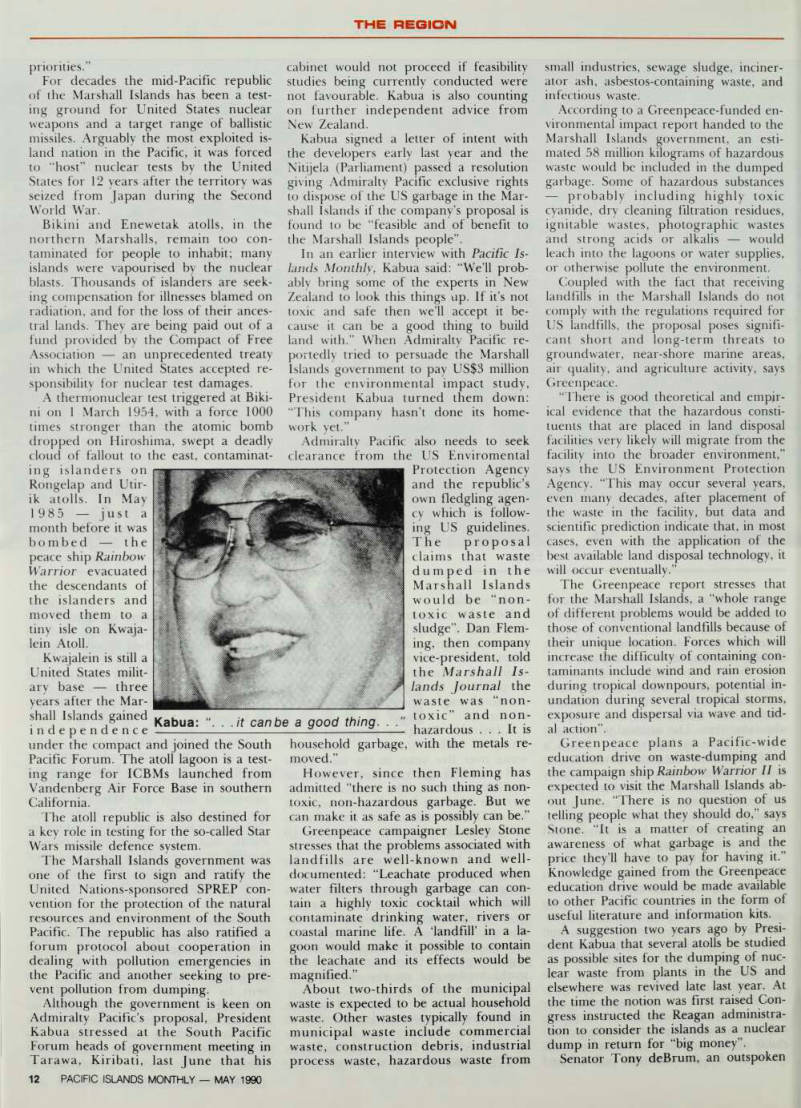
Senator Tony deßrum, an outspoken
Kabua: ". . .it can be a good thing. . .”
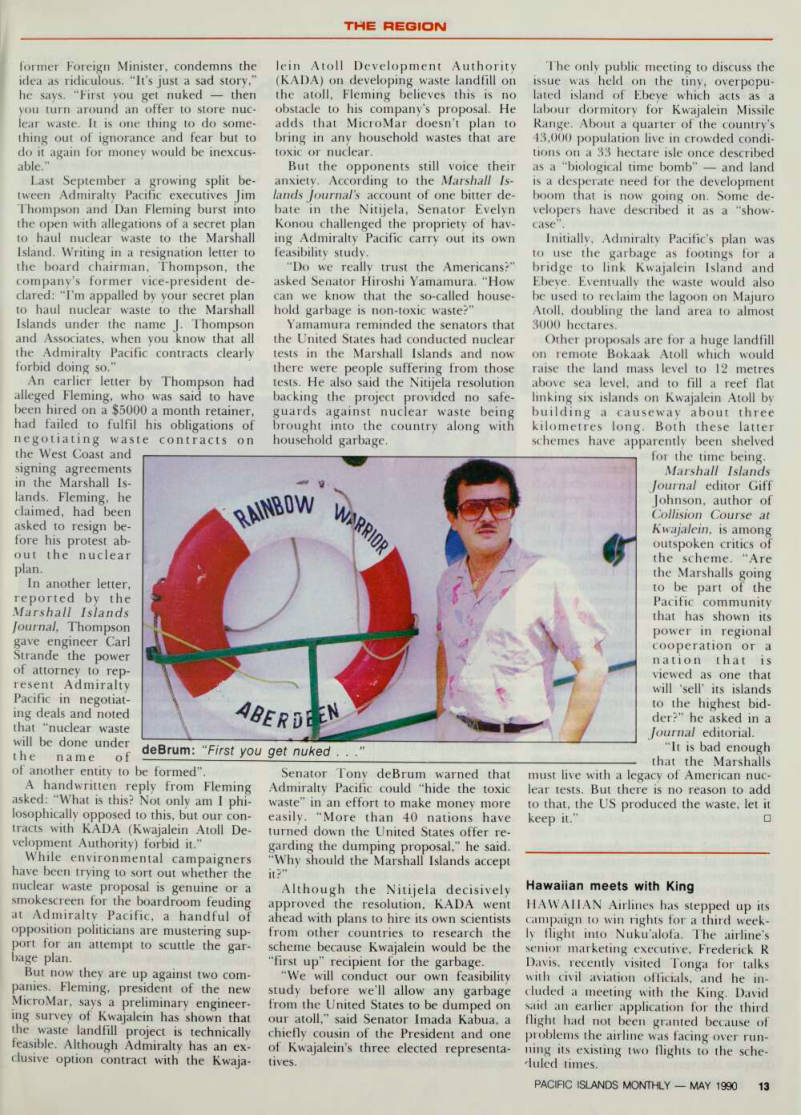
former Foreign Minister, condemns the idea as ridiculous. “It’s just a sad story,” he says. “First you get nuked then you turn around an offer to store nuc lear waste. It is one thing to do some thing out of ignorance and fear but to do it again for money would be inexcus able.”
Last September a growing split be
tween Admiralty Pacific executives Jim Thompson and Dan Fleming burst into the open with allegations of a secret plan to haul nuclear waste to the Marshall Island. Writing in a resignation letter to the board chairman, Thompson, the company’s former vice-president de clared: “I’m appalled by your secret plan to haul nuclear waste to the Marshall Islands under the name J. Thompson and Associates, when you know that all the Admiralty Pacific contracts clearly forbid doing so.”
An earlier letter by Thompson had alleged Fleming, who was said to have been hired on a $5OOO a month retainer, had failed to fulfil his obligations of negotiating waste contracts on
the West Coast and
signing agreements
in the Marshall Is lands. Fleming, he claimed, had been asked to resign be fore his protest ab out the nuclear
plan.
In another letter, reported by the Marshall Islands Journal , Thompson gave engineer Carl Strande the power of attorney to rep
resent Admiralty
Pacific in negotiat ing deals and noted that “nuclear waste will be done under the name of
of another entity to be formed”.
A handwritten reply from Fleming asked: “What is this? Not only am I phi losophically opposed to this, but our con tracts with KADA (Kwajalein Atoll De velopment Authority) forbid it.”
While environmental campaigners have been trying to sort out whether the nuclear waste proposal is genuine or a smokescreen for the boardroom feuding at Admiralty Pacific, a handful of opposition politicians are mustering sup port for an attempt to scuttle the gar
bage plan.
But now they are up against two com panies. Fleming, president of the new Micro Mar, says a preliminary engineer ing survey of Kwajalein has shown that the waste landfill project is technically feasible. Although Admiralty has an ex clusive option contract with the Kwaja
lein Atoll Development Authority
(KADA) on developing waste landfill on the atoll, Fleming believes this is no obstacle to his company’s proposal. He adds that Micro Mar doesn’t plan to bring in any household wastes that are toxic or nuclear.
But the opponents still voice their anxiety. According to the Marshall Islands Journal’s account of one bitter debate in the Nitijela, Senator Evelyn Konou challenged the propriety of having Admiralty Pacific carry out its own
feasibility study.
“Do we really trust the Americans?” asked Senator Hiroshi Yamamura. “How can we know that the so-called household garbage is non-toxic waste?”
Yamamura reminded the senators that the United States had conducted nuclear tests in the Marshall Islands and now there were people suffering from those tests. He also said the Nitijela resolution
backing the project provided no safe-
guards against nuclear waste being
brought into the country along with
household garbage.
Senator Tony deßrum warned that Admiralty Pacific could “hide the toxic waste” in an effort to make money more easily. “More than 40 nations have turned down the United States offer re
garding the dumping proposal,” he said.
“Why should the Marshall Islands accept it?”
Although the Nitijela decisively
approved the resolution, KADA went ahead with plans to hire its own scientists from other countries to research the scheme because Kwajalein would be the “first up” recipient for the garbage.
“We will conduct our own feasibility study before we’ll allow any garbage from the United States to be dumped on our atoll,” said Senator Imada Kabua, a chiefly cousin of the President and one of Kwajalein’s three elected representa tives.
The only public meeting to discuss the issue was held on the tiny, overpcpu lated island of Ebeye which acts as a labour dormitory for Kwajalein Missile Range. About a quarter of the country’s 43,000 population live in crowded condi tions on a 33 hectare isle once described as a “biological time bomb” and land is a desperate need for the development boom that is now going on. Some de velopers have described it as a “show case”.
Initially, Admiralty Pacific’s plan was
to use the garbage as footings for a bridge to link Kwajalein Island and Ebeye. Eventually the waste would also be used to reclaim the lagoon on Majuro Atoll, doubling the land area to almost 3000 hectares.
Other proposals are for a huge landfill on remote Bokaak Atoll which would raise the land mass level to 12 metres above sea level, and to fill a reef flat linking six islands on Kwajalein Atoll by building a causeway about three kilometres long. Both these latter schemes have apparently been shelved
for the time being.
Marshall Islands Journal editor Giff Johnson, author of Collision Course at Kwajalein, is among outspoken critics of the scheme. “Are the Marshalls going to be part of the
Pacific community
that has shown its power in regional cooperation or a nation that is viewed as one that will ‘sell’ its islands to the highest bid der?” he asked in a Journal editorial.
“It is bad enough that the Marshalls
must live with a legacy of American nuc lear tests. But there is no reason to add to that, the US produced the waste, let it keep it.” □
Hawaiian meets with King HAWAIIAN Airlines has stepped up its campaign to win rights for a third week ly flight into Nukualofa. The airline’s senior marketing executive, Frederick R Davis, recently visited Tonga for talks with civil aviation officials, and he in cluded a meeting with the King. David said an earlier application for the third flight had not been granted because of problems the airline was facing over run ning its existing two flights to the sche duled times.
deBrum: ‘‘First you get nuked . . ."
The best and the worst of Ofa
Samoa
NATURAL disasters bring out
the best and the worst in peo ple, and Ofa was no exception.
For example, the Mainland US Gov ernment agency handling disaster relief,
the Federal Emergency Management
Administration (FEMA) counted up the applications for household disaster assist ance in American Samoa. They found 6900 of them.
The only problem is that other, pre- Ofa statistics showed that there were not that many households in the territory.
Further, the Red Cross, running a diffe rent assistance programme, had a total of only 5200 claims. Since not all families were hurt by the storm this meant that many hundreds of families had sought to defraud the governnment. “The num bers of applications are outrageous,” an anonymous FEMA official told the Samoa Journal. “We will be verifying ev
erything.”
FEMA faced a minor version of this same problem on the Mainland, after the San Francisco earthquake, but the feds had a basic identification tool to mini mise the extent of the scam and potential con men know about it. On the Mainland, 99 per cent of the houses have well-fixed addresses, usually a num ber and a street name. There are no such addresses for most houses in Amer ican Samoa, and island names are con fusing to the Statesiders flown in for handling the claims.
The extent of the fraudulent claims was well publicised and caused at least one of the newspapers in Pago Pago to write a pained editorial on the subject, saying, in effect, “do not try to get more than your share”.
While the fraud problem slowed the application-screening process and while there were some criticisms, as there al ways are in such situations, that the re lief agency did not act quickly enough, FEMA did approve enough applications rapidly enough to cause another
problem.
The Bank of Hawaii, despite regular infusions of currency arriving on every plane from Honolulu, ran out of cash.
So many people had so many large Ofa checks so quickly that the bank could not keep up with the demand for dollars.
Bankers tried to convince the grantees to put at least some of the money in savings or checking accounts, but most families wanted cash on the barrelhead.
“We can’t cash $4OOO checks all in one go. We got nearly the whole island con verging on us,” complained one bank official. Another island bank, Amerika Samoa Bank, did not have this problem. (Despite the very real damage to the is
lands, one wonders what happens to personal spending patterns, and to prices, with so much extra cash sloshing around in the island’s economy).
It is not that all FEMA assistance flows quickly through a single pipeline. There are at least two principal programmes for storm-hurt families (as well as others for businessmen and for the government itself). The programme paying the most rapidly is the individual and family grant programme. There is also the housing programme, which in some cases will provide entirely new houses for eligible families, and in more cases will provide help to rebuild damaged houses. Given the size of the challenge and the relatively small number of building contractors in the territory, FEMA decided that it
would, under some circumstances, allow families to repair their own houses or hire handymen to do it for them; this decision was an indications of FEMA’s flexibility; it would not make such a deci sion on the Mainland, and had not done so during the last big storm to hit Amer ican Samoa.
Some 500 families, whose houses were totally obliterated during the storm, and who are now living in FEMA-supplied tents, will get 360-, 480-, 600-, or 720square foot houses, built of wood on concrete foundations, at no cost. (The size of the house varied depending on the size of the destroyed house). FEMA contends that these houses, in most inst ances, will be both more comfortable and more valuable than the earlier house.
Typically storms are more likely to flat ten the less durable houses in a com munity than the sturdier ones. So, if all goes as planned, the basic housing stock of American Samoa will, ultimately, be improved by the combination of Ofa and
Fema.
While the storm-relief programme in American Samoa are considerably better funded than those in Western Samoa they are also more complicated, and more likely to involve written applica tions.
In Western Samoa, where the damage was even worse, different and simpler systems of distributing relief were used.
In one of them each of the 47 members of the parliament will be allocated 60,000 Western Samoan tala (U 5526,000) to help with storm-caused losses to families in the constituency.
Since each member has, on average, ab out 3400 constituents, this works out to less than US$B per person.
The funds are usually distributed through the traditional power structure (village councils, and extended families) and in some constituencies it is simply divided among the families. In other dis
tricts the money is distributed by systems which lay stress on prestige and age as well as on numbers (i.e. matai get more money than non-matai).
Meanwhile, Ofa provided an oppor tunity for the new owners of Hawaii Air to seek to rebuild its frayed reputation in American Samoa. Hawaii Air put
together two special “alofa flights” which
brought emergency relief supplies to American Samoa from Hawaii. Diverting a DC-8 from the normal Honolulu- Marshall Islands run (an Air Marshall Islands operation) the first of the two
flights brought 25,000 pounds of non
perishable food, medical supplies and other items donated by the Samoan com munity and others in Hawaii.
On the first flight, the Bank of Hawaii paid for 14,000 gallons of fuel, and Paci fic Resources, Inc. paid for another 5,000 gallons. Hawaiian Airlines cockpit and cabin crew, as well as ground per sonnel volunteered their time to make the flights. □
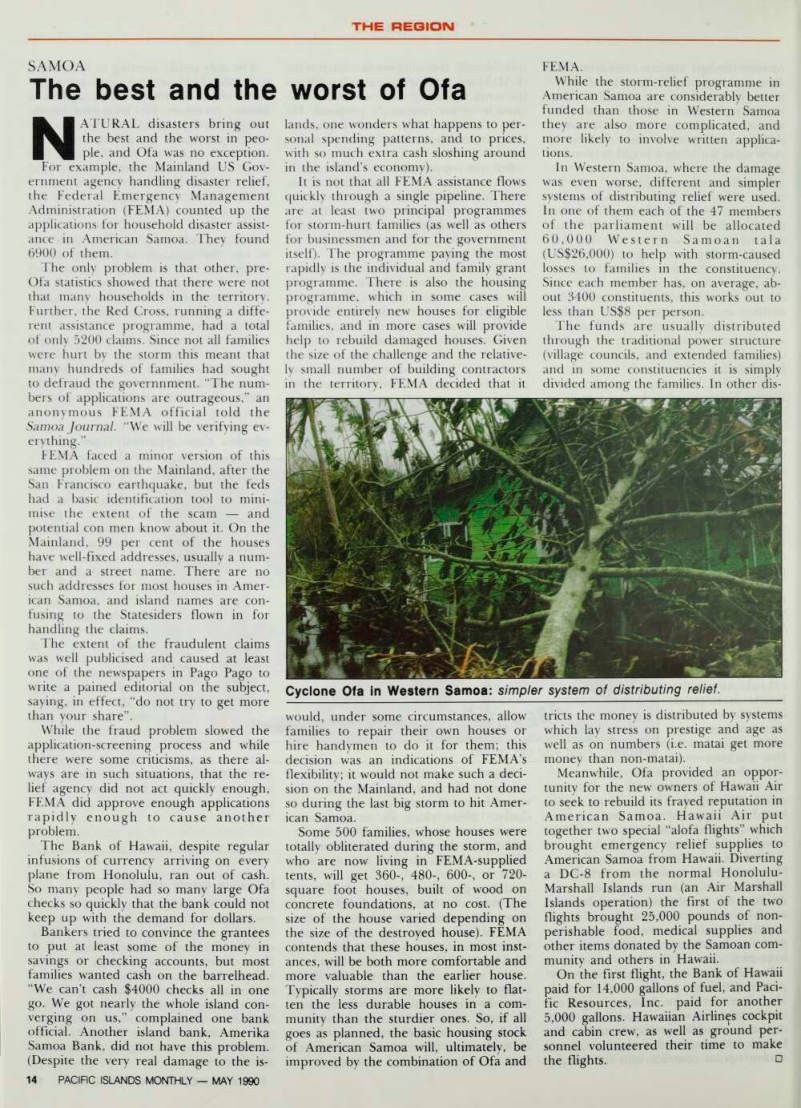
Cyclone Ofa in Western Samoa: simpler system of distributing relief.
The day of the devils
Tonga
THE Kingdom of Tonga scored an international publicity coup last month, but one which its leaders probably could have done without. The breathless saga first hit Pacific Island air waves on March 28. A female member of Tonga’s 3000-member Tokaikolo Christian Fellowship claimed to have
been kidnapped, interrogated and drug
ged by two men in dark glasses and a modern-day witch with computers on her chest. The woman prayed in her drugged delirium and, she later claimed, an angel dressed in shining white re leased her from her captors’ van.
The kidnappers apparently wanted to know about an audience which Tokaiko lo members and four visiting New Zealanders had just held that day with King Taufa’ahau Tupou IV. Tokaikolo’s leader, the Rev. Lifau Vailea, also went on Radio Tonga with what one foreign diplomat described as “weird” allegations of devils being loose in the Kingdom.
Two days later, the four Kiwis accompa nied by a large Tokaikolo group, had a second audience with the King amid
growing rumours of a conspiracy by
Police Minister George Akau’ola and foreign mercenaries to stage a coup d’etat.
The first outsiders knew of this threat to Tonga’s monarchy came from Akau’ola himself. He chose April Fool’s Day to go on Radio Tonga to address a
“whispering campaign” which had
sprung up since the national elections, particularly regarding the Protected Per sons passport scheme. Most of Akau’ola’s speech dealt with rumours of corruption and misuse of funds from the passport scheme. In almost a postscript to his half-hour speech called “Peace and Security in Tonga Today”, the Police Minister claimed the four New Zealan ders and the Fellowship had told the King “amazing, untrue and unbeliev able” lies about a conspiracy to over throw the country.
Akau’ola said later that, during their first audience, the Kiwis told the King an Auckland man was training terrorists to invade Tonga. When the Auckland police reported back that the Aucklander was a respected, wealthy businessman who knew nothing of coups in Tonga, the four Kiwis changed their story, said Akau’ola. They then accused the Police Minister and other defence officials of planning a coup funded by an “un friendly country”. American backing was hinted at for a force of 19 European mercenaries who were to arrive in a heli copter on April 6. (Akau’ola told repor ters his police force didn’t have a heli
copter so he was looking forward to tak ing delivery of one on the due date.) On Monday April 2, the Kiwis got de portation orders but refused to budge.
One of them, conservative Catholic jour nalist Bernard Moran, told the foreign media their lives were in danger from the coup plotters. At the Rev. Vailea’s suggestion, the four had earlier aban doned their hotels for the Tokaikolo church compound, where they were placed under tight security.
All of which was “puzzling” to the New Zealand High Commissioner in Nuku’alofa, John Carter, because none of the Kiwis had come to him for help.
Carter described the coup rumours as
“pie in the sky”, and a source of some amusement to Tongans.
Tongan journalists reported conflict
ing stories from the Kiwis. None would comment on their audiences with the King, nor offer any evidence to sub stantiate allegations on a coup conspira cy. Christchurch engineer Dennis Lloyd McLachlan said he’d been invited to speak to the Tokaikolo church on the topic of One World Government, after a similar speech to the Fellowship’s Auck land congregation. Moran apparently told some local reporters his ticket to Tonga had been paid for by fellow visi tors John and Sharon Fawcett, but he thought he was coming for a holiday.
Back in Auckland, Moran’s wife, Annet ta, told Radio New Zealand her husband had gone to Tonga to write articles on
the church there.
Meanwhile, news was emerging in New Zealand of the previous exploits of McLachlan and the Fawcetts. McLachlan had been convicted last year of criminal
libel (an extremely rare charge) against
the former Prime Minister, Sir Robert Muldoon. McLachlan admitted on radio he was out of New Zealand illegally as he still had some time to serve in his sent ence of period detention.
Attorney-General David Lange
weighed in with a blunt dismissal of the Fawcetts’ credentials. Lange said he’d run into the Fawcetts last year when they preached publicly and circulated record ings alleging that the Soviet Union was providing arms to Maori terrorists for bloody attacks on the Commonwealth Games and at Waitangi. John Fawcett responded that he and his wife didn’t make a habit of stirring up anarchy and it was rubbish to say they were always
claiming anti-government plots. Fawcett
accused the several Christian groups who’d complained to the media of want ing to discredit him and his wife.
So April 6 dawned and it found McLachlan and Sharon Fawcett in the Nuku’alofa magistrates court on three
immigration charges. No foreign merce
naries. No helicopter (sorry, George).
The following week the pair were found guilty and along with their two compan ions, placed under house arrest at the Tokaikolo compound until the first flight to New Zealand on April 14. The foursome were met at Auckland by ab out 50 Auckland Fellowship members and whisked off to a reception.
But the four remained unrepentant.
Moran said the King was still in danger.
Although one coup had been averted, said Moran, “the same European people” responsible for it were still in Tonga. He accused David Lange of “blackening (the) names” of the Fawcetts in a letter to the King. Lange said he’d written to the King after the four had been served deportation orders, to tell the King “of my experience at the hands of these people”.
Lange said he’s always known where the Fawcetts were speaking around New Zealand because he’d get letters from people warning the nation was in peril.
“And then I heard the tape recordings of this woman,” Lange said. They were “full of Messianic prophecy and doom,
and Waitangi Day being disrupted by
civil war, angels taking people off hither and yon,” he said. “Why she bothered to book a plane to get to Tonga I do not know, because most of the time she seemed to go by angel.” Lange said Waitangi and the Commonwealth Games had come and gone. “Armageddon had not descended, and I think they lost their credibility.” He had decided to “tell the King that”. □
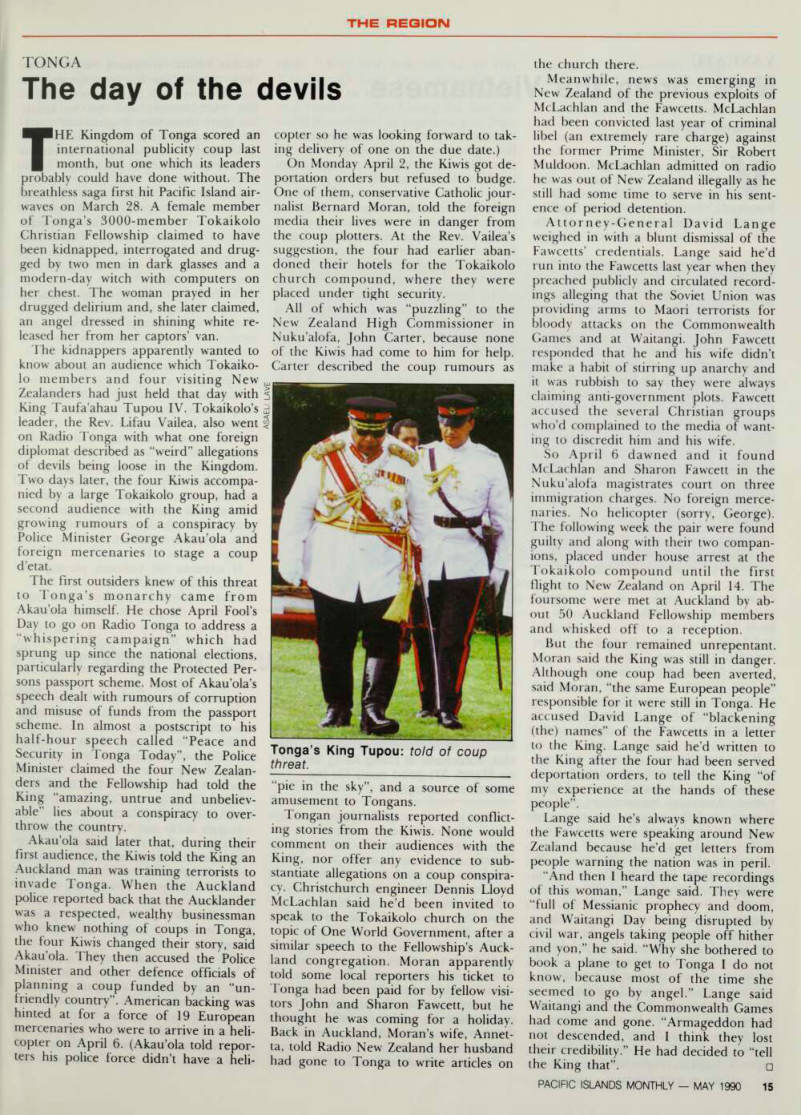
Tonga’s King Tupou: told of coup threat.
Now, bring the Vietnamese
Vanuatu
By David North
VfANUATU, following a series of conflicting statements, has apparently decided to accept a hundred Vietnamese refugee families, providing a series of conditions are met.
The road to that decision was a rough one.
First a self-identified ambassador of the President of Vanuatu, Selwyn A.
Leodoro, told Vietnamese in California that his country would welcome refugees from Hong Kong.
Then the office of Prime Minister Walter Lini and the Vanuatu Foreign Office vehemently denied these reports, and said that Leodoro had been fired as Secretary of the President prior to the
California trip.
In March Walter Lini visited Hong Kong with Leodoro, and reportedly told both the Hong Kong Government and the United Nations High Commissioner for Refugees that Vanuatu would reset tle 100 Vietnamese refugees families now stuck in Hong Kong.
The California-based, Japan-linked, Vietnamese-run Cuong De International Foundation, led by a Vietnamese resi dent of California, Lien Bang Phuoc Nguyen, was to make the arrangements.
Nguyen and a resident of the Washing ton area, Elwood McKee, told Pacific Is lands Monthly that they met with Lini and Leodoro in Hong Kong in the latest round of these negotiations.
None of the refugees have yet arrived in Port Vila, and a number of hurdles need to be surmounted before they do, but it appears that Vanuatu, at least in principal, has agreed to such a settle ment.
If the resettlement occurs, it will hap pen because of two independent factors: the persistance of a small group of Viet namese-American businessmen, led by Nguyen, and the adventurous nature of Vanuatu’s foreign policy. Prime Minister Walter Lini has proved himself to be a risk-taker, and Vanuatu’s decision to be the first of the South Pacific nations to accept the refugees fits into that pattern.
Vanuatu after all, has briefly flirted with Libya’s Gaddafi, accepted Soviet fishing fees, routinely voted against the West in the United Nations, and licensed banks for non-Vanuatu operations which routinely get into trouble. It is in charac ter that Vanuatu should be a pioneer in the acceptance of refugees of a different background than the host population.
Nguyen is an American citizen, an official of the Mitsui Company (one of Japan’s largest corporations), and, in
addition, a successful entrepreneur in the export-import business. His firm, he says, exports more goods to Japan from the United States (mostly meat products) than it moves from Japan to the US an accomplishment that American business, generally, has been unable to copy.
Nguyen has an appropriate back ground for international affairs. His late grandfather, for whom the family foundation was named, was Chamberlain to the Emperor of Indochina until 1905 when he had to leave the country (then ruled by the French) and repair to
Japan. The Chamberlain’s family
apparently had and still has some
money, as well as useful Japanese con tacts. Nyguen spent many years in Japan, speaks Japanese (and English) fluently and has a Japanese name, Ben Kasahara. Lini used that name in his re cent correspondence with him.
More than a year ago Nguyen and some Vietnamese colleagues in Califor nia decided that the United States, Au stralia and Canada were not accepting
enough Vietnamese refugees, particular
ly, from Hong Kong, and that one more new sites for resettlement were needed.
They decided that Vanuatu would be a good place to settle, partially because there was a precedent for Vietnamese living in that country.
Nguyen made seven trips to Vanuatu
in his effort to secure resettlement opportunities for his countrymen. He told PIM that each trip involved three to five other persons, and that his family has spent more than a quarter of a mil lion US dollars in travel, communica tions, legal fees and the like in its efforts to arrange the hoped-for refugee reset tlement.
According to Nguyen, now optimistc about the prospects for Vanuatu’s acceptance of refugees, it has sometimes been a frustrating process. “There were times when I sat in a hotel room in Port Vila for ten days, just waiting for the response to a letter.”
He had been disturbed by denials a few months ago that Vanuatu was even
thinking about accepting refugees, and
seemed to be reluctant to talk about the matter.
Why did Vanuatu shift its policy on
this point?
Has the Government of Walter Lini simply been changing its mind fre quently on this issue?
Has there been turmoil within the Prime Minister’s inner circle, with Leodoro in, out, and back in again?
Did the story break on the planned resettlement of refugees in Vanuatu at an inconvenient time for Lini, thus generating both denials at the time, and a subsequent confirmation in Hong
Kong?
Is someone in Vanuatu playing fast and loose with the truth?
Or is the real explanation some com bination of the possible answers outlined above?
It is hard to know what happened in the past within the government’s inner circles, but the Prime Minister has laid out some of the ground rules for re fugee resettlement, and within them Nguyen and his colleagues have made some tentative plans.
The Prime Minister’s letter of March 14 to Nguyen (Kasahara) is both welcom ing and vague. It is headed (in solid
Caps): “Approval To Recruit In
Ternational Vietnamese For
Vanuatu Projects”.
It goes on to say: “As Minister of Im migration I give my approval to your request to recruit up to 100 professional and technical workers from the Refugee Detention Camps in Hong Kong to work on various projects that your organisa tion will undertake in Vanuatu especially the Community College and fisheries
projects.”
The term “recruit” implies admission to Vanuatu, but does not state it. Nor is there any reference at all to the terms and conditions of the Vietnamese pre sence in the country, nor to the arrival of family members, which Nguyen ex pects. (For example, will the Vietnamese in Vanuatu, like the Vietnamese on
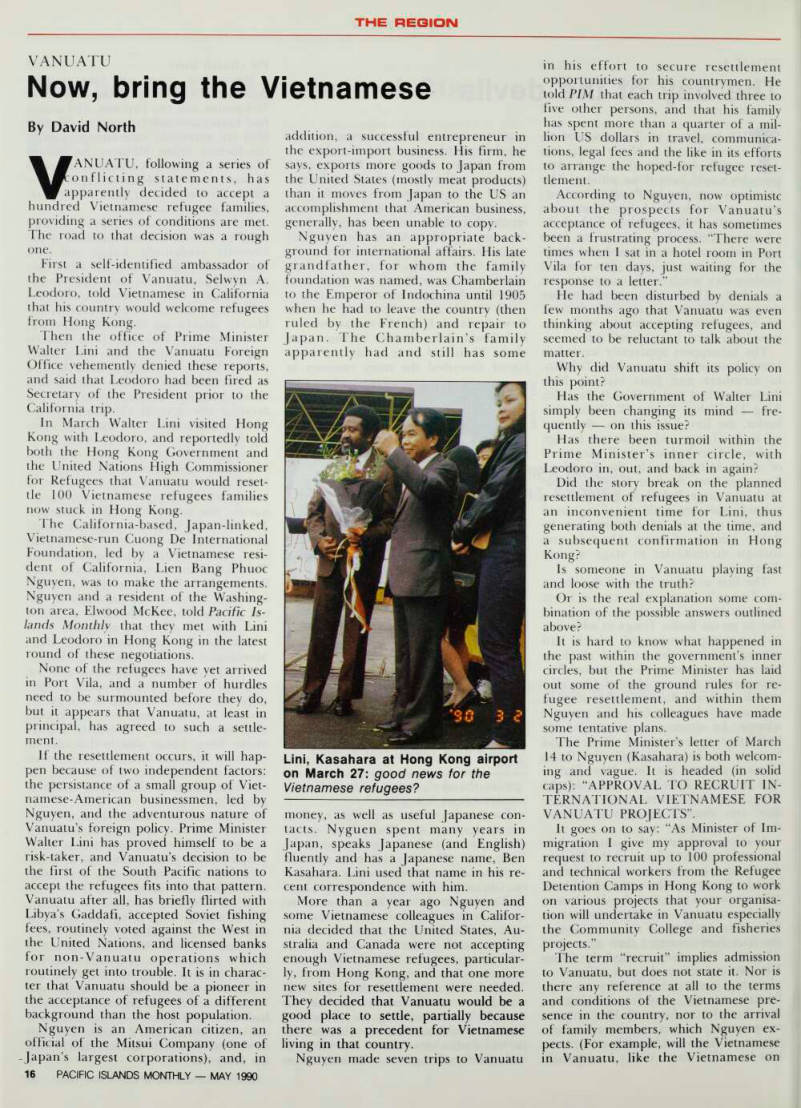
Lini, Kasahara at Hong Kong airport on March 27: good news for the Vietnamese refugees?
Guam, be able to acquire citizenship ulti mately?) There are conditions, however, as follows: “This approval is subject to: 1) agreement by all parties involved, i.e.
UNHCR (United Nations High Commis sioner for Refugees) and the Hong Kong (Br.) Government. 2) The formalities to be completed with Immigration and Labour Department [of Vanuatu]. 3) My formal declaration in due course.”
The first of these three is no problem at all, the Hong Kong and the UN au thorities will be delighted with the pros pect of 100 families leaving, and even more so with the arrival of a new coun try among those accepting refugees. The second and third provisions can be handled easily, if Vanuatu’s current poli cy remains its policy.
Lini’s letter, incidentally, contains an indication that Leodoro is back in his government’s good graces: “You [Kasa hara/Nguyen] and Mr Leodoro should proceed to arrange with all parties con cerned to recruit the workers.”
Two other questions remain to be answered: first, how will the resettlement of the refugees, including the air travel, be financed, and what will the refugees do once they get to Vanuatu.
On the first point, Nguyen has already done some calculations, saying that air travel perhaps could be secured for US$35OO a family. He is not asking Vanuatu to pay for the travel.
As to what the refugees will do once they arrive, if they arrive, this much is
clear. Their first stop will be in Port Vila, though later some may settle on Pentecost, the home island to both Lini and Leodoro. The Cuong De Interna tional Foundation is negotiating to lease
an existing building (served by electricity
and telephone) and 14 hectares of land (35 acres) in the Fresh Water Hill area near Port Vila. This will serve as a stag ing area for the arrivals.
There are expectations that the Cuong De Foundation will open a headquarters in Port Vila and will help with the estab
lishment of a community college.
Meanwhile Vanuatu and Vietnam may be moving toward closer relations with or without the refugees. A report from the Vietnam capital of Hanoi, quoted Vanuatu President Frederick Kalmoana Timkata as saying his country was pre
pared to develop cooperative relations
with Vietnam.
Timkata made the statement after re ceiving the credentials of Vietnam’s Ambassador to Vanuatu, Tran Tuan Anh. □
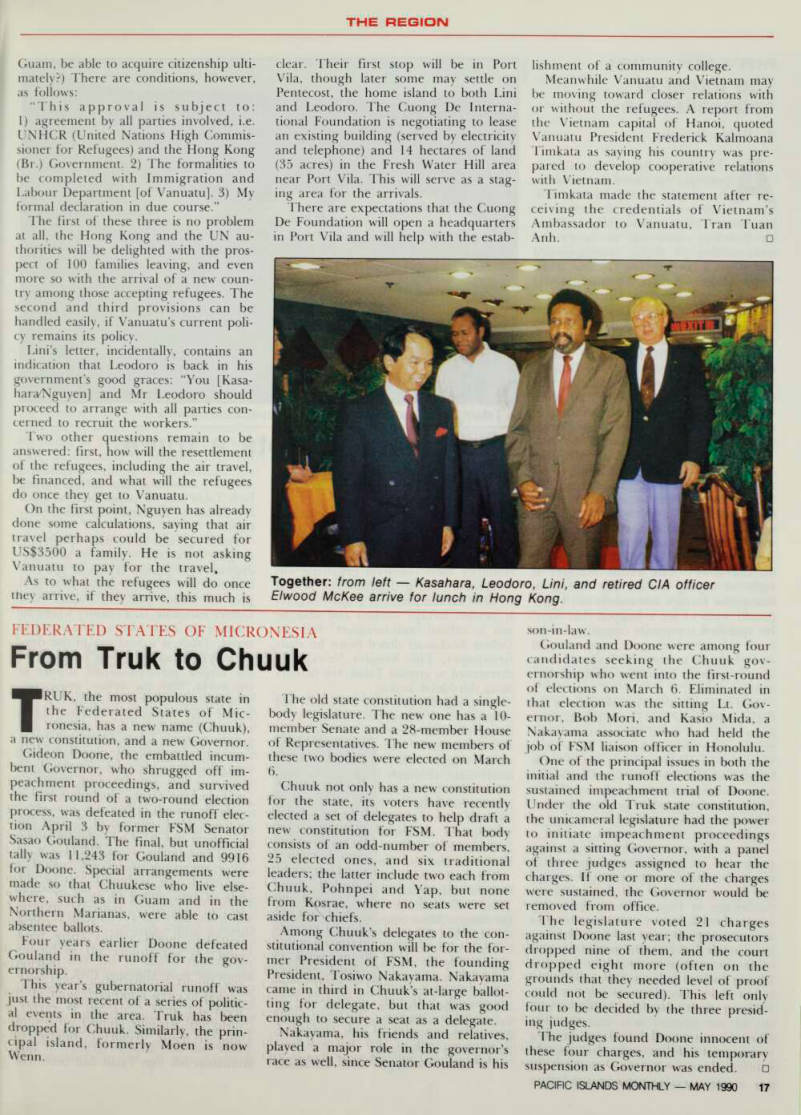
Together: from left - Kasahara, Leodoro, Lini, and retired CIA officer Elwood McKee arrive for lunch in Hong Kong.
From Truk to Chuuk
Federated States Of Micronesia
TRUK, the most populous state in the Federated States of Mic ronesia, has a new name (Chuuk), a new constitution, and a new Governor.
Gideon Doone, the embattled incum bent Governor, who shrugged off im peachment proceedings, and survived the first round of a two-round election process, was defeated in the runoff elec tion April 3 by former FSM Senator Sasao Gouland. The final, but unofficial tally was 11,243 for Gouland and 9916 for Doone. Special arrangements were made so that Chuukese who live else where, such as in Guam and in the Northern Marianas, were able to cast absentee ballots.
Four years earlier Doone defeated Gouland in the runoff for the gov
ernorship.
This year’s gubernatorial runoff was just the most recent of a series of politic al events in the area. Truk has been dropped for Chuuk. Similarly, the prin cipal island, formerly Moen is now Wenn.
The old state constitution had a single body legislature. The new one has a 10member Senate and a 28-member House of Representatives. The new members of these two bodies were elected on March 6.
Chuuk not only has a new constitution for the state, its voters have recently elected a set of delegates to help draft a new constitution for FSM. That body consists of an odd-number of members, 25 elected ones, and six traditional leaders; the latter include two each from Chuuk, Pohnpei and Yap, but none from Kpsrae, where no seats were set aside for chiefs.
Among Chuuk’s delegates to the con stitutional convention will be for the for mer President of FSM, the founding President, Tosiwo Nakayama. Nakayama came in third in Chuuk’s at-large ballot ting for delegate, but that was good enough to secure a seat as a delegate.
Nakayama, his friends and relatives, played a major role in the governor’s race as well, since Senator Gouland is his
son-in-law.
Gouland and Doone were among four candidates seeking the Chuuk gov ernorship who went into the first-round of elections on March 6. Eliminated in that election was the sitting Lt. Gov ernor, Bob Mori, and Kasio Mida, a Nakayama associate who had held the Job of FSM liaison officer in Honolulu.
One of the principal issues in both the initial and the runoff elections was the sustained impeachment trial of Doone.
Under the old Truk state constitution, the unicameral legislature had the power
to initiate impeachment proceedings
against a sitting Governor, with a panel of three judges assigned to hear the charges. If one or more of the charges were sustained, the Governor would be removed from office.
The legislature voted 21 charges against Doone last year; the prosecutors dropped nine of them, and the court dropped eight more (often on the grounds that they needed level of proof could not be secured). This left only four to be decided by the three presid
ing judges.
The judges found Doone innocent of these four charges, and his temporary suspension as Governor was ended. □
The threat of
Papua New Guinea
The threat of nationalisation
By Robin Bromby
A LEADING Papua New Guinea politician has raised doubts about the security of hundreds of mil lions of dollars of foreign investment in his country. Deputy Prime Minister Ako ka Doi has come out in favour of
nationalising all major foreign-owned
companies in Papua New Guinea. While Prime Minister Rabbie Namaliu has said the government has no nationalisation poplicy in mind, Doi’s statements must threaten what remains of business confi dence in that nation.
Doi told a provincial premiers’ confer ence in Port Moresby that the Govern ment was moving toward ensuring that Papua New Guineans take over all major
foreign-owned companies operating in
the country. “There must be a change toward economic nationalism,” he said.
The following day, Prime Minister Namaliu issued a statement trying to set foreign investors’ minds at rest. He assured the business community that the Government was committed to honour ing existing contracts and arrangement
with foreign companies.
But a few days later Doi spoke again on the issue: “The Prime Minister is right in saying we do not intend to nationalise foreign investment but I per sonally want to see it happen that way.”
He specified companies operating in the areas of stevedoring, transport, retail and wholesale as ones which should have already gone to Papua New Guinea own
ership.
Also of concern in Port Moresby is the decision by the PNG Trade Union Con gress to press for a 20 per cent wage increase for all workers at a time when the Papua New Guinea economy is being hampered by the fact that wages
are uncompetitively high by Third
World standards, while productivity and skills levels are well below those of neighbouring Asian countries.
For the moment anyway, foreign com panies including those involved in
mining and oil development are keep
ing up a public face that they still have confidence in Papua New Guinea. Pri vately, though, most expatriate managers are extremely worried by both the un predictability of the local politicians, and of the government’s failure to get any handle on the escalating law and order crisis. One Australian living in Port Moresby summed up his decision to pull out of the country next month: “You know things are grim when you choose a restaurant mainly by the level of security it offers.” □
Buchanan accepts a truce
By Robin Bromby
JUST at a time when the last thing it needed was another business crisis, the Papua New Guinea Govern ment was confronted by threats from the country’s most colourful expatriate en
trepreneur. Citing departmental refusal
to allow his companies to employ urgent ly needed foreign workers and what he saw as official “anti-foreigner” feelings, Dennis Buchanan closed down his daily newspaper, The Niugini News, and threatened to ground Talair, the nation’s main third-level airline.
It was not the first time Buchanan had threatened to leave the country after doing business there for 40 years, but the Government was quick to try and mend fences. They must have been aware that, although Buchanan is well known for his occasional outbursts, he had faced similar problems in Vanuatu last year; there, after being refused work permits for expatriate staff, Buchanan sold his Air Melanesie and pulled out all his investments in Vanuatu.
The end result of the Papua New Guinea imbroglio is likely to be that Talair will continue operating but that the Niugini News could remain closed the staff has been paid off and any new buyer is likely to be deterred by both the paper’s chronic financial losses and re vived ministerial talk of new Press con trols in Papua New Guinea (Communica tions Minister Brown Sinamoi having said he will introduce legislation to con trol all the media and would ban jour nalists from Parliament).
The latest row began when Buchanan
suddenly announced that he was closing both Talair and the paper, both of which are owned by his family company, over night.
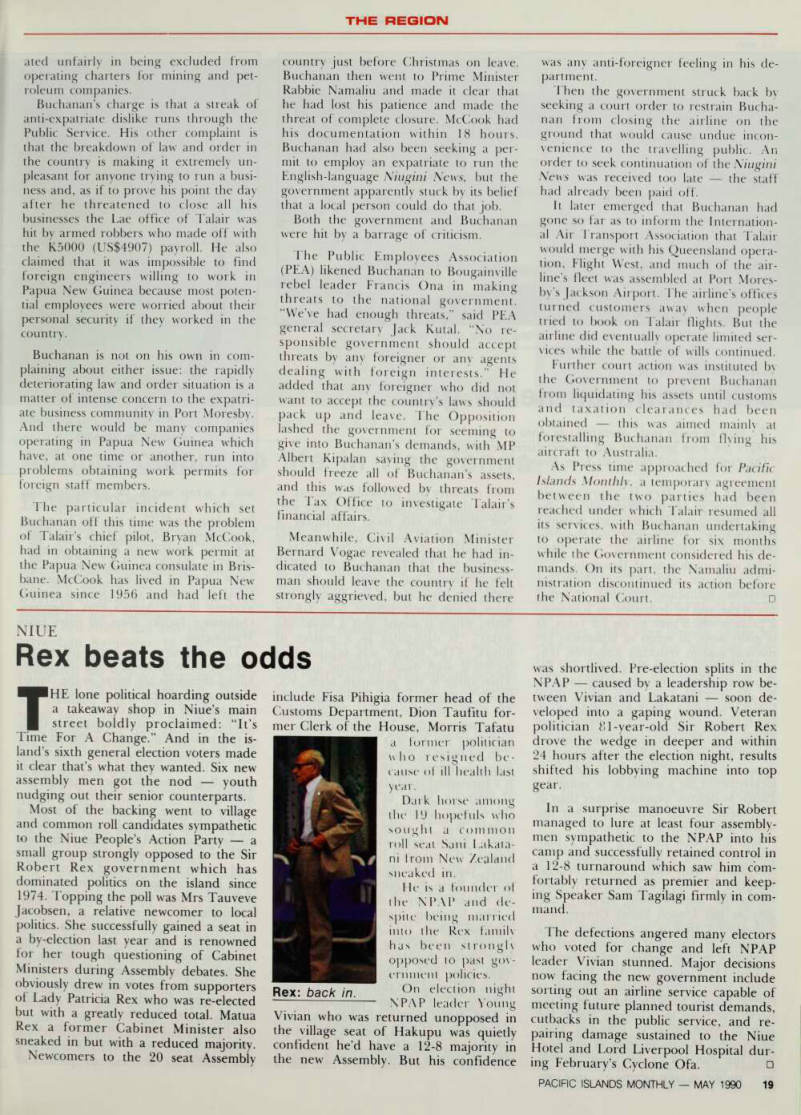
Talair operates more than 50 aircraft, ranging from Dash 8 airliners to single engined light planes. It flies to 136 des tinations and employs about 1000 peo ple, of whom 800 are Papua New Guinea nationals. In a country where air travel is the basic form of cross-country travel, Talair is a vital cog in the com munications network. It is also one of the largest privately-owned airlines in the world. With the airline, newspaper, property and other investments it is esti mated that Buchanan’s investments in Papua New Guinea total about K5O mil lion (U 5549.07 million). He is well aware that nothing like this amount would be realised if the assets were all disposed of, a factor which no doubt gave the Gov ernment some leverage.
The threat of closure arose over the issue of work permits to expatriate staff Buchanan wished to employ or, rather, the non-issue of work permit.
Government sources in Port Moresby agree much of the trouble has arisen at Papua New Guinea’s Brisbane consulate which has attracted a reputation of being difficult with expatriates seeking work permits. Buchanan has also criticised the permanent heads of the two depart ments in Port Moresby, Civil Aviation and Labour and Employment, for also
making problems for him: the depart
ment heads are, coincidentally, sisters Jean and Rose Kekedo, respectively.
There was also another grudge in that Buchanan felt that Talair had been tre
A Talair Dash 8: vital cog in the communication network.
aled unfairly in being excluded from operating charters for mining and pet
roleum companies.
Buchanan’s charge is that a streak of anti-expatriate dislike runs through the Public Service. His other complaint is that the breakdown of law and order in the country is making it extremely un pleasant for anyone trying to run a busi ness and, as if to prove his point the day after he threatened to close all his businesses the Lae office of Talair was hit by armed robbers who made off with the K5OOO (US$49O7) payroll. He also claimed that it was impossible to find foreign engineers willing to work in Papua New Guinea because most poten tial employees were worried about their personal security if they worked in the country.
Buchanan is not on his own in com plaining about either issue: the rapidly deteriorating law and order situation is a matter of intense concern to the expatri ate business community in Port Moresby.
And there would be many companies operating in Papua New Guinea which have, at one time or another, run into
problems obtaining work permits for
foreign staff members.
The particular incident which set Buchanan off this time was the problem of Talair’s chief pilot, Bryan McCook, had in obtaining a new work permit at the Papua New Guinea consulate in Bris bane. McCook has lived in Papua New Guinea since 1956 and had left the
country just before Christmas on leave.
Buchanan then went to Prime Minister Rabbie Namaliu and made it clear that he had lost his patience and made the threat of complete closure. McCook had his documentation within 18 hours.
Buchanan had also been seeking a per mit to employ an expatriate to run the English-language Niugini News, but the government apparently stuck by its belief that a local person could do that job.
Both the government and Buchanan were hit by a barrage of criticism.
The Public Employees Association (PEA) likened Buchanan to Bougainville rebel leader Francis Ona in making threats to the national government.
“We’ve had enough threats,” said PEA general secretary Jack Kutal. “No re sponsible government should accept threats by any foreigner or any agents dealing with foreign interests.” He added that any foreigner who did not want to accept the country’s laws should pack up and leave. The Opposition lashed the government for seeming to give into Buchanan’s demands, with MP Albert Kipalan saying the government should freeze all of Buchanan’s assets, and this was followed by threats from the Tax Office to investigate Talair’s financial affairs.
Meanwhile, Civil Aviation Minister Bernard Vogae revealed that he had in dicated to Buchanan that the business man should leave the country if he felt strongly aggrieved, but he denied there
was any anti-foreigner feeling in his de partment.
Then the government struck back by seeking a court order to restrain Bucha nan from closing the airline on the ground that would cause undue incon venience to the travelling public. An order to seek continuation of the A iugini News was received too late the staff had already been paid off.
It later emerged that Buchanan had gone so far as to inform the Internation al Air Transport Association that Talair would merge with his Queensland opera tion, Flight West, and much of the air line’s fleet was assembled at Port Mores by’s Jackson Airport. The airline’s offices turned customers away when people tried to book on Talair flights. But the airline did eventually operate limited ser vices while the battle of wills continued.
Further court action was instituted by the Government to prevent Buchanan from liquidating his assets until customs and taxation clearances had been obtained this was aimed mainly at forestalling Buchanan from living his aircraft to Australia.
As Press time approached for Pacific Islands Monthly . a temporary agreement between the two parlies had been reached under which Talair resumed all its services, with Buchanan undertaking to operate the airline for six months while the Government considered his de mands. On its part, the Namaliu admi nistration discontinued its action before the National Court.
Rex beats the odds
Niue
THE lone political hoarding outside
a takeaway shop in Niue’s main
street boldly proclaimed: “It’s
Time For A Change.” And in the is land’s sixth general election voters made it clear that’s what they wanted. Six new assembly men got the nod youth nudging out their senior counterparts.
Most of the backing went to village and common roll candidates sympathetic to the Niue People’s Action Party a small group strongly opposed to the Sir Robert Rex government which has dominated politics on the island since 1974. Topping the poll was Mrs Tauveve Jacobsen, a relative newcomer to local politics. She successfully gained a seat in a by-election last year and is renowned for her tough questioning of Cabinet Ministers during Assembly debates. She obviously drew in votes from supporters of Lady Patricia Rex who was re-elected but with a greatly reduced total. Matua Rex a former Cabinet Minister also sneaked in but with a reduced majority.
Newcomers to the 20 seat Assembly
include Fisa Pihigia former head of the Customs Department, Dion Taufitu for mer Clerk of the House, Morris Tafatu
a former politician who resigned be cause of ill health last year.
Dark horse among the 19 hopefuls who sought a common roll seat Sani Lakata ni from New Zealand sneaked in.
He is a founder of the NPAP and de spite being married into the Rex familv has been s trough opposed to past gov
ernment policies.
On election night NPAP leader Young
Vivian who was returned unopposed in the village seat of Hakupu was quietly confident he’d have a 12-8 majority in the new Assembly. But his confidence
was shortlived. Pre-election splits in the NPAP caused by a leadership row be tween Vivian and Lakatani soon de veloped into a gaping wound. Veteran politician PI-year-old Sir Robert Rex drove the wedge in deeper and within 24 hours after the election night, results shifted his lobbying machine into top gear.
In a surprise manoeuvre Sir Robert managed to lure at least four assembly men sympathetic to the NPAP into his camp and successfully retained control in a 12-8 turnaround which saw him com
fortably returned as premier and keep
ing Speaker Sam Tagilagi firmly in com mand.
The defections angered many electors who voted for change and left NPAP leader Vivian stunned. Major decisions now facing the new government include sorting out an airline service capable of meeting future planned tourist demands, cutbacks in the public service, and re pairing damage sustained to the Niue Hotel and Lord Liverpool Hospital dur
ing February’s Cyclone Ofa. □
Rex: back in.
Grim news on nerve gas
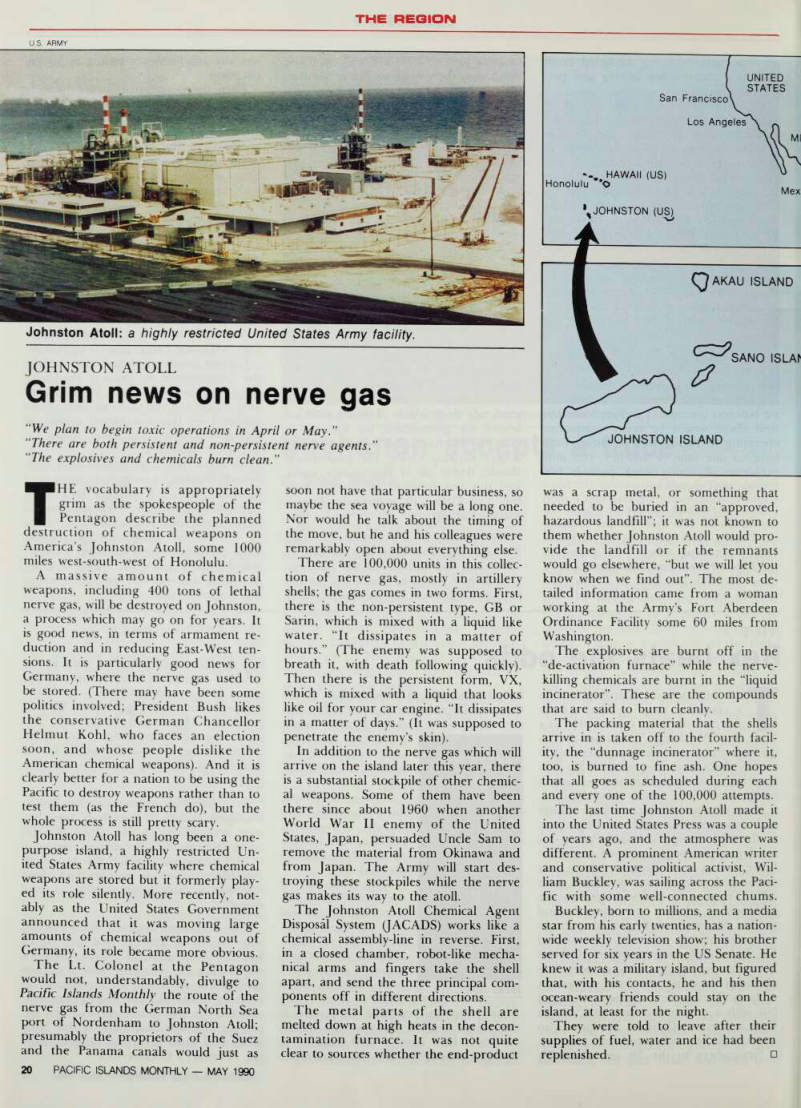
Johnston Atoll
“We plan to begin toxic operations in April or May."
“There are both persistent and non-persistent nerve agents.”
“The explosives and chemicals burn clean."
THE vocabulary is appropriately
grim as the spokespeople of the
Pentagon describe the planned
destruction of chemical weapons on America’s Johnston Atoll, some 1000 miles west-south-west of Honolulu.
A massive amount of chemical weapons, including 400 tons of lethal nerve gas, will be destroyed on Johnston, a process which may go on for years. It is good news, in terms of armament re duction and in reducing East-West ten sions. It is particularly good news for Germany, where the nerve gas used to be stored. (There may have been some politics involved; President Bush likes the conservative German Chancellor Helmut Kohl, who faces an election soon, and whose people dislike the American chemical weapons). And it is clearly better for a nation to be using the Pacific to destroy weapons rather than to test them (as the French do), but the whole process is still pretty scary.
Johnston Atoll has long been a one purpose island, a highly restricted Un ited States Army facility where chemical weapons are stored but it formerly play ed its role silently. More recently, not ably as the United States Government announced that it was moving large amounts of chemical weapons out of Germany, its role became more obvious.
The Lt. Colonel at the Pentagon would not, understandably, divulge to Pacific Islands Monthly the route of the nerve gas from the German North Sea port of Nordenham to Johnston Atoll; presumably the proprietors of the Suez and the Panama canals would just as
soon not have that particular business, so maybe the sea voyage will be a long one.
Nor would he talk about the timing of the move, but he and his colleagues were remarkably open about everything else.
There are 100,000 units in this collec tion of nerve gas, mostly in artillery shells; the gas comes in two forms. First, there is the non-persistent type, GB or Sarin, which is mixed with a liquid like water. “It dissipates in a matter of hours.” (The enemy was supposed to breath it, with death following quickly).
Then there is the persistent form, VX, which is mixed with a liquid that looks like oil for your car engine. “It dissipates in a matter of days.” (It was supposed to penetrate the enemy’s skin).
In addition to the nerve gas which will arrive on the island later this year, there is a substantial stockpile of other chemic al weapons. Some of them have been there since about 1960 when another World War II enemy of the United States, Japan, persuaded Uncle Sam to remove the material from Okinawa and from Japan. The Army will start des troying these stockpiles while the nerve gas makes its way to the atoll.
The Johnston Atoll Chemical Agent Disposal System (JACADS) works like a chemical assembly-line in reverse. First, in a closed chamber, robot-like mecha nical arms and fingers take the shell apart, and send the three principal com ponents off in different directions.
The metal parts of the shell are melted down at high heats in the decon tamination furnace. It was not quite clear to sources whether the end-product
was a scrap metal, or something that needed to be buried in an “approved, hazardous landfill”; it was not known to them whether Johnston Atoll would pro vide the landfill or if the remnants would go elsewhere, “but we will let you know when we find out”. The most de tailed information came from a woman working at the Army’s Fort Aberdeen Ordinance Facility some 60 miles from
Washington.
The explosives are burnt off in the “de-activation furnace” while the nerve killing chemicals are burnt in the “liquid incinerator”. These are the compounds that are said to burn cleanly.
The packing material that the shells arrive in is taken off to the fourth facil ity, the “dunnage incinerator” where it, too, is burned to fine ash. One hopes that all goes as scheduled during each and every one of the 100,000 attempts.
The last time Johnston Atoll made it into the United States Press was a couple of years ago, and the atmosphere was different. A prominent American writer and conservative political activist, Wil liam Buckley, was sailing across the Paci fic with some well-connected chums.
Buckley, born to millions, and a media star from his early twenties, has a nation wide weekly television show; his brother served for six years in the US Senate. He knew it was a military island, but figured that, with his contacts, he and his then ocean-weary friends could stay on the island, at least for the night.
They were told to leave after their supplies of fuel, water and ice had been replenished. □
Johnston Atoll: a highly restricted United States Army facility.
Adding colour to life in Rarotonga

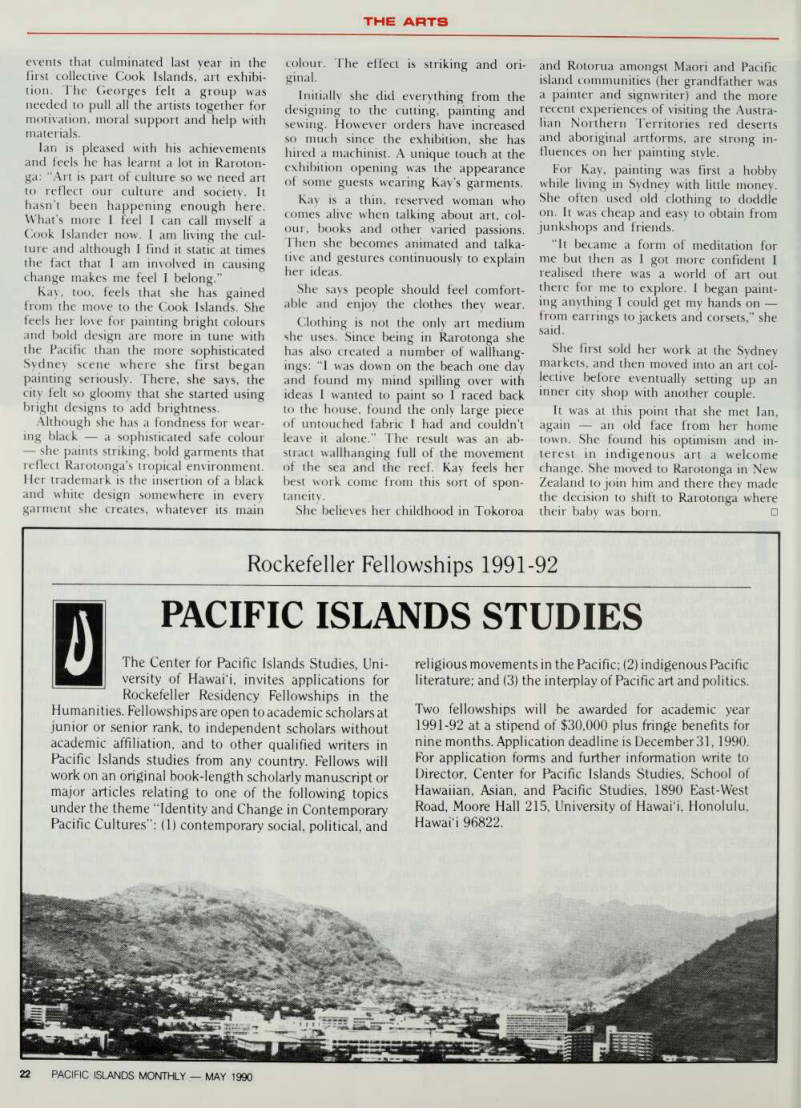
The Arts
By Angela McCarthy
TO walk into Akaoa Art Studio is a visual experience in contemporary Pacific art and design. Bold col
ourful wallhangings, paintings, bonecarv
ings and painted clothing lie or hang everywhere. No other outlet in the Cook Islands has such variety.
The two artists, Kay and lan George, arrived in Rarotonga 18 months ago from New Zealand. They say the en vironment has strongly influenced their work from the day they arrived. “My art has changed since coming here,” ex plains lan. “My colours are brighter, I have dropped the New Zealand symbol ism and the harsher contrasts. I am now using more South Pacific motifs and loc al legends and symbols.”
The new symbols highlight the central theme in lan’s paintings youth sear ching for a culture, tradition and identi ty. It is a valid theme for many Pacific Islanders living away from their home islands including lan himself.
A New Zealand-born Cook Islander, lan taught art in Rotorua, specialising in New Zealand Maori. In 1988 he was part of the Rotorua guide group for Te Maori Exhibition a collection of sacred New Zealand Maori artifacts then on show in Auckland. Recalls lan: “There I was telling people about Maori carvings and realising that I knew no thing at all about my own Cook Island Culture. Yet our culture is our identity and as a painter and an individual I felt I needed to know about my own culture to develop further.” So lan talked Kay
into moving to Rarotonga.
Rarotonga was initially a disappoint ment in the area of visual contemporary artwork. Aside from Mike Tavioni’s tye dying and carving studio there was little to see, although the performing arts were strong. To lan, even the woodcarv ing was disappointing, because it was orientated too much to the tourist mar ket. The foundations for the develop ment of art did not exist. Art was not taught formally in schools at any level, and there were very few support services or organisations with which to exchange information. The artists were there. But their profile was low.
In need of a job lan presented himself to the Education Department emphasis ing his art background. He was im
mediately employed as an English
teacher but asked to come up with an outline for an art programme for the following year. The Department was keen to have a formal school art prog
ramme running to help prepare youths
for the South Pacific Arts and Cultural Festival in Rarotonga in 1992. Before lan, there was no-one with the experi ence to do it.
Since then lan has established an art department at the national high school, now in its second year, and runs ongoing courses at the Cook Islands primary training college. He is also writing a for mal art curriculum for the Cook Islands. lan is quiet, but determined. His ponytail and casual clothes contrast with his piercing eyes and resolute manner.
He believes strongly in what is important in life and is prepared to put time and
energy into achieving his goals. His en thusiasm for his art and artforms in the Pacific is infectious, as the large numbers of students wanting to take his art classes show.
Somehow, along with the art educa tion, lan also managed to keep produc ing his own artwork. As well as contem porary Maori paintings he does black ink drawings which were popular in the art exhibition Kay and lan held last year.
He also carves. He was a woodcarver in New Zealand. In Rarotonga he is ex perimenting with bone because of the difficulty getting wood. The local carvers use demolition wood offcuts which is not readily available. Therefore lan realise on friends and family in New Zealand to send beef bone supplies to him. lan’s bonecarvings are beautiful. They are more angular than New Zealand Maori pendants and have distinct Cook Island motifs. His work is recognisable.
At a more traditional level lan is re searching the existence of a Cook Island equivalent of the New Zaland manaia, which is a lizard-like spiritual motif of life and death, prominent in some form in most Polynesian art. Because of the common ancestry of New Zealand and Cook Islands Maori he feels sure it ex isted but destroyed by the missionaries because of its symbolism. Once he finds it he wants to re-establish it, through paintings and carvings, as a traditional spiritual motif of the Cook Islands.
Artwork aside, lan, Kay and other loc al artists have set up the Te Pua Neinei Arts and Cultural Society. The group has a bi-monthly newsletter and various
Kay and lan George: “We need art to reflect our culture and society.”
events that culminated last year in the first collective Cook Islands, art exhibi tion. The Georges felt a group was needed to pull all the artists together for motivation, moral support and help with materials. lan is pleased with his achievements and feels he has learnt a lot in Raroton ga; “Art is part of culture so we need art to reflect our culture and society. It hasn’t been happening enough here.
What’s more I feel I can call myself a Cook Islander now. I am living the cul ture and although I find it static at times the fact that I am involved in causing change makes me feel I belong.”
Kay, too, feels that she has gained from the move to the Cook Islands. She feels her love for painting bright colours and bold design are more in tune with the Pacific than the more sophisticated Sydney scene where she first began painting seriously. There, she says, the city felt so gloomy that she started using bright designs to add brightness.
Although she has a fondness for wear ing black a sophisticated safe colour she paints striking, bold garments that reflect Rarotonga’s tropical environment.
Her trademark is the insertion of a black and white design somewhere in every garment she creates, whatever its main
colour. The effect is striking and ori ginal.
Initially she did everything from the
designing to the cutting, painting and
sewing. However orders have increased so much since the exhibition, she has hired a machinist. A unique touch at the exhibition opening was the appearance of some guests wearing Kay’s garments.
Kay is a thin, reserved woman who comes alive when talking about art, col our, books and other varied passions.
Then she becomes animated and talka tive and gestures continuously to explain her ideas.
She says people should feel comfort able and enjoy the clothes they wear.
Clothing is not the only art medium she uses. Since being in Rarotonga she has also created a number of wallhang ings: “I was down on the beach one day and found my mind spilling over with ideas I wanted to paint so I raced back to the house, found the only large piece of untouched fabric I had and couldn’t leave it alone.” The result was an ab stract wallhanging full of the movement of the sea and the reef. Kay feels her best work come from this sort of spon
taneity.
She believes her childhood in Tokoroa
and Rotorua amongst Maori and Pacific island communities (her grandfather was a painter and signwriter) and the more recent experiences of visiting the Austra lian Northern Territories red deserts and aboriginal artforms, are strong in fluences on her painting style.
For Kay, painting was first a hobby while living in Sydney with little money.
She often used old clothing to doddle on. It was cheap and easy to obtain from junkshops and friends.
“It became a form of meditation for me but then as I got more confident I realised there was a world of art out there for me to explore. I began paint ing anything I could get my hands on from earrings to jackets and corsets,” she said.
She first sold her work at the Sydney markets, and then moved into an art col lective before eventually setting up an inner city shop with another couple.
It was at this point that she met lan, again an old face from her home town. She found his optimism and in terest in indigenous art a welcome change. She moved to Rarotonga in New Zealand to join him and there they made the decision to shift to Rarotonga where their baby was born. □
Advertisements & other items, p. 22 (1 item)
Pacific Islands Studies
Rockefeller Fellowships 1991-92
1
The Center for Pacific Islands Studies, University of Hawai'i, invites applications for Rockefeller Residency Fellowships in the Humanities. Fellowships are open to academic scholars at junior or senior rank, to independent scholars without academic affiliation, and to other qualified writers in Pacific Islands studies from any country. Fellows will work on an original book-length scholarly manuscript or major articles relating to one of the following topics under the theme “Identity and Change in Contemporary Pacific Cultures”: (1) contemporary social, political, and religious movements in the Pacific; (2) indigenous Pacific literature; and (3) the interplay of Pacific art and politics.
Two fellowships will be awarded for academic year 1991-92 at a stipend of $30,000 plus fringe benefits for nine months. Application deadline is December 31,1990.
For application forms and further information write to Director, Center for Pacific Islands Studies, School of Hawaiian, Asian, and Pacific Studies, 1890 East-West Road, Moore Hall 215, University of Hawafi, Honolulu, Hawai'i 96822.
P
The right of the unborn
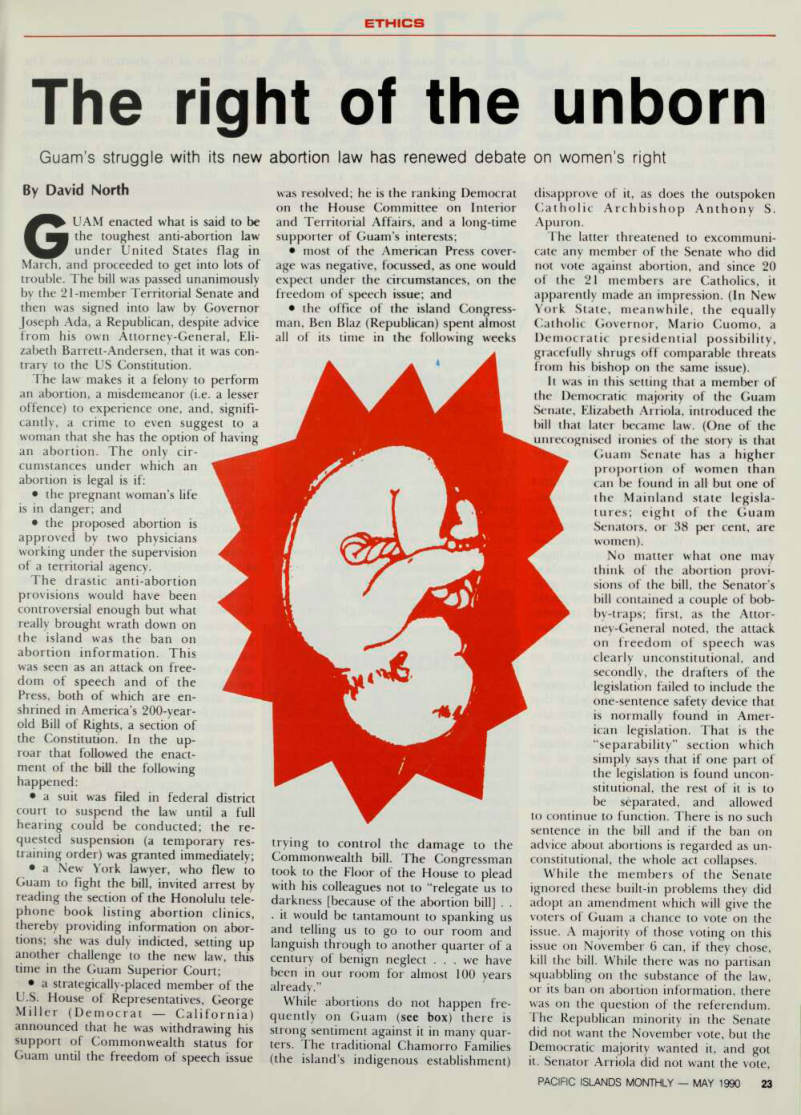
Guam’s struggle with its new abortion law has renewed debate on women’s right
By David North
UAM enacted what is said to be ■ ■ the toughest anti-abortion law under United States flag in March, and proceeded to get into lots of trouble. The bill was passed unanimously by the 21-member Territorial Senate and then was signed into law by Governor
Joseph Ada, a Republican, despite advice
from his own Attorney-General, Eli zabeth Barrett-Andersen, that it was con trary to the US Constitution.
The law makes it a felony to perform an abortion, a misdemeanor (i.e. a lesser offence) to experience one, and, signifi cantly, a crime to even suggest to a woman that she has the option of having
an abortion. The only cir cumstances under which an abortion is legal is if: • the pregnant woman’s life is in danger; and • the proposed abortion is approved by two physicians working under the supervision of a territorial agency.
The drastic anti-abortion provisions would have been controversial enough but what really brought wrath down on the island was the ban on abortion information. This was seen as an attack on free dom of speech and of the Press, both of which are en shrined in America’s 200-year old Bill of Rights, a section of the Constitution. In the up roar that followed the enact ment of the bill the following
happened:
• a suit was filed in federal district court to suspend the law until a full hearing could be conducted; the re quested suspension (a temporary res training order) was granted immediately; • a New York lawyer, who flew to Guam to fight the bill, invited arrest by reading the section of the Honolulu tele phone book listing abortion clinics, thereby providing information on abor tions; she was duly indicted, setting up another challenge to the new law, this time in the Guam Superior Court; • a strategically-placed member of the U.S. House of Representatives, George Miller (Democrat California) announced that he was withdrawing his support of Commonwealth status for Guam until the freedom of speech issue
was resolved; he is the ranking Democrat on the House Committee on Interior and Territorial Affairs, and a long-time supporter of Guam’s interests; • most of the American Press coverage was negative, focussed, as one would expect under the circumstances, on the freedom of speech issue; and • the office of the island Congressman, Ben Blaz (Republican) spent almost all of its time in the following weeks
trying to control the damage to the Commonwealth bill. The Congressman took to the Floor of the House to plead with his colleagues not to “relegate us to darkness [because of the abortion bill] . . . it would be tantamount to spanking us and telling us to go to our room and languish through to another quarter of a century of benign neglect ... we have been in our room for almost 100 years
already.”
While abortions do not happen fre quently on Guam (see box) there is strong sentiment against it in many quar ters. The traditional Chamorro Families (the island’s indigenous establishment)
disapprove of it, as does the outspoken
Catholic Archbishop Anthony S.
Apuron.
The latter threatened to excommuni cate any member of the Senate who did not vote against abortion, and since 20 of the 21 members are Catholics, it apparently made an impression. (In New York State, meanwhile, the equally Catholic Governor, Mario Cuomo, a Democratic presidential possibility, gracefully shrugs off comparable threats from his bishop on the same issue).
It was in this setting that a member of the Democratic majority of the Guam Senate, Elizabeth Arriola, introduced the bill that later became law. (One of the unrecognised ironies of the story is that
Guam Senate has a higher proportion of women than can be found in all but one of the Mainland state legisla tures; eight of the Guam Senators, or 38 per cent, are women).
No matter what one may think, of the abortion provi sions of the bill, the Senator’s bill contained a couple of bob by-traps; first, as the Attor ney-General noted, the attack on freedom of speech was clearly unconstitutional, and secondly, the drafters of the legislation failed to include the one-sentence safety device that is normally found in Amer ican legislation. That is the “separability” section which simply says that if one part of the legislation is found uncon stitutional, the rest of it is to be separated, and allowed
to continue to function. There is no such sentence in the bill and if the ban on advice about abortions is regarded as un constitutional, the whole act collapses.
While the members of the Senate
ignored these built-in problems they did
adopt an amendment which will give the voters of Guam a chance to vote on the issue. A majority of those voting on this issue on November 6 can, if they chose, kill the bill. While there was no partisan squabbling on the substance of the law, or its ban on abortion information, there was on the question of the referendum.
The Republican minority in the Senate did not want the November vote, but the Democratic majority wanted it, and got it. Senator Arriola did not want the vote,
but abstained on the issue.
Governor Ada was not happy with the choices he faced. (He could sign the bill, let it be law without his signature or veto it). The Governor, like Congressman Blaz, is opposed to abortion, but, like the Congressman, prefers a more moderate stand on the issue in that he would per mit abortions in cases of rape, incest or a grossly deformed foetus, as well as in cases where the mother’s life was in
danger.
Rather than using the veto to seek these modifications he went ahead and signed the bill saying: “I still believe that a foetus is a human being. And, there fore, as human beings they have rights, civil rights.” He said that Guam would develop a programme to accept, and to find adoptive homes, for unwanted babies as an "alternative to abortion”.
Between the passage by the Senate, and the Governor’s signature, the story had hit the front page of the New York Times, and secured the attention of Mainland lobbyists, politicians and com mentators; there was sustained Mainland media attention to every aspect of the issue (see related story).
The first lobbyist on the scene was a photogenic New Yorker, Janet Benshoof, Director of the Reproductive Rights Pro ject of the American Civil Liberties Un ion (ACLU). (ACLU lawyers, incidental ly, have been active in the past in litiga tion involving Palau and nuclear weapons, taking the anti-nuclear posi tion). Benshoof had been alerted to the issue by another Mainland-trained, female lawyer, Anita Arriola, the Sena tor’s daughter who has since become a leader of the abortion rights group on Guam.
Benshoof sought to dissuade Governor Ada from signing the bill, and when that did not work, and the bill became law, she challenged it at a meeting in Guam’s Press Club. It was a carefully staged,
thoroughly-announced breaking of the
law. The Attorney-General, Barrett- Andersen, knew what was going to hap pen, and had two of her investigators in the audience, one with a tape recorder.
And the Press and abortion-rights sup porters were on hand as well. It was then that Benshoof invited arrest by reading from the medical section of the Honolulu phone book. The younger Arriola was to be her defence lawyer in Guam’s Superior Court. But cooler heads prevailed, and, rather than face sure defeat in the court room, the case
against Benshoof was dropped.
Guam judges, perhaps because of the apparent prowess of the anti-abortion faction, have shown a lack of interest in hearing these cases. Benshoofs arrest was first brought before Superior Court Judge Ramon Diaz, who said it would not be appropriate for him to hear the
case, which wound up in the court of Peter C. Siguenza. Similarly, the one judge on the federal bench in Guam, Cristobal Duenas, ducked the case and the court system had to fly in the Feder al District Court Judge from the North ern Marianas, Alex Munson.
Munson, presumably looking at the free speech issue, let it be known that “this will be the easiest trial of my life”.
The case that Munson will hear on May 8 is the attempt on the part of the ACLU to dismiss the Guam law as un constitutional; Benshoof is expected to make that argument. She quickly won the first round on this issue, when Mun son agreed to grant a temporary res
training order, essentially suspending the
operations of the law until he can make a decision.
A day or so later the other side of the issue brought in its own Mainland lob byist. (The American terms for the two factions are pro-choice or choice, for those opposing abortion restrictions, and pro-life or life, for those supporting such restrictions). The pro-lifer was an equally photogenic male, Brian Young, a staff member of the American Life Lobby from California. Senator Arriola met him at the Won Pat International Air port with a red carnation lei. One of the banners displayed at the terminal was one showing a headless picture of baby, being held by forceps, as it was placed in a glass container; the caption read: “Freedom of Choice?”
Meanwhile, back in Washington, Con gressman Ben Blaz struggled with the
side-effects of the abortion dispute. The
Congressman, over a long period of
time, has secured the agremeent of 174 House members to co-sponsor his bill making Guam a commonwealth. It is not exactly a hot issue among most members of Congress, but Guam’s position is understandable to them and Blaz is well liked; the Commonwealth Bill is, and probably will continue to be, the most
significant challenge in Blaz’ legislative
career.
When the word came that Governor Ada had signed the bill, Congressman Miller objected strongly, He sent a letter to all of the other co-signers of Blaz’
Commonwealth 81l asking that they join
him by withdrawing as sponsors of the bill. His rationale was that “states and territories may have the right to pass laws that deny women the right to choose, but no government has the right to deny its citizens freedom of speech”.
Miller’s position was doubly troubling
to Blaz; first, Miller is expected, at some point, to succeed the ailing chairman of the House Interior Committee, Morris Udall (Democrat-Arizona), and this is the committee that handles all territorial leg islations. Secondly, Blaz will need the support of urban liberals in the House, like Miller, if the Commonwealth bill is to succeed.
One of the reasons why the Mainland is so interested in the Guam bill is be cause it is, at the moment, the most like ly vehicle to bring the abortion issue back to the U.S. Supreme Court.
Some 20 years ago a more liberal court ruled, in Roe V. Wade, that states cannot bar women from having abor tions. Legal abortions then became a routine, if not applauded, part of Amer ican life. Last year a more conservative court (President Reagan made several life-time appointments to the court) took a step back from Roe V. Wade and said, in a Missouri case, that states could limit the right of women to have abortions.
The Missouri case had two immediate consequences, one political and the other
legal. Politically, it energised the pro
choice movement. The abortion issues became a significant one in state elec tions, and the consensus was that pro choice candidates benefitted thereby.
Legally, the Missouri case has stimu lated the pro-life forces to find another test case to move to the Supreme Court.
They want one which will force the Jus tices to decide not whether or not a legislature can limit a woman’s right to abortion, but whether the state can eli minate that right. The lifers have been thwarted in state after state, as either in the legislature, or, in the case of heavily- Mormon Idaho, the Governor, has blocked such legislation. □
Abortion rare
WHILE the debate is at a fever pitch over abortions in Guam they are infre quent, at least by United States Mainland standards.
In recent years there have been more than 3000 five births each year on Guam, in comparison there were 82 abortions recorded in 1988 by public health authorities rising to 159 in 1989.
The latter figure works out to 53 abor tions to 1000 live births, the usual statis tical measuring device.
On the Mainland, the ratio is about 425 abortions to 1000 live births; in Hawaii it is higher, 611 per thousand, while in Washington, D.C. there are routinely more abortions than live births.
Some of the abortions in Guam in re cent years may have been performed on women from the nearby Commonwealth of the Northern Marianas, where abor tions are illegal. The constitutionality of the Marianas ban may be challenged as a by-product of the legal activity on this matter in Guam. □
Pacific
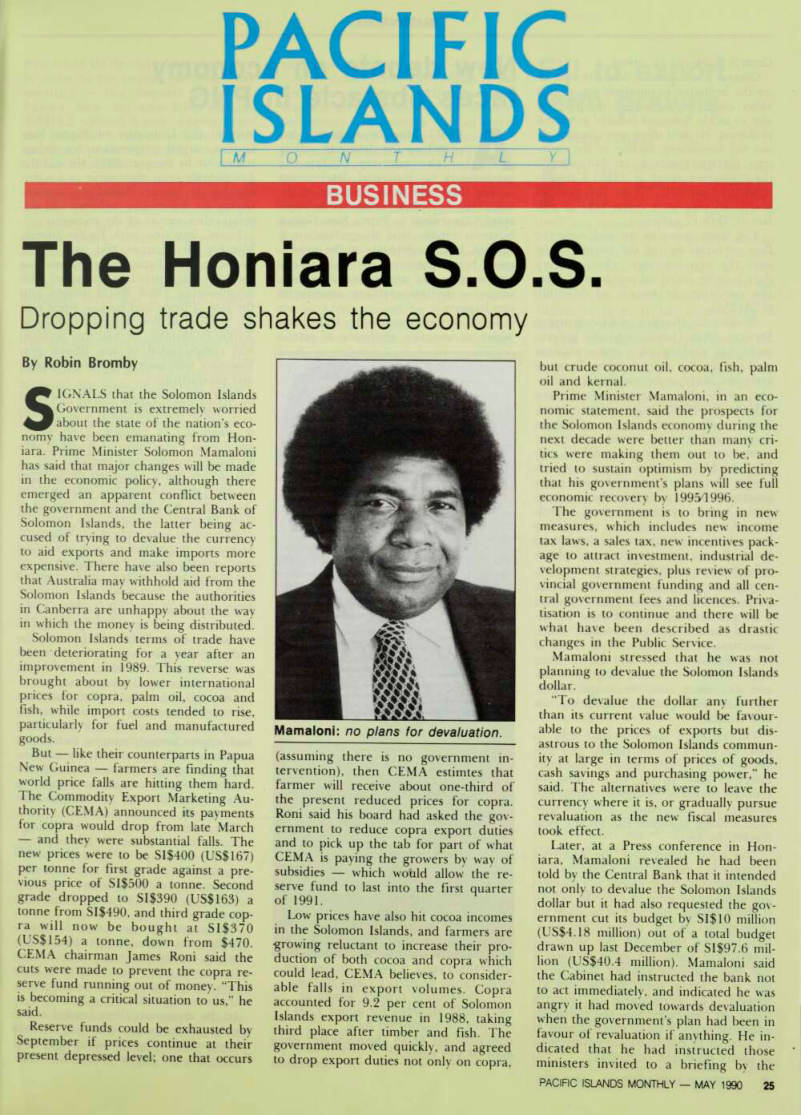
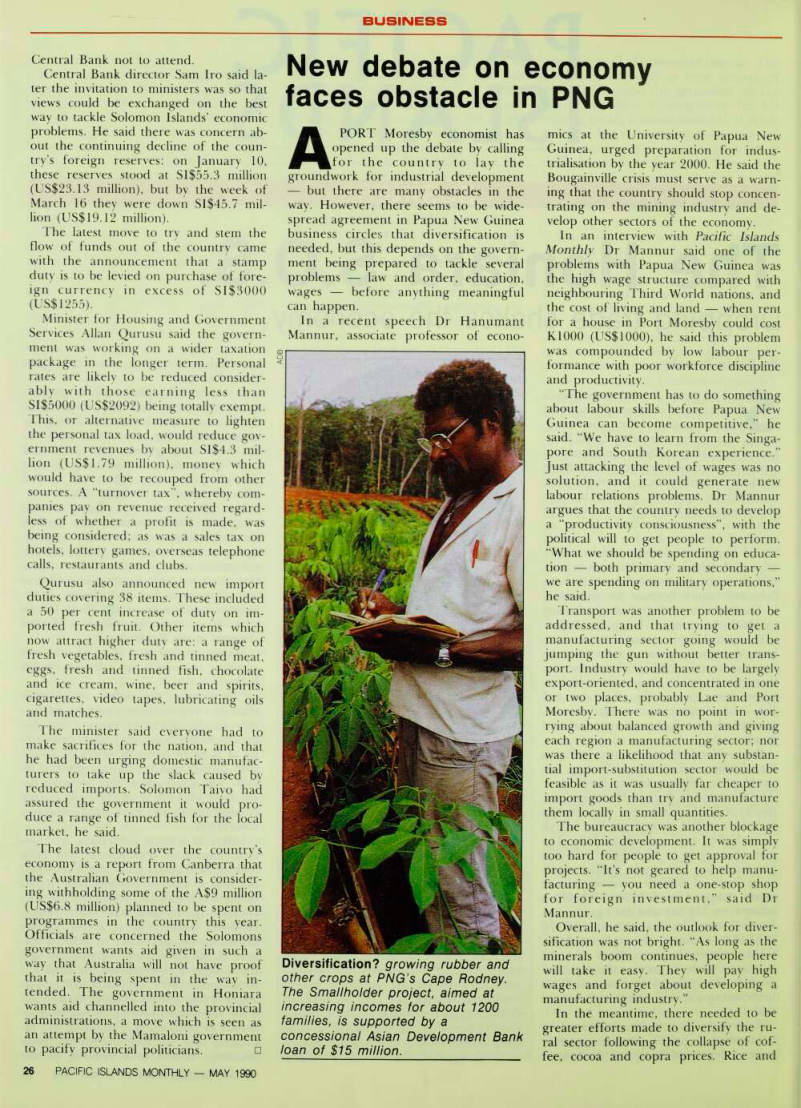
Islands
Monthly
Business
The Honiara S.O.S.
Dropping trade shakes the economy
By Robin Bromby
SIGNALS that the Solomon Islands Government is extremely worried about the state of the nation’s eco nomy have been emanating from Hon iara. Prime Minister Solomon Mamaloni has said that major changes will be made in the economic policy, although there emerged an apparent conflict between the government and the Central Bank of Solomon Islands, the latter being ac cused of trying to devalue the currency to aid exports and make imports more expensive. There have also been reports that Australia may withhold aid from the Solomon Islands because the authorities in Canberra are unhappy about the way in which the money is being distributed.
Solomon Islands terms of trade have been deteriorating for a year after an improvement in 1989. This reverse was brought about by lower international prices for copra, palm oil, cocoa and fish, while import costs tended to rise, particularly for fuel and manufactured goods.
But like their counterparts in Papua New Guinea farmers are finding that world price falls are hitting them hard.
The Commodity Export Marketing Au thority (CEMA) announced its payments for copra would drop from late March and they were substantial falls. The new prices were to be Sls4oo (US$l67) per tonne for first grade against a pre vious price of Slssoo a tonne. Second grade dropped to 515390 (US$l63) a tonne from 515490, and third grade cop ra will now be bought at 515370 (US$l54) a tonne, down from $470.
CEMA chairman James Roni said the cuts were made to prevent the copra re serve fund running out of money. “This is becoming a critical situation to us,” he said.
Reserve funds could be exhausted by September if prices continue at their present depressed level; one that occurs
(assuming there is no government in tervention), then CEMA estimtes that farmer will receive about one-third of the present reduced prices for copra.
Roni said his board had asked the gov ernment to reduce copra export duties and to pick up the tab for part of what CEMA is paying the growers by way of subsidies which wofald allow the re serve fund to last into the first quarter of 1991.
Low prices have also hit cocoa incomes in the Solomon Islands, and farmers are ■growing reluctant to increase their pro duction of both cocoa and copra which could lead, CEMA believes, to consider able falls in export volumes. Copra accounted for 9.2 per cent of Solomon Islands export revenue in 1988, taking third place after timber and fish. The government moved quickly, and agreed to drop export duties not only on copra,
but crude coconut oil, cocoa, fish, palm oil and kernal.
Prime Minister Mamaloni, in an eco nomic statement, said the prospects for the Solomon Islands economy during the next decade were better than many cri tics were making them out to be, and tried to sustain optimism by predicting that his government’s plans will see full economic recovery by 1995/1996.
The government is to bring in new measures, which includes new income lax laws, a sales tax, new incentives pack age to attract investment, industrial de velopment strategies, plus review of pro vincial government funding and all cen tral government fees and licences. Priva tisation is to continue and there will be what have been described as drastic changes in the Public Service.
Mamaloni stressed that he was not planning to devalue the Solomon Islands dollar.
“To devalue the dollar any further than its current value would be favour able to the prices of exports but dis astrous to the Solomon Islands commun ity at large in terms of prices of goods, cash savings and purchasing power,” he said. The alternatives were to leave the currency where it is, or gradually pursue revaluation as the new fiscal measures took effect.
Later, at a Press conference in Hon iara, Mamaloni revealed he had been told by the Central Bank that it intended not only to devalue the Solomon Islands dollar but it had also requested the gov ernment cut its budget by Sls 10 million (US$4.lB million) out of a total budget drawn up last December of 51597.6 mil lion (US$4O.4 million). Mamaloni said the Cabinet had instructed the bank not to act immediately, and indicated he was angry it had moved towards devaluation when the government’s plan had been in favour of revaluation if anything. He in dicated that he had instructed those ministers invited to a briefing by the
Mamaloni: no plans for devaluation.
Central Bank not to attend.
Central Bank director Sam Iro said la ter the invitation to ministers was so that views could be exchanged on the best way to tackle Solomon Islands’ economic problems. He said there was concern ab out the continuing decline of the coun try’s foreign reserves: on January 10, these reserves stood at 51555.3 million (U 5523.13 million), but by the week of March 16 they were down 51545.7 mil lion (U 5519.12 million).
The latest move to try and stem the flow of funds out of the country came with the announcement that a stamp duty is to be levied on purchase of fore ign currency in excess of Sls3ooo
(US$l255).
Minister for Housing and Government Services Allan Qurusu said the govern ment was working on a wider taxation package in the longer term. Personal rates are likely to be reduced consider ably with those earning less than Slssooo (US$2O92) being totally exempt.
This, or alternative measure to lighten the personal tax load, would reduce gov ernment revenues by about 5154.3 mil lion (US$l.79 million), money which would have to be recouped from other sources. A “turnover tax”, whereby com panies pay on revenue received regard less of whether a profit is made, was being considered; as was a sales tax on hotels, lottery games, overseas telephone calls, restaurants and clubs.
Qurusu also announced new import duties covering 38 items. These included a 50 per cent increase of duty on im ported fresh fruit. Other items which now attract higher duty are: a range of fresh vegetables, fresh and tinned meat, eggs, fresh and tinned fish, chocolate and ice cream, wine, beer and spirits, cigarettes, video tapes, lubricating oils and matches.
The minister said everyone had to make sacrifices for the nation, and that he had been urging domestic manufac turers to take up the slack caused by reduced imports. Solomon Taiyo had assured the government it would pro duce a range of tinned fish for the local market, he said.
The latest cloud over the country’s economy is a report from Canberra that the Australian Government is consider ing withholding some of the As 9 million (US$6.B million) planned to be spent on programmes in the country this year.
Officials are concerned the Solomons government wants aid given in such a way that Australia will not have proof that it is being spent in the way in tended. The government in Honiara wants aid channelled into the provincial administrations, a move which is seen as an attempt by the Mamaloni government to pacify provincial politicians. □
New debate on economy
faces obstacle in PNG
ABORT Moresby economist has
opened up the debate by calling
for the country to lay the groundwork for industrial development but there are many obstacles in the way. However, there seems to be wide spread agreement in Papua New Guinea business circles that diversification is needed, but this depends on the govern ment being prepared to tackle several problems law and order, education,
wages before anything meaningful
can happen.
In a recent speech Dr Hanumant Mannur, associate professor of econo-
mics at the University of Papua New Guinea, urged preparation for indus trialisation by the year 2000. He said the Bougainville crisis must serve as a warn ing that the country should stop concen trating on the mining industry and de velop other sectors of the economy.
In an interview with Pacific Islands Monthly Dr Mannur said one of the problems with Papua New Guinea was the high wage structure compared with neighbouring Third World nations, and the cost of living and land when rent for a house in Port Moresby could cost KlOOO (US$1000), he said this problem was compounded by low labour per formance with poor workforce discipline
and productivity.
“The government has to do something about labour skills before Papua New Guinea can become competitive,” he said. “We have to learn from the Singa pore and South Korean experience.”
Just attacking the level of wages was no solution, and it could generate new labour relations problems. Dr Mannur argues that the country needs to develop a “productivity consciousness”, with the political will to get people to perform.
“What we should be spending on educa tion both primary and secondary
we are spending on military operations,”
he said.
Transport was another problem to be addressed, and that trying to get a manufacturing sector going would be jumping the gun without better trans port. Industry would have to be largely export-oriented, and concentrated in one or two places, probably Lae and Port Moresby. There was no point in wor
rying about balanced growth and giving
each region a manufacturing sector; nor was there a likelihood that any substan tial import-substitution sector would be feasible as it was usually far cheaper to import goods than try and manufacture them locally in small quantities.
The bureaucracy was another blockage to economic development. It was simply too hard for people to get approval for projects. “It’s not geared to help manu facturing you need a one-stop shop for foreign investment,” said Dr Mannur.
Overall, he said, the outlook for diver sification was not bright. “As long as the minerals boom continues, people here will take it easy. They will pay high wages and forget about developing a
manufacturing industry.”
In the meantime, there needed to be greater efforts made to diversify the ru ral sector following the collapse of cof fee, cocoa and copra prices. Rice and
Diversification? growing rubber and other crops at PNG’s Cape Rodney.
The Smallholder project, aimed at increasing incomes for about 1200 families, is supported by a concessional Asian Development Bank loan of $15 million.
fruit could be developed in many areas in order to cut imports of those com modities rice imports alone cost Papua New Guinea KBO million (US$7B.9 million) a year. Fishing could also help, but it was an industry still in its infancy producing export revenue of a mere K 9 million a year.
Graham Hogg, executive director of the Papua New Guinea Employers’ Fed eration, said that much investment was “on hold” simply due to fear fear of the implications of the Bougainville cri sis, and of serious law and order prob lems throughout the country.
But, said Hogg, even without those problems there was a general feeling that there were limited opportunities for
industrial expansion or development.
The average urban wage was eight times that of typical rates in South-East Asia, while rural wages were 3.5 times higher.
Without any sizeable internal market, these cost factors were a major barrier to
developing a manufacturing sector.
The PNG Chamber of Commerce is now engaged on preparing a submission to the national government aimed to overcoming blockages which inhibit the private sector and which are currently in its view inhibiting new investment.
Chamber of Commerce President Stan Joyce said the general view in the private sector was that law and order needed to be re-established through Papua New Guinea. Also, bureaucratic blockages needed to be eliminated, such as those which made it difficult to acquire visas and work permits.
Joyce said it was difficult to encourage investors into a country where they could be afraid for their lives.
The country had too many regula tions. A local person had to get official permission to go into business with a
foreigner, and major superannuation
funds had a great deal of money but were very restricted as to how they could invest they could not go into the stock market, for example which was a se vere inhibitor to the development of a
local capital market.
In a recent article, John Millett of the Institute of National Affairs in Port Moresby drew attention to the fact that the country had intensive but not exten sive growth. And another problem; “The population increase is mostly in the rural areas and hence that is where most of the output increase must come from.
Such a focus would dictate, for example, that much more effort be put into mobi lising customary land than into exploit ing other natural resources.”
Millett said it was the unbalanced de velopment strategy which was causing the breakdown in law and order. Crop diversification alone could not overcome the problems caused by low prices for the main export agricultural products.
“Tea was introduced into the High lands to reduce dependency on coffee.
Villagers and smallholders weren’t attracted to it they dedicated their land to the crop providing the best re turns, measured in the broadest sense.
On the basis of relative prices, of tea and coffee, some plantations switched from tea to coffee, at considerable cost in both investment and foregone produc tion. Today relative prices of these two crops have reversed for how long, though, is another question,” Millett said.
No amount of crop diversification could prevent the individual farmers from the behaviour of his particular crop. Millet argues that consolidation rather than diversification was needed now, especially in the rural sector.
What is clear is that the debate about the fundamental strategy for Papua New Guinea’s economy is only beginning. Mil lett makes the point that “three miner als”, four major crops plus a few minor ones, timber and fish seems to be an impressive line-up for the size of the economy”, so the question could well be asked: why are so many people so wor ried. It is this fear in the minds of inves tors which could be the main inhibitor to Papua New Guinea’s short-term develop ment. □
Rice trials a failure TRIALS with rice cultivation in Morobe’s Markham Valley have been de cribed as a failure, although Rice Indus tries Pty Ltd the company behind the scheme said it was still determined to develop the industry on a commercial scale. It said the first experiment failed because of poor soil, and problems with
management techniques, the irrigation
and weed control.
Livestock and Agriculture Minister Galen Lang said the Government still held high hopes that rice would prove a viable industry in Papua New Guinea.
Telecommunications boost ABOUT KBO million (U 5578.52 million) is to be spent by the Post and Telecom munications Corporation to upgrade communications throughout Papua New Guinea. The new works announced by Communications Minister Brown Sina moi include money for more rural tele phone services, a contract to digitalise Papua New Guinea’s telecommunications network, a new headquarters building in Port Moresby, cable and transmission equipment and a satellite development programme.
Fiji to export
farm prawns
By Penny Gibson
FIJI will begin exporting salt-water
prawns in September following the recent takeover of the country’s only prawn farm, declared bankrupt in 1988 and closed in 1989.
Coral Reef Prawns (Fiji) Ltd and its parent company, Barrier Reef Fisheries (Australia) Ltd, are investing over Fsl million to upgrade and reorganise the farm to turn it into a commercially pro fitable venture. It has already begun supplying the local market.
With international prawn prices be tween $lO-$2O a kilo and an initial pro duction of two tonnes a week, a con servative estimate of sales is over $20,000 a week, or $1 million a year. The local market, mainly the tourism industry, will absorb 30 tonnes a year, with the rest being exported to New Zealand, Austra lia and, perhaps, the United States.
Farm manager, Australian aquaculture consultant Paul Thomas, also anticipates
becoming a regional supplier of juvenile
or post-larvae prawns to farms that do not have a specialised hatchery, which is necessary to produce juvenile prawns raised from eggs. The company has already exported to the Solomon Islands and Thomas expects to supply Fiji far mers or village co-operatives who take up the lucrative prawn farm business.
The hatchery began production in ear
ly March and can produce three million prawns a month, although the farm will initially require only five million a year.
The company will swing into full pro duction after the completion of major reconstruction work on the 25 hectares of ponds to enable improved manage ment of the growing prawns, expected by the end of this month. In two years the company wili invest in the necessary
equipment to intensify production two
or three fold.
The prawn farm is on the north coast of Fiji’s main island of Viti Levu, on reclaimed land that is too saline for other forms of agriculture. It has had a
chequered history, being initially funded
and established by the United Nation’s Food and Agriculture Organisation as a Government fish farm in 1972, then switching to prawns in 1976. In 1978 the Government decided to turn it into a
commercial undertaking run by a private
company, but this didn’t transpire until 1984 with a joint venture between the Government’s Fiji Development Bank (FDB) and France Aquaculture, a worl
dwide fish farming organisation.
The FDB declared the over capitalised, over-equipped venture bank
rupt in 1988. Although the Government injected F 570,000 to prop it up, France Aquaculture pulled out in June 1989.
Barrier Reef Fisheries negotiated a con trolling interest (51%) shortly after.
With such a high percentage of local sales, the company doesn’t qualify for Fiji’s tax-free status, but does receive some Government assistance, particularly on reduced duty on the importation of capital items. Discussions are continuing with Government on further incentives such as tax relief.
The farm grows the same salt-water Penaues monodon prawns produced for export around South East Asia and the Pacific. Farm-grown prawns have a five to six month life-cycle that starts in the hatchery and continues in breeding tanks until they reach the post-larvae stage (four weeks), when they are re leased into the ponds for maturing. To ensure continued high production of quality prawns, proper water quality must be rigorously maintained and the prawns fed every 4-6 hours with a spe cial pelletised diet imported from the United States.
Initial stocking will be 10 prawns per cubic metre in the ponds, but this will increase to at least 20 when the company installs the equipment to aerate the
ponds with oxygen, currently planned
for 1992.
Coral Reef Prawns will do its own marketing, concentrating on regular sup plies to the New Zealand and Australian markets and increasing during Christmas and Easter when prawns are in high de mand. The international price depends on the size and quality of prawn and the current supply and demand situation, but usually fluctuates between Fslo and $2O a kilo. Locally, the 15 centimetre long prawns sell for $l5 to $2B a kilo “at the farm gate” depending on the level of processing.
A F 540,000 processing plant, built to Australian Department of Primary In dustries standards, has just been built to chill the fresh prawns and process them to the level required by the buyer. In itially it will be used to process prawns for the local hotel market. Most ex ported prawns will be sold chilled only.
Thomas said prawn farming was a highly specialised process and he con ducts intensive training for the 12 staff in prawn breeding and farm manage ment, with the aim of handing over to locals and doubling the staffing level by the completion of his two year contract.
He said he expects Coral Reef Prawns to spawn interest in a new export indus try for Fiji. □
Tuna industry loses battle
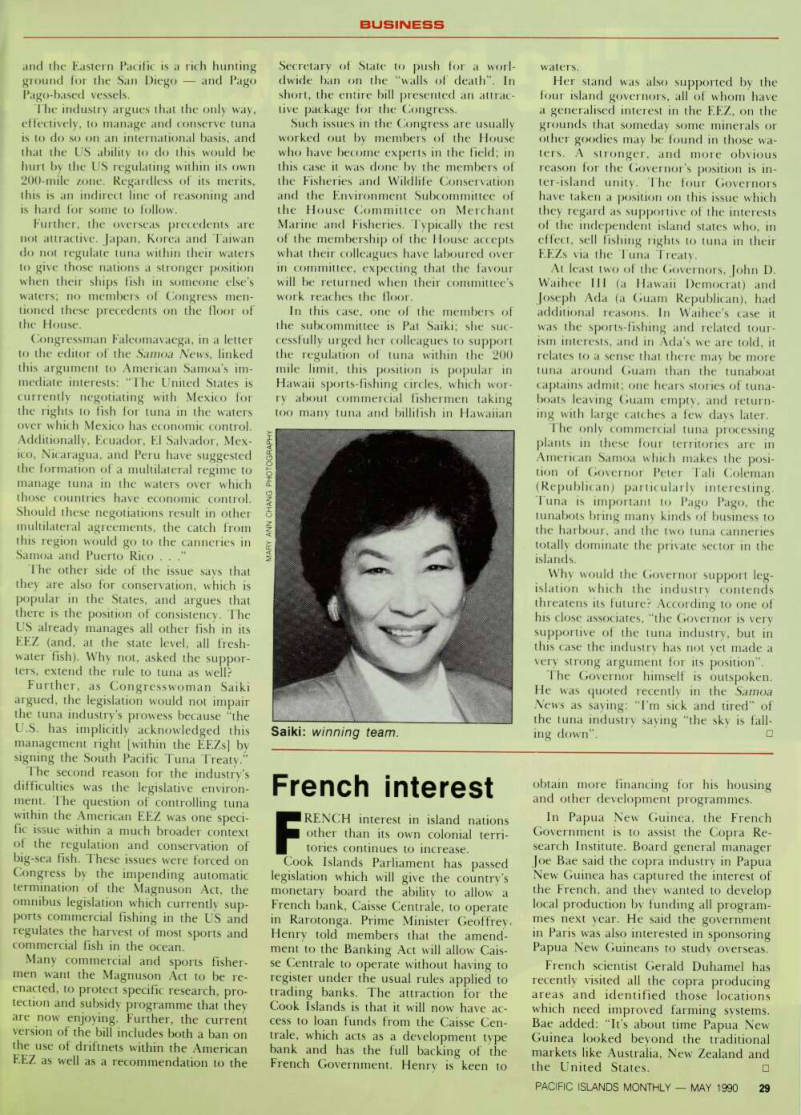
THE United States tuna industry, which appears so rich and strong from the islands’ point of view, has lost a major battle in the US Congress.
It may have been partially selfinflicted, and it certainly was complicated, but the result was clearly not desired by the owners of the tunaboats and of the two big tuna factories in American Samoa.
The tuna industry found itself outgunned despite an interesting set of allies: President Bush, the US State Department, some California Congressmen, American Samoa’s Democratic Congressman Eni F.H. Faleomavaega, and its legislature, the Fono. On the other side, which is winning so far, are the Governors of the four US flag jurisdictions in the Pacific (American Samoa, Guam, Hawaii and the Marianas), the big sea sports fishermen and, importantly, most of the members of the House of Representatives Merchant Marine and Fisher-
ies Committee (including Congress-
woman Pat Saiki, Republican of Hawaii).
The issue is whether the US should manage (i.e. regulate) the harvest of tuna within 200 miles of its coasts, in the Exclusive Economic Zone (EEZ). The tuna industry does not want this regulation; but a larger group pushed for it,
winning a 396-21 roll call vote on the floor of the House of Representatives, The tuna industry usually gets its own way in Washington.
When the US Department of Labors tried to extend Mainland-level minimum wages to workers in the Pago Pago tuna plants, the tuna industry defeated the Department; when the State Department negotiated the multi-year and multi million dollar treaty with the Pacific Is lands over tuna fishing rights Uncle Sam paid 80 per cent of the bill. (That treaty, incidentally, seems to be perking along happily, now about half-way through its five-year life). So why did the industry lose this battle in the Conrgess?
Part of the answer lies in the convo luted argument that the industry tried to make, and part in the complex environ ment in which the 200-mile limit issue
was fought.
The industry contends that if the US were to regulate the harvest of tuna within the 200-mile limit it would make it harder for the State Department (and the industry) to bargain with other coun tries for the US tuna fleet to fish in their waters. While the US and the Pacific is lands have worked out such a treaty, there is no such treaty in place with the nations of Central and South America,
and the Eastern Pacific is a rich hunting ground for the San Diego and Pago
Pago-based vessels.
The industry argues that the only way, effectively, to manage and conserve tuna is to do so on an international basis, and that the US ability to do this would be hurt by the US regulating within its own 200-mile zone. Regardless of its merits, this is an indirect line of reasoning and is hard for some to follow.
Further, the overseas precedents are not attractive. Japan, Korea and Taiwan do not regulate tuna within their waters to give those nations a stronger position when their ships fish in someone else’s waters; no members of Congress men tioned these precedents on the floor of the House.
Congressman Faleomavaega, in a letter to the editor of the Samoa News, linked this argument to American Samoa’s im mediate interests: “The United States is currently negotiating with Mexico for the rights to fish for tuna in the waters over which Mexico has economic control.
Additionally, Ecuador, El Salvador, Mex ico, Nicaragua, and Peru have suggested the formation of a multilateral regime to manage tuna in the waters over which those countries have economic control.
Should these negotiations result in other multilateral agreements, the catch from this region would go to the canneries in Samoa and Puerto Rico . .
The other side of the issue says that they are also for conservation, which is popular in the States, and argues that there is the position of consistency. The US already manages all other fish in its EEZ (and, at the state level, all fresh water fish). Why not, asked the suppor ters, extend the rule to tuna as well?
Further, as Congresswoman Saiki
argued, the legislation would not impair
the tuna industry’s prowess because “the U.S. has implicitly acknowledged this management right [within the EEZs] by signing the South Pacific Tuna Treaty.”
The second reason for the industry’s difficulties was the legislative environ ment. The question of controlling tuna within the American EEZ was one speci fic issue within a much broader context of the regulation and conservation of big-sea fish. These issues were forced on
Congress by the impending automatic
termination of the Magnuson Act, the omnibus legislation which currently sup ports commercial fishing in the US and regulates the harvest of most sports and commercial fish in the ocean.
Many commercial and sports fisher men want the Magnuson Act to be re enacted, to protect specific research, pro tection and subsidy programme that they are now enjoying. Further, the current version of the bill includes both a ban on the use of driftnets within the American EEZ as well as a recommendation to the
Secretary of State to push for a worl dwide ban on the “walls of death”. In short, the entire bill presented an attrac tive package for the Congress.
Such issues in the Congress are usually worked out by members of the House who have become experts in the field; in this case it was done by the members of the Fisheries and Wildlife Conservation and the Environment Subcommittee of the House Committee on Merchant Marine and Fisheries. Typically the rest of the membership of the House accepts what their colleagues have laboured over in committee, expecting that the favour will be returned when their committee’s work reaches the floor.
In this case, one of the members of the subcommittee is Pat Saiki; she suc
cessfully urged her colleagues to support
the regulation of tuna within the 200 mile limit, this position is popular in Hawaii sports-fishing circles, which wor ry about commercial fishermen taking 100 many tuna and billifish in Hawaiian
waters.
Her stand was also supported by the four island governors, all of whom have a generalised interest in the EEZ, on the grounds that someday some minerals or other goodies may be found in those wa ters. A stronger, and more obvious reason for the Governor’s position is in ter-island unity. The four Governors have taken a position on this issue which they regard as supportive of the interests of the independent island states who, in effect, sell fishing rights to tuna in their EEZs via the Tuna Treaty.
At least two of the Governors, John D.
Waihee 111 (a Hawaii Democrat) and Joseph Ada (a Guam Republican), had additional reasons. In Waihee’s case it was the sports-fishing and related tour ism interests, and in Ada’s we are told, it relates to a sense that there may be more tuna around Guam than the tunaboat captains admit; one hears stories of tuna boats leaving Guam empty, and return ing with large catches a few days later.
The only commercial tuna processing plants in these four territories are in American Samoa which makes the posi tion of Governor Peter Tali Coleman
(Republican) particularly interesting.
Tuna is important to Pago Pago, the lunabots bring many kinds of business to the harbour, and the two tuna canneries totally dominate the private sector in the islands.
Why would the Governor support leg islation which the industry contends threatens its future? According to one of his close associates, “the Governor is very supportive of the tuna industry, but in this case the industry has not yet made a very strong argument for its position”.
The Governor himself is outspoken.
He was quoted recently in the Samoa News as saying: “I’m sick and tired” of the tuna industry saying “the sky is fall ing down”. □
Saiki: winning team.
Advertisements & other items, p. 28 (1 item)
Million
THREE
KIWIS
AT YOUR FINGERTIPS
cosmopolitan New Zealanders.
As a Forum Island nation, exploration and development of new markets can be a difficult and frustrating exercise.
Now, through the establishment in New Zealand of the South Pacific Trade Office, you have direct access to a variety of services that are specifically geared to assist you in the export and promotion of South Pacific products into New Zealand.
Services include market research, marketing plans, identification of potential customers, office facilities, product displays, participation in trade fairs, and secondments.
For further details contact ...
SOUTH PACIFIC
TRADE OFFICE
Jetset Centre. 44 Emily Place.
RO. Box 774, Auckland 1. New Zealand.
Phone (09) .402-0465. Fax (09) 776-642 Telex SPTO NZ64428. nd so too is a potential market of 3.2 million Madison 3734
French interest
in island nations other than its own colonial terri tories continues to increase.
Cook Islands Parliament has passed legislation which will give the country’s monetary board the ability to allow a French bank, Caisse Centrale, to operate in Rarotonga. Prime Minister Geoffrey.
Henry told members that the amend ment to the Banking Act will allow Cais se Centrale to operate without having to register under the usual rules applied to trading banks. The attraction for the Cook Islands is that it will now have ac cess to loan funds from the Caisse Cen trale, which acts as a development type bank and has the full backing of the French Government. Henry is keen to
obtain more financing for his housing and other development programmes.
In Papua New Guinea, the French Government is to assist the Copra Re search Institute. Board general manager Joe Bae said the copra industry in Papua New Guinea has captured the interest of the French, and they wanted to develop local production by funding all program mes next year. He said the government in Paris was also interested in sponsoring Papua New Guineans to study overseas.
French scientist Gerald Duhamel has recently visited all the copra producing areas and identified those locations which need improved farming systems.
Bae added: “It’s about time Papua New Guinea looked beyond the traditional markets like Australia, New Zealand and the United States. □
Advertisements & other items, pp. 30-31 (1 item)
Toyota
2Ss The Toyota Hilux is the world’s most popular pick-up.
And the Hilux 4X4 is the best-selling Hilux of them all. Which stands to reason. People around the world respect Toyota’s attention to style. Hilux’s car-like comfort. Rugged reliability. And as you might expect from Toyota, power. This, of course, is the most important asset for a truck. And happily, the Hilux 4X4 offers a choice of four powerful engines: 2.8 and 2.4-litre diesel engines. Plus 2.2 and 1.8-litre petrol engines. When it comes to power and good looks, nobody can beat Toyota. Nobody.
u 111 *1 »» t f \ ill V I mh
The return of the Giant Clam
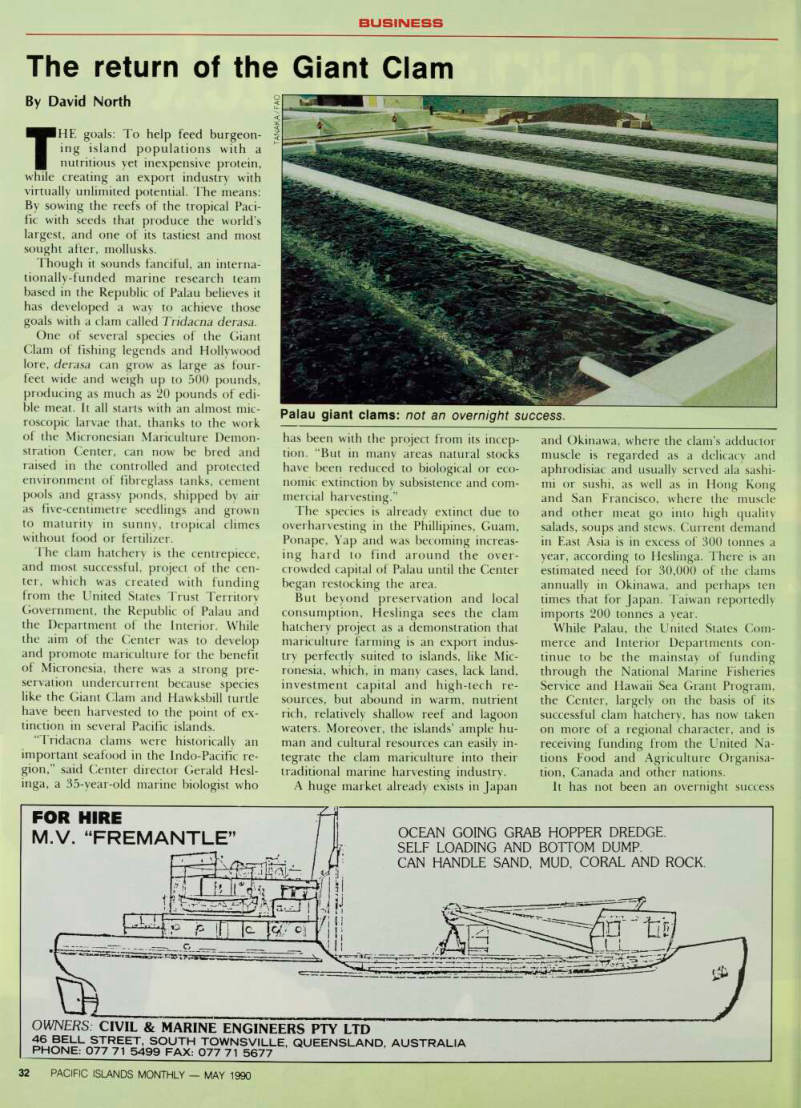
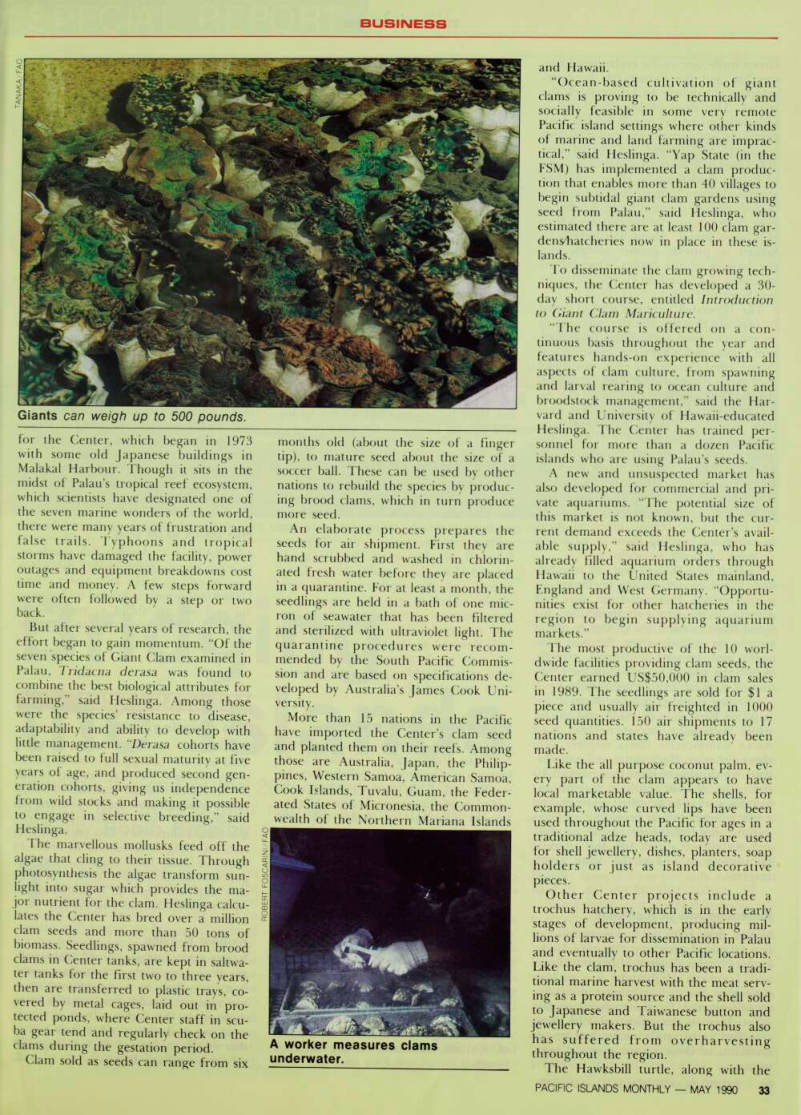
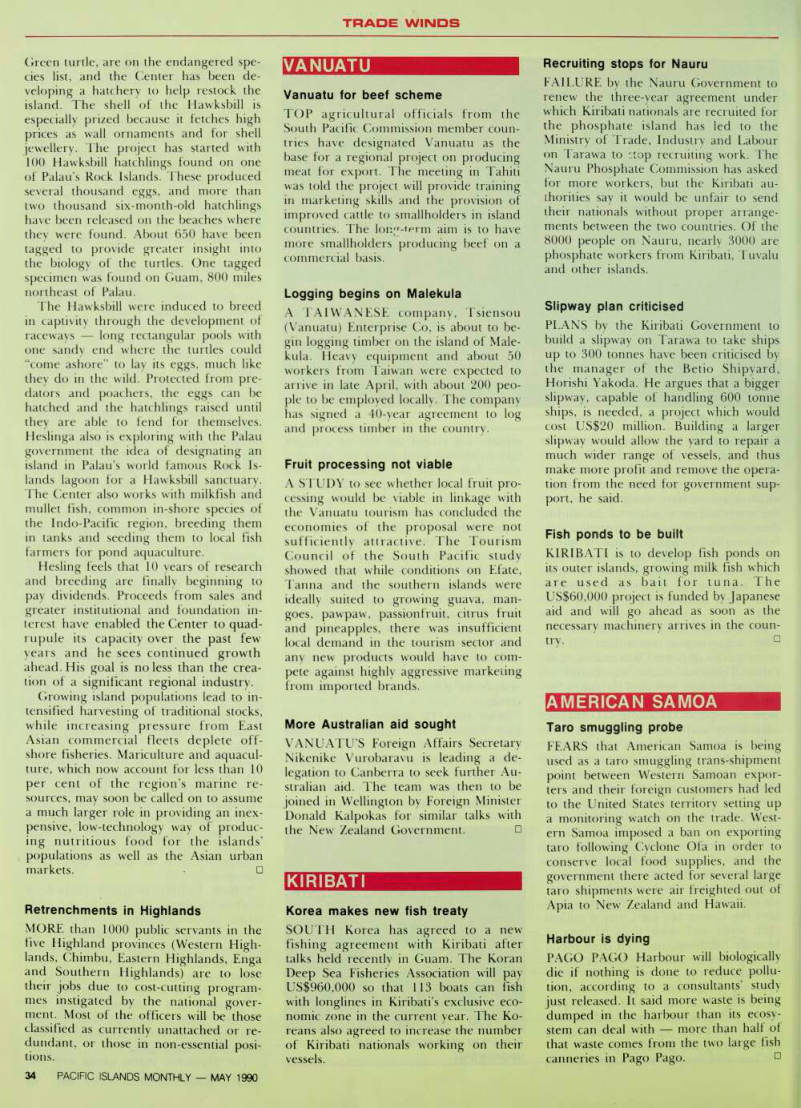
By David North
THE goals: To help feed burgeon
ing island populations with a
nutritious yet inexpensive protein,
while creating an export industry with virtually unlimited potential. The means: By sowing the reefs of the tropical Paci fic with seeds that produce the world’s largest, and one of its tastiest and most sought after, mollusks.
Though it sounds fanciful, an interna tionally-funded marine research team based in the Republic of Palau believes it has developed a way to achieve those goals with a clam called Tridacna derasa.
One of several species of the Giant
Clam of fishing legends and Hollywood
lore, derasa can grow as large as four feet wide and weigh up to 500 pounds, producing as much as 20 pounds of edi ble meat. It all starts with an almost mic roscopic larvae that, thanks to the work of the Micronesian Mariculture Demon stration Center, can now be bred and raised in the controlled and protected environment of fibreglass tanks, cement pools and grassy ponds, shipped by air as five-centimetre seedlings and grown to maturity in sunny, tropical climes without food or fertilizer.
The clam hatchery is the centrepiece, and most successful, project of the cen ter, which was created with funding from the United States Trust Territory Government, the Republic of Palau and the Department of the Interior. While the aim of the Center was to develop and promote mariculture for the benefit of Micronesia, there was a strong pre servation undercurrent because species like the Giant Clam and Hawksbill turtle have been harvested to the point of ex tinction in several Pacific islands.
“Tridacna clams were historically an important seafood in the Indo-Pacific re gion,” said Center director Gerald Hesl
inga, a 35-year-old marine biologist who
has been with the project from its incep tion. “But in many areas natural stocks have been reduced to biological or eco nomic extinction by subsistence and com
mercial harvesting.”
The species is already extinct due to overharvesting in the Phillipines, Guam, Ponape, Yap and was becoming increas ing hard to find around the over crowded capital of Palau until the Center
began restocking the area.
But beyond preservation and local consumption, Heslinga sees the clam hatchery project as a demonstration that mariculture farming is an export indus try perfectly suited to islands, like Mic ronesia, which, in many cases, lack land, investment capital and high-tech re sources, but abound in warm, nutrient rich, relatively shallow reef and lagoon waters. Moreover, the islands’ ample hu man and cultural resources can easily in tegrate the clam mariculture into their
traditional marine harvesting industry.
A huge market already exists in Japan
and Okinawa, where the clam’s adductor muscle is regarded as a delicacy and aphrodisiac and usually served ala sashi mi or sushi, as well as in Hong Kong and San Francisco, where the muscle and other meat go into high quality salads, soups and stews. Current demand in East Asia is in excess of 300 tonnes a year, according to Heslinga. There is an estimated need for 30,000 of the clams annually in Okinawa, and perhaps ten times that for Japan. Taiwan reportedly imports 200 tonnes a year.
While Palau, the United States Com merce and Interior Departments con tinue to be the mainstay of funding through the National Marine Fisheries Service and Hawaii Sea Grant Program, the Center, largely on the basis of its successful clam hatchery, has now taken on more of a regional character, and is receiving funding from the United Na tions Food and Agriculture Organisa tion, Canada and other nations.
It has not been an overnight success
Palau giant clams: not an overnight success.
for the Center, which began in 1973 with some old Japanese buildings in Malakal Harbour. Though it sits in the midst of Palau’s tropical reef ecosystem, which scientists have designated one of the seven marine wonders of the world, there were many years of frustration and false trails. Typhoons and tropical storms have damaged the facility, power outages and equipment breakdowns cost time and money. A few steps forward were often followed by a step or two back.
But after several years of research, the effort began to gain momentum. “Of the seven species of Giant Clam examined in Palau, Tridacna dcrasa was found to combine the best biological attributes for
farming,” said Heslinga. Among those
were the species’ resistance to disease,
adaptability and ability to develop with
little management. “Derasa cohorts have been raised to full sexual maturity at five years of age, and produced second gen eration cohorts, giving us independence from wild stocks and making it possible to engage in selective breeding,” said
Heslinga.
The marvellous mollusks feed off the algae that cling to their tissue. Through photosynthesis the algae transform sun light into sugar which provides the ma jor nutrient for the clam. Heslinga calcu lates the Center has bred over a million clam seeds and more than 50 tons of biomass. Seedlings, spawned from brood clams in Center tanks, are kept in saltwa ter tanks for the first two to three years, then are transferred to plastic trays, co vered by metal cages, laid out in pro tected ponds, where Center staff in scu ba gear tend and regularly check on the clams during the gestation period.
Clam sold as seeds can range from six
months old (about the size of a finger tip), to mature seed about the size of a soccer ball. These can be used by other nations to rebuild the species by produc ing brood clams, which in turn produce more seed.
An elaborate process prepares the seeds for air shipment. First they are hand scrubbed and washed in chlorin ated fresh water before they are placed in a quarantine. For at least a month, the seedlings are held in a bath of one mic ron of seawater that has been filtered and sterilized with ultraviolet light. The quarantine procedures were recom mended by the South Pacific Commis sion and are based on specifications de veloped by Australia’s James Cook Uni
versity.
More than 15 nations in the Pacific have imported the Center’s clam seed and planted them on their reefs. Among those are Australia, Japan, the Philip pines, Western Samoa, American Samoa, Cook Islands, Tuvalu, Guam, the Feder ated States of Micronesia, the Common wealth of the Northern Mariana Islands
and Hawaii.
“Ocean-based cultivation of giant clams is proving to be technically and socially feasible in some very remote Pacific island settings where other kinds of marine and land farming are imprac tical,” said Heslinga. “Yap State (in the FSM) has implemented a clam produc tion that enables more than 40 villages to
begin subtidal giant clam gardens using
seed from Palau,” said Heslinga, who estimated there are at least 100 clam gar densdiatcheries now in place in these is lands.
To disseminate the clam growing tech niques, the Center has developed a 30day short course, entitled Introduction to Giant Clam Mariculture.
“The course is offered on a con tinuous basis throughout the year and features hands-on experience with all aspects of clam culture, from spawning and larval rearing to ocean culture and broodstock management,” said the Har vard and University of Hawaii-educated Heslinga. The Center has trained per sonnel for more than a dozen Pacific islands who are using Palau’s seeds.
A new and unsuspected market has also developed for commercial and pri vate aquariums. “The potential size of this market is not known, but the cur rent demand exceeds the Center’s avail able supply,” said Heslinga, who has
already filled aquarium orders through
Hawaii to the United States mainland,
England and West Germany. “Opportu
nities exist for other hatcheries in the
region to begin supplying aquarium
markets.”
The most productive of the 10 worl dwide facilities providing clam seeds, the Center earned US$5O,OOO in clam sales in 1989. The seedlings are sold for $1 a piece and usually air freighted in 1000 seed quantities. 150 air shipments to 17 nations and states have already been made.
Like the all purpose coconut palm, ev ery part of the clam appears to have local marketable value. The shells, for example, whose curved lips have been used throughout the Pacific for ages in a traditional adze heads, today are used for shell jewellery, dishes, planters, soap holders or just as island decorative pieces.
Other Center projects include a trochus hatchery, which is in the early stages of development, producing mil lions of larvae for dissemination in Palau and eventually to other Pacific locations.
Like the clam, trochus has been a tradi tional marine harvest with the meat serv ing as a protein source and the shell sold to Japanese and Taiwanese button and jewellery makers. But the trochus also has suffered from overharvesting
throughout the region.
The Hawksbill turtle, along with the
Giants can weigh up to 500 pounds.
A worker measures clams underwater.
Green turtle, are on the endangered spe cies list, and the Center has been de veloping a hatchery to help restock the island. The shell of the Hawksbill is especially prized because it fetches high prices as wall ornaments and for shell jewellery. The project has started with 100 Hawksbill hatchlings found on one of Palau’s Rock Islands. These produced several thousand eggs, and more than two thousand six-month-old hatchlings have been released on the beaches where they were found. About 650 have been
tagged to provide greater insight into
the biology of the turtles. One tagged specimen was found on Guam, 800 miles northeast of Palau.
The Hawksbill were induced to breed
in captivity through the development of
raceways long rectangular pools with
one sandy end where the turtles could “come ashore” to lay its eggs, much like they do in the wild. Protected from pre dators and poachers, the eggs can be hatched and the hatchlings raised until they are able to fend for themselves.
Heslinga also is exploring with the Palau government the idea of designating an island in Palau’s world famous Rock Is lands lagoon for a Hawksbill sanctuary.
The Center also works with milkfish and mullet fish, common in-shore species of the Indo-Pacific region, breeding them in tanks and seeding them to local fish
farmers for pond aquaculture.
Hesling feels that 10 years of research
and breeding are finally beginning to
pay dividends. Proceeds from sales and greater institutional and foundation in terest have enabled the Center to quad ruple its capacity over the past few years and he sees continued growth ahead. His goal is no less than the crea
tion of a significant regional industry.
Growing island populations lead to in tensified harvesting of traditional stocks, while increasing pressure from East Asian commercial fleets deplete off shore fisheries. Mariculture and aquacul ture, which now account for less than 10 per cent of the region’s marine re sources, may soon be called on to assume a much larger role in providing an inex
pensive, low-technology way of produc
ing nutritious food for the islands’ populations as well as the Asian urban markets. □ Retrenchments in Highlands MORE than 1000 public servants in the five Highland provinces (Western High lands, Chimbu, Eastern Highlands, Enga and Southern Highlands) are to lose their jobs due to cost-cutting program mes instigated by the national gover ment. Most of the officers will be those classified as currently unattached or re dundant, or those in non-essential posi tions.
Advertisements & other items, p. 32 (1 item)
For Hire
M.V. “FREMANTLE”
OCEAN GOING GRAB HOPPER DREDGE
SELF LOADING AND BOTTOM DUMP.
CAN HANDLE SAND, MUD, CORAL AND ROCK. / rrri n /I! n t ?= ir }y c.
LL.
PaBTSf r7oi OWNERS: CIVIL & MARINE ENGINEERS PTY LTD
SOUTH TOWNSVILLE, QUEENSLAND, AUSTRALIA
PHONE: 077 71 5499 FAX: 077 71 5677
TXT) ‘
American Samoa
Trade Winds
Vanuatu
Vanuatu for beef scheme TOP agricultural officials from the South Pacific Commission member coun tries have designated Vanuatu as the base for a regional project on producing meat for export. The meeting in Tahiti was told the project will provide training in marketing skills and the provision of improved cattle to smallholders in island countries. The long-term aim is to have more smallholders producing beef on a commercial basis.
Logging begins on Malekula A TAIWANESE company, Tsiensou (Vanuatu) Enterprise Co, is about to be gin logging timber on the island of Male kula. Heavy equipment and about 50 workers from Taiwan were expected to arrive in late April, with about 200 peo ple to be employed locally. The company has signed a 40-year agreement to log and process timber in the country.
Fruit processing not viable A STUDY to see whether local fruit pro cessing would be viable in linkage with the Vanuatu tourism has concluded the economies of the proposal were not sufficiently attractive. The Tourism Council of the South Pacific study showed that while conditions on Efate, Tanna and the southern islands were ideally suited to growing guava, man goes, pawpaw, passionfruit, citrus fruit and pineapples, there was insufficient local demand in the tourism sector and any new products would have to com
pete against highly aggressive marketing
from imported brands.
More Australian aid sought VANUATU’S Foreign Affairs Secretary Nikenike Vurobaravu is leading a de legation to Canberra to seek further Au stralian aid. The team was then to be
joined in Wellington by Foreign Minister
Donald Kalpokas for similar talks with the New Zealand Government. □
Kiribati
Korea makes new fish treaty SOUTH Korea has agreed to a new fishing agreement with Kiribati after talks held recently in Guam. The Koran Deep Sea Fisheries Association will pay U 55960,000 so that 113 boats can fish with longlines in Kiribati’s exclusive eco nomic zone in the current year. The Ko reans also agreed to increase the number of Kiribati nationals working on their vessels.
Recruiting stops for Nauru FAILURE by the Nauru Government to renew the three-year agreement under which Kiribati nationals are recruited for the phosphate island has led to the Ministry of Trade, Industry and Labour on Tarawa to ctop recruiting work. The Nauru Phosphate Commission has asked for more workers, but the Kiribati au thorities say it would be unfair to send their nationals without proper arrange ments between the two countries. Of the 8000 people on Nauru, nearly 3000 are phosphate workers from Kiribati, Tuvalu and other islands.
Slipway plan criticised PLANS by the Kiribati Government to build a slipway on Tarawa to take ships up to 300 tonnes have been criticised by the manager of the Betio Shipyard, Horishi Yakoda. He argues that a bigger
slipway, capable of handling 600 tonne
ships, is needed, a project which would cost US$2O million. Building a larger slipway would allow the yard to repair a much wider range of vessels, and thus make more profit and remove the opera tion from the need for government sup port, he said.
Fish ponds to be built KIRIBATI is to develop fish ponds on its outer islands, growing milk fish which are used as bait for tuna. The US$6O,OOO project is funded by Japanese aid and will go ahead as soon as the necessary machinery arrives in the coun try. □
American Samoa
Taro smuggling probe FEARS that American Samoa is being used as a taro smuggling trans-shipment point between Western Samoan expor ters and their foreign customers had led to the United States territory setting up a monitoring watch on the trade. West ern Samoa imposed a ban on exporting taro following Cyclone Ofa in order to conserve local food supplies, and the government there acted for several large taro shipments were air freighted out of Apia to New Zealand and Hawaii.
Harbour is dying PAGO PAGO Harbour will biologically die if nothing is done to reduce pollu tion, according to a consultants’ study just released. It said more waste is being dumped in the harbour than its ecosy stem can deal with more than half of that waste comes from the two large fish canneries in Pago Pago. D
Bridging
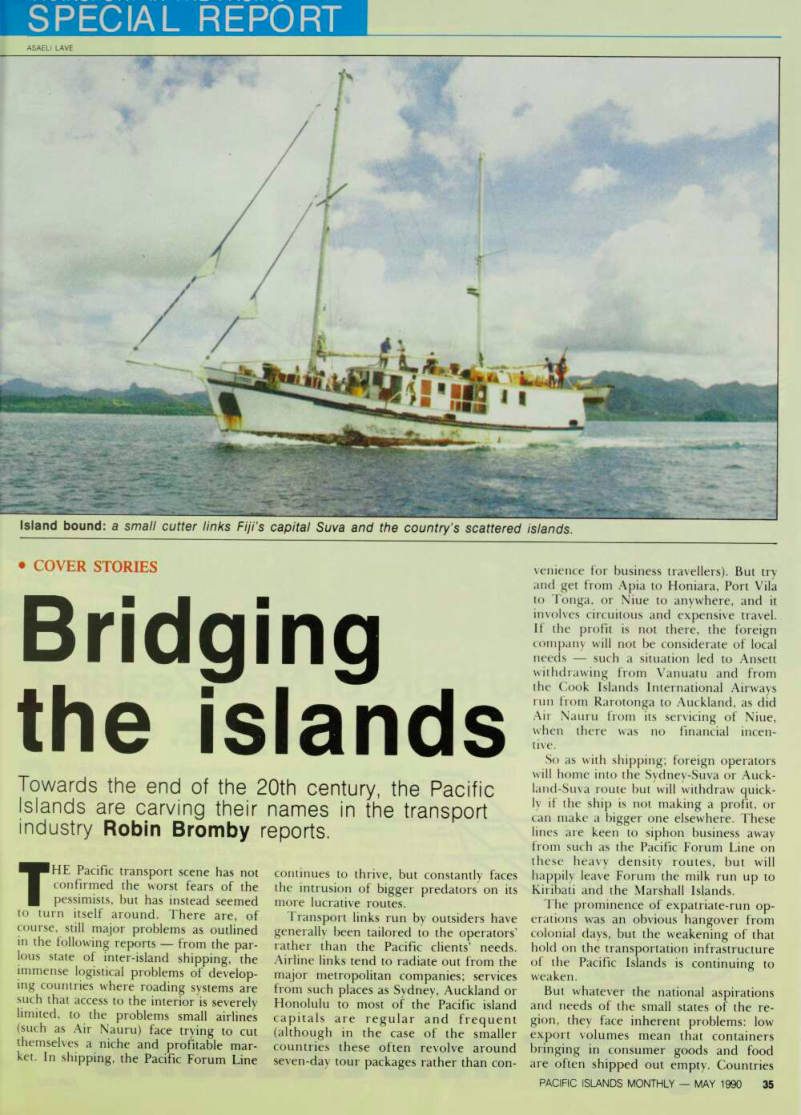

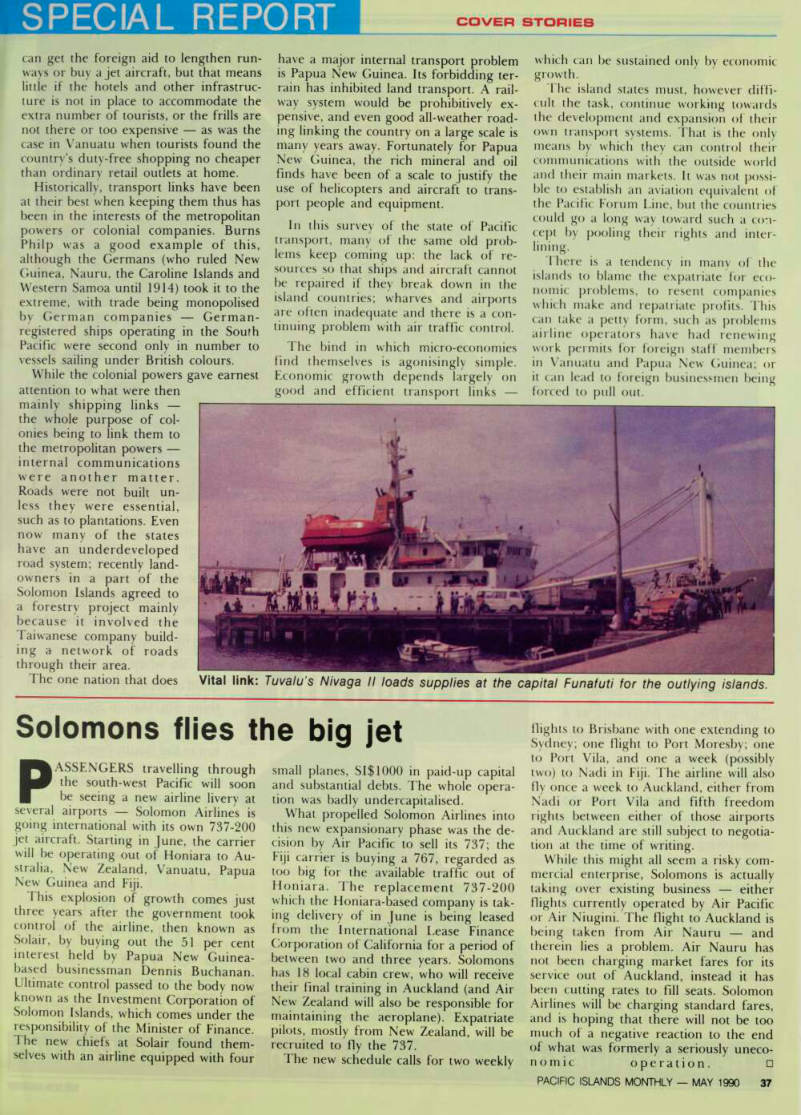
Special Report
Cover Stories
Bridging the islands
Towards the end of the 20th century, the Pacific Islands are carving their names in the transport industry Robin Bromby reports.
THE Pacific transport scene has not confirmed the worst fears of the pessimists, but has instead seemed to turn itself around. There are, of course, still major problems as outlined in the following reports from the par lous state of inter-island shipping, the
immense logistical problems of develop
ing countries where reading systems are such that access to the interior is severely limited, to the problems small airlines (such as Air Nauru) face trying to cut themselves a niche and profitable mar ket. In shipping, the Pacific Forum Line
continues to thrive, but constantly faces the intrusion of bigger predators on its more lucrative routes.
Transport links run by outsiders have generally been tailored to the operators’ rather than the Pacific clients’ needs.
Airline links tend to radiate out from the major metropolitan companies; services from such places as Sydney, Auckland or Honolulu to most of the Pacific island capitals are regular and frequent (although in the case of the smaller countries these often revolve around seven-day tour packages rather than con
venience for business travellers). But try and get from Apia to Honiara, Port Vila to Tonga, or Niue to anywhere, and it involves circuitous and expensive travel.
If the profit is not there, the foreign company will not be considerate of local needs such a situation led to Ansett withdrawing from Vanuatu and from the Cook Islands International Airways run from Rarotonga to Auckland, as did Air Nauru from its servicing of Niue, when there was no financial incen tive.
So as with shipping; foreign operators will home into the Sydney-Suva or Auck land-Suva route but will withdraw quick ly if the ship is not making a profit, or can make a bigger one elsewhere. These lines are keen to siphon business away from such as the Pacific Forum Line on these heavy density routes, but will happily leave Forum the milk run up to Kiribati and the Marshall Islands.
The prominence of expatriate-run op erations was an obvious hangover from colonial days, but the weakening of that hold on the transportation infrastructure of the Pacific Islands is continuing to weaken.
But whatever the national aspirations and needs of the small states of the re
gion, they face inherent problems: low
export volumes mean that containers bringing in consumer goods and food are often shipped out empty. Countries
Island bound: a small cutter links Fiji’s capital Suva and the country’s scattered islands.
can get the foreign aid to lengthen run ways or buy a jet aircraft, but that means little if the hotels and other infrastruc ture is not in place to accommodate the extra number of tourists, or the frills are not there or too expensive as was the case in Vanuatu when tourists found the
country’s duty-free shopping no cheaper
than ordinary retail outlets at home.
Historically, transport links have been at their best when keeping them thus has been in the interests of the metropolitan powers or colonial companies. Burns Philp was a good example of this, although the Germans (who ruled New Guinea, Nauru, the Caroline Islands and Western Samoa until 1914) took it to the extreme, with trade being monopolised by German companies German registered ships operating in the South Pacific were second only in number to vessels sailing under British colours.
While the colonial powers gave earnest
attention to what were then
mainly shipping links
the whole purpose of col onies being to link them to the metropolitan powers internal communications were another matter.
Roads were not built un less they were essential, such as to plantations. Even now many of the states have an underdeveloped road system; recently land owners in a part of the Solomon Islands agreed to
a forestry project mainly
because it involved the Taiwanese company build ing a network of roads through their area.
The one nation that does
have a major internal transport problem is Papua New Guinea. Its forbidding ter rain has inhibited land transport. A rail way system would be prohibitively ex pensive, and even good all-weather read ing linking the country on a large scale is many years away. Fortunately for Papua New Guinea, the rich mineral and oil finds have been of a scale to justify the use of helicopters and aircraft to trans port people and equipment.
In this survey of the state of Pacific transport, many of the same old prob lems keep coming up: the lack of re sources so that ships and aircraft cannot be repaired if they break down in the island countries; wharves and airports are often inadequate and there is a con tinuing problem with air traffic control.
The bind in which micro-economies find themselves is agonisingly simple.
Economic growth depends largely on good and efficient transport links
which can be sustained only by economic growth.
The island states must, however diffi cult the task, continue working towards the development and expansion of their own transport systems. That is the only means by which they can control their communications with the outside world and their main markets. It was not possi ble to establish an aviation equivalent of the Pacific Forum Line, but the countries could go a long way toward such a con cept by pooling their rights and inter
lining.
There is a tendency in many of the islands to blame the expatriate for eco nomic problems, to resent companies which make and repatriate profits. This can take a petty form, such as problems airline operators have had renewing work permits for foreign staff members in Vanuatu and Papua New Guinea; or it can lead to foreign businessmen being forced to pull out.
Vital link: Tuvalu’s Nivaga II loads supplies at the capital Funafuti for the outlying islands.
Advertisements & other items, p. 36 (1 item)
air neui zEaiann
KZ V fli rnEUJ ZEBLdPO .
A 2 -~-t, au
Bringing you more of IMew Zealand
than you can imagine.
Hong Kong Kuala \ Lumpur \ • \ Townsville I Brisbane \ M Adelaide % Melbourne Hobart Vancouver Los Angeles Rarot % Tahiti ® Auckland \ Singapore I I \ I Fiji f A S ia \ 4 \| 1 / Wellington i Christchurch
Astonishingly beautiful. Excitingly
don different. More variety than you can possibly imagine. This is New Zealand.
Land of immense contrasts, beyond all
Irt expectation.
Discover this place. From the spectacular grandeur of the mountainous south, to the lush viridescence of the sub-tropical north.
From the bright lights of cosmopolitan cities, the quiet life of country resorts. A charming warmth of hospitality awaits you everywhere.
One proud international airline knows every part of this extraordinary country. Air New Zealand. Flying direct from Australia and the South Pacific Islands: Hong Kong, Singapore and Tokyo; the U.S.A. and Canada: Britain and Continental Europe. And within New Zealand up to 400* flights a day serve over 30 cities, towns and resorts.
Let your imagination take flight. Our way. * Link network in association with Air Nelson, Eagle Air and Mount Cook Airline.
air neui zEaiann
ANPO2B3
Solomons flies the big jet
PASSENGERS travelling through
the south-west Pacific will soon be seeing a new airline livery at several airports Solomon Airlines is going international with its own 737-200 jet aircraft. Starting in June, the carrier will be operating out of Honiara to Au stralia, New Zealand, Vanuatu, Papua New Guinea and Fiji.
This explosion of growth comes just three years after the government took control of the airline, then known as Solair, by buying out the 51 per cent interest held by Papua New Guinea based businessman Dennis Buchanan.
Ultimate control passed to the body now known as the Investment Corporation of Solomon Islands, which comes under the responsibility of the Minister of Finance.
The new chiefs at Solair found them selves with an airline equipped with four
small planes, Slslooo in paid-up capital
and substantial debts. The whole opera
tion was badly undercapitalised.
What propelled Solomon Airlines into this new expansionary phase was the de cision by Air Pacific to sell its 737; the Fiji carrier is buying a 767, regarded as too big for the available traffic out of Honiara. The replacement 737-200 which the Honiara-based company is tak ing delivery of in June is being leased from the International Lease Finance Corporation of California for a period of between two and three years. Solomons has 18 local cabin crew, who will receive their final training in Auckland (and Air New Zealand will also be responsible for
maintaining the aeroplane). Expatriate
pilots, mostly from New Zealand, will be recruited to fly the 737.
The new schedule calls for two weekly
flights to Brisbane with one extending to Sydney; one flight to Port Moresby; one to Port Vila, and one a week (possibly two) to Nadi in Fiji. The airline will also fly once a week to Auckland, either from Nadi or Port Vila and fifth freedom rights between either of those airports and Auckland are still subject to negotia tion at the time of writing.
While this might all seem a risky com mercial enterprise, Solomons is actually taking over existing business either flights currently operated by Air Pacific or Air Niugini. The flight to Auckland is being taken from Air Nauru and therein lies a problem. Air Nauru has not been charging market fares for its service out of Auckland, instead it has been cutting rates to fill seats. Solomon Airlines will be charging standard fares, and is hoping that there will not be too much of a negative reaction to the end of what was formerly a seriously uneco nomic operation. □
Advertisements & other items, p. 38 (1 item)
The best value for money location in the South Pacific.
w K A Fiji Marine Shipyard The Marine Shipyard carries on what is an age-old Fiji tradition. The art of shipbuilding has been in our blood for over 35 centuries. Butitwas only overthe last two centuries or so that our popularity as a location for shipbuilding started to emerge.
Shipbuilding For the past 60 years the Marine Shipyard has been building ships in Fiji and throughout the Pacific. Our expertise covers everything from tourist vessels to fishing boat and barges. No job is too big, or too small.
Ship Repairs We also have an impressive track record on ship repairs. A 100-1000 tonne capacity slip, 4 cradles (20—73 metres) and a 120 metre repair wharf give us the flexibility to take on most repair jobs.
So when you’re ready to build or repair your next vessel think Fiji Marine Shipyard the best value for money location in the South Pacific.
For further information send for our free brochure:
FIJI
MARINE
SHIPYARD
SUVA
GPO Box 326, Suva, Fiji Phone; 314699, Telex: 2486 FMF AS-FJ The best value for money location in the South Pacific.
WkSONADOiSON
Forum Line shows how things can work
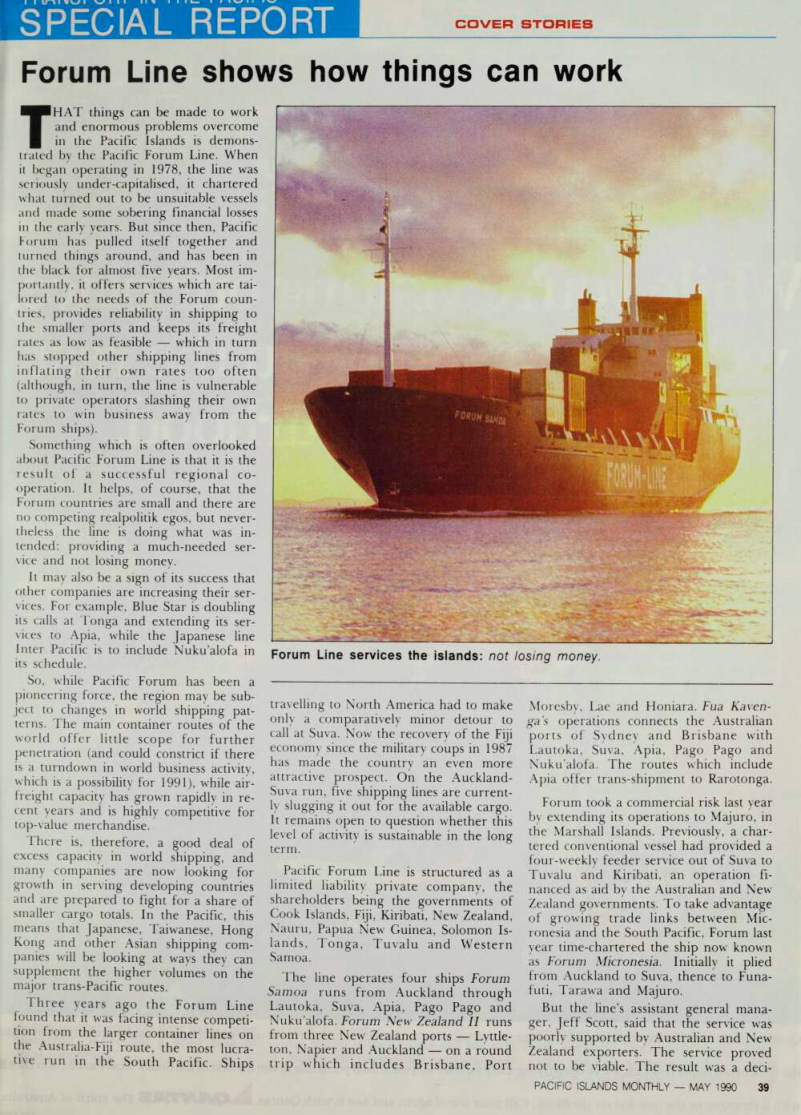

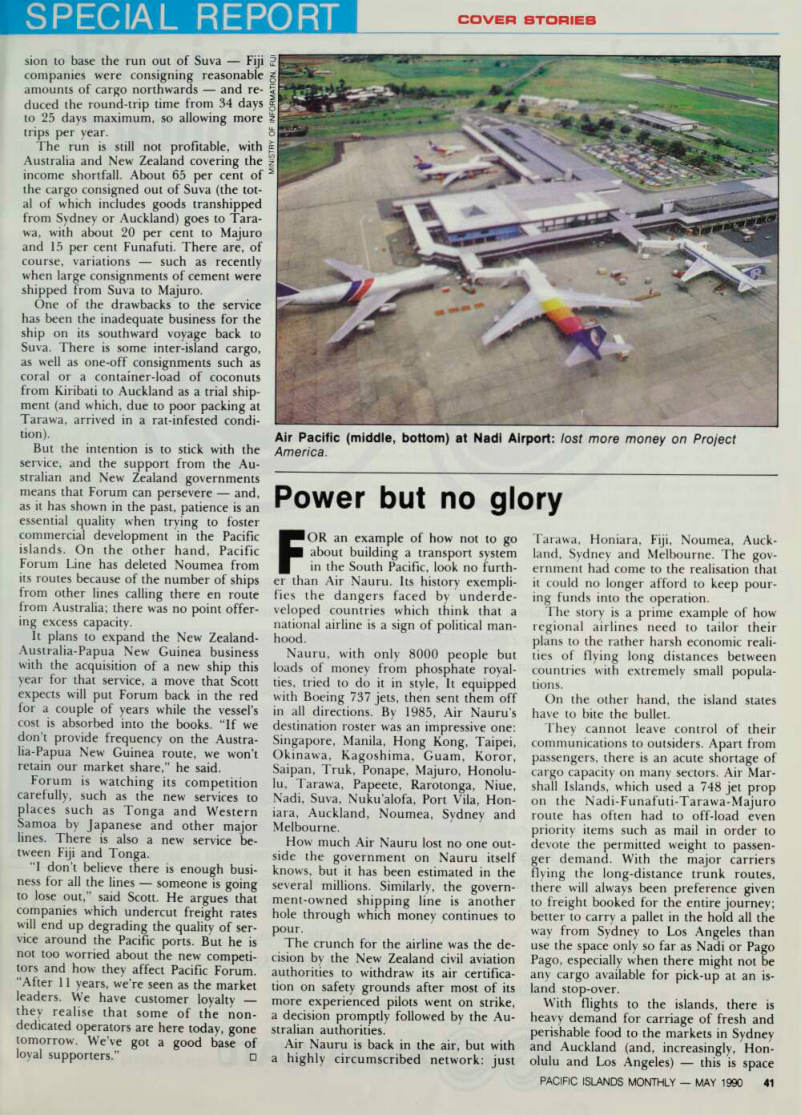
THAT things can be made to work and enormous problems overcome in the Pacific Islands is demons trated by the Pacific Forum Line. When it began operating in 1978, the line was seriously under-capitalised, it chartered what turned out to be unsuitable vessels and made some sobering financial losses in the early years. But since then, Pacific Forum has pulled itself together and turned things around, and has been in the black for almost five years. Most im portantly, it offers services which are tai lored to the needs of the Forum coun tries, provides reliability in shipping to the smaller ports and keeps its freight rates as low as feasible which in turn has stopped other shipping lines from inflating their own rates too often (although, in turn, the line is vulnerable to private operators slashing their own rates to win business away from the Forum ships).
Something which is often overlooked about Pacific Forum Line is that it is the result of a successful regional co operation. It helps, of course, that the Forum countries are small and there are no competing realpolitik egos, but never theless the line is doing what was in tended; providing a much-needed ser vice and not losing money.
It may also be a sign of its success that other companies are increasing their ser vices. For example, Blue Star is doubling its calls at Tonga and extending its ser vices to Apia, while the Japanese line Inter Pacific is to include Nukualofa in its schedule.
So, while Pacific Forum has been a pioneering force, the region may be sub ject to changes in world shipping pat terns. The main container routes of the world offer little scope for further penetration (and could constrict if there is a turndown in world business activity, which is a possibility for 1991), while air freight capacity has grown rapidly in re cent years and is highly competitive for top-value merchandise.
There is, therefore, a good deal of excess capacity in world shipping, and many companies are now looking for growth in serving developing countries and are prepared to fight for a share of smaller cargo totals. In the Pacific, this means that Japanese, Taiwanese, Hong Kong and other Asian shipping com panies will be looking at ways they can supplement the higher volumes on the major trans-Pacific routes.
Three years ago the Forum Line found that it was facing intense competi tion from the larger container lines on the Australia-Fiji route, the most lucra tive run in the South Pacific. Ships
travelling to North America had to make only a comparatively minor detour to call at Suva. Now the recovery of the Fiji economy since the military coups in 1987 has made the country an even more attractive prospect. On the Auckland- Suva run, five shipping lines are current ly slugging it out for the available cargo.
It remains open to question whether this level of activity is sustainable in the long term.
Pacific Forum Line is structured as a limited liability private company, the shareholders being the governments of Cook Islands, Fiji, Kiribati, New Zealand, Nauru, Papua New Guinea, Solomon Is lands, Tonga, Tuvalu and Western Samoa.
The line operates four ships Forum Samoa runs from Auckland through Lautoka, Suva, Apia, Pago Pago and Nukualofa. Forum New Zealand II runs from three New Zealand ports Lyttle ton, Napier and Auckland on a round trip which includes Brisbane, Port
Moresby, Lae and Honiara. Fua Kaven ga’s operations connects the Australian ports of Sydney and Brisbane with Lautoka, Suva, Apia, Pago Pago and Nukualofa. The routes which include Apia offer trans-shipment to Rarotonga.
Forum took a commercial risk last year by extending its operations to Majuro, in the Marshall Islands. Previously, a char tered conventional vessel had provided a four-weekly feeder service out of Suva to Tuvalu and Kiribati, an operation fi nanced as aid by the Australian and New Zealand governments. To take advantage of growing trade links between Mic ronesia and the South Pacific, Forum last year time-chartered the ship now known as Forum Micronesia. Initially it plied from Auckland to Suva, thence to Funa futi, Tarawa and Majuro.
But the line’s assistant general mana ger, Jeff Scott, said that the service was
poorly supported by Australian and New
Zealand exporters. The service proved not to be viable. The result was a deci
Forum Line services the islands: not losing money.
sion to base the run out of Suva Fiji companies were consigning reasonable amounts of cargo northwards and re duced the round-trip time from 34 days to 25 days maximum, so allowing more trips per year.
The run is still not profitable, with Australia and New Zealand covering the income shortfall. About 65 per cent of the cargo consigned out of Suva (the tot al of which includes goods transhipped from Sydney or Auckland) goes to Tara wa, with about 20 per cent to Majuro and 15 per cent Funafuti. There are, of course, variations such as recently when large consignments of cement were shipped from Suva to Majuro.
One of the drawbacks to the service has been the inadequate business for the ship on its southward voyage back to Suva. There is some inter-island cargo, as well as one-off consignments such as coral or a container-load of coconuts from Kiribati to Auckland as a trial ship ment (and which, due to poor packing at Tarawa, arrived in a rat-infested condi tion).
But the intention is to stick with the service, and the support from the Au stralian and New Zealand governments means that Forum can persevere and, as it has shown in the past, patience is an essential quality when trying to foster commercial development in the Pacific islands. On the other hand, Pacific Forum Line has deleted Noumea from its routes because of the number of ships from other lines calling there en route from Australia; there was no point offer
ing excess capacity.
It plans to expand the New Zealand- Australia-Papua New Guinea business with the acquisition of a new ship this year for that service, a move that Scott expects will put Forum back in the red for a couple of years while the vessel’s cost is absorbed into the books. “If we don’t provide frequency on the Austra lia-Papua New Guinea route, we won’t retain our market share,” he said.
Forum is watching its competition carefully, such as the new services to places such as Tonga and Western
Samoa by Japanese and other major
lines. There is also a new service be
tween Fiji and Tonga.
“I don’t believe there is enough busi ness for all the lines someone is going to lose out,” said Scott. He argues that companies which undercut freight rates will end up degrading the quality of ser vice around the Pacific ports. But he is not too worried about the new competi tors and how they affect Pacific Forum.
“After 11 years, we’re seen as the market leaders. We have customer loyalty they realise that some of the non dedicated operators are here today, gone tomorrow. We’ve got a good base of loyal supporters.” □
Advertisements & other items, pp. 39-40 (2 items)
Special Report
39
I I U \ I W I 111 I I I i— I #»>✓!! I W
PACIFIC ISLANDS MONTHLY MAY 1990
COVER STORIES
ff "fif w f|j
HAWAII
-f
SOLOMON ISLANDS
1%: <*• m
TAHITI
■fSA
m m
BALI
mm |^4- &491 R
PAPUA NEW GUINEA
A -i? »■
FIJI . .
M \% |;W
NEW CALEDONIA
STRALIA
■H m ms>
<sam
NEW ZEALAND
. J'r ‘^iV# mmF Santas is Australia’s international airline and proud of it. But we’re also proud of the rest of our neighbourhood, and naturally know it like he back of our hand. After all, we’ve been flying there for over 50 years. So if you’d like to see the rest of the South West Pacific, don’t see it vith a stranger, or the new kid on the block. Call your travel agent and see it with Qantas. The spirit of Australia.
Ministry Of Information, Fiji

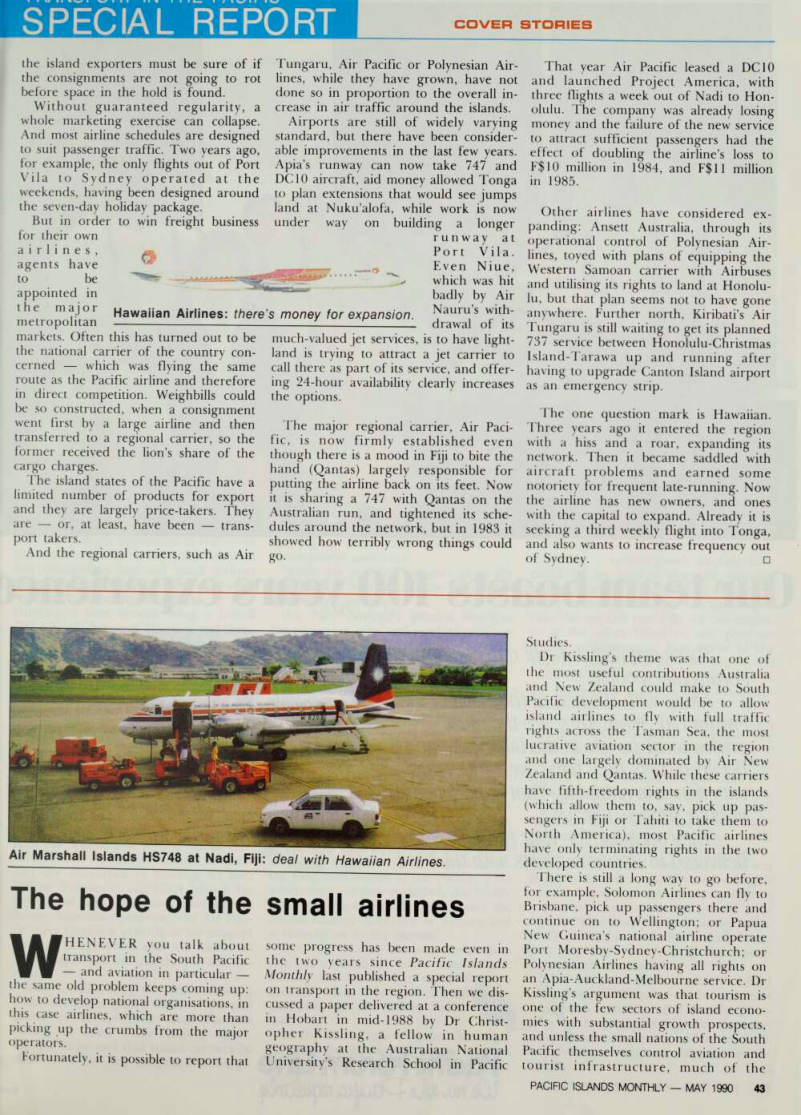
Power but no glory
FOR an example of how not to go about building a transport system in the South Pacific, look no furth er than Air Nauru. Its history exempli fies the dangers faced by underde veloped countries which think that a national airline is a sign of political man hood.
Nauru, with only 8000 people but loads of money from phosphate royal ties, tried to do it in style, It equipped with Boeing 737 jets, then sent them off in all directions. By 1985, Air Nauru’s destination roster was an impressive one:
Singapore, Manila, Hong Kong, Taipei,
Okinawa, Kagoshima, Guam, Koror, Saipan, Truk, Ponape, Majuro, Honolu lu, Tarawa, Papeete, Rarotonga, Niue, Nadi, Suva, Nukualofa, Port Vila, Hon iara, Auckland, Noumea, Sydney and Melbourne.
How much Air Nauru lost no one out side the government on Nauru itself knows, but it has been estimated in the several millions. Similarly, the govern ment-owned shipping line is another hole through which money continues to pour.
The crunch for the airline was the de cision by the New Zealand civil aviation authorities to withdraw its air certifica tion on safety grounds after most of its more experienced pilots went on strike, a decision promptly followed by the Au stralian authorities.
Air Nauru is back in the air, but with a highly circumscribed network: just
Tarawa, Honiara, Fiji, Noumea, Auck land, Sydney and Melbourne. The gov ernment had come to the realisation that it could no longer afford to keep pour ing funds into the operation.
The story is a prime example of how regional airlines need to tailor their plans to the rather harsh economic reali ties of flying long distances between countries with extremely small popula tions.
On the other hand, the island states have to bite the bullet.
They cannot leave control of their communications to outsiders. Apart from passengers, there is an acute shortage of cargo capacity on many sectors. Air Mar shall Islands, which used a 748 jet prop on the Nadi-Funafuti-Tarawa-Majuro route has often had to off-load even priority items such as mail in order to devote the permitted weight to passen ger demand. With the major carriers flying the long-distance trunk routes,
there will always been preference given
to freight booked for the entire journey; better to carry a pallet in the hold all the way from Sydney to Los Angeles than use the space only so far as Nadi or Pago Pago, especially when there might not be any cargo available for pick-up at an is land stop-over.
With flights to the islands, there is heavy demand for carriage of fresh and perishable food to the markets in Sydney and Auckland (and, increasingly, Hon olulu and Los Angeles) this is space
Air Pacific (middle, bottom) at Nadi Airport: lost more money on Project America.
Ministry Of Information, Fiji
the island exporters must be sure of if the consignments are not going to rot before space in the hold is found.
Without guaranteed regularity, a whole marketing exercise can collapse.
And most airline schedules are designed to suit passenger traffic. Two years ago, for example, the only flights out of Port Vila to Sydney operated at the weekends, having been designed around
the seven-day holiday package.
But in order to win freight business
for their own airlines, agents have to be appointed in the maj o r metropolitan
markets. Often this has turned out to be the national carrier of the country con cerned which was flying the same route as the Pacific airline and therefore in direct competition. Weighbills could be so constructed, when a consignment went first by a large airline and then transferred to a regional carrier, so the former received the lion’s share of the
cargo charges.
The island states of the Pacific have a limited number of products for export
and they are largely price-takers. They
are or, at least, have been trans port takers.
And the regional carriers, such as Air
Tungaru, Air Pacific or Polynesian Air lines, while they have grown, have not done so in proportion to the overall in crease in air traffic around the islands.
Airports are still of widely varying
standard, but there have been consider able improvements in the last few years.
Apia’s runway can now take 747 and DC 10 aircraft, aid money allowed Tonga to plan extensions that would see jumps land at Nukualofa, while work is now under way on building a longer
runway at Port Vila.
Even Niue, which was hit
badly by Air
Nauru’s with drawal of its
much-valued jet services, is to have light land is trying to attract a jet carrier to call there as part of its service, and offer
ing 24-hour availability clearly increases
the options.
The major regional carrier, Air Paci fic, is now firmly established even though there is a mood in Fiji to bite the hand (Qantas) largely responsible for putting the airline back on its feet. Now it is sharing a 747 with Qantas on the Australian run, and tightened its sche dules around the network, but in 1983 it showed how terribly wrong things could go-
That year Air Pacific leased a DC 10 and launched Project America, with three flights a week out of Nadi to Hon olulu. The company was already losing money and the failure of the new service to attract sufficient passengers had the effect of doubling the airline’s loss to Fslo million in 1984, and Fsll million in 1985.
Other airlines have considered ex panding: Ansett Australia, through its operational control of Polynesian Air lines, toyed with plans of equipping the Western Samoan carrier with Airbuses and utilising its rights to land at Honolu lu, but that plan seems not to have gone anywhere. Further north, Kiribati’s Air Tungaru is still waiting to get its planned 737 service between Honolulu-Christmas Island-Tarawa up and running after having to upgrade Canton Island airport as an emergency strip.
The one question mark is Hawaiian.
Three years ago it entered the region with a hiss and a roar, expanding its network. Then it became saddled with aircraft problems and earned some
notoriety for frequent late-running. Now
the airline has new owners, and ones with the capital to expand. Already it is seeking a third weekly flight into Tonga, and also wants to increase frequency out of Sydney. □
Hawaiian Airlines: there’s money for expansion.
Advertisements & other items, p. 42 (1 item)
If you’ve got business in Vila,
here’s a blue chip contact.
It’s not just tourists who are singing our praises. We’ve got business people from Australia, New Zealand, Fiji and Papua New Guinea talking about us too.
They’re very impressed with the personal care, attention and service on every flight, the complimentary champagne and the international standard cuisine.
Because Air Vanuatu really means business, we have Business Class, special Circle Pacific Fares and services twice a week out of Sydney and Brisbane to Vila and once a week out of Melbourne and Auckland.
So before doing any deals in Vila, call us.
TELEPHONE: AUSTRALIA (008) 33 1175,
AUCKLAND 733 435, VILA 3848.
AIR VANUATU
The hope of the small airlines

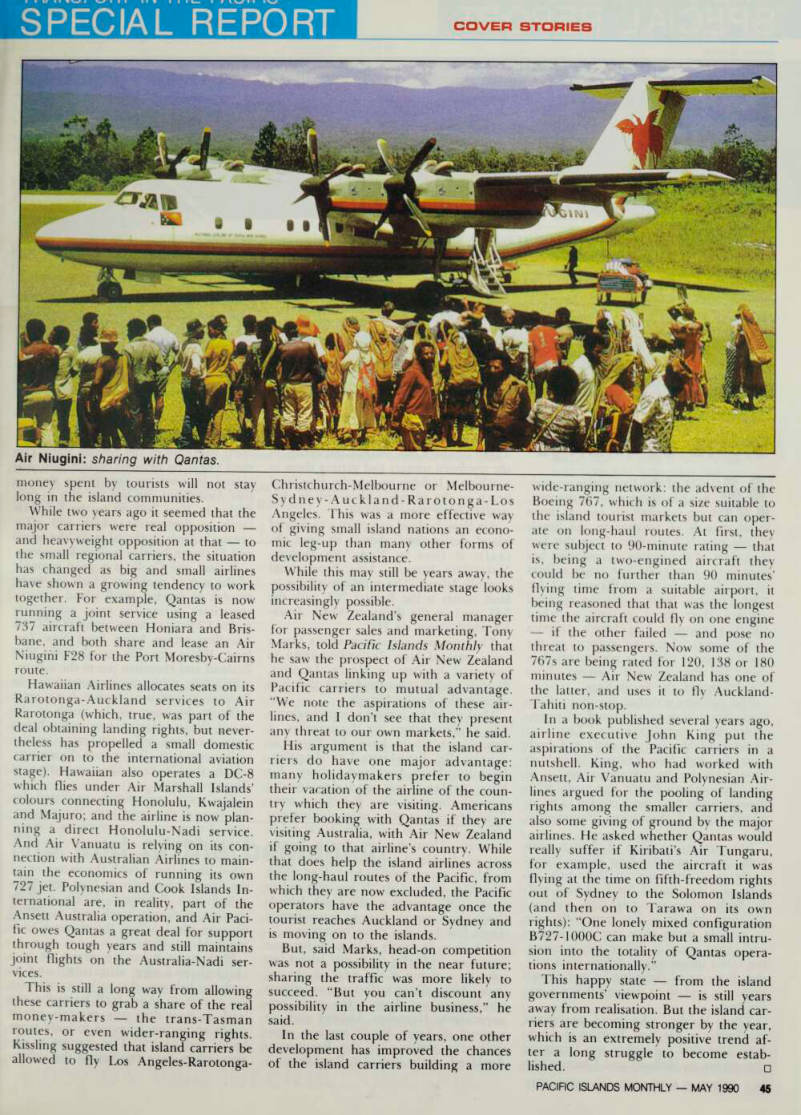
WHENEVER you talk about transport in the South Pacific and aviation in particular the same old problem keeps coming up: how to develop national organisations, in this case airlines, which are more than picking up the crumbs from the major operators.
Fortunately, it is possible to report that
some progress has been made even in the two years since Pacific Islands Monthly last published a special report on transport in the region. Then we dis cussed a paper delivered at a conference in Hobart in mid-1988 by Dr Christ opher Kissling, a fellow in human geography at the Australian National University’s Research School in Pacific
Studies.
Dr Kissling’s theme was that one ol the most useful contributions Australia and New Zealand could make to South Pacific development would be to allow island airlines to fly with full traffic rights across the Tasman Sea, the mosl lucrative aviation sector in the region and one largely dominated by Air New Zealand and Qantas. While these carriers have fifth-freedom rights in the islands (which allow them to, say, pick up pas sengers in Fiji or Tahiti to take them to North America), most Pacific airlines have only terminating rights in the two
developed countries.
There is still a long way to go before, for example, Solomon Airlines can fly to Brisbane, pick up passengers there and continue on to Wellington; or Papua New' Guinea’s national airline operate Port Moresby-Sydney-Christchurch; or
Polynesian Airlines having all rights on
an Apia-Auckland-Melbourne service. Dr Kissling’s argument was that tourism is one of the few sectors of island econo mies with substantial growth prospects, and unless the small nations of the South Pacific themselves control aviation and tourist infrastructure, much of the
Air Marshall Islands HS748 at Nadi, Fiji: deal with Hawaiian Airlines.
money spent by tourists will not stay long in the island communities.
While two years ago it seemed that the major carriers were real opposition and heavyweight opposition at that to the small regional carriers, the situation has changed as big and small airlines have shown a growing tendency to work together. For example, Qantas is now runmng a joint service using a leased 7.37 aircraft between Honiara and Brisbane, and both share and lease an Air Niugini F2B for the Port Moresby-Cairns
ro if-
Hawaiian Airlines a locates seats on its Karotonga-Auckland services to Air Rarotonga (which true, was part of the deal obtaining landing rights, but nevertheless has propelled a small domestic carrier on to the international aviation Hawaila l n al A so operates a DC-8 which flies under Air Marshall Islands’
CO Honolulu, Kwajalein an . ajuro, and the airline is now plan- A 1"? d w eCt Honolu u ; Nadl service, And Air Vanuatu is relying on its connection with Australian Airlines to main- SS - the economics of running its own 27 jet. Polynesian and Cook Islands Inernational are, m reality, part of the Ansett Australia operation, and Air Padtic owes Qantas a great deal for support through tough years and still maintains joint mgms on the Australia-Nadi ser- . ... . „ . inis is still a long way from allowing these carriers to grab a share of the real money ma ers the trans-Tasman outes, or even wider-ranging rights. isslmg suggested that island carriers be allowed to fly Los Angeles-Rarotonga-
Christchurch-Melbourne or Melbourne-
Sydney-Auckland-Rarotonga-Los
Angeles. This was a more effective way of giving small island nations an economic leg-up than many other forms of
development assistance.
While this may still be years away, the possibility of an intermediate stage looks
increasingly possible.
Air New Zealand’s general manager for passenger sales and marketing, Tony Marks, told Pacific Islands Monthly that he saw the prospect of Air New Zealand and Qantas linking up with a variety of Pacific carriers to mutual advantage.
“We note the aspirations of these airlines, and I don’t see that they present any threat to our own markets,” he said.
His argument is that the island carriers do have one major advantage:
many holidaymakers prefer to begin
their vacation of the airline of the country which they are visiting. Americans prefer booking with Qantas if they are visiting Australia, with Air New Zealand if going to that airline’s country. While that does help the island airlines across the long-haul routes of the Pacific, from which they are now excluded, the Pacific operators have the advantage once the tourist reaches Auckland or Sydney and is moving on to the islands.
But, said Marks, head-on competition was not a possibility in the near future; sharing the traffic was more likely to succeed. “But you can’t discount any possibility in the airline business,” he said.
In the last couple of years, one other development has improved the chances of the island carriers building a more
wide-ranging network: the advent of the Boeing 767, which is of a size suitable to the island tourist markets but can oper ate on long-haul routes. At first, they were subject to 90-minute rating that is, being a two-engined aircraft they could be no further than 90 minutes’ flying time from a suitable airport, it being reasoned that that was the longest time the aircraft could fly on one engine if the other failed and pose no threat to passengers. Now some of the 767 s are being rated for 120, 138 or 180 minutes Air New Zealand has one of the latter, and uses it to fly Auckland- Tahiti non-stop.
In a book published several years ago, airline executive John King put the aspirations of the Pacific carriers in a nutshell. King, who had worked with Ansett, Air Vanuatu and Polynesian Air lines argued for the pooling of landing rights among the smaller carriers, and also some giving of ground by the major airlines. He asked whether Qantas would really suffer if Kiribati’s Air Tungaru, for example, used the aircraft it was flying at the time on fifth-freedom rights out of Sydney to the Solomon Islands (and then on to Tarawa on its own rights): “One lonely mixed configuration 8727-1000 C can make but a small intru sion into the totality of Qantas opera
tions internationally.”
This happy state from the island governments’ viewpoint is still years away from realisation. But the island car riers are becoming stronger by the year, which is an extremely positive trend af ter a long struggle to become estab lished. □
Air Niugini: sharing with Qantas.
Advertisements & other items, pp. 43-45 (3 items)
Special Report
43
• I W » I » W ■ I I ■■■ k— I I 1 V/ ■ » ■ W
PACIFIC ISLANDS MONTHLY MAY 1990
COVER STORIES
Our team boasts 100 years experience
These are just some of our Pacific Forum Line people.
Along with the rest of the Pacific Forum Line team, they are the most professional people in the business and between them they have over 100 years experience in shipping. That experience is at your service, always.
They organise for your products to be delivered to Pacific markets with the kind of efficiency you’ve come to expect from Pacific Forum Line.
Pacific Forum Line Shipping Services Australia American Samoa New Zealand Tuvalu Fiji Kiribati New Caledonia Papua New Guinea Tonga Solomon Islands Western Samoa Cook Islands Telephone: Auckland NZ (09) 396-700 Fax: (09) 392-683 Telex: 60460 / w)
Podfic Forum Line
We, mlhlfkLOtyD.
TA49O(
Special Report
45
i i u t i i w ■ v/ iii i i i iii u. i % v/ i i ■ vy
PACIFIC ISLANDS MONTHLY MAY 1990
COVER STORIES
Signs of change
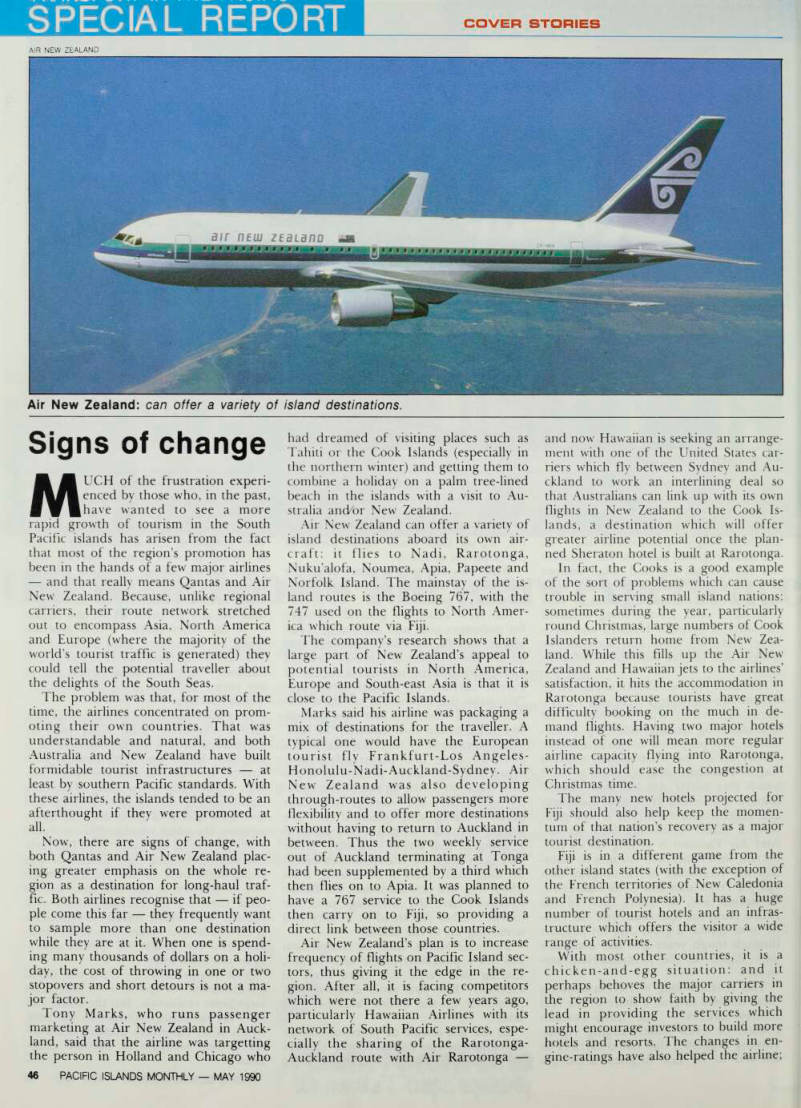
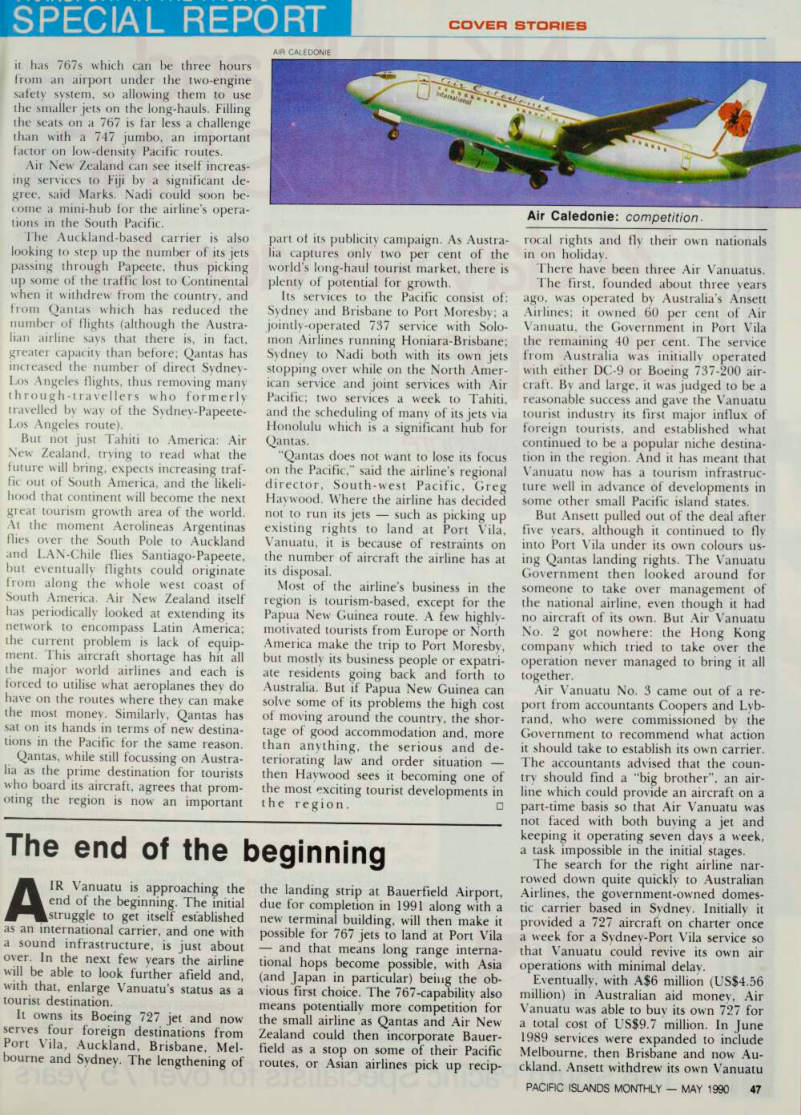

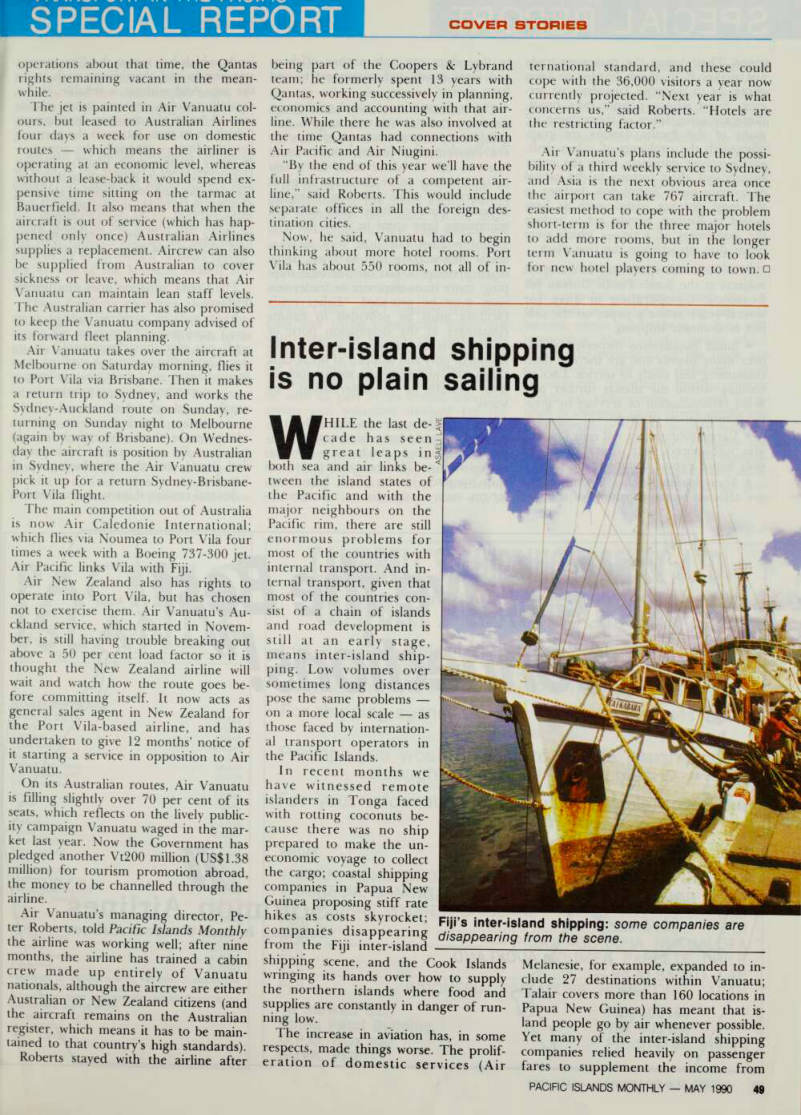
MUCH of the frustration experi enced by those who, in the past, have wanted to see a more rapid growth of tourism in the South Pacific islands has arisen from the fact that most of the region’s promotion has been in the hands of a few major airlines and that really means Qantas and Air New Zealand. Because, unlike regional carriers, their route network stretched out to encompass Asia, North America and Europe (where the majority of the world’s tourist traffic is generated) they could tell the potential traveller about the delights of the South Seas.
The problem was that, for most of the time, the airlines concentrated on prom oting their own countries. That was understandable and natural, and both Australia and New Zealand have built formidable tourist infrastructures at least by southern Pacific standards. With these airlines, the islands tended to be an
afterthought if they were promoted at
all.
Now, there are signs of change, with both Qantas and Air New Zealand plac ing greater emphasis on the whole re gion as a destination for long-haul traf fic. Both airlines recognise that if peo ple come this far they frequently want to sample more than one destination while they are at it. When one is spend ing many thousands of dollars on a holi day, the cost of throwing in one or two stopovers and short detours is not a ma jor factor.
Tony Marks, who runs passenger marketing at Air New Zealand in Auck land, said that the airline was targetting the person in Holland and Chicago who
had dreamed of visiting places such as Tahiti or the Cook Islands (especially in the northern winter) and getting them to combine a holiday on a palm tree-lined beach in the islands with a visit to Au stralia anchor New Zealand.
Air New Zealand can offer a variety of island destinations aboard its own air craft: it flies to Nadi, Rarotonga, Nukualofa, Noumea, Apia, Papeete and Norfolk Island. The mainstay of the is land routes is the Boeing 767, with the 747 used on the flights to North Amer ica which route via Fiji.
The company’s research shows that a large part of New Zealand’s appeal to potential tourists in North America, Europe and South-east Asia is that it is close to the Pacific Islands.
Marks said his airline was packaging a mix of destinations for the traveller. A typical one would have the European
tourist fly Frankfurt-Los Angeles-
Honolulu-Nadi-Auckland-Sydney. Air
New Zealand was also developing through-routes to allow passengers more flexibility and to offer more destinations without having to return to Auckland in between. Thus the two weekly service out of Auckland terminating at Tonga had been supplemented by a third which then flies on to Apia. It was planned to have a 767 service to the Cook Islands then carry on to Fiji, so providing a direct link between those countries.
Air New Zealand’s plan is to increase frequency of flights on Pacific Island sec tors, thus giving it the edge in the re gion. After all, it is facing competitors which were not there a few years ago, particularly Hawaiian Airlines with its network of South Pacific services, espe cially the sharing of the Rarotonga- Auckland route with Air Rarotonga
and now Hawaiian is seeking an arrange ment with one of the United States car riers which fly between Sydney and Au ckland to work an interlining deal so that Australians can link up with its own flights in New Zealand to the Cook Is lands, a destination which will offer greater airline potential once the plan ned Sheraton hotel is built at Rarotonga.
In fact, the Cooks is a good example of the sort of problems which can cause trouble in serving small island nations: sometimes during the year, particularly round Christmas, large numbers of Cook Islanders return home from New Zea land. While this fills up the Air New Zealand and Hawaiian jets to the airlines’ satisfaction, it hits the accommodation in Rarotonga because tourists have great difficulty booking on the much in de
mand flights. Having two major hotels
instead of one will mean more regular
airline capacity flying into Rarotonga,
which should ease the congestion at Christmas time.
The many new hotels projected for Fiji should also help keep the momen tum of that nation’s recovery as a major tourist destination.
Fiji is in a different game from the other island states (with the exception of the French territories of New Caledonia and French Polynesia). It has a huge number of tourist hotels and an infras tructure which offers the visitor a wide range of activities.
With most other countries, it is a chicken-and-egg situation: and it perhaps behoves the major carriers in the region to show faith by giving the lead in providing the services which might encourage investors to build more hotels and resorts. The changes in en gine-ratings have also helped the airline;
Air New Zealand: can offer a variety of island destinations.
it has 767 s which can be three hours from an airport under the two-engine safety system, so allowing them to use the smaller jets on the long-hauls. Filling the seats on a 767 is far less a challenge than with a 747 jumbo, an important factor on low-density Pacific routes.
Air New Zealand can see itself increas ing services to Fiji by a significant de gree, said Marks. Nadi could soon be come a mini-hub for the airline’s opera tions in the South Pacific.
The Auckland-based carrier is also looking to step up the number of its jets passing through Papeete, thus picking up some of the traffic lost to Continental when it withdrew from the country, and from Qantas which has reduced the number of flights (although the Austra lian airline says that there is, in fact, greater capacity than before; Qantas has increased the number of direct Sydney- Los Angeles flights, thus removing many
through-travellers who formerly
travelled by way of the Sydney-Papeete- Los Angeles route).
But not just Tahiti to America: Air New Zealand, trying to read what the future will bring, expects increasing traf fic out of South America, and the likeli hood that continent will become the next great tourism growth area of the world.
At the moment Aerolineas Argentinas flies over the South Pole to Auckland and LAN-Chile flies Santiago-Papeete,
but eventually flights could originate
from along the whole west coast of South America. Air New Zealand itself has periodically looked at extending its network to encompass Latin America; the current problem is lack of equip ment. This aircraft shortage has hit all the major world airlines and each is forced to utilise what aeroplanes they do have on the routes where they can make the most money. Similarly, Qantas has sat on its hands in terms of new destina tions in the Pacific for the same reason.
Qantas, while still focussing on Austra lia as the prime destination for tourists who board its aircraft, agrees that prom oting the region is now an important
part ot its publicity campaign. As Austra lia captures only two per cent of the world’s long-haul tourist market, there is plenty of potential for growth.
Its services to the Pacific consist of: Sydney and Brisbane to Port Moresby; a jointly-operated 737 service with Solo mon Airlines running Honiara-Brisbane; Sydney to Nadi both with its own jets stopping over while on the North Amer ican service and joint services with Air Pacific; two services a week to Tahiti, and the scheduling of many of its jets via Honolulu which is a significant hub for Qantas.
“Qantas does not want to lose its focus on the Pacific,” said the airline’s regional director, South-west Pacific, Greg Haywood. Where the airline has decided not to run its jets such as picking up existing rights to land at Port Vila, Vanuatu, it is because of restraints on the number of aircraft the airline has at
its disposal.
Most of the airline’s business in the region is tourism-based, except for the Papua New Guinea route. A few highly motivated tourists from Europe or North America make the trip to Port Moresby, but mostly its business people or expatri ate residents going back and forth to Australia. But if Papua New Guinea can solve some of its problems the high cost of moving around the country, the shor tage of good accommodation and, more than anything, the serious and de teriorating law and order situation then Haywood sees it becoming one of the most exciting tourist developments in the region. □
rocal rights and fly their own nationals in on holiday.
There have been three Air Vanuatus.
The first, founded about three years ago, was operated by Australia’s Ansett Airlines; it owned 60 per cent of Air Vanuatu, the Government in Port Vila the remaining 40 per cent. The service from Australia was initially operated with either DC-9 or Boeing 737-200 air craft. By and large, it was judged to be a reasonable success and gave the Vanuatu tourist industry its first major influx of foreign tourists, and established what continued to be a popular niche destina tion in the region. And it has meant that Vanuatu now has a tourism infrastruc ture well in advance of developments in some other small Pacific island states.
But Ansett pulled out of the deal after five years, although it continued to fly into Port Vila under its own colours us
ing Qantas landing rights. The Vanuatu
Government then looked around for someone to take over management of the national airline, even though it had no aircraft of its own. But Air Vanuatu No. 2 got nowhere: the Hong Kong company which tried to take over the operation never managed to bring it all together.
Air Vanuatu No. 3 came out of a re port from accountants Coopers and Lyb rand, who were commissioned by the Government to recommend what action it should take to establish its own carrier.
The accountants advised that the coun try should find a “big brother”, an air line which could provide an aircraft on a part-time basis so that Air Vanuatu was not faced with both buying a jet and keeping it operating seven days a week, a task impossible in the initial stages.
The search for the right airline nar rowed down quite quickly to Australian Airlines, the government-owned domes tic carrier based in Sydney. Initially it provided a 727 aircraft on charter once a week for a Sydney-Port Vila service so that Vanuatu could revive its own air
operations with minimal delay.
Eventually, with As 6 million (U 554.56 million) in Australian aid money, Air Vanuatu was able to buy its own 727 for a total cost of US$9,7 million. In June 1989 services were expanded to include Melbourne, then Brisbane and now Au ckland. Ansett withdrew its own Vanuatu
Air Caledonie: competition .
operations about that time, the Qantas rights remaining vacant in the mean while.
The jet is painted in Air Vanuatu col ours, but leased to Australian Airlines four days a week for use on domestic routes which means the airliner is operating at an economic level, whereas without a lease-back it would spend ex pensive time sitting on the tarmac at Bauerfield. It also means that when the aircraft is out of service (which has hap pened only once) Australian Airlines supplies a replacement. Aircrew can also be supplied from Australian to cover sickness or leave, which means that Air Vanuatu can maintain lean staff levels.
The Australian carrier has also promised to keep the Vanuatu company advised of its forward fleet planning.
Air Vanuatu takes over the aircraft at Melbourne on Saturday morning, flies it to Port Vila via Brisbane. Then it makes a return trip to Sydney, and works the Sydney-Auckland route on Sunday, re turning on Sunday night to Melbourne (again by way of Brisbane). On Wednes day the aircraft is position by Australian in Sydney, where the Air Vanuatu crew pick it up for a return Sydney-Brisbane- Port Vila flight.
The main competition out of Australia is now Air Caledonie International; which flies via Noumea to Port Vila four times a week with a Boeing 737-300 jet.
Air Pacific links Vila with Fiji.
Air New Zealand also has rights to operate into Port Vila, but has chosen not to exercise them. Air Vanuatu’s Au ckland service, which started in Novem ber, is still having trouble breaking out above a 50 per cent load factor so it is thought the New Zealand airline will wait and watch how the route goes be fore committing itself. It now acts as general sales agent in New Zealand for the Port Vila-based airline, and has undertaken to give 12 months’ notice of it starting a service in opposition to Air Vanuatu.
On its Australian routes, Air Vanuatu is filling slightly over 70 per cent of its seats, which reflects on the lively public ity campaign Vanuatu waged in the mar ket last year. Now the Government has pledged another Vt2oo million (US$l.3B million) for tourism promotion abroad, the money to be channelled through the airline.
Air Vanuatu’s managing director, Pe ter Roberts, told Pacific Islands Monthly the airline was working well; after nine months, the airline has trained a cabin crew made up entirely of Vanuatu nationals, although the aircrew are either Australian or New Zealand citizens (and the aircraft remains on the Australian register, which means it has to be main tained to that country’s high standards).
Roberts stayed with the airline after
being part of the Coopers & Lybrand team; he formerly spent 13 years with
Qantas, working successively in planning,
economics and accounting with that air line. While there he was also involved at the time Qantas had connections with Air Pacific and Air Niugini.
“By the end of this year we’ll have the full infrastructure of a competent air line,” said Roberts. This would include separate offices in all the foreign des tination cities.
Now, he said, Vanuatu had to begin thinking about more hotel rooms. Port Vila has about 550 rooms, not all of in
ternational standard, and these could cope with the 36,000 visitors a year now currently projected. “Next year is what concerns us,” said Roberts. “Hotels are the restricting factor.”
Air Vanuatu’s plans include the possi bility of a third weekly service to Sydney, and Asia is the next obvious area once the airport can take 767 aircraft. The easiest method to cope with the problem short-term is for the three major hotels to add more rooms, but in the longer term Vanuatu is going to have to look for new hotel players coming to town. □
The end of the beginning
A IR Vanußtu is approaching the end of the beginning. The initial struggle to get itself established as an international carrier, and one with a sound infrastructure, is just about OV 5 r , n 1 e next years the airline \m eale to look further afield and, with that, enlarge Vanuatu’s status as a tourist destination. t owns its Boeing 727 jet and now serves our foreign destinations from ort da, Auckland, Brisbane, Melbourne and Sydney. The lengthening of
the landing strip at Bauerfield Airport, due for completion in 1991 along with a new terminal building, will then make it possible for 767 jets to land at Port Vila and that means long range interna tional hops become possible, with Asia (and Japan in particular) being the ob vious first choice. The 767-capability also means potentially more competition for the small airline as Qantas and Air New Zealand could then incorporate Bauer field as a stop on some of their Pacific routes, or Asian airlines pick up recip-
Advertisements & other items, p. 48 (1 item)
Europe.
BANK LINE and
COLUMBUS LINE
24 day service to
Europe.
Need we say more...
G The Joint Service Partners offer facilities for shipment of; Containers (FCiyLCL) and Break-bulk Cargo plus reefer space and deeptanks for carriage of vegetable oils and other liquid bulk cargo.
Carriers also accept heavy lifts, overlength and cumbersome parcels.
Ports of Service: Loading; Papeete, Apia, Suva, Lautoka, Noumea, Port Vila, Santo, Honiara, Port Moresby, Lae, Madang, Kimbe, Rabaul, Kieta, Darwin. For: Rotterdam, Antwerp, Hamburg, Hull, Dunkirk, Le Havre.
Additional ports on enquiry.
Please contact our regional offices for further information: The Bank Line (Australasia) Pty Ltd Columbus Line Reederei GmbH Suite 701, 51 Pitt St, P.O. Box 1 667, Lae/Papua New Guinea.
Sydney, NSW, Australia 2000 Phone: 423466/423487/A.H. 422481 Phone 251 6688 Telex 24063 Telex: Colline N E 441 71 The South Pacific Specialists for over 75 years
Inter-island shipping

is no plain sailing
WHILE the last de cade has seen great leaps in both sea and air links be tween the island states of the Pacific and with the major neighbours on the Pacific rim, there are still enormous problems for most of the countries with internal transport. And in ternal transport, given that most of the countries con sist of a chain of islands and road development is still at an early stage, means inter-island ship ping. Low volumes over sometimes long distances pose the same problems on a more local scale as those faced by internation al transport operators in the Pacific Islands.
In recent months we have witnessed remote islanders in Tonga faced with rotting coconuts be cause there was no ship prepared to make the un economic voyage to collect the cargo; coastal shipping companies in Papua New Guinea proposing stiff rate hikes as costs skyrocket;
companies disappearing
from the Fiji inter-island
shipping scene, and the Cook Islands wringing its hands over how to supply the northern islands where food and supplies are constantly in danger of run ning low.
The increase in aviation has, in some respects, made things worse. The prolif eration of domestic services (Air
Melanesie, for example, expanded to in clude 27 destinations within Vanuatu; Talair covers more than 160 locations in Papua New Guinea) has meant that is land people go by air whenever possible.
Yet many of the inter-island shipping companies relied heavily on passenger fares to supplement the income from
Fiji’s inter-island shipping: some companies are disappearing from the scene.
cargo. Their losing the passenger trade just makes it so much harder to keep going, or to maintain frequency of ser vice. Even where people take boats, there are often fewer of them doing so; many of the Pacific nations are grap pling with the problems of urban drift, where young nationals from the outer islands seek their fortune in the capital or a main town. Population declines in the most distance island, such as hap pened in Kiribati, against act to reduce the economies of scale which were never that attractive in the first place.
Paul Gini, who specialised in transport subjects at the South Pacific Bureau for Economic Co-operation in Suva for several years, wrote a paper on the sub
ject of domestic shipping.
• Small populations dispersed widely
over many islands and are thereby time consuming and costly to service. Lack of roading within the islands further pre vents rationalisation of services by grea ter consolidation of cargo. • Cargo volumes are not only low, but also unbalanced, with copra often the
only major export commodity.
• Many loading and unloading points
are affected by the proximity of the reef
so that ships can only anchor offshore and ferry goods and passengers to and from shore.
The container revolution made things worse by the fact that the large ocean going ships stop at fewer ports than the old conventional vessels, which could heave-to off an island town for a few hours and take on or discharge cargo in
comparatively small quantities. Shipping
is now a game of fewer port calls and minimising time spent in those ports.
Gini pointed out that, with interna tional lines making calls to fewer ports, more pressure is put on domestic ship ping: more trans-shipment or feeder ser vices must be provided. “Either costly facilities must be provided to handle containers at the destination port, or goods must be unpacked at the trans shipment port and shipped as break-bulk cargo, this nullifying the major door-to door benefit of containerisation,” he wrote.
But and no one can blame them
privately-owned domestic shipping com
panies cannot be in the business of cross
subsidisation. The remaining private
ship operator in the Cook Islands no longer runs to the distant northern is
lands, which has meant the Government stepping in and chartering vessels to do the job. And without a reliable, if not entirely regular, services outer islands lose all hope of economic development (which, in its turn, increases the pressure for islanders especially the young to move to the main island). Tonga’s fourth Five Year Plan summed it up:
“Inadequacy and irregularity of shipping
services particularly in the outer islands results in large quantities of produce not reaching internal and external markets with growers not being adequately com pensated.”
The Cooks’ situation does sum up the problem.
The Government in Rarotonga char tered the Fiji vessel Kaunitoni. Most ves sels operating out of Rarotonga service the southern islands, where the greatest distance on a voyage is less than 300 km, compared with more than 1100 km to the northern islands. And several of the more distant islands have no airstrip, which means they rely entirely on sea transport for movement of both people and goods, with the trips lasting up to five days.
Several smaller ships were chartered to
take essential supplies to the northern islands but they had inadequate cargo capacity, and the communities began re porting they were running low on sup plies including diesel fuel for electricity generators.
Kiribati has similar problems. Shipping services to the country’s outermost com munity, on Christmas Island, do not run to a regular schedule. That is acceptable for non-perishable cargo inwards, and copra outwards, but means that much of the food supplies and all the passengers have to go by air (which involves travell ing by way of the Marshall Islands and Hawaii).
These far-flung countries also gener ate a further problem, in that the dis tances are so great (3200 km from Tara wa to Christmas Island) that the ships must be large enough to withstand heavy ocean seas, and also have crews trained
in advanced navigation techniques.
There is no simple answer. Private operators are unlikely to keep a modern fleet of ships because the money re quired for re-investment is not being generated, so they tend to stick with old er and less fuel-efficient ships. Inde pendence brought to power politicians
who answered to constituents, many of whom demand better shipping services (among other things), so that govern ments have been sensitive to these press ures. But governments tend to get land ed with the uneconomic routes, and this becomes just one more drain on already
strained budgets.
In order to try and solve some of these problems, the South Pacific Forum has established the South Pacific Mari time Development Plan. This scheme will seek answers to the islands’ shipping questions, from evolving vessels which are suited to the trade to port manage ment and infrastructure.
Paul Gini’s paper stressed that ship ping had to be considered within the entire transport framework, particularly how aircraft could be used to carry peo ple and freight in places on uneconomic sea voyages. “Domestic shipping should be seen as part of an overall transport sector and solutions devised for the problems it now faces should fully account for constraints imposed by and the effects on other parts of that sector,” he wrote. Integrated approach was all: developing container wharf facilities at one link in the transport chain will be
less efficient if the reading, storage and other requirements are not met.
Similarly, attention, too, should be paid to small-scale streamlining such as organising copra to be assembled in one central point for collection by ships.
“It is important that new vessels that might be built do not become liabilities for the future, too expensive to operate or difficult to maintain,” said Gini. While it is now a few years since this was writ ten, the situation in the Pacific is still largely the same and the points he makes remain valid, simply because so many ships used on domestic routes are old and inefficient.
It nevertheless seems unlikely that in ter-island or coastal shipping can ever become totally profitable or at least self supporting. Many of the factors which govern the economics of the trade are immutable the long distances, small
populations, problems finding return
cargos on some routes, seasonal varia tions in shipping space needs, inefficient port handlings where proper wharves and storage do not exist. Probably the best that can be hoped for is the elimina tion of the most costly aspects and mini misation of losses and the drain on gov ernment or aid funds. □
Advertisements & other items, pp. 50-51 (1 item)
"We have the Best
Connections!"
BRISBANE]
SYDNEY
V
* HONIARA
PORT VILA NADI
AUCKLAND
I Solomon Airlines Solomon Islands National Airline
CAMPBELL'S SHIPPING AGENCY LTD
CAMPBELL'S CUSTOMS CLEARANCES
For all your shipping arrangements to/from and throughout the region simply Phone or Fax us your queries and we will be only too happy to assist you.
For shipping agency work or custom clearances again call us.
Perhaps you would like us to handle transhipments through Suva, again no problem For your information our agency vessels cover the
following routes.
FROM TO
TAIWAN, HONGKONG, JAPAN LAUTOKA, FIJI
INDONESIA, BANGKOK, MALAYSIA, SINGAPORE FIJI
MELBOURNE, SYDNEY, BRISBANE FIJI
CHILE FIJI
FIJI PAGOPAGO, APIA, NUKUALOFA
FIJI
FIJI
FIJI
INDONESIA, SINGAPORE, HONGKONG, JAPAN
NOUMEA, PAPEETE, CHILE
— VILA, SANTO, LAE
10 Stewart St., Vinod Patel Building,
G.P.O. BOx 43,
SUVA, FIJI
Fax 300144 Tlx: FJ2184 Ph: 314189, 314170
PACIFIC
SLANDS
fMONr H L Y I
SUBSCRIPTIONS
American Samoa Australia Canada Cook Islands F ')' French Polynesia FS of Marshalls FS of Micronesia Guam Hawaii Japan Kiribati Nauru New Caledonia New Zealand Niue Norfolk Island Northern Marianas Papua New Guinea Solomon Islands Tonga Tuvalu United Kingdom US (Mainland) Vanuatu Western Samoa Elsewhere US$45
AUSS3O
US$45
AUSS46
s24 US$45 US$35 US$35 US$45 US$45
US$3B
AUSS46
AUSS42
US$32
AUSS42
AUSS46
USS42
US$36
AUSS42
AUSS46
AUSS46
AUSS46
Stg Pound 28 US$45
AUSS42
AUSSSO
AUSS63
Payments to Pacific Islands Monthly Subscriptions Dept, GPO Box 1167, Suva, Fiji Subscription rates includes the cost of airmail to all destinations set out above Telephone 314 111 Fax 302 011 Telex: FJ2124
Fiji seeks a better system
By Penny Gibson
THE Fiji Government is to under take a major transport sector study within the next 12 months. The study will analyse all aspects of the sec tor. including road, marine and air traf fic. and is likelv to be financed interna tionally and undertaken bv consultants.
As well as providing data, the 12month studv will make recommendations on resolving the transport difficulties faced bv travellers, particularlv in rural and island areas, and increasing the effi cient of transport services.
The transport sector is fairly dynamic at present, with millions of dollars being spent on upgrading infrastructure and facilities, but there are two major areas
of stagnation causing problems domesti
cally: inter-island shipping and the bus service. • Air Transport: Air transport is a. growth sector, re flecting the increased number of tourists entering the country and the increased
economic activity.
Civil Aviation Authority of Fiji -CAAF)
statistics show a substantial increase in cargo freighters into Nadi in the last year, largely due to the tax-free zone
industry generating more traffic.
During the year, international aircraft
movements averaged 16 a day through
Nadi and two through Nausori. Interna tional passenger arrivals increased by 33 per cent over 1987/88, departures by 26 per cent and transit passengers by 17.8 per cent. At Nausori, international pas sengers dropped by about 10 per cent with a further decline expected. Domes tic flights averaged 71 a day through Nadi and 37 through Nausori. Domestic passenger traffic at both Nadi and Nausori increased more than 10 per cent over 1987/88.
Some recent developments in the sec tor, include F 510.5 million extensions to the airport included more administration offices and check-in counters, improved baggage reclaim, a larger restaurant and
departure lounge, major renovations to
and expansion of the transit lounge, Fi
jian decorations throughout carparking
and landscaping.
Over the next five years, CAAF will
extend the Nadi Airport apron and build a new taxiway to enable parking for more domestic and international air craft and allow one aircraft to come in as another prepares to depart. The airport can currently cater for four Boeing 747 s and three 767 s at any one time and the tendency for aircraft to come at the same time puts pressure on the facilities.
On-going projects include the intro duction of short-circuit security televi sion, extension of the baggage conveyor system, more VIP areas for airlines and an expanded check-in area. There are plans for an arrival duty-free shop, more office space at arrivals and a new aerob ridge. Within a year CAAF will invest about F|3 million to replace the Auto matic Message Switching System, a navigation system that channels messages around the world, to comply with inter national standards.
CAAF began running its own Air Traffic Control Courses in November 1989, with plans for eventually catering for other regional countries. Controllers had previously been sponsored by the United Nations Development Program me to study in Asia, but when funding was substantially reduced, CAAF began its own training programme, which co ordinates more closely with training schedules and is more relevant to local conditions.
In another major development, Fiji Air’s engineering department has begun providing maintenance services to other Pacific airlines, the first being Air Tun garu, of Kiribati. The move should save smaller airlines the expense of setting up their own maintenance operations, utilise underused expertise at Nausori, and
earn foreign exchange for Fiji.
• Marine Transport: Marine transport covers a vast amount of traffic and cargo movement into and out of Fiji and between the islands and is a sign of the economic well-being of an economy. The Ports Authority of Fiji (PAF) and Marine Department are re sponsible for most traffic.
PAF has control of the three major international ports at Suva, Lautoka and Levuka. Its statistics show that the total number of vessels visiting these ports in 1989 was 960, 54 more than 1988, and 1,773,084 tonnes of cargo passed through the ports. It is making a con scious effort to generate more traffic by
offering competitive rates to get shippers
to use its facilities to trans-ship cargo, which will generate more income, pre dominantly foreign exchange.
The Suva Wharf has undergone major reconstruction over the last few years and F|lo million is being spent on major repairs, renovations and extensions to Lautoka’s Queen’s Wharf. The works are necessary because of the different ship ping technology from when the wharves
were built 30 years ago; the ships are now much larger and cargo handling has changed to containers, which require different unloading, transport and stor age facilities. Both wharves also needed maintenance work to repair ravages of time, and more offices.
Inter-island shipping is one of the ma jor issues the transport study will have to address. Fiji has a three-tier system oper ating for inter-island shipping: the com mercial sector, the Marine Department and the Auxiliary Unit.
The Marine Department operates 40 vessels, mainly for transport of Govern ment personnel and machinery, but also for charter to the general public. The boats also carry cargo and passengers when going to remote islands, particular ly where it is not lucrative to run com mercial vessels.
The military’s Auxiliary Unit runs
three ships, also taking personnel and
cargo to the more remote areas and ser
vicing rural populations.
According to the President of the Fiji
Inter-island Shipowner’s Association, Jim
Smith, they all vie for cargo and passen gers. He said there was a lack of rationa lisation in the sector, no regular route scheduling and freight rates had re mained unchanged since 1986, making it very difficult for commercial operators to maintain their viability and profitabil ity. Many operators had gone to the wall, with Association membership falling to five from 12, five years ago. Last year 10 ships were sold.
Smith called for the shipping system to be brought into line with other coun tries, thus giving operators a basis on which to plan ahead, make investments to improve and expand services.
Director of Marine, Captain Sekove Gama, said operators had been offered the opportunity to regulate themselves and determine schedules earlier this year under the licensing provisions of the marine legislation, but had not yet re sponded. He suggested that many inter island operators had the wrong type of ships for their purpose, which reduced
profitability.
A major problem identified by both Smith and Captain Gama was the uncer tainty created in the sector because un scrupulous operators edged out sche duled shipping by arriving at islands a few days earlier and “stealing” cargo and passengers.
Smith said: “If the Government is se rious about tapping the potential of out er islands, development of the transport system needs to take place. When inves tors put a ship on, they must know they will get a return.” He said Government
promised action, but nothing transpired.
If secure routes were established, every body would benefit. While boats need an assured cargo to ensure viability of the
route, islanders need assurances of a regular route to ensure their produce can get to mainland markets.
Shippers are also hampered by freight
rates, which haven’t risen since 1986 while the cost of fuel, wages and mainte nance have soared. The Prices and In comes Board is considering the new rates.
Another uncertainty in the sector is the seasonal movement of passengers and, to a slightly lesser extent, cargo.
Traffic is weak between February and June, then picks and peaks between October and January.
Passenger traffic between Viti Levu and Vanua Levu alone is 220,000 people annually, and this is expected to almost double with the completion of tarsealing of Vanua Levu’s main road and major wharf developments at Savusavu and Nabouwalu on Vanua Levu this year. • Road Transport: The Government is putting a major effort into road improvement in Fiji.
The World Bank is financing the sealing of 120 km, worth $53 million over three years and the Asian Development Bank is financing maintenance and resealing.
It is expected that work will commence to upgrade the congested Ba and Sigato ka bridges on Viti Levu to double lanes.
The number of vehicles registered in 1989 was double 1988 registrations, with the trend continuing this year. The big gest increase was private vehicles, largely due to the influx of cheaper recon ditioned and second-hand cars; 2176 registrations last year equalled total 1985-88 registrations. Over 1000 com mercial vehicles (excluding taxkhire cars) were registered last year compared to 2000 from 1985-88.
A major road transport issue the transport study must address is the bus system. The industry is in array, with poor services, broken down buses and overcrowding in the urban areas.
According to the President of the Fiji Bus Operators’ Association, Pyara Singh, who represents Fiji’s 70 bus operators, this is largely due to no fare increases since 1982 and high maintenance costs.
“The whole bus industry needs an overhaul and rationalisation, but the Government has turned a blind eye to the problem.” The association was seek ing a 50 per cent fare increase, but has reduced its demand to 20 per cent plus further Government subsidies. Singh estimated the industry needs $2 million from Government to make it viable and properly operational. □
Advertisements & other items, pp. 52-53 (1 item)
Unispeed Air Services Ltd.
Unispeed Express Worldwide
International The System
We take ft personally
Sfr Victilti •v?
Mr*""’
' u "SO Ic For a Prompt Reliable Collection Call 314677 Suva 63870 Lautoka 73460 Nadi 83110 Labasa 76660 Ba 50933 Sigatoka
KYOWA
KYOWA
SHIPPING
CO., LTD.
Liner Service to Paciffic Islands
FROM OJAPAN
OKOREA
OTAIWAN
O THAILAND
TO OSAIPAN
OFEDERATED STATES
OF MICRONESIA
OMARSHAL ISLANDS
©AMERICAN SAMOA
ONEW CALEDONIA
O FIJI
OHONG KONG
©SINGAPORE
©PHILIPPINES
©MALAYSIA
©INDONESIA
©GUAM
©YAP
©PALAU
©WESTERN SAMOA
©SOLOMON ISLANDS
©VANUATU
©PAPUA NEW GUINEA
HEAD OFFICE:
6th Floor., Kikushima Bldg 2-3, Hamamatsucho 2-chome, Mmato-ku, Tokyo 105 Japan Phon«: 03(437)2885 (Rep.) Cables; MARIQUEEN” Tokyo Telex: 242-4651 Kyowa J
OSAKA OFFICE
Dai San Fuji Bldg,, 3-13, Itachibon 1-chome, Osaka 550, Phone: 06(533)5821 (Rep ) Cables; MARIQUEEN" Osaka Telex: 525-6271 Ssiosa J
The Rundschau list
Stamps
By john Hunter
THE West German stamp magazine, Michel Rundschau, has released its survey of stamp issues of the world in 1988. This survey is an excel lent indication of the developments in the stamp industry around the world.
Unfortunately the number of stamp issues for 1988 is up on the number of issues in 1987. The number is up from
9107 to 9512 stamps. Stamp collectors were beginning to take heart that the number of issues had begun to fall.
However, the reversed trend seems to indicate that stamp issuing agencies are returning to the high issue rate of 1984 and 1985 when over 10,000 stamps were issued.
When one compares these numbers to 1979 when 7804 stamps were issued it shows that the agencies are out to take as
much money as possible from the collec tor. There is a very limited number of collectors the agencies can squeeze and when they are squeezed too much for the hard earned cent they fall away from stamp collecting in large numbers. This is happening. Rumour has it that 40 per cent of collectors have stopped collecting Australian stamps for the reason that it is getting too expensive. In fact Australia Post is soon to issue a $2O stamp when you consider buying a corner block of 4, a first day cover and stamp pack only the rich can afford the luxury of collect
ing stamps.
In the Pacific it is sad to see that most authorities have increased the number of stamp issues from their 1987 number.
However congratulations must go to the Cook Islands and Tuvalu for a con siderable reduction in their stamp issues.
Further congratulations must go to the Pacific in 1988 as not one agency coun try was included in the world’s fifteen top countries with the largest number of stamp issues.
The two worst countries in the world for the largest number of stamp issues in 1988 were Grenada & Grenadines 385 stamps (284 in 1987), and Guyana 383 stamps (356 in 1987).
Here are the number of stamps issued in the Pacific in 1988 compared to 1987.
The countries are listed in the order of numbers of stamps issued.
The Pacific area has shown, on the whole, considerable restraint in the num ber of new issues. Large number of stamp issues do not mean greater profit.
It usually means less profit as collectors
dump the offending countries.
Post alternative THE British Government is having talks with the Australian transport giant TNT about setting up a rival service to the Royal Mail. The word is the Thatcher Government is looking at plans to break up the Post Office monopoly with a cheap commercial nationwide letter ser vice. D
Chountry
Niuthafo-ou-Is 1987 12
Stamps
1988 8 Kiribati 15 10 Cook Is 10 103
Penrhyn
12 8 Nauru 15 11 Niue 15 15 Tokelau Is 17 12 Aitutaki 16 18
Fiji
19 17 Norfolk Is 19 31 Pitcairn 22 16 New Caledonia 23 22 Papua New Guinea 23 22
French Polynesia
26 27 Vamiatu 25 42 Solomon Is 24 37 Palau 29 54
Tonga
37 21 Samoa 38 21 Micronesia 44 8 New Zealand 51 31 Australia 67 61 Tuvalu 78 169
Advertisements & other items, p. 54 (1 item)
Appointment Of Professional Staff
TOURISM COUNCIL OF THE SOUTH PACIFIC
Applications are invited for the position of Head of the Research and Statistics Division of the Tourism Council of the South Pacific an inter-governmental organisation of twelve island countries of the South Pacific.
The main objectives of the Council are to promote, co-ordinate, plan and implement projects and activities designed to strengthen regional co-operation in tourism development of member countries.
Most funding is currently provided by the Pacific Regional Tourism Development Programme financed by the European Economic
Community.
The Head of the Research and Statistics Division will report to the Director of the Tourism Council of the South Pacific and will be responsible for planning, organising and executing the research and statistics work programme of the Council including: collection, processing, analysis, interpretation and dissemination of statistics: surveys, studies and other research activities; advice and assistance to member countries on research and statistics: operation and enhancement of computer database system; all other research and statistics activities.
This position is restricted to nationals of the member countries* of the TCSP. Applicants should have relevant qualifications and experience appropriate to the post and a record of achievements in tourism in the region at middle and senior level. Some familiarity with computer database operations will be an advantage.
Interested applicants are advised to obtain a copy of further particulars of the post from the Secretariat [Phone: (679) 315277; Fax: (679) 301995] before applying.
Applications should include a detailed curriculum vitae and names and addresses of three referees with whom the applicant has been associated in a professional capacity. The application must be submitted by 31 July 1990 to the Director, Tourism Council of the South Pacific, P.O. Box 13119, Suva, Fiji. Envelope should be marked “Professional Staff Application". The successful applicant is expected to take up his position preferably by 1 October 1990.
Member countries of TCSP are American Samoa, Cook Islands. Fiji, Kiribati, Niue.
Papua New Guinea, Solomon Islands, Tahiti. Tonga, Tuvalu, Vanuatu and Western Samoa.
Solving the mystery
Books
Easter Island, The Mystery Solved, by Thor Heyerdahl, published by Souvenir Press, London, UK Pounds 18.95; and “L’ile de Pacques,” by Pierre Loti, published by Editions Pierre-Olivier Combelles, France, FF 195.
Reviewed by Nicholas Rothwell
THOR Heyerdahl’s confidently-titled
account of western explorers’ attempts to unravel the history of Easier Island marks the culmination of a life-time of personal involvement with the Pacific’s remotest, most enigmatic haven Rapa-Nui, known by its natives by names of wild poetry: “Te-Pito-o-te- Henua”, “The Navel of the World”, or
Mata-Kile-Rangi", “Eyes looking at
heaven.”
This volume races through the history of discovery and settlement, includes a brief account of Heyerdahl’s pioneering 1955 expedition the visit which gave rise to the author’s captivating book Aku-Aku and concludes with the findings of his triumphal return in 1986.
Easter Island The Mystery Solved, occupies a peculiar niche, since it ming les popular history, the author’s own philosophical nursings on world peace and his tree-wheeling speculations about prehistoric oceanic voyagings; yet at the same time, it is printed in the format of a small coffee-table book, and the photo graphs it contains of Easter Island’s par ched-gieen fields, the open, sea stretch ing beyond the cliff-faces, and the res tored statues ga/ing inland, are of start
ling quality and compositional beauty.
1 hese images alone and Easter Is land is one of the rare places on this planet which seem to communicate their character freely to the camera lens make the book worthwhile, and summon up that sense of distant, brooding divin
ity communicated by an earlier explorer
of the Island, Katherine Routledge, who wrote in 1919: “Everywhere is the wind of heaven; round and above all are boundless sea and skv, infinite space and a great silence. The dweller there is ever listening for he knows not what, feeling unconsciously that he is in the antecham ber to something vet more vast which is just beyond his ken.”
Although Heyerdahl himself has in evitably become part of the modern legend ol the Pacific, thanks to his Kon liki exploits, and he has been involved with Pacific archaeology and ethnology ever since his Marquesan researchers of 1957-58, his prevailing thesis about pat terns of Pacific settlement that the cul tutes of America played a key role in the
colonisation of Easter Island remains controversial among more mainstream researchers in the field.
This book links the argument to the history of the study of Easter Island, for it unfolds a narrative of the invasions and arrivals of the past two centuries, balanced by an account of the author’s own life and beliefs, and an exposition of his theories. He makes a persuasive case for at least some contact from South America before the arrival of Polyne sians on Easter Island; among the evi dence marshalled is data from pollen re cords, genetic examinations of the blood of today’s Easter Islanders, and Heyer dahl's own interpretations of island myths and traditions.
Vet despite the considerable exuber ance and skill with which this case is made, at times Heyerdahl seems so ena moured of his visions of trans-oceanic, trans-cultural journeyings that he over states his argument, coming close to sug
gesting that Polynesian culture plaved lit
tle part in the shaping of Easter Island.
But travellers who visit both Tahitian sacred worship enclosures and Easter Is land’s majestic statues may sense more
similarity than Heyerdahl seems willing
to acknowledge between the two cul tures. Indeed, this book has been sax aged in scholarly reviews bv critics who claim Heyerdahl’s near-exclusive focus on American Indian seafaring leads him to neglect the ample evidence for Polynesian settlement, and for the links between Polynesian and Easter Island culture.
Nevertheless, Heyerdahl’s basic con tention that two waves of migrant populations came to Easter Island first Americans, later Polynesians cer tainly seems feasible. This twin-migration view has recently found support from a new linguistic study of the Island bv Robert Langdon and Darrell Trvon, which concludes that Polynesian speakers arrived in Easier Island in the earlv 17th century, about a 100 years before west ern contact, to find it inhabited bv ear lier settlers, probably from South America. 1 his, then, is the "mystery" Heyerdahl believes to have been solved bv his new book; in addition, he recounts another achievement of his latest expedition, which succeeded, thanks to the ingenuity of .i young Czech engineer, in managing to ‘walk a giant Easter Island monolith with the aid only of ropes, and levers, so providing a model lor the ancient stone carvers’ successful transportation of their enormous votive figures down the “im age roads" described by Captain Cook.
At times, Heyerdahl succeeds in com municating the sheer excitement of his
decades-long involvement with the Is land, and the haunting atmosphere that still exists in its crater-torn hills today.
But often, his narrative becomes a detec tive story of his quest for evidence of
trans-oceanic journeyings. Although he
warns that the mythical traditions of the Easter Islanders were corrupted by their contacts with westerners, he nevertheless relies on local tales to support the claims he favours, while discounting other, con
tradictory pieces of evidence.
His ultimate conclusion reduces the importance of Polynesian settlement of the Island to the following: “Ethnog raphic evidence thus indicates that the Polynesians were indeed brought to Eas ter Island, either with their consent or against their will, by navigators from a more culturally developed area of ancient Peru, using either force or cun
ning. Maybe the 19th century Europeans
were not the first to sail from Peru into the Pacific as slave raiders. Historv re peals itself.”
A constant theme of Heyerdahl’s glob al explorations has been the contention that cross-cultural contacts have been the hidden means of transmission of civilisa tion. systematically ignored bv the scien tific establishment. After a lifetime of unorthodox achievements, it is now Heyerdahl whose presentations of Easter Island culture will reach the common reader, while the endeavours of less known researchers, with their differing conclusions, will remain more obscure.
Strangely, the poignant sense of place
that infected Aku-Aku is little in evi dence in these pages, swamped as thev are bv theory and bv the internationalist concerns of the globe-trotting explorer.
Another book devoted to Easter Is land. of rather different character, has just been published in Europe: the jour nal kept bv the French Pacific author Pierre Loti, when, as a voting sailor in 1872, he visited the island. Loti's text, charmingly simple vet possessed of a re markable acuity, summons up a haunt ing sense of an island poised between
cultures, mediating between clashing
worlds the same sense that lingers still on the Chilean-governed island today.
Loti's blurry sketches and drawings also seem to capture the essence of what survived a century ago upon the "navel ol the world”. Enraptured bv what he found. Loti was in no haste to solve the “mystery" of the statues before his eves.
" Ihe island", lie recorded, "is dotted with tall, monstruous statues, the crea tions of we do not know what race today vanished or degenerated and its past remains an enigma."
Somehow, even I hor Heyerdahl's tinelx argued demystifications pale slightly before the youthful Pierre Loti's recollections of this “land halt fantasy, a country of dreams." □
A woman’s champion
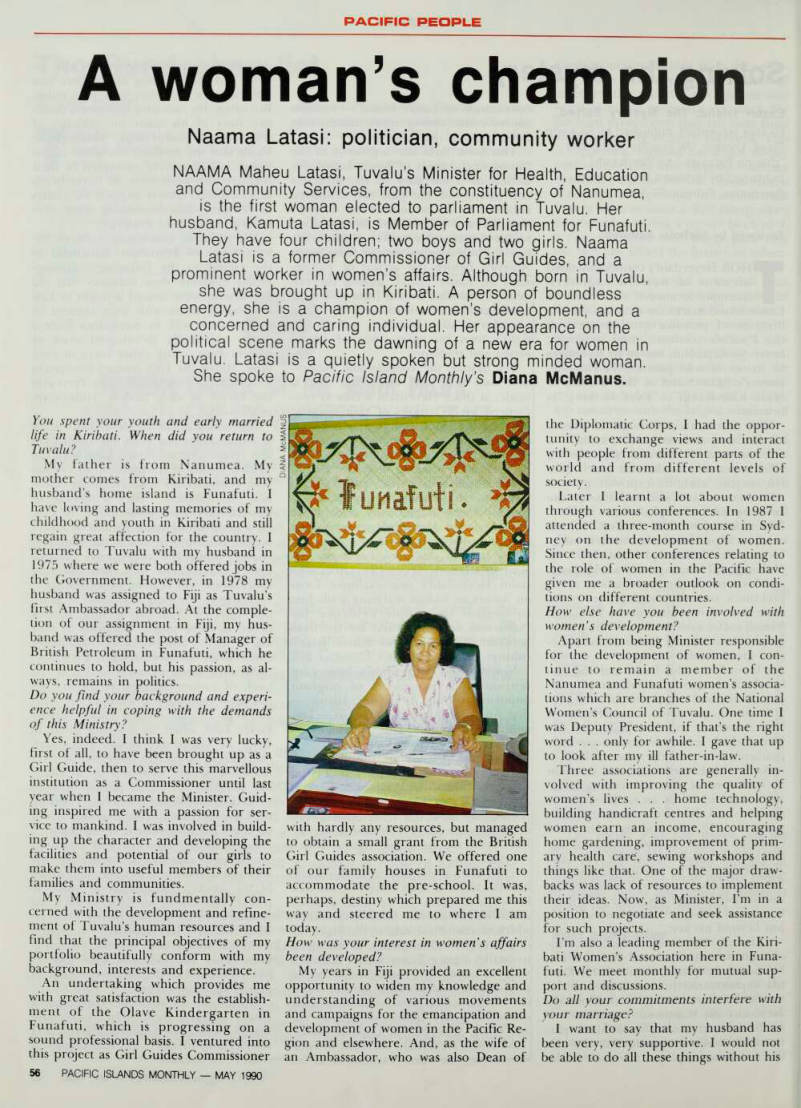
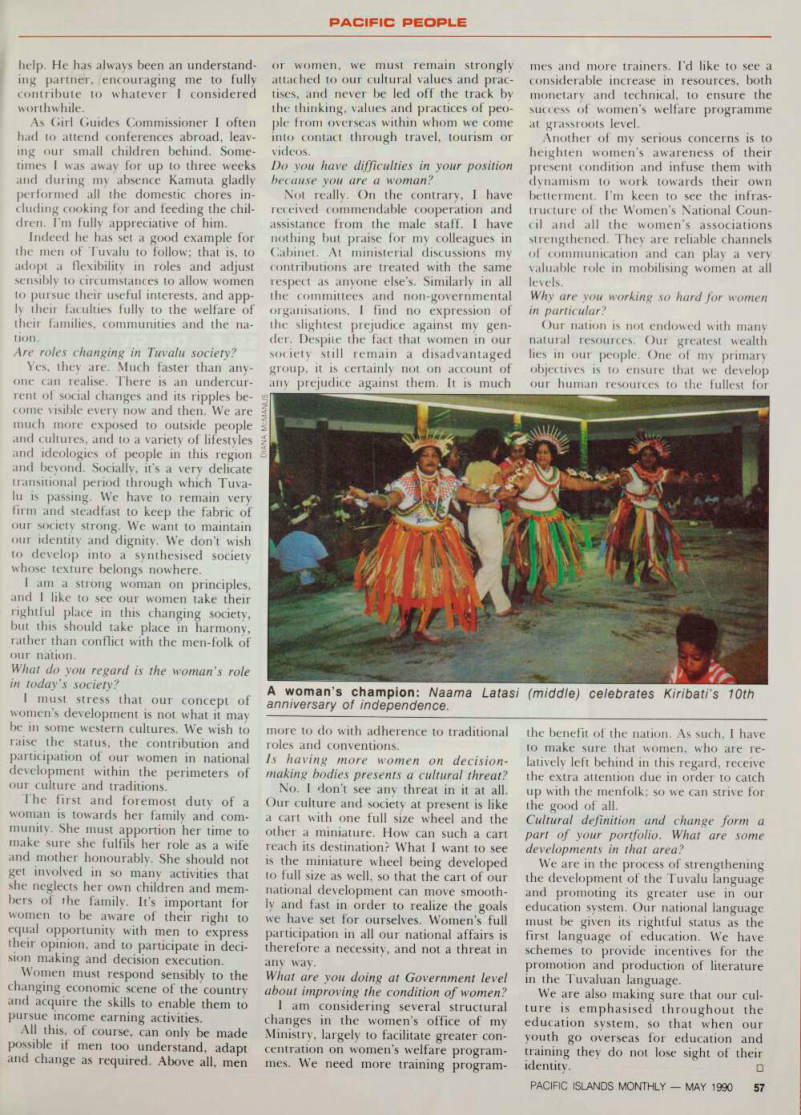
Pacific People
Naama Latasi: politician, community worker
NAAMA Maheu Latasi, Tuvalu's Minister for Health, Education and Community Services, from the constituency of Nanumea, is the first woman elected to parliament in Tuvalu. Her husband, Kamuta Latasi, is Member of Parliament for Funafuti, They have four children; two boys and two girls. Naama Latasi is a former Commissioner of Girl Guides, and a prominent worker in women’s affairs. Although born in Tuvalu, she was brought up in Kiribati. A person of boundless energy, she is a champion of women's development, and a concerned and caring individual. Her appearance on the political scene marks the dawning of a new era for women in Tuvalu. Latasi is a quietly spoken but strong minded woman.
She spoke to Pacific Island Monthly's Diana McManus.
You spent your youth and early married life in Kiribati. When did you return to Tuvalu?
My father is from Nanumea. My mother comes from Kiribati, and my husband’s home island is Funafuti. I have loving and lasting memories of my childhood and youth in Kiribati and still regain great affection for the country. I returned to Tuvalu with my husband in 1975 where we were both offered jobs in the Government. However, in 1978 my husband was assigned to Fiji as Tuvalu’s first Ambassador abroad. At the comple tion of our assignment in Fiji, my hus band was offered the post of Manager of British Petroleum in Funafuti, which he continues to hold, but his passion, as al ways, remains in politics.
Do you find your background and experi ence helpful in coping with the demands of this Ministry?
Yes, indeed. I think I was very lucky, first of all, to have been brought up as a Girl Guide, then to serve this marvellous institution as a Commissioner until last year when I became the Minister. Guid ing inspired me with a passion for ser vice to mankind. I was involved in build ing up the character and developing the facilities and potential of our girls to make them into useful members of their families and communities.
My Ministry is fundmentally con cerned with the development and refine ment of Tuvalu’s human resources and I find that the principal objectives of my portfolio beautifully conform with my background, interests and experience.
An undertaking which provides me with great satisfaction was the establish ment of the Olave Kindergarten in Funafuti, which is progressing on a sound professional basis. I ventured into this project as Girl Guides Commissioner
with hardly any resources, but managed to obtain a small grant from the British Girl Guides association. We offered one of our family houses in Funafuti to accommodate the pre-school. It was,
perhaps, destiny which prepared me this
way and steered me to where I am
today.
How was your interest in women’s affairs been developed?
My years in Fiji provided an excellent opportunity to widen my knowledge and understanding of various movements and campaigns for the emancipation and development of women in the Pacific Re gion and elsewhere. And, as the wife of an Ambassador, who was also Dean of
the Diplomatic Corps, I had the oppor tunity to exchange views and interact with people from different parts of the world and from different levels of society.
Later I learnt a lot about women through various conferences. In 1987 I attended a three-month course in Syd ney on the development of women.
Since then, other conferences relating to the role of women in the Pacific have given me a broader outlook on condi tions on different countries.
How else have you been involved with women’s development?
Apart from being Minister responsible for the development of women, I con tinue to remain a member of the Nanumea and Funafuti women’s associa tions which are branches of the National Women’s Council of Tuvalu. One time I was Deputy President, if that’s the right word . . . only for awhile. I gave that up to look after my ill father-in-law.
Three associations are generally in volved with improving the quality of women’s lives . . . home technology, building handicraft centres and helping women earn an income, encouraging home gardening, improvement of prim ary health care, sewing workshops and things like that. One of the major draw backs was lack of resources to implement their ideas. Now, as Minister, I’m in a position to negotiate and seek assistance for such projects.
I’m also a leading member of the Kiri bati Women’s Association here in Funa futi. We meet monthly for mutual sup port and discussions.
Do all your commitments interfere with your marriage?
I want to say that my husband has been very, very supportive. I would not be able to do all these things without his
help. He has always been an understand ing partner, encouraging me to fully contribute to whatever I considered worthwhile.
As Girl Guides Commissioner I often had to attend conferences abroad, leav ing our small children behind. Some times I was away for up to three weeks and during my absence Kamuta gladly performed all the domestic chores in cluding cooking for and feeding the chil dren. I’m fully appreciative of him.
Indeed he has set a good example for the men of Tuvalu to follow; that is, to adopt a flexibility in roles and adjust sensibly to circumstances to allow women to pursue their useful interests, and app ly their faculties fully to the welfare of their families, communities and the na tion.
Are roles changing in Tuvalu society?
Yes, they are. Much faster than any one can realise. There is an undercur rent of social changes and its ripples be come visible every now and then. We are much more exposed to outside people and cultures, and to a variety of lifestyles and ideologies of people in this region and beyond. Socially, it’s a very delicate transitional period through which Tuva lu is passing. We have to remain very firm and steadfast to keep the fabric of our society strong. We want to maintain our identity and dignity. We don’t wish to develop into a synthesised society whose texture belongs nowhere.
I am a strong woman on principles, and I like to see our women take their rightful place in this changing society, but this should take place in harmony, rather than conflict with the men-folk of our nation.
What do you regard is the woman’s role in today’s society?
I must stress that our concept of women’s development is not what it may be in some western cultures. We wish to raise the status, the contribution and participation of our women in national development within the perimeters of our culture and traditions.
The first and foremost duty of a woman is towards her family and com munity. She must apportion her time to make sure she fulfils her role as a wife and mother honourably. She should not get involved in so many activities that she neglects her own children and mem bers of the family. It’s important for women to be aware of their right to equal opportunity with men to express their opinion, and to participate in deci sion making and decision execution.
Women must respond sensibly to the changing economic scene of the country and acquire the skills to enable them to pursue income earning activities.
All this, of course, can only be made possible if men too understand, adapt and change as required. Above all, men
or women, we must remain strongly attached to our cultural values and prac tises, and never be led off the track by the thinking, values and practices of peo ple from overseas within whom we come into contact through travel, tourism or videos.
Do you have difficulties in your position because you are a woman?
Not really. On the contrary, I have received commendable cooperation and assistance from the male staff. I have nothing but praise for my colleagues in Cabinet. At ministerial discussions my contributions are treated with the same respect as anyone else’s. Similarly in all the committees and non-governmental organisations, I find no expression of
the slightest prejudice against my gen
der. Despite the fact that women in our society still remain a disadvantaged group, it is certainly not on account of any prejudice against them. It is much
mes and more trainers. I’d like to see a considerable increase in resources, both monetary and technical, to ensure the success of women’s welfare programme at grassroots level.
Another of my serious concerns is to heighten women’s awareness of their present condition and infuse them with dynamism to work towards their own betterment. I’m keen to see the infras tructure of the Women’s National Coun cil and all the women’s associations strengthened. They are reliable channels of communication and can play a very valuable role in mobilising women at all levels.
Why are you working so hard for women in particular?
Our nation is not endowed with many natural resources. Our greatest wealth lies in our people. One of my primary objectives is to ensure that we develop our human resources to the fullest for
more to do with adherence to traditional roles and conventions.
Is having more women on decision making bodies presents a cultural threat?
No. I don’t see any threat in it at all.
Our culture and society at present is like a cart with one full size wheel and the other a miniature. How can such a cart reach its destination? What I want to see is the miniature wheel being developed to full size as well, so that the cart of our national development can move smooth ly and fast in order to realize the goals we have set for ourselves. Women’s full participation in all our national affairs is therefore a necessity, and not a threat in any way.
What are you doing at Government level about improving the condition of women?
I am considering several structural changes in the women’s office of my Ministry, largely to facilitate greater con centration on women’s welfare program mes. We need more training program
the benefit of the nation. As such, I have to make sure that women, who are re latively left behind in this regard, receive the extra attention due in order to catch up with the menfolk; so we can strive for the good of all.
Cultural definition and change form a part of your portfolio. What are some developments in that area?
We are in the process of strengthening the development of the Tuvalu language and promoting its greater use in our education system. Our national language must be given its rightful status as the first language of education. We have schemes to provide incentives for the promotion and production of literature in the Tuvaluan language.
We are also making sure that our cul ture is emphasised throughout the education system, so that when our youth go overseas for education and training they do not lose sight of their
identity. □
Diana Mcmanus
A woman’s champion: Naama Latasi (middle) celebrates Kiribati’s 10th anniversary of independence.
Advertisements & other items, pp. 58-60 (1 item)
Pacific
ACIFI
ISLANDS
IM O N
U
fIRK€T PLfIC
For the benefit of our readers who would like to place a small classified advertisement in our magazine, Market Place will assist you in selling personal items, accommodation, real estate, boating or a service ... in fact anything you would like to sell to our over 50,000 readers.
Market Place Advertising Rates are structured to allow you to place as many advertisements as you wish, economically.
DIESEL ENGINES & PARTS
Caterpillar engines. Truck, Marine, Industrial. New, Rebuilt, Exchange. All genuine parts. Write Cat Engines, P.O. 319 Nambour Q.L.D. 4560, Australia. Fax 071 421249. Phone 071 421647 ai
BOOKS & PUBLICATIONS
Send for our free colour catalogue of revealing expose books on: Science, Politics, Medicine, Magnetic Healing, UFOs, Pyramidology, Etc.
“MOONGATE" The latest addition, exposes NASA and reveals the real truths about the Moon & UFO's 20 colour illustrations. Stunning. VERITAS PRESS, BOX
636, PALM BEACH, GOLD COAST, OLD
4221. AUSTRALIA. 075-345070. A 2
Project Development. Feasibility Studies, (giant clam, topshetl, pearls, abalone, oysters, shrimp). Joint ventures also sought with governments and private companies. Pacific Aquaculture Consulting, 14431 Holt Ave., Santa Ana, California, 92705, USA, as
STAMPS WANTED
Pacific Islands stamps on exchange basis. J. Lai, 19 Lovoni Rd, Tamavua, Suva, Fiji. A 4
FOR SALE
PORT VILA VANUATU U 55350,000
Popular small resort for sale.
Restaurant/Bar/Bungalows in tropical gardens on quiet lagoon Excellent return.
Easily managed by couple, Further information: P.O. Box 400, Port Vila, Vanuatu. A 5
COMMERCIAL PRINTING
Top quality four colour printing, brochures, posters, packaging, product labels, fabric labels, billboards, books, magazines, stickers, books. Export quality. Contact Fiji's most experienced Com-
mercial Printers. FIJI TIMES COMMER- CIAL PRINTING, P.O. Box 1167, Suva. Fiji.
Phone: 314111. Fax. 301521.
HOLIDAY ACCOMMODATION
“Rainbow Bay Coolangatta”
Rainbow Place Apartments on the beach at beautiful Rainbow Bay. 1 & 2 bed units s/c. Large balcony facing north with magnificent coast and sea views. Solar heated pool Compact tennis. Ftandy to N.S.W. Clubs. Security basement parking.
Resident Managers. Phone (075) 36 6759 for booking or write for brochure. 180 Marine Parade, Coolangatta. 3223. Australia.
Como Holiday Units (Fully self-contained).
Beachfront location overlooking the splendour of Keppel Bay and the islands. Two minutes from Hotels/Restaurants. Warm Welcome. Phone (079) 391594 or write 32 Anzac Parade, Yeepoon Old. 4703, Australia.
Yamba, NSW, We specialise in all forms of holiday lettings. For friendly and promt attention write or phone for our free Holiday Accommodation booklet.
BECOME MAIL ORDER
“Think and Grow Rich", hot selling book, huge commissions.
World Entreprenuers, PC Box 1334, Mt.
Hagen., PAPUA NEW GUINEA,
BOATING
Boating Holidays NZ’s Bay Of Islands, Hauraki Gulf and Fiji. Bare boat, skippered, learn & cruise, flotilla, charter yachts and launches 26'-42' All available from Rainbow Yacht Charters, P.O. Box 8327, Symonds Street, Auckland, NZ. Phone. (09)3089-419. Fax (09) 790-457.
SELF ADHESIVE LABEL
FORUM LABELS (FIJI) LTD
P.O. Box 1167, Suva., Fiji. Phone: 314111.
We print self-adhesive labels in rolls, multi-coloured labels with hot foil, and die cut to shape, tickets and tags in rolls. We also supply labelling machines and fabric labels.
PACIFIC
SLANDS
IMQNT H L Y
MRRK6T PLRC6 CRN UJORK
WOND6RS FOR VOU ...
Promote your business, or service, sell your household
items, cars or heavy machinery
etc.
ONLY AUSSI PER WORD.
NO COMPANY LOGO. NO
DISPLAY. NO BOLD TYPE.
Just forward your Advertisement together with payment to: PACIFIC ISLANDS MONTHLY “Market Place ”, P.O. Box 1167, Suva, Fiji.
CONDITIONS:
1/ All Advertisements are subject to acceptance and approval of publisher. 2. Advertisements are published as space permits; we cannot guarantee date of insertion. 3. All advertisements must be prepaid and should be typed or printed clearly. 4. Deadline for receipt of advertisements is the 10th of the month prior to issue.
5. PACIFIC ISLANDS MONTHLY
assumes no responsibility for any service other than publishing paid advertisements in this section.
anyhow
have a
Winfield
merest rj\|ESS yOUB Fl
EDUCf
ing VVarn
OKIND
Ith Al» SM
Created as Living Hardware.
tM *P^'r- I k Y -.4 t y r V Mitsubishi’s full-time four-wheel drive, a corner-stone of the diverse technologies that results in their organic performance, is beautifully simple. As any truly advanced idea should be. Linking a viscous coupling unit, a sort of torque transfering devise with the center differential puts smooth, forceful acceleration and stable cornering under the wheels of their new organically inspired vehicles.
The idea behind organic performance is that a car should really operate the way you want it to rather than the driver having to accommodate the various quirks of the vehicle. Both the driving conditions and the vehicle’s operation are monitored by the vehicle itself. In this way the car constantly fine-tunes its drive systems for the optimum ■ operation while also adjusting its perform- ■ n ance according to the external conditions.
Concern for your safety is why we make cars that perform as an extension of your will. You can’t be expected to anticipate every traffic situation any more than you can pay attention to every mechanical detail.
So we’ve made cars that share some of the work load with you. With less time spent worrying about the running of the vehicle, you can spend more enjoying the drive.
Because when you drive a Mitsubishi, you’re driving technology you can trust.
A
MITSUBISHI
MOTORS
MITSUBISHI GRLRNT
AMERICAN SAMOA: MORRIS SCANLAN SERVICE INC. PO Box 367, Pago Pago, Tel 633-5520/AUSTRALIA: MITSUBISHI MOTORS AUSTRALIA LTD. Box 1284, South Road, Clovelly Park, South Australia 5042. Tel (08] 275-7223/FIJI: NIVIS MOTOR & MACHINERY CO., LTD. G.P.O, Box 150, Suva, Tel, 383411/FRENCH POLYNESIA (TAHITI): ETS-BREDIN FRERESETFILS P.O. Box 21, Papeete, Tahiti, Tel. 4-202-58/NEW CALEDONIA: SOCIETE D'IMPORTATION D AUTO DU PACIFIQUE SUD S.A. B.P. 438 Rond Point du Pacifique, Noumea, Tel 274144/NEW ZEALAND: MITSUBISHI MOTORS NEW ZEALAND LTD. Todd Park. Heriot Drive, Private Bag, Porirua, Tel. 370-109/ NORFOLK ISLAND: BORRYS LTD. P.O Box 169. Norfolk Island, Tel. 2114/PAPUA NEW GUINEA: TOBA PTY. LTD. P O Box 503, Port Moresby, Tel 21-7874/SOLOMON ISLANDS: HARVEST PACIFIC LTD. G.P.O Box 88, Honiara, Guadalcanal, Tel. 30128/TONGA: SITANI MAPI CO., LTD. P.O. Box 83, Nuku ALOFA. Tel. 21-044/VANUATU: SOCOMETRA B P. 06 Route de Lagon. Port-Vila, Tel. 2314/WESTERN SAMOA: A M. MACDONALD HOLDINGS LTD.
P.O. Box 576, Apia, Tel, 22022/SAIPAN/POHNPEI/MAJURO/KOSRAE/TRUK/YAP/BELAU: MICRONESIAN MOTORS, INC. 997 South Manne Dnve, Tamuning, Guam 96911, Tel 646-6827