Pacific
Islands
Monthly
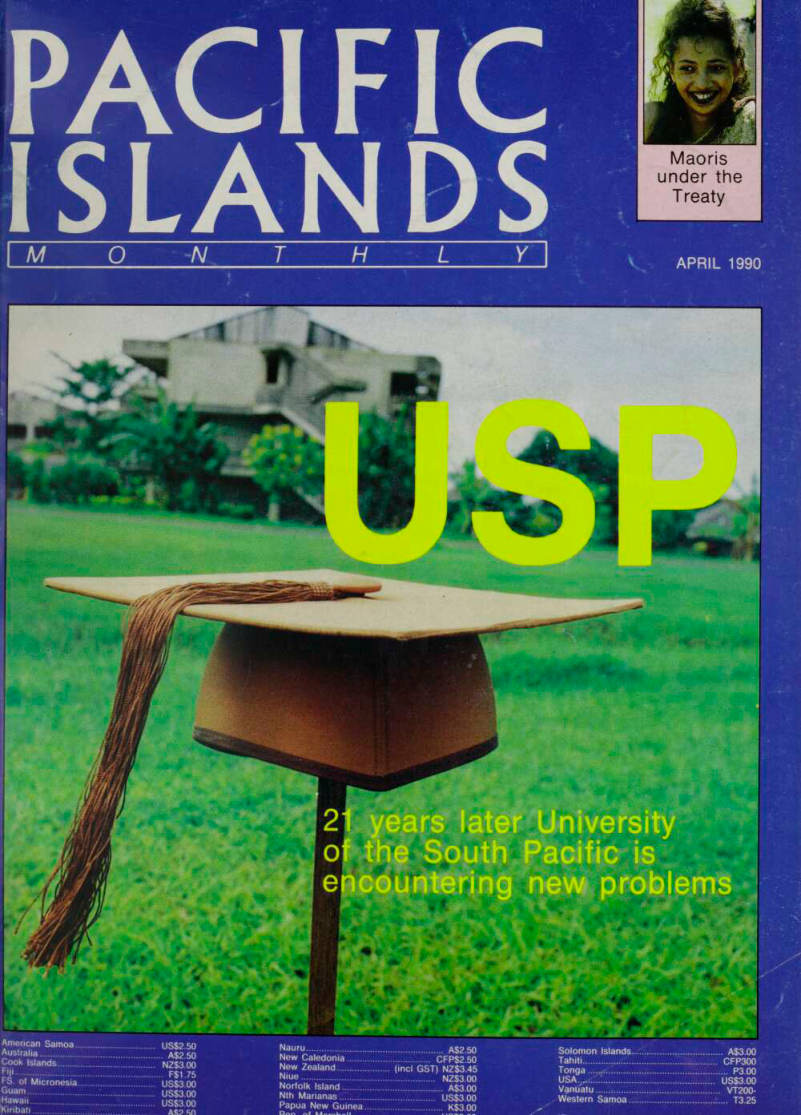
Maoris under the T reaty
April 1990
I I I I^L^^ ■
(21 years later University of the South Pacific is encountering new problems
American Samoa US$2.5O Australia A 52.50 Cook Islands NZ$3 00 S'-" F 51.75 t-b. of Micronesia US$3 00 g uam US$3.OO av y a " US$3.OO Klrlbab A*9
A$2. 5O New Caledonia CFPS2.SO New Zealand (incl GST) NZ53.45
N'ue Nz$3.Oo
Norfolk Island A 53.00 Nth Marianas US$3.OO Papua New Guinea K 53.00
Solomon Islands A 53.00 Tahiti . CFP3OO Tonga P3.00
Uss3.Oo
Vanuatu VT2OO - Samoa T 3.25
Advertisements & other items, pp. 2-4 (1 item)
Series
SUPER
J
World’s biggest lineup
tecordim
idio
est lineup of recording and radio headphone stereos. More than just headphone stereo, Super J Series features
include high-tech AM/FM synthesizer tuning with
presets, digital display, remote contro
auto reverse, quick recharge, DSL for deeper,
stronger bass—and more.
H5-J303A
Advanced Synthesizer Tuning with Stereo Recording
H5-JXBOBA
World’s Most Advanced Headphone Stereo ■ FM stereo/AM synthesizer tuning with memory presets BAuto reverse stereo recording BDSL—AlWA’s dynamic super loudness B Full-function wired remote controller BQuick 20 minute recharge
HS-JZOEMkllA
Super Best Seller with Digital Synthesizer Tuner
H5-JI70
Auto Reverse Headphone Stereo Recorder with Digital Synthesizer X-777 World’s First Midi System with BBE Sound B550W PMPO output power B BBE sound for remarkable high-definition sound BWireless remote control of the entire system B 2-way CD edit
C5D-XR90
Compact Disc Stereo Double Cassette Portable B 150W PMPO output power B BBE system for high definition sound BSuper active subwoofer system (3D) BQuatz synthesizer tuner B Full wireless remote control
HV-6505 DIGITAL
Video Cassette Recorder BLine recording capability B Digital auto tracking BAuto Voltage power supply (90V-260V Usable)
Digital Audios.Video
AIWA*
Mobex Pty., Ltd. Unit 1, 70 Gibbes Street Chatswood N.S.W. 2067 AUSTRALIA PHONE: 001-61-2-4066277/Oceania Indent Agency (P.N.G.) Pty., Ltd. Ago St., Gordon Box 5518, Boroko, Port Moresby Papua New Guinea PHONE: 256411/The Sound Centre Ltd. P.O. Box 434 Port Vila, Vanuatu PHONE: 2035/P. Hargovind Bros. 190 Renwick Road P.O. Box 409 Suva Fiji PHONE: 24350/Octavium GroufL Ltd. 33 Constellation Drive Mairangi Bay, Auckland 10 NEW ZEALAND PHONE: 001-64-9-479-1272/Hifivox 19 av. Foch B.P. 1458 NOUMEA Nouvelle-Caledonie PHONE: 001-687-27.24.66/Harves2i Pacific Limited P.O. Box 517, Honiara, Solomon Islands PHONE: 131/Fare-Hi-Fi Stereo Rue de Marechal Foch P.O. Box 269, Papeete Tahiti R.C. 6604A TAHITI PHONE: 2.48.14/Micropac Audio, Inoi P.O. Box 3478 Agana, Guam 96910 PHONE: 472-8091, 472-8297/Rarotonga Duty Free Shop Private Bag P.O. Box 92, Rarotonga, Cook Island/Nauru Co-Operative Society Republic of Nauru ,
Four Basic Colours
YELLOW BLACK
Plus
Fiji Times Commercial Printing
uthrode till
Equals
Printing Excellence
r. a u toifr basic col fours W^3t ° Ur exper ' encec * master printers, with the latest in printing technology, can produce from Full colour packaging and food labels that look good enough to eat; award winning full colour brochures and posters; magazines, calendars, books, stickers, fabric labels and billboards with pictures that leap right out of the printed pages. v« y °. L l r < pr i )duct rec l uires export-quality, high impact four colour printing, then you should be talking to us first. you II find our prices very competitive and our paper stock quite extensive.
FIJI TIMES
COMMERCIAL PRINTING DIVISION
Printing Excellence
20 GORDON STREET, SUVA. PHONE: SUVA 314111. Fax: 301521 LAUTOKA 60352. LABASA 81644.
Thanks to our Airline more
people are landing johs.
® B ■«./ #1 A; a*.
At Air Pacific we’re doing our part in creating more jobs in the community over a surprising range of areas. Naturally new aircraft like our wide bodied 767 mean extra jobs within the airline, but also because were bringing in more visitors, jobs are created down the line at the rate of one new job for every additional 32 visitors. There’s expansion in all areas of the hospitality and building industries; finance and * manufacturing, motor, retail and much more.
In fact, estimates are that over 20,000 people in V F.j, are employed in tourism related jobs.
In an economy that’s increasingly counting on tourism, we’re setting our sights on future expansion because we know there’ll be always people wanting to land a job. Air Pacific. The rainbow from Fiji.
ARMOnCp I
FIJI’S INTERNATIONAL AIRLINE
Pacific
Islands
Islands
Vol 60 No. 4
Voice Of The Pacific
April 1990
The Region
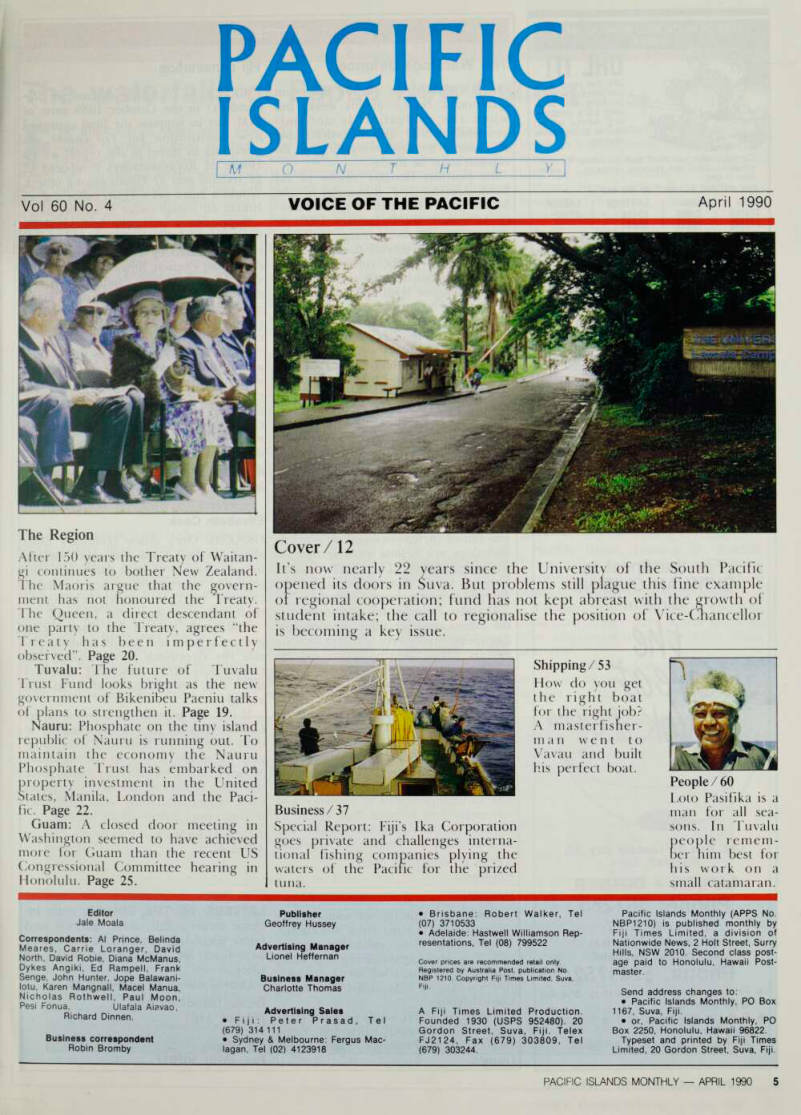
After 150 years the Treaty of Waitan gi continues to bother New Zealand.
The Maoris argue that the govern ment has not honoured the Treaty.
The Queen, a direct descendant of one party to the Treaty, agrees “the
Treaty has been imperfectly
observed”. Page 20.
Tuvalu: The future of Tuvalu Trust Fund looks bright as the new government of Bikenibeu Paeniu talks of plans to strengthen it. Page 19.
Nauru: Phosphate on the tiny island republic of Nauru is running out. To maintain the economy the Nauru Phosphate Trust has embarked on property investment in the United States, Manila, London and the Paci fic. Page 22.
Guam: A closed door meeting in Washington seemed to have achieved more for Guam than the recent US
Congressional Committee hearing in
Honolulu. Page 25.
Cover /12 It’s now nearly 22 years since the University of the South Pacific opened its doors in Suva. But problems still plague this fine example of regional cooperation; fund has not kept abreast with the growth of student intake; the call to regionalise the position of Vice-Cnancellor is becoming a key issue.
Business/37
Special Report: Fiji’s Ika Corporation
goes private and challenges interna
tional fishing companies plying the
waters of the Pacific for the prized tuna.
Shipping/53 How do you get the right boat
for the right job?
A masterfisner man went to Vavau and built his perfect boat.
People / 60 Loto Pasifika is a man for all sea sons. In Tuvalu
people remem
ber him best for his work on a small catamaran.
Editor dale Moala Correspondents: Al Prince, Belinda Meares, Carrie Loranger, David North, David Robie, Diana McManus, Dykes Angiki, Ed Rampell, Frank Senge, John Hunter, dope Balawani lotu, Karen Mangnall, Macel Manua, Nicholas Rothwell, Paul Moon, Pesi Fonua, Ulafala Aiavao, Richard Dinnen.
Business correspondent Robin Bromby
Publisher
Geoffrey Hussey
Advertising Manager
Lionel Heffernan Business Manager Charlotte Thomas Advertising Sales • Fiji; Peter Prasad, Tel (679) 314 111 • Sydney & Melbourne: Fergus Mac lagan, Tel (02) 4123918
• Brisbane: Robert Walker, Tel (07) 3710533 • Adelaide: Hastwell Williamson Rep resentations, Tel (08) 799522 Cover prices are recommended retail only.
Registered by Australia Post, publication No.
NBP 1210. Copyright Fiji Times Limited, Suva, Fiji.
A Fiji Times Limited Production.
Founded 1930 (USPS 952480). 20 Gordon Street, Suva, Fiji. Telex FJ2124, Fax (679) 303809, Tel (679) 303244.
Pacific Islands Monthly (APRS No.
NBP1210) is published monthly by Fiji Times Limited, a division of Nationwide News, 2 Holt Street, Surry Hills, NSW 2010. Second class post age paid to Honolulu, Hawaii Post master.
Send address changes to: • Pacific Islands Monthly, PO Box 1167, Suva, Fiji. • or, Pacific Islands Monthly, PO Box 2250, Honolulu, Hawaii 96822.
Typeset and printed by Fiji Times Limited, 20 Gordon Street, Suva, Fiji.
Letters
The Wahlroos defence ORDINARILY an author does not question a review of his work. But when the evaluation is not only eminently unfair and inaccurate, but also uninformed and misleading, an ex ception must be made.
In Norman Douglas’ review of my book Mutiny and Romance in the South Seas: A Companion to the Boun ty Adventure (P/M, January 1990) he accuses me of mentioning “trivia” in
the companion (encyclopaedia) section
of my book; yet he concerns himself only with minutiae such as an inconsis tent spelling of Nadi and Lakemba.
Douglas questions my scholarship
(which is based on lifelong research), yet he is unable to point to one single inaccuracy of history or fact. He ridi cules my psychological evaluation of the relationship between Bligh and Christ ian, yet he is unable to come up with a
convincing explanation of the mutiny.
Douglas is inconsistent. After criticis ing the inclusion of “trivia” in my book, he says that “the value (of my section on Tahitian history) is reduced” by the omission of two Australian films which he claims were partly made on Tahiti.
Not only is Douglas inconsistent, he is misinformed. The 1916 silent movie was filmed in Rotorua and on Norfolk and does not belong in a section on I ahitian history. The 1932 Chauvel film was partly shot on Tahiti, but the Polynesian extras were Tongans.
Douglas ridicules my statement that the Fijians consider Bligh the principal European discoverer of Fiji and he smugly asks: “Which Fijians did Dr Wahlroos consult?” The answer is: the Government of Fiji which, on the occa sion of the 150th anniversary of Bligh’s death, issued a commemorative stamp describing him as the principal dis coverer of Fiji.
I welcome criticism of my book, but the petty and uninformed review by Mr Douglas does not do him credit. It is also so unappreciative of romance and adventure and humour that I fear its author would never understand the true meaning of. Huzzah for Otaheite!
Sven Wahlroos, Phd
California
Penpals
Martha Lisa Utia,lB. She wants to cor respond with “anyone from anywhere”.
Martha likes music, collecting stamps,
travelling, cooking, socialising. She wants
photos of those who write to her.
Address: Depot 4,Arorangi, Rarotonga,
Cook Islands.
Ricky Lee, 38. He wants penpals “from anywhere”. Address:PO Box 163, Vani mo, Sandaun Province, Papua New Guinea.
Fiji constitution I REFER to an article (Fijians get the numbers) in the October 1989 issue of PIM. Let us suppose the final approved new constitution for Fiji comes out essentially as stated in the report with a House of Representatives composed of 27 Indians and 37 Fijians among others.
Would a Fijian get a Fijian ballot and an Indian an Indian ballot in an election?
Supposing a particular individual Fi jian believed he personally would be bet ter represented by a local Indian candi date in an election, how could that Fijian vote for the Indian candidate? Whom does the daughter or son of a Fijian mother (father) and an Indian father (mother) vote for? An Indian or a Fijian candidate. Etc, etc.
For how many generations would such a constitution make any sense? Because, over a sufficiently long period of time, even with legal or other impediments, the gene pool would eventually become completely mingled so that one could not tell who was Fijian and who was In dian, or who was whatever.
Robert Silberstorf
Medellin, Colombia Elizabeth Cook GRAEME Orr’s article (February PIM) about Elizabeth Cook is strangely lacking in any mention of most Australia’s only source of information on her. I refer of course to the recent television documentary series on her husband.
The series showed the Cooks being granted a grace and favour residence be side the Greenwich Naval College and Observatory. If I remember rightly I think that was said to be after his first voyage.
If that was pure fiction I would expect Graeme Orr at least to mention it, to deny its veracity. However I would sug gest he makes a trip to the Maritime Museum in Greenwich and watch some television replays of that series of James Cook before submitting what I consider is a necessary follow-up on his wife.
John Allan
Adelaide.
Letters To The Editor Must In
clude writer’s full name, address and home telephone number. All letters may be edited for purposes of clarity or space.
Letters should be addressed to: Pacific Islands Monthly PO Box 1167 Suva Fiji Islands Fax: (679) 302011
Advertisements & other items, p. 6 (1 item)
qreaP
HOW ON EARTH AM I GOING TO TAKE
ALL THIS HOME ?
DHL IT!
DHL has years of experience carefully packing and shipping Fiji’s outstanding works of art directly to your home doorstep.
Our reputation has been built on caring for your valuables Don't take chances, phone us we're here to help.
Just call DHL we ll do the rest
SUVA
313166 313149
NADI LAUTOKA I LABASA
73800 I 65400 81162 72019 I 65401 I
MARTIN FABRICS
FIJI'S ONLY HOUSE OF FASHION WEAR
* FLORAL DRESS PRINTS a HABUTAE SILK * 100% COTTON PRINTS * FANCY FABRICS * TAPA PRINTS * MENS SUITING &
* ISLAND PRINTS SHIRTING MATERIAL
LARGEST SELECTION IN FIJI OF
* CURTAIN FABRIC FROM SWEDEN
AVAILABLE AT ALL
MARTIN FABRICS RETAIL OUTLET
SUVA NADI TOWN
281 VICTORIA PRO. OPP. NAMOTOMOTO VILLAGE
BA TOWN LAUTOKA
MAIN STREET BILA STREET
MARTINS CORNER
4 MILES NABUA
For the finest in
SICHUAN CUISINE
dine at m
qreaP
Cnr. Bau St/Laucala Bay Rd, Flagstaff, Suva.
LUNCH • DINNER
Phone: 301285
NOW ALSO AT:
404, Khyber Pass Rd, Newmarket, Auckland.
Phone: 5221752
• Friendly and unpretentious oriental style service. • Fully licensed bar and a splendid wine list. • All major credit cards accepted.
The waterfalls of Papua New Guinea
Stamp Box
FOR hundreds of years after New Guinea became known to them, Europeans left it alone. The huge island had no obvious riches and it had more mountains, swamps and jungle for its size than anywhere else in the world.
The advance guards of Western ‘civilisa tion’ were missionaries and traders, many of whom paid with their lives for their adventurousness.
By 1900 the Dutch had the western half of the island and the Germans and Australians the eastern part. After the First World War the Australians were mandated the east by the League of Na tions with a sacred trust to spread Euro pean civilisation.
The exact nature of the interior was unknown to such an extent that even as late as 1930 it was thought to be largely uninhabited. As far back as 1876 a French sailor called Tregance had pub lished a totally fraudulent account of a journey whereby he had encountered a powerful people called the ‘Orangwoks’ given to gold mining and horse riding.
The reality was very different however .
It was apparent from both north and south coasts that there was a huge mountain range running along the is land and it was assumed that it was ‘solid’. In fact there were two mountain ranges separated by a huge sparsely populated plateau which is in turn in
terspersed by deep river valleys.
Expeditions in the early 30s estab lished the existence of a huge population hidden in the highlands, away from the sultry mosquito-ridden coast. A stone
age people, separated into thousands of tiny enclaves with their own languages, came face to face with the all-powerful Westerners. Warriors confident at fight ing with spear and arrows were shocked beyond belief when they came to face to face with rifles. Many such tribes had had no idea that there were any other people in the world except themselves.
From the mountains, many rivers de scend to the coast. Fast flowing streams interspersed with waterfalls and rapids have grown to enormous shallow slug gish giants by the time they reach the coastal regions. There are five thousand
or so miles of coastline much of it lined with mangroves. Ship’s launches cannot usually penetrate more than a hundred miles upstream.
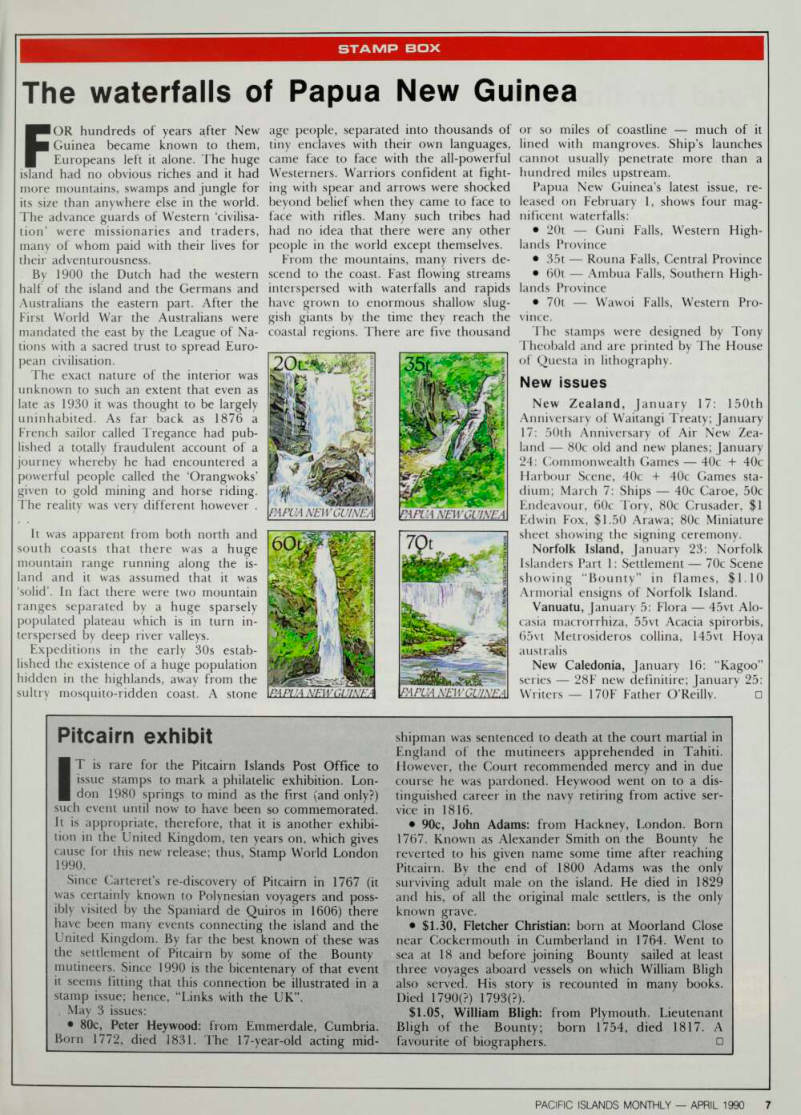
Papua New Guinea’s latest issue, re leased on February 1, shows four mag nificent waterfalls: • 20t Guni Falls, Western High lands Province • 35t Rouna Falls, Central Province • 60t Ambua Falls, Southern High lands Province • 70t Wawoi Falls, Western Pro vince.
The stamps were designed by Tony Theobald and are printed by The House of Questa in lithography.
New issues New Zealand, January 17: 150th Anniversary of Waitangi Treaty; January 17: 50th Anniversary of Air New Zea land —80 c and new planes; January 24: Commonwealth Games —40 c 40c Harbour Scene, 40c -I- 40c Games sta dium; March 7: Ships —40 c 50c Endeavour, 60c Tory, 80c Crusader, $1 Edwin Fox, $1.50 Arawa; 80c Miniature sheet showing the signing ceremony.
Norfolk Island, January 23: Norfolk Islanders Part 1; Settlement —70 c showing “Bounty” in flames, $l.lO Armorial ensigns of Norfolk Island.
Vanuatu, January 5: Flora 45vt Alo casia macrorrhiza, 55vt Acacia spirorbis, 65vt Metrosideros collina, 145vt Hoya australis New Caledonia, January 16: “Kagoo” series —28 F definitire; January 25: Writers —170 F O’Reilly. □
Pitcairn exhibit
IT is rare for the Pitcairn Islands Post Office to issue stamps to mark a philatelic exhibition. Lon don 1980 springs to mind as the first (and only?) such event until now to have been so commemorated.
It is appropriate, therefore, that it is another exhibi tion in the United Kingdom, ten years on, which gives cause for this new release; thus, Stamp World London 1990.
Since Carteret’s re-discovery of Pitcairn in 1767 (it was certainly known to Polynesian voyagers and poss ibly visited by the Spaniard de Quiros in 1606) there have been many events connecting the island and the United Kingdom. By far the best known of these was the settlement of Pitcairn by some of the Bounty mutineers. Since 1990 is the bicentenary of that event it seems fitting that this connection be illustrated in a stamp issue; hence, “Links with the UK”. , May 3 issues: • 80c, Peter Heywood: from Emmerdale, Cumbria.
Born 1772, died 1831. The 17-year-old acting mid
shipman was sentenced to death at the court martial in England of the mutineers apprehended in Tahiti.
However, the Court recommended mercy and in due course he was pardoned. Heywood went on to a dis tinguished career in the navy retiring from active ser vice in 1816. • 90c, John Adams: from Hackney, London. Born 1767. Known as Alexander Smith on the Bounty he reverted to his given name some time after reaching Pitcairn. By the end of 1800 Adams was the only surviving adult male on the island. He died in 1829 and his, of all the original male settlers, is the only known grave. • $1.30, Fletcher Christian: born at Moorland Close near Cockermouth in Cumberland in 1764. Went to sea at 18 and before joining Bounty sailed at least three voyages aboard vessels on which William Bligh also served. His story is recounted in many books.
Died 1790(?) 1793(?). $1.05, William Bligh: from Plymouth. Lieutenant Bligh of the Bounty; born 1754, died 1817. A favourite of biographers. □
Food for thought
Headlines
RESEARCHERS in Australia and Fiji are cooperating to produce information lon Ithe nutrient com position of Pacific Island food. Dr Heather Greenfield of the Department of Food Science and Technology at the University of New South Wales in Syd ney and Dr Bill Aaldersberg of the University of the South Pacific in Suva are collecting information for a data base on the food content.
A laboratory has been established in Suva to collect food and analyse con tent. The data is then scrutinised by Dr Greenfield in Sydney. A similar labora tory has been set up in Papua New Guinea.
“We are concerned with how well the data is described. For instance, food labelled as ‘pig’ will differ considerably in fat content depending on which part of the animal is analysed and whether it s raw or cooked,” Dr Greenfield said.
“We need to know which part of the animal is commonly consumed. The same with insects, which are consumed all round the world. It depends on whether it is the head, wings or interior that people eat.”
The research will result in food com position tables which will allow the assessment of the adequacy of people’s diets. It will also allow researchers to look at the relationship of diet to dis ease.
Dr Greenfield said the Pacific Islands diet included a lot of imported proces sed foods. She hoped the food com position tables would promote the in creased production of indigenous foods and foster a Pacific Island identity with indigenous cuisine suitable for the tour ist industry and for local processing.
The research project is being funded by US Aid through the South Pacific Commission. □
Immigration policy changes
THE Fiji Government has announced
major changes to its immigration policy
relating to permanent resident status for investors, work permits and visitors visas. The changes include raising the
qualifying period of registration for Fiji
citizenship from five years to seven years. The current regulations for visi tors and tourists from a number of countries to have their visas issued on arrival will remain in force but bona fide visitors will be barred from partici pating in political activities, work, study or research.
On business applications, the new policy says the minimum investment re quired to purchase or set up a business
in Fiji is F 5500,000 (U 55350,000) with project proposals to be approved by the Ministry for Trade and Commerce. Ap plications for investor status will be res
tricted to industry, manufacturing,
agriculture, fisheries and forestry.
Commerce, imports and the retail trade will be reserved for Fiji citizens.
Applications for investor status in joint venture with indigenous Fijians will be given special consideration.
The new policy makes it mandatory that applicants seeking permanent resi dence status must have police clearance from their country of origin. In addi tion, they will not be permitted to join or finance any political party or take part in any national or local govern ment political activities or election cam
paigns. □
Rabuka on culture MAJOR-GENERAL Sitiveni Rabuka is listed as one of the key speakers at the Fiji Tourism Convention at the Hyatt Regency Fiji from June 14-16. Rabuka, who commands the Fiji Military Forces after staging two military coups in 1987, has been asked to speak on the topic, Interfacing with Fijian culture.
He “heads an impressive line-up of local and overseas speakers who will cover a wide variety of topics related to the convention theme Fiji. The Future is Now”, says a statement from the organisers.
The convention will be chaired by Savenaca Siwatibau, the former Gov ernor of the Reserve Bank of Fiji, who now heads the Pacific Operations Cen tre for the United Nations Economics and Social Commission for Asia and the Pacific (ESCAP) in Port Vila. □
Chemical weapons dumped CHEMICAL weapons from United States military bases on the Japanese island of Okinawa have been trans ported to Johnston Atoll for destruc tion. An army spokesman, Major Joe Padila, confirmed the nerve gases were now stockpiled on the atoll 1120kilometres south-west of Hawaii. The burn-off is expected to be the first step in using Johnstone Atoll for the des truction of United States chemical
weapons deployed in Germany.
Padila said an assessment by the Un ited States Army in 1983 indicated the weapons could be disposed of safely and in an environmentally acceptable manner. In February, the Army re leased an environmental impact assess ment report which said destroying the weapons at one of eight possible loca tions on the continental United States would have many disadvantages, the
biggest being risks in moving them
across the country. It said that on John stone Atoll the environmental impacts of incident-free handling and disposal will be minimal. □ Workshop on environment THE United Nations Development Programme (UNDP) will host a work shop on “Environmental management and sustainable development in the South Pacific” in Suva from the 17th to 21st of this month. It is designed for senior environmental officials at perma nent secretary level.
UNDP has invited participants from Fiji, Cook Islands, Federated States of Micronesia, Kiribati, Marshall Islands, Nauru, Niue, Palau, Papua New Guinea, Solomon Islands, Tokelau, Tonga, Tuvalu, Vanuatu and Western Samoa. □
Kava control
AUSTRALIA’S Northern Terri tory Government may impose restrictions on the sale of Kava.
The move follows reports that use of the ceremonial drink may cause liver dis function and weight loss.
In 1981, Kava was introduced on a large scale to Arnhem Land an area of the Territory mostly occupied by Aboriginal reserves where tribal lifestyles are still followed by many inhabitants.
Excessive consumption of alcohol by Aborigines (and whites) remains a prob lem in the Northern Territory and its capital, Darwin. It was thought Kava could be introduced as a substitute for
alcohol. The drink gives a pleasant feel ing without promoting the violent and aggressive behaviour so often associated with excessive alcohol consumption.
Kava sells in the Territory in 270 gram packets of powder for about As3s.
It is classified by Australian authorities as a food rather than a drug and there fore its sale is not restricted. But some
Aboriginal communities have placed
their own bans on Kava following re ports of weight loss and liver problems.
The Territory government is consider ing possible legislative options to control the sale and use of Kava. A total ban is reportedly one of the options being ex amined, but Health Minister Steve Hat ton is known to believe an outright ban would not succeed. □
Advertisements & other items, pp. 9-11 (1 item)
now servicing
Fuels and lubricants.
Plastics. Chemicals. Bitumen.
Aviation Services. Bunkering.
Shell has penetrated even more of the Pacific to widen its network of offices, terminals and
Network Shell
now servicing
even more
of the Pacific.
distributors as well as service stations.
Now you can re-assess your source of supply, because Shell quality and value is close at hand, with the service to back it up.
REGIONAL OFFICES: GUAM 671 477 4350. Also servicing Marshall Islands (Majuro), Northern Marianas (Saipan), Palau.
IJI 679 313 933. Also servicing Tonga, Cook Islands, American Samoa, Western Samoa • PAPUA NEW GUINEA 675 228 700. Also servicing Solomon Islands.
NEW CALEDONIA 687 285 720. Also servicing Tahiti, Vanuatu.
Nothing is more pleasurable than a comfortable ride. But it should never come at the expense of driving dynamics. The new Accord 2.0/ is quietly engineered to deliver the best of both.
Its powerfully efficient 16-valve, 2.0-liter PGM-FI-equipped engine has been innovatively designed with the new Honda balancer shaft system built right into the aluminum alloy block, greatly reducing noise and vibration. While Honda’s responsive four-wheel double-wishbone suspension makes the ride powerfully smooth. So the elegantly finished interior remains spaciously quiet, its distinctively large, slanting windshield Pod Mofesby/Honda A R 3°l3/NEW1 3/NEW ZEALAND: Honda New Zealand Ltd. P.O. Box 97-340, South Auckland/PAPUA NEW GUINEA: Toba Pty., Ltd. P.O. Box 503, Box 235, CHRB Sa,pan CM 96950/ Cnnl m°, r M f n "° Services p 0 B °* 49. Bairiki Tarawa, Republic of Kiribati/U.S. TRUST TERRITORY: United Micronesia Development Association P.O.
Kwok Kuen & Co., Ltd P080x537 H<«ia«/NaS?u C< !" f 74 ’ Rara '°"9a/GUAM Mark’s Motor Co, Inc. P.O. Box DV, Agana/Motor Distributors (Samoa) Ltd. P.O Box 576, Apia/Lee 96799; Heleck's Service Center Ltd P O Box 113 R Panned ! Republic of Nauru/FIJI. Coral Island Motors Ltd. PO. Box 12052 Suva Fiji/Holiday Motors, Parts and Service P.O. Box 968, Pago Pago, American Samoa South Pacific 2899/Honrta Farm itn d ol no. o! , . 3 ?°', America . n .!^° a . 937 9^ /Ton 9 a Industrial Traders P.O. Box 1035, Nukualofa, Tonga/NORFOLK ISLAND: Duncombe Bay Garage PO. Box 220, Norfolk Island Pacific 2899/Hnnria Farm itn on d .no. a oa " 30 ' 33Mun 9 d,na usinai iraoersK.u. Box 1035, Nukuaofa,Tone 2899/Honda Farm Ltd. P.O. Box 1031, Pori Vila, Vanuatu/NEW CALEDONIA: Soclete Generale D’lmportation Automobile S.A RT 1 BIS Ducos-Complexe Delco BP 1464-Nonmea, Nondelle-Caledonie
■ ; ■. ■. y"*■. •m . v .' 4 S%> • u;kS| V 9 enhancing that open-road feeling. As the flowing contours of a tough exterior composed of 90% anti-corrosion steel by weight and the glistening wraparound headlights round out the refinement. Yet, all this elegance doesn’t mean driving will be boring. For on the Accord, dynamic performance is never a luxury.
In 1989, Honda engines powered the HONDA Marlboro McLaren team to victory in the Formula One Constructors' Championships. This is the fourth consecutive year that Honda has won this honor. - I mm
Campus
Cover Stories
Education
Crisis on Campus
University of the South Pacific faces new problems in 1990 s
By Jope Balawanilotu
WHEN the University of the South Pacific turned 21 last year there were no candles, no parties, no celebrations. Yet it rightly de served a major bash, in typical island fashion. The university was freely touted as the Pacific’s most successful example of regional co-operation. Just two years earlier, it had survived its biggest test a genuine but little-known threat of com
plete closure during and immediately af ter Fiji’s coups in May and September 1987. The resumption of lectures after an enforced early mid-year break that year marked the USP’s coming of age.
But emergence into adolescence has brought its own turbulence. The uni versity faces the 1990 s in the grip of a crisis of identity and finance. Educa tionally, the USP’s 11 member nations must decide whether to prune the in stitution’s role back to its charter origins of providing a “pure” university educa
tion, or whether to continue with the present mishmash of post-secondary, technical and university teaching. Philo sophically, the USP has to decide whether it’s an international institution which just happens to be in the Pacific or whether to consciously assert, in staf fing and course content, its regional
identity.
Culturally, the university is struggling
to reconcile traditional Pacific respect for lines of authority and the need to en courage young, challenging intellects.
But it’s money which poses the most immediate threat to the USP’s growth.
Vice chancellor Geoffrey Caston is this month asking the USP grants committee to sanction a 50 per cent hike in the operating budget for the next triennium.
Funding from the USP’s member nations peaked in 1983 when Caston took over to find the budget overspent by half a million dollars. Since then the annual budget has remained the same in real terms, and Caston says seven years on, he’s got no additional staff but half as many students again.
The regional governments’ current annual contribution of F 513.4 million won’t, Caston says, pay for much-needed new dining facilities, more lab equip ment, more library books and salaries which will attract, and keep, adequately qualified staff. The requested hike would boost the annual budget to just over Fs23 million. But Caston points out this will merely return funding to its 1984 level.
The university cannot afford its pre
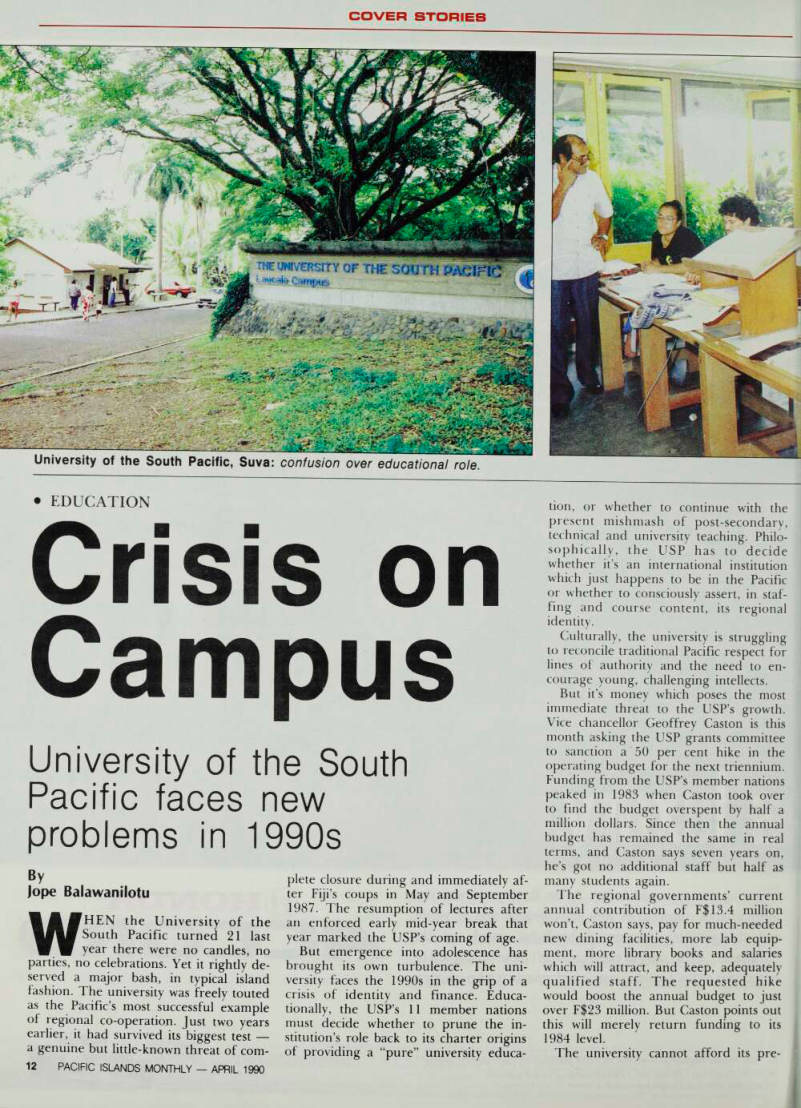
University of the South Pacific, Suva: confusion over educational role.
sent student numbers and Gaston warns that if the budget doesn’t go up, student rolls will have to be cut. He wants a change in the method of handling fees: 90 per cent of students are government sponsored and pay no fees while the fees from the remaining private students go back to their home governments, mainly Fiji.
Gaston says this inflexibility prevents the USP from becoming more self
financing, as required by its Council.
“We have to impose quotas on the num ber of students sponsored by govern ments,” he says. “We also have to reduce the number of extension students throughout the region, which has been
going up and up.”
But the Vice-Chancellor appreciates the Council’s 11 member nations will find it hard to put more money into the USP, with their economies not growing, with the exception of Fiji.
These domestic financial constraints will undoubtedly set the parameters for debate at the May Council meeting when members grapple with the USP’s future
identity.
The lack of money is directly related to the dilemma of educational perform ance at the university. A huge infusion of cash is needed to cope with the ad hoc expansion of its teaching role. Gas ton says a major area of strain is the increasing proportion of enrolments for foundation and preliminary courses, the equivalent of seventh form at secondary school.
This influx is due, Gaston believes, to
the failure of secondary schools in the islands to develop as their governments had planned. So students are seeking their preparation at university itself.
“Our staff are not really hired to be secondary school teachers,” he points out. “That needs special gifts. They are to do research and other things. So it’s not terribly efficient.”
A corollar of this problem is the problems almost every USP student has with the language of instruction. “Every student here at the USP is really learning in his second language, and very often third or fourth language,” Gaston explains. The wide range in language skills means the university also has to plug the holes by offering special courses to bring students’ English up to scratch.
Gaston lauds the general language progress of such students as a “tremendous achievement” and believes such problems need to be borne in mind when contemplating the USP’s high failure rates in the early stages.
This proliferation of foundation and language courses is merely an indication of a deeper confusion over the USP’s educational role. The university avoids
minority, specialist courses like engineer-
ing and pharmacological science. Students can be better served by universities in the Rim nations. But Gaston says it does tread a line between pure theory and a technical application.
The USP is trying, Gaston says, to produce graduates well-versed in the basic sciences or humanities, equipped with the most modern knowledge in their
particular topic. But he also believes they must end up with the particular skill to apply their knowledge under the special circumstances in their home island: a hybrid of technocrat and technician.
“You don’t really need computer en gineers to be produced here,” he ex plains, “but you do need computer scien tists.” The difference Gaston perceives is that Fiji, for example, will never have an industry for designing or manufacturing computers. “What it wants is people who have the knowledge of how to use them, and that’s important.”
Fiji has already arrived at the point of needing more technical training than its educational system can provide. Whether the USP will want to continue straddling the line between “pure” university and
pseudo polytechnic is a question which
holds cultural implications as well. Uni
versities traditionally encourage indepen
dent thinking while technical training emphasises mastering set tasks and sys tems, learning passed on by example and rote.
Shedding more technical-oriented courses would probably provoke more suspicion of the elitist, foreign influenced university ethos than the USP currently suffers under. Gaston recog nises the cultural clash between a uni versity’s aim to encourage challenging minds and the traditional view of teachers as authority figures who should be inculcating respect for the status quo.
Gaston admits some of the Pacific’s cultural leaders probably don’t want the USP to encourage “all this question
asking” but, removing that element would remove the essence of a universi ty. “If you want something that you call the university that’s going to produce citizens of the future that are going to advance the country technologically, in trade and in every other way, then you’ve got to have people who think like this.”
The cultural suspicion of universities has been sharpened in the USP’s case by the post-coup regime in Fiji which ac cuses the institution of being a breeding ground for alien and disruptive political influences. Gaston accepts domestic poli tical activity by staff as inevitable and
justifiable, as long as ideologies don’t
creep into the teaching. But he points out that the political activity of staff has been very restrained compared with what would have happened at universi ties in, say, Africa.
Gaston feels it’s to the USP’s credit that it’s produced three Coalition gov ernment members and one Alliance Minister. “I know we’ve come under fire about that but I think that our staff has behaved very well in this respect. And Fiji hasn’t got so much political talent that it can afford to ignore the ones who happen to teach here.”
All of which is a circular method of approaching the crux of the USP’s identity crisis enacting its so-called policy of regionalism outlined by the university Council in Vanuatu last year.
That directive related specifically to fill ing the Vice-Chancellory with a Pacific Islander, to replace British-born Gaston whose term ends in 1991. But it surfaces in issues as diverse as compulsory “Paci fic” course content and the failure of the USP’s culturally-oriented Pacific Week.
Gaston believes the USP’s thrust should be international in research and teaching but with a Pacific context.
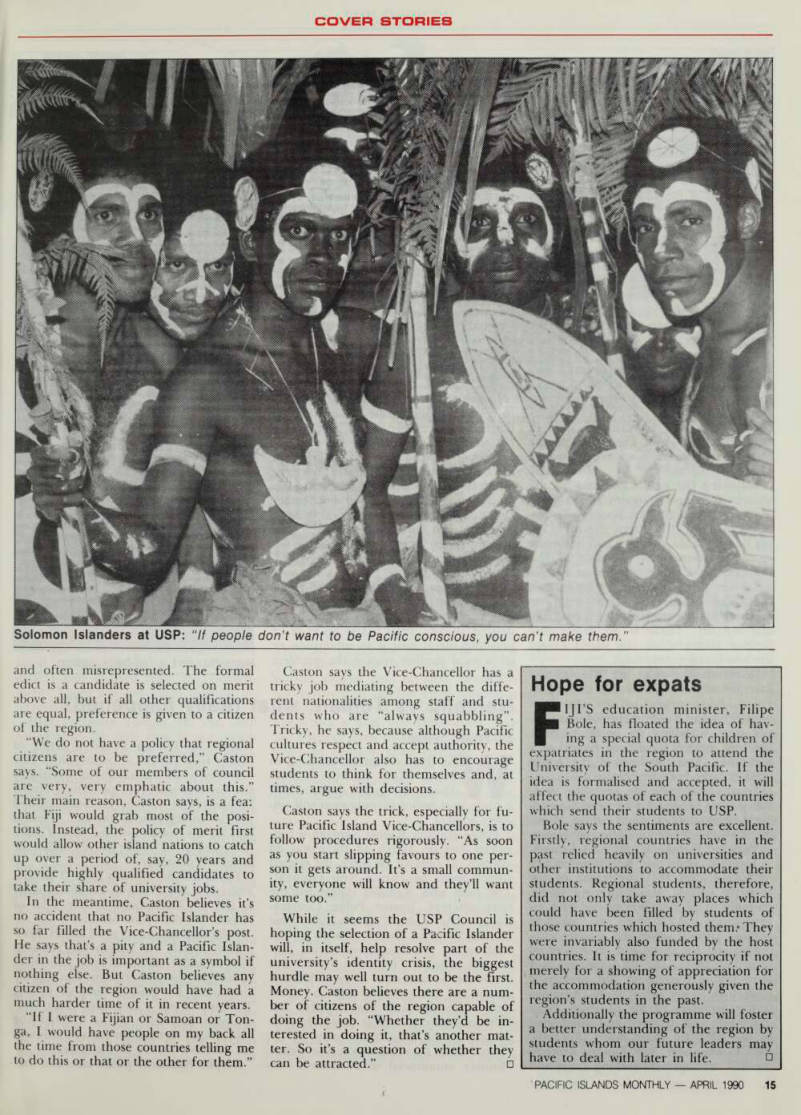
The best way to touch base with the university’s Pacific roots, he believes, is through cultural entertainment, dance, theatre and similar extra curricular acti vities. Gaston disagrees with putting this Pacific element into the academic prog ramme because “if people don’t want to be Pacific-conscious, you can’t make them”.
This may hint at a touch of defensive ness because the regionalism debate in recent years has focussed on the Vice- Chancellor’s job, and on Gaston himself.
He was given a two-year extension to his tenure so a Pacific Island replacement could be sought. Applications closed at the end of March and Fiji, at least, is expected to nominate its former Reserve Bank governor, Savenaca Siwatibau. But the extension of Gaston’s term apparent ly cost the future interest of several pre viously shortlisted locals.
Gaston says the regionalism policy at the USP has always been controversial
Caston -.“follow procedures rigorously”.
and often misrepresented. The formal edict is a candidate is selected on merit above all, but if all other qualifications are equal, preference is given to a citizen of the region.
“We do not have a policy that regional citizens are to be preferred,” Gaston says. “Some of our members of council are very, very emphatic about this.”
Their main reason, Gaston says, is a fea: that Fiji would grab most of the positions. Instead, the policy of merit first would allow other island nations to catch up over a period of, say, 20 years and provide highly qualified candidates to take their share of university jobs.
In the meantime, Caston believes it’s no accident that no Pacific Islander has so far filled the Vice-Chancellor’s post, He says that’s a pity and a Pacific Islander in the job is important as a symbol if nothing else. But Caston believes any citizen of the region would have had a much harder time of it in recent years.
If I were a Fijian or Samoan or Tonga, I would have people on my back all the time from those countries telling me to do this or that or the other for them.”
Caston says the Vice-Chancellor has a tricky job mediating between the diffe rent nationalities among staff and stu dents who are “always squabbling”.
Tricky, he says, because although Pacific cultures respect and accept authority, the Vice-Chancellor also has to encourage students to think for themselves and, at times, argue with decisions.
Caston says the trick, especially for fu ture Pacific Island Vice-Chancellors, is to follow procedures rigorously. “As soon as you start slipping favours to one per son it gets around. It’s a small commun ity, everyone will know and they’ll want some too.”
While it seems the USP Council is hoping the selection of a Pacific Islander will, in itself, help resolve part of the
university’s identity crisis, the biggest
hurdle may well turn out to be the first.
Money. Caston believes there are a num ber of citizens of the region capable of doing the job. “Whether they’d be in terested in doing it, that’s another mat ter. So it’s a question of whether they can be attracted.” □
Solomon Islanders at USP: “If people don’t want to be Pacific conscious, you can’t make them.”
membership
Micronesians seek membership
THE University of the South Pacific may have two more Pacific island countries as members next year.
They are the Federated States of Mic ronesia and the Marshall Islands.
“We’ve been talking to them for two, three years now about them becoming full members,” says Geoffrey Gaston, the university’s Vice-Chancellor. “Council took a decision in 1986, because they made some approaches to us, that they would be very welcome to come in as full members of the university.”
But Fiji’s coups in 1987 halted talks briefly. Now they are talking again, Gas ton says. “The door is open to them to come and join at any time,” he says. AIS the countries that are members of the South Pacific Forum are members of the University of the South Pacific with the exception of Australia, New Zealand and Papua New Guinea, each of which has its own universities, and the Federated States of Micronesia and the Marshall Islands. Meanwhile they do send their students to the University of the South Pacific as foreign students. “So that real ly suggests that the Marshalls and the FSM should be part of this as they’re part of other regional organisations,” says Gaston. “Politically, I think, they would like to be because they want to identify themselves as Pacific island countries.
“It’s much better if they were in and we can have 13 flags rather then 11. I wouldn’t say it would help financially be cause we’d also have to undertake obliga tions to them. We probably have to think of setting up extension centres there, and things like that.”
David Panuelo, the deputy chief of mission at the Federated States of Mic ronesia Embassy in Suva, says full mem bership will mean that they can send their students for about half as much as they are paying as non-members.
They are paying S9OOO a student a year whereas the 11 member countries are paying about S4OOO a student a year.
Panuelo says that his Embassy has re commended to the administration in Pohnpei to join the university. The final decision will have to be made by Con gress, which is expected to convene its budget session next month.
The current university members in clude the Solomon Islands, Vanuatu, Fiji, Nauru, the Kiribati, Tuvalu, the Tokelaus, Western Samoa, Tonga, Niue and the Cooks. □
Hope for expats
FIJI’S education minister, Filipe
Bole, has floated the idea of hav ing a special quota for children of expatriates in the region to attend the University of the South Pacific. If the idea is formalised and accepted, it will affect the quotas of each of the countries which send their students to USP.
Bole says the sentiments are excellent.
Firstly, regional countries have in the past relied heavily on universities and other institutions to accommodate their students. Regional students, therefore, did not only take away places which could have been filled by students of those countries which hosted them. 0 They were invariably also funded by the host countries. It is time for reciprocity if not merely for a showing of appreciation for the accommodation generously given the region’s students in the past.
Additionally the programme will foster a better understanding of the region by students whom our future leaders may have to deal with later in life. □
Round one for the militants
Papua New Guinea
By Frank Senge
IT is an uneasy ceasefire that has been wrought on Bougainville. In its eagerness to stop the bloody uprising that took 150 Papua New Guinean lives and that of one expatriate, the Govern ment agreed to a militant initiative to call a ceasefire in mid-February. In that the Government was caught off guard, while the militants had obviously given thought and planned their actions care
fully.
A ceasefire was signed into effect on March 1 by Deputy Controller of the State of Emergency, Colonel Leo Nuia and Commander of the outlawed
Bougainville Republican Army, Sam
Kauona. Immediately, the militants cal led for all the security forces to be off Bougainville before any peace talks could begin. The Government gave in and refused its own Controller of the State of Emergency’s advice to stage a phased withdrawal.
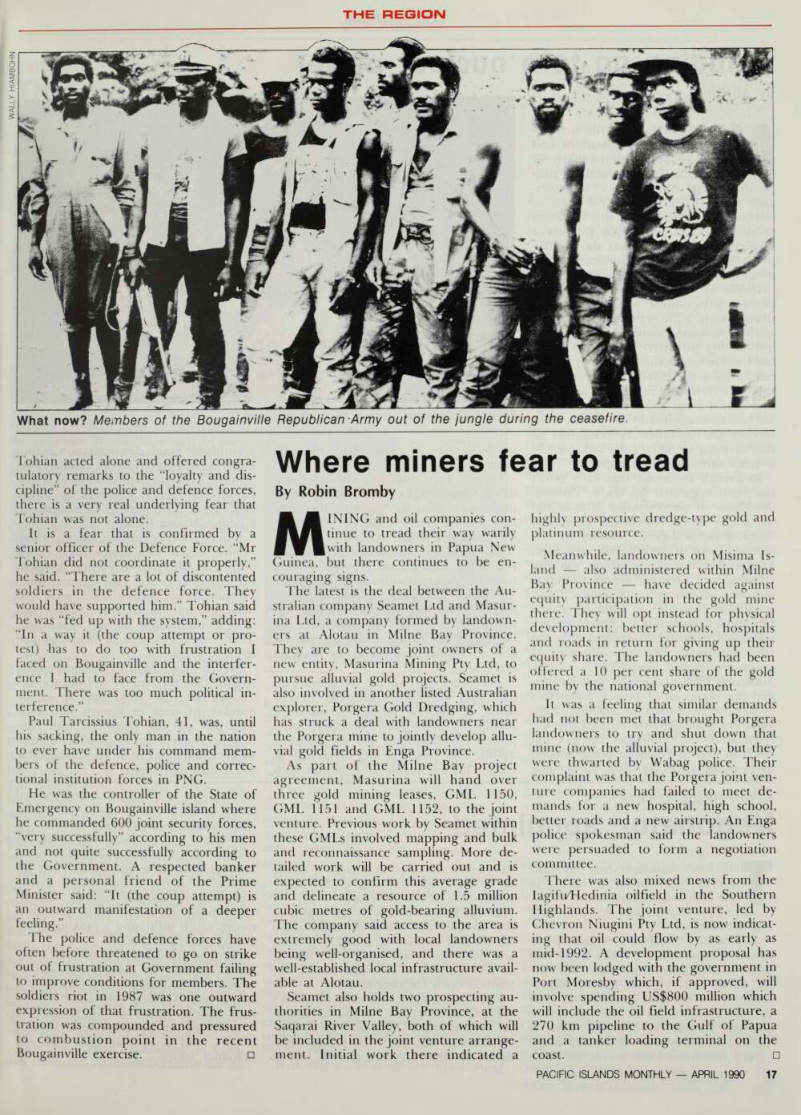
Following the total withdrawal of the security forces on Bougainville Island on March 16, the outlawed Bougainville Re publican Army (BRA) took control of ev ery district in the province and has made its headquarters at the site of the Bougainville Copper Limited at Pangu na. It set up road blocks, set up its own complaints officer and issued letters to business houses guaranteeing protection and security. There is no Papua new Guinea authority on the island except the provincial government.
Government-owned air Niugini un ilaterally withdrew its services to the pro vince. Government-owned statutory body, Post and Telecommunications Cor poration, withdrew its postal services.
Banking services have been limited to a minimum. And the bulk of the public services have been withdrawn.
Four weeks into the ceasefire there still was no peace talks between Govern ment negotiators, Foreign Affairs Minis ter Michael Somare and Attorney Gener al Bernard Narokobi, and BRA leaders.
Trouble again hit Bougainville im mediately after the withdrawal of the
security forces. Mauraudering mobs,
claiming to be members of the BRA vi sited shops and car yards and “asked to borrow” various goods and vehicles with out paying for them and often without returning them. The BRA claimed they were criminal elements and personally undertook to get rid of them. Adminis trative Secretary of the province, Peter Tsiamalili, was detained and questioned by the BRA for three hours. Recently, BRA Commander Sam Kauona wrote to the BCL management seeking a care and
maintenance contract in exchange for protection of the property.
The militants want all non- Bougainvilleans who have no legal proof that they are employed to be out of the province. There was no whimper from the Government and people fled, leaving personal belongings, and in the case of those who married Bougainvilleans, half their families.
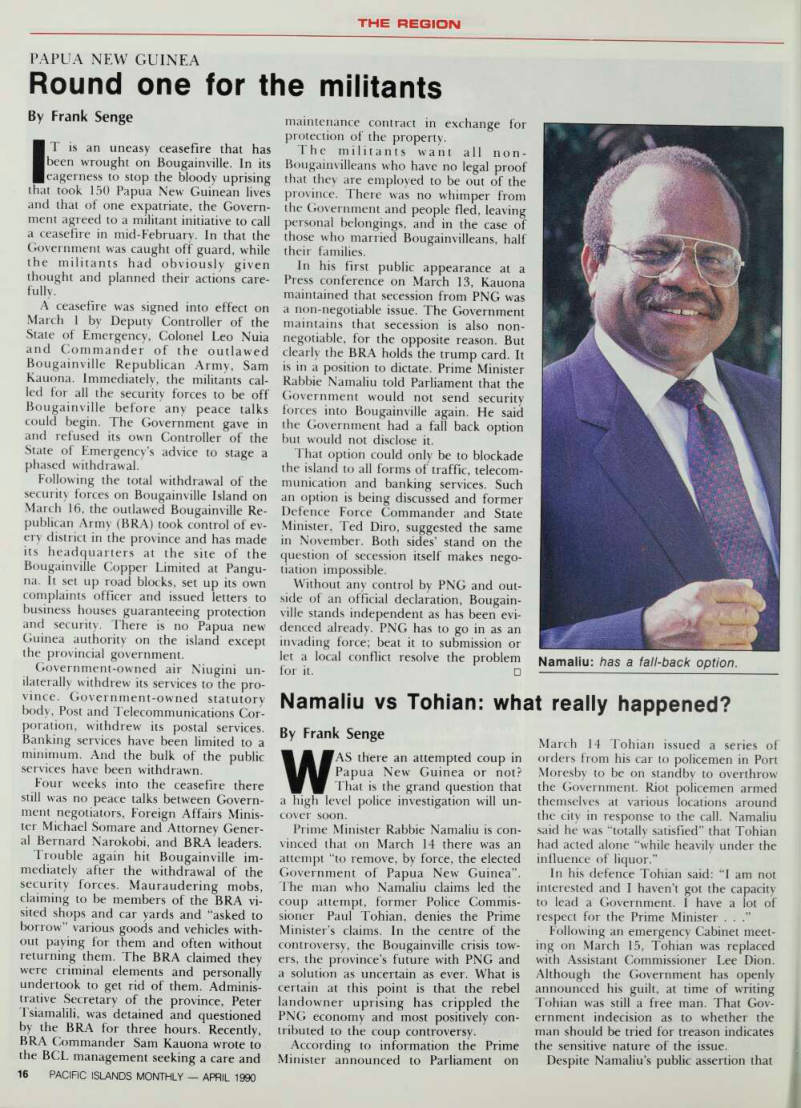
In his first public appearance at a Press conference on March 13, Kauona maintained that secession from PNG was a non-negotiable issue. The Government maintains that secession is also non negotiable, for the opposite reason. But clearly the BRA holds the trump card. It is in a position to dictate. Prime Minister Rabbie Namaliu told Parliament that the Government would not send security forces into Bougainville again. He said the Government had a fall back option but would not disclose it.
That option could only be to blockade the island to all forms of traffic, telecom munication and banking services. Such an option is being discussed and former Defence Force Commander and State Minister, Ted Diro, suggested the same in November. Both sides’ stand on the question of secession itself makes nego
tiation impossible.
Without any control by PNG and out side of an official declaration, Bougain ville stands independent as has been evi denced already. PNG has to go in as an invading force; beat it to submission or let a local conflict resolve the problem for it. □
Namaliu: has a fail-back option.
Namaliu vs Tohian: what really happened?
By Frank Senge
WAS there an attempted coup in Papua New Guinea or not?
That is the grand question that a high level police investigation will un cover soon.
Prime Minister Rabbie Namaliu is con vinced that on March 14 there was an attempt “to remove, by force, the elected Government of Papua New Guinea”.
The man who Namaliu claims led the coup attempt, former Police Commis sioner Paul Tohian, denies the Prime Minister’s claims. In the centre of the controversy, the Bougainville crisis tow ers, the province’s future with PNG and a solution as uncertain as ever. What is certain at this point is that the rebel landowner uprising has crippled the PNG economy and most positively con tributed to the coup controversy.
According to information the Prime Minister announced to Parliament on
March 14 Tohian issued a series of orders from his car to policemen in Port Moresby to be on standby to overthrow the Government. Riot policemen armed themselves at various locations around the city in response to the call. Namaliu said he was “totally satisfied” that Tohian had acted alone “while heavily under the influence of liquor.”
In his defence Tohian said: “I am not interested and I haven’t got the capacity to lead a Government. I have a lot of respect for the Prime Minister . .
Following an emergency Cabinet meet ing on March 15, Tohian was replaced with Assistant Commissioner Lee Dion.
Although the Government has openly announced his guilt, at time of writing Tohian was still a free man. That Gov ernment indecision as to whether the man should be tried for treason indicates the sensitive nature of the issue.
Despite Namaliu’s public assertion that
Tohian acted alone and offered congra tulatory remarks to the “loyalty and dis cipline” of the police and defence forces, there is a very real underlying fear that Tohian was not alone.
It is a fear that is confirmed by a senior officer of the Defence Force. “Mr Tohian did not coordinate it properly,” he said. “There are a lot of discontented soldiers in the defence force. They would have supported him.” Tohian said he was “fed up with the system,” adding: “In a way it (the coup attempt or pro test) -has to do too with frustration I faced on Bougainville and the interfer ence I had to face from the Govern ment. There was too much political in terference.”
Paul Tarcissius Tohian, 41, was, until his sacking, the only man in the nation to ever have under his command mem bers of the defence, police and correc tional institution forces in PNG.
He was the controller of the State of Emergency on Bougainville island where he commanded 600 joint security forces, “very successfully” according to his men
and not quite successfully according to
the Government. A respected banker and a personal friend of the Prime Minister said: “It (the coup attempt) is an outward manifestation of a deeper feeling,”
The police and defence forces have often before threatened to go on strike out of frustration at Government failing to improve conditions for members. The soldiers riot in 1987 was one outward expression of that frustration. The frus tration was compounded and pressured to combustion point in the recent Bougainville exercise. □
What now? Members of the Bougainville Republican Army out of the jungle during the ceasefire.
Where miners fear to tread
By Robin Bromby
MINING and oil companies con tinue to tread their way warily with landowners in Papua New Guinea, but there continues to be en
couraging signs.
The latest is the deal between the Au stralian company Seamet Ltd and Masur ina Ltd, a company formed by landown ers at Alotau in Milne Bay Province.
They are to become joint owners of a new entity, Masurina Mining Pty Ltd, to pursue alluvial gold projects. Seamet is also involved in another listed Australian explorer, Porgera Gold Dredging, which has struck a deal with landowners near the Porgera mine to jointly develop allu vial gold fields in Enga Province.
As part of the Milne Bay project agreement, Masurina will hand over three gold mining leases, GML 1150, GML 1151 and GML 1152, to the joint venture. Previous work by Seamet within these GMLs involved mapping and bulk and reconnaissance sampling. More de tailed work will be carried out and is expected to confirm this average grade and delineate a resource of 1.5 million cubic metres of gold-bearing alluvium.
The company said access to the area is extremely good with local landowners being well-organised, and there was a well-established local infrastructure avail able at Alotau.
Seamet also holds two prospecting au thorities in Milne Bay Province, at the Saqarai River Valley, both of which will be included in the joint venture arrange ment. Initial work there indicated a
highly prospective dredge-type gold and
platinum resource.
Meanwhile, landowners on Misima Is land also administered within Milne Bay Province have decided against
equity participation in the gold mine
there. They will opt instead for physical
development: better schools, hospitals
and roads in return for giving up their equity share. The landowners had been offered a 10 per cent share of the gold mine by the national government.
It was a feeling that similar demands had not been met that brought Porgera landowners to try and shut down that mine (now the alluvial project), but they
were thwarted by Wabag police. Their
complaint was that the Porgera joint ven ture companies had failed to meet de mands for a new hospital, high school, better roads and a new airstrip. An Enga police spokesman said the landowners were persuaded to form a negotiation committee.
There was also mixed news from the lagifu/Hedinia oilfield in the Southern
Highlands. The joint venture, led by
Chevron Niugini Pty Ltd, is now indicat ing that oil could flow by as early as mid-1992. A development proposal has now been lodged with the government in Port Moresby which, if approved, will involve spending US$BOO million which will include the oil field infrastructure, a 270 km pipeline to the Gulf of Papua and a tanker loading terminal on the coast. □
Advertisements & other items, p. 17 (1 item)
The Region
Christian Durocher
Standing up to a nuclear power
By Al Prince (Editor, Tahiti Sun Press)
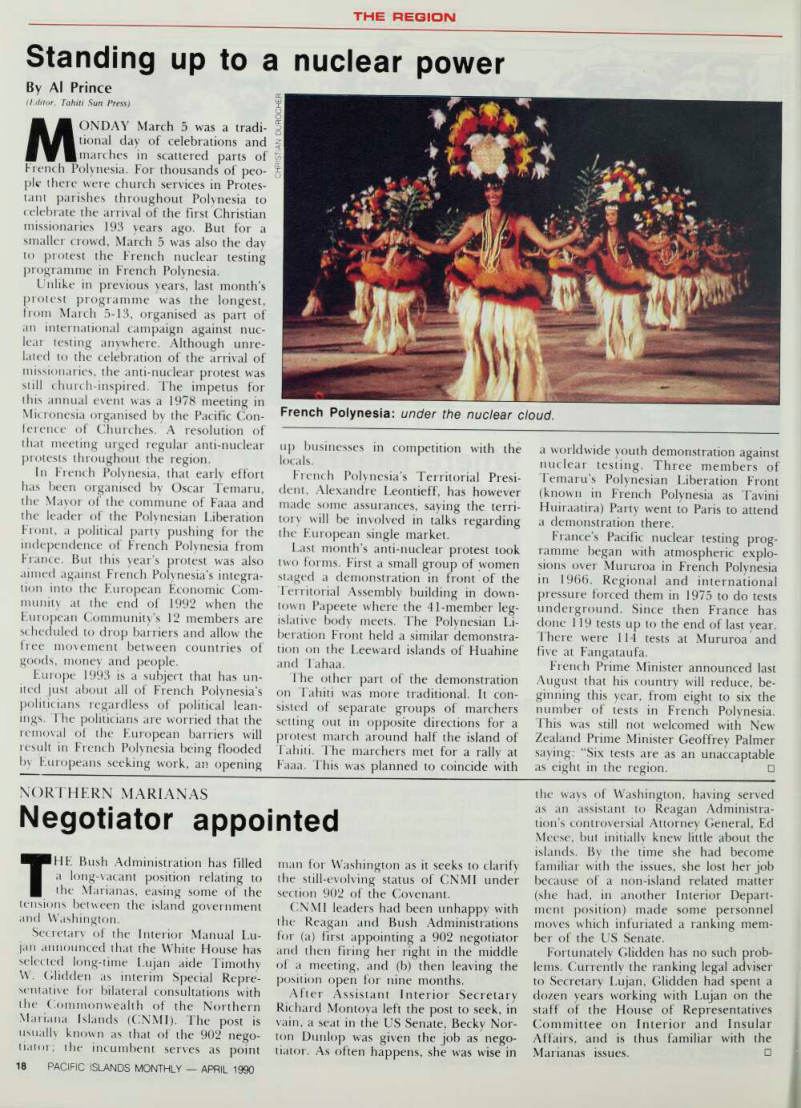
MONDAY March 5 was a tradi tional day of celebrations and marches in scattered parts of French Polynesia. For thousands of peo ple there were church services in Protes tant parishes throughout Polynesia to celebrate the arrival of the first Christian missionaries 193 years ago. But for a smaller crowd, March 5 was also the day to protest the French nuclear testing programme in French Polynesia.
Unlike in previous years, last month’s protest programme was the longest, from March 5-13, organised as part of an international campaign against nuc lear testing anywhere. Although unre lated to the celebration of the arrival of missionaries, the anti-nuclear protest was still church-inspired. The impetus for this annual event was a 1978 meeting in Micronesia organised by the Pacific Con ference of Churches. A resolution of
that meeting urged regular anti-nuclear
protests throughout the region.
In French Polynesia, that early effort has been organised by Oscar Temaru, the Mayor of the commune of Faaa and the leader of the Polynesian Liberation Front, a political party pushing for the independence of French Polynesia from France. But this year’s protest was also aimed against French Polynesia’s integra tion into the European Economic Com munity at the end of 1992 when the European Community’s 12 members are scheduled to drop barriers and allow the free movement between countries of goods, money and people.
Europe 1993 is a subject that has un ited just about all of French Polynesia’s politicians regardless of political lean ings. The politicians are worried that the removal of the European barriers will result in French Polynesia being flooded
by Europeans seeking work, an opening
up businesses in competition with the locals.
French Polynesia’s Territorial President, Alexandre Leontieff, has however made some assurances, saying the territory will be involved in talks regarding
the European single market.
Last month’s anti-nuclear protest took two forms. First a small group of women staged a demonstration in front of the Territorial Assembly building in downtown Papeete where the 41-member legislative body meets. The Polynesian Liberation Front held a similar demonstration on the Leeward islands of Huahine and Tahaa.
The other part of the demonstration on Tahiti was more traditional. It consisted of separate groups of marchers setting out in opposite directions for a protest march around half the island of Tahiti. The marchers met for a rally at Faaa. This was planned to coincide with
a worldwide youth demonstration against nuclear testing. Three members of Temaru’s Polynesian Liberation Front (known in French Polynesia as Tavini Huiraatira) Party went to Paris to attend a demonstration there.
France’s Pacific nuclear testing prog ramme began with atmospheric explo sions over Mururoa in French Polynesia in 1966. Regional and international pressure forced them in 1975 to do tests underground. Since then France has done 119 tests up to the end of last year.
There were 114 tests at Mururoa and five at Fangataufa.
French Prime Minister announced last August that his country will reduce, be ginning this year, from eight to six the number of tests in French Polynesia.
This was still not welcomed with New Zealand Prime Minister Geoffrey Palmer saying: “Six tests are as an unaccaptable as eight in the region. □
Christian Durocher
French Polynesia: under the nuclear cloud.
Negotiator appointed
Northern Marianas
THE Bush Administration has filled a long-vacant position relating to the Marianas, easing some of the tensions between the island government and Washington.
Secretary of the Interior Manual Lu jan announced that the White House has selected long-time Lujan aide Timothy W. Glidden as interim Special Repre sentative for bilateral consultations with the Commonwealth of the Northern Mariana Islands (CNMI). The post is usually known as that of the 902 nego tiator; the incumbent serves as point
man for Washington as it seeks to clarify the still-evolving status of CNMI under section 902 of the Covenant.
CNMI leaders had been unhappy with the Reagan and Bush Administrations for (a) first appointing a 902 negotiator and then firing her right in the middle of a meeting, and (b) then leaving the position open for nine months.
After Assistant Interior Secretary Richard Montoya left the post to seek, in vain, a seat in the US Senate, Becky Nor ton Dunlop was given the job as nego tiator. As often happens, she was wise in
the ways of Washington, having served as an assistant to Reagan Administra tion’s controversial Attorney General, Ed Meese, but initially knew little about the islands. By the time she had become familiar with the issues, she lost her job because of a non-island related matter (she had, in another Interior Depart ment position) made some personnel moves which infuriated a ranking mem ber of the US Senate.
Fortunately Glidden has no such prob
lems. Currently the ranking legal adviser
to Secretary Lujan, Glidden had spent a dozen years working with Lujan on the staff of the House of Representatives Committee on Interior and Insular Affairs, and is thus familiar with the Marianas issues. □
Diana Mcmanus
Tuvalu
The mouse that roared
By Diana McManus
TINY Tuvalu can almost be seen as the mouse that roared. As one of the world’s smallest sovereign na tions it is propped up largely with aid from friendly donor countries. However, it is determined to become economically self-reliant despite formidable difficul ties. This determination has given rise to an aid experiment which is the world’s first in design concept, and Tuvalu is possibly still the only developing nation to be benefitting from such a scheme.
The scheme is, of course, the Tuvalu Trust Fund.
Normally economic aid comes in pack age form funded by one or more donors. There is usually a specific pro ject in mind and once that project has been completed the maintenance and running costs fall upon the shoulders of the recipient. Whilst these sorts of pack ages are gratefully received and often add vital infrastructural plant and ser vices to Tuvalu, they do not necessarily create a developing situation for Tuvalu.
Health services, sea walls, education, the Public Services, are not short term in
come-generating propositions and they
cost money to upkeep.
The beauty of the Tuvalu Trust Fund is that it does generate immediate in come in the form of interest which may be used by the Government, after capital maintenance and administration charges, to finance recurrent expenditure.
Now in its third year of operations the Tuvalu Trust Fund experiment appears to be heading for a resounding success.
It was established on June 16, 1987 with the Governments of Tuvalu, Au stralia, New Zealand and the United Kingdom as signatories to an interna tional agreement. Contributions to the Fund totalled just over A 527.4 million.
The donors were: Australia $B.O million, New Zealand $8.3 million, United King dom $8.5 million, Tuvalu $1.6 million, Japan $700,000 and South Korea $30,000. Japan and South Korea did not become parties to the Agreement.
In the first year of the Fund’s incep tion the Tuvalu Government chose to pace its withdrawals because the stock market wobble in October 1987 threatened to jeopardise its future. Over night the Fund lost about $l.B million.
Spending on Government business was very cautious until the Fund’s real value was re-established. Now the Government expects to call upon the interest annual ly. At September 30, 1989 the Fund’s value stood at over $33.7 million.
“The good news”, according to Pana pasi Nelesone, Assistant Secretary for Fi-
nance, “is that for 1990 about $1 million from the Fund’s earnings is available to assist with recurrent expenditure after all the real value of the Fund and its administration costs have been taken care of. That amounts to about 25 per cent of the total Budget.”
The money is managed by Westpac
Investment Management Proprietary Li
mited, of Australia. Its goal is to mini mise risk through a diversified invest ment portfolio within Australia and overseas.
The islanders do not want to live on hand-outs. The Trust Fund is seen as a very real way of overcoming some of the country’s economic short-comings. Tuva lu does try very hard to operate on a
balanced budget. However, departure
taxes and customs duties, improvements in taxation, accounting and management systems are not enough to make ends meet; not even with the limited foreign exchange earnings derived from its Phi latelic Bureau and licensing of foreign fishing vessels.
With the benefits of the Trust Fund
project quite apparent, the new Paeniu Government is actively seeking new donors for the Fund. Hard on the heels of his election in October last year, Paeniu, with senior members of his Pub lic Service, approached traditional and new donors with the proposal while visit ing the European Economic Community.
The United Kingdom, (traditional), France, (traditional), Germany, (tradi tional), and Italy, (new), were all approached and Tuvalu is awaiting their response.
It would appear, once again, that spe cific aid policies may inhibit the out come. However, there is another way around the problem and that is for possible donor countries to consider allowing some of their regional aid dona tions which are handled by organisations such as UNDP to be channelled into the Fund. This is one of the most appropri ate and pressing aid requirements per ceived by Tuvalu.
The Trust Fund will be one of the items on the agenda for discussion at the Donors’ Meeting in Funafuti scheduled for next month. The meeting was to have been held last July but was post poned due to the pressures of the gener al election held in October. This meeting will consist of traditional donors.
The UNDP is arranging a follow-up round table meeting of donor countries at Geneva in November. The meeting is specifically to discuss Tuvalu’s develop ment programmes and policies and to identify areas where the donor commun ity could best assist Tuvalu. Certainly the Trust Fund will be on the agenda at that meeting. In addition to traditional donors it is hoped that new donors, par ticularly the Nordic countries, will attend.
Seve Paeniu, Tuvalu’s Assistant Plan ning Officer, Department of Foreign Affairs and Economic Planning, says: “We hope to attract the interest of the Nordic (Scandinavian) countries to this part of the world where they have not formerly been involved in respect to aid.
Their aid policies are less stringent and this ties in very well with Tuvalu’s rationale on aid projects.”
In fact UNDP is assisting Tuvalu’s efforts to publicise and promote the con cept of the Fund by financing a brochure on the subject which was due out by the end of the last month.
Optimism, enthusiasm and determina tion abound in Tuvalu Government cir cles when it comes to the Tuvalu Trust Fund. There is no denying that at pre sent the experimental Trust Fund, in its extreme infancy, represents a success which may have far reaching consequ ences for the future of other struggling developing nations. It could well become a blueprint for survival for other small countries around the world. □
Diana Mcmanus
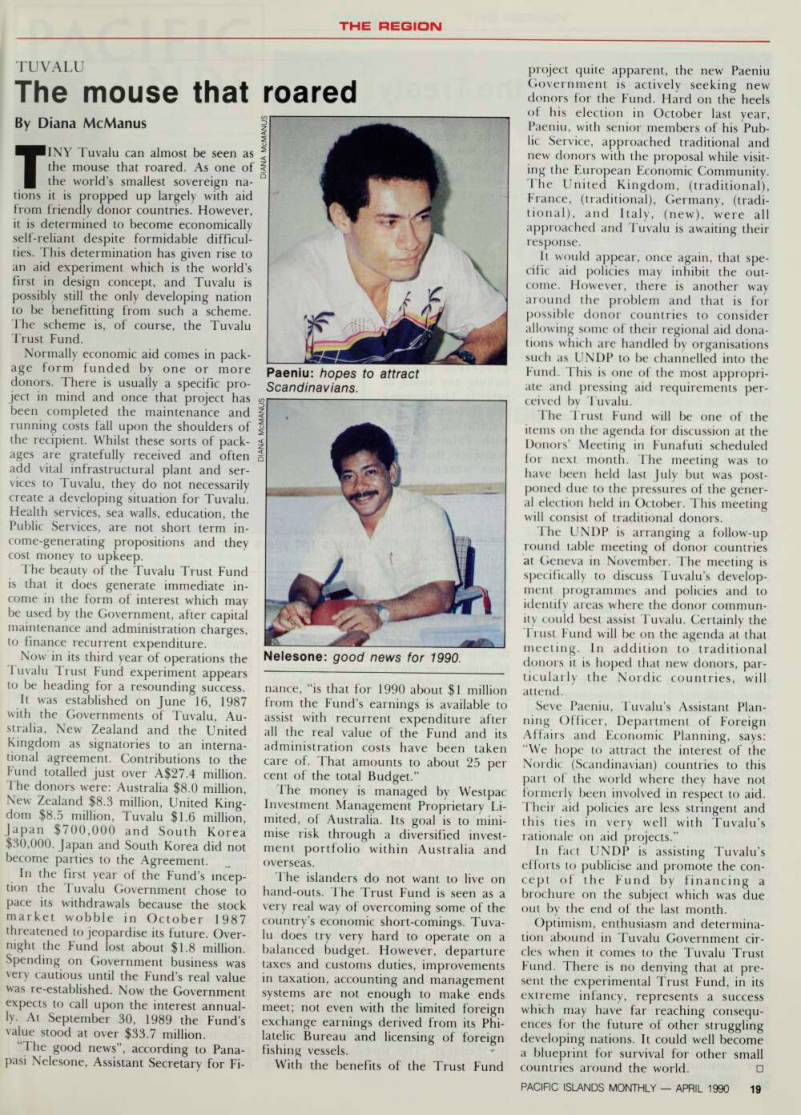
Paeniu: hopes to attract Scandinavians.
Nelesone: good news for 1990.
Diana Mcmanus
150 years under the Treaty
Maori
By Karen Mangnall
ON February 6 about 30,000 New Zealanders sesqui-ed up to Waitangi in the Bay of Islands for a birthday party. The occasion was the 150th anniversary of the signing of the Treaty of Waitangi, a contract be tween the Crown and chiefs of the va rious Maori tribes, the founding charter of modern New Zealand. The day’s dis cord revealed that 150 years in the life of a nation is only a short leap into adolescence, not the considered stroll of adulthood.
In the past 20 years, Waitangi Day has evolved from the carelessly smug beach barbecue-celebration of immigrant domi nance to a focus for Maori protest. The 50 or so heckling protesters scattered through the viewing stands with their “Honour the Treaty” banners, were stunned first into silence and then cheers by the Bishop of Aotearoa, the Most Rev Whakahuihui Vercoe. Taking his sermon text from Psalm 137, the Anglican Bishop said he had come to the waters of Waitangi “to weep for what could have been a unique document in the his tory of the world of the indigenous peo ple” and their colonisers.
Since the Treaty was signed, Maori had been “marginalised”. Bishop Vercoe said. “The language of this land is yours, the custom is yours, the media by which we tell the world who we are is yours.”
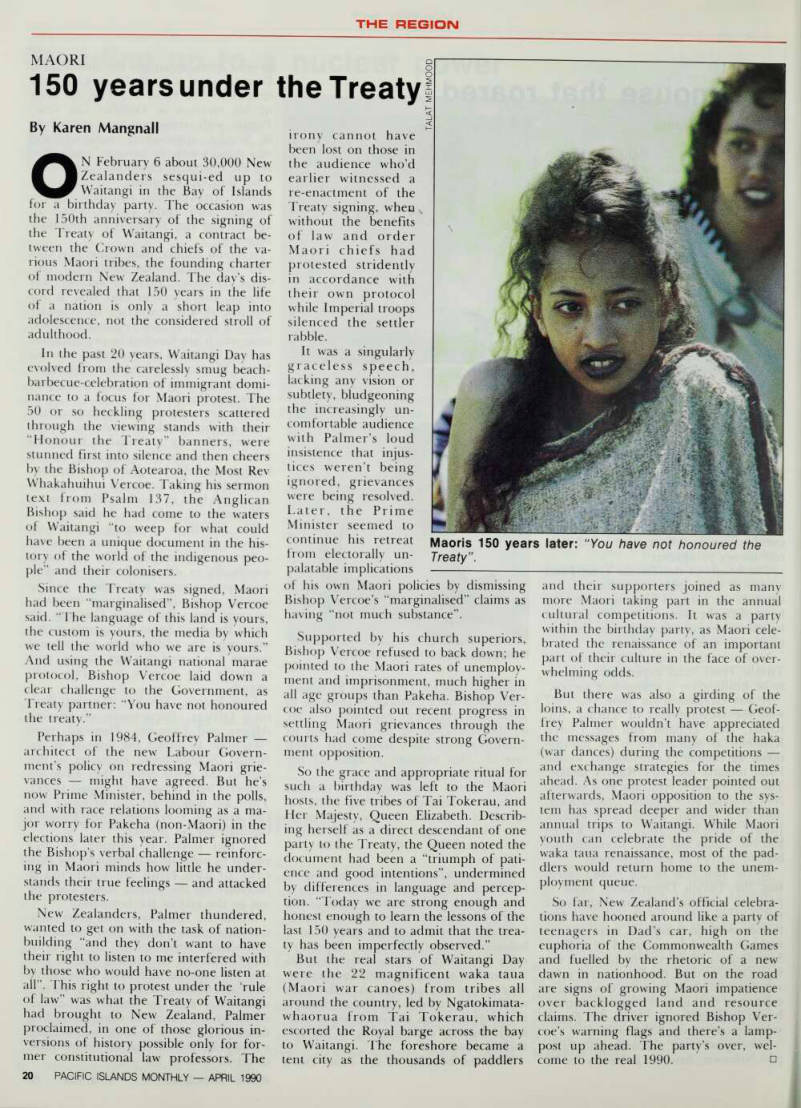
And using the Waitangi national marae protocol, Bishop Vercoe laid down a clear challenge to the Government, as Treaty partner: “You have not honoured the treaty.”
Perhaps in 1984, Geoffrey Palmer architect of the new Labour Govern
ment’s policy on redressing Maori grie
vances might have agreed. But he’s now Prime Minister, behind in the polls, and with race relations looming as a ma jor worry for Pakeha (non-Maori) in the elections later this year. Palmer ignored the Bishop’s verbal challenge reinforc ing in Maori minds how little he under stands their true feelings and attacked the protesters.
New Zealanders, Palmer thundered, wanted to get on with the task of nation building “and they don’t want to have their right to listen to me interfered with by those who would have no-one listen at all”. This right to protest under the ‘rule of law” was what the Treaty of Waitangi had brought to New Zealand, Palmer proclaimed, in one of those glorious in versions of history possible only for for mer constitutional law professors. The
irony cannot have been lost on those in the audience who’d earlier witnessed a re-enactment of the
Treaty signing, when
without the benefits of law and order Maori chiefs had
protested stridently
in accordance with their own protocol while Imperial troops silenced the settler rabble.
It was a singularly
graceless speech,
lacking any vision or
subtlety, bludgeoning
the increasingly un comfortable audience with Palmer’s loud insistence that injus tices weren’t being
ignored, grievances
were being resolved.
Later, the Prime Minister seemed to continue his retreat from electorally un palatable implications
of his own Maori policies by dismissing Bishop Vercoe’s “marginalised” claims as having “not much substance”. c . . upporte by his church superiors, Bishop Vercoe refused to back down; he pointed to the Maori rates of unemployment and imprisonment, much higher in all age groups than Pakeha. Bishop Vercoe also pointed out recent progress in settling Maori grievances through the courts had come despite strong Govern-
ment opposition.
So the grace and appropriate ritual for such a birthday was left to the Maori hosts, the five tribes of Tai Tokerau, and Her Majesty. Queen Elizabeth. Describing herself as a direct descendant of one party to the Treaty, the Queen noted the document had been a “triumph of patience and good intentions”, undermined by differences in language and perception. “Today we are strong enough and honest enough to learn the lessons of the last 150 years and to admit that the treaty has been imperfectly observed.”
But the real stars of Waitangi Day were the 22 magnificent waka taua (Maori war canoes) from tribes all around the country, led by Ngatokimatawhaorua from Tai Tokerau, which escorted the Royal barge across the bay to Waitangi. The foreshore became a tent city as the thousands of paddlers
and their supporters joined as many more Maori taking part in the annual cultural competitions. It was a party within the birthday party, as Maori cele brated the renaissance of an important t of their culture in the face O F f over . whe lmiag odds, But there was also a girding of the loins, a chance to really protest Geof frey Palmer wouldn’t have appreciated the messages from many of the haka (war dances) during the competitions and exchange strategies for the times a ,cacl A j °“ P rotest leader P oln ‘ ed out afterwards, Maori opposition to the sys tem has s .P read d< ; e P er and " lder ,! han annual m P s to Waitangi. While Maori y°" th can celebrate the pr.de of the ™ aka taua renaissance, most of the pad d ers would return home to the unem - P ovme,u c l ueue - So far, New Zealand’s official celebra tions have hooned around like a party of teenagers in Dad’s car, high on the euphoria of the Commonwealth Games and fuelled by the rhetoric of a new dawn in nationhood. But on the road
are signs of growing Maori impatience
over backlogged land and resource claims. The driver ignored Bishop Ver coe’s warning flags and there’s a lamp post up ahead. The party’s over, wel come to the real 1990. □
Maoris 150 years later: “You have not honoured the Treaty”.
Songs of Paradise
Vanuatu
By David Robie
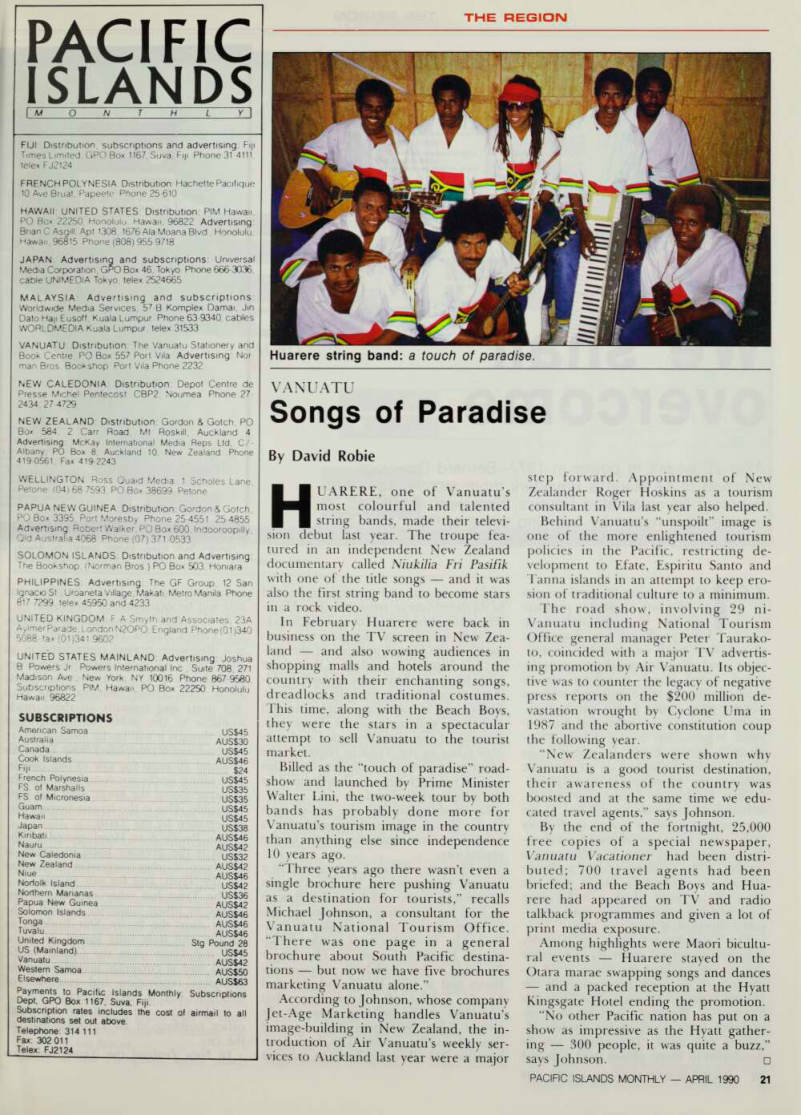
HUARERE, one of Vanuatu’s most colourful and talented string bands, made their televi sion debut last year. The troupe fea tured in an independent New Zealand documentary called Niukilia Fri PasiFik with one of the title songs and it was also the first string band to become stars in a rock video.
In February Huarere were back in business on the TV screen in New Zea land and also wowing audiences in shopping malls and hotels around the country with their enchanting songs, dreadlocks and traditional costumes.
This time, along with the Beach Boys, they were the stars in a spectacular attempt to sell Vanuatu to the tourist market.
Billed as the “touch of paradise” road show and launched by Prime Minister Walter Lini, the two-week tour by both bands has probably done more for Vanuatu’s tourism image in the country than anything else since independence 10 years ago.
“Three years ago there wasn’t even a single brochure here pushing Vanuatu as a destination for tourists,” recalls Michael Johnson, a consultant for the Vanuatu National Tourism Office.
“There was one page in a general brochure about South Pacific destina tions but now we have five brochures marketing Vanuatu alone.”
According to Johnson, whose company Jet-Age Marketing handles Vanuatu’s image-building in New Zealand, the in troduction of Air Vanuatu’s weekly ser vices to Auckland last year were a major
step forward. Appointment of New Zealander Roger Hoskins as a tourism consultant in Vila last year also helped.
Behind Vanuatu’s “unspoilt” image is one of the more enlightened tourism policies in the Pacific, restricting de velopment to Efate, Espiritu Santo and Tanna islands in an attempt to keep ero sion of traditional culture to a minimum.
The road show, involving 29 ni- Vanuatu including National Tourism Office general manager Peter Taurako to, coincided with a major TV advertis ing promotion by Air Vanuatu. Its objec tive was to counter the legacy of negative press reports on the $2OO million de
vastation wrought by Cyclone Uma in
1987 and the abortive constitution coup the following year.
“New Zealanders were shown why Vanuatu is a good tourist destination, their awareness of the country was boosted and at the same time we edu cated travel agents,” says Johnson.
By the end of the fortnight, 25,000 free copies of a special newspaper, Vanuatu Vacationer had been distri buted; 700 travel agents had been briefed; and the Beach Boys and Hua rere had appeared on TV and radio talkback programmes and given a lot of print media exposure.
Among highlights were Maori bicultu ral events Huarere stayed on the Otara marae swapping songs and dances and a packed reception at the Hyatt
Kingsgate Hotel ending the promotion.
“No other Pacific nation has put on a show as impressive as the Hyatt gather ing 300 people, it was quite a buzz,” says Johnson. □
Huarere string band: a touch of paradise.
Advertisements & other items, p. 21 (1 item)
Pacific
SLANDS
IMP N T H L Q
FIJI Distribution, subscriptions and advertising: Fiji Times Limited GPO Box 1167, Suva, Fiji Phone 31 4111 telex FJ2124 FRENCH POLYNESIA Distribution Hachette Pacifique 10 Ave Bruat, Papeete Phone 25 610 HAWAII UNITED STATES: Distribution: PIM Hawaii PO Box 22250, Honolulu Hawaii 96822 Advertising Brian C Asgill Apt 1308 1676 Ala Moana Blvd , Honolulu, Hawaii 96815 Phone (808) 955 9718 JAPAN Advertising and subscriptions: Universal Media Corporation, GPO Box 46, Tokyo Phone 666-3036, cable UNIMEDIA Tokyo, telex 2524665 MALAYSIA Advertising and subscriptions Worldwide Media Services, 5 7 B Komplex Damai. Jin Dato Haji Eusoff, Kuala Lumpur Phone 63 9340, cables WORLDMEDIA Kuala Lumpur, telex 31533 VANUATU: Distribution: The Vanuatu Stationery and Book Centre PO Box 557 Port Vila Advertising: Nor man Bros Bookshop Port Vila Phone 2232 NEW CALEDONIA Distribution: Depot Centre de Presse Michel Pentecost CBP2 Noumea Phone 27 2434, 27 4729 NEW ZEALAND: Distribution: Gordon & Gotch, PO Box 584, 2 Carr Road, Mt Roskill, Auckland 4 Advertising; McKay International Media Reps Ltd, C/- Albany, PO Box 8, Auckland 10, New Zealand Phone 419-0561, Fax 419-2243 WELLINGTON Ross Ouaid Media 1 Scholes Lane Petone (04) 68 7593 PO Box 38699, Petone PAPUA NEW GUINEA Distribution: Gordon & Gotch PO Box 3395, Port Moresby Phone 25-4551 25 4855 Advertising Robert Walker, PO Box 600 Indooroopilly Old Australia 4068 Phone (07) 371 -0533 SOLOMON ISLANDS: Distribution and Advertising The Bookshop (Norman Bros ) PO Box 503, Honiara PHILIPPINES: Advertising The GF Group, 12 San Ignacio St , Uroaneta Village, Makati Metro Manila Phone 817 7299 telex 45950 and 4233 UNITED KINGDOM P A Smyth and Associates 23A Aylmer Parade London N2OPO, England Phone (01 )340 5088 fax (01)341 9602 UNITED STATES MAINLAND Advertising Joshua B Powers Jr Powers International Inc , Suite 708 271 Madison Ave New York. NY 10016 Phone 867 9580 Subscriptions PIM, Hawaii, PO Box 22250 Honolulu Hawaii 96822
SUBSCRIPTIONS
American Samoa Australia Canada Cook Islands F 'l' French Polynesia FS of Marshalls FS of Micronesia Guam Hawaii Japan Kiribati Nauru New Caledonia New Zealand Niue Norfolk Island Northern Marianas Papua New Guinea Solomon Islands Tonga Tuvalu United Kingdom US (Mainland) Vanuatu Western Samoa Elsewhere US$45
AUSS3O
US$45
AUSS46
s24
USS4S
US$35
USS3S
US$45
USS4S
USS3B
AUSS46
AUSS42
USS32
AUSS42
AUSS46
USS42
US$36
AUSS42
AUSS46
AUSS46
AUSS46
Stg Pound 28
USS4S
AUSS42
AUSSSO
AUSS63
Payments to Pacific Islands Monthly: Subscriptions Dept, GPO Box 1167, Suva, Fiji.
Subscription rates includes the cost of airmail to all destinations set out above Telephone: 314 111 Fax 302 011 Telex; FJ2124
We shall
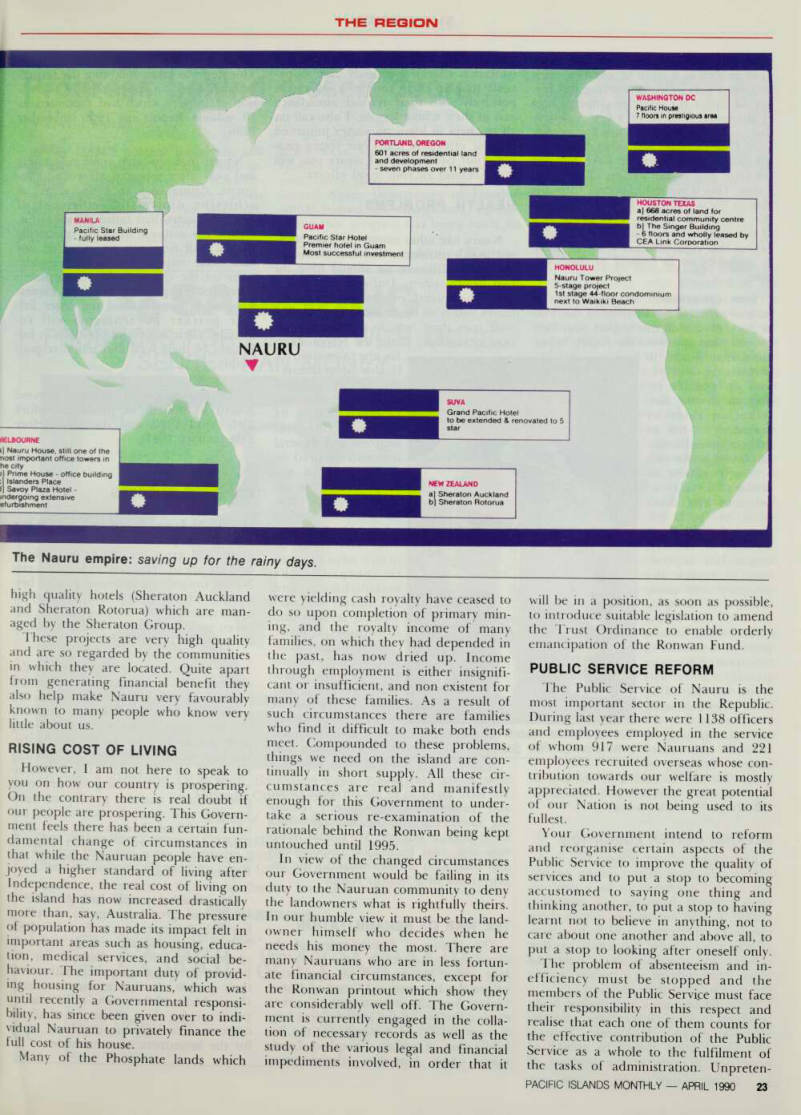
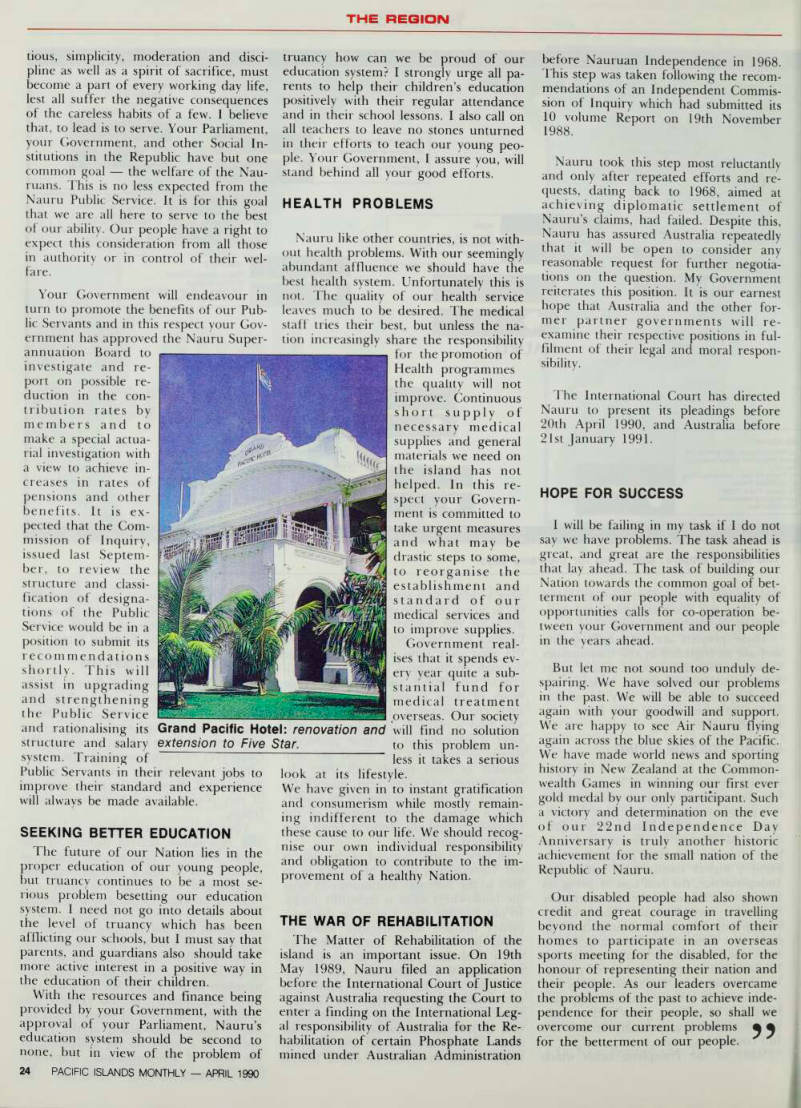
Nauru
We shall overcome
After 22 weeks in power in 1977, Bernard Dowiyogo returned to be Nauru’s President three months ago. In February he celebrated Nauru’s 22nd year as an independent nation by outlining some of the major issues facing his phosphate-rich country.
44 lAM not going to speak to you ■on how our country is prosper- Jing, how much phosphate we have produced, how happy we all are, how much we trust our Government, and what beautiful prospects lie ahead. I wish mainly to inform you all generally of current events and address you the main issues facing our Nation.
One of the most important Government organisation is the Nauru Phosphate Royalties Trust. In recent years the Trust has embarked on an extensive programme of property investments.
Nauru House in Melbourne which, although 13 years old, is still one of the most important office towers in that city with a very high rate of tenant occupancy. The Trust also owns, in Melbourne, a smaller office building known as Prime House, the Islanders Place, and the Savoy Plaza Hotel which is undergoing an extensive refurbishment with anticipated completion later this year.
The Trust has a number of property investments outside Australia and earlier this month I joined the Trust in an inspection of property investments in the United States of America. The Trust has invested in Portland, Oregon, in a residential land development project involving 601 acres. The project will be developed in seven phases over a period
of 11 years and each phase is to be sold in its development sequence. The Minis ter assisting the President and the Speak er with other local dignitaries partici pated in the formal opening of the pro ject last September, and since then there have been excellent sales of both build ing lots and houses built by the Trust.
Phase one is nearing completion and plans are well in hand for Phase two.
Because of the meticulous care and con cern taken by the Trust in regard to the natural environment of the land this project has been very much welcomed by the people of Portland.
In Washington DC the Trust owns Pacific House, a seven-floor building in a prestigious area near the centre of the
capital city.
In Houston, Texas, I participated in a Signing Ceremony for the Trust’s latest investment in the purchase of 668 acres of land for a residential community cen tre development project similar to Port land. The Trust also owns another build ing in Houston known as The Singer Building. This building contains six floors and is fully leased and occupied by the CAE-Link Corporation that assembles in the building many of the airline flight simulators that are used throughout the world. The Link Cor poration has asked the Trust to consider
increasing the size of the building and this will be examined by the Trust.
In Honolulu we inspected progress on the Trust’s Nauru Tower project which is a five-stage project comprising in its first stage a 44-floor condominium tower located in a prime area next to Waikiki Bach. This Tower contains more than 300 units and virtually all those made available to the public have been sold even though it will be 18 months before the building is completed. The Trust has retained 26 units for sale to our people.
The piling works are completed and the construction of the tower itself will soon be visible. This is the largest project ever undertaken by the Trust.
The Pacific Star Hotel owned by the Trust is the premier hotel in Guam. It has been a most successful investment for the Trust, and for our people.
The Trust has other property invest ments in other countries as well. The Trust owns the Pacific Star Building in Manila and it is fully leased. In Suva, Fiji, the Trust owns the Grand Pacific Hotel and is currently investigating the complete renovation and extension of this hotel into a Five Star status.
In London, the Trust owns a small office building in an attractive part of
the city.
In New Zealand the Trust owns two
Copyright. Pacific Islands Monthly. Graphics by: Artworks (Fiji)
high quality hotels (Sheraton Auckland and Sheraton Rotorua) which are man aged by the Sheraton Group.
These projects are very high quality and are so regarded by the communities in which they are located. Quite apart from generating financial benefit they also help make Nauru very favourably known to many people who know very little about us.
Rising Cost Of Living
However, I am not here to speak to you on how our country is prospering.
On the contrary there is real doubt if our people are prospering. This Govern ment feels there has been a certain fun damental change of circumstances in that while the Nauruan people have en joyed a higher standard of living after Independence, the real cost of living on the island has now increased drastically more than, say, Australia. The pressure of population has made its impact felt in important areas such as housing, educa tion, medical services, and social be haviour. The important duty of provid ing housing for Nauruans, which was until recently a Governmental responsi bility, has since been given over to indi vidual Nauruan to privately finance the full cost of his house.
Many of the Phosphate lands which
were yielding cash royalty have ceased to do so upon completion of primary min ing, and the royalty income of many families, on which they had depended in the past, has now dried up. Income
through employment is either insignifi
cant or insufficient, and non existent for many of these families. As a result of such circumstances there are families who find it difficult to make both ends meet. Compounded to these problems, things we need on the island are con tinually in short supply. All these cir cumstances are real and manifestly enough for this Government to under take a serious re-examination of the rationale behind the Ronwan being kept untouched until 1995.
In view of the changed circumstances our Government would be failing in its duty to the Nauruan community to deny the landowners what is rightfully theirs.
In our humble view it must be the land owner himself who decides when he needs his money the most. There are many Nauruans who are in less fortun ate financial circumstances, except for the Ronwan printout which show they are considerably well off. The Govern ment is currently engaged in the colla tion of necessary records as well as the study of the various legal and financial impediments involved, in order that it
will be in a position, as soon as possible, to introduce suitable legislation to amend the Trust Ordinance to enable orderly emancipation of the Ronwan Fund.
Public Service Reform
The Public Service of Nauru is the most important sector in the Republic.
During last year there were 1138 officers and employees employed in the service of whom 917 were Nauruans and 221 employees recruited overseas whose con tribution towards our welfare is mostly appreciated. However the great potential of our Nation is not being used to its fullest.
Your Government intend to reform and reorganise certain aspects of the Public Service to improve the quality of services and to put a stop to becoming accustomed to saying one thing and thinking another, to put a stop to having learnt not to believe in anything, not to care about one another and above all, to put a stop to looking after oneself only.
The problem of absenteeism and in efficiency must be stopped and the members of the Public Servi.ce must face their responsibility in this respect and realise that each one of them counts for the effective contribution of the Public Service as a whole to the fulfilment of the tasks of administration. Unpreten
The Nauru empire: saving up for the rainy days.
tious, simplicity, moderation and disci pline as well as a spirit of sacrifice, must become a part of every working day life, lest all suffer the negative consequences of the careless habits of a few. I believe that, to lead is to serve. Your Parliament, your Government, and other Social In stitutions in the Republic have but one common goal the welfare of the Nau ruans. This is no less expected from the Nauru Public Service. It is for this goal that we are all here to serve to the best of our ability. Our people have a right to expect this consideration from all those in authority or in control of their wel fare.
Your Government will endeavour in turn to promote the benefits of our Pub lic Servants and in this respect your Gov ernment has approved the Nauru Super
annuanon Board to investigate and re port on possible re duction in the con tribution rates by members and to make a special actua rial investigation with a view to achieve in creases in rates of pensions and other benefits. It is ex pected that the Com mission of Inquiry, issued last Septem ber, to review the structure and classi fication of designa tions of the Public Service would be in a position to submit its recommendations shortly. This will assist in upgrading
and strengthening
the Public Service and rationalising its structure and salary system. Training of
Public Servants in their relevant jobs to improve their standard and experience will always be made available.
Seeking Better Education
The future of our Nation lies in the proper education of our young people, but truancy continues to be a most serious problem besetting our education system, I need not go into details about the level of truancy which has been afflicting our schools, but I must say that parents, and guardians also should take more active interest in a positive way in the education of their children.
With the resources and finance being provided by your Government, with the approval of your Parliament, Nauru’s education system should be second to none, but in view of the problem of
truancy how can we be proud of our education system? I strongly urge all pa rents to help their children’s education positively with their regular attendance and in their school lessons. I also call on all teachers to leave no stones unturned in their efforts to teach our young peo ple. Your Government, I assure you, will stand behind all your good efforts.
Health Problems
Nauru like other countries, is not with out health problems. With our seemingly abundant affluence we should have the best health system. Unfortunately this is not. The quality of our health service leaves much to be desired. The medical staff tries their best, but unless the na tion increasingly share the responsibility
for the promotion of Health programmes the quality will not improve. Continuous short supply of necessary medical supplies and general materials we need on the island has not helped. In this re spect your Govern ment is committed to take urgent measures and what may be drastic steps to some, to reorganise the establishment and standard of our medical services and
to improve supplies.
Government real ises that it spends ev ery year quite a sub stantial fund for medical treatment ( overseas. Our society will find no solution to this problem un less it takes a serious
look at its lifestyle, We have given in to instant gratification and consumerism while mostly remain ing indifferent to the damage which these cause to our life. We should recog nisf °“ r own responsibility and obll S at T “ contribute to the tm- P rovement of a bealth V Nation,
The War Of Rehabilitation
The Matter of Rehabilitation of the island is an important issue. On 19th May 1989, Nauru filed an application before the International Court of Justice against Australia requesting the Court to enter a finding on the International Leg al responsibility of Australia for the Re habilitation of certain Phosphate Lands mined under Australian Administration
before Nauruan Independence in 1968.
This step was taken following the recom mendations of an Independent Commis sion of Inquiry which had submitted its 10 volume Report on 19th November 1988.
Nauru took this step most reluctantly and only after repeated efforts and re quests, dating back to 1968, aimed at
achieving diplomatic settlement of
Nauru’s claims, had failed. Despite this, Nauru has assured Australia repeatedly that it will be open to consider any reasonable request for further negotia tions on the question. My Government reiterates this position. It is our earnest hope that Australia and the other for mer partner governments will re examine their respective positions in ful filment of their legal and moral respon
sibility.
The International Court has directed Nauru to present its pleadings before 20th April 1990, and Australia before 21st January 1991.
Hope For Success
I will be failing in my task if I do not say we have problems. The task ahead is great, and great are the responsibilities that lay ahead. The task of building our Nation towards the common goal of bet terment of our people with equality of opportunities calls for co-operation be tween your Government and our people in the years ahead.
But let me not sound too unduly de spairing. We have solved our problems in the past. We will be able to succeed again with your goodwill and support.
We are happy to see Air Nauru flying again across the blue skies of the Pacific.
We have made world news and sporting history in New Zealand at the Common wealth Games in winning our first ever gold medal by our only participant. Such a victory and determination on the eve of our 22nd Independence Day Anniversary is truly another historic achievement for the small nation of the Republic of Nauru.
Our disabled people had also shown credit and great courage in travelling beyond the normal comfort of their homes to participate in an overseas sports meeting for the disabled, for the honour of representing their nation and their people. As our leaders overcame the problems of the past to achieve inde pendence for their people, so shall we overcome our current problems • • for the betterment of our people.
Grand Pacific Hotel: renovation and extension to Five Star.
Advertisements & other items, p. 22 (1 item)
The Region
Progress behind closed doors

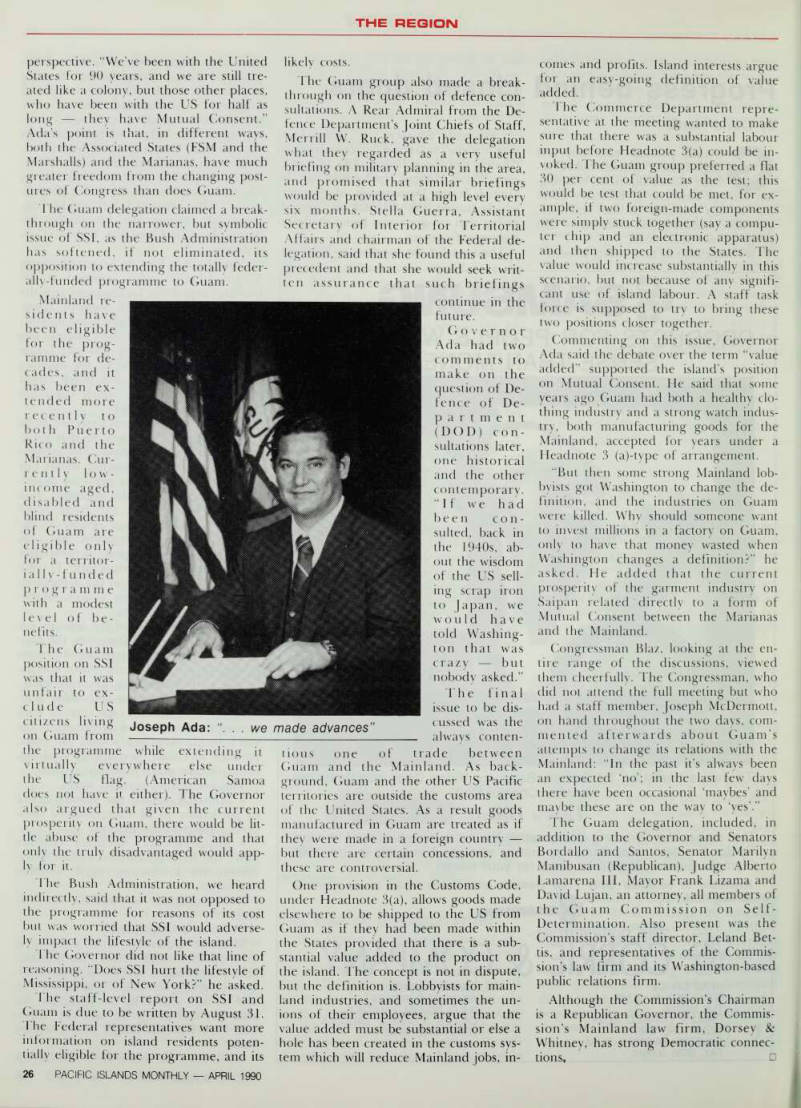
Guam
By David North
UAM’S political leadership and
■ high federal officials talked behind closed doors in Washington for two days late in February about the island’s relations to the Mainland, and all concerned said afterwards that progress had been made.
“We were able to turn things around .
. . we made advances . . . some hard lines were softened,” according to Guam’s Governor Joseph Ada (Republi
can). Larry Morgan, spokesman for the
United States Department of Interior, which hosted the discussions, agreed, saying that progress was being made on four specific issues.
The tone for the meeting in Washing
ton was in sharp contrast to that of De cember’s stormy Congressional hearing in Honolulu which took place in front of hundreds of Guamanians and an array of television cameras and radio mic rophones. The subject of both meetings was the draft Guam Commonwealth Act, written on the island, and later submit ted to the House of Representatives by Guam’s Congressman, Ben Blaz (Repub lican). The proposed bill would fun
damentally change the relationship be
tween the island and the Federal Gov ernment.
Congressman Ron de Lugo (Democrat Virgin Islands), who presided at the hearing, urged the Guamanians and the Federal officials to seek areas of agree ment. He said that without some narrow ing of differences that the Congress was unlikely to do anything with the Guam bill, particularly in light on the ongoing debate on the status of a much larger territory, Puerto Rico (which has more than 3.2 million people).
February’s meeting was designed to be
constructive, by all hands, so that prog ress made was no accident. The sessions were closed, so that neither island nor federal officials felt any need for grand
standing. Similarly the meeting took
place in Washington, far from island activists. Further, it was agreed by the
bi-partisan Guam delegation that only
the Governor would speak to press after the meeting. (Two Democratic Territo rial Senators were part of the delegation: ex-Governor Bordallo’s widow, Made line, and Frank Santos).
The specific output of the sessions was aimed at narrowing differences, the non dramatic stuff of the incremental process of reaching agreements. Four specific issues were raised, by pre-agreement, and after thrashing out both sides’ posi tions it was agreed, in each case, to work toward further areas of agreement at the staff level. Another round of talks,
perhaps in Guam, perhaps in Washing
ton, will take place probably in June.
The four issues covered were: • Mutual Consent, the island’s desire to participate in all Congressional deci sions related to the island;
• Supplemental Security Income
(SSI), the federally-funded welfare prog ramme for low-income aged, disabled and blind; • Consultations on defence matters; and • Trade arrangements.
Mutual Consent is a proposed arrangement which bothers many Main land policymakers who see it as a techni que for giving the island a veto over any and all bills passed by the Congress. No state has this power. In fact, the Amer ican Civil War was fought over a related issue.
Governor Ada sees it from a different
perspective. “We’ve been with the United States for 90 years, and we are still tre ated like a colony, but those other places, who have been with the US for half as long they have Mutual Consent.”
Ada’s point is that, in different ways, both the Associated States (FSM and the Marshalls) and the Marianas, have much greater freedom from the changing post ures of Congress than does Guam.
The Guam delegation claimed a break through on the narrower, but symbolic issue of SSL as the Bush Administration has softened, if not eliminated, its opposition to extending the totally feder ally-funded programme to Guam.
Mainland re sidents have
been eligible
for the prog ramme for de cades, and it has been ex tended more
recently to
both Puerto Rico and the Marianas. Cur
rently low
income aged,
disabled and blind residents of Guam are
eligible only
for a territor
ially-funded
programme with a modest level of be nefits.
The Guam position on SSI was that it was unfair to ex clude US
citizens living
on Guam from
the programme while extending it
virtually everywhere else under
the US flag. (American Samoa does not have it either). The Governor also argued that given the current prosperity on Guam, there would be lit tle abuse of the programme and that
only the truly disadvantaged would app
ly for it.
The Bush Administration, we heard indirectly, said that it was not opposed to the programme for reasons of its cost but was worried that SSI would adverse ly impact the lifestyle of the island.
The Governor did not like that line of reasoning. “Does SSI hurt the lifestyle of Mississippi, or of New York?” he asked.
The staff-level report on SSI and Guam is due to be written by August 31.
The Federal representatives want more information on island residents poten tially eligible for the programme, and its
likely costs.
The Guam group also made a break through on the question of defence con sultations. A Rear Admiral from the De fence Department’s Joint Chiefs of Staff, Merrill W. Ruck, gave the delegation what they regarded as a very useful briefing on military planning in the area, and promised that similar briefings would be provided at a high level every six months. Stella Guerra, Assistant Secretary of Interior for Territorial Affairs and chairman of the Federal de legation, said that she found this a useful precedent and that she would seek writ ten assurance that such briefings
continue m the future.
Governor Ada had two comments to make on the question of De fence of De part m e n t (DOD) con sultations later, one historical and the other contemporary.
“If we had been con sulted, back in the 19405, ab out the wisdom of the US sell ing scrap iron to Japan, we would have
told Washing
ton that was crazy but
nobody asked.”
The final issue to be dis cussed was the always conten
tious one of trade between Guam and the Mainland. As back ground, Guam and the other US Pacific territories are outside the customs area of the United States. As a result goods manufactured in Guam are treated as if they were made in a foreign country but there are certain concessions, and these are controversial.
One provision in the Customs Code, under Headnote 3(a), allows goods made elsewhere to be shipped to the US from Guam as if they had been made within the States provided that there is a sub stantial value added to the product on the island. The concept is not in dispute, but the definition is. Lobbyists for main land industries, and sometimes the un ions of their employees, argue that the value added must be substantial or else a hole has been created in the customs sys tem which will reduce Mainland jobs, in
comes and profits. Island interests argue for an easy-going definition of value added.
The Commerce Department repre sentative at the meeting wanted to make sure that there was a substantial labour input before Headnote 3(a) could be in voked. The Guam group preferred a flat 30 per cent of value as the test; this would be test that could be met, for ex ample, if two foreign-made components were simply stuck together (say a compu ter chip and an electronic apparatus) and then shipped to the States. The value would increase substantially in this scenario, but not because of any signifi cant use of island labour. A staff task force is supposed to try to bring these
two positions closer together.
Commenting on this issue, Governor Ada said the debate over the term “value added” supported the island’s position on Mutual Consent. He said that some years ago Guam had both a healthy clo thing industry and a strong watch indus try, both manufacturing goods for the Mainland, accepted for years under a Headnote 3 (a)-type of arrangement.
“But then some strong Mainland lob byists got Washington to change the de finition, and the industries on Guam were killed. Why should someone want to invest millions in a factory on Guam, only to have that money wasted when Washington changes a definition?” he asked. He added that the current prosperity of the garment industry on Saipan related directly to a form of Mutual Consent between the Marianas and the Mainland.
Congressman Blaz, looking at the en tire range of the discussions, viewed them cheerfully. The Congressman, who did not attend the full meeting but who had a staff member, Joseph McDermott, on hand throughout the two days, com mented afterwards about Guam’s attempts to change its relations with the Mainland: “In the past it’s always been an expected ‘no’; in the last few days there have been occasional ‘maybes’ and maybe these are on the way to ‘yes’.”
The Guam delegation, included, in addition to the Governor and Senators Bordallo and Santos, Senator Marilyn
Manibusan (Republican), Judge Alberto
Lamarena HI, Mayor Frank Lizama and David Lujan, an attorney, all members of the Guam Commission on Self- Determination. Also present was the Commission’s staff director, Leland Bet tis, and representatives of the Commis sion’s law firm and its Washington-based public relations firm.
Although the Commission’s Chairman is a Republican Governor, the Commis sion’s Mainland law firm, Dorsey & Whitney, has strong Democratic connec tions, □
Joseph Ada: "... we made advances”
Advertisements & other items, p. 25 (1 item)
Sg Samsung
PRODUCTS FOR PEOPLE WITH MORE
SENSE THAN MONEY
To own a Samsung TV Screen, Samsung Video Deck and Samsung Remote Control Unit!
That’d Great!
That makes the Samsung Combination the most inexpensive of its kind.
Go for the best view. Samsung quality was good enough for the 1988 Olympic Games. Should be ideal for your home!
Available at selected Duty Free Dealers and Burns Philp Home Centres throughout Fiji.
Oj SAMSUNG
SOLE DISTRIBUTORS:-
CORRIE & COMPANY
HEAD OFFICE
G.P.O. BOX 45, SUVA
TLX: FJ2166
CABLES: CORRICO’ SUVA
TELEPHONE: 386777
BANKERS: WESTPAC, SUVA
FAX: (679) 300610
BRANCH OFFICE:
161 VITOGO PARADE
G.P.O. BOX 83, LAUTOKA
CABLES: “CORRICO” LAUTOKA
TELEPHONE: 60137
Pacific
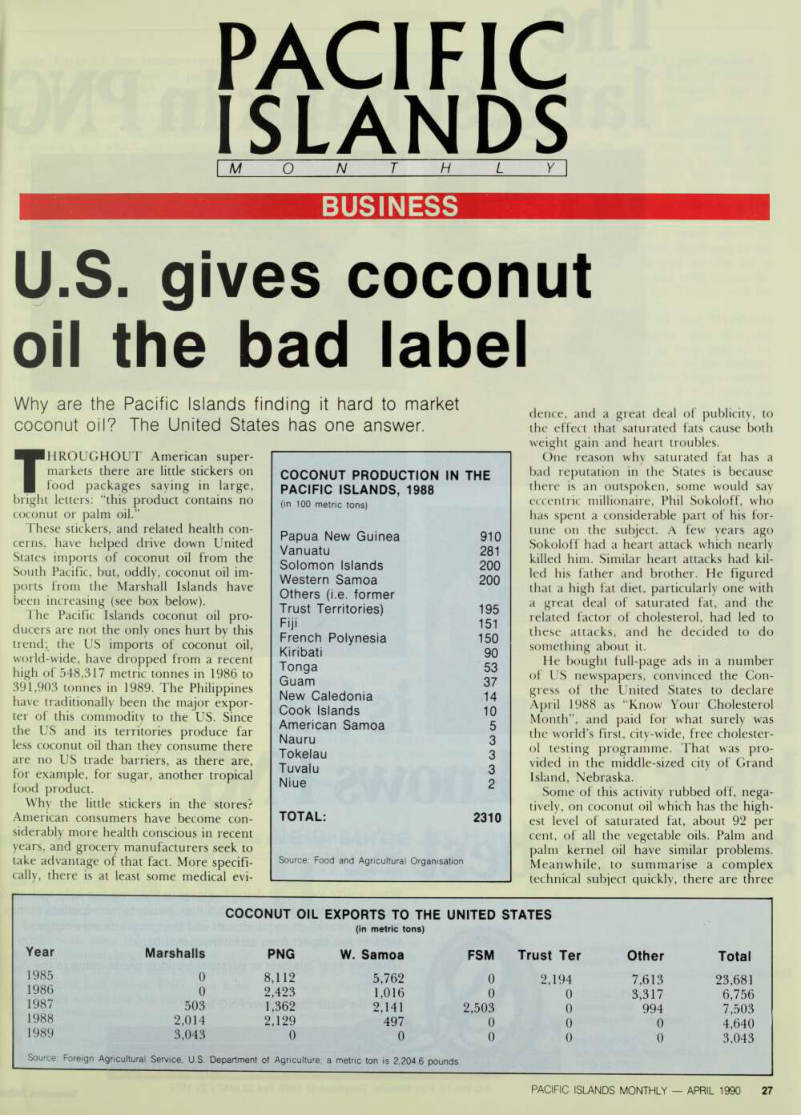

Islands
M Onthl Y
Business
U.S. gives coconut oil the bad label
Why are the Pacific Islands finding it hard to market coconut oil? The United States has one answer.
THROUGHOUT American super markets there are little stickers on
food packages saying in large,
bright letters: “this product contains no coconut or palm oil.”
These stickers, and related health con cerns, have helped drive down United States imports of coconut oil from the South Pacific, but, oddly, coconut oil im ports from the Marshall Islands have been increasing (see box below).
The Pacific Islands coconut oil pro ducers are not the only ones hurt by this trend; the US imports of coconut oil, world-wide, have dropped from a recent high of 548,317 metric tonnes in 1986 to 391,903 tonnes in 1989. The Philippines have traditionally been the major expor ter of this commodity to the US. Since the US and its territories produce far less coconut oil than they consume there are no US trade barriers, as there are, for example, for sugar, another tropical food product.
Why the little stickers in the stores?
American consumers have become con siderably more health conscious in recent years, and grocery manufacturers seek to take advantage of that fact. More specifi cally, there is at least some medical evi-
Coconut Production In The
Pacific Islands, 1988
(in 100 metric tons)
dence, and a great deal of publicity, to the effect that saturated fats cause both weight gain and heart troubles.
One reason why saturated fat has a bad reputation in the States is because there is an outspoken, some would say eccentric millionaire, Phil Sokoloff, who has spent a considerable part of his for tune on the subject. A few years ago Sokoloff had a heart attack which nearly killed him. Similar heart attacks had kil led his father and brother. He figured that a high fat diet, particularly one with a great deal of saturated fat, and the related factor of cholesterol, had led to these attacks, and he decided to do something about it.
He bought full-page ads in a number of US newspapers, convinced the Con gress of the United States to declare April 1988 as “Know Your Cholesterol Month”, and paid for what surely was the world’s first, city-wide, free cholester ol testing programme. That was pro vided in the middle-sized city of Grand Island, Nebraska.
Some of this activity rubbed off, nega tively, on coconut oil which has the high est level of saturated fat, about 92 per cent, of all the vegetable oils. Palm and palm kernel oil have similar problems.
Meanwhile, to summarise a complex technical subject quickly, there are three
COCONUT OIL EXPORTS TO THE UNITED STATES (in metric tons)
Papua New Guinea 910 Vanuatu 281 Solomon Islands 200 Western Samoa 200 Others (i.e. former Trust Territories) 195 Fiji 151 French Polynesia 150 Kiribati 90 Tonga 53 Guam 37 New Caledonia 14 Cook Islands 10 American Samoa 5 Nauru 3 Tokelau 3 Tuvalu 3 Niue 2
Total:
2310 Source: Food and Agricultural Organisation
Year Marshalls
Png
W. Samoa
Fsm
Trust Ter Other Total 1985 0 8,112 5,762 0 2,194 7,613 23,681 1986 0 2,423 1,016 0 0 3,317 6,756 1987 503 1,362 2,141 2,503 0 994 7,503 1988 2,014 2,129 497 0 0 0 4,640 1989 3,043 0 0 0 0 0 3,043 Source.
Foreign Agricultural Service, U.S. Department of Agriculture; a metric ton is 2,204.6 pounds.
other kinds of fats (mono-unsaturated and two different kinds of polyunsatu rated fats) all of which are said to be better for you than saturated fat.
There are American health food firms which do nothing but sell various kinds of cooking oils which are predominantly composed of these other kinds of fats, and which contain only small amounts of saturated fat. Some of these rival oils, such as almond, flax, peanut, rapeseek and sunflower oil, have saturated fat percentages in the 6 per cent to 19 per cent range.
All of this has taken its toll in the marketplace. Whereas the US brought in at least 150,000 tons of coconut oil for edible uses in 1985 the estimate for last year was only 92,000 tons. Most coconut oil now used in the US finds its way into shampoos and other soap products where there are no objections of satu rated fat.
There may be some possibilities for larger shipments of coconut oil to the US this year, largely for non-food pur poses, if the price continues to drop.
The average price for the period Octo ber 1988 to September 1989 was $545 per metric ton. By November, 1989 it was $4BO and in January it dropped to $434. If the price of coconut oil drops to the point where it becomes an attractive substitute for other, more costly oils, the volume of imports should increase.
Coconut oil is one of the possible com mercial uses of coconuts. If they cannot be sold in the shell (and those that reach the US go for 80 cents to a dollar each in the East Coast supermarkets) one can scrape out the meat and sell it as dessi cated coconut. (American shoppers pay about $2.30 to $4 for a pound of flaked coconut in a plastic bag or in an alumi nium can). If the producers have neither of these options, as most islands do not, the other option is to sell the stuff as copra.
To produce copra one opens the nut, and air dries it until the moisture level is reduced to about 14 per cent. Then the meat is shipped to a processing plant where the oil is presed out of it, leaving coconut oil, a relatively heavy and valu able commodity, and copra meal, a light er and less valuable product. The latter is a low-protein animal food supplement used extensively to feed the cattle of, among other places, Denmark and Hol land (whose principal port is Rotterdam).
Coconuts grow throughout the South Pacific, with even the minor producers growing thousands of metric tons of it (see top table p 27). Of the 1988 produc tion, almost half was in PNG, and most of the rest was in the Solomons, Vanuatu and Western Samoa.
In terms of value, the principal forms of coconut exports from the Pacific Is lands are copra and coconut oil. The
former was worth U 5533,119,000 to the islands in the last year for which statistics are available, 1987, while the latter brought in $28,370,000. In contrast the islands shipped $320,000 worth of whole nuts that year (with Western Samoa and Tonga sharing that market) and about $1,300,000 worth of dried coconut (with PNG having the largest share, followed by the Solomons).
Why have PNG and Western Samoa
lost their coconut oil export markets in the US, once worth millions of dollars a year? Why have the Marshalls done so well in a declining market?
One answer is that the Japanese are less worried than Americans are about
saturated fat, and they import large
quantities to use as cooking oil. Some of the oil processing facilities which used to ship their product to the States are now owned by Japanese who like to sell in their own market.
The Marshalls had a ready answer to the question about their shipments to the US “we have shipped coconut oil to the States for years, and have an operat ing pressing plant, the Tobalar mill on
Majuro.”
Frank Solomon of the Marshalls embassy in Washington said that the plant was operating at only part of its capacity, given the state of the market, and that the Marshalls no longer imports copra for pressing, as it had done in prior years. The Majuro plant may have picked up some of the business from the plant that used to operate on Palau, but is now out of business.
Coconuts are probably of greater rela tive economic importance to Western Samoa than they are to any other Pacific Islands nation, given the extensive acreage devoted to plantations, some of which date back to the German days.
While PNG shipped more than $l6 mil lion worth of coconut oil in 1987, com pared to about $4 million for Western Samoa, PNG’s coconut sales were dwarfed by its mineral exports. In recent months Western Samoa’s coconut indus try have taken two body blows, the fall ing world prices of coconut oil, and Cyclone Ofa’s destruction of many coco nut trees.
Palm oil, produced much less widely in the region, is under the same kind of health-oriented pressures as coconut oil.
The principal area producers of palm oil in 1987 were PNG, which exported $37 million worth of it, and the Solomons, which sold palm oil valued at $3.4 mil lion. □
Advertisements & other items, p. 28 (1 item)
largest bank in PNG
me
ANGCO
si m < > ;i A
is the
bank that knows PNG
business best
The Papua New Guinea Banking Corporation is not only PNG's largest bank, it's also the only one with branch representation in all 19 provinces.
For enquiries, call: Col Cavanagh Executive Manager - Corporate & International When you're looking at doing business in PNG, we can help with trade finance and foreign exchange facilities, business introduction, money transfers, travellers requirements and the comprehensive range of services you expect from an international bank. (675) 22 9731 Jim Forrester Manager - International Whatever your business or personal banking needs, come to the
PNGBC.
Francis Gubag Assistant Manager - International (675) 22 9731 We're the bank that knows PNG best.
APUA NEW GUINEA BANKING CORPORATION
P.0.80x 78, Port Moresby. Telephone 21 1999. Fax 22 9867/21 1954 Samuelson Talbot 21
Ada’s mill on Guam
WHEN you ask Guam Governor Joseph Ada about the commer cial uses of coconut on his is land, you get a warm and detailed re sponse.
It seems that the Governor’s grand father, who lived on Saipan during the brief German occupation at the begin ning of this century, was chosen by the Germans to go to Europe to study, among other things, production of oil from coconuts, and photography. Some of the best pre-World War I landscape photography of Saipan was taken by his grandfather, the Governor says proudly.
When Josef Ada, the grandfather, re
turned to Saipan, he began producing
oil from coconuts, and then he made soap from the oil. Subsequently he brought the oil and soap business, and his family, to Guam where the Governor was born. “I remember visiting the little factory when I was a boy,” he said. The factory closed following the elder Ada’s death in the 19505.
According to the Governor, the prin cipal commercial use of Guam’s coconuts now is the production of a candy, gollor ia (or guejuria) which is sold to depart ing tourists, among others. The brow nish candy is made from a combination of coconut milk, flour and sugar. It is tastiest, we have been told, when made from what might be termed adolescent coconuts, rather than fully ripe ones. □
New surge in Hawaii
HAWAII is expecting a new surge of growth in tourist traffic, and is planning for an expansion of air transportation into and within the is land state. The Narita-Honolulu route is now the second busiest in the world, and now two other Japanese carriers All
Nippon and Japan Air Systems may
also begin flying that route in order tq cope with the huge number of Japanese who want to fly to Hawaii.
Japan now supplies 20 per cent of the state’s tourist traffic.
The latest economic indicators report
from First Hawaiian Bank says all the
state’s major airports have now planned
developments to meet the growing de mand. Honolulu International Airport is building a US$7OO million terminal which is aimed at relieving the bot tleneck at Customs. Construction should begin within the next few months.
Keahole Airport is to get an internation al terminal and a 1740-metre extension to its runway at a cost of U 5574.4 mil lion. The bank report forsees direct Japan-Keahole flights when the Kona- Kohala Resort is fully developed. □
Question marks over BNZ sellout
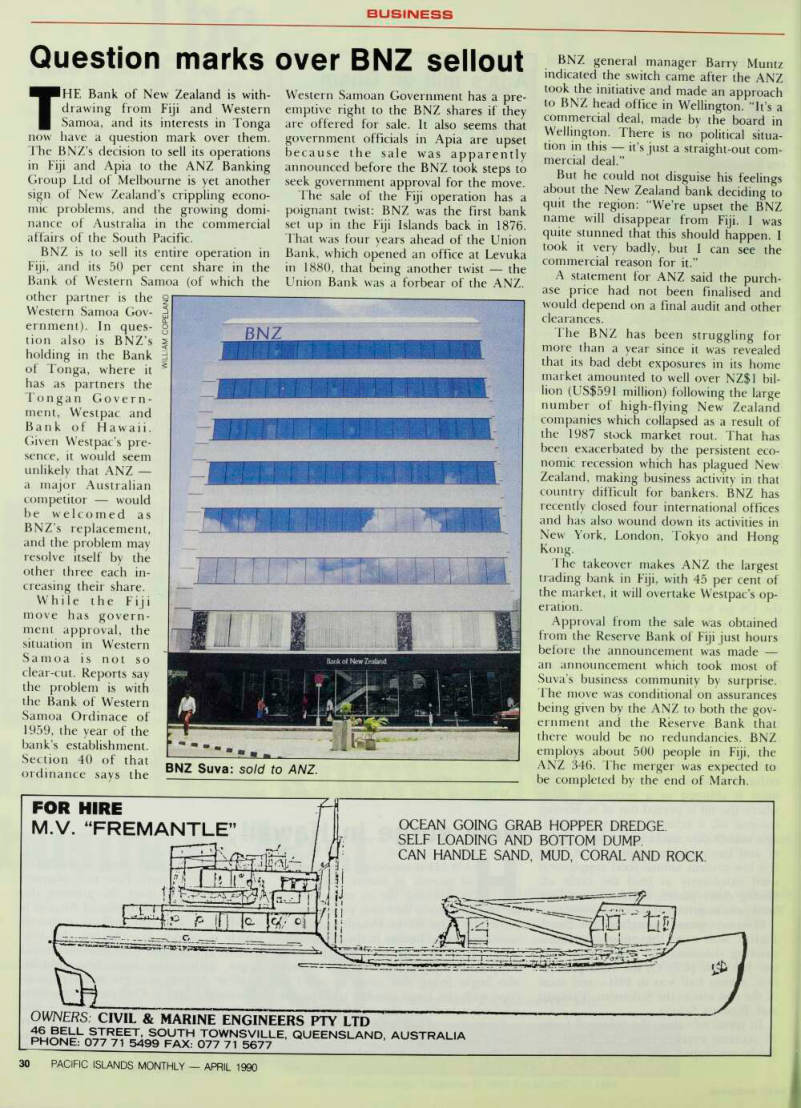
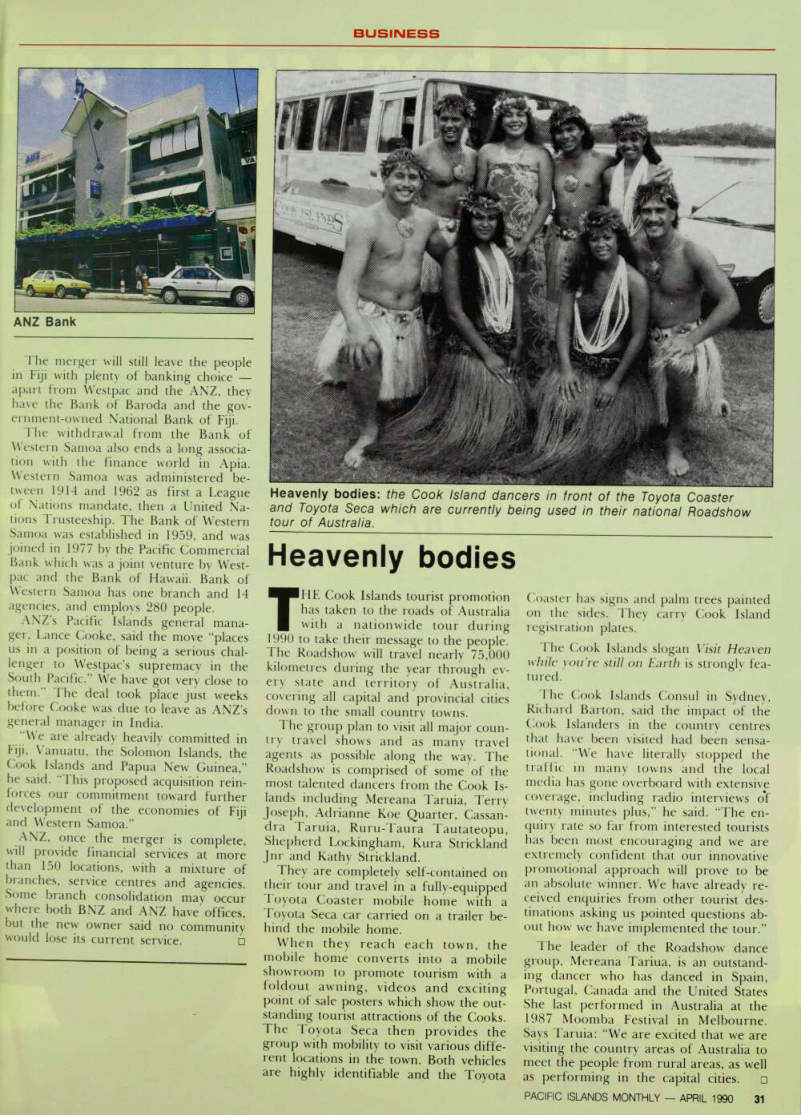
THE Bank of New Zealand is withdrawing from Fiji and Western Samoa, and its interests in Tonga now have a question mark over them, The BNZ’s decision to sell its operations in Fiji and Apia to the ANZ Banking Group Ltd of Melbourne is yet another sign of New Zealand’s crippling economic problems, and the growing dominance of Australia in the commercial affairs of the South Pacific.
BNZ is to sell its entire operation in Fiji, and its 50 per cent share in the Bank of Western Samoa (of which the
other partner is the Western Samoa Gov ernment). In ques tion also is BNZ’s holding in the Bank of Tonga, where it has as partners the
Tongan Govern
ment, Westpac and Bank of Hawaii.
Given Westpac’s pre sence, it would seem unlikely that ANZ a major Australian competitor would be welcomed as
BNZ’s replacement,
and the problem may resolve itself by the other three each in creasing their share.
While the Fiji move has govern ment approval, the situation in Western Samoa is not so clear-cut. Reports say the problem is with the Bank of Western Samoa Ordinace of 1959, the year of the bank’s establishment.
Section 40 of that ordinance says the
Western Samoan Government has a pre emptive right to the BNZ shares if they are offered for sale. It also seems that government officials in Apia are upset because the sale was apparently announced before the BNZ took steps to seek government approval for the move, The sale of the Fiji operation has a poignant twist: BNZ was the first bank set up in the Fiji Islands back in 1876.
That was four years ahead of the Union Bank, which opened an office at Levuka in 1880, that being another twist the Union Bank was a forbear of the ANZ.
BNZ general manager Barry Muntz indicated the switch came after the ANZ took the initiative and made an approach to BNZ head office in Wellington. “It’s a commercial deal, made by the board in Wellington. There is no political situa tion in this it’s just a straight-out com mercial deal.”
But he could not disguise his feelings about the New Zealand bank deciding to quit the region: “We’re upset the BNZ name will disappear from Fiji. I was quite stunned that this should happen. I took it very badly, but I can see the commercial reason for it.”
A statement for ANZ said the purch ase price had not been finalised and would depend on a final audit and other clearances.
The BNZ has been struggling for more than a year since it was revealed that its bad debt exposures in its home market amounted to well over NZ$l bil lion (US$59l million) following the large number of high-flying New Zealand companies which collapsed as a result of the 1987 stock market rout. That has been exacerbated by the persistent eco nomic recession which has plagued New Zealand, making business activity in that country difficult for bankers. BNZ has recently closed four international offices and has also wound down its activities in New York, London, Tokyo and Hong Kong.
The takeover makes ANZ the largest trading bank in Fiji, with 45 per cent of the market, it will overtake Westpac’s op eration.
Approval from the sale was obtained from the Reserve Bank of Fiji just hours before the announcement was made an announcement which took most of Suva’s business community by surprise.
The move was conditional on assurances being given by the ANZ to both the gov ernment and the Reserve Bank that there would be no redundancies. BNZ employs about 500 people in Fiji, the ANZ 346. The merger was expected to be completed by the end of March.
BNZ Suva: sold to ANZ.
The merger will still leave the people in Fiji with plenty of banking choice apart from Westpac and the ANZ, they have the Bank of Baroda and the gov ernment-owned National Bank of Fiji.
The withdrawal from the Bank of Western Samoa also ends a long associa tion with the finance world in Apia.
Western Samoa was administered be tween 1914 and 1962 as first a League of Nations mandate, then a United Na tions Trusteeship. The Bank of Western Samoa was established in 1959, and was joined in 1977 by the Pacific Commercial Bank which was a joint venture by West pac and the Bank of Hawaii. Bank of Western Samoa has one branch and 14 agencies, and employs 280 people.
ANZ’s Pacific Islands general mana ger, Lance Cooke, said the move “places us in a position of being a serious chal lenger to Westpac’s supremacy in the South Pacific.” We have got very close to them. The deal took place just weeks before Cooke was due to leave as ANZ’s general manager in India.
“We are already heavily committed in Fiji, Vanuatu, the Solomon Islands, the Cook Islands and Papua New Guinea,” he said. “This proposed acquisition rein forces our commitment toward further development of the economies of Fiji and Western Samoa.”
ANZ, once the merger is complete, will provide financial services at more than 150 locations, with a mixture of branches, service centres and agencies.
Some branch consolidation may occur where both BNZ and ANZ have offices, but the new owner said no community would lose its current service. □
ANZ Bank
Advertisements & other items, p. 30 (1 item)
rrtTs
FOR HIRE
M.V. “FREMANTLE”
»- M
OCEAN GOING GRAB HOPPER DREDGE.
SELF LOADING AND BOTTOM DUMP.
CAN HANDLE SAND, MUD, CORAL AND ROCK.
OWNERS: CIVIL & MARINE ENGINEERS PTY LTD PMOMc L rSX F^ E J;^ OUTH TOWNSVILLE, QUEENSLAND, AUSTRALIA PHONE: 077 71 5499 FAX: 077 71 5677
rrtTs
Heavenly bodies
THE Cook Islands tourist promotion has taken to the roads of Australia with a nationwide tour during 1990 to take their message to the people.
The Roadshow will travel nearly 75,000 kilometres during the year through ev ery state and territory of Australia, covering all capital and provincial cities down to the small country towns.
The group plan to visit all major coun try travel shows and as many travel agents as possible along the way. The Roadshow is comprised of some of the most talented dancers from the Cook Is lands including Mereana Taruia, Terry Joseph, Adrianne Koe Quarter, Cassan dra Taruia, Ruru-Taura Tautateopu,
Shepherd Lockingham, Kura Strickland
Jnr and Kathy Strickland.
They are completely self-contained on their tour and travel in a fully-equipped Toyota Coaster mobile home with a Toyota Seca car carried on a trailer be hind the mobile home.
When they reach each town, the mobile home converts into a mobile showroom to promote tourism with a foldout awning, videos and exciting point of sale posters which show the out standing tourist attractions of the Cooks.
The Toyota Seca then provides the group with mobility to visit various diffe rent locations in the town. Both vehicles are highly identifiable and the Toyota
Coaster has signs and palm trees painted on the sides. They carry Cook Island
registration plates.
The Cook Islands slogan Visit Heaven while you ’ re still on Earth is strongly fea tured.
The Cook Islands Consul in Sydney, Richard Barton, said the impact of the Cook Islanders in the country centres that have been visited had been sensa tional. “We have literally stopped the traffic in many towns and the local media has gone overboard with extensive coverage, including radio interviews o’f twenty minutes plus,” he said. “The en quiry rate so far from interested tourists has been most encouraging and we are extremely confident that our innovative promotional approach will prove to be an absolute winner. We have already re ceived enquiries from other tourist des tinations asking us pointed questions ab out how we have implemented the tour,”
The leader of the Roadshow dance group, Mereana Tariua, is an outstand ing dancer who has danced in Spain, Portugal, Canada and the United States She last performed in Australia at the 1987 Moomba Festival in Melbourne.
Says Taruia: “We are excited that we are visiting the country areas of Australia to meet the people from rural areas, as well as performing in the capital cities. □
Heavenly bodies: the Cook Island dancers in front of the Toyota Coaster and Toyota Seca which are currently being used in their national Roadshow tour of Australia.
Advertisements & other items, pp. 32-33 (1 item)
Toyota
i 1 I ,: j- -a. *'\A.r PS 1 The Toyota Hilux is the world’s most popular pick-up.
And the Hilux 4X4 is the best-selling Hilux of them all. Which stands to reason. People around the world respect Toyota’s attention to style. Hilux’s car-like comfort. Rugged reliability. And as you might expect from Toyota, power. This, of course, is the most important asset for a truck. And happily, the Hilux 4X4 offers a choice of four powerful engines: 2.8 and 2.4-litre diesel engines. Plus 2.2 and 1.8-litre petrol engines. When it comes to power and good looks, nobody can beat Toyota. Nobody.
sM
* -a* V s i ■
Giving revenue buoyancy
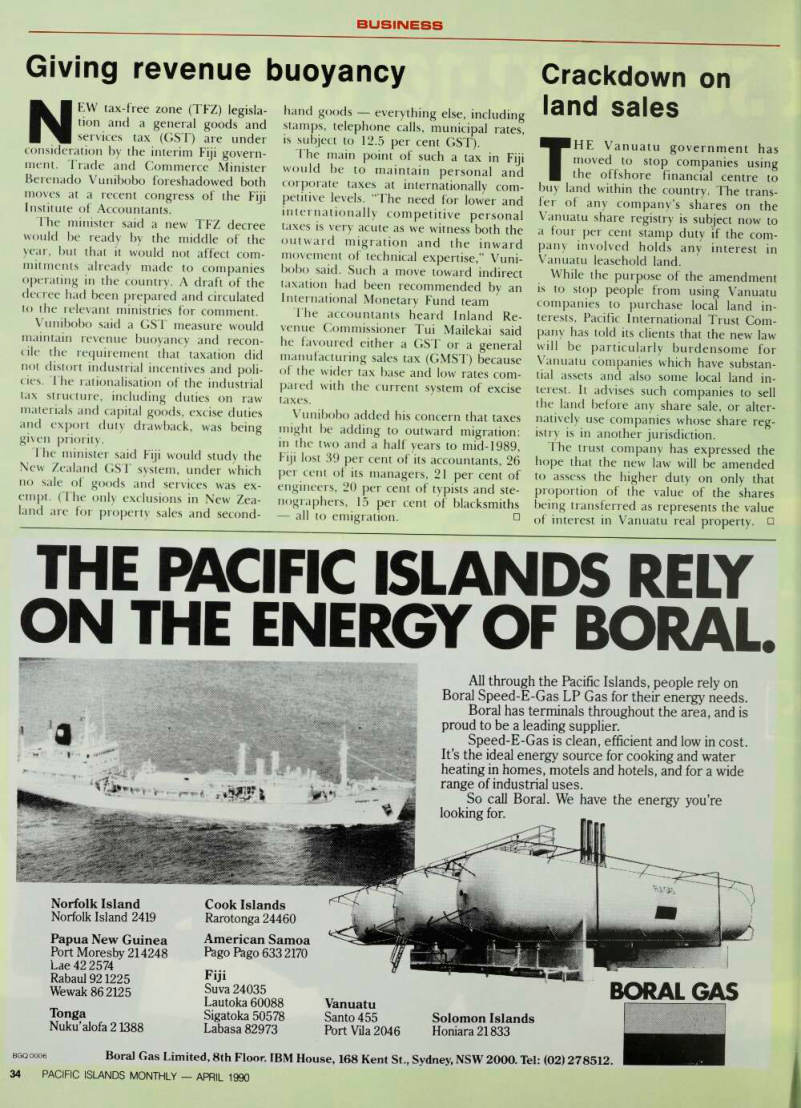
NEW tax-free zone (TFZ) legisla tion and a general goods and services tax (GST) are under consideration by the interim Fiji govern ment. Trade and Commerce Minister Berenado Vunibobo foreshadowed both moves at a recent congress of the Fiji Institute of Accountants.
The minister said a new TFZ decree would be ready by the middle of the year, but that it would not affect com mitments already made to companies operating in the country. A draft of the decree had been prepared and circulated to the relevant ministries for comment.
Vunibobo said a GST measure would maintain revenue buoyancy and recon cile the requirement that taxation did not distort industrial incentives and poli cies. The rationalisation of the industrial tax structure, including duties on raw materials and capital goods, excise duties and export duty drawback, was being
given priority.
1 he minister said Fiji would study the New Zealand GST system, under which no sale of goods and services was ex empt. (The only exclusions in New Zea land are for property sales and second
hand goods everything else, including stamps, telephone calls, municipal rates, is subject to 12.5 per cent GST).
The main point of such a tax in Fiji would be to maintain personal and corporate taxes at internationally com petitive levels. “The need for lower and internationally competitive personal taxes is very acute as we witness both the outward migration and the inward movement of technical expertise,” Vuni bobo said. Such a move toward indirect taxation had been recommended by an International Monetary Fund team The accountants heard Inland Re venue Commissioner Tui Mailekai said he favoured either a GST or a general manufacturing sales tax (GMST) because of the wider tax base and low rates com pared with the current system of excise taxes.
Vunibobo added his concern that taxes might be adding to outward migration: in the two and a half years to mid-1989, Fiji lost 39 per cent of its accountants, 26 per cent of its managers, 21 per cent of engineers, 20 per cent of typists and ste nographers, 15 per cent of blacksmiths all to emigration. □
Crackdown on land sales
land sales
THE Vanuatu government has moved to stop companies using the offshore financial centre to buy land within the country. The trans fer of any company’s shares on the Vanuatu share registry is subject now to a four per cent stamp duty if the com pany involved holds any interest in Vanuatu leasehold land.
While the purpose of the amendment is to stop people from using Vanuatu companies to purchase local land in terests, Pacific International Trust Com pany has told its clients that the new law will be particularly burdensome for Vanuatu companies which have substan tial assets and also some local land in terest. It advises such companies to sell the land before any share sale, or alter natively use companies whose share reg istry is in another jurisdiction.
The trust company has expressed the hope that the new law will be amended to assess the higher duty on only that proportion of the value of the shares being transferred as represents the value of interest in Vanuatu real property. □
Advertisements & other items, p. 34 (1 item)
The Pacific Islands Rely
ON THE ENERGY OF BORAL.
V
■III
1 All through the Pacific Islands, people rely on Boral Speed-E-Gas LP Gas for their energy needs.
Bora! has terminals throughout the area, and is proud to be a leading supplier.
Speed-E-Gas is clean, efficient and low in cost.
It’s the ideal energy source for cooking and water heating in homes, motels and hotels, and for a wide range of industrial uses.
So call Boral. We have the energy you’re looking for.
Norfolk Island Norfolk Island 2419 Papua New Guinea Port Moresby 214248 Lae 42 2574 Rabaul 921225 Wewak 86 2125 Tonga Nukualofa 21388 Cook Islands Rarotonga 24460 American Samoa Pago Pago 6332170 Fiji Suva 24035 Lautoka 60088 Sigatoka 50578 Labasa 82973 Vanuatu Santo 455 Port Vila 2046
BORAL GAS
Solomon Islands Honiara 21833 Boral Gas Limited, Bth Floor. IBM House, 168 Kent St., Sydney, NSW 2000. Tel: (02) 278512.
Blue Lagoon
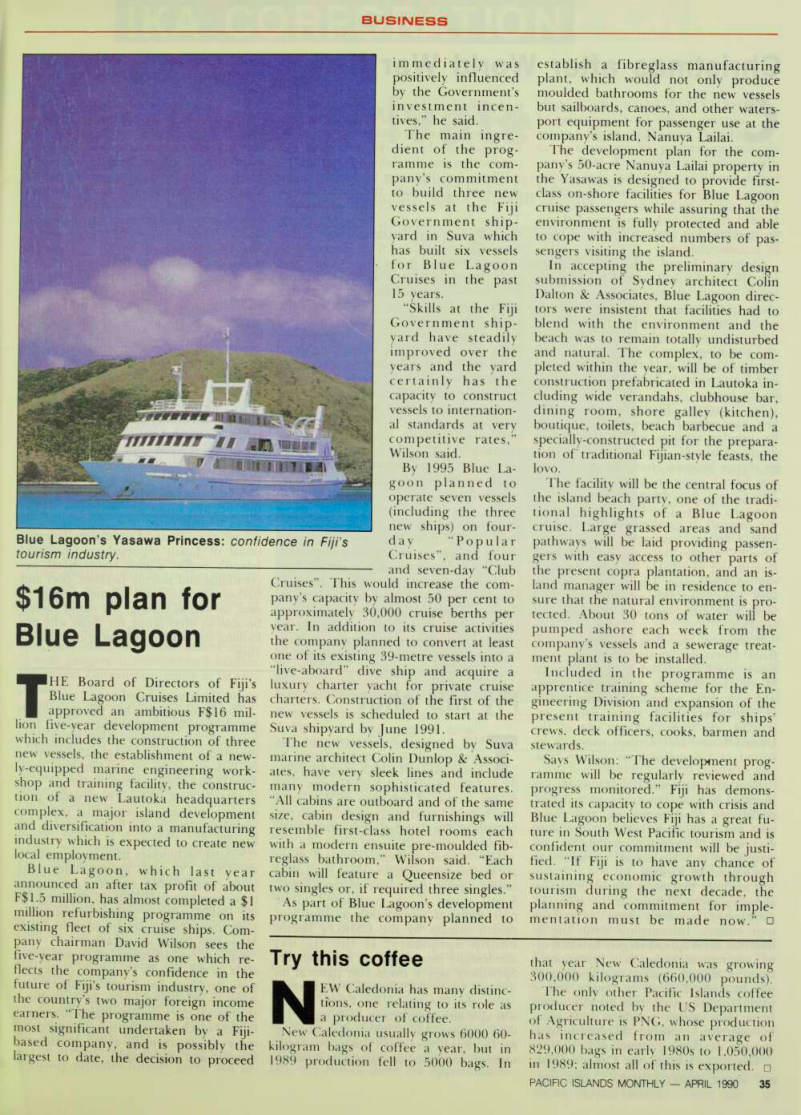
$16m plan for Blue Lagoon
THE Board of Directors of Fiji’s Blue Lagoon Cruises Limited has approved an ambitious Fsl6 mil
lion five-year development programme
which includes the construction of three new vessels, the establishment of a new
ly-equipped marine engineering work
shop and training facility, the construc
tion of a new Lautoka headquarters complex, a major island development and diversification into a manufacturing industry which is expected to create new
local employment.
Blue Lagoon, which last year announced an after tax profit of about F$L5 million, has almost completed a $1 million refurbishing programme on its existing fleet of six cruise ships. Com pany chairman David Wilson sees the five-year programme as one which re flects the company’s confidence in the future of Fiji’s tourism industry, one of the country’s two major foreign income earners. “The programme is one of the most significant undertaken by a Fiji based company, and is possibly the largest to date, the decision to proceed
immediately was
positively influenced
by the Government’s investment incen tives,” he said.
The main ingre dient of the prog ramme is the com pany’s commitment to build three new vessels at the Fiji
Government ship
yard in Suva which has built six vessels for Blue Lagoon Cruises in the past 15 years.
“Skills at the Fiji
Government ship
yard have steadily improved over the years and the yard certainly has the capacity to construct vessels to internation al standards at very competitive rates,”
Wilson said.
By 1995 Blue La goon planned to operate seven vessels (including the three new ships) on four
day “Popular
Cruises”, and four and seven-dav “Club
Cruises”. This would increase the com pany’s capacity by almost 50 per cent to approximately 30,000 cruise berths per year. In addition to its cruise activities the company planned to convert at least one of its existing 39-metre vessels into a “live-aboard” dive ship and acquire a luxury charter yacht for private cruise charters. Construction of the first of the new vessels is scheduled to start at the Suva shipyard by June 1991.
The new vessels, designed by Suva marine architect Colin Dunlop & Associ ates, have very sleek lines and include many modern sophisticated features.
“All cabins are outboard and of the same size, cabin design and furnishings will resemble first-class hotel rooms each with a modern ensuite pre-moulded fib reglass bathroom,” Wilson said. “Each cabin will feature a Queensize bed or two singles or, if required three singles.”
As part of Blue Lagoon’s development programme the company planned to
establish a fibreglass manufacturing
plant, which would not only produce moulded bathrooms for the new vessels but sailboards, canoes, and other waters port equipment for passenger use at the company’s island, Nanuya Lailai.
The development plan for the com pany’s 50-acre Nanuya Lailai property in the Yasawas is designed to provide first class on-shore facilities for Blue Lagoon cruise passengers while assuring that the environment is fully protected and able to cope with increased numbers of pas sengers visiting the island.
In accepting the preliminary design
submission of Sydney architect Colin Dalton & Associates, Blue Lagoon direc tors were insistent that facilities had to blend with the environment and the beach was to remain totally undisturbed and natural. The complex, to be com pleted within the year, will be of timber construction prefabricated in Lautoka in cluding wide verandahs, clubhouse bar, dining room, shore galley (kitchen), boutique, toilets, beach barbecue and a specially-constructed pit for the prepara tion of traditional Fijian-style feasts, the lovo.
The facility will be the central focus of the island beach party, one of the tradi tional highlights of a Blue Lagoon cruise. Large grassed areas and sand pathways will be laid providing passen gers with easy access to other parts of the present copra plantation, and an is land manager will be in residence to en sure that the natural environment is pro tected. About 30 tons of water will be pumped ashore each week from the company’s vessels and a sewerage treat ment plant is to be installed.
Included in the programme is an apprentice training scheme for the En gineering Division and expansion of the present training facilities for ships’ crews, deck officers, cooks, barmen and stewards.
Says Wilson: “The development prog ramme will be regularly reviewed and progress monitored.” Fiji has demons trated its capacity to cope with crisis and Blue Lagoon believes Fiji has a great fu ture in South West Pacific tourism and is confident our commitment will be justi fied. “If Fiji is to have any chance of
sustaining economic growth through
tourism during the next decade, the planning and commitment for imple mentation must be made now.” □
Blue Lagoon's Yasawa Princess: confidence in Fiji’s tourism industry.
Try this coffee
NEW Caledonia has many distinc tions, one relating to its role as a producer of coffee.
New Caledonia usually grows 6000 60kilogram bags of coffee a year, but in 1989 production fell to 5000 bags. In
that year New Caledonia was growing 300.000 kilograms (660,000 pounds).
The only other Pacific Islands coffee producer noted by the US Department of Agriculture is PNG, whose production has increased from an average of 829.000 bags in early 1980 s to 1,050,000 in 1989; almost all of this is exported. □
Christmas after World War II
CHRISTMAS Island, the easterly outcrop of the far-flung nation of Kiribati, looks likely to get a major airport upgrading in an attempt to stimulate tourist interest. A Melbourne based consulting firm has just under taken a study of the island (also called Kiritimati), which follows a Japanese funded report which recommended ma jor development of the airport and tour ist accommodation.
Christmas Island lies about 32C0km east of the Kiribati capital of Tarawa, but is actually closer (2100 km) to Hon olulu, or three hours flying time away. It is the largest purely coral formation in the world with a land area of 388 sq km, and the island was used as an air base during World War II for refuelling Un ited States aircraft flying the long trans
pacific hops.
Air Tungaru, Kiribati’s national air line, now operates three small aircraft to fly regular services within the Gilbert group of islands. There is also a weekly jet service between Honolulu and Christ mas Island, using an Aloha Airlines 737- 200 Combi but designated as an Air Tungaru flight. The forward section of the aircraft is configured for freight, with a 60-seat passenger compartment.
The 737 Combi normally loads general freight and perishable food for the jour ney to Christmas Island, and returns with specialised fish exports, including fresh milk fish, reef and sea fish, and
crayfish.
Passengers travelling the route south from Honolulu consists of three main types: staff employed by the National Space Development Agency of Japan, which operates a satellite tracking station at Christmas Island; sports fishing en thusiasts on tour packages out of the United States, and Kiribati nationals in volved in Government or private busi ness.
Most of Christmas Island’s needs are supplied by boat; general cargo and non perishable food comes in, and copra goes out. The study said that the ships do not run to a regular schedule and are unreliable for passenger transport to other parts of Kiribati.
It outlines the major tourist attraction as being sports fishing in the inner la goons, and is mainly done by package tour visitors. Information about the is land has been spread largely by word-of mouth recommendation. “Promotional material, details, costings and booking all proved very difficult to obtain and it would appear that this largely stems from poor agency activities in Honolu lu,” Airplan reported. Birdwatching is another developing attraction.
The island’s hotel, the Captain Cook,
is described as having adequate accom modation but it did not provide the lux ury or upmarket services which would be necessary if the tourist base was ex panded beyond the fishing fraternity.
When Air Tungaru begins flying its chartered 737 Combi, the plan is for it to travel Honolulu-Christmas Island- Tarawa-Nadi one day, then the return the following day. At the moment, to get from Christmas Island or Honolulu to Tarawa requires flying from either Ma juro (Marshall Islands) or Nadi on Air lines of the Marshall Islands but this service has limited seat availability on the small twin-propellor aircraft, almost no freight space several days’ wait in Majuro for a connection, and a long flying time.
Before Aloha will allow its aircraft to fly the new service, its own and Federal Aviation Authority requirements have to be met. Cassidy Field on Christmas Is land must be fitted with runway lights and new approach equipment. At the moment, the Aloha jet often has to delay its Honolulu departure if strong tail winds might get the aircraft to Cassidy before dawn.
The airstrip on Canton Island has to be upgraded to act as an alternative landing place fuel will be stored there, and the runway will be improved,
and fire-fighting equipment installed.
Airplan reports that Aloha has also sought changes at Bonriki Airport, on Tarawa. These include new radio equip ment, new wind cones, re-sealing of parts of the runway and apron (particu larly the elimination of loose stones or
coral which could be sucked into a jet engine) and repainting on runway mark
ings.
But the consultants indicate the new jet service will bring substantial benefits.
Communication between the Line and Phoenix island groups with the govern ment centre will be greatly improved.
There will be better postal services with mail going through Fiji, as the Airlines of the Marshall Islands service cannot always accommodate mailbags if there is heavy demand for freight space. Many tertiary students go to Fiji, so the in creased capacity to that country will allow more regular travel between the two countries. The use of the Combi air craft will mean greater opportunities for exporters on Tarawa to tap the Honolu lu market.
While all the smaller island countries see tourism as one of the more possible ways in which to have economic growth, Kiribati does face problems in this re
gard. The government’s development
plan has acknowledged the country’s dis tance from the major markets, infre quent air services and the existence of more easily accessible countries with similar attractions. The government has also been concerned that the lifestyle of the people could be damaged if too many tourists came to Kiribati.
Last year, Pacific Consultants Interna tional of Japan reported on Christmas Island’s needs: a new resort hotel, re creational and marine facilities, port and harbour facilities and a better airport. It said, as well as fishing, the island should be able to offer scope for those who are looking for boating, sailing and scuba di ving. □
Fly lab shut
THE Australian Government has overturned a recommendation to keep open a CSIRO research facil ity at Laloki in Papua New Guinea. The facility is one of only two in the world which can breed a genetically altered version of the dreaded agricultural pest, the screw worm fly.
The Australian Department of Prim ary Industry has acted to close the Laloki facility against the advice of the CSIRO.
Screw worm fly is considered to be potentially as devastating as foot and mouth disease by the CSIRO’s Doctor Phillip Spradbery. If the fly was accidentally introduced to Australia, Dr Spradbery says it could cost pastoral in dustries up to As3oo million each year.
But the closure of the Laloki facility will save the Department of Primary In dustry about A 5200,000 and, according to Dr Spradbery, will leave Australia without any response capability if screw
worm fly is introduced.
The Laloki centre has the capacity to breed 40 million sterile screw worm flies a month. The strategy is that if the fly is detected in an area of Australia the ster ile flies would be released in that area.
The fertile flies attempt to breed with the sterile flies, without successfully pro ducing offspring, and the total fly population begins to decline, dying off
rapidly.
Similar techniques have been used by the CSIRO in trials against other pests with considerable success. Australia’s
notorious blowfly has been targetted by
the CSIRO with a genetic modification programme being developed at its Black Mountain centre near Canberra.
Genetic modification of insect pests such as the blowfly which causes se rious problems for Australian sheep far mers - is being seen as a realistic alternative to expensive, highly toxic pes ticides which are now less favoured by more environmentally-aware producers, farmers and consumers. □
Ika goes private
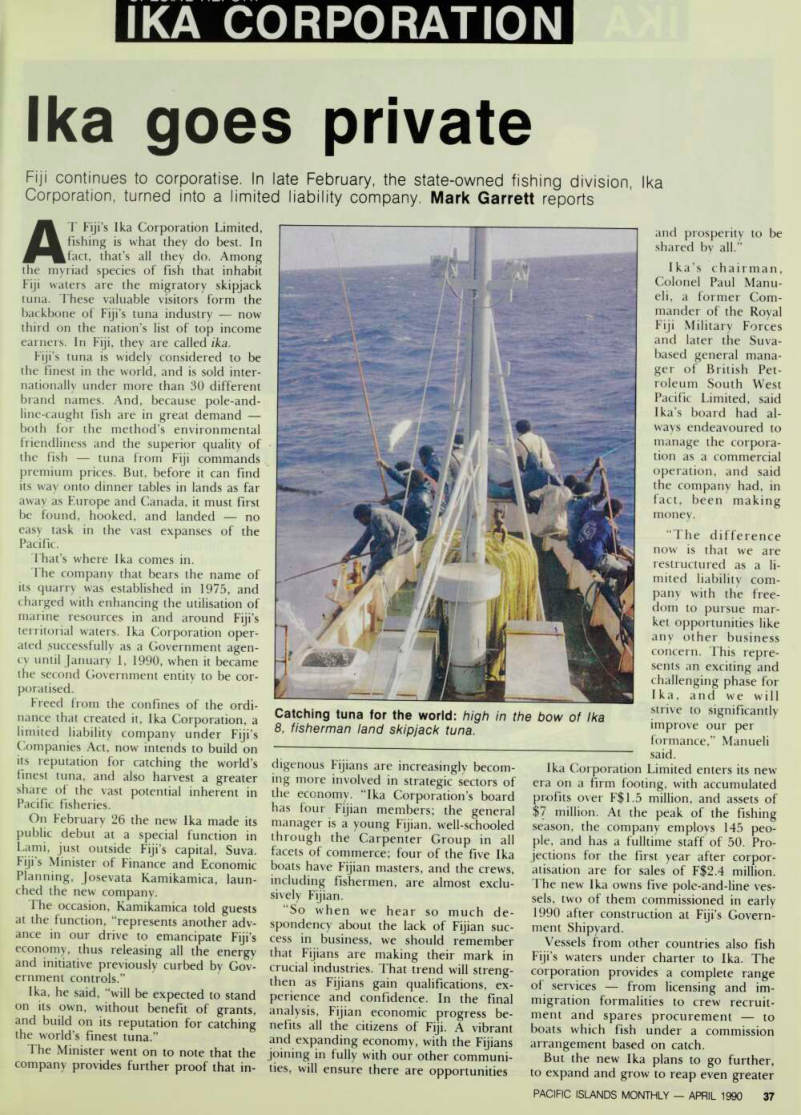
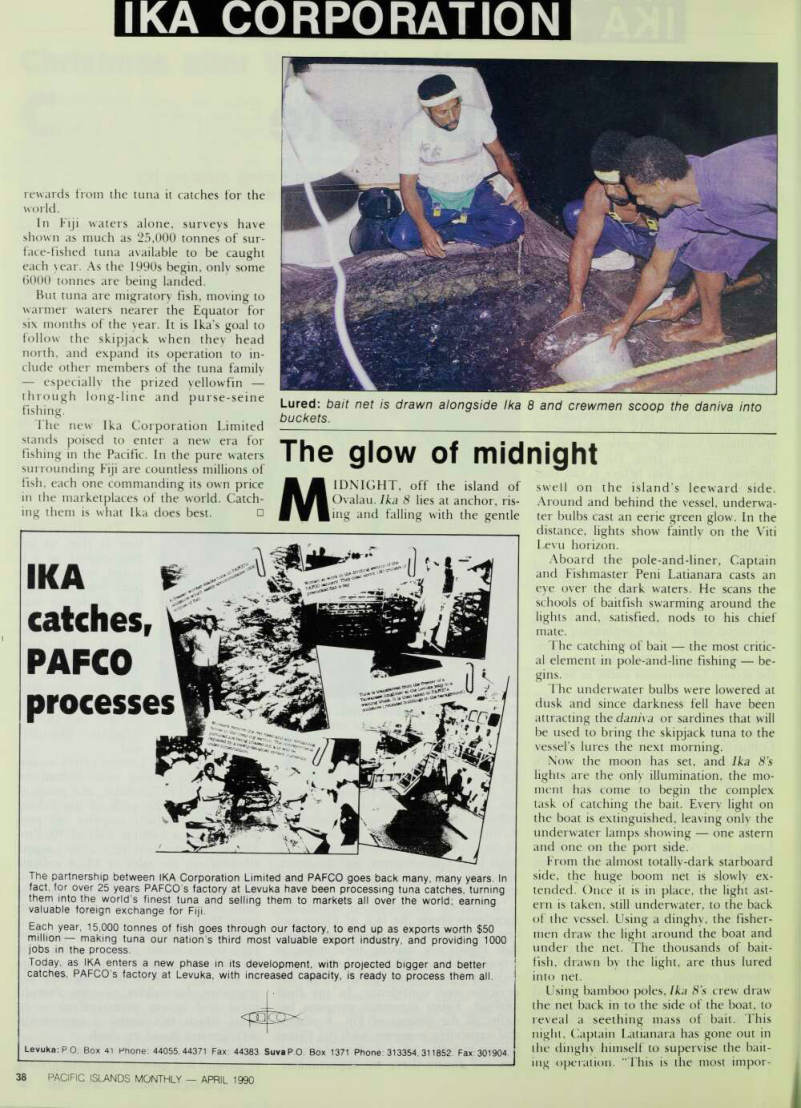
Ika Corporation
Fiji continues to corporatise. In late February, the state-owned fishing division, Ika Corporation, turned into a limited liability company. Mark Garrett reports
AT Fiji’s Ika Corporation Limited, fishing is what they do best. In fact, that’s all they do. Among the myriad species of fish that inhabit Fiji waters are the migratory skipjack tuna. These valuable visitors form the backbone of Fiji’s tuna industry now third on the nation’s list of top income earners. In Fiji, they are called ika.
Fiji’s tuna is widely considered to be the finest in the world, and is sold inter nationally under more than 30 different brand names. And, because pole-and line-caught fish are in great demand both for the method’s environmental friendliness and the superior quality of the fish tuna from Fiji commands premium prices. But, before it can find its way onto dinner tables in lands as far away as Europe and Canada, it must first be found, hooked, and landed no easy task in the vast expanses of the Pacific.
That’s where Ika comes in.
The company that bears the name of its quarry was established in 1975, and charged with enhancing the utilisation of marine resources in and around Fiji’s territorial waters. Ika Corporation oper ated successfully as a Government agen cy until January 1, 1990, when it became the second Government entity to be cor poratised.
Freed from the confines of the ordi nance that created it, Ika Corporation, a limited liability company under Fiji’s Companies Act, now intends to build on its reputation for catching the world’s finest tuna, and also harvest a greater share of the vast potential inherent in Pacific fisheries.
On February 26 the new Ika made its public debut at a special function in Lami, just outside Fiji’s capital, Suva.
Fiji’s Minister of Finance and Economic Planning, Josevata Kamikamica, laun ched the new company.
The occasion, Kamikamica told guests at the function, “represents another adv ance in our drive to emancipate Fiji’s economy, thus releasing all the energy and initiative previously curbed by Gov ernment controls.”
Ika, he said, “will be expected to stand on its own, without benefit of grants, and build on its reputation for catching the world’s finest tuna.”
The Minister went on to note that the company provides further proof that in-
digenous Fijians are increasingly becom ing more involved in strategic sectors of the economy. “Ika Corporation’s board has four Fijian members; the general manager is a young Fijian, well-schooled
through the Carpenter Group in all
facets of commerce; four of the five Ika boats have Fijian masters, and the crews, including fishermen, are almost exclu
sively Fijian.
“So when we hear so much de spondency about the lack of Fijian suc cess in business, we should remember that Fijians are making their mark in crucial industries. That trend will streng then as Fijians gain qualifications, ex perience and confidence. In the final analysis, Fijian economic progress be nefits all the citizens of Fiji. A vibrant and expanding economy, with the Fijians joining in fully with our other communi ties, will ensure there are opportunities
and prosperity to be shared by all.”
Ika’s chairman, Colonel Paul Manu eli, a former Com mander of the Royal Fiji Military Forces and later the Suva based general mana ger of British Pet roleum South West Pacific Limited, said Ika’s board had al ways endeavoured to manage the corpora tion as a commercial operation, and said the company had, in fact, been making money, “The difference now is that we are restructured as a li mited liability com pany with the free dom to pursue mar ket opportunities like any other business concern. This repre sents an exciting and
challenging phase for
Ika, and we will strive to significantly improve our per formance,” Manueli said.
Ika Corporation Limited enters its new era on a firm footing, with accumulated profits over Fsl.s million, and assets of $7 million. At the peak of the fishing season, the company employs 145 peo ple, and has a fulltime staff of 50. Pro jections for the first year after corpor atisation are for sales of F 52.4 million.
The new Ika owns five polc-and-line ves sels, two of them commissioned in early 1990 after construction at Fiji’s Govern
ment Shipyard.
Vessels from other countries also fish Fiji’s waters under charter to Ika. The corporation provides a complete range of services from licensing and im migration formalities to crew recruit ment and spares procurement to boats which fish under a commission arrangement based on catch.
But the new Ika plans to go further, to expand and grow to reap even greater
Catching tuna for the world: high in the bow of Ika 8, fisherman land skipjack tuna.
rewards from the tuna it catches for the world.
In Fiji waters alone, surveys have shown as much as 25,000 tonnes of sur face-fished tuna available to be caught each vear. As the 1990 s begin, only some 6000 tonnes are being landed.
But tuna are migratory fish, moving to warmer waters nearer the Equator for six months of the year. It is Ika’s goal to follow the skipjack when they head north, and expand its operation to in clude other members of the tuna family
especially the prized yellowfin
through long-line and purse-seine
fishing.
The new Ika Corporation Limited stands poised to enter a new era for fishing in the Pacific. In the pure waters surrounding Fiji are countless millions of fish, each one commanding its own price in the marketplaces of the world. Catch ing them is what Ika does best. □
The glow of midnight
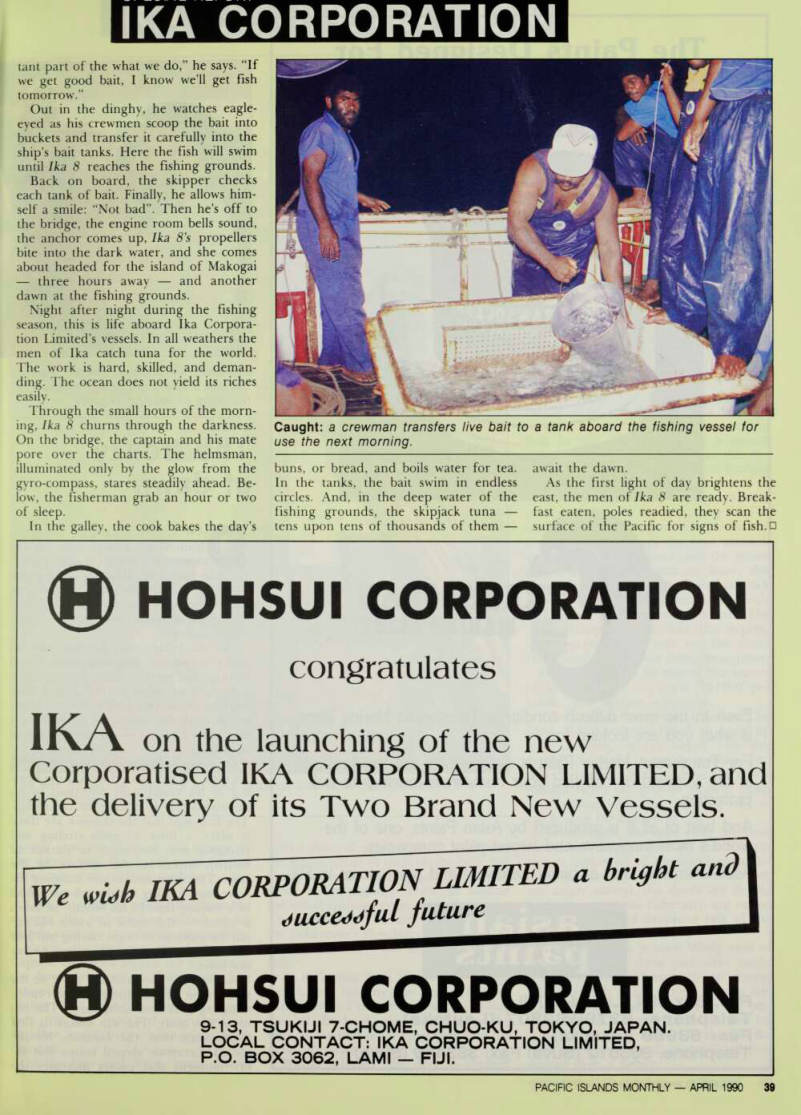
Midnight, off the island of Ovalau. Ika 8 lies at anchor, ris ing and falling with the gentle
swell on the island’s leeward side.
Around and behind the vessel, underwa ter bulbs cast an eerie green glow. In the distance, lights show faintly on the Viti Levu horizon.
Aboard the pole-and-liner, Captain
and Fishmaster Peni Latianara casts an eye over the dark waters. He scans the schools of baitfish swarming around the lights and, satisfied, nods to his chief mate.
The catching of bait the most critic al element in pole-and-line fishing be
gins.
The underwater bulbs were lowered at dusk and since darkness fell have been attracting the daniva or sardines that will be used to bring the skipjack tuna to the vessel’s lures the next morning.
Now the moon has set, and Ika B’s lights are the only illumination, the mo ment has come to begin the complex task of catching the bait. Every light on the boat is extinguished, leaving only the underwater lamps showing one astern and one on the port side.
From the almost totally-dark starboard side, the huge boom net is slowly ex tended. Once it is in place, the light ast ern is taken, still underwater, to the back of the vessel. Using a dinghy, the fisher men draw the light around the boat and under the net. The thousands of bait fish, drawn by the light, are thus lured into net.
Using bamboo poles, Ika B’s crew draw the net back in to the side of the boat, to reveal a seething mass of bait. This night, Captain Latianara has gone out in the dinghy himself to supervise the bail ing operation. “This is the most impor
Lured: bait net is drawn alongside Ika 8 and crewmen scoop the daniva into buckets.
tant part of the what we do,” he says. “If we get good bait, I know we’ll get fish tomorrow.”
Out in the dinghy, he watches eagle eyed as his crewmen scoop the bait into buckets and transfer it carefully into the ship’s bait tanks. Here the fish will swim until Ika 8 reaches the fishing grounds.
Back on board, the skipper checks each tank of bait. Finally, he allows him self a smile: “Not bad”. Then he’s off to the bridge, the engine room bells sound, the anchor comes up, Ika B’s propellers bite into the dark water, and she comes about headed for the island of Makogai three hours away and another dawn at the fishing grounds.
Night after night during the fishing
season, this is life aboard Ika Corpora tion Limited’s vessels. In all weathers the men of Ika catch tuna for the world.
The work is hard, skilled, and deman ding. The ocean does not yield its riches
easily.
Through the small hours of the morn ing, Ika 8 churns through the darkness.
On the bridge, the captain and his mate pore over the charts. The helmsman, illuminated only by the glow from the gyro-compass, stares steadily ahead. Be low, the fisherman grab an hour or two
of sleep.
In the galley, the cook bakes the day’s
buns, or bread, and boils water for tea.
In the tanks, the bait swim in endless circles. And, in the deep water of the
fishing grounds, the skipjack tuna
tens upon tens of thousands of them
await the dawn.
As the first light of day brightens the east, the men of Ika 8 are ready. Break fast eaten, poles readied, they scan the surface of the Pacific for signs of fish.n
Caught: a crewman transfers live bait to a tank aboard the fishing vessel for use the next morning.
Advertisements & other items, pp. 38-40 (2 items)
catches,
IKA t
PAFCO
processes
Z&s&i t-i -
41 i a*ai -»r U HW >5 <5 .-tc* , f * e* ■'i ia i » * The partnership between IKA Corporation Limited and PAFCO goes back many, many years. In fact, for over 25 years PAFCO’s factory at Levuka have been processing tuna catches, turning them into the world's finest tuna and selling them to markets all over the world; earning valuable foreign exchange for Fiji.
Each year, 15,000 tonnes of fish goes through our factory, to end up as exports worth $5O million — making tuna our nation’s third most valuable export industry, and providing 1000 jobs in the process.
Today, as IKA enters a new phase in its development, with projected bigger and better catches, PAFCO’s factory at Levuka, with increased capacity, is ready to process them all.
<pncp><
Levuka: P.O, Box 41 Hhone: 44055,44371 Fax: 44383 SuvaP.O. Box 1371 Phone: 313354, 311852 Fax:301904.
(G) Hohsui Corporation
congratulates IKA on the launching of the new Corporatised IKA CORPORATION LIMITED, and the delivery of its Two Brand New Vessels. ducceddful future
® HOHSUI CORPORATION
9-13, TSUKIJI 7-CHOME, CHUO-KU, TOKYO, JAPAN.
LOCAL CONTACT: IKA CORPORATION LIMITED,
P.O. BOX 3062, LAMI FIJI.
The Paints Designed For
All Your Marine Needs
THANSOCrf*
may marine W” drp
TRANSOCEAN
Hi MARINE FAINT
Even in the most difficult conditions Transocean Marine Paint is what you are looking for.
For Transocean Marine Paint is designed for the toughest job, in the shipyard or onboard your boat, from touchup to hull protection.
And best of all it is produced by Asian Paints, one of the world’s most innovative and largest paint companies.
Asian Paints. Found at better hardware and paint stores in Fiji,
asian
paints
P.O. Box 694, Lautoka, Fiji.
Telephone: 62799/62807 (Lautoka) Fax: 63959 (Lautoka) Telephone: 383612 (Suva) Fax: 383446 (Suva)
The frenzy
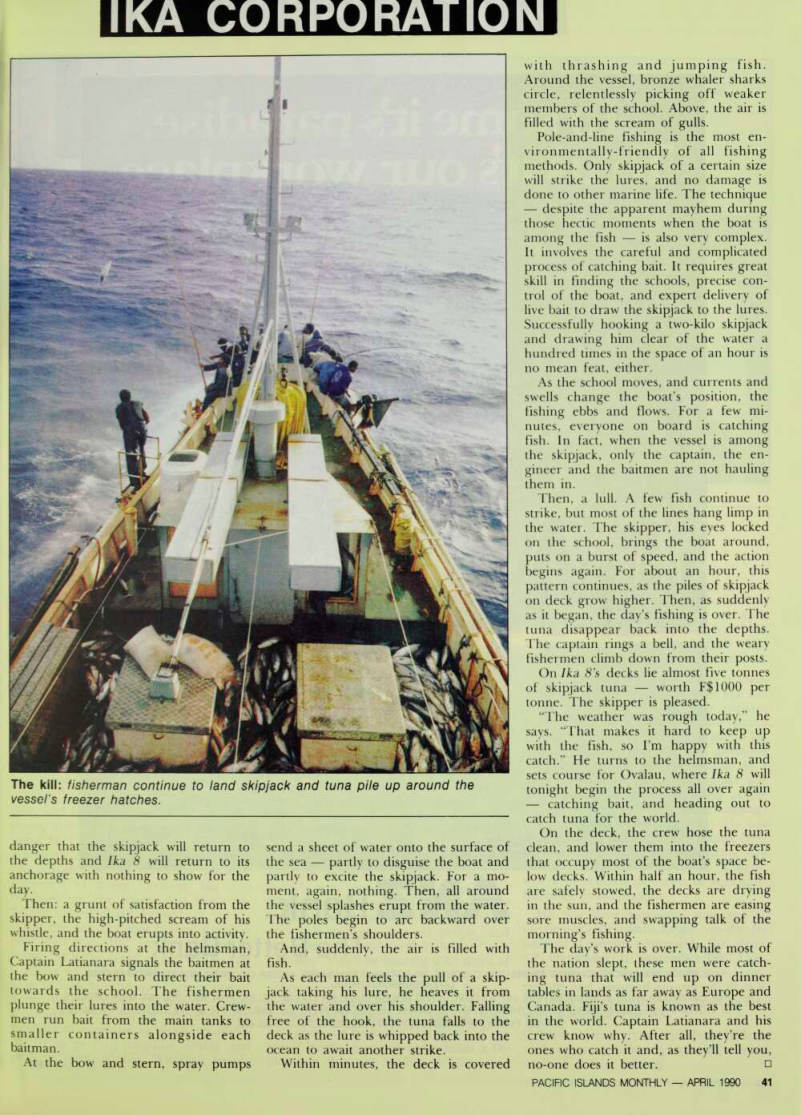
of dawn
DAWN, off Makogai. Under a leaden sky, Ika 8 rolls on the deepwater swells of the Pacific.
On the island of Makogai a green backdrop off the starboard bow only the earliest of risers are up and about.
In the vessel’s wake, a handful of gulls wheel and cry.
On the bridge, on the bow and on every corner of the boat, eyes strain
through the early-morning light to catch
a glimpse of skipjack. The prized tuna feed on the surface only at dawn. If they are to catch any today, the men of Ika 8 must find a school and soon. Tension runs high.
Captain Latianara, binoculars glued to his eyes, his feet braced against the heav ing of his vessel, calls directions to his helmsman. He is looking for two things.
The first sign that the skipjack are there is often a flock of gulls circling and plunging into the water in pursuit of baitfish stirred to the surface by the tuna. The fishmaster is also scanning the wave-tops, looking for the tell-tale splash of a leaping fish. In his mouth, he holds a whistle the sound of which will sig nal the baitman to begin casting bait into the water to draw Ika B’s quarry nearer the lures.
Around the bow and the stern sit the fishermen, their long poles ready, dangling pink and white lures. The mi nutes tick away. The sun makes its first appearance over the horizon. No-one speaks. Everyone aboard knows that ev ery moment that passes increases the
The hunt: Fishmaster, Captain Peni Latianara scans the ocean at dawn for signs of feeding skipjack.
danger that the skipjack will return to the depths and Ika 8 will return to its anchorage with nothing to show for the
day.
Then; a grunt of satisfaction from the skipper, the high-pitched scream of his whistle, and the boat erupts into activity.
Firing directions at the helmsman, Captain Latianara signals the baitmen at the bow and stern to direct their bait towards the school. The fishermen plunge their lures into the water. Crew men run bait from the main tanks to smaller containers alongside each baitman.
At the bow and stern, spray pumps
send a sheet of water onto the surface of the sea partly to disguise the boat and partly to excite the skipjack. For a mo ment, again, nothing. Then, all around the vessel splashes erupt from the water.
The poles begin to arc backward over the fishermen’s shoulders.
And, suddenly, the air is filled with fish.
As each man feels the pull of a skip jack taking his lure, he heaves it from the water and over his shoulder. Falling free of the hook, the tuna falls to the deck as the lure is whipped back into the ocean to await another strike.
Within minutes, the deck is covered
with thrashing and jumping fish.
Around the vessel, bronze whaler sharks circle, relentlessly picking off weaker members of the school. Above, the air is filled with the scream of gulls.
Pole-and-line fishing is the most en vironmentally-friendly of all fishing methods. Only skipjack of a certain size will strike the lures, and no damage is done to other marine life. The technique despite the apparent mayhem during those hectic moments when the boat is among the fish is also very complex.
It involves the careful and complicated process of catching bait. It requires great skill in finding the schools, precise con trol of the boat, and expert delivery of live bait to draw the skipjack to the lures.
Successfully hooking a two-kilo skipjack and drawing him clear of the water a hundred times in the space of an hour is no mean feat, either.
As the school moves, and currents and swells change the boat’s position, the fishing ebbs and flows. For a few mi nutes, everyone on board is catching fish. In fact, when the vessel is among the skipjack, only the captain, the en gineer and the baitmen are not hauling them in.
Then, a lull. A few fish continue to strike, but most of the lines hang limp in the water. The skipper, his eyes locked on the school, brings the boat around, puts on a burst of speed, and the action begins again. For about an hour, this pattern continues, as the piles of skipjack on deck grow higher. Then, as suddenly as it began, the day’s fishing is over. The tuna disappear back into the depths.
The captain rings a bell, and the weary fishermen climb down from their posts.
On Ika B’s decks lie almost five tonnes of skipjack tuna worth Fslooo per tonne. The skipper is pleased.
“The weather was rough today,” he says. “That makes it hard to keep up with the fish, so I’m happy with this catch.” He turns to the helmsman, and sets course for Ovalau, where Ika 8 will tonight begin the process all over again catching bait, and heading out to catch tuna for the world.
On the deck, the crew hose the tuna clean, and lower them into the freezers that occupy most of the boat’s space be low decks. Within half an hour, the fish are safely stowed, the decks are drying in the sun, and the fishermen are easing sore muscles, and swapping talk of the
morning’s fishing.
The day’s work is over. While most of the nation slept, these men were catch ing tuna that will end up on dinner tables in lands as far away as Europe and Canada. Fiji’s tuna is known as the best in the world. Captain Latianara and his crew know why. After all, they’re the ones who catch it and, as they’ll tell you, no-one does it better. □
The kill; fisherman continue to land skipjack and tuna pile up around the vessel’s freezer hatches.
Advertisements & other items, pp. 41-42 (2 items)
Ika Corporation
The Better Bank
Hip t n I •» hi • > S *• s I* X
FOREIGN CURRENCY EXCHANGE, TRAVELLERS CHEQUES, TELEGRAPHIC TRANSFERS, LETTER OF CREDIT, INVESTMENT ENQUIRIES
LATEST CURRENCY RATES.
ADMINISTRATION . IST & 4TH FL, CIVIC HOUSE SUVA. PH 314 000. TELEX: 2194. FAX: 300 267. MAIN OFFICES; CTORIA PDE, SUVA. PH;3I2 411.30 THOMSON ST., SUVA. PH; 312 333. BA: PH:7S 322. LABASA. PH: 82 377. LAUTOKA: PH: 60 355.
NADI. PH: 70 399. NAUSORI. PH: 47 100. SIGATOKA. PH: 50 433.
IH|
Man with a mission
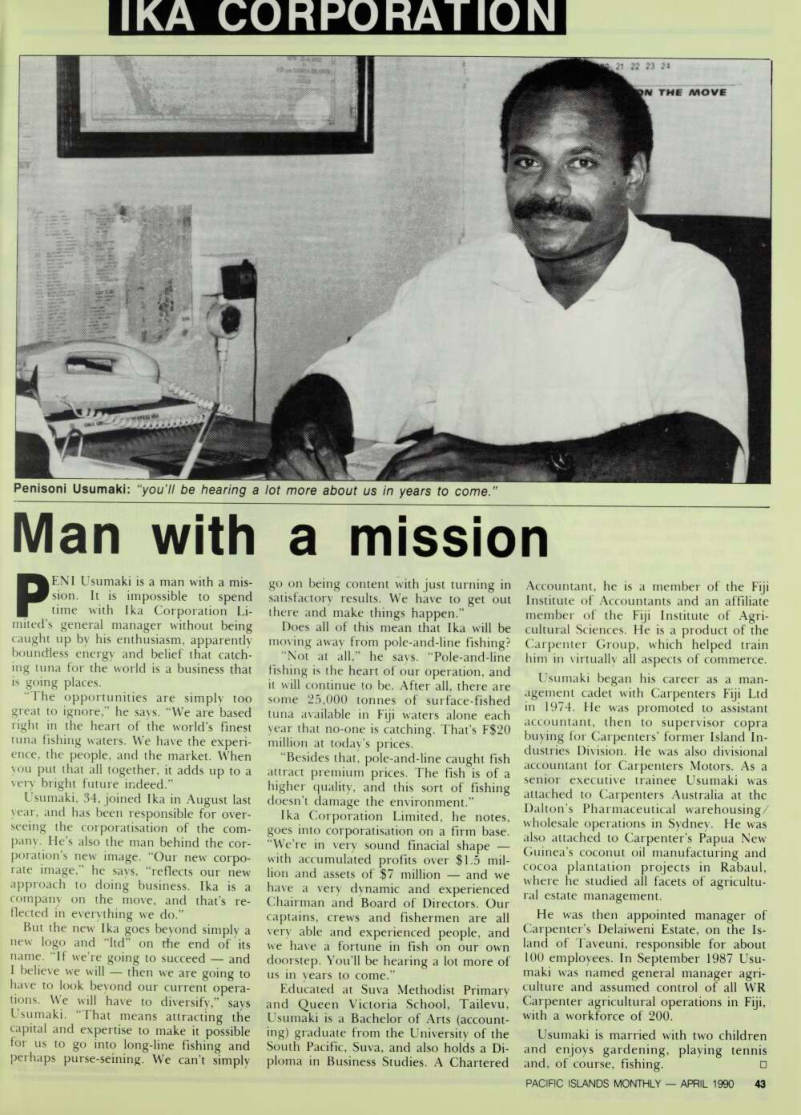
PENI Usumaki is a man with a mission. It is impossible to spend time with Ika Corporation Limiteds general manager without being caught up by his enthusiasm, apparently boundless energy and belief that catchmg tuna for the world is a business that is going places.
“The opportunities are simply too great to ignore,” he says. “We are based right in the heart of the world's finest tuna fishing waters. We have the experience, the people, and the market. When you put that all together, it adds up to a very bright future indeed."
Usumaki, 34, joined Ika in August last year, and has been responsible for overseeing the corporatisation of the company. He’s also the man behind the corporation’s new image. “Our new corporate image,” he says, “reflects our new approach to doing business. Ika is a company on the move, and that’s refleeted in everything we do.”
But the new Ika goes beyond simply a new logo and “ltd” on the end of its name. “If we’re going to succeed and I believe we will then we are going to have to look beyond our current operations. We will have to diversify,” says Usumaki. “That means attracting the capital and expertise to make it possible or us to go into long-line fishing and perhaps purse-seining. We can’t simply
go on being content with just turning in satisfactory results. We have to get out there and make things happen.”
Does all of this mean that Ika will be
moving away from pole-and-line fishing?
“Not at all” he says. “Pole-and-line fishing is the heart of our operation, and it will continue to be. After all, there are some 25,000 tonnes of surface-fished tuna available in Fiji waters alone each year that no-one is catching. That’s Fs2o million at today’s prices.
“Besides that pole-and-line caught fish attract premium prices. The fish is of a higher quality, and this sort of fishing doesn’t damage the environment.”
Ika Corporation Limited, he notes, goes into corporatisation on a firm base.
“We’re in very sound finacial shape with accumulated profits over $1.5 million and assets of $7 million - and we have a very dynamic and experienced Chairman and Board of Directors. Our captains, crews and fishermen are all very able and experienced people, and we have a fortune in fish on our own doorstep. You’ll be hearing a lot more of us in years to come.”
Educated at Suva Methodist Primary and Queen Victoria School, Tailevu, Usumaki is a Bachelor of Arts (accounting) graduate from the University of the South Pacific, Suva, and also holds a Diploma in Business Studies. A Chartered
Accountant, he is a member of the Fiji Institute of Accountants and an affiliate member of the Fiji Institute of Agri cultural Sciences. He is a product of the Carpenter Group, which helped train him in virtually all aspects of commerce, TT . • , , .
UsUm . ak ' bega " , h 'L Career as aman : ag ” Cadet W,th Car P e " terS F U| Ltd 1974 ’ He “ as P romoted to asslstam accoumant - lhen t 0 supervisor copra buyln S f<^. Carpenters former Island In duStneS He was a ‘ s ° d'vtstonal accountant for Carpenters Motors. As a “ , ex t ecu “ ve tramee A U,u " ,akl was aUa " pu Car P enters f ustral ‘ a at . thc ° a ‘ °" ? Pharmaceutlcal warehousing/ « hole^ e «P e > a uons m Sydney. He was attached to Carpenters Papua New Gulnea^ s coconut oil manufacturing and C ° h C ° a P' 3 ™" 0 .? P r f° jeCtS l n Rab l ul ’ be Stud,ed all faCetS of ag,lClllu " management, He was then appointed manager of Carpenter’s Delaiweni Estate, on the Is * °f Taveuni, responsible for about 100 employees. In September 1987 Usu maki was named general manager agri culture and assumed control of all WR
Carpenter agricultural operations in Fiji,
with a workforce of 200.
Usumaki is married with two children and enjoys gardening, playing tennis and, of course, fishing. □
Penisoni Usumaki: “you’ll be hearing a lot more about us in years to come."
Advertisements & other items, pp. 43-44 (2 items)
Ika Corporation
(U corporation ltd
CATCHING TUNA
FOR THE WORLD
II n the clear, pure waters of the Pacific swim countless I millions of tuna, each one commanding a high price I in the marketplaces of the world. In Fiji, we call them I ika, and the ones in our waters are considered the At IKA Corporation Ltd, catching them is what we do best.
Transformed from Government agency to private company, the new, corporatised, IKA operates five pole-and-line vessels, and stands poised to enter a new era for fishing in the Pacific. We're growing and changing, with a clear vision of the riches the sea can yield for our country and the region.
Find out more about the new IKA, and the unique advantages we can offer to those who share our vision.
(U corporation ltd
IKA: The name says it all.
For information and inquiries, contact P.O. Box 3062 Lami, Fiji, Tel: (679) 361-922, 361-089, 361-213 Fax; (679) 302-994, Tlx: FJ 2245
WILSON ADDiSOH 103.339
Free at last
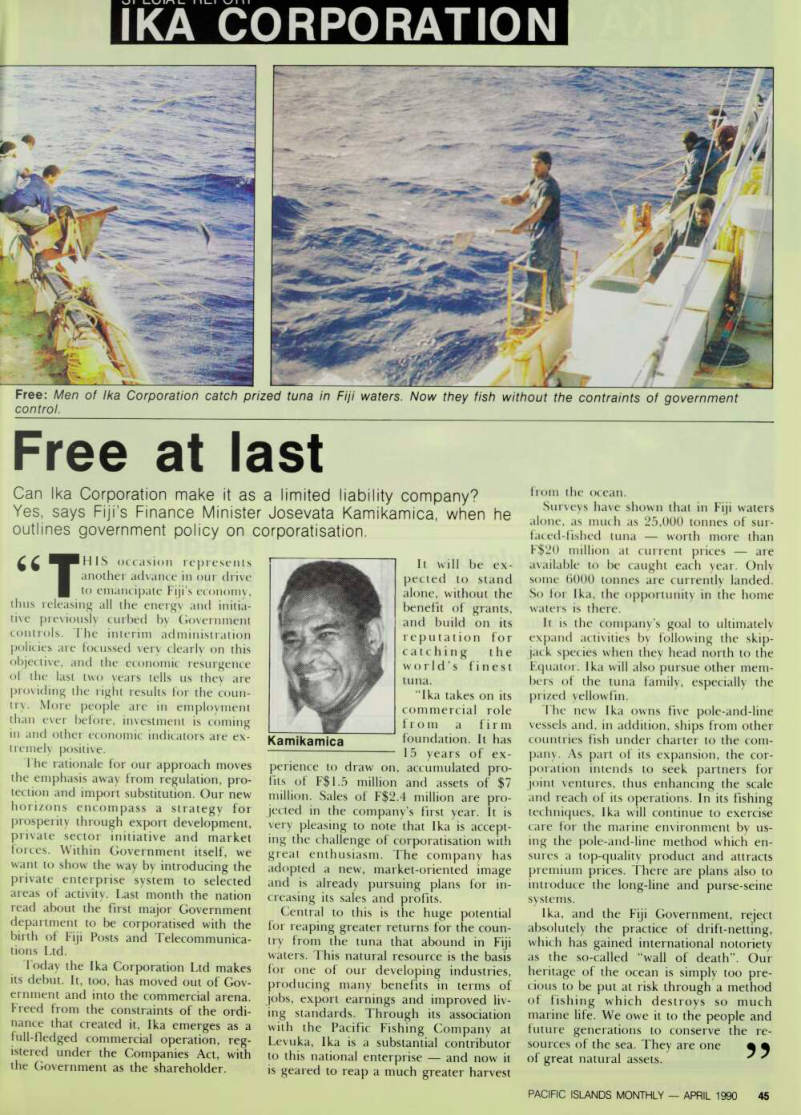
Can Ika Corporation make it as a limited liability company?
Yes, says Fiji’s Finance Minister Josevata Kamikamica, when he outlines government policy on corporatisation.
££ occasion represents I another advance in our drive to emancipate Fiji’s economy, thus releasing all the energy and initia tive previously curbed by Government controls. The interim administration policies are focussed very clearly on this objective, and the economic resurgence of the last two years tells us they are providing the right results for the coun try. More people are in employment than ever before, investment is coming in and other economic indicators are ex
tremely positive.
The rationale for our approach moves the emphasis away from regulation, pro tection and import substitution. Our new horizons encompass a strategy for
prosperity through export development,
private sector initiative and market forces. Within Government itself, we want to show the way by introducing the private enterprise system to selected areas of activity. Last month the nation read about the first major Government department to be corporatised with the birth of Fiji Posts and Telecommunica tions Ltd.
Today the Ika Corporation Ltd makes its debut. It, too, has moved out of Gov ernment and into the commercial arena.
Freed from the constraints of the ordi nance that created it, Ika emerges as a full-fledged commercial operation, reg istered under the Companies Act, with the Government as the shareholder.
It will be ex pected to stand alone, without the benefit of grants, and build on its reputation for
catching the
world’s finest tuna.
“Ika takes on its commercial role from a firm foundation. It has 15 years of ex
perience to draw on, accumulated pro fits of F$L5 million and assets of $7 million. Sales of F 52.4 million are pro jected in the company’s first year. It is very pleasing to note that Ika is accept
ing the challenge of corporatisation with
great enthusiasm. The company has adopted a new, market-oriented image and is already pursuing plans for in creasing its sales and profits.
Central to this is the huge potential for reaping greater returns for the coun try from the tuna that abound in Fiji waters. This natural resource is the basis for one of our developing industries, producing many benefits in terms of jobs, export earnings and improved liv ing standards. Through its association with the Pacific Fishing Company at Levuka, Ika is a substantial contributor to this national enterprise and now it is geared to reap a much greater harvest
from the ocean.
Surveys have shown that in Fiji waters alone, as much as 25,000 tonnes of sur faced-fished tuna worth more than Fs2o million at current prices are available to be caught each year. Only some 6000 tonnes are currently landed.
So for Ika, the opportunity in the home waters is there.
It is the company’s goal to ultimately
expand activities by following the skip
jack species when they head north to the Equator. Ika will also pursue other mem bers of the tuna family, especially the prized yellowfm.
The new Ika owns five pole-and-line vessels and, in addition, ships from other countries fish under charter to the com pany. As part of its expansion, the cor poration intends to seek partners for joint ventures, thus enhancing the scale and reach of its operations. In its fishing techniques, Ika will continue to exercise care for the marine environment by us ing the pole-and-line method which en sures a top-quality product and attracts premium prices. There are plans also to introduce the long-line and purse-seine systems.
Ika, and the Fiji Government, reject
absolutely the practice of drift-netting,
which has gained international notoriety as the so-called “wall of death”. Our heritage of the ocean is simply too pre cious to be put at risk through a method of fishing which destroys so much marine life. We owe it to the people and future generations to conserve the re sources of the sea. They are one * * of great natural assets. ' *
Free: Men of Ika Corporation catch prized tuna in Fiji waters. Now they fish without the contraints of government control.
Kamikamica
Advertisements & other items, p. 45 (1 item)
Ika Corporation
45
kj i uv ir\ i_ i 1 1_ i vi i i
PACIFIC ISLANDS MONTHLY APRIL 1990
Feeding the fishermen
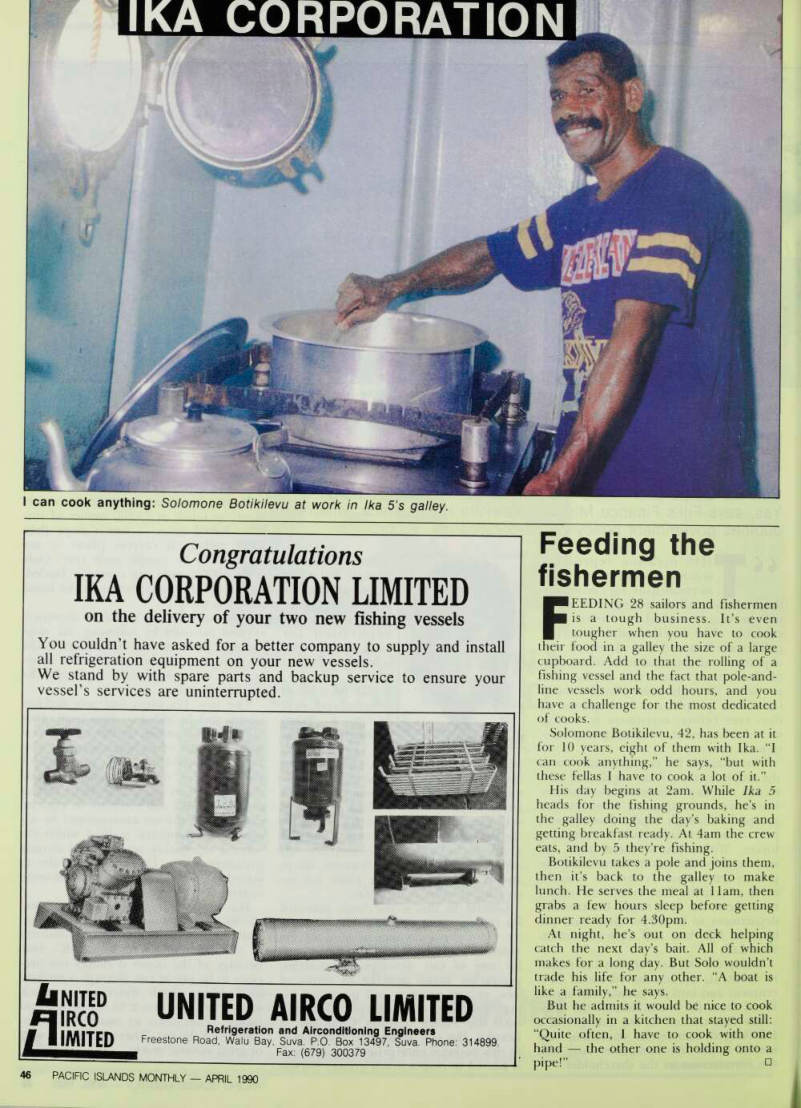
fishermen
FEEDING 28 sailors and fishermen is a tough business. It’s even tougher when you have to cook their food in a galley the size of a large cupboard. Add to that the rolling of a fishing vessel and the fact that pole-and line vessels work odd hours, and you have a challenge for the most dedicated of cooks.
Solomone Botikilevu, 42, has been at it for 10 years, eight of them with Ika. “I can cook anything,” he says, “but with these fellas I have to cook a lot of it.”
His day begins at 2am. While Ika 5 heads for the fishing grounds, he’s in the galley doing the day’s baking and getting breakfast ready. At 4am the crew
eats, and by 5 they’re fishing.
Botikilevu takes a pole and joins them, then it’s back to the galley to make lunch. He serves the meal at 11am, then grabs a few hours sleep before getting
dinner ready for 4.30 pm.
At night, he’s out on deck helping catch the next day’s bait. All of which makes for a long day. But Solo wouldn’t trade his life for any other. “A boat is like a family,” he says.
But he admits it would be nice to cook occasionally in a kitchen that stayed still: “Quite often, I have to cook with one hand the other one is holding onto a pipe!” □
I can cook anything: Solomone Botikilevu at work in Ika s’s galley.
Advertisements & other items, p. 46 (1 item)
Ika Corporation Limited
Congratulations
on the delivery of your two new fishing vessels You couldn’t have asked for a better company to supply and install all refrigeration equipment on your new vessels.
We stand by with spare parts and backup service to ensure your vessel’s services are uninterrupted.
L
IINITED
fIIRCO
I lIMITED
UNITED AIRCO LIMITED
Refrigeration and Airconditioning Engineers Freestone Road, Walu Bay, Suva. P.O. Box 13497, Suva. Phone: 314899.
Fax: (679) 300379
Soli and the sea
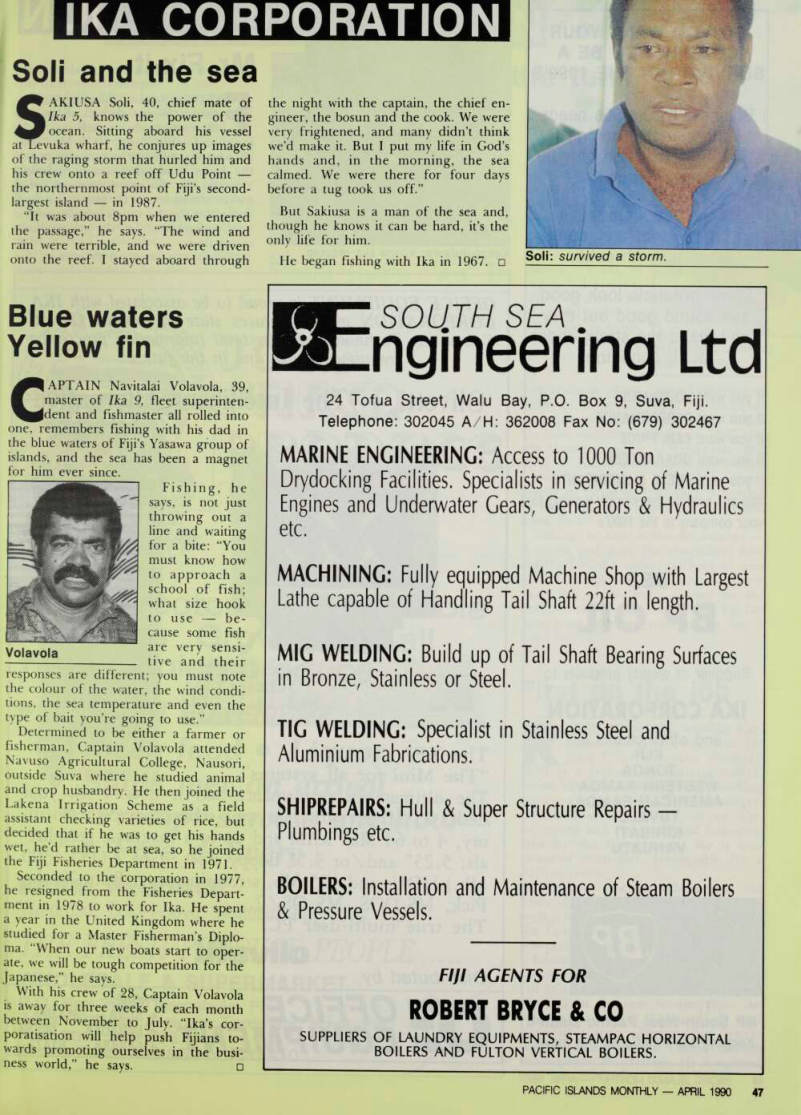
AKIUSA Soli, 40, chief mate of 5, knows the power of the ocean. Sitting aboard his vessel atXevuka wharf, he conjures up images of the raging storm that hurled him and his crew onto a reef off Udu Point the northernmost point of Fiji’s second largest island in 1987.
“It was about Bpm when we entered the passage,” he says. “The wind and rain were terrible, and we were driven onto the reef. I stayed aboard through
the night with the captain, the chief en gineer, the bosun and the cook. We were very frightened, and many didn’t think we’d make it. But I put my life in God’s hands and, in the morning, the sea calmed. We were there for four days before a tug took us off.”
But Sakiusa is a man of the sea and, though he knows it can be hard, it’s the only life for him.
He began fishing with Ika in 1967. □
Soli: survived a storm.
Yellow fin
Blue waters Yellow fin
CAPTAIN Navitalai Volavola, 39, master of Ika 9, fleet superinten dent and fishmaster all rolled into one, remembers fishing with his dad in the blue waters of Fiji’s Yasawa group of islands, and the sea has been a magnet for him ever since.
Fishing, he
says, is not just throwing out a line and waiting for a bite: “You must know how to approach a school of fish; what size hook to use be cause some fish are very sensi tive and their
responses are different; you must note the colour of the water, the wind condi tions, the sea temperature and even the type of bait you’re going to use.”
Determined to be either a farmer or fisherman, Captain Volavola attended Navuso Agricultural College, Nausori, outside Suva where he studied animal and crop husbandry. He then joined the Lakena Irrigation Scheme as a field assistant checking varieties of rice, but decided that if he was to get his hands wet, he’d rather be at sea, so he joined the Fiji Fisheries Department in 1971.
Seconded to the corporation in 1977, he resigned from the Fisheries Depart ment in 1978 to work for Ika. He spent a year in the United Kingdom where he studied for a Master Fisherman’s Diplo ma. “When our new boats start to oper ate, we will be tough competition for the Japanese,” he says.
With his crew of 28, Captain Volavola is away for three weeks of each month between November to July. “Ika’s cor poratisation will help push Fijians to wards promoting ourselves in the busi ness world,” he says. □
Volavola
Advertisements & other items, pp. 47-48 (1 item)
Engineering Ltd
J 6
C SOUTH SEA .
24 Tofua Street, Walu Bay, P.O. Box 9, Suva, Fiji.
Telephone: 302045 A/H: 362008 Fax No: (679) 302467 MARINE ENGINEERING: Access to 1000 Ton Drydocking Facilities. Specialists in servicing of Marine Engines and Underwater Gears, Generators & Hydraulics etc.
MACHINING: Fully equipped Machine Shop with Largest Lathe capable of Handling Tail Shaft 22ft in length.
MIG WELDING: Build up of Tail Shaft Bearing Surfaces in Bronze, Stainless or Steel.
TIG WELDING: Specialist in Stainless Steel and Aluminium Fabrications.
SHIPREPAIRS: Hull & Super Structure Repairs Plumbings etc.
BOILERS: Installation and Maintenance of Steam Boilers & Pressure Vessels.
FIJI AGENTS FOR
ROBERT BRYCE & CO
SUPPLIERS OF LAUNDRY EQUIPMENTS, STEAMPAC HORIZONTAL
BOILERS AND FULTON VERTICAL BOILERS.
DO YOU WANT YOUR
COMPANY TO BE A
SURVIVOR IN THE 1990’S
Business in the 90s needs the smooth running assurance that can only be
given by quality
Some suppliers make promises that they don’t back up with action Some products look good and sound good but they don’t stand the strain under tough conditions If you want TOUGHNESS If you want PERFORMANCE If you want FAIR PRICE If you want GUARANTEES If you want FUELS & LUBRICANTS that will provide the smooth running for your company in the 1990’5.
SEE
BP OIL
Supplier of quality products to
IKA CORPORATION
and other clients in
FIJI
TONGA
WESTERN SAMOA
AMERICAN SAMOA
TUVALU
KIRIBATI
VANUATU
(BP) BP South-West Pacific Limited Keeping the Pacific on the move
Mr Fix-it


FLEET supervisor Filimone Vakalu tulawa, 39, has the task of keeping the corporation’s vessels out catch ing tuna for the world. He is Mr Fix-it all who co-ordinates the movement of the boats; maintains communications; arranges for hiring of seasonal crew; makes arrangements for provisions, fuel, and water for the vessels and prepares a work programme for the corporation’s entire fleet.
“Fijians can be good fishermen, but
Vakalututawa: keeps Ika moving.
need guidance and expertise on how to run their own businesses,” he says.
A product of Ratu Kadavulevu School, in Tailevu, Vakalutulawa also attended the Fiji College of Agriculture and the School of Maritime Studies. He did a course on diesel engines in Japan. He
gained wide experience working in the
Fisheries Department, the Fiji Military Forces, Patterson Brothers, Beachcomber Cruises, Blue Lagoon Cruises and Tro pik Wood Industries before he found his niche at Ika Corporation.
“The new boats mean more cash, and more employment,” he says. □
Advertisements & other items, pp. 48-49 (1 item)
- Office
OFFICE EQUIPMENT is proud to be associated with IKA CORPORATION as it embraces state of the art Olivetti Computing Technology for its total information proccesing requiments now and in the future
Olivetti The Intelligent Alternative
II um J S S ■ $ s' ¥ S The XP7.
“The Mini for all systems”
The ultimate in performance and it doesn’t fill your desk. 25 MHz. with zero wait states, fast cache memory, 4 to 64 Mb. RAM and up to 5 magnetic peripherals: 5.25” and/or 3-5” floppy discs, 1 or 2 (135/300 Mb.) HDUs and 125 Mb. streaming tape. Runs Xenix,
Pick, MS-DOS, MS OS/2.
The true multi-user PC.
Olivetti
Distributed by a
- OFFICE
!- EQUIPMENT
PHONE:
• SUVA 314200
• LAUTOKA 60933
• LABASA 81472
PIC*
Qp $■ A & Y 3 r<i o
msujj
mm
Fruits, rootcrops, vegetable
suppliers Growers of all
farm choice produce
• General merchants • Frozen food • Liquor • Ships met on arrival • Prompt service any hour • Free delivery
FARM PRODUCE
Waidroso, Colo-i-Suva, Naitasiri Rd, Suva, Fiji.
THE FRESH PRODUCE PEOPLE
WHOLESALE & SUPERMARKET .
P.O. Box 3905, Samabula, Fiji. \ 74 & 76 Ragg Avenue, Tamavua, Suva, Fiji. I Fax: Suva 320 033 Phone-. Suva 320 855 or 320 410 /
Home is where the tuna is
Sekiguchi has done a lot of fishing. In Japan, Venezuela, Papua New Guinea and Fiji, he’s tracked and caught the elusive skipjack tuna all the way. Captain Sekiguchi, from Tokyo, has been catching tuna with Ika since 1978 and, he says, he may nev er go home again.
“The weather’s better here,” he says with a grin. “Clean air, clean water, good fishing and plenty of grog!” The
quiet fishmaster of Ika 5 “I’m 42, I think” has grown very fond of the
latter: “Before, in Japan, I had very bad teeth very painful. Now, I drink lots of grog and no pain!”
But Sekiguchi is also a man with a mission. “I like to teach,” he says.
“Here we have a lot of good people, who want to learn.
I’ll keep on passing
on the skills I have.”
A graduate of the Tokyo University of Fisheries, Sekiguchi began his career as an apprentice officer on a cargo vessel.
He later worked long-liners in PNG, did test shrimp trawling in Venezuela, and came to Ika as a captain under United Nations assistance in 1978. He returned briefly to Japan in 1987, but “I wanted to help Fiji, so I asked Ika if I could come back.”
Fishing, he says, is like the weather it comes and goes. He remembers dur ing the 1980-81 season catching 42 ton nes of skipjack in two hours. “There were fish everywhere piled on the deck, on the bridge, everywhere. Fiji has very good fishing grounds. Ika has a good future.” □
Sekiguchi: drinking plenty of grog.
First on the job
RAJESH Chand, 37, was Ika Cor poration’s first employee. He joined the company in April 1976 as a general administration clerk.
From being a sole employee working
under a part-time general manager.
Chand has seen Ika grow from two char ter vessels and a second-hand boat don ated by the Government. He is now financial controller, responsible for a staff of seven.
“The past few years have seen the fruits of our sacrifices, and changes have been for the better,” he says. “I’ve seen Ika Corporation grow and I think the prospects for the future are great.”
Educated at Labasa Secondary School, Chand first worked at Paradise Builders Ltd as a building supervisor. He holds a Diploma in Business Studies from the Fiji Institute of Technology and attended a tuna administration system course funded by the United Nations Development Programme. He is married with two children. □
Advertisements & other items, p. 49 (1 item)
Ika Corporation
49
ori_wirvi_ i 1I wi»i
PACIFIC ISLANDS MONTHLY APRIL 1990
New boats for Ika
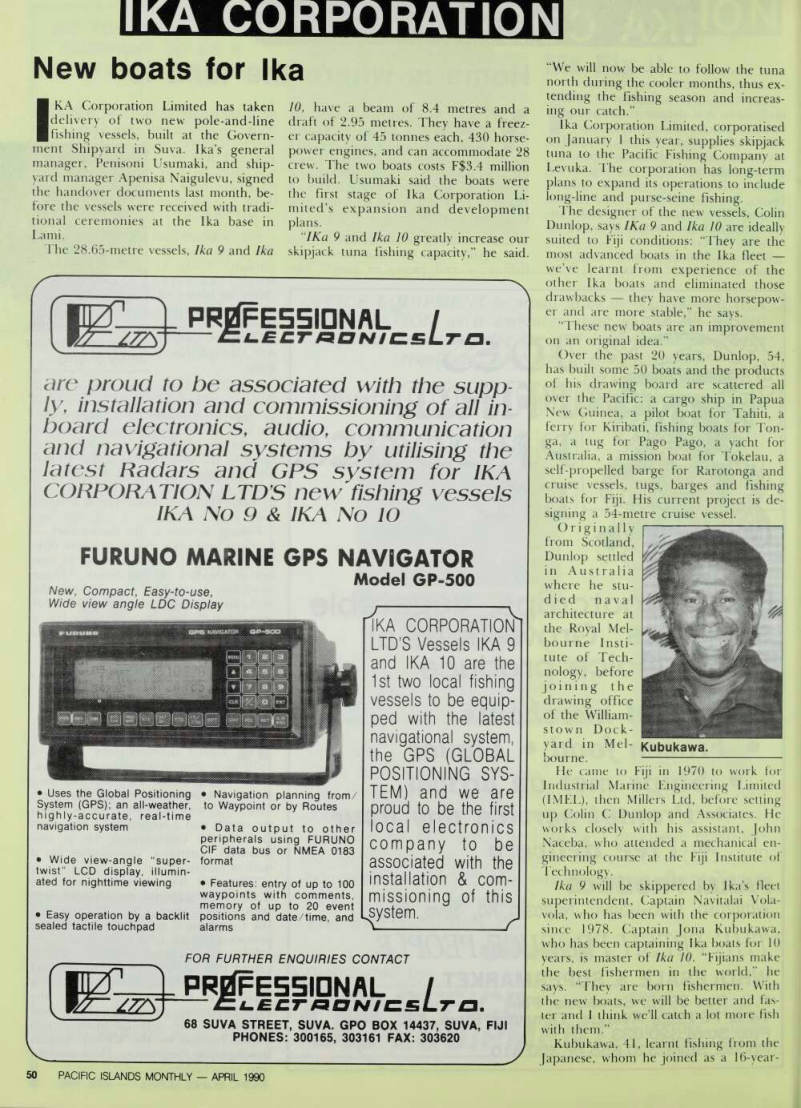
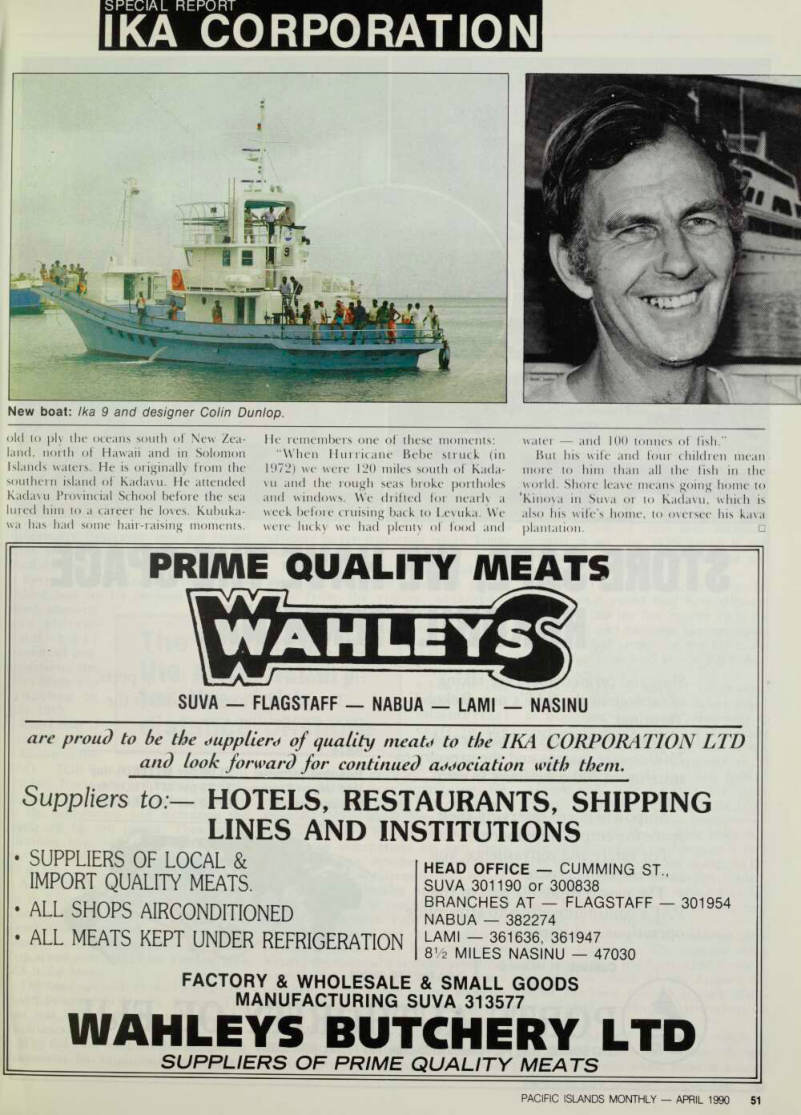
IKA Corporation Limited has taken delivery of two new pole-and-line fishing vessels, built at the Government Shipyard in Suva. Ika’s general manager, Penisoni Usumaki, and shipyard manager Apenisa Naigulevu, signed the handover documents last month, before the vessels were received with traditional ceremonies at the Ika base in Lami.
The 28.65-metre vessels, Ika 9 and Ika
10, have a beam of 8.4 metres and a draft of 2.95 metres. They have a freez er capacity of 45 tonnes each, 430 horse power engines, and can accommodate 28 crew. The two boats costs F|3.4 million to build. Usumaki said the boats were the first stage of Ika Corporation Li mited’s expansion and development plans.
“IKa 9 and Ika 10 greatly increase our skipjack tuna fishing capacity,” he said.
“We will now be able to follow the tuna north during the cooler months, thus ex tending the fishing season and increas ing our catch.”
Ika Corporation Limited, corporatised
on January 1 this year, supplies skipjack tuna to the Pacific Fishing Company at Levuka. The corporation has long-term plans to expand its operations to include
long-line and purse-seine fishing.
The designer of the new vessels, Colin Dunlop, says IKa 9 and Ika 10 are ideally suited to Fiji conditions: “They are the most advanced boats in the Ika fleet we’ve learnt from experience of the other Ika boats and eliminated those drawbacks they have more horsepow er and are more stable,” he says.
“These new boats are an improvement on an original idea.”
Over the past 20 years, Dunlop, 54, has built some 50 boats and the products of his drawing board are scattered all over the Pacific: a cargo ship in Papua New Guinea, a pilot boat for Tahiti, a ferry for Kiribati, fishing boats for Ton ga, a tug for Pago Pago, a yacht for Australia, a mission boat for Tokelau, a
self-propelled barge for Rarotonga and
cruise vessels, tugs, barges and fishing boats for Fiji. His current project is de signing a 54-metre cruise vessel.
Originally from Scotland,
Dunlop settled
in Australia where he stu died naval architecture at the Royal Mel bourne Insti tute of Tech
nology, before
joining the
drawing office
of the William stown Dock yard in Mel bourne.
He came to Fiji in 1970 to work for Industrial Marine Engineering Limited (IMEL), then Millers Ltd, before setting up Colin C Dunlop and Associates. He works closely with his assistant, John Naceba, who attended a mechanical en gineering course at the Fiji Institute of
Technology.
Ika 9 will be skippered by Ika’s fleet
superintendent, Captain Navitalai Vola
vola, who has been with the corporation since 1978. Captain Jona Kubukawa, who has been captaining Ika boats for 10 years, is master of Ika 10. “Fijians make the best fishermen in the world,” he says. “They are born fishermen. With the new boats, we will be better and fas ter and I think we’ll catch a lot more fish with them.”
Kubukawa, 41, learnt fishing from the Japanese, whom he joined as a 16-year-
Kubukawa.
old to ply the oceans south of New Zea land, north of Hawaii and in Solomon Islands waters. He is originally from the southern island of Kadavu. He attended Kadavu Provincial School before the sea lured him to a career he loves. Kubuka wa has had some hair-raising moments.
He remembers one of these moments: “When Hurricane Bebe struck (in 1972) we were 120 miles south of Kada vu and the rough seas broke portholes and windows. We drifted for nearly a week before cruising back to Levuka. We were lucky we had plenty of food and
water and 100 tonnes of fish.”
But his wife and four children mean more to him than all the fish in the world. Shore leave means going home to 'Kinoya in Suva or to Kadavu, which is also his wife’s home, to oversee his kava plantation. □
New boat: Ika 9 and designer Colin Dunlop.
Advertisements & other items, pp. 50-52 (1 item)
Ipt ] Professional /
PROFESSIONAL /
aoNi csLra.
are proud to be associated with the supply, installation and commissioning of all in-
board electronics, audio, communication
and navigational systems by utilising the
latest Radars and GPS system for IKA CORPORATION LTDS new fishing vessels IKA No 9 & IKA No 10 10 7T
FURUNO MARINE GPS NAVIGATOR
Model GP-500 New, Compact, Easy-to-use, Wide view angle LDC Display • Uses the Global Positioning System (GPS); an all-weather, highly-accurate, real-time navigation system • Navigation planning from/ to Waypoint or by Routes • Wide view-angle “supertwist” LCD display, illuminated for nighttime viewing • Data output to other peripherals using FURUNO GIF data bus or NMEA 0183 format • Easy operation by a backlit sealed tactile touchpad • Features: entry of up to 100 waypoints with comments, memory of up to 20 event positions and date/time, and alarms v
IKA CORPORATION
LTD’S Vessels IKA 9 and IKA 10 are the Ist two local fishing vessels to be equipped with the latest navigational system,
the GPS (GLOBAL
POSITIONING SYS-
TEM) and we are proud to be the first local electronics company to be associated with the installation & commissioning of this system. r
FOR FURTHER ENQUIRIES CONTACT
IpT ] PROFESSIONAL /
9/r~ zzaT — czi-EcraaNicsL 68 SUVA STREET, SUVA. GPO BOX 14437, SUVA, FIJI
PHONES: 300165, 303161 FAX: 303620
PRIME QUALITY MEATS
WAHLEYS
SUVA FLAGSTAFF NABUA LAMI NASINU
cire proud to be the suppliers of quality meats to the IKA CORPORATION LTD and look forward for continued association with them .
Suppliers to:— HOTELS, RESTAURANTS, SHIPPING
LINES AND INSTITUTIONS
• SUPPLIERS OF LOCAL &
IMPORT QUALITY MEATS,
• ALL SHOPS AIRCONDITIONED
• ALL MEATS KEPT UNDER REFRIGERATION
HEAD OFFICE GUMMING ST„
SUVA 301190 or 300838
BRANCHES AT FLAGSTAFF 301954
NABUA 382274
LAMI 361636, 361947
BV 2 MILES NASINU 47030
FACTORY & WHOLESALE & SMALL GOODS
MANUFACTURING SUVA 313577
WAHLEYS BUTCHERY LTD
SUPPLIERS OF PRIME QUALITY MEATS
t I kssm wm ! o » * ' J'
tTSMBUL
•• i -« ’ST «•: 5- * ?// «\\ i v ym m.
STORE SAFE, WE HAVE THE SPACE
ROKOBILI TERMINAL
Ship and cargo owners are taking advantage of the PAF’s new Rokobili Terminal.
The terminal has a total area of 7500 square metres and the capacity to store up to 700 containers in two
layers.
Shipowners are reserving their
space for empty containers.
For safety and convenience, you must book your space.
The new terminal is part of the PAF’s continuing effort to streamline operations and improve the standard of services in Fiji ports.
The Rokobili terminal offers the most competitive rate.
RATE.
Rokobili Terminal $l.OO per MT(TEU)/day RAF Wharf Storage $1.35 per MT(TEU)/day Private Depots $2.00 per MT(TEU)/day t Contact H. Hazelman N. Ledua ] *
SUVA PH: (679) 315399
PORTS AUTHORITY OF FIJI
GPO BOX 780, Suva, Fiji. Phone: 312700 Cable: PAF FJ, Fax: (679) 300064
The fisherman’s choice
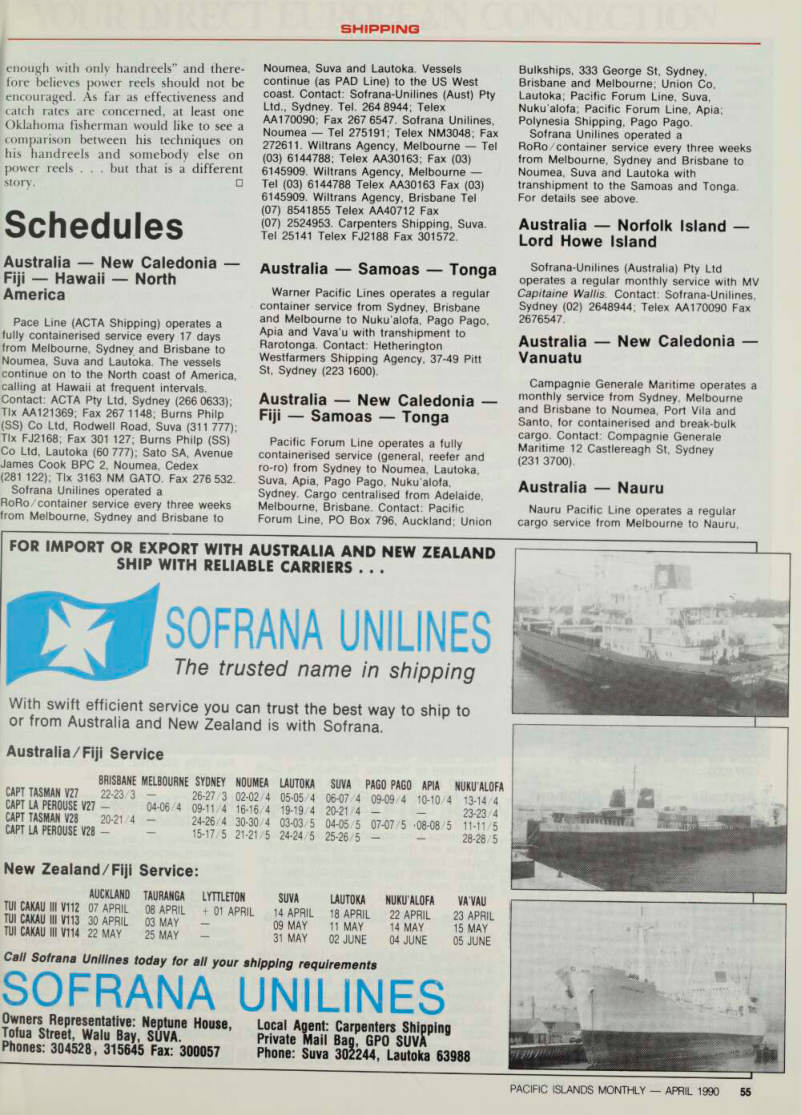
Shipping
How do you build the perfect fishing boat? Masterfisherman Paul Mead went to Vava’u to have one made.
By Bob Gillet
PAUL Mead knows small boats.
Working as a masterfisherman for the South Pacific Commission (SPC) since 1974, he has carried out 19
lengthy fishing assignments in 10 Pacific
Island countries. During this period Paul made extensive use of about 40 small fishing boats and intermittently fished from another 40. In short, Paul is a fisherman’s fisherman who has fished from almost anything that floats in the Pacific Islands.
Recently Paul decided to build a fishing boat for his personal use. After
much planning
and eleven and- h a 1 f months of con struction, the Dora Malia was launched in
July 1989.
Paul’s boat is
basically what
is known as the
FAO TON-7, extended to 35ft (10.7 m). It was enlarged from the origin al design by adding 4ft (1.2 m) of length to the mid-section and increasing the freeboard by two planks. These mod ifications have effectively doubled the size of the craft; from a cubic number of 33 to 64.
As modified, the Dora Malia can carry up to 2 tonnes of fish in its two holds.
The two fuel tanks hold 540 litres of diesel which gives 600 nautical miles of range at a cruising speed of 5.4 knots.
Top speed with the 32 hp Yamaha ME -188 is 7.4 knots.
The boat was built at the Fisheries Di vision boatyard in Vava’u, Tonga. The cost was U 5533,300, not including the electronics.
Why did Paul settle on this design? In discussions he emphasised the import
ance of the right design for the prevail ing sea conditions, intended fishery, and distance offshore to be worked. What he selected for Tonga may not be the best boat in other areas. For example, if he were operating in the relatively near shore fishery of Western Samoa, his choice would certainly be the 28ft (8.5 m) Alia aluminium catamaran. Paul wanted a boat for bottom fishing and trolling capable of venturing 120 nautical miles
offshore in the frequently rough Tonga
conditions.
After Paul decided to get a boat of his own, he could have purchased a used boat from the region, obtained a
The right boat for the right fishery for the right distance offshore
stock design
from overseas, or built locally.
As he has not
been impress
ed with the available used commercial craft in the Pacific Islands (“most fall into
the floating junk category”, a new vessel was considered more appropriate. He decided against bringing in a new vessel from the United States, New Zealand, or Australia because he has long wanted a boat which incorporates his own ideas and innovations. Another consideration is that he has an extremely high regard for Tongan boatbuilder Aisea Tupou.
He then had to consider a building material. Because Paul was not ac quainted with steel and this type of con struction would not be possible in Vava’u, the material was eliminated from consideration. Although fibreglass was a possibility, Paul wished to use materials available locally, or at least regionally; he did not want to commute occasionally to the United States or New Zealand for materials. He therefore decided on wood. More specifically, he chose Fijian
dakua (Agathis vitiensis) for planking and rosarosa (Heritiera ornithocephala) for the frames.
The TON-7 was favoured over other available designs for a number of reasons. Paul liked the idea of a planked vessel relative to one of plywood for its strength. Furthermore, as the TON-7 is decked over, it is more seaworthy in ex tremely rough (survival) conditions than open (non-self bailing) craft. Finally, the characteristics of a boat are important for people who plan on spending a signi ficant portion of their lives thrashing around at sea; the TON model is well known for being a good sea boat and having a nice motion.
If the TON-7 had never been de signed, what would Paul have selected?
It is likely that the first runner up in the P. Mead Vessel Selection Contest would be a stretched version of the FIJ-5, the 28ft (8.5 m) craft built by the Fiji Fisher ies Division.
There were a number of changes made to the Dora Malia to make it easier to fish from and more convenient to operate. Probably the most significant modification concerns the fish holds.
“For quality fish, it is important to be able to work inside the fish holds.”
Accordingly, the hatches are large enough to pass bags of ice and the.holds deep enough to permit a generous-size human to work inside. This latter fea ture makes the hold high enough to be a very convenient height for sitting. As the opening of the one of the fish holds is inside the cabin, a nifty sliding door has been added to the cabin allowing easy passage of ice and fish.
Attention was given to reducing glare
for the helmsman. The forward cabin and its windows has been raked forward.
In addition, much of the forward in terior has been painted in dark black board paint, resulting in less strain on the eyes.
In the transom area where much of
the fishing action takes place, changes
have been made which make it a more
convenient work platform. A “poling rack” extends aft of the transom which, in addition to being a nice place to pull fish from and providing an easy way to board the boat, effectively increases the size of the work deck. Another nice fea ture in the stern area is that the bul warks at the transom are removable. The seats provided by the raised fish-holds are both more comfortable and safer than sitting on the rail. Irritating “toe stubbers” have been eliminated or smoothed.
Paul has attempted to ba lance the safety, fuel economy, and improved sea-motion aspects of having a sail with the realities of a fishing boat.
With an “it’s a fish boat first” philosophy, all shrouds and
other rigging “garbage” will be well removed from the fishing areas. In addi tion, the mast will be collapsible.
All the decks have been covered in fibreglass and non-skid paint has been applied. Unlike many small commercial fishing craft found in the Pacific Islands, the Dora Malia passes the “jumps on the deck” test; a well-nourished Tongan droping one metre produces a solid “thunk” with little flexing or other signs of weakness of the deck.
Fishing has become increasingly soph isticated since Paul’s early 1970 s Western Samoa Peace Corps days. Nowadays, it is generally recognised that electronic fishing aids are essential for many types of commercial fishing in the Pacific Is lands. Paul’s electronic quiver will in clude communication, navigation, fish finding, and safety equipment.
The Dora Malia has a Ray Jefferson 500 M VHF radio. It was purchased in the United States for $l4O and was selected because it is “basic and easy to
Dara Malia passes the jump-on-the-deck test
use”. There is a Si-Tex A-310 sat nav which was purchased for US$l3OO. It was chosen because of its cost, con tinuous clock, and ease of use. Paul chose a Genetron Monochrome M 7 video sounder at US$7OO because of favourable consumer reports, handy accessories, ease of use, and the built-in trouble shooting features. Future electro nic purchases planned include a radar (probably a Goldstar on the basis of re ports from visiting albacore fishermen),
an SSB radio, and the older type (VHF) Emergency Position Indicating Radio Beacon (EPIRB).
The availability of spare parts and ser vicing were not major considerations in the selection of the electronic gear. Any brand purchased would have to be ship ped overseas for repair due to the elec tronic technician situation in Vava’u.
Much of Paul’s information on marine electronics came from buyer’s guides published by Skipper Marine Electronics, 3170 Commercial Ave., Northbrook, IL,
USA 60062;tel (312)-272-4700; or toll free in USA (800)-621- 2378.
The boat will be equipped with four Alvey Reef King Reels for trolling, ika-shibi, palu-ahi fishing. Trolling will
be done with two 14ft (4.3 m) trolling beams. Six poles rigged with pearl shell lures will also be carried.
Paul plans on using four of the mod ified F AO/Samoan handreels for bot tom fishing. Although some fishermen have expressed the opinion that “fisher man require electric or hydraulic reels to be effective in commercial bottom fishing”, Paul has a different view. He states that the Pacific Islands bottomfish resources “have been whacked hard
[ enough with only handreels” and there f fore believes power reels should not be encouraged. As far as effectiveness and catch rates are concerned, at least one Oklahoma fisherman would like to see a comparison between his techniques on his handreels and somebody else on power reels . . . but that is a different story. □
Advertisements & other items, p. 54 (2 items)
Shipping
Hai Service
TONGA
KIRIBATI
VANUATU
COOK ISLAND
Solomon islands
NEW CALEDONIA
U.S. SAMOA
WESTERN SAMOA
FRENCH POLYNESIA
JAPAN . KOREA
YOU’LL FIND IT,
WHERE THE SKY MEETS
THE SEA
m
RORO. CONTAINER &
B.BULK SHIPPING
BALI
HAI SERVICE
AGENTS
and
PHONE
SUVA:Burns Philp(B.P) 311 777 Carpenter Shipping (C.S) 31 2244 LAUTOKArB P 60777 C S 63988 APIA:B P 22611 PAGOPAGO :Polynesia Shipping Services Ltd 633-1211 PAPEETE:Compagnie Maritime Polynesienne 42 84 02 NOUMEA:Etablissements Ballande 687-283384 VILA:B P 2456 SANTO:B P 230 HONlARA:Sullivans (Solomon Islands) Ltd 21645 TARAWA;Shipping Corporation of Kiribati 26195 NUKUALOFA:B P 21500 BUSANtfor general cargo Young Chang Shipping Co , Ltd 753-0451 for vehicle Pan Continental Shipping Co., Ltd 778-7680 Soyang Shipping Co , Ltd 752-7755 JAPANdor general cargo Swire 03-230-9245 for vehicle NVK Lines 03-284-5506 Mitsui O S K 03-587-7123
Schedules
Australia New Caledonia
Fiji Hawaii North
America
Pace Line (ACTA Shipping) operates a fully containerised service every 17 days from Melbourne, Sydney and Brisbane to Noumea, Suva and Lautoka. The vessels continue on to the North coast of America, calling at Hawaii at frequent intervals.
Contact: ACTA Pty Ltd, Sydney (266 0633); Tlx AA121369; Fax 267 1148; Burns Philp (SS) Co Ltd, Rodwell Road, Suva (311 777); Tlx FJ2168; Fax 301 127; Burns Philp (SS) Co Ltd, Lautoka (60 777); Sato SA, Avenue James Cook BPC 2, Noumea, Cedex (281 122); Tlx 3163 NM GATO. Fax 276 532.
Sofrana Unilines operated a Roßo/container service every three weeks from Melbourne, Sydney and Brisbane to
Noumea, Suva and Lautoka. Vessels continue (as PAD Line) to the US West coast. Contact: Sofrana-Unilines (Aust) Pty Ltd., Sydney. Tel. 264 8944; Telex AA170090; Fax 267 6547. Sofrana Unilines, Noumea Tel 275191; Telex NM3048; Fax 272611. Wiltrans Agency, Melbourne Tel (03) 6144788; Telex AA30163; Fax (03) 6145909. Wiltrans Agency, Melbourne Tel (03) 6144788 Telex AA30163 Fax (03) 6145909. Wiltrans Agency, Brisbane Tel (07) 8541855 Telex AA40712 Fax (07) 2524953. Carpenters Shipping, Suva.
Tel 25141 Telex FJ2IBB Fax 301572.
Australia Samoas Tonga
Warner Pacific Lines operates a regular container service from Sydney, Brisbane and Melbourne to Nukualofa, Pago Pago, Apia and Vava’u with transhipment to Rarotonga. Contact: Hetherington Westfarmers Shipping Agency, 37-49 Pitt St. Sydney (223 1600).
Australia New Caledonia
Fiji Samoas Tonga
Pacific Forum Line operates a fully containerised service (general, reefer and ro-ro) from Sydney to Noumea, Lautoka, Suva, Apia, Pago Pago, Nukualofa, Sydney. Cargo centralised from Adelaide, Melbourne, Brisbane. Contact; Pacific Forum Line, PC Box 796, Auckland; Union
Bulkships, 333 George St, Sydney, Brisbane and Melbourne; Union Co, Lautoka; Pacific Forum Line, Suva, Nukualofa; Pacific Forum Line, Apia; Polynesia Shipping, Pago Pago.
Sofrana Unilines operated a Roßo/container service every three weeks from Melbourne, Sydney and Brisbane to Noumea, Suva and Lautoka with transhipment to the Samoas and Tonga.
For details see above.
Australia Norfolk Island
Lord Howe Island
Sofrana-Unilines (Australia) Pty Ltd operates a regular monthly service with MV Capitaine Wallis. Contact: Sofrana-Unilines, Sydney (02) 2648944; Telex AA170090 Fax 2676547.
Australia New Caledonia Vanuatu Campagnie Generale Maritime operates a monthly service from Sydney, Melbourne and Brisbane to Noumea, Port Vila and Santo, for containerised and break-bulk cargo. Contact: Compagnie Generale Maritime 12 Castlereagh St. Sydney (231 3700).
Australia Nauru
Nauru Pacific Line operates a regular cargo service from Melbourne to Nauru,
passenger service to Nauru only. Contact: Nauru Pacific Line (Aust) Pty Ltd, Nauru House, 80 Collins St, Melbourne (653 5709), Nedlloyd Swire, 8 Spring St, Sydney, (20 522).
Australia Solomon Islands Vanuatu NGAL/PNGL joint service operates a monthly service. Contact: Nedlloyd Swire Pty Ltd, 6 Spring St, Sydney (20 522).
Australia New Zealand ANL Ltd operates the Tranztas contain er service between Australia and New Zealand, offering access to five vessels.
These vessels call at Melbourne, Sydney, Brisbane (Tasmania, Adelaide and Fre mantle via feeder services) in Australia and Auckland, Wellingtoin, Lyttelton, Port Chalmers, Nelson, Tauranga (Napier via feeder service) in New Zealand. Each ves sel operates on an approximate three weekly round voyage schedule.
Australia NZ Fiji Vanuatu New Caledonia Solomons New Guinea Sitmar Cruises operates a year-round cruise programme from Sydney to include the better-known ports in the above countries plus a number of unspoilt, and largely unknown, island paradises. Contact: Sitmar Cruises, 39 Martin Place, Sydney (239 9000) for NSW; reservations and inquiries (008 42 2277); rest of Australia, reservations and enquiries (088 22 2277).
Australia NZ Fiji Tonga
Vanuatu New Caledonia Solomons Samoas Tahiti P&O Liners call at Auckland, Bay of Islands, Honiara, Lautoka, Noumea, Nukualofa, Pago Pago, Papeete, Port Moresby, Santo, Savusavu, Suva, Vava’u and Vila on cruises from Australia.
Contact: P&O Booking Centre, Thomas Cook Pty Ltd, 33 Bligh St, Sydney (237 0333).
Australia PNG Solomons Vanuatu A consortium of NGAL/PNG and CONPAC has four vessels operating a joint service from east coast Australian ports to Port Moresby, Lae, Alotau, Madang, Wewak, Rabaul, Kavieng-Kimbe, Kieta, Honiara, Vila, Santo. Contact: Burns Philp & Co Ltd, PO Box R 124, Royal Exchange, Sydney (20 547); Nedlloyd Swire, 8 Spring St, Sydney (20 522); New Guinea Express Lines, 37 Pitt St, Sydney (241 3991); Vila Agents, PO Box 27, Port Vila (2456), Tlx
Nhioii.
Australia Kiribati CCS operates a 6 weekly service from Melbourne, Sydney and Brisbane to Kiribati (Tarawa). Contact: Chief Container Service, 8 Spring Street, Sydney (251-2699) Fax 251-2271.
Australia Tuvalu
CCS operates a direct service every second voyage to Tuvalu (Funafuti).
Contact: Chief Container Service, 8 Spring Street, Sydney (251-2699) Fax 251-2271.
Australia New Caledonia
Vanuatu
CCS operates a monthly service from Melbourne, Sydney and Brisbane to Noumea, Vila and Santo. Contact: Chief Container Service, 8 Spring Street, Sydnev (251-2699) Fax 251-2271.
Australia Solomons
Vanuatu
CCS operates a monthly service from Melbourne, Sydney and Brisbane to Honiara, Vila and Santo. Contact: Chief Container Service, 8 Spring Street, Sydney (251-2699) Fax 251-2271.
Europe Tahiti New
Caledonia Vanuatu
The Bank Line and Columbus Line operate a regular joint cargo service from Hamburg, Bramen, Antwerp, Rotterdam and Le Havre to Papeete, Noumea, Port Vila and Santo. Contact; The Bank Line, PO Box 952, Lae, Papua New Guinea. Telex: NE 44265, Tel: 421235, Fax: 422925; Columbus Line, Lae (423466), Tlx NE44171; Ets A.M. Fare UTE, Papeete; Ets Ballande, Noumea and other local agents.
Sofrana Europe Australia Line “Sofeal” operates a regular three-weekly service from North European ports including Felixstowe to Papeete from Noumea.
Contact: from McArthur Shipping Agency Co Pty Ltd., Tel (02) 5502222 Telex AA24045 Fax 5191382.
Europe PNG Solomons
The Bank Line & Columbus Line operate a regular joint cargo service from Hamburg, Bramen, Antwerp, Rotterdam and Le Havre to Port Moresby, Lae, Madang, Kimbe, Rabaul, Kieta and Honiara and on inducement to Yandina. Contact: The Bank Line, PO Box 952, Lae, Papua New Guinea.
Telex: NE 44265, Tel: 421235, Fax; 422925; Columbus Line, Lae (423466), Tlx NE44171; or lines’ local agents.
Rarotonga Line operates regular services to Tonga and the Samoas from New Zealand. Contact Sofrana Unilines (NZ) Ltd.
Tel (09) 773279 Telex NZ2313 Fax (09) 393874.
Europe W. Samoa Tonga
Fiji
The Bank Line & Columbus Line operate a regular joint cargo service from Hamburg, Breman, Antwerp, Rotterdam and Le Havre to Apia, Nukualofa, Suva and Lautoka. Contact; The Bank Line, PO Box 952, Lae, Papua New Guinea. Telex; NE 44265, Tel: 421235, Fax: 422925; Columbus Line, Lae (423466), Tlx NE44171; or lines’ local agents.
Far East Fiji New Zealand New Zealand Unit Express (NZUE) operates a monthly service accepting containerised and break-bulk cargo from Manila, Keelung, Kaohsiung and Hong Kong to Lautoka, Suva and thence to New Zealand ports.
Contact: Carpenters Shipping, Private Mail Bag, GPO Suva, Fiji (312-244), Fax; (679) 301-572, Tlx FJ2199; New Zealand Unit Express, Maritime Building, 2-10 Customhouse Quay, PC Box 890, Wellington (727 865), Cables
Enzueman Wellington, Tlx
NZ31340 NEDLNZ, or Nedlloyd Swire Pty Ltd. Sydney (20 522).
Far East Mid South Pacific China Navigation's New Guinea Pacific Line operates a regular container and Break Bulk-Heavy Lift service from Hong Kong, Taiwan, Manila, Singapore, Malaysia, Thailand to Port Moresby, Lae, Rabaul, Kieta and Honiara with 18 days frequency.
Wewak and Madang will receive four direct calls a year or more on inducement. A T/service via Lae to these and other PNG ports connecting with monthly sailings is available at cost. Cargo from the same Eastern ports to the South Pacific ports of Noumea, Santo, Vila, Papeete, Pago Pago, Apia, Nukualofa, Rarotonga and Tarawa will be shipped via Japan or Busan on the monthly Bali Hai service. Contact Steamships Shipping, PO Box 634, Port Moresby (220 283 or 220 289).
Kyowa Shipping Ltd operates monthly services from Japan to Guam, Saipan, Solomons, New Caledonia, Fiji, Western and American Samoa, Tahiti, Cook Islands, Tonga and Vanuatu. Contact; Hetherington Wesfarmers Shipping Agency, 37-49 Pitt St, Sydney (223 1600); Carpenters Shipping, Suva (312 244), Tlx FJ2199.
Guam Northern Marianas Saipan Shipping Co operates a weekly service via barge carrying containers and conventional cargo between Guam and Saipan and Tinian. Contact: Saipan Shipping Co. Inc, PO Box 8, Saipan CM 96950 (322 9706 or 322 9707). Tlx 783619; Fax (670) 322 3183; Guam agents Maritime Agencies of the Pacific Ltd.
Hawaii Samoas Tonga Cook Islands Hawaii-Pacific Line operates a monthly container service between Honolulu, Pago Pago, Apia, Nukualofa and Avatiu (Rarotonga). Contact: Hawaii-Pacific Maritime, Inc., PO Box 3264, Honolulu HI (9860)-32641 (808 531 4841). Apia Pacific Forum Line, PO Box 655, Apia, Western Samoa, Tel (685) 20345, Tlx (793) 2345 x, Fax (685) 22343; Rarotonga Hawaii Pacific Lines Ltd, PO Box 54, Rarotonga, Cook Islands. Tel (682) 21780, Tlx (717) 6202 MARTINA RG, Fax (682) 24780; Pagopago Kneubuhl Maritime Service Corporation, PO Box 39, Pagopago, American Samoa 96799, Tel (684) 6335121/6335122, Tlx (682) 505
Kneubuhl Sb, Fax (684) 6335100;
Nukualofa.
Advertisements & other items, pp. 55-57 (1 item)
Sofrana Unilines
FOR IMPORT OR EXPORT WITH AUSTRALIA AND NEW ZEALAND SHIP WITH RELIABLE CARRIERS . . ,
The trusted name in shipping
With swift efficient service you can trust the best way to ship to or from Australia and New Zealand is with Sofrana.
Australia/Fiji Service
CART TASMAN V 27
CART LA PEROUSE V 27
CART TASMAN V2B
CART LA PEROUSE V2B
BRISBANE MELBOURNE SYDNEY NOUMEA LAUTOKA
22-23/3 - 26-27/3 02-02/4 05-05 4 04-06/4 09-11/4 16-16/4 19-19 4 20-21/4 - 24-26/4 30-30/4 03-03/5 - 15-17/5 21-21/5 24-24/5
SUVA PAGO PAGO APIA NUKU ALOFA
06-07/4 09-09/4 10-10/4 13-14 4 20-21, 4 - - 23-23/4 04-05/5 07-07/5 'OB-08/5 11-11/5 25-26/5 - - 28-28/5 New Zealand/Fiji Service:
AUCKLAND TAURANGA
TUI CAKAU 111 Vll2 07 APRIL 08 APRIL TUI CAKAU 111 Vll3 30 APRIL 03 MAY TUI CAKAU 111 Vll4 22 MAY 25 MAY
LYTTLETON SUVA LAUTOKA NUKUALOFA VA’VAU
+Ol APRIL 14 APRIL 18 APRIL 22 APRIL 23 APRIL 09 MAY 11 MAY 14 MAY 15 MAY - 31 MAY 02 JUNE 04 JUNE 05 JUNE Call Sofrana Unlllnes today for all your shipping requirements
SOFRANA UNILINES
(1 uinore DnnPAAA M iMi:..«. n a ■ ■
Owners Representative: Neptune House,
Tofua Street, Walu Bay, SUVA.
Phones: 304528, 315645 Fax: 300057
Local Agent; Carpenters Shipping
Private Mail Bag, GPO SUVA Phone: Suva 302244, Lautoka 63988
YOUR DIRECT EUROPEAN CONNECTION
• u m w *mT:
EUROPE-SOUTH PACIFIC JOINT SERVICE
The South Pacific Specialists offer facilities for shipment of: Containers (FCL/LCL) and Breakbulk Cargo plus reefer space and deeptanks for carriage of vegetable oils and other liquid bulk cargo.
Carriers also accept heavy lifts, overlength and cumbersome parcels.
RSS
Ports of Service- Please contact our regional offices for Loading: Papeete, Apia, Suva, f uriher information: Lautoka, Noumea, Port Vila, Santo, lhe Bank Line ’ Telex: NE44265 Honiara, Port Moresby, Lae,Madang 8 0. Box , Tel: 422988 Kimbe, Rabaul, Kieta, Darwin. ’ Lae. Papua New Guinea Facsimile; 422925 For: Rotterdam, Antwerp, Hamburg, Hull, Dunkirk, Le Havre.
Additional ports on enquiry.
- ROUND THE WORLD SERVICE -
Columbus Line Reederei GmbH P.O. Box 1667 Lae/Papua New Guinea Phone; 42 3466/42 3287 A.H. 42 2481 Telex; Colline NE 44 171
THE BANK LINE LTD LONDON
COLUMBUS LINE REEDEREI GMBH HAMBURG
The AIDS cover-up
Health
By David Robie
FROM Papeete’s Piano Bar to the Hotel Papua in Port Moresby the message is much the same: AIDS is a death-dealing virus that is a scourge for Western and palagi gay communities.
Or intravenous drug users. It’s no real problem for Pacific Islanders, Wrong.
Newspapers treat AIDS sufferers in Papua New Guinea, where most Pacific cases in an independent island nation have been identified, in sensationalist style. They are outcasts, Lepers, Scare tactics, Wrong again.
These glib, simplistic attitudes are ris ky for South Pacific communicators, warn health and population workers.
One of the biggest tasks for educators in the region is to dispel the myths about AIDS and to persuade governments to face up to the realities.
Some Pacific governments frequently try to cover up the seriousness of the problem because it “creates a bad image and damages tourism so AIDS is brushed under the carpet”.
But the facts are there; Like it or not, AIDS is well established in the Pacific.
And, apart from the large pool of poten tial HIV (human immunodeficiency virus) carriers among islanders living in Australia, France, New Zealand and the United States, there are believed to be hundreds with HIV already in Pacific nations.
According to World Health Organisa tion figures presented at last month’s re gional seminar on new perspectives in population communication in Auckland, full AIDS cases have now been reported in five Pacific island nations or territories Fiji 2, French Polynesia 8, New Cale donia 8, Papua New Guinea 13 and Tonga 1.
However, perhaps more revealing is that more than 70 HIV infection cases have been reported in French Polynesia, more than 40 in New Caledonia, 30 in Papua New Guinea, 12 in Guam, and
less than five each in the Federated States of Micronesia, Marshall Islands and Tonga. Other unreported HIV cases are believed to be present in other Paci fic nations and among the Pacific islan der communities in metropolitan coun tries.
Several of the population conference delegates visited the NZ AIDS Founda tion headquarters in Auckland and met Pacific Islands and Maori community workers. They pledged to make a grea ter effort to inform Pacific communities about the virus and its implications for island societies (see box).
Posters on the wall depicted “safe sex” themes. In one, showing two men with a condom, the slogan said: “It takes two to have unsafe sex but only one to pre vent it.” Said another: “It’s your life love carefully!”
“AIDS has this connotation of ‘dying’, ‘sin’, and ‘pollution’,” Jenny Rankin, edi tor of the foundation’s education maga zine Network told the delegates. “There is this distorted image of a group of safe people who do nice things with each other. Outside of this group is another group of nasty people. And the safe peo ple will remain safe providing the nasties are kept outside of the mainstream.”
Rankin condemned the news media’s role in the region for perpetuating myths. “Media has created the wrong im ages.” She added: “AIDS is about living, human need and community. Unless wc can deal with these issues then this virus will kill a lot of people even in the Pacific Islands.”
Rankin appealed to newspapers in the South Pacific to abandon the “fear” stor ies and run articles with real, informa tion about HIV and AIDS. “Let us talk about how to stay safe,” she added. “And how to create support networks.”
Within a week of the seminar joint ly sponsored by the United Nations Fund for Population Activities (UNFPA), UN Educational, Scientific and Cultural Organisation (UNESCO) and the South
Pacific Commission (SPC) a $lOO,OOO Pacific Islands Aids Trust was launched in New Zealand to provide education among islander communities. The trust will complement the work being done by the national Aids Foundation, which re ceives a $1.5 million annual government grant, and the Te Roopu Tautoko Trust which works with the Maori community.
Frank Wiki, a Te Roopu community worker, agreed with the vital importance of education work: “One Maori infected is one too many.” He recalled: “One man, a Maori, believed HIV was only carried by white gay mem. So as long as he had sex only with other Maoris he would be alright. Unfortunately, this is a widely spread belief.”
The foundation educators appealed to Pacific governments to put more re sources into AIDS education prog rammes.
But HIV or AIDS sufferers are not the only Pacific Islanders to be unfairly
stigmatised, the population conference
was told. On average one tenth of the populations in Pacific nations are dis abled yet they are forgotten and
ignored by national planners.
Cook Islander Fanaura Kingstone, a regional social development adviser, made an impassioned plea for the wel fare of the thousands of “grossly neg lected and deprived” handicapped Paci fic Islanders.
According to her breakdown of the latest national census figures, 554,240 people are disabled in the Pacific Islands states which have a combined population of more than five million. The figures include American Samoa with 3229, Cook Islands (1775), Fiji (17,884), French Polynesia (16,675), Kiribati (6349), New Caledonia (14,536), Niue (328), Papua New Guinea (301,072), Solomon Islands (28,157), Tonga (9453), Vanuatu (14,263) and Western Samoa (15,890).
“The disabled people of the region are at the bottom of the social and economic
pile of their country’s society,” Kingstone
said. □
Sorting through the myth words
WATCH your language when
talking about AIDS/HIV, says New Zealand Aids Foundation advocate Jenny Rankine. The persistence of words and phrases that imply certain groups are running around deliberately infecting “innocent” people stems from assumptions about gay men, drug users and prostitutes which government de partments, the medical establishment and the media have in Pacific countries.
And in the rest of the world.
Even the use of the word “AIDS” itself
is alarmist and often misplaced.
For example, use of the phrase “AIDS virus” confuses HIV with the life threatening phase of HIV infection and equates infection with death. Only a small proportion of people who get HIV develop actual AIDS symptoms.
“AIDS test” Using this phrase im
plies that being HIV antibody positive
means you’ll automatically get AIDS, or that they’re the same.
Not so. It is actually an HIV antibody test.
AIDS means acquired immune de ficiency syndrome a series of symp toms pointing to the health condition.
Yet AIDS is often referred to as a disease. A disease sounds highly infec tious and easily spread. When compared to Hepatatis B, HIV is hard to catch.
This confusion contributes to an irra tional fear about infection.
And somebody who has HIV is not an AIDS carrier.
“Bad language about AIDS, language which blocks prevention efforts, will in volve challenges to medical, media and government responses to the epidemic,'’ says Rankine. D [
Missing link
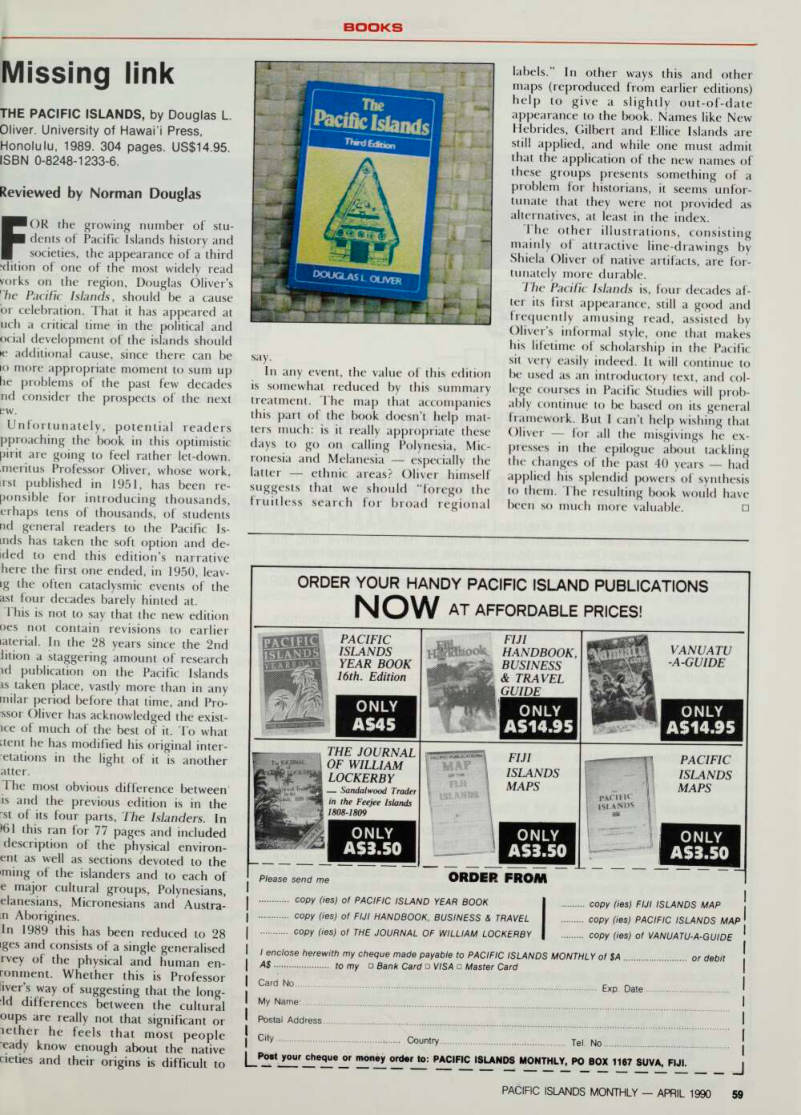
Books
The Pacific Islands, By Douglas L.
Oliver. University of Hawai’i Press, Honolulu, 1989. 304 pages. U 5514.95.
Isbn 0-8248-1233-6.
Reviewed by Norman Douglas
FOR the growing number of stu dents of Pacific Islands history and societies, the appearance of a third edition of one of the most widely read vorks on the region, Douglas Oliver’s r he Pacific Islands, should be a cause or celebration. That it has appeared at uch a critical time in the political and ocial development of the islands should ►e additional cause, since there can be io more appropriate moment to sum up he problems of the past few decades nd consider the prospects of the next ew.
Unfortunately, potential readers pproaching the book in this optimistic pirit are going to feel rather let-down, meritus Professor Oliver, whose work, irst published in 1951, has been re
ponsible for introducing thousands,
erhaps tens of thousands, of students nd general readers to the Pacific Is mds has taken the soft option and de ided to end this edition’s narrative here the first one ended, in 1950, leav ig the often cataclysmic events of the ast four decades barely hinted at. 1 his is not to say that the new edition oes not contain revisions to earlier laterial. In the 28 years since the 2nd lition a staggering amount of research id publication on the Pacific Islands as taken place, vastly more than in any milar period before that time, and Pre ssor Oliver has acknowledged the exist ice of much of the best of it. To what rtent he has modified his original inter etations in the light of it is another alter.
The most obvious difference between is and the previous edition is in the st of its four parts, The Islanders. In 161 this ran for 77 pages and included description of the physical environ ent as well as sections devoted to the mmg of the islanders and to each of e major cultural groups, Polynesians, elanesians, Micronesians and Austra
n Aborigines.
In 1989 this has been reduced to 28 iges and consists of a single generalised rvey of the physical and human en ronment. Whether this is Professor liver’s way of suggesting that the long id differences between the cultural oups are really not that significant or icther he feels that most people eady know enough about the native cieties and their origins is difficult to
say.
In any event, the value of this edition is somewhat reduced by this summary treatment. The map that accompanies this part of the book doesn’t help mat ters much: is it really appropriate these days to go on calling Polynesia, Mic ronesia and Melanesia especially the latter ethnic areas? Oliver himself suggests that we should “forego the fruitless search for broad regional
labels.” In other ways this and other maps (reproduced from earlier editions) help to give a slightly out-of-date appearance to the book. Names like New Hebrides, Gilbert and Ellice Islands are still applied, and while one must admit that the application of the new names of these groups presents something of a problem for historians, it seems unfor tunate that they were not provided as alternatives, at least in the index.
I he other illustrations, consisting mainly of attractive line-drawings by Shiela Oliver of native artifacts, are for tunately more durable.
The Pacific Islands is, four decades af ter its first appearance, still a good and frequently amusing read, assisted by Oliver’s informal style, one that makes his lifetime of scholarship in the Pacific sit very easily indeed. It will continue to be used as an introductory text, and col lege courses in Pacific Studies will prob ably continue to be based on its general framework. But I can’t help wishing that Oliver for all the misgivings he ex presses in the epilogue about tackling the changes of the past 40 years had applied his splendid powers of synthesis to them. The resulting book would have been so much more valuable. □
Advertisements & other items, p. 59 (1 item)
Order Your Handy Pacific Island Publications
NOW AT AFFORDABLE PRICES!
PACIFIC
ISLANDS
YEAR BOOK
16th. Edition
ONLY
AS4S
FIJI
HANDBOOK,
BUSINESS
& TRAVEL
GUIDE
ONLY
A 514.95
VANUATU
-A-GUIDE
ONLY
A 514.95 ss
THE JOURNAL
OF WILLIAM
LOCKERBY
Sandalwood Trader in the Feejee Islands 1808-1809
ONLY
A 53.50 fin
I SIMiM
FIJI
ISLANDS
MAPS
ONLY
A 53.50
PACIFIC
I ISLANDS
MAPS
Please send me
ORDER FROM
copy (ies) of PACIFIC ISLAND YEAR BOOK copy (ies) of FIJI HANDBOOK. BUSINESS & TRAVEL copy (ies) of THE JOURNAL OF WILLIAM LOCKERBY copy (ies) FIJI ISLANDS MAP
copy (ies) PACIFIC ISLANDS MAP
copy (ies) of VANUATU-A-GUIDE I enclose herewith my cheque made payable to PACIFIC ISLANDS MONTHLY of $A or debit A $ to my □ Bank Card □ VISA □ Master Card I Card No.
Exp, Date My Name: Postal Address.
I I j C,ty Country Te |, No [ Post your chequej>r money order to: PACIFIC ISLANDS MONTHLY, PO BOX 1167 SUVA, FIJI.
Coming in
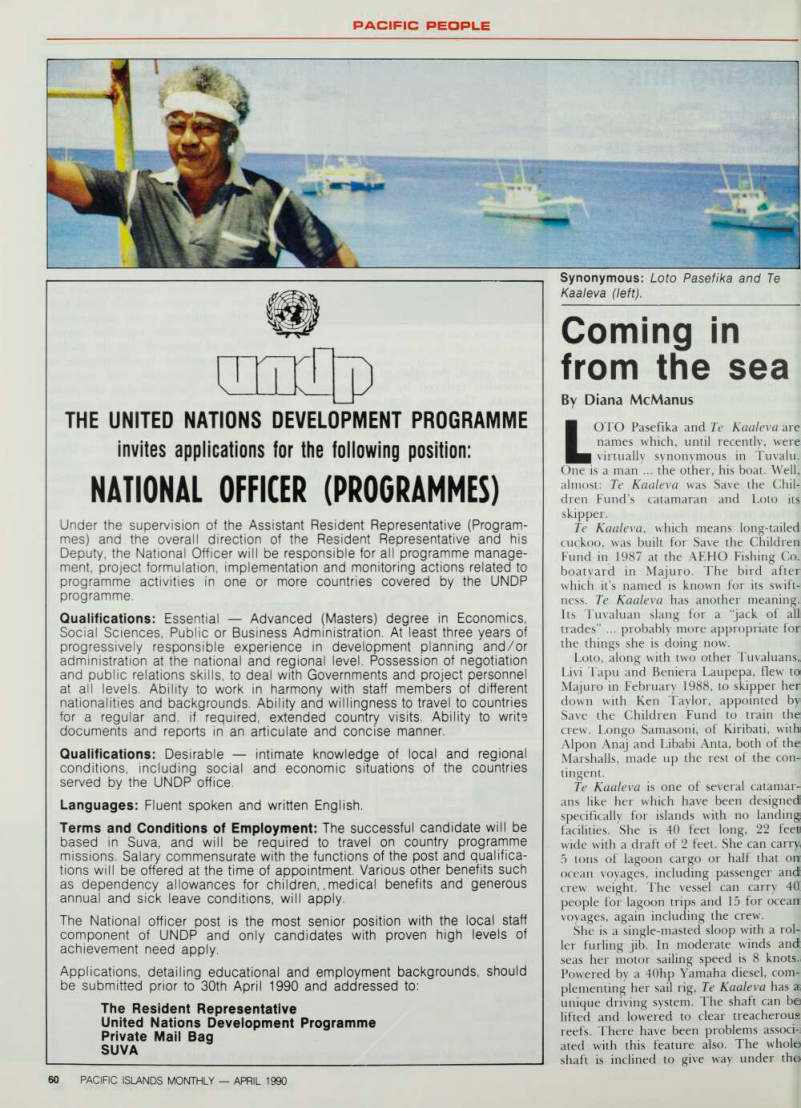
Pacific People
Coming in from the sea
By Diana McManus
LOTO Pasefika and Te Kaaleva are names which, until recently, were virtually synonymous in Tuvalu.
One is a man ... the other, his boat. Well, almost: Te Kaaleva was Save the Chil dren Fund’s catamaran and Loto its skipper.
Te Kaaleva, which means long-tailed cuckoo, was built for Save the Children Fund in 1987 at the AEHO Fishing Co. boatyard in Majuro. The bird after which it’s named is known for its swift ness. Te Kaaleva has another meaning.
Its Tuvaluan slang for a “jack of alll trades” ... probably more appropriate for the things she is doing now.
Loto, along with two other Tuvaluans,, Livi Tapu and Beniera Laupepa, flew to Majuro in February 1988, to skipper her down with Ken Taylor, appointed by Save the Children Fund to train the crew. Longo Samasoni, of Kiribati, with Alpon Anaj and Libabi Anta, both of the Marshalls, made up the rest of the con tingent.
Te Kaaleva is one of several catamar ans like her which have been designed! specifically for islands with no landings facilities. She is 40 feet long, 22 feet) wide with a draft of 2 feet. She can 5 tons of lagoon cargo or half that onr ocean voyages, including passenger and crew weight. The vessel can carry 40[ people for lagoon trips and 15 for ocean voyages, again including the crew.
She is a single-masted sloop with a rol ler furling jib. In moderate winds and seas her motor sailing speed is 8 knots..
Powered by a 40hp Yamaha diesel, com plementing her sail rig, Te Kaaleva has as unique driving system. The shaft can be lifted and lowered to clear treacherous reefs. There have been problems associ-i ated with this feature also. The whole shaft is inclined to give way under the
Synonymous: Loto Pasefika and Te Kaaleva (left).
■stress of ocean voyages. The vessel has [lost its propeller and shaft once and has its share of problems.
Loto’s eyes sparkle with amusement as he recalls the first time he laid eyes on Te Kaaleva. “I was a seaman for years and years and the smallest boat I ever had command of was my first vessel, and she was 79 feet long. Never in my life did I even think about the possibility of my life being in danger. But I took one look at this little boat, thought of sailing her all the way from the Marshalls to Tuvalu, and I thought, ‘Get me out of
here on the next plane’. But the next day Ken took me out on sea trials with him and over the next two weeks we had her out in all kinds of conditions. I could feel my confidence in this boat growing, and I knew that we could do it.”
It’s just as well he did gain that confi dence because the trip turned out to be quite an initiation for Loto a crash course in sailing, as he puts it. He and Taylor came to an agreement whereby Loto would navigate and Taylor would teach the rest of the crew to sail. Just south of Tarawa Taylor took ill and they
had to return and drop him off at hos pital. They had 10 days to get to Tuvalu for the official launching, for which Joy Carrol, Director, AsiaTacific Region of Save the Children Fund would fly from America to attend. And Loto was now in command.
“We went slowly, slowly past the south ern atolls of Kiribati. And suddenly when we came to the last, the wind swung around from the north-east and was very strong. I was afraid but I knew it was exactly the wind we wanted to get home quickly, so I said, ‘Come on. We’ll go for it.’ And we did. We got home in two days. Never before in all my days on bigger ships did I do that trip so quickly.
That boat flew! And since then I know I could go around the world in that boat.”
Until recently its main objective was to carry Save the Children Fund staff to the outer islands to meet people and to
implement projects.
At present Save the Children Fund is being absorbed into the Island Develop ment Office, a government department and only recently Te Kaaleva was trans ferred to the Department of Works and Communications. The Save the Children Fund will continue to play an advisory role and seek funding but it will slowly
phase out.
And what of the cheerful, accommo dating Loto Pasefika? Here is an indi vidual with an amazing variety of experi ence behind him; from seaman to public servant and diplomat. He hails from an interesting family. His father, Frank Pasefika, was a Senior Clerk with the District Commissioner in the days when Tuvalu was British colony of the Ellice Islands. He was based at Funafuti during the war and was transferred to Tarawa when the war ended.
Young Loto stayed behind to study at the government school of Elisefou in Vaitupu. When the new King George V secondary school was completed at Bike nibou on Tarawa, the Elisefou school and the old King George V school on Abemama were closed and the students formed the first intake of the new school. This included former Prime Minister Dr Tomasi Puapua. Loto finished school there in 1959.
Despite the privileges of diplomacy,
Loto missed the sea. In 1982 he jumped at the opportunity to temporarily fill in as Captain of Tuvalu’s pole and line tuna vessel, Te Tautai, when the captain fell ill. As it was, he stayed on the ship until 1984. Apart from another short, three-month contract on Te Tautai in the Solomons during 1986, Loto otherwise remained unemployed until he heard of the plans for Te Kaaleva.
For awhile he and the boat were one.
He has developed a grand passion for catamarans and read every book he could get on the subject. □
Advertisements & other items, pp. 60-64 (1 item)
National Officer (Programmes)
THE UNITED NATIONS DEVELOPMENT PROGRAMME
invites applications tor the following position:
Under the supervision of the Assistant Resident Representative (Programmes) and the overall direction of the Resident Representative and his Deputy, the National Officer will be responsible for all programme management, project formulation, implementation and monitoring actions related to programme activities in one or more countries covered by the UNDP programme.
Qualifications: Essential Advanced (Masters) degree in Economics, Social Sciences, Public or Business Administration. At least three years of progressively responsible experience in development planning and/or administration at the national and regional level. Possession of negotiation and public relations skills, to deal with Governments and project personnel at all levels. Ability to work in harmony with staff members of different nationalities and backgrounds. Ability and willingness to travel to countries for a regular and, if required, extended country visits. Ability to write documents and reports in an articulate and concise manner.
Qualifications: Desirable intimate knowledge of local and regional conditions, including social and economic situations of the countries served by the UNDP office.
Languages: Fluent spoken and written English.
Terms and Conditions of Employment: The successful candidate will be based in Suva, and will be required to travel on country programme missions. Salary commensurate with the functions of the post and qualifications will be offered at the time of appointment. Various other benefits such as dependency allowances for children,.medical benefits and generous annual and sick leave conditions, will apply.
The National officer post is the most senior position with the local staff component of UNDP and only candidates with proven high levels of achievement need apply.
Applications, detailing educational and employment backgrounds, should be submitted prior to 30th April 1990 and addressed to: The Resident Representative United Nations Development Programme Private Mail Bag
SUVA
THE UNITED NATIONS DEVELOPMENT PROGRAMME
invites applications for the following position:
NATIONAL FINANCE OFFICER
Under the supervision of the Assistant Resident Representative (Administration) and the general supervision of the Resident Representative and his Deputy, the National Finance Officer will be responsible for the organization and supervision of the day-to-day operations of the Finance Section.
Qualifications: Master’s degree in Accounting/Administration and Management or a member of an Institute of Chartered Accountants.
At least five years experience in the accounting field.
Several years experience in a computerized environment. Familiarity with the use of P.C.’s in a local area network (LAN) configuration, knowledge of P.C. software such as Lotus 1-2-3, D-Base and Framework.
Ability to work in harmony with staff members of different nationalities and backgrounds.
Languages: Fluent spoken and written English.
Terms and Conditions of Employment: The successful candidate will be based in Suva. A tax free salary commensurate with the functions of the post and qualifications will be offered at the time of appointment. Other benefits,such as dependency allowances tor children, medical benefits and generous annual and sick leave conditions, will apply.
Applications, detailing educational and employment background, should be submitted prior to 30 April 1990 and addressed to: The Assistant Resident Representative (Administration) United Nations Development Programme Private Mail Bag
SUVA
AC! FI
ISLANDS
rw For the benefit of our readers who would like to place a small classified advertisement in our magazine, we’ve introduced from this issue a special Market Place page that we believe will assist you m selling personal items, accommodation, real estate, boating or a service in fact anything you would like to sell to our over 50,000 readers. Market Place Advertising Rates are structured to allow you to place as many advertisements as you wish, economically.
DIESEL ENGINES & PARTS
Caterpillar engines. Truck, Marine. Industrial. New, Rebuilt, Exchange. All genuine parts. Write Cat Engines, P.O. 319 Nambour Q.L.D. 4560, Australia. Fax 071 421249. Phone 071 421647. ai
BOOKS & PUBLICATIONS
Send for our free colour catalogue of revealing expose books on: Science, Politics, Medicine, Magnetic Healing, UFOs, Pyramidology, Etc.
“MOONGATE" The latest addition, exposes NASA and reveals the real truths about the Moon & UFO’s 20 colour illustrations. Stunning. VERITAS PRESS, BOX
636, PALM BEACH, GOLD COAST, OLD
4221. AUSTRALIA. 075-345070. A 2
AQUACULTURE CONSULTIN'
SERVICES
Project Development. Feasibility Studies, (giant clam, topshell, pearls, abalone, oysters, shrimp). Joint ventures also sought with governments and private companies. Pacific Aquaculture Consulting, 14431 Holt Ave., Santa Ana, California,
92705, USA. A 3
STAMPS WANTED
Pacific Islands stamps on exchange basis. J. Lai, 19 Lovoni Rd, Tamavua, Suva, Fiji. A 4
FOR SALE
PORT VILA VANUATU U 55350,000
Popular small resort for sale.
Restaurant/Bar/Bungalows in tropical gardens on quiet lagoon. Excellent return.
Easily managed by couple. Further information: P.O. Box 400, Port Vila, Vanuatu. A c
COMMERCIAL PRINTING
Top quality four colour printing, brochures, posters, packaging, product labels, fabric labels, billboards, books, magazines, stickers, books. Export quality. Contact Fiji’s most experienced Com-
mercial Printers. FIJI TIMES COMMER- CIAL PRINTING, P.O. Box 1167, Suva. Fiji.
Phone: 314111. Fax. 301521.
HOLIDAY ACCOMMODATION
“Rainbow Bay Coolangatta”
Rainbow Place Apartments on the beach at beautiful Rainbow Bay. 1 & 2 bed units s/c. Large balcony facing north with magnificent coast and sea views. Solar heated pool. Compact tennis. Handy to N.S.W. Clubs. Security basement parking.
Resident Managers. Phone (075)36 6759 for booking or write for brochure. 180 Marine Parade, Coolangatta. 3223. Australia.
Como Holiday Units (Fully self-contained).
Beachfront location overlooking the splendour of Keppel Bay and the islands. Two minutes from Hotels/Restaurants. Warm Welcome. Phone (079) 391594 or write 32 Anzac Parade, Yeepoon Old. 4703, Australia.
Yamba, NSW. We specialise in all forms of holiday lettings. For friendly and promt attention write or phone for our free Holiday Accommodation booklet.
L.J. HOOKER
1 j YAMBA
P.O. Box 113, Yamba, 2464 or phone (066) 46 2202. After Hours: Ross or Jenny Macqueen (066) 462606 or Michael Macqueen (066)462838.
BOATING
Boating Holidays NZ’s Bay Of Islands, Hauraki Gulf and Fiji. Bare boat, skippered, learn & cruise, flotilla, charter yachts and launches 26’-42’
All available from Rainbow Yacht Charters, P.O. Box 8327, Symonds Street, Auckland, NZ. Phone: (09)3089-419. Fax (09) 790-457.
SELF ADHESIVE LABELS
FORUM LABELS (FIJI) LTD
P.O. Box 1167, Suva., Fiji, Phone: 314111.
We print self-adhesive labels in rolls, multi-coloured labels with hot foil, and die cut to shape, tickets and tags in rolls. We also supply labelling machines and fabric labels.
PACIFIC
SLANDS
I M 0 N T H L Y~ l
MRRKCT PLRCC CRN UJORK
LUONDCRS FOR VOU ...
Promote your business, or service, sell your household
items, cars or heavy machinery
etc.
ONLY AUSSI PER WORD.
NO COMPANY LOGO. NO
DISPLAY. NO BOLD TYPE.
Just forward your Advertisement together with payment to: PACIFIC ISLANDS MONTHLY “Market Place", P.O. Box 1167, Suva, Fiji.
CONDITIONS:
1/ All Advertisements are subject to acceptance and approval of publisher. 2. Advertisements are published as space permits: we cannot guarantee date of insertion. 3. All advertisements must be prepaid and should be typed or printed clearly. 4. Deadline for receipt of advertisements is the 10th of the month prior to issue.
5. PACIFIC ISLANDS MONTHLY
assumes no responsibility for any service other than publishing paid advertisements in this section.
s« eg v >»' >jy %] , %p> v%w v^Jp^k'^W. %T 3 w , %jini! %3r. - - » v Wr v»»» •.,>** %.%* •■- V» ■ - $ * ’ » nr <#* * m v* sf*V !*%r» **%T\ 1* * jp* -K !■ w ’^ ,*s&* ¥ ** . , ../^Av - «;
SnS&n**-*** s'**
Si ’AX K|®i V'
\c^s^ a
, *<%> *»* f /,«s»#*'<* 'Sr* *|n * «J* % “■* *|gt *■ «jk. * « » *#.m iWfc* te js# !3Q5
«*6 zpio/C|
Created as Living Hardware.
'.‘l 9 v/ Mitsubishi’s full-time four-wheel drive, a corner-stone of the diverse technologies that results in their organic performance, is beautifully simple. As any truly advanced idea should be. Linking a viscous coupling unit, a sort of torque transfering devise with the center differential puts smooth, forceful acceleration and stable cornering under the wheels of their new organically inspired vehicles.
The idea behind organic performance is that a car should really operate the way you want it to rather than the driver having to accommodate the various quirks of the vehicle. Both the driving conditions and the vehicle’s operation are monitored by the vehicle itself. In this way the car constantly Oc o
WJ9SO
fine-tunes its drive systems for the optimum operation while also adjusting ance according to the externmje&fiditions.
Concern for your safety cars that perform as an ot your will. You can’t be expected to every traffic situation any more can pay attention to every mechanical detail.
So we’ve made cars that share some of the work load with you. With less time spent worrying about the running of the vehicle, you can spend more enjoying the drive.
Because when you drive a Mitsubishi, you’re driving technology you can trust.
A
MITSUBISHI I
MOTORS
MITSUBISHI GHLRNT
AMERICAN SAMOA; MORRIS SCANLAN SERVICE INC. PO Box 367, Pago Pago. Tel 633-5520/AUSTRALIA: MITSUBISHI MOTORS AUSTRALIA LTD. Box 1284, South Road, Clovelly Park, Australia 5042 M (080 275-7223/FIJI: NIVIS MOTOR & MACHINERY CO.. LTD. G.P.O. Box 150, Suva, Tel 383411 /FRENCH POLYNESIA (TAHITI): ETS-BREDIN FRERES ET FILS P O Box 21, Papeete, Tahiti. Tel 4-202-58/ NEW CALEDONIA SOCIE: IT.
DTMPORTATION D AUTO DU PACIFIQUE SUD S.A. B.P. 438 Rond Pomtdu Pacifique, Noumea, Tel 274144/NEW ZEALAND: MITSUBISHI MOTORS NEW ZEALAND LTD. Todd Park, Henot Drive, Private Bag, Porirua, TeL 370-1 NORFOLK ISLAND; BORRYS LTD. PO Box 169, Norfolk Island, Tel. 2114/PAPUA NEW GUINEA: TOBA PTY. LTD. PO Box 503, Port Moresby, Tel. 21-7874/SOLOMON ISLANDS; HARVEST PACiFiC LTD. &P.O. Box 88, Honiarru Guadalcanal, Tel 30128/TONGA: SITANI MAFI CO., LTD. PO. Box 83, Nuku ALOFA, Tel. 21-044/VANUATU: SOCOMETRA B P 06 Route de Lagon, Port-Vila, Tel. 2314/WESTERN SAMOA: A M, MACDONALD HOLDINGS LTHT PO Rnx 576 Ania Tnl 2?n??/SAlPAN/POHNPEI/MAJURO/KOSRAE/TRUK/YAP/BELAU: MICRONESIAN MOTORS, INC. 997 South Marine Drive, Tamuning, Guam 96911, Tel, 646-6827