Pacific
Islands
Monthly
Triumph for the islands
March 1990
mg' W
for-the people Solomons: Nori gets stronger
American Samoa US$2.5O
Australia As 2 50
Cook Islands NZ$3 00 Rj« F 51.75 FS. of Micronesia US$3 00 S uam US$3.OO Hawaii US$3.OO Kiribati... A 5 2.50
Nauru A 52.50 New Caledonia ;; CFPS2.SO New Zealand (incl GST) NZ53.45 Niue NZ$3.OO Norfolk Island A 53.00 Nth Marianas US$3.OO Papua New Guinea K 53.00 Rep. of Marshall US$3.OO
Solomon Islands A 53.00 Tahiti CFP3OO Tonga ... P 3.00
Usa Us$3.Oo
Vanuatu VT2OO - Samoa T 3.25 'Recommended retail price only
Advertisements & other items, pp. 2-4 (1 item)
The new 3235.
Not just
two of a kind.
A pair of true individuals.
\\ bile most manufacturers offer different engine O sizes and options, their new models usually look as similar as peas in a pod.
Hut here’s a set of twins you’ll have no trouble tell-
ing apart.
The new Mazda 3235.
Not just variations on a theme. Two totally different ears.
I he 323 5-door Astina combines rugged ver- Ou satility and sporty performance in an unexpectedly graceful silhouette. I he sleek, agile profile turns heads as easily as the Astina turns corners. Precise handling and enthusiastic response make every drive a sheer delight.
Ihe 323 4-door Sedan is the ultimate in affordable style. Seductive contours and energetic performance belie this ear’s functional beauty. The well-appointed cabin fits a family in comfort. And, the spacious trunk fits all their luggage, too. lake a look at the new Mazda 3235. Drive one.
I hen the other. Break away from the humourless, homogenized moulds of automotive design. u O • I hese are the shapes of things to come. this warranty is valid only in \nstralia.
■mazoa
© Mazda Motor Corporation
Four Basic Colours
YELLOW BLACK
Plus
Fiji Times Commercial Printing
yrmone iiii
Equals
Printing Excellence
■ It is quite amazing what our experienced master printers, with the latest in printing technology, can produce from four basic colours.
Full colour packaging and food labels that look good enough to eat; award winning full colour brochures and posters: magazines, calendars, books, stickers, fabric labels and billboards with pictures that leap right out of the printed pages.
If your product requires export-quality, high impact four colour printing, then you should be talking to us first.
You’ll find our prices very competitive and our paper stock quite extensive.
FIJI TIMES
COMMERCIAL PRINTING DIVISION
Printing Excellence
20 GORDON STREET, SUVA. PHONE: SUVA 314111. Fax: 301521 LAUTOKA 60352. LABASA 81644.
Pacific
Islands
Monthly
Vol 60 No. 3
Voice Of The Pacific
March 1990
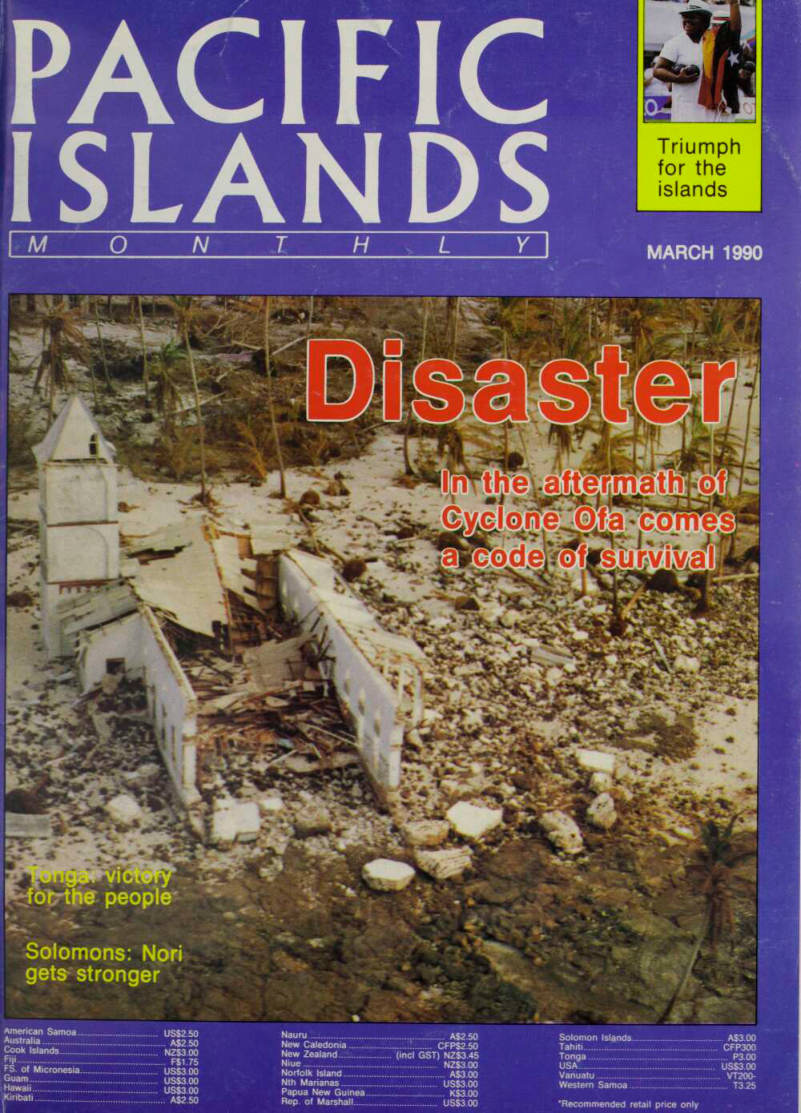
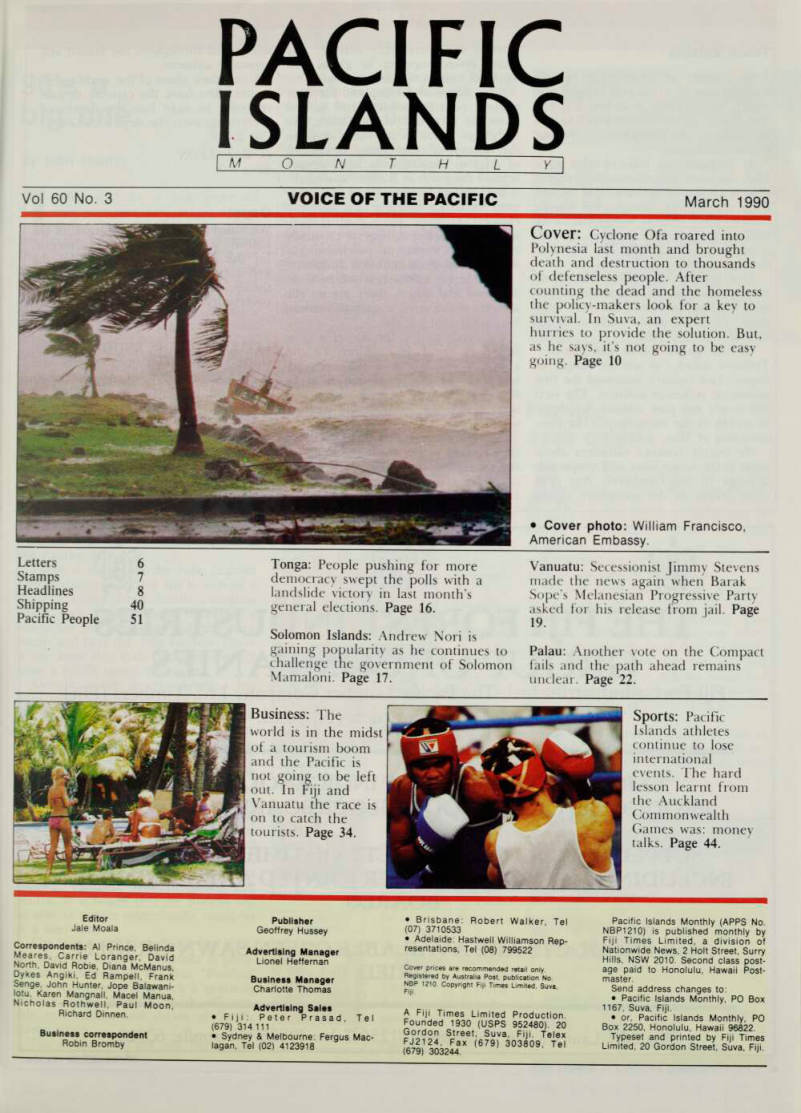
Cover: Cyclone Ofa roared into Polynesia last month and brought death and destruction to thousands of defenseless people. After counting the dead and the homeless the policy-makers look for a key to survival. In Suva, an expert hurries to provide the solution. But, as he says, it’s not going to be easy going. Page 10
Letters 6 Stamps 7 Headlines 8 Shipping 40 Pacific People 51
Tonga: People pushing for more democracy swept the polls with a landslide victory in last month’s general elections. Page 16.
Solomon Islands: Andrew Nori is gaining popularity as he continues to challenge the government of Solomon Mamaloni. Page 17.
Vanuatu: Secessionist Jimmy Stevens made the news again when Barak
Sope’s Melanesian Progressive Party
asked for his release from jail. Page 19.
Palau: Another vote on the Compact fails and the path ahead remains unclear. Page 22.
Business: The world is in the midst of a tourism boom and the Pacific is not going to be left out. In Fiji and Vanuatu the race is on to catch the tourists. Page 34.
Sports: Pacific
Islands athletes continue to lose international events. The hard lesson learnt from the Auckland Commonwealth Games was: money talks. Page 44.
Editor Jale Moala Correspondents: Al Prince, Belinda Meares, Carrie Loranger, David North, David Robie, Diana McManus, Dykes Angiki, Ed Rampell, Frank Senge, John Hunter, Jope Balawani lotu. Karen Mangnall, Macel Manua Nicholas Rothwell, Paul Moon, Richard Dinnen.
Business correspondent Robin Bromby
Publisher Geoffrey Hussey Advertising Manager Lionel Heffernan Business Manager Charlotte Thomas Advertising Sales • Fiji : Peter Prasad, Tel (679) 314 111 • Sydney & Melbourne; Fergus Mac lagan, Tel (02) 4123918
• Brisbane; Robert Walker, Tel (07) 3710533 • Adelaide: Hastwell Williamson Rep resentations, Tel (08) 799522 Cover prices are recommended retail only.
Registered by Australia Post, publication No NBP 1210. Copyright Fiji Times Limited, Suva Fiji.
A Fiji Times Limited Production Founded 1930 (USPS 952480). 20 Gordon Street, Suva, Fiji. Telex FJ2124, Fax (679) 303809, Tel (679) 303244.
Pacific Islands Monthly (APRS No.
NBP1210) is published monthly by Fiji Times Limited, a division of Nationwide News, 2 Holt Street, Surry Hills, NSW 2010. Second class post age paid to Honolulu, Hawaii Post master.
Send address changes to; • Pacific Islands Monthly, PO Box 1167, Suva, Fiji. • or, Pacific Islands Monthly, PO Box 2250, Honolulu, Hawaii 96822.
Typeset and printed by Fiji Times Limited, 20 Gordon Street, Suva, Fiji.
• Cover photo: William Francisco, American Embassy.
Oops!

Letters
Youth Suicide .
THE tragedy of Truk (PIM Feb) is symptomatic of a sickness around the world.AlymToffler described it as Future Shock; Pierre Teilhard de Chardin as strikes in the noosphere” refusal to use our brains.
As Teilhard said, you can offer mankind the most magnificent future. But if it is known beforehand that all will
then disintegrate, people will simply
“down tools”. Human beings will never consent to labour like Sisyphys, eternally pushing rocks up hills (The Vision of the Past, p. 231).
That feeling has to be most acute amongst the youth of the world as they start to grasp the size of the work to be done. There’s a whole world to be recreated.
“Is the game worth the candle,”
Teilhard asked, “or are we simply its dupes? Last century witnessed the first systematic strikes in industry. The next will surely not pass without the threat of strikes in the noosphere” (The Phenomenon of Man, p. 253).
We rightly concern ourselves about holes in the ozone layer and irreparable damage to the biosphere. But even more fragile in the noosphere of the
world’s reflective grey matter; our brains linked together by global net works of communications media.
Given scope to develop and use their brains, young people stand poised upon the threshold of the future, like fledglings about to try their wings in the vastness of outer space. Grandsons of Afghan camel-drivers have already orbited the earth in Russian spacecraft.
But young persons given no scope even for nation-building have only two choices. As Pope John Paul II said,
they feel impelled to migrate physically
to a better world; or psychologically into oblivion (S ollicitudo Rei Socialis).
Considering all the research by Fr F.
X. Bezel and others, there are no glib answers to the worst tragedy of modern life: adolescent suicides.
But surely part of the answer is to be found in the Pope’s address To the Youth of The World in 1987, remind ing them of the jewel that is to be found at the core of each young per son’s being: the irreplaceable treasure of their own selves.
All creation attended their birth, for they carried within them the hopes of the everlasting hills. They are indeed creation’s crowning glory. For the re flective competence of their brains is
unmatched throughout the known and knowable universe.
Using their share of the world’s grey matter, they have the capacity to gain reflective in sight into the depths of everything; even the depths of God (1 Cor 2:10)!
G. R. Fallon
Suva •
Oops!
WE failed to credit Larry Morgan, of the United States Department of Interior, for the photograph on page 8 of the February issue. The photo was one of the illustrations used in the Truk suicide cover story.
Letters To The Editor Must In
clude writer’s full name, address and home telephone number. All letters may be edited for purposes of clarity or space.
Letters should be addressed to: Pacific Islands Monthly PO Box 1167 Suva Fiji Islands Fax: (679) 302011
Advertisements & other items, p. 6 (1 item)
Group Of Companies
m
ili
jf
THE FIJI FOREST INDUSTRIES
GROUP OF COMPANIES
Fiji Forest Industries Ltd, The Pacific Lumber Company Ltd, Timbers (Fiji) Ltd, Wood Products (Fiji) Ltd.
LARGEST EXPORTERS OF INDIGENOUS TIMBER
PRODUCERS OF PLYWOOD, BLOCKBOARD AND VENEER
SUPPLIERS ALSO OF A VARIETY OF TIMBER PRODUCTS
INCLUDING MOULDING, FINGER JOINTED AND LAMINATED
BOARDS
OUR PRODUCTS ARE AVAILABLE GREEN SAWN OR KILN
DRIED
Box 608, Lautoka, Fiji. Telephone: 61255 Telex: FJ5280 Facsimile: 60323 6 PACIFIC ISLANDS MONTHI Y MARCH IQQD wksON ADOtSOH 103.306
big one
Stamps
90’s a big one
By John Hunter
1 990 will be a big year of anniversaries and major stamp shows. May 6 will be the 150th anniversary of Britain’s famous “penny black” stamp, the first and probably the most famous stamp in the world. Most Pacific countries will celebrate this event with stamp issues. Britain will be the foc al point of celebrations in May with a massive stamp exhibition at London’s Alexandra Palace. Closer to home Can berra will host the National Exhibition in March at the National Sports Centre.
However, the event of the year for the Pacific area is the New Zealand 1990 World Stamp Exhibition in Auckland from August 24 to September 2.
Of great importance to the Pacific area’s philatelic future is the Pacifica Stand at the New Zealand 1990 Exhibi tion. Cook Islands, Federated States of Micronesia, Fiji, Kiribati, Marshall Is lands, Nauru, Niue, Papua New Guinea, Solomon Islands, Tonga, Tuvalu, Vanuatu and Western Samoa will be in the Pacifica Stand.
There is hope that the New Zealand 1990 Exhibition will see the launch of a Pacifica stamp from Pacific countries where each Pacific country will issue a stamp for the Exhibition with the same theme and bear the title Pacifica. There is also hope that each Pacific nation will issue a Pacific stamp each year.
Already a step in this direction has been taken with the opening in Decem ber of a Pacifica Stamp Bureau in Syd ney. The bureau, will handle marketing, publicity and other related philatelic matters of Pacific Island stamp issuing nations. Initially the bureau will handle matters relating to the Forum Island Countries which are signatories to the Sparteca agreement with Australia and New Zealand. These are Fiji, Cook Is lands, Niue, Marshall Islands, Federated States of Micronesia, Solomon Islands, Kiribati, Tonga, Tuvalu, Papua New Guinea, Vanuatu, Western Samoa and Nauru. It is hoped that the Bureau will be able to service other Pacific countries at a later time.
The bureau will co-ordinate and final ise plans for as many countries as possi ble to participate in the first “Pacifica” stamp series and will launch a quarterly Pacifica Stamp Bulletin which will con tain information and details of Pacific stamp issues.
The bureau will not sell stamps but
hopes at a later date to act as a Mailbox for people wishing to deal with Pacific countries in stamp matters.
The Bureau’s address is P.O. Box 316 Lane Cove NSW 2066, Australia Telephone (02) 2314583, Fax (043) 885620 This step is a milestone in the Pacific philatelic area. Most Pacific countries are experiencing sale downturns. This im portant move will assist in turning the spotlight on Pacific stamps and encour age existing and new collectors to begin collecting Pacific stamps.
New issues New Caledonia: January writers of New Caledonia, February butterflies, March museum exhibition, April aquarium, May World Soccer Cup, June 50th anniversary for a Free
France, July Petroglyphs, August
New Zealand 1990, October World of the Deep, November flora, De cember — painters.
French Polynesia: January 11 re sources, February 19 wildlife, March 14 The World of Maohl, May 3 Stampworld London, May 18 Centenary of Papeete, June 6 birds,
July 10 folk lore,
Septem
ber 2 Centen ary of the Birth of De Gaulle, October 9 Lions Club 30 Years, Novem-
ber 22 legends, Dec e m ber 5 Tahiti Tiara.
Tuvalu: February
trees, April ships of the war, May 150th anniversary of the first stamp, August mail ser vices (Pacifica), Octo ber flowers, N ovember Christmas.
Vanuatu: January flora, London 1990, 10th Anniversary of Inde pendence, Pacifica, New Zealand 1990, Christmas. □
For her
eyes only
A LAWSUIT was filed in the
French Polynesian capital of
Papeete by a young woman claiming that the use of a photograph of her on a 1989 stamp violated her right to privacy. The court agreed with her and ordered on July 1 I that the post office cease sales of the stamp.
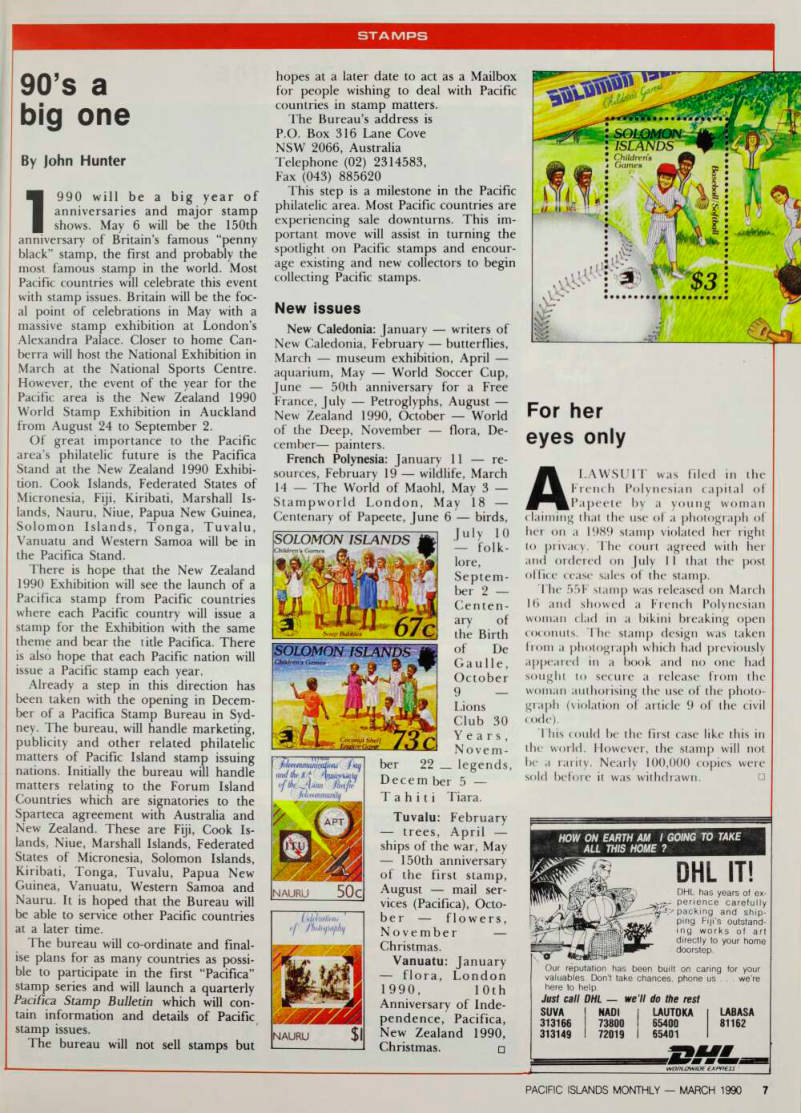
The 55F stamp was released on March 16 and showed a French Polynesian woman clad in a bikini breaking open coconuts. The stamp design was taken from a photograph which had previously appeared in a book and no one had sought to secure a release from the woman authorising the use of the photo graph (violation of article 9 of the civil code).
This could be the first case like this in the world. However, the stamp will not be a rarity. Nearly 100,000 copies were sold before it was withdrawn. □
Advertisements & other items, p. 7 (1 item)
Dhl It!
HOW ON EARTH AM I GOING TO TAKE
ALL THIS HOME ?
DHL has years of experience carefully packing and shipping Fiji's outstanding works of art directly to your home doorstep Our reputation has been built on caring for your valuables. Don’t take chances, phone us . . . we’re here to help.
Just call DHL we ’II do the rest
WORLDWIDE EXPRESS
Woodman, woodman, save those trees
Headlines
WHAT do you do when trees stand in the way of develop ment? Simple, says Fiji’s Public Works Department, cut them down.
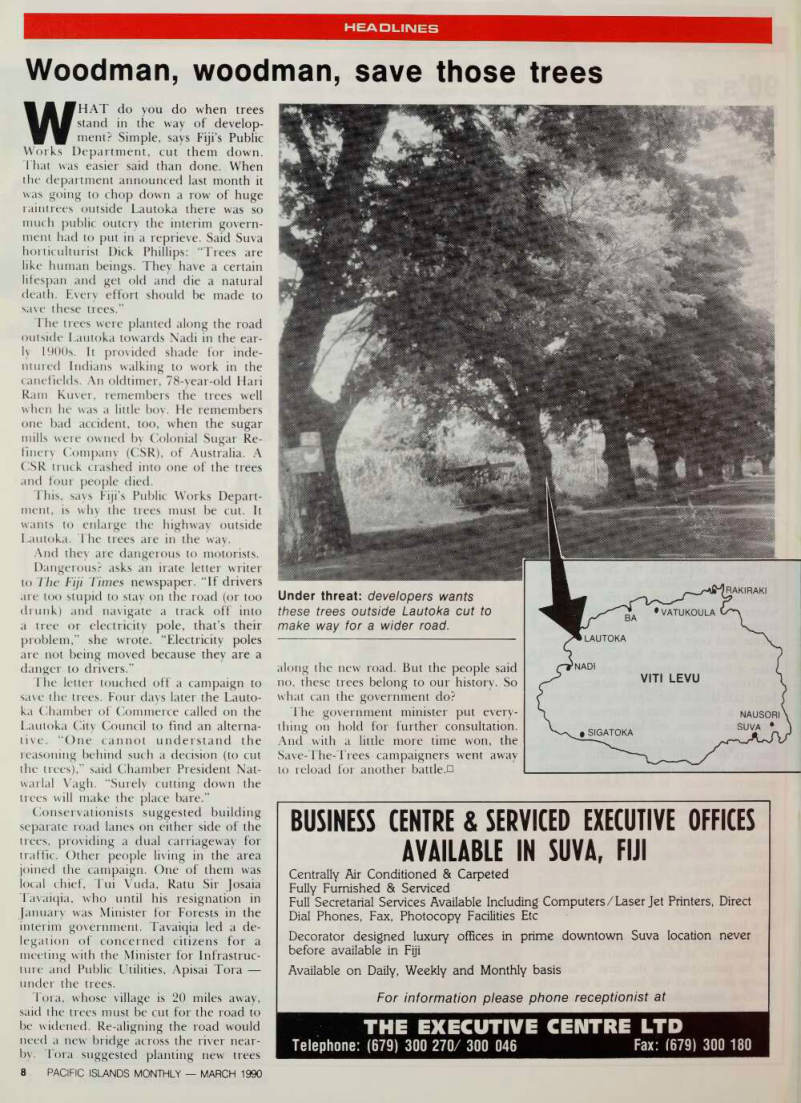
That was easier said than done. When the department announced last month it was going to chop down a row of huge raintrees outside Lautoka there was so much public outcry the interim govern ment had to put in a reprieve. Said Suva horticulturist Dick Phillips; “Trees are like human beings. They have a certain lifespan and get old and die a natural death. Every effort should be made to save these trees.”
The trees were planted along the road outside Lautoka towards Nadi in the ear ly 1900 s. It provided shade for inde ntured Indians walking to work in the canefields. An oldtimer, 78-year-old Hari Ram Kuver, remembers the trees well when he was a little boy. He remembers one bad accident, too, when the sugar mills were owned by Colonial Sugar Re finery Company (CSR), of Australia. A CSR truck crashed into one of the trees and four people died.
This, says Fiji’s Public Works Depart ment, is why the trees must be cut. It wants to enlarge the highway outside Lautoka. The trees are in the way.
And they are dangerous to motorists.
Dangerous? asks an irate letter writer to The Fiji Times newspaper. “If drivers are too stupid to stay on the road (or too drunk) and navigate a track off into a tree or electricity pole, that’s their
problem,” she wrote. “Electricity poles
are not being moved because they are a danger to drivers.”
The letter touched off a campaign to save the trees. Four days later the Lauto ka Chamber of Commerce called on the Lautoka City Council to find an alterna tive. “One cannot understand the reasoning behind such a decision (to cut the trees),” said Chamber President Nat
warlal Vagh. “Surely cutting down the
trees will make the place bare.”
Conservationists suggested building
separate road lanes on either side of the trees, providing a dual carriageway for traffic. Other people living in the area joined the campaign. One of them was local chief, Tui Vuda, Ratu Sir Josaia Tavaiqia, who until his resignation in January was Minister for Forests in the interim government. Tavaiqia led a de legation of concerned citizens for a meeting with the Minister for Infrastruc ture and Public Utilities, Apisai Tora under the trees.
Tora, whose village is 20 miles away, said the trees must be cut for the road to be widened. Re-aligning the road would need a new bridge across the river near by. Tora suggested planting new trees
along the new road. But the people said no, these trees belong to our history. So what can the government do?
The government minister put every thing on hold for further consultation.
And with a little more time won, the Save-The-Trees campaigners went away to reload for another battle.D
Under threat: developers wants these trees outside Lautoka cut to make way for a wider road.
Advertisements & other items, pp. 8-9 (1 item)
Business Centre & Serviced Executive Offices
AVAILABLE IN SUVA, FIJI
Centrally Air Conditioned & Carpeted Fully Furnished & Serviced Full Secretarial Services Available Including Computers /Laser Jet Printers, Direct Dial Phones, Fax, Photocopy Facilities Etc Decorator designed luxury offices in prime downtown Suva location never before available in Fiji Available on Daily, Weekly and Monthly basis For information please phone receptionist at
THE EXECUTIVE CENTRE LTD
Telephone: (679) 300 270/ 300 046 Fax; (679) 300 180
anyhow
haw a
Winfield
t>s the rest pitimess educes
OKIND
A u gltn SM He
A/R 1890-F
5821-C
A Code
Cover Stories
A Code for Survival
After the fury of killer Cyclone Ofa, an expert in Suva hurries to complete a programme that will save houses in future.
By Jope Balawanilotu
THE international community has
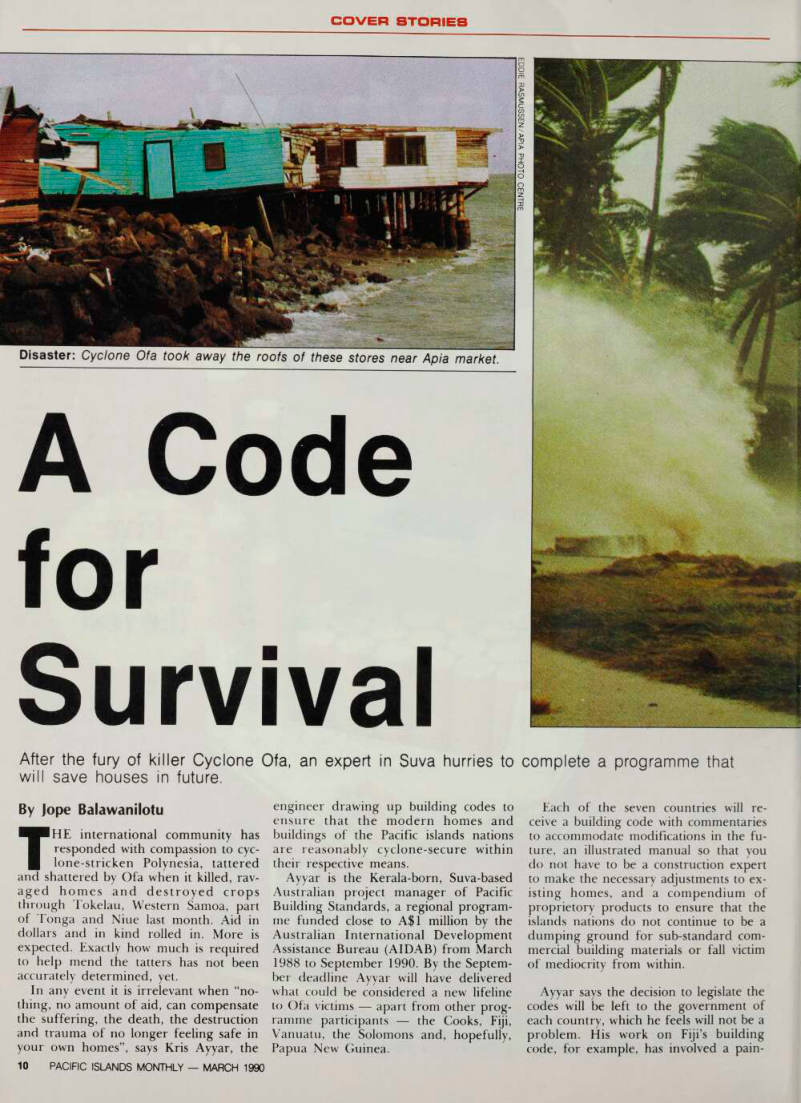
responded with compassion to cyc lone-stricken Polynesia, tattered and shattered by Ofa when it killed, rav aged homes and destroyed crops through Tokelau, Western Samoa, part of Tonga and Niue last month. Aid in dollars and in kind rolled in. More is expected. Exactly how much is required to help mend the tatters has not been accurately determined, yet.
In any event it is irrelevant when “no thing, no amount of aid, can compensate the suffering, the death, the destruction and trauma of no longer feeling safe in your own homes”, says Kris Ayyar, the
engineer drawing up building codes to ensure that the modern homes and buildings of the Pacific islands nations are reasonably cyclone-secure within their respective means.
Ayyar is the Kerala-born, Suva-based Australian project manager of Pacific Building Standards, a regional program me funded close to A|l million by the Australian International Development Assistance Bureau (AIDAB) from March 1988 to September 1990. By the Septem ber deadline Ayyar will have delivered what could be considered a new lifeline to Ofa victims apart from other prog ramme participants the Cooks, Fiji, Vanuatu, the Solomons and, hopefully, Papua New Guinea.
Each of the seven countries will re ceive a building code with commentaries to accommodate modifications in the fu ture, an illustrated manual so that you do not have to be a construction expert to make the necessary adjustments to ex isting homes, and a compendium of proprietory products to ensure that the islands nations do not continue to be a dumping ground for sub-standard com mercial building materials or fall victim of mediocrity from within.
Ayyar says the decision to legislate the codes will be left to the government of each country, which he feels will not be a
problem. His work on Fiji’s building
code, for example, has involved a pain-
Eddie Rasmussen /Apia Photo Centre
Disaster: Cyclone Ofa took away the roofs of these stores near Apia market.
staking process of dialogue and consulta tion with and between the public sector, the private sector, interested groups and consumers. This level of consultation, however, has been lacking in Papua New Guinea because he has to deal with a committee of expatriate public servants who “don’t have a permanent stake in that country”, says Ayyar. “The locals were born there and will die there.
Their children will be born there and will die there. Unless you involve those sort of people how honestly will this document turn out what Papua New Guineans really want?”
Western Samoa, perhaps the worst hit by Ofa, pulled out of the Pacific Build ing Standards programme after it failed to have Ayyar relocate his office in Apia.
Unfortunately, I think it is more or less in the Samoan spirit that they won’t
tolerate something from outside,” ex plains Ayyar. “They felt that it would be much more appropriate to produce a building code for them by actually being facilitated in Western Samoa and con sulting the people of Western Samoa.
They were not quite prepared to accept the fact that I would be producing docu ments for them from my location in Suva although I was trying to involve the people there as much as I had been in
volving the people of Fiji.” Additionally
the Western Samoa government equated a building code to higher costs.
Ayyar says that the equation is not necessarily true and there seems to be a myth in the Pacific that modern mate rials like concrete blocks, tin sheets, nuts and bolts and nails automatically mean
secure buildings. Says Ayyar: “Certainly
in the minds of the many who are not
5 educated in engineering or building sci i ence, and even in the minds of the well \ educated, such myths do exist. It’s party : true, of course, that we should have ; strong materials to withstand strong . forces. But ... in many instances you ; can compensate for the lack of strength i of the materials by a suitable arrange - ment of the materials how they’re i connected together.”
Ayyar says the Polynesian-type fales adapted by the Fijian province of Lau compare favourably with the more mod ern homes of the Pacific. The aerodyna mic, oval-shaped houses of timber with strategically placed joints bound with coir have withstood many cyclones and hurricanes over the past 150 years. Yet,
similar shaped buildings constructed
with sturdier, modern materials have not withstood winds up to only 30 to 40 knots. Says Ayyar: “This is where I believe, in terms of cost, in many inst ances the additional cost involved is sole ly a cost of ensuring that the connections and the locations of these connections are done properly and thoroughly. If that is done the actual materials that people (have been using) would be quite
adequate. Speaking generally about the
middle-class type buildings which are being put up in these countries, the materials have been strong enough. The problem has been how they have been connected together. So what a building code has to do is to ensure that these important aspects are kept in view.”
In Tonga, these important aspects are
being questioned. The kingdom opted
out of the Pacific Building Standards programme because it got money from New Zealand to fund its own building code project, and hired a private consul tant to do the job.
Niue, Tuvalu, the Cooks and the Solo mons will have a code which will ensure buildings can safely resist cyclone wind speeds of 49 metres/second (about 100 knots). A swift change of heart by Tonga and Western Samoa will group them under this category but their codes will lack the level of consultations the others have enjoyed, says Ayyar. Fiji and Vanuatu will have codes which will en able their buildings to cope with wind speeds up to 57 metres/second (about 115 knots).
The choices have been dependent largely on affordability and acceptability with the basic engineering parametres in mind. The choices have accommodated the desires of the peoples of the islands in the Pacific to forge ahead into the future and its associated uncertainties and leave the past behind with its time tested traditions. Ayyar was not quite prepared for “this craze in many, many people of these islands (who) think that it’s a status symbol to have a concrete block house with tin sheet roofing.’n
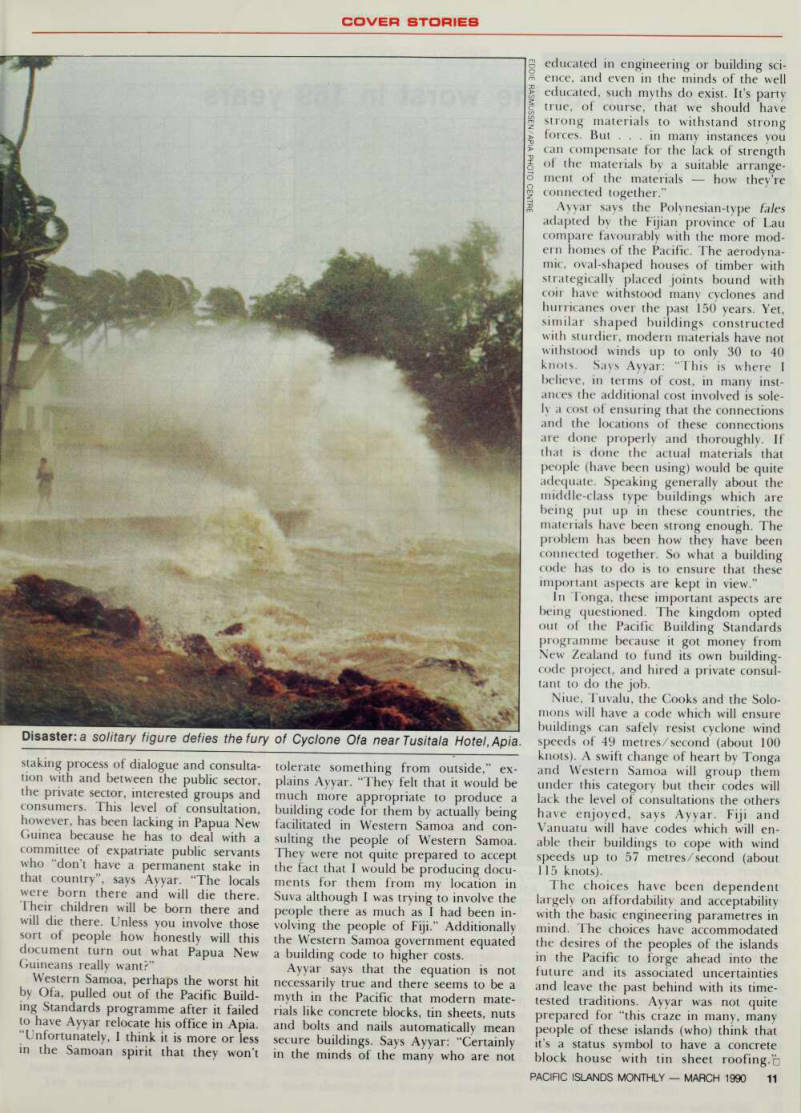
Disaster: a solitary figure defies the fury of Cyclone Ofa near Tusitala Hotel, Apia.
Eddie Rasmussen /Apia Photo Centre
Ofa was one of the worst in 169 years
Western Samoa
By Aivao Ulafala
YCLONE Ofa which hit Western B Samoa on February 2-3, is one of
most devastating cyclones to
hit the country since records were kept in 1831. Casualties included seven dead, most of them washed away by waves or
killed by flying debris.
Ofa cost the country WS$3O6 million,
according to a preliminary estimate by
the National Disaster Council, twice this year’s government budget. The council report is going to prospective aid donors.
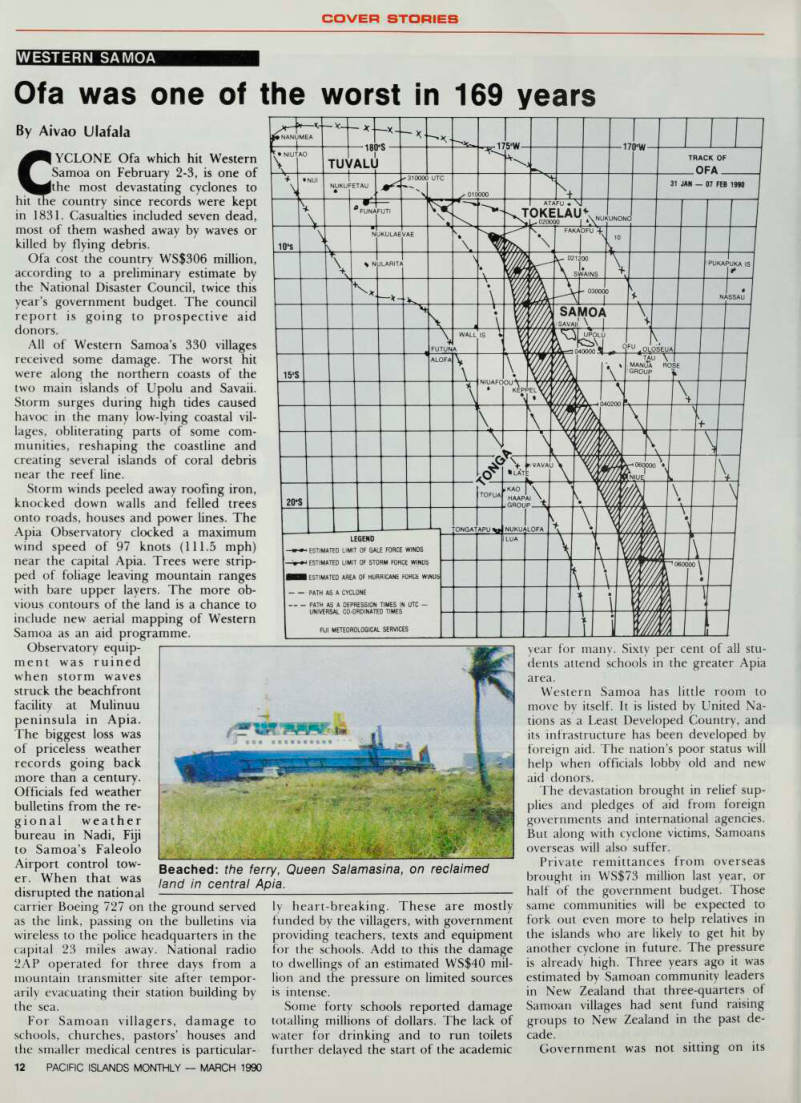
All of Western Samoa’s 330 villages received some damage. The worst hit were along the northern coasts of the two main islands of Upolu and Savaii.
Storm surges during high tides caused havoc in the many low-lying coastal vil lages, obliterating parts of some com munities, reshaping the coastline and creating several islands of coral debris near the reef line.
Storm winds peeled away roofing iron, knocked down walls and felled trees onto roads, houses and power lines. The Apia Observatory clocked a maximum wind speed of 97 knots (111.5 mph) near the capital Apia. Trees were strip
ped of foliage leaving mountain ranges
with bare upper layers. The more ob vious contours of the land is a chance to include new aerial mapping of Western Samoa as an aid programme.
Observatory equip ment was ruined when storm waves struck the beachfront facility at Mulinuu
peninsula in Apia.
The biggest loss was of priceless weather records going back more than a century.
Officials fed weather bulletins from the re
gional weather
bureau in Nadi, Fiji to Samoa’s Faleolo Airport control tow er. When that was disrupted the national
carrier Boeing 727 on the ground served as the link, passing on the bulletins via wireless to the police headquarters in the capital 23 miles away. National radio 2AP operated for three days from a mountain transmitter site after tempor arily evacuating their station building by the sea.
For Samoan villagers, damage to schools, churches, pastors’ houses and the smaller medical centres is particular-
ly heart-breaking. These are mostly funded by the villagers, with government providing teachers, texts and equipment for the schools. Add to this the damage to dwellings of an estimated WS$4O mil lion and the pressure on limited sources is intense.
Some forty schools reported damage totalling millions of dollars. The lack of water for drinking and to run toilets further delayed the start of the academic
year for many. Sixty per cent of all stu dents attend schools in the greater Apia area.
Western Samoa has little room to move by itself. It is listed by United Na tions as a Least Developed Country, and its infrastructure has been developed by foreign aid. The nation’s poor status will help when officials lobby old and new aid donors.
The devastation brought in relief sup plies and pledges of aid from foreign governments and international agencies.
But along with cyclone victims, Samoans overseas will also suffer.
Private remittances from overseas brought in WS$73 million last year, or half of the government budget. Those same communities will be expected to fork out even more to help relatives in the islands who are likely to get hit by another cyclone in future. The pressure is already high. Three years ago it was estimated by Samoan community leaders in New Zealand that three-quarters of Samoan villages had sent fund raising groups to New Zealand in the past de cade.
Government was not sitting on its
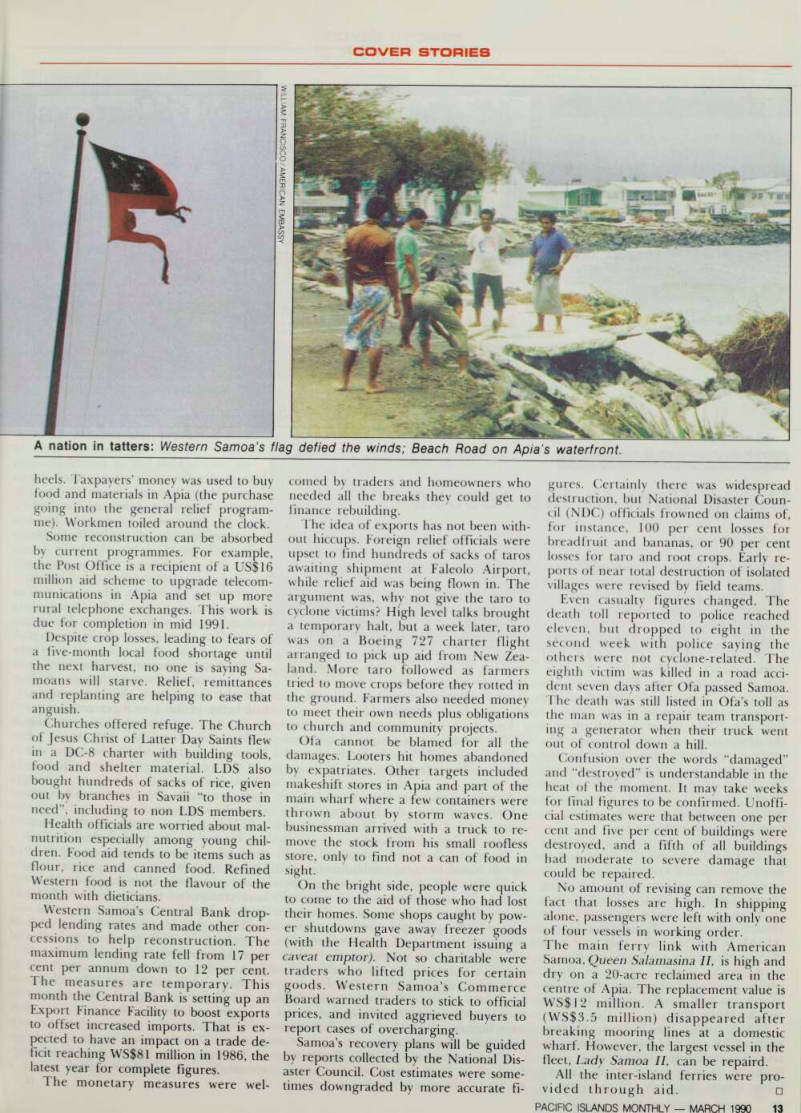
Beached: the ferry, Queen Salamasina, on reclaimed land in central Apia.
heels. Taxpayers’ money was used to buy food and materials in Apia (the purchase going into the general relief program me). Workmen toiled around the clock.
Some reconstruction can be absorbed by current programmes. For example, the Post Office is a recipient of a Us|l6 million aid scheme to upgrade telecom munications in Apia and set up more rural telephone exchanges. This work is due for completion in mid 1991.
Despite crop losses, leading to fears of a five-month local food shortage until the next harvest, no one is saying Sa moans will starve. Relief, remittances and replanting are helping to ease that anguish.
Churches offered refuge. The Church of Jesus Christ of Latter Day Saints flew in a DC-8 charter with building tools, food and shelter material. LDS also bought hundreds of sacks of rice, given out by branches in Savaii “to those in need”, including to non LDS members.
Health officials are worried about mal nutrition especially among young chil dren. Food aid tends to be items such as flour, rice and canned food. Refined Western food is not the flavour of the month with dieticians.
Western Samoa’s Central Bank drop ped lending rates and made other con cessions to help reconstruction. The maximum lending rate fell from 17 per cent per annum down to 12 per cent.
The measures are temporary. This month the Central Bank is setting up an Export Finance Facility to boost exports to offset increased imports. That is ex pected to have an impact on a trade de ficit reaching WS$Bl million in 1986, the latest year for complete figures.
The monetary measures were wel
corned by traders and homeowners who needed all the breaks they could get to
finance rebuilding.
The idea of exports has not been with out hiccups. Foreign relief officials were upset to find hundreds of sacks of taros
awaiting shipment at Faleolo Airport,
while relief aid was being flown in. The argument was, why not give the taro to cyclone victims? High level talks brought a temporary halt, but a week later, taro was on a Boeing 727 charter flight arranged to pick up aid from New Zea land. More taro followed as farmers tried to move crops before they rotted in the ground. Farmers also needed money to meet their own needs plus obligations to church and community projects.
Ofa cannot be blamed for all the damages. Looters hit homes abandoned by expatriates. Other targets included makeshift stores in Apia and part of the main wharf where a few containers were thrown about by storm waves. One businessman arrived with a truck to re move the stock from his small roofless store, only to find not a can of food in sight.
On the bright side, people were quick to come to the aid of those who had lost their homes. Some shops caught by pow er shutdowns gave away freezer goods (with the Health Department issuing a caveat emptor). Not so charitable were traders who lifted prices for certain goods. Western Samoa’s Commerce Board warned traders to stick to official prices, and invited aggrieved buyers to report cases of overcharging.
Samoa’s recovery plans will be guided by reports collected by the National Dis aster Council. Cost estimates were some times downgraded by more accurate fi
gures. Certainly there was widespread destruction, but National Disaster Coun cil (NDC) officials frowned on claims of, for instance, 100 per cent losses for breadfruit and bananas, or 90 per cent losses for taro and root crops. Early re ports of near total destruction of isolated villages were revised by field teams.
Even casualty figures changed. The
death toll reported to police reached eleven, but dropped to eight in the second week with police saying the others were not cyclone-related. The eighth victim was killed in a road acci dent seven days after Ofa passed Samoa.
The death was still listed in Ofa’s toll as the man was in a repair team transport ing a generator when their truck went out of control down a hill.
Confusion over the words “damaged” and “destroyed” is understandable in the heat of the moment. It may take weeks for final figures to be confirmed. Unoffi cial estimates were that between one per cent and five per cent of buildings were destroyed, and a fifth of all buildings had moderate to severe damage that could be repaired.
No amount of revising can remove the fact that losses are high. In shipping alone, passengers were left with only one of four vessels in working order.
The main ferry link with American Samoa, Queen Salamasina 11, is high and dry on a 20-acre reclaimed area in the centre of Apia. The replacement value is WS$l2 million. A smaller transport (WS$3.5 million) disappeared after breaking mooring lines at a domestic wharf. However, the largest vessel in the fleet, Lady Samoa 11, can be repaird.
All the inter-island ferries were pro vided through aid. □
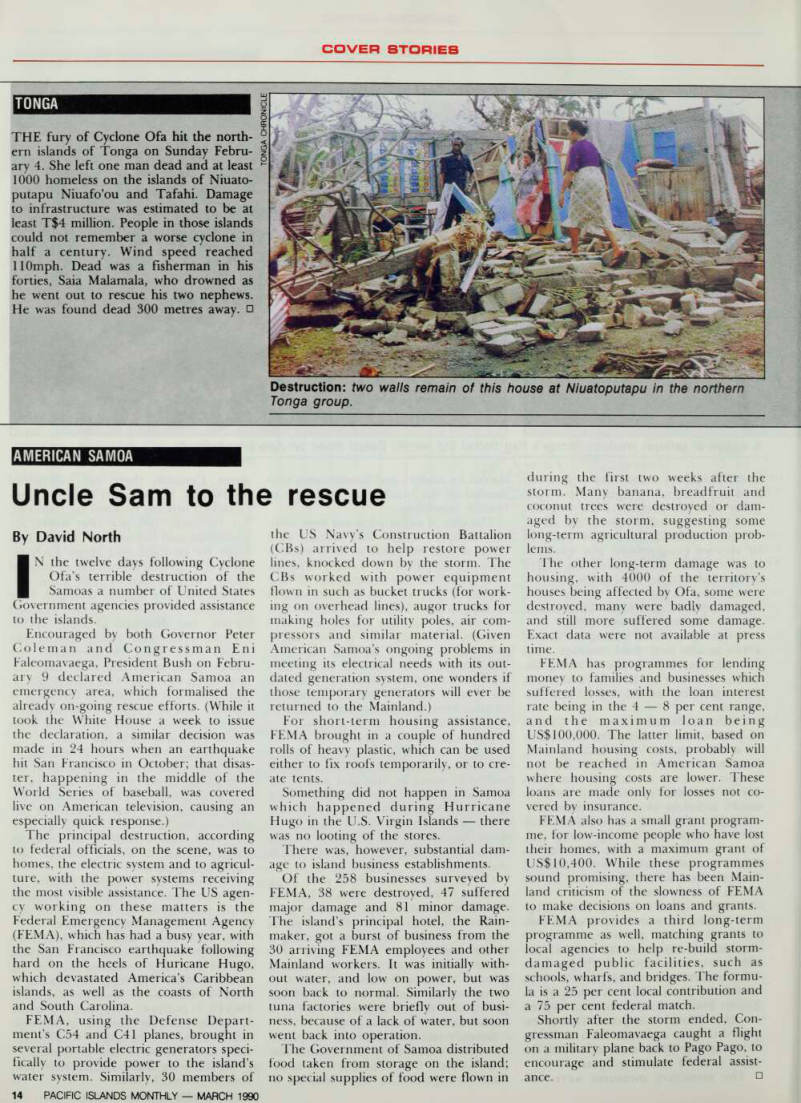
William Francisco/American Embassy
A nation in tatters: Western Samoa's flag defied the winds; Beach Road on Apia's waterfront.
Tonga
THE fury of Cyclone Ofa hit the north ern islands of Tonga on Sunday Febru ary 4. She left one man dead and at least 1000 homeless on the islands of Niuato putapu Niuafo’ou and Tafahi. Damage to infrastructure was estimated to be at least T|4 million. People in those islands could not remember a worse cyclone in half a century. Wind speed reached HOmph. Dead was a fisherman in his forties, Saia Malamala, who drowned as he went out to rescue his two nephews.
He was found dead 300 metres away. □
Destruction: two walls remain of this house at Niuatoputapu in the northern Tonga group.
Uncle Sam to the rescue
American Samoa
By David North
IN the twelve days following Cyclone
Ofa’s terrible destruction of the Samoas a number of United States Government agencies provided assistance to the islands.
Encouraged by both Governor Peter Coleman and Congressman Eni Faleomavaega, President Bush on Febru ary 9 declared American Samoa an emergency area, which formalised the already on-going rescue efforts. (While it took the White House a week to issue the declaration, a similar decision was made in 24 hours when an earthquake hit San Francisco in October; that disas ter, happening in the middle of the World Series of baseball, was covered live on American television, causing an
especially quick response.)
The principal destruction, according
to federal officials, on the scene, was to homes, the electric system and to agricul ture, with the power systems receiving the most visible assistance. The US agen cy working on these matters is the Federal Emergency Management Agency (FEMA), which has had a busy year, with the San Francisco earthquake following hard on the heels of Huricane Hugo, which devastated America’s Caribbean islands, as well as the coasts of North and South Carolina.
FEMA, using the Defense Depart menfs C 54 and C4l planes, brought in several portable electric generators speci fically to provide power to the island’s water system. Similarly, 30 members of
the US Navy’s Construction Battalion (CBs) arrived to help restore power lines, knocked down by the storm. The CBs worked with power equipment flown in such as bucket trucks (for working on overhead lines), augor trucks for making holes for utility poles, air compressors and similar material. (Given American Samoa’s ongoing problems in meeting its electrical needs with its outdated generation system, one wonders if those temporary generators will ever be returned to the Mainland.) For short-term housing assistance, FEMA brought in a couple of hundred rolls of heavy plastic, which can be used either to fix roofs temporarily, or to ereate tents.
Something did not happen in Samoa which happened during Hurricane Hugo in the U.S. Virgin Islands there was no looting of the stores.
There was, however, substantial damage to island business establishments.
Of the 258 businesses surveyed by FEMA, 38 were destroyed, 47 suffered major damage and 81 minor damage, The island’s principal hotel, the Rainmaker, got a burst of business from the 30 arriving FEMA employees and other Mainland workers. It was initially without water, and low on power, but was soon back to normal. Similarly the two tuna factories were briefly out of business, because of a lack of water, but soon went back into operation.
The Government of Samoa distributed food taken from storage on the island; no special supplies of food were flown in
during the first two weeks after the storm. Many banana, breadfruit and coconut trees were destroyed or dam
aged by the storm, suggesting some
long-term agricultural production prob
lems.
The other long-term damage was to housing, with 4000 of the territory’s houses being affected by Ofa, some were
destroyed, many were badly damaged,
and still more suffered some damage.
Exact data were not available at press time.
FEMA has programmes for lending money to families and businesses which suffered losses, with the loan interest rate being in the 4 8 per cent range, and the maximum loan being US$lOO,OOO. The latter limit, based on Mainland housing costs, probably will not be reached in American Samoa where housing costs are lower. These loans are made only for losses not co vered by insurance.
FEMA also has a small grant program me, for low-income people who have lost their homes, with a maximum grant of US$lO,4OO. While these programmes sound promising, there has been Main land criticism of the slowness of FEMA to make decisions on loans and grants.
FEMA provides a third long-term programme as well, matching grants to local agencies to help re-build storm damaged public facilities, such as schools, wharfs, and bridges. The formu la is a 25 per cent local contribution and a 75 per cent federal match.
Shortly after the storm ended, Con gressman Faleomavaega caught a flight on a military plane back to Pago Pago, to encourage and stimulate federal assist ance. D
Ravaged by winds and seas
Niue
By Stafford Guest
NATURE’S bulldozer the in famous Cyclone Ofa un leashed its fury on Niue Island after sweeping through Western Samoa, American Samoa and the northern Ton ga Islands. Howling winds peaking at 90 knots swirling about 60 kms from the eye of the hurricane lashed Niue on Saturday February 3 and Sunday Febru ary 4. But the horror and devastation was caused by gigantic Pacific rollers.
Niue’s narrow reef and 30-metre high coastal cliffs offered little protection against mountainous seas sweeping in from the north, flinging thousands of tonnes of water as high as 75 metres into the air.
Elderly Niueans who have spent most of their lives on the island effec tionately known as the Rock say na ture unleashed a fury never seen before.
Most of the major damage estimated at US$2.5 million was sustained by homes and buildings on the western side of the island. Hardest hit was a two-kilometre stretch of coastline in the main village of Alofi.
Niue’s Lord Liverpool Hospital looks as if it was hit by an Exocet missile giant boulders of old coral smashed wards, offices, the kitchen and morgue.
Patients were evacuated in rain and high winds- to the safety of private homes while those not in need of constant medical care were quickly discharged.
Guests at the Niue Hotel fled for their lives as tonnes of sea water crashed down on the accommodation block and rocks plummeted into huge glass win dows surrounding the bar, reception area and dining room. The hotel appears to be beyond repair as does the hospital. Government officials are con sidering whether to relocate the two faci lities on higher ground.
Along Niue’s Golden Mile where ex patriate government officers and school teachers are housed, homes and flats on the seaward side of the main road were smashed by the headlong rush of angry seas which uprooted coconut and bread fruit trees and heaved boulders from the bowels of these to 100 metres inland.
Two politicians suffered the full blast of Ofa, Cabinet Minister Robert Rex Jr, son of Premier Sir Robert Rex both of whom were in New Zealand when the cyclone arrived lost his clifftop home when two rogue waves sucked the build ing into the sea within minutes. Today a concrete floor slab is the only remains of a family home. Niue’s Speaker of the
Assembly, Sam Tagelagi, whose home commands a view of Alofi Bay also suf fered heartbreak. Vicious winds tore at the roof of his Diamond Head property and destroyed much of the building and
personal belongings.
At the Niue Public Works Depot at Amanau, derelict excavation machinery and vehicles buried deep in cliffside chasms and caves were hurled back onto surrounding property. Workshops, offices and stores were awash with sea
water. Niue’s wharf also took a battering but new concrete extensions carried out last year under an Australian aid prog ramme probably saved it. The road ramp was swept away damaging fuel lines and cutting access to vital petrol and diesel storage tanks.
Sea tracks to scenic spots around the western coastline and two village boat ramps built with United States and New Zealand aid were pounded to pieces and a church in the north-western village of Hikutavake was almost demolished by the raging seas. Samoa Air’s two Twin Otters one on its way from Vavau in Tonga to Pagopago in American Samoa, the other on a scheduled flight to Niue sought shelter from the mounting storm at Hanan International Airport. Both
planes suffered damage but were quickly
repaired before being ferried back to their Pagopago base.
Government employees worked round-the-clock in atrocious conditions evacuating those in danger and attemp ting to maintain power, water and tele communication systems.
When the storm cleared, the reality of devastation was evident in a concen trated area of several square kilometres in Alofi. An RNZAF Hercules flew in emergency supplies and personnel to assess the damage. Latest figures indicate Cyclone Ofa cost the people the Niue about US$2.5 million.
For Niue’s Premier Sir Robert Rex it was a time of frustration and concern.
He was in New Zealand attending Waitangi Day celebrations when disaster struck. The 81-year-old veteran politi cian flew to Niue with the Duke of Edin burgh and New Zealand’s Foreign Minis ter Mike Moore to inspect the damage and be briefed on clean-up operations.
Now the islanders face the daunting
task of replanting bushgardens wiped
out by salt spray and wind. Although traders maintain sufficient stocks of food most Niueans rely on bushgardens for taro, cassava and vegetables.
Niue has a population of 2000 and major reconstruction work will place pressure on its workforce. A national disaster committee has been set up to list priorities for repairs and redevelopment.
A massive injection of aid will be re quired to restore health services and re locate the hotel.
Sir Robert is keen to see the imple mentation of an action plan to rebuild damaged property. His government faces a general election at the end of March ... to many 81-year-olds a daunt ing task in the wake of such an economic setback.
When asked in New Zealand if he was prepared to stand again in view of the problems which lie ahead Sir Robert re plied: “I’ll have to stand again now, de spite pressure from my family to stand down. It would be like a captain desert
ing a sinking ship.” □
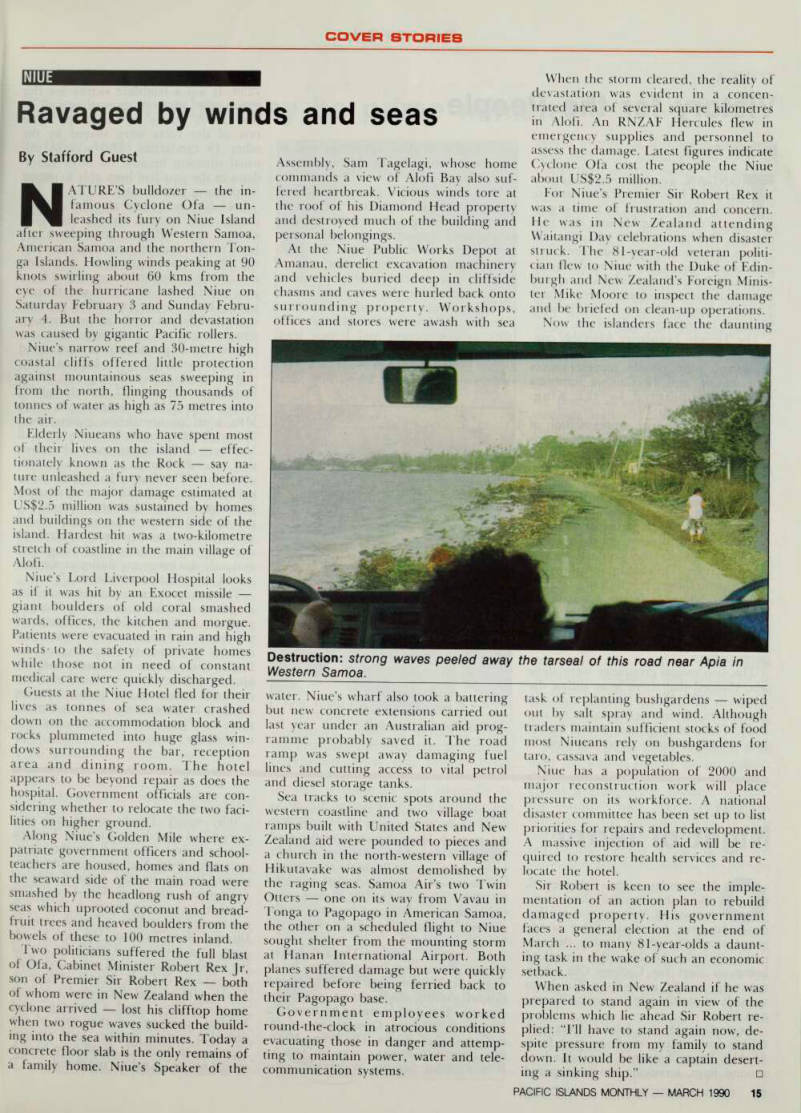
Destruction: strong waves peeled away the tarseal of this road near Apia in Western Samoa.
Matangi Tonga
The Region
Tonga
Victory for the People
By Pesi Fonua
TONGAN general elections are
usually low-key affairs because
they do not result in a new gov ernment, a new Prime Minister or a new Cabinet. But last month it was different.
It was the most vigorously contested general election in the history of the is land kingdom; 55 candidates contested nine seats for the common people, and 23 nobles contested nine of the 33 seats allocated for nobles of the realm.
The Tongan Legislative Assembly con sists of 30 members, nine noble repre
sentatives, nine people representatives
representing and 12 Cabinet ministers
who are appointed by the King,
Taufa’ahau Tupou IV.
Despite the minority representation of
the majority of the population in Parlia ment, the commoners, the February 15 election witnessed a new political aware ness, with people in the towns and vil lages spending a good part of their time
‘talking politics’ and openly expressing
their wishes for more participation in the decision-making process. As the election day drew nearer the contest became more intense. The battle for the nine seats was no longer just a desire by indi vidual candidates to secure a seat in the House, but it was confrontation of ideals between groups of like-minded candi dates who drew the kingdom closer to
party politics.
The two major groupings were those who claimed that there is an unfair dis tribution of national wealth and that government is not accountable to any body. Their message was that if elected they would pressure government to be
more thrifty in their spendings and to become accountable to the Legislative
Assembly.
The second major groupings fought
for economic development, and sought to improve living standards and create
employment opportunities; government
inefficiency was second place. The elec tion campaign attracted a new style of political harassment where opponents tried to scandalise the other and words like communism were used to win votes.
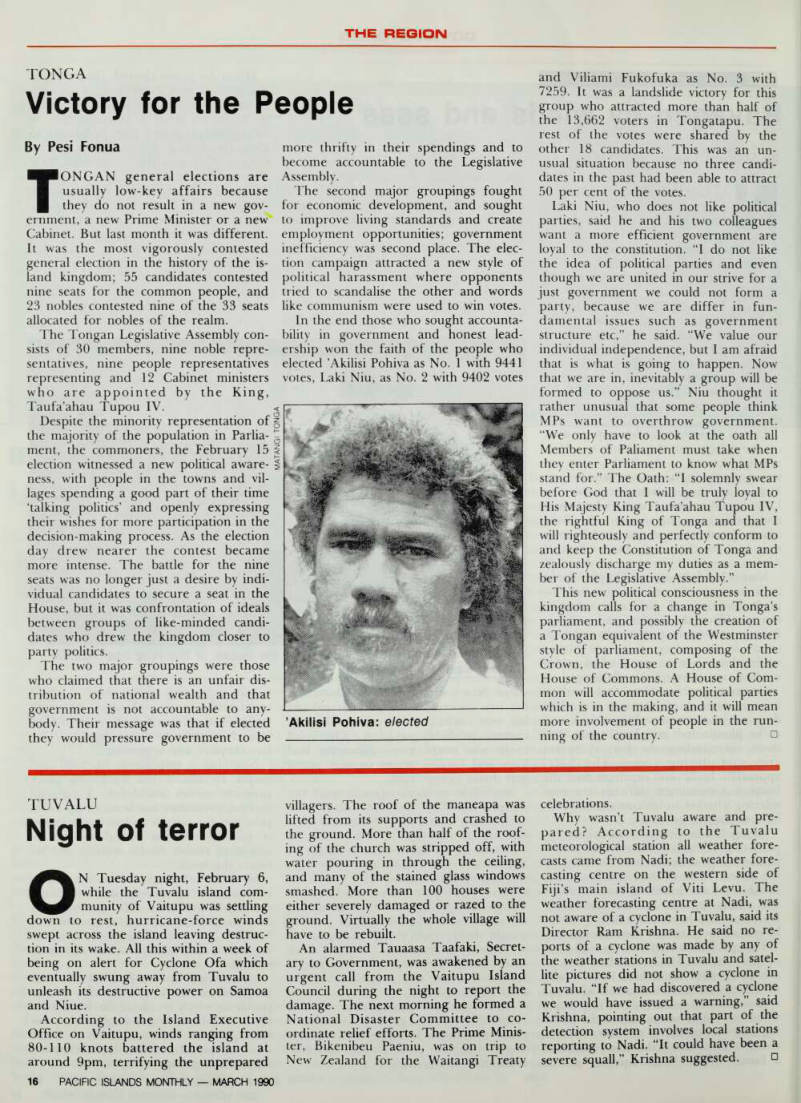
In the end those who sought accounta bility in government and honest lead ership won the faith of the people who elected ’Akilisi Pohiva as No. 1 with 9441 votes, Laki Niu, as No. 2 with 9402 votes
and Viliami Fukofuka as No. 3 with 7259. It was a landslide victory for this group who attracted more than half of the 13,662 voters in Tongatapu. The rest of the votes were shared by the other 18 candidates. This was an un usual situation because no three candi dates in the past had been able to attract 50 per cent of the votes, Laki Niu, who does not like political parties, said he and his two colleagues want a more efficient government are loyal to the constitution. “I do not like the idea of political parties and even though we are united in our strive for a just government we could not form a party, because we are differ in fun damental issues such as government structure etc,” he said. “We value our individual independence, but I am afraid that is what is going to happen. Now that we are in, inevitably a group will be formed to oppose us,” Niu thought it rather unusual that some people think MPs want to overthrow government.
“We only have to look at the oath all Members of Paliament must take when they enter Parliament to know what MPs stand for.” The Oath: “I solemnly swear before God that I will be truly loyal to
His Majesty King Taufa’ahau Tupou IV,
the rightful King of Tonga and that I will righteously and perfectly conform to and keep the Constitution of Tonga and zealously discharge my duties as a mem ber of the Legislative Assembly.”
This new political consciousness in the kingdom calls for a change in Tonga’s parliament, and possibly the creation of a Tongan equivalent of the Westminster
style of parliament, composing of the
Crown, the House of Lords and the House of Commons. A House of Com mon will accommodate political parties which is in the making, and it will mean more involvement of people in the run ning of the country. □
Matangi Tonga
’Akilisi Pohiva: elected
Night of terror
Tuvalu
ON Tuesday night, February 6,
while the Tuvalu island com munity of Vaitupu was settling down to rest, hurricane-force winds swept across the island leaving destruc tion in its wake. All this within a week of being on alert for Cyclone Ofa which eventually swung away from Tuvalu to unleash its destructive power on Samoa and Niue.
According to the Island Executive Office on Vaitupu, winds ranging from 80-110 knots battered the island at around 9pm, terrifying the unprepared
villagers. The roof of the maneapa was lifted from its supports and crashed to the ground. More than half of the roof ing of the church was stripped off, with
water pouring in through the ceiling,
and many of the stained glass windows smashed. More than 100 houses were either severely damaged or razed to the ground. Virtually the whole village will have to be rebuilt.
An alarmed Tauaasa Taafaki, Secret ary to Government, was awakened by an urgent call from the Vaitupu Island Council during the night to report the damage. The next morning he formed a National Disaster Committee to co ordinate relief efforts. The Prime Minis ter, Bikenibeu Paeniu, was on trip to New Zealand for the Waitangi Treaty
celebrations.
Why wasn’t Tuvalu aware and pre pared? According to the Tuvalu meteorological station all weather fore casts came from Nadi; the weather fore casting centre on the western side of Fiji’s main island of Viti Levu. The weather forecasting centre at Nadi, was not aware of a cyclone in Tuvalu, said its Director Ram Krishna. He said no re ports of a cyclone was made by any of the weather stations in Tuvalu and satel lite pictures did not show a cyclone in Tuvalu. “If we had discovered a cyclone we would have issued a warning,” said Krishna, pointing out that part of the detection system involves local stations reporting to Nadi. “It could have been a severe squall,” Krishna suggested. □
Solomon Star
Solomon Islands
The man who may be prime minister
By Dykes Angiki
THE man who may one day become Solomon Islands Prime Minister, Opposition Leader Andrew Nori, is hardly known outside his country.
However his enthusiasm, and concern
for fairplay, accountability and good
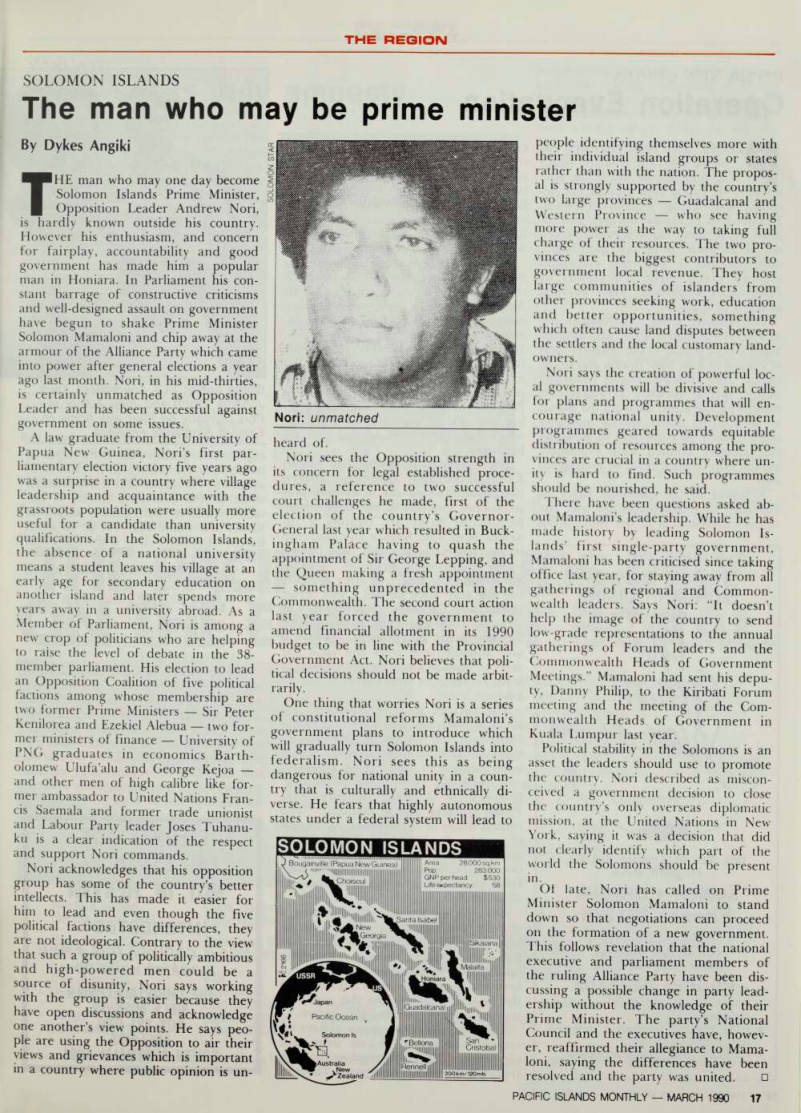
government has made him a popular man in Honiara. In Parliament his con stant barrage of constructive criticisms and well-designed assault on government have begun to shake Prime Minister Solomon Mamaloni and chip away at the armour of the Alliance Party which came into power after general elections a year ago last month. Nori, in his mid-thirties, is certainly unmatched as Opposition Leader and has been successful against government on some issues.
A law graduate from the University of Papua New Guinea, Nori’s first par liamentary election victory five years ago was a surprise in a country where village leadership and acquaintance with the grassroots population were usually more useful for a candidate than university qualifications. In the Solomon Islands, the absence of a national university means a student leaves his village at an early age for secondary education on another island and later spends more years away in a university abroad. As a Member of Parliament, Nori is among a new crop of politicians who are helping to raise the level of debate in the 38member parliament. His election to lead an Opposition Coalition of five political factions among whose membership are two former Prime Ministers Sir Peter Kenilorea and Ezekiel Alebua two for mer ministers of finance University of PNG graduates in economics Barth olomew Ulufa’alu and George Kejoa and other men of high calibre like for mer ambassador to United Nations Fran cis Saemala and former trade unionist and Labour Party leader Joses Tuhanu ku is a clear indication of the respect and support Nori commands.
Nori acknowledges that his opposition group has some of the country’s better intellects. This has made it easier for him to lead and even though the five political factions have differences, they are not ideological. Contrary to the view that such a group of politically ambitious and high-powered men could be a source of disunity, Nori says working with the group is easier because they have open discussions and acknowledge one another’s view points. He says peo ple are using the Opposition to air their views and grievances which is important in a country where public opinion is un-
heard of.
Nori sees the Opposition strength in its concern for legal established proce dures, a reference to two successful court challenges he made, first of the election of the country’s Governor- General last year which resulted in Buck
ingham Palace having to quash the
appointment of Sir George Lepping, and the Queen making a fresh appointment something unprecedented in the Commonwealth. The second court action last year forced the government to amend financial allotment in its 1990 budget to be in line with the Provincial Government Act. Nori believes that poli tical decisions should not be made arbit
rarily.
One thing that worries Nori is a series of constitutional reforms Mamaloni’s government plans to introduce which will gradually turn Solomon Islands into federalism. Nori sees this as being dangerous for national unity in a coun try that is culturally and ethnically di verse. He fears that highly autonomous states under a federal system will lead to
people identifying themselves more with their individual island groups or states rather than with the nation. The propos al is strongly supported by the country’s two large provinces Guadalcanal and Western Province who see having more power as the way to taking full charge of their resources. The two pro vinces are the biggest contributors to government local revenue. They host large communities of islanders from other provinces seeking work, education and better opportunities, something which often cause land disputes between the settlers and the local customary land owners.
Nori says the creation of powerful loc al governments will be divisive and calls for plans and programmes that will en
courage national unity. Development
programmes geared towards equitable
distribution of resources among the pro vinces are crucial in a country where un ity is hard to find. Such programmes should be nourished, he said.
There have been questions asked ab out Mamaloni’s leadership. While he has
made history by leading Solomon Is
lands’ first single-party government, Mamaloni has been criticised since taking office last year, for staying away from all gatherings of regional and Common wealth leaders. Says Nori: “It doesn’t help the image of the country to send low-grade representations to the annual gatherings of Forum leaders and the Commonwealth Heads of Government Meetings.” Mamaloni had sent his depu ty, Danny Philip, to the Kiribati Forum meeting and the meeting of the Com monwealth Heads of Government in Kuala Lumpur last year.
Political stability in the Solomons is an asset the leaders should use to promote the country. Nori described as miscon ceived a government decision to close the country’s only overseas diplomatic mission, at the United Nations in New York, saying it was a decision that did not clearly identify which part of the world the Solomons should be present in.
Of late, Non has called on Prime Minister Solomon Mamaloni to stand down so that negotiations can proceed on the formation of a new government.
This follows revelation that the national executive and parliament members of the ruling Alliance Party have been dis cussing a possible change in party lead ership without the knowledge of their Prime Minister. The party’s National Council and the executives have, howev er, reaffirmed their allegiance to Mama loni, saying the differences have been resolved and the party was united. □
Solomon Star
Nori: unmatched
Operation Evacuation
Papua New Guinea
PEOPLE have been evacuated en masse from the troubled island of Bougainville where the gov ernment of Papua New Guinea has de clared war against secessionist rebels.
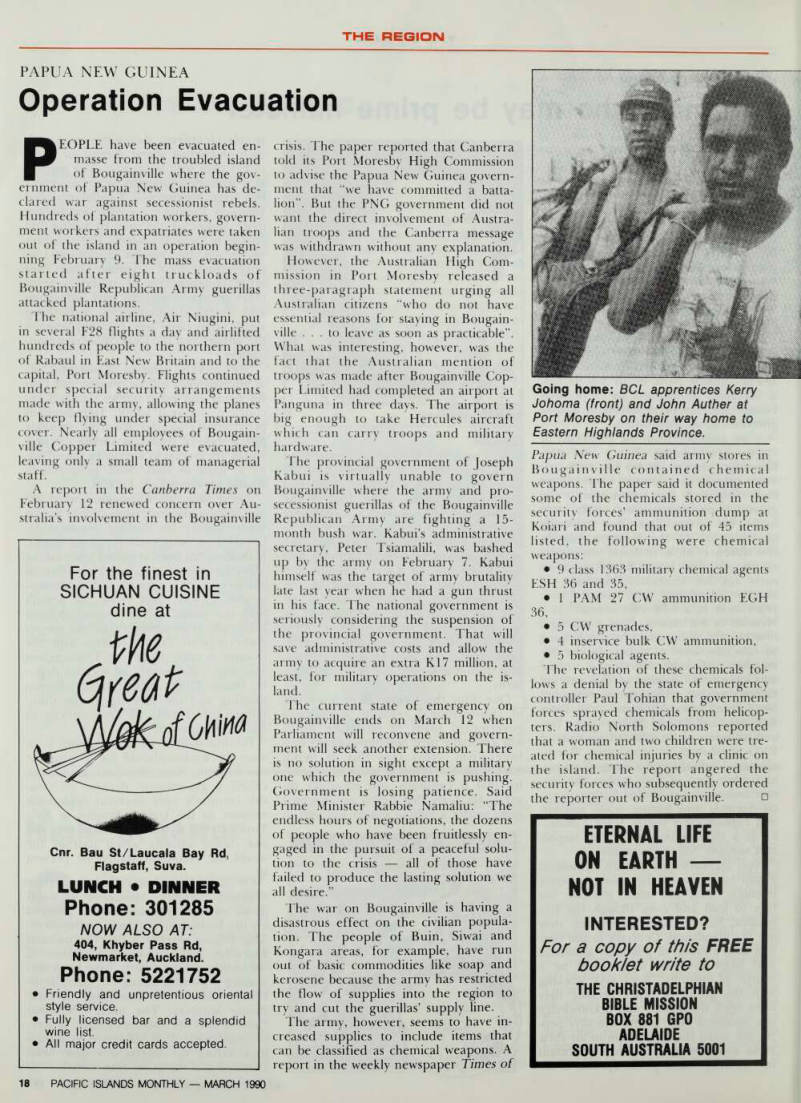
Hundreds of plantation workers, govern ment workers and expatriates were taken out of the island in an operation begin ning February 9. The mass evacuation started after eight truckloads of Bougainville Republican Army guerillas
attacked plantations.
The national airline, Air Niugini, put in several F2B flights a day and airlifted hundreds of people to the northern port of Rabaul in East New Britain and to the
capital, Port Moresby. Flights continued
under special security arrangements made with the army, allowing the planes to keep flying under special insurance
cover. Nearly all employees of Bougain
ville Copper Limited were evacuated, leaving only a small team of managerial staff.
A report in the Canberra Times on February 12 renewed concern over Au stralia’s involvement in the Bougainville
crisis. The paper reported that Canberra told its Port Moresby High Commission to advise the Papua New Guinea govern ment that “we have committed a batta lion”. But the PNG government did not want the direct involvement of Austra lian troops and the Canberra message was withdrawn without any explanation.
However, the Australian High Com mission in Port Moresby released a
three-paragraph statement urging all
Australian citizens “who do not have essential reasons for staying in Bougain ville ... to leave as soon as practicable”.
What was interesting, however, was the fact that the Australian mention of troops was made after Bougainville Cop per Limited had completed an airport at Panguna in three days. The airport is big enough to take Hercules aircraft which can carry troops and military hardware.
The provincial government of Joseph Kabui is virtually unable to govern Bougainville where the army and pro secessionist guerillas of the Bougainville
Republican Army are fighting a 15-
month bush war. Kabui’s administrative secretary, Peter Tsiamalili, was bashed up by the army on February 7. Kabui himself was the target of army brutality late last year when he had a gun thrust in his face. The national government is
seriously considering the suspension of
the provincial government. That will save administrative costs and allow the army to acquire an extra Kl 7 million, at least, for military operations on the is land.
The current state of emergency on Bougainville ends on March 12 when Parliament will reconvene and govern ment will seek another extension. There is no solution in sight except a military one which the government is pushing.
Government is losing patience. Said Prime Minister Rabbie Namaliu: “The endless hours of negotiations, the dozens of people who have been fruitlessly en gaged in the pursuit of a peaceful solu tion to the crisis all of those have failed to produce the lasting solution we all desire.”
The war on Bougainville is having a disastrous effect on the civilian popula tion. The people of Buin, Siwai and Kongara areas, for example, have run out of basic commodities like soap and kerosene because the army has restricted the flow of supplies into the region to try and cut the guerillas’ supply line.
The army, however, seems to have in creased supplies to include items that can be classified as chemical weapons. A report in the weekly newspaper Times of
Papua New Guinea said army stores in Bougainville contained chemical weapons. The paper said it documented some of the chemicals stored in the security forces’ ammunition dump at Koiari and found that out of 45 items listed, the following were chemical weapons: • 9 class 1363 military chemical agents ESH 36 and 35, • 1 PAM 27 CW ammunition EGH 36, • 5 CW grenades, • 4 inservice bulk CW ammunition, • 5 biological agents.
The revelation of these chemicals fol lows a denial by the state of emergency controller Paul Tohian that government forces sprayed chemicals from helicop ters. Radio North Solomons reported that a woman and two children were tre ated for chemical injuries by a clinic on the island. The report angered the security forces who subsequently ordered the reporter out of Bougainville. □
Going home: BCL apprentices Kerry Johoma (front) and John Auther at Port Moresby on their way home to Eastern Highlands Province.
Advertisements & other items, p. 18 (1 item)
qreaP
For the finest in
SICHUAN CUISINE
dine at m
qreaP
MM Cnr. Bau St/Laucala Bay Rd, Flagstaff, Suva.
LUNCH • DINNER
Phone: 301285
NOW ALSO AT:
404, Khyber Pass Rd, Newmarket, Auckland.
Phone: 5221752
• Friendly and unpretentious oriental style service. • Fully licensed bar and a splendid wine list. • All major credit cards accepted.
ETERNAL LIFE
ON EARTH
NOT IN HEAVEN
INTERESTED?
For a copy of this FREE booklet write to
THE CHRISTADELPHIAN
BIBLE MISSION
BOX 881 GPO
ADELAIDE
SOUTH AUSTRALIA 5001
Sope seeks July amnesty
Vanuatu
IN four months’ time on July 30 the long-ruling government of Father Walter Lini will want to be giving out gifts in the Vanuatu capital of Port Vila. The event is the 10th anniversary of independence from Britain and France. For the government such an occasion should mark unique events, one of which could be the release from Port
Vila prison of 71-year-old political rebel
Jimmy Moli Stevens.
Stevens was jailed for 14 years and six months in August 1980 for his part in leading the Santo Rebellion, a secession ist movement which Lini’s government had to crush with the help of troops from Papua New Guinea. He was sent enced to an extra two years and three months in 1982 when he and other pris oners broke from prison and tried to flee the main island of Efate by boat.
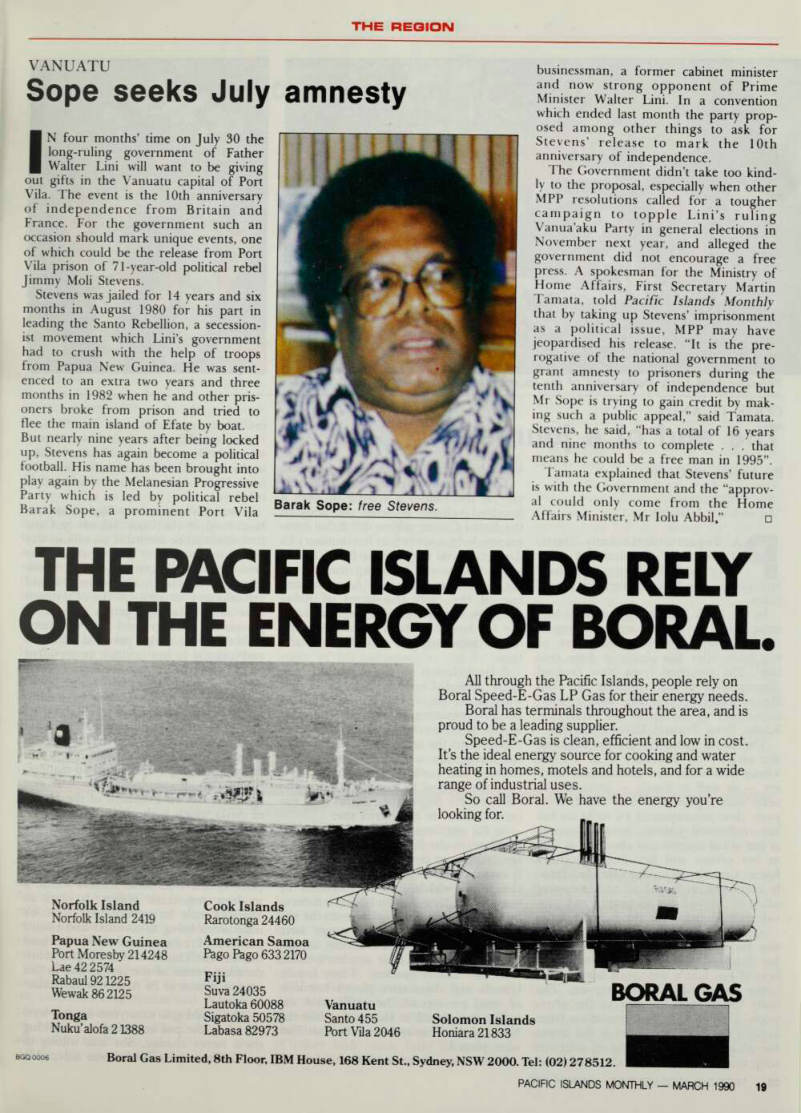
But nearly nine years after being locked up, Stevens has again become a political football. His name has been brought into play again by the Melanesian Progressive Party which is led by political rebel Barak Sope, a prominent Port Vila
businessman, a former cabinet minister and now strong opponent of Prime Minister Walter Lini. In a convention which ended last month the party prop osed among other things to ask for Stevens’ release to mark the 10th
anniversary of independence.
The Government didn’t take too kind ly to the proposal, especially when other MPP resolutions called for a tougher campaign to topple Lini’s ruling Vanua’aku Party in general elections in November next year, and alleged the government did not encourage a free press. A spokesman for the Ministry of Home Affairs, First Secretary Martin Tamata, told Pacific Islands Monthly that by taking up Stevens’ imprisonment as a political issue, MPP may have jeopardised his release. “It is the pre rogative of the national government to grant amnesty to prisoners during the tenth anniversary of independence but Mr Sope is trying to gain credit by mak ing such a public appeal,” said Tamata.
Stevens, he said, “has a total of 16 years and nine months to complete . , . that means he could be a free man in 1995”.
Tamata explained that Stevens’ future is with the Government and the “approv al could only come from the Home Affairs Minister, Mr lolu Abbil,” □
Barak Sope: free Stevens.
Advertisements & other items, p. 19 (1 item)
The Pacific Islands Rely
ON THE ENERGY OF BORAL
* a ; w *«' ■ - - j&r ri f * %«.' y <■ V All through the Pacific Islands, people rely on Boral Speed-E-Gas LP Gas for their energy needs.
Boral has terminals throughout the area, and is proud to be a leading supplier.
Speed-E-Gas is clean, efficient and low in cost.
It’s the ideal energy source for cooking and water heating in homes, motels and hotels, and for a wide range of industrial uses.
So call Boral. We have the energy you’re
looking for.
Norfolk Island Norfolk Island 2419 Papua New Guinea Port Moresby 214248 Lae 422574 Rabaul 921225 Wewak 862125 Tonga Nukualofa 21388 Cook Islands Rarotonga 24460 American Samoa Pago Pago 6332170 Fiji Suva 24035 Lautoka 60088 Sigatoka 50578 Labasa 82973 Vanuatu Santo 455 Port Vila 2046
BORAL GAS
Solomon Islands Honiara 21833 , ||pr ■ ' Boral Gas Limited, Bth Floor, IBM House, 168 Kent St., Sydney, NSW 2000. Tel: (02) 278512.
The end of a journey
Cook Islands
By Angela McCarthy
“Aue e Rarotonga”
“Au te Cook Islands”
PA Tepaeru Ariki Lady Davis,
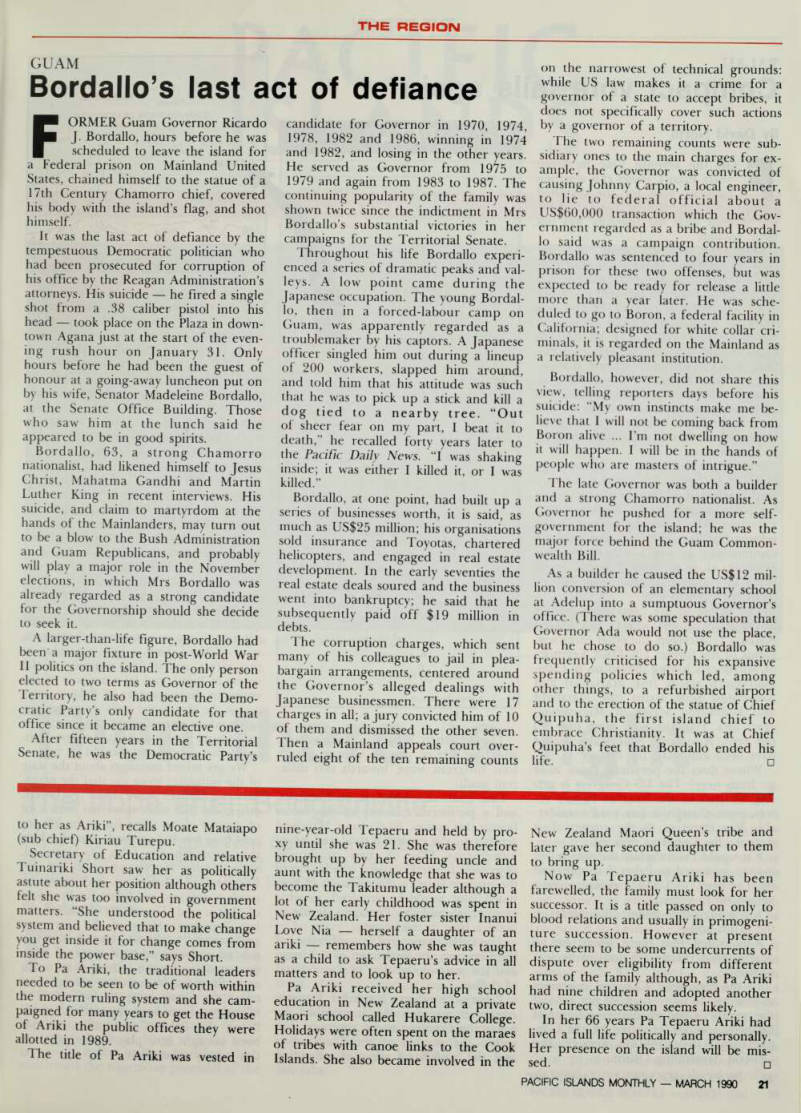
President of the House of Ariki (chiefs), died calling to the island and people she had represented for 45 years.
In the Cook Islands, flags flew at half mast as two days of mourning ending in a state funeral, followed the return of her body after her death in New Zea land. She returned from New Zealand accompanied by her husband Sir Tom Davis family, friends and repre sentatives of Arikinui Te Atairangi Kaahu (New Zealand Maori Queen).
The Cook Island ceremonies began at the airport on February 8 at 4.10 am where traditional and government lead ers as well as family received the body with a prayer service. The funeral party then accompanied Pa Ariki on her last traditional journey home, stopping at her tribal maraes and churches as well as her offices and her foster mother’s home. Crowds, including extended fami
ly members, gathered at each stopping
place to farewell her in prayer and pro vide refreshments for the funeral party.
After six hours of ceremony the coffin was finally carried to her home where her husband Sir Tom Davis and mem bers of her family welcomed her into the house and held a family service. The body lay in state the rest of the after noon. That evening representatives from around the island gathered at the house for an apare an evening of religious song intended to comfort the family and
signal her spirit’s ascent to the heavens.
The next morning, after a private ser vice at the house, a convoy of over a hundred vehicles escorted the body to the Bahai Centre where the Bahai com munity held a service in her honour. Pa Tepaeru Ariki had been a Bahai for 20 years. She was a founding member of the Cook Island Spiritual Assembly and one of the early translators of Bahai readings into Maori. Although a Bahai she was buried in Ariki fashion a sign of her importance as a symbol of tradi tion.
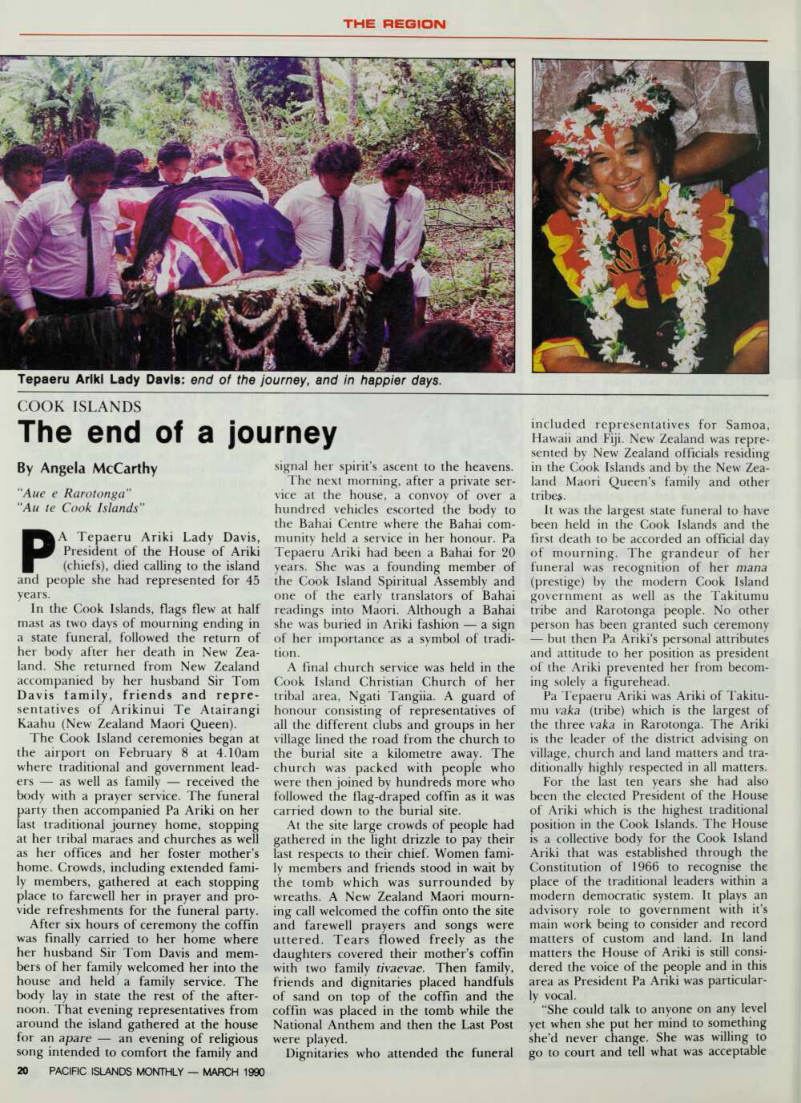
A final church service was held in the Cook Island Christian Church of her tribal area, Ngati Tangiia. A guard of honour consisting of representatives of all the different clubs and groups in her village lined the road from the church to the burial site a kilometre away. The church was packed with people who were then joined by hundreds more who followed the flag-draped coffin as it was carried down to the burial site.
At the site large crowds of people had gathered in the light drizzle to pay their last respects to their chief. Women fami ly members and friends stood in wait by the tomb which was surrounded by wreaths, A New Zealand Maori mourn ing call welcomed the coffin onto the site and farewell prayers and songs were uttered. Tears flowed freely as the daughters covered their mother’s coffin with two family tivaevae. Then family, friends and dignitaries placed handfuls of sand on top of the coffin and the coffin was placed in the tomb while the National Anthem and then the Last Post
were played.
Dignitaries who attended the funeral
included representatives for Samoa, Hawaii and Fiji. New Zealand was repre sented by New Zealand officials residing in the Cook Islands and by the New Zea land Maori Queen’s family and other tribes.
It was the largest state funeral to have been held in the Cook Islands and the first death to be accorded an official day of mourning. The grandeur of her funeral was recognition of her mana (prestige) by the modern Cook Island government as well as the Takitumu tribe and Rarotonga people. No other person has been granted such ceremony but then Pa Ariki’s personal attributes and attitude to her position as president of the Ariki prevented her from becom
ing solely a figurehead.
Pa Tepaeru Ariki was Ariki of Takitu mu vaka (tribe) which is the largest of the three vaka in Rarotonga. The Ariki is the leader of the district advising on village, church and land matters and tra ditionally highly respected in all matters.
For the last ten years she had also been the elected President of the House of Ariki which is the highest traditional position in the Cook Islands. The House is a collective body for the Cook Island Ariki that was established through the Constitution of 1966 to recognise the place of the traditional leaders within a modern democratic system. It plays an advisory role to government with it’s main work being to consider and record matters of custom and land. In land matters the House of Ariki is still consi dered the voice of the people and in this area as President Pa Ariki was particular ly vocal.
“She could talk to anyone on any level yet when she put her mind to something she’d never change. She was willing to go to court and tell what was acceptable
Tepaeru Ariki Lady Davis: end of the journey, and in happier days.
to her as Ariki”, recalls Moate Mataiapo (sub chief) Kiriau Turepu.
Secretary of Education and relative Tuinariki Short saw her as politically astute about her position although others felt she was too involved in government matters. “She understood the political system and believed that to make change you get inside it for change comes from inside the power base,” says Short.
To Pa Ariki, the traditional leaders needed to be seen to be of worth within the modern ruling system and she cam paigned for many years to get the House of Ariki the public offices they were allotted in 1989.
The title of Pa Ariki was vested in
nine-year-old Tepaeru and held by pro
xy until she was 21. She was therefore brought up by her feeding uncle and aunt with the knowledge that she was to become the Takitumu leader although a lot of her early childhood was spent in New Zealand. Her foster sister Inanui Love Nia herself a daughter of an ariki remembers how she was taught as a child to ask Tepaeru’s advice in all matters and to look up to her.
Pa Ariki received her high school education in New Zealand at a private Maori school called Hukarere College.
Holidays were often spent on the maraes of tribes with canoe links to the Cook Islands. She also became involved in the
New Zealand Maori Queen’s tribe and later gave her second daughter to them to bring up.
Now Pa Tepaeru Ariki has been farewelled, the family must look for her successor ‘ Bisa ** P a **ed on only to blood relations and usually in primogeni ture succession. However at present there seem to be some undercurrents of dispute over eligibility from different a ™s of the family although, as Pa Ariki had nine children and ado P te d another two direct succession seems likelv had lived a full life politically and personally.
Her presence on the island will be mis sed. □
Bordallo’s last act of defiance
Guam
FORMER Guam Governor Ricardo J. Bordallo, hours before he was scheduled to leave the island for a Federal prison on Mainland United States, chained himself to the statue of a 17th Century Chamorro chief, covered his body with the island’s flag, and shot himself.
It was the last act of defiance by the tempestuous Democratic politician who had been prosecuted for corruption of his office by the Reagan Administration’s attorneys. His suicide he fired a single shot from a .38 caliber pistol into his head took place on the Plaza in down town Agana just at the start of the even ing rush hour on January 31. Only hours before he had been the guest of honour at a going-away luncheon put on by his wife, Senator Madeleine Bordallo, at the Senate Office Building. Those who saw him at the lunch said he appeared to be in good spirits.
Bordallo, 63, a strong Chamorro nationalist, had likened himself to Jesus Christ, Mahatma Gandhi and Martin Luther King in recent interviews. His suicide, and claim to martyrdom at the hands of the Mainlanders, may turn out to be a blow to the Bush Administration and Guam Republicans, and probably will play a major role in the November elections, in which Mrs Bordallo was already regarded as a strong candidate for the Governorship should she decide to seek it.
A larger-than-life figure, Bordallo had been a major fixture in post-World War II politics on the island. The only person elected to two terms as Governor of the Territory, he also had been the Demo cratic Party’s only candidate for that office since it became an elective one.
After fifteen years in the Territorial Senate, he was the Democratic Party’s
candidate for Governor in 1970, 1974, 1978, 1982 and 1986, winning in 1974 and 1982, and losing in the other years.
He served as Governor from 1975 to 1979 and again from 1983 to 1987. The
continuing popularity of the family was
shown twice since the indictment in Mrs Bordallo’s substantial victories in her campaigns for the Territorial Senate.
Throughout his life Bordallo experi enced a series of dramatic peaks and val leys. A low point came during the Japanese occupation. The young Bordal lo, then in a forced-labour camp on Guam, was apparently regarded as a troublemaker by his captors. A Japanese officer singled him out during a lineup of 200 workers, slapped him around, and told him that his attitude was such that he was to pick up a stick and kill a dog tied to a nearby tree. “Out of sheer fear on my part, I beat it to death,” he recalled forty years later to the Pacific Daily News. “I was shaking inside; it was either I killed it, or I was killed.”
Bordallo, at one point, had built up a series of businesses worth, it is said, as much as US$25 million; his organisations sold insurance and Toyotas, chartered helicopters, and engaged in real estate development. In the early seventies the real estate deals soured and the business went into bankruptcy; he said that he subsequently paid off $l9 million in debts.
The corruption charges, which sent many of his colleagues to jail in plea bargain arrangements, centered around the Governor’s alleged dealings with Japanese businessmen. There were 17 charges in all; a jury convicted him of 10 of them and dismissed the other seven.
Then a Mainland appeals court over ruled eight of the ten remaining counts
on the narrowest of technical grounds: while US law makes it a crime for a governor of a state to accept bribes, it does not specifically cover such actions by a governor of a territory.
The two remaining counts were sub sidiary ones to the main charges for ex ample, the Governor was convicted of
causing Johnny Carpio, a local engineer,
to lie to federal official about a US$6O,OOO transaction which the Gov ernment regarded as a bribe and Bordal lo said was a campaign contribution.
Bordallo was sentenced to four years in prison for these two offenses, but was expected to be ready for release a little more than a year later. He was sche duled to go to Boron, a federal facility in California; designed for white collar cri minals, it is regarded on the Mainland as
a relatively pleasant institution.
Bordallo, however, did not share this view, telling reporters days before his suicide: “My own instincts make me be lieve that I will not be coming back from Boron alive ... I’m not dwelling on how it will happen. I will be in the hands of people who are masters of intrigue.”
The late Governor was both a builder and a strong Chamorro nationalist. As Governor he pushed for a more self government for the island; he was the major force behind the Guam Common wealth Bill.
As a builder he caused the US$l2 mil lion conversion of an elementary school at Adelup into a sumptuous Governor’s office. (There was some speculation that Governor Ada would not use the place, but he chose to do so.) Bordallo was frequently criticised for his expansive spending policies which led, among other things, to a refurbished airport and to the erection of the statue of Chief Quipuha, the first island chief to embrace Christianity. It was at Chief Quipuha’s feet that Bordallo ended his life. □
Compact vote fails again
Palau
By David North
FOR the seventh time in seven years Palau’s voters cast a strong majority vote for the disputed Compact with the United States, and for the seventh time the majority was not
large enough.
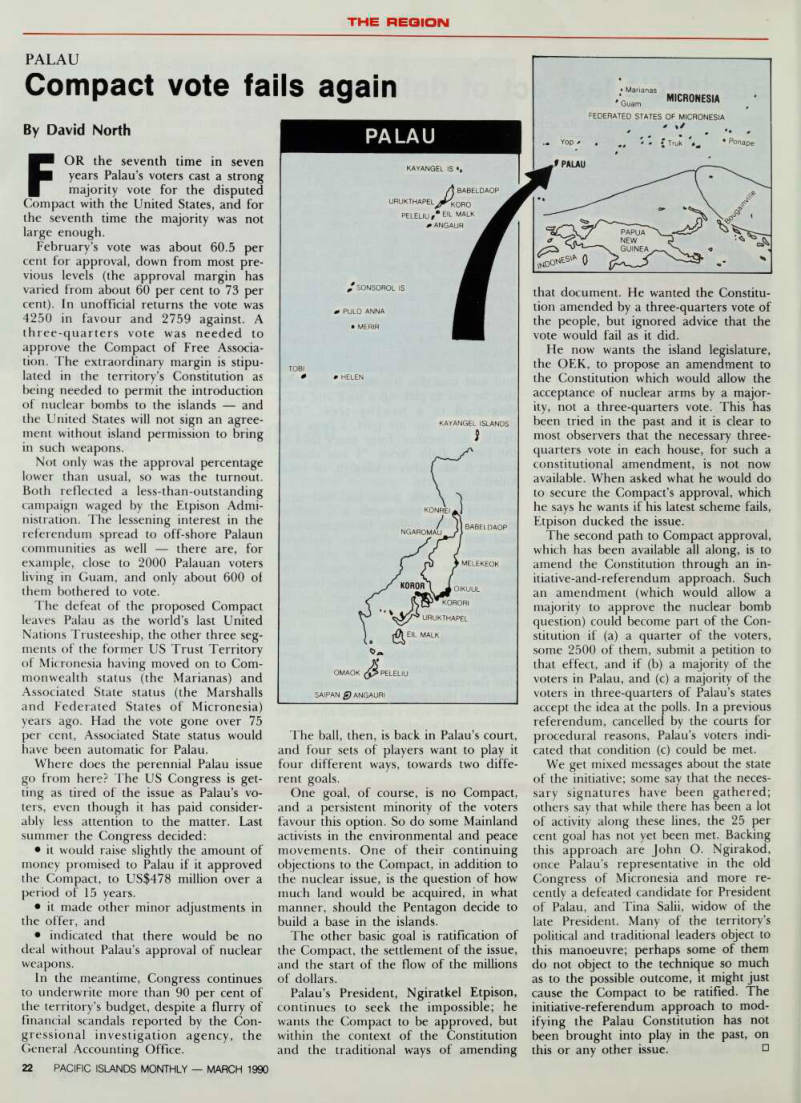
February’s vote was about 60.5 per cent for approval, down from most pre vious levels (the approval margin has varied from about 60 per cent to 73 per cent). In unofficial returns the vote was 4250 in favour and 2759 against. A three-quarters vote was needed to approve the Compact of Free Associa
tion. The extraordinary margin is stipu
lated in the territory’s Constitution as being needed to permit the introduction of nuclear bombs to the islands and the United States will not sign an agree ment without island permission to bring in such weapons.
Not only was the approval percentage lower than usual, so was the turnout.
Both reflected a less-than-outstanding campaign waged by the Etpison Admi nistration. The lessening interest in the referendum spread to off-shore Palaun communities as well there are, for example, close to 2000 Palauan voters living in Guam, and only about 600 of them bothered to vote.
The defeat of the proposed Compact leaves Palau as the world’s last United Nations Trusteeship, the other three seg ments of the former US Trust Territory of Micronesia having moved on to Com monwealth status (the Marianas) and Associated State status (the Marshalls and Federated States of Micronesia) years ago. Had the vote gone over 75 per cent, Associated State status would have been automatic for Palau.
Where does the perennial Palau issue go from here? The US Congress is get ting as tired of the issue as Palau’s vo ters, even though it has paid consider ably less attention to the matter. Last summer the Congress decided: • it would raise slightly the amount of money promised to Palau if it approved the Compact, to US$47B million over a period of 15 years. • it made other minor adjustments in the offer, and • indicated that there would be no deal without Palau’s approval of nuclear weapons.
In the meantime, Congress continues to underwrite more than 90 per cent of the territory’s budget, despite a flurry of financial scandals reported by the Con gressional investigation agency, the General Accounting Office.
The ball, then, is back in Palau’s court, and four sets of players want to play it four different ways, towards two diffe
rent goals.
One goal, of course, is no Compact, and a persistent minority of the voters favour this option. So do some Mainland activists in the environmental and peace movements. One of their continuing objections to the Compact, in addition to the nuclear issue, is the question of how much land would be acquired, in what manner, should the Pentagon decide to build a base in the islands.
The other basic goal is ratification of the Compact, the settlement of the issue, and the start of the flow of the millions of dollars.
Palau’s President, Ngiratkel Etpison,
continues to seek the impossible; he wants the Compact to be approved, but within the context of the Constitution and the traditional ways of amending
that document. He wanted the Constitu tion amended by a three-quarters vote of the people, but ignored advice that the vote would fail as it did.
He now wants the island legislature, the OEK, to propose an amendment to the Constitution which would allow the acceptance of nuclear arms by a major ity, not a three-quarters vote. This has been tried in the past and it is clear to most observers that the necessary three quarters vote in each house, for such a constitutional amendment, is not now available. When asked what he would do to secure the Compact’s approval, which he says he wants if his latest scheme fails, Etpison ducked the issue.
The second path to Compact approval,
which has been available all along, is to amend the Constitution through an in itiative-and-referendum approach. Such an amendment (which would allow a majority to approve the nuclear bomb question) could become part of the Con stitution if (a) a quarter of the voters, some 2500 of them, submit a petition to that effect, and if (b) a majority of the voters in Palau, and (c) a majority of the voters in three-quarters of Palau’s states accept the idea at the polls. In a previous referendum, cancelled by the courts for procedural reasons, Palau’s voters indi cated that condition (c) could be met.
We get mixed messages about the state of the initiative; some say that the neces sary signatures have been gathered; others say that while there has been a lot of activity along these lines, the 25 per cent goal has not yet been met. Backing this approach are John O. Ngirakod, once Palau’s representative in the old Congress of Micronesia and more re cently a defeated candidate for President of Palau, and Tina Salii, widow of the late President. Many of the territory’s political and traditional leaders object to this manoeuvre; perhaps some of them do not object to the technique so much as to the possible outcome, it might just cause the Compact to be ratified. The initiative-referendum approach to mod ifying the Palau Constitution has not been brought into play in the past, on this or any other issue. D
Advertisements & other items, p. 23 (1 item)
Pacific
ISLANDS
MONTHLY
BUSINESS
Closed: Bougainville copper mine; new oil strikes bring hope.
Then there is light
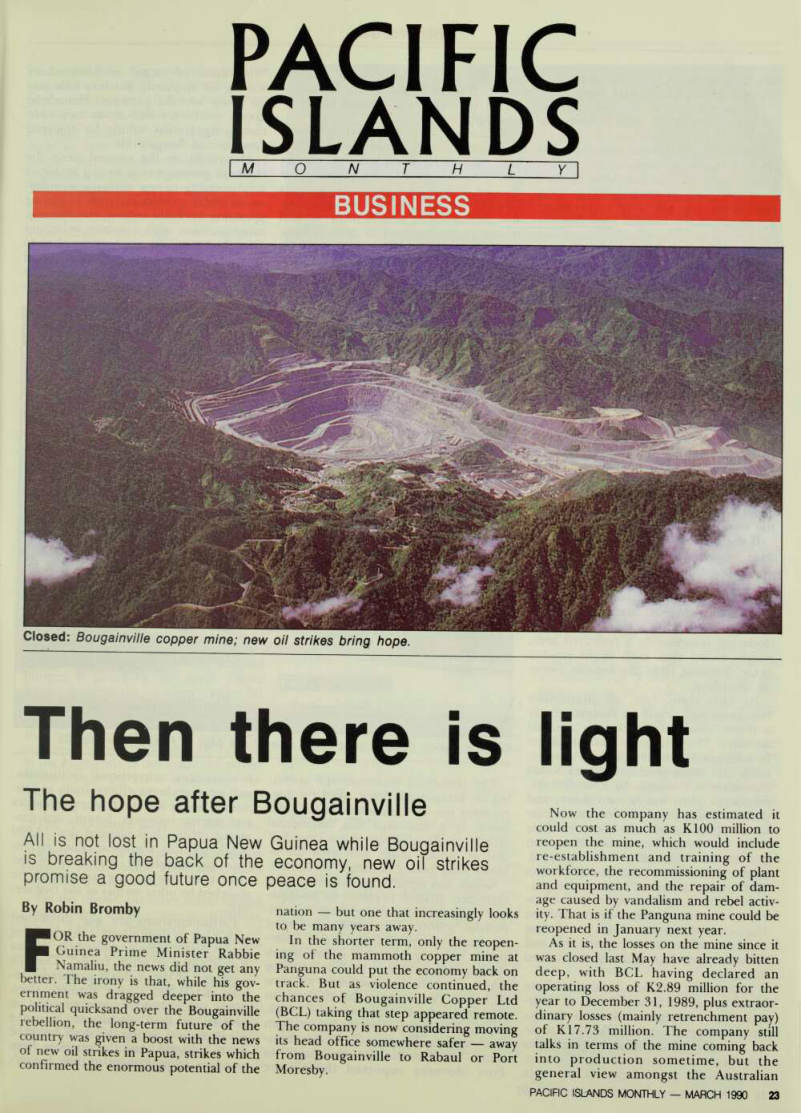
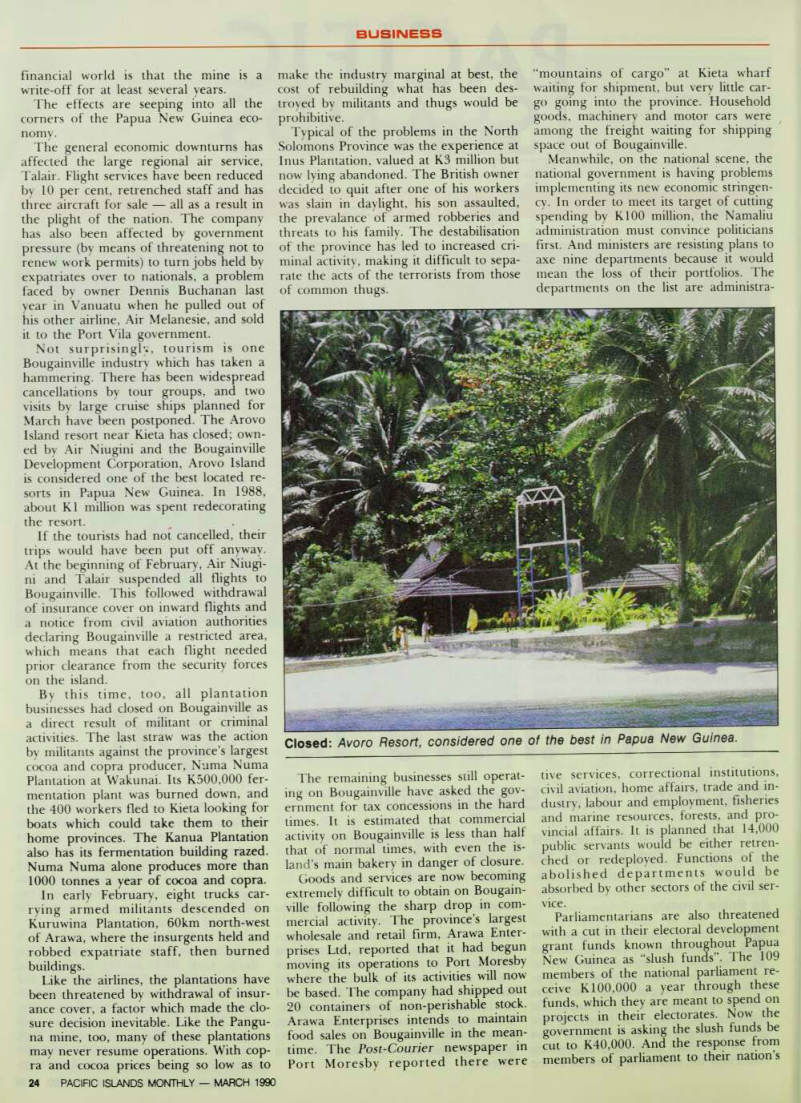
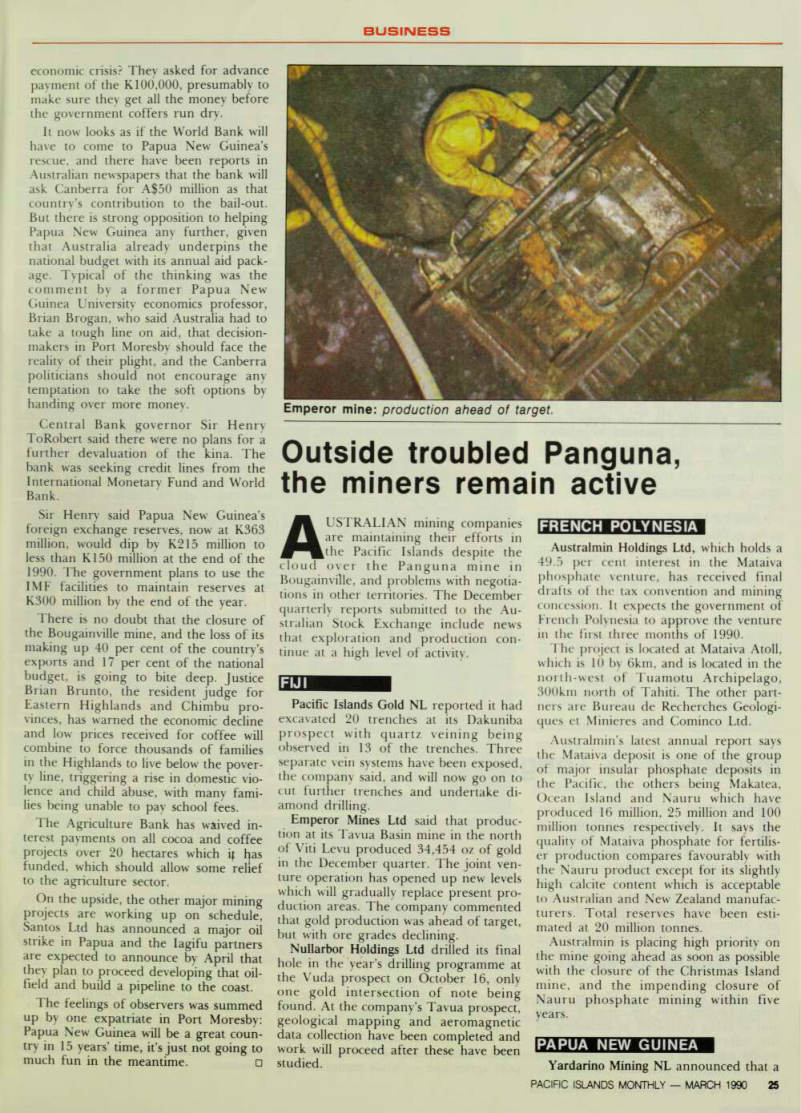
The hope after Bougainville
All is not lost in Papua New Guinea while Bougainville is breaking the back of the economy, new oil strikes promise a good future once peace is found.
By Robin Bromby
FOR the government of Papua New Guinea Prime Minister Rabbie Namaliu, the news did not get any better. The irony is that, while his gov ernment was dragged deeper into the political quicksand over the Bougainville rebellion, the long-term future of the country was given a boost with the news of new oil strikes in Papua, strikes which confirmed the enormous potential of the
nation but one that increasingly looks to be many years away.
In the shorter term, only the reopen ing of the mammoth copper mine at Panguna could put the economy back on track. But as violence continued, the chances of Bougainville Copper Ltd (BCL) taking that step appeared remote.
The company is now considering moving its head office somewhere safer away from Bougainville to Rabaul or Port Moresby.
Now the company has estimated it could cost as much as KlOO million to reopen the mine, which would include re-establishment and training of the workforce, the recommissioning of plant and equipment, and the repair of dam age caused by vandalism and rebel activ ity. That is if the Panguna mine could be reopened in January next year.
As it is, the losses on the mine since it was closed last May have already bitten deep, with BCL having declared an operating loss of K 2.89 million for the year to December 31, 1989, plus extraor
dinary losses (mainly retrenchment pay)
of K 17.73 million. The company still talks in terms of the mine coming back into production sometime, but the general view amongst the Australian
financial world is that the mine is a write-off for at least several years.
The effects are seeping into all the corners of the Papua New Guinea eco nomy.
The general economic downturns has affected the large regional air service, Talair. Flight services have been reduced by 10 per cent, retrenched staff and has three aircraft for sale all as a result in the plight of the nation. The company has also been affected by government pressure (by means of threatening not to renew work permits) to turn jobs held by expatriates over to nationals, a problem faced by owner Dennis Buchanan last year in Vanuatu when he pulled out of his other airline, Air Melanesie, and sold it to the Port Vila government.
Not surprisingly, tourism is one Bougainville industry which has taken a hammering. There has been widespread cancellations by tour groups, and two visits by large cruise ships planned for March have been postponed. The Arovo Island resort near Kieta has closed; own ed by Air Niugini and the Bougainville
Development Corporation, Arovo Island
is considered one of the best located re sorts in Papua New Guinea. In 1988, about K 1 million was spent redecorating the resort.
If the tourists had not cancelled, their trips would have been put off anyway.
At the beginning of February, Air Niugi ni and Talair suspended all flights to Bougainville. This followed withdrawal of insurance cover on inward flights and a notice from civil aviation authorities declaring Bougainville a restricted area, which means that each flight needed prior clearance from the security forces on the island.
By this time, too, all plantation businesses had closed on Bougainville as a direct result of militant or criminal activities. The last straw was the action
by militants against the province’s largest
cocoa and copra producer, Numa Numa Plantation at Wakunai. Its K 500,000 fer mentation plant was burned down, and the 400 workers fled to Kieta looking for boats which could take them to their home provinces. The Kanua Plantation also has its fermentation building razed.
Numa Numa alone produces more than 1000 tonnes a year of cocoa and copra.
In early February, eight trucks car rying armed militants descended on Kuruwina Plantation, 60km north-west of Arawa, where the insurgents held and robbed expatriate staff, then burned
buildings.
Like the airlines, the plantations have been threatened by withdrawal of insur ance cover, a factor which made the clo sure decision inevitable. Like the Pangu na mine, too, many of these plantations may never resume operations. With cop ra and cocoa prices being so low as to
make the industry marginal at best, the cost of rebuilding what has been des troyed by militants and thugs would be
prohibitive.
Typical of the problems in the North Solomons Province was the experience at Inus Plantation, valued at K 3 million but now lying abandoned. The British owner decided to quit after one of his workers was slain in daylight, his son assaulted, the prevalance of armed robberies and threats to his family. The destabilisation of the province has led to increased cri minal activity, making it difficult to sepa rate the acts of the terrorists from those of common thugs.
The remaining businesses still operat ing on Bougainville have asked the gov ernment for tax concessions in the hard times. It is estimated that commercial activity on Bougainville is less than half that of normal times, with even the is land’s main bakery in danger of closure.
Goods and services are now becoming extremely difficult to obtain on Bougain ville following the sharp drop in com mercial activity. The province’s largest wholesale and retail firm, Arawa Enter prises Ltd, reported that it had begun moving its operations to Port Moresby where the bulk of its activities will now be based. The company had shipped out 20 containers of non-perishable stock.
Arawa Enterprises intends to maintain food sales on Bougainville in the mean time. The Post-Courier newspaper in Port Moresby reported there were
“mountains of cargo” at Kieta wharf waiting for shipment, but very little car go going into the province. Household goods, machinery and motor cars were among the freight waiting for shipping space out of Bougainville.
Meanwhile, on the national scene, the national government is having problems implementing its new economic stringen cy. In order to meet its target of cutting spending by KlOO million, the Namaliu administration must convince politicians first. And ministers are resisting plans to axe nine departments because it would mean the loss of their portfolios. The departments on the list are administra
tive services, correctional institutions, civil aviation, home affairs, trade and in dustry, labour and employment, fisheries and marine resources, forests, and pro vincial affairs. It is planned that 14,000 public servants would be either retren ched or redeployed. Functions of the abolished departments would be absorbed by other sectors of the civil ser vice.
Parliamentarians are also threatened with a cut in their electoral development grant funds known throughout Papua New Guinea as “slush funds”. The 109 members of the national parliament re ceive K 100,000 a year through these funds, which they are meant to spend on projects in their electorates. Now the government is asking the slush funds be cut to K 40,000. And the response from members of parliament to their nation’s
Closed: Avoro Resort, considered one of the best in Papua New Guinea.
economic crisis? They asked for advance payment of the K 100,000, presumably to make sure they get all the money before the government coffers run dry.
It now looks as if the World Bank will have to come to Papua New Guinea’s rescue, and there have been reports in Australian newspapers that the bank will ask Canberra for Asso million as that country’s contribution to the bail-out.
But there is strong opposition to helping Papua New Guinea any further, given that Australia already underpins the national budget with its annual aid pack age. Typical of the thinking was the comment by a former Papua New Guinea University economics professor, Brian Brogan, who said Australia had to take a tough line on aid, that decision makers in Port Moresby should face the reality of their plight, and the Canberra politicians should not encourage any temptation to take the soft options by handing over more money.
Central Bank governor Sir Henry Toßobert said there were no plans for a further devaluation of the kina. The bank was seeking credit lines from the International Monetary Fund and World Bank.
Sir Henry said Papua New Guinea’s foreign exchange reserves, now at K 363 million, would dip by K 215 million to less than Kl5O million at the end of the 1990. The government plans to use the IMF facilities to maintain reserves at K3OO million by the end of the year.
There is no doubt that the closure of the Bougainville mine, and the loss of its making up 40 per cent of the country’s exports and 17 per cent of the national budget, is going to bite deep. Justice Brian Brunto, the resident judge for Eastern Highlands and Chimbu pro vinces, has warned the economic decline and low prices received for coffee will combine to force thousands of families in the Highlands to live below the pover ty line, triggering a rise in domestic vio lence and child abuse, with many fami lies being unable to pay school fees.
The Agriculture Bank has waived in terest payments on all cocoa and coffee projects over 20 hectares which if has funded, which should allow some relief to the agriculture sector.
On the upside, the other major mining projects are working up on schedule, Santos Ltd has announced a major oil strike in Papua and the lagifu partners are expected to announce by April that they plan to proceed developing that oil field and build a pipeline to the coast.
The feelings of observers was summed up by one expatriate in Port Moresby: Papua New Guinea will be a great coun try in 15 years’ time, it’s just not going to much fun in the meantime. □
Outside troubled Panguna,
the miners remain active
AUSTRALIAN mining companies
are maintaining their efforts in the Pacific Islands despite the cloud over the Panguna mine in
Bougainville, and problems with negotia
tions in other territories. The December quarterly reports submitted to the Au stralian Stock Exchange include news that exploration and production con tinue at a high level of activity.
Fiji
Pacific Islands Gold NL reported it had excavated 20 trenches at its Dakuniba prospect with quartz veining being observed in 13 of the trenches. Three separate vein systems have been exposed, the company said, and will now go on to cut further trenches and undertake di
amond drilling.
Emperor Mines Ltd said that produc tion at its Tavua Basin mine in the north of Viti Levu produced 34,454 oz of gold in the December quarter. The joint ven ture operation has opened up new levels which will gradually replace present pro duction areas. The company commented that gold production was ahead of target, but with ore grades declining.
Nullarbor Holdings Ltd drilled its final hole in the year’s drilling programme at the Vuda prospect on October 16, only one gold intersection of note being found. At the company’s Tavua prospect,
geological mapping and aeromagnetic
data collection have been completed and work will proceed after these have been studied.
French Polynesia
Australmin Holdings Ltd, which holds a 49.5 per cent interest in the Mataiva phosphate venture, has received final drafts of the tax convention and mining concession. It expects the government of French Polynesia to approve the venture in the first three months of 1990.
The project is located at Mataiva Atoll, which is 10 by 6km, and is located in the north-west of Tuamotu Archipelago, 300 km north of Tahiti. The other part ners are Bureau de Recherches Geologi ques et Minieres and Cominco Ltd.
Australian's latest annual report says the Mataiva deposit is one of the group of major insular phosphate deposits in the Pacific, the others being Makatea, Ocean Island and Nauru which have produced 16 million, 25 million and 100 million tonnes respectively. It says the quality of Mataiva phosphate for fertilis er production compares favourably with the Nauru product except for its slightly high calcite content which is acceptable to Australian and New Zealand manufac turers. Total reserves have been esti mated at 20 million tonnes.
Australmin is placing high priority on
the mine going ahead as soon as possible with the closure of the Christmas Island mine, and the impending closure of Nauru phosphate mining within five years.
Papua New Guinea
Yardarino Mining NL announced that a
Emperor mine: production ahead of target.
subsidiary company had been granted two prospecting licences in the Gulf of Papua. The two tenements cover 3838 sq km along 100 km of shoreline. The
beaches along this highly prospective
coastal area contain black sands which are mainly magnetite and ilmenite. Re search conducted back in the 1960 s indi cates that some of the sand contains up to three per cent combined zircon and rutile. Yardarino said the project has the added advantage of an easily accessible section (by boat) of Papua New Guinea, and one which is free of political prob lems.
Three junior Australian oil explorers, Trident Petroleum NL, First Australian Re sources NL and Victoria Petroleum NL have been joined in a venture by the United States giants, Exxon Corporation and the Du Pont Group, who have farmed into exploration areas PPL 106 and PPL 117 in the Fly River area. The first of four wells to be drilled on the permits near the Ok Tedi copper and gold mine had the potential to produce more than one billion barrels of oil, a consortium spokesman said. The Amer ican partners will fund the development costs in the event of a commercial dis covery.
Austin Oil NL has requested a variation to the drilling commitment on PPL 60 on the Papuan Fold Belt, and this has been granted by the government. The com pany is now pursuing its project to use gas from PPL 60 to generate electricity for the Port Moresby area.
Browns Creek Gold NL has exercised its option to acquire all the shares in the unlisted company Fly Delta Petroleum NL, the licensee of PPL 87 in the Fly River delta. Canadian Occidental Pet roleum Ltd and Husky Oil International
Inc (also of Canada) have now farmed into PPL, 87 agreeing to fund 100 per cent of completing 300 km of the seismic work. The two Canadian companies will also drill the first well to earn a 50 per cent interest in PPL 87.
Placer Pacific Ltd and Highlands Gold Ltd announced they had upgraded pro duction expectations at the Porgera gold mine. They now believe they can extract 2.2 million ounces of gold more than
previously announced.
Construction of the 1500 tonnes-a-day plant is well advanced, with completion due in the third quarter of 1990. Plans call for 8000 tonnes a day of ore proces sing once the mine is in full production.
The joint venture partners have also increased their estimates of capital costs, saying they have added 25 per cent to the May 1989 feasibility study figure of K 660 million. This blow-out of cost re flects site construction experience, and extra costs in respect to land compensa tion and infrastructure expenses.
Work continued on upgrading both the National Highway and Enga Provin cial Highway to allow for transport of
the large plant equipment. Other roads
around the Porgera site are also being upgraded for local traffic and the haul age fleet.
More than 900 metres of underground development work was completed in the December quarter, as was the power line survey from the Hides gasfield in the Southern Highlands to the Porgera mine.
At Porgera, the total project workforce now stands at about 2300, of whom 1600 are Porgerans or Engans.
Placer Pacific, which has an 80 per cent interest in the Misima gold mine, reported that project produced 86,890 oz
of gold in the December quarter, and 533, 370 oz of silver. These figures were above estimated production totals.
In January, Highlands Gold reached an agreement with New Britain Mining Pty Ltd to acquire five prospecting li cences in East New Britain province foi K 6.1 million. One of the prospecting areas, 508 Uramit, includes the Wild Dog prospect where exploration has estab lished a gold-copper-silver resource.
Porgera Gold Dredging (PNG) Ltd, listed on the Australian Stock Exchange last October, reported that work was well advanced on its alluvial gold project at Porgera. Production is expected to begin
in April.
The company is also negotiating with Masurina Ltd, a landowners’ company at Milne Bay, for the mining of alluvial gold deposits on areas over which it and Masurina hold prospecting licences.
Adelaide Petroleum NL is a partner in PPL 108, located in the Papuan Fold Belt 100 km to the west of the lagifu-Hedinia oil field. The company said that, based on farm-out agreements which had re cently been achieved in adjoining licence areas, Adelaide Petroleum was confident PPL 108 would find farm-in partners.
Solomon Islands
Solomon Pacific Resources NL, which holds 50 per cent of the Malukuna pros pect, said the operating partner, Poseidon Exploration Ltd, working as part of its farm-in deal, had carried out ridge and spur soil sampling which had
outlined a prominent gold anomaly in
the upper reaches of Kichia Creek; this will be tested by trenching as part of the 1990 exploration programme. □
Investing in Tonga
THE Bank of Tonga has spent T 575,000 to print 10,000 copies of a booklet, Investing in Tonga, to work as a marketing tool for the king dom. General Manager Brynmor Harris said the publication has already received very favourable comment within Tonga.
It will be available free through Ton ga’s Ministry of Finance, the Bank of Tonga, Ministry of Labour, Commerce and Industries, and through branches of Westpac, Bank of New Zealand and Bank of Hawaii.
Investing in Tonga is a 32-page, large format booklet, with full colour printing and is being promoted as including all the information a prospective investor would need. In a foreword, Industries Minister Baron Vaea said characteristic
elements of Tonga’s economy, financial system and regulations might not be readily understood by outsiders. “Col lecting this type of information is a time consuming and costly exercise which can detract from the overall attractiveness of a prospective investment hence the great value of this publication,” he said.
Tonga’s economy is still based pre dominantly on agriculture, with 60 per cent of the population depending on the land for their livelihood. This sector con tributes about 47 per cent of the nation’s gross domestic product (GDP). The in vestment guide puts the services sector at 42 per cent of GDP, manufacturing six per cent. However, agriculture is declin ing as a share of GDP especially ex port agriculture while manufacturing
and services industries are growing.
The tourism industry continues to ex pand and, while small in comparison with other South Pacific destinations, it has become one of the major sectors of the Tongan economy.
Australia and New Zealand are the kingdom’s main trading partners, buying 70 per cent of Tonga’s exports between them. These countries also dominate im ports, although the United States and Japan have expanded their sales to Ton ga in recent years.
Investing in Tonga is divided into eight sections; Tonga an overview; In vesting in Tonga; Company formation and registration; investment incentives; taxation; banking, finance and exchange control; infrastructure and services, and Tonga’s attractions as viewed by foreign investors. D
Advertisements & other items, pp. 27-30 (1 item)
£\K\vW\\i\ti\^A
I
□ESEXQESE3I9
in mi HH
JUST LANDED
F/Rje/H/C/H/ /
’fi//E/W/ / / / /
£\K\vW\\i\ti\^A
Who can you
bank on no matter
where you land
in the Pacific?
Westpac has a strong presence in this part of the world.
The Westpac \l# is a familiar and welcome sight throughout the South Pacific.
W ith the recent purchase of the operations of the Banque Indosuez in French Polynesia and New Caledonia, no matter where you land in the region, you’ll find Westpac.
The Banque Indosuez connection, with its 46 branches, brings to eleven the number of South Pacific countries where Westpac has a presence.
Our programme of expansion is a planned one and is part of our overall aim to build and maintain a reputation that people and businesses in the Pacific can bank on.
We see our role as being closely involved in the Pacific’s development.
It’s a role that covers not only multinational companies and major operators, it also extends to small local business people and entrepreneurs.
Westpac has a commitment to the Pacific. And it’s a commitment you can bank on. Wherever you land. ll# You can bank on Westpac Branches: Bahrain. Beijing. Chicago. Columbus. Frankfurt. Hong Kong. Honiara. Houston. Jakarta. Kuala Lumpur. London. Los Angeles. New York.
Niue. Noumea. Papeete. Port Moresby. Port Vila. Rarotonga. San Francisco. Seoul. Singapore. Suva. Sydney. Taipei. Tokyo. Wellington.
Subsidiary: Kiribati (Bank of Kiribati Ltd, Tarawa) Affiliates: Tonga (Bank of Tonga. Nukualofa) .Tuvalu (National Bank of Tuvalu, Funafuti) .Western Samoa (Pacific Commercial Bank Ltd, Apia)
The Toyota Hilux is the world’s most popular pick-up.
And the Hilux 4X4 is the best-selling Hilux of them all. Which stands to reason. People around the world respect Toyota’s attention to style. Hilux’s car-like comfort. Rugged reliability. And as you might expect from Toyota, power. This, of course, is the most important asset for a truck. And happily, the Hilux 4X4 offers a choice of four powerful engines: 2.8 and 2.4-litre diesel engines. Plus 2.2 and 1.8-litre petrol engines. When it comes to power and good looks, nobody can beat Toyota. Nobody.
TOYOTA
% i H a.
Sfc V V a i
Wrre lielpino the economy
1 IT9 /»/• J
take on.
mm ■3 The fact is tourism is one of our most critical sources of income.. .and we’re doing our best to bring tourist dollars into the country. Our 747, a new 767, and ATR’s will help carry almost 150,000 people into Fiji this year direct from Japan, Australia, New Zealand and the Pacific Islands.
They’ll spend
around SlOO million dollars which will flow throughout our economy to the people of Fiji. At resorts, shops, markets, restaurants... you name it. Everyone benefits because tourist dollars circulate to every quarter of our community, creating jobs and improving living standards.
No matter how you look at it, we at Air Pacific are really helping the economy take off. Air Pacific. The rainbow from Fiji.
AIR PACIFIC
FIJI'S INTERNATIONAL AIRLINE
Fiji marble sparks territorial row
A HUGE marble deposit near Sigatoka is the subject of claim and counter-claim between Fiji Government officials and an Australian mining company. The picture is further confused by the presence of a second Australian miner who says it is the only company which has fulfilled its legal obligations in relation to the marble pro ject. The row centres on an area near Toga village in the Sigatoka Valley on Viti Levu.
Two leases covering marble deposits have been covered by prospecting li cences. One has been granted to Paget
Goldmining (Fiji) Ltd, a subsidiary of
Paget Gold Mining Co Ltd, which is a company listed on the Australian Stock Exchange. This area covers 350 hectares.
There is no controversy about this lease Fiji’s Department of Mineral Re sources has confirmed the lease exists.
The second area involves an adjacent 200 ha. This is the disputed territory.
The Department of Mineral Resources said the prospecting lease is held by
Korosoniyasa Holdings Company Ltd,
which is a local landowner vehicle. An unlisted Australian company, Major Min ing Ltd, claims it has a partnership deal with the landowners the government replies that Major has no permission at the moment to enter such an agreement as it does not have the necessary author isation from the department or the minister.
There is quite a lot at stake; Major Mining has announced that the area over which it has staked a joint venture claim contains at least 53 million tonnes of marble. Major’s chairman Dr Frank Corbett described the deposists as being equal with Italian marble, with a very fine grain and excellent polishing char acteristics. It has been dubbed “Fiji Pink” by Major. Dr Corbett told Pacific Islands Monthly he has had many enquiries, especially from resort projects, about the stone.
Major has said it is now involved in a
feasibility study, with the venture being
launched around August and probably including a Fs2 million marble proces
sing centre. Major said its subsidiary,
Major Pacific Ltd, has a joint venture agreement with Korosoniyasa and the Australian partner has so far spent A$ 100,000. It is the first joint venture agreement in Fiji which gives the land owners a 50 per cent equity; if the deal survives the official government proces ses, the landowners will provide the min ing licence and will have preferential
employment rights.
Major has also made much of the de posits being easily accessible a claim disputed by Paget, and backed by the
Department of Mineral Resources. Paget chairman Roger Stroud told Pacific Is lands Monthly that the only access Koro soniyasa/ Major have is through Paget’s prospecting area. “What are they going to do mine by balloon? ” said Stroud.
He said Paget had spent money, time and effort to follow the Fiji government requirements, another claim confirmed by the department. “We are doing every
thing the right way,” added Stroud.
Paget was now three-quarters of the way through its environmental impact state ment. But Stroud does agree with Cor bett about the value of the area. “It has potential there is no problem about that,” he said.
It was after initial publicity for the Ma jor Mining scheme that the dispute boiled up. The Department of Mineral Resources said it had not approved the joint venture between Major and the landowners’ company. Dr Corbett coun ter-claimed the joint venture had lodged two signed and sealed copies of the min ing agreement with the department and had also received a mineral export permit.
Mineral Resources’ deputy director Alfred Simpson has branded this claim as “thoroughly misleading”. In a written release, he said when the department heard of the proposed joint venture it wrote to the companies involved to advise them of the correct procedure.
That letter was dated November 17, and at February 6 the department had re ceived no reply.
Lack of permission did not prevent Major assisting the local company which held the prospecting licence.“lt merely means that the Australian company can not acquire any holding in the licence area or the benefits which might be gained from work and money invested in it,” said Simpson. The export licence was for samples being sent for testing in Australia, and had been issued to Major Mining with the permission of Koroso niyasa not to Major as the licence holder itself.
Simpson said the department would require a written agreement on com pensation, and a full environmental im pact report, before any mining licence would be considered. In fact, said Simp son, Korosoniyasa’s licence expired on December 31, and was allowed to lapse even though the department had sent the company a reminder before that date. Since then, Korosoniyasa has ap plied for a new licence.
Meanwhile, Dr Corbett remains opti mistic. He still says the plan is for pro duction this year, and the company has sent out samples to architects. □
Advertisements & other items, p. 31 (1 item)
Kiwis
m * fL *
THREE
MILLION
KIWIS
AT YOUR FINGERTIPS
And so too is a potential market of 3.2 million l. cosmopolitan New Zealanders.
As a Forum Island nation, exploration and development of new markets can be a difficult and frustrating exercise.
Now, through the establishment in New Zealand of the South Pacific Trade Office, you have direct access to a variety of services that are specifically geared to assist you in the export and promotion of South Pacific products into New Zealand.
Services include market research, marketing plans, identification of potential customers, office facilities, product displays, participation in trade fairs, and secondments.
For further details contact...
SOUTH
TRADE
PACIFIC
OFFICE
Jetset Centre, 44 Emily Place, PO. Box 774, Auckland 1. New Zealand.
Phone (09) 302-0465, Fax (09) 776-642, Telex SPTO NZ63328.
Madison 3734
Solomon Star
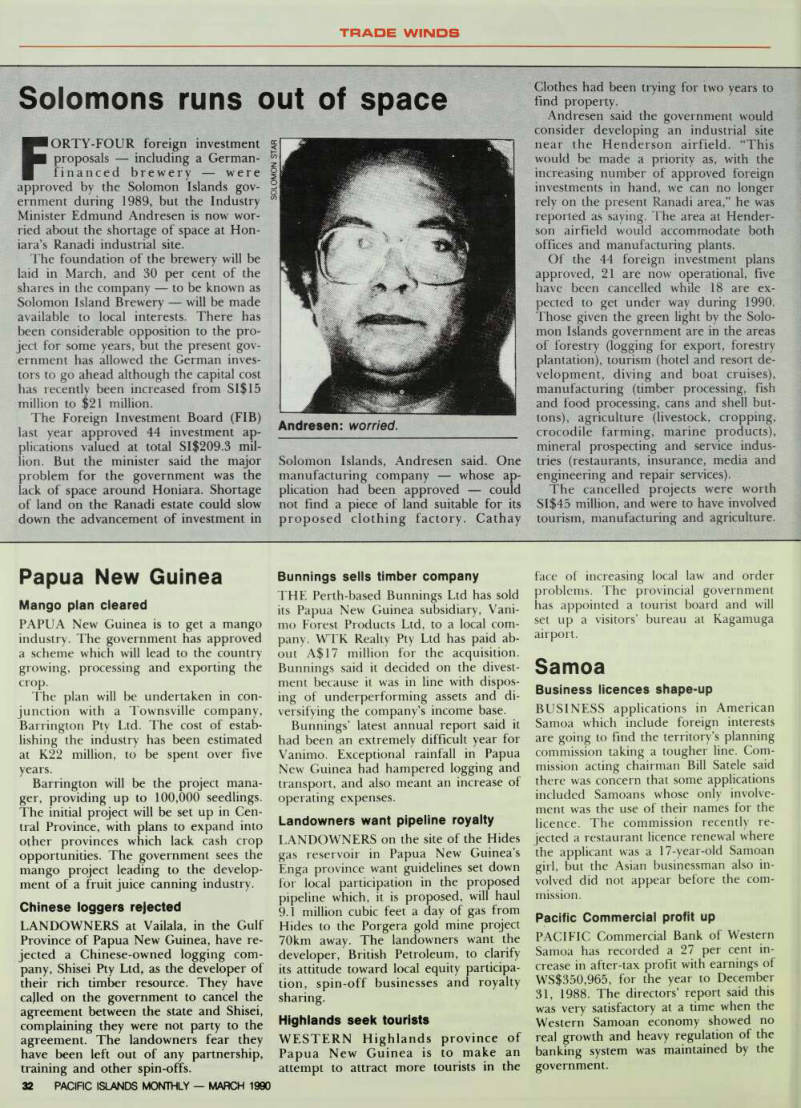
Trade Winds
Solomons runs out of space
FORTY-FOUR foreign investment
proposals including a German
financed brewery were approved by the Solomon Islands gov ernment during 1989, but the Industry Minister Edmund Andresen is now wor ried about the shortage of space at Hon iara’s Ranadi industrial site.
The foundation of the brewery will be laid in March, and 30 per cent of the shares in the company to be known as Solomon Island Brewery will be made available to local interests. There has been considerable opposition to the pro ject for some years, but the present gov ernment has allowed the German inves tors to go ahead although the capital cost has recently been increased from Sls 15 million to $2l million.
The Foreign Investment Board (FIB) last year approved 44 investment ap plications valued at total 515209.3 mil lion. But the minister said the major problem for the government was the lack of space around Honiara. Shortage of land on the Ranadi estate could slow down the advancement of investment in
Solomon Islands, Andresen said. One manufacturing company whose ap plication had been approved could not find a piece of land suitable for its
proposed clothing factory. Cathay
Clothes had been trying for two years to find property.
Andresen said the government would consider developing an industrial site near the Henderson airfield. “This would be made a priority as, with the
increasing number of approved foreign
investments in hand, we can no longer rely on the present Ranadi area,” he was reported as saying. The area at Hender son airfield would accommodate both
offices and manufacturing plants.
Of the 44 foreign investment plans approved, 21 are now operational, five have been cancelled while 18 are ex pected to get under way during 1990.
Those given the green light by the Solo mon Islands government are in the areas of forestry (logging for export, forestry plantation), tourism (hotel and resort de velopment, diving and boat cruises),
manufacturing (timber processing, fish
and food processing, cans and shell but
tons), agriculture (livestock, cropping,
crocodile farming, marine products), mineral prospecting and service indus tries (restaurants, insurance, media and
engineering and repair services).
The cancelled projects were worth Sls4s million, and were to have involved tourism, manufacturing and agriculture.
Papua New Guinea
Mango plan cleared PAPUA New Guinea is to get a mango industry. The government has approved a scheme which will lead to the country
growing, processing and exporting the
crop.
The plan will be undertaken in con junction with a Townsville company, Barrington Pty Ltd. The cost of estab lishing the industry has been estimated at K 22 million, to be spent over five years.
Barrington will be the project mana ger, providing up to 100,000 seedlings.
The initial project will be set up in Cen tral Province, with plans to expand into other provinces which lack cash crop opportunities. The government sees the
mango project leading to the develop
ment of a fruit juice canning industry.
Chinese loggers rejected LANDOWNERS at Vailala, in the Gulf Province of Papua New Guinea, have re jected a Chinese-owned logging com pany, Shisei Pty Ltd, as the developer of their rich timber resource. They have cajled on the government to cancel the agreement between the state and Shisei, complaining they were not party to the agreement. The landowners fear they have been left out of any partnership, training and other spin-offs.
Bunnings sells timber company THE Perth-based Bunnings Ltd has sold its Papua New Guinea subsidiary, Vani mo Forest Products Ltd, to a local com pany. WTK Realty Pty Ltd has paid ab out A|l7 million for the acquisition.
Bunnings said it decided on the divest ment because it was in line with dispos ing of underperforming assets and di versifying the company’s income base.
Bunnings’ latest annual report said it had been an extremely difficult year for Vanimo. Exceptional rainfall in Papua New Guinea had hampered logging and transport, and also meant an increase of operating expenses.
Landowners want pipeline royalty LANDOWNERS on the site of the Hides gas reservoir in Papua New Guinea’s Enga province want guidelines set down for local participation in the proposed pipeline which, it is proposed, will haul 9.1 million cubic feet a day of gas from Hides to the Porgera gold mine project 70km away. The landowners want the developer, British Petroleum, to clarify its attitude toward local equity participa tion, spin-off businesses and royalty sharing.
Highlands seek tourists
WESTERN Highlands province of
Papua New Guinea is to make an attempt to attract more tourists in the
face of increasing local law and order
problems. The provincial government
has appointed a tourist board and will set up a visitors’ bureau at Kagamuga airport.
Samoa
Business licences shape-up BUSINESS applications in American Samoa which include foreign interests are going to find the territory’s planning commission taking a tougher line. Com mission acting chairman Bill Satele said there was concern that some applications included Samoans whose only involve ment was the use of their names for the licence. The commission recently re jected a restaurant licence renewal where the applicant was a 17-year-old Samoan girl, but the Asian businessman also in volved did not appear before the com mission.
Pacific Commercial profit up PACIFIC Commercial Bank of Western Samoa has recorded a 27 per cent in crease in after-tax profit with earnings of W 55350,965, for the year to December 31, 1988. The directors’ report said this was very satisfactory at a time when the Western Samoan economy showed no real growth and heavy regulation of the banking system was maintained by the government.
Solomon Star
Andresen: worried.
Solomon Islands
Casino gets green light A CASINO resort costing Sls2l million has got the green light from the Solo mon Islands government. It will be built at Mamara, west of Honiara, by an Au stralian company, Swain (SI) Ltd which is a subsidiary of Industrial Performance Group Ltd. The casino had previously been opposed by the Guadalcanal Pro vincial government.
Airline to lease 737 SOLOMON Airlines is to lease a Boeing 737 airliner from a California finance company, and will introduce the aircraft on its routes from June 1. The 100-seat aircraft will be replaced in 1992 by a later version of the 737 which can carry 140 passengers. The 737 will be used on the three weekly flights between Honiara and Brisbane, and will fly once a week to Fiji, Vanuatu and Papua New Guinea.
With the introduction of the stretched version in 1992, Solomon Airlines hopes to expand its routes to include South east Asia and Japan. Air New Zealand will be responsible for maintenance of the new jet.
Fish deal extended THE Solomon Islands government has extended its agreement under which Japanese tuna boats have access to the country’s economic zone. A government
spokesman was reported as saying the
12-month extension will give the admi nistration the time it needs to review fishing policies. Under the present agreement, the Solomon Island govern ment received about Sls3 million a year by way of licence fees from the Japanese tuna fleet.
Micronesia
Garbage bid on again Marshall Islands is again the target of a waste management company, following an earlier unsuccessful attempt to use the islands for the disposal of household garbage from the United States. The earlier bid was made by Admiralty Paci fic Inc. Now another company, Microne sian Marine Development Inc, wants to use Kwajalein Atoll as a dump by means of landfill. The company will spend USSSOO,OOO on a feasibility study.
Tinian starts visitor centre ALTHOUGH tourism is still in its infan cy on the island, Tinian in the Northern Mariana group has begun work on a visi tor centre. The island, separated by ab out 5 km of water from Saipan, is about to have a high-speed boat service from
Tonga
Friendly nears profitability TONGA’S government-owned Friendly Island Airways is getting closer to pro fitability after widening its revenue base to 63 inter-island flights a week. The airline has also installed a computer sys tem which allows it to make bookings for any airline in the world, and accept bookings from abroad for its own flights.
General manager Dennis Hoskin said its current operations were in the black, but Friendly Islands Airways was carrying losses from the past years.
New terminal started CONSTRUCTION of the T$6 million terminal at Tonga’s Fua’motu interna tional airport was to have begun in February. The project is being funded by Japanese aid. The new terminal will be used by both domestic and interna tional passengers, with the existing build ing being turned into offices for the De partment of Civil Aviation. It is expected the new terminal will be in use by March next year.
Pumpkin sales promise JAPANESE agents have confirmed they will buy 5000 tonnes of pumpkins from
Tonga during 1990 despite some prob
lems with the initial shipment last year, including weak crates, bad packing and some evidence of fruit fly. Tonga earned a net T$600,000 in foreign exchange for the 3000 tonnes of pumpkins shipped to Japan in late 1989. The 76 million pumpkins were grown on allotments covering 800 hectares.
the main island and the locals hope Air Micronesia will begin a regular shuttle.
Palau raises rejected PLANS to pay the majority of Palau’s government workers more money have been blocked by the United States De partment of the Interior, saying the is land state lacks the U 55489,500 neces sary. Government workers in the trust territory number about 1200.
Marshalls airline expands IN a service similar to that of Air Raro tonga, Airline of the Marshall Islands has used Hawaii Airlines aircraft and crews to expand its network. The Ma juro-based carrier now operates the DC -8 jet twice a week between its home base and Honolulu. The aircraft is a combi type, which has a large cargo section at the rear.
Fiji
Beef shortage BUTCHERS in Fiji have reported a con tinuing shortage of beef. The Ministry of Primary Industries is predicting these shortages will occur for a few years as a result of many cattle having been sold or dying during the 1987 drought.
Trade deficit up SOARING imports pushed Fiji’s trade deficit to a record F 5366 million for calendar 1989. This was a 160 per cent increase in the 1988 figure, and has been attributed to a surge in imports.
Exports rose marginally over the year from Fsslß million to F 5672 million, but imports shot up from F 5659 million to a new high of Fs93B million. Much of the import rise resulted from a huge inflow of materials and capital goods under Fiji’s tax-free zone scheme.
Bid to wipe out moth A TEAM of Australian scientists visited Fiji, Western Samoa and Tonga to study the destructive Fruit Piercing Moth, which threatens the region’s fruit indus try. The scientists are evaluating biolo gical controls by use of a parasite.
Metal ordered STANDARD Concrete, a Suva-based company, has an order for 7500 tonnes of crushed metal to be shipped to Vanuatu for use on a wharf at Santo Island. The order, worth USSI2O,OOO is thought to be the largest aggregate ex port order from Fiji.
Cook Islands
Cooks moves to solar COOK Islands technicians have been sent to French Polynesia to train in the use of solar power to prepare for the introduction of a system in the Northern islands.
France is lending the Cooks NZsl3.s million for the project and the upgrad ing of Rarotonga’s power and water sup plies. Pukapuka will be the first island to have solar-generated electricity.
Pearl farm grows THE United States Agency for Interna tional Development is putting up NZ$25 million to aid the development of a black pearl industry on the island of Suwar row, with possible extension to Penrhyn and Pukapuka. The Cook Islands Public Works Department will be responsible for building a jetty, septic tank and wa ter system for pearl farm workers.
boom industry
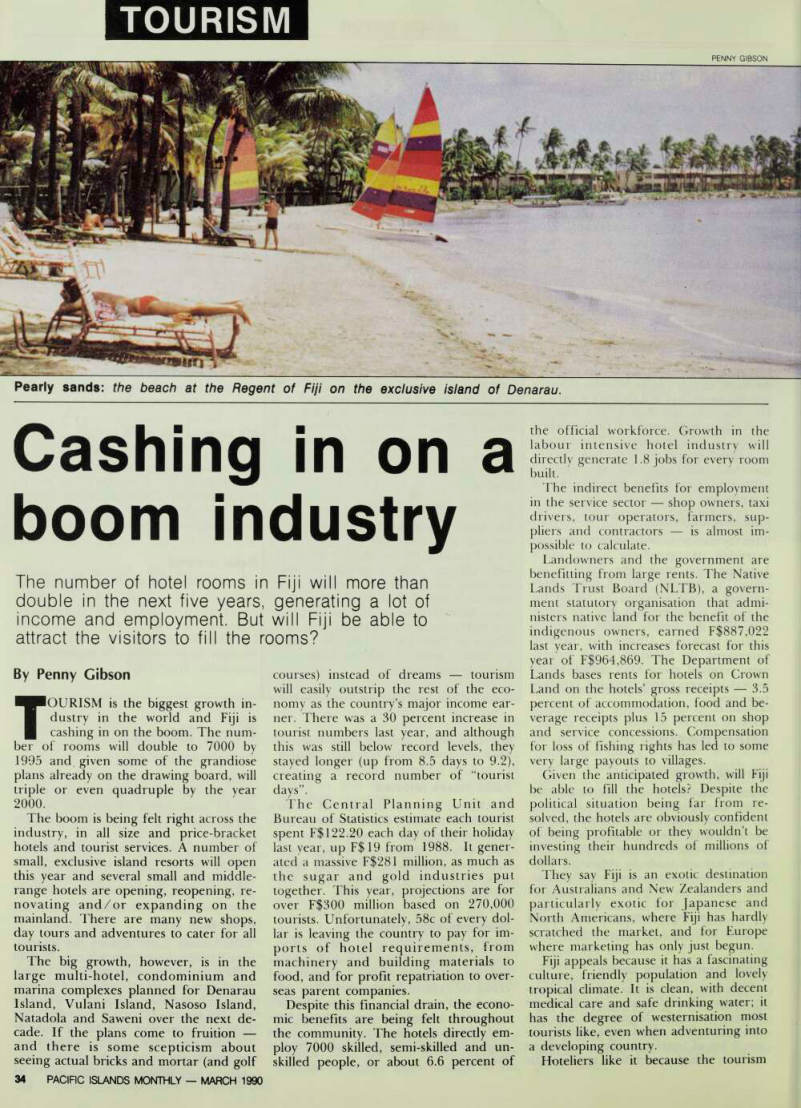
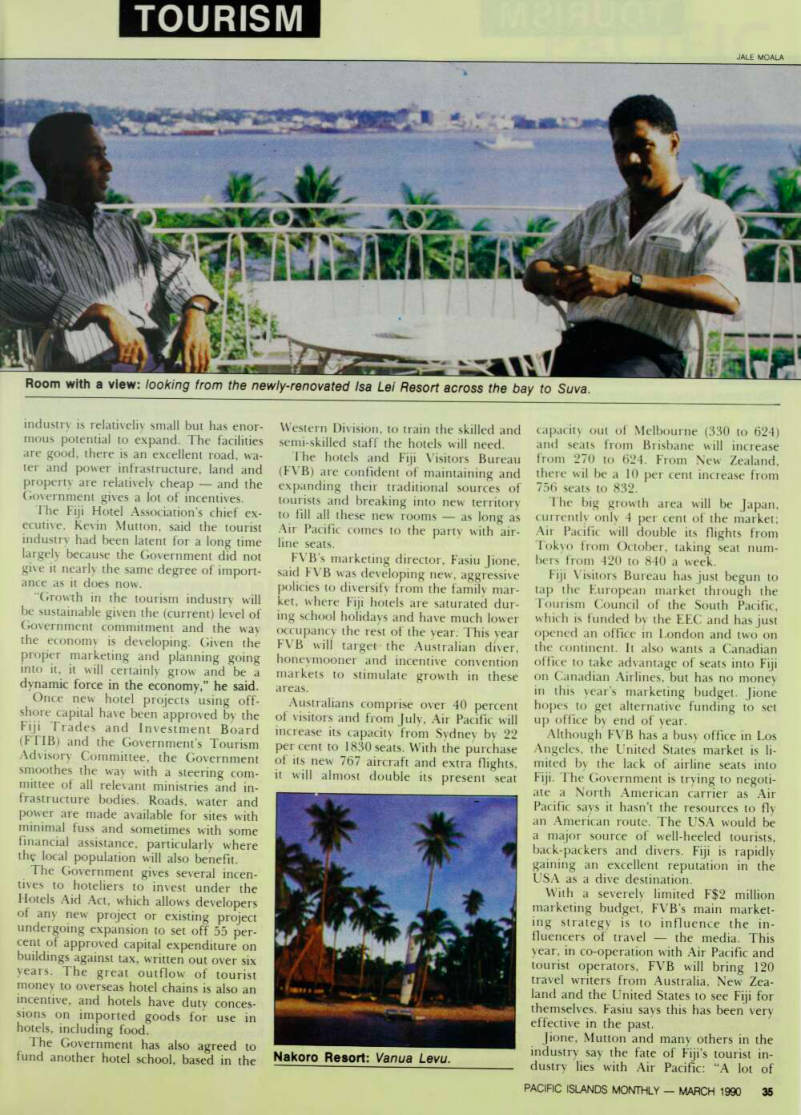
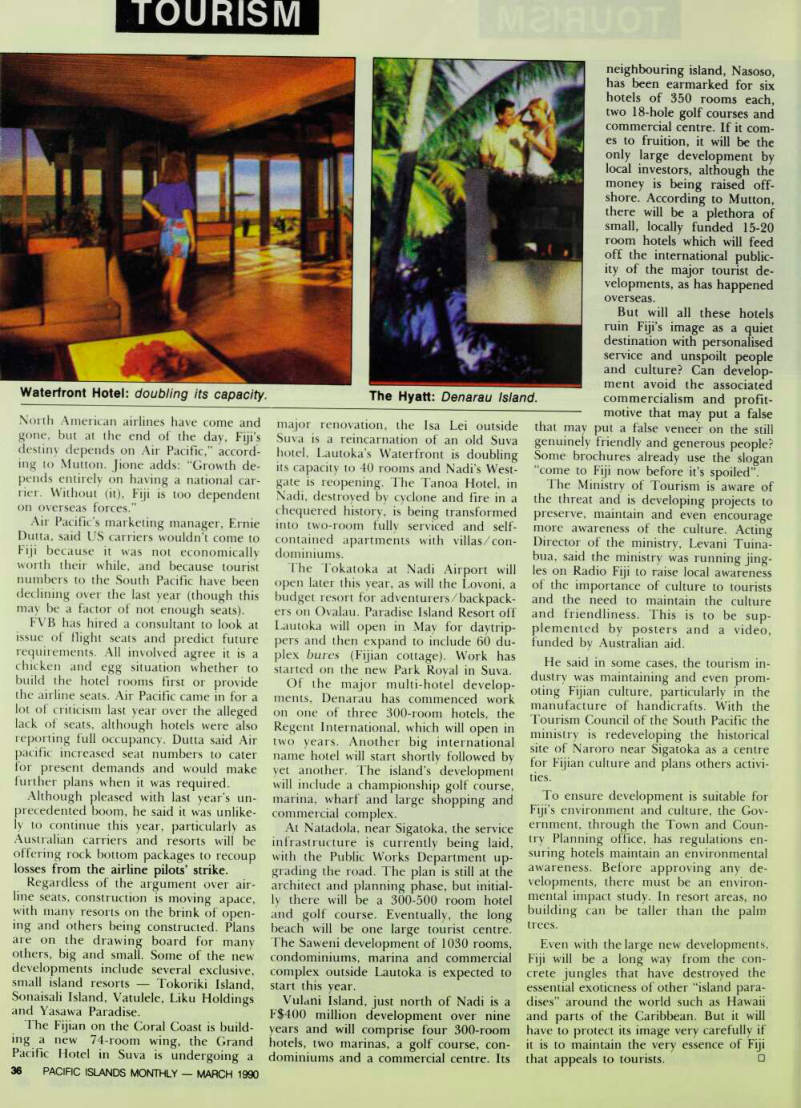
Tourism
Cashing in on a boom industry
The number of hotel rooms in Fiji will more than double in the next five years, generating a lot of income and employment. But will Fiji be able to attract the visitors to fill the rooms?
By Penny Gibson
TOURISM is the biggest growth in
dustry in the world and Fiji is cashing in on the boom. The num ber of rooms will double to 7000 by 1995 and given some of the grandiose plans already on the drawing board, will triple or even quadruple by the year 2000.
The boom is being felt right across the industry, in all size and price-bracket hotels and tourist services. A number of small, exclusive island resorts will open this year and several small and middle range hotels are opening, reopening, re novating and/or expanding on the mainland. There are many new shops, day tours and adventures to cater for all tourists.
The big growth, however, is in the large multi-hotel, condominium and marina complexes planned for Denarau Island, Vulani Island, Nasoso Island, Natadola and Saweni over the next de cade. If the plans come to fruition and there is some scepticism about seeing actual bricks and mortar (and golf
courses) instead of dreams tourism will easily outstrip the rest of the eco nomy as the country’s major income ear ner. There was a 30 percent increase in tourist numbers last year, and although this was still below record levels, they stayed longer (up from 8.5 days to 9.2), creating a record number of “tourist
days”.
The Central Planning Unit and Bureau of Statistics estimate each tourist spent F$ 122.20 each day of their holiday last year, up Fsl9 from 1988. It gener ated a massive Fs2Bl million, as much as the sugar and gold industries put together. This year, projections are for over F|3oo million based on 270,000 tourists. Unfortunately, 58c of every dol lar is leaving the country to pay for im ports of hotel requirements, from machinery and building materials to food, and for profit repatriation to over seas parent companies.
Despite this financial drain, the econo mic benefits are being felt throughout the community. The hotels directly em ploy 7000 skilled, semi-skilled and un skilled people, or about 6.6 percent of
the official workforce. Growth in the labour intensive hotel industry will directly generate 1.8 jobs for every room built.
The indirect benefits for employment in the service sector shop owners, taxi drivers, tour operators, farmers, sup pliers and contractors is almost im possible to calculate.
Landowners and the government are benefitting from large rents. The Native Lands Trust Board (NLTB), a govern ment statutory organisation that admi nisters native land for the benefit of the indigenous owners, earned F 5887,022 last year, with increases forecast for this year of F 5964,869. The Department of Lands bases rents for hotels on Crown Land on the hotels’ gross receipts 3.5 percent of accommodation, food and be verage receipts plus 15 percent on shop and service concessions. Compensation for loss of fishing rights has led to some very large payouts to villages.
Given the anticipated growth, will Fiji be able to fill the hotels? Despite the political situation being far from re solved, the hotels are obviously confident of being profitable or they wouldn’t be investing their hundreds of millions of dollars.
They say Fiji is an exotic destination for Australians and New Zealanders and particularly exotic for Japanese and North Americans, where Fiji has hardly scratched the market, and for Europe where marketing has only just begun.
Fiji appeals because it has a fascinating culture, friendly population and lovely tropical climate. It is clean, with decent medical care and safe drinking water; it has the degree of westernisation most tourists like, even when adventuring into a developing country.
Hoteliers like it because the tourism
Penny Gibson
Pearly sands: the beach at the Regent of Fiji on the exclusive island of Denarau.
industry is relativeliy small but has enor mous potential to expand. The facilities are good, there is an excellent road, wa ter and power infrastructure, land and property are relatively cheap and the Government gives a lot of incentives.
The Fiji Hotel Association’s chief ex ecutive, Kevin Mutton, said the tourist industry had been latent for a long time largely because the Government did not give it nearly the same degree of import ance as it does now.
“Growth in the tourism industry will be sustainable given the (current) level of Government commitment and the way the economy is developing. Given the
proper marketing and planning going
into it, it will certainly grow and be a dynamic force in the economy,” he said.
Once new hotel projects using off shore capital have been approved by the Fiji Trades and Investment Board (FTIB) and the Government’s Tourism Advisory Committee, the Government smoothes the way with a steering com mittee of all relevant ministries and in frastructure bodies. Roads, water and power are made available for sites with minimal fuss and sometimes with some financial assistance, particularly where the local population will also benefit.
The Government gives several incen tives to hoteliers to invest under the Hotels Aid Act, which allows developers of any new project or existing project undergoing expansion to set off 55 per cent of approved capital expenditure on buildings against tax, written out over six years. The great outflow of tourist money to overseas hotel chains is also an incentive, and hotels have duty conces sions on imported goods for use in hotels, including food.
The Government has also agreed to fund another hotel school, based in the
Western Division, to train the skilled and semi-skilled staff the hotels will need.
The hotels and Fiji Visitors Bureau (FVB) are confident of maintaining and expanding their traditional sources of tourists and breaking into new territory to fill all these new’ rooms as long as Air Pacific comes to the party with air line seats.
FVB’s marketing director, Fasiu Jione, said FVB was developing new, aggressive policies to diversify from the family mar ket, where Fiji hotels are saturated dur ing school holidays and have much lower occupancy the rest of the year. This year FVB will target the Australian diver, honeymooner and incentive convention markets to stimulate growth in these areas.
Australians comprise over 40 percent of visitors and from July, Air Pacific will increase its capacity from Sydney by 22 per cent to 1830 seats. With the purchase of its new’ 767 aircraft and extra flights, it will almost double its present seat
capacity out of Melbourne (330 to 624) and seats from Brisbane will increase from 270 to 624. From New Zealand, there wil be a 10 per cent increase from 756 seats to 832.
The big growth area will be Japan, currently only 4 per cent of the market; Air Pacific will double its flights from Tokyo from October, taking seal num bers from 420 to 840 a week.
Fiji Visitors Bureau has just begun to tap the European market through the Tourism Council of the South Pacific, which is funded by the EEC and has just opened an office in London and two on the continent. It also wants a Canadian office to take advantage of seats into Fiji on Canadian Airlines, but has no money in this year’s marketing budget. Jione hopes to get alternative funding to set up office by end of year.
Although FVB has a busy office in Los Angeles, the United States market is li mited by the lack of airline seals into Fiji. The Government is trying to negoti ate a North American carrier as Air Pacific says it hasn’t the resources to fly an American route. The USA would be a major source of well-heeled tourists,
back-packers and divers. Fiji is rapidly
gaining an excellent reputation in the USA as a dive destination.
With a severely limited Fs2 million marketing budget, FVB’s main market ing strategy is to influence the in fluencers of travel the media. This year, in co-operation with Air Pacific and tourist operators, FVB will bring 120 travel writers from Australia, New Zea land and the United States to see Fiji for themselves. Fasiu says this has been very effective in the past.
Jione, Mutton and many others in the industry say the fate of Fiji’s tourist in dustry lies with Air Pacific: “A lot of
Jale Moala
Room with a view: looking from the newly-renovated Isa Lei Resort across the bay to Suva.
Nakoro Resort: Vanua Levu.
North American airlines have come and gone, but at the end of the day, Fiji’s destiny depends on Air Pacific,” accord ing to Mutton. Jione adds: “Growth de pends entirely on having a national car rier. Without (it), Fiji is too dependent on overseas forces.”
Air Pacific’s marketing manager, Ernie Dutta, said US carriers wouldn’t come to Fiji because it was not economically worth their while, and because tourist numbers to the South Pacific have been declining over the last year (though this may be a factor of not enough seats).
FVB has hired a consultant to look at issue of flight seats and predict future requirements. All involved agree it is a chicken and egg situation whether to build the hotel rooms first or provide the airline seats. Air Pacific came in for a lot of criticism last year over the alleged lack of seats, although hotels were also reporting full occupancy. Dutta said Air pacific increased seat numbers to cater for present demands and would make further plans when it was required.
Although pleased with last year’s un precedented boom, he said it was unlike ly to continue this year, particularly as Australian carriers and resorts will be offering rock bottom packages to recoup losses from the airline pilots’ strike.
Regardless of the argument over air line seats, construction is moving apace, with many resorts on the brink of open ing and others being constructed. Plans are on the drawing board for many others, big and small. Some of the new developments include several exclusive, small island resorts Tokoriki Island, Sonaisali Island, Vatulele, Liku Holdings and Yasawa Paradise.
The Fijian on the Coral Coast is build ing a new 74-room wing, the Grand Pacific Hotel in Suva is undergoing a
major renovation, the Isa Lei outside Suva is a reincarnation of an old Suva hotel, Lautoka’s Waterfront is doubling its capacity to 40 rooms and Nadi’s West gate is reopening. The Tanoa Hotel, in Nadi, destroyed by cyclone and fire in a
chequered history, is being transformed
into two-room fully serviced and self contained apartments with villas/con dominiums.
The Tokatoka at Nadi Airport will open later this year, as will the Lovoni, a budget resort for adventurers/backpack ers on Ovalau. Paradise Island Resort off Lautoka will open in May for daytrip pers and then expand to include 60 du plex burcs (Fijian cottage). Work has started on the new Park Royal in Suva.
Of the major multi-hotel develop ments, Denarau has commenced work on one of three 300-room hotels, the Regent International, which will open in two years. Another big international name hotel will start shortly followed by yet another. The island’s development will include a championship golf course, marina, wharf and large shopping and
commercial complex.
At Natadola, near Sigatoka, the service infrastructure is currently being laid, with the Public Works Department up grading the road. The plan is still at the architect and planning phase, but initial ly there will be a 300-500 room hotel
and golf course. Eventually, the long
beach will be one large tourist centre.
The Saweni development of 1030 rooms, condominiums, marina and commercial complex outside Lautoka is expected to start this year.
Vulani Island, just north of Nadi is a Fs4oo million development over nine years and will comprise four 300-room hotels, two marinas, a golf course, con dominiums and a commercial centre. Its
neighbouring island, Nasoso, has been earmarked for six hotels of 350 rooms each, two 18-hole golf courses and commercial centre. If it com es to fruition, it will be the
only large development by
local investors, although the money is being raised off shore. According to Mutton, there will be a plethora of small, locally funded 15-20 room hotels which will feed off the international public ity of the major tourist de
velopments, as has happened
overseas.
But will all these hotels
ruin Fiji’s image as a quiet
destination with personalised
service and unspoilt people
and culture? Can develop ment avoid the associated commercialism and profit motive that may put a false
that may put a false veneer on the still
genuinely friendly and generous people?
Some brochures already use the slogan “come to Fiji now before it’s spoiled”.
The Ministry of Tourism is aware of the threat and is developing projects to preserve, maintain and even encourage more awareness of the culture. Acting Director of the ministry, Levani Tuina bua, said the ministry was running jing les on Radio Fiji to raise local awareness of the importance of culture to tourists and the need to maintain the culture and friendliness. This is to be sup plemented by posters and a video, funded by Australian aid.
He said in some cases, the tourism in dustry was maintaining and even prom oting Fijian culture, particularly in the manufacture of handicrafts. With the Tourism Council of the South Pacific the ministry is redeveloping the historical site of Naroro near Sigatoka as a centre for Fijian culture and plans others activi ties.
To ensure development is suitable for Fiji’s environment and culture, the Gov ernment, through the Town and Coun try Planning office, has regulations en suring hotels maintain an environmental awareness. Before approving any de velopments, there must be an environ mental impact study. In resort areas, no building can be taller than the palm trees.
Even with the large new developments, Fiji will be a long way from the con crete jungles that have destroyed the essential exoticness of other “island para dises” around the world such as Hawaii and parts of the Caribbean. But it will have to protect its image very carefully if it is to maintain the very essence of Fiji that appeals to tourists. □
Waterfront Hotel: doubling its capacity.
The Hyatt: Denarau Island.
Untouched Paradise
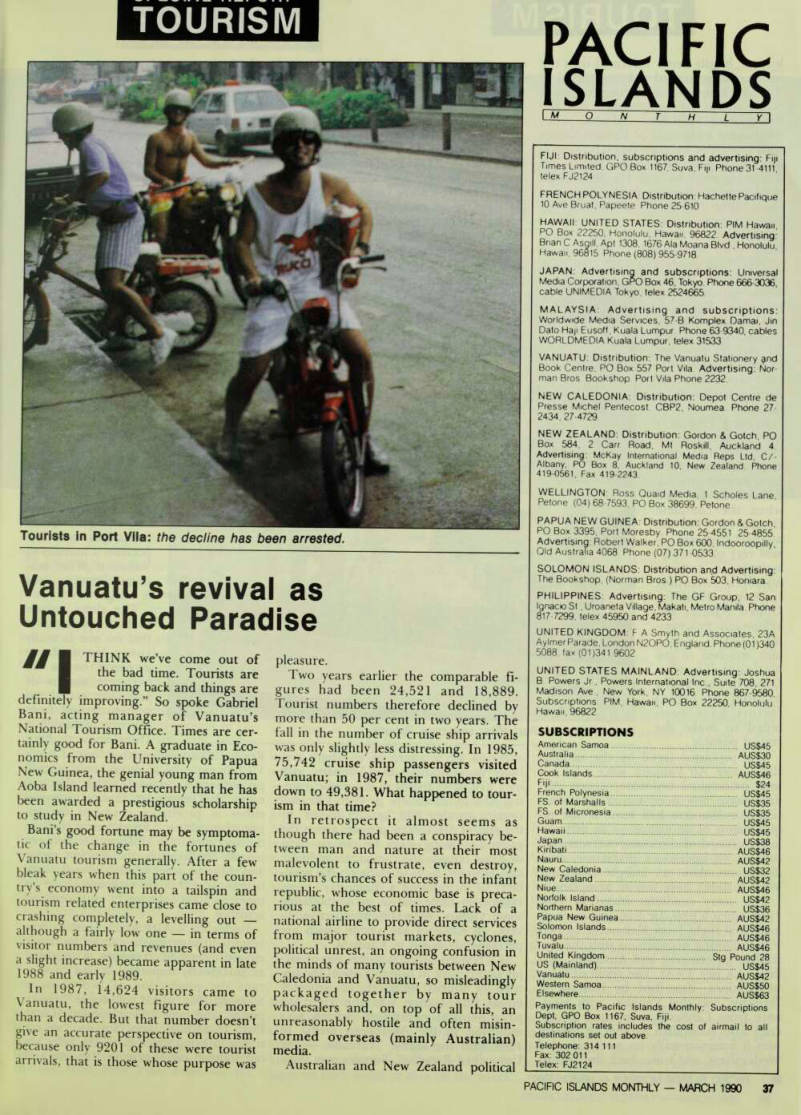
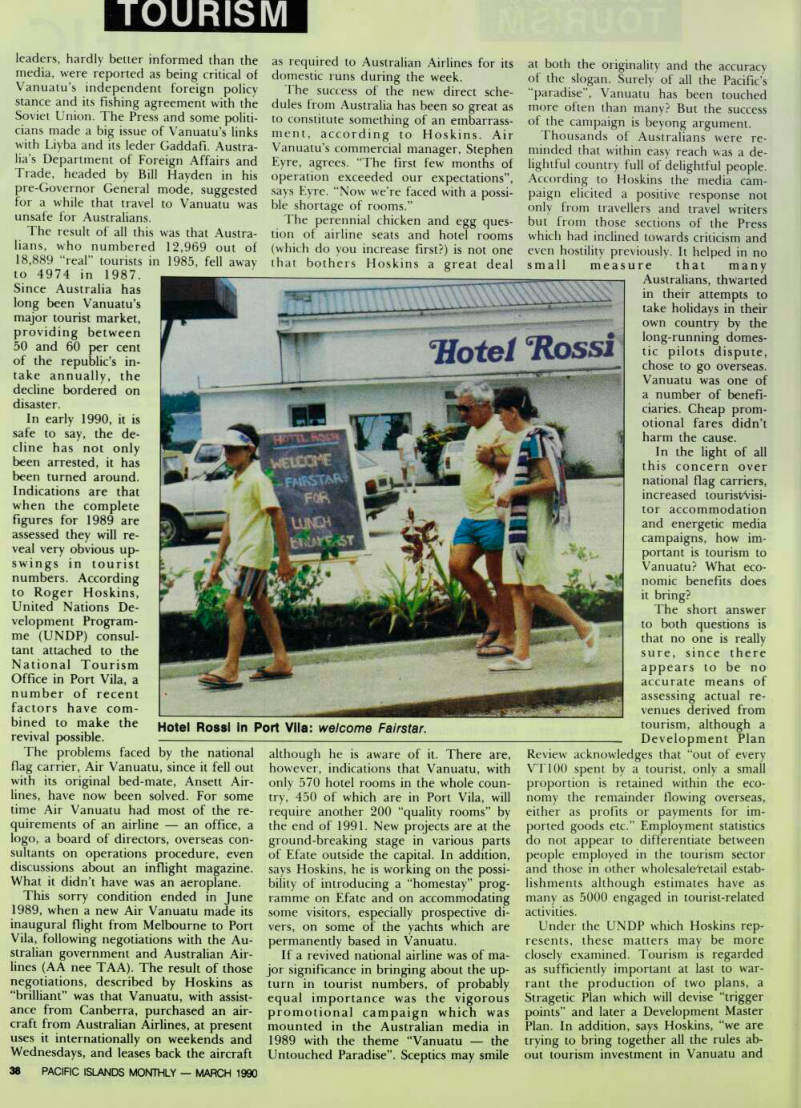
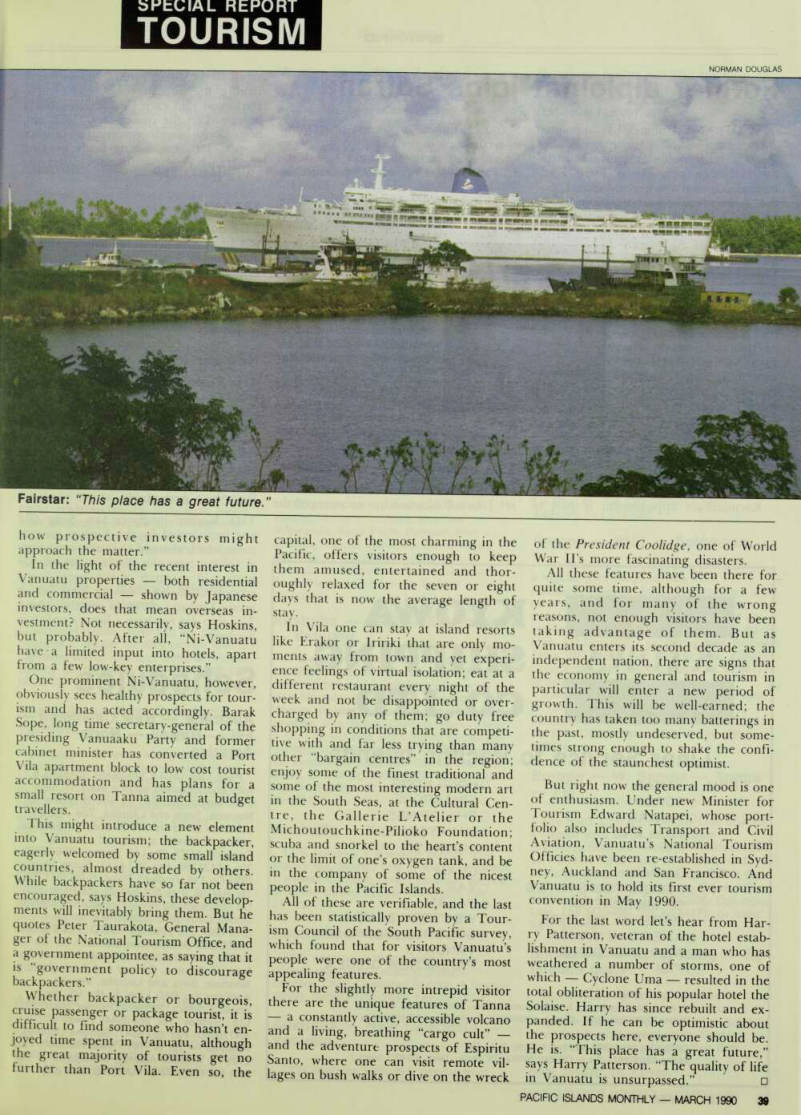
Vanuatu’s revival as Untouched Paradise
//I THINK we’ve come out of the bad time. Tourists are ■ . coming back and things are
definitely improving.” So spoke Gabriel
ani, acting manager of Vanuatu’s National Tourism Office. Times are certamly good for Bani. A graduate in Economics from the University of Papua New Guinea the genial young man from Aoba Island learned recently that he has been awarded a prestigious scholarship to study in New Zealand.
Bam s good fortune may be symptomatic ot the change in the fortunes of tourism generally. After a few bleak years when this part of the country s economy went into a tailspin and tounsm related enterprises came close to crashing completely, a levelling out although a fairly low one in terms of visitor numbers and revenues (and even ?noo 11 j Crease ) became apparent in late 1988 ami early 1989.
In 1987, 14,624 visitors came to Vanuatu, the lowest figure for more than a decade. But that number doesn’t give an accurate perspective on tourism, because only 9201 of these were tourist arrivals, that is those whose purpose was
pleasure.
Two years earlier the comparable fi gures had been 24,521 and 18,889.
Tourist numbers therefore declined by more than 50 per cent in two years. The fall in the number of cruise ship arrivals was only slightly less distressing. In 1985, 75,742 cruise ship passengers visited Vanuatu; in 1987, their numbers were down to 49,381. What happened to tour ism in that time?
In retrospect it almost seems as though there had been a conspiracy be tween man and nature at their most malevolent to frustrate, even destroy, tourism’s chances of success in the infant republic, whose economic base is preca rious at the best of times. Lack of a national airline to provide direct services from major tourist markets, cyclones, political unrest, an ongoing confusion in the minds of many tourists between New Caledonia and Vanuatu, so misleadingly packaged together by many tour wholesalers and, on top of all this, an unreasonably hostile and often misin formed overseas (mainly Australian) media.
Australian and New Zealand political
Tourists in Port Vila: the decline has been arrested.
leaders, hardly better informed than the media, were reported as being critical of
Vanuatu’s independent foreign policy
stance and its fishing agreement with the Soviet Union. The Press and some politi cians made a big issue of Vanuatu’s links with Liyba and its leder Gaddafi. Austra lia’s Department of Foreign Affairs and Trade, headed by Bill Hayden in his pre-Governor General mode, suggested for a while that travel to Vanuatu was unsafe for Australians.
The result of all this was that Austra lians, who numbered 12,969 out of 18,889 “real” tourists in 1985, fell away
to 4974 in 1987.
Since Australia has long been Vanuatu’s major tourist market,
providing between
50 and 60 per cent of the republic’s in take annually, the decline bordered on disaster.
In early 1990, it is safe to say, the de cline has not only been arrested, it has been turned around.
Indications are that when the complete figures for 1989 are assessed they will re veal very obvious up swings in tourist
numbers. According
to Roger Hoskins, United Nations De
velopment Program
me (UNDP) consul tant attached to the National Tourism Office in Port Vila, a number of recent factors have com bined to make the revival possible.
The problems faced by the national flag carrier, Air Vanuatu, since it fell out with its original bed-mate, Ansett Air lines, have now been solved. For some time Air Vanuatu had most of the re quirements of an airline an office, a logo, a board of directors, overseas con sultants on operations procedure, even discussions about an inflight magazine.
What it didn’t have was an aeroplane.
This sorry condition ended in June 1989, when a new Air Vanuatu made its inaugural flight from Melbourne to Port Vila, following negotiations with the Au stralian government and Australian Air lines (AA nee TAA). The result of those negotiations, described by Hoskins as “brilliant” was that Vanuatu, with assist ance from Canberra, purchased an air craft from Australian Airlines, at present uses it internationally on weekends and Wednesdays, and leases back the aircraft
as required to Australian Airlines for its domestic runs during the week.
The success of the new direct sche dules from Australia has been so great as to constitute something of an embarrass ment, according to Hoskins. Air Vanuatu’s commercial manager, Stephen Eyre, agrees. “The first few months of operation exceeded our expectations”, says Eyre. “Now we’re faced with a possi ble shortage of rooms.”
The perennial chicken and egg ques tion of airline seats and hotel rooms (which do you increase first?) is not one that bothers Hoskins a great deal
although he is aware of it. There are, however, indications that Vanuatu, with only 570 hotel rooms in the whole coun try, 450 of which are in Port Vila, will require another 200 “quality rooms” by the end of 1991. New projects are at the ground-breaking stage in various parts of Efate outside the capital. In addition, says Hoskins, he is working on the possi
bility of introducing a “homestay” prog
ramme on Efate and on accommodating some visitors, especially prospective di vers, on some of the yachts which are permanently based in Vanuatu.
If a revived national airline was of ma jor significance in bringing about the up turn in tourist numbers, of probably equal importance was the vigorous promotional campaign which was mounted in the Australian media in 1989 with the theme “Vanuatu the Untouched Paradise”. Sceptics may smile
at both the originality and the accuracy of the slogan. Surely of all the Pacific’s “paradise”, Vanuatu has been touched more often than many? But the success of the campaign is beyong argument.
Thousands of Australians were re minded that within easy reach was a de lightful country full of delightful people.
According to Hoskins the media cam paign elicited a positive response not only from travellers and travel writers but from those sections of the Press which had inclined towards criticism and even hostility previously. It helped in no small measure that many
Australians, thwarted in their attempts to take holidays in their own country by the
long-running domes
tic pilots dispute,
chose to go overseas.
Vanuatu was one of a number of benefi ciaries. Cheap prom otional fares didn’t harm the cause.
In the light of all this concern over national flag carriers, increased tourisfrVisi tor accommodation and energetic media campaigns, how im portant is tourism to Vanuatu? What eco nomic benefits does
it bring?
The short answer to both questions is that no one is really sure, since there appears to be no accurate means of assessing actual re venues derived from tourism, although a Development Plan
Review acknowledges that “out of every VTIOO spent by a tourist, only a small proportion is retained within the eco nomy the remainder flowing overseas, either as profits or payments for im ported goods etc.” Employment statistics do not appear to differentiate between people employed in the tourism sector and those in other wholesalotetail estab lishments although estimates have as many as 5000 engaged in tourist-related activities.
Under the UNDP which Hoskins rep resents, these matters may be more closely examined. Tourism is regarded as sufficiently important at last to war rant the production of two plans, a Stragetic Plan which will devise “trigger points” and later a Development Master Plan. In addition, says Hoskins, “we are trying to bring together all the rules ab out tourism investment in Vanuatu and
Hotel Rossi in Port Vila: welcome Fairstar.
aiXoachXeXaXr .! nVeSt ° rS might
P ht the liffht of fh P • , . ■ Vanuatu b„,i. bu, tm n ent h N ot n A eC f eSSari 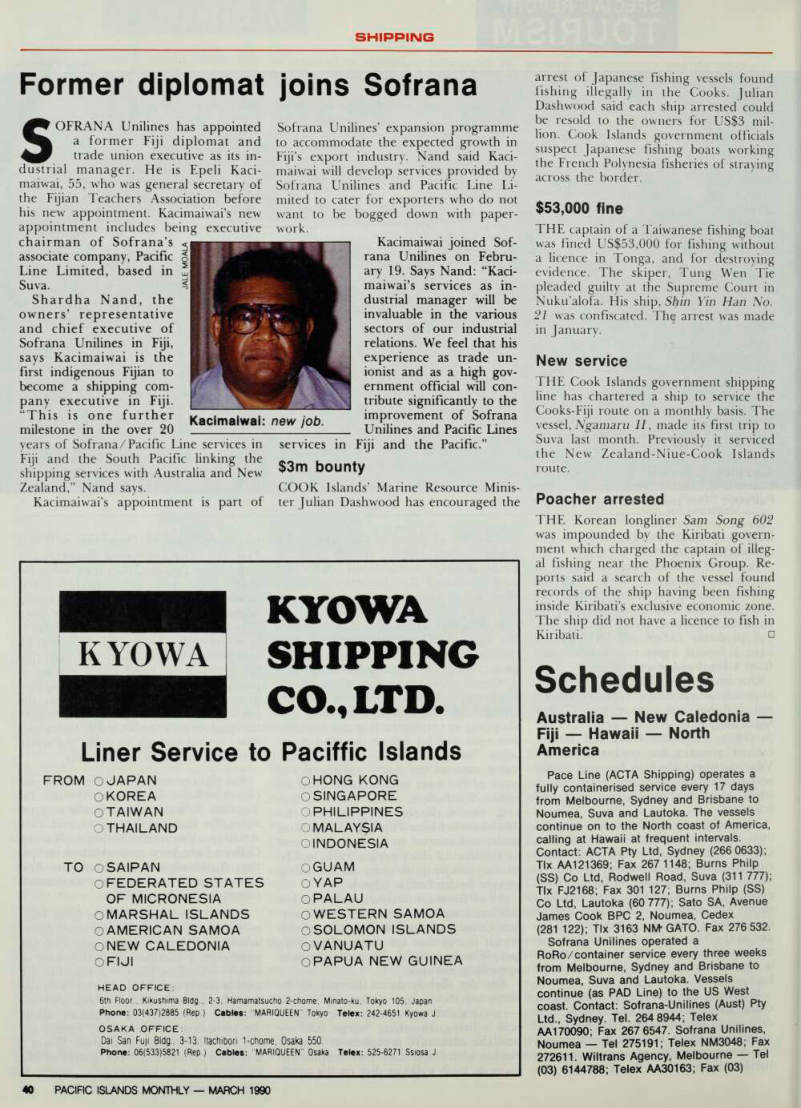
Shipping
SOFRANA Unilines has appointed
a former Fiji diplomat and trade union executive as its in dustrial manager. He is Epeli Kaci maiwai, 55, who was general secretary of the Fijian Teachers Association before his new appointment. Kacimaiwai’s new appointment includes being executive
chairman of Sofrana’s associate company, Pacific Line Limited, based in Suva.
Shardha Nand, the
owners’ representative
and chief executive of Sofrana Unilines in Fiji, says Kacimaiwai is the
first indigenous Fijian to
become a shipping com pany executive in Fiji.
“This is one further milestone in the over 20
years of Sofrana/Pacific Line services in Fiji and the South Pacific linking the shipping services with Australia and New Zealand,” Nand says.
Kacimaiwai’s appointment is part of
Sofrana Unilines’ expansion programme to accommodate the expected growth in Fiji’s export industry. Nand said Kaci maiwai will develop services provided by Sofrana Unilines and Pacific Line Li mited to cater for exporters who do not want to be bogged down with paper work.
Kacimaiwai joined Sof rana Unilines on Febru ary 19. Says Nand: “Kaci maiwai’s services as in dustrial manager will be invaluable in the various sectors of our industrial relations. We feel that his experience as trade un ionist and as a high gov ernment official will con tribute significantly to the improvement of Sofrana Unilines and Pacific Lines
services in Fiji and the Pacific.”
s3m bounty
COOK Islands’ Marine Resource Minis ter Julian Dashwood has encouraged the
arrest of Japanese fishing vessels found fishing illegally in the Cooks. Julian Dashwood said each ship arrested could be resold to the owners for US$3 mil lion. Cook Islands government officials suspect Japanese fishing boats working the French Polynesia fisheries of straying across the border.
$53,000 fine
THE captain of a Taiwanese fishing boat was fined U 5553,000 for fishing without a licence in Tonga, and for destroying evidence. The skiper, Tung Wen Tie pleaded guilty at the Supreme Court in Nukualofa. His ship, Shin Yin Han No. 21 was confiscated. The arrest was made in January.
New service THE Cook Islands government shipping line has chartered a ship to service the Cooks-Fiji route on a monthly basis. The vessel, Ngamaru 11 , made its first trip to Suva last month. Previously it serviced the New Zealand-Niue-Cook Islands route.
Poacher arrested THE Korean longliner Sam Song 602 was impounded by the Kiribati govern ment which charged the captain of illeg al fishing near the Phoenix Group. Re ports said a search of the vessel found records of the ship having been fishing inside Kiribati’s exclusive economic zone.
The ship did not have a licence to fish in Kiribati. □
Jale Moala
Kacimaiwai: new job.
Schedules
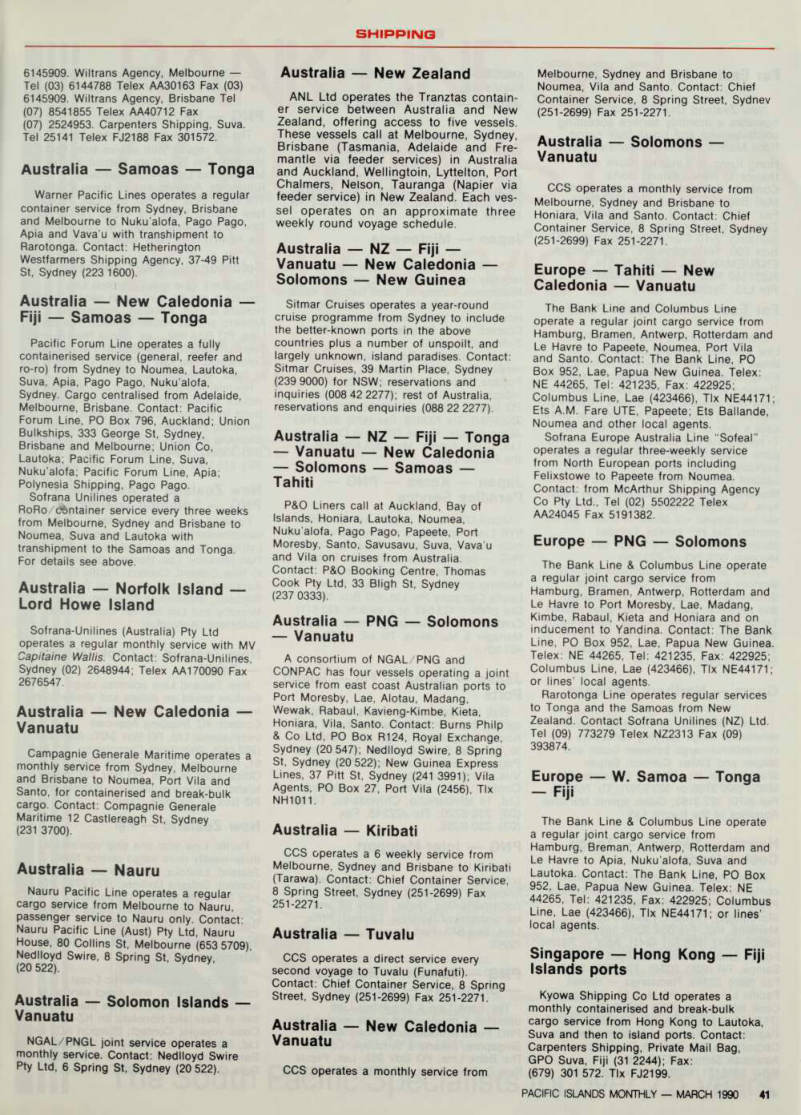
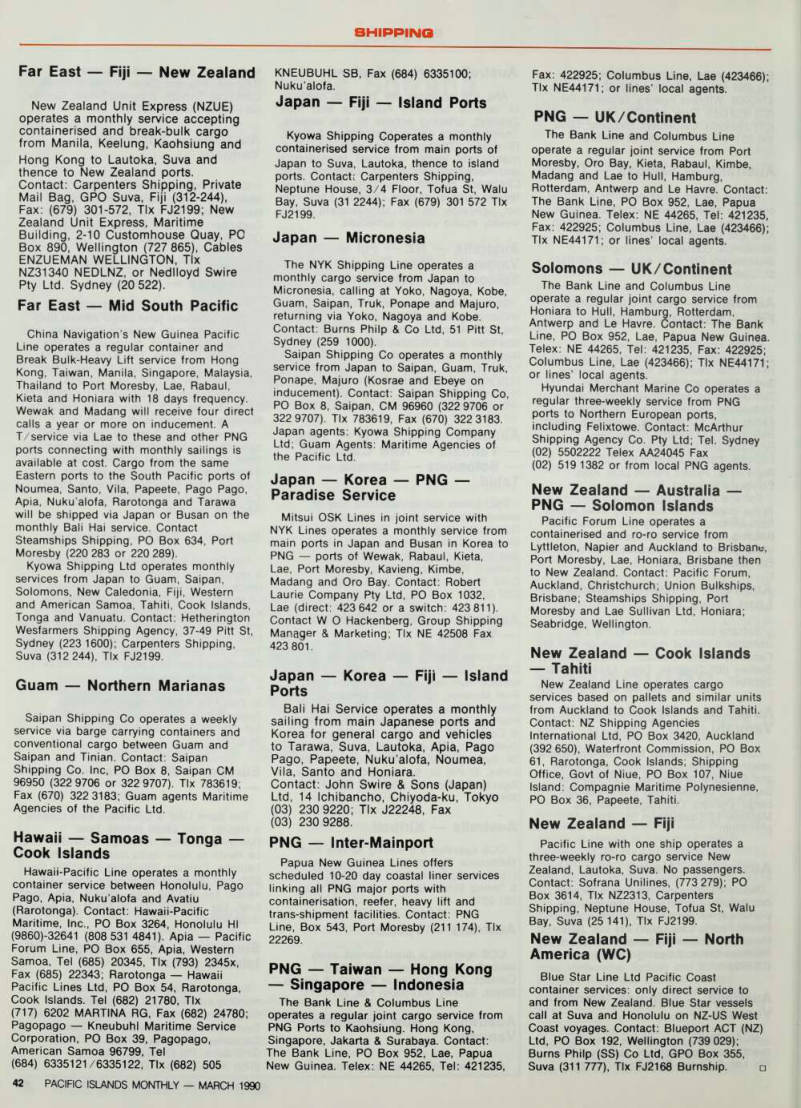
Australia New Caledonia
Fiji Hawaii North
America
Pace Line (ACTA Shipping) operates a fully containerised service every 17 days from Melbourne, Sydney and Brisbane to Noumea, Suva and Lautoka. The vessels continue on to the North coast of America, calling at Hawaii at frequent intervals.
Contact: ACTA Pty Ltd, Sydney (266 0633); Tlx AA121369; Fax 267 1148; Burns Philp (SS) Co Ltd, Rodwell Road, Suva (311 777); Tlx FJ2168; Fax 301 127; Burns Philp (SS) Co Ltd, Lautoka (60 777); Sato SA, Avenue James Cook BPC 2, Noumea, Cedex (281 122); Tlx 3163 NM* GATO. Fax 276 532.
Sofrana Unilines operated a Roßo/container service every three weeks from Melbourne, Sydney and Brisbane to Noumea, Suva and Lautoka. Vessels continue (as PAD Line) to the US West coast. Contact: Sofrana-Unilines (Aust) Pty Ltd., Sydney. Tel. 264 8944; Telex AA170090; Fax 267 6547. Sofrana Unilines, Noumea Tel 275191; Telex NM3048; Fax 272611. Wiltrans Agency, Melbourne Tel (03) 6144788; Telex AA30163; Fax (03)
6145909. Wiltrans Agency, Melbourne Tel (03) 6144788 Telex AA30163 Fax (03) 6145909. Wiltrans Agency, Brisbane Tel (07) 8541855 Telex AA40712 Fax (07) 2524953. Carpenters Shipping, Suva.
Tel 25141 Telex FJ2IBB Fax 301572.
Australia Samoas Tonga
Warner Pacific Lines operates a regular container service from Sydney, Brisbane and Melbourne to Nukualofa, Pago Pago, Apia and Vava’u with transhipment to Rarotonga. Contact; Hetherington Westfarmers Shipping Agency, 37-49 Pitt St, Sydney (223 1600).
Australia New Caledonia
Fiji Samoas Tonga
Pacific Forum Line operates a fully containerised service (general, reefer and ro-ro) from Sydney to Noumea, Lautoka, Suva, Apia, Pago Pago, Nukualofa, Sydney. Cargo centralised from Adelaide, Melbourne, Brisbane. Contact: Pacific Forum Line, PO Box 796, Auckland; Union Bulkships, 333 George St, Sydney, Brisbane and Melbourne; Union Co, Lautoka; Pacific Forum Line, Suva, Nuku’alofa; Pacific Forum Line, Apia; Polynesia Shipping, Pago Pago.
Sofrana Unilines operated a Roßo/c?sntainer service every three weeks from Melbourne, Sydney and Brisbane to Noumea, Suva and Lautoka with transhipment to the Samoas and Tonga.
For details see above.
Australia Norfolk Island
Lord Howe Island
Sofrana-Unilines (Australia) Pty Ltd operates a regular monthly service with MV Capitaine Wallis. Contact: Sofrana-Unilines, Sydney (02) 2648944; Telex AA170090 Fax 2676547.
Australia New Caledonia Vanuatu Campagnie Generale Maritime operates a monthly service from Sydney, Melbourne and Brisbane to Noumea, Port Vila and Santo, for containerised and break-bulk cargo. Contact: Compagnie Generale Maritime 12 Castlereagh St, Sydney (231 3700).
Australia Nauru
Nauru Pacific Line operates a regular cargo service from Melbourne to Nauru, passenger service to Nauru only. Contact: Nauru Pacific Line (Aust) Pty Ltd, Nauru House, 80 Collins St, Melbourne (653 5709), Nedlloyd Swire, 8 Spring St, Sydney, (20 522).
Australia Solomon Islands
Vanuatu
NGAL/PNGL joint service operates a monthly service. Contact: Nedlloyd Swire Pty Ltd, 6 Spring St, Sydney (20 522).
Australia New Zealand ANL Ltd operates the Tranztas contain er service between Australia and New Zealand, offering access to five vessels.
These vessels call at Melbourne, Sydney, Brisbane (Tasmania, Adelaide and Fre mantle via feeder services) in Australia and Auckland, Wellingtoin, Lyttelton, Port Chalmers, Nelson, Tauranga (Napier via feeder service) in New Zealand. Each ves sel operates on an approximate three weekly round voyage schedule.
Australia NZ Fiji Vanuatu New Caledonia Solomons New Guinea Sitmar Cruises operates a year-round cruise programme from Sydney to include the better-known ports in the above countries plus a number of unspoilt, and largely unknown, island paradises. Contact; Sitmar Cruises, 39 Martin Place, Sydney (239 9000) for NSW; reservations and inquiries (008 42 2277); rest of Australia, reservations and enquiries (088 22 2277).
Australia NZ Fiji Tonga
Vanuatu New Caledonia Solomons Samoas Tahiti P&O Liners call at Auckland, Bay of Islands, Honiara, Lautoka, Noumea, Nukualofa, Pago Pago, Papeete, Port Moresby, Santo, Savusavu, Suva, Vava’u and Vila on cruises from Australia.
Contact: P&O Booking Centre, Thomas Cook Pty Ltd. 33 Bligh St, Sydney (237 0333).
Australia PNG Solomons Vanuatu A consortium of NGAL/PNG and CONPAC has four vessels operating a joint service from east coast Australian ports to Port Moresby, Lae, Alotau, Madang, Wewak, Rabaul, Kavieng-Kimbe, Kieta, Honiara, Vila, Santo. Contact: Burns Philp & Co Ltd, PO Box R 124, Royal Exchange, Sydney (20 547); Nedlloyd Swire, 8 Spring St, Sydney (20 522); New Guinea Express Lines. 37 Pitt St, Sydney (241 3991); Vila Agents, PO Box 27, Port Vila (2456), Tlx
Nhioii.
Australia Kiribati CCS operates a 6 weekly service from Melbourne, Sydney and Brisbane to Kiribati (Tarawa). Contact; Chief Container Service, 8 Spring Street, Sydney (251-2699) Fax 251-2271.
Australia Tuvalu CCS operates a direct service every second voyage to Tuvalu (Funafuti).
Contact; Chief Container Service, 8 Spring Street, Sydney (251-2699) Fax 251-2271.
Australia New Caledonia Vanuatu CCS operates a monthly service from
Melbourne, Sydney and Brisbane to Noumea, Vila and Santo. Contact: Chief Container Service, 8 Spring Street, Sydney (251-2699) Fax 251-2271.
Australia Solomons Vanuatu CCS operates a monthly service from Melbourne, Sydney and Brisbane to Honiara, Vila and Santo. Contact: Chief Container Service, 8 Spring Street, Sydney (251-2699) Fax 251-2271.
Europe Tahiti New Caledonia Vanuatu The Bank Line and Columbus Line operate a regular joint cargo service from Hamburg, Bramen, Antwerp, Rotterdam and Le Havre to Papeete, Noumea, Port Vila and Santo. Contact: The Bank Line, PO Box 952, Lae, Papua New Guinea. Telex: NE 44265, Tel; 421235, Fax: 422925; Columbus Line, Lae (423466), Tlx NE44171; Ets A.M. Fare LITE, Papeete: Ets Ballande, Noumea and other local agents.
Sofrana Europe Australia Line “Sofeal” operates a regular three-weekly service from North European ports including Felixstowe to Papeete from Noumea.
Contact: from McArthur Shipping Agency Co Pty Ltd., Tel (02) 5502222 Telex AA24045 Fax 5191382.
Europe PNG Solomons
The Bank Line & Columbus Line operate a regular joint cargo service from Hamburg, Bramen, Antwerp, Rotterdam and Le Havre to Port Moresby, Lae, Madang, Kimbe, Rabaul, Kieta and Honiara and on inducement to Yandina. Contact: The Bank Line, PO Box 952, Lae, Papua New Guinea.
Telex: NE 44265, Tel: 421235, Fax: 422925; Columbus Line, Lae (423466), Tlx NE44171; or lines’ local agents.
Rarotonga Line operates regular services to Tonga and the Samoas from New Zealand. Contact Sofrana Unilines (NZ) Ltd.
Tel (09) 773279 Telex NZ2313 Fax (09) 393874.
Europe W. Samoa Tonga
- Fiji
The Bank Line & Columbus Line operate a regular joint cargo service from Hamburg, Breman, Antwerp, Rotterdam and Le Havre to Apia, Nukualofa, Suva and Lautoka. Contact; The Bank Line, PO Box 952, Lae, Papua New Guinea. Telex; NE 44265, Tel: 421235, Fax: 422925; Columbus Line, Lae (423466), Tlx NE44171; or lines’ local agents.
Singapore Hong Kong Fiji
Islands ports
Kyowa Shipping Co Ltd operates a monthly containerised and break-bulk cargo service from Hong Kong to Lautoka, Suva and then to island ports. Contact: Carpenters Shipping, Private Mail Bag, GPO Suva, Fiji (31 2244); Fax: (679) 301 572. Tlx FJ2199.
Far East Fiji New Zealand New Zealand Unit Express (NZUE) operates a monthly service accepting containerised and break-bulk cargo from Manila, Keelung, Kaohsiung and Hong Kong to Lautoka, Suva and thence to New Zealand ports.
Contact: Carpenters Shipping, Private Mail Bag, GPO Suva, Fiji (312-244), Fax: (679) 301-572, Tlx FJ2199; New Zealand Unit Express, Maritime Building, 2-10 Customhouse Quay, PO Box 890, Wellington (727 865), Cables
Enzueman Wellington, Tlx
NZ31340 NEDLNZ, or Nedlloyd Swire Pty Ltd. Sydney (20 522).
Far East Mid South Pacific China Navigation’s New Guinea Pacific Line operates a regular container and Break Bulk-Heavy Lift service from Hong Kong, Taiwan, Manila, Singapore, Malaysia, Thailand to Port Moresby, Lae, Rabaul, Kieta and Honiara with 18 days frequency.
Wewak and Madang will receive four direct calls a year or more on inducement. A T/service via Lae to these and other PNG ports connecting with monthly sailings is available at cost. Cargo from the same Eastern ports to the South Pacific ports of Noumea, Santo, Vila, Papeete, Pago Pago, Apia, Nuku’alofa, Rarotonga and Tarawa will be shipped via Japan or Busan on the monthly Bali Hai service. Contact Steamships Shipping, PO Box 634, Port Moresby (220 283 or 220 289).
Kyowa Shipping Ltd operates monthly services from Japan to Guam, Saipan, Solomons, New Caledonia, Fiji, Western and American Samoa, Tahiti, Cook Islands, Tonga and Vanuatu. Contact: Hetherington Wesfarmers Shipping Agency, 37-49 Pitt St, Sydney (223 1600); Carpenters Shipping, Suva (312 244), Tlx FJ2199.
Guam Northern Marianas Saipan Shipping Co operates a weekly service via barge carrying containers and conventional cargo between Guam and Saipan and Tinian. Contact; Saipan Shipping Co. Inc, PO Box 8, Saipan CM 96950 (322 9706 or 322 9707). Tlx 783619; Fax (670) 322 3183; Guam agents Maritime Agencies of the Pacific Ltd.
Hawaii Samoas Tonga Cook Islands Hawaii-Pacific Line operates a monthly container service between Honolulu, Pago Pago, Apia, Nuku’alofa and Avatiu (Rarotonga). Contact; Hawaii-Pacific Maritime, Inc., PO Box 3264, Honolulu HI (9860)-32641 (808 531 4841). Apia Pacific Forum Line, PO Box 655, Apia, Western Samoa, Tel (685) 20345, Tlx (793) 2345 x, Fax (685) 22343; Rarotonga Hawaii Pacific Lines Ltd, PO Box 54, Rarotonga, Cook Islands. Tel (682) 21780. Tlx (717) 6202 MARTINA RG, Fax (682) 24780; Pagopago Kneubuhl Maritime Service Corporation, PO Box 39, Pagopago, American Samoa 96799, Tel (684) 6335121/6335122, Tlx (682) 505
Kneubuhl Sb, Fax (684) 6335100;
Nukualofa.
Japan Fiji Island Ports
Kyowa Shipping Coperates a monthly containerised service from main ports of Japan to Suva, Lautoka, thence to island ports. Contact: Carpenters Shipping, Neptune House, 3/4 Floor, Tofua St, Walu Bay, Suva (31 2244); Fax (679) 301 572 Tlx FJ2199.
Japan Micronesia
The NYK Shipping Line operates a monthly cargo service from Japan to Micronesia, calling at Yoko, Nagoya, Kobe, Guam, Saipan, Truk, Ponape and Majuro, returning via Yoko, Nagoya and Kobe.
Contact: Burns Philp & Co Ltd, 51 Pitt St, Sydney (259 1000).
Saipan Shipping Co operates a monthly service from Japan to Saipan, Guam, Truk, Ponape, Majuro (Kosrae and Ebeye on inducement). Contact: Saipan Shipping Co, PO Box 8, Saipan, CM 96960 (322 9706 or 322 9707). Tlx 783619, Fax (670) 322 3183.
Japan agents; Kyowa Shipping Company Ltd; Guam Agents; Maritime Agencies of the Pacific Ltd.
Japan Korea PNG Paradise Service Mitsui OSK Lines in joint service with NYK Lines operates a monthly service from main ports in Japan and Busan in Korea to PNG ports of Wewak, Rabaul, Kieta, Lae, Port Moresby, Kavieng, Kimbe, Madang and Oro Bay. Contact: Robert Laurie Company Pty Ltd, PO Box 1032, Lae (direct: 423 642 or a switch: 423 811).
Contact W O Hackenberg, Group Shipping Manager & Marketing; Tlx NE 42508 Fax 423 801.
Japan Korea Fiji Island
Ports Bali Hai Service operates a monthly sailing from main Japanese ports and Korea for general cargo and vehicles to Tarawa, Suva, Lautoka, Apia, Pago Pago, Papeete, Nuku’alofa, Noumea, Vila, Santo and Honiara.
Contact: John Swire & Sons (Japan) Ltd, 14 Ichibancho, Chiyoda-ku, Tokyo (03) 230 9220; Tlx J 22248, Fax (03) 230 9288.
PNG Inter-Mainport
Papua New Guinea Lines offers scheduled 10-20 day coastal liner services linking all PNG major ports with containerisation, reefer, heavy lift and trans-shipment facilities. Contact: PNG Line, Box 543, Port Moresby (211 174), Tlx 22269.
PNG Taiwan Hong Kong
Singapore Indonesia
The Bank Line & Columbus Line operates a regular joint cargo service from PNG Ports to Kaohsiung. Hong Kong, Singapore, Jakarta & Surabaya. Contact: The Bank Line, PO Box 952, Lae, Papua New Guinea. Telex; NE 44265, Tel: 421235,
Fax: 422925; Columbus Line, Lae (423466); Tlx NE44171; or lines’ local agents.
PNG UK/Continent
The Bank Line and Columbus Line operate a regular joint service from Port Moresby, Oro Bay, Kieta, Rabaul, Kimbe, Madang and Lae to Hull, Hamburg, Rotterdam, Antwerp and Le Havre. Contact: The Bank Line, PC Box 952, Lae, Papua New Guinea. Telex: NE 44265, Tel: 421235, Fax: 422925; Columbus Line, Lae (423466); Tlx NE44171; or lines’ local agents.
Solomons UK/Continent
The Bank Line and Columbus Line operate a regular joint cargo service from Honiara to Hull, Hamburg, Rotterdam, Antwerp and Le Havre. Contact: The Bank Line, PO Box 952, Lae, Papua New Guinea Telex: NE 44265, Tel: 421235, Fax: 422925; Columbus Line, Lae (423466); Tlx NE44171; or lines’ local agents.
Hyundai Merchant Marine Co operates a regular three-weekly service from PNG ports to Northern European ports, including Felixtowe. Contact: McArthur Shipping Agency Co. Pty Ltd; Tel. Sydney (02) 5502222 Telex AA24045 Fax (02) 519 1382 or from local PNG agents.
New Zealand Australia PNG - Solomon Islands Pacific Forum Line operates a containerised and ro-ro service from Lyttleton, Napier and Auckland to Brisbane, Port Moresby, Lae, Honiara, Brisbane then to New Zealand. Contact: Pacific Forum, Auckland, Christchurch; Union Bulkships, Brisbane; Steamships Shipping, Port Moresby and Lae Sullivan Ltd, Honiara; Seabridge, Wellington.
New Zealand Cook Islands Tahiti New Zealand Line operates cargo services based on pallets and similar units from Auckland to Cook Islands and Tahiti.
Contact: NZ Shipping Agencies International Ltd, PO Box 3420, Auckland (392 650), Waterfront Commission, PO Box 61, Rarotonga, Cook Islands: Shipping Office, Govt of Niue, PO Box 107, Niue Island; Compagnie Maritime Polynesienne, PO Box 36, Papeete, Tahiti.
New Zealand Fiji Pacific Line with one ship operates a three-weekly ro-ro cargo service New Zealand, Lautoka, Suva. No passengers.
Contact: Sofrana Unilines, (773 279); PO Box 3614, Tlx NZ2313, Carpenters Shipping, Neptune House, Tofua St, Walu Bay, Suva (25 141). Tlx FJ2199.
New Zealand Fiji North
America (WC)
Blue Star Line Ltd Pacific Coast container services: only direct service to and from New Zealand. Blue Star vessels call at Suva and Honolulu on NZ-US West Coast voyages. Contact: Blueport ACT (NZ) Ltd, PO Box 192, Wellington (739 029); Burns Philp (SS) Co Ltd, GPO Box 355, Suva (311 777), Tlx FJ2168 Burnship. □
Advertisements & other items, pp. 40-43 (3 items)
Comltd.
KYOWA
KYOWA
SHIPPING
COmLTD.
Liner Service
FROM OJAPAN
OKOREA
OTAIWAN
O THAILAND
to Paciffic Islands
OHONG KONG
OSINGAPORE
O PHILIPPINES
O MALAYSIA
©INDONESIA
TO OSAIPAN
OFEDERATED STATES
OF MICRONESIA
O MARSHAL ISLANDS
©AMERICAN SAMOA
©NEW CALEDONIA
©FIJI
©GUAM
©YAP
©PALAU
©WESTERN SAMOA
©SOLOMON ISLANDS
©VANUATU
©PAPUA NEW GUINEA
HEAD OFFICE:
6th Floor., Kikushima Bldg , 2-3, Hamamatsucho 2-chome, Mmato-ku, Tokyo 105, Japan Phone: 03(437)2885 (Rep ) Cables: "MARIQUEEN" Tokyo Telex: 242-4651 Kyowa J.
OSAKA OFFICE
Dai San Fuji Bldg., 3-13, llachibori 1-chome, Osaka 550.
Phone: 06(533)5821 (Rep ) Cables: ■MARIQUEEN" Osaka Telex: 525-6271 Ssiosa J.
The South Pacific Specialists for over 75 years
Europe.
BANK LINE and
COLUMBUS LINE
24 day service to
Europe.
Need we say more...
G The Joint Service Partners offer facilities for shipment of; Containers (FCL/LCL) and Break-bulk Cargo plus reefer space and deeptanks for carriage of vegetable oils and other liquid bulk cargo.
Carriers also accept heavy lifts, overlength and cumbersome parcels.
Ports of Service: Loading: Papeete, Apia, Suva, Lautoka, Noumea, Port Vila, Santo, Honiara, Port Moresby, Lae, Madang, Kimbe, Rabaul, Kieta, Darwin. For: Rotterdam, Antwerp, Hamburg, Hull, Dunkirk. Le Havre.
Additional ports on enquiry.
Please contact our regional offices for further information: The Bank Line (Australasia) Pty Ltd Columbus Line Reederei GmbH Suite 701, 51 Pitt St, p.O. Box 1 667, Lae/Papua New Guinea.
Sydney, NSW, Australia 2000 Phone: 423466/423487/A.H. 422481 Phone 251 6688 Telex 24063 Telex: Colline N E 441 71
Xivth Commonwealth Games

Talat Mehmood
Robbed? Immano Launa competes for Papua New Guinea in the heptathlon. A knee injury prevented her from a personal best score and she finished 11th in the javelin.
Money talks
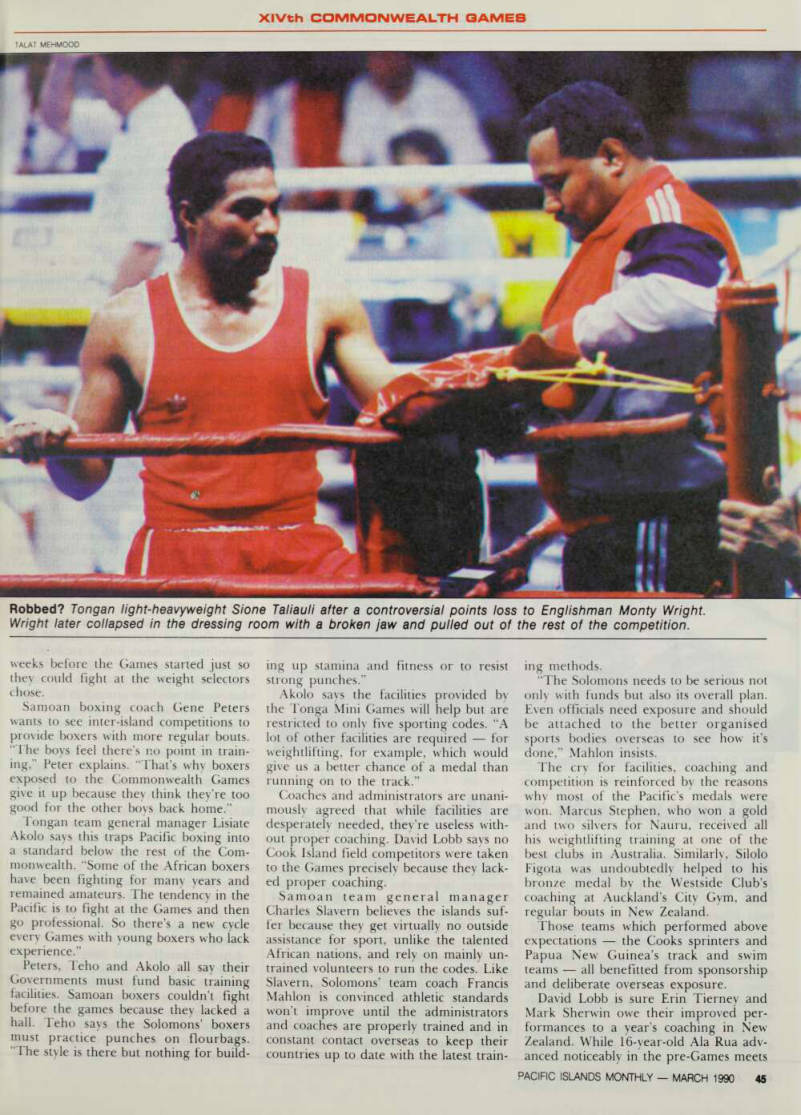
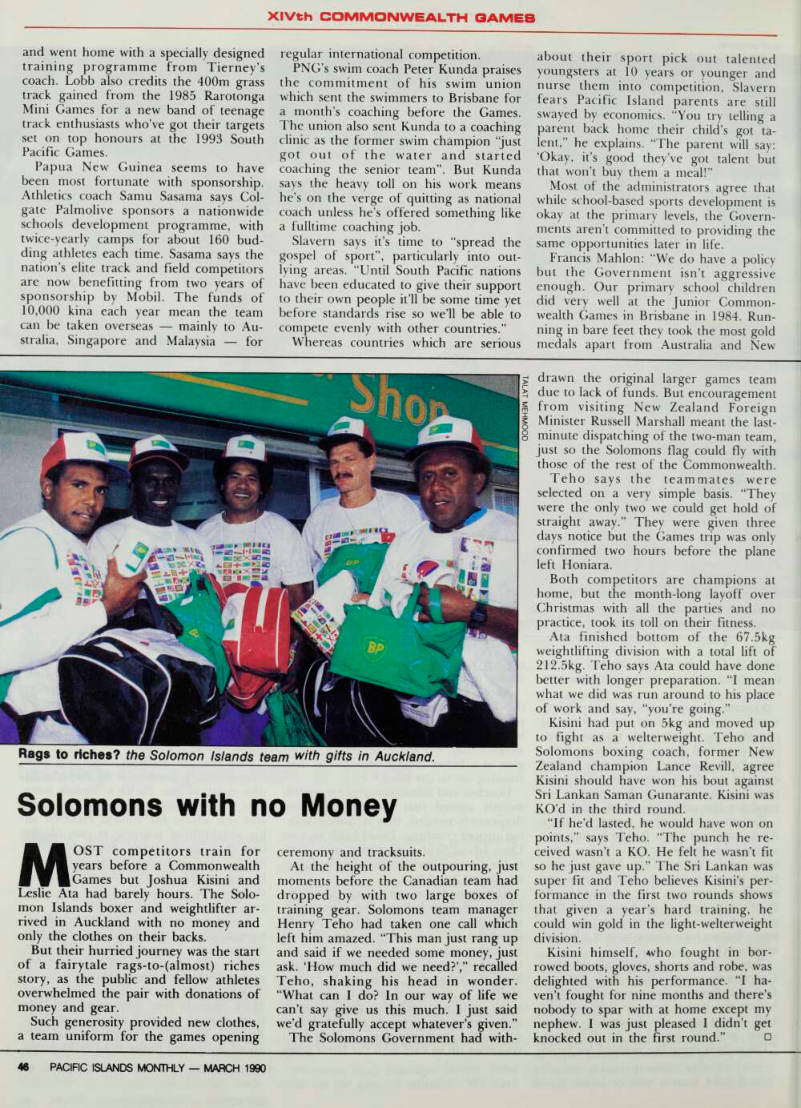
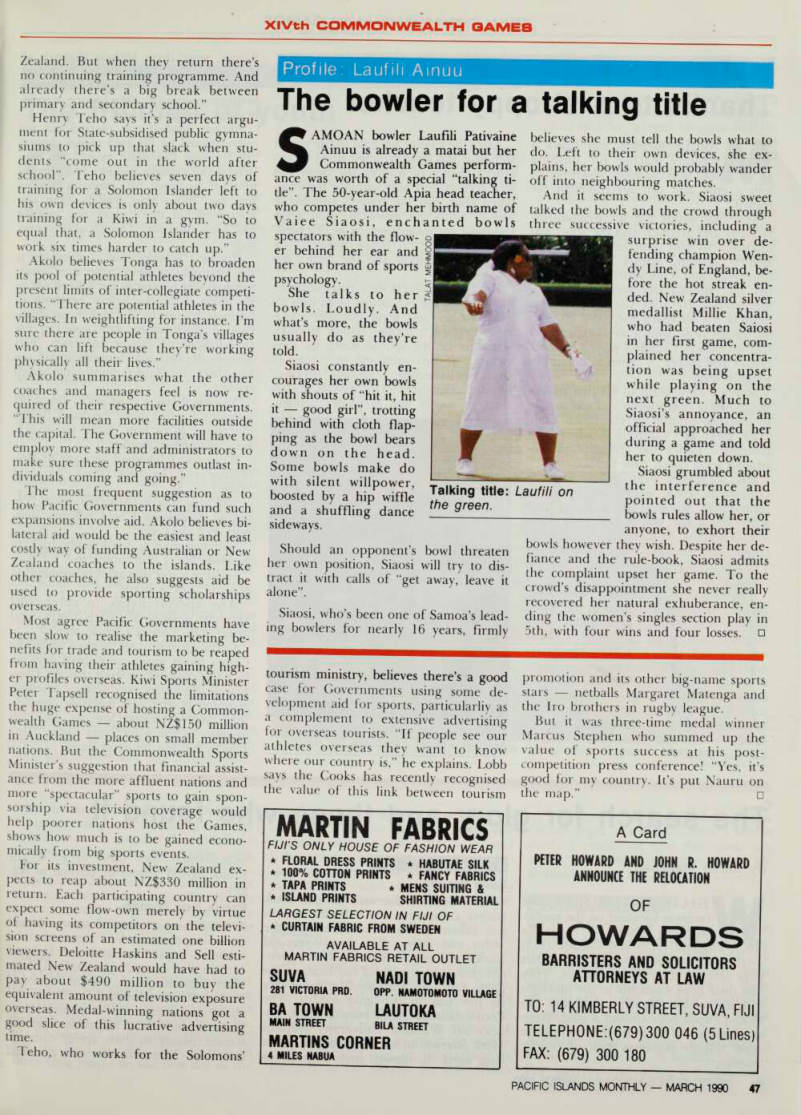
Going for gold has a price
By Karen Mangnall
THE Auckland Commonwealth Games proved to be the most suc cessful international sports outing ever for Pacific nations. But the glowing promise suggested by the medal haul two golds, two silvers and two bronzes cannot dim the Games’ true lesson for small island nations. When it comes to
running, jumping, swimming, lifting,
boxing or cycling money talks.
The Australians know how to spend for success. The Australian Government has pumped millions of dollars into sport in recent years, mainly through the Canberra Institute of Sport. The Aussies won 162 medals 52 gold, 54 silver, 56 bronze to top the table. Thanks to $350,000 in preparation funds, their
swimmers took 21 of the 32 gold medals in the pool, smashing games records almost at will.
Prime Minister Bob Hawke happily reaped the benefits of that investment: “Talent is one thing but it’s got to be developed and trained and we’re getting the dividends now.”
That message is arriving with a thump about now on ministerial desks around the Pacific as the various team managers and coaches put in their reports. Given the right level of Government financial support, they believe Pacific nations can compete consistently at the top of certain sports.
Solomons team manager Henry Teho sums up the general attitude: “We have
the potential to be gold medallists in any sports. The same goes for other Pacific Islanders.”
Cooks team general manager David Lobb says opposition like the Australian megabuck medal machine hasn’t put off competitors. “We’ve had enough success in a limited way to strive further. And we’ve seen the successes of our neigh bours PNG, Samoa and Marcus Stephen for Nauru. Sure he’s trained in Melbourne but he’s a Pacific Islander.”
But they all point to many hurdles the islands face: isolation from international competition, a small population pool of potential athletes, lack of facilities, lack of coaches, lack of money.
All these problems seem to have coin cided for the Pacific boxers. Lobb says Cooks boxers had only two bouts the Tonga Mini Games and the Oceania champs in November in the six months before the Games.
“We haven’t got the population to have enough boxers in the same weights to have bouts.” Lobb also points to in effective administration, with fit boxers being asked to lose several kilos barely
weeks before the Games started just so they could fight at the weight selectors chose.
Samoan boxing coach Gene Peters wants to see inter-island competitions to provide boxers with more regular bouts.
“The boys feel there’s no point in train ing,” Peter explains. “That’s why boxers exposed to the Commonwealth Games give it up because they think they’re too good for the other boys back home.”
Tongan team general manager Lisiate Akolo says this traps Pacific boxing into a standard below the rest of the Com monwealth. “Some of the African boxers have been fighting for many years and remained amateurs. The tendency in the Pacific is to fight at the Games and then go professional. So there’s a new cycle every Games with young boxers who lack experience.”
Peters, Teho and Akolo all say their Governments must fund basic training facilities. Samoan boxers couldn’t fight before the games because they lacked a hall. Teho says the Solomons’ boxers must practice punches on flourbags.
“The style is there but nothing for build
ing up stamina and fitness or to resist
strong punches.”
Akolo says the facilities provided by the Tonga Mini Games will help but are restricted to only five sporting codes. “A lot of other facilities are required for weightlifting, for example, which would give us a better chance of a medal than running on to the track.”
Coaches and administrators are unanimously agreed that while facilities are desperately needed, they’re useless without proper coaching. David Lobb says no Cook Island field competitors were taken to the Games precisely because they lacked proper coaching.
Samoan team general manager Charles Slavern believes the islands suffer because they get virtually no outside assistance for sport, unlike the talented African nations, and rely on mainly untrained volunteers to run the codes. Like Slavern, Solomons’ team coach Francis Mahlon is convinced athletic standards won’t improve until the administrators and coaches are properly trained and in constant contact overseas to keep their countries up to date with the latest train-
ing methods.
“The Solomons needs to be serious not only with funds but also its overall plan.
Even officials need exposure and should be attached to the better organised sports bodies overseas to see how' it’s done,” Mahlon insists, The cry for facilities, coaching and competition is reinforced by the reasons why most of the Pacific’s medals were won. Marcus Stephen, who won a gold and two silvers for Nauru, received all his weightlifting training at one of the best clubs in Australia. Similarly, Silolo Figota was undoubtedly helped to his bronze medal by the Westside Club’s coaching at Auckland’s City Gym, and regular bouts in New r Zealand, Those teams which performed above expectations the Cooks sprinters and Papua New Guinea’s track and swim teams all benefitted from sponsorship and deliberate overseas exposure, David Lobb is sure Erin Tierney and Mark Sherwin owe their improved per formances to a year’s coaching in New Zealand. While 16-year-old Ala Rua adv anced noticeably in the pre-Games meets
Talat Mehmood
Robbed? Tongan light-heavyweight Sione Taliauli after a controversial points loss to Englishman Monty Wright.
Wright later collapsed in the dressing room with a broken jaw and pulled out of the rest of the competition.
and went home with a specially designed
training programme from Tierney’s
coach. Lobb also credits the 400 m grass track gained from the 1985 Rarotonga Mini Games for a new band of teenage track enthusiasts who’ve got their targets set on top honours at the 1993 South Pacific Games.
Papua New Guinea seems to have been most fortunate with sponsorship.
Athletics coach Samu Sasama says Col gate Palmolive sponsors a nationwide schools development programme, with twice-yearly camps for about 160 bud ding athletes each time. Sasama says the nation’s elite track and field competitors are now benefitting from two years of sponsorship by Mobil. The funds of 10,000 kina each year mean the team can be taken overseas mainly to Au stralia, Singapore and Malaysia for
regular international competition.
PNG’s swim coach Peter Kunda praises the commitment of his swim union which sent the swimmers to Brisbane for a month’s coaching before the Games.
The union also sent Kunda to a coaching clinic as the former swim champion “just got out of the water and started coaching the senior team”. But Kunda says the heavy toll on his work means he’s on the verge of quitting as national coach unless he’s offered something like
a fulltime coaching job.
Slavern says it’s time to “spread the gospel of sport”, particularly into out lying areas. “Until South Pacific nations have been educated to give their support to their own people it’ll be some time yet before standards rise so we’ll be able to compete evenly with other countries.”
Whereas countries which are serious
about their sport pick out talented youngsters at 10 years or younger and nurse them into competition, Slavern fears Pacific Island parents are still swayed by economics. “You try telling a parent back home their child’s got ta lent,” he explains. “The parent will say: ‘Okay, it’s good they’ve got talent but that won’t buy them a meal!”
Most of the administrators agree that while school-based sports development is okay at the primary levels, the Govern ments aren’t committed to providing the same opportunities later in life.
Francis Mahlon: “We do have a policy but the Government isn’t aggressive enough. Our primary school children did very well at the Junior Common wealth Games in Brisbane in 1984. Run ning in bare feet they took the most gold medals apart from Australia and New
Zealand. But when they return there’s no continuing training programme. And already there’s a big break between
primary and secondary school.”
Henry Teho says it’s a perfect argu ment for State-subsidised public gymna siums to pick up that slack when stu dents “come out in the world after school”. Teho believes seven days of training for a Solomon Islander left to his own devices is only about two days training for a Kiwi in a gym. “So to equal that, a Solomon Islander has to work six times harder to catch up.”
Akolo believes Tonga has to broaden its pool of potential athletes beyond the present limits of inter-collegiate competi tions. “There are potential athletes in the villages. In weightlifting for instance. I’m sure there are people in Tonga’s villages who can lift because they’re working physically all their lives.”
Akolo summarises what the other coaches and managers feel is now re quired of their respective Governments.
“This will mean more facilities outside the capital. The Government will have to employ more staff and administrators to make sure these programmes outlast in
dividuals coming and going.”
The most frequent suggestion as to how Pacific Governments can fund such expansions involve aid. Akolo believes bi lateral aid would be the easiest and least costly way of funding Australian or New Zealand coaches to the islands. Like other coaches, he also suggests aid be used to provide sporting scholarships overseas.
Most agree Pacific Governments have been slow to realise the marketing be nefits for trade and tourism to be reaped
from having their athletes gaining high
er profiles overseas. Kiwi Sports Minister Peter Tapsell recognised the limitations the huge expense of hosting a Common wealth Games about NZ$l5O million in Auckland places on small member nations. But the Commonwealth Sports Minister’s suggestion that financial assist ance from the more affluent nations and more spectacular” sports to gain spon sorship via television coverage would help poorer nations host the Games, shows how much is to be gained econo mically from big sports events.
For its investment, New Zealand ex pects to reap about NZ$33O million in return. Each participating country can expect some flow-own merely by virtue of having its competitors on the televi sion screens of an estimated one billion viewers. Deloitte Haskins and Sell esti mated New Zealand would have had to pay about $490 million to buy the equivalent amount of television exposure overseas. Medal-winning nations got a good slice of this lucrative advertising time.
Teho, who works for the Solomons’
tourism ministry, believes there’s a good case for Governments using some de velopment aid for sports, particularliy as a complement to extensive advertising for overseas tourists, “If people see our athletes overseas they want to know where our country is,” he explains. Lobb says the Cooks has recently recognised the value of this link between tourism
promotion and its other big-name sports stars netballs Margaret Matenga and the Iro brothers in rugby league.
But it was three-time medal winner Marcus Stephen who summed up the value of sports success at his post competition press conference! “Yes, it’s good for my country. It’s put Nauru on the map.” □
Talat Mehmood
Solomons with no Money
MOST competitors train for
years before a Commonwealth Games but Joshua Kisini and Leslie Ata had barely hours. The Solo mon Islands boxer and weightlifter ar rived in Auckland with no money and only the clothes on their backs.
But their hurried journey was the start of a fairytale rags-to-(almost) riches story, as the public and fellow athletes overwhelmed the pair with donations of money and gear.
Such generosity provided new clothes, a team uniform for the games opening
ceremony and tracksuits.
At the height of the outpouring, just moments before the Canadian team had dropped by with two large boxes of training gear. Solomons team manager Henry Teho had taken one call which left him amazed. “This man just rang up and said if we needed some money, just ask. ‘How much did we need?’,” recalled Teho, shaking his head in wonder.
“What can I do? In our way of life we can’t say give us this much. I just said we’d gratefully accept whatever’s given.”
The Solomons Government had with
drawn the original larger games team due to lack of funds. But encouragement from visiting New Zealand Foreign Minister Russell Marshall meant the last minute dispatching of the two-man team, just so the Solomons flag could fly with those of the rest of the Commonwealth.
Teho says the teammates were selected on a very simple basis. “They were the only two we could get hold of straight away.” They were given three days notice but the Games trip was only confirmed two hours before the plane left Honiara.
Both competitors are champions at home, but the month-long layoff over Christmas with all the parties and no practice, took its toll on their fitness.
Ata finished bottom of the 67.5 kg weightlifting division with a total lift of 212.5 kg. Teho says Ata could have done better with longer preparation. “I mean what we did was run around to his place of work and say, “you’re going.”
Kisini had put on skg and moved up to fight as a welterweight. Teho and Solomons boxing coach, former New Zealand champion Lance Revill, agree Kisini should have won his bout against Sri Lankan Saman Gunarante. Kisini was KO’d in the third round.
“If he’d lasted, he would have won on points,” says Teho. “The punch he re ceived wasn’t a KO. He felt he wasn’t fit so he just gave up.” The Sri Lankan was super fit and Teho believes Kisini’s per formance in the first two rounds shows that given a year’s hard training, he could win gold in the light-welterweight division.
Kisini himself, who fought in bor rowed boots, gloves, shorts and robe, was delighted with his performance. “I ha ven’t fought for nine months and there’s nobody to spar with at home except my nephew. I was just pleased I didn’t get knocked out in the first round.” □
Rags to riches? the Solomon Islands team with gifts in Auckland.
Talat Mehmood
Talat Mehmood
Profile: Laufili Ainuu
The bowler for a talking title
SAMOAN bowler Laufili Pativaine Ainuu is already a matai but her Commonwealth Games perform ance was worth of a special “talking ti tle”. The 50-year-old Apia head teacher, who competes under her birth name of Vaiee Siaosi, enchanted bowls
spectators with the flow er behind her ear and her own brand of sports
psychology.
She talks to her bowls. Loudly. And what’s more, the bowls usually do as they’re told.
Siaosi constantly en courages her own bowls with shouts of “hit it, hit
it good girl”, trotting
behind with cloth flap ping as the bowl bears down on the head.
Some bowls make do with silent willpower, boosted by a hip wiffle and a shuffling dance
sideways.
Should an opponent’s bowl threaten her own position, Siaosi will try to dis tract it with calls of “get away, leave it alone”.
Siaosi, who’s been one of Samoa’s lead ing bowlers for nearly 16 years, firmly
believes she must tell the bowls what to do. Left to their own devices, she ex plains, her bowls would probably wander off into neighbouring matches.
And it seems to work. Siaosi sweet talked the bowls and the crowd through three successive victories, including a
surprise win over de
fending champion Wen
dy Line, of England, be fore the hot streak en ded. New Zealand silver medallist Millie Khan, who had beaten Saiosi in her first game, com plained her concentra tion was being upset while playing on the next green. Much to Siaosi’s annoyance, an official approached her during a game and told her to quieten down.
Siaosi grumbled about the interference and pointed out that the bowls rules allow her, or anyone, to exhort their
bowls however they wish. Despite her de fiance and the rule-book, Siaosi admits the complaint upset her game. To the crowd’s disappointment she never really recovered her natural exhuberance, en ding the women’s singles section play in sth, with four wins and four losses. □
Talat Mehmood
Talking title: Laufili on the green.
Advertisements & other items, p. 47 (1 item)
Howards
MARTIN FABRICS
FIJI’S ONLY HOUSE OF FASHION WEAR
* FLORAL DRESS PRINTS
★ 100% COTTON PRINTS
* TAPA PRINTS *
★ ISLAND PRINTS
★ HABUTAE SILK
★ FANCY FABRICS
MENS SUITING &
SHIRTING MATERIAL
LARGEST SELECTION IN FIJI OF
* CURTAIN FABRIC FROM SWEDEN
AVAILABLE AT ALL
MARTIN FABRICS RETAIL OUTLET
SUVA NADI TOWN
281 VICTORIA PRO. OPP. NAMOTOMOTO VILLAGE
BA TOWN LAUTOKA
MAIN STREET BILA STREET
MARTINS CORNER
4 MILES NABUA
A Card
PETER HOWARD AND JOHN R. HOWARD
ANNOUNCE THE RELOCATION
OF
HOWARDS
BARRISTERS AND SOLICITORS
ATTORNEYS AT LAW
TO: 14 KIMBERLY STREET, SUVA, FIJI
TELEPHONE:(679)3OO 046 (5 Lines)
FAX: (679) 300 180
Talat Mehmood
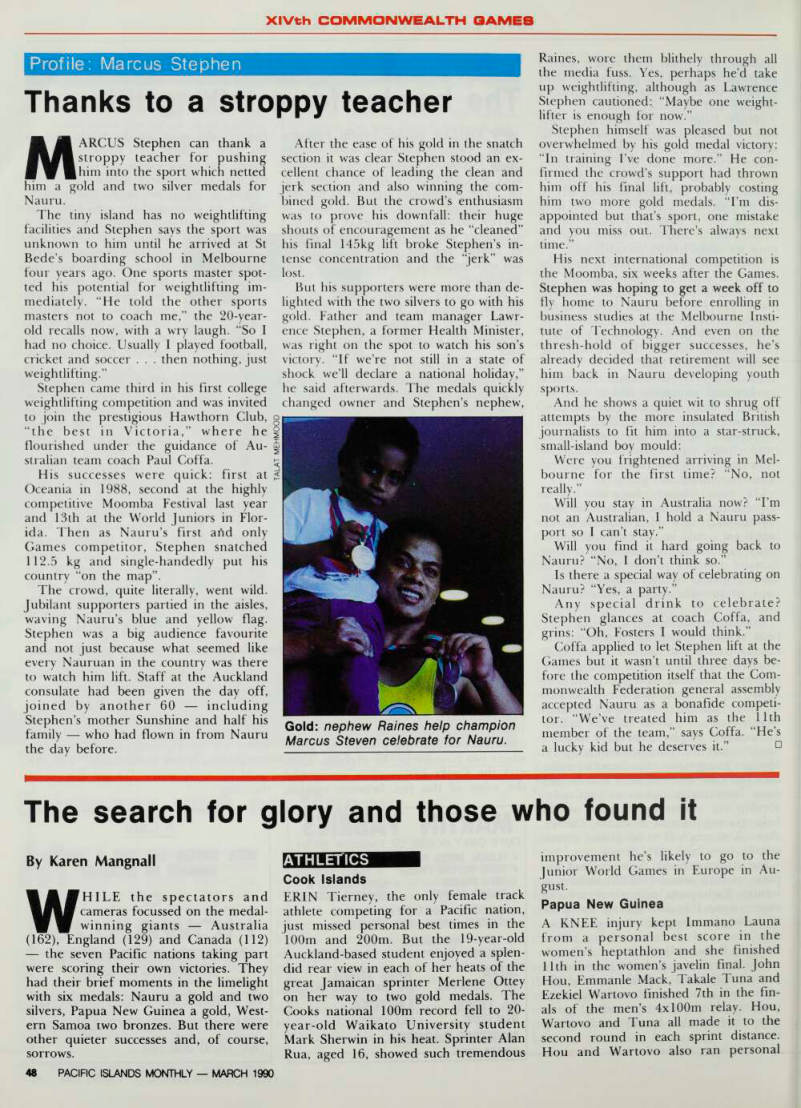
Profile: Marcus Stephen
Thanks to a stroppy teacher
MARCUS Stephen can thank a stroppy teacher for pushing him into the sport which netted him a gold and two silver medals for Nauru.
The tiny island has no weightlifting facilities and Stephen says the sport was unknown to him until he arrived at St Bede’s boarding school in Melbourne four years ago. One sports master spot ted his potential for weightlifting im mediately. “He told the other sports masters not to coach me,” the 20-year old recalls now, with a wry laugh. “So I had no choice. Usually I played football, cricket and soccer . . . then nothing, just
weightlifting.”
Stephen came third in his first college weightlifting competition and was invited to join the prestigious Hawthorn Club, “the best in Victoria,” where he flourished under the guidance of Au stralian team coach Paul Coffa.
His successes were quick: first at Oceania in 1988, second at the highly competitive Moomba Festival last year and 13th at the World Juniors in Flor ida. Then as Nauru’s first and only
Games competitor, Stephen snatched
112.5 kg and single-handedly put his country “on the map”.
The crowd, quite literally, went wild.
Jubilant supporters partied in the aisles, waving Nauru’s blue and yellow flag.
Stephen was a big audience favourite and not just because what seemed like every Nauruan in the country was there to watch him lift. Staff at the Auckland consulate had been given the day off, joined by another 60 including Stephen’s mother Sunshine and half his family who had flown in from Nauru the day before.
After the ease of his gold in the snatch section it was clear Stephen stood an ex cellent chance of leading the clean and jerk section and also winning the com bined gold. But the crowd’s enthusiasm was to prove his downfall: their huge shouts of encouragement as he “cleaned” his final 145 kg lift broke Stephen’s in tense concentration and the “jerk” was lost.
But his supporters were more than de lighted with the two silvers to go with his gold. Father and team manager Lawr ence Stephen, a former Health Minister, was right on the spot to watch his son’s victory. “If we’re not still in a state of shock we’ll declare a national holiday,” he said afterwards. The medals quickly
changed owner and Stephen’s nephew,
Raines, wore them blithely through all the media fuss. Yes, perhaps he’d take up weightlifting, although as Lawrence
Stephen cautioned;. “Maybe one weight
lifter is enough for now.”
Stephen himself was pleased but not
overwhelmed by his gold medal victory:
“In training I’ve done more.” He con firmed the crowd’s support had thrown him off his final lift, probably costing him two more gold medals. “I’m dis appointed but that’s sport, one mistake and you miss out. There’s always next time.”
His next international competition is the Moomba, six weeks after the Games.
Stephen was hoping to get a week off to fly home to Nauru before enrolling in business studies at the Melbourne Insti tute of Technology. And even on the thresh-hold of bigger successes, he’s already decided that retirement will see him back in Nauru developing youth sports.
And he shows a quiet wit to shrug off attempts by the more insulated British journalists to fit him into a star-struck, small-island boy mould: Were you frightened arriving in Mel bourne for the first time? “No, not
really.”
Will you stay in Australia now? “I’m not an Australian, I hold a Nauru pass port so I can’t stay.”
Will you find it hard going back to Nauru? “No, I don’t think so.”
Is there a special way of celebrating on Nauru? “Yes, a party.”
Any special drink to celebrate?
Stephen glances at coach Coffa, and grins: “Oh, Fosters I would think.”
Coffa applied to let Stephen lift at the Games but it wasn’t until three days be fore the competition itself that the Com
monwealth Federation general assembly
accepted Nauru as a bonafide competi tor. “We’ve treated him as the 11th member of the team,” says Coffa. “He’s a lucky kid but he deserves it.” I=l
Talat Mehmood
Gold: nephew Raines help champion Marcus Steven celebrate for Nauru.
The search for glory and those who found it
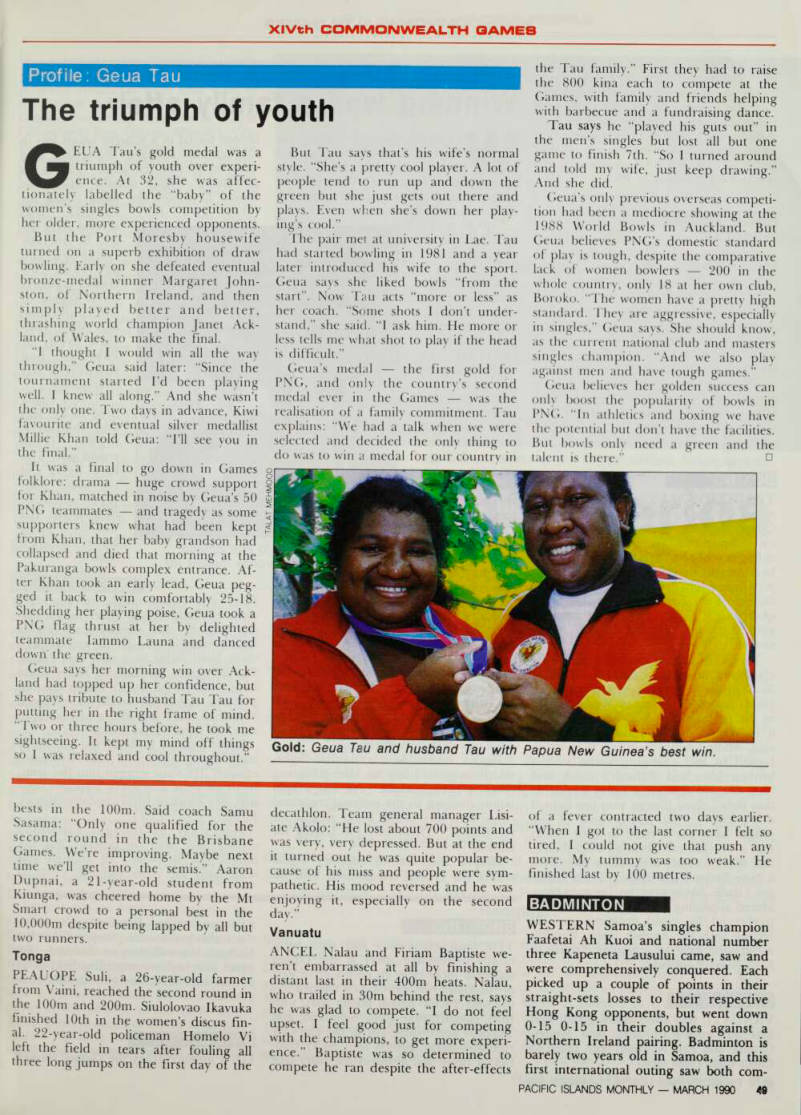
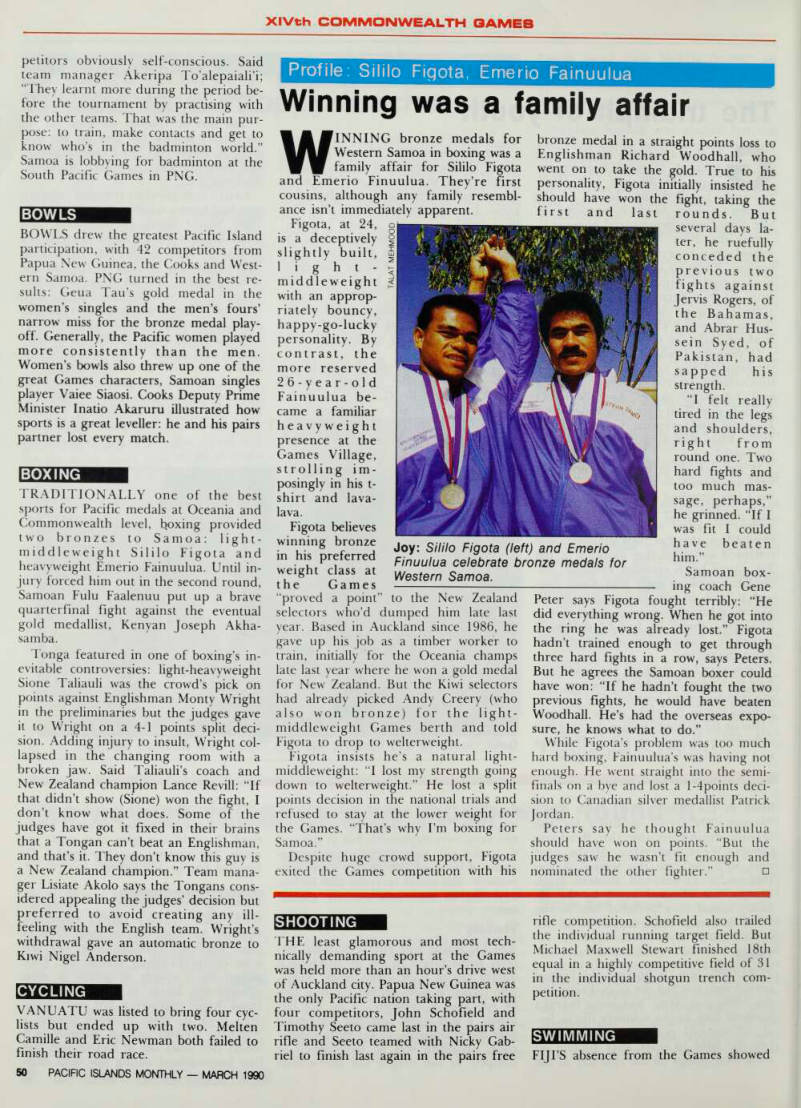
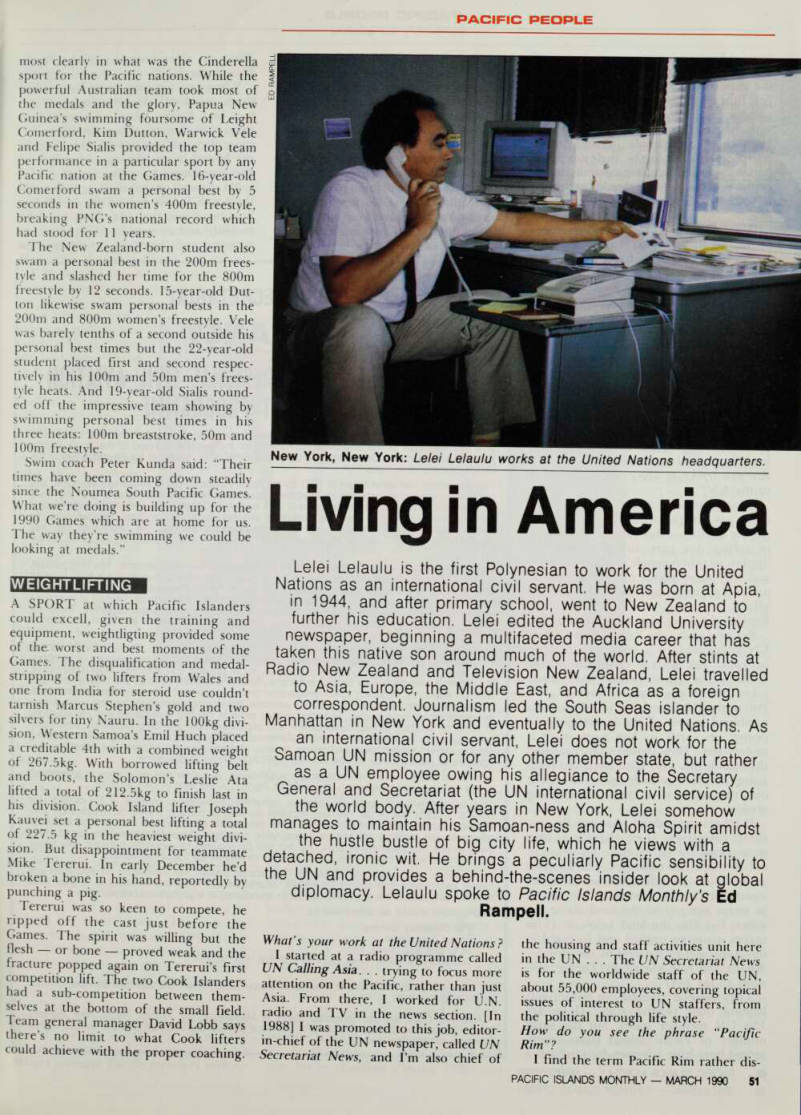
By Karen Mangnall
WHILE the spectators and cameras focussed on the medal
winning giants Australia
(162), England (129) and Canada (112) the seven Pacific nations taking part were scoring their own victories. They had their brief moments in the limelight with six medals: Nauru a gold and two silvers, Papua New Guinea a gold, West ern Samoa two bronzes. But there were other quieter successes and, of course, sorrows.
Iathletics
Cook Islands ERIN Tierney, the only female track athlete competing for a Pacific nation, just missed personal best times in the 100 m and 200 m. But the 19-year-old Auckland-based student enjoyed a splen did rear view in each of her heats of the great Jamaican sprinter Merlene Ottey on her way to two gold medals. The Cooks national 100 m record fell to 20year-old Waikato University student Mark Sherwin in his heat. Sprinter Alan Rua, aged 16, showed such tremendous
improvement he’s likely to go to the Junior World Games in Europe in Au gust.
Papua New Guinea A KNEE injury kept Immano Launa from a personal best score in the women’s heptathlon and she finished 11th in the women’s javelin final. John Hou, Emmanle Mack, Takale Tuna and Ezekiel Wartovo finished 7th in the fin als of the men’s 4xloom relay. Hou, Wartovo and Tuna all made it to the second round in each sprint distance.
Hou and Wartovo also ran personal
bests in the 100 m. Said coach Samu Sasama: “Only one qualified for the second round in the the Brisbane Games. We’re improving. Maybe next time we’ll get into the semis.” Aaron Dupnai, a 21-year-old student from Kiunga, was cheered home by the Mt Smart crowd to a personal best in the 10,000 m despite being lapped by all but two runners.
Tonga PEAUOPE Suli, a 26-year-old farmer from Vaini, reached the second round in the 100 m and 200 m. Siulolovao Ikavuka finished 10th in the women’s discus fin al. 22-year-old policeman Homelo Vi left the field in tears after fouling all three long jumps on the first day of the
decathlon. Team general manager Lisi ate Akolo: “He lost about 700 points and was very, very depressed. But at the end it turned out he was quite popular be cause of his miss and people were sym pathetic. His mood reversed and he was enjoying it, especially on the second
day.”
Vanuatu ANCEL Nalau and Firiam Baptiste we ren’t embarrassed at all by finishing a distant last in their 400 m heats. Nalau, who trailed in 30m behind the rest, says he was glad to compete. “I do not feel upset. I feel good just for competing with the champions, to get more experi ence.” Baptiste was so determined to compete he ran despite the after-effects
of a fever contracted two days earlier.
“When I got to the last corner I felt so tired, I could not give that push any more. My tummy was too weak.” He finished last by 100 metres.
Badminton
WESTERN Samoa’s singles champion
Faafetai Ah Kuoi and national number three Kapeneta Lausului came, saw and
were comprehensively conquered. Each
picked up a couple of points in their straight-sets losses to their respective Hong Kong opponents, but went down 0-15 0-15 in their doubles against a Northern Ireland pairing. Badminton is barely two years old in Samoa, and this first international outing saw both com
petitors obviously self-conscious. Said
team manager Akeripa To’alepaiali’i;
“They learnt more during the period be fore the tournament by practising with the other teams. That was the main pur pose: to train, make contacts and get to know who’s in the badminton world.”
Samoa is lobbying for badminton at the South Pacific Games in PNG.
Bowls
BOWLS drew the greatest Pacific Island participation, with 42 competitors from Papua New Guinea, the Cooks and West ern Samoa. PNG turned in the best re sults: Geua Tau’s gold medal in the women’s singles and the men’s fours’ narrow miss for the bronze medal play off. Generally, the Pacific women played more consistently than the men.
Women’s bowls also threw up one of the great Games characters, Samoan singles player Vaiee Siaosi. Cooks Deputy Prime Minister Inatio Akaruru illustrated how sports is a great leveller: he and his pairs partner lost every match.
Boxing
TRADITIONALLY one of the best sports for Pacific medals at Oceania and
Commonwealth level, boxing provided
two bronzes to Samoa: light
middleweight Sililo Figota and
heavyweight Emerio Fainuulua. Until in jury forced him out in the second round, Samoan Fulu Faalenuu put up a brave quarterfinal fight against the eventual gold medallist, Kenyan Joseph Akha samba.
Tonga featured in one of boxing’s in evitable controversies: light-heavyweight Sione Taliauli was the crowd’s pick on
points against Englishman Monty Wright
in the preliminaries but the judges gave it to Wright on a 4-1 points split deci sion. Adding injury to insult, Wright col lapsed in the changing room with a broken jaw. Said Taliauli’s coach and New Zealand champion Lance Revill: “If that didn’t show (Sione) won the fight, I don’t know what does. Some of the judges have got it fixed in their brains that a Tongan can’t beat an Englishman, and that’s it. They don’t know this guy is a New Zealand champion.” Team mana ger Lisiate Akolo says the Tongans cons idered appealing the judges’ decision but preferred to avoid creating any ill
feeling with the English team. Wright’s
withdrawal gave an automatic bronze to Kiwi Nigel Anderson.
(Cycling
VANUATU was listed to bring four cyc lists but ended up with two. Melten Camille and Eric Newman both failed to finish their road race.
Ishooting
THE least glamorous and most tech nically demanding sport at the Games was held more than an hour’s drive west of Auckland city. Papua New Guinea was the only Pacific nation taking part, with four competitors, John Schofield and Timothy Seeto came last in the pairs air rifle and Seeto teamed with Nicky Gab riel to finish last again in the pairs free
rifle competition. Schofield also trailed the individual running target field. But Michael Maxwell Stewart finished 18th equal in a highly competitive field of 31 in the individual shotgun trench com petition.
Swimming
FIJI’S absence from the Games showed
most clearly in what was the Cinderella sport for the Pacific nations. While the powerful Australian team took most of the medals and the glory, Papua New Guinea’s swimming foursome of height Comerford, Kim Dutton, Warwick Vele and Felipe Sialis provided the top team performance in a particular sport by any Pacific nation at the Games. 16-year-old Comerford swam a personal best by 5 seconds in the women’s 400 m freestyle, breaking PNG’s national record which had stood for 11 years.
The New Zealand-born student also swam a personal best in the 200 m frees tyle and slashed her time for the 800 m freestyle by 12 seconds. 15-year-old Dut ton likewise swam personal bests in the 200 m and 800 m women’s freestyle. Vele was barely tenths of a second outside his personal best times but the 22-year-old student placed first and second respec tively in his 100 m and 50m men’s frees tyle heats. And 19-year-old Sialis round ed off the impressive team showing by swimming personal best times in his three heats: 100 m breaststroke, 50m and
100 m freestyle.
Swim coach Peter Kunda said: “Their times have been coming down steadily since the Noumea South Pacific Games.
What we’re doing is building up for the 1990 Games which are at home for us.
The way they’re swimming we could be looking at medals.”
Iweightlifting
A SPORT at which Pacific Islanders could excell, given the training and
equipment, weightligting provided some
of the. worst and best moments of the Games. The disqualification and medal stripping of two lifters from Wales and one from India for steroid use couldn’t tarnish Marcus Stephen’s gold and two silvers for tiny Nauru. In the 100 kg divi sion, Western Samoa’s Emil Huch placed a creditable 4th with a combined weight of 267.5 kg. With borrowed lifting belt and boots, the Solomon’s Leslie Ata lifted a total of 212.5 kg to finish last in his division. Cook Island lifter Joseph Kauvei set a personal best lifting a total of 227.5 kg in the heaviest weight divi sion. But disappointment for teammate Mike Tererui. In early December he’d broken a bone in his hand, reportedly by
punching a pig.
Tererui was so keen to compete, he ripped off the cast just before the Games. The spirit was willing but the flesh or bone proved weak and the fracture popped again on Tererui’s first competition lift. The two Cook Islanders had a sub-competition between them selves at the bottom of the small field.
Team general manager David Lobb says there’s no limit to what Cook lifters could achieve with the proper coaching.
Talat Mehmood
Profile: Geua Tau
The triumph of youth
EUA Tau’s gold medal was a ■ ■ triumph of youth over experi ence. At 32, she was affec tionately labelled the “baby” of the women’s singles bowls competition by her older, more experienced opponents.
But the Port Moresby housewife turned on a superb exhibition of draw bowling. Early on she defeated eventual bronze-medal winner Margaret John ston, of Northern Ireland, and then simply played better and better, thrashing world champion Janet Ack land, of Wales, to make the final.
“I thought I would win all the way through,” Geua said later: “Since the tournament started I’d been playing well. I knew all along.” And she wasn’t the only one. Two days in advance, Kiwi favourite and eventual silver medallist Millie Khan told Geua: “I’ll see you in the final.”
It was a final to go down in Games folklore: drama huge crowd support for Khan, matched in noise by Geua’s 50 PNG teammates and tragedy as some supporters knew what had been kept from Khan, that her baby grandson had collapsed and died that morning at the Pakuranga bowls complex entrance. Af ter Khan took an early lead, Geua peg ged it back to win comfortably 25-18.
Shedding her playing poise, Geua took a PNG flag thrust at her by delighted teammate lammo Launa and danced down' the green.
Geua says her morning win over Ack land had topped up her confidence, but she pays tribute to husband Tau Tau for putting her in the right frame of mind.
“Two or three hours before, he took me sightseeing. It kept my mind off things so I was relaxed and cool throughout.”
But Tau says that’s his wife’s normal style. “She’s a pretty cool player. A lot of people tend to run up and down the green but she just gets out there and plays. Even when she’s down her play ing’s cool.”
The pair met at university in Lae. Tau had started bowling in 1981 and a year later introduced his wife to the sport.
Geua says she liked bowls “from the start”. Now Tau acts “more or less” as her coach. “Some shots I don’t under stand,” she said. “I ask him. He more or less tells me what shot to play if the head is difficult.”
Geua’s medal the first gold for PNG, and only the country’s second medal ever in the Games was the realisation of a family commitment. Tau explains: “We had a talk when we were selected and decided the only thing to do was to win a medal for our country in
the Tau family.” First they had to raise the 800 kina each to compete at the Games, with family and friends helping with barbecue and a fundraising dance.
Tau says he “played his guts out” in the men’s singles but lost all but one game to finish 7th. “So I turned around and told my wife, just keep drawing.”
And she did.
Geua’s only previous overseas competi tion had been a mediocre showing at the 1988 World Bowls in Auckland. But Geua believes PNG’s domestic standard of play is tough, despite the comparative lack of women bowlers 200 in the whole country, only 18 at her own club, Boroko. “The women have a pretty high standard. They are aggressive, especially in singles,” Geua says. She should know, as the current national club and masters singles champion. “And we also play against men and have tough games.”
Geua believes her golden success can only boost the popularity of bowls in PNG. “In athletics and boxing we have the potential but don’t have the facilities.
But bowls only need a green and the talent is there.” □
Talat Mehmood
Gold: Geua Tau and husband Tau with Papua New Guinea's best win.
Talat Mehmood
Profile: Sililo Figota, Emerio Fainuulua
Winning was a family affair
WINNING bronze medals for Western Samoa in boxing was a family affair for Sililo Figota and Emerio Finuulua. They’re first cousins, although any family resembl ance isn’t immediately apparent.
Figota, at 24, is a deceptively slightly built, light middleweight with an approp riately bouncy, happy-go-lucky personality. By contrast, the more reserved 26-year-old Fainuulua be came a familiar heavyweight presence at the Games Village, strolling im posingly in his t shirt and lava lava.
Figota believes winning bronze in his preferred weight class at the Games
“proved a point” to the New Zealand selectors who’d dumped him late last year. Based in Auckland since 1986, he gave up his job as a timber worker to train, initially for the Oceania champs late last year where he won a gold medal for New Zealand. But the Kiwi selectors had already picked Andy Creery (who also won bronze) for the light middleweight Games berth and told
Figota to drop to welterweight.
Figota insists he’s a natural light
middleweight: “I lost my strength going
down to welterweight.” He lost a split points decision in the national trials and refused to stay at the lower weight for the Games. “That’s why I’m boxing for Samoa.”
Despite huge crowd support, Figota exited the Games competition with his
bronze medal in a straight points loss to Englishman Richard Woodhall, who went on to take the gold. True to his personality, Figota initially insisted he should have won the fight, taking the first and last rounds. But
several days la ter, he ruefully conceded the previous two
fights against
Jervis Rogers, of the Bahamas, and Abrar Hus sein Syed, of Pakistan, had sapped his strength.
“I felt really tired in the legs and shoulders,
right from
round one. Two hard fights and too much mas
sage, perhaps,”
he grinned. “If I was fit I could have beaten him.”
Samoan box ing coach Gene
Peter says Figota fought terribly: “He
did everything wrong. When he got into the ring he was already lost.” Figota hadn’t trained enough to get through three hard fights in a row, says Peters.
But he agrees the Samoan boxer could have won: “If he hadn’t fought the two previous fights, he would have beaten Woodhall. He’s had the overseas expo sure, he knows what to do.”
While Figota’s problem was too much hard boxing, Fainuulua’s was having not enough. He went straight into the semi finals on a bye and lost a l-4points deci sion to Canadian silver medallist Patrick Jordan.
Peters say he thought Fainuulua should have won on points. “But the judges saw he wasn’t fit enough and nominated the other fighter.” □
Talat Mehmood
Joy: Sililo Figota (left) and Emerio Finuulua celebrate bronze medals for Western Samoa.
Pacific People
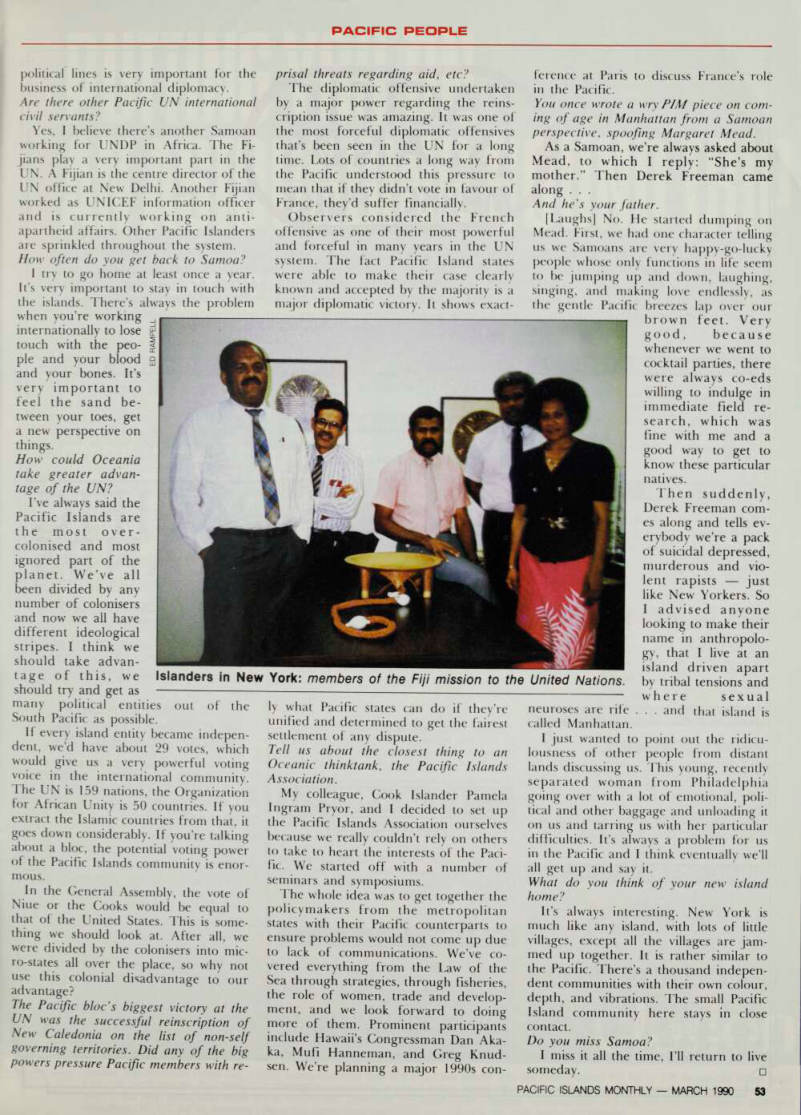
Living in America
Lelei Lelaulu is the first Polynesian to work for the United Nations as an international civil servant. He was born at Apia, in 1944, and after primary school, went to New Zealand to further his education. Lelei edited the Auckland University newspaper, beginning a multifaceted media career that has taken this native son around much of the world. After stints at Radio New Zealand and Television New Zealand, Lelei travelled to Asia, Europe, the Middle East, and Africa as a foreign correspondent. Journalism led the South Seas islander to Manhattan in New York and eventually to the United Nations. As an international civil servant, Lelei does not work for the Samoan UN mission or for any other member state, but rather as a UN employee owing his allegiance to the Secretary General and Secretariat (the UN international civil service) of the world body. After years in New York, Lelei somehow manages to maintain his Samoan-ness and Aloha Spirit amidst the hustle bustle of big city life, which he views with a detached, ironic wit. He brings a peculiarly Pacific sensibility to the UN and provides a behind-the-scenes insider look at global diplomacy. Lelaulu spoke to Pacific Islands Monthly's Ed Rampell.
What’s your work at the United Nations ?
I started at a radio programme called UN Calling Asia. . . trying to focus more attention on the Pacific, rather than just Asia. From there, I worked for U.N. radio and TV in the news section. [ln 1988] I was promoted to this job, editor in-chief of the UN newspaper, called UN Secretariat News, and I’m also chief of
the housing and staff activities unit here in the UN . . . The UN Secretariat News is for the worldwide staff of the UN, about 55,000 employees, covering topical issues of interest to UN staffers, from the political through life style.
How do you see the phrase “Pacific Rim”? 1 find the term Pacific Rim rather dis
New York, New York: Lelei Lelaulu works at the United Nations headquarters.
Ed Rampell
tasteful because it conjures up images of a bowl, in the same sense that the Rim is the important part, and we in the Pacific get flushed after everyone is finished with us. So, I have tremendous problems with that, and I wanted to point out that.
Hey! there are people in the Pacific,
people with strongly independent,
nationalistic and to a large extent, demo cratic systems, which should either be left alone or developed along lines they’d like.
I’ve tried to push for better awareness of the fact that Oceania is an area, which albeit very small has a lot to teach the world in terms of getting on with their neighbours and dealing with their own communities, making sure they’re in harmony with the environment and those around them. We in the Pacific do have a tremendous amount to offer the rest of the world. And as we all know, it’s not the size of the country that gives the advice, it’s the quality of the advice.
What we have done in the Pacific over the centuries is something that the rest of the world can well learn from. It’s one of the driving forces behind my work here at the UN and elsewhere.
Are you trying to bring the Pacific Way to the UN?
As an alternative to the way things are done, we can point out the Pacific Way can be useful this idea of consensus, of taking due care and affording the dignity to other people’s points of view, and why those points of view are there, are very important in international affairs.
Explain the term “aquatic continent”?
Renagi Lohia, the Papua New Guinea UN ambassador, is a proponent of what he calls “the aquatic continent of the Pacific”. For years, people have made jokes about the Pacific, saying . . .
Polynesia, Melanesia, and Micronesia combined is one of the largest political power on earth but most of it is underwater. They should stop regarding the islands this way. With advanced tech nology, it’s now possible for us to look at our resources in a three dimensional sense.
If others can restrict what can fly over their countries, then there’s a very strong case for us to make on who can sail through our countries. The Oceanic area should consider themselves as an aquatic or Oceania continent. Think of it in terms not just of the land above the water, but also the land below it. (This makes us) more unified and focussed in our approach to the rest of the world.
What’s the role played by Pacific mis sions to the UN?
They have a tremendous value, way beyond their relative sizes. There are 159 UN member states, but the small number of Pacific Island states repre sented here have a tremendous influence
beyond their size on the issues discussed by the UN because most Pacific peoples are highly literate and well in tune with the necessity to find out what bothers the person down stream. I’m very, very proud of the people that the Pacific sends to New York on the diplomatic level. For example, the top man on the Law of the Sea is a Fijian. Fiji has a strong mission here, Samoa has probably one of the hardest working missions.
They make a tremendous impact be cause of their good common sense, the
Pacific Way and approach.
What are other examples of the Pacific Way at the UN?
When you get into committees, when there are deadlocks between blocs you find Pacific Island counsel is very important for breaking deadlocks be cause they can speak to all sides. They’re not bound by an ideological brush.
Are they bound by voting blocs?
No. Except on positions agreed on by the South Pacific Forum, they’re all free to vote anyway they like. They have this
mobility and acceptability by parties not
agreeing and this ability to traverse the
political lines is very important for the business of international diplomacy.
Are there other Pacific UN international civil servants?
Yes, I believe there’s another Samoan working for UNDP in Africa. The Fi jians play a very important part in the UN. A Fijian is the centre director of the UN office at New Delhi. Another Fijian worked as UNICEF information officer and is currently working on anti apartheid affairs. Other Pacific Islanders are sprinkled throughout the system.
How often do you get back to Samoa?
I try to go home at least once a year.
It’s very important to stay in touch with the islands. There’s always the problem
when you’re working internationally to lose touch with the peo ple and your blood and your bones. It’s very important to feel the sand be tween your toes, get a new perspective on
things.
How could Oceania take greater advan tage of the UN?
I’ve always said the Pacific Islands are the most over colonised and most ignored part of the planet. We’ve all been divided by any number of colonisers and now we all have
different ideological
stripes. I think we should take advan tage of this, we should try and get as
many political entities out of the South Pacific as possible.
If every island entity became indepen dent, we’d have about 29 votes, which would give us a very powerful voting voice in the international community.
The UN is 159 nations, the Organization for African Unity is 50 countries. If you extract the Islamic countries from that, it goes down considerably. If you’re talking about a bloc, the potential voting power of the Pacific Islands community is enor mous.
In the General Assembly, the vote of Niue or the Cooks would be equal to that of the United States. This is some thing we should look at. After all, we were divided by the colonisers into mic ro-states all over the place, so why not use this colonial disadvantage to our
advantage?
The Pacific bloc’s biggest victory at the UN was the successful reinscription of New Caledonia on the list of non-self governing territories. Did any of the big powers pressure Pacific members with re
prisal threats regarding aid, etc?
The diplomatic offensive undertaken by a major power regarding the reins cription issue was amazing. It was one of the most forceful diplomatic offensives that’s been seen in the UN for a long time. Lots of countries a long way from the Pacific understood this pressure to mean that if they didn’t vote in favour of
France, they’d suffer financially.
Observers considered the French offensive as one of their most powerful and forceful in many years in the UN system. The fact Pacific Island states were able to make their case clearly known and accepted by the majority is a
major diplomatic victory. It shows exact-
ly what Pacific states can do if they’re unified and determined to get the fairest settlement of any dispute.
Tell us about the closest thing to an Oceanic thinktank, the Pacific Islands Association.
My colleague, Cook Islander Pamela Ingram Pryor, and I decided to set up the Pacific Islands Association ourselves because we really couldn’t rely on others to take to heart the interests of the Paci fic. We started off with a number of seminars and symposiums.
The whole idea was to get together the policymakers from the metropolitan states with their Pacific counterparts to ensure problems would not come up due to lack of communications. We’ve co vered everything from the Law of the Sea through strategies, through fisheries, the role of women, trade and develop ment, and we look forward to doing more of them. Prominent participants include Hawaii’s Congressman Dan Aka ka, Mufi Hanneman, and Greg Knud sen. We’re planning a major 1990 s con
ference at Paris to discuss France’s role in the Pacific.
You once wrote a wry PIM piece on com ing of age in Manhattan from a Samoan perspective, spoofing Margaret Mead.
As a Samoan, we’re always asked about Mead, to which I reply: “She’s my mother.” Then Derek Freeman came
along . . .
And he’s your father. [Laughs] No. He started dumping on Mead. First, we had one character telling us we Samoans are very happy-go-lucky people whose only functions in life seem to be jumping up and down, laughing,
singing, and making love endlessly, as
the gentle Pacific breezes lap over our
brown feet. Very
good, because
whenever we went to cocktail parties, there were always co-eds
willing to indulge in
immediate field re search, which was fine with me and a good way to get to know these particular natives.
Then suddenly,
Derek Freeman com es along and tells ev erybody we’re a pack of suicidal depressed, murderous and vio lent rapists just like New Yorkers. So I advised anyone looking to make their name in anthropolo gy, that I live at an island driven apart by tribal tensions and where sexual
neuroses are rife ... and that island is called Manhattan.
I just wanted to point out the ridicu lousness of other people from distant lands discussing us. This young, recently separated woman from Philadelphia going over with a lot of emotional, poli tical and other baggage and unloading it on us and tarring us with her particular difficulties. It’s always a problem for us in the Pacific and I think eventually we’ll all get up and say it.
What do you think of your new island home?
It’s always interesting. New York is much like any island, with lots of little villages, except all the villages are jam med up together. It is rather similar to the Pacific. There’s a thousand indepen dent communities with their own colour, depth, and vibrations. The small Pacific Island community here stays In close contact.
Do you miss Samoa?
I miss it all the time, I’ll return to live
someday. □
Ed Rampell
Islanders in New York: members of the Fiji mission to the United Nations.
Advertisements & other items, pp. 52-56 (1 item)
Y Vacancy
FORUM SECRETARIAT
HEAD, SOUTH PACIFIC REGIONAL CIVIL AVIATION
DEVELOPMENT PROGRAMME
Applications are invited from suitably qualified and experienced persons, who must be citizens of a member state of the South Pacific Forum*, for the position of Head of the South Pacific Regional Civil Aviation Development Programme (SPRCADP), based at the Headquarters of the Forum Secretariat in Suva, Fiji.
The Secretariat was established in 1973 by the South Pacific Forum to encourage economic and political co-operation between its member states, and between those states and the more industrialised countries. Under the control of a Secretary General, the Secretariat undertakes a regional work programme covering economic services, legal and political services, and the energy, tourism, trade, transport and telecommunications sectors. The Secretariat also has significant responsibilities with regard to ACP/EC regional projects funded under Lome Conventions.
The Secretariat's Aviation Programme currently comprises two main projects. The first involves the upgrading of five international airports in the region (Bauerfield, Bonriki, Fua’amotu, Funafuti and Nausori). The second major activity is the South Pacific Regional Civil Aviation Development Project. This is initially a five-year regional technical assistance project aimed at improving and enhancing civil aviation planning and development of Forum Island countries. There are also a number of air transport projects being developed in association with the Association of the South Pacific Airlines (ASPA) for which funding will be sought.
The Head of the Programme is responsible to the Secretary General, through the Director of Programmes, for the effective management of the Programme and the achievement of its objectives through the implementation of regional technical projects and activities. More specifically, the officer is responsible for liaising with consultants and relevant national and international civil aviation agencies, including ICAO; preparation and finalisation of terms of reference and tender procedures as necessary for consultancy services: developing appropriate training, and personnel development programmes, and other related projects; holding discussions with FIC countries in order to facilitate project development and implementation; providing necessary administrative support for the development and implementation of the projects; preparing and undertaking regular project assessments and review reports, and ensuring the efficient and effective management of project funds in line with the SPRCADP Terms of Reference.
Applicants should have a relevant tertiary qualification, plus extensive experience in government or the private sector, preferably in the South Pacific, in the field of civil aviation.
This appointment will carry an attractive remuneration package, payable in Fiji dollars. For non-Fiji citizens this is tax free and includes housing or housing allowance, repatriation allowance, education and child allowances. Other benefits for all employees include superannuation payments and medical, life and travel insurance coverage. The appointee will be based at the Secretariat's Headquarters in Suva, Fiji but will be required to undertake periodic duty travel.
Appointment would be for three years initially, renewable by mutual agreement.
Applications, which close on 31 March 1990 should contain full information on education and career background and should list names, addresses and telephone numbers of at least three referees with whom the applicant has been associated in a professional capacity.
Applications should be addressed to; The Secretary General Forum Secretariat GPO Box 856, Suva, Fiji Telephone: 312600: Telex 2229 SPECSUVA; Fax 302204 All enquiries should be made to Miss Karen Sorby, Acting Head, Management Services Division on 312600 Ext. 219. * Australia, Cook Islands, Federated States of Micronesia, Fiji, Kiribati, Nauru, New Zealand, Niue, Papua New Guinea, Republic of the Marshall Islands, Solomon Islands, Tonga, Tuvalu, Vanuatu and Western Samoa.
ACIFI
ISLANDS
M Q N
For the benefit of our readers who would like to place a small classified advertisement in our magazine, we've introduced from this issue a special Market Place page that we believe will assist you in selling personal items, accommodation, real estate, boating or a service in fact anything you would like to sell to our over 50,000 readers. Market Place Advertising Rates are structured to allow you to place as many advertisements as you wish, economically
POSITION WANTED
Contract Accountant, New Zealand.
Accountant with "hands on” and management experience requires assignments or locum management.
Phone Graham Hawkes (09) 377144, 4159454 A.H.
PROMOTION
Banners, school and sporting awards, conference folders and satchels, commercials and promotional products. Merit Press, Master Screen Printers, 3/3 Telopea St., Telopea, N.S.W. 2117. Phone (02) 871 2956
WANTED
Model or toy trains, cars, planes, boats, etc., any condition. Genuine collector (03)818-2191 or Box 356, Hawthorn, 3122.
FAMILY SAFETY
PROTECTALARM
SAVE-A-LIFE. Stop a crisis before it’s a disaster. Mini Pendant Transmitter starts help fast for those at risk alone. Telephone (07)378-2163. (09)353-2464. Toll Free (008) 074155 Ext. 95. Write P.O. Box 838, Toowong, Old., 4066, Australia.
REAL ESTATE
Real Estate Sunshine Coast, Richardson & Wrench, Alexandra Headland. Ask for John Hey (071) 431888 A/H (071)43- 6656.
COMMERCIAL PRINTING
Top quality four colour printing, brochures, posters, packaging, product labels, fabric labels, billboards, books, magazines, stickers, books. Export quality. Contact Fiji’s most experienced Com-
SELF ADHESIVE LABELS
FORUM LABELS (FIJI) LTD
P.O. Box 1167, Suva., Fiji, Phone: 314111.
We print self-adhesive labels in rolls, multi-coloured labels with hot foil, and die cut to shape, tickets and tags in rolls. We also supply labelling machines and fabric labels.
PACIFIC
SLANDS
I M O N T H L Y~
MRRK6T PLACE CRN WORK
WONDERS FOR VOU ...
Promote your business, or service, sell your household
items, cars or heavy machinery
etc.
ONLY AUSSI PER WORD.
NO COMPANY LOGO. NO
DISPLAY. NO BOLD TYPE.
Just forward your Advertisement together with payment to: PACIFIC ISLANDS MONTHLY “Market Place”, P.O. Box 1167, Suva, Fiji.
CONDITIONS:
1/ All Advertisements are subject to acceptance and approval of publisher. 2. Advertisements are published as space permits: we cannot guarantee date of insertion. 3. All advertisements must be prepaid and should be typed or printed clearly. 4. Deadline for receipt of advertisements is the 10th of the month prior to issue.
5. PACIFIC ISLANDS MONTHLY
assumes no responsibility for any service other than publishing paid advertisements in this section.
mercial Printers. FIJI TIMES COMMER- CIAL PRINTING, P.O. Box 1167, Suva. Fiji.
Phone: 314111. Fax. 301521.
HOLIDAY ACCOMMODATION
“Rainbow Bay Coolangatta”
Rainbow Place Apartments on the beach at beautiful Rainbow Bay. 1 & 2 bed units s/c. Large balcony facing north with magnificent coast and sea views. Solar heated pool. Compact tennis. Handy to N.S.W. Clubs. Security basement parking.
Resident Managers. Phone (075) 36 6759 for booking or write for brochure. 180 Marine Parade, Coolangatta. 3223. Australia.
Como Holiday Units (Fully self-contained).
Beachfront location overlooking the splendour of Keppel Bay and the islands. Two minutes from Hotels/Restaurants. Warm Welcome. Phone (079) 391594 or write 32 Anzac Parade, Yeepoon Old. 4703, Australia.
Yamba, NSW. We specialise in all forms of holiday lettings. For friendly and promt attention write or phone for our free Holiday Accommodation booklet.
L.J. HOOKER
1 1 YAMBA 11
P.O. Box 113, Yamba, 2464 or phone (066) 46 2202. After Hours; Ross or Jenny Macqueen (066) 462606 or Michael Macqueen (066) 462838.
BOATING
Boating Holidays NZ’s Bay Of Islands, Hauraki Gulf and Fiji. Bare boat, skippered, learn & cruise, flotilla, charter yachts and launches 26’-42’
All available from Rainbow Yacht Charters, P.O. Box 8327, Symonds Street, Auckland, NZ. Phone; (09)3089-419. Fax (09) 790-457.
CMX23O
STEREO CASSETTE DECK
WITH FM-STEREO/MW TUNER
& CD CHANGER CONTROL
■S’ rs V X CMX23O the trend-setting in-car sound
player offered by Clarion, that front-
runner in the car audio field. Visit new sound frontiers with the
amazing CMX23O,
a masterpiece in human
engineering. /
/ / / y c a <v a o O / /
clarion
her information Australia: AWA Distribution Limited Dept. 112-118 Talavera Road North Ryde NSW 2113 / New Zealand: AWA New Zealand Limited, P.O. Box 50-248, Porirua / Fiji Islands: Brijlal , Co ’o td D ’ G ’ RO - Box 362, Suva Tahiti: Hl FL - VAIRAATOA. Avenue Chef Vairaatoa B.P. 1128, Papeete / New Caledonia: Caldis, B.PMI, Noumea Cedex / Guam: Micropac Audio me., PO. Box 3478, Agana, Guam 96910, U.S.A. Tel: 472-8091, Cable Code: HIFI AUDIO AGANA / Vanuatu: The Sound Centre, PO. Box 434, Vila / Cook Islands: South Seas International Ltd., PO. Box 49, Rarotonga / Papua New Guinea: Haoemever fPN.G.t Ptv ltd PO Bn* 14? R RnmWn Pnrt Mnmchu
Created as Living Hardware.
v s. 0.
Mitsubishi’s full-time four-wheel drive, a corner-stone of the diverse technologies that results in their organic performance, is beautifully simple* As any truly advanced idea should be. Linking a viscous coupling unit, a sort of torque transfering devise with the center differential puts smooth, forceful acceleration and stable cornering under the wheels of their new organically inspired vehicles* The idea behind organic performance is that a car should really operate the way you want it to rather than the driver having to accommodate the various quirks of the vehicle* Both the driving conditions and the vehicle’s operation are monitored by the vehicle itself. In this way the car constantly fine-tunes its drive systems for the optimum operation while also adjusting its performance according to the external conditions.
Concern for your safety is why we make cars that perform as an extension of your will. You can’t be expected to anticipate every traffic situation any more than you can pay attention to.every mechanical detail.
So we’ve made cars that share some of the work load with you. With less time spent worrying about the running of the vehicle, you can spend more enjoying the drive.
Because when you drive a Mitsubishi, you’re driving technology you can trust.
A
MITSUBISHI
MOTORS
MITSUBISHI GRLRNT
AMERICAN SAMOA: MORRIS SCANLAN SERVICE INC. PO Box 367, Pago Pago. Tel 633-5520/AUSTRALIA: MITSUBISHI MOTORS AUSTRALIA LTD. Box 1284, South Road, Clovelly Park, South Australia 5042, Tel (083 275-7223/FIJI; NIVIS MOTOR & MACHINERY CO.. LTD. G.PO Box 150, Suva, Tel. 383411/FRENCH POLYNESIA (TAHITI): ETS-BREDIN FRERES ETFILS PO. Box 21, Papeete, Tahiti, Tel. 4-202-58/NEW CALEDONIA: SOCIETE D'IMPORTATION DAUTO DU PACIFIQUE SUDS.A. B.P 438 Rond Pointdu Pacifique, Noumea, Tel. 274144/NEW ZEALAND: MITSUBISHI MOTORS NEW ZEALAND LTD. Todd Park, Heriot Drive, Private Bag. Porirua, Tel. 370-109/ NORFOLK ISLAND: BORRYS LTD. PO Box 169, Norfolk Island, Tel. 2114/PAPUA NEW GUINEA: TOBA PTY. LTD. PO Box 503, Port Moresby, Tel 21-7874/SOLOMON ISLANDS: HARVEST PACIFIC LTD. G.PO Box 88, Honiara, Guadalcanal. Tel. 30128/TONGA: SITANI MAFI CO., LTD. PO Box 83, Nuku ALOFA, Tel. 21-044/VANUATU; SOCOMETRA B P. 06 Route de Lagon, Port-Vila, Tel. 2314/WESTERN SAMOA: A M. MACDONALD HOLDINGS LTD.
PO Box 576, Apia, Tel. 22022/SAIPAN/POHNPEI/MAJURO/KOSRAE/TRUK/YAP/BELAU: MICRONESIAN MOTORS, INC. 997 South Manne Dnve, Tamuning, Guam 96911, Tel. 646-6827