Pacific

Islands
Monthly
American Samoa . US$2.5O Australia A 52.50 Cook Islands NZ$3.OO Fiji F 51.75 FS. of Micronesia US$3.OO Guam US$3.OO Hawaii. .. US$3.OO Kiribati A 52.50 Nauru A 52.50 New Caledonia ...: CFPS2.SO New Zealand (incl GST) NZ53.45 Niue NZ$3.OO Norfolk Island A 53.00 Nth Marianas US$3.OO Papua New Guinea K 53.00 Rep. of Marshall US$3.OO Solomon Islands A 53.00 Tahiti CFP3OO Tonga P 3.00
Usa Us$3.Oo
Vanuatu ’. VT2OO - Samoa T 3.25 ‘Recommended retail price only
February 1990
Tb h b bhhr
Mhm&M
Cw 4
A priest tries
I /• Fiji: top m /choices for TV M /• Vanuatu: the m / Leodoro Affair / » Special Report: banking in the region
Advertisements & other items, p. 2 (1 item)
Aiwa
SUPERCaDSERIES Wbrids bl “ est lineup
Recording & Radio
• 4’ * • ■ i •in*
HS-JBOBA
Advanced Synthesizer Tuning with Stereo Recording
H5-JXBOBA
World’s Most Advanced Headphone Stereo ■FM stereo/AM synthesizer tuning with memory presets BAuto reverse stereo recording ■DSL—AIWA’s dynamic super loudness ■Full-function wired remote controller ■ Quick 20 minute recharge
H5-J2oBMkll A
Super Best Seller with Digital Synthesizer Tuner
H5-JI7O
Auto Reverse Headphone Stereo Recorder with Digital Synthesizer X-777 World’s First Midi System with BBE Sound ■ 550 W PMPO output power ■ BBE sound for remarkable high-definition sound ■ Wireless remote control of the entire system ■ 2-way CD edit
CSD-XR9O
Compact Disc Stereo Double Cassette Portable ■ 150 W PMPO output power*BßE system for high definition sound BSuper active subwoofer system (3D) BQuatz synthesizer tuner ■Full wireless remote control
Digital Audio & Video
AIWA
HV-G505 DIGITAL
Video Cassette Recorder ■ Line recording capability ■ Digital auto tracking ■ Auto Voltage power supply (90V-260V Usable) Mobex Pty., Ltd. Unit 1,70 Gibbes Street Chatswood N.S.W. 2067 AUSTRALIA PHONE: 001-61-2-4066277/Oceania Indent Agency (P.N.Q.) Pty., Ltd. Ago St., Gordon Box §§lB, Boroko, Port Moresby, Papua New Guinea PHONE: 266411/The Sound Centre Ltd. P.O, Box 434 Port Vila, Vanuatu PHONE: 2036/P. Hargovind Bros. 190 Renwick Road PO. Box 409 Suva Fiji PHONE: 24360/Octavium Group Ltd. 33 Constellation Drive Mairangi Bay, Auckland 10 NEW ZEALAND PHONE: 001-64-9-479-1272/Hi(lvo* 19 av. Foch B.P 1468 NOUMEA PHONE: 001-687-27.24.66/Harvesf Pacific Limited P.O. Box 617, Honiara, Solomon Islands PHONE: 131/Fare-Hi-Fi Stereo Ruede Marechal Foch P.O. Box 269, Papeete Tahiti R.C. 6604 A TAHITI PHONE: 2.48.14/Mlcropac Audio, Inc.
P.O. Box 3478 Agana, Guam 96910 PHONE: 472-8091, 472-8297/Rarotonga Duty Free Shop Private Bag P.O. Box 92, Rarotonga, Cook Island/Nauru Co-Operative Society Republic of Nauru
Pacific
Islands
Monthly
Vol 60 No. 2
Voice Of The Pacific
February 1990
Cover
Suicide in Truk has become the most disturbing social problem in the Federated States of Mic ronesia. Suicide rate there has be come one of the highest in the world, a trend that is worrying so cial workers and leaders in the re
gion. The same question is being
asked again and again: Why are
Trukese youths killing themselves?
Page 8.
Cover photo: Nitin Lai.
Business
Special Report: Banking in the
Pacific Islands is seeing better days, except in Papua New Guinea where the crisis in Bougainville has caused the country’s economy to dive. The Australians are the
leading figures in the region’s
banking industry. But locally
owned banks are popular with small account holders because they understand local customs and traditions. Page 35.
The region
Papua New Guinea: The country’s political crisis deepens as the war in Bougainville escalates. Foreigners have been asked to leave the island as the government contemplates fullscale war. Page 12.
Fiji: Freedom of the press is at stake as the interim government plans a legislation to issue newspaper licences on an annual basis. At the same time the Minister for Information refuses to talk to the press. Page 13.
Vanuatu: A former private secretary of the President goes to Washing ton and talks to Vietnamese about the possibility of resettling refugees at Pentecost, island of Prime Minister Walter Lini. Page 15.
Editor dale Moala Correspondents: Al Prince, Belinda Meares, Carrie Loranger, David North, David Robie, Diana McManus, Dykes Angiki, Ed Rampell, Frank Senge, John Hunter, dope Balawani lotu, Karen Mangnall, Macel Manua, Nicholas Rothwell, Paul Moon, Richard Dinner) Business correspondent Robin Bromby Publisher Geoffrey Hussey Advertising Manager Lionel Heffernan Business Manager Charlotte Thomas Advertising Sales • Fiji Peter Prasad, Tel (679) 314 111 • Sydney & Melbourne Fergus Maclagan, Tel (02) 4123918 • Brisbane: Robert Walker, Tel (07) 3710533 • Adelaide: Hastwell Williamson Representations, Tel (08) 799522
Cover prices are recommended retail only Registered by Australia Post, publication No NBP 1210 Copyright Fiji Times Limited, Suva, Fiji.
Departments
Letters p 4, Stamps p 6, Health p5O, Books p5l, Pacific People p 52.
Advertisements & other items, p. 3 (1 item)
3
PACIFIC ISLANDS MONTHLY FEBRUARY 1990
A Fiji Times Limited Production.
Founded 1930 (USPS 952480). 20 Gordon Street, Suva, Fiji. Telex FJ2124, Fax (679) 303809, Tel (679) 303244.
Pacific Islands Monthly (APPS No.
NBP1210) is published monthly by Fiji Times Limited, a division of Nationwide News, 2 Holt Street, Surry Hills, NSW 2010. Second class post age paid to Honolulu, Hawaii Post master.
Send address changes to: • Pacific Islands Monthly, PO Box 1167, Suva, Fiji • or, Pacific Islands Monthly, PO Box 2250, Honolulu, Hawaii 96822.
Typeset and printed by Fiji Times Limited, 20 Gordon Street, Suva, Fiji.
Remembering Tuvalu

Letters
SEPTEMBER 1989 PIM had a story of Diana McManus (“Farewell from a White Ship”) about the former manager of the Tuvalu Philatelic Bureau, Mr Frank Hoy. The story brought back vivid memories for my wife and me, as we lived I uvalu from June 1977 to August 1979 when I was the first resident Attorney General there.
Frank Hoy and his wife made us very welcome on Funafuti and one of Frank s adventures taught us a useful lesson about shopping there. When he
first arrived, Frank had gone to the “Fusi” (Cooperative Store) to buy sugar.
No container of any sort was available. 80 Frank had to walk home carrying lhe sugar in his cupped hands.
As the Philatelic Bureau was just across the road from our house, we often saw the young staff practising sword dances and hula dances for spe cial events these were Samoan rather than Tuvaluan in origin, but as your readers will know. Pacific culture is very eclectic in its approach A couple of minor corrections to
McManus’ story, by the way. Firstly, the island group ceased to be called the Ellice Islands and adopted the name Tuvalu in 1976, on separation from the Gilberts, while still a colony. Secondly, there was never a “Provisional Govern ment” of Tuvalu; Toalipi Lauti (as he was then known) became Chief Minis ter of the colonial Government in 1976 while Tom Laying was H.M. Commis sioner. In 1978 Toalipi became Prime Minister of an independent state with Sir Fiatau Penitala Teo as Governor General. 1 remember the occasion well, as I had the privilege of swearing in the then Governor-General.
John F Wilson
Hong Kong Full stomach I REFER to December 1989 issue of PIM which on pages 25, 26, 27 covers John McCrystal’s story of Western Samoa’s fragile economy. I find it hard to swallow some of the comments made by the Controller of Customs Mr Joe Devoe.
Sir, no doubt the public are well aware that yourself and other business associates have full stomachs everyday but please be more sensible when com menting on government issues.
M L Peti
Auckland
Penpals
Stephen Kemp. He visited the Cook Is lands, French Polynesia and New Zea land in 1984 and would like to corres pond with anyone in those countries or nearby as he anticipates further travels.
Address: 1020 Mifflin Street, Hunting don, PA 16652, USA.
Bisia Justin, 16. He is a high school student and wants penpals from “all over the world”. Justin says he has “numerous hobbies and will answer all the letters from people of any age and sex”. Address: Saint Joseph’s Rigu High School, PO Box 105, Kieta, NSP, Papua New Guinea.
Samuel Tororea, 21. He wants penpals from “the island states and elsewhere”.
Hobbies: reading, writing, collecting
and exchanging stamps, exchanging
gifts. Address: PO Box 1646, Arawa, North Solomons Province, Papua New Guinea. □
Letters To The Editor Must In
elude writer’s full name, address and home telephone number. All letters may be edited for purposes of clarity or space.
Letters should be addressed to: Pacific Islands Monthly PO Box 1167 Suva
Fiji Islands
Fax; (679) 302011
Advertisements & other items, pp. 4-6 (1 item)
Ǥ Samsung
PRODUCTS FOR PEOPLE WITH MORE
SENSE THAN MONEY
(i To own a Samsung TV Screen, Samsung Video Deck and Samsung Remote Control Unit!
rhat’tf Great!
That makes the Samsung Combination the most inexpensive of its kind. Go for the best view. Samsung quality is good enough for the 1988 Olympic Games. Should be ideal for your home!
Available at selected Duty Free Dealers and Burns Philp Home Centres throughout Fiji. m*
SJg SAMSUNG
SOLE DISTRIBUTORS:-
i CORRIE & COMPANY
HEAD OFFICE
G.P.O. BOX 45, SUVA
TLX: FJ2166
CABLES: CORRICO’ SUVA
TELEPHONE: 386777
BANKERS; WESTPAC, SUVA
FAX: (679) 300610
BRANCH OFFICE:
161 VITOGO PARADE
G.P.O. BOX 83, LAUTOKA
CABLES: “CORRICO" LAUTOKA
TELEPHONE: 60137
-*■ .-»• <*' <%• <v <* <♦" < . v»*\ Cv¥
>TvvV%>» n , v v 1
x,s* v.'i*- ara V 1 i fTwT\i M t Ml - W*
'Ma¥'.v».v'»'
M V* V ppgr %. 1 \
vSSI
#w i %.5 - •%, sj4« vS y\o^ #> *K' v\e® *4 w % A A. ~...<'-0 •??>• <vx f» .y; >“-V. -
SIU
* ■ M! % / - * ® \\ % * M BA j| ' t 'Nk ’*
5Ei **SBi
*-*» im; op 5 4
APS 7010/C
THE TAKARA
'ROCK' N FLOWERS
Coming now to the South Pacific These unique novelty items dance and groove to the beat of music.
Sole agents for Oceania:
AESTHETIC
CREATIONS PTY LTD
431 PARK REGIS
27 PARK ST. SYDNEY
NSW 2000
AUSTRALIA.
PH 02 2832966
FAX 02 2832863
Trade enquiries welcome.
Distributors required for Samoa, Cook Islands and New Caledonia. *Warning* Beware imitations!
Protected by worldwide copyright and Patents.
Frame stamps
Stamps
PNG introduces Frame stamps
By John Hunter
A MILESTONE in the stamp scene of the Pacific Islands will occur on March 7. Papua New Guinea is to issue the first regular Frama stamp. Frama stamps have been a part of the stamp scene worldwide for quite a number of years now.
The Frama stamp is a gummed label which has a value stamped on it by a vending type of machine. The name Fra ma comes from the name of the manu facturer of the machine which despenses the label Frama Ag, of Switzerland.
The name Frama has been accepted worldwide as the name of this label.
The Frama machine is especially valu able after the post office has closed. A person may place coins in the machine and push buttons displaying a standard rate of postage value and two other values. A fourth button may be used which will print onto the label the value of coins which have been inserted in the machine. The machine is heavy-duty mild steel plate and measures 34cm by 50cm by 20cm. Internal access is by a locked front door on which are mounted: • the control buttons • coin acceptor slot • coin reject knob • LCD display showing the total value of coins inserted and the balance re maining after the issue of the requested stamps. • Frama issuing slot.
Change is given in the form of an additional postage stamp. The coins are stored in a cash box. The stamps are automatically printed and cut to a stan dard size (40mm x 32mm in the case of PNG) from a roll of gummed stamp paper.
Australia and New Zealand have been using Frama stamps since the mid 1980 s.
Labels from different machines can often be identified. In the case of Au stralia, the label carries the capital city’s post code or for other labels an identify ing number and letter appears in one corner.
I have used the terms stamp and label.
Australia Post has recognised the Frama label as a stamp, but quite a number of countries recognise the label as a label only (similar to a Franking machine label) Papua New Guinea recognises the label as a stamp.
Australia and New Zealand have been using the Frama stamp for a number of years. The only other Pacific country to use Framas was Pitcairn Island which
rented a machine a couple of years ago for Stampex in Adelaide.
Other Pacific countries will keep an eye on Papua New Guinea to monitor the success or otherwise of the Frama venture. The collecting of Frama labels
has a large following, particularly in
Europe. Collectors alone will assure Papua New Guinea an initial success, financially, with the Frama. Collectors
not only value the normally produced
label but those labels which have faulty printing or paper varieties command
large prices. For example, labels which
have zero values printed are highly sought after.
Australia and New Zea land have used
specially de
signed Frama
paper. Austra lia has been us
ing a variety of
native animals as a design while New Zea land has used its flag as a
background
design.
PNG thus embarks on a new venture.
Certainly col
lectors worl dwide will make the ven ture popular.
How the labels
be accepted by the local people is another matter. PNG Post is preparing a
large promotion campaign.
It wil be difficult for local people to see that the label is a stamp. Australians still have this difficulty.
Framas are rarely encountered on nor mal mail and even postal authorities do not know how to treat the Frama. Fre quently Frama stamps are not cancelled and not readily accepted as payment for postal services. PNG will have this trou ble. Further Australian Frama machines are more often not working due to lack of paper or jammed coin slots. PNG Postal authorities will also have to con tend with this too.
The PNG machine will make its debut at Boroko Post Office. Consequently the label bears the designation “Boroko” on it.
The stamp will also bear the words Papua New Guinea and the value of the required rate. The machine will accept Kl, 50t, 20t, lOt, st, 2t and It coins.
Stamps can be selected with values from It to K 99.99. Additional machines will be installed in other centres. □
Nuclear review
Last Month
THE United States Department of Energy has asked for another six months to take another look at the safety of Rongelap Atoll (see map) in the Marshall Islands, one of the sites of American nuclear tests in the late forties and fifties. The department told the House of Representatives’ Insular and International Affairs Subcommittee that Energy Secretary James Watkins wanted a new look at Rongelap. The atoll had been the centre of a controversial claim by the Energy Department that it was safe.
The Department of Energy said it was not backtracking from its stand but Wat kins was concerned with issues raised by the people of Rongelap. The review will involve Rongelapese, scientist, health specialists and health and radiation ex perts.
The announcement came at nearly the same time 3200 Marshall Islanders were
reported to have filed compensation claims at the Majuro-based Nuclear Claims Tribunal seeking payment for
damages caused by the testing program
me in the Marshalls more than 30 years ago. Nearly 5400 claims were lodged for alleged damage to health, land or prop erty, death and other damage.
The people of Bikini, Eniwetok, Rongelap and Utirik atolls are receiving
compensation payments through the
Marshalls Compact of Free Association with the United States. Payment for claims made to the Nuclear Claims Tri bunal are made from interest acquired from a US$l5O million trust fund pro vided by the United States in 1986 and invested in Wall Street stocks and bonds.
Meanwhile the United States Army is going ahead with its Star Wars testing programme at Kwajalein Atoll despite concern about water and air pollution.
The army said the tests would not add much to the atoll’s pollution problems although it will clean up the existing mess. □
Nori’s assault THE Opposition Leader of the Solomon Islands, Andrew Nori, continued his assault on the government last month.
He predicted revenue in real terms will drop by 27 per cent this year because of constricted activities in the commercial sector and the drying up of liquidity in the banking system.
Nori said that while government would need more money to meet its ex penses, its revenue will drop. He pointed out that the budget for salaries had been underestimated, especially when there were plans to recruit at least 170 more
people.
School teachers employed under the National Teaching Service will receive an 18.5 per cent pay rise, an increase that will cost the government US$2.5 million, said the Secretary for Education and Human Resources Development, James
Saliga.
The government has also agreed to open a consular office in Brisbane in June to promote trade and investment.
The consular will have a staff of four and a budget of U 5565,000. • Nori is a former Cabinet Minister.
An error in production last month made him a former Prime Minister. □
Marshall Islands
Modern toddy
THE Forum Secretariat has hired a Fiji engineering firm to provide machinery for a modern toddy fermentation plant
in Tarawa. The machinery, designed by
Albho Engineering Works, of Lautoka, is made of stainless steel to withstand Kiri bati’s corrosive weather.
Albho engineer Albert Ho said the plant would initially cater for the local market “then possibly at a later stage they will consider export to Australia”.
Toddy is an alcoholic drink made from the sap of coconut palms.
Earlier police in Kiribati had cracked down on illegal plants making toddy for sale in Tarawa. The operation resulted in the discovery of those selling toddy without a licence and others whose li cence had expired. □
Making friends
COOK Islands announced last month it expected to sign a Treaty of Friendship with France soon. This followed talks in Tahiti last September and in Paris in October between Cook Islands Prime Minister Geoffrey Henry and his French counterpart Michel Rocard.
Cook Islands legal adviser Jim Gosse lin was reported as saying the proposed treaty would cover such things like de velopment assistance, social and cultural exchanges, education, and maritime mat ters of interest to the Cooks and neigh
bouring French Polynesia.
Gosselin sees such a treaty as leading to cooperative arrangements for the pat rolling of more than six million square kilometres of ocean covered in the exclu sive economic zones of Cook Islands and French Polynesia. □
Advertisements & other items, p. 7 (1 item)
$3.00 Delivery
DOYLES ARMY STORES
NEW SUMMER MAIL
ORDER CATALOGUE
$3.00 DELIVERY
New Zealands’s Largest Army Surplus Supplier • Camping gear • Dog Tags • Sleeping Bags • Knives
AND LOTS MORE!!
Cut out this coupon and send $3.00 to Doyles Army Navy & Camping Stores P.O. Box 39-249 Auckland. W.l.
New Zealand.
CATALOGUE
• Boots • Badges • Military Equipment • Zippo’s • Flags • Buckles • Back Packs • Hats • T-Shirts • Sunglasses • Studded Belts • Tents • Camo Clothing • Novelties Name: Address:
killing
Cover Story
The killing field
Al Jesuit priest tries to solve the puzzle of suicide in paradise
The tourist brochures describe Truk as a “natural paradise (that) holds a deep fascination for visitors”.
What it doesn’t say is that within the social framework of this Micronesian state is one of the world’s highest rates of suicide.
By David North
THE young man’s mother gave away his pet dog, so he killed himself.
Another feared that he would be beaten after coming home from watch ing video, so he hung himself. Another suicide occurred after a young man hurt his brother in a fight, and was severely chastised by his parents.
These are not isolated instances, they are a part of a widespread pattern in Truk, in the Federated States of Mic ronesia, which may well be the suicide capital of the Pacific, four times that of Guam, and seven times that of American Samoa. In fact there are only a few places in the world with suicide rates higher than that of Truk. Looking at another way, suicide has become the
leading cause of death of males aged 15-30 in Truk.
The form of suicide favoured in Truk is a particularly grim one no instant death with a bullet in the head, or the drowsy departure caused by an overdose of sleeping pills. About 80 per cent of those killing themselves in Truk do so by hanging; they often tie a rope to a tree, loop it around their neck, and then lean against it from a standing or sitting position until they strangle themselves.
There are variations; women sometimes prefer drug overdoses, and men some times consume a toxic substance, like Clorox or another poison, or use guns or explosives, but death by hanging is the traditional method.
Suicide is not new to the Central Paci fic. United States Navy Commander Charles Wilkes, while exploring the Gil berts around 1840, wrote this still perti
nent description:
“ . . [Gilbertese] are said to be subject to despondency and sullen ness, that sometimes causes them to commit suicide ... To termin ate their lives they always resort to hanging on a tree. The motive of this act is generally the treatment they have received, or offence taken at the conduct of some per son, whom affection or fear ren ders them unwilling to injure; the
mortification and grief produced
thereby leads them at last to suicide, which is considered by them as a remedy for their evils, as well as a severe revenge upon those who had ill-treated them...”
The missionaries noticed these deaths as well. At the turn of the century there were six suicide attempts within two years, two successful, at a Truk mission
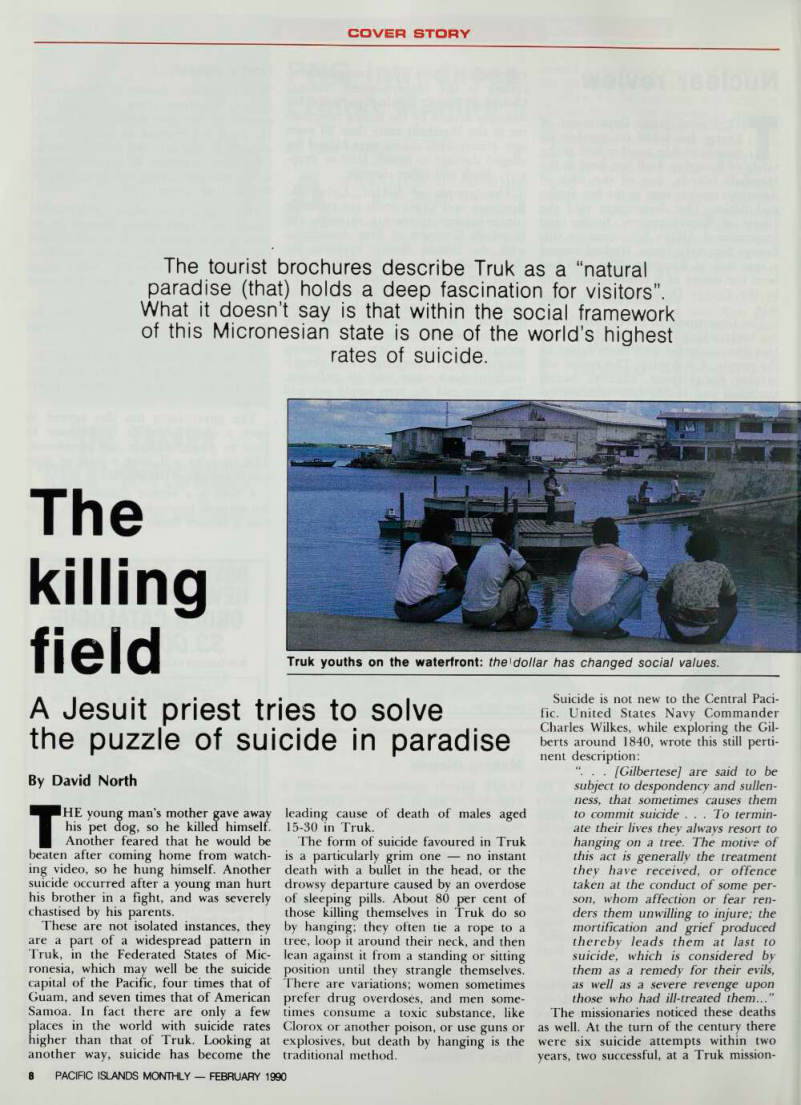
Truk youths on the waterfront: the dollar has changed social values.
ary boarding school. The headmistress organised and trained a group of boys to thwart future suicide attempts.
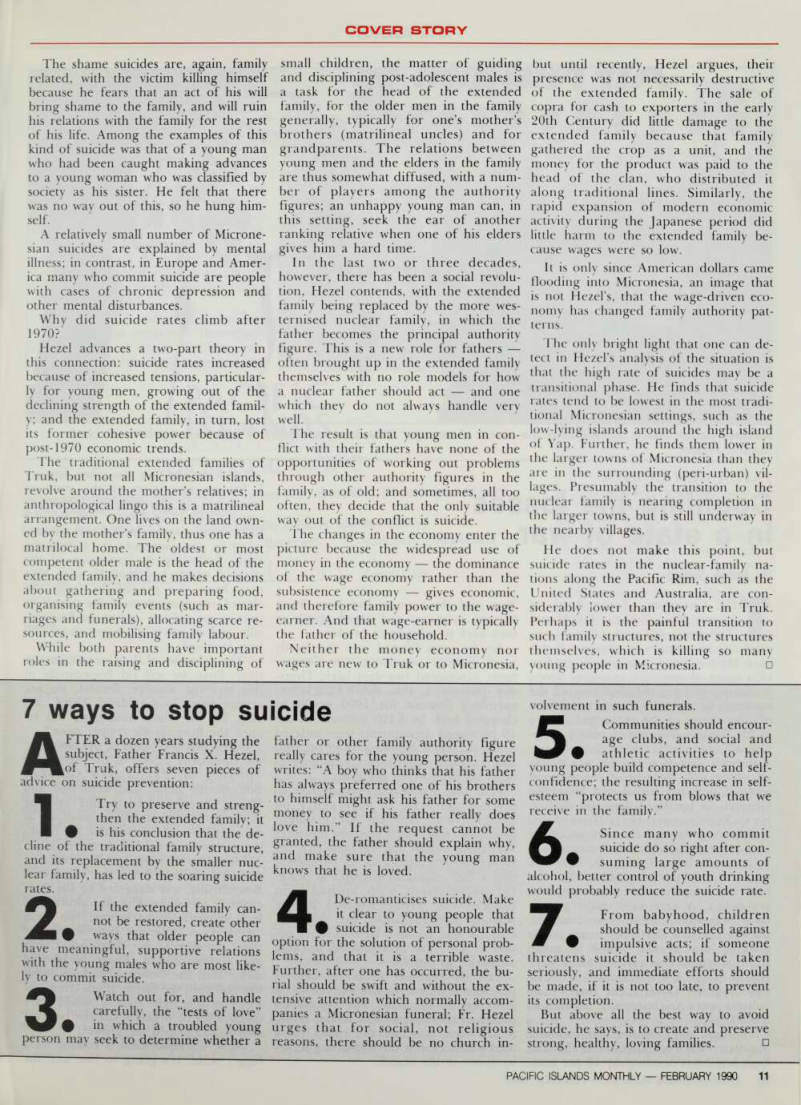
By the 1920 s the Japanese occupiers, who had their own (quite different) pat terns of suicide, were keeping, as one might suspect, the first good statistics on the subject, recording about eight such deaths per 100,000 Truk residents per year (the standard measure in the field.) In the period after World War II the rate remained at approximately the same level but then it started to rise sharply, as the following shows:
While the suicide rate has usually been somewhat higher in Truk than elsewhere in Micronesia, other areas, too, have seen the number of suicides increase.
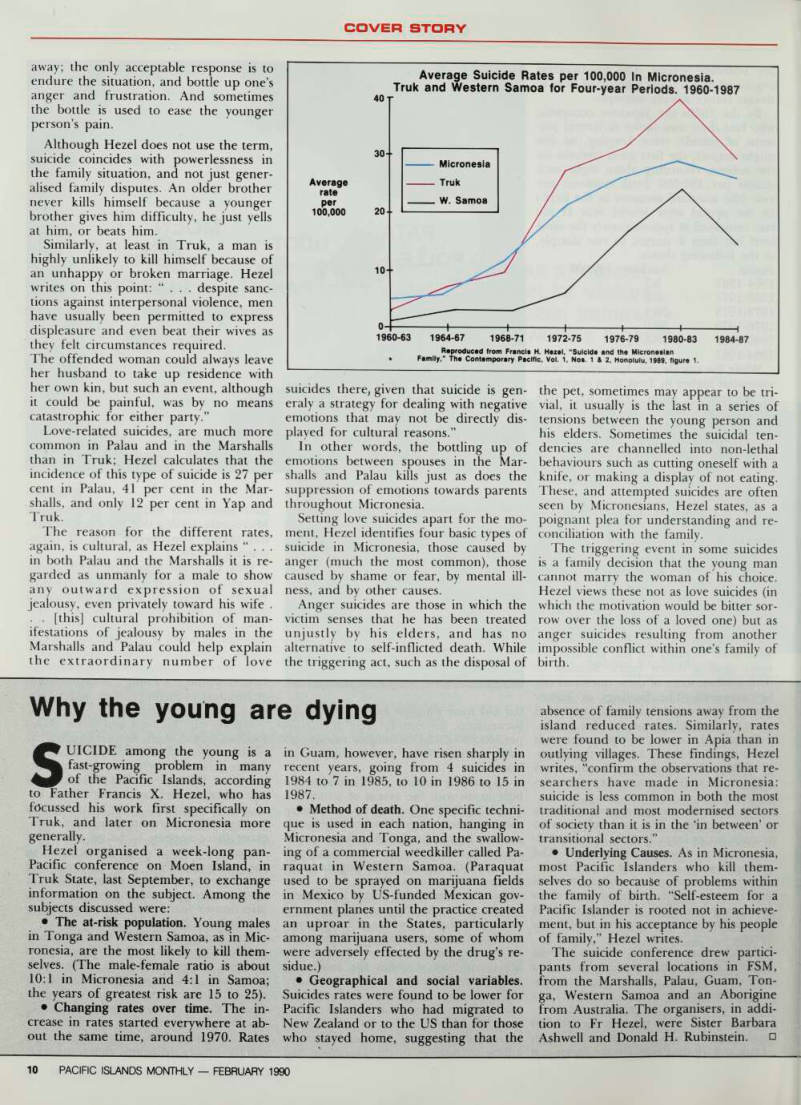
The peaks for Micronesia as a whole were 40 suicides in 1980 and 43 in 1987. (The latter was the year in which 20 suicides were recorded in the Marshalls, twice the highest level reported pre
viously.)
Who is dying? Why are they killing themselves? And why have the rates in creased so much in recent years?
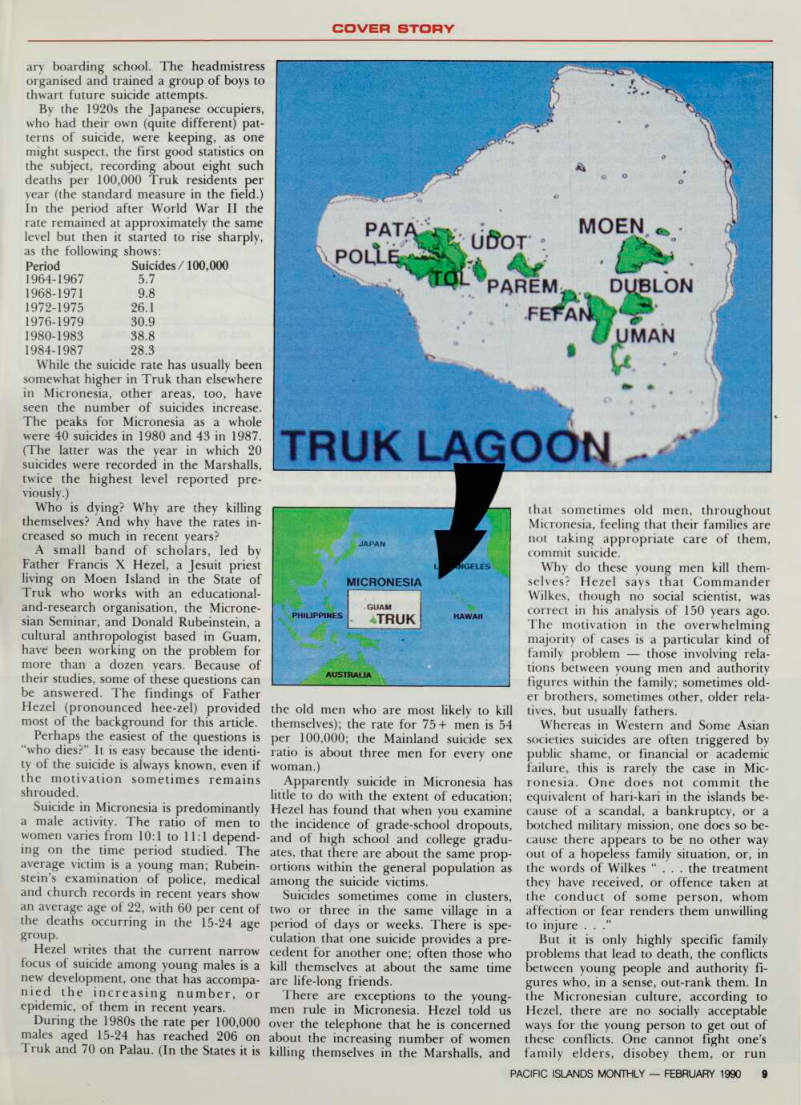
A small band of scholars, led by Father Francis X Bezel, a Jesuit priest living on Moen Island in the State of Truk who works with an educational and-research organisation, the Microne sian Seminar, and Donald Rubeinstein, a cultural anthropologist based in Guam, have been working on the problem for more than a dozen years. Because of their studies, some of these questions can be answered. The findings of Father Bezel (pronounced hee-zel) provided most of the background for this article.
Perhaps the easiest of the questions is “who dies?” It is easy because the identi ty of the suicide is always known, even if the motivation sometimes remains shrouded.
Suicide in Micronesia is predominantly a male activity. The ratio of men to women varies from 10:1 to 11:1 depend ing on the time period studied. The average victim is a young man; Rubein stein’s examination of police, medical and church records in recent years show an average age of 22, with 60 per cent of the deaths occurring in the 15-24 age group.
Bezel writes that the current narrow focus of suicide among young males is a new development, one that has accompa nied the increasing number, or epidemic, of them in recent years.
During the 1980 s the rate per 100,000 males aged 15-24 has reached 206 on Truk and 70 on Palau. (In the States it is
the old men who are most likely to kill themselves); the rate for 75+ men is 54 per 100,000; the Mainland suicide sex ratio is about three men for every one woman.) Apparently suicide in Micronesia has little to do with the extent of education; Bezel has found that when you examine the incidence of grade-school dropouts, and of high school and college gradu ates, that there are about the same prop ortions within the general population as among the suicide victims.
Suicides sometimes come in clusters, two or three in the same village in a period of days or weeks. There is spe culation that one suicide provides a pre cedent for another one; often those who kill themselves at about the same time are life-long friends.
There are exceptions to the young men rule in Micronesia. Bezel told us over the telephone that he is concerned about the increasing number of women killing themselves in the Marshalls, and
that sometimes old men, throughout Micronesia, feeling that their families are not taking appropriate care of them, commit suicide.
Why do these young men kill them selves? Bezel says that Commander Wilkes, though no social scientist, was correct in his analysis of 150 years ago.
The motivation in the overwhelming majority of cases is a particular kind of
family problem those involving rela
tions between young men and authority figures within the family; sometimes old er brothers, sometimes other, older rela tives, but usually fathers.
Whereas in Western and Some Asian societies suicides are often triggered by public shame, or financial or academic failure, this is rarely the case in Mic ronesia. One does not commit the equivalent of hari-kari in the islands be cause of a scandal, a bankruptcy, or a botched military mission, one does so be cause there appears to be no other way out of a hopeless family situation, or, in the words of Wilkes “ . . . the treatment they have received, or offence taken at the conduct of some person, whom affection or fear renders them unwilling
to injure . .
But it is only highly specific family problems that lead to death, the conflicts between young people and authority fi gures who, in a sense, out-rank them. In the Micronesian culture, according to Bezel, there are no socially acceptable ways for the young person to get out of these conflicts. One cannot fight one’s family elders, disobey them, or run
Period Suicides/100,000 1964-1967 5.7 1968-1971 9.8 1972-1975 26.1 1976-1979 30.9 1980-1983 38.8 1984-1987 28.3
away; the only acceptable response is to endure the situation, and bottle up one’s anger and frustration. And sometimes the bottle is used to ease the younger person’s pain.
Although Hezel does not use the term, suicide coincides with powerlessness in the family situation, and not just gener alised family disputes. An older brother never kills himself because a younger brother gives him difficulty, he just yells at him, or beats him.
Similarly, at least in Truk, a man is highly unlikely to kill himself because of an unhappy or broken marriage. Hezel writes on this point: “ . . . despite sanc tions against interpersonal violence, men have usually been permitted to express displeasure and even beat their wives as
they felt circumstances required.
The offended woman could always leave her husband to take up residence with her own kin, but such an event, although it could be painful, was by no means catastrophic for either party.”
Love-related suicides, are much more common in Palau and in the Marshalls than in Truk; Hezel calculates that the incidence of this type of suicide is 27 per cent in Palau, 41 per cent in the Mar shalls, and only 12 per cent in Yap and Truk.
The reason for the different rates, again, is cultural, as Hezel explains “ . . . in both Palau and the Marshalls it is re garded as unmanly for a male to show any outward expression of sexual jealousy, even privately toward his wife . . . [this] cultural prohibition of man ifestations of jealousy by males in the Marshalls and Palau could help explain the extraordinary number of love
suicides there, given that suicide is generaly a strategy for dealing with negative emotions that may not be directly displayed for cultural reasons.”
In other words, the bottling up of emotions between spouses in the Marshalls and Palau kills just as does the suppression of emotions towards parents
throughout Micronesia.
Setting love suicides apart for the moment, Hezel identifies four basic types of suicide in Micronesia, those caused by anger (much the most common), those caused by shame or fear, by mental illness, and by other causes.
Anger suicides are those in which the victim senses that he has been treated unjustly by his elders, and has no alternative to self-inflicted death. While the triggering act, such as the disposal of
the pet, sometimes may appear to be tri vial, it usually is the last in a series of tensions between the young person and his elders. Sometimes the suicidal ten dencies are channelled into non-lethal behaviours such as cutting oneself with a knife, or making a display of not eating, These, and attempted suicides are often seen by Micronesians, Hezel states, as a poignant plea for understanding and re conciliation with the family, The triggering event in some suicides is a family decision that the young man cannot marry the woman of his choice, Hezel views these not as love suicides (in which the motivation would be bitter sor row over the loss of a loved one) but as anger suicides resulting from another impossible conflict within one’s family of birth.
The shame suicides are, again, family related, with the victim killing himself because he fears that an act of his will bring shame to the family, and will ruin his relations with the family for the rest of his life. Among the examples of this kind of suicide was that of a young man who had been caught making advances to a young woman who was classified by society as his sister. He felt that there was no way out of this, so he hung himself.
A relatively small number of Micronesian suicides are explained by mental illness; in contrast, in Europe and Amertea many who commit suicide are people with cases of chronic depression and other mental disturbances.
Why did suicide rates climb alter 1970?
Bezel advances a two-part theory in this connection: suicide rates increased because of increased tensions, particularly for young men, growing out of the declining strength of the extended family; and the extended family, in turn, lost its former cohesive power because of post-1970 economic trends.
The traditional extended families of Truk, but not all Micronesian islands, revolve around the mother’s relatives; in anthropological lingo this is a matrilineal arrangement. One lives on the land owned by the mother’s family, thus one has a matrilocal home. The oldest or most competent older male is the head of the extended family, and he makes decisions about gathering and preparing food, organising family events (such as marriages and funerals), allocating scarce resources, and mobilising family labour.
While both parents have important roles in the raising and disciplining of
small children, the matter of guiding and disciplining post-adolescent males is a task for the head of the extended family, for the older men in the family generally, typically for one’s mother’s brothers (matrilineal uncles) and for grandparents. The relations between young men and the elders in the family are thus somewhat diffused, with a num ber of players among the authority figures; an unhappy young man can, in this setting, seek the ear of another ranking relative when one of his elders gives him a hard time.
In the last two or three decades, however, there has been a social revolu tion, Hezel contends, with the extended family being replaced by the more wes ternised nuclear family, in which the father becomes the principal authority figure. This is a new role for fathers often brought up in the extended family themselves with no role models for how a nuclear father should act and one which they do not always handle very well.
The result is that young men in con flict with their fathers have none of the
opportunities of working out problems
through other authority figures in the
family, as of old; and sometimes, all too often, they decide that the only suitable way out of the conflict is suicide.
The changes in the economy enter the picture because the widespread use of money in the economy the dominance of the wage economy rather than the subsistence economy gives economic, and therefore family power to the wage earner. And that wage-earner is typically the father of the household.
Neither the money economy nor wages are new to Truk or to Micronesia,
but until recently, Bezel argues, their presence was not necessarily destructive of the extended family. The sale of copra for cash to exporters in the early 20th Century did little damage to the extended family because that family gathered the crop as a unit, and the money for the product was paid to the head of the clan, who distributed it along traditional lines. Similarly, the rapid expansion of modern economic activity during the Japanese period did little harm to the extended family be cause wages were so low. „ is onl since American dollars came flooding into Micronesia, an image that not Hezel’s that the wage-driven eco no has changed family authority pat terns le on v bught *B™ l^lat one can c^e ‘ 111 ., s ana v SIS °( *bc situation is t * iat tie rate su i c *des ma > be a transitional phase. He finds that suicide rates tend to be lowest in the most tradi tional Micronesian settings, such as the islands around the high island °. a P Further, he finds them lower in t ie al S cl towns of Micronesia than they ale * n l^ie surroun ding (peii-urban) vil 'ages. Presumably the transition to the nuclear family is nearing completion in tne * ar g er towns, but is still underway in
near by villages.
He does not make this point, but suicide rates in the nuclear-family na tions along the Pacific Rim, such as the United States and Australia, are con siderably lower than they are in Truk, Perhaps it is the painful transition to such family structures, not the structures themselves, which is killing so many young people in Micronesia. □
Why the young are dying
SUICIDE among the young is a fast-growing problem in many of the Pacific Islands, according to Father Francis X. Hezel, who has focussed his work first specifically on Truk, and later on Micronesia more
generally.
Hezel organised a week-long pan- Pacific conference on Moen Island, in Truk State, last September, to exchange information on the subject. Among the subjects discussed were: • The at-risk population. Young males in Tonga and Western Samoa, as in Mic ronesia, are the most likely to kill them selves. (The male-female ratio is about 10:1 in Micronesia and 4:1 in Samoa; the years of greatest risk are 15 to 25). • Changing rates over time. The in crease in rates started everywhere at ab out the same time, around 1970. Rates
in Guam, however, have risen sharply in recent years, going from 4 suicides in 1984 to 7 in 1985, to 10 in 1986 to 15 in 1987. • Method of death. One specific techni que is used in each nation, hanging in Micronesia and Tonga, and the swallow ing of a commercial weedkiller called Pa raquat in Western Samoa. (Paraquat used to be sprayed on marijuana fields in Mexico by US-funded Mexican gov ernment planes until the practice created an uproar in the States, particularly among marijuana users, some of whom were adversely effected by the drug’s re sidue.) • Geographical and social variables.
Suicides rates were found to be lower for Pacific Islanders who had migrated to New Zealand or to the US than for those who stayed home, suggesting that the
absence of family tensions away from the island reduced rates. Similarly, rates were found to be lower in Apia than in
outlying villages. These findings, Hezel
writes, “confirm the observations that re searchers have made in Micronesia: suicide is less common in both the most traditional and most modernised sectors of society than it is in the ‘in between’ or transitional sectors.” • Underlying Causes. As in Micronesia, most Pacific Islanders who kill them selves do so because of problems within the family of birth. “Self-esteem for a Pacific Islander is rooted not in achieve ment, but in his acceptance by his people of family,” Hezel writes.
The suicide conference drew partici pants from several locations in FSM, from the Marshalls, Palau, Guam, Ton ga, Western Samoa and an Aborigine from Australia. The organisers, in addi tion to Fr Hezel, were Sister Barbara Ash well and Donald H. Rubinstein. □
7 ways to stop suicide
AFTER a dozen years studying the subject, Father Francis X. Hezel, of Truk, offers seven pieces of advice on suicide prevention: ITry to preserve and streng then the extended family; it 9 is his conclusion that the de cline of the traditional family structure, and its replacement by the smaller nuc lear family, has led to the soaring suicide rates. 2 If the extended family can not be restored, create other 0 ways that older people can have meaningful, supportive relations with the young males who are most like ly to commit suicide. 3 Watch out for, and handle carefully, the “tests of love” % in which a troubled young person may seek to determine whether a
father or other family authority figure
really cares for the young person. Hezel writes: “A boy who thinks that his father has always preferred one of his brothers to himself might ask his father for some money to see if his father really does love him.” If the request cannot be granted, the father should explain why, and make sure that the young man knows that he is loved. 4De-romanticises suicide. Make it clear to young people that 9 suicide is not an honourable option for the solution of personal prob lems, and that it is a terrible waste.
Further, after one has occurred, the bu rial should be swift and without the ex tensive attention which normally accom panies a Micronesian funeral; Fr. Hezel urges that for social, not religious reasons, there should be no church in
volvement in such funerals. 5 Communities should encour age clubs, and social and % athletic activities to help young people build competence and self confidence; the resulting increase in self esteem “protects us from blows that we receive in the family.” 6 Since many who commit suicide do so right after con w suming large amounts of alcohol, better control of youth drinking would probably reduce the suicide rate. 7 From babyhood, children should be counselled against 0 impulsive acts; if someone threatens suicide it should be taken seriously, and immediate efforts should be made, if it is not too late, to prevent
its completion.
But above all the best way to avoid suicide, he says, is to create and preserve strong, healthy, loving families. □
Counting the losses
The Region
Papua New Guinea
Counting the losses in a state of war
By Frank Senge
THE Governor of the Bank of Papua New Guinea, Sir Henry Toßobert, planned a nasty sur prise for his country on January 2 this year. He was going to announce the first of a series of economic measures aimed at staving off a rapid depletion of the country’s foreign reserves and to cushion off the effects of the prolonged closure of the Bougainville copper mine and de
pressed agricultural commodity prices.
Instead, Toßobert himself was shock ed, along with the rest of the country, when a personal friend and Governor General, Sir Ignatius Kilage, 48, died on New Year’s eve. Out of respect, Toßobert postponed the announcement of the economic adjustment measures.
One week later, Tuesday 9, Toßobert told the still shocked nation that the bank had adopted a recessionary monet ary policy. A zero rate credit growth target was set for 1990, down from the previous year’s 9-10 per cent credit growth. New lending would be made from banks only as existing loans were repaid except a few exempted activities including the Government itself. Indi viduals were to borrow a maximum K2OOO only.
The next day, Finance and Planning Minister, Paul Pora announced that the Kina had been devalued by 10 per cent.
Pora said the country had been living beyond its means and urged people to turn back to subsistence produce.
As the news filtered into the mostly rural illiterate population, the Govern ment announced two days later, Thurs day January 4, that the K 1.25 billion spending forecast for 1990 would be chopped back by KlOO million. All the 19 provincial departments were ordered to cut proposed spending by 10 per cent and national departments and govern ment agencies by 25 per cent.
Pora told Parliament, reconvened to discuss the state of emergency on Bougainville, that the Government would also seek wages restraint measures with trade unions. On the same day, the Government announced to Parliament that it had ceased all attempts at peace ful negotiations with militants on Bougainville. Prime Minister Rabbie Namaliu told Parliament that the Gov ernment had adopted an all-military op tion to quell the 14-month-old uprising as quickly as possible.
The Government proposed heavier penalties against terrorism and taking up arms against the state. The Opposition protested the Government action, saying it had come too late and called for a total withdrawal of the 600-strong secur ity force on the island.
But when the vote was taken January 5 for an extension of the state of emergency on Bougainville, Parliament voted 62 to 18 in favour. The security forces were given a further two months, using its new powers to try to end the crisis. Following the extension of the state of emergency Namaliu said: “We now have the greenlight from the elected representatives of the people to pursue our military option on Bougain ville, and we accept the heavy responsibi lities involved.
“The priorities of the Government are clear. First, we will rid Bougainville of this terrorist scourge. Second, we will restore peace to the island. Third, and vital, for the whole nation, we will re open the Bougainville copper mine.”
In the first two weeks of the new year, the cumulative effects of the landowner uprising on Papua New Guinea’s Bougainville island and depressed and
falling agricultural commodity and log
prices impacted on the nation all at once. Toßobert estimated that the result ing recession would last three years.
The non-mining private sector, already reeling from the shocks of Bougainville, was staggered by the Gov ernment measures. The agricultural and local manufacturing sectors, two areas targeted as potential beneficiaries of these measures, are doubtful. Cocoa growers spokesman, Roger Middleton, said: “Had the Government been sensi tive and used the Stabex funds (from the EEC) at the right time it would have taken a lot of pressure off the banking system and helped the grower.
“Now, unemployment is coming on a bigger scale. It’s going to bite into the
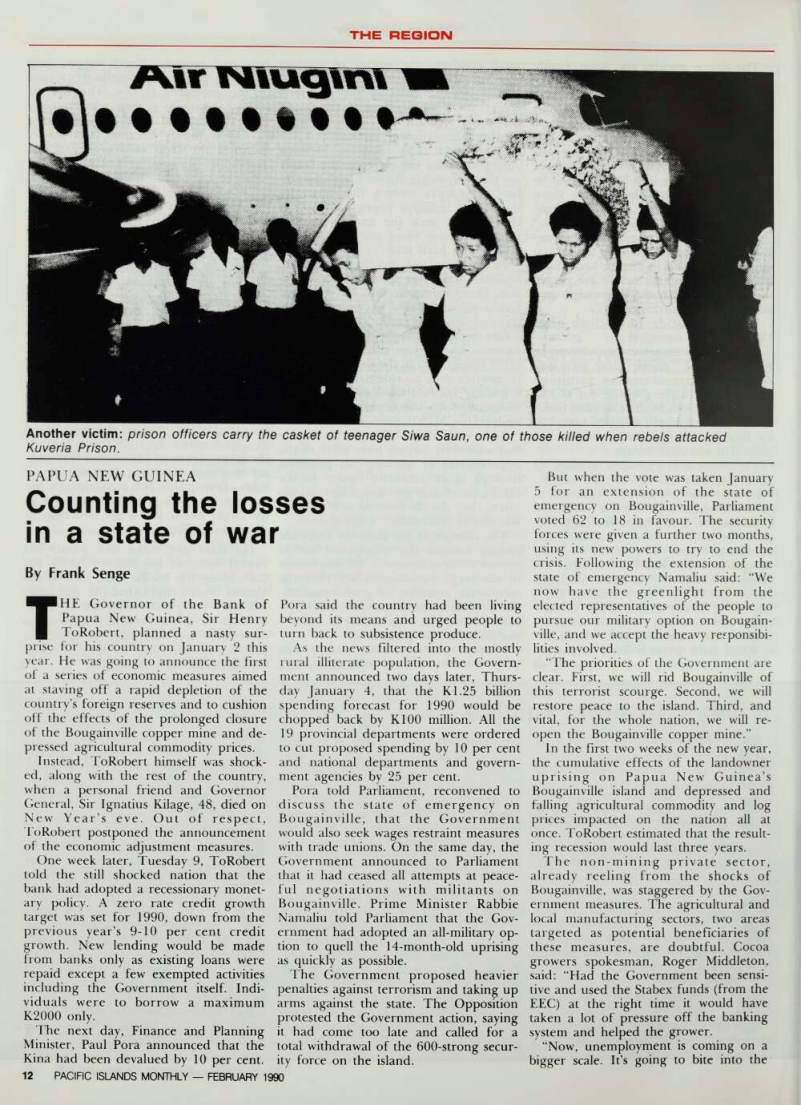
Another victim: prison officers carry the casket of teenager Siwa Saun, one of those killed when rebels attacked Kuveria Prison.
whole economy now, and I don’t know
where we are going. I don’t think any body else does either; and that is very
frightening.”
In the third week of January, the country was subjected to escalating vio lence on Bougainville and throughout the country. In direct retaliation to the Government announcement of an all out
military operation, Bougainville militants
stole into the Kuveria prison on Wednes day, January 17, and killed seven people.
Two adults were incinerated when the house which they were sleeping in was torched, four warders and a young girl were shot. The mostly Bougainvillean prisoners were freed.
That week a 15-seater Sirkosy helicop ter and various properties throughout Bougainville were burnt. Previously, un touched Buka island on the northern tip of Bougainville was affected when the Government station there was torched as well. For the first time since the crisis began, a Briton resident of Australia was killed by militants.
It was also a warning to Australian ministers attending a PNGAustralia joint ministerial forum in Port Moresby that the militants were serious.
Whether intentionally or uninten tionally two Australian citizens, including a journalist were wounded in the same week. The message hit home. Australian Foreign Affairs and Trade Minister, Senator Gareth Evans announced that Australia would evacuate its citizens on Bougainville if their lives were in dan ger. Bougainville Copper mine brought its resting heavy equipment into use on
Friday, January 19, and completed an
airfield in two days. The airfield on the mine site, is reportedly large enough to take a Hercules aircraft.
At the same time, PNG requested Au stralia at the ministerial forum for assist ance to solve its economic and Bougain ville crisis. Australia agreed to help fund, train and equip an additional 600 men for the defence force. Australian defence instructors are to fly into the country in the next few weeks to conduct training of soldiers before they are deployed on Bougainville.
A shipment of small arms are also re ported to be on the way from Australia to replenish depleted supplies on Bougainville. Australia has also commit ted an additional K 1 million on top of a Kl 4 million five-year project aid prog ramme to upgrade the PNG police force.
The additional aid will be used to up grade the mobile and riot squads of the constabulary. No commitment was made on a request for K 15.5 million uncom mitted, budget support aid. That is the scene which opened the New Year and the decade for 15-year-old Papua New Guinea. □
It started with a joke
Fiji
By Jale Moala
FOR so long now Fiji’s Minister for Information (and now Broadcast ing, Television and Telecom munications) has been the victim of quiet jokes. One calls him the Minister of Let ters, referring to his recent habit of writ ing regularly to the country’s two daily newspapers. His letters have become common features of the dailies’ opinion columns. The Minister, Ratu Inoke Kubuabola, a political infant, is a strong critic of journalism in Fiji and the press in general.
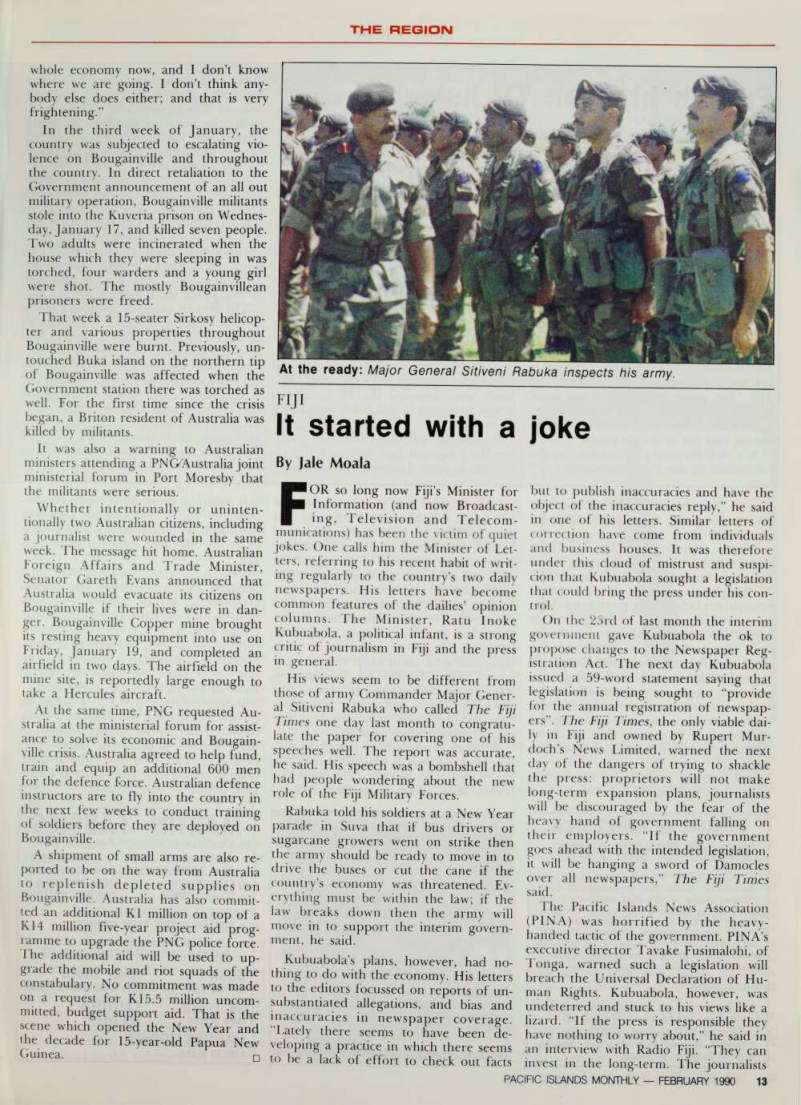
His views seem to be different from those of army Commander Major Gener al Sitiveni Rabuka who called The Fiji Times one day last month to congratu late the paper for covering one of his speeches well. The report was accurate, he said. His speech was a bombshell that had people wondering about the new role of the Fiji Military Forces.
Rabuka told his soldiers at a New Year parade in Suva that if bus drivers or sugarcane growers went on strike then the army should be ready to move in to drive the buses or cut the cane if the country’s economy was threatened. Ev erything must be within the law; if the law breaks down then the army will move in to support the interim govern ment, he said.
Kubuabola’s plans, however, had no thing to do with the economy. His letters to the editors focussed on reports of un substantiated allegations, and bias and inaccuracies in newspaper coverage.
“Lately there seems to have been de veloping a practice in which there seems to be a lack of effort to check out facts
but to publish inaccuracies and have the object of the inaccuracies reply,” he said in one of his letters. Similar letters of correction have come from individuals and business houses. It was therefore under this cloud of mistrust and suspi cion that Kubuabola sought a legislation that could bring the press under his con trol.
On the 23rd of last month the interim government gave Kubuabola the ok to propose changes to the Newspaper Reg istration Act. The next day Kubuabola issued a 59-word statement saying that legislation is being sought to “provide for the annual registration of newspap ers”. The Fiji Times, the only viable dai ly in Fiji and owned by Rupert Mur doch’s News Limited, warned the next day of the dangers of trying to shackle the press; proprietors will not make
long-term expansion plans, journalists
will be discouraged by the fear of the heavy hand of government falling on their employers. “If the government goes ahead with the intended legislation, it will be hanging a sword of Damocles over all newspapers,” The Fiji Times said.
Ihe Pacific Islands News Association (PINA) was horrified by the heavy handed tactic of the government. PINA’s executive director Tavake Fusimalohi, of Tonga, warned such a legislation will breach the Universal Declaration of Hu man Rights. Kubuabola, however, was undeterred and stuck to his views like a lizard. “If the press is responsible they have nothing to worry about,” he said in an interview with Radio Fiji. “They can invest in the long-term. The journalists
At the ready: Major General Sitiveni Rabuka inspects his army.
do not have to worry. I don’t see any reason for them to worry if they are responsible.”
When a reporter from The Fiji Times pointed out to him that licensing was a form of censorship, Kubuabola replied: “Censorship is checking out contents of newspapers before they go to print. I am
not checking before printing, merely
laying down some guidelines for accura cy.” The Australian, an influential Au stralian daily, said that what Kubuabola is “undeniably doing is establishing a sys tem that means newspapers will have to look constantly over their shoulders to make sure they are not annoying the authorities. If they do so they risk being closed down. If that is not censorship, what is?”
Will licensing improve the standard of journalism in Fiji? Will it bring about
responsibility? These were questions that journalists wanted to ask Kubuabola. But the Minister of Information distanced himself from the press and avoided hav ing to answer questions except for the interview with the state-run Radio Fiji.
Pacific Islands Monthly tried unsuccess fully to see Kubuabola before he flew to Washington to attend the annual Prayer Breakfast at White House. Australian Associated Press was told to write ques tions and send them in. It did, and the reply: “The Minister for Information, Ratu Inoke Kubuabola has advised that
since legislation regarding newspaper
registration is being drawn up, he is un able to answer your questions.”
Whether intentionally or not, the tim ing of Kubuabola’s announcement late last month was perfect. The issue re ceived little attention in New Zealand
and Australia because the media concen trated on the Commonwealth Games in Auckland. The only strong attack came from the Murdoch-owned The Austra lian.
The Australian, pointed out that
through an extraordinary visa regula
tion, Fiji has already made it “extremely difficult” for overseas journalists to visit.
It said that to impose censorship in the form of annual registration “is as short sighted as it is tragic. It is also unneces sary, even from the point of view of those in Fiji most critical of the media”.
The paper warned that Fiji “is taking on the institutionalised trappings of a dicta torship. After all the ravages wrought by the country’s ill-conceived coups, Fiji’s people with their pre-Rabuka tradi tions of democracy, freedom and intelli gent debate deserve better”. □
French high on TV list
THE French have emerged as a popular choice in the scramble to take television to the 124,098 households which home Fiji’s 727,000 population. The emergence of the F 511.4 million French proposal at the top of the popularity list comes as a sur prise in view of earlier indications and overtures favouring Television New Zea land.
Fiji’s Minister of Information, Broad casting, Television and Communication, Ratu Inoke Kubuabola, said 25 com panies from the United States, New Zea land, Australia, China, Israel, France and Fiji responded to a Fiji Government advertisement calling for applications to set up a national television service for Fiji. “But there were only about seven serious applications which met all the re quirements,” said Kubuabola. By that he meant that the seven proposed; • a self-financing television service controlled by the Fiji Government;
• that the Fiji Government owns sub stantial shares in the venture; and • at no cost to the Fiji Government.
The seven included OTC Internation al (Australia), Pacific Media Develop ment Corporation (Australia), TeleDifus sion de France/Sofirad (France), Ashyam International Press Service (Israel), Christian Television Network (New Zealand), Television New Zealand, and a joint venture between prominent Suva businessman Jim Ah Koy and Cable Television Network (USA).
The China Zhejiang Corporation for International Economic and Technical Co-operation, Bliss Cablevision (USA), Satcom (Fiji), Television Australia, and Supernova Satellite Systems (New Zea land) were amongst the 18 companies which proposed to sell either equipment or services.
Kubuabola said the committee study ing the proposals had narrowed the ap plicants to four; Television New Zealand,
OTC International, Cable Television Network, TeleDifussion de France/ Sofirad. The minister said all four appli cants offer attractive proposals including allowing the Fiji Government to own 51 percent of the joint venture at no cost to the Fiji Government.
Kubuabola was impressed with Tele- Difussion de France/Sofirad’s service in French Polynesia. “I’ve seen the televi sion in Tahiti and I’m particularly im pressed with its emphasis on the kind of programmes which enhance local cus toms and cultures,” he said. “We’re very impressed and it’s the kind of television service which we’re looking for.”
The French proposal includes a televi sion news agency to serve the countries of the Pacific. It says: “This agency could be the television counterpart of the Pac news press agency, and would have a daily news exchange service via Intelsat.”
Suva-based Pacnews was developed by the West German organisation Frieder ich Ebert Stiftung (FES). It involves the exchange of broadast news collected from the South Pacific’s radio stations and transmitted to subscribers). □
Advertisements & other items, p. 14 (1 item)
Martin Fabrics
HOW ON EARTH AM I GOING TO TAKE
ALL THIS HOME ?
DHL IT!
sr DHL has years of experience carefully packing and shipping Fiji’s outstanding works of art directly to your home doorstep.
Our reputation has been built on caring for your valuables. Don't take chances, phone us we're here to help.
Just call DHL we’ll do the rest
MARTIN FABRICS
FIJI’S ONLY HOUSE OF FASHION WEAR
* FLORAL DRESS PRINTS * HABUTAE SILK * 100% COTTON PRINTS * FANCY FABRICS * TAPA PRINTS * MENS SUITING &
* ISLAND PRINTS SHIRTING MATERIAL
LARGEST SELECTION IN FIJI OF
* CURTAIN FABRIC FROM SWEDEN
AVAILABLE AT ALL
MARTIN FABRICS RETAIL OUTLET
SUVA
281 VICTORIA PRD.
BA TOWN
MAIN STREET
NADI TOWN
OPP. NAMOTOMOTO VILLAGE
LAUTOKA
BILA STREET
MARTINS CORNER
4 MILES NABUA
ATTRACTIVE ALL-PURPOSE VESSEL
AVAILABLE FOR LOCAL CHARTERS
If you’re looking for a beautiful all-purpose vessel that carries four passengers in total comfort (more if travelling inter-island) for sport diving charters, VIP tourist charters, fishing charters or as a reliable support vessel for oceanic research — then this 16 metre fully electronic tramp motor sailer with 2 X A metre draft, 20 cubic metre hold, air-blast frozen, which carries 7 tonnes of cargo comfortably (unlicensed) is the ideal vessel for you to charter.
But if this does not convince you, then rest assured our attractive charter rates will.
Contact the Boat Operator, LOKE LANI, c/- Coleman Marine, P.O. Box 112, Neiafu, Vava’u, Kingdom of Tonga.
Leodoro
Vanuatu
Leodoro and the Vietnamese affair
By David North
Washington HAS Vanuatu offered to resettle several thousand Vietnamese refugees, now in camps in Hong Kong and elsewhere? The pre stigeful U.S. West Coast daily, the San Diego Union, wrote that this was the case. So did America’s leading Viet
namese publication Nguoi Viet.
Half a dozen affluent Vietnamese- American refugees were convinced to the extent that they planned to pay their own way to Port Vila in mid-January to check out the possibility. In at least two cases, it would have been at least the second trip to Vanuatu.
But the Vanuatu Ministry of Foreign Affairs and Prime Minister Walter Lini (see box) poured cold water on the story, telling Pacific Islands Monthly that it had no policy for the resettlement of re fugees, Vietnamese or otherwise.
If, there were to be such a resettle ment (and there are a few long-time Vanuatu residents who are Vietnamese) it would be remarkable for several reasons: • It would mark the first significant resettlement of Vietnamese in the South Pacific since the fall of Saigon in 1975; • It would represent a major change in the population mix in Vanuatu, now an almost exclusively Melanesian nation; • and it could be viewed as a major twist to the tale of the British lion (one of Vanuatu’s former colonial powers) as Walter Lini’s government showed that it was more welcoming than Margaret Thatcher’s Hong Kong. (Thatcher’s peo ple have forced some Vietnamese re fugees to return to Vietnam).
The story emerged in an unlikely loca tion, far from the South Pacific, in the columns of Nguio Viet, a California pub lication written for that state’s Viet namese population.
According to Nguoi Viet and the Un ion the subject was raised by Selwyn A.
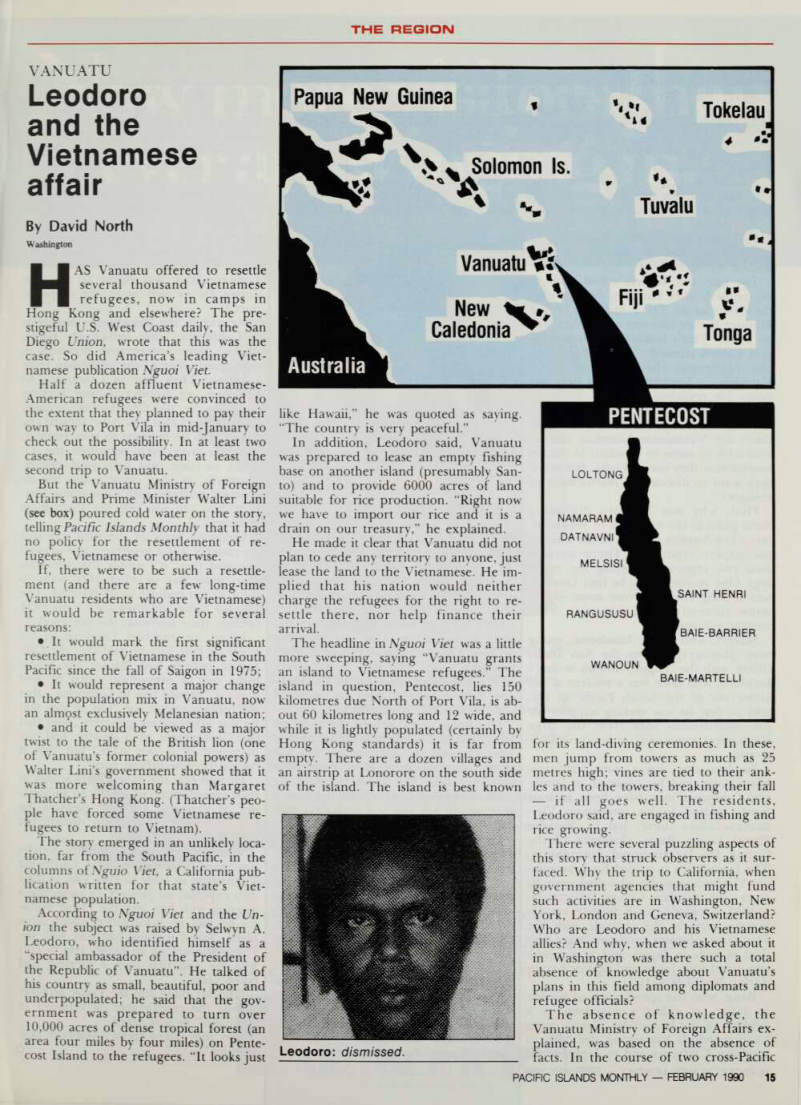
Leodoro, who identified himself as a “special ambassador of the President of the Republic of Vanuatu”. He talked of his country as small, beautiful, poor and underpopulated; he said that the gov ernment was prepared to turn over 10,000 acres of dense tropical forest (an area four miles by four miles) on Pente cost Island to the refugees. “It looks just
like Hawaii,” he was quoted as saying.
“The country is very peaceful.”
In addition, Leodoro said, Vanuatu was prepared to lease an empty fishing base on another island (presumably San to) and to provide 6000 acres of land suitable for rice production. “Right now we have to import our rice and it is a drain on our treasury,” he explained.
He made it clear that Vanuatu did not plan to cede any territory to anyone, just lease the land to the Vietnamese. He im plied that his nation would neither charge the refugees for the right to re settle there, nor help finance their arrival.
The headline in Nguoi Viet was a little more sweeping, saying “Vanuatu grants an island to Vietnamese refugees.” The island in question, Pentecost, lies 150 kilometres due North of Port Vila, is ab out 60 kilometres long and 12 wide, and while it is lightly populated (certainly by Hong Kong standards) it is far from empty. There are a dozen villages and an airstrip at Lonorore on the south side of the island. The island is best known
for its land-diving ceremonies. In these, men jump from towers as much as 25 metres high; vines are tied to their ank les and to the towers, breaking their fall if all goes well. The residents, Leodoro said, are engaged in fishing and
rice growing.
There were several puzzling aspects of this story that struck observers as it sur faced. Why the trip to California, when government agencies that might fund such activities are in Washington, New York, London and Geneva, Switzerland?
Who are Leodoro and his Vietnamese allies? And why, when we asked about it in Washington was there such a total absence of knowledge about Vanuatu’s plans in this field among diplomats and
refugee officials?
The absence of knowledge, the Vanuatu Ministry of Foreign Affairs ex plained, was based on the absence of facts. In the course of two cross-Pacific
telephone conversations Clement Kalor ib, a ranking Vanuatu Foreign Affairs official, said: “Mr Leodoro is not an ambassador of Vanuatu, he is an ambas sador for himself. The Ministry would, of course, know about such matters, [the proposed refugee resettlement scheme] and we know nothing of it.”
Kalorib said that he knew Leodoro, and stated that he used to be an official in the Ministry of Education, was trans ferred to the Office of the President, where he served as personal secretary to the President, and was subsequently “dis missed for misconduct”.
The next day Kalorib called back, at my request, after checking further with the Office of the Prime Minister. (Prime Minister Walter Lini was out of Port Vila on a New Year’s holiday). On that occa sion Kalorib stressed: “Mr Leodoro does not represent the Government of Vanuatu . . . Vanuatu does not have any policy for resettling refugees ... [as to the prospective visit of several Viet namese from Southern California] if there are Vietnamese-American citizens who wish to come to Vanuatu to discuss investments they are welcome, but not if they want to discuss the resettlement of
refugees.”
First, why was Leodoro discussing these plans in the town hall of Westmins ter, a Los Angeles suburb, as the Califor nia papers reported? (There were at least two reporters covering the meet ing). One reason might be that Leodoro was seeking funding from some of the more successful of California’s Viet
namese refugees.
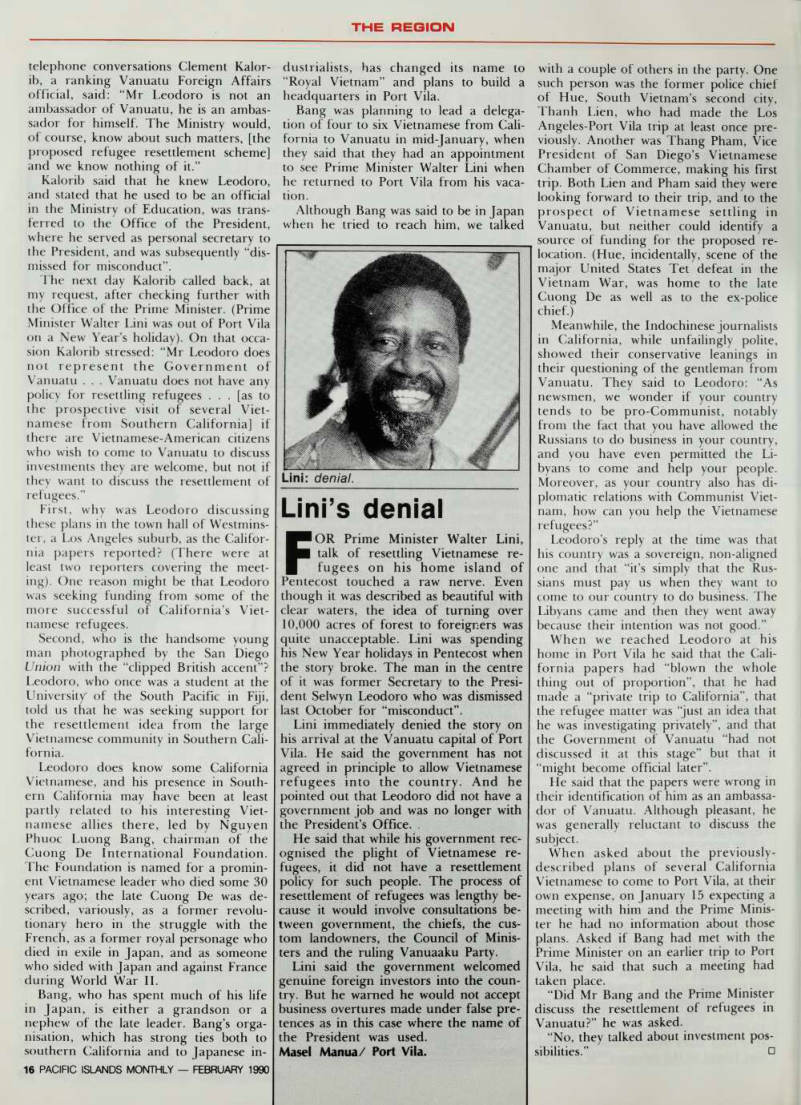
Second, who is the handsome young
man photographed by the San Diego
Union with the “clipped British accent”?
Leodoro, who once was a student at the University* of the South Pacific in Fiji, told us that he was seeking support for the resettlement idea from the large Vietnamese community in Southern Cali fornia.
Leodoro does know some California Vietnamese, and his presence in South ern California may have been at least partly related to his interesting Viet namese allies there, led by Nguyen Phuoc Luong Bang, chairman of the Cuong De International Foundation.
The Foundation is named for a promin ent Vietnamese leader who died some 30 years ago; the late Cuong De was de scribed, variously, as a former revolu tionary hero in the struggle with the French, as a former royal personage who died in exile in Japan, and as someone who sided with Japan and against France during World War 11.
Bang, who has spent much of his life in Japan, is either a grandson or a nephew of the late leader. Bang’s orga nisation, which has strong ties both to southern California and to Japanese in
-16 Pacific Islands Monthly February 1990
dustrialists, has changed its name to “Royal Vietnam” and plans to build a headquarters in Port Vila.
Bang was planning to lead a delega tion of four to six Vietnamese from Cali fornia to Vanuatu in mid-January, when they said that they had an appointment to see Prime Minister Walter Lini when he returned to Port Vila from his vaca tion.
Although Bang was said to be in Japan when he tried to reach him, we talked
with a couple of others in the party. One such person was the former police chief of Hue, South Vietnam’s second city, Thanh Lien, who had made the Los Angeles-Port Vila trip at least once pre viously. Another was Thang Pham, Vice President of San Diego’s Vietnamese Chamber of Commerce, making his first trip. Both Lien and Pham said they were looking forward to their trip, and to the prospect of Vietnamese settling in Vanuatu, but neither could identify a source of funding for the proposed re location. (Hue, incidentally, scene of the major United States Tet defeat in the Vietnam War, was home to the late Cuong De as well as to the ex-police chief.) Meanwhile, the Indochinese journalists in California, while unfailingly polite, showed their conservative leanings in their questioning of the gentleman from Vanuatu. They said to Leodoro: “As newsmen, we wonder if your country tends to be pro-Communist, notably from the fact that you have allowed the Russians to do business in your country, and you have even permitted the Li byans to come and help your people.
Moreover, as your country also has di plomatic relations with Communist Viet nam, how can you help the Vietnamese refugees?”
Leodoro’s reply at the time was that his country was a sovereign, non-aligned one and that “it’s simply that the Rus sians must pay us when they want to come to our country to do business. The Libyans came and then they went away because their intention was not good.”
When we reached Leodoro at his home in Port Vila he said that the Cali fornia papers had “blown the whole thing out of proportion”, that he had made a “private trip to California”, that the refugee matter was “just an idea that he was investigating privately”, and that the Government of Vanuatu “had not discussed it at this stage” but that it “might become official later”.
He said that the papers were wrong in their identification of him as an ambassa dor of Vanuatu. Although pleasant, he was generally reluctant to discuss the subject.
When asked about the previously described plans of several California Vietnamese to come to Port Vila, at their own expense, on January 15 expecting a meeting with him and the Prime Minis ter he had no information about those plans. Asked if Bang had met with the Prime Minister on an earlier trip to Port Vila, he said that such a meeting had taken place.
“Did Mr Bang and the Prime Minister discuss the resettlement of refugees in Vanuatu?” he was asked.
“No, they talked about investment pos sibilities.” □
Lini’s denial
FOR Prime Minister Walter Lini, talk of resettling Vietnamese re fugees on his home island of Pentecost touched a raw nerve. Even though it was described as beautiful with dear waters, the idea of turning over 10,000 acres of forest to foreigners was quite unacceptable. Lini was spending his New Year holidays in Pentecost when the story broke. The man in the centre of it was former Secretary to the Presi dent Selwyn Leodoro who was dismissed last October for “misconduct”.
Lini immediately denied the story on his arrival at the Vanuatu capital of Port Vila. He said the government has not agreed in principle to allow Vietnamese refugees into the country. And he pointed out that Leodoro did not have a government job and was no longer with the President’s Office.
He said that while his government rec ognised the plight of Vietnamese re fugees, it did not have a resettlement policy for such people. The process of resettlement of refugees was lengthy be cause it would involve consultations be tween government, the chiefs, the cus tom landowners, the Council of Minis ters and the ruling Vanuaaku Party.
Lini said the government welcomed genuine foreign investors into the coun try. But he warned he would not accept business overtures made under false pre tences as in this case where the name of the President was used.
Masel Manua/ Port Vila.
Lini: denial.
Advertisements & other items, pp. 16-17 (2 items)
The Region
air oicinc
r The sheer size and comfort of our 747 and new 767 will attract more visitors this year than ever before.
Both aircraft offer Economy and Business Class wide bodied luxury that makes holidaying in Fiji a pleasure from the moment anyone steps on board.
People from Japan, Australia and New Zealand are flying here direct in greater numbers than ever.
In fact, we’re counting on more than 290,000 visitors arriving here this year with the help of Air Pacific.
That means exciting times are winging our way and your way too. Air Pacific. The rainbow from Fiji.
air oicinc
FIJI'S INTERNATIONAL AIRLINE
Calling the islands:
New Zealand
Calling the islands: Radio NZ on the air
HORTWAVE radio listeners throughout the Pacific now have alternative to the übiquitous Radio Australia for their regional and international news from Wellington, Radio New Zealand is on air with a powerful new transmitter designed to give a good signal through the Pacific.
But not only the old, low-powered trans mitters been put on the scrapheap; the shortwave service will no longer broad cast just relays from the home service stations, it will instead originate its own programmes.
Pacific languages will be widely used, although the transmissions will be main stream English, Radio New Zealand In ternational manager lan Johnstone told Pacific Islands Monthly all on-air staff will be bi-lingual. So, in a programme about Tongans in New Zealand (for ex ample), the announcer will speak mostly in English but weave in occasional sent ences and phrases in the Tongan lan guage.
Transmissions from the new 100 kilo watt transmitter were due to start in late January in time for the Commonwealth Games being held in Auckland. This will
be followed by special programming
around Waitangi Day on February 6.
The regular schedule will take effect on February 7 (see box).
There will be four broadcasts per day: a two-hour breakfast show to Polynesia, followed by a similar transmission to Melanesia. The former should also be
audible in the United States, while the latter can be heard in East Asia as well.
The transmitter will be back on the air for a lunchtime show, which will be aimed throughout the Pacific. Then there is an evening programme just to
Polynesia.
Johnstone said the breakfast program me will have music, news, messages to the island listeners, transport and weath er information. The midday broadcast will concentrate more on documentaries and features chosen from the home ser vice, and will also feature a guest each day who will talk about his or her life and interests. The last transmission of each day will be an attempt to have a local feel over shortwave: there will be music requests, communities in New Zea land keeping in touch with the people
back home, and talkback. This will be aimed at people in Fiji, Tonga, the Samoas, Niue and the Cook Islands but Johnstone said it was planned to operate a similar service for the Melanesian countries once Radio New Zaland Inter national had more resources.
Johnstone said the station would be flexible. The transmitter would stay on air to cover special events, and will re broadcast material from island stations.
For example, he said, the Tongan radio station could compile a programme to celebrate that country’s national day which would be transmitted from Wel lington so it could be heard by an inter national audience.
On air, the station will identify itself both in English and Maori. So rather than a faint signal through the crackle and static which has been Radio New Zealand’s plight for 40 years now is land listeners should be able to hear, loud and clear: “This is Radio New Zea land International” or “Te Reo Irirangi o Aotearoa, o Te Moana-nui-a-kiwa”. □
Labour picks first islander
New Zealand
PACIFIC Islanders in New Zealand have a good chance to put one of their own into Parliament in this year’s elections. In November, the Labour Party selected 37-year-old Sa moan union official Taito Phillip Field to contest the traditionally red-ribbon seat of Otara, in South Auckland. It’s the first time Labour has chosen a Pacific Islander to contest a winnable seat.
Otara became the focus of Labour’s Pacific Island supporters throughout the country. For four decades, Pacific Island voters have helped Labour retain at least five urban seats, particularly in Auck land. In the past, calls for Pacific Islan ders to be chosen to contest winnable seats had been drowned out by the party hierarchy, who feared white voters wouldn’t support a brown candidate.
The 1990 elections offered Labour a se
vere choice: only Otara offered a vacan cy for a Pacific Island candidate. The other four likely seats are held by youn gish, European MPs and if Labour failed in Otara, Pacific Islanders faced a wait of more than 10 years for another chance.
Ten hopefuls five Pacific Islanders lined up to fill the vacancy left by retiring Agriculture Minister Colin Moyle, one of five senior Cabinet minis ters stepping down at this year’s elec tions.
At least 400 people packed the Te Puke O Tara community hall in Otara township for the often emotional selec tion meeting, during which several Paci fic Island candidates hammered home the message it was time for Labour to pay its debts to a loyal Pacific Island constituency.
Field himself avoided playing overtly on his ethnic background, explaining afterwards he didn’t want any taint of “tokenism” about his selection. He be lieves choosing a Pacific Islander for an electorate which contains one of the largest Island communities in Auckland is not only fair but essential for Labour to retain the seat. Despite being an out sider Field was an organiser for the Hotel Workers Union in Whangarei, north of Auckland he believes Otara’s Pacific Island voters will identify with him, particularly the Samoans who’ll
appreciate having a bilingual MP.
Labour no longer regards Otara as a safe seat. Last election, Moyle’s majority was halved to about 2400 votes. Otara
township’s mainly Polynesian population
has suffered greatly under Rogernomics.
There’s record unemployment with the closure of the freezing works and factor ies. A recent housing survey estimated as many as 5000 families may be officially
designated “homeless” in South Auck land, many in Otara. More than 1000 of these families are on the Housing Cor poration’s waiting list for homes. At the same time Labour is undercutting many of the fundamentals of low-income fami lies: free education and health care.
Along with attacks on Western Samoa’s immigration quota, talk of a Whites Only
immigration policy and the charging of
fees for foreign students, this has left many Pacific Island voters disillusioned with Labour.
Field is already bracing himself for a
bruising year-long campaign. The left
wing New Labour Party has targetted Otara as one of two key seats for the elections, and Field believes the NLP and its strong candidate, Maori union official Malt Robson, pose a real threat. Field can call on his union links to reach the Pacific Island workforce and intends to
campaign on “working people’s issues”
of equitable access to health care and
education, job training schemes and
promoting more community pride in
Otara township.
But shepherding voters away from the NLP isn’t Field’s only worry. The other part of the electorate is Howick, a mainly affluent European area which now hold half the electorate’s population. Fewer than half of Howick’s residents voted Labour last election and new housing subdivisions now put the area firmly in the camp of the opposition National Par ty. Several of the European candidates for selection threw up the threat of a racial backlash in Howick against a Paci fic Islander. But Field doesn’t believe this will eventuate, as his emphasis on economic policies will appeal to the Howick residents whose concerns lie with interest rates and business investment.
However, Labour’s informal polling in Howick shows considerable resistance to any Labour candidate, with a Pacific Islander facing an extra hurdle. □
Advertisements & other items, p. 18 (1 item)
Time to listen
FROM February 7, Radio New Zealand International will follow this schedule: (All times UTC add 10 hours for Papua New Guinea, Guam; add 11 hours for Solomon Islands, Vanuatu; add 12 hours for Kiribati, Tuvalu, Nauru, Fiji; add 13 hours for Tonga; deduct 10 hours for Cook Islands; deduct 11 hours for Samoa, Niue.) Eastern Pacific: 1700-1900 UTC 17730 kilohertz
0330-0600 UTC
Western Pacific:
1905-2100 UTC
0630-0930 UTC
General Service:
2100-2400 UTC
• Alternative 17705 kilohertz 17730 kilohertz 17730 kilohertz 17705 kilohertz
frequencies: 15485,
17680 or 9850 kilohertz As a guide to time conversion, 1700 UTC is Sam in Suva; 1900 is 7am in Suva; 2200 is 10am in Suva and 0330 is 3.30 pm in Suva. □
Sunday
Hawaii
Sunday protest
AT the same time that the Baltic States were demanding greater freedom from the Soviet Union, hundreds of Hawaiians gathered to de monstrate for Hawaiian sovereignty on the 97th anniversary of the overthrow of the indigenous Hawaiian monarchy in 1894. The protest, called “Sovereign Sunday”, was held on the grounds of the lolani Palace in downtown Honolulu on January 14.
The day long demonstration featured Native speakers and singers stressing de mands for Hawaiian self determination and the re-establishment of the Polyne sian nation. M.C. Kawaipuna Prejean, a dissident who has travelled to Libya, periodically led the crowd in “Sovereign ty Now!” chants. Activist attorney Milila ni Trask, the Kia Aina (governor) of Ka La Hui Hawaii (the Sovereign Hawaiian Nation) delivered a stirring address, call ing for the return of lands lost after the military overthrow of Queen Liliuokalani in 1893.
Trask denounced the state agency in charge of native concerns, the Office of Hawaiian Affai rs (OHA) and John \\ aihee, the Hawaiian governor of the Aloha State, as sell-outs to the sovereignty cause and urged the people to vote them out of office. Trask prom ised “direct actions” in early 1990 to im plement Ka La Hui’s nationhood prog ramme.
Another speaker, Dr Kekuni Blaisdell, said that on January 17, 1893, 200
marines and sailors of the USS Boston, anchored in Honolulu harbour, marched to the gates of the lolani Palace, heavily armed with gattling guns and artillery.
The Americans forced Queen Luliuoka lani to “yield under protest”, and give up her nation to plantation owners.
Since then, Hawaiians have become an oppressed minority, landless and often homeless in their own ancestral home land, with serious health, crime, and other problems. Symptomatic of these social ills is Mama Loa, a pure Hawaiian who performed graceful hulas during Sovereign Sunday. Mama Loa lives in an
abandoned bus and her daughter lives in a shack, illegally squatting at a North Shore beach. □
Sovereignty Sunday: protesters demonstrate in front of the statue of Queen Liliuokalani in Honolulu.
Advertisements & other items, p. 19 (1 item)
Phone: 301285
For the finest in
SICHUAN CUISINE
dine at m Cnr. Bau St/Laucala Bay Rd, Flagstaff, Suva.
LUNCH • DINNER
Phone: 301285
NOW ALSO AT:
404, Khyber Pass Rd, Newmarket, Auckland.
Phone: 5221752
• Friendly and unpretentious oriental style service. • Fully licensed bar and a splendid wine list. • All major credit cards accepted
Impasse on new status
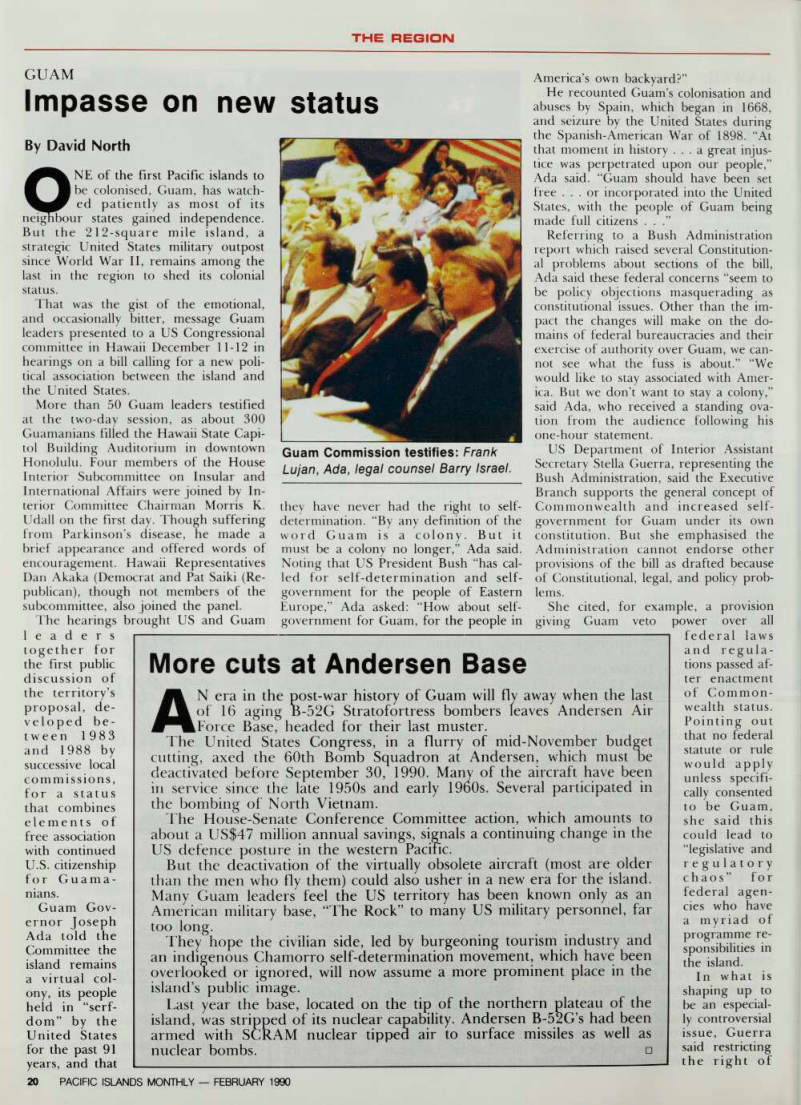
Guam
By David North
NE of the first Pacific islands to B Sbe colonised, Guam, has watch ed patiently as most of its
neighbour states gained independence.
But the 212-square mile island, a strategic United States military outpost since World War 11, remains among the last in the region to shed its colonial status.
That was the gist of the emotional, and occasionally bitter, message Guam leaders presented to a US Congressional committee in Hawaii December 11-12 in hearings on a bill calling for a new poli tical association between the island and the United States.
More than 50 Guam leaders testified at the two-day session, as about 300 Guamanians filled the Hawaii State Capi tol Building Auditorium in downtown Honolulu. Four members of the House Interior Subcommittee on Insular and International Affairs were joined by In terior Committee Chairman Morris K.
Udall on the first day. Though suffering from Parkinson’s disease, he made a brief appearance and offered words of encouragement. Hawaii Representatives Dan Akaka (Democrat and Pat Saiki (Re publican), though not members of the subcommittee, also joined the panel.
The hearings brought US and Guam
leaders
together for
the first public discussion of the territory’s
proposal, de
veloped be
tween 1983 and 1988 by successive local commissions, for a status that combines elements of free association with continued
U.S. citizenship
for Guama nians.
Guam Gov
ernor Joseph
Ada told the Committee the island remains a virtual col ony, its people held in “serf dom” by the United States for the past 91 years, and that
they have never had the right to selfdetermination. “By any definition of the word Guam is a colony. But it must be a colony no longer,” Ada said.
Noting that US President Bush “has called for self-determination and selfgovernment for the people of Eastern Europe,” Ada asked: “How about selfgovernment for Guam, for the people in
America’s own backyard?”
He recounted Guam’s colonisation and abuses by Spain, which began in 1668, and seizure by the United States during the Spanish-American War of 1898. “At that moment in history ... a great injus tice was perpetrated upon our people,”
Ada said. “Guam should have been set free ... or incorporated into the United States, with the people of Guam being made full citizens . .
Referring to a Bush Administration report which raised several Constitution al problems about sections of the bill, Ada said these federal concerns “seem to
be policy objections masquerading as
constitutional issues. Other than the im pact the changes will make on the do mains of federal bureaucracies and their exercise of authority over Guam, we can not see what the fuss is about.” “We would like to stay associated with Amer ica. But we don’t want to stay a colony,” said Ada, who received a standing ova tion from the audience following his one-hour statement.
US Department of Interior Assistant Secretary Stella Guerra, representing the Bush Administration, said the Executive Branch supports the general concept of Commonwealth and increased self government for Guam under its own constitution. But she emphasised the Administration cannot endorse other provisions of the bill as drafted because
of Constitutional, legal, and policy prob
lems.
She cited, for example, a provision giving Guam veto power over all
federal laws
and regula
tions passed af ter enactment of Common wealth status.
Pointing out that no federal statute or rule
would apply
unless specifi
cally consented
to be Guam, she said this could lead to
“legislative and
regulatory
chaos” for federal agen cies who have a myriad of programme re
sponsibilities in
the island.
In what is shaping up to be an especial ly controversial issue, Guerra
said restricting
the right of
Guam Commission testifies: Frank Lujan, Ada, legal counsel Barry Israel.
of self-determination to only the indige nous inhabitants of Guam could violate fundamental US Constitutional protec
tions against limiting voting along ethnic
or racial lines.
The bill calls for the US Congress to recognise “the exclusive right to self determination of the indigenous Cha morros”, defined as those living on Guam in 1950 and their descendants.
Guam leaders testified that the island’s indigenous people have never had a chance to freely choose what political sta tus and national affiliation they desire.
Guerra said that limiting the right of self-determination (which presumably would take some form of vote in the future) to one group based solely on ethnic or racial criterion would violate Constitutional guarantees of due process and equal protection, which apply to all US citizens of Guam.
A Federal Interagency report that de veloped the Bush Administration’s posi tion expressed sympathy for the dilem ma of Chamorros, who find themselves a minority in their own island. Of the is land’s 138,000 residents, about 45 per cent are Chamorros, 25 percent Filipino- Americans, 20 percent statesiders and 10 percent Micronesians and Asians.
This demographic phenomenon is a
major concern of many Chamorro lead ers, who retain control of the local gov ernment because their extended family systems and close knit communities pro duce exceptionally high Chamorro voter turnouts. But the business community is dominated by US statesiders and Japanese tourism and real estate com panies, and the retail sector by South Koreans and Taiwanese.
Ada said the Congress, because of its constitutional authority to decide the political status of the territory, has the power to allow a one-time Chamorro only act of self-determination.
Guerra said other federal concerns in clude the bill’s provisions to give Guam
authority to negotiate foreign agree
ments and air rights, control over im
migration, special trade advantages,
annual payments for US base facilities, and granting a Guam-controlled commis sion the power to dispose of federally held lands and property, including ac cess and easements to military bases.
Subcommittee Chairman Ron de Lugo (Democrat-Virgin Islands) reiterated the position Congressional leaders have taken on the Guam-drafted bill: that there are major concerns with provisions that must be resolved through negotia tions and compromise with Guam
leaders.
De Lugo pressed Ada, who is Commis sion Chairman, on whether the Commis sion had the power to negotiate and sup port necessary changes in the measure?
The Governor maintained the Commis sion had no authority to negotiate changes and whatever amendments Con gress makes in the bill would have to be approved by Guam voters.
Acknowledging that the voters of Guam would have the ultimate say on whatever revised bill Congress passes, de Lugo told Ada, “that road map you have described to us is a design for disaster, a design for failure.”
“We have reached a point where there is political support for Commonwealth,” de Lugo said, referring to 160 House and Senate members who have co sponsored the measure on the condition that problems in the bill can be worked out.
“Congress is not going to be a political sucker,” de Lugo said. “Congress is not going to set itself up by making changes without the approval of Guam leaders.”
Commission Vice-Chairman Frank Santos wavered at one point, agreeing to introduce legislation to give the Commis sion power to negotiate, but later backed away from that position, saying the Com mission will not negotiate. □
More cuts at Andersen Base
AN era in the post-war history of Guam will fly away when the last of 16 aging B-52G Stratofortress bombers leaves Andersen Air Force Base, headed for their last muster.
The United States Congress, in a flurry of mid-November budget cutting, axed the 60th Bomb Squadron at Andersen, which must be deactivated before September 30, 1990. Many of the aircraft have been in service since the late 1950 s and early 19605. Several participated in the bombing of North Vietnam.
The House-Senate Conference Committee action, which amounts to about a US$47 million annual savings, signals a continuing change in the US defence posture in the western Pacific.
But the deactivation of the virtually obsolete aircraft (most are older than the men who fly them) could also usher in a new era for the island.
Many Guam leaders feel the US territory has been known only as an American military base, “The Rock” to many US military personnel, far
too long.
They hope the civilian side, led by burgeoning tourism industry and an indigenous Chamorro self-determination movement, which have been overlooked or ignored, will now assume a more prominent place in the
island’s public image.
Last year the base, located on the tip of the northern plateau of the island, was stripped of its nuclear capability. Andersen B-52 G’s had been armed with SCRAM nuclear tipped air to surface missiles as well as nuclear bombs. □
Advertisements & other items, pp. 21-22 (1 item)
The Pacific Islands Rely
ON THE ENERGY OF BORAL.
I ■s. - I * WS ■ ■■ All through the Pacific Islands, people rely on Boral Speed-E-Gas LP Gas for their energy needs.
Boral has terminals throughout the area, and is proud to be a leading supplier.
Speed-E-Gas is clean, efficient and low in cost.
It’s the ideal energy source for cooking and water heating in homes, motels and hotels, and for a wide range of industrial uses.
So call Boral. We have the energy you’re looking for.
Norfolk Island Norfolk Island 2419 Papua New Guinea Port Moresby 214248 Lae 422574 Rabaul 921225 Wewak 862125 Tonga Nukualofa 21388 % - Cook Islands Rarotonga 24460 American Samoa Pago Pago 6332170 Fiji Suva 24035 Lautoka 60088 Sigatoka 50578 Labasa 82973 Vanuatu Santo 455 Port Vila 2046 r
BORAL GAS
Solomon Islands Honiara 21833 . :• Boral Gas Limited, Bth Floor, IBM House, 168 Kent St., Sydney, NSW 2000. Tel: (02) 278512.
Four Basic Colours
YELLOW CYAN BLACK
Plus
Fiji Times Commercial Printin;
mwone qp C
Equals
Printing Excellence
V - ■ It is quite amazing what our experienced master printers, with the latest in printing technology, can produce from four basic colours.
Full colour packaging and food labels that look good enough to eat; award winning full colour brochures and posters; magazines, calendars, books, stickers, fabric labels and billboards with pictures that leap right out of the printed pages.
If your product requires export-quality, high impact four colour printing, then you should be talking to us first.
You’ll find our prices very competitive and our paper stock quite extensive.
FIJI TIMES
COMMERCIAL PRINTING DIVISION
Printing Excellence
20 GORDON STREET, SUVA. PHONE: SUVA 314111. Fax: 301521 LAUTOKA 60352. LABASA 81644.
Pacific
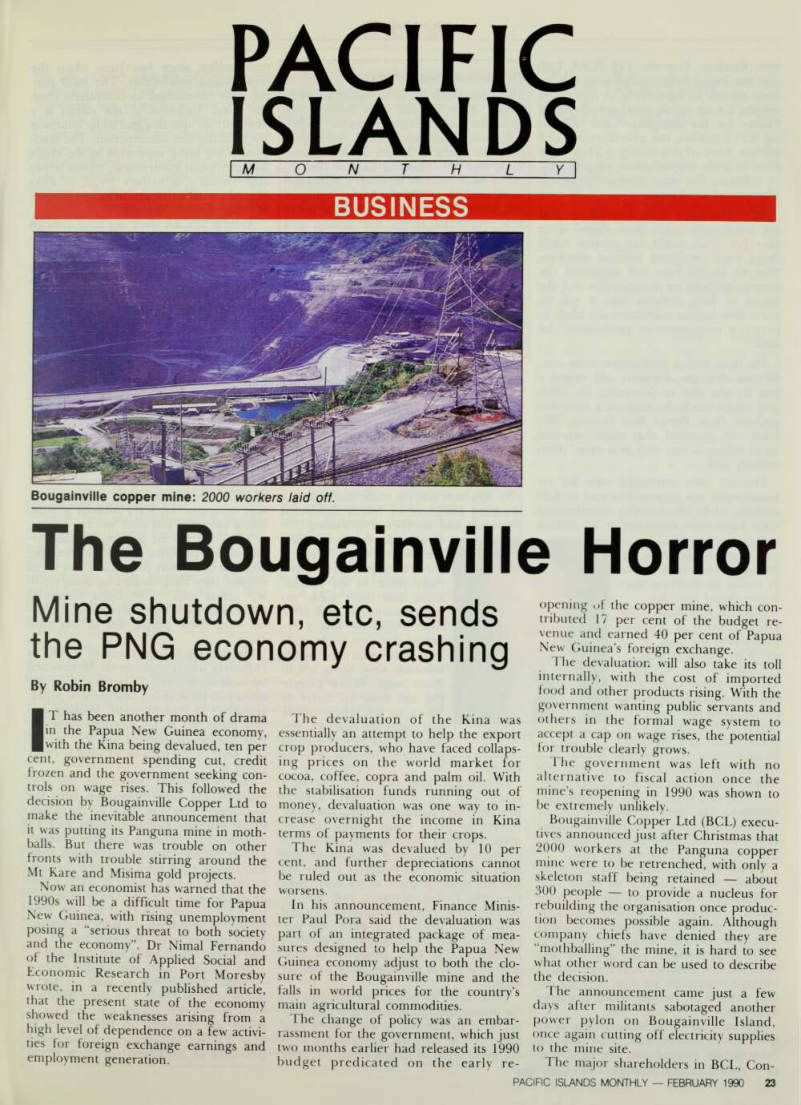
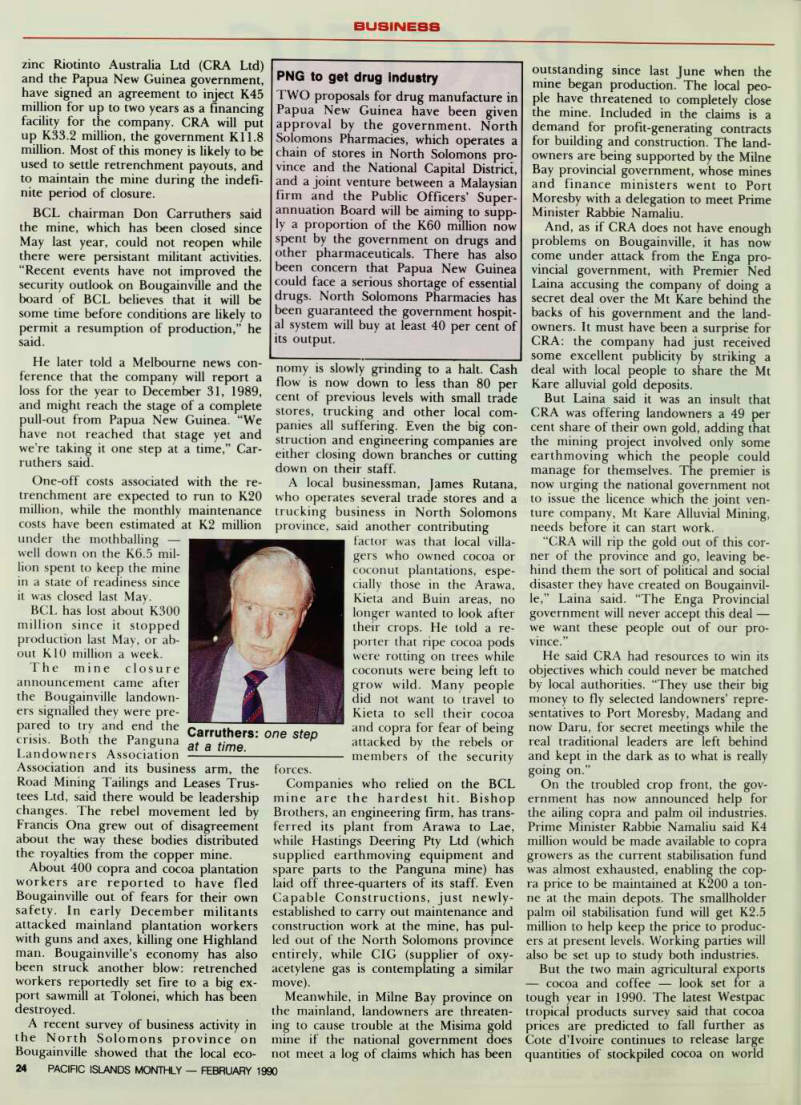
Islands
Monthly
Business
The Bougainville Horror
Mine shutdown, etc, sends the PNG economy crashing
By Robin Bromby
IT has been another month of drama in the Papua New Guinea economy, with the Kina being devalued, ten per cent, government spending cut, credit frozen and the government seeking con trols on wage rises. This followed the
decision by Bougainville Copper Ltd to
make the inevitable announcement that it was putting its Panguna mine in moth balls. But there was trouble on other fronts with trouble stirring around the Mt Kare and Misima gold projects.
Now an economist has warned that the 1990 s will be a difficult time for Papua New Guinea, with rising unemployment posing a “serious threat to both society and the economy”. Dr Nimal Fernando of the Institute of Applied Social and Economic Research in Port Moresby wrote, in a recently published article, that the present state of the economy showed the weaknesses arising from a high level of dependence on a few activi
ties for foreign exchange earnings and
employment generation.
The devaluation of the Kina was essentially an attempt to help the export crop producers, who have faced collaps ing prices on the world market for cocoa, coffee, copra and palm oil. With the stabilisation funds running out of money, devaluation was one way to in crease overnight the income in Kina terms of payments for their crops.
The Kina was devalued by 10 per cent, and further depreciations cannot be ruled out as the economic situation worsens.
In his announcement, Finance Minis ter Paul Pora said the devaluation was part of an integrated package of mea sures designed to help the Papua New Guinea economy adjust to both the clo sure of the Bougainville mine and the falls in world prices for the country’s main agricultural commodities.
The change of policy was an embar rassment for the government, which just two months earlier had released its 1990 budget predicated on the early re
opening of the copper mine, which con tributed 17 per cent of the budget re venue and earned 40 per cent of Papua
New Guinea’s foreign exchange.
The devaluation will also take its toll internally, with the cost of imported food and other products rising. With the government wanting public servants and others in the formal wage system to accept a cap on wage rises, the potential for trouble clearly grows.
The government was left with no alternative to fiscal action once the mine’s reopening in 1990 was shown to
be extremely unlikely,
Bougainville Copper Ltd (BCL) execu tives announced just after Christmas that 2000 workers at the Panguna copper mine were to be retrenched, with only a skeleton staff being retained about 300 people to provide a nucleus for rebuilding the organisation once produc tion becomes possible again. Although company chiefs have denied they are “mothballing” the mine, it is hard to see what other word can be used to describe the decision.
The announcement came just a few days after militants sabotaged another power pylon on Bougainville Island,
once again cutting off electricity supplies
to the mine site.
The major shareholders in BCL, Con
Bougainville copper mine: 2000 workers laid off.
zinc Riotinto Australia Ltd (CRA Ltd) and the Papua New Guinea government, have signed an agreement to inject R 45 million for up to two years as a financing facility for the company. CRA will put up R 33.2 million, the government Rll.B million. Most of this money is likely to be used to settle retrenchment payouts, and to maintain the mine during the indefi nite period of closure.
BCL chairman Don Carruthers said the mine, which has been closed since May last year, could not reopen while there were persistant militant activities.
“Recent events have not improved the security outlook on Bougainville and the board of BCL believes that it will be some time before conditions are likely to permit a resumption of production,” he said.
He later told a Melbourne news con ference that the company will report a loss for the year to December 31, 1989, and might reach the stage of a complete pull-out from Papua New Guinea. “We have not reached that stage yet and we’re taking it one step at a time,” Car ruthers said.
One-off costs associated with the re trenchment are expected to run to R2O million, while the monthly maintenance costs have been estimated at R 2 million
under the mothballing well down on the R 6.5 mil lion spent to keep the mine in a state of readiness since it was closed last May, BCL has lost about R3OO million since it stopped production last May, or ab out RlO million a week.
The mine closure announcement came after the Bougainville landown ers signalled they were pre pared to try and end the crisis. Both the Panguna Landowners Association
Association and its business arm, the Road Mining Tailings and Leases Trus tees Ltd, said there would be leadership changes. The rebel movement led by Francis Ona grew out of disagreement about the way these bodies distributed the royalties from the copper mine.
About 400 copra and cocoa plantation workers are reported to have fled Bougainville out of fears for their own safety. In early December militants attacked mainland plantation workers with guns and axes, killing one Highland man. Bougainville’s economy has also been struck another blow: retrenched workers reportedly set fire to a big ex port sawmill at Tolonei, which has been
destroyed.
A recent survey of business activity in the North Solomons province on Bougainville showed that the local eco-
nomy is slowly grinding to a halt. Cash flow is now down to less than 80 per cent of previous levels with small trade stores, trucking and other local com panies all suffering. Even the big con struction and engineering companies are either closing down branches or cutting down on their staff.
A local businessman, James Rutana, who operates several trade stores and a trucking business in North Solomons province, said another contributing
i factor was that local villa gers who owned cocoa or coconut plantations, espe cially those in the Arawa, Rieta and Buin areas, no longer wanted to look after their crops. He told a re porter that ripe cocoa pods were rotting on trees while coconuts were being left to
grow wild. Many people
did not want to travel to Rieta to sell their cocoa and copra for fear of being attacked by the rebels or members of the security
forces.
Companies who relied on the BCL mine are the hardest hit. Bishop Brothers, an engineering firm, has trans ferred its plant from Arawa to Lae, while Hastings Deering Pty Ltd (which
supplied earthmoving equipment and
spare parts to the Panguna mine) has laid off three-quarters of its staff. Even
Capable Constructions, just newly
established to carry out maintenance and construction work at the mine, has pul led out of the North Solomons province entirely, while CIG (supplier of oxy acetylene gas is contemplating a similar move).
Meanwhile, in Milne Bay province on the mainland, landowners are threaten ing to cause trouble at the Misima gold mine if the national government does not meet a log of claims which has been
outstanding since last June when the mine began production. The local peo ple have threatened to completely close the mine. Included in the claims is a demand for profit-generating contracts for building and construction. The land owners are being supported by the Milne Bay provincial government, whose mines and finance ministers went to Port Moresby with a delegation to meet Prime Minister Rabbie Namaliu.
And, as if CRA does not have enough problems on Bougainville, it has now come under attack from the Enga pro vincial government, with Premier Ned Laina accusing the company of doing a secret deal over the Mt Rare behind the backs of his government and the land owners. It must have been a surprise for CRA: the company had just received
some excellent publicity by striking a
deal with local people to share the Mt
Rare alluvial gold deposits.
But Laina said it was an insult that CRA was offering landowners a 49 per cent share of their own gold, adding that
the mining project involved only some
earthmoving which the people could manage for themselves. The premier is now urging the national government not to issue the licence which the joint ven ture company, Mt Rare Alluvial Mining, needs before it can start work.
“CRA will rip the gold out of this cor ner of the province and go, leaving be hind them the sort of political and social disaster they have created on Bougainvil le,” Laina said. “The Enga Provincial government will never accept this deal we want these people out of our pro vince.”
He said CRA had resources to win its objectives which could never be matched by local authorities. “They use their big money to fly selected landowners’ repre sentatives to Port Moresby, Madang and now Daru, for secret meetings while the real traditional leaders are left behind and kept in the dark as to what is really
going on.”
On the troubled crop front, the gov ernment has now announced help for the ailing copra and palm oil industries.
Prime Minister Rabbie Namaliu said R 4 million would be made available to copra growers as the current stabilisation fund was almost exhausted, enabling the cop ra price to be maintained at R2OO a ton ne at the main depots. The smallholder palm oil stabilisation fund will get R 2.5 million to help keep the price to produc ers at present levels. Working parties will also be set up to study both industries.
But the two main agricultural exports cocoa and coffee look set for a tough year in 1990. The latest Westpac tropical products survey said that cocoa prices are predicted to fall further as Cote d’lvoire continues to release large quantities of stockpiled cocoa on world
Carruthers: one step at a time.
markets. Other potents of trouble in clude the news that both Malaysia and Indonesia are expanding their produc tion, and Asian cocoa output should in crease by almost 20 per cent this year with world stocks continuing to rise. “An unprecedented low price makes it difi cult to predict how much lower prices will fall,” Westpac concludes.
As for coffee, the bank sees a further price fall this year with marginal recov ery in 1991. Prices were unlikely to bot tom with large stocks to be cleared in the short term.
Not all the news is bad. Resource com pany interest continues to be high, and the latest development is that the United States conglomerates Du Pont and Ex xon are entering the Papua New Guinea oil search they have farmed in to PPL 106 and PPL 117 held by the Australian companies First Australian Resources NL, Victoria Petroleum NL and the Tri dent Petroleum. The first wells to be drilled are near the Ok Tedi mine in the Papua Basin. Meanwhile, Oil Search Ltd reported that recent drilling activity in PPL 100 in the Southern Highlands had confirmed the discovery of a new oil pool in the Toro Sandstone, and may be linked to the Hedinia field.
While these issues continued to rumble around the Papua New Guinea land scape, the article in the Port Moresby Post-Courier by Dr Nimal Fernando, who teaches at the Institute of Applied Social and Economic Research in Port Moresby, drew attention to more deep seated problems for the country.
In the years 1973-80, there was negative per capita in come growth that growth
becoming posi
tive only after the surge of mine explora tion and pro duction. By contrast, growth in agri cultural earn ings decline
significantly
largely due to poor export prices for cof fee and cocoa.
The food crop sector the “shock absor ber” of the economy had not per formed well either, with per capita food production
ta food production actually falling since
independence. Dr Fernando said this, was reflected in cereal imports, which rose from 71,000 tonnes in 1974 to 184,000 in 1987.
He warned that the cash crop sector may have expanded at the expense of subsistence crops and so increased the vulnerability of the economy to world market forces on both exports and im ports.
Dr Fernando said falling export crop prices and the closure of the BCL mine would further weaken Papua New
Guinea’s foreign reserve position during
1990 but the loss of copper mine re venues would also have an impact on government expenditure, both in the loss of revenue and the additional ex penses keeping security forces on
Bougainville.
But he saw the major problem as
being the growth of uemployment the
labour force growing at the rate of 50,000 people a year with formal em ployment absorbing fewer than 10,000 of those. Unemployment is found in urban areas and among young people, with the worsening law and order situa tion being partly a reflection of unfulfil led expectations of the young living in towns. But even those left in the rural areas are in for hard times as depressed coffee prices will have severely adverse affects on those provinces where coffee is a major part of the economic acitivity.
Dr Fernando urged economic reforms,
including:
• Changing current wage determina
tion methods, which are in appropriate for Papua New Guinea, to allow greater labour flexibil ity to increase employment and foreign in vestment. • Removal of subsidies to the rural sector to remove dis tortions. • More financial liber alisation, allow ing for higher interest rates much of the savings in the rural sector re in a i n s un mobilised and unavailable for investment purposes. □
PNG to get drug Industry
TWO proposals for drug manufacture in Papua New Guinea have been given approval by the government. North Solomons Pharmacies, which operates a chain of stores in North Solomons pro vince and the National Capital District, and a joint venture between a Malaysian firm and the Public Officers’ Super annuation Board will be aiming to supp ly a proportion of the R6O million now spent by the government on drugs and other pharmaceuticals. There has also been concern that Papua New Guinea could face a serious shortage of essential drugs. North Solomons Pharmacies has been guaranteed the government hospit al system will buy at least 40 per cent of its output.
PNG advertising warning
PAPUA New Guinea Communications Minister Brown Sinamoi has said he will enforce the 1985 Commercial Advertise ment Act after finding that local printers are losing millions of Kina because much company work is still being produced overseas. The Act, which was brought in to help encourage a local advertising in
dustry, prohibits advertising materials
being produced overseas and used by
PNG newspapers, television, cinemas or radio. Sinamoi said many comany and annual reports are still being printed abroad.
Sepik appoints trade rep EAST Sepik has become the first Papua New Guinea province to appoint an overseas trade representative. A Singa pore businessman, who has contacts throughout South-East Asia, will report to the government on potential investors.
The provincial government is now con sidering appointing a tourism repre sentative based in Guam to promote the area as a visitor destination.
fight-back
The Norfolk fight-back
NORFOLK Island’s government, deeply worried by the effects of the Australian domestic pilots’ dis pute nas had on the island’s one source of revenue tourism has begun talks to try and insulate itself against further troubles. Initially it is seeking some 737 jet flights on the services from Sydney and Brisbane, but long-term it wants Norfolk declared an international des tination which would allow other Pacific carriers to fly into the island.
Immigration and Commerce Minister Bill Blucher said the island, even with the airlines reporting services back to near-normal, is receiving only three F2B flights a week from Sydney, and one from Brisbane. Normally there was a daily service. And, at the height of the dispute, the island was dependent on the Royal Australian Air Force which flew occasional Hercules services from the Australian mainland.
But East-West, a subsidiary of Ansett Australia which provides the scheduled runs from the Australian mainland, has not been able to get back to daily flights.
“They’re hesitant about providing addi tional aircraft we feel as if we’re at the end of the queue,” said Blucher.
Since August, disaster had struck the Norfolk Island tourism businesses hotels were feeling the pinch, with some of the smaller accommodation houses running at about 30 per cent occupancy.
Blucher said some tourist-related businesses, such as duty-free outlets, would go out of business as a result of the pilots’ dispute. The only stable factor had been the three normal weekly Air New Zealand flights from Auckland, us ing a Boeing 737 and Air New Zea land had thrown in a few additional flights as well.
Blucher said the government is asking Ansett/East-West to introduce the 737- 300 aircraft, the largest which the Nor folk Island landing strip can handle.
They seat more than 100 people, against the F2B’s 58 capacity. They also can car ry much greater tonnages of mail and cargo both of which have been subject
to delays during the dispute.
What the Norfolk Islanders want is one 737 flight each week in addition to existing services, with an optimum of four 737 jet services between Norfolk and Sydney each week, and one from Brisbane that would mean an annual tourist turnover of 30,000 people which is about comfortable capacity for the is land’s facilities. Blucher is hoping the service will be upgraded by June. □
New owners pledge on-time Hawaiian
THE new owners of the region’s fas test growing carriers, Hawaiian Airlines, have pledged to pump capital into the airline, which has suf fered bad publicity because of late run ning in recent years and recently had to lay off 200 workers to stop the cash flow
haemorrhage.
The new owners are J. Thomas Tal bot, a wealthy California businessman, and Peter V. Ueberroth, who has been associated with a small airline in the Un ited States and who is best known as the organiser of the extremely profitable Los
Angeles Olympic Games. They replace
John H Magoon, now 74, who held 56 per cent of the stock in Hawaiian. Ma goon had made it a condition that the new owners not only had airline experi ence, but were able to inject capital into the operation. Magoon had tried to sell the airline back in 1987, but that deal fell apart because of the stock market crash; he had then hoped to find a buyer who would be resident in Hawaii.
At a recent Hawaiian Airlines Inc (HAL) stockholder meeting, the share holders approved the sale to HAL Ac quisition Inc. The new owners bought
759,500 shares at US$22 a share, plus another 909,000 shares from Magoon’s company making the total value of the deal US$37 million. Talbot will be the new chairman.
Magoon will own no shares in the new company.
Hawaiian now services several Pacific
destinations: Sydney, Auckland, Pagopa
go, Rarotonga, Papeete, Guam, as well as Tonga and Apia. The airline also leases seats to Air Rarotonga between Auck land and the Cook Islands. With new owners and adequate financial backing, Hawaiian is looking at further expansion in the region with negotiations well under way for Honolulu-Nagoya flights (Japan Air Lines still hold its 20 per cent stake in Hawaiian), is seeking traffic rights into Melbourne and believes it will be operating into Nadi within three years. Hawaiian is also looking to supple ment its fleet with the purchase of furth er LlOll Tristars. The latest announce ment is that the airline is to add a third weekly Honolulu-Nuku’alofa service from February which will connect with services to Japan a move welcomed by Tonga’s exporters of fresh produce.
The Sydney-based manager for Hawaiian operations in Australia, New Zealand and the Cook Islands, Alex Klu jin, said that eliminating the delays for which Hawaiian flights had become in creasingly known was part of the re building programme. “It’s a new start for Hawaiian,” he said. “We’ll be looking at the on-time performance and the mechanical side of the airline.” It would be a matter of rebuilding Hawaiian’s
reputation, Klujin said.
One of his priorities would be to get
more people on the flights to the Cook Islands. This sector was heavily domin ated by Cook Islanders travelling, mainly to New Zealand, and was subject to con siderable seasonal fluctuations. Hawaiian would be looking to new fare initiatives to lift loadings on what are now the lightly patronised flights, and was look ing at a tie-up with Continental to have Australian tourists fly to the Cooks via Auckland.
Hawaiian will put new effort into working with Australian travel agents and wholesalers so it could work towards greater frequency of flights than the present one a week out of that country.
It has begun offering free inter-island flights around the Hawaiian archipelago for travellers using its international ser vices.
Hawaiian began in 1929 flying eight
seater Sikorsky amphibians between Honolulu and the outer islands. It graduated to DC3s in 1941 and played a major part in inter-island transport dur ing the war. □
Tuvalu air agreement
FIJI and Tuvalu have signed a new air agreement which allows each country to nominate a carrier to operate over the route between Funafuti and Nadi. At present, Fiji Air is the only carrier flying an 11-seat Heron aircraft to Tuvalu tlyee times a week (Airlines of the Mar shall Islands lands there once a week, but only to refuel and has no traffic rights). Fiji Air is to become the carrier nominated by that country, and it is understood that a company called Air Tuvalu is being formed there with gov
ernment backing.
New laws hit tax havens
AUSTRALIA has finally released
details of new tax laws designed to stop companies domiciled there from using tax havens such as the Cook Islands, Western Samoa or Vanuatu to avoid Australian corporate tax. It has been estimated that A|>6 bil lion in corporate income is locked away in the tax havens. Accountants have pro tested that the proposed new law, to be enacted before the beginning of the new financial year on July 1, will cast its net too wide and will also mean retrospective taxes on companies which have siphoned profits off in tax havens.
It is two years since Australian treasur er Paul Keating first mooted the law, and the draft still has to be fine-tuned before it is introduced into the House of
Representatives. The parliamentary com
mittee which investigated the use of tax
havens found that many large Australian companies used them including News Corporation, BHP, Elders IXL and
Bond Corporation.
The new system will make tax payable when accrued and earned, rather than waiting for it to be repatriated to Austra lia, Keating said, when releasing the new draft law (which covers 119 pages), that some companies’ offshore transactions may no longer be profitable.
Legal firms claim the new legislation will directly hit the bottom-line perform ance of many companies which use off shore tax havens. But an accountancy firm, Ernst and Young, has argued in a submission to the government that not just tax havens will be affected by the new law; it will hit at companies trying to compete abroad. □
Advertisements & other items, p. 26 (1 item)
Study In
AUSTRALIA
■ NATUROPATHY
■ ACUPUNCTURE
■ 3 Year Diploma ■ 4 Year Degree ■ Fully Accredited ■ Overseas Students Registered College ■ Commence Feb. 1990 Apply to:
ACADEMY or
Natural Therapies P.O. Box 8819 Gold Coast Mail Centre, Bundall 4217 Queensland, AUSTRALIA.
Phone: 075 388141 Fax: 075 384808
Tagging
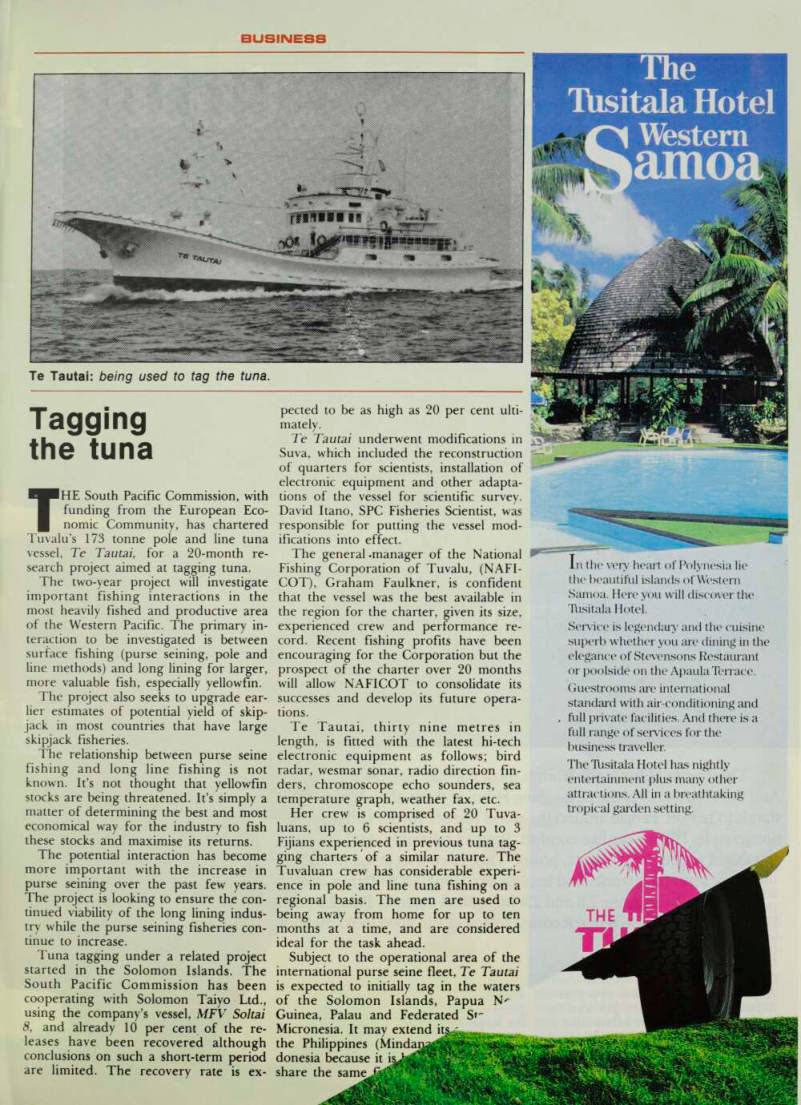
the tuna
THE South Pacific Commission, with funding from the European Eco nomic Community, has chartered Tuvalu’s 173 tonne pole and line tuna vessel, Te Tautai, for a 20-month re search project aimed at tagging tuna.
The two-year project will investigate important fishing interactions in the most heavily fished and productive area of the Western Pacific. The primary in teraction to be investigated is between
surface fishing (purse seining, pole and
line methods) and long lining for larger, more valuable fish, especially yellowfin.
The project also seeks to upgrade ear lier estimates of potential yield of skip jack in most countries that have large
skipjack fisheries.
The relationship between purse seine fishing and long line fishing is not known. It’s not thought that yellowfin stocks are being threatened. It’s simply a matter of determining the best and most economical way for the industry to fish these stocks and maximise its returns.
The potential interaction has become more important with the increase in purse seining over the past few years.
The project is looking to ensure the con tinued viability of the long lining indus try while the purse seining fisheries con tinue to increase.
Tuna tagging under a related project started in the Solomon Islands. The South Pacific Commission has been cooperating with Solomon Taiyo Ltd., using the company’s vessel, MTV Soltai 8, and already 10 per cent of the re leases have been recovered although conclusions on such a short-term period are limited. The recovery rate is ex
pected to be as high as 20 per cent ulti
mately.
Te Tautai underwent modifications in Suva, which included the reconstruction of quarters for scientists, installation of electronic equipment and other adapta tions of the vessel for scientific survey.
David Itano, SPC Fisheries Scientist, was responsible for putting the vessel mod ifications into effect.
The general -manager of the National Fishing Corporation of Tuvalu, (NAFI COT), Graham Faulkner, is confident that the vessel was the best available in the region for the charter, given its size, experienced crew and performance re cord. Recent fishing profits have been encouraging for the Corporation but the prospect of the charter over 20 months will allow NAFICOT to consolidate its successes and develop its future opera tions.
Te Tautai, thirty nine metres in length, is fitted with the latest hi-tech electronic equipment as follows; bird radar, wesmar sonar, radio direction fin ders, chromoscope echo sounders, sea temperature graph, weather fax, etc.
Her crew is comprised of 20 Tuva luans, up to 6 scientists, and up to 3 Fijians experienced in previous tuna tag ging charters of a similar nature. The Tuvaluan crew has considerable experi ence in pole and line tuna fishing on a regional basis. The men are used to being away from home for up to ten months at a time, and are considered ideal for the task ahead.
Subject to the operational area of the international purse seine fleet, Te Tautai is expected to initially tag in the waters of the Solomon Islands, Papua N** Guinea, Palau and Federated St~ Micronesia. It may extend
the Philippines
donesia because it share the same^%l&
Te Tautai: being used to tag the tuna.
Advertisements & other items, p. 27 (2 items)
Business
In the very heart of Polynesia lie
the beautiful islands of Western Samoa. Here you will discover the Thsitala Hotel.
Service is legendary and the cuisine superb whether you are dining in the elegance of Stevensons Restaurant or poolside on the Apaula Tbrrace.
Guestrooms are international standard with air-conditioning and full private facilities. And there is a full range of services for the business traveller.
The Ursitala Hotel has nightly entertainment plus many other attractions. All in a breathtaking tropical garden setting.
international attention
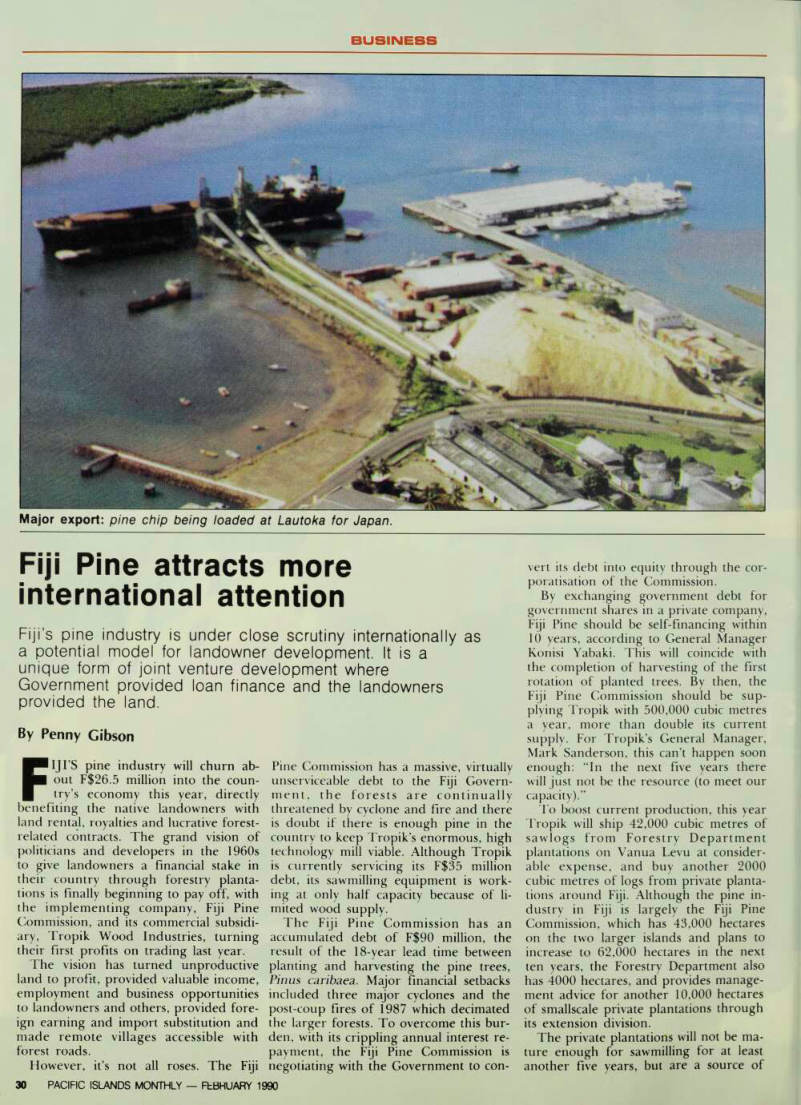

Fiji Pine attracts more international attention
Fiji’s pine industry is under close scrutiny internationally as a potential model for landowner development. It is a unique form of joint venture development where Government provided loan finance and the landowners provided the land.
By Penny Gibson
FIJI’S pine industry will churn ab out F 526.5 million into the coun try’s economy this year, directly benefiting the native landowners with land rental, royalties and lucrative forest related contracts. The grand vision of politicians and developers in the 1960 s to give landowners a financial stake in
their country through forestry planta
tions is finally beginning to pay off, with the implementing company, Fiji Pine Commission, and its commercial subsidi ary, Tropik Wood Industries, turning their first profits on trading last year.
The vision has turned unproductive land to profit, provided valuable income, employment and business opportunities to landowners and others, provided fore
ign earning and import substitution and
made remote villages accessible with forest roads.
However, it’s not all roses. The Fiji
Pine Commission has a massive, virtually unserviceable debt to the Fiji Govern ment, the forests are continually threatened by cyclone and fire and there is doubt if there is enough pine in the
country to keep Tropik’s enormous, high
technology mill viable. Although Tropik is currently servicing its Fs3s million debt, its sawmilling equipment is work ing at only half capacity because of li mited wood supply.
The Fiji Pine Commission has an accumulated debt of Fs9o million, the result of the 18-year lead time between
planting and harvesting the pine trees,
Pinus caribaea. Major financial setbacks included three major cyclones and the post-coup fires of 1987 which decimated the larger forests. To overcome this bur den, with its crippling annual interest re payment, the Fiji Pine Commission is negotiating with the Government to con
vert its debt into equity through the cor poratisation of the Commission.
By exchanging government debt for government shares in a private company, Fiji Pine should be self-financing within 10 years, according to General Manager Konisi Yabaki. This will coincide with the completion of harvesting of the first rotation of planted trees. By then, the Fiji Pine Commission should be sup plying Tropik with 500,000 cubic metres a year, more than double its current
supply. For Tropik’s General Manager,
Mark Sanderson, this can’t happen soon enough; “In the next five years there will just not be the resource (to meet our
capacity).”
To boost current production, this year Tropik will ship 42,000 cubic metres of
sawlogs from Forestry Department
plantations on Vanua Levu at consider able expense, and buy another 2000 cubic metres of logs from private planta tions around Fiji. Although the pine in dustry in Fiji is largely the Fiji Pine Commission, which has 43,000 hectares on the two larger islands and plans to increase to 62,000 hectares in the next ten years, the Forestry Department also has 4000 hectares, and provides manage ment advice for another 10,000 hectares
of smallscale private plantations through
its extension division.
The private plantations will not be ma ture enough for sawmilling for at least another five years, but are a source of
Major export: pine chip being loaded at Lautoka for Japan.
timber for posts, poles and woodchips.
The quality of the logs has been a prob lem due to cyclone and fire damage and
plantation neglect, but is improving fol
lowing the recent introduction of de
tailed management plans by the Fiji-
German Forestry Extension Project. The Dawasamu plantation on Viti Levu has established its own small sawmill which is doing well for the Fijian landowner operators.
Under Fiji Pine’s corporatisation deal, it is rumoured the Government will insist all pine plantations be brought under the auspices of the Fiji Pine company, with private plantation owners being offered shares in the new company. Fiji Pine will then have, with its subsidiary Tropik, an effective monopoly on the
country’s pine industry.
Tropik is the biggest processor of tim ber in Fiji, producing more than the rest of the country put together. With 51 per cent ownership by Fiji Pine Commission, it has an interesting relationship with its major supplier one of cordiality and mutual understanding, although it main tains a very separate identity and is
fiercely competitive.
Sanderson is disappointed by the qual
ity of the logs supplied by the Commis sion. His profits are made on sawn tim ber, but poor quality logs twisted, stunted or bent must be put through the less profitable chipping process. Tro
pik originally planned on receiving over
50 per cent of its long supply as sawlogs, but is currently getting only 30 per cent.
The Fiji Pine Commission has laun ched a major research and forest man agement campaign to ensure future logs will be straight and tall. It’s to their own advantage; they are paid $l6 / m 3 royalty for sawlogs and only $2.72 for pulplogs, a total of $1,616,000 in 1989. The land owners received 3 per cent of this, or $48,480.
Tropik will export 25,000 m 3 of sawn timber this year, worth over $8 million and comprising 55-60 per cent of total sawn timber exports from Fiji. Australia is the major export destination (90 per cent), with the balance going to New Zealand, New Caledonia and other mar kets. Tropik recently entered the Taiwanese market and introduced Pinus caribaea to Japan last year.
The timber is popular on the interna tional market. It is denser, stronger and has a better knot structure than Pinus
radiata grown in Australia, New Zealand and Chile and is price competitive with timber imports from other countries such as the United States and Canada.
Competitiveness is enhanced by Fiji Gov
ernment tax and duty concessions similar to those for the recently established tax free zones.
Tropik also expects to earn about Fsl6 million for exporting nearly 200,000 tonnes of chips this year.
Although woodchip prices are currently
the highest ever, Sanderson is wary of Tropik’s vulnerability to price fluctua tions given a high 70 per cent of mill output is chips. Fortunately, the risk is minimised by a five-year chip contract with C. Itoh, of Japan, while Tropik tries to increase its proportion of sawn tim ber; “There is more stability in sawn tim ber, more added value, and it gives a
much higher price and profit margin.”
Locally, Sanderson said people had converted to pine for construction in quite a big way. In two years Tropik has cornered 66 per cent of the Fiji market for framing timber and plans to further increase sales from the current annual 9000 m 3 sawn timber and 5000 m 3 poles, worth $3.3 million.
Tropik’s major local marketing
strategy is price combined with good
quality, dry timber that is preservative
treated services sawmillers in the in digenous industry have yet to come to effective grips with.
Pine has taken the pressure off the indigenous rainforest timbers for hous
ing and non-specialised uses, allowing
the beautiful hardwoods to realise their true value on the export market as spe cialist timber for furniture, wall cladding, etc. It has enabled the country to conserve some of its natural forests and to slow the rate of harvesting, being mindful of environmental considerations and the conservation of rainforests.
Yabaki, a former head of the Ministry of Forests, has been involved in the pine industry from its inception, and said it was achieving its major aims to create an industry for the landowners that meets local needs and conserve the rainforests.
I he industry has converted non productive grasslands, burnt out by years of slash-and-burn agriculture, into pine forests which are generating income and employment for the local population.
Landowners directly benefit from land rental ($130,000 last year) and the royal
ties from logged trees and gravel taken from plantations for reading. Forestry reading has opened access to 29 villages, allowing easier access to markets and
non-village employment.
The Fiji Pine Commission has a $6.5 million budget, employs 193 staff and pays over $607,000 to contract labourers, often landowners groups, during the
four-month planting and weeding
season.
Yabaki said the Fiji Pine Commission’s
original mandate was to eventually priva
tise with the landowners controlling the company. Thus, landowners from each of the five forests are represented on the Board.
To assist landowners gain the neces sary business and management skills to run the eventual company, the Commis sin has a landowner affairs division
which helps identify projects, form com
panies and provides support through the training, accountancy services and tech nical advice. It invests $50,000 a year in training landowners as foresters, admi nistrators and business people.
At present there are 12 landowner companies, nine directly assisted by the Fiji Pine Commission. With capital in vestment of over $1.3 million, they are expected to gross over $l7 million in the next five years. Although most have con tracts with the Fiji Pine Commission and
Tropik, including silvicultural, logging,
catering, transport and site maintenance, some also run non-forestry operations, such as beche-de-mer business.
Since 1978, the Commission has run a trust fund based on deducting 5 per cent of landowner forest contract earnings, which is then loaned to assist business
development through purchase of capital
equipment and provision of working
capital.
Sanderson said Tropik had a policy of using landowner companies and had
provided extensive training, particularly
in logging, and financed the supply of equipment on a lease arrangement: “There are positive signs that these small
companies will develop into profitable
and efficient enterprises.”
With an operating budget of $2O mil
lion, Tropik employs 320 people directly
and another 300 indirectly on contract.
Both Tropik and the Fiji Pine Commis sion create flow-on employment in the
commercial sector, including engineer
ing, services and transport. □
Solomons opens coconut mill SOLOMON Islands’ first coconut crushing mill has been opened by Prime Minister Solomon Mamaloni. The mill, located at Yandina in the Russell Islands, was built at a cost of Ssl.s million, with machinery being made in Taiwan. It is expected to process copra from the Lev
ers Pacific Plantations Ltd estate on the island, and will export 6200 tonnes of coconut oil and 3300 tonnes of coconut cake a year. 1 s man 9° ban NEW ZEALAND has lifted a ban on
mangoes and other product exported from Fiji. The ban was introduced when the fruit was found to contain Fruit Fly larvae. It is thought the pests managed to live through fumigation, but now New Zealand agriculture authorities say they are satisfied with improved procedures introduced at Nadi Airport.
Tonga gets new factory A JOINT Australian-Tongan venture, to be called Sky High Bags Company Ltd, is to begin manufacturing ladies’ hand bags at a new factory at Nukualofa with in the next few months. About 300 local people will be employed, and the factory is scheduled to produce 200,000 bags a year for export, worth about US$l.2 mil lion.
Cooks land directive COOK Islands Prime Minister Geoffrey Henry has told lawyers that any land deal must include a proportion of local ownership. The directive is to close off a loophole whereby land is leased from a local person, then sub-leased at a much higher value to a third party. Henry said all sub-leases should include payment to the original owners.
Marshalls expands fishery AN experimental fisheries project will be expanded this year as the next step in developing a tuna and reef fish export industries in the Marshall Islands. A Japanese agency has financed a study around Arno atoll, and Resources and Development chief Benson Wise says docks and related facilities will now be developed. The initial aim is to market the fish in Majuro, the capital, and at the United States base on Kwajalein.
Experts for Fiji TWO United Nations agencies, the UN Development Programme and the UN Industrial Organisation will pay for six business experts to be attached to the Fiji Trade and Investment Board. They will help advise local industries and assess new projects. Priority will be given to helping businesses which needed tech nology and expertise to get them off the
ground.
Chevron gets extension THE consortium developing the lagifu oilfield in Papua New Guinea, led by Chevron Niugini Pty Ltd, has been given an extention of time in which to make application for a development licence.
The original deadline was November 28, but the government has now allowed the consortium until March 1. The delay was sought because Chevron said it had not concluded proving its reserves.
Air service delayed A PROPOSED air freight service to link American Samoa with the West Coast of the United States has been delayed by problems in obtaining clearance from the United States Federal Aviation Au thority. Inland Freight Forwarder Ser vice, of Hawaii, now expects to be oper ating by March and then hopes to ex tend the flights to include Western Samoa.
Placer stays on AUSTRALIAN mining company Placer Pacific Ltd has put on hold plans to quit its exploration work in Fiji after a last minute find which it considers worth further investigation. The company has been exploring for gold in the country for five years, with disappointing results.
However, just recently it reported find
ing an intersection near Macuata, on Vanua Levu, but it has no indications whether this is a gold outcrop or a size
able deposit.
Kiribati fish warning THE Kiribati fisheries authorities is alarmed by the large number of lobsters being caught at a rate which could wipe out the population in local waters. The authorities have issued a warning that they will prosecute fishermen, hotel and
restaurant owners catching protected
species or young fish.
Marshalls unveils income plans THE Marshalls Islands government has announced several major construction projects as well as plans for new income generating activities. In addition to the already announced US$9 million Capitol building, the government now plans a new government house for the President together with guest homes for visiting heads of state, as well as new docks and causeways.
The administration is looking at a range of income-producing schemes in cluding a breadfruit chip plant, new pro
duce marketing projects and a pcultry
farm.
Fines at Hawaii airport ON-THE-SPOT fines up to US$5O will be imposed on all travellers bound for the United States mainland or Alaska who fail to declare agricultural items at any Hawaiian airport.
Tinian factories opposed MAYOR Ignacio K Quichocho, of the Northern Mariana island of Tinian, has
come out against proposed law changes
that will allow more than five garment factories to be built there. Five factories were enough on the island, he said, and Tinian should be looking at establishing a casino to further the tourist industry and economic development.
TV future secure PAPUA New Guinea’s commercial televi sion company, EM-TV, has assured view ers its future is secure despite being owned by the troubled Australian pa rent, Bond Corporation and Bond Media Ltd. Bond Media managing direc tor Gary Rice told a Port Moresby press conference the Papua New Guinea op eration was now strong and well estab lished and there were plans to use satel lite transmission to reach areas of the country which now did not receive the
EM-TV signal.
767 flies to Honiara A BOEING 767 airliner was used on holiday traffic to the Solomon Islands in December and January, the first time such a large aircraft has used at Hender son Airport in Honiara. The aircraft,
supplied by Qantas, was operated jointly
on the Brisbane-Honiara service, and was introduced to cope with heavy book ings over the Christmas holidays.
Bank runs out of cash THE Bank of Tonga was caught short of cash in December, and limited cash with drawals to Ts3o a time. A bank spokes man said the government had given no warning that it was going to issue vouchers for civil service pay arrears, and this complicated matters on top of the usual heavy Christmas withdrawals
by local and visiting Tongans.
Vanuatu bank gets help U 55493,000 is to be provided under the
United Nations Development Program
me for helping the Development Bank of Vanuatu to train staff, improve man agement techniques and upgrade lend
ing policies and operational procedures.
The programme will help the bank im prove its role as an instrument of nation
al development.
Kiribati needs training MONEY spent sending students abroad for technical and professional training would be better spent establishing a Kiri bati institute for higher education, said the Director of the University of the South Pacific Centre in Kiribati, Roniti Teiwaki. Overseas training was costing Asl million a year, and the idea of*a local institute had already attracted con siderable donor interest, he said.
Air Tungaru criticised KIRIBATI’S national airline, Air Tun garu, has been severely criticised by the country’s Director of Audit for the state of its accounting, with the recommenda tion that the financial control system and entire operations needed an overhaul.
The report said the airline’s accounts were drawn up with a pre-determined profit figure in mind, that management was confused, senior accountants incom petent and non-professional, and that the board gave no clear policy direction.
Wood company for sale WESTERN Samoa’s government has de cided to sell by tender the Coconut Wood Products Ltd after carrying its los ses for several years. The alternative of attempting to restructure the company was discussed, but then discarded. The company was out of action for three years in the early 1980 s.
ANA operates to Saipan NEW airline services in Micronesia are now a common occurrence as the tourist industry in the region booms. Now All Nippon Airways (ANA) has begun a Norita-Saipan service on a twice-weekly basis. ANA will be using a LlOll Tristar with a capacity for 256 passengers.
Cooks tax increases A TWO per cent increase in income tax has been introduced by the Cook Islands government to help pay for the new state television service and the plan to set up a culture history. The tax hike is ex pected to add NZ5730,000 to govern ment revenues.
Niue airport lights up NIUE is to get night lighting at its air port, a project to cost an estimated NZ5602,000. This will allow the landing strip to be used 24 hours a day, which is aimed at making the island a more attractive calling place for international carriers. The government, since Air Nauru withdrew its flights, has been hoping that it can persuade an airline flying in the region to include a stop at Niue.
Kiribati upgrades telecom KIRIBATI is to have a satellite-based telecommunications system to link all the outer islands. The five-year, As2l mil lion scheme will be developed as a joint venture between the government and Australia’s OTC International. The country will be integrated into the Pacific Area Co-operative Telecommunications network. □
Skin Diver eyes Bikini A WRITER for the American magazine Skin Diver said the Bikini Atoll in the Marshall Islands could become a major attraction for skin divers. The lagoon is strewn with the sunken wrecks of United States and Japanese warships which were used as target practice during the Ato mic bomb tests more than 35 years ago.
So far, few divers had been to the atoll.
Kiribati draws from reserves KIRIBATI has withdrawn US$lO mil lion from its reserve fund in the last two years to balance the country’s budget.
The fund was set up from proceeds of phosphate mining on Ocean Island (also known as Banaba) which finished in 1979. But finance minister Teatoa Tean naki said the fund still stood at more than US$l5O million.
Vanuatu to make beer VANUATU’S parliament has passed leg islation allowing the government to set up a brewing company in which it will be the major shareholder. The bill was pas sed in the face of strong opposition from church and other groups. The govern ment argues that the production of the Vanuatu Beer brand will enable it to control alcohol content and reduce beer
imports.
Airport plan for Aitutaki SURVEY work on a new international airport for the Cook Islands will begin on Aitutaki in April. The island is consi dered to have considerable potential for tourism due to its natural beauty. Its present airstrip was built by United States forces in World War II and the island was once a stopover for Tasman Empire Airways Ltd (TEAL) flying boats. The current proposal is to build an international airport on compressed coral. Initial survey work will cost more than NZ$2O,OOO. The airport upgrading will take three years to complete. The government believes the Aitutaki strip will give tourists another point of entry to the country, and the landing strip will provide an alternative to Rarotonga, 225 kilometre south, in the case of bad weather.
Nippon gives Tonga
Trade Winds
Nippon gives Tonga new hope in squash
ANEW Tongan-Japanese joint
venture has been set up to orga nise the export of squash from the South Pacific kingdom, after growers last year found that freight and other costs of sending the crop to Japan ate up all their profit.
Nippon Tonga Enterprises Ltd is a
partnership between two Tongan firms, Lavaka Ata Estate Ltd and Gateway En terprises Ltd, and Japan’s Tokai Kogya Co Ltd. The company has said it will arrange for the export of squash and other produce to Japan, and will also be involved in equipment hire, construction and vehicle imports.
A recent Times of Tonga report showed that, of recent shipments to Japan, growers received T 52.68 million but that it cost them T 52.56 million to land the crop in Japan. And when in terest and other indirect costs were added, it was expected that the farmers would actually lose money.
Squash exports to Japan began in
1987 when a 400 tonne shipment brought US$ll5,OOO for the growers.
Then the 1988 shipment rose dramati cally to 1400 tonnes, which led to plans for a major expansion in 1989 and the establishment of squash as a major and lucrative export crop.
The government came up with T 5500,000 to help cover the costs of sending the crop to Japan, but the 1989 crop by its very size raised prob lems about finding enough money to
ship all that the growers had produced in the expectation of high rewards.
Altogether, 4064 tonnes was despatch ed last November, racking up a freight bill of $1.37 million. The bins in which they were packed cost an extra $320,000, while there was also the $557,147 which the Tonga Development Bank had adv anced in order to produce the large crop. Operational costs and commissions completed the cost side of the ledger.
The Tonga Development Bank had to step in and advance money for the freight because the growers did have the cash to pay for that. The total amount left for distribution to growers was a mere $116,000 not nearly enough to cover their own costs, and to provide a return for all the effort. Some were left in debt as a result of participating in the great 1989 squash export effort.
Nevertheless, there is still apparently considerable optimism that the trade can be made to pay, and the entry of the new joint venture company indicates a commercial confidence that there is a fu ture. The 1989 season has punctured the hopes of those growers who believed that it was a way to make a quick for tune, and reports indicate that there has been some failures in the organisation of packing and exporting of the squash, re ports which speak of confusion at the wharf when growers could not find bins in which to pack their crop, and uncer
tainty about whose produce was actually
aboard each shipment. □
Advertisements & other items, p. 31 (1 item)
For Sale
CAR RENTAL FRANCHISE
Expressions of interest are sought for the purchase of Thrifty Car Rental franchise.
Thrifty Car Rental is one of the world’s largest car rental groups with over 750 franchise outlets worldwide.
An exclusive franchise is now available in: Tonga Cook Islands Vanuatu Solomon Islands New Caledonia Western Samoa Tahiti American Samoa For further information please write to:
TRAC (ASIA/PACIFIC) INC.
5/31 Terminus Street Castle Hill, Sydney 2154
AUSTRALIA
Facsimile: 61-2-489 7459 Telephone: 61-2-489 1593 Car Rental
Expats hired to plug Fiji brain drain
NEARLY 4500 people emigrated
from Fiji in the year to July 1989, and both the public service and other agencies are concerned about the way in which the “brain drain” is affecting the country. The Public Service Commission has stepped up training and increased recruitment of expatriates to meet its short-term needs.
The Fiji Development Bank (FDB) is
one agency facing a serious shortage of skilled and experienced people. The bank’s managing director, Laisenia Qarase, was quoted by The Fiji Times as saying the FDB had lost more than 60 per cent of its staff since 1987, most through emigration. The bank was look ing to recruit people from overseas, and had recently appointed two Sri Lankans to the computer and accounting sections.
Qarase said if the emigration trend con tinues the bank would be facing a critical situation.
Public Service Commission (PSC) secretary Poseci Bune said the staff shor tages had now reached the urgent stage.
He told a manpower planning workshop in Suva that the manpower losses were probably greater than shown by the 4500
figure. n
Advertisements & other items, p. 32 (1 item)
Forum Fisheries Agency
SENIOR ECONOMIST
Applications are invited for the position of Senior Economist.
The Forum Fisheries'Agency (FFA) was established to coordinate regional fisheries policies to promote the development of fisheries resources to ensure that maximum benefits are achieved by the peoples of the region from their fisheries resources.
The appointee will have the primary responsibility to provide advice and undertake economic analysis on aspects of fisheries development and will be expected to lead a small team in this work.
Applicant should ideally have postgraduate qualifications in economics, possibly with some experience in the establishment and development of fisheries. Preference will be given to applicants from FFA Member Countries: Australia, Cook Islands, Federated States of Micronesia, Fiji, Kiribati, Marshall Islands, Nauru, New Zealand, Niue, Palau, Papua New Guinea, Solomon Islands, Tonga, Tuvalu, Vanuatu and Western Samoa.
The appointee will be based on Honiara but will be required to travel widely especially in the South Pacific Region. A tax free salary at a regional level applies, with attractive transportation, housing, child and educational allowances, recreation leave and superannuation provisions.
Applications and enquiries should be addressed to:
DIRECTOR, FORUM FISHERIES AGENCY
PO BOX 629, HONIARA, SOLOMON ISLANDS
Applicants should detail education and employment background with particulars of three referees with whom the applicant has been associated in a professional capacity.
Closing Date: 28 February 1990.
Banking in

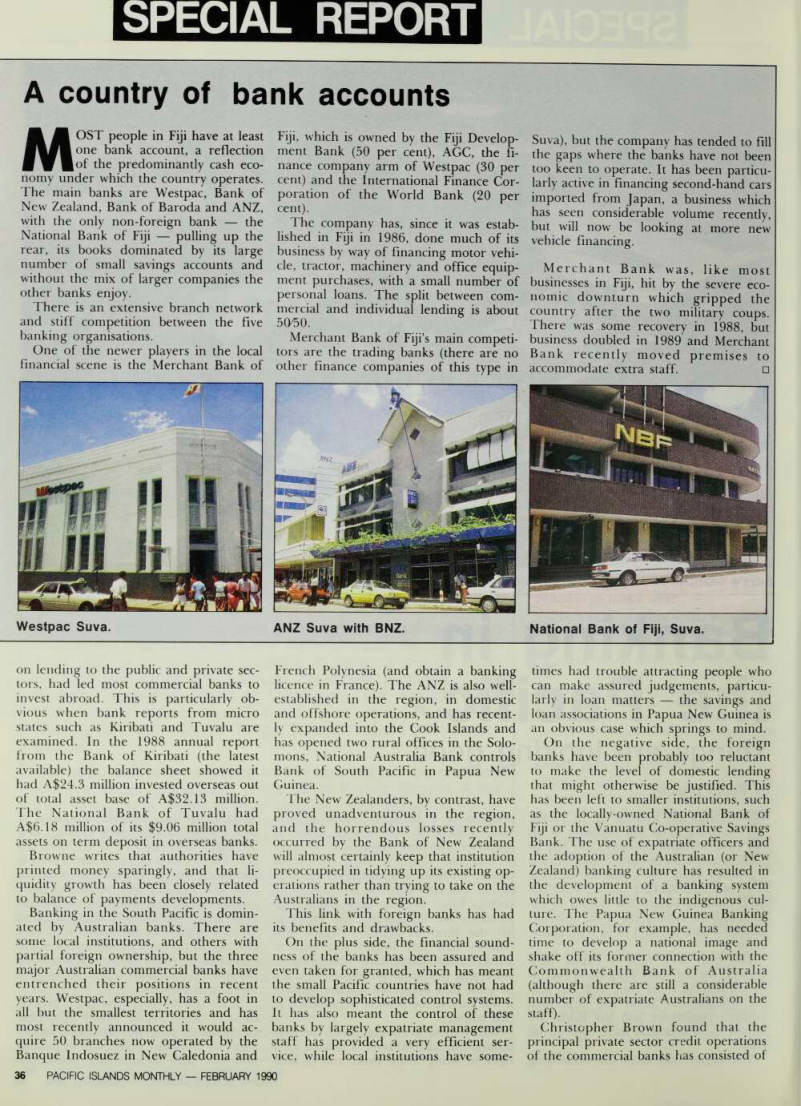
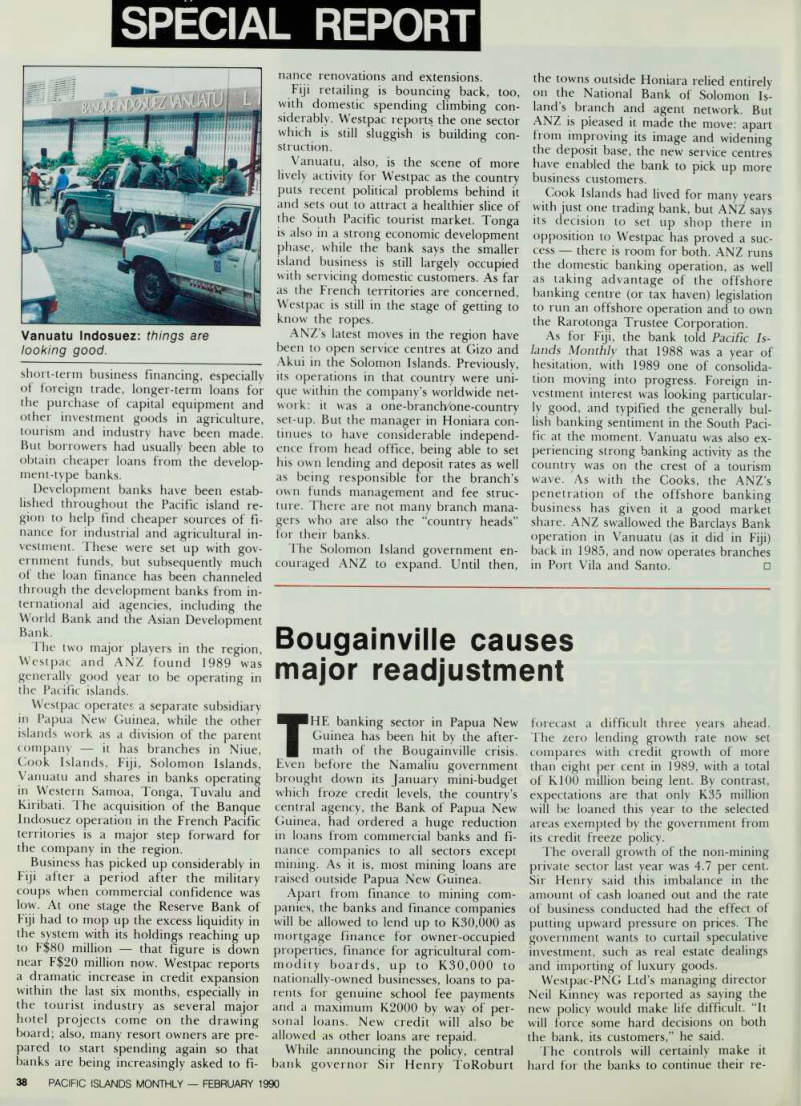
Special Report
Banking in the Pacific Things are looking good
By Robin Bromby
THINGS are looking up in Pacific banking. The Fiji economy is on the rebound. Vanuatu has put its political problems behind it and tourism is growing again, the Cooks are thriving as an offshore banking centre, while the ANZ Banking Group has started to ex pand into the rural areas of the Solomon Islands and found it to be a profitable move.
The only dull spot is Papua New Guinea: the economy until quite recent ly, was moving along quite well. But now the Bougainville mess has depressed business confidence and the banks are subject to new central bank controls on credit.
The region still faces the underlying
problem of it being an uphill task to build a banking and finance sector in countries with tiny population numbers and one which is often subsistence based. Without a growing indigenous capital market based on an expanding savings base, banking and finance institutions are limited in their ability to lift the level of activity. Papua New Guinea had just begun last year to attract Asian, particularly Malaysian involvement in capital formation it will be some time before we will see whether it will survive the present nervousness in that country.
When most loans are small, perhaps around the Aslooo level, it is hard for a bank to wring much profit out of local
banking activities, with administration of such a loans costing nearly as much as if the figure had been 10 or 20 times lar ger. The last year has seen banks even in the much bigger markets of Australia and New Zealand seek to recoup more of their costs; last month, new charges were levied on small business accounts by most banks. In the larger countries, too, the institutions handle many major corporations which helps to balance out the tens of thousands of smaller deposi tors and borrowers, In his recent book , Economic Develop ment in Seven Pacific Island Countries, Christopher Browne said this limited scope of monetary policy due to popula tion size, with its attendant restrictions
Suva’s financial centre: domestic spending is climbing.
on lending to the public and private sec tors, had led most commercial banks to invest abroad. This is particularly ob vious when bank reports from micro states such as Kiribati and Tuvalu are examined. In the 1988 annual report from the Bank of Kiribati (the latest available) the balance sheet showed it had A|24.3 million invested overseas out of total asset base of A 532.13 million.
The National Bank of Tuvalu had A 56.18 million of its $9.06 million total assets on term deposit in overseas banks.
Browne writes that authorities have printed money sparingly, and that li quidity growth has been closely related to balance of payments developments.
Banking in the South Pacific is domin ated by Australian banks. There are some local institutions, and others with partial foreign ownership, but the three major Australian commercial banks have entrenched their positions in recent years. Westpac, especially, has a foot in all but the smallest territories and has most recently announced it would ac quire 50 branches now operated by the Banque Indosuez in New Caledonia and
French Polynesia (and obtain a banking licence in France). The ANZ is also well established in the region, in domestic and offshore operations, and has recent ly expanded into the Cook Islands and has opened two rural offices in the Solo mons, National Australia Bank controls Bank of South Pacific in Papua New Guinea.
The New Zealanders, by contrast, have proved unadventurous in the region, and the horrendous losses recently occurred by the Bank of New Zealand will almost certainly keep that institution preoccupied in tidying up its existing op erations rather than trying to take on the Australians in the region.
This link with foreign banks has had its benefits and drawbacks.
On the plus side, the financial sound ness of the banks has been assured and even taken for granted, which has meant the small Pacific countries have not had to develop sophisticated control systems.
It has also meant the control of these banks by largely expatriate management staff has provided a very efficient ser vice, while local institutions have some
times had trouble attracting people who can make assured judgements, particu larly in loan matters the savings and loan associations in Papua New Guinea is an obvious case which springs to mind.
On the negative side, the foreign banks have been probably too reluctant to make the level of domestic lending that might otherwise be justified. This has been left to smaller institutions, such as the locally-owned National Bank of Fiji or the Vanuatu Co-operative Savings Bank. The use of expatriate officers and the adoption of the Australian (or New Zealand) banking culture has resulted in the development of a banking system which owes little to the indigenous cul ture. The Papua New Guinea Banking Corporation, for example, has needed time to develop a national image and shake off its former connection with the Commonwealth Bank of Australia (although there are still a considerable number of expatriate Australians on the staff).
Christopher Brown found that the principal private sector credit operations of the commercial banks has consisted of
short-term business financing, especially
of foreign trade, longer-term loans for the purchase of capital equipment and other investment goods in agriculture, tourism and industry have been made.
But borrowers had usually been able to obtain cheaper loans from the develop ment-type banks.
Development banks have been estab lished throughout the Pacific island re gion to help find cheaper sources of fi nance for industrial and agricultural in vestment. These were set up with gov ernment funds, but subsequently much of the loan finance has been channeled through the development banks from in ternational aid agencies, including the World Bank and the Asian Development Bank.
The two major players in the region, Westpac and ANZ found 1989 was generally good year to be operating in the Pacific islands.
Westpac operates a separate subsidiary in Papua New Guinea, while the other islands work as a division of the parent company it has branches in Niue, Cook Islands, Fiji, Solomon Islands, Vanuatu and shares in banks operating in Western Samoa, Tonga, Tuvalu and Kiribati. The acquisition of the Banque Indosuez operation in the French Pacific territories is a major step forward for the company in the region.
Business has picked up considerably in Fiji after a period after the military coups when commercial confidence was low. At one stage the Reserve Bank of Fiji had to mop up the excess liquidity in the system with its holdings reaching up to FsBo million that figure is down near Fs2o million now. Westpac reports a dramatic increase in credit expansion within the last six months, especially in the tourist industry as several major hotel projects come on the drawing board; also, many resort owners are pre pared to start spending again so that banks are being increasingly asked to fi
nance renovations and extensions.
Fiji retailing is bouncing back, too, with domestic spending climbing con siderably. Westpac reports the one sector which is still sluggish is building con struction.
Vanuatu, also, is the scene of more lively activity for Westpac as the country puts recent political problems behind it and sets out to attract a healthier slice of the South Pacific tourist market. Tonga is also in a strong economic development phase, while the bank says the smaller island business is still largely occupied with servicing domestic customers. As far as the French territories are concerned, Westpac is still in the stage of getting to know the ropes.
ANZ’s latest moves in the region have been to open service centres at Gizo and Akui in the Solomon Islands. Previously, its operations in that country were uni que within the company’s worldwide net work: it was a one-branclvbne-country set-up. But the manager in Honiara con tinues to have considerable independ ence from head office, being able to set his own lending and deposit rates as well as being responsible for the branch’s own funds management and fee struc ture. There are not many branch mana gers who are also the “country heads” for their banks.
The Solomon Island government en couraged ANZ to expand. Until then,
the towns outside Honiara relied entirely on the National Bank of Solomon Is land’s branch and agent network. But ANZ is pleased it made the move: apart
from improving its image and widening
the deposit base, the new service centres have enabled the bank to pick up more business customers, Cook Islands had lived for many years with just one trading bank, but ANZ says its decision to set up shop there in opposition to Westpac has proved a suc cess there is room for both. ANZ runs the domestic banking operation, as well as taking advantage of the offshore banking centre (or tax haven) legislation to run an offshore operation and to own
the Rarotonga Trustee Corporation.
As for Fiji, the bank told Pacific Is lands Monthly that 1988 was a year of hesitation, with 1989 one of consolida tion moving into progress. Foreign in vestment interest was looking particular ly good, and typified the generally bul lish banking sentiment in the South Paci fic at the moment. Vanuatu was also ex
periencing strong banking activity as the
country was on the crest of a tourism wave. As with the Cooks, the ANZ’s penetration of the offshore banking business has given it a good market share. ANZ swallowed the Barclays Bank operation in Vanuatu (as it did in Fiji) back in 1985, and now operates branches in Port Vila and Santo. □
Vanuatu Indosuez: things are looking good.
A country of bank accounts
MOST people in Fiji have at least one bank account, a reflection of the predominantly cash eco nomy under which the country operates.
The main banks are Westpac, Bank of New Zealand, Bank of Baroda and ANZ, with the only non-foreign bank the National Bank of Fiji pulling up the rear, its books dominated by its large number of small savings accounts and without the mix of larger companies the other banks enjoy.
There is an extensive branch network and stiff competition between the five
banking organisations.
One of the newer players in the local financial scene is the Merchant Bank of
Fiji, which is owned by the Fiji Develop ment Bank (50 per cent), AGC, the fi nance company arm of Westpac (30 per cent) and the International Finance Cor poration of the World Bank (20 per cent).
The company has, since it was estab lished in Fiji in 1986, done much of its business by way of financing motor vehi cle, tractor, machinery and office equip ment purchases, with a small number of personal loans. The split between com mercial and individual lending is about 5050.
Merchant Bank of Fiji’s main competi tors are the trading banks (there are no other finance companies of this type in
Suva), but the company has tended to fill the gaps where the banks have not been too keen to operate. It has been particu larly active in financing second-hand cars imported from Japan, a business which has seen considerable volume recently, but will now be looking at more new
vehicle financing.
Merchant Bank was, like most businesses in Fiji, hit by the severe eco nomic downturn which gripped the country after the two military coups.
There was some recovery in 1988, but business doubled in 1989 and Merchant Bank recently moved premises to accommodate extra staff. □
Westpac Suva.
ANZ Suva with BNZ.
National Bank of Fiji, Suva.
Advertisements & other items, p. 35 (1 item)
Bhbhi
u v
IM U
N G U E
COOK
S ■
JUST LANDED
'F/ft/£/N/C'/H/ / / / /
iTTiWfiUi
>\\v
Who can you
bank on no matter
where you land
in the Pacific?
Westpac has a strong presence in this part of the world.
The Westpac %l# is a familiar and welcome sight throughout the South Pacific.
W ith the recent purchase of the operations of the Banque Indosuez in French Polynesia and New Caledonia, no matter where you land in the region, you’ll find Westpac.
The Banque Indosuez connection, with its 46 branches, brings to eleven the number of South Pacific countries where Westpac has a presence.
Our programme of expansion is a planned one and is part of our overall aim to build and maintain a reputation that people and businesses in the Pacific can bank on.
We see our role as being closely involved in the Pacific’s development.
Ifr’s a role that covers not only multinational companies and major operators, it also extends to small local business people and entrepreneurs.
Westpac has a commitment to the Pacific. And it’s a commitment you can bank on. Wherever you land. u# You can bank on Westpac Branches: Bahrain. Beijing. Chicago. Columbus. Frankfurt. Hong Kong. Honiara. Houston. Jakarta. Kuala Lumpur. London. Los Angeles. New York.
Niue. Noumea. Papeete. Port Moresby. Port Vila. Rarotonga. San Francisco. Seoul. Singapore. Suva. Sydney. Taipei. Tokyo. Wellington.
Subsidiary: Kiribati (Bank of Kiribati Ltd, Tarawa) Affiliates: Tonga (Bank of Tonga, Nuku’alofa) .Tuvalu (National Bank of Tuvalu, Funafuti) .Western Samoa (Pacific Commercial Bank Ltd, Apia)
Bougainville causes

major readjustment
THE banking sector in Papua New Guinea has been hit by the after math of the Bougainville crisis.
Even before the Namaliu government brought down its January mini-budget which froze credit levels, the country’s central agency, the Bank of Papua New Guinea, had ordered a huge reduction in loans from commercial banks and fi nance companies to all sectors except mining. As it is, most mining loans are raised outside Papua New Guinea.
Apart from finance to mining com panies, the banks and finance companies will be allowed to lend up to K 30,000 as mortgage finance for owner-occupied properties, finance for agricultural com modity boards, up to K 30,000 to nationally-owned businesses, loans to pa rents for genuine school fee payments and a maximum K2OOO by way of per sonal loans. New credit will also be allowed as other loans are repaid.
While announcing the policy, central bank governor Sir Henry Toßoburt
forecast a difficult three years ahead.
The zero lending growth rate now set compares with credit growth of more than eight per cent in 1989, with a total of KlOO million being lent. By contrast, expectations are that only K 35 million will be loaned this year to the selected areas exempted by the government from its credit freeze policy.
The overall growth of the non-mining private sector last year was 4.7 per cent.
Sir Henry said this imbalance in the amount of cash loaned out and the rate of business conducted had the effect of putting upward pressure on prices. The government wants to curtail speculative investment, such as real estate dealings and importing of luxury goods.
Westpac-PNG Ltd’s managing director Neil Kinney was reported as saying the new policy would make life difficult. “It will force some hard decisions on both the bank, its customers,” he said.
The controls will certainly make it hard for the banks to continue their re
cent increases in profit results [see box].
The Papua New Guinea Banking Cor poration has also been putting runs on the board. In the year to December 31, 1988, it reported a 15 per cent profit rise over the preceding year. Both these banks have strong ties to Australia, as does the Bank of South Pacific through its National Australia Bank parent. The key to their entrenched position is their deep involvement in trade and finance links to Sydney and Melbourne, and this makes it hard for newcomers to break in as Indosuez Niugini Bank and Niugi
ni-Lloyd International Bank found out.
Meanwhile, the Bank of Papua New Guinea is taking action to clean up the savings and loan movement in the coun try. It plans to liquidate 90 inoperative societies.
These societies, which operate along the lines of credit unions, have often found themselves in financial trouble; the trend to lend money for consump tion (school fees or household appliances for example) has been increasing. But lax control meant that some loans were made without a full check as to whether
the people could afford to repay them.
Some loans were made without proper records being kept. Administrative ex penses for wages, staff benefits and other operational needs sometimes ex ceeded income so some officials dip ped into members’ savings to make up the shortfall.
At the end of June 1989, there were 123 savings and loan associations still registered, with a total membership of 114,000. Only 33 of these are active, the remaining 90 being the dormant ones the central bank will now wind up.
Since the bank issued stricter guide lines in mid-1988, the active societies have managed cost reductions which has improved their financial performance. □
Advertisements & other items, pp. 37-38 (1 item)
Mfa folk
M\q\
Y&'OtenZ'
At ANZ Bank, we speak your language. In fact we speak over 40 different languages worldwide.
Indeed ANZ Bank has the largest global network of any Australasian banking or financial services group.
But we will never be too big to ignore the simple and time proven effectiveness of direct customer contact, person to person.
If this is the way you prefer to do business, then come and say "hello'
Worldwide
AUSTRALIA • BAHAMAS • BAHRAIN • BANGLADESH . BRAZIL • CANADA • CAYMAN ISLANDS • COOK ISLANDS • PEOPLE S REPUBLIC OF CHINA . FIJI . FRANCE • GERMANY . GHANA • GREECE • GUERNSEY • HONG KONG • INDIA .
INDONESIA . IRAN . ITALY • JAPAN • JERSEY . JORDAN . KENYA • REPUBLIC OF KOREA . MALAYSIA . MONACO • NEPAL • NEW ZEALAND • NIGERIA . OMAN . PAKISTAN . PAPUA NEW GUINEA • QATAR . SINGAPORE . SOLOMON ISLANDS • SPAIN • SRI LANKA . SWITZERLAND . TAIWAN . THAILAND • UGANDA . UNITED ARAB EMIRATES . UNITED KINGDOM .
UNITED STATES OF AMERICA . VANUATU • ZAIRE • ZAMBIA • ZIMBABWE
/DOES YOUR
I BUSINESS
I NEED:
£ PLANT or MACHINERY?
\ MOTOR VEHICLES?
< OFFICE EQUIPMENT?
( FURNITURE & FITTINGS?
/ \ The Merchant Dank of Fiji can finance V all types of capital equipment. ♦ Consider the benefits of financing with MB F v ★ Quick and efficient service \ ★ Competitive rates \ *No added costs or fees \ ★You retain your established lines of credit r ★ Payments can be structured to suit your cash flow / Phone us on Suva 314955 Fax 300026 or Lautoka Phone 60322 Fax 60319 Burns Philp \ IS"" u, “ * yij B| jj x . v .“Can we help you?”
Bank profit
WESTFAC Bank-PNG Ltd has recorded a record after tax profit of K 6.53 million for the year to September 30, 1989. This com pares with last year’s result of K 4.42 mil lion, and represents a 33 per cent in crease after allowing for changes to corporate tax rates.
Strong growth in the bank’s retail core deposit base underpinned an overall im provement in Westpac’s overall market share, a bank statement said. Interna tional business and travel product sales also increased substantially.
Return on average shareholder’s funds was 21.8 per cent, and Westpac PNG has declared a final dividend of 25 toea per share (interim dividend was 15 toea) making a total for the year of 40t, up from 30t last year.
Westpac Chairman Sir Eric Neal said the Papua New Guinea staff had worked magnificently during the year, and there would be an increased emphasis on cus tomer service in the coming year. □
Hawaii cautioned
FIRST Hawaiian Bank’s latest economic indicators report says a cautious approach is necessary in 1990, and that the state’s growth is expected to be mod erate. Growth potential was marred by labour shortages; bottlenecks were occur ring across all industries. In September total jobs available increased by three per cent, but the labour force grew by only one per cent. Slower growth on the mainland United States will mean the eastbound visitor arrivals will not in crease at the same pace as in recent years. The bank estimtes the state’s eco nomy will grow by four per cent this year. □
Advertisements & other items, p. 38 (1 item)
Special Report
40
PACIFIC ISLANDS MONTHLY FEBRUARY 1990
Dd llr\ 1 1 ILJ IN I I It? rdUIIIU
SPECIAL REPORT
Cooks charter military ship
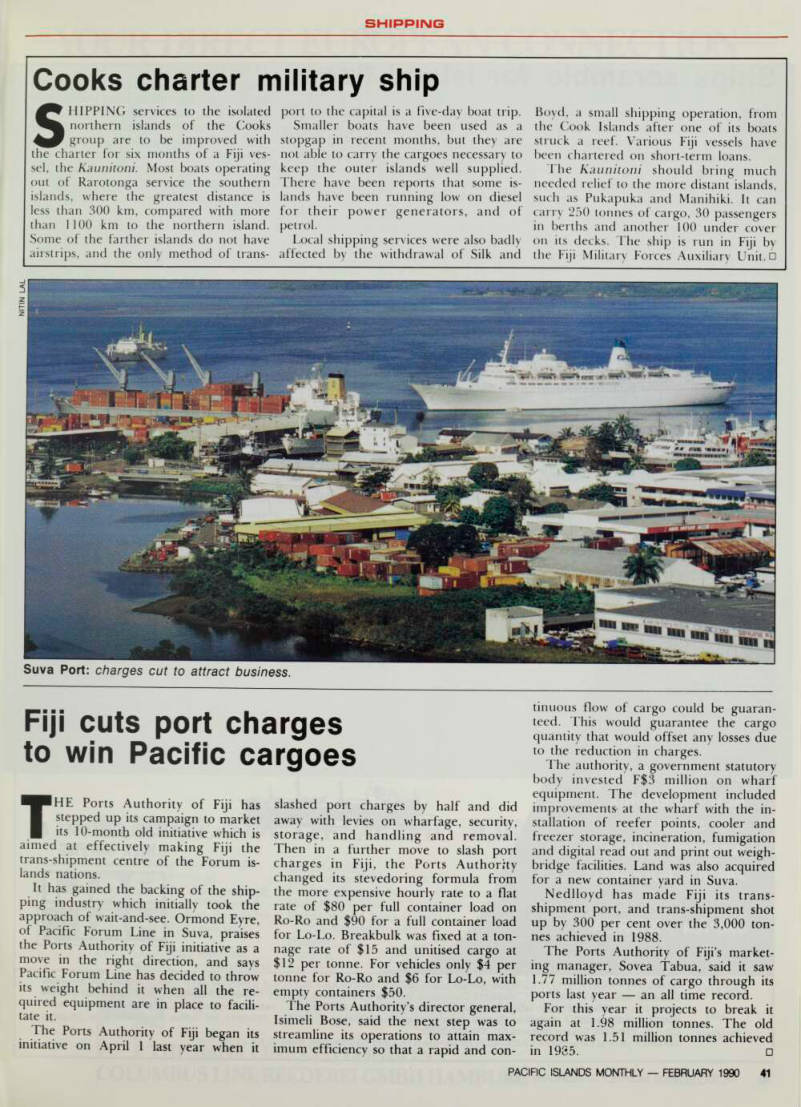
SHIPPING services to the isolated northern islands of the Cooks group are to be improved with the charter for six months of a Fiji ves sel, the Kaunitoni. Most boats operating out of Rarotonga service the southern islands, where the greatest distance is less than 300 km, compared with more than 1100 km to the northern island.
Some of the farther islands do not have airstrips, and the only method of trans
port to the capital is a five-day boat trip.
Smaller boats have been used as a stopgap in recent months, but they are not able to carry the cargoes necessary to keep the outer islands well supplied.
There have been reports that some is lands have been running low on diesel for their power generators, and of petrol.
Local shipping services were also badly affected by the withdrawal of Silk and
Boyd, a small shipping operation, from the Cook Islands after one of its boats struck a reef. Various Fiji vessels have been chartered on short-term loans.
The Kaunitoni should bring much needed relief to the more distant islands, such as Pukapuka and Manihiki. It can carry 250 tonnes of cargo, 30 passengers in berths and another 100 under cover on its decks. The ship is run in Fiji by the Fiji Military Forces Auxiliary Unit.D
Fiji cuts port charges
to win Pacific cargoes
THE Ports Authority of Fiji has
stepped up its campaign to market its 10-montb old initiative which is
aimed at effectively making Fiji the
trans-shipment centre of the Forum is lands nations.
It has gained the backing of the ship
ping industry which initially took the
approach of wait-and-see. Ormond Eyre, of Pacific Forum Line in Suva, praises the Ports Authority of Fiji initiative as a move in the right direction, and says Pacific Forum Line has decided to throw its weight behind it when all the re quired equipment are in place to facili tate it.
The Ports Authority of Fiji began its initiative on April 1 last year when it
slashed port charges by half and did away with levies on wharfage, security, storage, and handling and removal, Then in a further move to slash port
charges in Fiji, the Ports Authority
changed its stevedoring formula from the more expensive hourly rate to a flat rate of $BO per full container load on Ro-Ro and $9O for a full container load for Lo-Lo. Breakbulk was fixed at a ton nage rate of $l5 and unitised cargo at $l2 per tonne. For vehicles only $4 per tonne for Ro-Ro and $6 for Lo-Lo, with empty containers $5O.
The Ports Authority’s director general, Isimeli Bose, said the next step was to streamline its operations to attain max imum efficiency so that a rapid and con
tinuous flow of cargo could be guaran teed. This would guarantee the cargo quantity that would offset any losses due to the reduction in charges.
The authority, a government statutory body invested Fs3 million on wharf
equipment. The development included
improvements at the wharf with the in stallation of reefer points, cooler and freezer storage, incineration, fumigation and digital read out and print out weigh bridge facilities. Land was also acquired for a new container yard in Suva.
Nedlloyd has made Fiji its trans shipment port, and trans-shipment shot up by 300 per cent over the 3,000 ton nes achieved in 1988.
The Ports Authority of Fiji’s market ing manager, Sovea Tabua, said it saw 1.77 million tonnes of cargo through its ports last year an all time record.
For this year it projects to break it again at 1.98 million tonnes. The old record was 1.51 million tonnes achieved in 1985. □
-I 3 z t z
Suva Port: charges cut to attract business.
Ships scramble for island flags
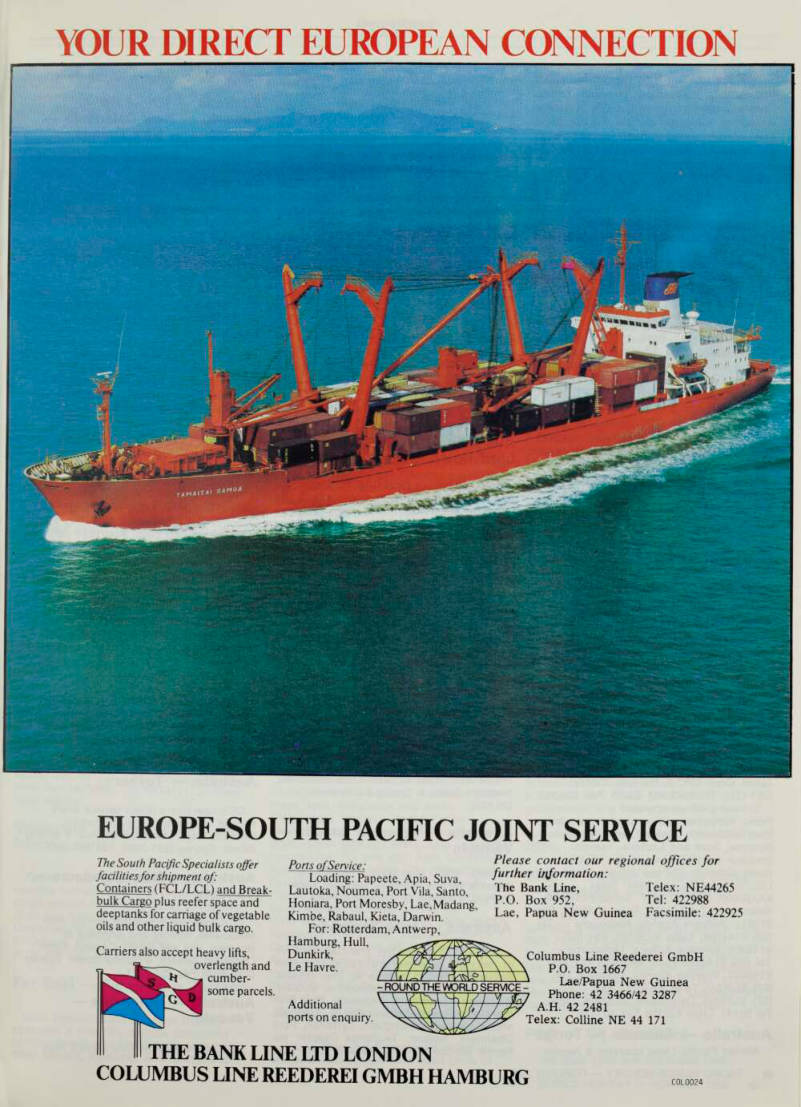
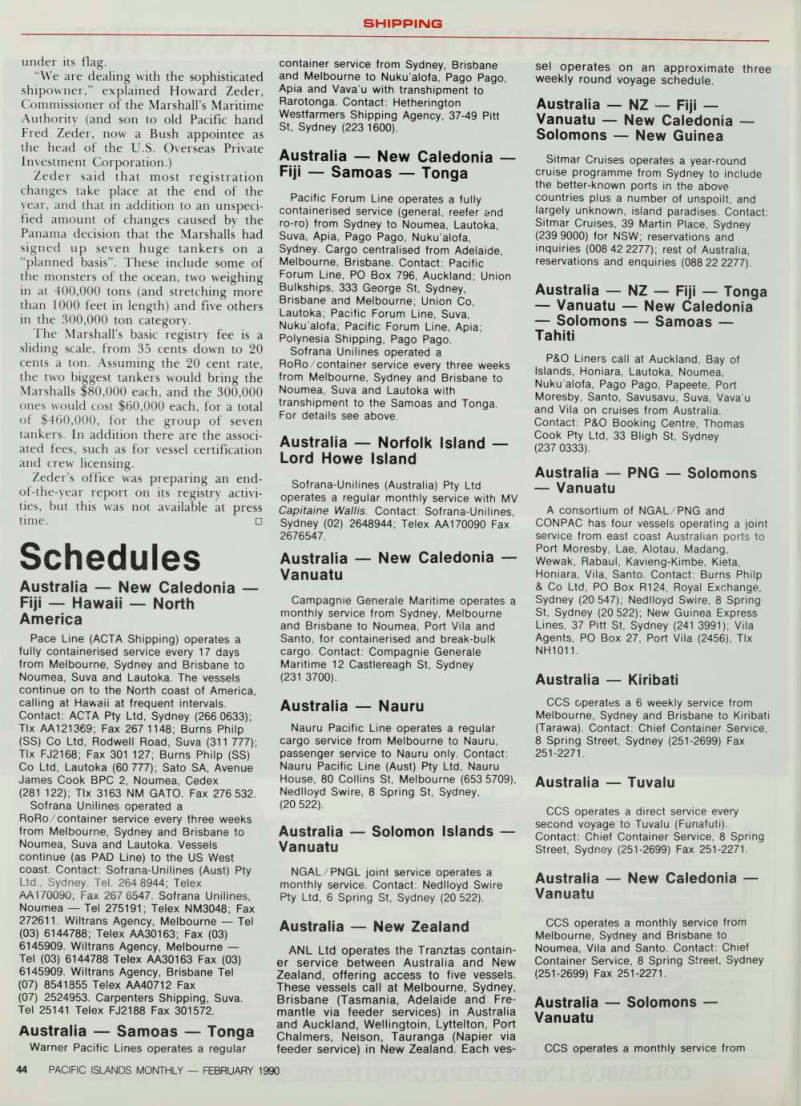
BOTH Vanuatu and the Republic of the Marshalls received some unexpected revenues as a result of the United States invasion of Panama their shipping registry fees soared when the US cut off ships carrying Panama flags from US waters.
A couple of weeks before the invasion, as part of United States commercial sanctions on Panama, the Department of State ruled that ships carrying the Panama flag of convenience would not be admitted to US waters after January 31, 1990. Since Panama, like Africa’s Liberia, has a significant part of the world’s shipping flying its flag, there was a scramble for other flags, and both Vanuatu and the Marshalls were only too happy to oblige. (The nationality of a ship’s owners, and the flag it carries, are often different; Panama, Liberia and other providers of flags of convenience compete as to who can provide the least
expensive, least troublesome registry
system.) Although hard figures were not im-
mediately available, apparently
Vanuatu’s Deputy Commissioner of Maritime Affairs, who works in New
York, registered an additional hundred vessels or so, increasing the size of the Vanuatu flag fleet to about 500.
Meanwhile, in the Marshall’s Hawaii office, perhaps another 15 or 20 ships registered as a result of the US bar of
Panamanian ships.
Many of the ships transferring to Mar shalls or Vanuatu registration were own ed by Hong Kong, Taiwan or Japanese interests. The Evergreen Line, out of Taiwan, for example, shifted from Panamanian to Marshall Island registra tion for at least two of its ships which use the port of Baltimore (the deepsea port closest to Washington.) How much of a financial boost was the shift to Vanuatu registry? Again, hard data are lacking. One source said that each registry involved hard negotiations between the owners on one hand, and the registering nation on the other. “It’s a bazaar out there,” he said. No one was anxious to quote exact numbers, but an estimate of about US$25OO or $3OOO a year for an average 10,000 ton freighter was suggested. (The registry rate is often calculated by so many cents per ton; the $3OOO would be 30 cents a ton for a
10,000 ton ship.) Given these benchmarks, Vanuatu probably picked up at least U 55250,000 to $300,000 in registry fees, assuming one hundred 10,000 ton ships, but more were the ships, on average, larger. In addition there was usually other fees as well, such as for inspection services; under some circumstances these associ ated charges can be more than the reg
istry fee.
One of the ironies of the Vanuatu windfall was that on the very day that the story of its good fortune emerged (December 29) as a result of the invasion of Panama, Vanuatu’s ambassador to the United Nations was voting in the Gener al Assembly to condemn that invasion.
By that time the US had rescinded its ban on Panama flag ships, and, as a re sult, there are no more expected shifts in registration caused by that factor. In fact, there may be some movement back to Panama now that the status quo ante has been restored.
The Marshalls situation is a bit diffe rent. The republic has been actively in volved for only about two years, after an extensive planning period; and it appears to focus its attentions on a smal ler collection of very large vessels. Ear lier in 1989 it had a fleet of only five
under its flag.
“We are dealing with the sophisticated
shipowner,” explained Howard Zeder,
Commissioner of the Marshall’s Maritime Authority (and son to old Pacific hand Fred Zeder, now a Bush appointee as the head of the U.S. Overseas Private
Investment Corporation.)
Zeder said that most registration changes take place at the end of the year, and that in addition to an unspeci fied amount of changes caused by the Panama decision that the Marshalls had signed up seven huge tankers on a “planned basis”. These include some of the monsters of the ocean, two weighing in at 400,000 tons (and stretching more than 1000 feet in length) and five others in the 300,000 ton category.
The Marshall’s basic registry fee is a sliding scale, from 35 cents down to 20 cents a ton. Assuming the 20 cent rate, the two biggest tankers would bring the Marshalls $BO,OOO each, and the 300,000 ones would cost $60,000 each, for a total of $460,000, for the group of seven tankers. In addition there are the associ ated fees, such as for vessel certification and crew licensing.
Zeder’s office was preparing an end of-the-year report on its registry activi ties, but this was not available at press time. □
Advertisements & other items, pp. 40-41 (1 item)
Bali
TONGA,
KIRIBATI
VANUATU
COOK ISLAND
SOLOMON ISLANDS
NEW CALEDONIA
U.S. SAMOA
WESTERN SAMOA
FRENCH POLYNESIA
JAPAN . KOREA
YOU’LL FIND IT,
WHERE THE SKY MEETS
THE SEA
RORO. CONTAINER &
B.BULK SHIPPING
BALI
HAI SERVICE
AGENTS
and
PHONE
SUVA:Burns Philp(B P) 311777 Carpenter Shipping (C S) 31 2244 LAUTOKArB P 60777 C S 63988 APIA B P 22611 PAGOPAGO Polynesia Shipping Services Ltd 633-1 211 PAPEETE:Compagnie Maritime Polynesienne 42 84 02 NOUMEA:Etablissements Ballande 687-283384 VILA:B P 2456 SANTO-.B P 230 HONlARA:Sullivans (Solomon Islands) Ltd 21645 TARAWA:Shipping Corporation of Kiribati 26195 NUKUALOFA'S P 21500 BUSANrfor general cargo Young Chang Shipping Co , Ltd 753-0451 for vehicle Pan Continental Shipping Co , Ltd 778-7680 Soyang Shipping Co , Ltd 752-7755 JAPANrfor general cargo Swire 03-230-9245 for vehicle NYK Lines 03-284-5506 Mitsui O S K 03-587-7123
YOUR DIRECT EUROPEAN CONNECTION
EUROPE-SOUTH PACIFIC JOINT SERVICE
The South Pacific Specialists offer facilities for shipment of: Containers (FCL/LCL) and Breakbulk Cargo plus reefer space and deeptanks for carriage of vegetable oils and other liquid bulk cargo.
Carriers also accept heavy lifts, overlength and cumbersome parcels.
Ports of Service: Loading: Papeete, Apia, Suva, Lautoka, Noumea, Port Vila, Santo, Honiara, Port Moresby, Lae,Madang, Kimbe, Rabaul, Kieta, Darwin.
For: Rotterdam, Antwerp, Hamburg, Hull, Dunkirk, Le Havre.
- ROUND THE WORLD SERVICE -
Additional ports on enquiry.
Please contact our regional offices for further information: The Bank Line, Telex: NE44265 P.O. Box 952, Tel: 422988 Lae, Papua New Guinea Facsimile: 422925 Columbus Line Reederei GmbH P.O. Box 1667 Lae/Papua New Guinea Phone: 42 3466/42 3287 A.H. 42 2481 Telex: Colline NE 44 171
THE BANK LINE LTD LONDON
COLUMBUS LINE REEDEREI GMBH HAMBURG
COL0024
Schedules
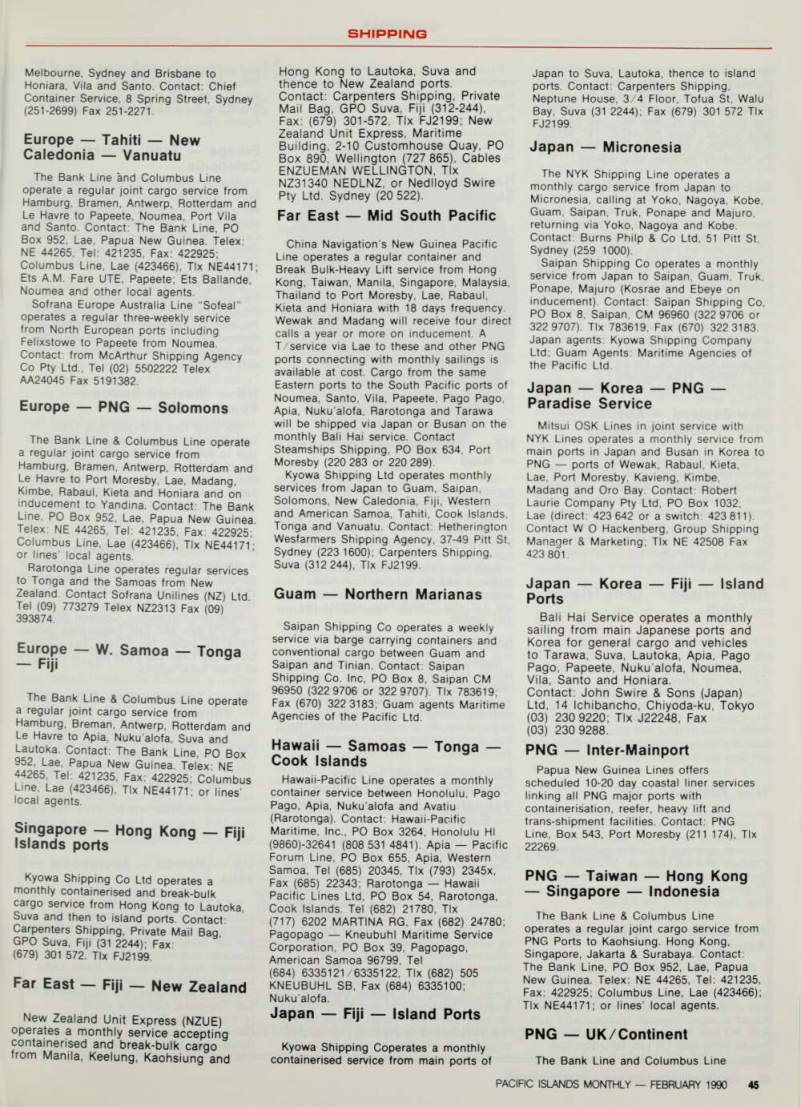
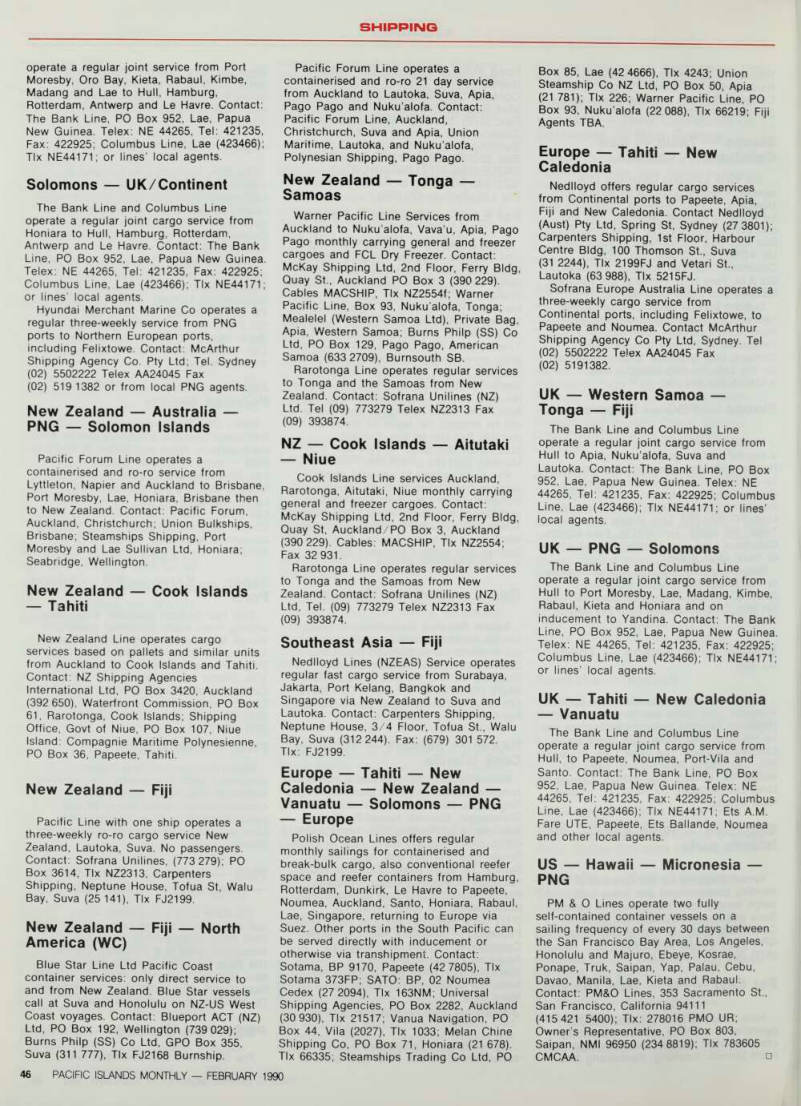
Australia New Caledonia
Fiji Hawaii North
America
Pace Line (ACTA Shipping) operates a fully containerised service every 17 days from Melbourne, Sydney and Brisbane to Noumea, Suva and Lautoka. The vessels continue on to the North coast of America, calling at Hawaii at frequent intervals.
Contact: ACTA Pty Ltd, Sydney (266 0633); Tlx AA121369; Fax 267 1148; Burns Philp (SS) Co Ltd, Rodwell Road, Suva (311 777); Tlx FJ2168; Fax 301 127; Burns Philp (SS) Co Ltd, Lautoka (60 777); Sato SA, Avenue James Cook BPC 2, Noumea, Cedex (281 122); Tlx 3163 NM GATO. Fax 276 532.
Sofrana Unilines operated a Roßo/container service every three weeks from Melbourne, Sydney and Brisbane to Noumea, Suva and Lautoka. Vessels continue (as PAD Line) to the US West coast. Contact; Sofrana-Unilines (Aust) Pty Ltd., Sydney. Tel. 264 8944; Telex AA170090; Fax 267 6547. Sofrana Unilines, Noumea Tel 275191; Telex NM3048; Fax 272611. Wiltrans Agency, Melbourne Tel (03) 6144788; Telex AA30163; Fax (03) 6145909. Wiltrans Agency, Melbourne Tel (03) 6144788 Telex AA30163 Fax (03) 6145909. Wiltrans Agency, Brisbane Tel (07) 8541855 Telex AA40712 Fax (07) 2524953. Carpenters Shipping, Suva.
Tel 25141 Telex FJ2IBB Fax 301572.
Australia Samoas Tonga
Warner Pacific Lines operates a regular
container service from Sydney, Brisbane and Melbourne to Nukualofa, Pago Pago, Apia and Vava’u with transhipment to Rarotonga. Contact; Hetherington Westfarmers Shipping Agency, 37-49 Pitt St, Sydney (223 1600).
Australia New Caledonia
Fiji Samoas Tonga
Pacific Forum Line operates a fully containerised service (general, reefer and ro-ro) from Sydney to Noumea, Lautoka, Suva, Apia, Pago Pago, Nukualofa, Sydney. Cargo centralised from Adelaide, Melbourne, Brisbane. Contact: Pacific Forum Line, PO Box 796, Auckland; Union Bulkships, 333 George St, Sydney, Brisbane and Melbourne: Union Co, Lautoka; Pacific Forum Line, Suva, Nukualofa; Pacific Forum Line, Apia; Polynesia Shipping, Pago Pago.
Sofrana Unilines operated a Roßo/container service every three weeks from Melbourne, Sydney and Brisbane to Noumea, Suva and Lautoka with transhipment to the Samoas and Tonga.
For details see above.
Australia Norfolk Island
Lord Mowe Island
Sofrana-Unilines (Australia) Pty Ltd operates a regular monthly service with MV Capitaine Wallis. Contact: Sofrana-Unilines, Sydney (02) 2648944; Telex AA170090 Fax 2676547.
Australia New Caledonia Vanuatu Campagnie Generale Maritime operates a monthly service from Sydney, Melbourne and Brisbane to Noumea, Port Vila and Santo, for containerised and break-bulk cargo. Contact: Compagnie Generale Maritime 12 Castlereagh St, Sydney (231 3700).
Australia Nauru
Nauru Pacific Line operates a regular cargo service from Melbourne to Nauru, passenger service to Nauru only. Contact: Nauru Pacific Line (Aust) Pty Ltd, Nauru House, 80 Collins St, Melbourne (653 5709), Nedlloyd Swire, 8 Spring St, Sydney, (20 522).
Australia Solomon Islands Vanuatu NGAL/PNGL joint service operates a monthly service. Contact: Nedlloyd Swire Pty Ltd, 6 Spring St, Sydney (20 522).
Australia New Zealand ANL Ltd operates the Tranztas contain er service between Australia and New Zealand, offering access to five vessels.
These vessels call at Melbourne, Sydney, Brisbane (Tasmania, Adelaide and Fre mantle via feeder services) in Australia and Auckland, Wellingtoin, Lyttelton, Port Chalmers, Nelson, Tauranga (Napier via feeder service) in New Zealand. Each ves
sel operates on an approximate three weekly round voyage schedule.
Australia NZ Fiji Vanuatu New Caledonia Solomons New Guinea Sitmar Cruises operates a year-round cruise programme from Sydney to include the better-known ports in the above countries plus a number of unspoilt, and largely unknown, island paradises. Contact: Sitmar Cruises, 39 Martin Place, Sydney (239 9000) for NSW; reservations and inquiries (008 42 2277); rest of Australia, reservations and enquiries (088 22 2277).
Australia NZ Fiji Tonga
Vanuatu New Caledonia Solomons Samoas Tahiti P&O Liners call at Auckland, Bay of Islands, Honiara, Lautoka, Noumea, Nukualofa, Pago Pago, Papeete, Port Moresby, Santo, Savusavu, Suva, Vava’u and Vila on cruises from Australia.
Contact: P&O Booking Centre, Thomas Cook Pty Ltd, 33 Bligh St, Sydney (237 0333).
Australia PNG Solomons Vanuatu A consortium of NGAL/PNG and CONPAC has four vessels operating a joint service from east coast Australian ports to Port Moresby, Lae, Alotau, Madang, Wewak, Rabaul, Kavieng-Kimbe, Kieta, Honiara, Vila, Santo. Contact: Burns Philp & Co Ltd, PO Box R 124, Royal Exchange, Sydney (20 547); Nedlloyd Swire, 8 Spring St, Sydney (20 522); New Guinea Express Lines, 37 Pitt St, Sydney (241 3991); Vila Agents. PO Box 27, Port Vila (2456), Tlx
Nhioii.
Australia Kiribati CCS operates a 6 weekly service from Melbourne, Sydney and Brisbane to Kiribati (Tarawa). Contact: Chief Container Service, 8 Spring Street, Sydney (251-2699) Fax 251-2271.
Australia Tuvalu CCS operates a direct service every second voyage to Tuvalu (Funafuti).
Contact: Chief Container Service, 8 Spring Street, Sydney (251-2699) Fax 251-2271.
Australia New Caledonia Vanuatu CCS operates a monthly service from Melbourne, Sydney and Brisbane to Noumea, Vila and Santo. Contact: Chief Container Service, 8 Spring Street, Sydney (251-2699) Fax 251-2271.
Australia Solomons Vanuatu CCS operates a monthly service from
Melbourne, Sydney and Brisbane to Honiara, Vila and Santo. Contact: Chief Container Service, 8 Spring Street, Sydney (251-2699) Fax 251-2271.
Europe Tahiti New Caledonia Vanuatu The Bank Line and Columbus Line operate a regular joint cargo service from Hamburg, Bramen, Antwerp, Rotterdam and Le Havre to Papeete, Noumea, Port Vila and Santo. Contact: The Bank Line, PO Box 952, Lae, Papua New Guinea. Telex: NE 44265, Tel: 421235, Fax: 422925; Columbus Line, Lae (423466), Tlx NE44171; Ets A.M. Fare UTE, Papeete; Ets Ballande, Noumea and other local agents.
Sofrana Europe Australia Line "Sofeal” operates a regular three-weekly service from North European ports including Felixstowe to Papeete from Noumea.
Contact: from McArthur Shipping Agency Co Pty Ltd., Tel (02) 5502222 Telex AA24045 Fax 5191382.
Europe PNG Solomons
The Bank Line & Columbus Line operate a regular joint cargo service from Hamburg, Bramen, Antwerp, Rotterdam and Le Havre to Port Moresby, Lae, Madang, Kimbe, Rabaul, Kieta and Honiara and on inducement to Yandina. Contact; The Bank Line, PO Box 952, Lae, Papua New Guinea.
Telex; NE 44265, Tel; 421235, Fax: 422925; Columbus Line, Lae (423466), Tlx NE44171’; or lines’ local agents.
Rarotonga Line operates regular services to Tonga and the Samoas from New Zealand. Contact Sofrana Unilines (NZ) Ltd Tel (09) 773279 Telex NZ2313 Fax (09) 393874.
Europe W. Samoa Tonga
- Fiji
The Bank Line & Columbus Line operate a regular joint cargo service from Hamburg, Breman, Antwerp, Rotterdam and Le Havre to Apia, Nukualofa, Suva and Lautoka. Contact: The Bank Line, PO Box 952, Lae, Papua New Guinea. Telex NE 44265, Tel: 421235, Fax; 422925; Columbus Line, Lae (423466), Tlx NE44171; or lines’ local agents.
Singapore Hong Kong Fiji
Islands ports
Kyowa Shipping Co Ltd operates a monthly containerised and break-bulk cargo service from Hong Kong to Lautoka, Suva and then to island ports. Contact: Carpenters Shipping, Private Mail Bag GPO Suva, Fiji (31 2244); Fax: (679) 301 572. Tlx FJ2199.
Far East Fiji New Zealand New Zealand Unit Express (NZUE) operates a monthly service accepting containerised and break-bulk cargo from Manila, Keelung, Kaohsiung and
Hong Kong to Lautoka, Suva and thence to New Zealand ports.
Contact: Carpenters Shipping, Private Mail Bag, GPO Suva, Fiji (312-244), Fax: (679) 301-572, Tlx FJ2199; New Zealand Unit Express, Maritime Building, 2-10 Customhouse Quay, PO Box 890, Wellington (727 865), Cables
Enzueman Wellington, Tlx
NZ31340 NEDLNZ, or Nedlloyd Swire Pty Ltd. Sydney (20 522).
Far East Mid South Pacific China Navigation’s New Guinea Pacific Line operates a regular container and Break Bulk-Heavy Lift service from Hong Kong, Taiwan, Manila, Singapore, Malaysia, Thailand to Port Moresby, Lae, Rabaul, Kieta and Honiara with 18 days frequency.
Wewak and Madang will receive four direct calls a year or more on inducement. A T/service via Lae to these and other PNG ports connecting with monthly sailings is available at cost. Cargo from the same Eastern ports to the South Pacific ports of Noumea, Santo, Vila, Papeete, Pago Pago, Apia, Nukualofa, Rarotonga and Tarawa will be shipped via Japan or Busan on the monthly Bali Hai service. Contact Steamships Shipping, PO Box 634, Port Moresby (220 283 or 220 289).
Kyowa Shipping Ltd operates monthly services from Japan to Guam, Saipan, Solomons, New Caledonia, Fiji, Western and American Samoa, Tahiti, Cook Islands, Tonga and Vanuatu. Contact: Hetherington Wesfarmers Shipping Agency, 37-49 Pitt St, Sydney (223 1600); Carpenters Shipping, Suva (312 244), Tlx FJ2199.
Guam Northern Marianas Saipan Shipping Co operates a weekly service via barge carrying containers and conventional cargo between Guam and Saipan and Tinian. Contact: Saipan Shipping Co. Inc, PO Box 8, Saipan CM 96950 (322 9706 or 322 9707). Tlx 783619; Fax (670) 322 3183; Guam agents Maritime Agencies of the Pacific Ltd.
Hawaii Samoas Tonga Cook Islands Hawaii-Pacific Line operates a monthly container service between Honolulu, Pago Pago, Apia, Nukualofa and Avatiu (Rarotonga). Contact: Hawaii-Pacific Maritime, Inc., PO Box 3264, Honolulu HI (9860)-32641 (808 531 4841). Apia Pacific Forum Line, PO Box 655, Apia, Western Samoa, Tel (685) 20345, Tlx (793) 2345 x, Fax (685) 22343; Rarotonga Hawaii Pacific Lines Ltd, PO Box 54, Rarotonga, Cook Islands. Tel (682) 21780, Tlx (717) 6202 MARTINA RG, Fax (682) 24780; Pagopago Kneubuhl Maritime Service Corporation, PO Box 39, Pagopago, American Samoa 96799, Tel (684) 6335121/6335122, Tlx (682) 505
Kneubuhl Sb, Fax (684) 6335100;
Nukualofa.
Japan Fiji Island Ports
Kyowa Shipping Coperates a monthly containerised service from main ports of
Japan to Suva, Lautoka, thence to island ports. Contact: Carpenters Shipping, Neptune House, 3/4 Floor, Tofua St, Walu Bay, Suva (31 2244); Fax (679) 301 572 Tlx FJ2199.
Japan Micronesia
The NYK Shipping Line operates a monthly cargo service from Japan to Micronesia, calling at Yoke, Nagoya, Kobe, Guam, Saipan, Truk, Ponape and Majuro, returning via Yoko, Nagoya and Kobe.
Contact: Burns Philp & Co Ltd, 51 Pitt St, Sydney (259 1000).
Saipan Shipping Co operates a monthly service from Japan to Saipan, Guam, Truk, Ponape, Majuro (Kosrae and Ebeye on inducement). Contact: Saipan Shipping Co, PO Box 8. Saipan, CM 96960 (322 9706 or 322 9707). Tlx 783619, Fax (670) 322 3183.
Japan agents: Kyowa Shipping Company Ltd; Guam Agents: Maritime Agencies of the Pacific Ltd.
Japan Korea PNG Paradise Service Mitsui OSK Lines in joint service with NYK Lines operates a monthly service from main ports in Japan and Busan in Korea to PNG ports of Wewak, Rabaul, Kieta, Lae, Port Moresby, Kavieng, Kimbe, Madang and Oro Bay. Contact: Robert Laurie Company Pty Ltd, PO Box 1032, Lae (direct: 423 642 or a switch: 423 811).
Contact W O Hackenberg, Group Shipping Manager & Marketing; Tlx NE 42508 Fax 423 801.
Japan Korea Fiji Island
Ports Bali Hai Service operates a monthly sailing from main Japanese ports and Korea for general cargo and vehicles to Tarawa, Suva, Lautoka, Apia, Pago Pago, Papeete, Nukualofa, Noumea, Vila, Santo and Honiara.
Contact: John Swire & Sons (Japan) Ltd, 14 Ichibancho, Chiyoda-ku, Tokyo (03) 230 9220; Tlx J 22248, Fax (03) 230 9288.
PNG Inter-Mainport
Papua New Guinea Lines offers scheduled 10-20 day coastal liner services linking all PNG major ports with containerisation, reefer, heavy lift and trans-shipment facilities. Contact: PNG Line, Box 543, Port Moresby (211 174), Tlx 22269.
PNG Taiwan Hong Kong
Singapore Indonesia
The Bank Line & Columbus Line operates a regular joint cargo service from PNG Ports to Kaohsiung. Hong Kong, Singapore, Jakarta & Surabaya. Contact: The Bank Line, PO Box 952, Lae, Papua New Guinea. Telex: NE 44265, Tel: 421235.
Fax; 422925; Columbus Line, Lae (423466); Tlx NE44171; or lines’ local agents.
PNG UK/Continent The Bank Line and Columbus Line
operate a regular joint service from Port Moresby, Oro Bay, Kieta, Rabaul, Kimbe, Madang and Lae to Hull, Hamburg, Rotterdam, Antwerp and Le Havre. Contact: The Bank Line, PO Box 952, Lae, Papua New Guinea. Telex: NE 44265, Tel: 421235, Fax: 422925; Columbus Line, Lae (423466); Tlx NE44171; or lines’ local agents.
Solomons UK/Contlnent The Bank Line and Columbus Line operate a regular joint cargo service from Honiara to Hull, Hamburg, Rotterdam, Antwerp and Le Havre. Contact; The Bank Line, PO Box 952, Lae, Papua New Guinea.
Telex: NE 44265, Tel: 421235, Fax: 422925; Columbus Line, Lae (423466); Tlx NE44171; or lines’ local agents.
Hyundai Merchant Marine Co operates a regular three-weekly service from PNG ports to Northern European ports, including Felixtowe. Contact: McArthur Shipping Agency Co. Pty Ltd; Tel. Sydney (02) 5502222 Telex AA24045 Fax (02) 519 1382 or from local PNG agents.
New Zealand Australia PNG Solomon Islands Pacific Forum Line operates a containerised and ro-ro service from Lyttleton, Napier and Auckland to Brisbane, Port Moresby, Lae, Honiara, Brisbane then to New Zealand. Contact: Pacific Forum, Auckland, Christchurch; Union Bulkships, Brisbane; Steamships Shipping, Port Moresby and Lae Sullivan Ltd, Honiara; Seabridge, Wellington.
New Zealand Cook Islands Tahiti New Zealand Line operates cargo services based on pallets and similar units from Auckland to Cook Islands and Tahiti.
Contact; NZ Shipping Agencies International Ltd, PO Box 3420, Auckland (392 650), Waterfront Commission, PO Box 61, Rarotonga, Cook Islands; Shipping Office, Govt of Niue, PO Box 107, Niue Island: Compagnie Maritime Polynesienne, PO Box 36, Papeete, Tahiti.
New Zealand Fiji Pacific Line with one ship operates a three-weekly ro-ro cargo service New Zealand, Lautoka, Suva. No passengers.
Contact; Sofrana Unilines, (773 279); PO Box 3614, Tlx NZ2313, Carpenters Shipping, Neptune House, Tofua St, Walu Bay, Suva (25 141), Tlx FJ2199.
New Zealand Fiji North
America (WC)
Blue Star Line Ltd Pacific Coast container services; only direct service to and from New Zealand. Blue Star vessels call at Suva and Honolulu on NZ-US West Coast voyages. Contact: Blueport ACT (NZ) Ltd, PO Box 192, Wellington (739 029); Burns Philp (SS) Co Ltd, GPO Box 355, Suva (311 777), Tlx FJ2168 Burnship.
Pacific Forum Line operates a containerised and ro-ro 21 day service from Auckland to Lautoka, Suva, Apia, Pago Pago and Nuku’alofa. Contact; Pacific Forum Line, Auckland, Christchurch, Suva and Apia, Union Maritime, Lautoka, and Nuku’alofa, Polynesian Shipping, Pago Pago.
New Zealand Tonga Samoas Warner Pacific Line Services from Auckland to Nuku’alofa, Vava’u, Apia, Pago Pago monthly carrying general and freezer cargoes and FCL Dry Freezer. Contact: McKay Shipping Ltd, 2nd Floor, Ferry Bldg, Quay St., Auckland PO Box 3 (390 229).
Cables MACSHIP, Tlx NZ2554f; Warner Pacific Line, Box 93, Nuku’alofa, Tonga; Mealelel (Western Samoa Ltd), Private Bag, Apia, Western Samoa; Burns Philp (SS) Co Ltd, PO Box 129, Pago Pago, American Samoa (633 2709), Burnsouth SB.
Rarotonga Line operates regular services to Tonga and the Samoas from New Zealand. Contact: Sofrana Unilines (NZ) Ltd. Tel (09) 773279 Telex NZ2313 Fax (09) 393874.
NZ Cook Islands Aitutaki Niue Cook Islands Line services Auckland, Rarotonga, Aitutaki, Niue monthly carrying general and freezer cargoes. Contact: McKay Shipping Ltd, 2nd Floor, Ferry Bldg, Quay St, Auckland/PO Box 3, Auckland (390 229). Cables: MACSHIP, Tlx NZ2554; Fax 32 931.
Rarotonga Line operates regular services to Tonga and the Samoas from New Zealand. Contact: Sofrana Unilines (NZ) Ltd, Tel. (09) 773279 Telex NZ2313 Fax (09) 393874.
Southeast Asia Fiji Nedlloyd Lines (NZEAS) Service operates regular fast cargo service from Surabaya, Jakarta, Port Kelang, Bangkok and Singapore via New Zealand to Suva and Lautoka. Contact: Carpenters Shipping, Neptune House, 3/4 Floor, Tofua St., Walu Bay, Suva (312 244). Fax: (679) 301 572.
Tlx: FJ2199.
Europe Tahiti New Caledonia New Zealand Vanuatu Solomons PNG
Europe
Polish Ocean Lines offers regular monthly sailings for containerised and break-bulk cargo, also conventional reefer space and reefer containers from Hamburg, Rotterdam, Dunkirk, Le Havre to Papeete, Noumea, Auckland, Santo, Honiara, Rabaul, Lae, Singapore, returning to Europe via Suez. Other ports in the South Pacific can be served directly with inducement or otherwise via transhipment. Contact: Sotama, BP 9170, Papeete (42 7805), Tlx Sotama 373FP; SATO: BP, 02 Noumea Cedex (27 2094), Tlx 163 NM; Universal Shipping Agencies, PO Box 2282, Auckland (30 930), Tlx 21517; Vanua Navigation, PO Box 44, Vila (2027), Tlx 1033; Melan Chine Shipping Co, PO Box 71, Honiara (21 678).
Tlx 66335; Steamships Trading Co Ltd, PO
Box 85, Lae (42 4666), Tlx 4243; Union Steamship Co NZ Ltd, PO Box 50, Apia (21 781); Tlx 226; Warner Pacific Line, PO Box 93, Nuku’alofa (22 088), Tlx 66219; Fiji Agents TBA.
Europe Tahiti New
Caledonia
Nedlloyd offers regular cargo services from Continental ports to Papeete, Apia, Fiji and New Caledonia. Contact Nedlloyd (Aust) Pty Ltd, Spring St, Sydney (27 3801); Carpenters Shipping, Ist Floor, Harbour Centre Bldg, 100 Thomson St., Suva (31 2244), Tlx 2199FJ and Vetari St., Lautoka (63 988), Tlx 5215FJ.
Sofrana Europe Australia Line operates a three-weekly cargo service from Continental ports, including Felixtowe, to Papeete and Noumea. Contact McArthur Shipping Agency Co Pty Ltd, Sydney. Tel (02) 5502222 Telex AA24045 Fax (02) 5191382.
UK Western Samoa
Tonga Fiji
The Bank Line and Columbus Line operate a regular joint cargo service from Hull to Apia, Nuku’alofa, Suva and Lautoka. Contact: The Bank Line, PO Box 952, Lae, Papua New Guinea. Telex; NE 44265, Tel: 421235, Fax: 422925; Columbus Line, Lae (423466); Tlx NE44171; or lines’ local agents.
UK PNG Solomons The Bank Line and Columbus Line operate a regular joint cargo service from Hull to Port Moresby, Lae, Madang, Kimbe, Rabaul, Kieta and Honiara and on inducement to Yandina. Contact: The Bank Line, PO Box 952, Lae, Papua New Guinea Telex: NE 44265, Tel: 421235, Fax; 422925; Columbus Line, Lae (423466); Tlx NE44171; or lines’ local agents.
UK Tahiti New Caledonia Vanuatu The Bank Line and Columbus Line operate a regular joint cargo service from Hull, to Papeete, Noumea, Port-Vila and Santo. Contact: The Bank Line, PO Box 952, Lae, Papua New Guinea. Telex; NE 44265, Tel: 421235. Fax: 422925; Columbus Line, Lae (423466); Tlx NE44171; Ets A.M.
Fare UTE, Papeete, Ets Ballande, Noumea and other local agents.
US Hawaii Micronesia
Png
PM & O Lines operate two fully self-contained container vessels on a sailing frequency of every 30 days between the San Francisco Bay Area, Los Angeles, Honolulu and Majuro, Ebeye, Kosrae, Ponape, Truk, Saipan, Yap, Palau, Cebu, Davao, Manila, Lae, Kieta and Rabaul.
Contact: PM&O Lines, 353 Sacramento St., San Francisco, California 94111 (415 421 5400); Tlx: 278016 PMO UR; Owner’s Representative, PO Box 803, Saipan, NMI 96950 (234 8819); Tlx 783605
Cmcaa. □
of Captain Cook
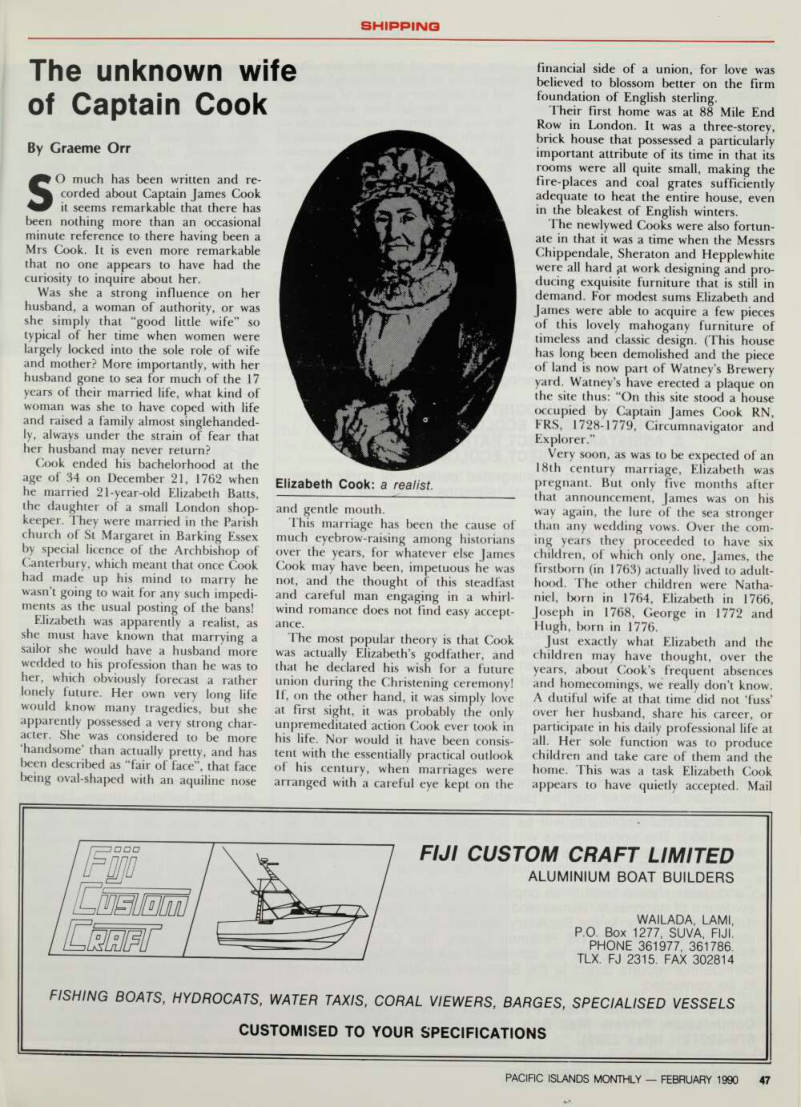
The unknown wife of Captain Cook
By Graeme Orr
SO much has been written and re corded about Captain James Cook it seems remarkable that there has been nothing more than an occasional minute reference to there having been a Mrs Cook. It is even more remarkable that no one appears to have had the curiosity to inquire about her.
Was she a strong influence on her husband, a woman of authority, or was she simply that “good little wife” so typical of her time when women were largely locked into the sole role of wife and mother? More importantly, with her husband gone to sea for much of the 17 years of their married life, what kind of woman was she to have coped with life and raised a family almost singlehanded ly, always under the strain of fear that her husband may never return?
Cook ended his bachelorhood at the age of 34 on December 21, 1762 when he married 21-year-old Elizabeth Batts, the daughter of a small London shop keeper. They were married in the Parish church of St Margaret in Barking Essex by special licence of the Archbishop of Canterbury, which meant that once Cook had made up his mind to marry he wasn’t going to wait for any such impedi ments as the usual posting of the bans!
Elizabeth was apparently a realist, as she must have known that marrying a sailor she would have a husband more wedded to his profession than he was to her, which obviously forecast a rather lonely future. Her own very long life would know many tragedies, but she apparently possessed a very strong char acter. She was considered to be more ‘handsome’ than actually pretty, and has been described as “fair of face”, that face being oval-shaped with an aquiline nose
and gentle mouth.
This marriage has been the cause of much eyebrow-raising among historians over the years, for whatever else James Cook may have been, impetuous he was not, and the thought of this steadfast and careful man engaging in a whirl wind romance does not find easy accept ance.
The most popular theory is that Cook was actually Elizabeth’s godfather, and that he declared his wish for a future union during the Christening ceremony!
If, on the other hand, it was simply love at first sight, it was probably the only unpremeditated action Cook ever took in his life. Nor would it have been consis tent with the essentially practical outlook of his century, when marriages were arranged with a careful eye kept on the
financial side of a union, for love was believed to blossom better on the firm
foundation of English sterling.
Their first home was at 88 Mile End Row in London. It was a three-storey, brick house that possessed a particularly important attribute of its time in that its rooms were all quite small, making the fire-places and coal grates sufficiently adequate to heat the entire house, even in the bleakest of English winters.
The newlywed Cooks were also fortun ate in that it was a time when the Messrs
Chippendale, Sheraton and Hepplewhite
were all hard work designing and pro ducing exquisite furniture that is still in demand. For modest sums Elizabeth and James were able to acquire a few pieces of this lovely mahogany furniture of timeless and classic design. (This house has long been demolished and the piece of land is now part of Watney’s Brewery yard. Watney’s have erected a plaque on the site thus: “On this site stood a house occupied by Captain James Cook RN, fRS, 1728-1779, Circumnavigator and
Explorer.”
Very soon, as was to be expected of an 18th century marriage, Elizabeth was pregnant. But only five months after that announcement, James was on his way again, the lure of the sea stronger than any wedding vows. Over the com ing years they proceeded to have six children, of which only one, James, the firstborn (in 1763) actually lived to adult hood. The other children were Natha niel, born in 1764, Elizabeth in 1766, Joseph in 1768, George in 1772 and Hugh, born in 1776.
Just exactly what Elizabeth and the children may have thought, over the years, about Cook’s frequent absences and homecomings, we really don’t know.
A dutiful wife at that time did not ‘fuss’ over her husband, share his career, or participate in his daily professional life at all. Her sole function was to produce children and take care of them and the home. This was a task Elizabeth Cook appears to have quietly accepted. Mail
Elizabeth Cook: a realist.
End Row was not in a fashionable area, nor were the Cook’s fashionable people.
When at home together they were simp ly an everyday family, a man and his wife and their children.
Cook’s outside companions were generally men of the sea while Eli zabeth’s friends were other homebound, family oriented women. Elizabeth apparently did not relate much to the sea, and matters such as mathematics and astronomy, both so very important to Cook in his surveying and mapping,
were not part of her daily life. She is alleged not to have understood the first and felt the latter to smack of paganism.
In what little has been written about her a line here, a comment there Elizabeth Cook has had the reputation of being a reserved and distant, sometimes even cold, woman. But perhaps that is not so surprising when one considers the consistent tragedies in her life. Their only daughter, also named Elizabeth, died at the age of four years in 1770 (not long after James encounter with
Australian coastline). Joseph, the third son, died in 1768 at the age of one month. George, the fourth son, died in 1772 at the age of four months. (These three infants died while Elizabeth was home alone, with James at sea).
Nathaniel, the second son, died in 1779 at the age of 16. He was lost at sea while on board the Thunderer, a man of-war, about six months after his father’s death. Hugh, the youngest, died in 1793 of scarlet fever at the age of 17, while attending Christ’s College at Cam bridge. James, the firstborn and only child to survive into adulthood died in 1794 at the age of 31. He had been master and commander of the Spitfire , a sloop-of-war, and while the sloop lay off Poole, England, waiting for hands to come aboard, she was driven out to sea in a heavy gale and all on board were drowned. James’ body was found, however, and he was buried in Cam bridge by the side of his brother, Hugh, whose funeral he had attended only six weeks earlier.
Thus the James and Elizabeth Cook line died without having had much of a chance to get started.
It is well known that Captain Cook was killed by natives in the Hawaiian Islands in February 1779 at the age of 51.
However, few are aware that the news of his death, relayed by hand from the Siberian coast, (for his ship went north from the Sandwich Isles before it made for home) did not reach Elizabeth in En gland until January 1780 eleven months later.
But the indomitable Elizabeth lived on alone until 1835 to the age of 93 totally bereft of her once large family. She was 56 years a widow.
Following Cook’s death Elizabeth was given a lifetime pension of 200 pounds a year from King George HI (who was reported to have wept upon hearing of Cook’s death), which was a substantial income at that time. She also apparently received considerable sums for her share of the profits from the sale of books about her husband’s voyages. Upon her death in 1835, she is recorded as having left the large sum of 60,000 pounds, most of which was left to various char ities.
Elizabeth, claiming to have been over whelmed by so many deaths, retired to Clapham, Surrey in 1778 where she lived for 47 years with her sad memor ies. She was said to be a handsome and dignified woman, possessed of her facul ties to the end. She constantly dressed in black satin and wore a ring containing strands of her husband’s hair. This claim has occasionally been disputed, but re ferences to it are frequent. She kept the anniversaries of her personal tragedies as fast days, partaking in quiet medita tion and reading her family Bible. □
Advertisements & other items, pp. 45-46 (1 item)
Fiji Custom Craft Limited
a an mn & a a
ALUMINIUM BOAT BUILDERS
WAILADA, LAMI,
P.O. Box 1277, SUVA, FIJI.
PHONE 361977, 361786.
TLX. FJ 2315. FAX 302814
FISHING BOATS, HYDROCATS, WATER TAXIS, CORAL VIEWERS, BARGES, SPECIALISED VESSELS
CUSTOMISED TO YOUR SPECIFICATIONS
SOUTH PACIFIC COMMISSION
The South Pacific Commission, as implementing agency for a project on the biological control of taro beetles (Papuana spp.) within the EEC Pacific Regional Agricultural Development Programme, is seeking applicants for the following posts located in Solomon Islands.
1. INSECT PATHOLOGIST
2. APPLIED INSECT ECOLOGIST
3. ASSISTANT (INSECT PATHOLOGY)
4. ASSISTANT (INSECT ECOLOGY)
The scientists will develop an integrated package of control measures for taro beetles with special reference to the use of insect pathogens.
Applicants for posts 1 and 2 should have an appropriate university degree, relevant post graduate training and a proven capability to coordinate and administer research programmes. Experience with studies on a broad range of pathogens (post 1) or with applied ecological and pest management studies in tropical environments (post 2) is essential.
Applicants for posts 3 and 4 should be Pacific Island nationals with an appropriate Diploma or University degree and preferably some post-graduate experience with an aspect of insect pathology (post 3) or applied insect ecology and control (post 4).
Depending on qualifications and experience, starting salaries for posts 1 and 2 will be within the ranges CFP 341,983 to 379,783, or 291,195 to 328,995, and for post 3 and 4 CFP 116,217 to 119,457 per month (US$1.00 = CFP 112, January 1990). SPC salaries are not subject to income tax in Solomon Islands (except for SI nationals). An Establishment Grant and allowances such as child and education allowances may be payable.
The successful applicants will be expected to take up duty by 30 June 1990. The appointments will be for a period of two years in the first instance. Because of funding source requirements, only nationals of EEC or ACP countries can be considered.
Candidates should send three copies of their curriculum vitae, plus evidence of nationality, names and addresses of three referees and date of availability, to the Secretary General, South Pacific Commission, Boite Postal No. D5, Noumea Cedex, New Caledonia by 28 February 1990. Applicants are advised to ask their referees to send confidential reports direct to the Secretary General without waiting to be contacted.
Further information: Plant Protection Officer, South Pacific Commission, Private Mail Bag, Suva, Fiji (tel 679-320796, fax 679-322721, telex 2385).
Chasing a place
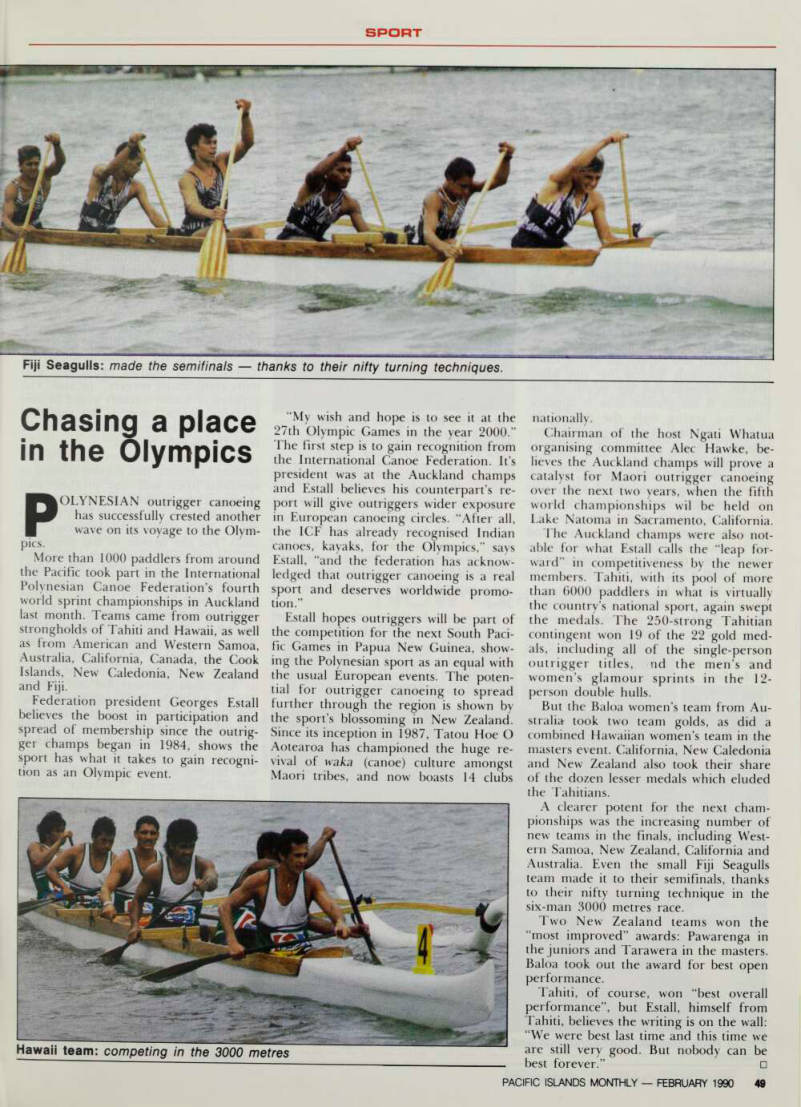
Sport
Chasing a place in the Olympics
POLYNESIAN outrigger canoeing
has successfully crested another wave on its voyage to the Olym pics.
More than 1000 paddlers from around the Pacific took part in the International Polynesian Canoe Federation’s fourth world sprint championships in Auckland last month. Teams came from outrigger strongholds of Tahiti and Hawaii, as well as from American and Western Samoa, Australia, California, Canada, the Cook Islands, New Caledonia, New Zealand
and Fiji.
Federation president Georges Estall believes the boost in participation and spread of membership since the outrig ger champs began in 1984, shows the sport has what it takes to gain recogni tion as an Olympic event.
“My wish and hope is to see it at the 27th Olympic Games in the year 2000.”
The first step is to gain recognition from the International Canoe Federation. It’s president was at the Auckland champs and Estall believes his counterpart’s re port will give outriggers wider exposure in European canoeing circles. “After all, the ICE has already recognised Indian canoes, kayaks, for the Olympics,” says Estall, “and the federation has acknow ledged that outrigger canoeing is a real sport and deserves worldwide promo tion.”
Estall hopes outriggers will be part of the competition for the next South Paci fic Games in Papua New Guinea, show ing the Polynesian sport as an equal with the usual European events. The poten tial for outrigger canoeing to spread further through the region is shown by the sport’s blossoming in New Zealand.
Since its inception in 1987, Tatou Hoe O Aotearoa has championed the huge re vival of waka (canoe) culture amongst Maori tribes, and now boasts 14 clubs
nationally.
Chairman of the host Ngati Whatua organising committee Alec Hawke, be lieves the Auckland champs will prove a
catalyst for Maori outrigger canoeing
over the next two years, when the fifth world championships wil be held on Lake Natoma in Sacramento, California.
The Auckland champs were also not able for what Estall calls the “leap for ward” in competitiveness by the newer members. Tahiti, with its pool of more than 6000 paddlers in what is virtually the country’s national sport, again swept the medals. The 250-strong Tahitian contingent won 19 of the 22 gold med als, including all of the single-person outrigger titles, nd the men’s and women’s glamour sprints in the 12person double hulls.
But the Baloa women’s team from Au stralia took two team golds, as did a combined Hawaiian women’s team in the masters event. California, New Caledonia and New Zealand also took their share of the dozen lesser medals which eluded the Tahitians.
A clearer potent for the next cham pionships was the increasing number of new teams in the finals, including West ern Samoa, New Zealand, California and Australia. Even the small Fiji Seagulls team made it to their semifinals, thanks to their nifty turning technique in the six-man 3000 metres race.
Two New Zealand teams won the “most improved” awards: Pawarenga in the juniors and Tarawera in the masters.
Baloa took out the award for best open performance.
Tahiti, of course, won “best overall performance”, but Estall, himself from Tahiti, believes the writing is on the wall; “We were best last time and this time we are still very good. But nobody can be best forever.” □
Fiji Seagulls: made the semifinals - thanks to their nifty turning techniques.
Hawaii team: competing in the 3000 metres
Robert Simms
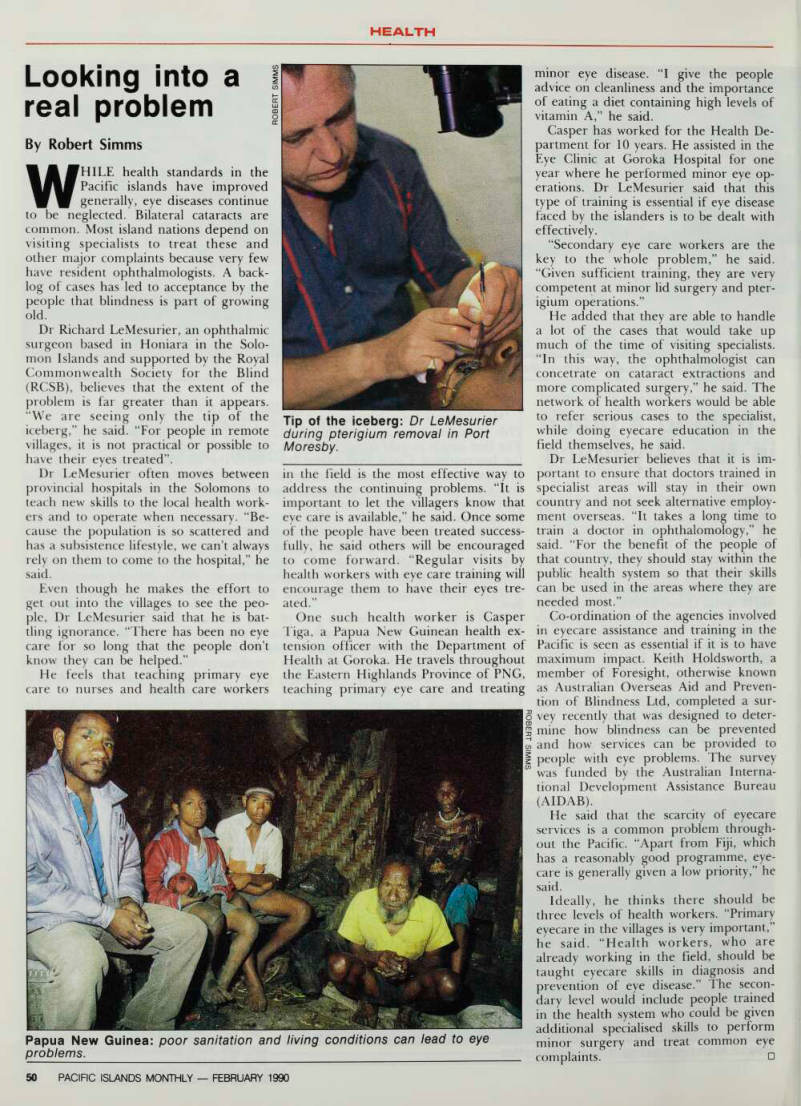
Health
Looking into a real problem
By Robert Simms
WHILE health standards in the Pacific islands have improved generally, eye diseases continue to be neglected. Bilateral cataracts are common. Most island nations depend on visiting specialists to treat these and other major complaints because very few have resident ophthalmologists. A back log of cases has led to acceptance by the people that blindness is part of growing old.
Dr Richard LeMesurier, an ophthalmic surgeon based in Honiara in the Solo mon Islands and supported by the Royal Commonwealth Society for the Blind (RCSB), believes that the extent of the problem is far greater than it appears.
“We are seeing only the tip of the iceberg,” he said. “For people in remote villages, it is not practical or possible to have their eyes treated”.
Dr LeMesurier often moves between provincial hospitals in the Solomons to teach new skills to the local health work ers and to operate when necessary. “Be cause the population is so scattered and has a subsistence lifestyle, we can’t always rely on them to come to the hospital,” he said.
Even though he makes the effort to get out into the villages to see the peo ple, Dr LeMesurier said that he is bat tling ignorance. “There has been no eye care for so long that the people don’t know they can be helped.”
He feels that teaching primary eye care to nurses and health care workers
in the field is the most effective way to address the continuing problems. “It is important to let the villagers know that eye care is available,” he said. Once some of the people have been treated success fully, he said others will be encouraged to come forward. “Regular visits by health workers with eye care training will encourage them to have their eyes tre ated.”
One such health worker is Casper Tiga, a Papua New Guinean health ex tension officer with the Department of Health at Goroka. He travels throughout the Eastern Highlands Province of PNG,
teaching primary eye care and treating
minor eye disease. “I give the people advice on cleanliness and the importance of eating a diet containing high levels of vitamin A,” he said.
Casper has worked for the Health De partment for 10 years. He assisted in the Eye Clinic at Goroka Hospital for one year where he performed minor eye op erations. Dr LeMesurier said that this type of training is essential if eye disease faced by the islanders is to be dealt with
effectively.
“Secondary eye care workers are the key to the whole problem,” he said.
“Given sufficient training, they are very competent at minor lid surgery and pter
igium operations.”
He added that they are able to handle a lot of the cases that would take up much of the time of visiting specialists.
“In this way, the ophthalmologist can concetrate on cataract extractions and more complicated surgery,” he said. The network of health workers would be able to refer serious cases to the specialist, while doing eyecare education in the field themselves, he said.
Dr LeMesurier believes that it is im portant to ensure that doctors trained in specialist areas will stay in their own country and not seek alternative employ ment overseas. “It takes a long time to train a doctor in ophthalomology,” he said. “For the benefit of the people of that country, they should stay within the public health system so that their skills can be used in the areas where they are needed most.”
Co-ordination of the agencies involved in eyecare assistance and training in the Pacific is seen as essential if it is to have maximum impact. Keith Holdsworth, a member of Foresight, otherwise known as Australian Overseas Aid and Preven tion of Blindness Ltd, completed a sur vey recently that was designed to deter mine how blindness can be prevented and how services can be provided to people with eye problems. The survey was funded by the Australian Interna tional Development Assistance Bureau
(Aidab).
He said that the scarcity of eyecare services is a common problem through out the Pacific. “Apart from Fiji, which has a reasonably good programme, eye care is generally given a low priority,” he said.
Ideally, he thinks there should be three levels of health workers. “Primary eyecare in the villages is very important,” he said. “Health workers, who are already working in the field, should be taught eyecare skills in diagnosis and prevention of eye disease.” The secon dary level would include people trained in the health system who could be given additional specialised skills to perform minor surgery and treat common eye complaints. □
Robert Simms
Papua New Guinea: poor sanitation and living conditions can lead to eye problems.
Tip of the iceberg: Dr LeMesurier during pterigium removal in Port Moresby.
Robert Simms
Emory’s
Books
Emory’s memories
Keneti, South Seas Adventures
OF KENNETH EMORY, by Bob Krauss, University of Hawaii Press, 1988, end paper maps, index, 419 pps.
Reviewed by Beatrice Levin FOR South Seas pioneer anthropo logist, Kenneth Emory, his work was his life, his romance and his obsession. No one who has ever been magnetised by the beauty and culture of Pacific Islands could fail to appreciate this book.
Biographies of such dedicated people inspire us and may challenge us to devo tion to a single ideal. In his old age, Emory may have realised he would nev er write his own autobiography. Turn ing to Bob Krauss, a popular journalist in Hawaii and a close friend, Emory said: “I want you to write my
biography.”
Krauss had written a number of books
and was actually seeking another subject.
Having sailed in voyaging canoes to re
trace ancient Polynesian migration
routes, Krauss is familiar with Pacific atolls and islands. The paths of the jour nalist and the anthropologist had crossed earlier, but it was not until Krauss was reporting on Emory at the Kuliouou Shelter Cave in 1956 that they became friends. Krauss responded eagerly to Emory’s request, and the result is a read able, enthusiastic book, full of admira tion of Emory on every page.
Where did the name Keneti come from? Natives who could not pronounce Kenneth, called Emory “Keneti”. Born in New England in 1898, Kenneth Emory moved with his family to Honolulu two years later, and early on became adept with a camera. He attended Punahou and then Dartmouth, graduating in 1920. Hired to be an errand boy for visiting scientists at Bishop Museum, he was soon making maps. Reports of man made ruins on Maui launched an ex pedition to the inhospitable Haleakala volcano, and Kenneth went along to take
photographs.
What was remarkable about Kenneth Emory’s approach to his first scientific expedition was his self-confidence. He had been in the crater as a boy of 15. As Bob Krauss puts it, Kenneth “limbered up an old five-by-seven view camera, smaller than a bread box, but not much . . Emory had an old friend on Maui who proved valuable to the expedition
by providing shelter, horses, pack mules
and cowboys. At the rim of the crater, an enormous pit fifteen square miles with a fiery orange ball over the opposite
rim, the vast field of cinder cones, Em ory was reminded of a herd of red and grey elephants.
Emory seemed born to anthropology and already knew how to measure, de scribe, survey and photograph, but his first field trip made an archaeologist out of him. By the time Kenneth returned to Honolulu, his team had revealed the ex istence of forty-eight stone terraces and platforms, previously unknown, and he had opened a “window to old Polynesia”.
Later he did an archaeological survey of Lanai. He learned to make records when the state-of-the-art was clumsy and inefficient. He assisted Helen Roberts as she gathered data for the classical work, Ancient Hawaiian Music.
Intimate moments in the relationship between Emory and his Tahitian wife are revealed. Until Emory began
teaching, he always had unpaid bills.
Even in March, 1948, when he was in vited to receive an honorary Doctorate of Science at Dartmouth, he could not afford to go.
Emory, meticulous about not leading an informant, knew that islanders were eager to please. If a native got vibes that an anthropologist had a certain opinion,
an islander would be too polite to con tradict him, especially if native were being paid. Emory’s integrity led to some unhappy times with a less honest anthro pologist.
When announcements of a new techni que called carbon dating reached him, he realised that it would be possible to fix an historical date on the artifacts his university students had uncovered in Kuliouou Valley on Oahu. Up to 1950, dirt archaeology on Pacific Islands and atolls was considered wasted effort. Em ory was to disprove this theory with a charcoal sample from the Kuliouou Shel ter Cave which provided the first radio carbon date A.D. 1400 for Polynesia. At last, accurately dating the occupation of the Hawaiian Islands was feasible.
How Emory loved his work is evident in a report: “Each day is so full of in terest and rendered so agreeable by the readiness of everyone to help us that it is too short . , Eventually, Emory, to protect sites in Hawaiian history, battled developers on Hawaii. This is a must-read book for anyone interested in the anthropology of the Pacific Islands. □
Advertisements & other items, p. 49 (1 item)
Hillbook HANDBOOK,
ORDER YOUR HANDY PACIFIC ISLAND PUBLICATIONS
NOW AT AFFORDABLE PRICES!
PACIFIC
ISLANDS
YEAR BOOK
16th. Edition
ONLY
AS4S
Hillbook HANDBOOK,
BUSINESS
& TRAVEL
GUIDE
ONLY
A 514.95
VANUATU
-A-GUIDE
ONLY
A 514.95
THE JOURNAL
OF WILLIAM
LOCKERBY
Sandalwood Trader in the Feejee Islands 1808-1809
ONLY
A 53.50
FIJI
ISLANDS
MAPS
ONLY
ASS.SO
pacih<
ISLANDS
PACIFIC
ISLANDS
MAPS
Please send me
ORDER FROM
copy (ies) FIJI ISLANDS MAP
copy (ies) PACIFIC ISLANDS MAP
I copy (ies) of PACIFIC ISLAND YEAR BOOK copy (ies) of FIJI HANDBOOK, BUSINESS & TRAVEL copy (ies) of THE JOURNAL OF WILLIAM LOCKERBY copy (ies) of VANUATU-A-GUIDE 1 I I enclose herewith my cheque made payable to PACIFIC ISLANDS MONTHLY of $A or debit A$ to my □ Bank Card □ VISA □ Master Card I Card No Exp. Date I I My Name: • Postal Address City Country.
Tel. No Post your cheque or money order to: PACIFIC ISLANDS MONTHLY, PO BOX 1167 SUVA, FIJI.
Two of
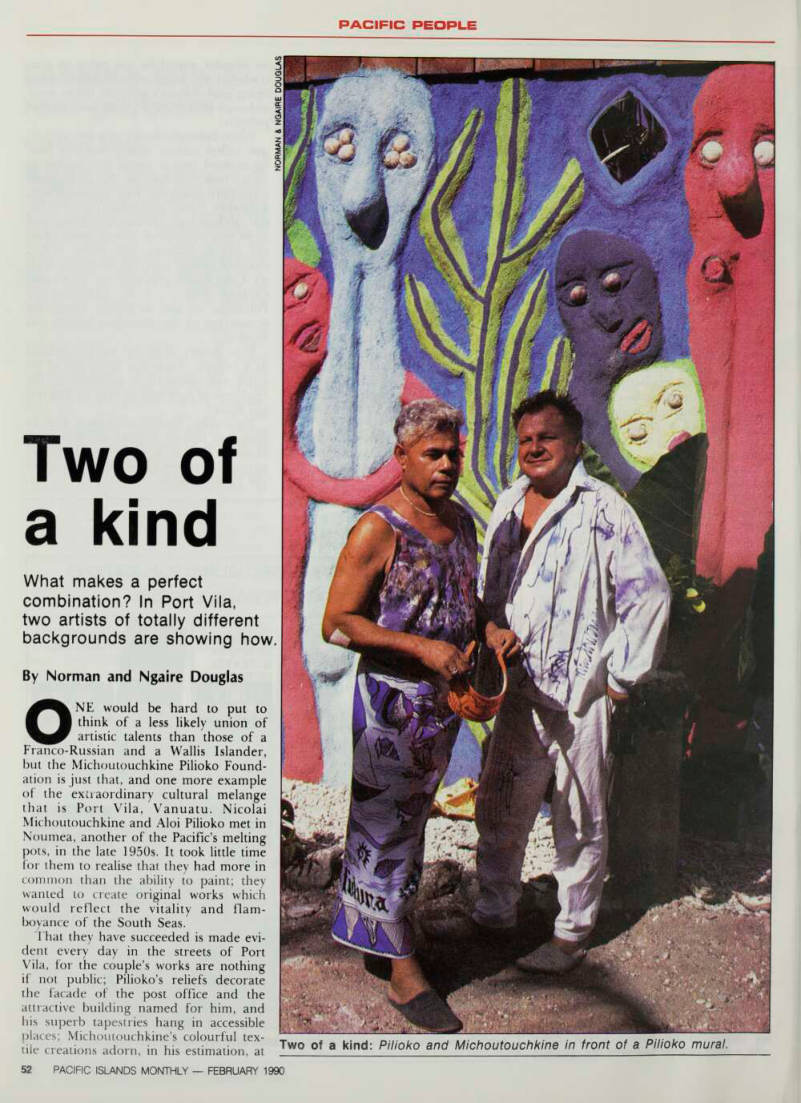
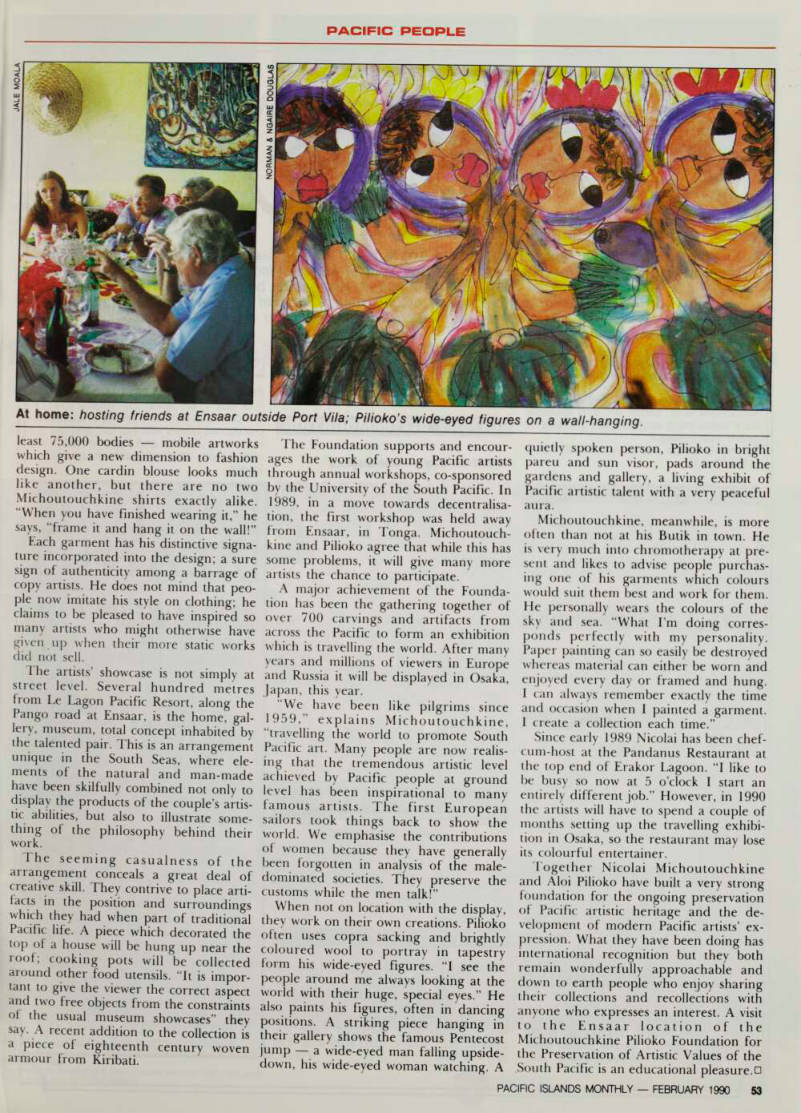
Pacific People
a kind
What makes a perfect combination? In Port Vila, two artists of totally different backgrounds are showing how.
By Norman and Ngaire Douglas
NE would be hard to put to V W think of a less likely union of artistic talents than those of a Franco-Russian and a Wallis Islander, but the Michoutouchkine Pilioko Found ation is just that, and one more example of the extraordinary cultural melange that is Port Vila, Vanuatu. Nicolai Michoutouchkine and Aloi Pilioko met in Noumea, another of the Pacific’s melting pots, in the late 19505. It took little time for them to realise that they had more in common than the ability to paint; they wanted to create original works which would reflect the vitality and flam boyance of the South Seas.
That they have succeeded is made evi dent every day in the streets of Port Vila, for the couple’s works are nothing if not public; Pilioko’s reliefs decorate the facade of the post office and the attractive building named for him, and
his superb tapestries hang in accessible
places; Michoutouchkine’s colourful tex tile creations adorn, in his estimation, at
Norman & Ngaire Douglas
Two of a kind: Pilioko and Michoutouchkine in front of a Pilioko mural.
least 75,000 bodies — mobile artworks which give a new dimension to fashion design. One cardin blouse looks much like another, but there are no two Michoutouchkine shirts exactly alike.
“When you have finished wearing it,” he says, “frame it and hang it on the wall!”
Each garment has his distinctive signa ture incorporated into the design; a sure sign of authenticity among a barrage of copy artists. He does not mind that peo ple now imitate his style on clothing; he claims to be pleased to have inspired so many artists who might otherwise have given up when their more static works did not sell.
The artists’ showcase is not simply at street level. Several hundred metres from Le Lagon Pacific Resort, along the Pango road at Ensaar, is the home, gal lery, museum, total concept inhabited by the talented pair. This is an arrangement unique in the South Seas, where ele ments of the natural and man-made have been skilfully combined not only to display the products of the couple’s artis tic abilities, but also to illustrate some thing of the philosophy behind their work.
The seeming casualness of the arrangement conceals a great deal of creative skill. They contrive to place arti facts in the position and surroundings which they had when part of traditional Pacific life. A piece which decorated the top of a house will be hung up near the roof; cooking pots will be collected around other food utensils. “It is impor tant to give the viewer the correct aspect and two free objects from the constraints of the usual museum showcases” they say. A recent addition to the collection is a piece of eighteenth century woven armour from Kiribati.
The Foundation supports and encour ages the work of young Pacific artists
through annual workshops, co-sponsored
by the University of the South Pacific. In 1989, in a move towards decentralisa tion, the first workshop was held away from Ensaar, in Tonga. Michoutouch kine and Pilioko agree that while this has some problems, it will give many more artists the chance to participate.
A major achievement of the Founda tion has been the gathering together of over 700 carvings and artifacts from across the Pacific to form an exhibition which is travelling the world. After many years and millions of viewers in Europe and Russia it will be displayed in Osaka, Japan, this year.
“We have been like pilgrims since 1959,” explains Michoutouchkine, “travelling the world to promote South Pacific art. Many people are now realis ing that the tremendous artistic level achieved by Pacific people at ground level has been inspirational to many famous artists. The first European sailors took things back to show the world. We emphasise the contributions of women because they have generally been forgotten in analysis of the male dominated societies. They preserve the customs while the men talk!”
When not on location with the display, they work on their own creations. Pilioko often uses copra sacking and brightly coloured wool to portray in tapestry form his wide-eyed figures. “I see the people around me always looking at the world with their huge, special eyes.” He also paints his figures, often in dancing
positions. A striking piece hanging in
their gallery shows the famous Pentecost jump — a wide-eyed man falling upside down, his wide-eyed woman watching. A
quietly spoken person, Piiioko in bright pareu and sun visor, pads around the gardens and gallery, a living exhibit of Pacific artistic talent with a very peaceful aura.
Michoutouchkine, meanwhile, is more often than not at his Butik in town. He is very much into chromotherapy at pre sent and likes to advise people purchas ing one of his garments which colours would suit them best and work for them.
He personally wears the colours of the sky and sea. “What I’m doing corres ponds perfectly with my personality.
Paper painting can so easily be destroyed whereas material can either be worn and enjoyed every day or framed and hung.
I can always remember exactly the time and occasion when I painted a garment.
I create a collection each time.”
Since early 1989 Nicolai has been chef cum-host at the Pandanus Restaurant at the top end of Erakor Lagoon. “I like to be busy so now at 5 o’clock 1 start an entirely different job.” However, in 1990 the artists will have to spend a couple of months setting up the travelling exhibi tion in Osaka, so the restaurant may lose its colourful entertainer.
Together Nicolai Michoutouchkine and Aloi Piiioko have built a very strong foundation for the ongoing preservation of Pacific artistic heritage and the de velopment of modern Pacific artists’ ex pression. What they have been doing has international recognition but they both
remain wonderfully approachable and
down to earth people who enjoy sharing their collections and recollections with anyone who expresses an interest. A visit to the Ensaar location of the Michoutouchkine Piiioko Foundation for the Preservation of Artistic Values of the South Pacific is an educational pleasure.□
Jale Moala
Norman & Nqaire Douglas
At home: hosting friends at Ensaar outside Port Vila; Pilioko’s wide-eyed figures on a wall-hanging.
Advertisements & other items, pp. 52-54 (2 items)
Pacific
AC! FI
ISLANDS
|MO N T
For the benefit of our readers who would like to place a small classified advertisement in our magazine, we’ve introduced from this issue a special Market Place page that we believe will assist you in selling personal items, accommodation, real estate, boating or a service ... in fact anything you would like to sell to our over 50,000 readers. Market Place Advertising Rates are structured to allow you to place as many advertisements as you wish, economically.
POSITION WANTED
Contract Accountant, New Zealand.
Accountant with “hands on" and management experience requires assignments or locum management.
Phone Graham Hawkes (09)377144, 4159454 A.H.
PROMOTION
Banners, school and sporting awards, conference folders and satchels, commercials and promotional products. Merit Press, Master Screen Printers, 3/3 Telopea St., Telopea, N.S.W. 2117. Phone (02) 871 2956
WANTED
Model or toy trains, cars, planes, boats, etc., any condition. Genuine collector (03)818-2191 or Box 356, Hawthorn, 3122.
FAMILY SAFETY
PROTECTALARM
SAVE-A-LIFE. Stop a crisis before it’s a disaster. Mini Pendant Transmitter starts help fast for those at risk alone. Telephone (07) 378-2163, (09) 353-2464. Toll Free (008)074155 Ext. 95. Write P.O. Box 838, Toowong, Old., 4066, Australia.
REAL ESTATE
Real Estate Sunshine Coast, Richardson & Wrench, Alexandra Headland. Ask for John Hey (071) 431888 A/H (071)43- 6656.
COMMERCIAL PRINTING
Top quality four colour printing, brochures, posters, packaging, product labels, fabric labels, billboards, books, magazines, stickers, books. Export quality. Contact Fiji’s most experienced Com-
mercial Printers. FIJI TIMES COMMER- CIAL PRINTING, P.O. Box 1167, Suva. Fiji.
Phone: 314111. Fax. 301521.
HOLIDAY ACCOMMODATION
“Rainbow Bay Coolangatta”
Rainbow Place Apartments on the beach at beautiful Rainbow Bay. 1 & 2 bed units s/c. Large balcony facing north with magnificent coast and sea views. Solar heated pool. Compact tennis. Handy to N.S.W. Clubs. Security basement parking.
Resident Managers. Phone (075) 36 6759 for booking or write for brochure. 180 Marine Parade, Coolangatta. 3223. Australia.
Como Holiday Units (Fully self-contained).
Beachfront location overlooking the splendour of Keppel Bay and the islands. Two minutes from Hotels/Restaurants. Warm Welcome. Phone (079) 391594 or write 32 Anzac Parade, Yeepoon Old. 4703, Australia.
Yamba, NSW. We specialise in all forms of holiday lettings. For friendly and promt attention write or phone for our free Holiday Accommodation booklet.
L.J. HOOKER
j YAMBA 1 1
P.O. Box 113, Yamba, 2464 or phone (066) 46 2202. After Hours: Ross or Jenny Macqueen (066) 462606 or Michael Macqueen (066) 462838.
BOATING
Boating Holidays NZ’s Bay Of Islands, Hauraki Gulf and Fiji. Bare boat, skippered, learn & cruise, flotilla, charter yachts and launches 26’-42’
All available from Rainbow Yacht Charters, P.O. Box 8327, Symonds Street, Auckland, NZ. Phone: (09)3089-419. Fax (09) 790-457.
SELF ADHESIVE LABELS
FORUM LABELS (FIJI) LTD
P.O. Box 1167, Suva., Fiji. Phone: 314111.
We print self-adhesive labels in rolls, multi-coloured labels with hot foil, and die cut to shape, tickets and tags in rolls. We also supply labelling machines and fabric labels.
PACIFIC
SLANDS
I MON T H L Y
MRRK6T PLRCC CRN UJORK
WOND6RS FOR VOU ...
Promote your business, or service, sell your household
items, cars or heavy machinery
etc.
ONLY AUSSI PER WORD.
NO COMPANY LOGO. NO
DISPLAY. NO BOLD TYPE.
Just forward your Advertisement together with payment to: PACIFIC ISLANDS MONTHLY “Market Place”, P.O. Box 1167, Suva, Fiji.
CONDITIONS:
1/ All Advertisements are subject to acceptance and approval of publisher. 2. Advertisements are published as space permits; we cannot guarantee date of insertion. 3. All advertisements must be prepaid and should be typed or printed clearly. 4. Deadline for receipt of advertisements is the 10th of the month prior to issue.
5. PACIFIC ISLANDS MONTHLY
assumes no responsibility for any service other than publishing paid advertisements in this section.
Feel all the excitement of live action at home
Q N 4885 N9073A ST-6350 The comfort of your own home... allthelive NEC is dedicated togiving youTVs,and VCRs There’s only one substitute to capture the action of sports on TV, and the choice to re- that add excitement to the comforts of home. cord your favorite programs for video re- Clever use of electronic technology proplays whenever you want. vides the degree of sophistication that suits all lifestyles. excitement of being there yourself
NEC home electronics.
Feel all the excitement of live action at home r W\ % m \ 4 For further information NEC Home Electronics Australia Pty. Ltd. 244 BeeGroff Road. Eppmg NSW 2121 Australia TEL (02) 868-1811 FAX (02) 869-1112 Ntu corporation (Sumitomo Mrta Building) 37-8 Shiba 5-chom© Mmafoku Tokyo 108 Japan
tEL (03)456-3111 FAX (03)798-6966
e
SEC
Official Sponsors to the 1990 Commonwealth Games.
Winning the 1,000 Lakes and
the RAC trophies is not the only reward
MITSUBISHI
s
ICHEUN
*5 *>
ELIN
m Tyres provided by The RAC Rally of Britain has long been considered one of the prize jewels in the World Rally Championship crown.
It is a particularly difficult course that winds through the moors and farmlands of England and the forests of Wales, In the 1989 RAC Rally, Mitsubishi Motors made motor sports history by becoming the first Japanese maker to capture this prize.
In its first WRC year and only 4 months after its amazing win in the 1,000 Lakes Rally of Finland, the Mitsubishi Galant has established itself as a future force in the European Rally scene.
When the Mitsubishi Galant flew in to win the RAC, it did a lot more than make rallying history—it proved once and for all, the rational behind Mitsubishi’s motor sports philosophy. For Mitsubishi, motor sports, not only in Europe, but all around the world, provide the ideal conditions the stress of competition with the rigours of nature —in which to try out their new technology, test its reliability and prove its superiority. The purpose? To make their passenger cars the safest, easiest and most enjoyable to drive on the road.
The RAC trophy, along with the 1,000 Lakes before it, is symbolic of the long heritage of winning that rides in the Galant and all Mitsubishi vehicles. Vehicles that respond to their drivers’ commands like.. .well, the rally cars they are.
MITSUBISHI QRLRNT
A
MITSUBISHI
MOTORS
AMERICAN SAMOA: MORRIS SCANLAN SERVICE INC. P.O Box 367, Pago Pago, Tel 633-5520/AUSTRALIA: MITSUBISHI MOTORS AUSTRALIA LTD. Box 1284, South Road, Clovelly Park. South Australia 5042, Tel (083 275-7223/FIJI: NIVIS MOTOR & MACHINERY CO., LTD. G P O Box 150, Suva, Tel. 383411/FRENCH POLYNESIA (TAHITI): ETS-BREDIN FRERES ET FILS PO. Box 21. Papeete, Tahiti, Tel 4-202-58/NEW CALEDONIA: SOCIETE D'IMPORTATION D AUTO DU PACIFIQUE SUD S.A. B.P 438 Rond Point du Pacifique, Noumea, Tel. 274144/NEW ZEALAND: MITSUBISHI MOTORS NEW ZEALAND LTD. Todd Park, Heriot Drive, Private Bag, Porirua, Tel 370-109/ NORFOLK ISLAND: BORRYS LTD. P.O Box 169, Norfolk Island, Tel. 2114/PAPUA NEW GUINEA: TOBA PTY. LTD. P.O. Box 503, Port Moresby, Tel. 21-7874/SOLOMON ISLANDS: HARVEST PACIFIC LTD. G.P.O. Box 88, Honiara, Guadalcanal, Tel 30128/TONGA: SITANI MAFI CO., LTD. PO Box 83, Nuku’ALOFA, Tel. 21-044/VANUATU: SOCOMETRA B P 06 Route de Lagon, Port-Vila, Tel. 2314/WESTERN SAMOA: A M. MACDONALD HOLDINGS LTD.
P.O Box 576, Apia, Tel. 22022/SAIPAN/POHNPEI/MAJURO/KOSRAE/TRUK/YAP/BELAU; MICRONESIAN MOTORS, INC. 997 South Manne Drive, Tamuning, Guam 96911, Tel. 646-6827