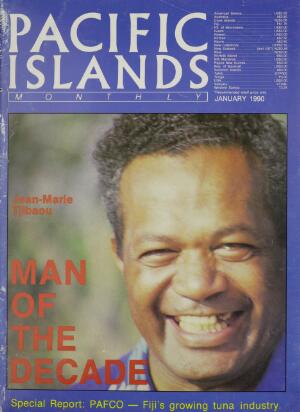
Pacific
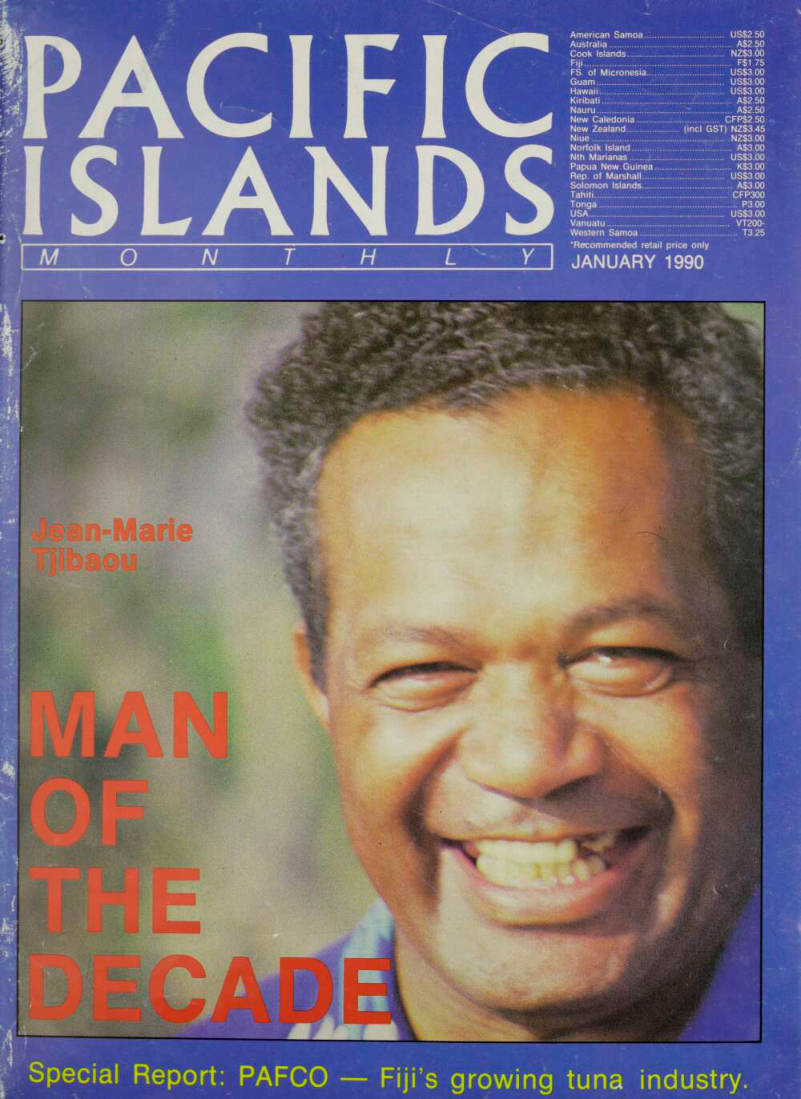
Islands
Monthly
American Samoa US$2.5O Australia A 52.50 Cook Islands NZ$3 00 Fiji F 51.75 FS. of Micronesia US$3.OO Guam ... US$3.OO Hawaii US$3.OO Kiribati * A 52.50 Nauru : A 52.50 New Caledonia CFPS2.SO New Zealand (incl GST) NZ53.45 Niue NZ$3.OO Norfolk Island A 53.00 Nth Marianas J...: US$3.OO Papua New Guinea K 53.00 Rep. of Marshall US$3.OO Solomon Islands A 53.00 Tahiti CFP3OO Tonga P 3.00
Usa Us$3.Oo
Vanuatu VT2OO - Samoa T 3.25 ‘Recommended retail price only
January 1990
i 3 .1 tafc htg I '
Special Report: PAFCO Fiji’s growing tuna industry.
Advertisements & other items, pp. 2-4 (1 item)
The new 3235.
Not just
two of a kind.
A pair of true individuals.
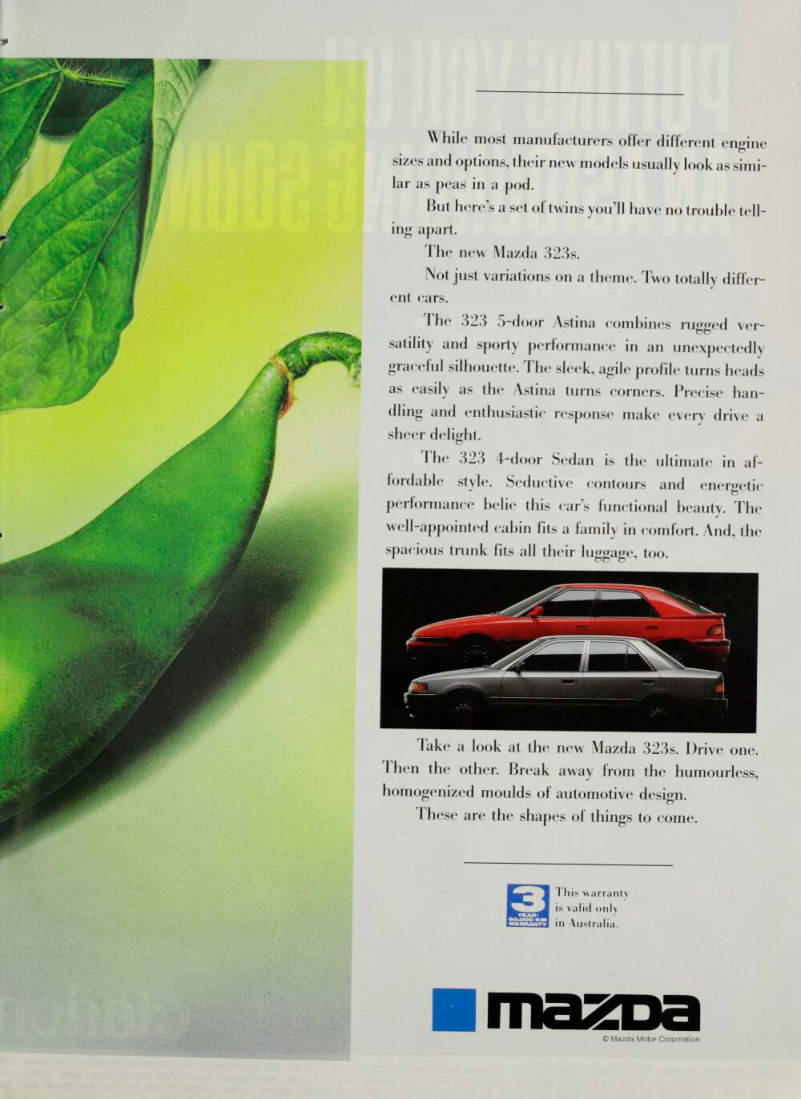
\\ hile most manufacturers offer different engine sizes and options, their new models usually look as simi- But here’s a set ol twins you’ll have no trouble tell-
ing apart.
The new Mazda 3235.
Not just variations on a theme. Two totally different ears.
The 323 5-d oor Astma combines rugged versatility and sporty performance in an unexpectedly graceful silhouette. The sleek, agile profile turns heads as easily as the Astina turns corners. Precise handling and enthusiastic response make every drive a sheer delight.
Fhe 323 4-door Sedan is the ultimate in affordable style. Seductive contours and energetic o performance belie this car’s functional beauty. The well-appointed cabin fits a family in comfort. And, the spacious trunk fits all their luggage, too.
Jake a look at the new Mazda 3235. Drive one. 4 hen the other. Break away from the humourless, homogenized moulds of automotive design.
These are the shapes of things to come. lar as peas in a pod.
This warranty is valid only in Australia.
mazoa
© Mazda Motor Corporation
\ * > X, \ - N . >- .
' ' ‘ W'
CMX23O
STEREO CASSETTE DECK
WITH FM-STEREO/MW TUNER
& CD CHANGER CONTROL
T :V CMX23O the trend-setting in-car sound
player offered by Clarion, that front
runner in the car audio field. Visit new sound frontiers with the
amazing CMX23O,
a masterpiece in human
engineering.
/ w m - / % s m / / / F c 51 a <p r a o / or /// * - J -
clarion
ir further information Australia: AWA Distribution Limited Dept. 112-118 Talavera Road North Ryde NSW 2113 / New Zealand: AWA New Zealand Limited, P.O. Box 50-248, Porirua / Fiji Islands: Brijlas & Co., Ltd., G.P.O. Box 362, Suva Tahiti: HI FI., VAIRAATOA. Avenue Chef Vairaatoa B.P. 1128, Papeete / New Caledonia: Caldis, 8.P.M1, Noumea Cedex / Guam: Micropac Audioi Inc., P.O. Box 3478, Agana, Guam 96910, U.S.A. Tel: 472-8091, Cable Code: HIFI AUDIO AGANA / Vanuatu: The SoundjCentre, P.O. Box 434, Vila / Cook Islands: South Seaif
Pacific
Islands
Monthly
Vol. 60 No. 1
Voice Of The Pacific
January 1990
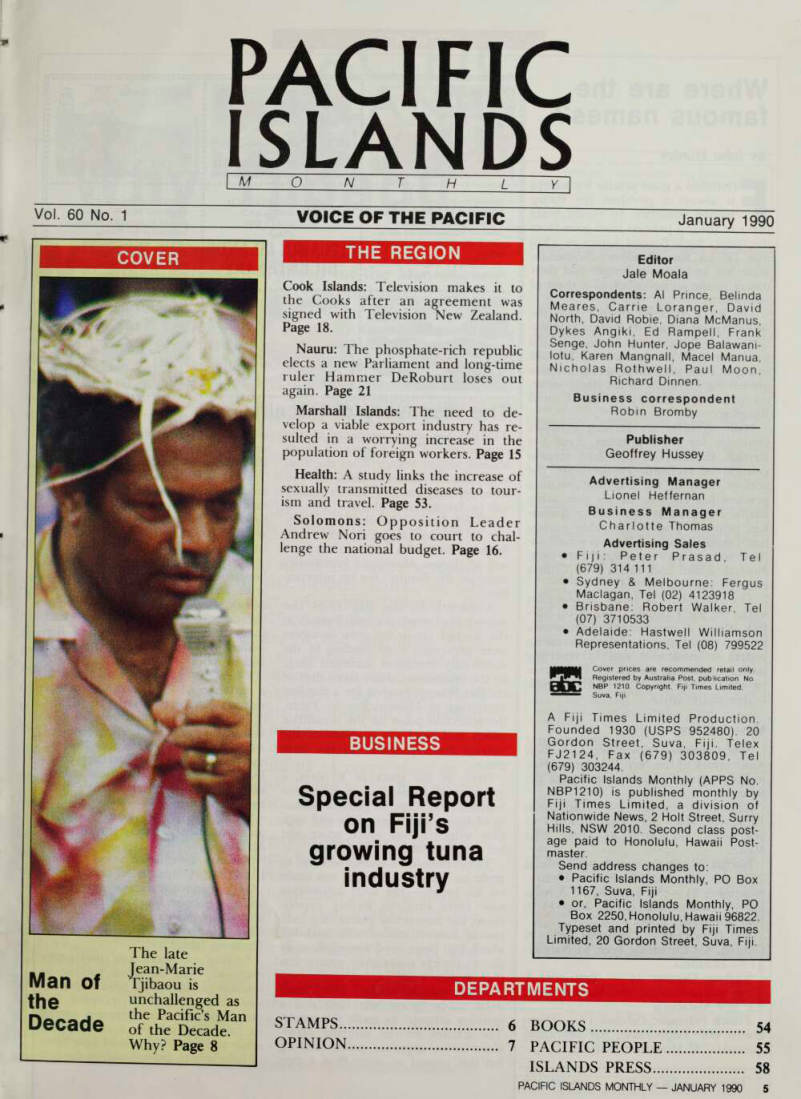
Cover
The late Jean-Marie Man Of Tjibaou is the unchallenged as Pacific’s Man Decade of the Decade.
Why? Page 8
The Region
Cook Islands: Television makes it to the Cooks after an agreement was signed with Television New Zealand.
Page 18.
Nauru: The phosphate-rich republic
elects a new Parliament and long-time ruler Hammer Deßoburt loses out again. Page 21 Marshall Islands: The need to de velop a viable export industry has re sulted in a worrying increase in the population of foreign workers. Page 15 Health: A study links the increase of sexually transmitted diseases to tour ism and travel. Page 53.
Solomons: Opposition Leader Andrew Nori goes to court to chal lenge the national budget. Page 16.
Business
Special Report on Fiji’s growing tuna industry
Editor Jale Moala Correspondents: Al Prince, Belinda Meares, Carrie Loranger, David North, David Robie, Diana McManus, Dykes Angiki, Ed Rampell, Frank Senge, John Hunter, Jope Balawani lotu, Karen Mangnall, Macel Manua, Nicholas Rothwell, Paul Moon, Richard Dinnen.
Business correspondent Robin Bromby
Publisher Geoffrey Hussey
Advertising Manager Lionel Heffernan Business Manager Charlotte Thomas Advertising Sales • Fiji: Peter Prasad, Tel (679) 314 111 • Sydney & Melbourne: Fergus Maclagan, Tel (02) 4123918 • Brisbane: Robert Walker, Tel (07) 3710533 • Adelaide: Hastwell Williamson Representations, Tel (08) 799522
Cover prices are recommended retail only.
Registered by Australia Post, publication No NBP 1210 Copyright. Fiji Times Limited, Suva. Fiji.
Advertisements & other items, p. 5 (2 items)
Departments
STAMPS 6
OPINION 7
BOOKS 54
PACIFIC PEOPLE 55
ISLANDS PRESS 58
5
PACIFIC ISLANDS MONTHLY JANUARY 1990
A Fiji Times Limited Production.
Founded 1930 (USPS 952480). 20 Gordon Street, Suva, Fiji. Telex FJ2124, Fax (679) 303809, Tel (679) 303244.
Pacific Islands Monthly (APPS No.
NBP1210) is published monthly by Fiji Times Limited, a division of Nationwide News, 2 Holt Street, Surry Hills, NSW 2010. Second class post age paid to Honolulu, Hawaii Post master.
Send address changes to: • Pacific Islands Monthly, PO Box 1167, Suva, Fiji • or, Pacific Islands Monthly, PO Box 2250, Honolulu, Hawaii 96822.
Typeset and printed by Fiji Times Limited, 20 Gordon Street, Suva, Fiji.
Where are the famous names?
famous names?
By John Hunter
FINDING a good printer for stamps
is always a problem for stamp issuing countries. In recent years many of the top printers have gone from the scene. Such famous names as Tho mas De La Rue, Bradbury Wilkinson, Waterlow and Sons no longer add their names to the corner block of a sheet of stamps.
The list is reduced further with the voluntary liquidation of Format Interna tional Ltd, the printers involved in the unauthorised production of Tuvalu
Stamps. Thus only three stamp printers
are left for the whole of the stamp secur ity printing industry in the United
Kingdom.
Many agencies are turning to other countries for their printing. Even the British Post Office has had stamps printed in Holland. Furthermore the cost of many of the European security printers has risen so steeply that many Pacific countries are now using Austra lian printers. The most notable Austra lian company now doing very well in deed from orders from Australian Post, Norfolk Island and Papua New Guinea is Leigh-Marden Pty Ltd.
The Australian Domestic Airline pilot strike hit the Philatelic Bureau of Nor folk Island. A very limited flight service to the island meant delays in stamp orders to customers and in receiving stamp supplies on the Island. The tourist industry on the Island also suffered bad ly due to the strike.
New issues New Caledonia: November 4 20th Anniversary of the New Caledonian His torical Society: 74f three founders of the
Society.
Samoa: November 1 Christmas 1989: 18s Mary and Joseph, 50s Two Shepherds, 55s Cattle, $2 Three Wise Men.
Norfolk Island: October 9 Christmas 1989: 30c, 60c, 75c, 80c, Bounty Hymns; November 21 50 Years Radio Austra lia: 41c First announcer, 65c Map, $l.lO Radio Australia Logo.
Fiji: November Christmas 1989: 9c Church, 45c Christmas Tree, $1 Natwity, $1.40 Islanders.
Kiribati: October 16 Transport 8c Telecommunications: 30c Satellite Dish, 75c MV Mataburo French Polynesia; October 12 Micro shells: 60f Triphoridae, 69f Muricidae Farartia, 73f Muricidae Morula.
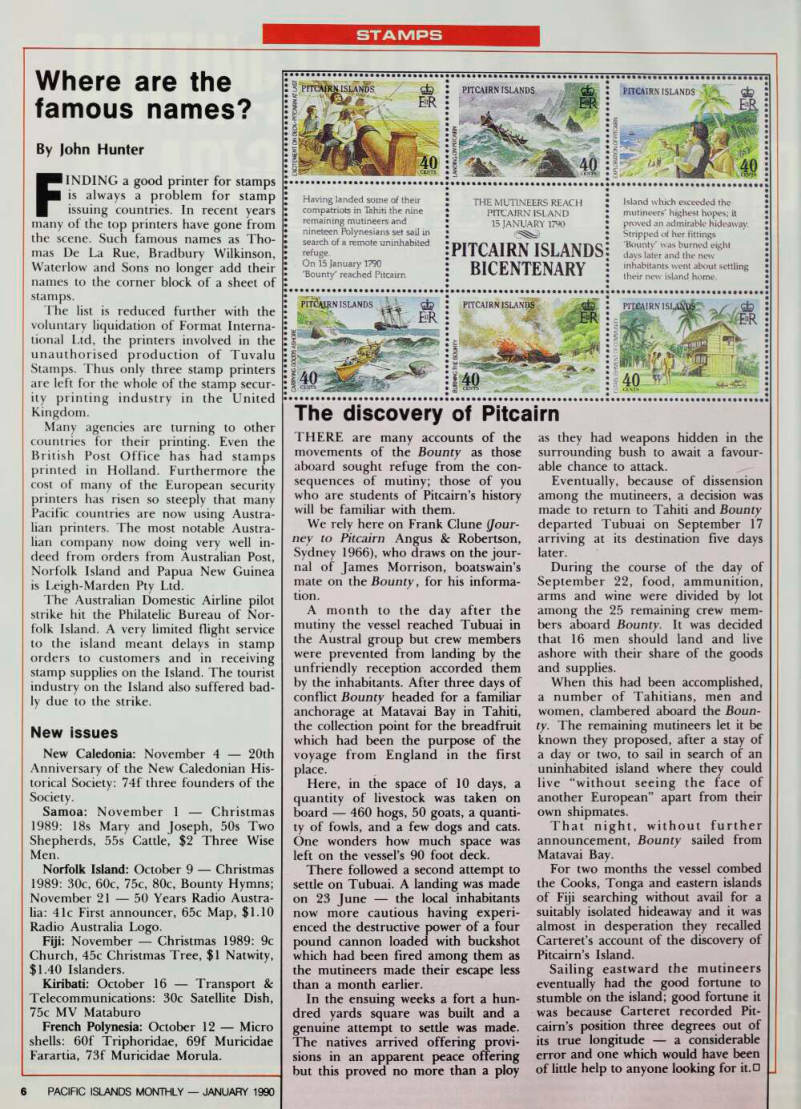
The discovery of Pitcairn
Stamps
THERE are many accounts of the movements of the Bounty as those aboard sought refuge from the con sequences of mutiny; those of you who are students of Pitcairn’s history will be familiar with them.
We rely here on Frank Clune {Jour ney to Pitcairn Angus 8c Robertson, Sydney 1966), who draws on the jour nal of James Morrison, boatswain’s mate on the Bounty, for his informa tion.
A month to the day after the mutiny the vessel reached Tubuai in the Austral group but crew members
were prevented from landing by the
unfriendly reception accorded them
by the inhabitants. After three days of conflict Bounty headed for a familiar anchorage at Matavai Bay in Tahiti, the collection point for the breadfruit which had been the purpose of the voyage from England in the first
place.
Here, in the space of 10 days, a quantity of livestock was taken on board 460 hogs, 50 goats, a quanti ty of fowls, and a few dogs and cats.
One wonders how much space was left on the vessel’s 90 foot deck.
There followed a second attempt to settle on Tubuai. A landing was made on 23 June the local inhabitants now more cautious having experi enced the destructive power of a four pound cannon loaded with buckshot which had been fired among them as the mutineers made their escape less than a month earlier.
In the ensuing weeks a fort a hun dred yards square was built and a genuine attempt to settle was made.
The natives arrived offering provi sions in an apparent peace offering but this proved no more than a ploy
as they had weapons hidden in the surrounding bush to await a favour able chance to attack.
Eventually, because of dissension among the mutineers, a decision was made to return to Tahiti and Bounty departed Tubuai on September 17 arriving at its destination five days later.
During the course of the day of September 22, food, ammunition, arms and wine were divided by lot among the 25 remaining crew mem bers aboard Bounty. It was decided that 16 men should land and live ashore with their share of the goods
and supplies.
When this had been accomplished, a number of Tahitians, men and women, clambered aboard the Boun ty. The remaining mutineers let it be known they proposed, after a stay of a day or two, to sail in search of an uninhabited island where they could live “without seeing the face of another European” apart from their
own shipmates.
That night, without further announcement, Bounty sailed from Matavai Bay.
For two months the vessel combed the Cooks, Tonga and eastern islands of Fiji searching without avail for a suitably isolated hideaway and it was almost in desperation they recalled Carteret’s account of the discovery of Pitcairn’s Island.
Sailing eastward the mutineers eventually had the good fortune to stumble on the island; good fortune it was because Carteret recorded Pit cairn’s position three degrees out of its true longitude a considerable error and one which would have been of little help to anyone looking for it.o
Why Tjibaou
Pacific
Islands
Monthly
Why Tjibaou
WHEN Pacific Islands Monthly asked Helen Fraser to profile Jean-Marie Tjibaou for the Man of the Decade cover story, her reaction was: “You’ve made the right choice. It was not to be the final justi fication to such a choice. But it was another agreement from someone who’s covered the region most of her life. (She now edits Pacific Report, a bi-monthly from Canberra). Fraser is an expert on the intricate politics that envelopes New Caledonia. She interviewed Tjibaou more times than any other overseas journalist, and was the last to interview him before he was assassinated last May. Fraser remembers Tjibaou as “a seductive figure even to those opposed to his ideas”. She said he had a wonderful sense of humour, which, at times, was “de liciously wicked”. These were the attractive qualities that marked Tjibaou’s life and his leadership, even at the most difficult times.
While other names came to mind and were seriously considered for the end of the decade laurel, it was Ijibaou, first a priest and later a freedom fighter, who stood out. He was a poet and liked music, often playing the piano into the early hours of the morning. As a leader he was charismatic, as an ordinary man he was spiritual. His courage was often infectious and someone once described him as “a visionary; no matter how turbulent and violent the events around him, (Tjibaou) seemed an oasis of calm and inspiration.” ma fW people said so many nice things about Ijibaou. There were no allegations of corruption as so common today in Pacific Islands politics. While Tjibaou had his weaknesses, he was not the kind of man you could pm a dirty tag on. He was Mr Clean, a unique freedom tighter whose main weapon was peace and who was l°y a l to the dream of finding Kanaks a better future with a new hope for their children.
The choice of Tjibaou was inevitable. For one decade he spent his life working for a final solution to the plight of his people. That he died because he found it was a tragedy. But the seeds he sowed are growing and his death didn’t change the achievement of the Matig non Accords, the comprehensive peace agreement that mally cost Tjibaou his life. The saddest part is that the ending, for him, was tragic; and that Tjibaou won’t be around for the harvest. n
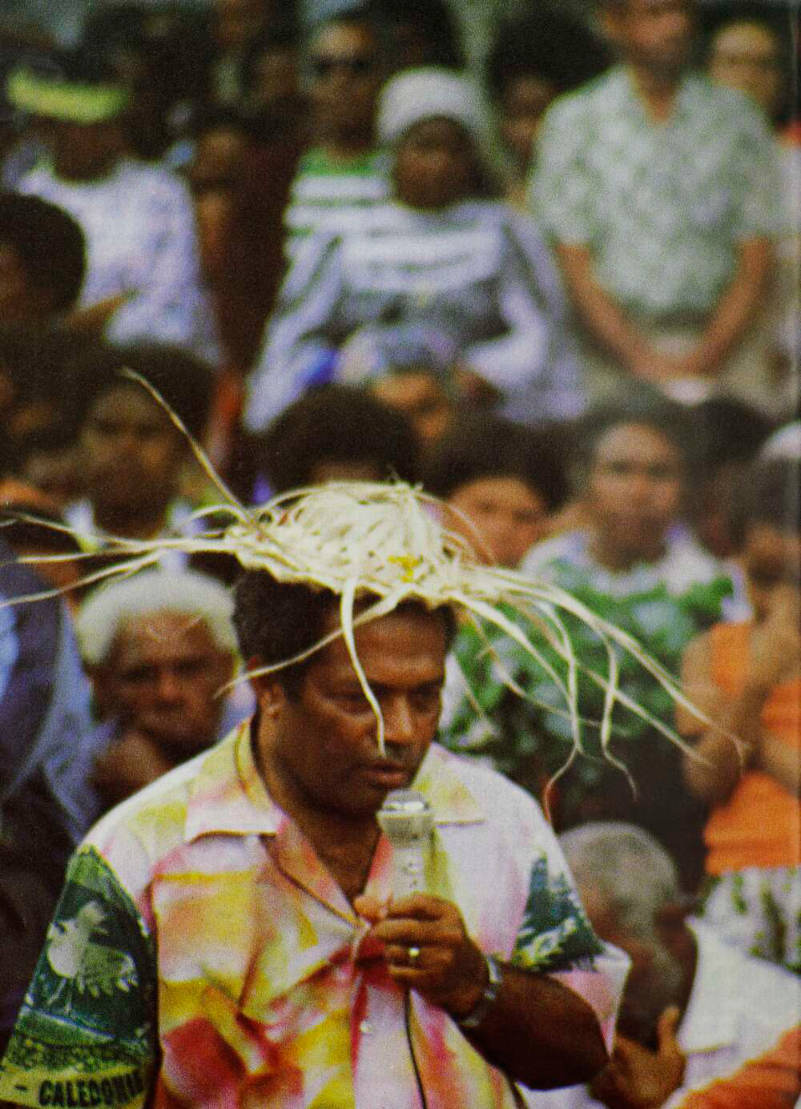
In the beginning: Tjibaou speaks in Noumea on November 24, 1982... before the killing started.
Advertisements & other items, p. 7 (1 item)
FIJI: Distribution, subscriptions and advertising: Fiji
Times Limited, GPO Box 1167, Suva, Fm Phone 31 -4111 telex FJ2124 FRENCH POLYNESIA Distribution: Hachette Pacifique 10 Ave Bruat, Papeete Phone 25-610 HAWAII UNITED STATES: Distribution: PIM Hawaii PO Box 22250. Honolulu, Hawaii, 96822 Advertising: Brian C Asqill Apt 1308, 1676 Ala Moana Blvd Honolulu Hawaii, 96815 Phone (808) 955-9718 JAPAN: Advertising and subscriptions: Universal Media Corporation, GPO Box 46, Tokyo Phone 666-3036 cable UNIMEDIA Tokyo, telex 2524665 MALAYSIA Advertising and subscriptions: Worldwide Media Services, 57-B Komplex Damai, Jin Dato Haji Eusoff, Kuala Lumpur Phone 63-9340, cables WORLDMEDIA Kuala Lumpur, telex 31533 VANUATU: Distribution: The Vanuatu Stationery and Book Centre. PO Box 557 Port Vila Advertising: Nor man Bros Bookshop Port Vila Phone 2232 NEW CALEDONIA: Distribution: Depot Centre de Presse Michel Pentecost CBP2, Noumea Phone 27 2434. 27-4729 NEW ZEALAND: Distribution: Gordon & Gotch, PO Box 584, 2 Carr Road, Mt Roskill, Auckland 4 Advertising: McKay International Media Reps Ltd C/- Albany, PO Box 8, Auckland 10. New Zealand Phone 419-0561, Fax 419-2243 WELLINGTON: Ross Quaid Petone (04) 68-7593, PO Box Media, 1 Scholes Lane, 38699. Petone PAPUA NEW GUINEA: Distribution: Gordon & Gotch PO Box 3395, Port Moresby Phone 25-4551 25-4855 Advertising: Robert Walker, PO Box 600, Indooroopilly Old Australia 4068 Phone (07) 371-0533 SOLOMON ISLANDS: Distribution and Advertising: The Bookshop, (Norman Bros ) PO Box 503, Honiara PHILIPPINES; Advertising: The GF Group, 12 San Ignacio St , Uroaneta Village, Makati, Metro Manila Phone 817-7299, telex 45950 and 4233 UNITED KINGDOM F A Smyth and Associates, 23A Aylmer Parade, London N2OPO, England Phone (01 )340 5088, fax (01)341 9602 UNITED STATES MAINLAND: Advertising: Joshua B Powers Jr , Powers International Inc , Suite 708 271 Madison Ave , New York, NY 10016 Phone 867-9580 Subscriptions PIM, Hawaii, PO Box 22250 Honolulu Hawaii, 96822
SUBSCRIPTIONS
American Samoa ...
Australia Canada Cook Islands Fi]i French Polynesia...
FS. of Marshalls FS. of Micronesia...
Guam Hawaii Japan Kiribati Nauru New Caledonia New Zealand Niue Norfolk Island Northern Marianas..
Papua New Guinea Solomon Islands Tonga Tuvalu United Kingdom US (Mainland) Vanuatu Western Samoa Elsewhere
USS4S
AUSS3O
USS4S
AUSS46
s24
USS4S
USS3S
USS3S
USS4S
USS4S
USS3B
AUSS46
AUSS42
USS32
AUSS42
AUSS46
USS42
USS36
AUSS42
AUSS46
AUSS46
AUSS46
Stg Pound 28
USS4S
AUSS42
AUSSSO
AUSS63
Payments to Pacific Islands Monthly: Subscriptions Dept, GPO Box 1167, Suva, Fiji.
Subscription rates includes the cost of airmail to all destinations set out above.
Telephone: 314 111 Fax: 302 011 Telex: FJ2124
Man of
Cover Story
Man of the Decade
‘We are from here and nowhere else. You are from here but also from somewhere else’
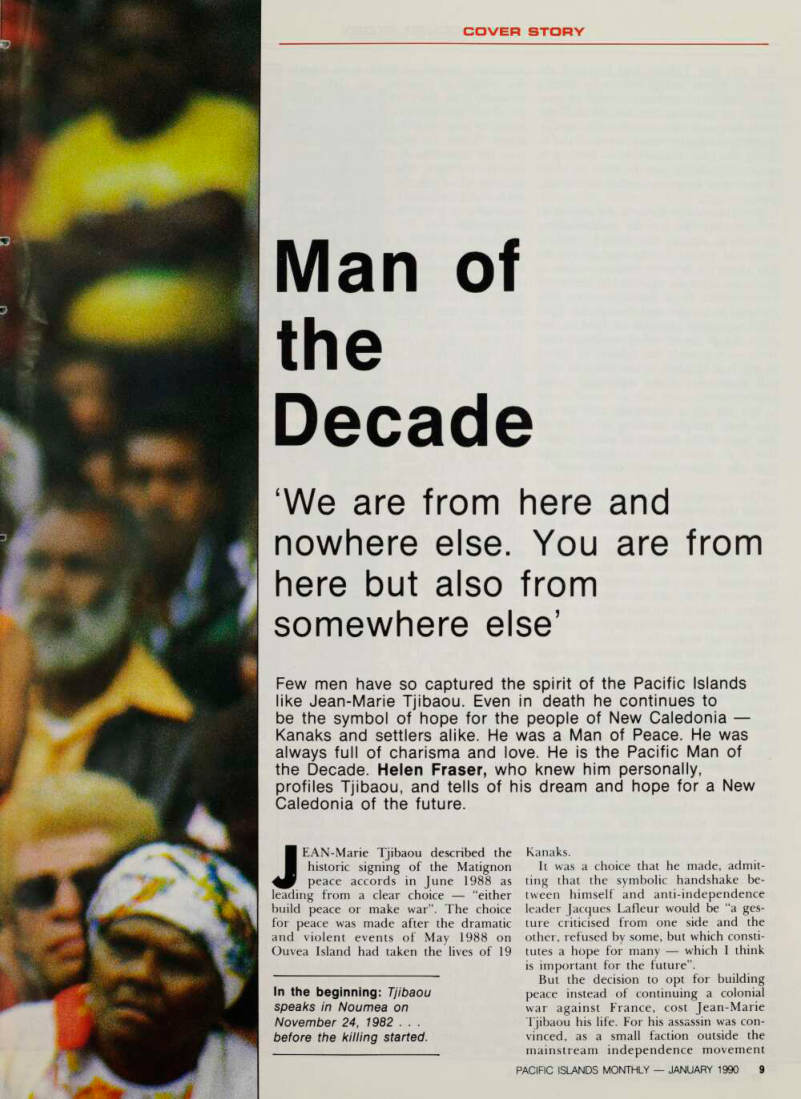
Few men have so captured the spirit of the Pacific Islands like Jean-Marie Tjibaou. Even in death he continues to be the symbol of hope for the people of New Caledonia Kanaks and settlers alike. He was a Man of Peace. He was always full of charisma and love. He is the Pacific Man of the Decade. Helen Fraser, who knew him personally, profiles Tjibaou, and tells of his dream and hope for a New Caledonia of the future.
JEAN-Marie Tjibaou described the
historic signing of the Matignon peace accords in June 1988 as leading from a clear choice “either build peace or make war”. The choice for peace was made after the dramatic and violent events of May 1988 on Ouvea Island had taken the lives of 19
Kanaks.
It was a choice that he made, admit ting that the symbolic handshake be tween himself and anti-independence leader Jacques Lafleur would be “a ges ture criticised from one side and the other, refused by some, but which consti tutes a hope for many which I think is important for the future”.
But the decision to opt for building peace instead of continuing a colonial war against France, cost Jean-Marie Tjibaou his life. For his assassin was con vinced, as a small faction outside the mainstream independence movement
still are, that Tjibaou had betrayed the
goal of Kanak independence by settling
on a plan that involved 10 years of tran sition, of training for Kanaks and de velopment of the economically under privileged largely Kanak areas of the is lands and the countryside leading to an independence vote in 1998 in which Kanaks and longterm settlers would take part.
For Jean-Marie Tjibaou the option of militant strategy for the independence movement against the French Govern ments of recent history was always the last choice, a decision that was made in each case after the rejection by France of compromises from Kanak leaders. The decision to boycott and disrupt the April 1988 territorial elections held on the same day as the French Presidential elec tions was made by Tjibaou as leader in the face of what he described as colo nial repression of the rightwing Chirac Government.
“We are on a battlefield and we are just dead people awaiting our turn to die, because the balance of power is such that if we didn’t have international sup port the colonial power could wipe us out.”
The statute planned for the territory which the elections were to usher in was described by Tjibaou as leading “to the death of the Kanak people”, a statute under which Kanaks would have been left with control of the most under developed, resource-less areas of New Caledonia while the anti-independence settlers would have controlled the weal thy urban area of Noumea and the bet ter farming areas.
The decision to turn to violence was also made after Tjibaou’s Kanak Socialist National Liberation Front (FLNKS) had tried again what they termed the “insti tutional road to independence” only to find by April 1988 that it was a cul de sac. It was an experience that was not new.
Three and a half years before, Tjibaou had led the independence movement into an earlier militant campaign against the French, of boycotting and disrupting territorial elections that would have ushered in a previous autonomy plan, and again one which the Kanak leaders had seen as leading to the domination of the Kanak people in demographic and political terms.
Again, the move to militancy was not lightly made but came after the rejection by the French Government of the inde pendence movement’s suggested mod ifications to the autonomy statute. Two factors particularly licensed Tjibaou as leader of the then Independence Front; firstly that France could, in 1983, for mally recognise “the innate and active right to independence of the Kanak peo ple” and then through the Lemoine
autonomy statute in 1984 deny Kanaks the chance to exercise this right; and secondly that Roch Pidjot, the “grand pere” of the independence movement and the man who had decades earlier asked France to grant autonomy, had seen his amendments to the 1984 auton omy statute flatly rejected by the French Socialist Government. And as in 1988 the move to militancy came after several years of trying the “institutional road to
independence . .
Tjibaou as leader of the independence movement was not only focussed on the French Government of the day, but also on the other communities in New Cale donia the ‘Caldoche’ settlers, the In donesians, the Vietnamese, the French Polynesians and the Wallis Islanders.
Tjibaou sought to persuade those not in the independence camp of the non threatening, indeed of the very necessity of independence for the well-being of the country. This was evident in the de cision to form a coalition Government in June 1982 not only with the Centre Par ty, FNSC, but also with his brother-in law Henry Wetta who was a member of the anti-independence RPCR, in his deci sion to reverse the annual Kanak depic tion of September 24, the anniversary of French colonisation, as a day of mourn ing for Kanaks and instead celebrate a day of Kanak culture in Noumea’s “place des Cocotiers” with all communities in vited to share in it, in his patient ex planations through the 1980 s that inde pendence meant recognition of Kanak sovereignty and once sovereign the wel coming by Kanaks of the other com munities as inhabitants of Kanaky.
In 1983 he told RPCR leader Jacques Lafleur and all New Caledonians in a televised round table discussion: “We say that we are the only people not to be recognised as people of a coun try. You are French nationalist it’s this message that you don’t absorb, that you refuse to absorb, “We are from here and nowhere else.
You are from here but also from some where else.”
Tjibaou from as early on as his party congress of 1982 insisted that Kanaks had to achieve economic independence and take their place in the circuits of New Caledonia’s economy before inde pendence was truly viable. And his vision of the kind of socialism he wanted to see in an independent state of Kanaky was one he described as where you didn’t have people who are very rich living alongside people who are very poor.
In 1985 after months of Kanak mili tancy he had accepted the Fabius/Pisani plan for a transition period to an inde pendence referendum, which, like the Matignon plan three years later, was to
be accompanied by major judicial, econo
mic and social reforms in the aim of
lessening the gaps between Kanaks and non-Kanaks.
With enormous enthusiasm Tjibaou, after electoral successes at the start of the transition period, led the Kanak in dependence movement into what he termed “the green revolution”. He was confident that if Kanaks had the chance to show what they could achieve and how their regional governments could succeed, then that along with the experi ence of Kanaks and non-Kanaks working
together, would win over enough people
for independence to be a reality.
But a change of government in Paris in 1986 brought obstructions to the re forms and the functioning of the Kanak regions, and in any case New Caledonia did not appear ready to welcome non- Kanaks and Kanaks working together on economic development for many set tlers who did embark on projects with Kanaks found themselves the targets of extreme rightwing violence.
Three years later Tjibaou was again offered the chance of choosing this peaceful road to independence, and now, under the Matignon Accord the re forms were to be deeper and more wide spread. It was the same bet, or gamble, he had accepted in 1985 although this time the finishing post was to be 10 years away.
“The first time I was asked at Matig non about the 10-year duration I wept for the people who are in prison, the people who have lost family members.
But to leave through the front door with an anthem and a flag only to come back begging through the back door No!”
The weeks before his death were filled with a whirlwind timetable of consulta tions with French officials, architects, agricultural experts, engineers and de velopment planners as the territory moved towards the start of provincial government. Tjibaou was as excited by his visions of what could be done in the two provinces that would come under Kanak control as he was by the Caldoche small-businessmen who were eager to come and set up their factories and businesses in the Kanak areas.
It was a vision tempered by reality, however: “There are development pro jects moving ahead, but there is always a timelag between our goals which are static and the setting up of the pro cess to achieve results, and this timelag is hard to accept for those who take part in determining the goals but who don’t have any power over the process to achieve them.” Lack of confidence in the French administration was also a hand icap, Tjibaou said. “But whafs terrific is that we’re now underway and it will be up to us to get the results.”
Tjibaou had a personality more suited to “building the peace than making war” for he was a seductive figure even to
those opposed to his ideas: the first qual ity that all use to try and paint his por trait was his wonderful, deliciously wick ed at times, sense of humour. Although this quality was in evidence even during some of the blackest periods of recent Kanak history, it was a humour at its best when the mood was one of
optimism.
His style as leader of the independ ence movement was not confrontational on several occasions when consensus decisions did not go his way, he prefer red to let the matter go for a few days while he quietly worked at reversing the decision. On one very important occa sion, when some sections of the inde pendence movement criticised him after the 1985 death of Eloi Machoro, he withdrew to his home at Hienghene for over a month and left the FLNKS to discover life without Tjibaou as leader. It was a point that was well made, and when he emerged from his “retreat” his control was reinforced.
And when asked what he would do if his support of the Matignon Accords was not accepted by the grassroots of his par ty, he replied that “I will go home to Hienghene to plant yams and (French Prime Minister and fellow peace architect) Rocard he’ll go and plant
cabbages.”
Tjibaou’s leadership was not a sole leadership; with Machoro he shared a partnership that saw the latter develop as the tactical strategist of the independ ence movement while Tjibaou concen trated on diplomacy and negotiations.
And as leader of the FLNKS Tjibaou was particularly close with his deputy, Yeiwene Yeiwene, who offered both sup port and objective criticism at times of major decision making, but above all who gave to the partnership with Tjibaou a buoyant optimism and his own brand of warm friendliness.
Throughout the South Pacific, France and internationally Tjibaou made warm friendships, particularly with the leaders of Vanuatu, Papua New Guinea and the Solomon Islands as well as in French Polynesia. As he put it once, he was very attracted to people whose language was the language of dreaming . . .
His vision for the future of “Kanaky” did not stop at the frontiers of the coun try but was for a neutral, nuclear free South Pacific: “It is very important that the day can come when we can perhaps negotiate a sort of neutrality pact with the super powers.
“It is more important for our develop ment and for regional development to negotiate a neutrality pact with the su perpowers than to amuse ourselves learning to play like big countries in a game made for big countries. We can only be toys in this game.” I=l
tribes had
‘And so the tribes had nothing to do but die...'
By Helen Fraser
FOR Jean-Marie Tjibaou, the for mer Catholic priest who was edu cated in French universities during the late 19605, it was not the ideas and influences of that time which led to his political commitment against colonialism, but rather the harsh conditions into which he was born.
“One is always influenced by the situa tion, it’s more the historical situation than studies that made my engagement, it’s necessary to fight to change the con ditions of the lives of my people,” he told me two years ago in a long interview about his life.
Tjibaou’s tribal village of Tiendanite near Hienghene is small, with only about 120 people. His grandmother was shot dead by the French during the 1917 Kanak uprising against the colonial pre sence, but Tjibaou said he was not influ enced by this so much as “by the stories of people being taken for work, of work ing in road gangs it was a bit like forced labour for the people”.
“The gendarmes regularly took a cer tain number of men each month from the tribe to go and work for the settlers, and there was a guard with a truncheon and a gun to make the people work.”
For Tjibaou these conditions gave him a picture of colonialism at a very early age: "... for my parents and grandpa rents it was the ‘native code’ that banned Kanaks from moving around, required a head tax to be paid by the chief even if there was no money it was organised so that people would be obliged to work for the settlers and then the money went to the administration.
“And so the tribes had nothing to do but die because there was nothing left to eat because there were no people left to work at growing things to eat.
“Anyone who so much as raised their heads was forced to work two, three or four months instead of one. Weeds were coming up through the yam fields, so people organised themselves to do the turns of the other of the pregnant women, of the sick.”
Tjibaou studied sociology at university in Lyons and then Paris where he ex perienced the openness of the university world. “There were narrow minded pro fessors just as there are narrow-minded
professors everywhere, but I had the chance to meet some extraordinary
people.
“One who taught me a lot was Roger Bastide, (he’s dead now) who was a pro fessor of ethnology. He had lived a long time in Brazil and he wrote on the prob lems of acculturation, on the illnesses of society, on the conflicts of culture which are caused by the impact of a dominat ing society on the dominated.”
But not long after returning to New Caledonia where the Catholic Church was both influential and opposed to in dependence, Tjibaou asked to leave the priesthood and return to lay duties it was because of the political situation.
You can’t take up a position for our brothers without questioning the struc ture of the Church and what it does,” he said.
Tjibaou turned to work in the field of youth work, training and development,
as he described it “helping people to find their identity in today’s world which dominates them . . . they need to know the laws, the circuits that regulate the situation where to go, how to get in formation on com merce, credit, the administration, train ing to dominate this world one must know about it and learn about it.”
His work in the area of Kanak cul ture is well-known, in particular the spec tacular success of the Melanesia 2000 fes tival held in Noumea in 1977. It was a time when his repu tation as a poet was also well established poems that, like his political speeches later, reflected his harmony with the world around him, of the sea, rocks, pine trees, mountains and rivers. He saw one of the main problems of the Cal doche settlers of New Caledonia as their
being “an impover
ished people, a peo ple without a culture they reject Kanaks
just as they reject the (metropolitan) French.”
He entered politics as part of the “push” of 1977 following the Union Caledonienne Bourail congress, along with Eloi Machoro, Pierre Declereq, Yeiwene Yeiwene and Francois Burck.
The latter, now Tjibaou’s successor as President of Union Caledonienne, is the only survivor of that group. Declereq was assassinated at his Noumea home in 1981, Machoro was gunned down by French para military marksmen in 1985 and Yeiwene was assassinated along with Tjibaou last May.
As the FUNKS felt forced to adopt a militant strategy in late 1984 to try to force France to negotiate a path towards independence the personal toll on Tjibaou grew heavy. Just a short time after meeting to accept an end to the roadblocks that were crippling the Terri tory by December 1984, 10 militants
from Tiendanite were killed in an ambush by mixed-race settlers. Two of Tjibaou’s brothers were among the dead.
The fathers, brothers and sons of the tiny tribe were decimated. Tjibaou was also prevented from attending the mass funeral because there were fears for his life as the killers later acquitted by a non-Kanak jury on the grounds of legiti mate defence were still at large.
Talking about the enormous personal sacrifice involved in leading the inde pendence movement, Tjibaou said it was something that was experienced every day in practical terms.
But it’s not only my wife, it’s the wives of my brothers, of the people who are dead, of those whose homes are burnt. It’s not a new situation.
“After the 1917 uprising our people didn’t count the dead. The village was again burnt to the ground. There was no-one left. The women were sent out to work for the settlers and the men were sent to prison in Noumea. The land was taken away from us.
“We live through something that has always been our lot.”
In 1983 Tjibaou made his first visit to Algeria, the former French colony which had won a hard and bitter war of inde pendence against France 20 years ear lier. He said his first trip to Algeria had an enormous effect on him: What affected me the most was to see the places where all the people were kil led, but also to see the strength of the Algerian people against the whites . . .”
For Tjibaou and his wife Marie- Claude, parents to four boys and an adopted daughter, their home at Hien ghene was the retreat away from the more pressing demands of leadership of a political struggle. Talking about his priorities for relaxation, Tjibaou said
they were;
“Fishing ... I really like diving for fish, because 1 feel at peace, or when I work in the fields . . .
“and I look after the ducks and the pigeons. Feeding the pigeons is very re
laxing.”
A fine singer, he admitted to playing the piano into the small hours of the morning “more for dreaming like when one looks at the sea . . . it’s my little pleasure!” □
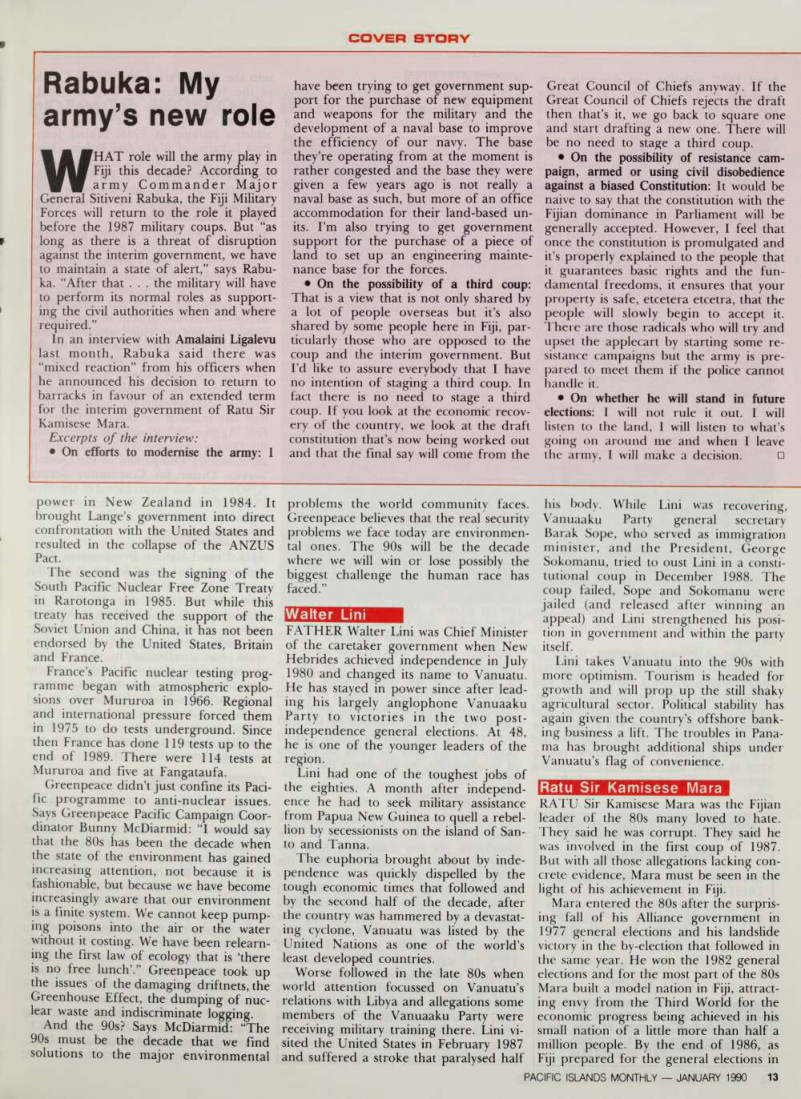
Tjibaou’s funeral: "We can only be toys in this game."
top ten
The Decade’s top ten
By Jale Moala
WHAT a decade the eighties was.
The much vaunted image of the South Seas paradise was forever changed by the rebellions and military coups which turned the region into a hotbed of ethnic violence. It saw the emergence of Vanuatu as an inde pendent nation and welcomed the dis mantling of the United States Trust Ter ritories in Micronesia which resulted in the formation of the Republic of the Marshall Islands and the Federated States of Micronesia. It was the decade of poverty in the smaller states and diving inflation in Fiji.
France continued nuclear testing in French Polynesia. In New Zealand, David Lange led Labour to a landslide victory in 1984 and took the country through controversial economic reforms that finally led to his downfall five years later.
In Fiji, a Labour Coalition government came into power in 1987 only to be un seated by the region’s first military coup a month later.
There was so much happening. Cyc lones swept through Fiji, Vanuatu, Solo mon Islands and Tonga, killed many people and caused millions of dollars in damage to roads, bridges and buildings.
But life went on despite the killer disease AIDS, the Greenhouse Effect and the hole in space. Pacific Islands Monthly moved to Suva. Fiji recovered from the coup, Father Walter Lini hung on in Vanuatu and Francis Ona stayed in the
jungles of Bougainville.
For the record, Pacific Islands Monthly picked the Decade’s Top Ten, a list of the 10 most influential people or orga nisations that shaped the 80s:
Greenpeace:
SINCE its formation in 1971, Green peace has worked for an end to nuclear weapons testing. The beginning of its eighties campaign in the Pacific was highlighted by its third trip to Mururoa where it staged another protest and
gained worldwide opinion against French
nuclear testing there.
This incessant campaign by Green peace against nuclear testing and the presence of nuclear-powered and nuc lear-armed ships in the region led to two key policies that challenged superpower military presence in the Pacific. The first was the anti-nuclear policies which cata pulted David’s Lange’s Labour Party to
power in New Zealand in 1984. It brought Lange’s government into direct confrontation with the United States and resulted in the collapse of the ANZUS Pact.
The second was the signing of the South Pacific Nuclear Free Zone Treaty in Rarotonga in 1985. But while this treaty has received the support of the Soviet Union and China, it has not been endorsed by the United States, Britain and France.
France’s Pacific nuclear testing prog
ramme began with atmospheric explo
sions over Mururoa in 1966. Regional and international pressure forced them in 1975 to do tests underground. Since then France has done 119 tests up to the end of 1989. There were 114 tests at Mururoa and five at Fangataufa.
Greenpeace didn’t just confine its Paci fic programme to anti-nuclear issues.
Says Greenpeace Pacific Campaign Coor
dinator Bunny McDiarmid: “I would say that the 80s has been the decade when the state of the environment has gained increasing attention, not because it is fashionable, but because we have become increasingly aware that our environment is a finite system. We cannot keep pump ing poisons into the air or the water without it costing. We have been relearn ing the first law of ecology that is ‘there is no free lunch’.” Greenpeace took up the issues of the damaging driftnets, the Greenhouse Effect, the dumping of nuc lear waste and indiscriminate logging.
And the 90s? Says McDiarmid: “The 90s must be the decade that we find solutions to the major environmental
problems the world community faces.
Greenpeace believes that the real security problems we face today are environmen tal ones. The 90s will be the decade where we will win or lose possibly the biggest challenge the human race has faced.”
[Walter Uni
FATHER Walter Lini was Chief Minister of the caretaker government when New Hebrides achieved independence in July 1980 and changed its name to Vanuatu.
He has stayed in power since after lead
ing his largely anglophone Vanuaaku
Party to victories in the two post independence general elections. At 48, he is one of the younger leaders of the
region.
Lini had one of the toughest jobs of the eighties. A month after independ ence he had to seek military assistance from Papua New Guinea to quell a rebel lion by secessionists on the island of San to and Tanna.
The euphoria brought about by inde pendence was quickly dispelled by the tough economic times that followed and by the second half of the decade, after the country was hammered by a devastat ing cyclone, Vanuatu was listed by the United Nations as one of the world’s least developed countries.
Worse followed in the late 80s when world attention focussed on Vanuatu’s relations with Libya and allegations some members of the Vanuaaku Party were
receiving military training there. Lini vi
sited the United States in February 1987 and suffered a stroke that paralysed half
his body. While Lini was recovering, Vanuaaku Party general secretary Barak Sope, who served as immigration minister, and the President, George Sokomanu, tried to oust Lini in a consti tutional coup in December 1988. The coup failed, Sope and Sokomanu were jailed (and released after winning an appeal) and Lini strengthened his posi tion in government and within the party itself.
Lini takes Vanuatu into the 90s with more optimism. Tourism is headed for growth and will prop up the still shaky agricultural sector. Political stability has again given the country’s offshore bank ing business a lift. The troubles in Pana ma has brought additional ships under Vanuatu’s flag of convenience.
Ratu Sir Kamisese Mara
RATU Sir Kamisese Mara was the Fijian leader of the 80s many loved to hate.
They said he was corrupt. They said he was involved in the first coup of 1987.
But with all those allegations lacking con crete evidence, Mara must be seen in the light of his achievement in Fiji.
Mara entered the 80s after the surpris ing fall of his Alliance government in 1977 general elections and his landslide victory in the by-election that followed in the same year. He won the 1982 general elections and for the most part of the 80s Mara built a model nation in Fiji, attract ing envy from the Third World for the economic progress being achieved in his small nation of a little more than half a million people. By the end of 1986, as Fiji prepared for the general elections in
April 1987, inflation was down to a re cord low of 1.8 per cent. The economy was at its best.
Mara lost the government in 1987 to a Coalition led by Dr Timoci Bavadra. The Coalition was ousted by a military coup a month later and Mara was later approached to form an interim govern ment in December 1987.
Although his image took a plunge af ter the coup when he joined the military Council of Ministers, Mara bounced back after that and executed a remarkable re covery programme in Fiji that lifted the economy from the brink of disaster into the lap of unprecendented growth. Infla tion was highest in 1988 when it hit 11.9 per cent during the times of economic readjustment. It was down to 6.1 per cent in 1989, and dropping. Economic growth was estimated at 12.5 per cent. A sign of Mara’s bold economic policies and optimism was the slashing of income taxes by 20 per cent in the 1990 national budget.
Philip Muller
THE 51-year-old Philip Muller is direc tor of the Forum Fisheries Agency. For 10 years the Agency became the protec tor of fishing rights in the region. Mul ler, who was appointed its director in 1981, was the engineer who kept it work ing. The most notable achievement of the agency under Muller was the signing of the tuna treaty with the United States in 1987, enabling the island states to draw benefits from the presence of Un ited States purse seiners in their fisheries.
Muller, a Western Samoan, is one of the more popular heads of regional organisations. He is a hard worker and his efforts to stop the use of the con troversial driftnets by Japanese and Taiwanese fishing fleets has enabled the issue to gain international attention. He is a strong critic of the Japanese reluct ance to enter into a multilateral fishing agreement with governments of the re
gion.
ISitiveni Rabuka
AT 10am May 14, 1987 ten soldiers stormed Parliament in Fiji and arrested the month-old Coalition government of Dr Timoci Bavadra. The man who stood from the public gallery to take over was Lieutenant-Colonel Sitiveni Rabuka, Chief of Operations and third-ranking officer in the Fiji Royal Military Forces.
It was the first military coup in the Paci fic Islands and introduced into the re gion a new sense of political awareness.
Rabuka is now major general and in command of a bigger Fiji army. His coup not only ousted Fiji’s second Prime Minister since independence, it also brought the country to its knees with the economy in danger of collapse and the
political situation quickly overheating.
Bavadra died last November from cancer and his wife Adi Kuini Vuikaba was in stalled in December as leader of the In dian-dominated Coalition between the National Federation Party and Labour.
While Fiji has solved its economic crisis the problem of a new constitution re mains unsolved. Last Christmas the Pres ident, Ratu Sir Penaia Ganilau, announced a new constitution would be ready this year.
Francis Ona
FRANCIS Ona began his guerilla war against Bougainville Copper Limited and the government of Papua New Guinea in November 1988. Since then the country is writing its history in blood with casual ties on all sides. His bloody rebellion has closed down one of the world’s biggest copper mines and his country’s biggest employer. On the international scene the rebellion has caused the price of copper to “dance”, as one commentator put it.
In a nutshell, Ona has brought to a stop 14 years of post-independence growth in Papua New Guinea. Whether he will find victory or not is another matter. What matters is that while he rules the jungles of Bougainville, he influences the future of his country.
Alain Lazare
NO athlete has been as prominent in the Pacific Islands as Alain Lazare, of New Caledonia. He has dominated long dis tance and middle distance races since the 1979 South Pacific Games in Suva. He won 23 gold medals and one silver in three South Pacific Games and two Mini Games from 1979 to 1989, having lost only once when he was beaten by Fiji’s Ilimo Daku in the 800 metres in Suva in 1979. He was hurt in 1985 and did not compete in the Rarotonga Mini Games.
He was the athlete of the 80s, always blowing like the wind, always winning. In 1987 he was hospitalised for two days after winning the last of his six gold medals at the South Pacific Games in Noumea. The same year he was selected
into the French team and finished 19th at the World Marathon Cup in Seoul, helping France finish third overall. He, however, was placed 71st in the world athletics ranking in 1988, behind Jean- Paul Lakafia, of Wallis and Futuna, who was ranked 65th. But his efforts in Seoul was the best finish by a Pacific Islands athlete in any world athletics event.
Aggie Grey
AGGIE Grey was a Swann girl. Her father was an English migrant chemist who married a pretty Samoan girl and settled in Apia. Aggie, as she is common ly known, grew to become a Pacific Is lands personality. The 80s marked her death and the growth of the family owned Aggie Grey Hotel which she built on the Apia waterfront into one of the best places to stay in the Pacific. With the help of her son Allan, Aggie’s Hotel opened its latest extension last year. It continues to provide the unique service that has made it so different from the rest. Aggie was honoured in 1983 when the Queen approved her appointment as an Honorary Companion of the Queen’s Service Order for Community Service (QSO). She was unquestionably the First Lady of the South Pacific and a legend in her lifetime.
[Undp
THE United Nations Development Prog ramme was just doing its job in the 80s and it was making people’s lives a little bit better each day. So unlike the regular donors to the region looking for political influence, the UNDP gave with out wanting anything back in return. Its work was unaffected by the political
changes taking place and its development
programme infiltrated the most remote outposts of the Pacific Islands. It was not always involved in massive multi-million dollar projects. But it was always there, building water tanks in Tuvalu or ice
making plants somewhere else.
(Albert Wendt
A MOVIE based on Albert Wendt’s novel, Flying Fox In A Freedom Tree, premiered at the Hawaii International Film Festival last month. In 1980 he re leased another novel, Leaves Of The Ba nyan Tree. Before that a movie was re leased based on his novel, Sons Of The Return Home. Wendt is currently work ing on four novels to be published soon.
The 50-year-old Samoan leads the way in a blooming literary scene in the Pacific Islands. Others have emerged like Epeli Hauofa with Kisses In The Nederends.
Cook Islander Alistair Te Ariki Campbell recently released his first novel, The Fri gate Bird, and Fiji’s Subramani put out another, The Fantasy Eaters, in 1988.
Wendt is an English professor at Auck land University. □
Rabuka: My
a rmy's new role
WHAT role will the army play in Fiji this decade? According to army Commander Major General Sitiveni Rabuka, the Fiji Military Forces will return to the role it played before the 1987 military coups. But “as long as there is a threat of disruption against the interim government, we have to maintain a state of alert,” says Rabu ka. “After that . . . the military will have to perform its normal roles as support ing the civil authorities when and where required.”
In an interview with Amalaini Ligalevu last month, Rabuka said there was “mixed reaction” from his officers when he announced his decision to return to barracks in favour of an extended term for the interim government of Ratu Sir Kamisese Mara.
Excerpts of the interview: • On efforts to modernise the army: I
have been trying to get government sup port for the purchase of new equipment and weapons for the military and the development of a naval base to improve the efficiency of our navy. The base they’re operating from at the moment is rather congested and the base they were given a few years ago is not really a naval base as such, but more of an office accommodation for their land-based un its. I’m also trying to get government support for the purchase of a piece of land to set up an engineering mainte nance base for the forces. • On the possibility of a third coup: That is a view that is not only shared by a lot of people overseas but it’s also shared by some people here in Fiji, par ticularly those who are opposed to the coup and the interim government. But I’d like to assure everybody that I have no intention of staging a third coup. In fact there is no need to stage a third coup. If you look at the economic recov ery of the country, we look at the draft constitution that’s now being worked out and that the final say will come from the
Great Council of Chiefs anyway. If the Great Council of Chiefs rejects the draft then that’s it, we go back to square one and start drafting a new one. There will be no need to stage a third coup. • On the possibility of resistance cam paign, armed or using civil disobedience against a biased Constitution: It would be naive to say that the constitution with the Fijian dominance in Parliament will be generally accepted. However, I feel that once the constitution is promulgated and it’s properly explained to the people that it guarantees basic rights and the fun damental freedoms, it ensures that your property is safe, etcetera etcetra, that the people will slowly begin to accept it.
There are those radicals who will try and upset the applecart by starting some re sistance campaigns but the army is pre pared to meet them if the police cannot handle it. • On whether he will stand in future elections: I will not rule it out. I will listen to the land, I will listen to what’s going on around me and when I leave the army, I will make a decision. □
Advertisements & other items, pp. 13-14 (2 items)
Cover Storv
Used Generating Plant
FOR SALE
TWO 1875 KVA 600 RPM NIIGATA
DIESELS WITH TOSHIBA 3.3 KV
50HZ BRUSHLESS GENERATORS
COMPLETE WITH AUXILIARY
PLANT, ELECTRICS AND STEEL
FRAME BUILDING.
FOR DETAILS CONTACT:-
ANDY YOUNG
MERZ AUSTRALIA P/L
55 LAVENDAR ST
MILSONS PT NSW AUST
TEL: 61-2-9222666
FAX: 61-2-9571474
AUSTRALIA
Foreign workers now worry Marianas
The Region
Northern Marianas
By David North
SOME experts say that there are more foreign workers than perma nent residents in the Northern Marianas a situation which has led to long-term troubles in other parts of the world, such as Fiji and the Caribbean.
Meanwhile, the other two United States flag territories, Guam and Amer ican Samoa, have approached a similar challenge in different ways.
Government and business leaders in the Commonwealth of the Northern Mariana Islands (CNMI) say that the workers are needed to staff a booming economy, and that theirs is a temporary presence. At the moment CNMI has control over its own immigration policy, but the Mainland Congress could take over by unilaterally passing a law to that effect. And, unlike Guam and American Samoa, CNMI has no voice in the Con gress.
The CNMI immigration situation is not unique. Take a fortunately-located island, provide it with more jobs than people willing to take the jobs at the wages offered and the employers’ im mediate answer is give me foreign workers, preferably ones who are willing to work long and hard for low wages.
And, frankly, preferably workers who lack the legal rights of the indigenous
population.
The Carib Indians and the 16th Cen tury European plantation owners were the first islanders to face this situation.
The plantation owners could not per suade the Indians to work the sugar cane, so they brought in slaves instead.
The Caribs are now only a memory on islands like Barbados, Jamaica and Haiti, where the descendants of those slaves are now the majority population.
More recently was the situation in Fiji.
The sugar planters could not get
what they regarded as an adequate
workforce from the islands, so they brought in short-term Indian indentured workers; the latter stayed, multiplied, se cured economic power and sought poli tical power as well. A somewhat compa rable scenario has played out in New Caledonia.
Further, in the Caribbean, Fiji, and New Caledonia, later-day colonial rulers decided that all residents, not just the original ones should have the vote.
Mainland governments do not routinely deny the vote to immigrants, and cer tainly not to the children of immigrants.
CNMI, in contrast, makes it extremely difficult for its temporary workers to be come either permanent legal residents or
citizens.
This is the long-term historical pattern which faces CNMI, and its off-shore in vestors, but one which was discussed only in passing in the recent CNMI elec tions.
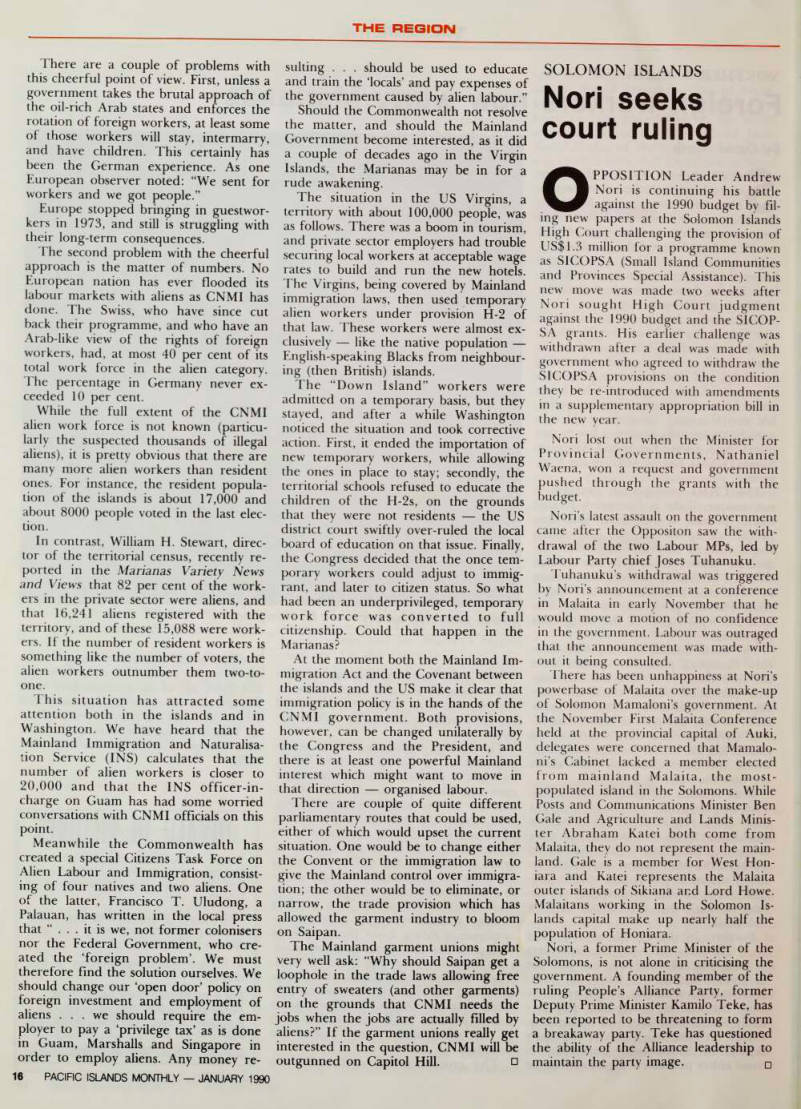
The foreign workers in CNMI are in construction, in the operation of hotels, and in the garment industry, but sugar cane-type labour practices prevail. Wages are low in the alien-dominated indus tries, there are few native workers in those sectors, and living conditions in the guestworkers’ barracks are said to be grim. Meanwhile, the CNMI industries have become accustomed to these work ers, and stoutly resist any effort to cut back on their utilisation. As a result a strange pattern emerges: overseas en trepreneurs (often from Japan, Taiwan or Korea) run factories whose raw mate rials (textiles) are produced abroad.
Then workers from Korea, the Philip pines and elsewhere do the work on pro ducts that are shipped overseas. Some money remains in the islands, but most of the beneficiaries of the process are outsiders.
The conventional wisdom in the
Marianas is that this use of foreign work ers is roughly comparable to the German and Swiss use of the guestworkers from Turkey and southern Europe, and that the workers will not stay, so there will be no long-term adverse consequences of their presence, but many short-term be nefits.
Saipan garments factory: work for foreigners
There are a couple of problems with this cheerful point of view. First, unless a government takes the brutal approach of the oil-rich Arab states and enforces the rotation of foreign workers, at least some of those workers will stay, intermarry, and have children. This certainly has been the German experience. As one European observer noted: “We sent for workers and we got people.”
Europe stopped bringing in guestwor kers in 1973, and still is struggling with their long-term consequences.
The second problem with the cheerful approach is the matter of numbers. No European nation has ever flooded its labour markets with aliens as CNMI has done. The Swiss, who have since cut back their programme, and who have an Arab-like view of the rights of foreign workers, had, at most 40 per cent of its total work force in the alien category.
The percentage in Germany never ex ceeded 10 per cent.
While the full extent of the CNMI alien work force is not known (particu larly the suspected thousands of illegal aliens), it is pretty obvious that there are many more alien workers than resident ones. For instance, the resident popula tion of the islands is about 17,000 and about 8000 people voted in the last elec tion.
In contrast, William H. Stewart, direc tor of the territorial census, recently re ported in the Marianas Variety News and Views that 82 per cent of the work ers in the private sector were aliens, and that 16,241 aliens registered with the territory, and of these 15,088 were work ers. If the number of resident workers is something like the number of voters, the alien workers outnumber them two-to one.
This situation has attracted some attention both in the islands and in Washington. We have heard that the Mainland Immigration and Naturalisa tion Service (INS) calculates that the number of alien workers is closer to 20,000 and that the INS officer-in charge on Guam has had some worried conversations with CNMI officials on this point.
Meanwhile the Commonwealth has created a special Citizens Task Force on Alien Labour and Immigration, consist ing of four natives and two aliens. One of the latter, Francisco T. Uludong, a Palauan, has written in the local press that ... it is we, not former colonisers nor the Federal Government, who cre ated the ‘foreign problem’. We must therefore find the solution ourselves. We should change our ‘open door’ policy on foreign investment and employment of aliens ... we should require the em ployer to pay a ‘privilege tax’ as is done in Guam, Marshalls and Singapore in order to employ aliens. Any money re
suiting . . . should be used to educate and train the ‘locals’ and pay expenses of the government caused by alien labour.”
Should the Commonwealth not resolve the matter, and should the Mainland Government become interested, as it did a couple of decades ago in the Virgin Islands, the Marianas may be in for a
rude awakening.
The situation in the US Virgins, a territory with about 100,000 people, was as follows. There was a boom in tourism, and private sector employers had trouble securing local workers at acceptable wage rates to build and run the new hotels.
The Virgins, being covered by Mainland
immigration laws, then used temporary alien workers under provision H-2 of that law. These workers were almost ex clusively like the native population
English-speaking Blacks from neighbour
ing (then British) islands.
The “Down Island” workers were admitted on a temporary basis, but they stayed, and after a while Washington noticed the situation and took corrective action. First, it ended the importation of new temporary workers, while allowing the ones in place to stay; secondly, the territorial schools refused to educate the children of the H-2s, on the grounds that they were not residents the US district court swiftly over-ruled the local board of education on that issue. Finally, the Congress decided that the once tem porary workers could adjust to immig rant, and later to citizen status. So what had been an underprivileged, temporary work force was converted to full citizenship. Could that happen in the Marianas?
At the moment both the Mainland Im migration Act and the Covenant between the islands and the US make it clear that immigration policy is in the hands of the CNMI government. Both provisions,
however, can be changed unilaterally by
the Congress and the President, and there is at least one powerful Mainland interest which might want to move in that direction organised labour.
There are couple of quite different parliamentary routes that could be used, either of which would upset the current situation. One would be to change either the Convent or the immigration law to give the Mainland control over immigra tion; the other would be to eliminate, or narrow, the trade provision which has allowed the garment industry to bloom
on Saipan.
The Mainland garment unions might very well ask: “Why should Saipan get a loophole in the trade laws allowing free entry of sweaters (and other garments) on the grounds that CNMI needs the jobs when the jobs are actually filled by aliens?” If the garment unions really get interested in the question, CNMI will be outgunned on Capitol Hill. □
Advertisements & other items, p. 15 (1 item)
Tuvalu In Pictures
Tuvalu A Celebration of 10 Years Independence, by Peter McQuarrie.
Published by the Government of Tuvalu. 104 pages of colour and black and white pictures depicting life and scenes in Tuvalu.
A limited hardcover edition of 800 copies.
For a numbered copy order from: Peter McQuarrie, P.O. Box 18, Funafuti, Tuvalu, Central Pacific, via
FIJI.
$A35.00 surface, $A47.00 airmail.
court ruling
Solomon Islands
Nori seeks court ruling
OPPOSITION Leader Andrew Nori is continuing his battle against the 1990 budget by fil ing new papers at the Solomon Islands High Court challenging the provision of US$l.3 million for a programme known as SICOPSA (Small Island Communities and Provinces Special Assistance). This new move was made two weeks after Nori sought High Court judgment against the 1990 budget and the SICOP SA grants. His earlier challenge was withdrawn after a deal was made with government who agreed to withdraw the SICOPSA provisions on the condition they be re-introduced with amendments in a supplementary appropriation bill in the new year.
Nori lost out when the Minister for Provincial Governments, Nathaniel Waena, won a request and government pushed through the grants with the
budget.
Nori’s latest assault on the government came after the Oppositon saw the with drawal of the two Labour MPs, led by Labour Party chief Joses Tuhanuku.
Tuhanuku’s withdrawal was triggered by Nori’s announcement at a conference in Malaita in early November that he would move a motion of no confidence in the government. Labour was outraged that the announcement was made with out it being consulted.
There has been unhappiness at Nori’s powerbase of Malaita over the make-up of Solomon Mamaloni’s government. At the November First Malaita Conference held at the provincial capital of Auki, delegates were concerned that Mamalo ni’s Cabinet lacked a member elected from mainland Malaita, the most populated island in the Solomons. While Posts and Communications Minister Ben Gale and Agriculture and Lands Minis ter Abraham Katei both come from Malaita, they do not represent the main land. Gale is a member for West Hon iara and Katei represents the Malaita outer islands of Sikiana and Lord Howe.
Malaitans working in the Solomon Is lands capital make up nearly half the population of Honiara.
Nori, a former Prime Minister of the Solomons, is not alone in criticising the government. A founding member of the ruling People’s Alliance Party, former Deputy Prime Minister Kamilo Teke, has been reported to be threatening to form a breakaway party. Teke has questioned the ability of the Alliance leadership to maintain the party image. □
Advertisements & other items, p. 17 (1 item)
anyhow
h
have a
Winfield
I
r|T|\|ES S
educes voup v\ OKiN j.
SM
WR 1890-F
TV makes
Cook Islands
TV makes its debut
By Angela McCarthy
AN electronic age Christmas pre sent came on air to all residents of Rarotonga on December 25 with the debut of broadcast television on the island. A deal signed between Televi sion New Zealand (TVNZ) and Cook Is land Prime Minister Geoffrey Henry on September 7 brought national television to the Cook Islands in the form of satel lite news broadcasts, air freighted videos and local programming.
TV will broadcast from spm to 11pm nightly. Initially, the Cook Islands
Broadcasting Corporation (CIBC) will
provide 10 hours a week of local content and look after advertising.
Every night a half hourly bi-lingual
news programme will be broadcast simultaneously. There will also be a
nightly cultural programme featuring
traditional dancing, contemporary enter tainment, and a variety of artistic pro jects. The rest of the schedule will be chosen from TVNZ programmes avail able to the Pacific. The general tapes will be airfreighted to Rarotonga weekly.
The six o’clock news will come via satel lite along with other live events like
sports.
“The basic principle we work on,” says TVNZ Satellite Operations Manager Lewis Woodburn, “is to offer the islands an economical option with guidelines for suggested programmes and schedules.
Stations choose what is to be transmitted from the material available nothing is compulsory.”
The TVNZ package is designed to make television viable for smaller island nations in the Pacific. TVNZ buy the rights to show overseas programmes in the Pacific region which means that the Pacific nations don’t have to individually face the full brunt of costs.
Niue is the only other Pacific island at present that uses TVNZ services. They have been broadcasting for a little more than a year, and according to Wood burn, they do two local newscasts a week and various documentaries.
The contract between the Cook Is lands government and TVNZ has changed considerably since talks first started. Some TVNZ negotiators felt that the proposed 10 hours a week of local programming was too ambitious. But the government and the Cook Islands Broadcasting Board argued that service must kick off with a strong local content.
This was particularly important to Hen ry, who said: “That the station is seen as of the Cook Islands and not just pumping out
foreign programmes is extremely impor
tant. We want Cook Islanders to see themselves on TV, and we want prog rammes produced that are relevant to their everyday needs as well as everyday entertainment.” Local input has been re negotiated and staff numbers have risen accordingly along with costs.
One of the biggest problems with set ting up television is finding and training people to run it. CIBC was fortunate.
American Richard Wachter, CIBC’s tech nical advisor, worked in Los Angeles on the technical side of movie and television productions like Mork and Mindy and the Bob Newhart Show. In 1989, while he was in the Cook Islands, the govern ment signed the TVNZ deal. Wachter ended up with a six-month contract with
Cibc.
Wachter is training people and has 20 staff members doing on-the-job training.
He also helped design the studio and organise the programming setup. He has been involved in videoing Maori lan guage classes, developing archival library tapes and building up profiles on Cook Islander entertainers.
The other key person with CIBC is Chief Executive Freddie Keil, an experi enced radio broadcaster. He and Wach ter were planning to set up a private television station. Keil is confident the Cook Islands will benefit from television: “It is progress but it’s up to the com munity to accept it as another way of communicating and entertaining and not abuse it. It will only affect us if we let it.
If the machine controls life, you’re lost.”
“That is why although TVNZ felt it ambitious of us to take on so much local production immediately we felt we had to. We want to record our life and cul ture so we don’t look back in five years time and say we used to do this and that, but now it’s gone. We will preserve it as it is still there the old with the new.”
The Cook Islands Broadcasting Cor poration as directed by the 1989 Broad casting Bill, which is before parliament, has to be self-funding. Funding has come from loans from the Cook Islands Post Office and an Australian telecom munications company. The budgetted expenditure for the corporation’s first year of operation is NZ$l million.
The network does not see enough advertising potential to pay all the bills.
The corporation’s accountants forecast that some measure of assistance will be needed in the first two or three years.
Broadcasting fees and advertising will be the major sources of funds. And the Broadcasting Bill will allow parliament to “appropriate funds for the purpose of
the corporation”.
“If we are going to survive we need all the advertising we can get. If it is in Chinese, we’ll take it but we want as much local advertising as possible,” says Keil. □
Problems with coconut trees
TELEVISION is being introduced to the Cook Islands as part of a gov ernment plan for improved tele communications that will eventually pro vide TV and FM radio broadcast to all the islands in the group. While most out er islands receive AM radio now, the re ception is not always clear. The islands have diesel generators except two that have solar power.
Before television can service the other islands, the telecommunications system of those islands must first be improved.
The upgrading of these facilities is sche duled to begin early 1990 and be finished by 1992. The initial outlay for Rarotonga has cost NZ$7OO,OOO and the
complete telecommunications project for
all the islands will cost NZ$l2 million.
“It is a nation-building facility and ser vice. It will help to bring islands closer together and create a sense of nation hood that will certainly go a long way towards dispelling the isolation that ex ists physically and mentally,” says Prime Minister Geoffrey Henry.
The choice of broadcasting transmis sion instead of cable transmission is one
area in which there was disagreement.
The initial planning group said laying cable into people’s homes was too expen sive because of the central mountain and isolation of some housing areas. Howev er, local chief executive Freddie Keil and American technical advisor Richard Wachter felt the eight translator masts erected around the island would have high maintenance costs and be very
vulnerable to cyclones. They argued the
initial expense of cable would pay off in
the long run. Another problem they
found was coconut tree interference with
signals.
“We looked at TV in the Caribbean and found the coconut trees can absorb signals. If a house is surrounded by coconut trees the TV antenna needs to be higher,” says Wachter. “The advice from New Zealand is broadcasting orientated because they use a broadcast ing system. They don’t have coconut trees there.”
TVNZ’s Satellites Operation Manager, Lewis Woodburn said coconut trees were not major problems as long as people were aware that higher antennas would be needed to avoid the taller trees. □
Advertisements & other items, pp. 19-20 (1 item)
air of excitement.
Our new 767 bruits an
air pacific q
f f -1 Exciting times are on the way for us all with the arrival of the 8767 to the Air Pacific international fleet. It’s the ultimate wide bodied aircraft that offers the latest in equipment and comfort to entice more businessmen and tourists to fly our airline. That’s good for us and good for you.
More jobs
There will be extra jobs created thanks to the purchase.
More at Air Pacific and more in the community over a surprising range of areas... all helping to cater for the needs of extra visitors. Estimates are that for every additional 32 visitors arriving to the country, one new job is created.
More Visitors
The sheer size and comfort of the 767 will attract more tourists than ever to our shores. Both Economy and Business Class offer wide bodied luxury that make holidaying in Fiji even more tempting than ever. In fact, we’re counting on more than 290,000 visitors this year.
More Money
The end result of buying our new 767 is more money for our economy. It will come through tourist dollars across a whole range of areas. The fact is, tourism is one of our most critical sources of income...and we’re doing our best to make sure we can make the most of every dollar.
Air Pacific.. .the rainbow of Fiji is working for you.
Aißmanc
FIJI’S INTERNATIONAL AIRLINE
Fuels and lubricants.
Plastics. Chemicals. Bitumen.
Aviation Services. Bunkering.
Shell has penetrated even more of the Pacific to widen its network of offices, terminals and
Network Shell
now servicing
even more
of the Pacific.
distributors as well as service stations.
Now you can re-assess your source of supply, because Shell quality and value is close at hand, with the service to back it up.
REGIONAL OFFICES: GLAM 6"1 -T" -i350. Also servicing Marshall Islands (Majuro), Northern Marianas (Saipan). Palau. 679 313 933- Also servicing Tonga. Cook Islands. American Samoa. Western Samoa • PAPE A NEW Gl INEA 675 2281)0. Also servicing Solomon Islands.
NEW CALEDONIA 687 285 "20. Also servicing Tahiti. Vanuatu.
How do you farewell a woman like this?
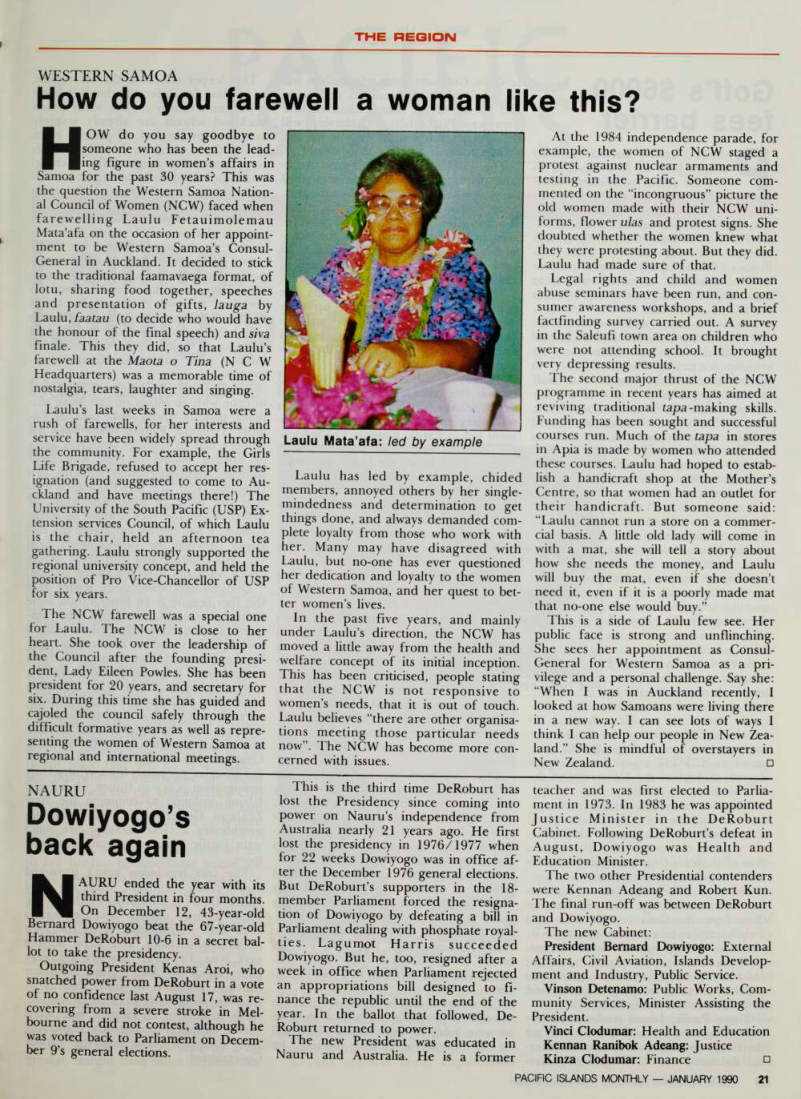
Western Samoa
HOW do you say goodbye to someone who has been the lead ing figure in women’s affairs in Samoa for the past 30 years? This was the question the Western Samoa Nation al Council of Women (NCW) faced when farewelling Laulu Fetauimolemau Mata’afa on the occasion of her appoint ment to be Western Samoa’s Consul- General in Auckland. It decided to stick to the traditional faamavaega format, of
lotu, sharing food together, speeches
and presentation of gifts, lauga by
Laulu, faatau (to decide who would have the honour of the final speech) and siva finale. This they did, so that Laulu’s farewell at the Maota o Tina (NCW Headquarters) was a memorable time of
nostalgia, tears, laughter and singing.
Laulu’s last weeks in Samoa were a rush of farewells, for her interests and
service have been widely spread through
the community. For example, the Girls Life Brigade, refused to accept her res ignation (and suggested to come to Au ckland and have meetings there!) The University of the South Pacific (USP) Ex tension services Council, of which Laulu is the chair, held an afternoon tea
gathering. Laulu strongly supported the
regional university concept, and held the position of Pro Vice-Chancellor of USP for six years.
The NCW farewell was a special one for Laulu. The NCW is close to her heart. She took over the leadership of the Council after the founding presi dent, Lady Eileen Powles. She has been president for 20 years, and secretary for six. During this time she has guided and cajoled the council safely through the difficult formative years as well as repre senting the women of Western Samoa at
regional and international meetings.
Laulu has led by example, chided members, annoyed others by her single mindedness and determination to get things done, and always demanded com plete loyalty from those who work with her. Many may have disagreed with Laulu, but no-one has ever questioned her dedication and loyalty to the women of Western Samoa, and her quest to bet ter women’s lives.
In the past five years, and mainly under Laulu’s direction, the NCW has moved a little away from the health and welfare concept of its initial inception.
This has been criticised, people stating that the NCW is not responsive to women’s needs, that it is out of touch.
Laulu believes “there are other organisa tions meeting those particular needs now”. The NCW has become more con cerned with issues.
At the 1984 independence parade, for example, the women of NCW staged a protest against nuclear armaments and testing in the Pacific. Someone com mented on the “incongruous” picture the old women made with their NCW uni forms, flower ulas and protest signs. She doubted whether the women knew what they were protesting about. But they did.
Laulu had made sure of that.
Legal rights and child and women abuse seminars have been run, and con sumer awareness workshops, and a brief factfinding survey carried out. A survey in the Saleufi town area on children who were not attending school. It brought very depressing results.
The second major thrust of the NCW programme in recent years has aimed at reviving traditional tapa -making skills.
Funding has been sought and successful courses run. Much of the tapa in stores in Apia is made by women who attended these courses. Laulu had hoped to estab lish a handicraft shop at the Mother’s Centre, so that women had an outlet for their handicraft. But someone said: “Laulu cannot run a store on a commer cial basis. A little old lady will come in with a mat, she will tell a story about how she needs the money, and Laulu will buy the mat, even if she doesn’t need it, even if it is a poorly made mat that no-one else would buy.”
This is a side of Laulu few see. Her public face is strong and unflinching.
She sees her appointment as Consul- General for Western Samoa as a pri vilege and a personal challenge. Say she: “When I was in Auckland recently, I looked at how Samoans were living there in a new way. I can see lots of ways I think I can help our people in New Zea land.” She is mindful of overstayers in New Zealand. □
Laulu Mata’afa: led by example
Dowiyogo’s
Nauru
Dowiyogo’s back again
NAURU ended the year with its third President in four months.
On December 12, 43-year-old Bernard Dowiyogo beat the 67-year-old Hammer Deßoburt 10-6 in a secret bal lot to take the presidency.
Outgoing President Kenas Aroi, who snatched power from Deßoburt in a vote of no confidence last August 17, was re covering from a severe stroke in Mel bourne and did not contest, although he was voted back to Parliament on Decem ber 9’s general elections.
This is the third time Deßoburt has lost the Presidency since coming into power on Nauru’s independence from Australia nearly 21 years ago. He first lost the presidency in 1976/1977 when for 22 weeks Dowiyogo was in office af ter the December 1976 general elections.
But Deßoburt’s supporters in the 18member Parliament forced the resigna tion of Dowiyogo by defeating a bill in Parliament dealing with phosphate royal ties. Lagumot Harris succeeded Dowiyogo. But he, too, resigned after a week in office when Parliament rejected an appropriations bill designed to fi nance the republic until the end of the year. In the ballot that followed, De- Roburt returned to power.
The new President was educated in Nauru and Australia. He is a former
teacher and was first elected to Parlia ment in 1973. In 1983 he was appointed Justice Minister in the Deßoburt Cabinet. Following Deßoburt’s defeat in August, Dowiyogo was Health and Education Minister.
The two other Presidential contenders were Kennan Adeang and Robert Kun.
The final run-off was between Deßoburt
and Dowiyogo.
The new Cabinet: President Bernard Dowiyogo: External Affairs, Civil Aviation, Islands Develop ment and Industry, Public Service.
Vinson Detenamo: Public Works, Com munity Services, Minister Assisting the President.
Vinci Clodumar: Health and Education Kennan Ranibok Adeang: Justice Kinza Clodumar: Finance □
Goff’s $6000
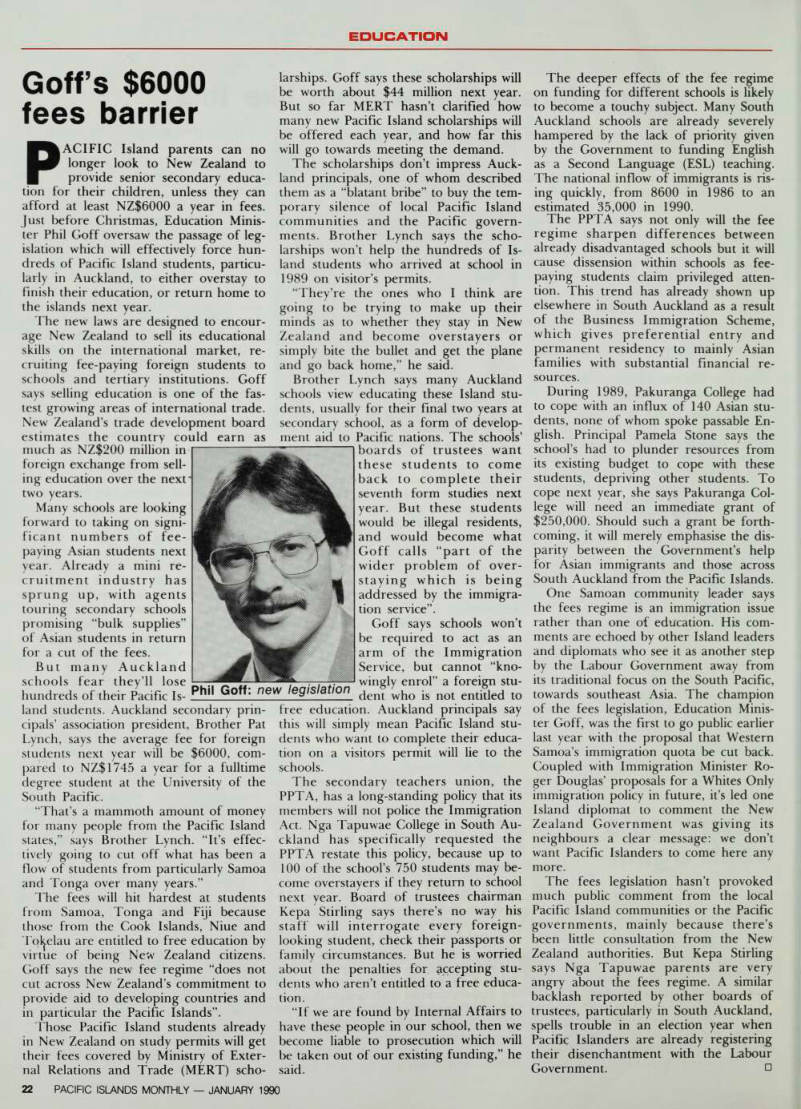
Education
Goff’s $6000 fees barrier
PACIFIC Island parents can no longer look to New Zealand to
provide senior secondary educa
tion for their children, unless they can afford at least NZ$6OOO a year in fees.
Just before Christmas, Education Minis ter Phil Goff oversaw the passage of leg islation which will effectively force hun dreds of Pacific Island students, particu larly in Auckland, to either overstay to finish their education, or return home to the islands next year.
The new laws are designed to encour age New Zealand to sell its educational skills on the international market, re
cruiting fee-paying foreign students to
schools and tertiary institutions. Goff says selling education is one of the fas test growing areas of international trade.
New Zealand’s trade development board estimates the country could earn as
much as NZ$2OO million in
foreign exchange from sell
ing education over the next two years.
Many schools are looking forward to taking on signi ficant numbers of fee paying Asian students next year. Already a mini re cruitment industry has sprung up, with agents
touring secondary schools
promising “bulk supplies”
of Asian students in return for a cut of the fees.
But many Auckland schools fear they’ll lose hundreds of their Pacific Is
land students. Auckland secondary prin cipals’ association president, Brother Pat Lynch, says the average fee for foreign students next year will be $6OOO, com pared to NZ$l745 a year for a fulltime degree student at the University of the South Pacific.
“That’s a mammoth amount of money for many people from the Pacific Island states,” says Brother Lynch. “It’s effec tively going to cut off what has been a flow of students from particularly Samoa and Tonga over many years.”
The fees will hit hardest at students from Samoa, Tonga and Fiji because those from the Cook Islands, Niue and Tokelau are entitled to free education by virtue of being New Zealand citizens.
Goff says the new fee regime “does not cut across New Zealand’s commitment to provide aid to developing countries and in particular the Pacific Islands”.
Those Pacific Island students already in New Zealand on study permits will get their fees covered by Ministry of Exter nal Relations and Trade (MERT) scho-
larships. Goff says these scholarships will be worth about $44 million next year.
But so far MERT hasn’t clarified how many new Pacific Island scholarships will be offered each year, and how far this will go towards meeting the demand.
The scholarships don’t impress Auck land principals, one of whom described them as a “blatant bribe” to buy the tem porary silence of local Pacific Island communities and the Pacific govern ments. Brother Lynch says the scho larships won’t help the hundreds of Is land students who arrived at school in 1989 on visitor’s permits.
“They’re the ones who I think are going to be trying to make up their minds as to whether they stay in New Zealand and become overstayers or simply bite the bullet and get the plane and go back home,” he said.
Brother Lynch says many Auckland schools view educating these Island stu dents, usually for their final two years at secondary school, as a form of develop ment aid to Pacific nations. The schools’
boards of trustees want these students to come back to complete their seventh form studies next year. But these students would be illegal residents, and would become what Goff calls “part of the wider problem of over
staying which is being
addressed by the immigra
tion service”.
Goff says schools won’t be required to act as an arm of the Immigration Service, but cannot “kno wingly enrol” a foreign stu dent who is not entitled to
free education. Auckland principals say this will simply mean Pacific Island stu dents who want to complete their educa tion on a visitors permit will lie to the schools.
The secondary teachers union, the PPTA, has a long-standing policy that its members will not police the Immigration Act. Nga Tapuwae College in South Au ckland has specifically requested the PPTA restate this policy, because up to 100 of the school’s 750 students may be come overstayers if they return to school next year. Board of trustees chairman Kepa Stirling says there’s no way his staff will interrogate every foreign looking student, check their passports or family circumstances. But he is worried about the penalties for accepting stu dents who aren’t entitled to a free educa tion.
“If we are found by Internal Affairs to have these people in our school, then we become liable to prosecution which will be taken out of our existing funding,” he said.
The deeper effects of the fee regime on funding for different schools is likely to become a touchy subject. Many South Auckland schools are already severely hampered by the lack of priority given
by the Government to funding English
as a Second Language (ESL) teaching.
The national inflow of immigrants is ris ing quickly, from 8600 in 1986 to an estimated 35,000 in 1990.
The PPTA says not only will the fee regime sharpen differences between already disadvantaged schools but it will cause dissension within schools as fee paying students claim privileged atten tion. This trend has already shown up elsewhere in South Auckland as a result of the Business Immigration Scheme, which gives preferential entry and permanent residency to mainly Asian families with substantial financial re sources.
During 1989, Pakuranga College had
to cope with an influx of 140 Asian stu dents, none of whom spoke passable En glish. Principal Pamela Stone says the school’s had to plunder resources from its existing budget to cope with these students, depriving other students. To cope next year, she says Pakuranga Col lege will need an immediate grant of $250,000. Should such a grant be forth coming, it will merely emphasise the dis parity between the Government’s help for Asian immigrants and those across South Auckland from the Pacific Islands.
One Samoan community leader says the fees regime is an immigration issue rather than one of education. His com ments are echoed by other Island leaders and diplomats who see it as another step by the Labour Government away from its traditional focus on the South Pacific, towards southeast Asia. The champion of the fees legislation, Education Minis ter Goff, was the first to go public earlier last year with the proposal that Western Samoa’s immigration quota be cut back.
Coupled with Immigration Minister Ro ger Douglas’ proposals for a Whites Only immigration policy in future, it’s led one Island diplomat to comment the New Zealand Government was giving its neighbours a clear message: we don’t want Pacific Islanders to come here any more.
The fees legislation hasn’t provoked much public comment from the local Pacific Island communities or the Pacific governments, mainly because there’s been little consultation from the New Zealand authorities. But Kepa Stirling says Nga Tapuwae parents are very angry about the fees regime. A similar backlash reported by other boards of trustees, particularly in South Auckland, spells trouble in an election year when Pacific Islanders are already registering their disenchantment with the Labour Government. □
Phil Goff: new legislation
Pacific
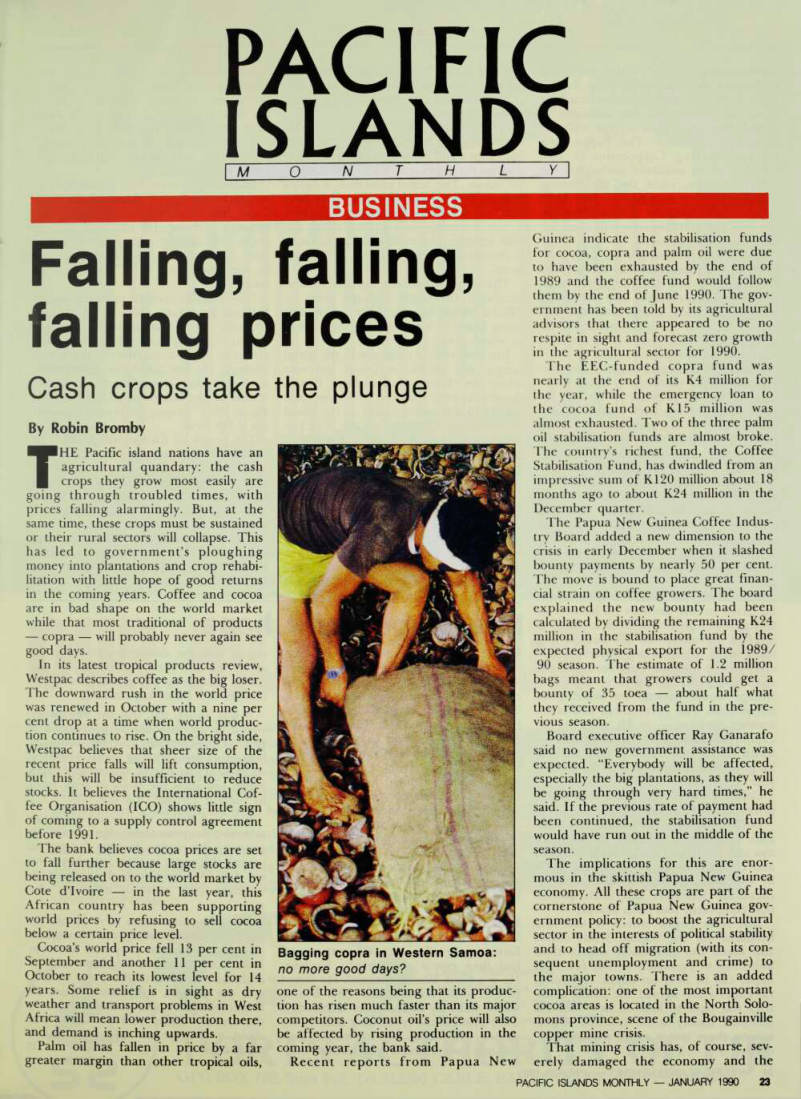
Islands
Monthly
Business
Falling, falling, falling prices Cash crops take the plunge
By Robin Bromby
THE Pacific island nations have an
agricultural quandary: the cash
crops they grow most easily are going through troubled times, with prices falling alarmingly. But, at the same time, these crops must be sustained or their rural sectors will collapse. This has led to government’s ploughing money into plantations and crop rehabi litation with little hope of good returns in the coming years. Coffee and cocoa are in bad shape on the world market while that most traditional of products copra will probably never again see
good days.
In its latest tropical products review, Westpac describes coffee as the big loser.
The downward rush in the world price was renewed in October with a nine per cent drop at a time when world produc tion continues to rise. On the bright side, Westpac believes that sheer size of the recent price falls will lift consumption, but this will be insufficient to reduce stocks. It believes the International Cof fee Organisation (ICO) shows little sign of coming to a supply control agreement before 1991.
The bank believes cocoa prices are set to fall further because large stocks are being released on to the world market by Cote d’lvoire in the last year, this African country has been supporting world prices by refusing to sell cocoa below a certain price level.
Cocoa’s world price fell 13 per cent in September and another 11 per cent in October to reach its lowest level for 14 years. Some relief is in sight as dry weather and transport problems in West Africa will mean lower production there, and demand is inching upwards.
Palm oil has fallen in price by a far greater margin than other tropical oils,
one of the reasons being that its produc tion has risen much faster than its major competitors. Coconut oil’s price will also be affected by rising production in the coming year, the bank said.
Recent reports from Papua New
Guinea indicate the stabilisation funds for cocoa, copra and palm oil were due to have been exhausted by the end of 1989 and the coffee fund would follow them by the end of June 1990. The gov ernment has been told by its agricultural advisors that there appeared to be no respite in sight and forecast zero growth in the agricultural sector for 1990.
The EEC-funded copra fund was nearly at the end of its K 4 million for the year, while the emergency loan to the cocoa fund of Kl 5 million was almost exhausted. Two of the three palm oil stabilisation funds are almost broke.
The country’s richest fund, the Coffee Stabilisation Fund, has dwindled from an impressive sum of Kl2O million about 18 months ago to about K 24 million in the December quarter.
The Papua New Guinea Coffee Indus try Board added a new dimension to the crisis in early December when it slashed bounty payments by nearly 50 per cent.
The move is bound to place great finan cial strain on coffee growers. The board explained the new bounty had been calculated by dividing the remaining K 24 million in the stabilisation fund by the expected physical export for the 1989/ 90 season. The estimate of 1.2 million bags meant that growers could get a bounty of 35 toea about half what they received from the fund in the pre vious season.
Board executive officer Ray Ganarafo said no new government assistance was expected. “Everybody will be affected, especially the big plantations, as they will be going through very hard times,” he said. If the previous rate of payment had been continued, the stabilisation fund would have run out in the middle of the season.
The implications for this are enor mous in the skittish Papua New Guinea economy. All these crops are part of the cornerstone of Papua New Guinea gov ernment policy: to boost the agricultural sector in the interests of political stability and to head off migration (with its con sequent unemployment and crime) to the major towns. There is an added complication; one of the most important cocoa areas is located in the North Solo mons province, scene of the Bougainville copper mine crisis.
That mining crisis has, of course, sev erely damaged the economy and the
Bagging copra in Western Samoa: no more good days?
government’s revenue the revenue it so desperately needs to prop up the na tion’s farmers in their troubled times. As it is, the government has managed to scrape up some funds to cope with the immediate problem. The Papua New Guinea Banking Corporation is now working on an assistance package to the coffee growers, while the government will inject more money into the cocoa fund. Prime Minister Rabbie Namaliu has said the administration will stand be hind cash crop growers.
Just how expensive this will be is indi cated by the prediction that cocoa prices could drop so low that village and smal lholders produce might stop harvesting altogether. Cocoa Board chairman Jack Ockley has told the government the in
dustry faces bankruptcy, with resulting
serious unemployment.
Plantation managers warned the gov ernment of the problems in late Octo ber they added pressure to the call for more funds saying they would not pay more than K6OO a tonne for dried beans, and would hope the stabilisation fund would continue to pay an addition al K 528 a tonne to support growers.
They said about 40,000 families de pended entirely on cocoa as their only means of income, with North Solomons and East New Britain likely to be the areas most severely affected by price col lapses. About 63 per cent of Papua New Guinea’s cocoa is produced by smallhol ders.
Meanwhile, the Namaliu government has acted to ease pressure on farmers by
forcing the Agriculture Bank to suspend
interest payments on all outstanding loans made to cocoa and coffee produc ers. Finance Minister Paul Pora said the suspension was indefinite and any
change would depend on world price
movements. The government had taken another decision to lift taxes on the export of agricultural commodities which would help farmers now but will hit government revenue over the coming year.
Coffee growers have more than world prices to worry about.
Coffee Industry Association chairman Dick Hagon said recently armed hold ups and stealing of coffee on plantations also contributed to the problems faced by the industry. Hagon said prices of chemicals, fertilizers and other planta tion equipment had risen sharply.
But it is copra which is the real headache for the region. While coffee and cocoa can reasonably expect their industries to eventually revive, few such hopes can be held for copra. Agricultu ral experts are agreed the island coun tries will have to look to new uses for coconuts, mainly in the direction of pro cessing them into a range of food pro ducts.
While Papua New Guinea is the most dramatic example of the world price crisis in the cash crops, most of the region’s states are affected.
In September the Vanuatu Commodities Marketing Board reduced prices for both copra and cocoa falls of VTSOOO a tonne for copra and VT27,000 a tonne for cocoa. The board chairman, Edward Kaloris, said the decision came after four years of subsidising the growers. He said it was tempting to keep on using the cash reserves, but reality had to be faced if the industry was to survive in the long term - The same month, the Fiji government increased the copra support price by Fs2o a tonne, but cut the price of local cocoa beans as a result of the depression in world prices.
Just how critical crops are to the island people was shown in Tonga last year when the Tonga Commodities Board, despite its own financial problems, paid out T$ 10,000 to buy copra on the island of Niuafo’ou where the people were facing an acute money shortage. Because of shipping problems, the board had stopped buying copra in Niuafo’ou and the product had been piling up, leading the islanders into financial straits so serious they could not even afford to buy basic necessities.
Island producers have not been helped by a campaign organised by the American Soybean Association, now abandoned, which set out to convince
United States residents that coconut and palm oils were linked to heart disease, While the American soybean industry has now been forced to drop the cam paign, the damage has been done. West ern Samoa’s copra oil mill, for example, is expecting reduced sales until the cam
paign is forgotten,
Meanwhile, Papua New Guinea’s Cop ra Marketing Board chairman Sir John Guise has brushed aside talk that the industry is dying. He has been moving about the country telling growers that most of the rumours were being spread by foreigners and were “absolute non sense”, “The humble coconut palm has always had an important place in the village economy and it will continue to do so,” he has said. Copra would remain a vital element in the country’s economic strategy. He has asked the government to ensure the Copra Board was repre sented on the boards of all the banks in Papua New Guinea to ensure growers got a fair deal.
The people of Kiribati will certainly be hoping that Sir John is right about cop ra’s future, as that product is one of the mainstays of their economy. Coconuts form one of the main ingredients in the local diet and as well as providing cash when turned into copra.
The world price tells its own story; in 1979, US$733 per tonne; in 1982, US$27O a tonne, and in 1986 just US$l43 per tonne. □
New paper, new hope
THE new owners of the Cook Island News are hoping that the promised business expansion in the country will carry them along with it.
The newspaper formerly published by
the governments Cook Islands Broad- Ca m mg rr a r Newspaper Corporation, was sold off by tender and came under pnvate ownership from October 1 last year. The government lost NZ$l6O,OOO °" £ooi Islands hence the sell-ott. The government will now con centrate on radio and television.
The paper’s managing editor, Lawrence Bailey, said the News now sold 1500 copies six days a week and considering Rarotonga has a population of 9000, that is an impressive penetration.
Tenders were called in May and Bailey’s company, Cook Islands News Ltd, was the successful bidder. He was a former journalist with the paper and had then run a photography business.
He is a Cook Islands national. He joined forces with Wendy and Phil Evans, whose skills lay in computer technology, They brought the typesetting skills to the partnership. One of the major lossmaking factors under government own-
ership was the double-key-stroking for all stories; now the News works with de sktop publishing equipment which eli minates one lot of key-stroking. „ was found that the neW spaper would be an uneco momic proposition if inted commer cially. So the company 3ought its own prmdng press . This new equipment can handle tabloid-size pages wi „ a||ow the to grow from News ks nt 12 . pag e, A -4 size, But, sa *d Bailey, that would not mean tabloid-style journalism. He wanted to preserve the readers looking forward to g ettin g the paper in their letterboxes ev erY day. We ave f° Be responsible we have 9 u * te a bit of influence, he sa *d- The company’s hopes were pinned on the Cook Islands taking off economical ly. Apart from the proposed Sheraton Hotel, the arrival of television and its eventual extension to the outer islands, and the modern telephone system, all meant economic and social changes in the country. Bailey said the Cooks was about to become an up-market tourist destination. □
Advertisements & other items, p. 25 (1 item)
Our Move, Your Gain
Ports Authority of Fiji while streamlining its operations has simplified the shipping agents work, by arriving at a standard charge for handling cargo in its different modes of operations; thus the loss acquired by hinderances of bad weather and inefficiences in stevedoring have been addressed . . .
Shipping agents are now protected by the PAF, which takes the sole responsibility of stevedoring by supplying appropriate equipments and a safe manning scale for higher efficiency and lower stevedoring costs. m Contact Wharf Manager H. Hazelman Suva Ph. 315399 E. Varea Lautoka Ph. 62944 D. Koyanasau Levuka Ph. 44189
PORTS AUTHORITY OF FIJI
GPO BOX 780, Suva Fiji, Tel 312700 CABLE: PAF FJ TELEX: 2203 FAX 300064.**
Sparteca rules
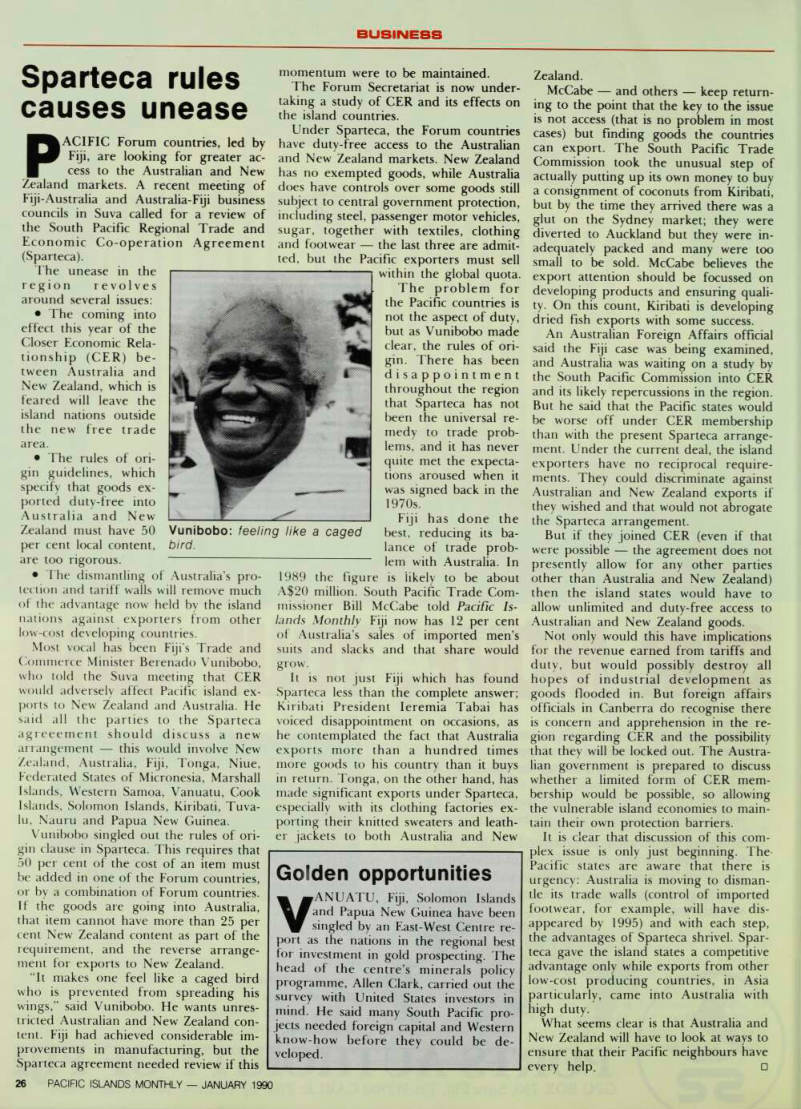
causes unease
PACIFIC Forum countries, led by Fiji, are looking for greater ac cess to the Australian and New Zealand markets. A recent meeting of Fiji-Australia and Australia-Fiji business councils in Suva called for a review of the South Pacific Regional Trade and Economic Co-operation Agreement (Sparteca).
The unease in the
region revolves
around several issues: • The coming into effect this year of the Closer Economic Rela tionship (CER) be tween Australia and New Zealand, which is feared will leave the island nations outside the new free trade area. • The rules of ori gin guidelines, which specify that goods ex ported duty-free into Australia and New Zealand must have 50 per cent local content, are too rigorous.
• The dismantling of Australia’s pro tection and tariff walls will remove much of the advantage now held by the island nations against exporters from other low-cost developing countries.
Most vocal has been Fiji’s Trade and Commerce Minister Berenado Vunibobo, who told the Suva meeting that CER would adversely affect Pacific island ex ports to New Zealand and Australia. He said all the parties to the Sparteca agreeement should discuss a new arrangement this would involve New Zealand, Australia, Fiji, Tonga, Niue, Federated States of Micronesia, Marshall Islands, Western Samoa, Vanuatu, Cook Islands, Solomon Islands, Kiribati, Tuva lu, Nauru and Papua New Guinea.
Vunibobo singled out the rules of ori gin clause in Sparteca. This requires that 50 per cent of the cost of an item must be added in one of the Forum countries, or by a combination of Forum countries.
If the goods are going into Australia, that item cannot have more than 25 per cent New Zealand content as part of the requirement, and the reverse arrange ment for exports to New Zealand.
“It makes one feel like a caged bird who is prevented from spreading his wings,” said Vunibobo. He wants unres tricted Australian and New Zealand con tent. Fiji had achieved considerable im provements in manufacturing, but the Sparteca agreement needed review if this
momentum were to be maintained.
The Forum Secretariat is now under taking a study of CER and its effects on the island countries.
Under Sparteca, the Forum countries have duty-free access to the Australian and New Zealand markets. New Zealand has no exempted goods, while Australia does have controls over some goods still subject to central government protection, including steel, passenger motor vehicles, sugar, together with textiles, clothing and footwear the last three are admit ted, but the Pacific exporters must sell
within the global quota.
The problem for the Pacific countries is not the aspect of duty, but as Vunibobo made clear, the rules of ori gin. There has been
disappointment
throughout the region
that Sparteca has not been the universal re medy to trade prob lems, and it has never quite met the expecta tions aroused when it was signed back in the 19705.
Fiji has done the best, reducing its ba lance of trade prob lem with Australia. In
1989 the figure is likely to be about As2o million. South Pacific Trade Com missioner Bill McCabe told Pacific Is lands Monthly Fiji now has 12 per cent of Australia’s sales of imported men’s suits and slacks and that share would grow.
It is not just Fiji which has found Sparteca less than the complete answer; Kiribati President leremia Tabai has voiced disappointment on occasions, as he contemplated the fact that Australia exports more than a hundred times more goods to his country than it buys in return. Tonga, on the other hand, has made significant exports under Sparteca, especially with its clothing factories ex porting their knitted sweaters and leath er jackets to both Australia and New
Zealand.
McCabe and others keep return ing to the point that the key to the issue is not access (that is no problem in most cases) but finding goods the countries can export. The South Pacific Trade Commission took the unusual step of actually putting up its own money to buy a consignment of coconuts from Kiribati, but by the time they arrived there was a glut on the Sydney market; they were diverted to Auckland but they were in adequately packed and many were too small to be sold. McCabe believes the export attention should be focussed on
developing products and ensuring quali
ty. On this count, Kiribati is developing dried fish exports with some success.
An Australian Foreign Affairs official said the Fiji case was being examined, and Australia was waiting on a study by the South Pacific Commission into CER and its likely repercussions in the region.
But he said that the Pacific states would be worse off under CER membership than with the present Sparteca arrange ment. Under the current deal, the island exporters have no reciprocal require ments. They could discriminate against Australian and New Zealand exports if they wished and that would not abrogate the Sparteca arrangement.
But if they joined CER (even if that were possible the agreement does not presently allow for any other parties other than Australia and New Zealand) then the island states would have to allow unlimited and duty-free access to Australian and New Zealand goods.
Not only would this have implications for the revenue earned from tariffs and
duty, but would possibly destroy all
hopes of industrial development as goods flooded in. But foreign affairs officials in Canberra do recognise there is concern and apprehension in the re
gion regarding CER and the possibility
that they will be locked out. The Austra lian government is prepared to discuss whether a limited form of CER mem bership would be possible, so allowing the vulnerable island economies to main tain their own protection barriers.
It is clear that discussion of this com plex issue is only just beginning. The Pacific states are aware that there is urgency: Australia is moving to disman tle its trade walls (control of imported footwear, for example, will have dis appeared by 1995) and with each step,
the advantages of Sparteca shrivel. Spar
teca gave the island states a competitive advantage only while exports from other low-cost producing countries, in Asia particularly, came into Australia with
high duty.
What seems clear is that Australia and New Zealand will have to look at ways to ensure that their Pacific neighbours have every help. □
Vunibobo: feeling like a caged bird.
Golden opportunities
VANUATU, Fiji, Solomon Islands and Papua New Guinea have been singled by an East-West Centre re port as the nations in the regional best for investment in gold prospecting. The head of the centre’s minerals policy programme, Allen Clark, carried out the survey with United States investors in mind. He said many South Pacific pro jects needed foreign capital and Western know-how before they could be de veloped.
Controversy over tuna laws
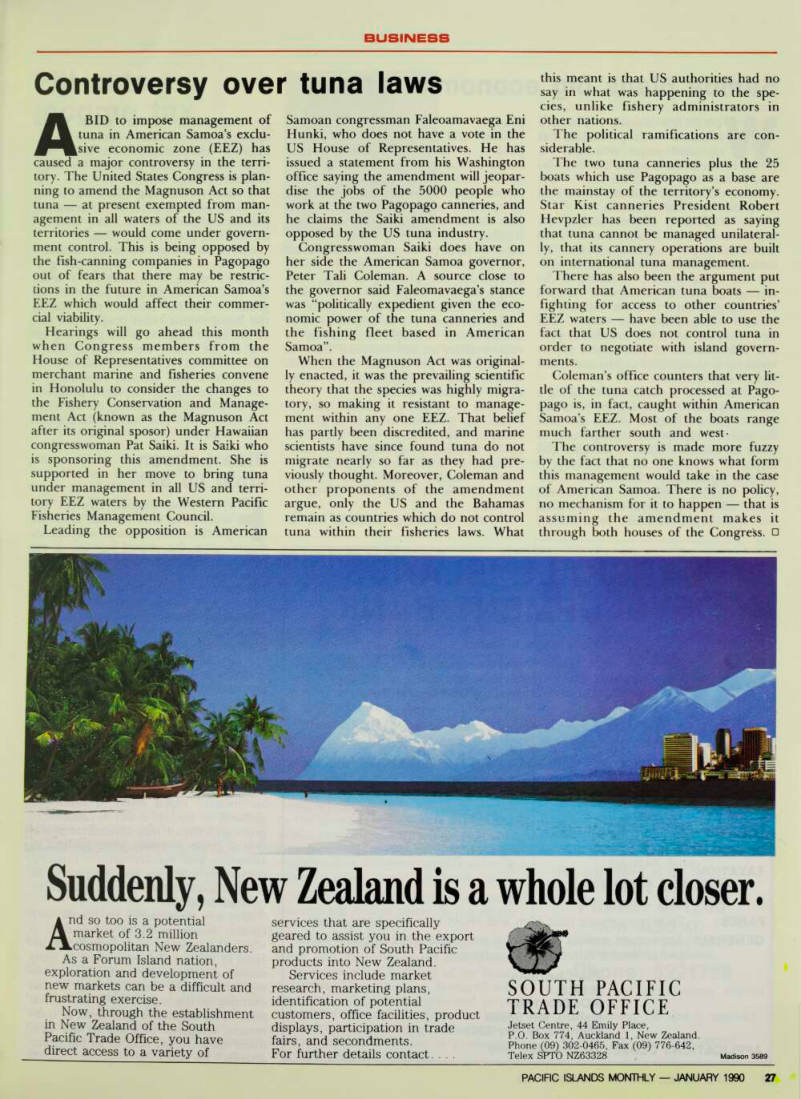
A BID to impose management of tuna in American Samoa’s exclusive economic zone (EEZ) has caused a major controversy in the territory. The United States Congress is planning to amend the Magnuson Act so that tuna at present exempted from management in all waters of the US and its territories would come under government control. This is being opposed by
the fish-canning companies in Pagopago
out of fears that there may be restrictions in the future in American Samoa’s EEZ which would affect their commercial viability.
Hearings will go ahead this month when Congress members from the House of Representatives committee on merchant marine and fisheries convene in Honolulu to consider the changes to the Fishery Conservation and Management Act (known as the Magnuson Act after its original sposor) under Hawaiian congresswoman Pat Saiki. It is Saiki who is sponsoring this amendment. She is supported in her move to bring tuna under management in all US and territory EEZ waters by the Western Pacific Fisheries Management Council.
Leading the opposition is American
Samoan congressman Faleoamavaega Eni Hunki, who does not have a vote in the US House of Representatives. He has issued a statement from his Washington office saying the amendment will jeopardisc the jobs of the 5000 people who work at the two Pagopago canneries, and he claims the Saiki amendment is also
opposed by the US tuna industry.
Congresswoman Saiki does have on her side the American Samoa governor, Peter Tali Coleman. A source close to the governor said Faleomavaega’s stance
was “politically expedient given the eco-
nomic power of the tuna canneries and the fishing fleet based in American Samoa”.
When the Magnuson Act was originally enacted, it was the prevailing scientific theory that the species was highly migratory, so making it resistant to management within any one EEZ. That belief has partly been discredited, and marine scientists have since found tuna do not migrate nearly so far as they had previously thought. Moreover, Coleman and other proponents of the amendment argue, only the US and the Bahamas remain as countries which do not control tuna within their fisheries laws. What
this meant is that US authorities had no say in what was happening to the spe cies, unlike fishery administrators in other nations.
The political ramifications are con siderable.
The two tuna canneries plus the 25 boats which use Pagopago as a base are the mainstay of the territory’s economy.
Star Kist canneries President Robert
Hevpzler has been reported as saying
that tuna cannot be managed unilateral ly, that its cannery operations are built on international tuna management.
There has also been the argument put forward that American tuna boats in fighting for access to other countries’
EEZ waters have been able to use the fact that US does not control tuna in order to negotiate with island govern ments.
Coleman’s office counters that very lit tle of the tuna catch processed at Pago pago is, in fact, caught within American Samoa’s EEZ. Most of the boats range much farther south and west- The controversy is made more fuzzy by the fact that no one knows what form this management would take in the case of American Samoa. There is no policy, no mechanism for it to happen that is assuming the amendment makes it through both houses of the Congress. □
Advertisements & other items, p. 27 (1 item)
Suddenly, New Zealand is a whole lot closer.
And so too is a potential market of 3.2 million New Zealanders.
As a Forum Island nation, exploration and development of new markets can be a difficult and frustrating exercise.
Now, through the establishment in New Zealand of the South Pacific Trade Office, you have direct access to a variety of services that are specifically geared to assist you in the export and promotion of South Pacific products into New Zealand.
Services include market research, marketing plans, identification of potential customers, office facilities, product displays, participation in trade fairs, and secondments.
For further details contact. . . .
SOUTH PACIFIC
TRADE OFFICE
Jetset Centre, 44 Emily Place, P.O. Box 774, Auckland 1, New Zealand.
Phone (09) 302-0465, Fax (09) 776-642, Telex SPTO NZ63328 Madison 3589
Samoa plans big economic reforms
WESTERN Samoa’s Finance Minister Tuilaepa Sailele has
signalled major structural re
forms in his latest Budget, labelling his new policies as a “calculated risk” but warning that higher inflation would lead to further monetary restraint.
The WS$ 182.95 million budget, the highest even in the country’s history, will introduce major economic reforms. The minister said some structural characteris tics had stifled growth leading to de
clining agricultural production, reduced
exports, poor land resource use and in creased consumption over output. The new measures will cover commodity pric ing, rehabilitation of plantations, export credits and abolition of export taxes, and tariff rationalisation.
“Government is committed to taking a calculated risk in launching the proposed policy reforms, because of the potential for such an expansionary programme to cause an excessive boost to inflation and imports,” Tuilaepa said. However, if adverse inflationary effects were to de velop during 1990, the government would advise the Central Bank of a need for appropriate restraint in monetary
policies.
Goods and services tax would be ex panded to cover professional services and a capital gains tax would be intro duced, with a consequent drop in direct income taxes. Many import tariffs would be reduced, with total abolition of im port duties on agricultural machinery, fertilisers and breeding animals. Export taxes on farm products will be abolished.
The government will expand the bonus scheme for the planting of high-yield, long-term tree crops. State plantations would be leased to the private sector.
Manufacturers will be helped by more infrastructure development, reduction of import duties on raw materials from 42 per cent to 35 per cent, an export credit scheme and the establishment of an equity investment facility.
Under the heading of social policy re forms, the government plans to provide villages with interest-free loans for school building programmes, the estab lishment of a Housing Corporation to provide housing finance and a means tested benefit for people over the age of 65 years.
Western Samoa’s government will be
gin construction on the Afulilo hydro
electricity project, build a container park,
upgrade telecommunications, build new roads and introduce payment for water
supplies through meters.
A National Planning Office will be set up to co-ordinate government economic policies and there will be a new Environ mental and Conservation Unit.
Under the budget estimates, statutory expenditure dropped despite the gov ernment having to provide for a seven per cent increase in some public service positions and the advance payment on the Royal Samoa Hotel project. But one of the major features is the planning for use of the Asian Development Bank’s loan of WS$l7.l million. This will in clude cocoa and coconut replanting, a new curriculum development program me in schools, establishing environmen tal conservation and telecommunications improvements. □
Blue Lagoon
profit up 89%
FIJI’S Blue Lagoon Cruises has announced a substantial after tax profit as the country’s tourism in dustry nears the record business it ex perienced before the coups of 1987. The company’s after tax profit was F$ 1,463,519 and the before tax profit of F$ 1,608,698 was an increase of 89 per cent on the financial year 1987-88, the period most affected by the tourism de cline after the coups.
Blue Lagoon chairman David Wilson said new vessels would be built to main tain present cruise capacity and provide for future growth, and recent reorga nisation of management responsibilities had shown positive results.
However he was critical of any moves which could discourage further invest ment in Fiji tourism, in particular airline capacity and schedules. Tourism was not an industry which could be taken for granted, he said. If it was to continue to grow and attract new investment it was crucial those investors were assured of adequate and reliable airline capacity, convenient schedules and competitive air fares supporting such growth, particular ly from Australia.
Recently announced Air Pacific and Qantas northern winter schedules, in which the majority of Sydney flights ar rived in Fiji late evening, returning early morning, effectively reducing a one week holiday to five days was not an example of the support needed, Wilson said. “This decision is little short of com mercial arrogance in a market that pro duces about 50 per cent of all Fiji visitor arrivals,” he said. E
Advertisements & other items, p. 28 (1 item)
Marshall Islands
DEVELOPMENT BANK
POSITION: Consultant to the Managing Director DUTIES: Embrace a wide scope covering: • Development programmes to enhance the Government’s economic and development programmes and expansion of the Bank. • Supervise Loans Officers in account control and submissions. • Promote lending consulting services to the Public. • Establish an overall staff training programme SALARY: US $35000 p.a. & basic furnished apartment or housing allowance US $750 p.m.
TERM: 12 months.
LOCATION: Majuro Marshall Islands.
LEAVE: Rate of 26 days p.a. on completion of contract TAXATION: Up to $lO4O p.a. Nil Next $lOO4O —8% Over 12% FARES: Economy airfares paid from and return to point of recruitment GENERAL: Application marked confidential with bona fide curriculum vitae, and at least 3 referees to be submitted to: The Chairman M.1.D.8.
P.O. Box 1048 Majuro, MH 96960 Phone 3230 Fax 3309 APPLICATIONS CLOSE: January 31st, 1989
Fiji cuts
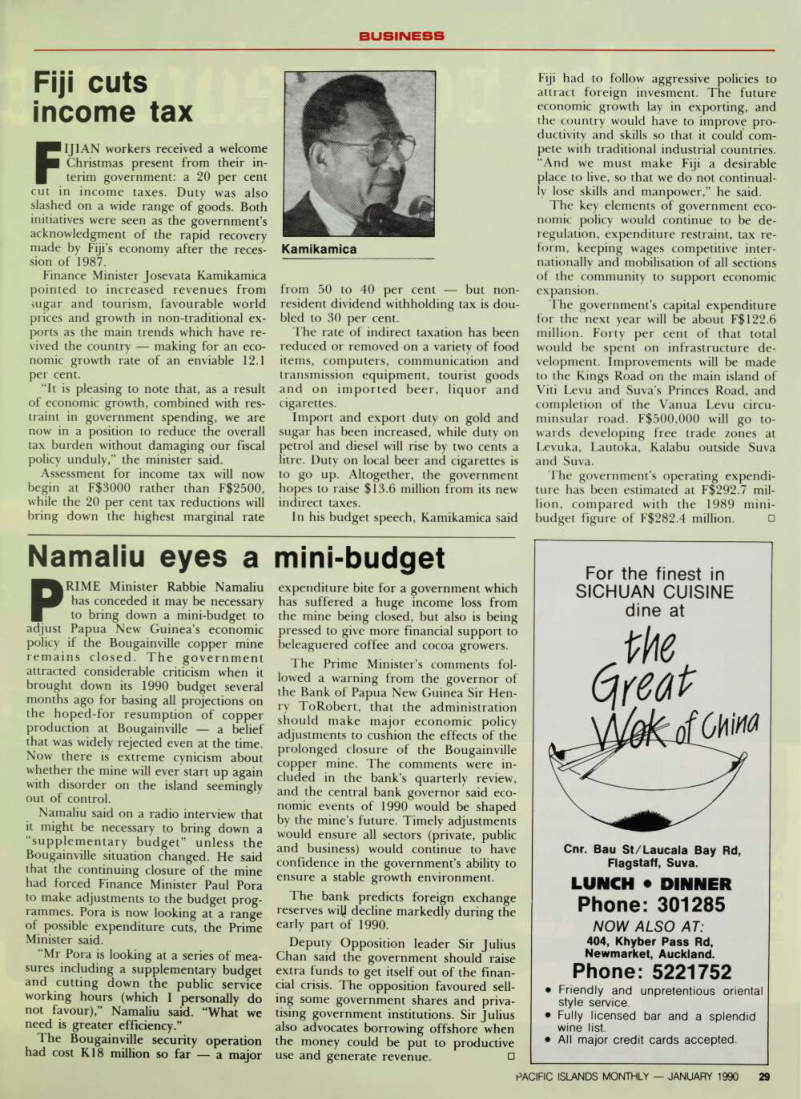


income tax
FIJIAN workers received a welcome Christmas present from their in terim government: a 20 per cent cut in income taxes. Duty was also slashed on a wide range of goods. Both initiatives were seen as the government’s acknowledgment of the rapid recovery made by Fiji’s economy after the reces sion of 1987.
Finance Minister Josevata Kamikamica pointed to increased revenues from >ugar and tourism, favourable world prices and growth in non-traditional ex ports as the main trends which have re vived the country making for an eco nomic growth rate of an enviable 12.1 per cent.
“It is pleasing to note that, as a result of economic growth, combined with res traint in government spending, we are now in a position to reduce the overall tax burden without damaging our fiscal policy unduly,” the minister said.
Assessment for income tax will now begin at Fs3ooo rather than F 52500, while the 20 per cent tax reductions will
bring down the highest marginal rate
from 50 to 40 per cent but non resident dividend withholding tax is dou bled to 30 per cent, The rate of indirect taxation has been reduced or removed on a variety of food items, computers, communication and
transmission equipment, tourist goods
and on imported beer, liquor and
cigarettes.
Import and export duty on gold and sugar has been increased, while duty on petrol and diesel will rise by two cents a litre. Duty on local beer and cigarettes is to go up. Altogether, the government hopes to raise $13.6 million from its new indirect taxes.
In his budget speech, Kamikamica said
Fiji had to follow aggressive policies to attract foreign invesment. The future economic growth lay in exporting, and the country would have to improve pro ductivity and skills so that it could com pete with traditional industrial countries.
“And we must make Fiji a desirable place to live, so that we do not continual ly lose skills and manpower,” he said.
The key elements of government eco nomic policy would continue to be de regulation, expenditure restraint, tax re form, keeping wages competitive inter nationally and mobilisation of all sections of the community to support economic expansion.
The government’s capital expenditure for the next year will be about F$ 122.6 million. Forty per cent of that total would be spent on infrastructure de velopment. Improvements will be made to the Kings Road on the main island of Viti Levu and Suva’s Princes Road, and completion of the Vanua Levu circu minsular road. F 5500,000 will go to wards developing free trade zones at Levuka, Lautoka, Kalabu outside Suva and Suva.
The government’s operating expendi
ture has been estimated at F 5292.7 mil lion, compared with the 1989 mini budget figure of F 5282.4 million. □
Kamikamica
Japan-Marianas air pact ROUTES between the Northern Marianas and Japan are to be opened by a new aviation pact signed recently in Tokyo. Two United States and two Japanese carriers will be allowed to fly from Guam and Saipan to any Japanese city not now served. In addition, Con tinental and Japan Air Lines will be joined by other United States and Japan carriers which will be able to serve Nagoya, Fukuoka and Naha from Guam and Saipan. The new services reflect the growing popularity of the Northern Mariana Islands with Japanese tourists.
Tonga credit bureau opens BUSINESSMAN S.L. Wong has furth ered his involvement in Tonga by open ing a credit bureau at Ma’ufanga. The bureau, with Tss million capital, will provide local customers with Visa, Amer ican Express, Mastercard and Diners’
Club cards.
Mr Wong is close to completing nego tiations to build a major hotel on Tonga tapu and an 18-hole golf course on ’Eua.
The latest development is that Wong has been involved in discussions with King Taufa’ahau Tupou IV regarding fishing and industrial enterprises.
China helps Samoa CHINA is to lend Western Samoa US$5.5 million interest-free following a visit to Beijing by Prime Minister Tofilau Eti Alesana. This sum is in addition to an earlier loan of U 552.75 million which has been earmarked for a new govern ment complex to be built during 1990.
Mining laws slated PAPUA New Guinea’s Mining Act was “hopelessly inadequate” as a basis for modern mineral exploration and the mining industry, according to Michael Hunt, an Australian mining law expert.
He told a conference in Port Moresby the legislation was based on a 1927 Queensland law, and there had been an apparent unwillingness to update it.
He said he was frustrated that it was more than a year since his last visit to Papua New Guinea and still there had been no bill introduced to the country’s parliament even after he had helped draft a new law.
Fiji eyes fishing licences FIJI is to introduce a new licensing sys tem to limit the catches of snapper and tuna in the country’s waters. Fisheries officials estimate the current fishing fleet is capable of taking twice the sustainable yield of snapper. The deepwater fleet will be limited under the regulations; also boats over 12 metres in length will be prohibited from fishing close to the shore and reef edges where small boats now operate.
Tourism hope TOURISM is expected to generate re venues of Fs2Bo million this financial year, a rise of 55 per cent over last year’s FslBl million, according to Fiji’s Finance Minister Josevata Kamikamica. Sugar production will also be up, but the coun try will nevertheless have a widening trade deficit reaching Fsl9o million, although the government is hoping that tourism will result in a much better bot tom line figure for the current account.
Garment exports are expected to rise dramatically, doubling to Fs7o million this year and rising to $9B million next year.
Bougainville at ready
DIRECTORS of Bougainville Copper
Ltd (BCL) have decided to keep the mine in a state of readiness rather than mothball it. The company was faced with these choices after months of closure forced by rebel violence violence which continued the week of the com pany’s decision. The mine’s major share holders, CRA Ltd and the Papua New Guinea Government, will advance K 45 million between them to BCL so that most of the remaining 2400 employees do not have to be retrenched.
Airline seeks listing NORFOLK Island Airlines Ltd is to seek listing on the Australian Stock Exchange.
It is planned the company will acquire the shell of Kennedy-Taylor Ltd, a firm already listed on the main board of the exchange, with that company’s electrical business being sold. The airline would then buy shares in Kennedy-Taylor, which in turn will buy the entire share holding in Norfolk Island Airlines’ main
subsidiary.
Record lending in PNG PAPUA New Guinea’s Agriculture Bank approved a record K 32.3 million in loans in 1987, according to the latest annual report tabled in parliament. This was up K 1.2 million on the previous year. Smal lholders received Kll million spread over 3295 applications.
American Samoa tax rises THE American Samoa senate has approved substantial tax increases in a move to tackle the territory’s financial troubles. Liquor and tobacco taxes will be tripled, while those on firearms and ammunition will be doubled.
Hawaiian airport growth
HAWAII’S major state airports experi
enced significant passenger growth dur ing the 1989 financial year which ended on June 30. Keahole Airport showed the biggest rise 13.4 per cent by hand ling 1.25 million passengers. Honolulu International was up 7 per cent with the state’s largest traffic figure of 22.34 mil lion people. Passenger numbers in creased at even the smaller airports: the 103,255 who moved through Lanai air port represented a whooping 31.9 per cent increase on the previous year.
Niue airport plans RUNWAY lighting and fuel shortage tanks are to be installed at Niue’s airport as an attempt to attract regional airlines to call at the island, whose transport links suffered when Air Nauru was grounded. The airline used a Boeing 737 to service Niue, but now Air Samoa is flying to the island using only a Twin Otter aircraft.
Saipan gets paddle steamer A REPLICA Mississippi paddle steamer has joined the Saipan cruise fleet of Showboat Inc. The double deck vessel, which has a steel hull, is the only one of its kind in Pacific waters and can carry 149 passengers. The crew will dress in costumes similar to those worn in the American south in the late 1800 s and the band will play music from that period. The vessel, named Jambalaya, in the latest attraction in the fast-growing Micronesian tourist industry.
Drought hits Niue beef NIUE’S main source of fresh beef, a farm run by an American national, is now in danger of going out of operation after a four-month drought. The oper ator has been forced to hand the farm back to the government because there is no pasture to feed cattle. The govern ment is now considering using the land
for forestry.
Elcom makes good profit PAPUA New Guinea’s Electricity Com mission recorded a net profit of K 8.4 million last year despite machine break downs and poor rainfall. Two gas tur bines had to be leased from Britain to meet power demand.
Finance Minister Paul Pora said the commission’s major project, the Yonki hydro-electricity scheme in the Eastern Highlands, which will cost the govern ment Kll7 million, is expected to be commissioned in April 1991. Yonki will provide a realiable power supply to all major Highland centres as well as Lae and Madang, and will also generate elec tricity for mining ventures in the Ramy
area including the Hidden Valley gold
project.
Nauru recruits tradesmen SOLOMON Islands tradesmen are being recruited for 12-month contracts on Nauru. More than 200 applications were received for the 38 available positions.
PNG to sign treaty PAPUA New Guinea has signalled it will sign an investment treaty with Australia to reassure investors, many of whom are concerned about the safety of their hold ings in that country. Australian business interests will be guaranteed they will not be nationalised, as will be the repatria tion of investment when a company pulls out.
The decision was announced by Trade and Industry Minister John Giheno. A Papua New Guinea delegation plans to visit Australia to negotiate what will be known as the Investment Promotion and Protection Agreement. The Bougainville crisis and other outbreaks of violence have led to increasing concern about economic stability in the country.
Air Tungaru waits KIRIBATI airline Air Tungaru is now waiting on the United States military to do its bit before regular services can be gin with the leased Aloha 737. The Kiri bati authorities have met US demands for improvements at Canton Island so that there is an adequate landing strip there as an alternative to Tarawa.
All that stands in the way of scheduled services is for a US Hercules to make a test landing at Canton to satisfy the Americans that a large aircraft can use the airfield. Air Tungaru has made several representations to the US Embas sy in Suva to speed the process along.
The airline is now hoping it will be flying a weekly Honolulu-Christmas Is land-Tarawa-Nadi route before the end of this month.
Namaliu eyes a mini-budget
PRIME Minister Rabbie Namaliu has conceded it may be necessary to bring down a mini-budget to adjust Papua New Guinea’s economic policy if the Bougainville copper mine remains closed. The government attracted considerable criticism when it brought down its 1990 budget several months ago for basing all projections on the hoped-for resumption of copper production at Bougainville a belief that was widely rejected even at the time.
Now there is extreme cynicism about whether the mine will ever start up again with disorder on the island seemingly out of control.
Namaliu said on a radio interview that it might be necessary to bring down a
“supplementary budget” unless the
Bougainville situation changed. He said that the continuing closure of the mine had forced Finance Minister Paul Pora to make adjustments to the budget prog rammes. Pora is now looking at a range of possible expenditure cuts, the Prime Minister said.
“Mr Pora is looking at a series of mea
sures including a supplementary budget
and cutting down the public service working hours (which I personally do not favour),” Namaliu said. “What we need is greater efficiency.”
The Bougainville security operation
had cost KlB million so far a major
expenditure bite for a government which has suffered a huge income loss from the mine being closed, but also is being pressed to give more financial support to beleaguered coffee and cocoa growers.
The Prime Minister’s comments fol lowed a warning from the governor of the Bank of Papua New Guinea Sir Hen ry Toßobert, that the administration should make major economic policy adjustments to cushion the effects of the prolonged closure of the Bougainville copper mine. The comments were in cluded in the bank’s quarterly review, and the central bank governor said eco nomic events of 1990 would be shaped
by the mine’s future. Timely adjustments
would ensure all sectors (private, public and business) would continue to have confidence in the government’s ability to ensure a stable growth environment.
The bank predicts foreign exchange reserves wi(] decline markedly during the early part of 1990.
Deputy Opposition leader Sir Julius Chan said the government should raise extra funds to get itself out of the finan cial crisis. The opposition favoured sell ing some government shares and priva tising government institutions. Sir Julius also advocates borrowing offshore when the money could be put to productive use and generate revenue. □
Advertisements & other items, pp. 29-31 (1 item)
6 reap
For the finest in
SICHUAN CUISINE
dine at m
6 reap
Cnr. Bau St/Laucala Bay Rd, Flagstaff, Suva.
LUNCH • DINNER
Phone: 301285
NOW ALSO AT:
404, Khyber Pass Rd, Newmarket, Auckland.
Phone: 5221752
• Friendly and unpretentious oriental style service. • Fully licensed bar and a splendid wine list. • All major credit cards accepted.
The Toyota Hilux is the world’s most popular pick-up.
And the Hilux 4X4 is the best-selling Hilux of them all. Which stands to reason. People around the world respect Toyota’s attention to style. Hilux’s car-like comfort. Rugged reliability. And as you might expect from Toyota, power. This, of course, is the most important asset for a truck. And happily, the Hilux 4X4 offers a choice of four powerful engines: 2.8 and 2.4-litre diesel engines. Plus 2.2 and 1.8-litre petrol engines. When it comes to power and good looks, nobody can beat Toyota. Nobody.
TOYOTA
IJ < m 3 i * v v 1 - m
Bank profit up
THE National Bank of Solomon Is lands has declared a profit of 5151.33 million, an increase of 61.4 per cent over the previous year.
The bank attributed much of the in creased profitability to record levels of
foreign exchange turnover.
Work is well under way on the refur bishment of the bank’s five-storey build ing in central Honiara. When completed, it will include new international and corporate branches. Three new branch offices are being built at Auki in Malaita province, Gizo and Noro in Western province. There will also be a new branch at Chinatown in Honiara.
In its general comments on the Solo mon Islands economy, the National Bank’s annual report said the country’s future prospects would always be heavily dependent on how well the natural re sources and agriculture were handled and developed. More emphasis would have to be placed on added value rather than merely exporting raw materials.
The bank said the new tuna proces sing plant was a step in this direction.
There was also a likelihood of decreasing log exports and a substantial rise in tim ber processing. Present gold prospects will probably contribute to economic de velopment over the next decade.
A tight liquidity situation had affected the bank during the 1988-89 financial year. Faced with strong growth in money supply and domestic credit, and a rising rate of inflation, the central bank had
tightened monetary controls by regulat
ing interest rates and the introduction of a five per cent statutory reserve deposit requirement. The liquidity situation was further exacerbated when the central bank introduced the “Bokolo” bond to soak up excess liquidity in the commer cial banking system. This had led some banks to introduce temporary lending restraints, the National Bank annual re port said. □
Cooks tourism goes up-market
RAROTONGA is to burst into the up-market tourist business with work due to start this month on a 200-room hotel to be operated by the Sheraton chain. The NZ$47 million project will be located at Vaima’aga and will include an 18-hole golf course.
Cook Islands Prime Minister Geoffrey Henry said the country had to change with the times, and a four-star hotel was needed to provide for the more affluent traveller. “We cannot remain forever in the romantic, Cook Islands version of the dream time,” said Henry. u t .. „ , , But the project does have some oppo- . lit , nents. Local residents, however, seem to have been satisfied after initially protesting the Sheraton hotel would unduly strain the island’s power and water supply systems. But it was later disclosed the u i n » hotel will have its own power generator, and will be looking to develop its own
water supply.
Tourism industry businessman Hugh Henry said the development was taking
the Cook Islands in the wrong direction it would not be possible to find enough local staff to man a 200-room hotel, he said. He believes accommoda tion should be built by Cook Island in terests rather than overseas investors. He said a major hotel would spell the end of the country’s magic, and the Cooks could go the way of Hawaii and Tahiti.
Under the agreement signed recently in Rarotonga, the Italian bank ICLE will supply the finance, while SICEI. will be responsible for construction work. (The Italian company was planning to fly labourers into the Cooks this month to begin construction work on the resort).
The Australian company Essington Ltd will oversee the development, with Sher aton taking over management on com
pletion.
The site is the second choice the first was subject to a public outcry and is the only one on the island which has space for the golf course. □
Advertisements & other items, pp. 33-34 (1 item)
I Emms
p 7
EMW /
FIJI CUSTOM CRAFT LIMITED
ALUMINIUM BOAT BUILDERS
WAILADA, LAMI,
P.O. Box 1277, SUVA, FIJI,
PHONE 361977, 361786.
TLX. FJ 2315. FAX 302814
FISHING BOATS, HYDROCATS, WATER TAXIS, CORAL VIEWERS, BARGES, SPECIALISED VESSELS
CUSTOMISED TO YOUR SPECIFICATIONS
< ill IP
UNITED STATES AGENCY FOR INTERNATIONAL DEVELOPMENT
Regional Development Office /South Pacific
COMMERCIAL AGRICULTURE DEVELOPMENT ADVISOR
The USAID regional office based in Suva, Fiji, is seeking candidates for a Personal Services Contractor Commercial Agriculture Development Advisor. The USAID provides assistance to the following countries in the South Pacific: Cook Islands, Fiji, Kiribati, Niue, Papua New Guinea, Solomon Islands, Tonga, Tuvalu, Western Samoa and Vanuatu. Interested professionals who are citizens of the United States or of independent Pacific island nations are requested to contact the USAID, ADO Office, P.O. Box 218, Suva, Fiji. Closing date for applications is January 22, 1990.
1. STATEMENT OF DUTIES
A. GENERAL
Under the direction of the USAID Agricultural Development Officer, the incumbent will be responsible for providing expert advice and assistance to the work of the USAID in the commercial development of the agricultural and marine sector through private sector investment and support.
B. SPECIFIC
1. Will provide advice on the development and implementation of a strategic vision for a USAID program in commercial agriculture development. 2. Will assist to design and implement a new Commercial Agriculture Development project which will serve to enhance agricultural marketing requirements in selected Pacific island nations. 3. Will provide recommendations for opportunities for U.S. investment in productive sector enterprises. 4. Will provide policy advice to USAID on privatization efforts within the region. 5. Will provide advice on commercial development opportunities to USAID fisheries development projects and other USAlDfunded programs. 6, Will make site visits to the island nations served by USAID to assess needs, meet with appropriate public and private sector personnel, and prepare trip reports and other program documentation and reports as required by the work plans of the
USAID,
7. Manage commercial development activities funded by USAID.
11. PERIOD OF CONTRACT
USAID intends to hire a qualified individual under a personal services contract for a period of two years, with the possibility of extension of the contract.
111. QUALIFICATIONS AND
EXPERIENCE
USAID is seeking highly motivitated professional showing strong interest in commercial agricultural planning and development.
A. Academic qualifications A university degree in business, economics or technical field is required.
B. Professional Experience The candidate for the position should be able to demonstrate the following skills in his/her work experience: Work experience in commercial agriculture.
International trade and investment issues.
Knowledge of small-scale economies.
Familiarity with international donor procedures.
IV. This is a request of expressions of interest for qualified candidates and not a hiring commitment by USAID. Interested persons should send a completed US Government form SFI7I or resume and dates of availability to: USAID, ADO Office, P.O.
Box 218, Suva, Fiji.
Fiji’s tuna industry
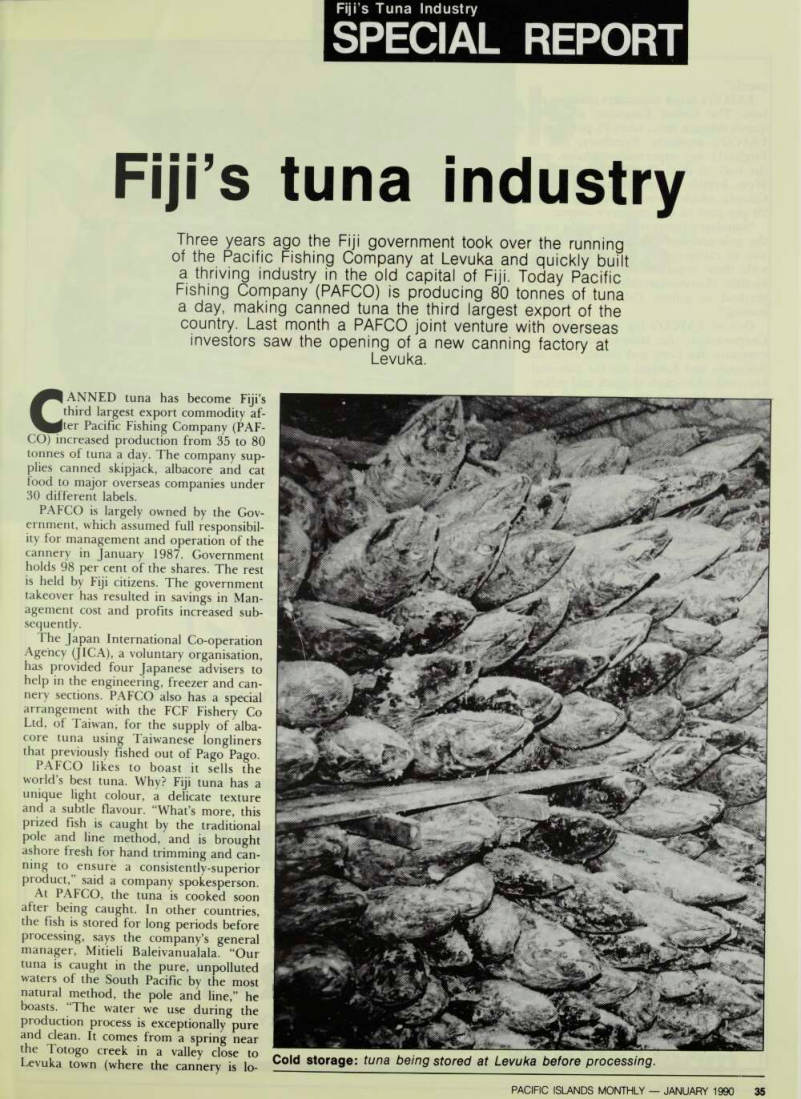
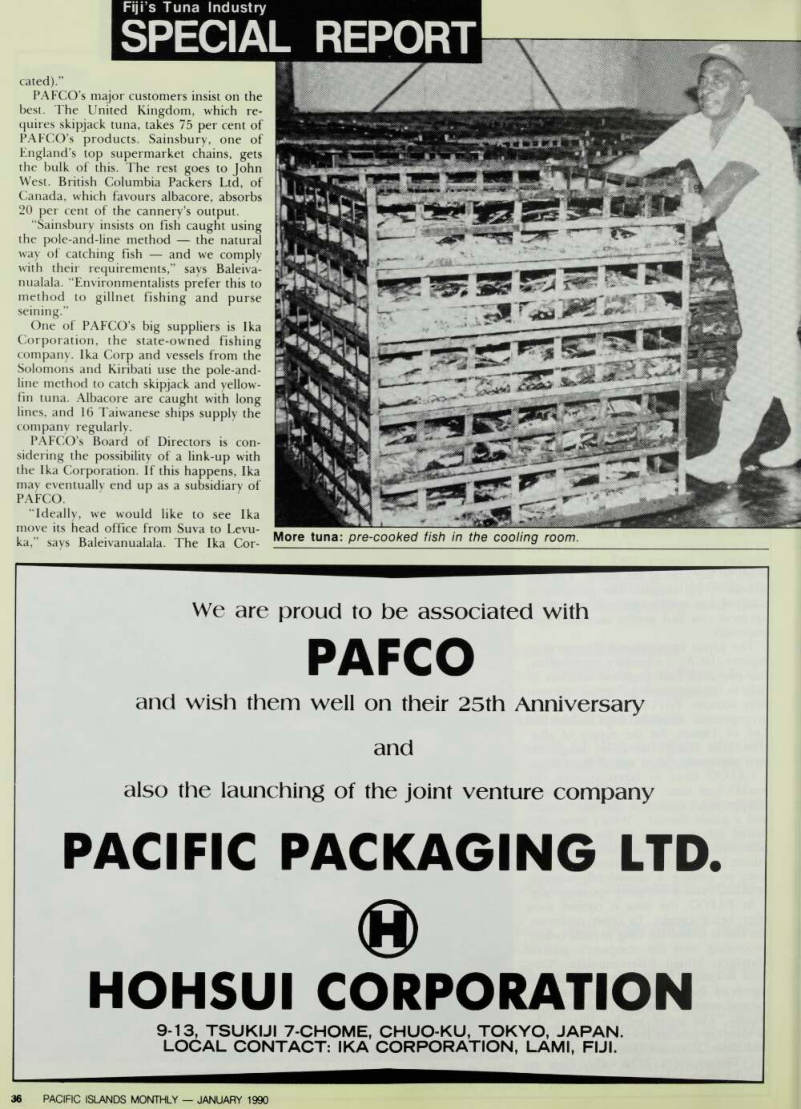

Special Report
Fiji’s tuna industry
Three years ago the Fiji government took over the running of the Pacific Fishing Company at Levuka and quickly built a thriving industry in the old capital of Fiji. Today Pacific Fishing Company (PAFCO) is producing 80 tonnes of tuna a day, making canned tuna the third largest export of the country. Last month a PAFCO joint venture with overseas investors saw the opening of a new canning factory at Levuka.
CANNED tuna has become Fiji’s third largest export commodity af ter Pacific Fishing Company (PAF CO) increased production from 35 to 80 tonnes of tuna a day. The company sup plies canned skipjack, albacore and cat food to major overseas companies under 30 different labels.
PAFCO is largely owned by the Gov ernment, which assumed full responsibil ity for management and operation of the cannery in January 1987. Government holds 98 per cent of the shares. The rest is held by Fiji citizens. The government takeover has resulted in savings in Man agement cost and profits increased sub
sequently.
The Japan International Co-operation Agency (JICA), a voluntary organisation, has provided four Japanese advisers to help in the engineering, freezer and can nery sections. PAFCO also has a special arrangement with the FCF Fishery Co Ltd, of Taiwan, for the supply of alba core tuna using Taiwanese longliners that previously fished out of Pago Pago.
PAFCO likes to boast it sells the world’s best tuna. Why? Fiji tuna has a unique light colour, a delicate texture and a subtle flavour. “What’s more, this prized fish is caught by the traditional pole and line method, and is brought ashore fresh for hand trimming and can ning to ensure a consistently-superior product,” said a company spokesperson.
At PAFCO, the tuna is cooked soon after being caught. In other countries, the fish is stored for long periods before processing, says the company’s general manager, Mitieli Baleivanualala. “Our tuna is caught in the pure, unpolluted waters of the South Pacific by the most natural method, the pole and line,” he boasts. “The water we use during the production process is exceptionally pure and clean. It comes from a spring near the Totogo creek in a valley close to Levuka town (where the cannery is lo-
Cold storage: tuna being stored at Levuka before processing.
cated).”
PAFCO’s major customers insist on the best. The United Kingdom, which re quires skipjack tuna, takes 75 per cent of PAFCO’s products. Sainsbury, one of England’s top supermarket chains, gets the bulk of this. The rest goes to John West. British Columbia Packers Ltd, of Canada, which favours albacore, absorbs 20 per cent of the cannery’s output.
“Sainsbury insists on fish caught using
the pole-and-line method the natural way of catching fish and we comply with their requirements,” says Baleiva nualala. “Environmentalists prefer this to method to gillnet fishing and purse seining.”
One of PAFCO’s big suppliers is Ika Corporation, the state-owned fishing company. Ika Corp and vessels from the Solomons and Kiribati use the pole-and line method to catch skipjack and yellow fin tuna. Albacore are caught with long lines, and 16 Taiwanese ships supply the
company regularly.
PAFCO’s Board of Directors is con sidering the possibility of a link-up with the Ika Corporation. If this happens, Ika may eventually end up as a subsidiary of
Pafco.
“Ideally, we would like to see Ika move its head office from Suva to Levu ka,” says Baleivanualala. The Ika Cor-
More tuna: pre-cooked fish in the cooling room.
poration was established by the Govern ment in 1975 to do commercial tuna fishing. Currently based at Lami, outside Suva, the corporation supplies PAFCO with fish for solid-pack production, Baleivanualala says PAFCO is also looking at the possibility of joint ven tures with Japanese and Taiwanese fishing companies, and there are some prospects of training Fiji crew to work on Japanese fishing boats. PAFCO is also looking into the production of sashimi or raw fish for the Japanese market. “Our new coldstore, to be built early next year through an Australian Aid Package will provide a special facility for the storage of sashimi,” Baleinaivalu says.
“At the moment we are doing a feasi bility study into the possibility of export ing the product. We are looking at prices and exploring new markets.”
Baleivanualala sees great potential for the development of the tuna industry in Fiji and is enthusiastic about plans for PAFCO. He would like to see the com pany increase its output from 15,000 tonnes to 20,000 tonnes a year, reduce overheads and increase profitability.
“At the moment the level of tuna stocks in our waters is unknown. We ex pect anything from 4-20,000 tonnes of tuna a year,” he says. “Therefore we
have to look outside to our neighbours, especially for skipjack and yellowfin tuna. This source of supply worked very well last year, so we are continuing with the system through 1990.
“Ideally, we would like to form close associations with countries such as Kiri bati, the Solomon Islands and Papua New Guinea for tuna supplies. Perhaps we can join forces with these countries.
If we work together, we’ll have a strong position in terms of pricing and produc tivity.
“With regards to albacore, Fiji is in the middle of the source and we’re now able to take advantage of this. The comple tion of our new coldstore will give us buying and selling power. The additional storage space will introduce a new facet to the business. We will be able to buy fish when prices are right and store the unprocessed tuna for export.”
With PAFCO now using two-piece can technology, Baleivanualala says there are possibilities for exporting cans to Amer ican Samoa and the Solomon Islands and perhaps New Zealand and Australia.
“Later, we can look to Asian countries, and maybe the United States,” he says.
Baleivanualala has just returned from negotiating major contracts in the Un ited Kingdom and Canada. His next
priority is to source raw materials for the company.
PAFCO has become the mainstay of the economy on the island of Ovalau, off the coast north of Suva. Levuka, its main centre, was the first capital of Fiji.
Now old and dusty, Levuka relies on PAFCO for employment.
“Without PAFCO, Levuka would be a ghost town, says local chief Ratu Kolinio Rokotuinaceva, who carries the title Tui Levuka. Ratu Kolinio says most people on Ovalau and neighbouring Moturiki island rely on PAFCO for work. “When the company makes a profit, the workers benefit through a bonus,” he says.
Ratu Kolinio recalls the days when Levuka enjoyed a brisk copra trade.
“Burns Philp and Morris Hedstrom were here at the time,” he says. “But today, the tuna industry is our only source of income. We have no other. Through PAFCO, people also have employment on the waterfront and with the Ports Au thority.”
PAFCO contributes to education and the promotion of sport on Ovalau. Says Ratu Kolinio: “The company has put aside about F$ 10,000 for education this year. I think the money will be used to sponsor students at secondary school level.” □
Advertisements & other items, pp. 36-39 (3 items)
Special Report
36
Fiji’s Tuna Industry
PACIFIC ISLANDS MONTHLY JANUARY 1990
Pafco
We are proud to be associated with
and wish them well on their 25th Anniversary and also the launching of the joint venture company
PACIFIC PACKAGING LTD.
HOHSUI CORPORATION
9-13, TSUKUI 7-CHOME, CHUO-KU, TOKYO, JAPAN.
LOCAL CONTACT: IKA CORPORATION, LAMI, FIJI.
Mobil Fuels
and Lubricants
catch boatloads
of business.
Congratulations Pafco If we can't save you moneywe don't deserve your business Mobil Your Noll Team.
SEIWA SANGYO CO., LTD.
KYODO BLDG.
21 WAMOTO-CHO. KANDA. CHIYODA-KU.
TOKYO JAPAN
SINCE 1965
HAS BEEN SUPPLYING PAFCO WITH
EVERYTHING THEY NEED AND SAW TODAY
PAFCO'S SUCCESS AT THE CELEBRATION
WE ARE ALSO SPECIALISTS IN:
0 PROFESSIONAL FISHING GEAR OF ALL SORTS
0 EVERYTHING INCLUDING THE KITCHEN SINK
REQUIRED BY FISHING BOATS OF ANY TYPE.
YOU CAN RELY UPON US TO OFFER YOU COMPETITIVELY.
PLEASE CALL US TODAY AT:
FAX: 03 (254) 7669 TELEX: 222-8120 EMMA J PHONE: 03 (256) 5605
OUR SINCERE CONGRATULATIONS!
TO
PACIFIC FISHING COMPANY LIMITED
ON THE OCCASION
OF THE DOUBLE-CELEBRATION OF
PAFCO'S 25TH ANNIVERSARY
AND THE LAUNCH OF
PACIFIC PACKAGING LIMITED
FROM ALL YOUR FRIENDS AND ASSOCIATES
AT
IUIISI COLUMBIA PACKERS UNITED
VANCOUVER, BE., CAIiIA
Special Report
38
M|i s i una industry
PACIFIC ISLANDS MONTHLY JANUARY 1990
of fishing
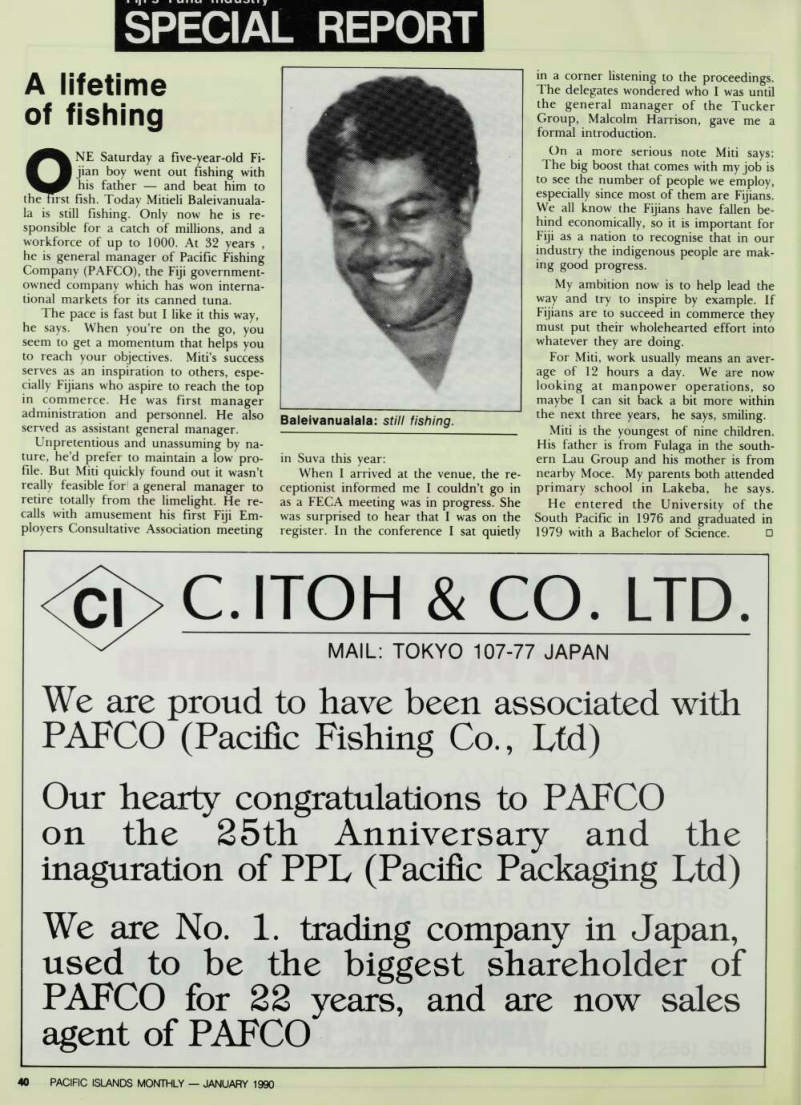
A lifetime of fishing
Saturday a five-year-old Fi-
B B jian boy went out fishing with his father and beat him to the first fish. Today Mitieli Baleivanuala la is still fishing. Only now he is re sponsible for a catch of millions, and a workforce of up to 1000. At 32 years , he is general manager of Pacific Fishing Company (PAFCO), the Fiji government owned company which has won interna tional markets for its canned tuna.
The pace is fast but I like it this way, he says. When you’re on the go, you seem to get a momentum that helps you to reach your objectives. Miti’s success serves as an inspiration to others, espe cially Fijians who aspire to reach the top in commerce. He was first manager administration and personnel. He also served as assistant general manager.
Unpretentious and unassuming by na ture, he’d prefer to maintain a low pro file. But Miti quickly found out it wasn’t really feasible for 1 a general manager to retire totally from the limelight. He re calls with amusement his first Fiji Em
ployers Consultative Association meeting
in Suva this year: When I arrived at the venue, the re ceptionist informed me I couldn’t go in as a FECA meeting was in progress. She was surprised to hear that I was on the register. In the conference I sat quietly
in a corner listening to the proceedings.
The delegates wondered who I was until the general manager of the Tucker Group, Malcolm Harrison, gave me a formal introduction.
On a more serious note Miti says: The big boost that comes with my job is to see the number of people we employ, especially since most of them are Fijians.
We all know the Fijians have fallen be hind economically, so it is important for Fiji as a nation to recognise that in our
industry the indigenous people are mak
ing good progress.
My ambition now is to help lead the way and try to inspire by example. If Fijians are to succeed in commerce they must put their wholehearted effort into
whatever they are doing.
For Miti, work usually means an aver age of 12 hours a day. We are now looking at manpower operations, so maybe I can sit back a bit more within the next three years, he says, smiling.
Miti is the youngest of nine children.
His father is from Fulaga in the south ern Lau Group and his mother is from nearby Moce. My parents both attended primary school in Lakeba, he says.
He entered the University of the South Pacific in 1976 and graduated in 1979 with a Bachelor of Science. □
Baleivanualala: still fishing.
Advertisements & other items, pp. 40-41 (2 items)
Special Report
40
■ ■ J ■ ■ MUM I I I M I I J
PACIFIC ISLANDS MONTHLY JANUARY 1990
<Ci> C.Itoh & Co. Ltd.
MAIL: TOKYO 107-77 JAPAN
We are proud to have been associated with PAFCO (Pacific Fishing Co., Ltd) Our hearty congratulations to PAFCO on the 25 th Anniversary and the inaguration of PPL (Pacific Packaging Ltd) We are No. 1. trading company in Japan, used to be the biggest shareholder of PAFCO for 22 years, and are now sales agent of PAFCO
UKR
at °nce Peifoet ss mr*. i ■-4 4 At Pacific Packaging Ltd, we use the leading edge of can-making technology to produce cans that are second to none. And, when you’re packing the world’s finest tuna, that’s important. u ■l* ■ PPL, investing in Fiji’s future.
Levuka: P.O. Box 41 Phone; 44239 Fax: 44370 Suva: P.O. Box 1371. Phone: 25009,311852. Tlx; FJ2349 Fax: 301904
The Romeo of the fishing business
A TUNA processing technologist
has launched an upgrading programme at the Pacific Fishing Company that will strengthen its position as one of the world’s top producers of
high-quality tuna.
Romeo Garcia, 53, of British Columbia Packers Ltd, Canada, was originally assigned by his company to conduct extensive research into PAFCO s processing methods. He has since been appointed deputy manager operations with PAFCO. Garcia arrived in Fiji in July to take up his new post.
“My intention is to upgrade the system in accordance with international regulations. To achieve this, I need to upgrade the existing facilities and procedures, then train and reorientate the people behind the equipment,” he says.
“The eventual objective is to meet the requirements of the Canadian Department of Fisheries, and to get the plant commissioned as a producer for Marks 8c Spencers, of the United Kingdom
the most demanding buyer.”
Prior to his new appointment at PAF- CO, Garcia performed quality assurance work at the plant over a two-year period, His survey has formed the basis of a
number of recommendations to further streamline PAFCO’s operations, intro duce new tuna equipment and renovate
existing facilities.
Rather than stand back and supervise installation work, Garcia prefers to go onto the floor and pitch in along with the workers. “PAFCO has the potential to become an A-l cannery,” he says.
“One of the reasons my company, B.C.
Packers, is taking an interest in the can nery is its strategic location. It is right in the middle of the tuna source.”
Under a technical agreement between the Fiji Government and B.C. Packers to upgrade PAFCO, Garcia was sent to Fiji to follow through on his earlier recom mendations. His company has also assigned a quality assurance officer to work at PAFCO. He hopes to upgrade the entire plant within a year to comply with Good Manufacturing Practices (GMP) at an estimated cost of US$2.5 million.
Garcia has already increased the speed of several processes. “In a fish cannery, the quality of your product can only be
maintained through quick processing,”
he says. Precooking, one of the first stages of processing tuna used to take
two hours. After Garcia made a number of changes and installed new plumbing for the steam ovens, it now takes less than half long. He also has plans for a new more efficient storage system. “We eventually hope to have about 3000 tuna fish boxes to be used in both the col dstore and the thawing area,” he says.
“Food grade, saltwater aluminium
plates shipped from Canada through
B.C. Packers are currently being assem bled in Suva.”
The fish room, which consists of the thawing area, the butchering area and the precooking area will eventually hold about 100 boxes. These replace three huge cement thawing tanks. “We’ve changed to the batch system using the upwelling method of thawing,” says Gar cia. “With the old system, it took a mini mum of five hours to thaw small fish.
The new cold storage is funded by the Australian Government. It will be built on reclaimed land in front of the can nery. While the existing facility stores 1500 tonnes of tuna, and is designed for big fish weighing 10 kg and upwards, the new coldstore will accommodate 3000 tonnes of cannery-grade fish. □
Advertisements & other items, pp. 42-43 (2 items)
Special Report
42
nji s i una industry
PACIFIC ISLANDS MONTHLY JANUARY 1990
Shipping and Travel
f
Bums
Philp
Shipping and Travel
Wish To Congratulate PAFCO For Their 25th Anniversary and
Inauguration Of Pacific Packaging Ltd.
/VS
NEW ZEALAND LINE
THE BLUE STAR LINE INC.
THE OFFICIAL CARRIER OF PAFCO EXPORTS
TO THE WORLD
BtT
UK/EUROPE
MEDITERRANEAN AND
JEDDAH SERVICE.
PACIFIC
COAST
CONTAINER
SERVICE
a*
BLUE STAR LINE
PACIFIC AMERICA
CONTAINER
EXPRESS
PACIFIC AMERICA CONTAINER-SERVICE
PACIFIC COAST CONTAINER SERVICE! AND MANY MORE ...
EAST COAST NORTH AMERICA.
U V
IM U
N G U E S
INI II
H9EXXI
K s S W E ■
qQEOBQ
JUST LANDED
F/R/e/N/c/H/ / /,
Who can you
bank on no matter
where you land
in the Pacific?
Westpac has a strong presence in this part of the world.
The Westpac ll# is a familiar and welcome sight throughout the South Pacific.
With the recent purchase of the operations of the Banque Indosuez in French Polynesia and New Caledonia, no matter where you land in the region, you’ll find Westpac.
The Banque Indosuez connection, with its 46 branches, brings to eleven the number of South Pacific countries where Westpac has a presence.
Our programme of expansion is a planned one and is part of our overall aim to build and maintain a reputation that people and businesses in the Pacific can bank on.
We see our role as being closely involved in the Pacific’s development.
It’s a role that covers not only multinational companies and major operators, it also extends to small local business people and entrepreneurs.
Westpac has a commitment to the Pacific. And it’s a commitment you can bank on. Wherever you land. ll# You can bank on Westpac Branches. Bahrain. Beijing. Chicago. Columbus. Frankfurt. Hong Kong. Honiara. Houston. Jakarta. Kuala Lumpur. London. Los Angeles. New York.
Niue. Noumea. Papeete. Port Moresby. Port Vila. Rarotonga. San Francisco. Seoul. Singapore. Suva. Sydney. Taipei. Tokyo. Wellington.
Subsidiary: Kiribati (Bank of Kiribati Ltd, Tarawa) Affiliates: Tonga (Bank of Tonga, Nukualofa) .Tuvalu (National Bank of Tuvalu, Funafuti) .Western Samoa (Pacific Commercial Bank Ltd, Apia)
canning enterprise
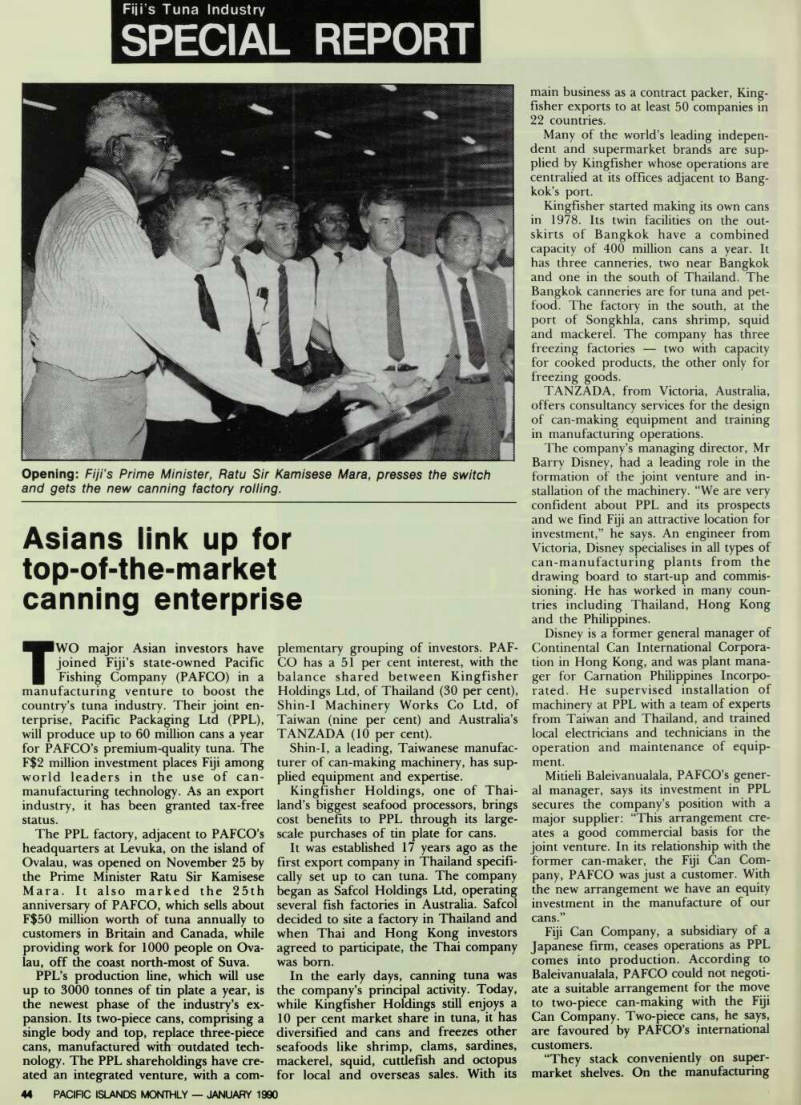
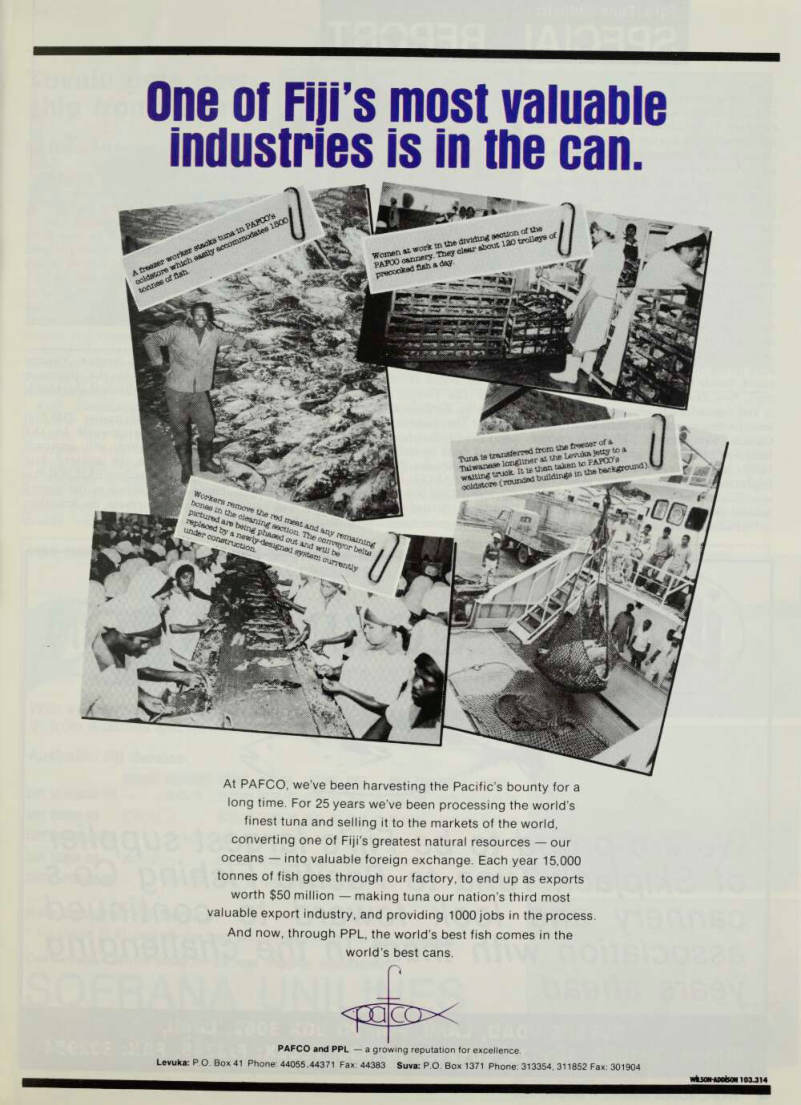
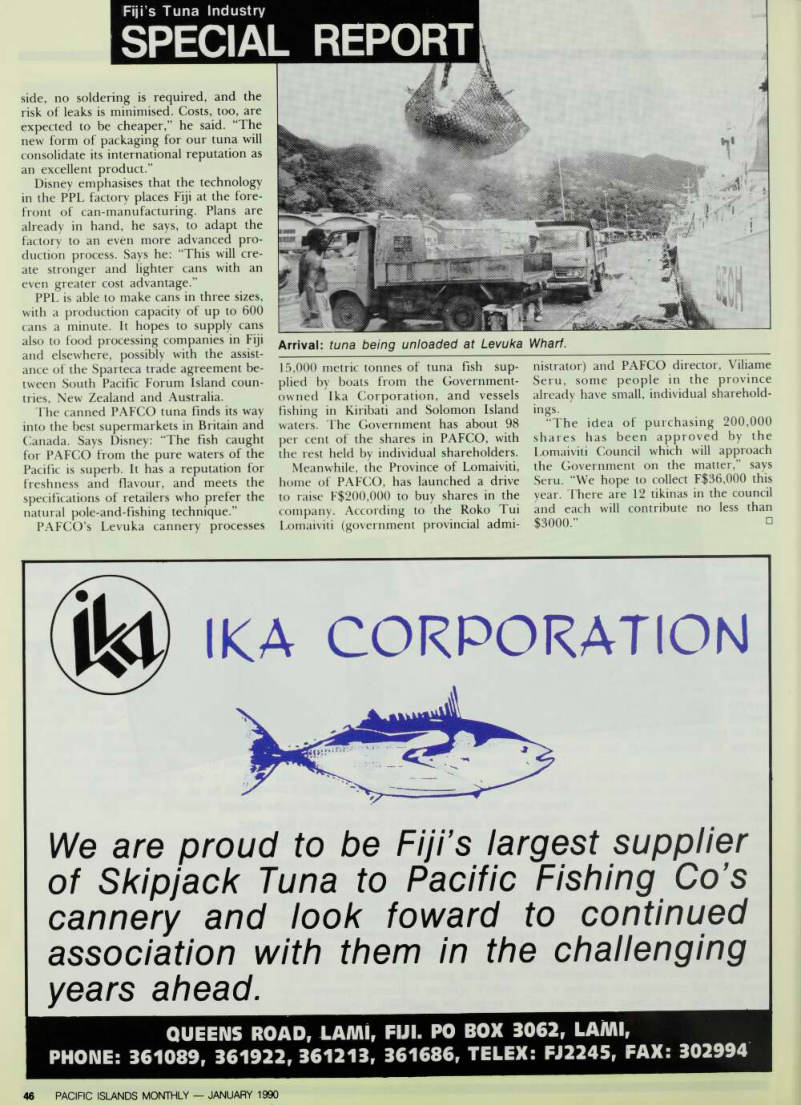
Asians link up for top-of-the-market canning enterprise
TWO major Asian investors have
joined Fiji’s state-owned Pacific
Fishing Company (PAFCO) in a manufacturing venture to boost the country’s tuna industry. Their joint en terprise, Pacific Packaging Ltd (PPL), will produce up to 60 million cans a year for PAFCO’s premium-quality tuna. The Fs2 million investment places Fiji among world leaders in the use of can manufacturing technology. As an export industry, it has been granted tax-free status.
The PPL factory, adjacent to PAFCO’s headquarters at Levuka, on the island of Ovalau, was opened on November 25 by the Prime Minister Ratu Sir Kamisese Mara. It also marked the 25th anniversary of PAFCO, which sells about Fsso million worth of tuna annually to customers in Britain and Canada, while providing work for 1000 people on Ova lau, off the coast north-most of Suva.
PPL’s production line, which will use up to 3000 tonnes of tin plate a year, is the newest phase of the industry’s ex
pansion. Its two-piece cans, comprising a
single body and top, replace three-piece
cans, manufactured with outdated tech nology. The PPL shareholdings have cre ated an integrated venture, with a com
plementary grouping of investors. PAF CO has a 51 per cent interest, with the balance shared between Kingfisher Holdings Ltd, of Thailand (30 per cent), Shin-I Machinery Works Co Ltd, of Taiwan (nine per cent) and Australia’s TANZADA (10 per cent).
Shin-I, a leading, Taiwanese manufac turer of can-making machinery, has sup
plied equipment and expertise.
Kingfisher Holdings, one of Thai land’s biggest seafood processors, brings cost benefits to PPL through its large scale purchases of tin plate for cans.
It was established 17 years ago as the first export company in Thailand specifi cally set up to can tuna. The company
began as Safcol Holdings Ltd, operating
several fish factories in Australia. Safcol decided to site a factory in Thailand and when Thai and Hong Kong investors agreed to participate, the Thai company was born.
In the early days, canning tuna was
the company’s principal activity. Today,
while Kingfisher Holdings still enjoys a
10 per cent market share in tuna, it has diversified and cans and freezes other seafoods like shrimp, clams, sardines, mackerel, squid, cuttlefish and octopus for local and overseas sales. With its
main business as a contract packer, King fisher exports to at least 50 companies in 22 countries.
Many of the world’s leading indepen dent and supermarket brands are sup
plied by Kingfisher whose operations are
centralied at its offices adjacent to Bang kok’s port.
Kingfisher started making its own cans in 1978. Its twin facilities on the out skirts of Bangkok have a combined capacity of 400 million cans a year. It has three canneries, two near Bangkok and one in the south of Thailand. The Bangkok canneries are for tuna and pet food. The factory in the south, at the
port of Songkhla, cans shrimp, squid
and mackerel. The company has three freezing factories two with capacity for cooked products, the other only for
freezing goods.
TANZADA, from Victoria, Australia, offers consultancy services for the design
of can-making equipment and training
in manufacturing operations.
The company’s managing director, Mr Barry Disney, had a leading role in the formation of the joint venture and in stallation of the machinery. “We are very confident about PPL and its prospects and we find Fiji an attractive location for investment,” he says. An engineer from Victoria, Disney specialises in all types of
can-manufacturing plants from the
drawing board to start-up and commis sioning. He has worked in many coun tries including Thailand, Hong Kong and the Philippines.
Disney is a former general manager of Continental Can International Corpora tion in Hong Kong, and was plant mana ger for Carnation Philippines Incorpo rated. He supervised installation of machinery at PPL with a team of experts from Taiwan and Thailand, and trained local electricians and technicians in the operation and maintenance of equip ment.
Mitieli Baleivanualala, PAFCO’s gener al manager, says its investment in PPL secures the company’s position with a major supplier: “This arrangement cre ates a good commercial basis for the joint venture. In its relationship with the former can-maker, the Fiji Can Com pany, PAFCO was just a customer. With the new arrangement we have an equity investment in the manufacture of our cans.”
Fiji Can Company, a subsidiary of a Japanese firm, ceases operations as PPL comes into production. According to Baleivanualala, PAFCO could not negoti ate a suitable arrangement for the move
to two-piece can-making with the Fiji
Can Company. Two-piece cans, he says, are favoured by PAFCO’s international customers.
“They stack conveniently on super market shelves. On the manufacturing
Opening: Fiji’s Prime Minister, Ratu Sir Kamisese Mara, presses the switch and gets the new canning factory rolling.
side, no soldering is required, and the risk of leaks is minimised. Costs, too, are expected to be cheaper,” he said. “The new form of packaging for our tuna will consolidate its international reputation as an excellent product.”
Disney emphasises that the technology in the PPL factory places Fiji at the fore front of can-manufacturing. Plans are already in hand, he says, to adapt the factory to an even more advanced pro duction process. Says he: “This will cre ate stronger and lighter cans with an even greater cost advantage.”
PPL is able to make cans in three sizes, with a production capacity of up to 600 cans a minute. It hopes to supply cans also to food processing companies in Fiji and elsewhere, possibly with the assist ance of the Sparteca trade agreement be tween South Pacific Forum Island coun tries, New Zealand and Australia.
The canned PAFCO tuna finds its way into the best supermarkets in Britain and Canada. Says Disney: “The fish caught for PAFCO from the pure waters of the Pacific is superb. It has a reputation for freshness and flavour, and meets the specifications of retailers who prefer the
natural pole-and-fishing technique.”
PAFCO’s Levuka cannery processes
15,000 metric tonnes of tuna fish sup plied by boats from the Government owned Ika Corporation, and vessels fishing in Kiribati and Solomon Island waters. The Government has about 98 per cent of the shares in PAFCO, with the rest held by individual shareholders.
Meanwhile, the Province of Lomaiviti, home of PAFCO, has launched a drive to raise F 5200,000 to buy shares in the company. According to the Roko Tui Lomaiviti (government provincial admi
nistrator) and PAFCO director, Viliame Seru, some people in the province already have small, individual sharehold ings.
“The idea of purchasing 200,000 shares has been approved by the Lomaiviti Council which will approach the Government on the matter,” says Seru. “We hope to collect F 536,000 this year. There are 12 tikinas in the council and each will contribute no less than $3000.” □
Arrival: tuna being unloaded at Levuka Wharf.
Advertisements & other items, pp. 44-46 (3 items)
Special Report
Fiji’s Tuna Industry
One of Fill’s most valuable
industries is in the can.
i «oi»n TMJ °"* 1 ,r- -i* IS I M V % *r (*« « 13 s*** ** « Wf 2^ liv> St tz ¥ WJ / At PAFCO, we’ve been harvesting the Pacific’s bounty for a long time. For 25 years we’ve been processing the world’s finest tuna and selling it to the markets of the world, converting one of Fiji’s greatest natural resources our oceans into valuable foreign exchange. Each year 15,000 tonnes of fish goes through our factory, to end up as exports worth $5O million making tuna our nation’s third most valuable export industry, and providing 1000 jobs in the process.
And now, through PPL, the world’s best fish comes in the world’s best cans.
<pQCD><
PAFCO and PPL a growing reputation for excellence.
Levuka: P.O. Box 41 Phone: 44055.44371 Fax; 44383 Suva: P.O. Box 1371 Phone: 313354, 311852 Fax; 301904 10&314
IK A CORPORATION
We are proud to be Fiji’s largest supplier of Skipjack Tuna to Pacific Fishing Co’s cannery and look toward to continued association with them in the challenging years ahead.
QUEENS ROAD, LAJUII, FIJI. PO BOX 3062, LAfIAI, PHONE: 361089, 361922, 361213, 361686, TELEX: FJ2245, FAX: 302994
Special Report
46
PACIFIC ISLANDS MONTHLY JANUARY 1990
Fiji’s Tuna Industry
SPECIAL REPORT
ship from Japan
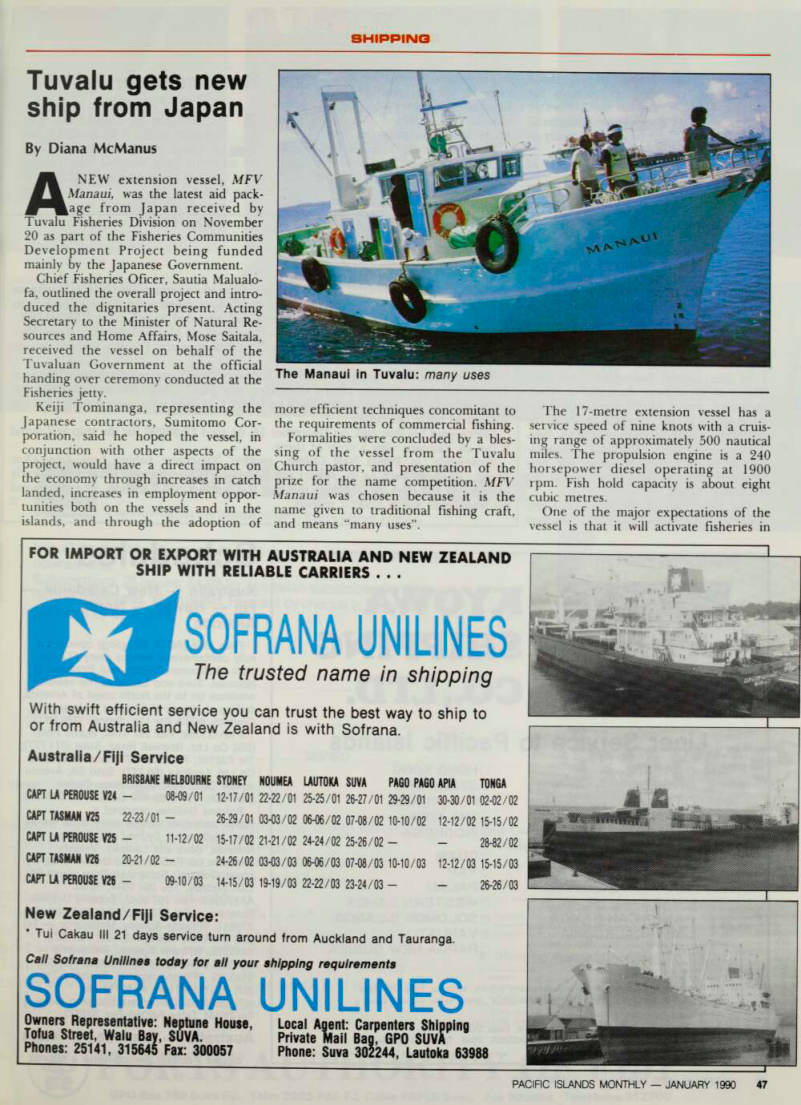
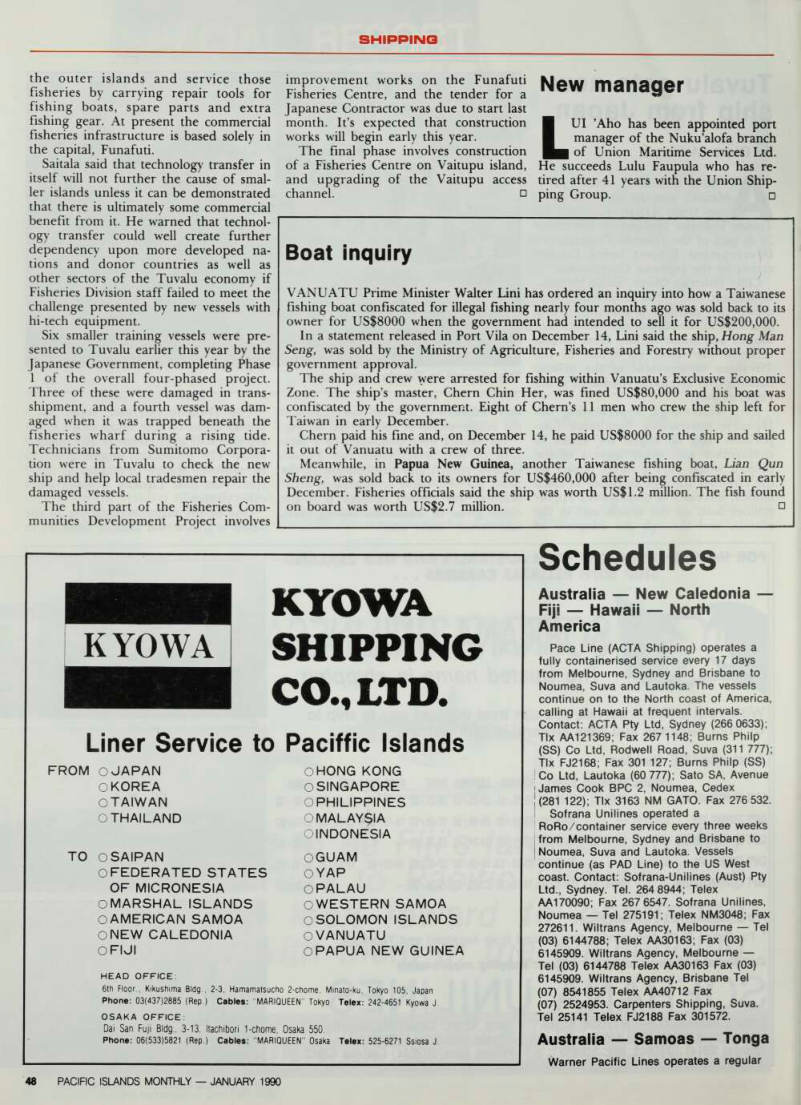
Shipping
Tuvalu gets new ship from Japan
By Diana McManus
ANEW extension vessel, MFV Manaui, was the latest aid pack age from Japan received by Tuvalu Fisheries Division on November 20 as part of the Fisheries Communities
Development Project being funded
mainly by the Japanese Government.
Chief Fisheries Oficer, Sautia Malualo fa, outlined the overall project and intro duced the dignitaries present. Acting Secretary to the Minister of Natural Re sources and Home Affairs, Mose Saitala, received the vessel on behalf of the Tuvaluan Government at the official handing over ceremony conducted at the
Fisheries jetty.
Keiji Tominanga, representing the
Japanese contractors, Sumitomo Cor poration, said he hoped the vessel, in conjunction with other aspects of the project, would have a direct impact on the economy through increases in catch landed, increases in employment oppor tunities both on the vessels and in the islands, and through the adoption of
more efficient techniques concomitant to the requirements of commercial fishing.
Formalities were concluded by a bles sing of the vessel from the Tuvalu Church pastor, and presentation of the prize for the name competition. MFV Manaui was chosen because it is the name given to traditional fishing craft, and means “many uses”.
The 17-metre extension vessel has a service speed of nine knots with a cruis ing range of approximately 500 nautical miles. The propulsion engine is a 240 horsepower diesel operating at 1900 rpm. Fish hold capacity is about eight cubic metres.
One of the major expectations of the vessel is that it will activate fisheries in
The Manaui in Tuvalu: many uses
the outer islands and service those
fisheries by carrying repair tools for
fishing boats, spare parts and extra fishing gear. At present the commercial fisheries infrastructure is based solely in the capital, Funafuti.
Saitala said that technology transfer in itself will not further the cause of smal ler islands unless it can be demonstrated that there is ultimately some commercial benefit from it. He warned that technol ogy transfer could well create further dependency upon more developed na tions and donor countries as well as other sectors of the Tuvalu economy if Fisheries Division staff failed to meet the challenge presented by new vessels with
hi-tech equipment.
Six smaller training vessels were pre sented to Tuvalu earlier this year by the Japanese Government, completing Phase 1 of the overall four-phased project.
Three of these were damaged in trans shipment, and a fourth vessel was dam aged when it was trapped beneath the fisheries wharf during a rising tide.
Technicians from Sumitomo Corpora tion were in Tuvalu to check the new ship and help local tradesmen repair the
damaged vessels.
The third part of the Fisheries Com munities Development Project involves
improvement works on the Funafuti Fisheries Centre, and the tender for a Japanese Contractor was due to start last month. It’s expected that construction works will begin early this year.
The final phase involves construction of a Fisheries Centre on Vaitupu island, and upgrading of the Vaitupu access channel. □
Advertisements & other items, pp. 47-48 (1 item)
So Fran A Unilines
FOR IMPORT OR EXPORT WITH AUSTRALIA AND NEW ZEALAND SHIP WITH RELIABLE CARRIERS . . .
The trusted name in shipping
With swift efficient service you can trust the best way to ship to or from Australia and New Zealand is with Sofrana.
Australia/ Fiji Service BRISBANE MELBOURNE SYDNEY NOUMEA LAUTOKA SUVA PAGO PAGO APIA TONGA CAP! LA PEROUSE V24 - 08-09 / 01 12-17 / 01 22-22 / 01 25-25 / 01 26-27 / 01 29-29 / 01 30-30 / 01 02-02 / 02 CAPT TASMAN V25 22-23 / 01 - 26-29 / 01 03-03 / 02 06-06 / 02 07-08 / 02 10-10 / 02 12-12 / 02 15-15 / 02 CAPT LA PEROUSE V25 — 11-12/02 15-17/02 21-21/02 24-24/02 25-26/02 — — 28-82/02 CAPT TASMAN V26 20-21/02 - 24-26 / 02 03-03 / 03 06-06 / 03 07-08 / 03 10-10 / 03 12-12 / 03 15-15 / 03 CAPT LA PEROUSE V26 - 09-10 / 03 14-15 / 03 19-19 / 03 22-22 / 03 23-24 / 03 - - 26-26 / 03 New Zealand/Fiji Service: Tui Cakau III 21 days service turn around from Auckland and Tauranga.
Call Sofrana Unlllnea today for all your shipping requirements
SOFRANA UNILINES
Owners Representative: Neptune House, Local Agent: Carpenters Shipping Tofua Street walu Bay SUVA. Private fail Bag, GPO SUVA Phones: 25141, 315645 Fax: 300057 Phone: Suva 302244, Lautoka 63988
KYOWA
KYOWA
SHIPPING
CO., LTD.
Liner Service
FROM OJAPAN
OKOREA
OTAIWAN
O THAILAND
TO OSAIPAN
OFEDERATED STATES
OF MICRONESIA
OMARSHAL ISLANDS
O AMERICAN SAMOA
ONEW CALEDONIA
O FIJI
to Paciffic Islands
OHONG KONG
OSINGAPORE
OPHILIPPINES
O MALAYSIA
©INDONESIA
OGUAM
OYAP
OPALAU
©WESTERN SAMOA
©SOLOMON ISLANDS
©VANUATU
©PAPUA NEW GUINEA
HEAD OFFICE:
6th Floor., Kikushima Bldg., 2-3, Hamamatsucho 2-chome, Mmato-ku, Tokyo 105, Japan Phone: 03(437)2885 (Rep.) Cables: "MARIQUEEN" Tokyo Telex: 242-4651 Kyowa J.
OSAKA OFFICE:
Dai San Fuji Bldg., 3-13, Itachibori 1-chome, Osaka 550.
Phone: 06(533)5821 (Rep.) Cables; “MARIQUEEN" Osaka Telex: 525-6271 Ssiosa J,
New manager
LUI ’Aho has been appointed port manager of the Nukualofa branch of Union Maritime Services Ltd.
He succeeds Lulu Faupula who has re tired after 41 years with the Union Ship ping Group. □
Boat inquiry
VANUATU Prime Minister Walter Lini has ordered an inquiry into how a Taiwanese fishing boat confiscated for illegal fishing nearly four months ago was sold back to its owner for US$BOOO when the government had intended to sell it for US$2OO,OOO.
In a statement released in Port Vila on December 14, Lini said the ship, Hong Man Seng, was sold by the Ministry of Agriculture, Fisheries and Forestry without proper
government approval.
The ship and crew were arrested for fishing within Vanuatu’s Exclusive Economic Zone. The ship’s master, Chern Chin Her, was fined US$BO,OOO and his boat was confiscated by the government. Eight of Chern’s 11 men who crew the ship left for Taiwan in early December.
Chern paid his fine and, on December 14, he paid US$BOOO for the ship and sailed it out of Vanuatu with a crew of three.
Meanwhile, in Papua New Guinea, another Taiwanese fishing boat, Lian Qun Sheng, was sold back to its owners for U 55460,000 after being confiscated in early December. Fisheries officials said the ship was worth US$l.2 million. The fish found on board was worth US$2.7 million. □
Schedules


Australia New Caledonia
Fiji Hawaii North
America
Pace Line (ACTA Shipping) operates a fully containerised service every 17 days from Melbourne, Sydney and Brisbane to Noumea, Suva and Lautoka. The vessels continue on to the North coast of America, calling at Hawaii at frequent intervals.
Contact; ACTA Pty Ltd, Sydney (266 0633); Tlx AA121369; Fax 267 1148; Burns Philp (SS) Co Ltd, Rodwell Road. Suva (311 777); Tlx FJ2168; Fax 301 127; Burns Philp (SS) Co Ltd, Lautoka (60 777); Sato SA, Avenue James Cook BPC 2, Noumea, Cedex (281 122); Tlx 3163 NM GATO. Fax 276 532.
Sofrana Unilines operated a Roßo/container service every three weeks from Melbourne, Sydney and Brisbane to Noumea, Suva and Lautoka. Vessels continue (as PAD Line) to the US West coast. Contact; Sofrana-Unilines (Aust) Pty Ltd., Sydney. Tel. 264 8944; Telex AA170090; Fax 267 6547. Sofrana Unilines, Noumea Tel 275191; Telex NM3048; Fax 272611. Wiltrans Agency, Melbourne Tel (03) 6144788; Telex AA30163; Fax (03) 6145909. Wiltrans Agency, Melbourne Tel (03) 6144788 Telex AA30163 Fax (03) 6145909. Wiltrans Agency, Brisbane Tel (07) 8541855 Telex AA40712 Fax (07) 2524953. Carpenters Shipping, Suva.
Tel 25141 Telex FJ2IBB Fax 301572.
Australia Samoas Tonga
Warner Pacific Lines operates a regular
container service from Sydney, Brisbane and Melbourne to Nukualofa, Pago Pago, Apia and Vava’u with transhipment to Rarotonga. Contact: Hetherington Westfarmers Shipping Agency, 37-49 Pitt St, Sydney (223 1600).
Australia New Caledonia
Fiji Samoas Tonga
Pacific Forum Line operates a fully containerised service (general, reefer and ro-ro) from Sydney to Noumea, Lautoka, Suva, Apia, Pago Pago, Nukualofa, Sydney. Cargo centralised from Adelaide, Melbourne, Brisbane. Contact: Pacific Forum Line, PO Box 796, Auckland; Union Bulkships, 333 George St, Sydney, Brisbane and Melbourne; Union Co, Lautoka; Pacific Forum Line, Suva, Nukualofa; Pacific Forum Line, Apia; Polynesia Shipping, Pago Pago.
Sofrana Unilines operated a Roßo/container service every three weeks from Melbourne, Sydney and Brisbane to Noumea, Suva and Lautoka with transhipment to the Samoas and Tonga.
For details see above.
Australia Norfolk Island Lord Howe Island Sofrana-Unilines (Australia) Pty Ltd operates a regular monthly service with MV Capitaine Wallis. Contact; Sofrana-Unilines, Sydney (02) 2648944; Telex AA170090 Fax 2676547.
Australia New Caledonia Vanuatu Campagnie Generale Maritime operates a monthly service from Sydney, Melbourne and Brisbane to Noumea, Port Vila and Santo, for containerised and break-bulk cargo. Contact: Compagnie Generale Maritime 12 Castlereagh St, Sydney (231 3700).
Australia Nauru Nauru Pacific Line operates a regular cargo service from Melbourne to Nauru, passenger service to Nauru only. Contact: Nauru Pacific Line (Aust) Pty Ltd, Nauru House, 80 Collins St, Melbourne (653 5709), Nedlloyd Swire, 8 Spring St, Sydney, (20 522).
Australia Solomon Islands Vanuatu NGAL/PNGL joint service operates a monthly service. Contact; Nedlloyd Swire Pty Ltd, 6 Spring St, Sydney (20 522).
Australia New Zealand ANL Ltd operates the Tranztas contain er service between Australia and New Zealand, offering access to five vessels.
These vessels call at Melbourne, Sydney, Brisbane (Tasmania, Adelaide and Fre mantle via feeder services) in Australia and Auckland, Wellingtoin, Lyttelton, Port Chalmers, Nelson, Tauranga (Napier via feeder service) in New Zealand. Each ves
sel operates on an approximate three weekly round voyage schedule.
Australia NZ Fiji Vanuatu New Caledonia Solomons New Guinea Sitmar Cruises operates a year-round cruise programme from Sydney to include the better-known ports in the above countries plus a number of unspoilt, and largely unknown, island paradises. Contact: Sitmar Cruises, 39 Martin Place, Sydney (239 9000) for NSW; reservations and inquiries (008 42 2277); rest of Australia, reservations and enquiries (088 22 2277).
Australia NZ Fiji Tonga
Vanuatu New Caledonia Solomons Samoas Tahiti P&O Liners call at Auckland, Bay of Islands, Honiara, Lautoka, Noumea, Nukualofa, Pago Pago, Papeete, Port Moresby, Santo, Savusavu, Suva, Vava’u and Vila on cruises from Australia.
Contact: P&O Booking Centre, Thomas Cook Pty Ltd, 33 Bligh St, Sydney (237 0333).
Australia PNG Solomons Vanuatu A consortium of NGAL/PNG and CONPAC has four vessels operating a joint service from east coast Australian ports to Port Moresby, Lae, Alotau, Madang, Wewak, Rabaul, Kavieng-Kimbe, Kieta, Honiara, Vila, Santo. Contact: Burns Philp & Co Ltd, PO Box R 124, Royal Exchange, Sydney (20 547); Nedlloyd Swire, 8 Spring St, Sydney (20 522); New Guinea Express Lines, 37 Pitt St, Sydney (241 3991); Vila Agents. PO Box 27, Port Vila (2456), Tlx
Nhioii.
Australia Kiribati CCS operates a 6 weekly service from Melbourne, Sydney and Brisbane to Kiribati (Tarawa). Contact: Chief Container Service, 8 Spring Street, Sydney (251-2699) Fax 251-2271.
Australia Tuvalu CCS operates a direct service every second voyage to Tuvalu (Funafuti).
Contact: Chief Container Service, 8 Spring Street, Sydney (251-2699) Fax 251-2271.
Australia New Caledonia Vanuatu CCS operates a monthly service from Melbourne, Sydney and Brisbane to Noumea, Vila and Santo. Contact: Chief Container Service, 8 Spring Street, Sydney (251-2699) Fax 251-2271.
Australia Solomons Vanuatu CCS operates a monthly service from
Melbourne, Sydney and Brisbane to Honiara, Vila and Santo. Contact; Chief Container Service, 8 Spring Street, Sydney (251-2699) Fax 251-2271.
Europe Tahiti New
Caledonia Vanuatu
The Bank Line and Columbus Line operate a regular joint cargo service from Hamburg, Bramen, Antwerp, Rotterdam and Le Havre to Papeete, Noumea, Port Vila and Santo. Contact: The Bank Line (A’asia) Pty Ltd, 53 Martin Place, Sydney (223 6255), Tlx AA24063; Columbus Line, Lae (423 466), Tlx NE44171; Ets A.M. Fare DTE, Papeete: Ets Ballande, Noumea and other local agents.
Sofrana Europe Australia Line “Sofeal” operates a regular three-weekly service from North European ports including Felixstowe to Papeete from Noumea.
Contact: from McArthur Shipping Agency Co Pty Ltd., Tel (02) 5502222 Telex AA24045 Fax 5191382.
Europe PNG Solomons
The Bank Line & Columbus Line operate a regular joint cargo service from Hamburg, Bramen, Antwerp, Rotterdam and Le Havre to Port Moresby, Lae, Madang, Kimbe, Rabaul, Kieta and Honiara and on inducement to Yandina. Contact: The Bank Line (A’asia) Pty Ltd, 51 Pitt St, Sydney (251 6688). Tlx: AA24066, Columbus Line, Lae (423466) Tlx: NE44171; or lines’ local agents.
Rarotonga Line operates regular services to Tonga and the Samoas from New Zealand. Contact Sofrana Unilines (NZ) Ltd.
Tel (09) 773279 Telex NZ2313 Fax (09) 393874.
Europe W. Samoa Tonga
-Fiji
The Bank Line & Columbus Line operate a regular joint cargo service from Hamburg, Breman, Antwerp, Rotterdam and Le Havre to Apia, Nukualofa, Suva and Lautoka. Contact: The Bank Line (A’asia) Pty Ltd, 53 Martin Place, Sydney (223 6255), Tlx AA24063; Columbus Line, Lae (423 466), Tlx NE44171; or lines’ local agents.
Singapore Hong Kong Fiji
Islands ports
Kyowa Shipping Co Ltd operates a monthly containerised and break-bulk cargo service from Hong Kong to Lautoka, Suva and then to island ports. Contact: Carpenters Shipping, Private Mail Bag, GPO Suva, Fiji (31 2244); Fax; (679) 301 572. Tlx FJ2199.
Far East Fiji New Zealand New Zealand Unit Express (NZUE) operates a monthly service accepting containerised and break-bulk cargo from Manila, Keelung, Kaohsiung and Hong
Kong to Lautoka, Suva and thence to New Zealand ports. Contact: Carpenters Shipping, Private Mail Bag, GPO Suva, Fiji (312 2244), Fax: (679) 311 572; Tlx FJ2199; Burns Philp, Suva (311 777); New Zealand Unit Express, Maritime Building, 2-10 Customhouse Quay, PO Box 890, Wellington (727 865), Cables ENZUEMAN
Wellington, Tlx Nz31340, Nedlnz, Or
Nedlloyd Swire Pty Ltd, Sydney (20 522).
Far East Mid South Pacific China Navigation’s New Guinea Pacific Line operates a regular container and Break Bulk-Heavy Lift service from Hong Kong, Taiwan, Manila, Singapore, Malaysia, Thailand to Port Moresby, Lae, Rabaul, Kieta and Honiara with 18 days frequency.
Wewak and Madang will receive four direct calls a year or more on inducement. A T/service via Lae to these and other PNG ports connecting with monthly sailings is available at cost. Cargo from the same Eastern ports to the South Pacific ports of Noumea, Santo, Vila, Papeete, Pago Pago, Apia, Nukualofa, Rarotonga and Tarawa will be shipped via Japan or Busan on the monthly Bali Hai service. Contact Steamships Shipping, PO Box 634, Port Moresby (220 283 or 220 289).
Kyowa Shipping Ltd operates monthly services from Japan to Guam, Saipan, Solomons, New Caledonia, Fiji, Western and American Samoa, Tahiti, Cook Islands, Tonga and Vanuatu. Contact: Hetherington Wesfarmers Shipping Agency, 37-49 Pitt St, Sydney (223 1600); Carpenters Shipping, Suva (312 244), Tlx FJ2199.
Guam Northern Marianas Saipan Shipping Co operates a weekly service via barge carrying containers and conventional cargo between Guam and Saipan and Tinian. Contact: Saipan Shipping Co. Inc, PO Box 8, Saipan CM 96950 (322 9706 or 322 9707). Tlx 783619; Fax (670) 322 3183; Guam agents Maritime Agencies of the Pacific Ltd.
Hawaii Samoas Tonga Cook Islands Hawaii-Pacific Line operates a monthly container service between Honolulu, Pago Pago, Apia, Nukualofa and Avatiu (Rarotonga). Contact: Hawaii-Pacific Maritime, Inc., PO Box 3264, Honolulu HI (9680)-32641 (808 531 4841) Morris Hedstrom Samoa Ltd, PO Box 189, Apia, Western Samoa (21 355, 22 722), Tlx 224 MORISHED SX), Fax 24 279; Union Citco Travel Ltd, Rarotonga, Cook Islands (682) 21 780); Tlx 62024 (UTRAV G); Fax (682) 20 859; Kneubuhl Maritime Services, PO Box 39, Pago Pago, American Samoa 96799, (684 633 5121); Tlx 782505; Fax (684) 633 5100; Union Maritime Services Ltd, PO Box 4 Nukualofa, Tonga (21 644/5); Tlx 6627, Fax (676) 21 645.
Japan Fiji Island Ports
Kyowa Shipping Coperates a monthly containerised service from main ports of
Japan to Suva, Lautoka, thence to island ports. Contact: Carpenters Shipping, Neptune House, 3/4 Floor, Tofua St, Walu Bay, Suva (31 2244); Fax (679) 301 572 Tlx FJ2199.
Japan Micronesia
The NYK Shipping Line operates a monthly cargo service from Japan to Micronesia, calling at Yoko, Nagoya, Kobe, Guam, Saipan, Truk, Ponape and Majuro, returning via Yoko, Nagoya and Kobe.
Contact; Burns Philp & Co Ltd, 51 Pitt St, Sydney (259 1000).
Saipan Shipping Co operates a monthly service from Japan to Saipan, Guam, Truk, Ponape, Majuro (Kosrae and Ebeye on inducement). Contact: Saipan Shipping Co, PO Box 8, Saipan, CM 96960 (322 9706 or 322 9707). Tlx 783619, Fax (670) 322 3183.
Japan agents: Kyowa Shipping Company Ltd; Guam Agents; Maritime Agencies of the Pacific Ltd.
Japan Korea PNG Paradise Service Mitsui OSK Lines in joint service with NYK Lines operates a monthly service from main ports in Japan and Busan in Korea to PNG ports of Wewak, Rabaul, Kieta, Lae, Port Moresby, Kavieng, Kimbe, Madang and Oro Bay. Contact: Robert Laurie Company Pty Ltd, PO Box 1032, Lae (direct: 423 642 or a switch: 423 811).
Contact W O Hackenberg, Group Shipping Manager & Marketing; Tlx NE 42508 Fax 423 801.
Japan Korea Fiji Island
Ports Bali Hai Service operates a monthly and general cargo and vehicle service from main Japanes ports and Korea to Suva, Lautoka, Apia, Pago Pago, Papeete, Nuku’alofa, Noumea, Vila, Santo and Honiara. Contact: John Swire and Sons (Japan) Ltd, 14 Ichibancho, Chiyoda-ku, Tokyo (03) 230 9220; Tlx J 22248, Fax (03) 230 9288.
PNG Inter-Mainport
Papua New Guinea Lines offers scheduled 10-20 day coastal liner services linking all PNG major ports with containerisation, reefer, heavy lift and trans-shipment facilities. Contact: PNG Line, Box 543, Port Moresby (211 174), Tlx 22269.
PNG Taiwan Hong Kong
Singapore Indonesia
The Bank Line & Columbus Line operates a regular joint cargo service from PNG Ports to Kaohsiung. Hong Kong, Singapore, Jakarta & Surabaya. Contact: The Bank Line (A’asia) Pty Ltd, 51 Pitt St, Sydney (251 6688); Tlx AA24063; Columbus Line, Lae (423 466); Tlx NE44171; or lines’ local agents.
PNG UK/Continent
The Bank Line and Columbus Line
operate a regular joint service from Port Moresby, Oro Bay, Kieta, Rabaul, Kimbe, Madang and Lae to Hull, Hamburg, Rotterdam, Antwerp and Le Havre. Contact: The Bank Line (A’asia) Pty Ltd, 53 Martin Place, Sydney (223 6255), Tlx AA24063; Columbus Line, Lae (423 466), Tlx NE44171; or lines’ local agents.
Solomons UK/Continent The Bank Line and Columbus Line operate a regular joint cargo service from Honiara to Hull, Hamburg, Rotterdam, Antwerp and Le Havre. Contact: The Bank Line (A’asia) Pty Ltd, 53 Martin Place, Sydney (223 6255), Tlx AA24063; Columbus Line, Lae (423 466), Tlx NE44171; or lines’ local agents.
Hyundai Merchant Marine Co operates a regular three-weekly service from PNG ports to Northern European ports, including Felixtowe. Contact; McArthur Shipping Agency Co. Pty Ltd; Tel. Sydney (02) 5502222 Telex AA24045 Fax (02) 519 1382 or from local PNG agents.
New Zealand Australia PNG Solomon Islands Pacific Forum Line operates a containerised and ro-ro service from Lyttleton, Napier and Auckland to Brisbane, Port Moresby, Lae, Honiara, Brisbane then to New Zealand. Contact: Pacific Forum, Auckland, Christchurch; Union Bulkships, Brisbane; Steamships Shipping, Port Moresby and Lae Sullivan Ltd, Honiara; Seabridge, Wellington.
New Zealand Cook Islands Tahiti New Zealand Line operates cargo services based on pallets and similar units from Auckland to Cook Islands and Tahiti.
Contact: NZ Shipping Agencies International Ltd, PC Box 3420, Auckland (392 650), Waterfront Commission, PC Box 61, Rarotonga, Cook Islands; Shipping Office, Govt of Niue, PO Box 107, Niue Island: Compagnie Maritime Polynesienne, PO Box 36, Papeete, Tahiti.
New Zealand Fiji Pacific Line with one ship operates a three-weekly ro-ro cargo service New Zealand. Lautoka, Suva. No passengers.
Contact: Sofrana Unilines, (773 279); PO Box 3614, Tlx NZ2313, Carpenters Shipping, Neptune House, Tofua St, Walu Bay, Suva (25 141), Tlx FJ2199.
New Zealand Fiji North
America (WC)
Blue Star Line Ltd Pacific Coast container services: only direct service to and from New Zealand. Blue Star vessels call at Suva and Honolulu on NZ-US West Coast voyages. Contact: Blueport ACT (NZ) Ltd, PO Box 192, Wellington (739 029); Burns Philp (SS) Co Ltd, GPO Box 355, Suva (311 777), Tlx FJ2168 Burnship.
Advertisements & other items, pp. 49-51 (1 item)
your Transhipment
3 a fi pin - r#
after
Let
your Transhipment
Cargo Free of charge
As from 1 st of April 1 989 Ports Authority of Fiji offers concessions on all transhipment cargo.
To qualify for this concession a minimum volume of 25 TEU containerised cargo or 100 Freight Tonne conventional cargo is required.
There's Free Wharfage. Free Handling and Removal, Free security on cargo and Free storage, all you pay is 50% port charge and normal stevedoring rates.
Take this great opportunity now and serve your clients better in volume and service in the islands and the world The Current Levy A. Ports Authority Charges B. Shipping Agency Charges
PORTS AUTHORITY OF FIJI
GPO Box 780 Suva Fiji, Telex 2203 PAF FJ, Cable PAFIJI Suva, Fax 300064, Telephone 312700
BANK LINE and
COLUMBUS LINE
24 day service to
Europe.
Need we say more...
ft G The Joint Service Partners offer facilities for shipment of; Containers (FCL/LCL) and Break-bulk Cargo plus reefer space and deeptanks for carriage of vegetable oils and other liquid bulk cargo.
Carriers also accept heavy lifts, overlength and cumbersome parcels.
Ports of Service: Loading; Papeete, Apia, Suva, Lautoka, Noumea, Port Vila, Santo, Honiara, Port Moresby, Lae, Madang, Kimbe, Rabaul, Kieta, Darwin. For; Rotterdam, Antwerp Hamburg, Hull, Dunkirk, Le Havre.
Additional ports on enquiry.
Please contact our regional offices for further information: The Bank Line (Australasia) Pty Ltd Suite 701, 51 Pitt St.
Sydney, NSW. Australia 2000 Phone 251 6688 Telex 24063 Columbus Line Reederei GmbH P.O. Box 1 667, Lae/Papua New Guinea.
Phone: 423466/423487/A.H. 422481 Telex; Colline NE 44171 The South Pacific Specialists for over 75 years
Sex, tourism and STD
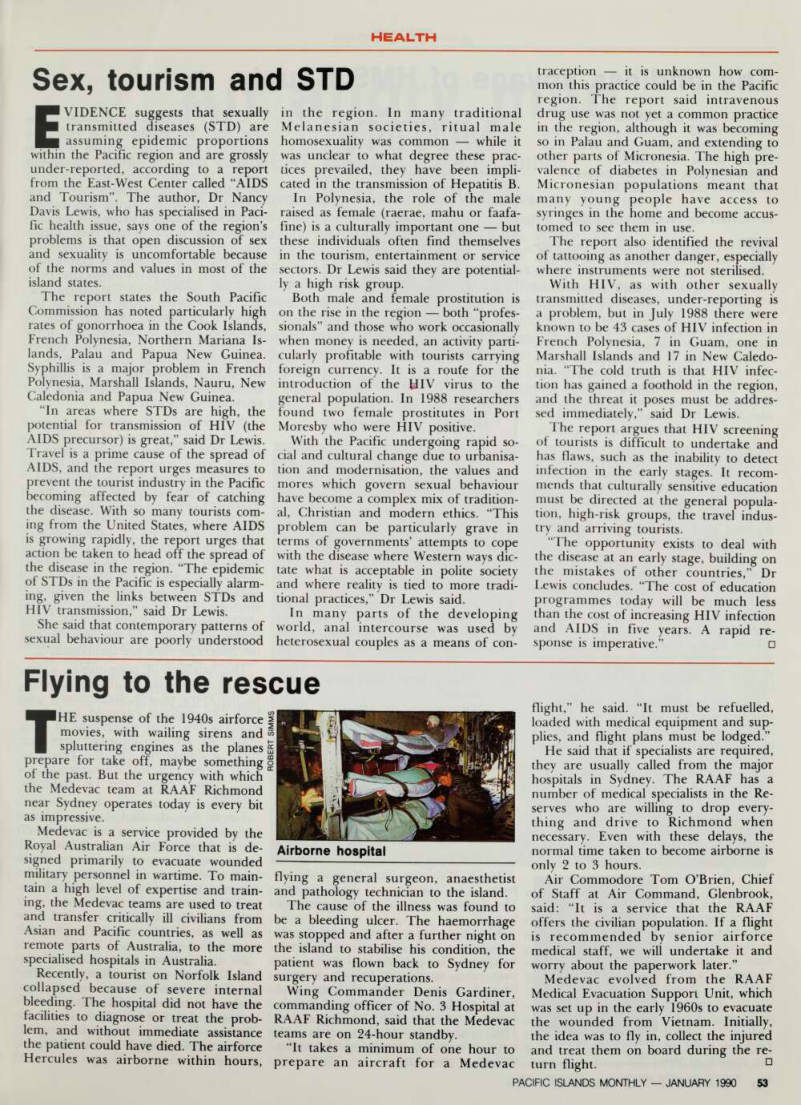
health
EVIDENCE suggests that sexually
transmitted diseases (STD) are
assuming epidemic proportions
within the Pacific region and are grossly under-reported, according to a report from the East-West Center called “AIDS and Tourism”. The author, Dr Nancy Davis Lewis, who has specialised in Pacific health issue, says one of the region’s problems is that open discussion of sex and sexuality is uncomfortable because of the norms and values in most of the island states.
The report states the South Pacific Commission has noted particularly high rates of gonorrhoea in the Cook Islands, French Polynesia, Northern Mariana Islands, Palau and Papua New Guinea, Syphillis is a major problem in French Polynesia, Marshall Islands, Nauru, New Caledonia and Papua New Guinea.
“In areas where STDs are high, the potential for transmission of HIV (the AIDS precursor) is great,” said Dr Lewis.
Travel is a prime cause of the spread of AIDS, and the report urges measures to prevent the tourist industry in the Pacific becoming affected by fear of catching te disease. With so many tourists coming from the United States, where AIDS is growing rapidly, the report urges that action be taken to head off the spread of the disease in the region. “The epidemic of STDs in the Pacific is especially alarming, given the links between STDs and HIV transmission,” said Dr Lewis.
She said that contemporary patterns of sexual behaviour are poorly understood
in the region. In many traditional Melanesian societies, ritual male homosexuality was common while it was unclear to what degree these practices prevailed, they have been implicated in the transmission of Hepatitis B.
In Polynesia, the role of the male raised as female (raerae, mahu or faafafine) is a culturally important one but these individuals often find themselves in the tourism, entertainment or service sectors. Dr Lewis said they are potentially a high risk group.
Both male and female prostitution is on the rise in the region both “professionals” and those who work occasionally when money is needed, an activity parti-
cularly profitable with tourists carrying
foreign currency. It is a route for the introduction of the HIV virus to the general population. In 1988 researchers found two female prostitutes in Port Moresby who were HIV positive.
With the Pacific undergoing rapid social and cultural change due to urbanisation and modernisation, the values and mores which govern sexual behaviour have become a complex mix of traditional, Christian and modern ethics. “This problem can be particularly grave in terms of governments’ attempts to cope with the disease where Western ways dietate what is acceptable in polite society and where reality is tied to more traditional practices,” Dr Lewis said.
In many parts of the developing world, anal intercourse was used by heterosexual couples as a means of con-
traception it is unknown how com mon this practice could be in the Pacific region. The report said intravenous drug use was not yet a common practice in the region, although it was becoming so in Palau and Guam, and extending to other parts of Micronesia. The high pre valence of diabetes in Polynesian and Micronesian populations meant that many young people have access to syringes in the home and become accus tomed to see them in use.
The report also identified the revival
of tattooing as another danger, especially
where instruments were not sterilised.
With HIV, as with other sexually transmitted diseases, under-reporting is a problem, but in July 1988 there were known to be 43 cases of HIV infection in French Polynesia, 7 in Guam, one in Marshall Islands and 17 in New Caledo nia. “The cold truth is that HIV infec tion has gained a foothold in the region, and the threat it poses must be addres sed immediately,” said Dr Lewis.
The report argues that HIV screening of tourists is difficult to undertake and has flaws, such as the inability to detect infection in the early stages. It recom mends that culturally sensitive education must be directed at the general popula tion, high-risk groups, the travel indus try and arriving tourists.
“The opportunity exists to deal with the disease at an early stage, building on the mistakes of other countries,” Dr Lewis concludes. “The cost of education programmes today will be much less than the cost of increasing HIV infection and AIDS in five years. A rapid re sponse is imperative.” □
THE suspense of the 1940 s airforce
Flying to the rescue
THE suspense of the 1940 s airforce movies, with wailing sirens and
spluttering engines as the planes i
prepare for take off, maybe something of the past. But the urgency with which the Medevac team at RAAF Richmond near Sydney operates today is every bit as impressive.
Medevac is a service provided by the Royal Australian Air Force that is de signed primarily to evacuate wounded military personnel in wartime. To main tain a high level of expertise and train ing, the Medevac teams are used to treat and transfer critically ill civilians from Asian and Pacific countries, as well as remote parts of Australia, to the more specialised hospitals in Australia.
Recently, a tourist on Norfolk Island collapsed because of severe internal bleeding. The hospital did not have the facilities to diagnose or treat the prob lem, and without immediate assistance the patient could have died. The airforce Hercules was airborne within hours,
flying a general surgeon, anaesthetist and pathology technician to the island.
The cause of the illness was found to be a bleeding ulcer. The haemorrhage was stopped and after a further night on the island to stabilise his condition, the patient was flown back to Sydney for surgery and recuperations.
Wing Commander Denis Gardiner, commanding officer of No. 3 Hospital at RAAF Richmond, said that the Medevac teams are on 24-hour standby.
“It takes a minimum of one hour to prepare an aircraft for a Medevac
flight,” he said. “It must be refuelled, loaded with medical equipment and sup plies, and flight plans must be lodged.”
He said that if specialists are required, they are usually called from the major hospitals in Sydney. The RAAF has a number of medical specialists in the Re serves who are willing to drop every thing and drive to Richmond when necessary. Even with these delays, the normal time taken to become airborne is only 2 to 3 hours.
Air Commodore Tom O’Brien, Chief of Staff at Air Command, Glenbrook, said: “It is a service that the RAAF offers the civilian population. If a flight is recommended by senior airforce medical staff, we will undertake it and worry about the paperwork later,”
Medevac evolved from the RAAF Medical Evacuation Support Unit, which was set up in the early 1960 s to evacuate the wounded from Vietnam. Initially, the idea was to fly in, collect the injured and treat them on board during the re turn flight. D
Robert Simms
Airborne hospital
The endless voyage of HMS Bounty
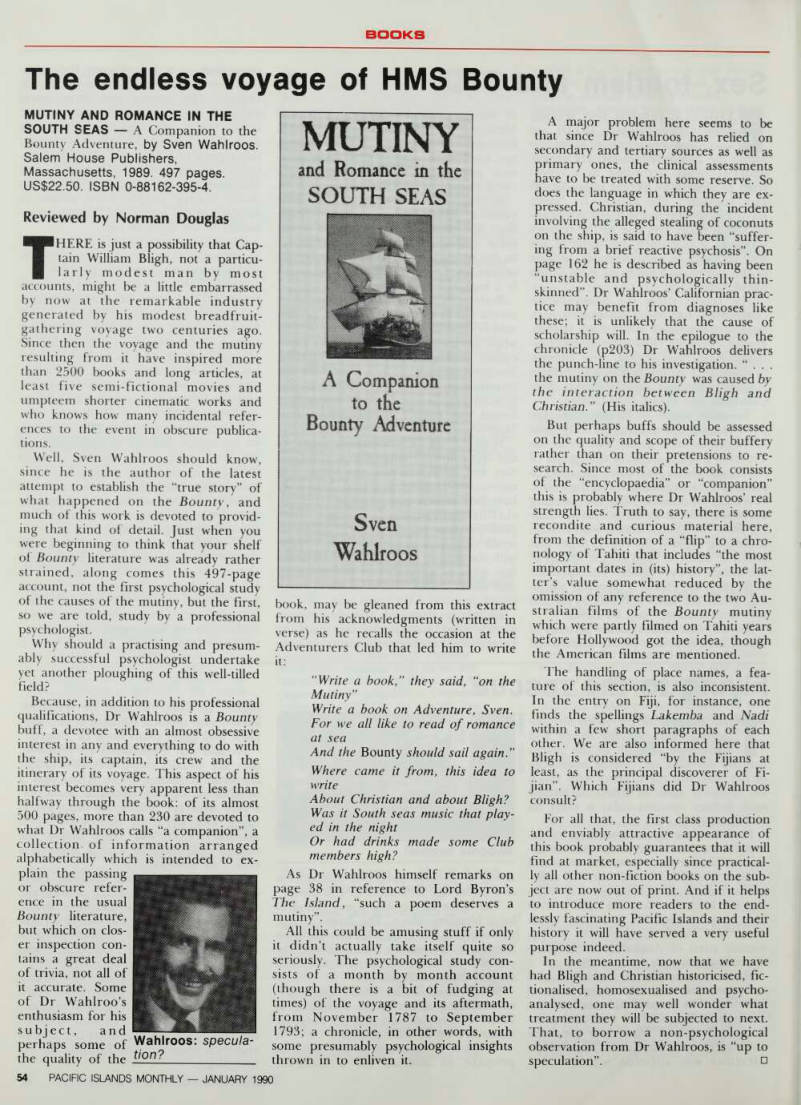
Books
Mutiny And Romance In The
SOUTH SEAS A Companion to the Bounty Adventure, by Sven Wahlroos.
Salem House Publishers, Massachusetts, 1989. 497 pages.
U 5522.50. Isbn 0-88162-395-4.
Reviewed by Norman Douglas
THERE is just a possibility that Cap tain William Bligh, not a particu larly modest man by most accounts, might be a little embarrassed by now at the remarkable industry generated by his modest breadfruit gathering voyage two centuries ago.
Since then the voyage and the mutiny resulting from it have inspired more than 2500 books and long articles, at least five semi-fictional movies and umpteem shorter cinematic works and who knows how many incidental refer ences to the event in obscure publica tions.
Well, Sven Wahlroos should know, since he is the author of the latest attempt to establish the “true story” of what happened on the Bounty, and much of this work is devoted to provid ing that kind of detail. Just when you were beginning to think that your shelf of Bounty literature was already rather strained, along comes this 497-page account, not the first psychological study of the causes of the mutiny, but the first, so we are told, study by a professional
psychologist.
Why should a practising and presum
ably successful psychologist undertake
yet another ploughing of this well-tilled field?
Because, in addition to his professional qualifications, Dr Wahlroos is a Bounty buff, a devotee with an almost obsessive interest in any and everything to do with the ship, its captain, its crew and the itinerary of its voyage. This aspect of his interest becomes very apparent less than halfway through the book: of its almost 500 pages, more than 230 are devoted to what Dr Wahlroos calls “a companion”, a collection- of information arranged alphabetically which is intended to ex
plain the passing
or obscure refer ence in the usual Bounty literature, but which on clos er inspection con tains a great deal of trivia, not all of it accurate. Some of Dr Wahlroo’s enthusiasm for his subject, and perhaps some of the quality of the
book, may be gleaned from this extract from his acknowledgments (written in verse) as he recalls the occasion at the Adventurers Club that led him to write it:
“Write a book,” they said, “on the Mutiny”
Write a book on Adventure, Sven.
For we all like to read of romance at sea And the Bounty should sail again ”
Where came it from, this idea to write About Christian and about Bligh?
Was it South seas music that play ed in the night Or had drinks made some Club members high?
As Dr Wahlroos himself remarks on page 38 in reference to Lord Byron’s The Island, “such a poem deserves a
mutiny”.
All this could be amusing stuff if only it didn’t actually take itself quite so
seriously. The psychological study con
sists of a month by month account (though there is a bit of fudging at times) of the voyage and its aftermath, from November 1787 to September 1793; a chronicle, in other words, with
some presumably psychological insights
thrown in to enliven it.
A major problem here seems to be that since Dr Wahlroos has relied on secondary and tertiary sources as well as primary ones, the clinical assessments have to be treated with some reserve. So does the language in which they are ex pressed. Christian, during the incident
involving the alleged stealing of coconuts
on the ship, is said to have been “suffer ing from a brief reactive psychosis”. On page 162 he is described as having been “unstable and psychologically thin skinned”. Dr Wahlroos’ Californian prac tice may benefit from diagnoses like these; it is unlikely that the cause of scholarship will. In the epilogue to the chronicle (p 203) Dr Wahlroos delivers the punch-line to his investigation. “ . . . the mutiny on the Bounty was caused by the interaction between Bligh and Christian .” (His italics).
But perhaps buffs should be assessed on the quality and scope of their buffery rather than on their pretensions to re search. Since most of the book consists of the “encyclopaedia” or “companion” this is probably where Dr Wahlroos’ real strength lies. Truth to say, there is some recondite and curious material here, from the definition of a “flip” to a chro nology of Tahiti that includes “the most important dates in (its) history”, the lat ter’s value somewhat reduced by the omission of any reference to the two Au stralian films of the Bounty mutiny which were partly filmed on Tahiti years before Hollywood got the idea, though the American films are mentioned.
The handling of place names, a fea ture of this section, is also inconsistent.
In the entry on Fiji, for instance, one finds the spellings Lakemba and Nadi within a few short paragraphs of each other. We are also informed here that Bligh is considered “by the Fijians at least, as the principal discoverer of Fi jian”. Which Fijians did Dr Wahlroos consult?
For all that, the first class production and enviably attractive appearance of this book probably guarantees that it will find at market, especially since practical ly all other non-fiction books on the sub ject are now out of print. And if it helps to introduce more readers to the end lessly fascinating Pacific Islands and their history it will have served a very useful purpose indeed.
In the meantime, now that we have had Bligh and Christian historicised, fic tionalised, homosexualised and psycho analysed, one may well wonder what treatment they will be subjected to next.
That, to borrow a non-psychological observation from Dr Wahlroos, is “up to
speculation”. □
Wahlroos: specula tion?
An angry man
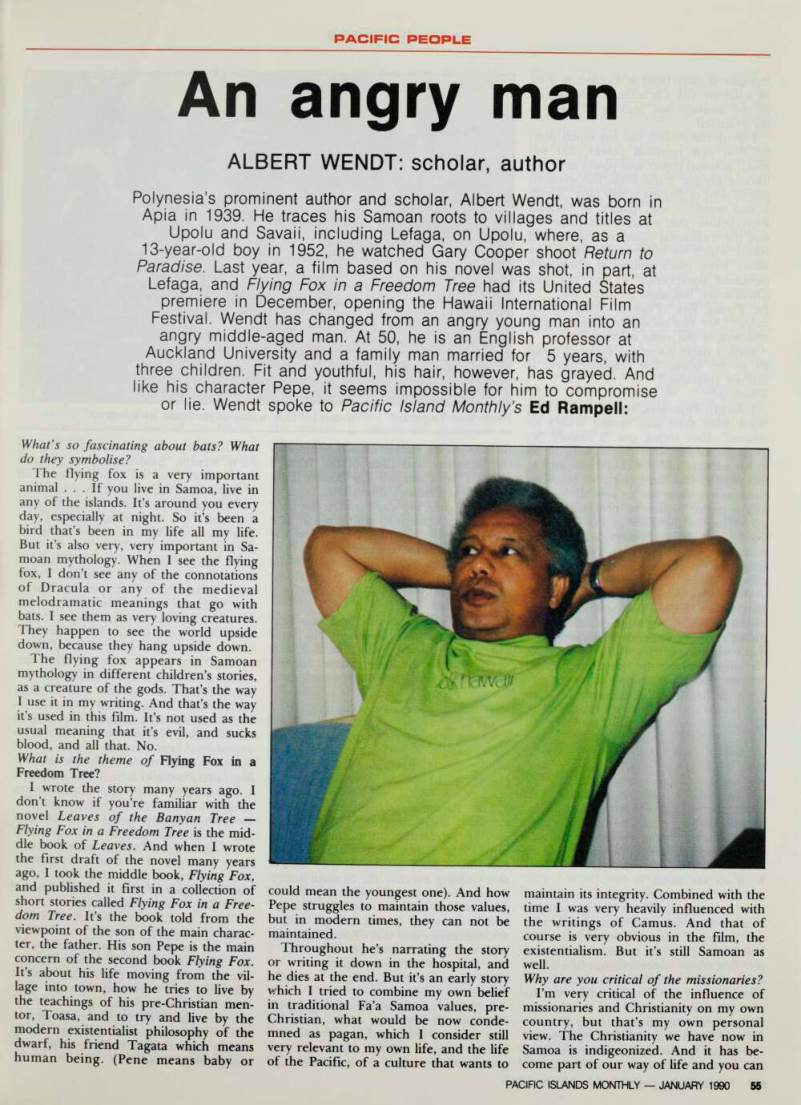
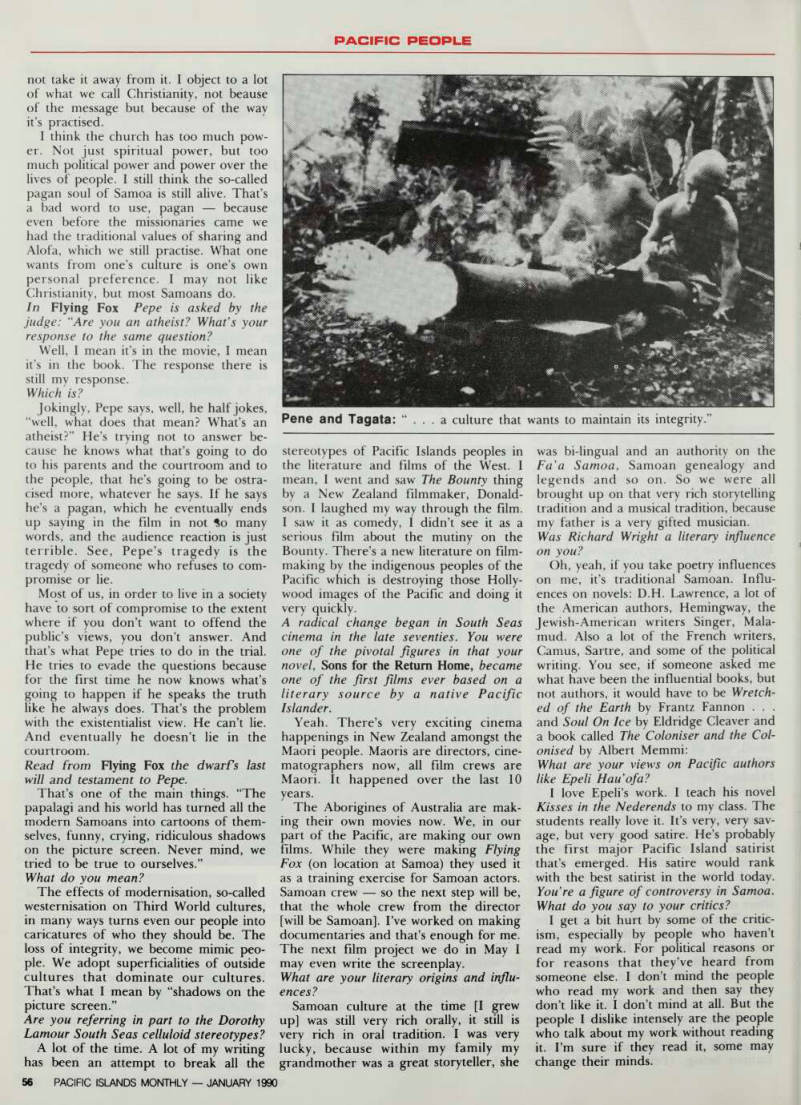
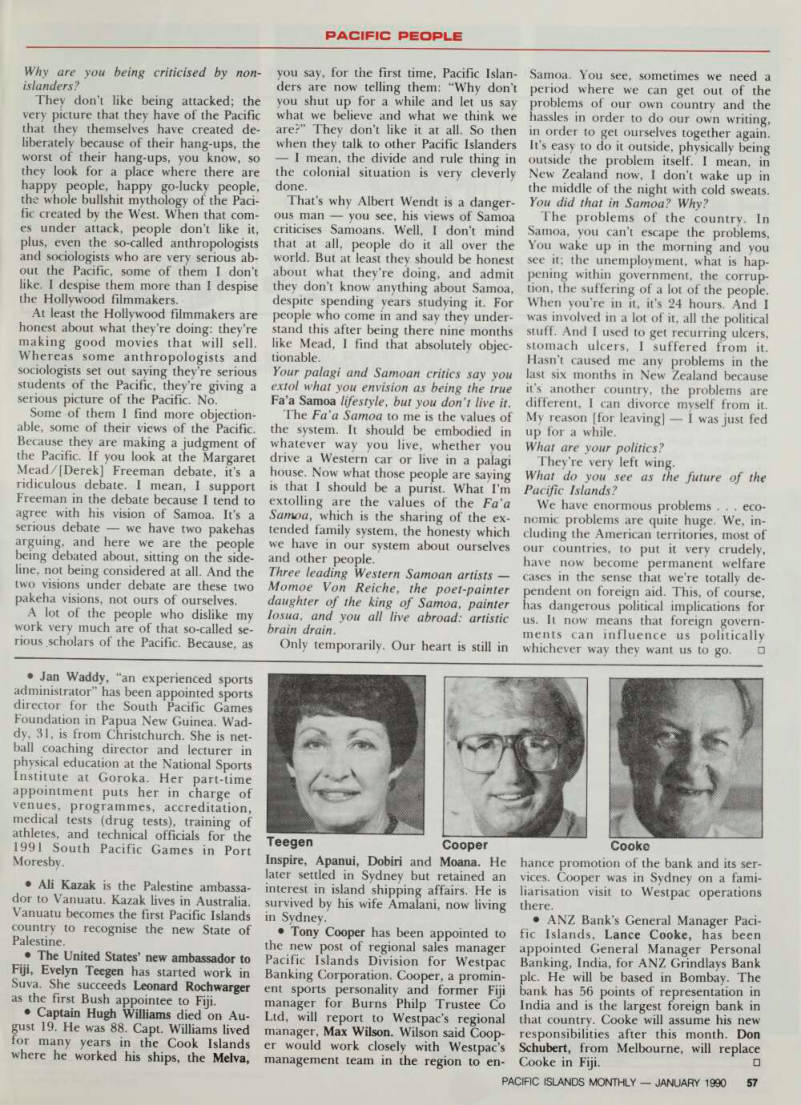
Pacific People
ALBERT WENDT: scholar, author Polynesia's prominent author and scholar, Albert Wendt, was born in Apia in 1939. He traces his Samoan roots to villages and titles at Upolu and Savaii, including Lefaga, on Upolu, where, as a 13-year-old boy in 1952, he watched Gary Cooper shoot Return to Paradise. Last year, a film based on his novel was shot, in part, at Lefaga, and Flying Fox in a Freedom Tree had its United States premiere in December, opening the Hawaii International Film Festival. Wendt has changed from an angry young man into an angry middle-aged man. At 50, he is an English professor at Auckland University and a family man married for 5 years, with three children. Fit and youthful, his hair, however, has grayed. And like his character Pepe, it seems impossible for him to compromise or lie. Wendt spoke to Pacific Island Monthly’s Ed Rampell:
What’s so fascinating about bats? What do they symbolise?
The flying fox is a very important animal ... If you live in Samoa, live in any of the islands. It’s around you every day, especially at night. So it’s been a bird that’s been in my life all my life.
But it’s also very, very important in Sa moan mythology. When I see the flying fox, I don’t see any of the connotations of Dracula or any of the medieval melodramatic meanings that go with bats. I see them as very loving creatures.
They happen to see the world upside
down, because they hang upside down.
The flying fox appears in Samoan mythology in different children’s stories, as a creature of the gods. That’s the way I use it in my writing. And that’s the way it’s used in this film. It’s not used as the usual meaning that it’s evil, and sucks blood, and all that. No.
What is the theme of Hying Fox in a Freedom Tree?
I wrote the story many years ago. I don’t know if you’re familiar with the novel Leaves of the Banyan Tree Flying Fox in a Freedom Tree is the mid dle book of Leaves. And when I wrote the first draft of the novel many years ago, I took the middle book, Flying Fox, and published it first in a collection of short stories called Flying Fox in a Free dom Tree. It’s the book told from the viewpoint of the son of the main charac ter, the father. His son Pepe is the main concern of the second book Flying Fox.
It’s about his life moving from the vil lage into town, how he tries to live by the teachings of his pre-Christian men tor, Toasa, and to try and live by the modern existentialist philosophy of the dwarf, his friend Tagata which means human being. (Pene means baby or
could mean the youngest one). And how Pepe struggles to maintain those values, but in modern times, they can not be maintained.
Throughout he’s narrating the story or writing it down in the hospital, and he dies at the end. But it’s an early story which I tried to combine my own belief in traditional Fa’a Samoa values, pre- Christian, what would be now condemned as pagan, which I consider still very relevant to my own life, and the life of the Pacific, of a culture that wants to
maintain its integrity. Combined with the time I was very heavily influenced with the writings of Camus. And that of course is very obvious in the film, the existentialism. But it’s still Samoan as well.
Why are you critical of the missionaries?
I’m very critical of the influence of missionaries and Christianity on my own country, but that’s my own personal view. The Christianity we have now in Samoa is indigeonized. And it has be come part of our way of life and you can
not take it away from it. I object to a lot of what we call Christianity, not beause of the message but because of the way
it’s practised.
I think the church has too much pow er. Not just spiritual power, but too much political power and power over the lives of people. I still think the so-called pagan soul of Samoa is still alive. That’s a bad word to use, pagan because even before the missionaries came we had the traditional values of sharing and Alofa, which we still practise. What one wants from one’s culture is one’s own personal preference. I may not like Christianity, but most Samoans do.
In Flying Fox Pepe is asked by the judge: “Are you an atheist? What’s your response to the same question?
Well, I mean it’s in the movie, I mean it’s in the book. The response there is still my response.
Which is?
Jokingly, Pepe says, well, he half jokes, “well, what does that mean? What’s an atheist?” He’s trying not to answer be cause he knows what that’s going to do to his parents and the courtroom and to the people, that he’s going to be ostra cised more, whatever he says. If he says he’s a pagan, which he eventually ends up saying in the film in not *o many words, and the audience reaction is just terrible. See, Pepe’s tragedy is the tragedy of someone who refuses to com promise or lie.
Most of us, in order to live in a society have to sort of compromise to the extent where if you don’t want to offend the public’s views, you don’t answer. And that’s what Pepe tries to do in the trial.
He tries to evade the questions because for the first time he now knows what’s going to happen if he speaks the truth like he always does. That’s the problem with the existentialist view. He can’t lie.
And eventually he doesn’t lie in the courtroom.
Read from Flying Fox the dwarfs last will and testament to Pepe.
That’s one of the main things. “The papalagi and his world has turned all the modern Samoans into cartoons of them selves, funny, crying, ridiculous shadows on the picture screen. Never mind, we tried to be true to ourselves.”
What do you mean?
The effects of modernisation, so-called westernisation on Third World cultures, in many ways turns even our people into caricatures of who they should be. The loss of integrity, we become mimic peo ple. We adopt superficialities of outside cultures that dominate our cultures.
That’s what I mean by “shadows on the
picture screen.”
Are you referring in part to the Dorothy Lamour South Seas celluloid stereotypes?
A lot of the time. A lot of my writing has been an attempt to break all the
stereotypes of Pacific Islands peoples in the literature and films of the West. I mean, I went and saw The Bounty thing by a New Zealand filmmaker, Donaldson. I laughed my way through the film, I saw it as comedy, I didn’t see it as a serious film about the mutiny on the Bounty. There’s a new literature on filmmaking by the indigenous peoples of the Pacific which is destroying those Hollywood images of the Pacific and doing it
very quickly.
A radical change began in South Seas cinema in the late seventies. You were one of the pivotal figures in that your novel, Sons for the Return Home, became one of the first films ever based on a literary source by a native Pacific Islander.
Yeah. There’s very exciting cinema happenings in New Zealand amongst the Maori people. Maoris are directors, cinematographers now, all film crews are Maori. It happened over the last 10 years.
The Aborigines of Australia are making their own movies now. We, in our part of the Pacific, are making our own films. While they were making Flying Fox (on location at Samoa) they used it as a training exercise for Samoan actors, Samoan crew so the next step will be, that the whole crew from the director [will be Samoan]. I’ve worked on making documentaries and that’s enough for me.
The next film project we do in May I may even write the screenplay.
What are your literary origins and influences?
Samoan culture at the time [I grew up] was still very rich orally, it still is very rich in oral tradition. I was very lucky, because within my family my grandmother was a great storyteller, she
was bi-lingual and an authority on the Fa’a Samoa, Samoan genealogy and legends and so on. So we were all brought up on that very rich storytelling tradition and a musical tradition, because my father is a very gifted musician.
Was Richard Wright a literary influence on you?
Oh, yeah, if you take poetry influences on me, it’s traditional Samoan. Influ ences on novels: D.H. Lawrence, a lot of the American authors, Hemingway, the
Jewish-American writers Singer, Mala
mud. Also a lot of the French writers, Camus, Sartre, and some of the political writing. You see, if someone asked me what have been the influential books, but not authors, it would have to be Wretch ed of the Earth by Frantz Fannon . . . and Soul On Ice by Eldridge Cleaver and a book called The Coloniser and the Col onised by Albert Memmi: What are your views on Pacific authors like Epeli Hau’ofa?
I love Epeli’s work. I teach his novel Kisses in the Nederends to my class. The students really love it. It’s very, very sav age, but very good satire. He’s probably the first major Pacific Island satirist that’s emerged. His satire would rank with the best satirist in the world today.
You’re a figure of controversy in Samoa.
What do you say to your critics?
I get a bit hurt by some of the critic
ism, especially by people who haven’t
read my work. For political reasons or for reasons that they’ve heard from someone else. I don’t mind the people who read my work and then say they don’t like it. I don’t mind at all. But the people I dislike intensely are the people who talk about my work without reading it. I’m sure if they read it, some may change their minds.
Pene and Tagata: “ . . . a culture that wants to maintain its integrity.”
Why are you being criticised by non islanders?
They don’t like being attacked; the very picture that they have of the Pacific that they themselves have created de liberately because of their hang-ups, the worst of their hang-ups, you know, so they look for a place where there are
happy people, happy go-lucky people,
the whole bullshit mythology of the Paci fic created by the West. When that com es under attack, people don’t like it, plus, even the so-called anthropologists and sociologists who are very serious ab out the Pacific, some of them I don’t like. I despise them more than I despise the Hollywood filmmakers.
At least the Hollywood filmmakers are
honest about what they’re doing: they’re
making good movies that will sell.
Whereas some anthropologists and
sociologists set out saying they’re serious
students of the Pacific, they’re giving a serious picture of the Pacific. No.
Some of them I find more objection able, some of their views of the Pacific.
Because they are making a judgment of the Pacific. If you look at the Margaret Mead/[Derek] Freeman debate, it’s a ridiculous debate. I mean, I support Freeman in the debate because I tend to agree with his vision of Samoa. It’s a serious debate we have two pakehas arguing, and here we are the people being debated about, sitting on the side line, not being considered at all. And the two visions under debate are these two pakeha visions, not ours of ourselves.
A lot of the people who dislike my work very much are of that so-called se rious scholars of the Pacific. Because, as
you say, for the first time, Pacific Islan ders are now telling them: “Why don’t you shut up for a while and let us say what we believe and what we think we are?” They don’t like it at all. So then when they talk to other Pacific Islanders I mean, the divide and rule thing in the colonial situation is very cleverly done.
That’s why Albert Wendt is a danger ous man you see, his views of Samoa criticises Samoans. Well, I don’t mind that at all, people do it all over the world. But at least they should be honest about what they’re doing, and admit they don’t know anything about Samoa,
despite spending years studying it. For
people who come in and say they under stand this after being there nine months like Mead, I find that absolutely objec tionable.
Your palagi and Samoan critics say you extol what you envision as being the true Fa’a Samoa lifestyle, but you don’t live it.
The Fa’a Samoa to me is the values of the system. It should be embodied in whatever way you live, whether you drive a Western car or live in a palagi house. Now what those people are saying is that I should be a purist. What I’m extolling are the values of the Fa’a Samoa, which is the sharing of the ex tended family system, the honesty which we have in our system about ourselves and other people.
Three leading Western Samoan artists Momoe Von Reiche, the poet-painter daughter of the king of Samoa, painter losua, and you all live abroad: artistic brain drain.
Only temporarily. Our heart is still in
Samoa. You see, sometimes we need a period where we can get out of the problems of our own country and the hassles in order to do our own writing, in order to get ourselves together again.
It’s easy to do it outside, physically being outside the problem itself. I mean, in New Zealand now, I don’t wake up in the middle of the night with cold sweats.
You did that in Samoa? Why?
The problems of the country. In Samoa, you can’t escape the problems, You wake up in the morning and you see it; the unemployment, what is hap pening within government, the corrup tion, the suffering of a lot of the people.
When you’re in it, it’s 24 hours. And I was involved in a lot of it, all the political stuff. And I used to get recurring ulcers, stomach ulcers, I suffered from it.
Hasn’t caused me any problems in the last six months in New Zealand because it’s another country, the problems are different, I can divorce myself from it.
My reason [for leaving] I was just fed up for a while.
What are your politics?
They’re very left wing.
What do you see as the future of the Pacific Islands?
We have enormous problems . . . eco nomic problems are quite huge. We, in cluding the American territories, most of our countries, to put it very crudely, have now become permanent welfare cases in the sense that we’re totally de pendent on foreign aid. This, of course,
has dangerous political implications for
us. It now means that foreign govern ments can influence us politically whichever way they want us to go. □
• Jan Waddy, “an experienced sports administrator” has been appointed sports director for the South Pacific Games Foundation in Papua New Guinea. Wad dy, 31, is from Christchurch. She is net ball coaching director and lecturer in physical education at the National Sports Institute at Goroka. Her part-time appointment puts her in charge of venues, programmes, accreditation, medical tests (drug tests), training of athletes, and technical officials for the 1991 South Pacific Games in Port
Moresby.
• Ali Kazak is the Palestine ambassa dor to Vanuatu. Kazak lives in Australia.
Vanuatu becomes the first Pacific Islands country to recognise the new State of Palestine. • The United States’ new ambassador to Fiji, Evelyn Teegen has started work in Suva. She succeeds Leonard Rochwarger as the first Bush appointee to Fiji. • Captain Hugh Williams died on Au gust 19. He was 88. Capt. Williams lived for many years in the Cook Islands where he worked his ships, the Melva,
Inspire, Apanui, Dobiri and Moana. He later settled in Sydney but retained an interest in island shipping affairs. He is survived by his wife Amalani, now living
in Sydney.
• Tony Cooper has been appointed to the new post of regional sales manager Pacific Islands Division for Westpac
Banking Corporation. Cooper, a promin
ent sports personality and former Fiji manager for Burns Philp Trustee Co Ltd, will report to Westpac’s regional manager, Max Wilson. Wilson said Coop er would work closely with Westpac’s management team in the region to en
hance promotion of the bank and its ser vices. Cooper was in Sydney on a fami liarisation visit to Westpac operations there. • ANZ Bank’s General Manager Paci fic Islands, Lance Cooke, has been appointed General Manager Personal Banking, India, for ANZ Grindlays Bank pic. He will be based in Bombay. The bank has 56 points of representation in India and is the largest foreign bank in that country. Cooke will assume his new responsibilities after this month. Don Schubert, from Melbourne, will replace Cooke in Fiji. □
Teegen
Cooper
Cooke
Advertisements & other items, p. 57 (1 item)
Pacific People
Island Press
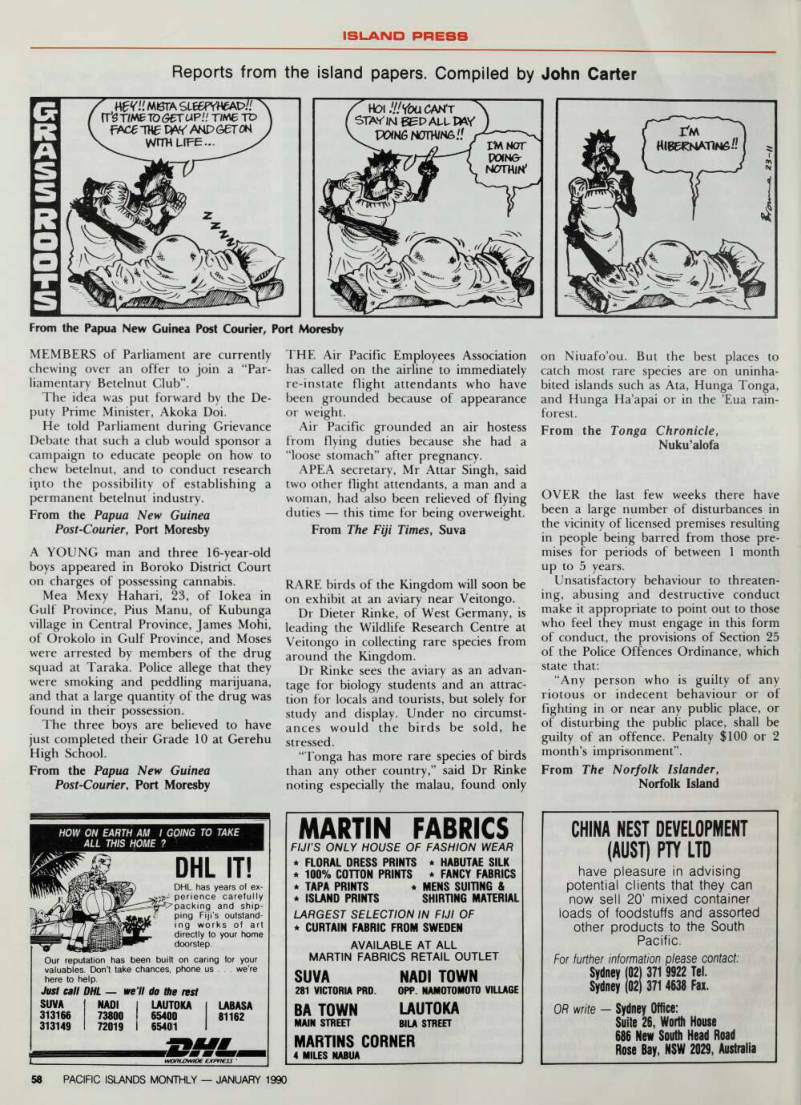
Reports from the island papers. Compiled by John Carter
MEMBERS of Parliament are currently chewing over an offer to join a “Par liamentary Betelnut Club”.
The idea was put forward by the De puty Prime Minister, Akoka Doi.
He told Parliament during Grievance Debate that such a club would sponsor a campaign to educate people on how to chew betelnut, and to conduct research into the possibility of establishing a permanent betelnut industry.
From the Papua New Guinea Post-Courier, Port Moresby A YOUNG man and three 16-year-old boys appeared in Boroko District Court on charges of possessing cannabis.
Mea Mexy Hahari, 23, of lokea in Gulf Province, Pius Manu, of Kubunga village in Central Province, James Mohi, of Orokolo in Gulf Province, and Moses were arrested by members of the drug squad at Taraka. Police allege that they
were smoking and peddling marijuana,
and that a large quantity of the drug was found in their possession.
The three boys are believed to have just completed their Grade 10 at Gerehu High School.
From the Papua New Guinea Post-Courier, Port Moresby
THE Air Pacific Employees Association has called on the airline to immediately re-instate flight attendants who have been grounded because of appearance
or weight.
Air Pacific grounded an air hostess from flying duties because she had a “loose stomach” after pregnancy.
APEA secretary, Mr Attar Singh, said two other flight attendants, a man and a woman, had also been relieved of flying duties this time for being overweight.
From The Fiji Times, Suva RARE birds of the Kingdom will soon be on exhibit at an aviary near Veitongo.
Dr Dieter Rinke, of West Germany, is leading the Wildlife Research Centre at
Veitongo in collecting rare species from
around the Kingdom.
Dr Rinke sees the aviary as an advan tage for biology students and an attrac tion for locals and tourists, but solely for study and display. Under no circumst ances would the birds be sold, he stressed.
“Tonga has more rare species of birds than any other country,” said Dr Rinke noting especially the malau, found only
on Niuafo’ou. But the best places to catch most rare species are on uninha bited islands such as Ata, Hunga Tonga, and Hunga Ha’apai or in the ’Eua rain forest.
From the Tonga Chronicle, Nukualofa OVER the last few weeks there have been a large number of disturbances in
the vicinity of licensed premises resulting
in people being barred from those pre mises for periods of between 1 month up to 5 years.
Unsatisfactory behaviour to threaten ing, abusing and destructive conduct make it appropriate to point out to those who feel they must engage in this form of conduct, the provisions of Section 25 of the Police Offences Ordinance, which state that: “Any person who is guilty of any riotous or indecent behaviour or of fighting in or near any public place, or of disturbing the public place, shall be guilty of an offence. Penalty $lOO or 2 month’s imprisonment”.
From The Norfolk Islander, Norfolk Island
From the Papua New Guinea Post Courier, Port Moresby
Advertisements & other items, pp. 58-60 (1 item)
Martin Fabrics
HOW ON EARTH AM I GOING TO TAKE
ALL THIS HOME ?
DHL IT!
DHL has years of experience carefully packing and shipping Fiji's outstanding works of art directly to your home doorstep.
Our reputation has been built on caring for your valuables. Don’t take chances, phone us we’re here to help.
Just call DHL we’ll do the rest
WORLDWIDE EXPRESS
MARTIN FABRICS
FIJI’S ONLY HOUSE OF FASHION WEAR
* FLORAL DRESS PRINTS * HABUTAE SILK * 100% COTTON PRINTS * FANCY FABRICS * TAPA PRINTS * MENS SUITING &
* ISLAND PRINTS SHIRTING MATERIAL
LARGEST SELECTION IN FIJI OF
* CURTAIN FABRIC FROM SWEDEN
AVAILABLE AT ALL
MARTIN FABRICS RETAIL OUTLET
SUVA
281 VICTORIA PRO.
BA TOWN
MAIN STREET
NADI TOWN
OPP. NAMOTOMOTO VILLAGE
LAUTOKA
BILA STREET
MARTINS CORNER
4 MILES NABUA
CHINA NEST DEVELOPMENT
(AUST) PTY LTD
have pleasure in advising potential clients that they can now sell 20’ mixed container loads of foodstuffs and assorted other products to the South Pacific.
For further information please contact: Sydney (02) 371 9922 Tel.
Sydney (02) 371 4638 Fax.
OR write - Sydney Office: Suite 26, Worth House 686 New South Head Road Rose Bay, NSW 2029, Australia
N 4885 N9073A ST-6350 The comfort of your own home... all the live action of sports on TV, and the choice to record your favorite programs for video replays whenever you want.
NEC is dedicated togiving youTVs, and VCRs that add excitement to the comforts of home.
Clever use of electronic technology provides the degree of sophistication that suits all lifestyles.
There’s only one substitute to capture the excitement of being there yourself
NEC home electronics.
Feel all the excitement of live action at home * * wm j li -4 .1 S .J 4 For further information: NEC Home Electronics Australia Pty. Ltd. 244 Beecroft Road, Epping, NS W. 2121, Australia TEL: (02) 868-1811 FAX (02) 869-1112 Ntu Corporation (Sumitomo Mrta Building) 37-8, Shiba 5-chome. Minato-ku, Tokyo 108 Japan
TEL: (03) 456-3111 FAX: (03) 798-6966
SEC
Official Sponsors to the 1990 Commonwealth Games.
Created as Living Hardware.
t cr V •>/ Mitsubishi’s full-time four-wheel drive, a corner-stone of the diverse technologies that results in their organic performance, is beautifully simple* As any truly advanced idea should be. Linking a viscous coupling unit, a sort of torque transfering devise with the center differential puts smooth, forceful acceleration and stable cornering under the wheels of their new organically inspired vehicles.
The idea behind organic performance is that a car should really operate the way you want it to rather than the driver having to accommodate the various quirks of the vehicle. Both the driving conditions and the vehicle’s operation are monitored by the vehicle itself. In this way the car constantly fine-tunes its drive systems for the optimum operation while also adjusting its performance according to the external conditions.
Concern for your safety is why we make cars that perform as an extension of your will. You can’t be expected to anticipate every traffic situation any more than you can pay attention to every mechanical detail.
So we’ve made cars that share some of the work load with you. With less time spent worrying about the running of the vehicle, you can spend more enjoying the drive.
Because when you drive a Mitsubishi, you’re driving technology you can trust.
MITSUBISHI GRLRNT
MW
MITSUBISHI
MOTORS
AMERICAN SAMOA; MORRIS SCANLAN SERVICE INC. PO Box 367, Pago Pago, Tel 633-5520/AUSTRALIA: MITSU BI SHI ® p b'p . hiti EW CAL EDO Nl/kf SOCIE TE = 275-7223/ FIJI: NIVIS MOTOR & MACHINERY CO.. LTD. GPO Box 150, Suva, Tel 3834! 1 /FReNGH T 2 P p Ponrua Je| 370 . 109/ \ □'IMPORTATION D AUTO DU PACIFIQUE SUD S.A BP. 438 Rond Point du Pacifique, Noumea, Tel 274144/NEW ZEALAND. MITSUBISHI MOTORS ntw ISLANDS' HARVEST PACIFIC LTD G PO Box 88. Honiara, .
NORFOLK ISLAND: BORRYS LTD. PO Box 169, Norfolk Island, Tel 2114/PAPUA NEW GUINEA: TOBA PTY LTD. PCX Box 503, PortMoresby. TeT2l p 7B 4 A M MACDONALD HOLDINGS LTD..( Guadalcanal, Tel 30128/TONGA: SITANI MAFI CO., LTD. PO Box 83, Nuku ALOFA, Tel 21-044/VANUATU: SOCOM ETRAB PO6 Route de Lagon PorfFVJa , TeL -A.M. mao — • ■ /RAiPAN/pnHNPEi/MAJURO/KOSRAE/TRUK/YAP/BELAU: MICRONESIAN MOTORS. INC. 997 South Manne Drive. Tamumng. Guam 96911. Te 6 D n Rav t;7ft Ar