Pacific
Islands
Monthly
American Samoa US$2.5O A$2.5O Cook Islands NZ$3.OO Fiji F 51.75 FS. of Micronesia US$3.OO Guam US$3.OO Hawaii US$3.OO Kiribati I A 52.50 Nauru A 52.50 New Caledonia CFPS2.SO New Zealand ... (incl GST) NZ$3.OO Niue NZ$3.OO Norfolk Island A 53.00 Nth Marianas US$3.OO Papua New Guinea K 53.00 Rep. of Marshall US$3.OO Solomon Islands A 53.00 Tahiti , CFP3OO Tonga P 3.00
Usa Us$3.Oo
Vanuatu VT2OO - Samoa T 3.25- ‘Recommended retail price only
December 1989
* ism * >lfea d vh,
Ebb
Eifiß
K!Sp
Advertisements & other items, p. 2 (1 item)
Feel all the excitement of live action at home
N 4885 The comfort of your own home... all the live action of sports on TV, and the choice to record your favorite programs for video replays whenever you want.
N9073A N EC is dedicated to giving youTVs, and VCRs that add excitement to the comforts of home.
Clever use of electronic technology provides the degree of sophistication that suits all lifestyles.
ST-6350 There’s only one substitute to capture the excitement of being there yourself
NEC home electronics.
Feel all the excitement of live action at home v * i 4 s * For further information: NEC Home Electronics Australia Pty. Ltd. 244 Beecroft Road, Epping. N S W 2121, Australia TEL: (02) 868-1811 FAX: (02) 869-1112 NEC Corporation (Sumitomo Mita Building) 37-8, Shiba 5-chome. Minato-ku, Tokyo 108, Japan
TEL: (03) 456-3111 FAX: (03) 798-6966
SEC
Official Sponsors to the 1990 Commonwealth Games.
Pacific
Islands
Monthly
Vol 59 No. 23
Voice Of The Pacific
December 1989
Cover
It happened in the Philippines. It hap pened in Pakistan.
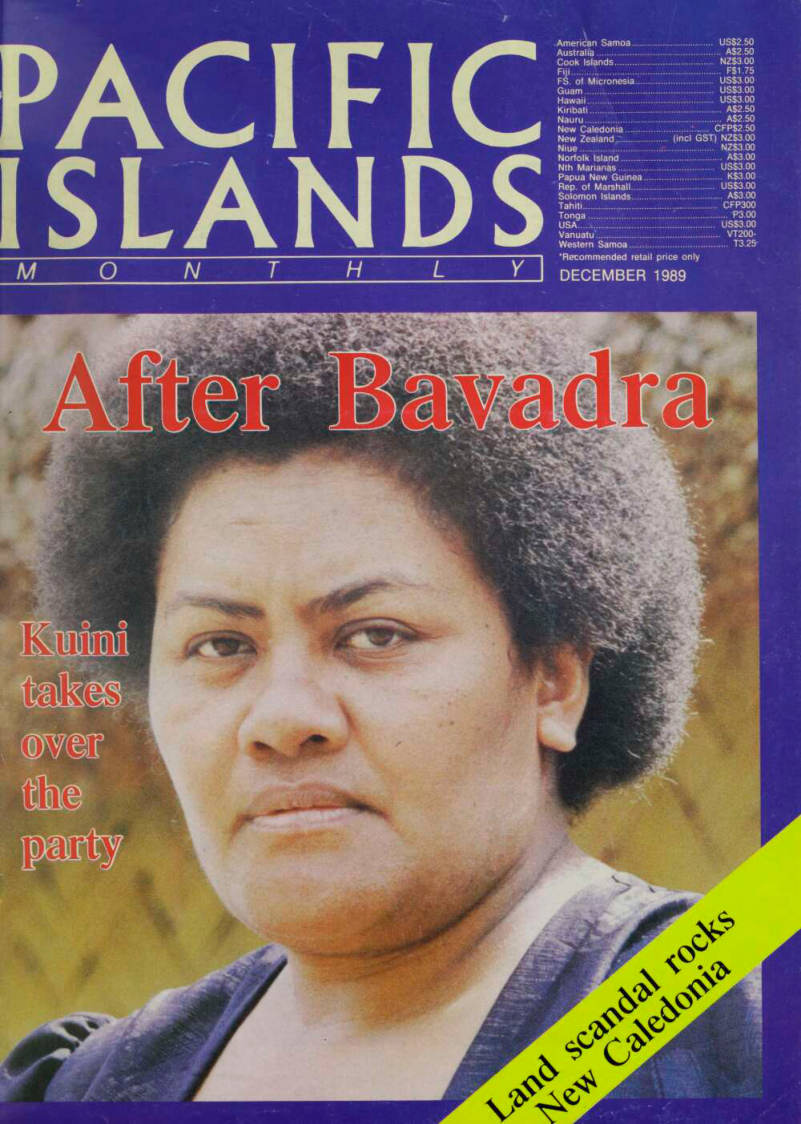
Now it’s happening in Fiji. Kuini, widow of deposed Prime Minister Dr Timoci Bavadra, has accepted the offer to lead her husband’s National Federation Party/ Labour Coalition. It is the beginning of a new era in Fiji politics. Page 8.
The Region
Cook Islands: A new formula for schools has been drawn up. It has attracted both criticism and support.
Page 15.
New Caledonia: A report has revealed a land scandal that is again testing the Matignon Accord. Page 17.
Business
Finance: Remittance from New Zea land is propping up the Western Sa moan economy. It is also causing some fragility. Page 25.
Tourism: Takahashi continues to ex pand his empire in the region by buying three more hotels. Page 30.
Departments
Letters 5
Stamps 6
Opinion 7
Books 50
Pacific People 51
Islands Press 54
Editor dale Moala Correspondents: Al Prince, Belinda Meares, Carrie Loranger, David North, David Robie, Diana McManus, Dykes Angiki, Ed Rampell, Frank Senge, John Hunter, dope Balawani lotu, Karen Mangnall, Macel Manua, Nicholas Rothwell, Paul Moon, Richard Dinnen.
Business correspondent Robin Bromby
Publisher Geoffrey Hussey
Advertising Manager Lionel Heffernan Business Manager Charlotte Thomas Advertising Sales • Fiji: Peter Prasad, Tel (679) 314 111 • Sydney & Melbourne: Fergus Maclagan, Tel (02) 4123918 • Brisbane: Robert Walker, Tel (07) 3710533 • Adelaide; Hastwell Williamson Representations, Tel (08) 799522
Cover prices are recommended retail only.
Registered by Australia Post, publication No.
NBP 1210. Copyright. Fiji Times Limited, Suva, Fiji.
Advertisements & other items, pp. 3-4 (2 items)
3
PACIFIC ISLANDS MONTHLY DECEMBER, 1989
A Fiji Times Limited Production.
Founded 1930 (USPS 952480). 20 Gordon Street, Suva, Fiji. Telex FJ2124, Fax (679) 303809, Tel (679) 303244.
Pacific Islands Monthly (APPS No.
NBP1210) is published monthly by Fiji Times Limited, a division of Nationwide News, 2 Holt Street, Surry Hills, NSW 2010. Second class post age paid to Honolulu, Hawaii Post master.
Send address changes to; • Pacific Islands Monthly, PO Box 1167, Suva, Fiji • or, Pacific Islands Monthly, PO Box 2250, Honolulu, Hawaii 96822.
Typeset and printed by Fiji Times Limited, 20 Gordon Street, Suva, Fiji.
anyhow
have a
Winfield
> the rest
HA ealth aH
OKING
rNIN g WA WV2 CC494/80
Marriage of

Tropicalites
Letters
Marriage of convenience
IN February 1989, a person came into my travel agency and booked a return ticket to Nadi, Fiji.
During my conversation with her, the subject of her marriage came up and she told me that she had just become mar ried to an Australian man and that she was trying to find husbands for two In dian girls who were living in Fiji, and they were willing to pay As4ooo for a marriage of convenience with an Austra lian citizen.
She indicated there was a lot of money to be made in this way and was I in terested and if so, she would give me
both girls’ phone numbers in Fiji.
Michael Azzaz Suleman
Payless Travel Burwood, NSW.
Two errors
THE table headed How the Pacific Is lands Are Doing which appeared on, page 30 of your September issue con tains two errors. The figures given in your table for the GNP per capita for Fiji and Western Samoa had been taken from a column headed Population (thousands) in a table printed on page 234 of the 1989 World Development Re port. The Per Capita GNP figure for Fiji shown in the World Bank’s 1989 World Development Report is US$l57O while that for Western Samoa is US$55O.
At least in terms of GNP per capita, Fiji and Western Samoa are doing better than is suggested in the table you pub lished.
Dr Gj. Abbott
Department of Economics USP, Suva.
Personal view
REFERRING to my letter Japan and Fiji on October issue, the letter does not rep resent the organisations indicated under my name at all. It is all from my person al point of view. I regret any inconveni ence caused to the organisations.
Shigetoshi Takagi
Suva, Fiji
Letters To The Editor Must In
clude writer’s full name, address and home telephone number. All letters may be edited for purposes of clarity or space.
Letters should be addressed to: Pacific Islands Monthly PO Box 1167 Suva
Fiji Islands
Fax: (679) 302011
Penpals
John W Karo, 15. He wants penpals from anywhere. Address: PO Box 760, Taraka, Lae, Papua New Guinea.
David Kiuare, 15. A student from Papua New Guinea. Address: PO Box 4245, Lae, Papua New Guinea.
Advertisements & other items, p. 5 (1 item)
The Fiji Forest Industries
W W
GROUP OF COMPANIES
Fiji Forest Industries Ltd, The Pacific Lumber Company Ltd, Timbers (Fiji) Ltd, Wood Products (Fiji) Ltd.
LARGEST EXPORTERS OF INDIGENOUS TIMBER
PRODUCERS OF PLYWOOD, BLOCKBOARD AND VENEER
SUPPLIERS ALSO OF A VARIETY OF TIMBER PRODUCTS
INCLUDING MOULDING, FINGER JOINTED AND LAMINATED
BOARDS
OUR PRODUCTS ARE AVAILABLE GREEN SAWN OR KILN
DRIED
Box 608, Lautoka, Fiji. Telephone: 61255 Telex: FJ5280 Facsimile: 60323
' WkSONAODbON 103.306
Around the
Stamps
Around the world in 96 years
By John Hunter
A POSTAL cover mailed in Nukualofa almost a century ago has turned up in New York City.
The cover was cancelled in 1892 and addressed to Hamburg, Germany. It had been dispatched from Nukualofa to Apia then sent to Sydney. From there it travelled aboard North German Lloyd’s Australian Main Line ship to Brandisi, Italy, where it was forwarded to Ham burg. How it ended up in the United States 96 years later is not known.
Details of the Tongan mail services of the last century are interesting as told by the Tonga Chronicle: “The German involvement in Tonga’s postal services can be traced back to the German firm of Johann Cesar Godeffroy und Sohn, of Hamburg, which had a treaty with the Tonga Wesleyan Mission by which all natural produce was sold to the firm. In 1975, the Imperial German government signed a treaty with Samoa to authorise the North German Lloyd Steamship Co to establish a line to the South Pacific. The following year a Treaty of Friendship between Germany and Tonga was concluded.
“As a result, North German Lloyd established the Australische Hauptlinie (Australian Main Line) from Europe to Sydney and the Australische Zweiglinie (Australian Branch Line) from Sydney to Nukualofa and Apia.
“On July 4, 1886, the Imperial German Post Office Department ordered a ship ment of postal supplies for Tongatapu.
But because New Zealand feared Ger man expansion in the Pacific, Tonga took over its own postal affairs on July 30, 1886. When the steamer Lubeck ar rived on September 19, use of German stamps were prohibited and Tongan stamps were required.
“On November 3, 1888, the Post Office
Department in Nukualofa agreed that all German mail destined for Samoan and German addresses be combined and routed through the German Postal
Steamship Agency at Tongatapu. But as
the Australian Branch Line grew more and more unprofitable, it was terminated and Tongatapu’s German Postal Steamship Agency closed in June 1989.”
Catalogues THE 24th edition of the The Australian Stamp Catalogue has been released. This edition has over 2500 price changes and more than 800 new listings. The cata logue has 176 pages with all stamp illus trations in full colour. It includes all Au stralian stamps issued up to the end of 1989, Australian FDCs are listed, as are
specimen overprints, stamp packs,
annual albums maximum cards, heritage stamp books, stamp replica cards, PSEs, postal cards, letter cards, airletters and aerogrammes.
The territories’ section contains the stamp and postal stationery of Australian Antarctic Territory, Christsmas island, Cocos (Keeling) Island, Nauru, Norfolk and Papua New Guinea. The catalogue is used as a standard reference and many use its catalogue numbers as de finitive reference numbers for Australian stamps. It costs A$ 19.95 and good value for this price.
Price quoted for stamps reflect the general lower value for general material but the scarce material in early Australia
and Papua New Guinea show quite hefty price increases. For investors, this is the area to obtain your blue chip invest ments.
Shows THE New Zealand stamp show, New Zealand 1990, the World Stamp Exhibi tion, is at the Auckland exhibition centre from August 24 to September 2 next year.
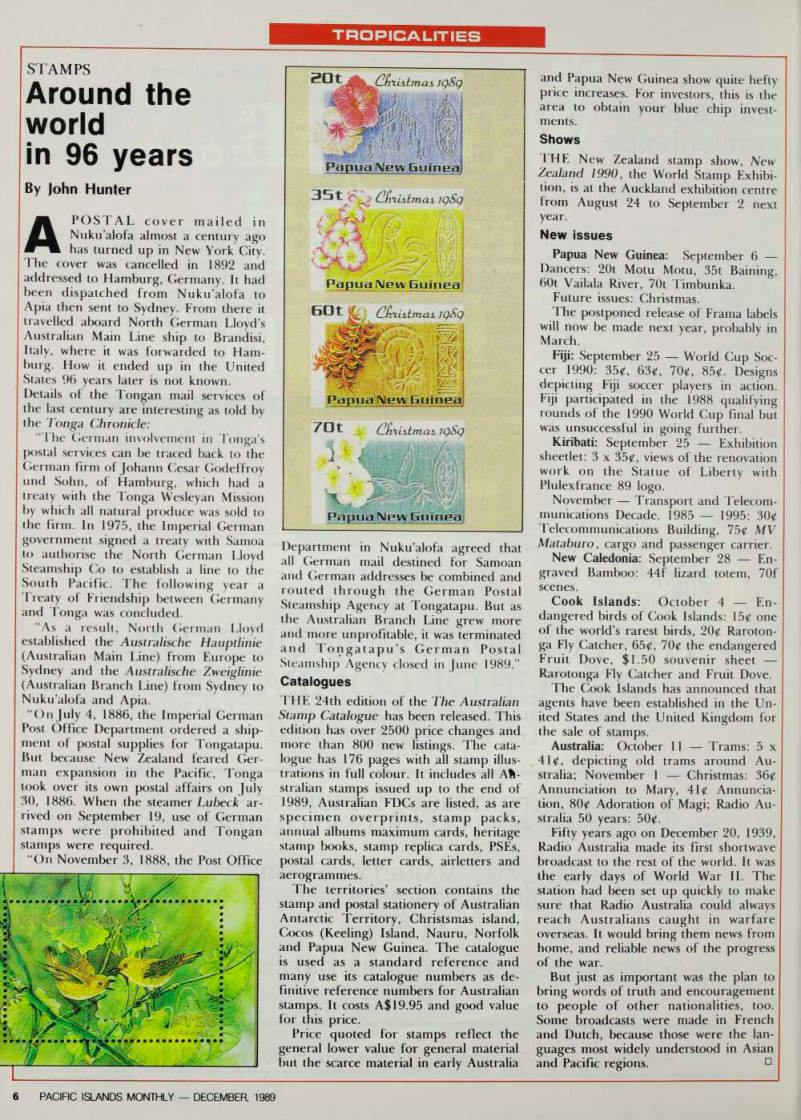
New issues Papua New Guinea: September 6 Dancers: 20t Motu Motu, 35t Raining, 60t Vailala River, 70t Timbunka.
Future issues: Christmas.
The postponed release of Frama labels will now be made next year, probably in March.
Fiji: September 25 World Cup Soc cer 1990: 35tf, 63y, 70tf, 85tf. Designs
depicting Fiji soccer players in action.
Fiji participated in the 1988 qualifying
rounds of the 1990 World Cup final but was unsuccessful in going further.
Kiribati: September 25 Exhibition sheetlet: 3 x 35tf, views of the renovation work on the Statue of Liberty with Plulexfrance 89 logo.
November Transport and Telecom munications Decade. 1985 1995: 30tf Telecommunications Building, 75tf MV Mataburo, cargo and passenger carrier.
New Caledonia: September 28 En graved Bamboo: 44f lizard totem, 70f scenes.
Cook Islands: October 4 En dangered birds of Cook Islands: 15tf one of the world’s rarest birds, 20tf Raroton ga Fly Catcher, 65tf, 70tf the endangered Fruit Dove, $1.50 souvenir sheet Rarotonga Fly Catcher and Fruit Dove.
The Cook Islands has announced that agents have been established in the Un ited States and the United Kingdom for the sale of stamps.
Australia: October 11 Trams: 5 x 41 tf, depicting old trams around Au stralia; November 1 Christmas: 36tf Annunciation to Mary, 41tf Annuncia tion, 80tf Adoration of Magi; Radio Au stralia 50 years: 50tf.
Fifty years ago on December 20, 1939, Radio Australia made its first shortwave broadcast to the rest of the world. It was the early days of World War 11. The station had been set up quickly to make sure that Radio Australia could always reach Australians caught in warfare overseas. It would bring them news from home, and reliable news of the progress of the war.
But just as important was the plan to bring words of truth and encouragement to people of other nationalities, too.
Some broadcasts were made in French and Dutch, because those were the lan guages most widely understood in Asian and Pacific regions. D
Merry
Pacific
Islands
Monthly
Opinion
Merry Christmas
CHRISTMAS last year was a tumultuous time in the region. The rebellion in Bougainville was already a month old and Papua New Guinea was quickly losing grip of its political problems and increased lawlessness. In the Vanuatu capital of Port Vila, a failed coup resulted in the President and some senior politicians being put in jail to spend Christmas behind bars. In Fiji, Methodist fun damentalists blocked roads in the capital Suva and successfully crip pled the city and stopped many people from going to church. It was a time of prayers, not for good harvests, but for peace in a region that was becoming synonymous with ethnic violence. Christmas last year was not a happy one.
This month, however, when Father Christmas returns to the is lands, he will find that things are different. Generally the region is quieter. A solution to Bougainville is now nearer than ever before. Fiji is continuing to iron out its political differences. Kuini Bavadra’s acceptance of the Coalition Party leadership is likely to give Fiji’s interim government an opponent more willing to compromise and allow national reconciliation to take place. Port Vila is certain to regain some of its romantic image, and Prime Minister Father Walter Lini’s Christmas sermon will take on a happier theme.
But as we end one decade and prepare for another we still find timidity in trying to predict the future of a region that has become a hot-bed of political turmoil and violence in recent times. The Pacific is going through change. As island states mature, people begin to see clearer the faults of the past and education beget more men and women unwilling to gamble their life on the wisaom of others. The system that saw colonies turn into autonomous states begin to be challenged, and changes continue to take place; sometimes slowly, and sometimes rapidly with unhappy consequences.
By next Christmas, the changes will bring many things: younger leaders, new rules, new govern ments. The flames of Bougainville would have been doused and Fiji would be nearer to its first general elections since the 1987 military coups. But who can really tell what’s around the corner? It’s hard to say in a region where poli tics is as unpredictable as the weather.
Merry Christmas, anyway. □
Man of the Decade
NEXT month Pacific Islands Monthly will name the per son who’s had the greatest impact in the region this decade. We will let December go and make the announcement after the decade has ended and the new one has begun.
Pacific Islands Monthly, now the most widely-read news magazine ex clusively covering the Pacific, will name other people who have made sig nificant contributions.
Advertisements & other items, p. 7 (1 item)
Our numbers have changed
FIJI: Distribution, subscriptions and advertising: Fiji Times Limited, GPO Box 1167, Suva, Fiji Phone 31 4111, telex FJ2124 FRENCH POLYNESIA Distribution Hachette Pacifique 10 Ave Bruat. Papeete Phone 25-610 HAWAII UNITED STATES: Distribution: PIM Hawaii, PO Box 22250 Honolulu, Hawaii, 96822 Advertising: Brian C Asgill Apt 1308, 1676 Ala Moana Blvd , Honolulu Hawaii, 96815 Phone (808) 955-9718 JAPAN: Advertising and subscriptions; Universal Media Corporation. GPO Box 46. Tokyo Phone 666-3036, cable UNIMEDIA Tokyo, telex 2524665 MALAYSIA Advertising and subscriptions: Worldwide Media Services, 57-B Komplex Damai, Jin Dato Haji Eusofl, Kuala Lumpur Phone 63-9340, cables WORLDMEDIA Kuala Lumpur, telex 31533 VANUATU: Distribution: The Vanuatu Stationery and Book Centre, PO Box 557 Port Vila Advertising: Nor man Bros Bookshop Port Vila Phone 2232 NEW CALEDONIA: Distribution: Depot Centre de Presse Michel Pentecost CBP2, Noumea Phone 27 2434, 27-4729 NEW ZEALAND: Distribution: Gordon & Gotch, PO Box 584 , 2 Carr Road, Mt Roskill, Auckland 4 Advertising; McKay International Media Reps Ltd, C/- Albany, PO Box 8, Auckland 10, New Zealand Phone 419-0561, Fax 419-2243 WELLINGTON: Ross Quaid Media 1 Schoies Lane Petone (04) 68-7593. PO Box 38699. Petone PAPUA NEW GUINEA: Distribution: Gordon & Gotch, PO Box 3395, Port Moresby Phone 25-4551 25-4855 Advertising: Robert Walker, PO Box 600, Indooroopnlv Old Australia 4068 Phone (07) 371-0533 SOLOMON ISLANDS: Distribution and Advertising: The Bookshop. (Norman Bros ) PO Box 503, Honiara PHILIPPINES: Advertising The GF Group, 12 San Ignacio St , Uroaneta Village, Makati, Metro Manila Phone 817 7299, telex 45950 and 4233 UNITED KINGDOM F A Smyth and Associates, 23A Aylmer Parade, London N2OPO, England Phone (01 )340 5088, fax (01)341 9602 UNITED STATES MAINLAND Advertising: Joshua B Powers Jr , Powers International Inc , Suite 708 , 271 Madison Ave , New York. NY 10016 Phone 867 9580, Subscriptions PIM, Hawaii, PO Box 22250, Honolulu Hawaii, 96822
SUBSCRIPTIONS
American Samoa . .
Australia Canada Cook Islands Fiji French Polynesia...
FS of Marshalls ...
FS. of Micronesia ..
Guam Hawaii Japan Kiribati Nauru New Caledonia New Zealand Niue Norfolk Island Northern Marianas..
Papua New Guinea Solomon Islands Tonga Tuvalu United Kingdom US (Mainland) Vanuatu Western Samoa Elsewhere . US$45
AUSS3O
US$45
AUSS46
$24 . US$45 . US$35 . US$35 US$45 US$45
US$3B
AUSS46
AUSS42
US$32
AUSS42
AUSS46
, US$42 . US$36
AUSS42
AUSS46
AUSS46
AUSS46
Stg Pound 28 US$45
AUSS42
AUSSSO
AUSS63
Payments to Pacific Islands Monthly: Subscriptions Dept, GPO Box 1167, Suva, Fiji Subscription rates includes the cost of airmail to all destinations set out above Telephone: 314 111 Fax: 302 011 Telex: FJ2124
Our numbers have changed
The Pacific Islands Monthly headquarters in Suva has new telephone and fax numbers.
Editorial: (679) 303429 Business: (679) 303244 Fax: (679) 303809 The postal address remains as: PO Box 1167, Suva, Fiji.
Kuini of hope
Cover
Kuini of hope Power in the hands of the chiefs
Mrs Kuini Bavadra has become the leader of Fiji’s Coalition Party, taking over from her husband who died last month. Other events last month suggest that Mrs Bavadra might be a beacon of hope in post-coup Fiji.
By Jale Moala
FOR nearly three years now, Fiji’s Coalition Party has been waging a verbal war against the interim gov ernment. Statement after statement, from both sides of the fence, kept alive the flame of dissent in a country ginger ly moving away from the traumas of two military coups in 1987. A settlement was nowhere in sight. The Coalition, domin ated by Indians and still smarting from being toppled from government by the army takeover, refused to play to a new set of rules strongly in favour of the indigenous Fijians.
Last month, however, after the death of deposed Prime Minister Dr Timoci Bavadra, the Coalition approached Kuini Bavadra to take over the party lead ership. She agreed “because of my husband’s personal sacrifice”. Mrs
Bavadra immediately voiced optimism
that now, for the first time since 1987, there was hope of reconciliation and compromise. “We have to face reality,” she says. “The interim government is running the government. The Coalition Party cannot set up a government in ex ile (and) I think it is reasonable to co operate as much as possible.”
It is almost inevitable that the interim
government of Prime Minister Ratu Sir Kamisese Mara would grasp this oppor tunity to try and heal the wounds of 1987.
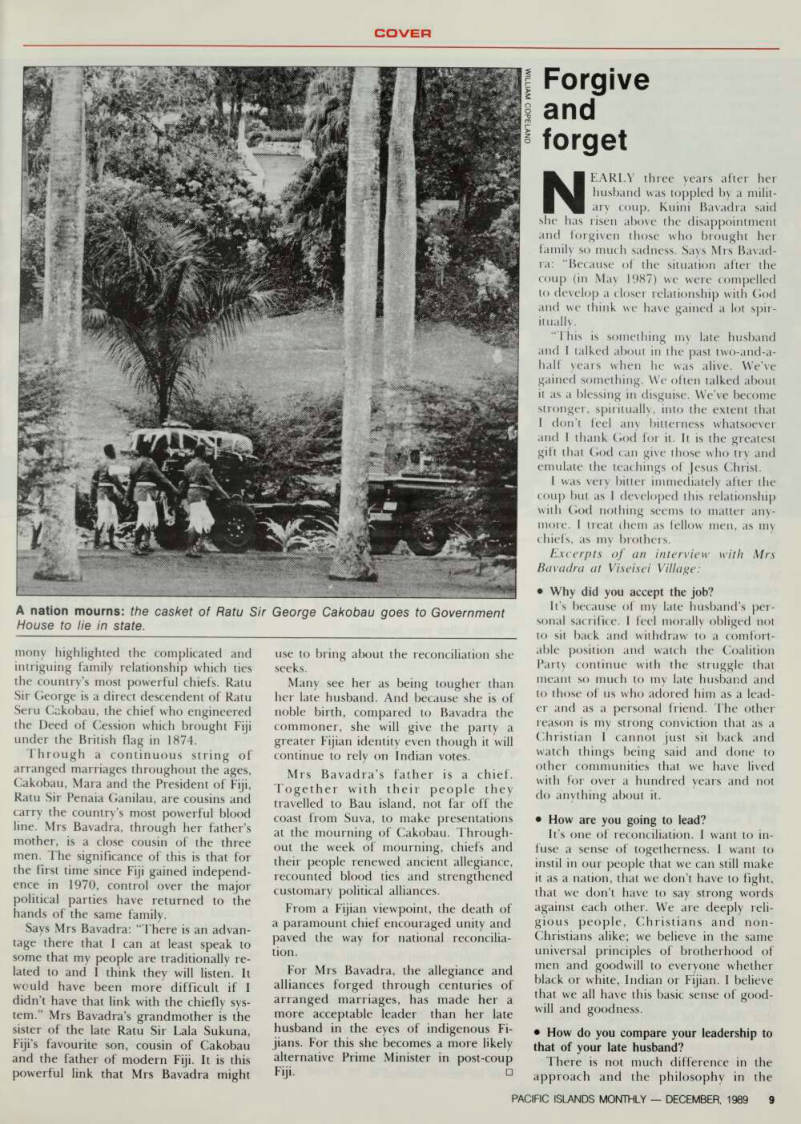
But of greater significance in events that took place last month was the death in Suva of Fiji’s paramount chief, the Vunivalu and former Governor-General, Ratu Sir George Cakobau. While the na tion mourn the death of a man de scribed as a chief, statesman, sportsman and friend, the death brought together Fiji’s leader and their people on the tiny island of Bau.
Traditional presentations from all parts of Fiji during the mourning cere
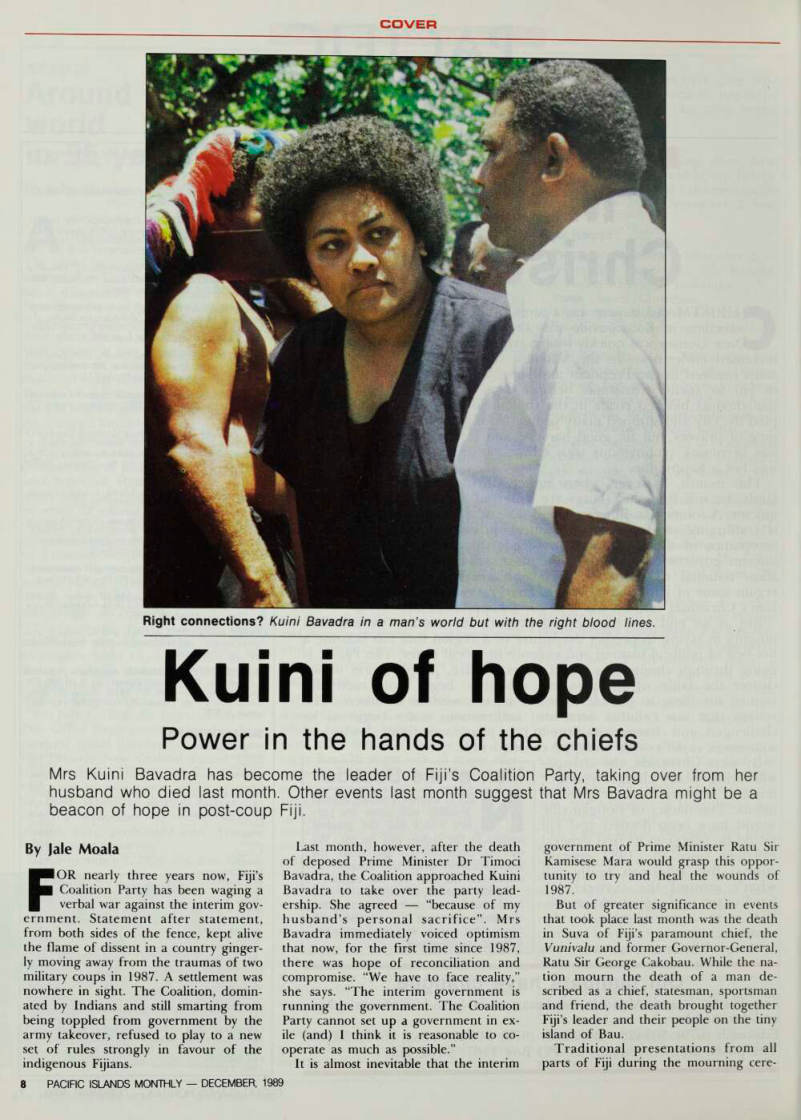
Right connections? Kuini Bavadra in a man’s world but with the right blood lines.
mony highlighted the complicated and
intriguing family relationship which ties
the country’s most powerful chiefs. Ratu Sir George is a direct descendent of Ratu Seru Cakobau, the chief who engineered the Deed of Cession which brought Fiji under the British flag in 1874.
Through a continuous string of
arranged marriages throughout the ages,
Cakobau, Mara and the President of Fiji, Ratu Sir Penaia Ganilau, are cousins and carry the country’s most powerful blood line. Mrs Bavadra, through her father’s mother, is a close cousin of the three men. The significance of this is that for the first time since Fiji gained independ ence in 1970, control over the major political parties have returned to the hands of the same family.
Says Mrs Bavadra: “There is an advan tage there that I can at least speak to some that my people are traditionally re lated to and I think they will listen. It would have been more difficult if I didn’t have that link with the chiefly sys tem.” Mrs Bavadra’s grandmother is the sister of the late Ratu Sir Lala Sukuna, Fiji’s favourite son, cousin of Cakobau and the father of modern Fiji. It is this powerful link that Mrs Bavadra might
use to bring about the reconciliation she seeks.
Many see her as being tougher than her late husband. And because she is of noble birth, compared to Bavadra the commoner, she will give the party a greater Fijian identity even though it will continue to rely on Indian votes.
Mrs Bavadra’s father is a chief.
Together with their people they
travelled to Bau island, not far off the coast from Suva, to make presentations at the mourning of Cakobau. Through out the week of mourning, chiefs and their people renewed ancient allegiance, recounted blood ties and strengthened customary political alliances.
From a Fijian viewpoint, the death of a paramount chief encouraged unity and paved the way for national reconcilia tion.
For Mrs Bavadra, the allegiance and alliances forged through centuries of arranged marriages, has made her a more acceptable leader than her late husband in the eyes of indigenous Fi jians. For this she becomes a more likely alternative Prime Minister in post-coup Fiji. □
A nation mourns: the casket of Ratu Sir George Cakobau goes to Government House to lie in state.
William Copeland
Forgive
and forget
NEARLY three years after her husband was toppled by a milit ary coup, Kuini Bavadra said she has risen above the disappointment and forgiven those who brought her family so much sadness. Says Mrs Bavad ra: “Because of the situation after the coup (in May 1987) we were compelled to develop a closer relationship with God and we think we have gained a lot spir
itually.
“This is something my late husband and I talked about in the past two-and-a half years when he was alive. We’ve gained something. We often talked about it as a blessing in disguise. We’ve become stronger, spiritually, into the extent that I don’t feel any bitterness whatsoever and 1 thank God for it. It is the greatest gift that God can give those who try and emulate the teachings of Jesus Christ.
I was very bitter immediately after the coup but as I developed this relationship with God nothing seems to matter any more. I treat diem as fellow men, as my chiefs, as my brothers.
Excerpts of an interview with Mrs Bavadra at Viseisei Village: • Why did you accept the job?
It’s because of my late husband’s per sonal sacrifice. I feel morally obliged not to sit back and withdraw to a comfort able position and watch the Coalition Party continue with the struggle that meant so much to my late husband and to those of us who adored him as a lead er and as a personal friend. The other reason is my strong conviction that as a Christian I cannot just sit back and watch things being said and done to other communities that we have lived with for over a hundred years and not do anything about it. • How are you going to lead?
It’s one of reconciliation. I want to in fuse a sense of togetherness. I want to instil in our people that we can still make it as a nation, that we don’t have to fight, that we don’t have to say strong words against each other. We are deeply reli gious people, Christians and non- Christians alike; we believe in the same universal principles of brotherhood of men and goodwill to everyone whether black or white, Indian or Fijian. I believe that we all have this basic sense of good will and goodness. • How do you compare your leadership to that of your late husband?
There is not much difference in the approach and the philosophy in the
sense that our approach are quite gentle
by nature. We believe in being as peace ful as we can and that we should respect our political rivals. We feel that we can differ with dignity. This is what I will continue to do. • If you became Prime Minister of Fiji, what would you like done?
The idea of prime ministership is so remote from my list of priorities. There are more pressing issues that we need to work towards as a party. The idea of achieving office or the idea of even thinking about that is far from my mind at this time.
I want to be seen more as a servant who is willing to serve. I don’t want to be seen as having dreams of high office and I don’t want to place too much emphasis on achieving status and all that. That is the biggest challenge that I face. • What are your priorities?
To fill the vacuum that most of our people feel in the party about the death of my husband. It is important to re mind our people that we must not be overwhelmed by the loss and that we must carry on. I feel that I can contri bute something to bring back confidence to our people. • Is your appointment a boost for women in Fiji?
Yes, I think so. But I am not the first.
A lot of other women have made big contributions in government and the pri vate sector. Women have achieved very important positions and this will enhance the aspirations Fiji women can have.
This shows that they, too, can rise to the occasion if demanded of them. • Would you like to work with the interim government?
That is the only thing we can do, realistically there is no other way. We have to face reality. The interim govern ment is running the government. We have proved in the last two-and-a-half years that the Coalition Party cannot set up a government in exile. If it was possi ble I would have done it, but since we have not been able to I think it is reason able to co-operate as much as we can.
The ways and means of doing that will only be clearer after I have had full dis cussions with party members. • Is your strong customary base an advan tage?
There are both advantages and dis advantage. One of the disadvantages is that I can be seen by fellow Fijians as some kind of a traitor. But I want to dwell on the advantages rather than on that element of disadvantage I want to show that being Fijian is irrelevant when it comes to national leadership. What is important is to have an individual who has the strength and character to speak
out and to offer a helping hand, one who is sincere about reconciliation. It is not important if you are a Fijian or an Indian leader.
As far as my links with the chiefly system is concerned, I feel there is an advantage there that I can at least speak to some that my people are traditionally related to and I think they will listen and that will make the struggle easier. It would have been more difficult if I didn’t have that link with the chiefly system. • Will you accept the draft constitution which gives indigenous Fijians a numerical advantage in parliament?
I am a great believer in the thought that no group of people has an inborn right to think itself superior to other so cial groups. I abhor any form of discri mination and I will continue to oppose the draft constitution although I am sensitive to what Fijians say about pro
tecting their indigenous rights. I appreci
ate their fears and I will go to great lengths to protect Fijian rights because I am a Fijian myself.
But we should not overdo it and turn around and tell other racial groups that because they belong to one particular ra cial group they should have less say in parliament. I don’t think that’s right. It’s wrong from a Christian viewpoint and it’s wrong from a Fijian viewpoint. Fi jians always show grace and are always nice to people whom we think do not belong to our community as such. • What killed your husband?
He had cancer. It was an incurable form of cancer. • Did it have anything to do with the stress suffered after the coup?
I was told by some doctors that it was very much stress-related. • What are your memories?
There is a lot of sadness in it. It’s been one of the most difficult times of my life, being with him in the last few weeks when he was in hospital. It’s been very hard for me personally because I know that as a person he was a very strong man, although he was very gentle. To see him physically fading out was some thing that hurt me deeply and some thing I will not forget for the rest of my life.
There are some good memories of being together in the last few weeks, last few months when he continued to sug gest things that have to be said in press statements, he continued to joke with his friends. He did not want his friends and supporters to show pity on him. Those are the qualities that I want to remember him by. Although he was undergoing a lot of stress and experiencing a lot of pain he never showed it.
• Did you consider the possibility that peo ple might not accept having a woman as leader?
Yes, I thought about that and I am not totally blind to the reality that some of our locals might not like a woman as head of a political party. It depends on me, on how I conduct myself. It can be done. If you focus on the opportunity to serve then you will be able to convince the people that it doesn’t really matter whether it’s a man or woman who leads. • Are you prepared for the dirty game of politics?
I believe that politics does not have to be dirty, does not have to be rough. I believe that it can be graceful and digni fied, and that you can still say things with conviction, sincerity. Generally speaking, you win more respect from people if you say and do things with grace and dignity. This way, in the end, you end up being a better person and a
better politician.
• Would you lead the Coalition into gener al elections or would you encourage boycott?
That is something that I want to re serve comment on until after consulta tion with the party. It has to be a party decision. It’s too important an issue for me to say something on right away. • Would you join the interim administra tion?
That is for the party management board to decide. • Were you ever double-minded about leading the Coalition?
Yes, certainly, because I have never seen myself as someone being fully equipped for this high office. I still think that the party has other people who are more capable and more experienced than I am. But perhaps the time is not right for them to take on this role. I think the time is right for me to be given the opportunity but I don’t think I am the best in the party. • How much has the country grown since the coup?
I cannot speak for the government, I only know about the civil service because I worked there. We have really per formed very well as a civil service and although there has been a lot of migra tion experienced in various fields, in teaching, in medicine and technical and other professional areas, there were other civil servants who were left behind and they really performed well. Credit must go to how the civil service has been managed and credit must go to the senior civil servants who helped maintain efficiency and productivity in the civil service since 1987. D
she’s tougher than tough
Baba’s obvious choice: she’s tougher than tough
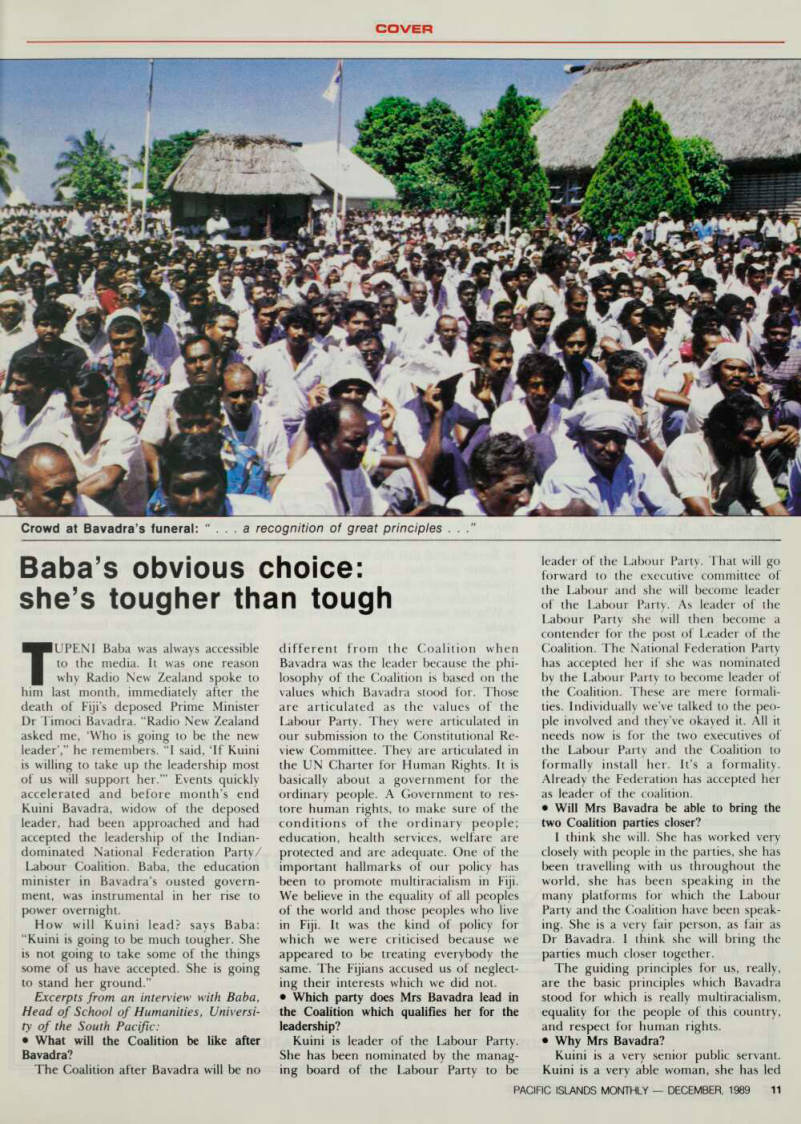
TUPENI Baba was always accessible to the media. It was one reason why Radio New Zealand spoke to him last month, immediately after the death of Fiji’s deposed Prime Minister Dr Timoci Bavadra. ‘‘Radio New Zealand asked me, ‘Who is going to be the new leader’,” he remembers. “I said, ‘lf Kuini is willing to take up the leadership most of us will support her.’” Events quickly accelerated and before month’s end Kuini Bavadra, widow of the deposed leader, had been approached and had accepted the leadership of the Indiandominated National Federation Party/ Labour Coalition. Baba, the education minister in Bavadra’s ousted government, was instrumental in her rise to
power overnight.
How will Kuini lead? says Baba: “Kuini is going to be much tougher. She is not going to take some of the things some of us have accepted. She is going to stand her ground.”
Excerpts from an interview with Baba, Head of School of Humanities, University of the South Pacific: • What will the Coalition be like after Bavadra?
The Coalition after Bavadra will be no
different from the Coalition when Bavadra was the leader because the philosophy of the Coalition is based on the values which Bavadra stood for. Those are articulated as the values of the Labour Party. They were articulated in our submission to the Constitutional Review Committee. They are articulated in the UN Charter for Human Rights. It is basically about a government for the ordinary people. A Government to restore human rights, to make sure of the conditions of the ordinary people; education, health services, welfare are protected and are adequate. One of the important hallmarks of our policy has been to promote multiracialism in Fiji.
We believe in the equality of all peoples of the world and those peoples who live in Fiji. It was the kind of policy for which we were criticised because we
appeared to be treating everybody the
same. The Fijians accused us of neglecting their interests which we did not. • Which party does Mrs Bavadra lead in the Coalition which qualifies her for the leadership?
Kuini is leader of the Labour Party.
She has been nominated by the managing board of the Labour Party to be
leader of the Labour Party. That will go forward to the executive committee of the Labour and she will become leader of the Labour Party. As leader of the Labour Party she will then become a contender for the post of Leader of the Coalition. The National Federation Party has accepted her if she was nominated by the Labour Party to become leader of the Coalition. These are mere formali ties. Individually we’ve talked to the peo ple involved and they’ve okayed it. All it needs now is for the two executives of the Labour Party and the Coalition to formally install her. It’s a formality.
Already the Federation has accepted her as leader of the coalition. • Will Mrs Bavadra be able to bring the two Coalition parties closer?
I think she will. She has worked very closely with people in the parties, she has been travelling with us throughout the world, she has been speaking in the many platforms for which the Labour Party and the Coalition have been speak ing. She is a very fair person, as fair as Dr Bavadra. I think she will bring the
parties much closer together.
The guiding principles for us, really,
are the basic principles which Bavadra stood for which is really multiracialism, equality for the people of this country, and respect for human rights. • Why Mrs Bavadra?
Kuini is a very senior public servant.
Kuini is a very able woman, she has led
Crowd at Bavadra’s funeral: "... a recognition of great principles . .."
many Fiji delegations as a leader. She led Fiji at the United Nations End of the Decade for Women conference in Kenya. Kuini is a graduate of the Uni versity of the South Pacific. She has had post-graduate training overseas and is a very able person. Kuini in her own right is very capable and politically very astute.
Some say she is much faster than a lot of us in the past (Coalition) government in terms of perception of issues. She has attended many of the conferences that Bavadra went to as leader of the Labour Party. For example, she went to Mel bourne at the Progressive Parties confer ence and she spoke on behalf of the women, a very impressive speech. In fact Kuini has had a kind of preparation for the position of being leader. In addition, Kuini in her own right has got chiefly connection, a fairly powerful chiefly con nection. But I think the first thing really
that makes her eligible is her ability and commitment to the values that Bavadra stood for.
We do not deny that she was married to Bavadra and that she has got a Bavad ra name and that is important for the ordinary people. But in addition to that she has the right qualifications. • Why not someone from within the party ranks?
The feeling is if Kuini is willing to serve she will serve as leader very, very well. For those of us who were close to Bavadra, if pressured, will be willing to lead. But I think we don’t really regard the leadership as something to fight for because it contains major responsibilities.
The party cannot maintain too many people. We can maintain Kuini and ev erybody will have to contribute to main tain her as we did for Dr Bavadra.
So in all Kuini will be able to act as
leader, maintain the principles and keep the people together. The movement will be stronger now than say a few weeks before Bavadra died when Bavadra was very ill. • Then she is the Coalition’s alternative prime minister?
Once she becomes leader she will be come the alternative Prime Minister.
And if we have elections I have no doubt that the people of Fiji will vote her in. • Are the people of Fiji ready for a woman prime minister?
Surprisingly the people of Fiji, I think, are ready. The people of Fiji are looking for people who are capable whether they are men or women. Unfortunately the way the parties operated in the last twen ty years did not support women. This is another new dimension which must be recognised. More than fifty per cent of the people of this country are women.
Even the most Moslem country like Pakistan which puts women as second class citizens are able to vote a woman in.
In Fiji we’ve had women as chiefs, women as leaders. But most of us males, because of our own sense of insecurity, have not really given them a fair go. I think this will be a new dimension which the Coalition will offer the people of Fiji. • What advantage has she got as a woman?
Kuini will maintain a lot of dignity and will make sure the dignity is kept on utterrances and statements. Kuini will have access to both professional and political advice that most of the leaders in the interim government don’t have access to. She will get business advice, she will get academic advice, and she will get political advice. She will get legal advice. These are the kinds of advices that will be given to Kuini by most of us who are involved. • Who pushed her name through?
I am blamed for being one of the first to go on air and mention her because I’ve worked very close with Kuini, and Bavadra. She’s the obvious choice. I think if we had gone back to govern ment Kuini would have played a part in
it. She probably would have come in on a political angle, probably on a woman’s role. But because she was the wife of the Prime Minister we had to observe certain degree of ethics. She was always in the Labour Party. She was part of the women who had been involved in the labour movement. That’s Kuini all over. • Will she be tougher than her husband?
They have different styles. Dr Bavadra is quiet, firm in his own way, humble, but tough, tough enough not to crack.
At the most times of crisis, during the time of the coup and all that harassment, he was able to stand aside, be cool and assess the situation in his own way. So he is tougher in that quiet sort of way.
Kuini is going to be much tougher.
Kuini is not going to take some of the things that some of us have accepted.
She is going to stand her ground. She can take and she can give it and I think with a little experience she will be a very difficult opponent. • What sort of leadership do you expect from her?
A very similar kind of leadership.
Kuini’s own upgringing is different. She will be more prepared to speak out. She will be more prepared to take on a num ber of things that perhaps Dr Bavadra would have hesitated a little and consult some other people. • What little things?
I think when it comes to certain tradi tional criticisms, Fijian interests a few of us like Bavadra and myself would go back a little and consider it very seriously because we were commoners and we had to be very careful in the kind of replies that we gave. Kuini, being of noble birth will have views to exchange on the mat ter fairly quickly. She will be far more vocal than us in those particular issues and might even take a lot of people who want to use the position to further their
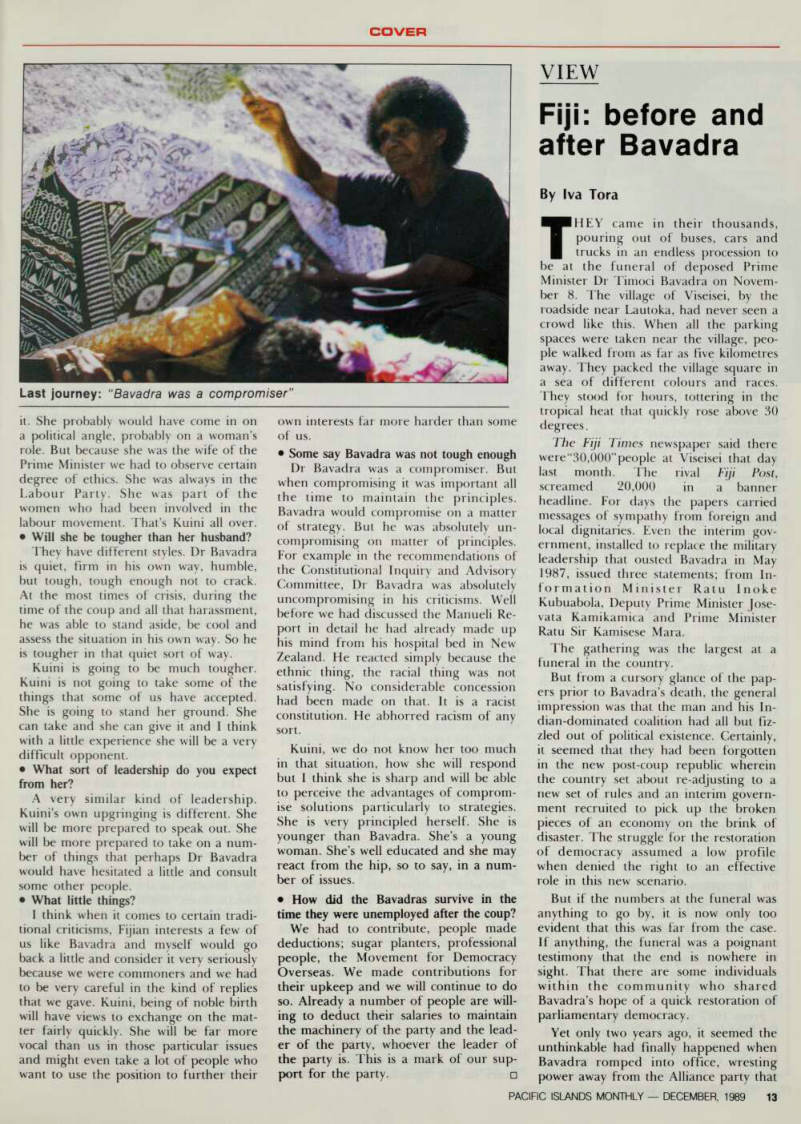
own interests far more harder than some of us. • Some say Bavadra was not tough enough Dr Bavadra was a compromiser. But when compromising it was important all the time to maintain the principles.
Bavadra would compromise on a matter of strategy. But he was absolutely un compromising on matter of principles.
For example in the recommendations of the Constitutional Inquiry and Advisory Committee, Dr Bavadra was absolutely uncompromising in his criticisms. Well before we had discussed the Manueli Re port in detail he had already made up his mind from his hospital bed in New Zealand. He reacted simply because the ethnic thing, the racial thing was not satisfying. No considerable concession had been made on that. It is a racist constitution. He abhorred racism of any sort.
Kuini, we do not know her too much in that situation, how she will respond but I think she is sharp and will be able to perceive the advantages of comprom ise solutions particularly to strategies.
She is very principled herself. She is younger than Bavadra. She’s a young woman. She’s well educated and she may react from the hip, so to say, in a num ber of issues. • How did the Bavadras survive in the time they were unemployed after the coup?
We had to contribute, people made
deductions; sugar planters, professional
people, the Movement for Democracy Overseas. We made contributions for their upkeep and we will continue to do so. Already a number of people are will ing to deduct their salaries to maintain the machinery of the party and the lead er of the party, whoever the leader of the party is. This is a mark of our sup port for the party. □
Last journey: “Bavadra was a compromiser”
Fact File
Name; Adi Kuini Teimumu Vuikaba Bavadra Date of Birth: December 23, 1949 Qualifications: Bachelor of Arts in History/ Politics/Administration (University of the South Pacific) Last position held in government; Principal Administrative Officer (Public Service Commission); acted as Director (Personnel Division), Public Service Commission Civil service career: 1970-1974 Cadet Officer/Clerical Officer, Public Service Commission; 1975-1984 Translator/In formation Officer/Principal Information Officer, Ministry of Information; 1985- 1989 Principal Administrative Officer, Public Service Commission Primary school education: Navua Indian School (1954-1956), Namalata District School (Kadavu) (1957-1959), Delana Mis sion School (Levuka) (1960), Levuka Public School (1961) Secondary school education: Adi Cakobau School (1962-1968), Suva Grammar
School. Passed NZ University Entrance, (1969) School prizes; (1967) Adi Cakobau School Principal’s Prize for character, 1968 Adi Cakobau School’s Head Girl Prize.
Conferences and overseas courses: Septem ber-December 1978 Public relations course for overseas information officers, London; represented Fiji Public Service Association women at World Conference organised by Public Service International, November 1984, New York; Head of the Official Fiji delegation to Nairobi at the World Conference on the United Nation End of the Decade for Women.
Positions held in service organisations: Past president of Fiji Public Servants Associa tion women’s wing; past president of Adi Cakobau School Old Girls’ Association; im mediate past president of University of South Pacific Alumini Association (ex USP Student Association); Secretary Coordina tor of Suva Hibiscus Festival Association; active memberof the Viseisei Methodist Church. □
Advertisements & other items, p. 12 (1 item)
idmmr /
Fan
I Emms I
FIJI CUSTOM CRAFT LIMITED
ALUMINIUM BOAT BUILDERS
WAILADA, LAMI,
P.O. Box 1277, SUVA, FIJI
PHONE 361977, 361786.
TLX. FJ 2315. FAX 302814
FISHING BOATS, HYDROCATS, WATER TAXIS, CORAL VIEWERS, BARGES, SPECIALISED VESSELS
CUSTOMISED TO YOUR SPECIFICATIONS
Fiji: before and
View
Fiji: before and after Bavadra
By Iva Tora
THEY came in their thousands, pouring out of buses, cars and trucks in an endless procession to be at the funeral of deposed Prime Minister Dr Timoci Bavadra on Novem ber 8. The village of Viseisei, by the roadside near Lautoka, had never seen a crowd like this. When all the parking spaces were taken near the village, peo ple walked from as far as five kilometres away. They packed the village square in a sea of different colours and races.
They stood for hours, tottering in the tropical heat that quickly rose above 30 degrees.
The Fiji Times newspaper said there were“3o,ooo”people at Viseisei that day last month. The rival Fiji Post, screamed 20,000 in a banner headline. For days the papers carried messages of sympathy from foreign and local dignitaries. Even the interim gov ernment, installed to replace the military leadership that ousted Bavadra in May 1987, issued three statements; from In formation Minister Ratu Inoke Kubuabola, Deputy Prime Minister Jose vata Kamikamica and Prime Minister Ratu Sir Kamisese Mara.
The gathering was the largest at a funeral in the country.
But from a cursory glance of the pap ers prior to Bavadra’s death, the general impression was that the man and his In dian-dominated coalition had all but fiz zled out of political existence. Certainly, it seemed that they had been forgotten in the new post-coup republic wherein the country set about re-adjusting to a new set of rules and an interim govern ment recruited to pick up the broken pieces of an economy on the brink of disaster. The struggle for the restoration of democracy assumed a low profile when denied the right to an effective role in this new scenario.
But if the numbers at the funeral was anything to go by, it is now only too evident that this was far from the case.
If anything, the funeral was a poignant testimony that the end is nowhere in sight. That there are some individuals within the community who shared Bavadra’s hope of a quick restoration of
parliamentary democracy.
Yet only two years ago, it seemed the unthinkable had finally happened when Bavadra romped into office, wresting power away from the Alliance party that
had been in government for almost two decades. A commoner, a westerner, and a novice to the political arena, Bavadra had defeated the odds and hit a nerve that struck at the very foundations of a very powerful customary establishment.
The Coalition’s victory exiled the Alliance party into the opposition and jolted it out of what was once a secure niche, leaving the conquered to lament its losses and gather the crumpled laurels of a crown held for 17 years.
The new government’s promise to the electorate of an inquiry into allegations of corruption became a shadow ever looming on an Alliance landscape where the sun was already beginning to set.
And it became a promise shortlived when 10 soldiers stormed parliament and brought to an abrupt end the 17year life of Fiji democracy.
The 1987 coups brought sharply into focus the distorted image of Fiji as the region’s model of a stable democracy and the underlying conflict of tradition versus progress. Perceived fears of threats to Fijian land and subsequent ex tremist Taukei reprisals; subjugation of Fijian interests to Indian and therefore “foreign” domination under a govern ment seen essentially as leftist with socialist tendencies became a justification for the coups led by the 38-year-old third-ranking army officer, Lieutenant- Colonel Sitiveni Rabuka.
The crisis opened up a Pandora’s box that sent investors flying, devalued the Fiji dollar, disrupted the economy and saw a mass exodus of mostly Indian pro fessionals escaping overseas on one-way tickets.
From 1987 until his health gave way, Dr Bavadra continued to wage a cam paign taken to the international stage, for the restoration of parliamentary democracy. But the push which initially
received fervent international support, particularly from Australia and New Zealand, ebbed into a lull as the interna tional community re-adjusted to a new regime and a new state of affairs.
The coup raised the traditional mechanisms of Fijian politicking to a
level not previously enjoyed nor given
extensive limelight under the Westmins ter system. And in so doing, uncovered a can of worms of conflict and friction
already existing, but lying dormant with
in the framework of traditional Fijian politics. It set a precedent for power blocks within the fragile aftermath of the coup, to grab a significant share of the cake and the spoils of power.
The coup gave licence to a new form of religious zeal that divided loyalties within the Methodist church, the reli gious, albeit imported, bastion of Fijian
spiritual life. Encouraged by the
Methodist Church’s General-Secretary, Rev Manasa Lasaro, Fijians erected roadblocks in a campaign to stop all work, sports and trade on Sundays. The power struggle within the church, re vealed the internal mechanism of the hierarchy at work, and a dirty side to church politics such as had never been disclosed before in such a candid and vindicative manner.
The coup provided the impetus for the formation of a fourth Fijian confed eracy based in the west of Fiji the Yasayasa Vakara confederacy. But while moves to form a western confederacy can be traced back to early this century, the issue was not revived until the coup.
For so long, despite their rich econo mic resources, western interests have been absorbed into Eastern Fiji priori ties. The economic backbone of the re public, the west, has provided sugar (Fiji’s main revenue earner), hydro electricity, timber and tourism.
With the coup came the realisation of their economic power. But unlike the Methodists, the Yasayasa Vakara group opted for a low-key approach in its
struggle for recognition and an indepen
dent voice.
But the Coalition jumped on the band wagon and formed a rival fourth confed eracy in a political gamble aimed at gathering more Fijian support.
Bavadra’s confederacy gained little
acceptance. More chiefs gave support to the Yasayasa Vakara led by Bavadra’s chief, the Tui Vuda, Ratu Sir Josaia Tavaiqia, Minister for Forest in the in terim government.
Bavadra’s death and the installation of his widow, Adi Kuini Vuikaba, as Coali tion leader, brings hope for a concilia tion between the two groups for their cause to appear to be more effective.
The importance attached to the issue is such that it has been made one of two issues on the agenda for discussion at
the next Great Council of Chiefs meet ing, whenever that might be.
The 1987 crisis also highlighted the peculiar relationship between the tradi tional Fijian set-up and the Westminster style of democracy. For so long, the two have existed side by side in a parallel working relationship without, it seems, either one crossing the other’s bound aries.
And despite the dominance of demo cratic rule, no boundaries were crossed and the relationship was harmonious for 17 years in any case. What happened in May 1987 could be seen as an attempt by a traditional system to reassert itself when faced with the perceived threat of usurpation by an imported and there fore alien rule.
Fiji, before the coup, was like a three legged stool. The Fijians had the land, the British ran the administration and the Indians provided the labour and had the money. This framework almost always worked in ensuring racial har mony and maintaining the balance of power. But when Bavadra romped into office in April 1987 on Indian votes, the twain met, the three-legged stool lost a leg and the balance was upset.
As one observer put it: “Once you, the Indians, have the money and then the political power, where does that leave the Fijians? It’s almost inevitable that someone like Rabuka would emerge.”
The Coalition underestimated the
strength of prevailing Fijian traditionalist
thought in a culture where blood is the essence of loyalty.
Two years after the coup, a number of pertinent questions remain unclear. How do we measure the degree to which tra ditionalist fears that culminated with the coup was a spontaneous mass response and how much of it was drummed up and fuelled by loss of power. How much of it, was a spontaneous response from below and how much of it was manipu lated and directed from above?
The answers to these and other equal ly pertinent questions will never be known for as long as ordinary Fijians remain uneducated and deprived of the opportunity to articulate their needs and question their leaders.
With an added dose of pragmatism, Mrs Bavadra, as she steps into her hus band’s shoes, might well bear in mind this slice of wisdom as she takes hold of the party that showed promise but, was denied its right: “There is nothing more difficult to ex ecute, nor more dubious of success, nor more dangerous, to administer than to introduce a new order of things; for he who introduces it has all those who pro fit from the old order as his enemies, and he has only lukewarm allies in all those who might profit from the new.” (, Machiavelli , The Prince). □
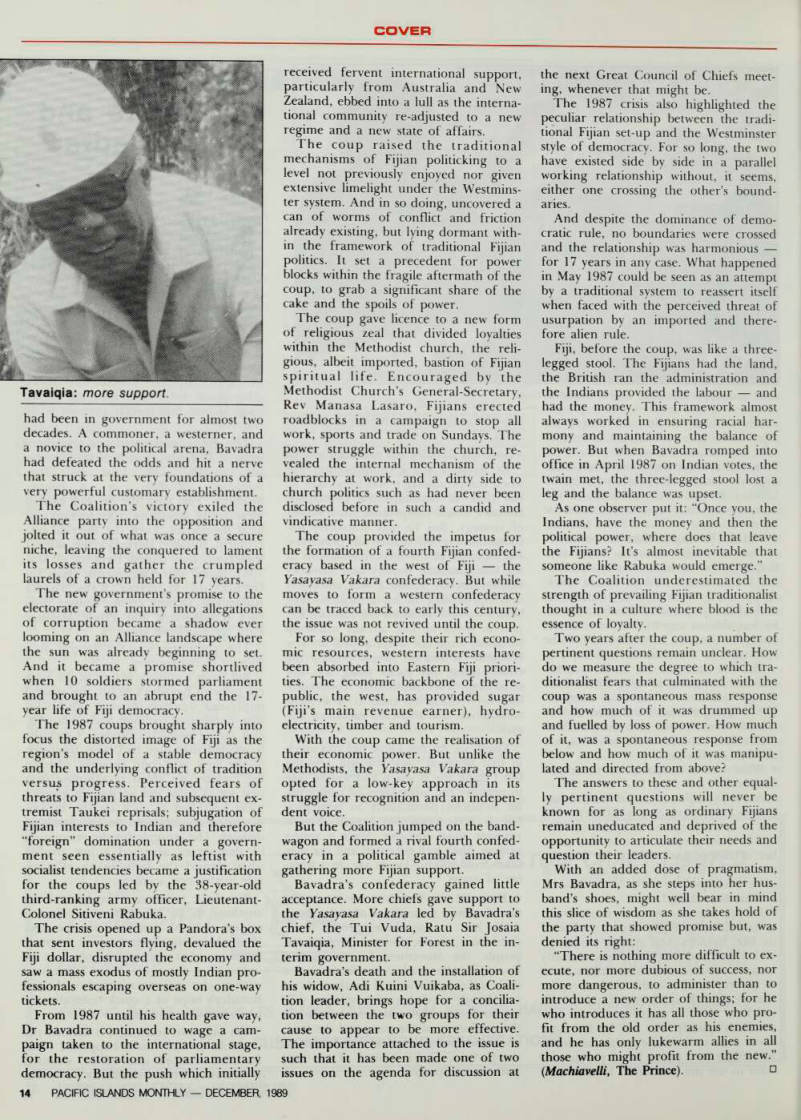
Tavaiqia: more support.
Jean-Pascal Couraud

The Region
Cook Islands
A new formula for schools
By Cheryl Lily
EDUCATION in the Cook Islands appears likely to undergo radical changes if proposals from a recent taskforce inquiry are implemented. The controversial report, Polynesia Way, has been labelled by many parents and teachers as bold innovative, naive, idealistic, unworkable, egocentric and su perficial. However, Government argues that by 1994 the Cook Islands will have a much better education system.
Polynesia Way, is the result of six months work by a team of five who were chosen to reflect a good cross section of Cook Islands society. Taskforce chair man David Lewis says the team receives submissions from all sections of the Cook Islands community both here and over seas. The taskforce also joined forces with education colleagues in Hawaii, New Zealand and Tahiti in an attempt to provide a Polynesian basis for future education in the Cook Islands.
The release of Polynesia Way, fulfils the Government’s election promise to appoint a ministerial taskforce to review the education system of the Cook Islands and to submit, within six months, a com
prehensive policy statement.
Education Minister Ngereteina Puna says he is very excited with the report that he regards as a reflection of the wishes of all Cook Islanders.
Says Puna: “At the end of the tunnel I see a system that will help our young people face the challenges of the twenty
first century. Polynesia Way points the
direction, but we are taking four years to get there as opposed to other countries that were given twelve months to imple ment a new system. We are moving for
ward cautiously.”
There has been criticism over the choice of taskforce members by some teachers who were surprised by the makeup of the team. While recognising the fact that they were all good citizens, many teachers felt that the taskforce members were not qualified to review education in a professional way. Task force chairman Lewis was the only teacher on the team, along with repre sentatives from the business and public sectors, and a recent ex-student.
Puna says the taskforce team was handpicked by himself and is a very fair representation of the Cook Islands com
munity. “Many people are under the
misconception that only teachers know what is wanted from education. The community knows what they want,” he says.
The taskforce identified the national goals of Cook Islands education to be “an education which will enable Cook Islanders to exercise control over their own cultural, political, economic and financial lives.” The emphasis of the new system will be to “keep things simple; allow children to go at their own pace and make it hard to fail.”
Major reforms recommended by the taskforce include school based manage ment in the form of Boards of Trustees; a bi-lingual education system; the estab lishment of an Institute of Higher Edu cation; the setting up of educational pro vinces with the integration of many schools; and a national core curriculum of Mathematics, English and Cook Is lands Maori the remaining subjects to be chosen by the individual boards of trustees.
In recommending major educational
reforms the taskforce acknowledges that the Cook Islands public has no confi dence in the present system which it re gards as a failure. The public, says the taskforce, wants an education system that is fair, of a high standard and equal for all.
The move towards school based man agement aims to get parents actively in volved in education and to have a say about how and what their child is taught.
This new system is said to offer a higher level of accountability and allows every one to be involved in the decision mak
ing process.
A bi-lingual approach to education will ensure that every child can speak En
glish and Cook Islands Maori fluently.l It is to begin at the preschool level and will continue throughout the child’s school life.
Government has accepted the report and it has now been handed over to an implementation team (all teachers and professionals), who will be responsible for drafting policy within the framework of Polynesia Way. There will be no changes until policy has been formulated and approved by Cabinet.
Says implementation team member
Lionel Brown: “At present there is no direction in education, no national objec tives. Only eight per cent of Cook Is lands students pass at Form 7 and those that leave or do not pass, have no real skills. The present system does not cater for the less academically inclined stu dents. The new system will be more flexible and open ended. Students will actually leave school with work skills”.
Under the proposed new system, stu dents will stay at their chosen school un til they sit the Cook Islands School Cer tificate. They car) then enter the “Insti tute of Higher Education, where they can choose to pursue an academic career up to University Entrance level, or ac
quire specialist training to diploma level
in trade, agriculture, fisheries, tourism
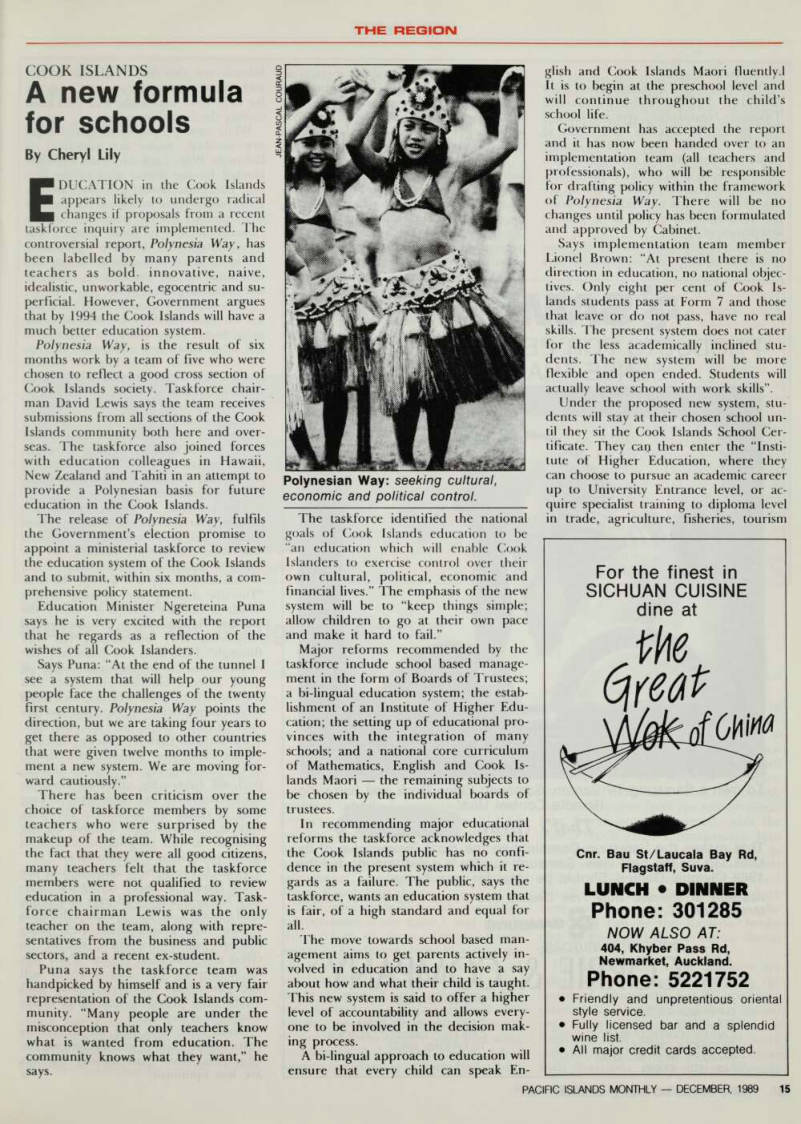
Jean-Pascal Couraud
Polynesian Way: seeking cultural, economic and political control.
or the creative arts.
Chairman of the implementation team Assistant Minister of Education 1 iriamate Ngatokorua, says the team is now going out into the community to explain Polynesia Way and to gauge public reaction. He says there has been a lot of panic by people who do not really understand what Polynesia Way is all about. He hopes that by holding community meetings, there will be a general acceptance of it.
I he most important part of the new education system is bilingualism, says
Ngatokorua. “It (bilingualism) is essential for a Cook Islands child to live success
fullyintheCooklslandsandoverseas.lt
will also give us a sense of belonging. We will keep our Cook Islands identity through our language and our culture.”
The implementation team is quick to point out that Polynesia Way is only a guideline to education reform. “In ess ence, what we are doing is putting the meat on the skeleton,” says Brown, “Only if a school feels ready and has the necessary expertise to make up a board of trustees will it be able to change.
Schools are also free to choose to stay with the old system if they want or to ask for help from the Ministry of Education
during the transition period.”
While most people agree that changes are needed, many are sceptical of Polynesia Way. Lack of funds has been blamed for the dismal state of the pre sent education system and just how the
government plans to successfully provide
the resources for the proposed changes remains unclear for most people. The new system will require specialised teachers, more bi-lingual resources and additional school facilities to cater for the expanding curriculum.
Puna acknowledges the need for a big ger education budget. He says he is an xious to get more money to upgrade all the schools with new equipment and im proved facilities. “Trimming” the present bureaucratic structures within the educa tion system and diverting the money to the schools is one way. The 1988/89 education budget was NZ|5.4 million of which $4.8 million went in salaries and wages alone. With the change to educa tional provinces, smaller schools will merge and thus avoid duplicating facili ties and resources.
The principal of Rarotonga’s largest
college, Harry Ivaiti, is unhappy about many of the proposed changes. He says that some changes are needed, but no thing as drastic as Polynesia Way.
“We need a step not a leap,” he says, “Do not destroy the present system which is labelled colonial marry the old and Polynesia Way. We don’t need
Polynesia Way bulldozing it’s way
through”. Ivaiti feels that financially, the implementation of Polynesian Way is going to be a blunder. He argues that the burden of costs will fall back onto school committees and parents, who will have to fundraise to meet any shortfall.
Rarotonga’s Catholic college principal,
Father Paul, sees “boldness and vision” in the taskforce report. “I think this re port will have a big effect on Cook Is lands education and society for a long time to come. To implement Polynesia Way is a colossal job, I think the big question is, can government afford to spend more money on education?”
Links between New Zealand and the Cook Islands are very strong and con cern has been expressed over how prop osed changes to the present education system will affect these ties. Most teachers agree that there will be no effect and Education Minister Puna says he is hoping that any changes will strengthen links with New Zealand and maybe even provide an exchange of re sources and expertise.
While Puna says that the next four years will be exciting and challenging for education, many parents and teachers are less optimistic. □
Advertisements & other items, pp. 15-16 (1 item)
6 reat
For the finest in
SICHUAN CUISINE
dine at m
6 reat
Cnr. Bau St/Laucala Bay Rd, Flagstaff, Suva.
LUNCH • DINNER
Phone: 301285
NOW ALSO AT:
404, Khyber Pass Rd, Newmarket, Auckland.
Phone: 5221752
• Friendly and unpretentious oriental style service. • Fully licensed bar and a splendid wine list. • All major credit cards accepted.
sg SAMSUNG
PRODUCTS FOR PEOPLE WITH MORE
SENSE THAN MONEY
To own a Samsung TV Screen, Samsung Video Deck and Samsung Remote Control Unit!
That’** Great!
That makes the Samsung Combination the most inexpensive of its kind. Go for the best view. Samsung quality is good enough for the 1988 Olympic Games. Should be ideal for your home!
Available at selected Duty Free Dealers and Burns Philp Home Centres throughout Fiji.
SAMSUNG
SOLE DISTRIBUTORS:-
CORRIB & COMPANY
HEAD OFFICE
G.P.O. BOX 45, SUVA
TLX; FJ2166
CABLES; ‘CORRICO' SUVA
TELEPHONE: 386777
BANKERS: WESTPAC, SUVA
FAX: (679) 300610
BRANCH OFFICE:
161 VITOGO PARADE
G.P.O. BOX 83, LAUTOKA
CABLES; “CORRICO” LAUTOKA
TELEPHONE: 60137
of relief
New Caledonia
The song of relief
THE song brought relief to hardline Kanaks. It was a special anthem composed in memory of the heroes who have died during the strug gle for self rule. For those who attended the two-day Union Caledonienne (UC) convention, the anthem, sung by every one at the gathering at Mare in the Loyalty Islands, was a fitting farewell af ter two days of intense debate. For the Kanaks it was a moving display of
strength, unity, and moderation.
It meant that the party, the largest component of the Kanak Socialist
National Liberation Front (FLNKS), has
managed to stay together despite the
assassination of UC chief Jean-Marie Tjibaou and his deputy Yeiwene Yeiwene at Ouvea last May. Things were shaky following the provincial elections in June when party officials were criti cised for seeming to be too occupied with new commitments. Some critics alleged at the time the UC officials were getting too close to the opposition Rally for the Republic in New Caledonia (RCPR). They were seen as being ele vated beyond the reach of the ordinary supporters by their new duties, the body guards and the chauffeured cars. For the party supporters in the bush, there was no indication of change in New Caledonia, even after a year of the
Matignon Accord.
The two-day convention at Mare last month reflected this feeling of frustra tion. The party leaders were continually reminded of their roles as representa tives of the party. The debates were de scribed as “animated”.
Party boss Francois Burck, who suc ceeded his longtime friend Tjibaou, was re-elected UC president. He won 115 votes (20 more than when he was first elected last May) out of 157, a clear sign of the growing confidence of the party
in his leadership. Vice-president Leopold
Joredie was absent because of a death in the family. He was re-elected after two rounds of voting. Ricard Kaloi, of Mare, became the second vice-president, a new position created at this convention to
give the Loyalty Islands a representative
in the top leadership.
The biggest surprise was the failure of Rymard Bouanaoue to regain the seat of the general secretary. Bouanaoue is mayor of Relep. He was absent from the convention and observers believe his abs ence contributed largely to his non-re election. He was replaced by little-known Francois Vouty, a 44-year-old with no previous official role in the party. He is seen as the man who will rebuild the link between the party leadership and the grassroots people. He was described as “a man who has time to meet (the peo ple) and listen to them. He is not stuck in a town hall or in an office”. □
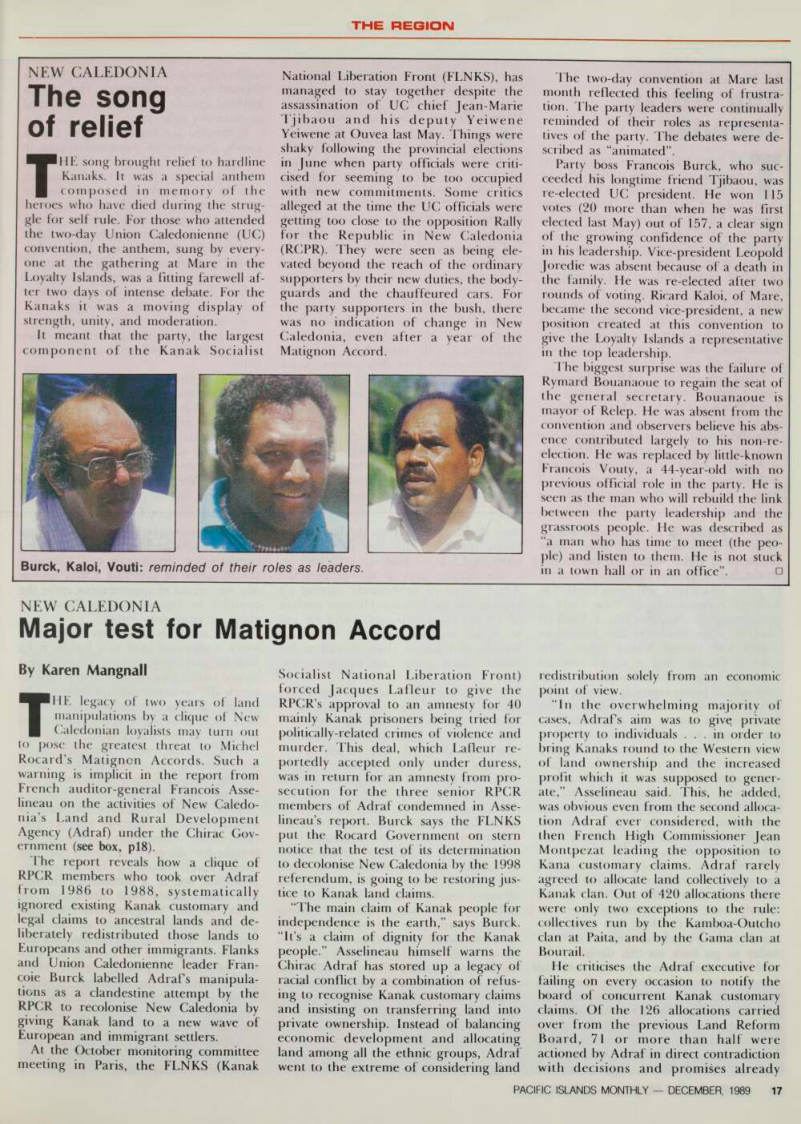
Burck, Kaloi, Vouti: reminded of their roles as leaders.
Major test for Matignon Accord
New Caledonia
By Karen Mangnall
T HE legacy of two years of land manipulations by a clique of New Caledonian loyalists may turn out to pose the greatest threat to Michel Rocard s Matignon Accords. Such a warning is implicit in the report from French auditor-general Francois Asse lineau on the activities of New Caledo nia s Land and Rural Development Agency (Adraf) under the Chirac Gov eminent (see box, p!8).
The report reveals how a clique of RPCR members who took over Adraf from 1986 to 1988, systematically ignored existing Kanak customary and legal claims to ancestral lands and de liberately redistributed those lands to Europeans and other immigrants. Flanks and Union Caledonienne leader Fran coie Burck labelled Adrafs manipula tions as a clandestine attempt by the RPCR to recolonise New Caledonia by giving Kanak land to a new wave of
European and immigrant settlers.
At the October monitoring committee meeting in Paris, the FLNKS (Kanak
Socialist National Liberation Front) forced Jacques Lafleur to give the RPCR’s approval to an amnesty for 40
mainly Kanak prisoners being tried for
politically-related crimes of violence and murder. This deal, which Lafleur re-
portedly accepted only under duress,
was in return for an amnesty from prosecution for the three senior RPCR members of Adraf condemned in Asselineau’s report. Burck says the FLNKS put the Rocard Government on stern notice that the test of its determination to decolonise New Caledonia by the 1998 referendum, is going to be restoring justice to Kanak land claims.
“The main claim of Kanak people for independence is the earth,” says Burck.
“It’s a claim of dignity for the Kanak people.” Asselineau himself warns the Chirac Adraf has stored up a legacy of racial conflict by a combination of refusing to recognise Kanak customary claims and insisting on transferring land into
private ownership. Instead of balancing
economic development and allocating
land among all the ethnic groups, Adraf went to the extreme of considering land
redistribution solely from an economic point of view.
“In the overwhelming majority of cases, Adrafs aim was to give private property to individuals ... in order to bring Kanaks round to the Western view of land ownership and the increased profit which it was supposed to gener ate,” Asselineau said. This, he added, was obvious even from the second alloca tion Adraf ever considered, with the then French High Commissioner Jean
Montpezat leading the opposition to
Kana customary claims. Adraf rarely agreed to allocate land collectively to a Kanak dan. Out of 420 allocations there were only two exceptions to the rule: collectives run by the Kamboa-Outcho clan at Paita, and by the Gama clan at Bourail.
He criticises the Adraf executive for failing on every occasion to notify the board of concurrent Kanak customary claims. Of the 126 allocations carried over from the previous Land Reform Board, 71 or more than half were actioned by Adraf in direct contradiction with decisions and promises already
given to Kanak clans. Asselineau warns: “Two of these allocations pose major problems of public order but there’s the threat that a greater number, if not all 69 other allocations, will cause conflict in future.” Already one of these cases is threatening to escalate into a head-on confrontation between the European owner and several Kanak tribes. The tribe at Oundjo had a verbal contract from the Land Reform Board for redis tribution of prime riverside grazing land.
The former owner had agreed to sell the land and in return the tribe leased it back to him to run his cattle. Adraf re fused to recognise the claim and evicted the tenant, selling the land to a Euro pean reported to have had land troubles elsewhere. Oundjo has written to the new Adraf threatening a mass land occupation unless the land’s returned.
It’s already begun seeking support from other Kanak tribes.
Burck says the Rocard Government has agreed to overturn at least 60 alloca tions made from 1986 to 1988. “In the Oundjo case the Qovernment is embar rassed because the land has been allo cated under French law and it’s difficult today to go back on this decision,” he said. But Asselineau says the potential for future conflict between European and Kanaks is also illustrated by the rate at which recipients have subsequently given up their entitlement. Of 317 perti nent allocations, so far only 49 have been carried right through. Although re cipients blamed Kanak legal claims for
their decisions to give up the land, Asse lineau speculates this may only mask a more real fear land occupations.
The auditor-general also accuses the Adraf clique of deliberately stirring up trouble among Kanaks. He says analysis of certain cases indicated Adraf set out to incite conflicts between individual Kanaks and Kanak clans as well as be tween Kanak clans and European set tlers.
By ignoring the existence of customary claims, Adraf in most cases redistributed land to Kanaks who had no customary right to it. In addition, those Kanaks who were allocated land whether or not they were members of the traditional landowning clan didn’t get permission to claim ownership from the relevant council of elders. “In many cases, it’s in cited often strident opposition from the customary owners,” says Asselineau.
An example of inflamed tempers came in Canala, an area ordinarily at flash point anyway, where a Kanak man was allocated nearly 47 hectares by Adraf de spite one of the board’s Kanak members
pointing out quite forcefully that the
land was already claimed by the Nechero clan. Trouble ensued and eventually De nis Millard, Adrafs director, visited the property with two colleagues. They were attacked and had to seek police protec tion. An axe was smashed into the roof of Millard’s car and all three were
threatened physically.
Such confrontations exposed the in adequacy of criteria from successive
High Commissioners under which land should be allocated to the various ethnic communities, Asselineau says, “because the allocation of land to a Kanak isn’t in any way an act of appeasement, quite the contrary in fact when that Kanak can claim no customary rights.”
Adraf took this attitude to the extreme when it allocated land to a Kanak at La Foa without recognising it encompassed sacred burial sites of the Chome clan, to which the recipient did not belong. The Chome clan also complained other tombs were located in a grotto on nearby land allocated to two Kanak brothers.
Finally, Asselineau describes some
allocations as “very inopportune” given
recent events in New Caledonia, and
cites just one example.
Adraf allocated just over two hectares at Mont-Dore to a certain Maurice Mit ride whose Hienghene property was bought for 42 per cent more than the Crown Lands valuation. His Mont-Dore allocation was at a substantial discount and based upon what Asselineau de scribes as an “imaginery” development project. Mitride was one of the self confessed killers of 10 Kanaks, (includ ing two brothers of the late FLNKS lead er Jean-Marie Tjibaou), at the Hien ghene massacre on December 5, 1984.
Along with his co-accused, Mitride was acquitted in 1987 on the grounds of
“legitimate defence”.
Asselineau comments tersely that such an allocation didn’t clamour for priority under the circumstances. □
The Adraf
New Caledonia
The Adraf scandal
THE French auditor-general Francois
Asselineau recently lifted the lid on loyalist corruption in New Cale donia’s Land and Rural Development Agency (Adraf). His confidential report accuses three senior members of the RPCR, New Caledonia’s main pro- French party, of taking over the running of Adraf from 1986 and perverting its legal functions, in particular, by denying Kanak land claims. Asselineau also im plies criticism of the supporting role played by the then French High Com missioner, Jean Montpezat, who was president of Adrafs board.
Adraf was set up in 1986 by the right wing Chirac Government to replace the Land Reform Board which was itself set up in 1982 by the Socialist Government.
The old board’s job was simply to buy and redistribute land to Kanak tradition al owners. Adrafs role was to buy and redistribute land equitably among all New Caledonia’s ethnic populations in
order to develop the rural economy.
Asselineau’s commission of inquiry was ordered by French prime minister Michel Rocard when he visited New Caledonia in August last year and was confronted by the FLNKS with evidence of Adraf s scandals. So far only an edited summary of the commission’s findings has been made public and it spares the three RPCR leaders: Adrafs former director Denis Millard, the former depu ty director Philippe Gomes, and Territo rial representative Harold Martin.
The full report, 23 pages plus tables and appendices, says the RPCR members ran Adraf as a clique, giving selected board members privileged access to essential documents. This clique would meet secretly, before Adraf board meet ings, and decide upon land purchases and sales which were then presented for rubber stamping at the full board meet
ing. The auditor-general also found key
information was withheld from the full board.
The crux of Asselineau’s criticism rests on what he sees as Adrafs deliberate policy of denying Kanak customary land claims and stirring up trouble not only between Kanak clans and European
landowners but also between Kanaks themselves (see main story). This hidden political agenda meant Adraf abandoned its statutory obligations.
It avoided the legally-required Crown Lands Department valuation except in 3.4 per cent of the cases. Of the 129 purchases with a Crown Land valuation, 86% or 111 parcels of land were bought for between double and triple the official value. The report says in many cases a valuation was obtained only after Adraf had bought the land and these valua tions were done by Philippe Gomes’ father-in-law, a land surveyor not a land valuer. Properties bought by Adraf were overvalued on average by 37 per cent.
As the flip side of this over-valuation, many purchasers were given knock-down prices and deferred loans at low interest rates.
The auditor-general’s report cites several examples of the RPCR clique misusing Adrafs power. They allocated 22 parcels of land to members of the Adraf board or their families. Other allocations were made for electoral or political reasons. Asselineau says these decisions “largely contributed to Adrafs reputation for favouritism and partial
ity”. He quotes from several applicants who spell out their links with the RPCR or the anti-independence cause as reason for favourable consideration. In August 1987, Adraf allocated nine properties to individuals whose applications had been drawn up by Gomes and another 10 properties were allocated to individuals who’d never applied for land.
Adraf was obliged to redistribute land for economic development. But the re port found that generally the Adraf cli que allocated land without a verified eco nomic development proposal from the recipient. The price to be paid and the terms of payment were frequently settled afterwards. Asselineau gives numerous examples of the bizarre outcomes of “these hasty allocations which illustrate the careless examination of each applica tion”: • In August 1987, Adraf allocated just over 375 hectares at Houailou to an in corporated society still being set up. A year later the group still didn’t exist and its development programme was, of course, equally nonexistent.
• In August 1987, eight properties
were allocated to Wallisians (Polynesian immigrants from the French territory of
Wallis and Futuna) at La Foa to set up a
piggery. Adraf approved this piggery
without any commercial feasibility study and even though it contravened the
town’s by-laws.
• Again in August 1987, Adraf agreed to split a La Foa property between two purchasers but later it was discovered the boundary line went straight through the only house on the land. • In February 1988, Adraf allocated six hectares of land to one European without realising, firstly, the land wasn’t economically viable because it was liable to flooding, and secondly, that one hectare was already leased to a company called Enercal.
The report also accused Adraf of be-
coming an intermediary in private land
transactions with 27 properties being bought and then allocated to someone nominated by the seller.
Asselineau says Adraf failed to adhere to its requirement to redistribute land to all ethnic groups in proportion to their populations. This failure was notable with regard to Kanaks: of 717 Kanak applications for land, only 136 were approved. Another aim of getting young
farmers onto land was met for Euro peans but not for Kanaks. And Adraf often gave Kanaks the poorest land (steep terrain, lack of water, distant from road or sea).
Asselineau notes an “unfortunate” comparison between the 581 rejected
Kanak applications, including many
from fathers of large Kanak families, and other results of Adrafs policies:
• 23 European recipients already
owned properties;
• Those 23 Europeans, who already owned a total of more than 4488 hec tares (an average of more than 195 hec tares each), were allocated an extra 3951 hectares (an average of more than 171 hectares each); • 34 recipients weren’t born in New Caledonia; • At least 77 recipients had secure jobs as public servants, municipal work ers or employees of the SLN nickel com pany.
Asselineau describes Adrafs internal management as “wasteful” and characte
rised by flagrant overspending on items
ranging from cars, petrol vouchers, orchids and plants for the Adraf offices
to hiring helicopters. □
Advertisements & other items, p. 19 (1 item)
ninntiK^-
LOW COST HIGH SPEED CATAMARANS FOR SALE .«* f WM™ 5 0f ' a M m\ '.m
2SSa_^;s
AST-
QAHTAS
ninntiK^-
WK'BRISBANE
LOA: 20M. CONST: ALUM. SEATING 150 PAX BEAM: 6.5 M. ENGINE: 2X V 8 MAN. SPEED: 26-29
KNOTS LAUNCHED: 1988. SURVEY; COASTAL.
FUEL CONS; 140 LPH
This attractively modem vessel will carry a full load at 26 knots. Passenger comfort is exceptional in aircraft type seats. Cabin airconditioned.
Price: AUD 750,000
LAUNCHED: 1987. CONST: ALUM. SURVEY: COASTAL
LOA: 16M. ENGINES: 2 X V 8 PERKINS. SEATING; 100PAX BEAM: 6.2 M. SPEED; 16-18 KNOTS. FUEL CONS. 100 LPH A versatile passenger carrier suitable for any application.
Would convert to superb dive/charter vessel or crew transfer.
Price AUD 420,000 * Also available: Low wash general purpose 100 pax. river/harbour ferry. * Near sistership available at AUD 620,000 Price AUD 425,000
FOR FURTHER DETAILS CONTACT SOLE BROKERS:
INTERNATIONAL BROKERING SERVICES P.O. BOX 460 SOUTHPORT
QUEENSLAND AUSTRALIA
PHONE 61 75 324744 FAX 61 75 912777
Outliving
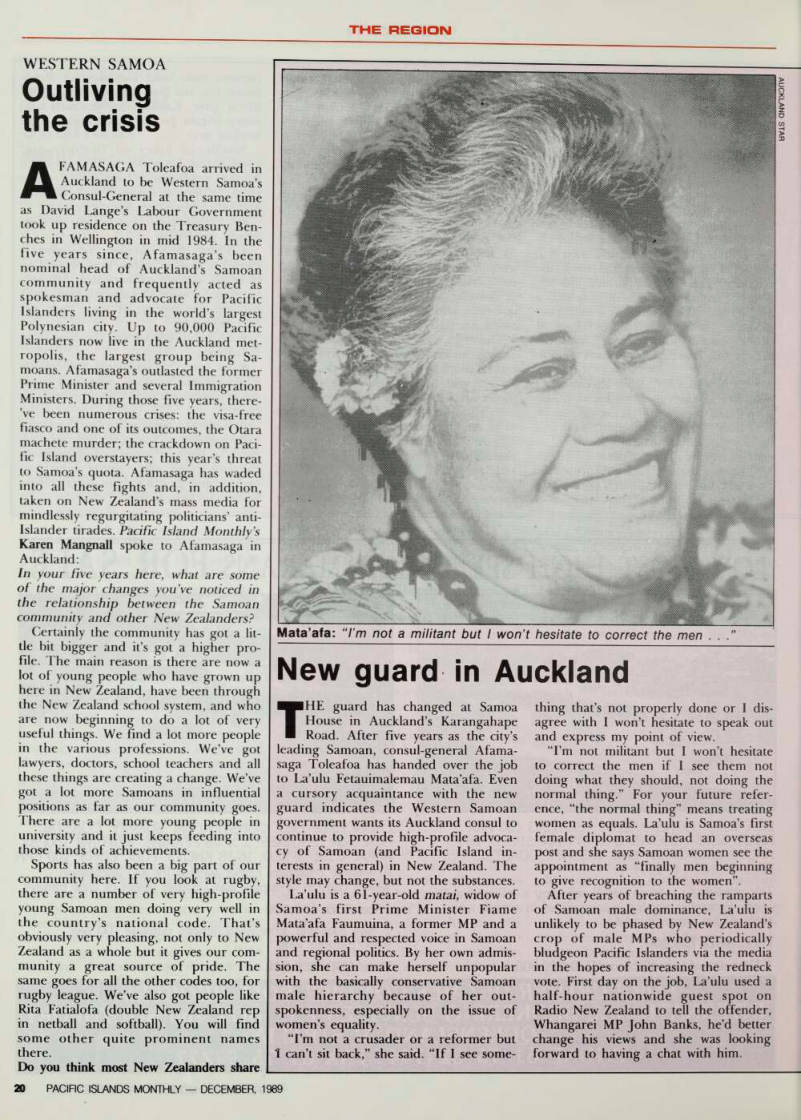
Western Samoa
Outliving the crisis
AFAMASAGA Toleafoa arrived in Auckland to be Western Samoa’s Consul-General at the same time as David Lange’s Labour Government took up residence on the Treasury Ben ches in Wellington in mid 1984. In the five years since, Afamasaga’s been nominal head of Auckland’s Samoan community and frequently acted as spokesman and advocate for Pacific Islanders living in the world’s largest Polynesian city. Up to 90,000 Pacific Islanders now live in the Auckland met ropolis, the largest group being Sa moans. Afamasaga’s outlasted the former Prime Minister and several Immigration Ministers. During those five years, there ’ve been numerous crises: the visa-free fiasco and one of its outcomes, the Otara machete murder; the crackdown on Paci fic Island overstayers; this year’s threat to Samoa’s quota. Afamasaga has waded into all these fights and, in addition, taken on New Zealand’s mass media for
mindlessly regurgitating politicians’ anti
islander tirades. Pacific Island Monthly’s Karen Mangnall spoke to Afamasaga in Auckland: In your five years here, what are some of the major changes you’ve noticed in the relationship between the Samoan community and other New Zealanders?
Certainly the community has got a lit tle bit bigger and it’s got a higher pro file. The main reason is there are now a lot of young people who have grown up here in New Zealand, have been through the New Zealand school system, and who are now beginning to do a lot of very useful things. We find a lot more people in the various professions. We’ve got lawyers, doctors, school teachers and all these things are creating a change. We’ve got a lot more Samoans in influential positions as far as our community goes.
There are a lot more young people in university and it just keeps feeding into those kinds of achievements.
Sports has also been a big part of our community here. If you look at rugby, there are a number of very high-profile young Samoan men doing very well in the country’s national code. That’s obviously very pleasing, not only to New Zealand as a whole but it gives our com munity a great source of pride. The same goes for all the other codes too, for rugby league. We’ve also got people like Rita Fatialofa (double New Zealand rep in netball and softball). You will find some other quite prominent names there.
Do you think most New Zealanders share
your view of Samoan achievements?
I believe New Zealanders do have that view of the Samoan community. I’ve just been in Dunedin and we were talking about how Dunedin was getting warmer and somebody said well, we might see a few more Islanders down here. I said yes, it’s probably going to do your rugby a great deal of good. It was a joke but they did see a certain element of truth. I mix quite widely through my job and also through my children and their ten nis and there are areas where you don’t see a Pacific Islander at all. People there have a very positive view of Pacific Islan ders or Samoans irrespective of the less positive things that have been written and said in the news media.
Do you think New Zealanders know very much about Samoans themselves?
I’m always amazed at how little people know. I think they’ve got an idea of cer tain things: we do go to church, by and
large we’re hard working because they
see us out in factories, we’re keen on educating our children. But as to fully understanding what actually goes on, I believe they don’t, I think many people would like to know but it’s not always easy. The easiest way is to know some one, make friends and then be invited to their home and social or family things. I believe there isn’t enough of that. Some times I feel like telling my New Zealand friends that they, being the hosts, should make the first move. After all they’re more comfortable here and the Pacific Islanders probably feel a bit reserved
and shy.
With the Samoan community making in creasing strides and becoming more visible, is this going to bring increased racial fric tion? 1 don’t believe so. In a city like Auck land where most of the mixing takes place, it’s a big city and I get the im pression that people are more concerned with getting on with their lives rather than with race. As Auckland becomes more cosmopolitan, a more multiracial and multi-ethnic society, people will forget about the race of the other person more and more and they’ll get on with being an Aucklander. If anything the race tensions along those lines will de crease in future.
The big racial issue which will domin ate is how to resolve differences over the Treaty of Waitangi between the tangata whenua (the Maori) and the rest of New Zealand. This has caused some friction and will probably continue to do so rather than race issues per se.
In tough economic times, immigrant com munities are often used as scapegoats. Do you think the Samoan community will suf fer such attention in future?
New Zealand has been through an economic crunch, incredible economic change. We’ve seen people lose their jobs
by the thousands, our own community has been hard hit. Fortunately, we’ve managed because people have turned to the inbuilt support system within the community. There has been a practice of using the new Pacific Island migrants as scapegoats but I believe the worst of that is behind us.
Do you see dangers to Western Samoa with the trend in New Zealand’s immigration policy away from access for Pacific Islan ders in favour of Europeans?
Well, one has to look at whafs hap pening at the moment and wonder just where New Zealand’s immigration poli cies will move in the future. The Minis ter of Immigration is talking about
bringing skilled people from Europe.
That’s all well and good if that’s what the economy needs. One would hope that this will not correspond to a reduc tion in access for people from the Paci fic, and certainly from Western Samoa.
The Western Samoan government has made it clear its immigration quota is an integral part of our relationship with New Zealand and any changes to the quota would mean substantial changes to that relationship. And I’m sure that’s the view of Samoans here to.
New Zealand must also bear in mind its position as a major Polynesian nation and that many Pacific nations look upon New Zealand as a main partner in the
region.
We’ve talked about the achievements of the Samoan community here but what things worry you when you look at the Samoan community’s development here?
There are aspects which do worry us and there are aspects of our community here we’d like to see changed. The over stayers issue is a big irritant in relations between Samoa and New Zealand and it doesn’t do our community here any good at all with that kind of image. So whatever actions are taken to control this problem will be fully supported by the Samoan community and government.
The economic situation is a worry. A lot of Samoan parents are succeeding in pushing their children through the school system here but we also know there are many who are falling by the wayside. They would be a worry because they will be the problem of the future. If
they’re poorly educated, if they lose
touch with their Samoan roots they’re likely to be very difficult to deal with.
We don’t know exactly how many young people are in that category, but my feel ing is it’s not a big number. There’s enough strength in the Samoan com munity to deal with these problems.
I’m concerned that South Auckland doesn’t become a ghetto. Otara has the potential to turn into some kind of Polynesian or Pacific Island ghetto. I’m sure it’s not too late for a lot of change there. □
New guard in Auckland
THE guard has changed at Samoa
House in Auckland’s Karangahape Road. After five years as the city’s
leading Samoan, consul-general Afama-
saga Toleafoa has handed over the job to La’ulu Fetauimalemau Mata’afa. Even a cursory acquaintance with the new guard indicates the Western Samoan government wants its Auckland consul to continue to provide high-profile advocacy of Samoan (and Pacific Island interests in general) in New Zealand. The style may change, but not the substances.
La’ulu is a 61-year-old matai, widow of Samoa’s first Prime Minister Fiame Mata’afa Faumuina, a former MP and a powerful and respected voice in Samoan and regional politics. By her own admission, she can make herself unpopular with the basically conservative Samoan male hierarchy because of her outspokenness, especially on the issue of
women’s equality.
“I’m not a crusader or a reformer but ‘I can’t sit back,” she said. “If I see some-
thing that’s not properly done or I dis agree with I won’t hesitate to speak out and express my point of view, “I’m not militant but I won’t hesitate to correct the men if I see them not doing what they should, not doing the normal thing.” For your future refer ence, “the normal thing” means treating women as equals. La’ulu is Samoa’s first female diplomat to head an overseas post and she says Samoan women see the appointment as “finally men beginning to give recognition to the women”, After years of breaching the ramparts of Samoan male dominance, La’ulu is unlikely to be phased by New Zealand’s crop of male MPs who periodically bludgeon Pacific Islanders via the media in the hopes of increasing the redneck vote. First day on the job, La’ulu used a half-hour nationwide guest spot on Radio New Zealand to tell the offender, Whangarei MP John Banks, he’d better change his views and she was looking forward to having a chat with him.
Mata’afa: “ I’m not a militant but I won’t hesitate to correct the men..."
She’s also ready to reiterate Western Samoa’s concerns about the trend in New Zealand immigration policy. New Immigration Minister Roger Douglas re cently indicated he’d soon revamp guide lines to give preference to skilled immig rants from declining sources such as Europe and north America. Douglas asserts his aim is to balance immigration from Europe, north America, Asia and the Pacific. But La’ulu echoes her prede cessor’s worries that New Zealand may be heading back to Whites Only im migration policy which would have a profound impact on its relations with Western Samoa.
She believes immigration will continue to be the top priority of government-to government dealings with the Western Samoans keen to clean up the overstayer
problem.
“Our government wants to promote the welfare of the people here and en courage them to be better citizens. At the same time our people come here and contribute to the welfare of this country and they should receive the benefits that New Zealanders get,” she says.
La’ulu says she’s long argued that Western Samoa doesn’t prepare its citizens adequately for life as an immig rant in New Zealand. More than 20 years ago, the Samoan National Council of Women offered, unsuccessfully, to run courses to teach emigrating Samoan women the basics of Kiwi housekeeping.
“It’s very difficult for them to come from a warm climate with large open houses and no locked doors to two or three bedrooms with many people living there. They don’t know about dusting or buying curtains or blankets on the beds or even dressing the children for the colder weather,” says La’ulu.
La’ulu says Samoans persist in seeing New Zealand as the land of milk and
honey and, quite naturally, their un
realistic expectations come crashing
down once they arrive in New Zealand.
She points out: “It’s an immediate set back or disadvantage which many don’t ever overcome. I would like to see Sa moan women becoming more comfort able with the New Zealand way of life.”
On the other hand, she believes the younger generation of Samoans born in New Zealand are successfully integrating the best of fa’a Samoa with Kiwi be haviour and attitudes. La’ulu wants to encourage more Samoans into the pro fessions and all levels of New Zealand life, particularly local and central gov ernment. “Like all immigrant groups Sa moans have a tendency to stick together,” she explains. “I would like to see our community come out a bit more and get involved with the wider com
munity.” □
Republicans
Northern Marianas
Republicans sweep the polls
By David North
THE Republicans won a sweeping
victory in the November election in the Commonwealth of the Northern Marianas. They kept control of the governorship and the territorial senate, ousted the Democrats from the
position of Washington representative,
but did not break the Democrats’ hold on the lower house of the legislature.
Although some 300 absentee votes were outstanding, it was clear that for mer Senate President Larry Guerrero had beaten the sitting Washington repre sentative Froilan Tenorio for the four year-term as governor of the Common wealth. In the Marianas the candidates for governor and lieutenant governor appear jointly on the ballot, so Guerrer o’s victory was also a win for his run ning-mate, the current Senate president, Benjamin T. Manglona. Loser in that race was Victor B. Hocog, who had served two terms as a territorial house member for the island of Rota.
Earlier speculation that a politician named Tenorio would win the gov ernorship proved incorrect, as Guerrero outpolled or outlasted three men with that name. Sitting Republican Governor Pedro P. Tenorio decided not to seek another term; then sitting Republican Lt.
Governor Pedro A. Tenorio lost the Re publican primary to Guerrero, with the last of the Tenorios, Froilan, falling in the November voting.
Meanwhile, with Froilan Tenorio run ning for governor, the two-year position of Washington representative was up for grabs. The Democratic candidate was Froilan’s long-time chief of staff and cousin, Herman T. Guerrero, who had secured a substantial amount of
Washington experience. The victorious
Republican was Juan N. Babauta, a freshman territorial senator from Saipan, the most populous of the islands.
Babauta got 4347 votes to 3187 for Guerrero.
The territorial legislature will remain split between the two parties. The nine member senate was 7-2 Republican be fore the last election but will be 6-3 Re publican in the next two years; the Re publicans gained one seat on Saipan, and held two seats on Rota, but the Demo crats, for the first time ever, won both seats on Tinian. (Six of the nine senate seats were at stake, with three other senators staying as holdovers; each of the three islands is allocated three sena tors.)
Although absentee votes may change the exact mix, it is apparent that the Democrats, who held a pre-election majority in the 15-member House of Representatives, will continue to domin ate that body, probably by a 10-5
margin.
All the races were vigorous ones, with most major candidates charging each other with corruption, unseemly be
haviour, and inappropriate public poli
cies.
Guerrero opened one of his newspap er advertisements with an obscene quota tion attributed to Froilan Tenorio and then moved on to tamer stuff such as “ . . . You can tell your AG [Attorney General] to stuff his suggestions you know where . . According to the ad this was from a telex to Governor Pedro P. Tenorio.
Froilan countered that Guerrero was a poor manager, having “almost bankrupt [Guerrero’s own] Saipan Shipping Com pany . . .” and then asked why Guerrero was suing the company in which he con tinued to own shares. He also said in ads: “Ask Larry about the Federal In dictment of his involvement with Casino
Gambling.”
Over and above the mud-slinging, there were major differences in style and substance between the two gubernatorial
candidates.
Guerrero was less venturesome in the issues he raised, while Tenorio made sweeping suggestions, such as near-total reorganisation of the local schools.
Tenorio indicated that the schools were not doing a good job of educating the children, and that a centralisation of the schools was needed to provide adequate education and facilities. Guerrero replied that he was opposed to bussing children, and disrupting neighbourhoods.
Tenorio, a strong nationalist, insisted that relations with the Mainland should be handled through the courts, under section 903 of the Coavenant, while Guerrero called for continued utilisation of the section 902 negotiations; the Bush Administration in Washington, which has dragged its feet on appointing a 902 representative, apparently did not hurt Guerrero’s cause thereby.
Guerrero focused much of his cam paign on his own interpretations of Tenorio’s statements. There was, for ex ample, a session with a women’s orga nisation in which Tenorio was quoted as saying: “I do not see a need for this organisation.” Tenorio’s reply was that he meant there was no need for such an organisation to press him on women’s issues, because he already was on their side. □
Gamblers’ den
BIG time casino gambling may come to the small Northern Marianas island of Tinian as a result of a November vote by its residents.
Tinian s people, who sense they do not share the prosperity of neighbouring Saipan, voted 459 yes to 63 no when asked to authorise the establishment of such a casino. They regarded it as a major potential source for jobs.
Meanwhile another vote in the Commonwealth of the Northern Marianas showed that the voters were overwhelmingly in favour of banning all forms of gambling, but because of the special majority needed in such cases, the referendum failed.
I he referendum was on and off the ballot several times, as the courts made several different rulings. Finally, the I erritorial Supreme Court ruled in favour of a vote, and the islanders split 4610 for abolition of gambling to 2894 in favour of its retention. This healthy margin was not enough, however, to make the vote binding. In the Marianas such issues must be carried not only by a majority of the voters, but also by at least two-thirds of the voters in each of two of the territory’s three senate districts. (These are Rota, Tinian and Saipan and
the largely uninhabited northern is lands). Voters in Tinian, consistent with their interest in a casino, voted against the Commonwealth referendum, while
large, but not large enough, majorities
voted for the gambling ban on the other two islands.
The principal form of commercial gambling in the islands are the omni present poker machines; you feed it coins, and play five-card draw poker.
Some people, including the Catholic Church, regard gambling as a social dis ease.
The passage of the Tinian referendum will test the powers of local government within the Commonwealth, and will set up an interesting series of conflicts which probably will wind up in the courts. Tinian, like the other two islands, has its own mayor and local government, so a structure is in place to handle the issues that a casino will create.
On the other hand, there are strong concerns expressed elsewhere in the Commonwealth that the little island will be overwhelmed by both the major financial interests (probably Japanese) needed to build the casino, and by the criminal elements that often accompany casino gambling. □
Advertisements & other items, p. 23 (1 item)
fastest
The
way
there
IS
here
A Canada and Europe by Canadian. The fastest and most direct way out of Fiji.
Canadian Airlines has been here in Fiji looking after passengers for 40 years. And there’s no doubt that we’ll be here for many more years to come.
Canadian
C anadian Airlines International
OdlYdd\>R
• HHiiit mi
Nz Embassy
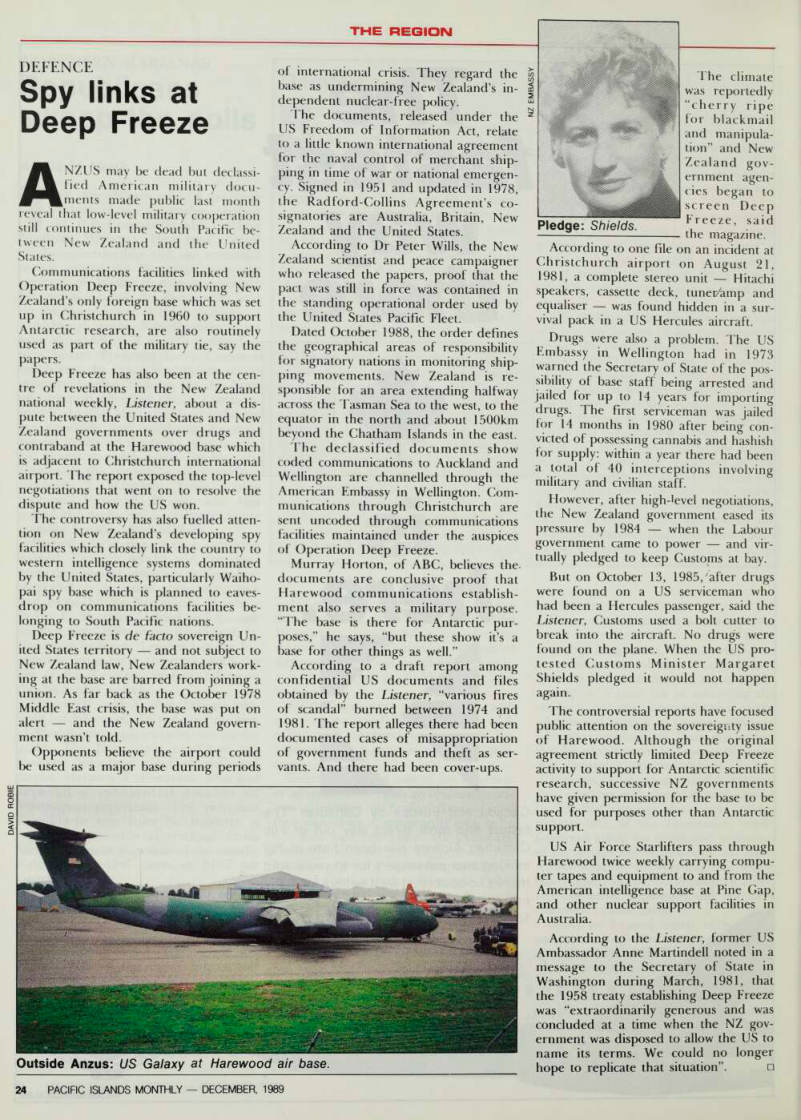
Defence
Spy links at Deep Freeze
ANZUS may be dead but declassi fied American military docu ments made public last month reveal that low-level military cooperation still continues in the South Pacific be tween New Zealand and the United States.
Communications facilities linked with Operation Deep Freeze, involving New Zealand’s only foreign base which was set up in Christchurch in 1960 to support Antarctic research, are also routinely used as part of the military tie, say the papers.
Deep Freeze has also been at the cen tre of revelations in the New Zealand national weekly, Listener, about a dis pute between the United States and New Zealand governments over drugs and contraband at the Harewood base which is adjacent to Christchurch international
airport. The report exposed the top-level
negotiations that went on to resolve the dispute and how the US won.
The controversy has also fuelled atten tion on New Zealand’s developing spy facilities which closely link the country to western intelligence systems dominated by the United States, particularly Waiho pai spy base which is planned to eaves drop on communications facilities be longing to South Pacific nations.
Deep Freeze is de facto sovereign Un ited States territory and not subject to New Zealand law, New Zealanders work ing at the base are barred from joining a union. As far back as the October 1978 Middle East crisis, the base was put on alert and the New Zealand govern ment wasn’t told.
Opponents believe the airport could be used as a major base during periods
of international crisis. They regard the base as undermining New Zealand’s in dependent nuclear-free policy.
The documents, released under the US Freedom of Information Act, relate to a little known international agreement for the naval control of merchant ship ping in time of war or national emergen cy. Signed in 1951 and updated in 1978, the Radford-Collins Agreement’s co signatories are Australia, Britain, New Zealand and the United States.
According to Dr Peter Wills, the New Zealand scientist and peace campaigner who released the papers, proof that the pact was still in force was contained in the standing operational order used by the United States Pacific Fleet.
Dated October 1988, the order defines the geographical areas of responsibility for signatory nations in monitoring ship ping movements. New Zealand is re sponsible for an area extending halfway across the Tasman Sea to the west, to the equator in the north and about 1500 km beyond the Chatham Islands in the east.
The declassified documents show coded communications to Auckland and Wellington are channelled through the American Embassy in Wellington. Com munications through Christchurch are sent uncoded through communications facilities maintained under the auspices of Operation Deep Freeze.
Murray Horton, of ABC, believes the documents are conclusive proof that Harewood communications establish ment also serves a military purpose.
“The base is there for Antarctic pur poses,” he says, “but these show it’s a base for other things as well.”
According to a draft report among confidential US documents and files obtained by the Listener, “various fires of scandal” burned between 1974 and 1981. The report alleges there had been documented cases of misappropriation of government funds and theft as ser vants. And there had been cover-ups.
The climate was reportedly “cherry ripe for blackmail and manipula tion” and New Zealand gov ernment agen cies began to screen Deep Freeze, said the magazine.
According to one file on an incident at Christchurch airport on August 21, 1981, a complete stereo unit Hitachi speakers, cassette deck, tuner/amp and equaliser was found hidden in a sur vival pack in a US Hercules aircraft.
Drugs were also a problem. The US Embassy in Wellington had in 1973 warned the Secretary of State of the pos sibility of base staff being arrested and jailed for up to 14 years for importing drugs. The first serviceman was jailed for 14 months in 1980 after being con victed of possessing cannabis and hashish for supply: within a year there had been a total of 40 interceptions involving military and civilian staff.
However, after high-level negotiations,
the New Zealand government eased its pressure by 1984 when the Labour government came to power and vir tually pledged to keep Customs at bay.
But on October 13, 1985, after drugs were found on a US serviceman who had been a Hercules passenger, said the Listener, Customs used a bolt cutter to break into the aircraft. No drugs were found on the plane. When the US pro tested Customs Minister Margaret Shields pledged it would not happen
again.
The controversial reports have focused public attention on the sovereignty issue of Harewood. Although the original agreement strictly limited Deep Freeze activity to support for Antarctic scientific research, successive NZ governments have given permission for the base to be used for purposes other than Antarctic support.
US Air Force Starlifters pass through Harewood twice weekly carrying compu ter tapes and equipment to and from the American intelligence base at Pine Gap, and other nuclear support facilities in Australia.
According to the Listener, former US Ambassador Anne Martindell noted in a message to the Secretary of State in Washington during March, 1981, that the 1958 treaty establishing Deep Freeze was “extraordinarily generous and was concluded at a time when the NZ gov ernment was disposed to allow the US to name its terms. We could no longer hope to replicate that situation”. □
Outside Anzus: US Galaxy at Harewood air base.
Pledge: Shields.
Nz Embassy
Pacific
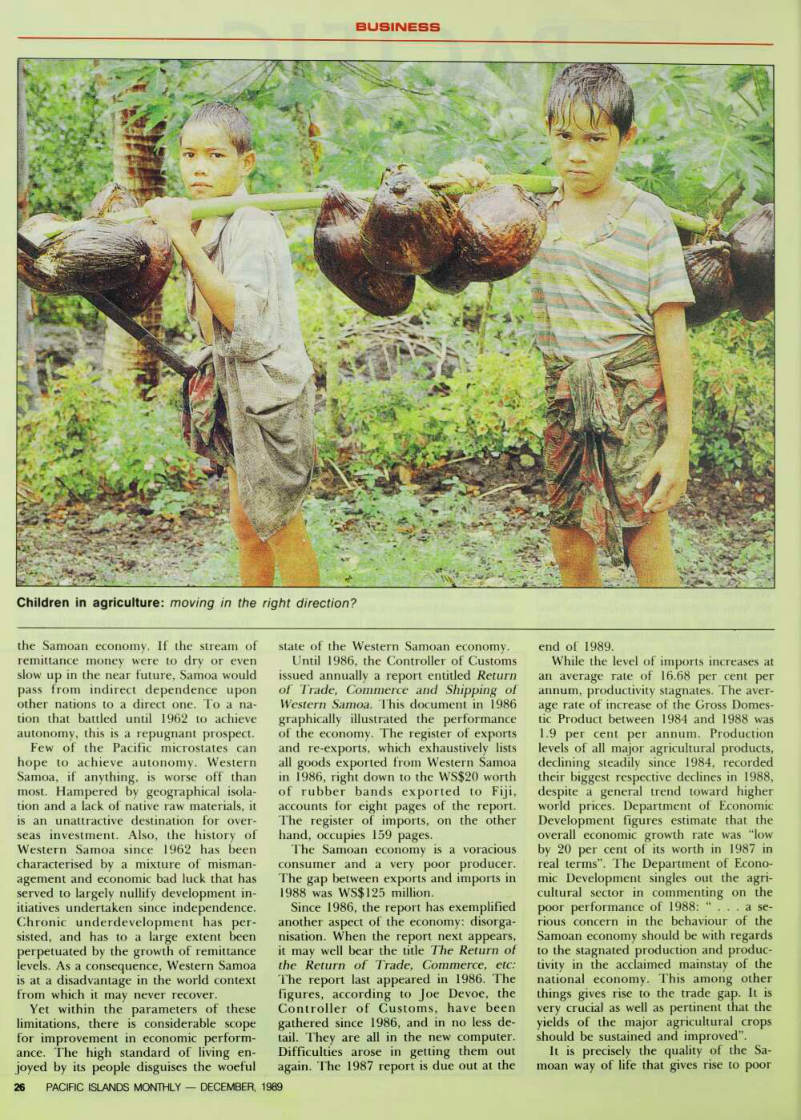
Islands
Monthly
Business
The way of the aiga Living in Western Samoa’s fragile economy
By John McCrystal
IT’S a little after 9pm on a Thursday in Western Samoa. The visitor to the capital Apia was leaving by taxi when the radio announcer started reading long list of names. It was the Post Office list of postal money orders waiting to be collected. The driver also listened. He, too, was expecting money from relatives in New Zealand, Australia, United States “all over the place”. The money was
coming, “one day soon”.
Money sent home by Samoans living abroad has become the major part of the Western Samoan economy. At least 80 per cent of the money come from New Zealand. The balance comes by Samoans working in American Samoa, Australia, the United States all over the place.
Labour is by far Western Samoa’s biggest export commodity. In 1988, it returned WS$73.B million, compared to WS$3l.5 million earned by all other export pro ducts.
“Remittance,” said Economic Develop ment Director Tunaimatia Falani Chan Tung “is a positive contribution to the balance of payments”. Samoa’s depend ence upon remittance as a major source of income is manifest.
In 1989, the New Zealand government sought to scrap or reduce the special quota of visas granted to Samoan immig rant labourers. The Samoan response re sembled New Zealand’s familiar alarm whenever the European Economic Com munity proposes to cut the quota of New Zealand butter. Western Samoa is in the unenviable position of dependence upon a market commodity that is affected by more than just simple economic and political factors. Given the depressed state of New Zealand’s own domestic job market, cutting back on the immigration of unskilled labour is a politically temp ting measure. The Samoan situation is precarious, and economic dependence
has profound implications not only for
the standard of living of Western Sa moans, but also for the Samoan way of life.
Precarious as the situation is, for most Samoans today it is a comfortable one. It is a unique marriage of fa’asamoa, (the traditional Samoan Way), and the be nefits of the modern West.
Fa’asamoa is based upon the extended family, the aiga. Traditionally, the aiga is a self-sufficient unit, producing its own needs entirely from the land in purely subsistence terms, the productive capac ity of traditional agriculture is still such that most aiga remain theoretically self sufficient. Samoa’s commerce with the outside world owes to the taste that its people have acquired for consumer items. Aiga members sent overseas to
work and remit enable most aiga to en joy a very high standard of living. While living in a traditional fale, a house with a thatched roof and without walls, many families own televisions and video recor ders, and most aiga have a car. In a nation described as one of the most under-developed in the world, there are
incongruous signs of affluence.
“Any reduction in remittance levels would adversely affect the standard of living of Samoans,” admits Tanuvasa Livigisitone, the Ministries of Economic Affairs, Development and Planning, and Trade and Commerce. “We recognise the fragility of the situation.”
Clearly, the way out of the current “fragile” situation is to boost the per formance of the productive sectors of
the Samoan economy. If the stream of remittance money were to dry or even slow up in the near future, Samoa would pass from indirect dependence upon other nations to a direct one. To a nation that battled until 1962 to achieve autonomy, this is a repugnant prospect.
Few of the Pacific microstates can hope to achieve autonomy. Western Samoa, if anything, is worse off than
most. Hampered by geographical isola-
tion and a lack of native raw materials, it is an unattractive destination for overseas investment. Also, the history of Western Samoa since 1962 has been characterised by a mixture of mismanagement and economic bad luck that has
served to largely nullify development in-
itiatives undertaken since independence.
Chronic underdevelopment has persisted, and has to a large extent been perpetuated by the growth of remittance levels. As a consequence, Western Samoa is at a disadvantage in the world context from which it may never recover.
Yet within the parameters of these limitations, there is considerable scope for improvement in economic performance. The high standard of living enjoyed by its people disguises the woeful
state of the Western Samoan economy.
Until 1986, the Controller of Customs issued annually a report entitled Return of Trade, Commerce and Shipping of Western Samoa. This document in 1986
graphically illustrated the performance
of the economy. The register of exports and re-exports, which exhaustively lists all goods exported from Western Samoa in 1986, right down to the WSS2O worth of rubber bands exported to Fiji, accounts for eight pages of the report.
The register of imports, on the other hand, occupies 159 pages.
The Samoan economy is a voracious consumer and a very poor producer.
The gap between exports and imports in 1988 was WSsl2s million.
Since 1986, the report has exemplified another aspect of the economy: disorganisation. When the report next appears, it may well bear the title The Return of the Return of Trade, Commerce, etc: The report last appeared in 1986. The figures, according to Joe Devoe, the Controller of Customs, have been gathered since 1986, and in no less detail. They are all in the new computer.
Difficulties arose in getting them out again. The 1987 report is due out at the
end of 1989.
While the level of imports increases at an average rate of 16.68 per cent per annum, productivity stagnates. The aver age rate of increase of the Gross Domes tic Product between 1984 and 1988 was 1.9 per cent per annum. Production levels of all major agricultural products, declining steadily since 1984, recorded their biggest respective declines in 1988,
despite a general trend toward higher
world prices. Department of Economic Development figures estimate that the overall economic growth rate was “low by 20 per cent of its worth in 1987 in real terms”. The Department of Econo
mic Development singles out the agri
cultural sector in commenting on the poor performance of 1988: “ . . . a se rious concern in the behaviour of the Samoan economy should be with regards
to the stagnated production and produc
tivity in the acclaimed mainstay of the national economy. This among other things gives rise to the trade gap. It is very crucial as well as pertinent that the yields of the major agricultural crops should be sustained and improved”, It is precisely the quality of the Sa moan way of life that gives rise to poor
Children in agriculture: moving in the right direction?
production. As each aiga can produce through traditional methods as much food as it needs, and through remittance can afford many of the things that it wants, there is little incentive to produce for an export market. Samoan farmers seldom produce goods for consumption outside the aiga because they need the
money. More commonly, they regard
this as a means to meet some extraordin ary expense, such as school fees, the purchase of a car or contribution to a village project. “The way to motivate the palagi, the white man, is through here,” a Samoan banker said, placing his hand over his heart. “The way to motivate an islander is through here.” He placed his hand on his stomach. “I wish there would be a famine,” he said. “No Sa moan will work unless his belly is emp ty.” Similarly, the Controller of Customs said: “They talk about deficits and other economic techniques. I’m not an eco nomist, but as long as I have a full sto mach, the economy is good.”
There is little incentive to boost the performance of such a “good” economy.
Complacency is a major threat to de velopment initiatives. For example, the agricultural sector, which is so crucial to the performance of the economy as a whole, recognises the need to diversify and develop, and an appropriately ambi tious set of programmes are underway.
Yet to succeed, these must be pursued with singlemindedness and urgency. The Minister of Agriculture, Pule Lameko, expresses confidence that agriculture and the economy in general are “moving in the right direction”. Yet when asked to comment about the need to break the nation’s dependence upon remittances, he comfortably observes that “they have been around for a long time”.
The Department of Economic De velopment’s latest annual report is an energetic document. It isolates the short comings of the economic performance for 1988 and sets priorities for effective improvement. The Director, Tunaimatia Falani, identifies employment as the cru cial issue. “Most of all,” he says, “Samoa needs a well-disciplined and trained labour force.” Labour is, after all, a re source of which Samoa has no shortage.
It is important that it is exploited within the country rather than exported. Talk of advanced programmes such as aquaculture, to exploit Western Samoa’s
redundant fishery, is tempered by prag
matism. “The current government is trying to address the various structural difficulties within the economy,” Falani says, then adds with a wry smile. “Our lack of resources makes it impossible to achieve all our aspirations at one time.”
Structural difficulties are very much in the mind of the minister, too. The infre quency and unreliability of shipping is one example. A ship sailed the week be
fore with a crop of 500 tonnes of coco nut oil. This week, an order for a furth er 1000 tonnes has been received. The next ship is due in three weeks, when half of that order will be consigned. It is unclear when the balance will sail. “This is money that the economy could already be using,” Livigisitone says. As Minister of Tourism and Hotels and Marketing as well as of Economic Development, Livigi sitone places emphasis on the selling not only of Samoan produce, but also of Samoa itself as a tourist destination. The minister, too, is aware of the significance of unemployment. 60 per cent of Sa moan youth is out of work. Primary in dustry provides a limited number and a variety of jobs. The drive, he believes, must be to establish secondary industry and to create opportunities. “We recog nise,” he says, echoing the words of the Director of his Department of Economic Development, “the fragility of the situa tion,”
Remittance levels fell by 4.4 per cent from 1987 to 1988. With the New Zea land government’s measures to tighten up on immigration, levels can be ex pected to fall further. In 1988, remitt ances earned no less than two thirds of the nation’s total overseas income. Better than four fifths of this money was remit ted from New Zealand. Given the de pressed state of New Zealand’s own job market, the position of immigrant labour is surely vulnerable. “Deep down,” says Avologo Ripley, of the Bank of Western Samoa, “the average Samoan knows
change is coming.” The danger facing
Western Samoa today is that of lapsing into a chronic beneficiary mentality, where the incentive to produce is re moved by an artificially sustained in come. There is evidence that this is hap pening. While it is true that Samoa will never achieve complete economic auton omy, the challenge now is to restore vitality to the economy. Political inde pendence was sought as the first step to self-determination. Economic self sufficiency, or some measure thereof, is the more difficult second step which must be no less vigorously pursued.
Hesitation increases the risk of sliding backwards. □
Then there
was success
WESTERN Samoa’s off-shore
banking centre is being judged
a success. It was only in June that the revised legislation was available, and now 120 companies have been listed in Apia with the registrar of foreign companies, Stanley Uren. Most of the companies have come from Europe and Hong Kong, with some interest from the West Coast of the United States. Uren told Pacific Islands Monthly he was satis fied with the way the centre had prog ressed.
Three trust companies are in business.
They are Asiaciti Trust Company Ltd, which also has offices in Port Vila, Hong Kong and Singapore it is trading in Apia under the name Western Samoa International Trust Ltd, the other com panies being European Pacific Trust Company (Western Samoa) Ltd, part of the European Pacific group which is lo cated in the Cook Islands, Luxembourg
and Hong Kong, and Intertrust Incorpo rated Ltd, which has associate companies in Europe and New Zealand.
Four banks have been established.
Three of these are B 2 licences which requires a paid-up capital of U 55250,000 these licences do not allow accepting deposits from the public nor issuing of cheques. There is one registration under the B 1 licence type, with the require ments of a paid-up capital of US$2 mil lion this bank can accept deposits above USSIOO,OOO.
One insurance company has registered under the off-shore legislation. Under the new Western Samoa law (called the International Companies Act) firms are exempt from income and other taxes, there are no currency or exchange con trols and no levies on remittances of funds from Western Samoa. The coun try has no tax treaties.
Uren said the government was discus sing further overseas promotion of the finance centre, with attention likely to be focussed in the Far East, particularly Hong Kong, South Korea and Indone sia. □
Vanair takes
to the sky
VANUATU’S new domestic airline, Vanair, is now in operation after taking over from the former pri vate operator, Air Melanesie. The gov ernment signalled several months ago it wanted to nationalise the nation’s domes tic air services, and has since bought four of the aircraft from the private company three Britten-Norman Islan ders and a Trilander. The owner of Air Melanesie, Dennis Buchanan, was re portedly paid US$5OO,OOO by the gov ernment.
Buchanan also owns Talair, of Papua New Guinea, the biggest private domes tic airline in the Pacific Islands. He told Pacific Islands Monthly he would sell two other air Melanesie aeroplanes in Au stralia and absorb two into the Talair fleet. Meanwhile, the other domestic Vanuatu carrier Doveair is still flying although the majority shareholder in that company, prominent Port Vila businessman Dinh van Tan, has said he is aware the government wants to even tually operate all internal air links.
Vanair began its operations with ser vices out of Port Vila to Tanna in the south and to the other main island, Espiritu Santo. Doveair has three air craft, and it is understood the govern ment intends it should continue to oper ate for a transitional period.
Buchanan said he hoped most of the local Air Melanesie staff would find jobs with the government airline. This ex cluded expatriate staff: his company’s chief engineer had not been able to re new his work permit after September 30, while the airline’s chief pilot will have no valid work permit after October 31. “I think they’ve used the work permits re fusal to force us to close down,” Bucha nan said.
He said he had been concerned about the company’s future since the Vanuatu government had last year nationalised the ground handling of aircraft at Port Vila’s Bauerfield airport. He had no ma jor regrets. D
Takinn it for granted
AUSTRALIAN companies seem to
be taking their dominant position
kin Kiribati for granted judging
from attendance at the third Tarawa In ternational Trade Fair. Only two Austra lian companies turned up to show their
latest products, compared with eight
from New Zealand and two from Fiji.
It is understood the Australian High Commission in Kiribati was disappointed with the country’s poor showing, which
was hi g hli g hted b y their trans-Tasman neighbours throwing a New Zealand
Night during the fair.
The companies were there to show their products, mainly in the areas of building materials or foodstuffs. Austra lia has traditionally been the main sup plier to Kiribati, largely due to the ship ping service which had linked the two countries for years, But this year, Pacific Forum Line link ed New Zealand, via Fiji, with Kiribati hence the new interest exporters in that country are now showing the market. □
Advertisements & other items, pp. 28-29 (1 item)
Toyota
I Si I rr*V M The Toyota Hilux is the world’s most popular pick-up.
And the Hilux 4X4 is the best-selling Hilux of them all. Which stands to reason. People around the world respect Toyota’s attention to style. Hilux’s car-like comfort. Rugged reliability. And as you might expect from Toyota, power. This, of course, is the most important asset for a truck. And happily, the Hilux 4X4 offers a choice of four powerful engines: 2.8 and 2.4-litre diesel engines. Plus 2.2 and 1.8-litre petrol engines. When it comes to power and good looks, nobody can beat Toyota. Nobody.
-A V V 1 *
got Tahiti
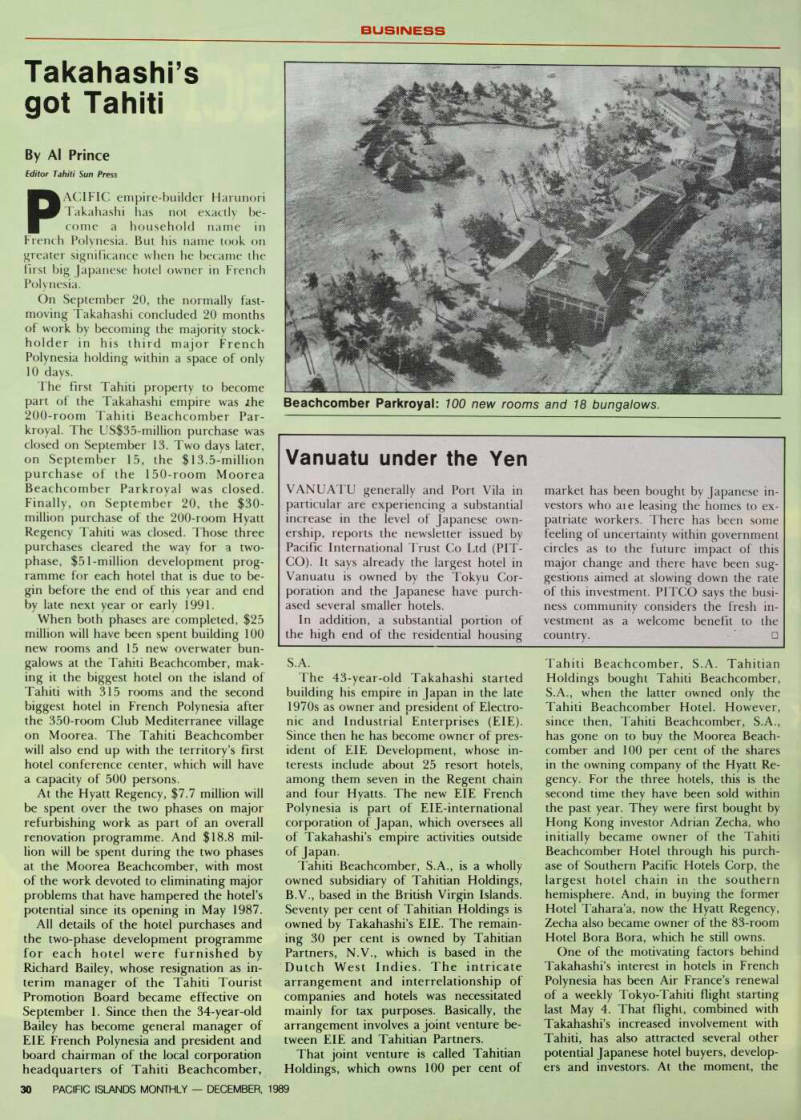
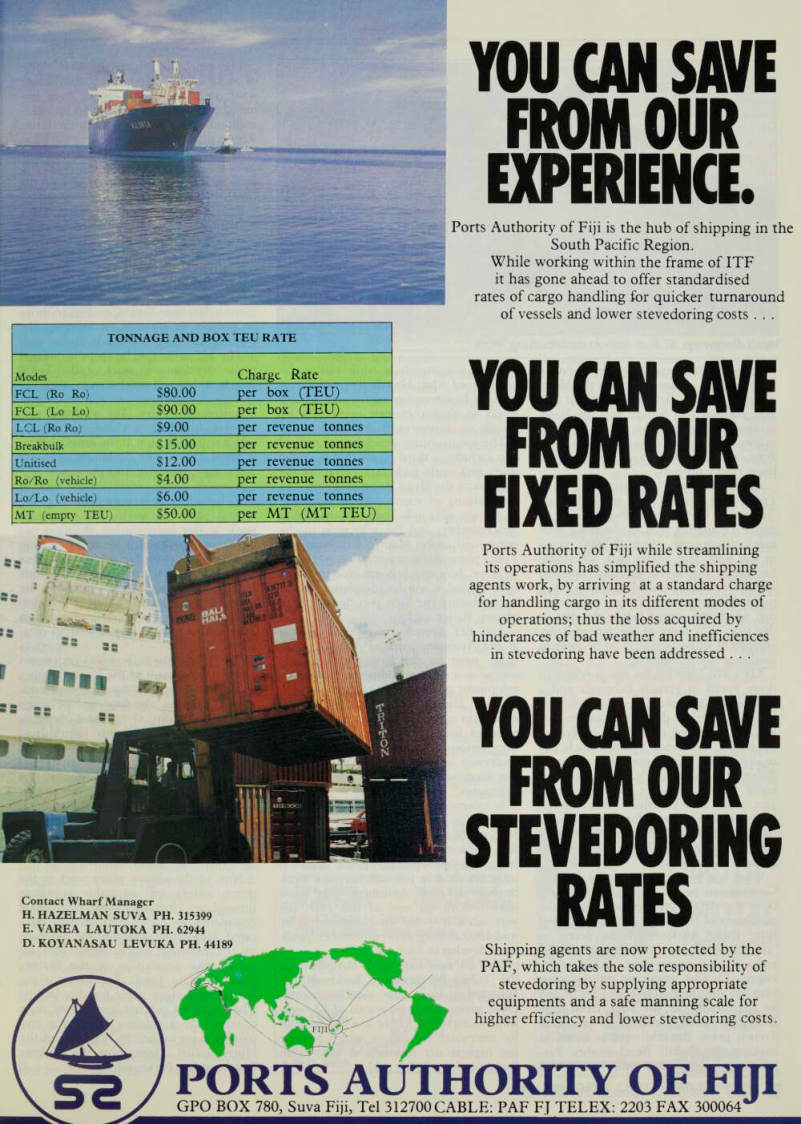
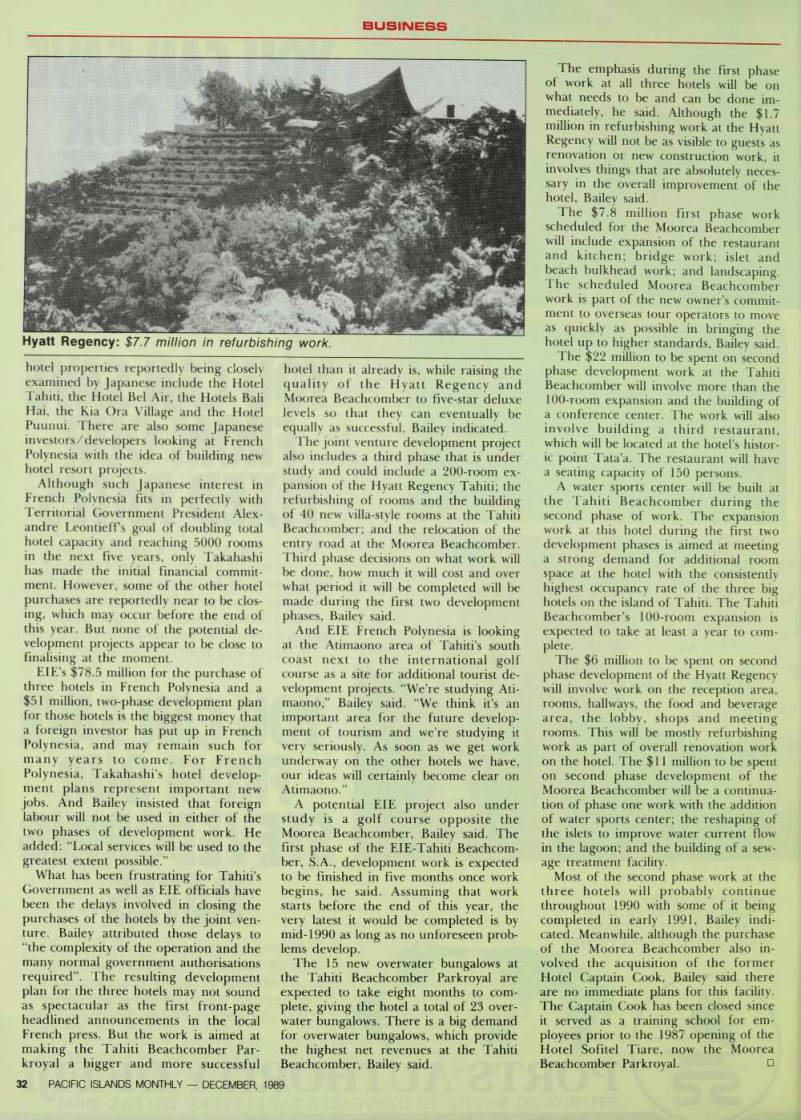
Takahashi’s got Tahiti
By Al Prince
Editor Tahiti Sun Press
PACIFIC empire-builder Harunori
Takahashi has not exactly be come a household name in French Polynesia. But his name took on greater significance when he became the first big Japanese hotel owner in French
Polynesia.
On September 20, the normally fast moving Takahashi concluded 20 months of work by becoming the majority stock holder in his third major French Polynesia holding within a space of only
10 days.
The first Tahiti property to become part of the Takahashi empire was .the 200-room Tahiti Beachcomber Par kroyal. The US$35-million purchase was closed on September 13. Two days later, on September 15, the $ 13.5-million purchase of the 150-room Moorea Beachcomber Parkroyal was closed.
Finally, on September 20, the $3O - purchase of the 200-room Hyatt Regency Tahiti was closed. Those three purchases cleared the way for a two
phase, $5l-million development prog
ramme for each hotel that is due to be gin before the end of this year and end by late next year or early 1991.
When both phases are completed, $25 million will have been spent building 100 new rooms and 15 new overwater bun galows at the Tahiti Beachcomber, mak ing it the biggest hotel on the island of Tahiti with 315 rooms and the second biggest hotel in French Polynesia after the 350-room Club Mediterranee village on Moorea. The Tahiti Beachcomber will also end up with the territory’s first hotel conference center, which will have a capacity of 500 persons.
At the Hyatt Regency, $7.7 million will be spent over the two phases on major refurbishing work as part of an overall renovation programme. And $lB.B mil lion will be spent during the two phases at the Moorea Beachcomber, with most of the work devoted to eliminating major problems that have hampered the hotel’s potential since its opening in May 1987.
All details of the hotel purchases and
the two-phase development programme
for each hotel were furnished by Richard Bailey, whose resignation as in terim manager of the Tahiti Tourist Promotion Board became effective on September 1. Since then the 34-year-old Bailey has become general manager of EIE French Polynesia and president and board chairman of the local corporation headquarters of Tahiti Beachcomber,
S.A.
The 43-year-old Takahashi started building his empire in Japan in the late 1970 s as owner and president of Electro nic and Industrial Enterprises (EIE).
Since then he has become owner of pres ident of EIE Development, whose in terests include about 25 resort hotels, among them seven in the Regent chain and four Hyatts. The new EIE French Polynesia is part of EIE-international corporation of Japan, which oversees all of Takahashi’s empire activities outside of Japan.
Tahiti Beachcomber, S.A., is a wholly owned subsidiary of Tahitian Holdings, 8.V., based in the British Virgin Islands.
Seventy per cent of Tahitian Holdings is owned by Takahashi’s EIE. The remain ing 30 per cent is owned by Tahitian Partners, N.V., which is based in the Dutch West Indies. The intricate arrangement and interrelationship of companies and hotels was necessitated mainly for tax purposes. Basically, the arrangement involves a joint venture be tween EIE and Tahitian Partners.
That joint venture is called Tahitian Holdings, which owns 100 per cent of
Tahiti Beachcomber, S.A. Tahitian
Holdings bought Tahiti Beachcomber,
S.A., when the latter owned only the Tahiti Beachcomber Hotel. However, since then, Tahiti Beachcomber, S.A., has gone on to buy the Moorea Beach comber and 100 per cent of the shares in the owning company of the Hyatt Re gency. For the three hotels, this is the second time they have been sold within the past year. They were first bought by Hong Kong investor Adrian Zecha, who initially became owner of the Tahiti Beachcomber Hotel through his purch ase of Southern Pacific Hotels Corp, the largest hotel chain in the southern hemisphere. And, in buying the former Hotel Tahara’a, now the Hyatt Regency, Zecha also became owner of the 83-room Hotel Bora Bora, which he still owns.
One of the motivating factors behind Takahashi’s interest in hotels in French Polynesia has been Air France’s renewal
of a weekly Tokyo-Tahiti flight starting
last May 4. That flight, combined with Takahashi’s increased involvement with Tahiti, has also attracted several other potential Japanese hotel buyers, develop ers and investors. At the moment, the
Beachcomber Parkroyal: 100 new rooms and 18 bungalows.
hotel properties reportedly being closely
examined by Japanese include the Hotel Tahiti, the Hotel Bel Air, the Hotels Bali Hai, the Kia Ora Village and the Hotel Puunui. There are also some Japanese
investors/developers looking at French
Polynesia with the idea of building new hotel resort projects.
Although such Japanese interest in French Polynesia fits in perfectly with Territorial Government President Alex andre Leontieff s goal of doubling total hotel capacity and reaching 5000 rooms in the next five years, only Takahashi has made the initial financial commit ment. However, some of the other hotel purchases are reportedly near to be clos ing, which may occur before the end of this year. But none of the potential de velopment projects appear to be close to finalising at the moment.
ElE’s $78.5 million for the purchase of three hotels in French Polynesia and a
$5l million, two-phase development plan
for those hotels is the biggest money that a foreign investor has put up in French Polynesia, and may remain such for many years to come. For French
Polynesia, Takahashi’s hotel develop
ment plans represent important new
jobs. And Bailey insisted that foreign
labour will not be used in either of the two phases of development work. He added: “Local services will be used to the greatest extent possible.”
What has been frustrating for Tahiti’s Government as well as EIE officials have been the delays involved in closing the purchases of the hotels by the joint ven ture. Bailey attributed those delays to “the complexity of the operation and the many normal government authorisations
required”. The resulting development
plan for the three hotels may not sound as spectacular as the first front-page headlined announcements in the local French press. But the work is aimed at making the Tahiti Beachcomber Par kroyal a bigger and more successful
hotel than it already is, while raising the quality of the Hyatt Regency and Moorea Beachcomber to five-star deluxe levels so that they can eventually be equally as successful, Bailey indicated.
The joint venture development project
also includes a third phase that is under study and could include a 200-room ex pansion of the Hyatt Regency Tahiti; the refurbishing of rooms and the building of 40 new villa-style rooms at the Tahiti Beachcomber; and the relocation of the entry road at the Moorea Beachcomber.
Third phase decisions on what work will be done, how much it will cost and over what period it will be completed will be made during the first two development
phases, Bailey said.
And EIE French Polynesia is looking at the Atimaono area of Tahiti’s south coast next to the international golf course as a site for additional tourist de velopment projects. “We’re studying Ati maono,” Bailey said. “We think it’s an important area for the future develop ment of tourism and we’re studying it very seriously. As soon as we get work underway on the other hotels we have, our ideas will certainly become clear on Atimaono.”
A potential EIE project also under study is a golf course opposite the Moorea Beachcomber, Bailey said. The first phase of the El E-Tahiti Beachcom ber, S.A., development work is expected to be finished in five months once work begins, he said. Assuming that work starts before the end of this year, the very latest it would be completed is by mid-1990 as long as no unforeseen prob
lems develop.
The 15 new overwater bungalows at the Tahiti Beachcomber Parkroyal are expected to take eight months to com plete, giving the hotel a total of 23 over water bungalows. There is a big demand for overwater bungalows, which provide the highest net revenues at the Tahiti Beachcomber, Bailey said.
The emphasis during the first phase
of work at all three hotels will be on what needs to be and can be done im mediately, he said. Although the $1.7 million in refurbishing work at the Hyatt Regency will not be as visible to guests as renovation or new construction work, it involves things that are absolutely neces sary in the overall improvement of the hotel, Bailey said.
The $7.8 million first phase work scheduled for the Moorea Beachcomber will include expansion of the restaurant and kitchen; bridge work; islet and beach bulkhead work; and landscaping.
The scheduled Moorea Beachcomber work is part of the new owner’s commit ment to overseas tour operators to move as quickly as possible in bringing the hotel up to higher standards, Bailey said.
The $22 million to be spent on second phase development work at the Tahiti Beachcomber will involve more than the 100-room expansion and the building of a conference center. The work will also involve building a third restaurant, which will be located at the hotel’s histor ic point Tata’a. The restaurant will have a seating capacity of 150 persons.
A water sports center will be built at the Tahiti Beachcomber during the second phase of work. The expansion work at this hotel during the first two
development phases is aimed at meeting
a strong demand for additional room space at the hotel with the consistently highest occupancy rate of the three big hotels on the island of Tahiti. The Tahiti Beachcomber’s 100-room expansion is expected to take at least a year to com
plete.
The $6 million to be spent on second
phase development of the Hyatt Regency
will involve work on the reception area, rooms, hallways, the food and beverage
area, the lobby, shops and meeting
rooms. This will be mostly refurbishing work as part of overall renovation work on the hotel. The $ll million to be spent on second phase development of the Moorea Beachcomber will be a continua tion of phase one work with the addition of water sports center; the reshaping of the islets to improve water current flow in the lagoon; and the building of a sew age treatment facility.
Most of the second phase work at the three hotels will probably continue throughout 1990 with some of it being completed in early 1991, Bailey indi cated. Meanwhile, although the purchase of the Moorea Beachcomber also in volved the acquisition of the former Hotel Captain Cook, Bailey said there are no immediate plans for this facility.
The Captain Cook has been closed since it served as a training school for em ployees prior to the 1987 opening of the Hotel Sofitel Tiare, now the Moorea Beachcomber Parkroyal. □
Hyatt Regency: $7.7 million in refurbishing work.
Vanuatu under the Yen
VANUATU generally and Port Vila in particular are experiencing a substantial increase in the level of Japanese own ership, reports the newsletter issued by Pacific International Trust Co Ltd (PIT CO). It says already the largest hotel in Vanuatu is owned by the Tokyu Cor
poration and the Japanese have purch
ased several smaller hotels.
In addition, a substantial portion of the high end of the residential housing
market has been bought by Japanese in vestors who aie leasing the homes to ex patriate workers. There has been some feeling of uncertainty within government circles as to the future impact of this major change and there have been sug gestions aimed at slowing down the rate of this investment. PITCO says the busi ness community considers the fresh in vestment as a welcome benefit to the country. ' □
Advertisements & other items, p. 31 (1 item)
Stevedoring
YOU CAN SAVE
FROM OUR
■ - ■• r ; Contact Wharf Manager
H. HAZELMAN SUVA PH. 315399
E. VAREA LAUTOKA PH. 62944
D. KOYANASAU LEVUKA PH. 44189
Ports Authority of Fiji is the hub of shipping in the South Pacific Region.
While working within the frame of ITF it has gone ahead to offer standardised rates of cargo handling for quicker turnaround of vessels and lower stevedoring costs . . .
YOU CAN SAVE
FROM OUR
FIXED RATES
Ports Authority of Fiji while streamlining its operations has simplified the shipping agents work, by arriving at a standard charge for handling cargo in its different modes of operations; thus the loss acquired by hinderances of bad weather and inefficiences in stevedoring have been addressed . , .
YOU CAN SAVE
FROM OUR
STEVEDORING
RATES
Shipping agents are now protected by the PAF, which takes the sole responsibility of stevedoring by supplying appropriate equipments and a safe manning scale for higher efficiency and lower stevedoring costs.
PORTS AUTHORITY OF FIJI
GPO BOX 780, Suva Fiji, Tel 312700 CABLE: PAF FJ TELEX: 2203 FAX 300064** as :: ■■■a ir<» ■
Grappling with island markets
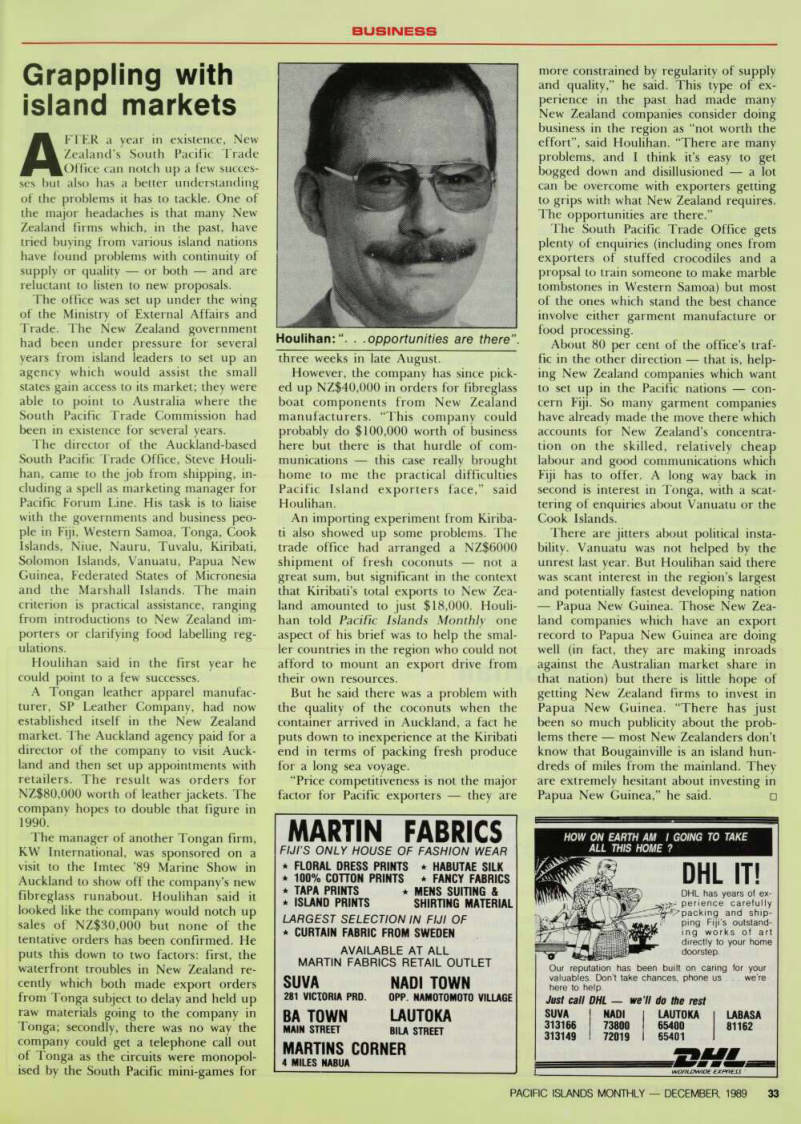
island markets
AFTER a year in existence, New Zealand’s South Pacific Trade Office can notch up a few succes ses but also has a better understanding of the problems it has to tackle. One of the major headaches is that many New Zealand firms which, in the past, have tried buying from various island nations have found problems with continuity of supply or quality or both and are reluctant to listen to new proposals.
The office was set up under the wing of the Ministry of External Affairs and Trade. The New Zealand government had been under pressure for several years from island leaders to set up an agency which would assist the small states gain access to its market; they were able to point to Australia where the South Pacific Trade Commission had been in existence for several years.
The director of the Auckland-based South Pacific Trade Office, Steve Houli han, came to the job from shipping, in cluding a spell as marketing manager for Pacific Forum Line. His task is to liaise with the governments and business peo ple in Fiji, Western Samoa, Tonga, Cook Islands, Niue, Nauru, Tuvalu, Kiribati, Solomon Islands, Vanuatu, Papua New Guinea, Federated States of Micronesia and the Marshall Islands. The main criterion is practical assistance, ranging from introductions to New Zealand im porters or clarifying food labelling reg ulations.
Houlihan said in the first year he could point to a few successes.
A Tongan leather apparel manufac turer, SP Leather Company, had now established itself in the New Zealand market. The Auckland agency paid for a director of the company to visit Auck land and then set up appointments with retailers. The result was orders for NZ$BO,OOO worth of leather jackets. The company hopes to double that figure in 1990.
The manager of another Tongan firm, KW International, was sponsored on a visit to the Imtec ’B9 Marine Show in Auckland to show off the company’s new fibreglass runabout. Houlihan said it looked like the company would notch up sales of NZ$3O,OOO but none of the tentative orders has been confirmed. He puts this down to two factors: first, the waterfront troubles in New Zealand re cently which both made export orders from Tonga subject to delay and held up raw materials going to the company in Tonga; secondly, there was no way the company could get a telephone call out of Tonga as the circuits were monopol ised by the South Pacific mini-games for
three weeks in late August.
However, the company has since pick ed up NZ$4O,OOO in orders for fibreglass boat components from New Zealand manufacturers. “This company could probably do $lOO,OOO worth of business here but there is that hurdle of com munications this case really brought home to me the practical difficulties Pacific Island exporters face,” said Houlihan.
An importing experiment from Kiriba ti also showed up some problems. The trade office had arranged a NZ$6OOO shipment of fresh coconuts not a great sum, but significant in the context that Kiribati’s total exports to New Zea land amounted to just $lB,OOO. Houli han told Pacific Islands Monthly one aspect of his brief was to help the smal ler countries in the region who could not afford to mount an export drive from their own resources.
But he said there was a problem with the quality of the coconuts when the container arrived in Auckland, a fact he puts down to inexperience at the Kiribati end in terms of packing fresh produce for a long sea voyage.
“Price competitiveness is not the major factor for Pacific exporters they are
more constrained by regularity of supply and quality,” he said. This type of ex perience in the past had made many New Zealand companies consider doing business in the region as “not worth the effort”, said Houlihan. “There are many problems, and I think it’s easy to get bogged down and disillusioned a lot can be overcome with exporters getting to grips with what New Zealand requires.
The opportunities are there.”
The South Pacific Trade Office gets
plenty of enquiries (including ones from
exporters of stuffed crocodiles and a propsal to train someone to make marble tombstones in Western Samoa) but most of the ones which stand the best chance involve either garment manufacture or food processing.
About 80 per cent of the office’s traf fic in the other direction that is, help ing New Zealand companies which want to set up in the Pacific nations con cern Fiji. So many garment companies have already made the move there which accounts for New Zealand’s concentra tion on the skilled, relatively cheap labour and good communications which Fiji has to offer. A long way back in second is interest in Tonga, with a scat tering of enquiries about Vanuatu or the Cook Islands.
There are jitters about political insta bility. Vanuatu was not helped by the unrest last year. But Houlihan said there was scant interest in the region’s largest and potentially fastest developing nation Papua New Guinea. Those New Zea land companies which have an export record to Papua New Guinea are doing well (in fact, they are making inroads against the Australian market share in that nation) but there is little hope of getting New Zealand firms to invest in Papua New Guinea. “There has just been so much publicity about the prob lems there most New Zealanders don’t know that Bougainville is an island hun dreds of miles from the mainland. They are extremely hesitant about investing in Papua New Guinea,” he said. □
Houlihan:“. . .opportunities are there".
Advertisements & other items, p. 33 (1 item)
Martin Fabrics
HOW ON EARTH AM I GOING TO TAKE
ALL THIS HOME ?
DHL IT!
DHL has years of ex- - perience carefully packing and shipping Fiji’s outstanding works of art directly to your home doorstep.
Our reputation has been built on caring for your valuables. Don’t take chances, phone us we’re here to help.
Just call DHL we ll do the rest
WORLDWIDE EXPRESS
MARTIN FABRICS
FIJI’S ONLY HOUSE OF FASHION WEAR
* FLORAL DRESS PRINTS a HABUTAE SILK * 100% COTTON PRINTS a FANCY FABRICS a TAPA PRINTS a MENS SUITING &
a ISLAND PRINTS SHIRTING MATERIAL
LARGEST SELECTION IN FIJI OF
a CURTAIN FABRIC FROM SWEDEN
AVAILABLE AT ALL
MARTIN FABRICS RETAIL OUTLET
SUVA
281 VICTORIA PRO.
BA TOWN
MAIN STREET
NADI TOWN
OPP. NAMOTOMOTO VILLAGE
LAUTOKA
BILA STREET
MARTINS CORNER
4 MILES NABUA
U.S. big bucks
Relying on the U.S. big bucks
THE prospect of a rapid change in the Federated States of Micronesia
from a dependent consumption
driven economy to a self-sufficient pro duction economy is not bright, according to the Bank of Hawaii’s report on the country. The nation is too dependent on funds from the United States, and most attempts at encouraging private enter prise have failed.
The Federated States of Micronesia (FSM) is comprised of four states: Pohn pei, Yap, Truk and Kosrae. In 1986 the country had 95,000 people, almost a half of whom are under the age of 15 years.
Population is growing rapidly, at the rate of about 3.5 per cent.
The FSM is a unique development economy, says the Bank of Hawaii. In exchange for allowing the United States exclusive access to its million square miles of ocean economic zone, the coun try received guaranteed funds, now run ning at about US$lOO million a year.
“Any substantial decline in the US pay ments to the FSM would have an im mediate impact on the nation’s economy and, therefore, on the living standards of its people,” said the bank’s report.
Those US payments are essential to the FSM’s economic survival.
The government is the only major em ployer. Excepting trade and a few ser vice industries, there is practically no pri
vate sector. About two-thirds of the em ployed labour force works for the gov ernment at one level or another, and the state administration controls utilities, communications and other services
usually provided by private firms.
In the hope of encouraging a bigger private sector, the government had sub sidised a wide range of economic activi ties. But most had been unsuccessful.
“Lack of management experience, en trepreneurial drive and institutions con ducive to a viable market economy has so far made most of these ventures wasteful undertakings,” the bank report said.
The most recent figure available 1983 showed the FSM had a gross national product of US$lO million, with per capita GNP of US$l3Ol, a figure which places the country amongst the “lower-middle income” nations according to the World Bank classification. But it is not a poor country, and the FSM
population enjoys an adequate standard
of living which should be helpful in the country’s quest for foreign capital to de velop a production economy, the Bank of Hawaii said.
The major problems is the FSM being made up of small isolated markets fewer than 100,000 people scattered over a vast expanse of ocean, far away from major markets.
The bank report said there was some
potential for economic development.
The major prospect was tourism. The FSM is too far away from either the US or Japan to be developed into a mass
tourist destination like Hawaii or Guam.
But the various states all have regular air connections, and each has unique attrac tions. The trend is already encouraging: between 1980 and 1987, visitor arrivals increased by 34 per cent, although the -total numbers are still small.
Fish and fish products offer potential for development. The FSM would like to compete with American Samoa in estab
lishing large-scale fish processing plants,
but there are handicaps; there is a lack of capital and infrastructure, and the FSM does not have a deep-water har bour like that at Pago Pago. The bank sees a better strategy as being the export of fresh fish, an activity which involves only small amounts of capital and a small labour force the obvious markets would be Guam, Hawaii and east Asia.
Agriculture could also be developed for import substitution, and there could be some light manufacturing there is the potential for manufacturing or assembling goods for sale in the US. But labour is a problem: a company which
recently opened a garment factory on
Yap to take advantage of free access to the American mainland market found the local population not keen to take up fulltime employment and had to import 250 women workers from Sri Lanka.
The Bank of Hawaii said another obsta cle was that goods made in US territories and sold on the mainland could provoke resentment and retaliation among US domestic producers, especially in the case of goods already made in the Un ited States. □
Bougainville shortfall
THE closure of the Bougainville copper mine will mean a shortfall in the country’s foreign exchange earnings of up to K5O million, the Bank of Papua New Guinea says in the June Quarterly economic bulletin just re leased. But the country should be able to maintain an open economy approach with a stable and easily convertible cur rency.
Even though there are no Bougainville earnings going into the state’s Mineral Resource Stabilisation Fund (MRSF) the bank expects that fund with an end of-year balance of K 144 million will be enough to cover budgetry needs for the 1990 and 1991 financial years.
The Bank of PNG estimates that the loss of three-and-a-half months of pro duction from Bougainville Copper Ltd, and the expected level of production for the rest of the year, will result in zero real gross domestic product growth in 1989. A firm monetary policy will be im plemented which is expected to neutral
ise any impact on interest rates and prices which the closure of the mine might have had.
Over the six months to June, the ba lance of payments deficit was Kl 3 mil lion, a significant deterioration on the corresponding period last year. It was due to a deadline in exports coinciding with a rise in imports. The coffee and cocoa industries were faced with depress ed world market prices. The cocoa fund was topped up by the government loan and would maintain payments to grow ers until the end of October. As far as the coffee fund is concerned, the rate of bounty payments will exhaust its re sources by mid-1990.
The bank said both industries de served government support, but this should be aimed at improving productiv ity and efficiency. “It is esential for the support to encourage the small farm hol der. Some estimates show that the coffee and cocoa industries are the source of cash income for 65 per cent of Papua
New Guinea’s rural population,” the bank said.
In commodities report in detail: Coffee: Coffee exports in the June quarter increased by 125 per cent to 26,100 tonnes. Exports are expected to be high for the remainder of 1989. But the price received during the June quar ter was 24 per cent lower than for the same period last year. Due to the possi ble exhaustion next year of the Coffee Stabilisation Fund, the Bank of PNG said an analysis of the cost and support struc ture of the coffee industry was called for
immediately.
Cocoa: Volume of exports was up 61 per cent, largely due to the increased production from rehabilitated cocoa plantations and favourable weather in the growing areas. Production was ex pected to increase further as more of the
newly planted, high-yielding hybrid
cocoa matured. Cocoa prices were also down 24 per cent.
Copra: Exports were down 12.6 per cent, and copra oil by 21.7 per cent, while prices went down by 18.6 and 24.5 per cent respectively. D
US adjusts sugar quotas
■ N a complex move the United States adjusted upwards its Hsugar quota for Fiji and Papua New Guinea while extending the quota time period. The gross value of the decision comes to about US$3.B million for Fiji and US$2.7 million for Papua New Guinea, relatively small numbers when compared against total sale of each na tion.
Over the last few years, the US has cut back generally, but not smoothly, on im ports of sugar (out of deference to domestic growers of sugar cane and sugar beet). It also has varied the time periods of importation, and, to add an extra complication, now uses the metric tonne about 2200 pounds) not the tradi tional short ton (2000 pounds).
Effective September 30, the United States extended the time period of the current sugar quota from a 12-month period to a 21-month one, now ending on September 30, 1990. At the same time raised its quotas on a roughly prop
ortional basis, with Fiji going from 9417 tonnes to 16966 tonnes, and PNG from 7258 tonnes to 12500. (As recently as the 12 months of calendar 1987, Fiji’s quota was 25,190 short tons.) By the time the higher quotas were announced, the two nations had shipped their sugar. They now will to have to ship about 7500 and 5200 tonnes respectively; this is about half-a-ship’s load of sugar.
The gross value of the additional quotas is calculated against the current price of bulk raw sugar in New York, 23 cents a pound at the time of writing, In one of the many anomalies of the US sugar trade, the politically powerful sugar growers in Florida not only grow it for a protected domestic market, they bring Caribbean farm workers (usually from sugar-producing islands) to cut the cane in the US at wages that do not attaract American workers to the crop, This is essentially a double subsidy for a crop that critics say should be grown in the Third, not the First World. □
Highlands floated
THE long-awaited float of Highlands
Gold Ltd is to go ahead in Austra lia, and will take over MIM Hold ings Ltd’s 30 per cent stake in the Asl billion Porgera gold mine in Papua New Guinea. Five per cent of the new com pany or 28 million shares with a face value of 50 toea each will be made available to the people of Papua New Guinea, although a majority of the stock will go to existing MIM shareholders. A total of 565 million shares worth As42o million will be available.
The funds raised will be used to fund part of Highland Gold’s share of the de
velopment costs of the Porgera project,
to repay part of Highland Gold’s debt to other MIM group companies and to
fund ongoing exploration and develop
ment in Papua New Guinea and the sur rounding region, said MIM chairman Sir Bruce Watson.
Porgera, which has been described as
the world’s largest undeveloped gold
prospect, is scheduled to come on stream in September next year with gold output expected to average 800,000 ounces a year for the first six years. At this rate of production, annual revenues will be more than As3oo million, with 30 per cent accruing to Highlands Gold.
MIM, Renison Goldfields Consolidated Ltd and Placer Pacific Ltd, who are the three owners of the Porgera project, have embarked on an extensive com munity relations programme, and even tually Papua New Guinea residents will own 10 per cent of the mine. Dividends
are expected to begin flowing in late 1991.
Highlands Gold has other properties in its portfolio, although the emphasis is heavily on gold. But there are also two
large deposits of chromite-nickel-cobalt
and copper-gold.
The float decision has been welcomed by Papua New Guinea prime minister Rabbie Namaliu who has urged his coun trymen to take up the shares being made available. Namaliu described the float as a vote of confidence in the future of
Papua New Guinea’s mining industry.
But Highlands Gold will have to in sure its loans against “warlike activities”, a common provision when projects are undertaken in developing countries where there have been incidents of vio lence. □
Japanese teach fishing ELEVEN Kiribati sailors are to spend a year in Japan learning pole and line fishing. They will work on Japanese boats and, on their return, will be em ployed by the Kiribati government owned Te Mautari Ltd fishing company, or on Japanese boats fishing in the coun try’s exclusive economic zone.
Air Pacific buy-back QANTAS, which owns 19.57 per cent of the Fiji carrier, Air Pacific is being asked to sell that interest back to the Suva gov ernment. Civil Aviation Minister David Pickering went to Sydney for a meeting with the Australian overseas airline and said negotiations would resume at a later date. Qantas seems unlikely to welcome the request now that Air Pacific is mak ing good profits, with its international services running at near capacity.
Accountants’ shortcomings ACCOUNTANTS in Papua New Guinea were not meeting the needs of their cus tomers, said PNG Investment Corpora tion managing director Eliakim Toßol ton. Speaking to a national accounting conference, he said: “Why is it that there is a pressing need for proficient accoun tants within the business community at large yet this demand is not being met or likely to be met within the forseeable future?” Toßolton said accountancy should be introduced at an earlier stage in high schools, and he criticised poor teaching standards. He also called on the University of Papua New Guinea in Port Moresby to introduce a course in the
discipline.
Aust funds Kiribati work AUSTRALIA is providing the funds for new work that has begun on Kiribati’s outer islands. The main part of the programme will be the construction of bridges and causeways to link north and south Tarawa, but much of the money will be spent on causeways and sea walls on the outer islands.
Advertisements & other items, pp. 35-36 (1 item)
Management - Accounting - Consulting
Highly experienced and qualified Australian Consultants available for: • Temporary Management Contracts • Representation in Australia • Multi-national Corporate/Tax Structuring • Project Feasibility Studies • Finance, Accounting and EDP Projects • Joint Venture Negotiation/Documentation • Foreign Exchange Management/Accounting • Gold Dealing/Financing Sage. .Advice "P+y. J_imi ted 9 Barellan Avenue Turramurra NSW 2074 Australia Phone or Fax (612) 445246
FORUM secretariat
\ 57>/r /
V VACANCY
HEAD, ENERGY DIVISION
Applications are invited from suitably qualified and experienced persons, who must be citizens of a member state of the South Pacific Forum*, for the position of Head of the Forum Secretariat’s Energy Division.
The Forum Secretariat was established in 1973 by the South Pacific Forum to encourage economic and political cooperation between its member states, and between those states and the more industrialised countries. Under the control of a Secretary General, the Secretariat undertakes a regional work programme covering economic services, legal and political services, and the energy, tourism, trade, transport and telecommunications sectors. The Secretariat also has significant responsibilities with regard to ACP/EC regional projects funded under Lome Conventions.
The Energy Division implements and administers a range of energy development assistance programmes aimed at increasing the ability of Forum Island Countries to plan and manage their national energy sectors. The Divison also assists in coordinating development assistance activites of other organisations in the region’s energy sector, convenes annual meetings of energy ministers and officials, provides technical assistance and advice to Forum Island Countries and disseminates energy information and statistics. The Division has a joint work programme with the United Nations Pacific Energy Development Programme (UNPEDP) and the Head of the Energy Division is require to work closely with the UNPEDP Project Manager in implementing regional energy activities.
The Head of the Energy Division is responsible to the Secretary General, through the Director of Programmes, for directing the work of the Division and administering its various energy programme activites. More specifically, the Head is responsible for formulating and developing regional policy initiatives, liaising with energy officials of Forum Island Governments and other energy-related organisations and agencies, negotiating consultancy contracts, identifying appropriate regional projects, preparing detailed funding proposals, negotiating with donor organisations, representing the Secretariat at regional and international meetings of energy-related organisations and formulating and convening regional training activities, seminars and workshops.
Applicants should have proven ability to manage successfully a regional, technical assistance programme, and to direct the work of a team of specialists. Experience in administering energy-related or similar technical programmes in developing countries would be highly regarded as would relevant academic qualifications, say in economics or engineering, with subsequent and substantive administrative/management experience. An ability to liaise effectively at senior levels with member and supporting governments and organisations, and with a wide range of people throughout the region and elsewhere is required. Preference will also be given to applicants possessing general knowledge and appreciation of the economic, social and political aspirations of the Forum’s region.
This appointment will carry an attractive remuneration package, payable in Fiji dollars. For non-Fiji citizens this is tax free and includes housing or housing allowance, education and child allowances. Other benefits include superannuation payments and medical, life and travel insurance coverage. The appointee will be based at the Secretariat’s Headquarters in Suva, Fiji but will be required to undertake periodic duty travel. Appointment would be for three years initially, renewable by mutual agreement.
Applications, which close on 31 January 1990, should contain full information on education and career background and should list names, addresses and telephone numbers of at least three referees with whom the applicant has been associated in a professional capacity.
Applications should be addressed to: The Secretary General Forum Secretariat GPO Box 856, Suva, Fiji Telephone: 312600. Telex: 2229 FJ, Fax:302204. from whom further information is available on request.
All enquiries should be made to Mr R. Wilson, Director of Services on 312600 Ext 202. *Member countries are: Australia, Cook Islands, Federated States of Micronesia, Fiji, Kiribati, Marshall Islands, Nauru, New Zealand, Niue, Papua New Guinea, Solomon Islands, Tonga, Tuvalu, Vanuatu, Western Samoa.
tightrope act
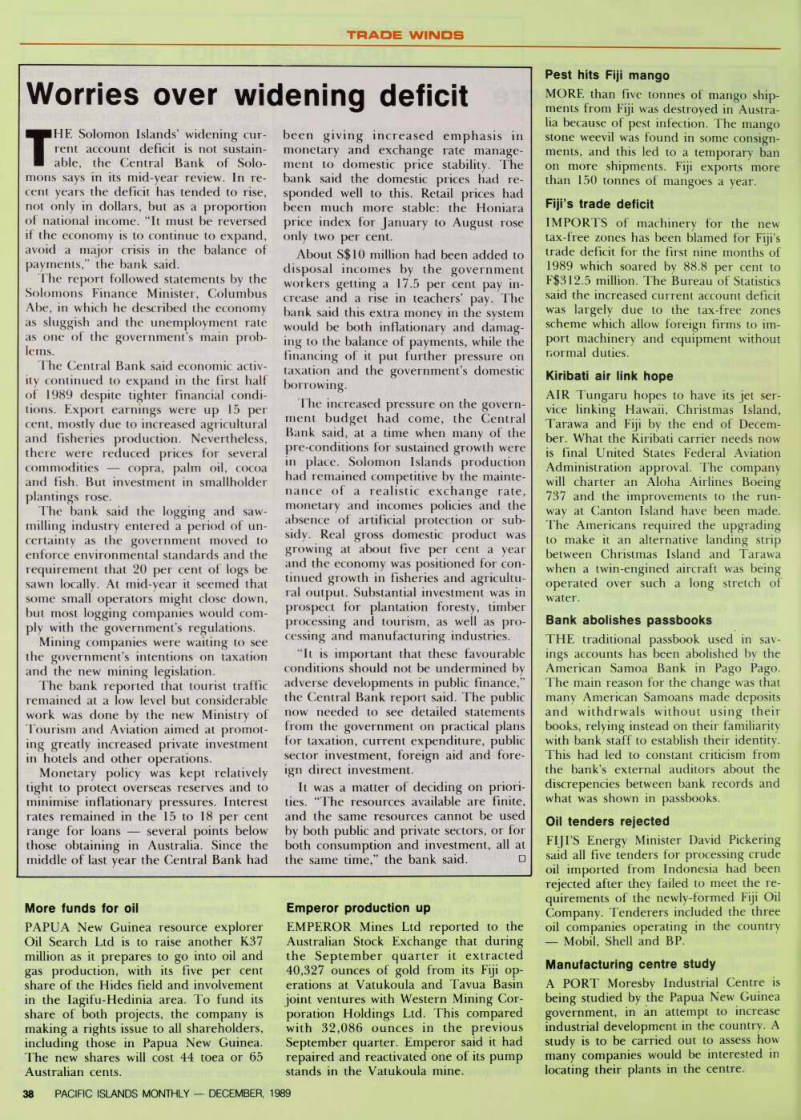
PNG budget a tightrope act
PAPUA New Guinea Finance Minister Paul Pora has handed down a K 1250 million budget with only minimal taxation increases. But it seems clear the government is banking on a re-opening of the Bougainville cop per mine, and the hope that it can avoid a deficit.
The budget was revealed just days af ter an official audit showed that 1988 national government deficit as K 52 mil lion, and a senior government official has confirmed this current budget will end in another major shortfall. He said the only way to avoid such a result would be to raise customs revenues and taxes or by borrowing more overseas.
Pora apparently told his cabinet col leagues back in September that his budget plans were based on an early re sumption of work at Bougainville the mine (before its closure in May after re bel attacks) contributed 30 per cent of the country’s export earnings and 11 per cent of gross domestic product. Pora told the cabinet that if the mine remained closed indefinitely, the government would be forced into a major reassess ment of its spending forecasts.
But the government faces other con straints, including the chances that Au stralia could cut its budget support in real terms as that country faces its own economic crisis. Cocoa and coffee prices remain low.
With private predictions of a deficit next year of at least Kll7 million, Pora’s latest budget must be viewed as some thing of a high wire act without the safe ty net.
The only tax increases in the budget are slight rises on beer, cigarettes, spirits, wines, soft drinks and diesel, about KB.B million in all. Pora said the government had seen revenues rise due to the im proved efficiency of taxation collection as well as duty on increased imports.
One of the more controversial aspects of the budget was the doubling of the parliamentarians’ slush fund to K 100,000. This is officially called the “unaccountable fund” because members can do with it as they please.
Pora said the government was looking to increased tax revenue from the min ing sector to encourage investment and growth in the non-mining sectors so that Papua New Guinea could move beyond its traditional and unsustainable reliance on a very narrow tax base concentrated in the formal sector of the economy.
Contractors and landowners who receive income from mining projects will be targetted; most small contractors and sub-contractors do not presently furnish
a tax return, so the 1989 budget intro duces a 17 per cent withholding tax.
There will also be a five per cent with holding tax on mining, oil and fishing royalties paid to landowners.
The Port Moresby newspaper Post- Courier commented that the 1990 budget “tests Papua New Guinea’s re venue collection machinery to the ful lest.” The few initiatives to raise extra revenue collection machinery to the ful lest.” The few initiatives to raise extra revenue would mean the government is
depending on increasing the efficiency
of the taxation system. Commentators have also pointed to plans for the Cen tral Bank to pay all its K5O million profit to the government in the form of a di vidend. The government will also draw KBO million from the Mineral Resources Stabilisation Fund.
But cuts have been made in certain areas. Infrastructure spending is down Kl 3 million to K 196 million, but still re
mains the single biggest budget item.
One programme which remains intact is the K 64 million to be spent on road
building, including the sealing of the
Magi Highway in Central Province and further work on the Enga Highway.
Provincial governments will get more money under the budget, with Pora saying the rises will help local health and education services. The biggest increases have gone to Western Highlands, Simbu and Eastern Highlands provinces, while
funding has been cut in East Sepik and North Solomons.
At this stage, the Papua New Guinea government will not seek commercial overseas loans to fund the 1990 budget.
Instead, it has allocated K 254 million to repay part of the country’s massive K 1.2 billion foreign debt. The repayments are aimed at maintaining the nation’s good credit rating when estimates are that more than K 6 billion will need to be found to finance future mineral develop ment.
The KBO million drawdown from the Mineral Resources Stabilisation Fund will make up for lost Bougainville revenues for a few months, but this plan is all built on the government’s hope the cop per mine will resume production at the start of 1990 a pretence which the company itself no longer maintains. Fai lure to get the mine back into produc tion will result in a gigantic drain on Papua New Guinea’s foreign exchange reserves in 1990. Coopers and Lybrand’s Bob Prosser said this would affect the confidence of much-needed foreign in vestors. Prosser said the real disappoint ment in the budget was the failure to reduce expenditure instead govern ment spending would rise by five per cent.
Pora told his colleagues back in September that the 1990 budget would be the most difficult since independence.
The government is caught with the pros
pect of further raiding the minerals Fund; it cannot borrow abroad for fear that it would then not be able to raise further loans to finance its commitments as a shareholder in the major mining ventures at Porgera, Hidden Valley and Lihir; finally, it has turned its back on either substantial tax rises or slashing its own spending. A great deal has to go right this financial year for the Namaliu government to make the budget predic tions stick.
Opposition economic spokesman Sir
Julius Chan told Parliament the budget
was “pinned together with panic and
madness”. He said the document was based on a false premise the re opening of the Bougainville copper mine. There was no contingency plan, said Sir Julius. □ Fiji hotel warning FIJI’S permanent secretary for Tourism, Robin Yarrow, has warned the country’s hoteliers to remain competitive and not over-price room rates and other services.
He said no increase should exceed six per cent. Yarrow said Fiji had to remain competitive with other regional tourist destinations such as Bali, Vanuatu, New Caledonia and French Polynesia.
Mt Kasi work resumes
TWO Australian mining companies,
Newmont Pty Ltd and Range Resources Ltd, have applied for the re establishment of a prospecting licence at Mt Kasi, on Fiji’s second largest island of Vanua Levu. The companies are confi dent of finding more gold occurrences at the prospect, known as SPL 1152. The area was mined in the 1940 s and the new exploration work has concentrated on finding gold which can be extracted
by open-pit methods.
PNG mining under scrutiny PAPUA New Guinea’s parliament has set up a permanent committee to oversee mining operations, and it will play a part in negotiations over royalty payments to landowners. The committee’s work will also include monitoring the conditions under which nationals are employed by
mining companies, and to investigate en
vironmental safeguards and effects.
KAL expands to Saipan KOREAN Airlines has inaugurated a
twice-weekly Seoul-Saipan service using a
Boeing 727 airliner. The service will be a non-stop one, compared to Air Mic ronesia and Northwest Airlines which operate between the two destinations via stopovers in Japan. The flights are ex pected to be heavily patronised now that South Korea has removed travel restric tions, with its citizens free to spend more time as tourists abroad.
More funds for oil PAPUA New Guinea resource explorer Oil Search Ltd is to raise another K 37 million as it prepares to go into oil and gas production, with its five per cent share of the Hides field and involvement in the lagifu-Hedinia area. To fund its share of both projects, the company is making a rights issue to all shareholders, including those in Papua New Guinea.
The new shares will cost 44 toea or 65 Australian cents.
Emperor production up EMPEROR Mines Ltd reported to the Australian Stock Exchange that during the September quarter it extracted 40,327 ounces of gold from its Fiji op erations at Vatukoula and Tavua Basin joint ventures with Western Mining Cor
poration Holdings Ltd. This compared
with 32,086 ounces in the previous September quarter. Emperor said it had repaired and reactivated one of its pump stands in the Vatukoula mine.
Pest hits Fiji mango MORE than five tonnes of mango ship ments from Fiji was destroyed in Austra lia because of pest infection. The mango stone weevil was found in some consign ments, and this led to a temporary ban on more shipments. Fiji exports more than 150 tonnes of mangoes a year.
Fiji’s trade deficit IMPORTS of machinery for the new tax-free zones has been blamed for Fiji’s trade deficit for the first nine months of 1989 which soared by 88.8 per cent to F 5312.5 million. The Bureau of Statistics said the increased current account deficit was largely due to the tax-free zones scheme which allow foreign firms to im port machinery and equipment without normal duties.
Kiribati air link hope AIR Tungaru hopes to have its jet ser vice linking Hawaii, Christmas Island, Tarawa and Fiji by the end of Decem ber. What the Kiribati carrier needs now is final United States Federal Aviation Administration approval. The company will charter an Aloha Airlines Boeing 737 and the improvements to the run way at Canton Island have been made.
The Americans required the upgrading to make it an alternative landing strip between Christmas Island and Tarawa when a twin-engined aircraft was being operated over such a long stretch of water.
Bank abolishes passbooks THE traditional passbook used in sav ings accounts has been abolished by the American Samoa Bank in Pago Pago.
The main reason for the change was that many American Samoans made deposits and withdrwals without using their books, relying instead on their familiarity with bank staff to establish their identity.
This had led to constant criticism from the bank’s external auditors about the discrepencies between bank records and what was shown in passbooks.
Oil tenders rejected FIJI’S Energy Minister David Pickering said all five tenders for processing crude oil imported from Indonesia had been rejected after they failed to meet the re quirements of the newly-formed Fiji Oil Company. Tenderers included the three oil companies operating in the country Mobil, Shell and BP.
Manufacturing centre study A PORT Moresby Industrial Centre is being studied by the Papua New Guinea government, in an attempt to increase industrial development in the country. A study is to be carried out to assess how many companies would be interested in locating their plants in the centre.
Fiji produces more
Trade Winds
FIJI’S industrial production has
taken a leap forward. Statistics re leased recently show that output rose 8.6 per cent in the June quarter over the previous three months, and was 12 per cent up on the same period the year before. Cement output rose the greatest 56 per cent.
Meanwhile, the Fiji Trade and Invest ment Board has announced that 10 more Australian companies plan to transfer their operations to Fiji, with the investment totalling about Fs2o million and representing about 1000 new jobs.
The board recently sent a delegation to Sydney and the decision by the com panies is a result of that. While in Au stralia, the Fiji delegation met with about 30 businessmen covering the manufac ture of footwear, garments, leather bags, electrical items, boat building, agricultu ral machinery, furniture, seafood proces
sing and mineral development.
The Trade and Investment Board said that so far 71 factories had been set up in Fiji under the tax-free incentive pack age. These plants employed 6500 peo
pie, although this will rise to about 10,000 when the factories reach full pro duction.
Up to the end of August, 160 com panies had received approval under the tax free zone legislation and would, when they are all completed, mean an investment in Fiji of F|97 million.
Board chairman, Professor Asesela Ravuvu, said it was critical for Fiji to build a vibrant and diversified export market. And the government had been protecting local businesses in order to encourage more industrial output as part of the policy of import substitution.
The last year has seen Fiji trade mis sions spread out over the Pacific and Professor Ravuvu said more companies should take advantage of missions which are now being planned. A 10-member mission visited Marshall Islands and Kiri bati in early October to promote a range of industrial products. The mission aims to take advantage of the recently intro duced Forum Line service to the Mar shall Islands. □
Worries over widening deficit
THE Solomon Islands’ widening cur rent account deficit is not sustain able, the Central Bank of Solo mons says in its mid-year review. In re cent years the deficit has tended to rise, not only in dollars, but as a proportion of national income. “It must be reversed if the economy is to continue to expand, avoid a major crisis in the balance of payments,” the bank said.
The report followed statements by the Solomons Finance Minister, Columbus Abe, in which he described the economy as sluggish and the unemployment rate as one of the government’s main prob lems.
The Central Bank said economic activ ity continued to expand in the first half of 1989 despite tighter financial condi tions. Export earnings were up 15 per cent, mostly due to increased agricultural and fisheries production. Nevertheless, there were reduced prices for several commodities copra, palm oil, cocoa and fish. But investment in smallholder
plantings rose.
The bank said the logging and saw milling industry entered a period of un certainty as the government moved to enforce environmental standards and the requirement that 20 per cent of logs be sawn locally. At mid-year it seemed that some small operators might close down, but most logging companies would com
ply with the government’s regulations.
Mining companies were waiting to see
the government’s intentions on taxation and the new mining legislation.
The bank reported that tourist traffic remained at a low level but considerable work was done by the new Ministry of Tourism and Aviation aimed at promot
ing greatly increased private investment
in hotels and other operations.
Monetary policy was kept relatively
tight to protect overseas reserves and to minimise inflationary pressures. Interest rates remained in the 15 to 18 per cent range for loans several points below those obtaining in Australia. Since the middle of last year the Central Bank had
been giving increased emphasis in monetary and exchange rate manage ment to domestic price stability. The bank said the domestic prices had re sponded well to this. Retail prices had been much more stable: the Honiara price index for January to August rose only two per cent.
About Sslo million had been added to disposal incomes by the government workers getting a 17.5 per cent pay in crease and a rise in teachers’ pay. The bank said this extra money in the system would be both inflationary and damag ing to the balance of payments, while the financing of it put further pressure on taxation and the government’s domestic
borrowing.
The increased pressure on the govern ment budget had come, the Central Bank said, at a time when many of the pre-conditions for sustained growth were in place. Solomon Islands production had remained competitive by the mainte nance of a realistic exchange rate, monetary and incomes policies and the absence of artificial protection or sub sidy. Real gross domestic product was growing at about five per cent a year and the economy was positioned for con tinued growth in fisheries and agricultu ral output. Substantial investment was in prospect for plantation foresty, timber processing and tourism, as well as pro
cessing and manufacturing industries.
“It is important that these favourable conditions should not be undermined by adverse developments in public finance,” the Central Bank report said. The public now needed to see detailed statements from the government on practical plans for taxation, current expenditure, public sector investment, foreign aid and fore ign direct investment.
It was a matter of deciding on priori ties. “The resources available are finite, and the same resources cannot be used by both public and private sectors, or for both consumption and investment, all at the same time,” the bank said. □
Advertisements & other items, p. 39 (1 item)
your Transhipment
JW7.» 5 S 3 Jj lin 9BW8? 4 ' "
JS ■ / :r uuS
IB I
N /
after
Let
•ii
your Transhipment
Cargo Free of charge
\s from 1 st of April 1 989 Ports Authority of Fiji offers :oncessions on all transhipment cargo. r o qualify for this concession a minimum volume of 25 r EU containerised cargo or 100 Freight Tonne :onventional cargo is required. r here's Free Wharfage, Free Handling and Removal, Free security on cargo and Free storage, all you pay is 50% Dort charge and normal stevedoring rates.
"ake this great opportunity now and serve your clients setter in volume and service in the islands and the world The Current Levy A. Ports Authority Charges
PORTS AUTHORITY OF FIJI
GPO Box 780 Suva Fiji, Telex 2203 PAF FJ, Cable PAFIJI Suva, Fax 300064, Telephone 312700
Schedules
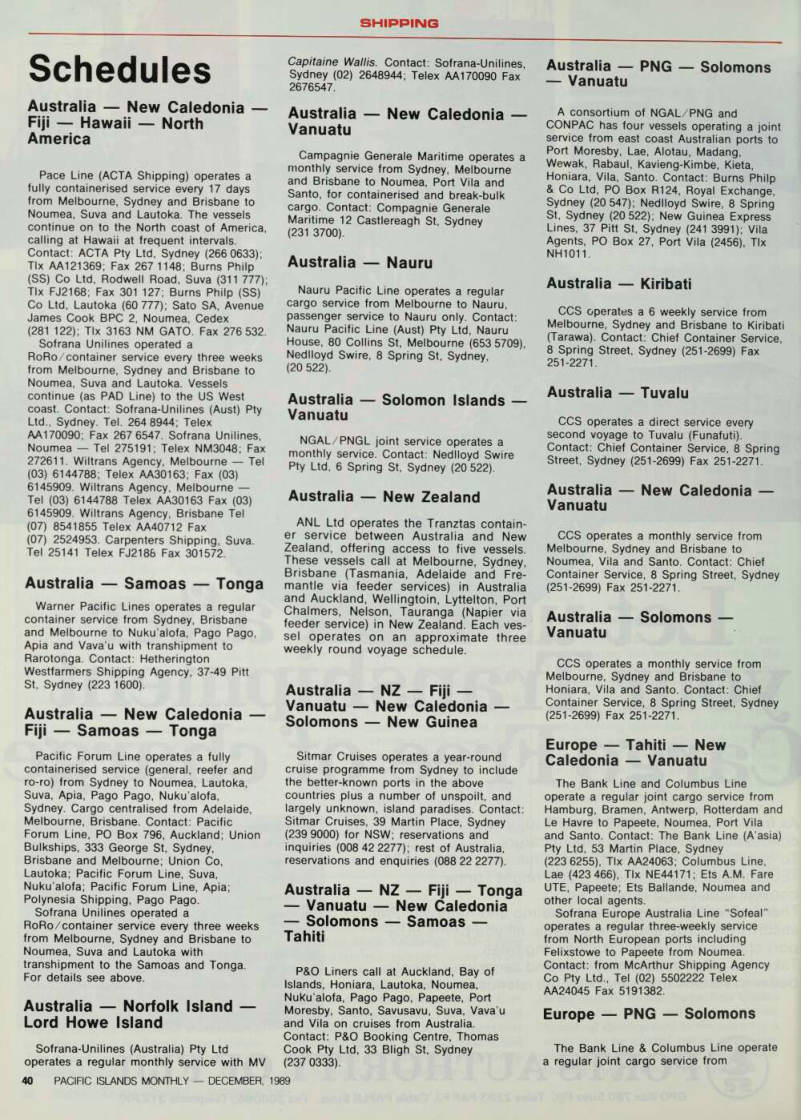
Shipping
Australia New Caledonia
Fiji Hawaii North
America
Pace Line (ACTA Shipping) operates a fully containerised service every 17 days from Melbourne, Sydney and Brisbane to Noumea, Suva and Lautoka. The vessels continue on to the North coast of America, calling at Hawaii at frequent intervals.
Contact: ACTA Pty Ltd, Sydney (266 0633); Tlx AA121369; Fax 267 1148; Burns Philp (SS) Co Ltd, Rodwell Road, Suva (311 777); Tlx FJ2168; Fax 301 127; Burns Philp (SS) Co Ltd, Lautoka (60 777); Sato SA, Avenue James Cook BPC 2, Noumea, Cedex (281 122); Tlx 3163 NM GATO. Fax 276 532.
Sofrana Unilines operated a Roßo/container service every three weeks from Melbourne, Sydney and Brisbane to Noumea, Suva and Lautoka. Vessels continue (as PAD Line) to the US West coast. Contact: Sofrana-Unilines (Aust) Pty Ltd., Sydney. Tel. 264 8944; Telex AA170090; Fax 267 6547. Sofrana Unilines, Noumea Tel 275191; Telex NM3048; Fax 272611. Wiltrans Agency, Melbourne Tel (03) 6144788; Telex AA30163; Fax (03) 6145909. Wiltrans Agency, Melbourne Tel (03) 6144788 Telex AA30163 Fax (03) 6145909. Wiltrans Agency, Brisbane Tel (07) 8541855 Telex AA40712 Fax (07) 2524953. Carpenters Shipping, Suva.
Tel 25141 Telex FJ2IBS Fax 301572.
Australia Samoas Tonga
Warner Pacific Lines operates a regular container service from Sydney, Brisbane and Melbourne to Nukualofa, Pago Pago, Apia and Vava’u with transhipment to Rarotonga. Contact: Hetherington Westfarmers Shipping Agency, 37-49 Pitt St, Sydney (223 1600).
Australia New Caledonia
Fiji Samoas Tonga
Pacific Forum Line operates a fully containerised service (general, reefer and ro-ro) from Sydney to Noumea, Lautoka, Suva, Apia, Pago Pago, Nukualofa, Sydney. Cargo centralised from Adelaide, Melbourne, Brisbane. Contact: Pacific Forum Line, PO Box 796, Auckland; Union Bulkships, 333 George St, Sydney, Brisbane and Melbourne; Union Co, Lautoka; Pacific Forum Line, Suva, Nukualofa; Pacific Forum Line, Apia;
Polynesia Shipping, Pago Pago.
Sofrana Unilines operated a Roßo/container service every three weeks from Melbourne, Sydney and Brisbane to Noumea, Suva and Lautoka with transhipment to the Samoas and Tonga.
For details see above.
Australia Norfolk Island
Lord Howe Island
Sofrana-Unilines (Australia) Pty Ltd operates a regular monthly service with MV
Capitaine Wallis. Contact: Sofrana-Unilines, Sydney (02) 2648944; Telex AA170090 Fax 2676547.
Australia New Caledonia Vanuatu Campagnie Generale Maritime operates a monthly service from Sydney, Melbourne and Brisbane to Noumea, Port Vila and Santo, for containerised and break-bulk cargo. Contact: Compagnie Generale Maritime 12 Castlereagh St, Sydney (231 3700).
Australia Nauru Nauru Pacific Line operates a regular cargo service from Melbourne to Nauru, passenger service to Nauru only. Contact: Nauru Pacific Line (Aust) Pty Ltd, Nauru House, 80 Collins St, Melbourne (653 5709), Nedlloyd Swire, 8 Spring St, Sydney, (20 522).
Australia Solomon Islands Vanuatu NGAL/PNGL joint service operates a monthly service. Contact; Nedlloyd Swire Pty Ltd, 6 Spring St, Sydney (20 522).
Australia New Zealand ANL Ltd operates the Tranztas contain er service between Australia and New Zealand, offering access to five vessels.
These vessels call at Melbourne, Sydney, Brisbane (Tasmania, Adelaide and Fre mantle via feeder services) in Australia and Auckland, Wellingtoin, Lyttelton, Port Chalmers, Nelson, Tauranga (Napier via feeder service) in New Zealand. Each ves sel operates on an approximate three weekly round voyage schedule.
Australia NZ Fiji Vanuatu New Caledonia Solomons New Guinea Sitmar Cruises operates a year-round cruise programme from Sydney to include the better-known ports in the above countries plus a number of unspoilt, and largely unknown, island paradises. Contact: Sitmar Cruises, 39 Martin Place, Sydney (239 9000) for NSW; reservations and inquiries (008 42 2277); rest of Australia, reservations and enquiries (088 22 2277).
Australia NZ Fiji Tonga
Vanuatu New Caledonia Solomons Samoas Tahiti P&O Liners call at Auckland, Bay of Islands, Honiara, Lautoka, Noumea, Nukualofa, Pago Pago, Papeete, Port Moresby, Santo, Savusavu, Suva, Vava’u and Vila on cruises from Australia.
Contact: P&O Booking Centre, Thomas Cook Pty Ltd, 33 Bligh St, Sydney (237 0333).
Australia PNG Solomons
Vanuatu
A consortium of NGAL/PNG and CONPAC has four vessels operating a joint service from east coast Australian ports to Port Moresby, Lae, Alotau, Madang, Wewak, Rabaul, Kavieng-Kimbe, Kieta, Honiara, Vila, Santo. Contact: Burns Philp & Co Ltd, PO Box R 124, Royal Exchange, Sydney (20 547); Nedlloyd Swire, 8 Spring St, Sydney (20 522); New Guinea Express Lines, 37 Pitt St, Sydney (241 3991); Vila Agents, PO Box 27, Port Vila (2456), Tlx
Nhioii.
Australia Kiribati
CCS operates a 6 weekly service from Melbourne, Sydney and Brisbane to Kiribati (Tarawa). Contact: Chief Container Service,
8 Spring Street, Sydney (251-2699) Fax
251-2271.
Australia Tuvalu
CCS operates a direct service every second voyage to Tuvalu (Funafuti).
Contact: Chief Container Service, 8 Spring Street, Sydney (251-2699) Fax 251-2271.
Australia New Caledonia
Vanuatu
CCS operates a monthly service from Melbourne, Sydney and Brisbane to Noumea, Vila and Santo. Contact: Chief Container Service, 8 Spring Street, Sydney (251-2699) Fax 251-2271.
Australia Solomons
Vanuatu
CCS operates a monthly service from Melbourne, Sydney and Brisbane to Honiara, Vila and Santo. Contact: Chief Container Service, 8 Spring Street, Sydney (251-2699) Fax 251-2271.
Europe Tahiti New
Caledonia Vanuatu
The Bank Line and Columbus Line operate a regular joint cargo service from Hamburg, Bramen, Antwerp, Rotterdam and Le Havre to Papeete, Noumea, Port Vila and Santo. Contact; The Bank Line (A’asia) Pty Ltd, 53 Martin Place, Sydney (223 6255), Tlx AA24063; Columbus Line, Lae (423 466), Tlx NE44171; Ets A.M. Fare DTE, Papeete: Ets Ballande, Noumea and other local agents.
Sofrana Europe Australia Line “Sofeal" operates a regular three-weekly service from North European ports including Felixstowe to Papeete from Noumea.
Contact: from McArthur Shipping Agency Co Pty Ltd., Tel (02) 5502222 Telex AA24045 Fax 5191382.
Europe PNG Solomons
The Bank Line & Columbus Line operate a regular joint cargo service from
Advertisements & other items, p. 41 (1 item)
Your Direct European Connection
u« *
EUROPE-SOUTH PACIFIC JOINT SERVICE
The South Pacific Specialists offer facilities for shipment of: Containers (FCL/LCL) and Breakbulk Cargo plus reefer space and deeptanks for carriage of vegetable oils and other liquid bulk cargo.
Carriers also accept heavy lifts, overlength and cumbersome parcels.
Ports of Service: Loading: Papeete, Apia, Suva, Lautoka, Noumea, Port Vila, Santo, Honiara, Port Moresby, Lae,Madang, Kimbe, Rabaul, Kieta, Darwin.
For: Rotterdam, Antwerp, Hamburg, Hull, Dunkirk, Le Havre.
ROUND THE WORLD SERVICE
Additional ports on enquiry.
Please contact our regional offices for further information: The Bank Line (Australasia) Pty Ltd Ground Floor Telex AA24063 53 Martin Place Telephone (02) 223 6255 Sydney NSW 2000 Facsimile (02) 223 6549 Columbus Line Reederei GmbH P.O. Box 1667 Lae/Papua New Guinea Phone; 42 3466/42 3287 42 2481 Colline NE 44 171
THE BANK LINE LTD LONDON
COLUMBUS LINE REEDEREI GMBH HAMBURG
Europe W. Samoa Tonga
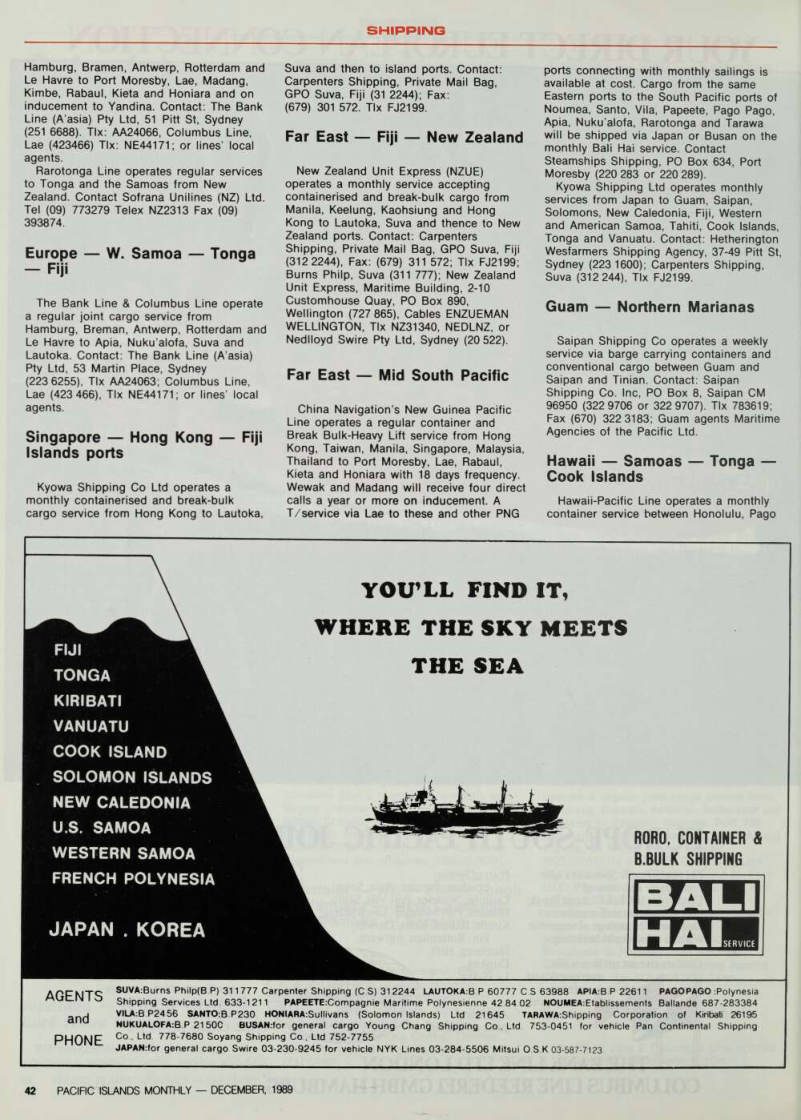
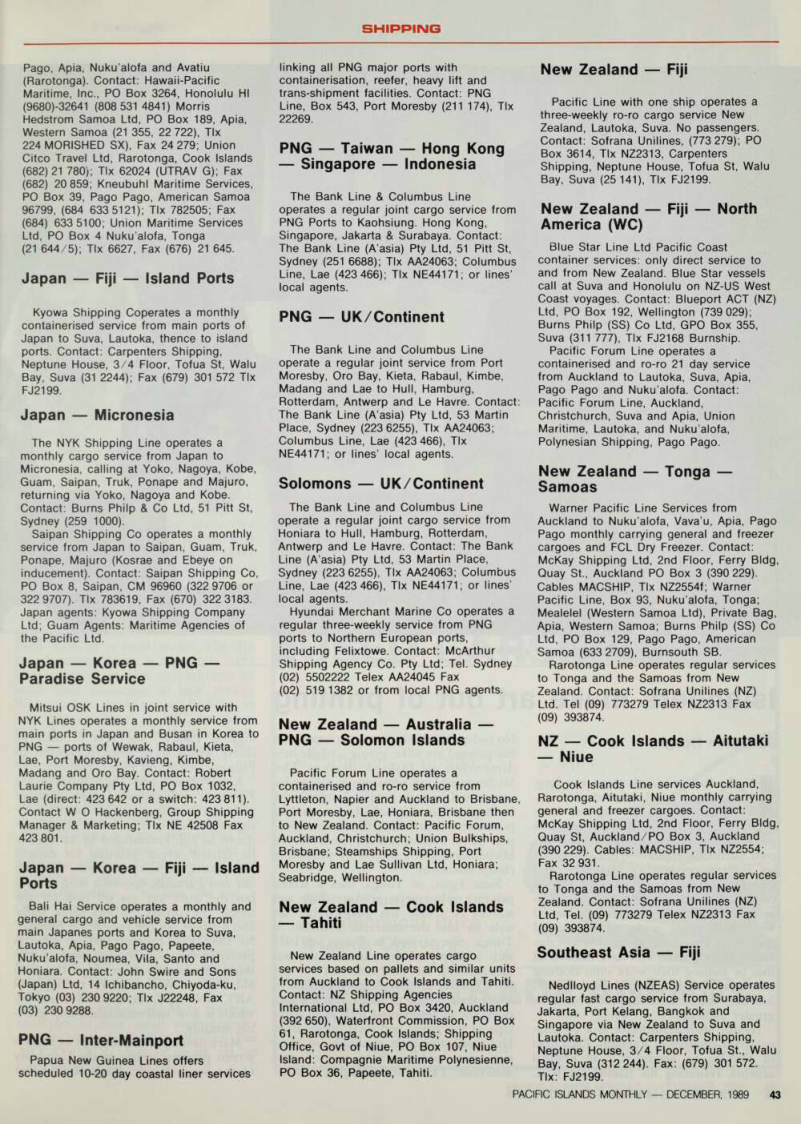
Hamburg, Bramen, Antwerp, Rotterdam and Le Havre to Port Moresby, Lae, Madang, Kimbe, Rabaul, Kieta and Honiara and on inducement to Yandina. Contact: The Bank Line (A’asia) Pty Ltd, 51 Pitt St, Sydney (251 6688). Tlx: AA24066, Columbus Line, Lae (423466) Tlx: NE44171; or lines’ local agents.
Rarotonga Line operates regular services to Tonga and the Samoas from New Zealand. Contact Sofrana Unilines (NZ) Ltd.
Tel (09) 773279 Telex NZ2313 Fax (09) 393874.
Europe W. Samoa Tonga
- Fiji
The Bank Line & Columbus Line operate a regular joint cargo service from Hamburg, Breman, Antwerp, Rotterdam and Le Havre to Apia, Nukualofa, Suva and Lautoka. Contact: The Bank Line (A’asia) Pty Ltd, 53 Martin Place, Sydney (223 6255), Tlx AA24063; Columbus Line, Lae (423 466), Tlx NE44171; or lines’ local agents.
Singapore Hong Kong Fiji
Islands ports
Kyowa Shipping Co Ltd operates a monthly containerised and break-bulk cargo service from Hong Kong to Lautoka,
Suva and then to island ports. Contact: Carpenters Shipping, Private Mail Bag, GPO Suva, Fiji (31 2244); Fax. (679) 301 572. Tlx FJ2199.
Far East Fiji New Zealand New Zealand Unit Express (NZUE) operates a monthly service accepting containerised and break-bulk cargo from Manila, Keelung, Kaohsiung and Hong Kong to Lautoka, Suva and thence to New Zealand ports. Contact: Carpenters Shipping, Private Mail Bag, GPO Suva, Fiji (312 2244), Fax: (679) 311 572; Tlx FJ2199; Burns Philp, Suva (311 777); New Zealand Unit Express, Maritime Building, 2-10 Customhouse Quay, PO Box 890, Wellington (727 865), Cables ENZUEMAN
Wellington, Tlx Nz31340, Nedlnz, Or
Nedlloyd Swire Pty Ltd, Sydney (20 522).
Far East Mid South Pacific China Navigation’s New Guinea Pacific Line operates a regular container and Break Bulk-Heavy Lift service from Hong Kong, Taiwan, Manila, Singapore, Malaysia, Thailand to Port Moresby, Lae, Rabaul, Kieta and Honiara with 18 days frequency.
Wewak and Madang will receive four direct calls a year or more on inducement. A T/service via Lae to these and other PNG
ports connecting with monthly sailings is available at cost. Cargo from the same Eastern ports to the South Pacific ports of Noumea, Santo, Vila, Papeete, Pago Pago, Apia, Nukualofa, Rarotonga and Tarawa will be shipped via Japan or Busan on the monthly Bali Hai service. Contact Steamships Shipping, PC Box 634, Port Moresby (220 283 or 220 289).
Kyowa Shipping Ltd operates monthly services from Japan to Guam, Saipan, Solomons, New Caledonia, Fiji, Western and American Samoa, Tahiti, Cook Islands, Tonga and Vanuatu. Contact: Hetherington Wesfarmers Shipping Agency, 37-49 Pitt St, Sydney (223 1600); Carpenters Shipping, Suva (312 244), Tlx FJ2199.
Guam Northern Marianas Saipan Shipping Co operates a weekly service via barge carrying containers and conventional cargo between Guam and Saipan and Tinian. Contact: Saipan Shipping Co. Inc, PC Box 8, Saipan CM 96950 (322 9706 or 322 9707). Tlx 783619; Fax (670) 322 3183; Guam agents Maritime Agencies of the Pacific Ltd.
Hawaii Samoas Tonga Cook Islands Hawaii-Pacific Line operates a monthly container service between Honolulu, Pago
Pago, Apia, Nukualofa and Avatiu (Rarotonga). Contact: Hawaii-Pacific Maritime, Inc., PO Box 3264, Honolulu HI (9680)-32641 (808 531 4841) Morris Hedstrom Samoa Ltd, PO Box 189, Apia, Western Samoa (21 355, 22 722), Tlx 224 MORISHED SX), Fax 24 279; Union Citco Travel Ltd, Rarotonga, Cook Islands (682)21 780); Tlx 62024 (UTRAV G); Fax (682) 20 859; Kneubuhl Maritime Services, PO Box 39, Pago Pago, American Samoa 96799, (684 633 5121); Tlx 782505; Fax (684) 633 5100; Union Maritime Services Ltd, PO Box 4 Nukualofa, Tonga (21 644/5); Tlx 6627, Fax (676) 21 645.
Japan Fiji Island Ports
Kyowa Shipping Coperates a monthly containerised service from main ports of Japan to Suva, Lautoka, thence to island ports. Contact: Carpenters Shipping, Neptune House, 3/4 Floor, Tofua St, Walu Bay, Suva (31 2244); Fax (679) 301 572 Tlx FJ2199.
Japan Micronesia
The NYK Shipping Line operates a monthly cargo service from Japan to Micronesia, calling at Yoko, Nagoya, Kobe, Guam, Saipan, Truk, Ponape and Majuro, returning via Yoko, Nagoya and Kobe.
Contact: Burns Philp & Co Ltd, 51 Pitt St, Sydney (259 1000).
Saipan Shipping Co operates a monthly service from Japan to Saipan, Guam, Truk, Ponape, Majuro (Kosrae and Ebeye on inducement). Contact: Saipan Shipping Co, PO Box 8, Saipan, CM 96960 (322 9706 or 322 9707). Tlx 783619, Fax (670) 322 3183.
Japan agents: Kyowa Shipping Company Ltd; Guam Agents: Maritime Agencies of the Pacific Ltd.
Japan Korea PNG Paradise Service Mitsui OSK Lines in joint service with NYK Lines operates a monthly service from main ports in Japan and Busan in Korea to PNG ports of Wewak, Rabaul, Kieta, Lae, Port Moresby, Kavieng, Kimbe, Madang and Oro Bay. Contact: Robert Laurie Company Pty Ltd, PO Box 1032, Lae (direct: 423 642 or a switch: 423 811).
Contact W O Hackenberg, Group Shipping Manager & Marketing; Tlx NE 42508 Fax 423 801.
Japan Korea Fiji Island
Ports Bali Hai Service operates a monthly and general cargo and vehicle service from main Japanes ports and Korea to Suva, Lautoka, Apia, Pago Pago, Papeete, Nukualofa, Noumea, Vila, Santo and Honiara. Contact; John Swire and Sons (Japan) Ltd, 14 Ichibancho, Chiyoda-ku, Tokyo (03) 230 9220; Tlx J 22248, Fax (03) 230 9288.
PNG Inter-Mainport
Papua New Guinea Lines offers scheduled 10-20 day coastal liner services
linking all PNG major ports with containerisation, reefer, heavy lift and trans-shipment facilities. Contact: PNG Line, Box 543, Port Moresby (211 174), Tlx 22269.
PNG Taiwan Hong Kong
Singapore Indonesia
The Bank Line & Columbus Line operates a regular joint cargo service from PNG Ports to Kaohsiung. Hong Kong, Singapore, Jakarta & Surabaya. Contact: The Bank Line (A’asia) Pty Ltd, 51 Pitt St, Sydney (251 6688); Tlx AA24063; Columbus Line, Lae (423 466); Tlx NE44171; or lines’ local agents.
PNG UK/Continent The Bank Line and Columbus Line operate a regular joint service from Port Moresby, Oro Bay, Kieta, Rabaul, Kimbe, Madang and Lae to Hull, Hamburg, Rotterdam, Antwerp and Le Havre. Contact: The Bank Line (A’asia) Pty Ltd, 53 Martin Place, Sydney (223 6255), Tlx AA24063; Columbus Line, Lae (423 466), Tlx NE44171; or lines’ local agents.
Solomons UK/Continent The Bank Line and Columbus Line operate a regular joint cargo service from Honiara to Hull, Hamburg, Rotterdam, Antwerp and Le Havre. Contact: The Bank Line (A’asia) Pty Ltd, 53 Martin Place, Sydney (223 6255), Tlx AA24063; Columbus Line, Lae (423 466), Tlx NE44171; or lines’ local agents.
Hyundai Merchant Marine Co operates a regular three-weekly service from PNG ports to Northern European ports, including Felixtowe. Contact: McArthur Shipping Agency Co. Pty Ltd; Tel. Sydney (02) 5502222 Telex AA24045 Fax (02) 5191382 or from local PNG agents.
New Zealand Australia PNG Solomon Islands Pacific Forum Line operates a containerised and ro-ro service from Lyttleton, Napier and Auckland to Brisbane, Port Moresby, Lae, Honiara, Brisbane then to New Zealand. Contact; Pacific Forum, Auckland, Christchurch; Union Bulkships, Brisbane; Steamships Shipping, Port Moresby and Lae Sullivan Ltd, Honiara; Seabridge, Wellington.
New Zealand Cook Islands Tahiti New Zealand Line operates cargo services based on pallets and similar units from Auckland to Cook Islands and Tahiti.
Contact; NZ Shipping Agencies International Ltd, PO Box 3420, Auckland (392 650), Waterfront Commission, PO Box 61, Rarotonga, Cook Islands; Shipping Office, Govt of Niue, PO Box 107, Niue Island: Compagnie Maritime Polynesienne, PO Box 36, Papeete, Tahiti.
New Zealand Fiji Pacific Line with one ship operates a three-weekly ro-ro cargo service New Zealand, Lautoka, Suva. No passengers.
Contact: Sofrana Unilines, (773 279); PO Box 3614, Tlx NZ2313, Carpenters Shipping, Neptune House, Tofua St, Walu Bay, Suva (25 141), Tlx FJ2199.
New Zealand Fiji North
America (WC)
Blue Star Line Ltd Pacific Coast container services: only direct service to and from New Zealand. Blue Star vessels call at Suva and Honolulu on NZ-US West Coast voyages. Contact: Blueport ACT (NZ) Ltd. PO Box 192, Wellington (739 029); Burns Philp (SS) Co Ltd, GPO Box 355, Suva (311 777), Tlx FJ2168 Burnship.
Pacific Forum Line operates a containerised and ro-ro 21 day service from Auckland to Lautoka, Suva, Apia, Pago Pago and Nukualofa. Contact: Pacific Forum Line, Auckland, Christchurch, Suva and Apia, Union Maritime, Lautoka, and Nukualofa, Polynesian Shipping, Pago Pago.
New Zealand Tonga Samoas Warner Pacific Line Services from Auckland to Nukualofa, Vava’u, Apia, Pago Pago monthly carrying general and freezer cargoes and FCL Dry Freezer. Contact: McKay Shipping Ltd, 2nd Floor, Ferry Bldg, Quay St., Auckland PO Box 3 (390 229).
Cables MACSHIP, Tlx NZ2554f; Warner Pacific Line, Box 93, Nukualofa, Tonga; Mealelel (Western Samoa Ltd), Private Bag, Apia, Western Samoa; Burns Philp (SS) Co Ltd, PO Box 129, Pago Pago, American Samoa (633 2709), Burnsouth SB.
Rarotonga Line operates regular services to Tonga and the Samoas from New Zealand. Contact: Sofrana Unilines (NZ) Ltd. Tel (09) 773279 Telex NZ2313 Fax (09) 393874.
NZ Cook Islands Aitutaki Niue Cook Islands Line services Auckland, Rarotonga, Aitutaki, Niue monthly carrying general and freezer cargoes. Contact: McKay Shipping Ltd, 2nd Floor, Ferry Bldg, Quay St, Auckland/PO Box 3, Auckland (390 229). Cables: MACSHIP, Tlx NZ2554; Fax 32 931.
Rarotonga Line operates regular services to Tonga and the Samoas from New Zealand. Contact: Sofrana Unilines (NZ) Ltd, Tel. (09) 773279 Telex NZ2313 Fax (09) 393874.
Southeast Asia Fiji Nedlloyd Lines (NZEAS) Service operates regular fast cargo service from Surabaya, Jakarta, Port Kelang, Bangkok and Singapore via New Zealand to Suva and Lautoka. Contact: Carpenters Shipping, Neptune House, 3/4 Floor, Tofua St., Walu Bay, Suva (312 244). Fax: (679) 301 572.
Tlx; FJ2199.
Advertisements & other items, p. 42 (1 item)
Bali
TONGA
KIRIBATI
VANUATU
COOK ISLAND
SOLOMON ISLANDS
NEW CALEDONIA
U.S. SAMOA
WESTERN SAMOA
FRENCH POLYNESIA
JAPAN . KOREA
YOU’LL FIND IT,
WHERE THE SKY MEETS
THE SEA
m
RORO. CONTAINER &
B.BULK SHIPPING
BALI
HAI SERVICE
AGENTS
and
PHONE
SUVA:Burns Philp(B P) 311777 Carpenter Shipping (C.S) 312244 LAUTOKA:B P 60777 C S 63988 APIA:B P 22611 PAGO PAGO :Polynesia Shipping Services Ltd 633-1211 PAPEETE:Compagnie Maritime Polynesienne 42 84 02 NOUMEA:Etablissements Ballande 687-283384 VILA:B P 2456 SANTO:B P 230 HONlARArSullivans (Solomon Islands) Ltd 21645 TARAWA:Shipping Corporation of Kiribati 26195 NUKUALOFA:B P 21500 BUSANrfor general cargo Young Chang Shipping Co., Ltd 753-0451 for vehicle Pan Continental Shipping Co , Ltd 778-7680 Soyang Shipping Co. Ltd 752-7755 JAPANifor general cargo Swire 03-230-9245 for vehicle NYK Lines 03-284-5506 Mitsui O.S K 03-587-7123
Islanders make art out of printing
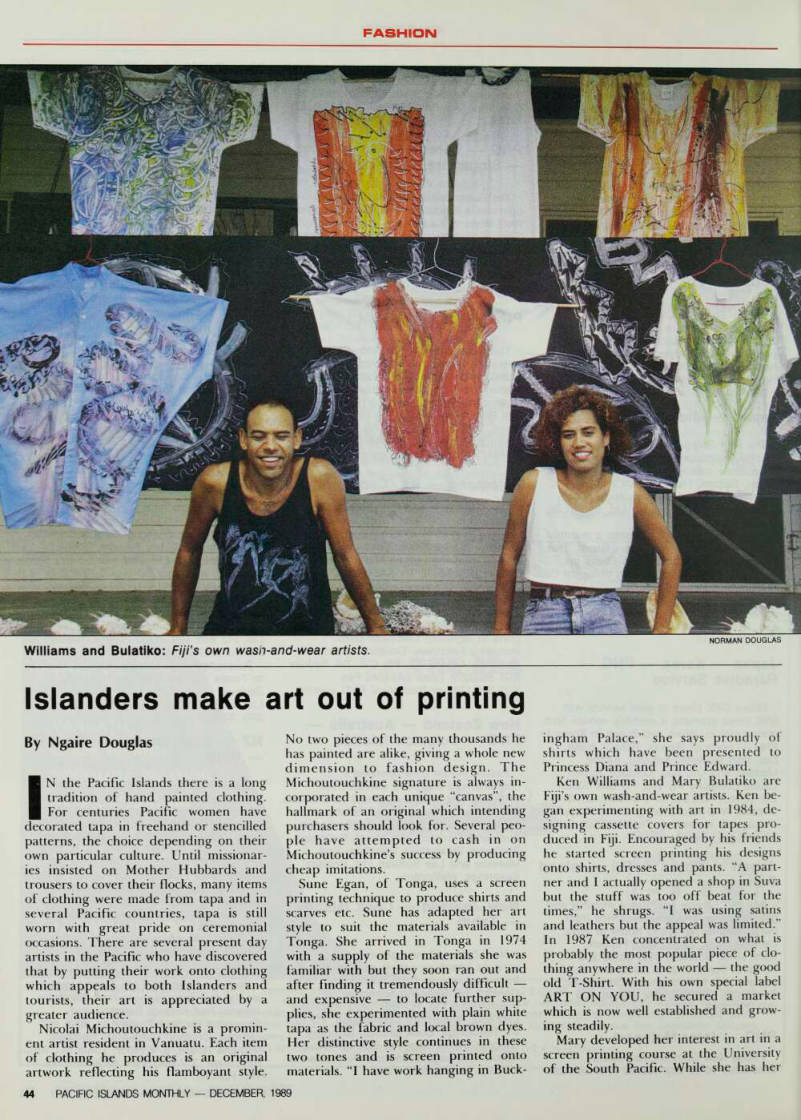
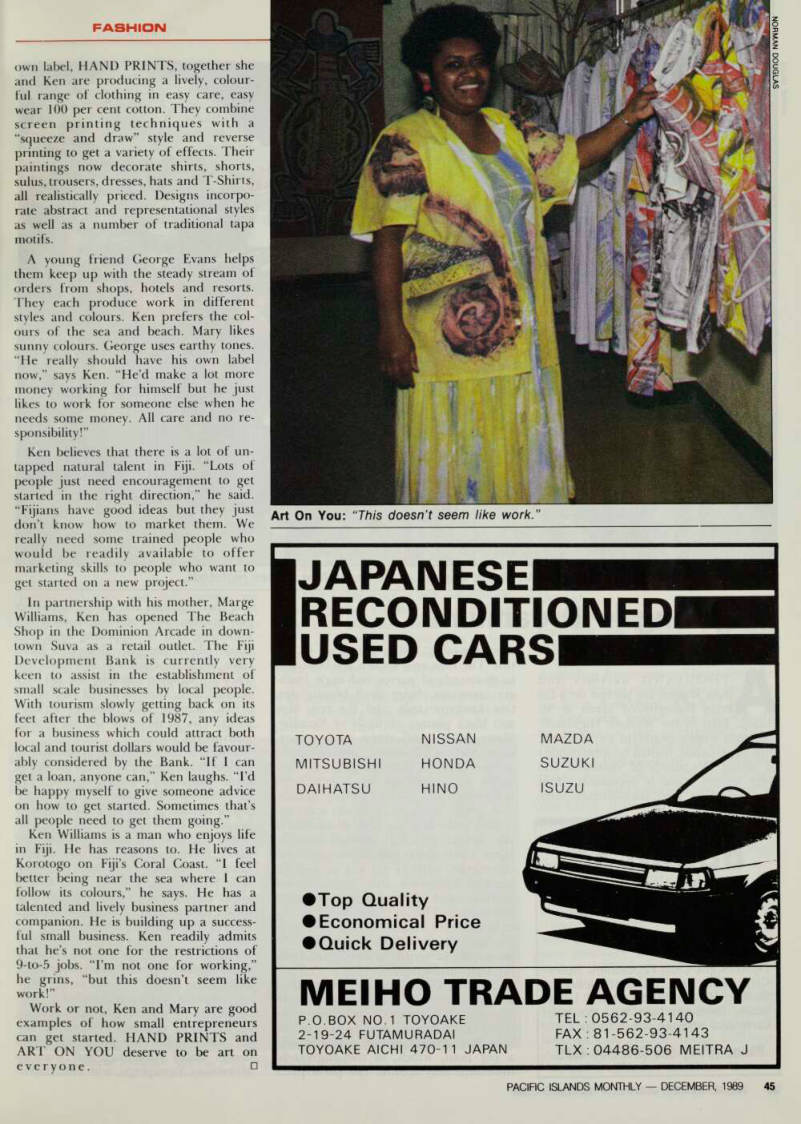
Fashion
By Ngaire Douglas
No two pieces of the many thousands he has painted are alike, giving a whole new dimension to fashion design. The Michoutouchkine signature is always in corporated in each unique “canvas”, the hallmark of an original which intending purchasers should look for. Several peo pie have attempted to cash in on
Michoutouchkine’s success by producing
cheap imitations.
Sune Egan, of Tonga, uses a screen
printing technique to produce shirts and
scarves etc. Sune has adapted her art style to suit the materials available in Tonga. She arrived in Tonga in 1974 with a supply of the materials she was familiar with but they soon ran out and after finding it tremendously difficult and expensive to locate further sup
plies, she experimented with plain white
tapa as the fabric and local brown dyes, Her distinctive style continues in these two tones and is screen printed onto materials. “I have work hanging in Buck
ingham Palace,” she says proudly of shirts which have been presented to Princess Diana and Prince Edward.
Ken Williams and Mary Bulatiko are Fiji’s own wash-and-wear artists. Ken be gan experimenting with art in 1984, de signing cassette covers for tapes pro duced in Fiji. Encouraged by his friends he started screen printing his designs onto shirts, dresses and pants. “A part ner and I actually opened a shop in Suva but the stuff was too off beat for the times,” he shrugs. I was using satins and leathers but the appeal was limited, In 1987 Ken concentrated on what is probably the most popular piece of clo thing anywhere in the world the good old T-Shirt. With his own special label ART ON YOU, he secured a market which is now well established and grow
ing steadily,
Mary developed her interest in art in a screen printing course at the University of the South Pacific. While she has her
IN the Pacific Islands there is a long tradition of hand painted clothing.
For centuries Pacific women have decorated tapa in freehand or stencilled patterns, the choice depending on their own particular culture. Until missionar ies insisted on Mother Hubbards and trousers to cover their flocks, many items of clothing were made from tapa and in several Pacific countries, tapa is still worn with great pride on ceremonial occasions. There are several present day artists in the Pacific who have discovered that by putting their work onto clothing which appeals to both Islanders and tourists, their art is appreciated by a greater audience.
Nicolai Michoutouchkine is a promin ent artist resident in Vanuatu. Each item of clothing he produces is an original artwork reflecting his flamboyant style.
Norman Douglas
Williams and Bulatiko: Fiji’s own wash-and-wear artists.
own label, HAND PRINTS, together she and Ken are producing a lively, colour ful range of clothing in easy care, easy wear 100 per cent cotton. They combine screen printing techniques with a “squeeze and draw” style and reverse printing to get a variety of effects. Their paintings now decorate shirts, shorts, sulus, trousers, dresses, hats and T-Shirts,
all realistically priced. Designs incorpo
rate abstract and representational styles as well as a number of traditional tapa motifs.
A young friend George Evans helps them keep up with the steady stream of orders from shops, hotels and resorts.
They each produce work in different styles and colours. Ken prefers the col ours of the sea and beach. Mary likes sunny colours. George uses earthy tones.
“He really should have his own label now,” says Ken. “He’d make a lot more money working for himself but he just likes to work for someone else when he needs some money. All care and no re
sponsibility!”
Ken believes that there is a lot of un tapped natural talent in Fiji. “Lots of people just need encouragement to get started in the right direction,” he said.
“Fijians have good ideas but they just don’t know how to market them. We really need some trained people who would be readily available to offer marketing skills to people who want to get started on a new project.”
In partnership with his mother, Marge Williams, Ken has opened The Beach Shop in the Dominion Arcade in down town Suva as a retail outlet. The Fiji Development Bank is currently very keen to assist in the establishment of small scale businesses by local people.
With tourism slowly getting back on its feet after the blows of 1987, any ideas for a business which could attract both local and tourist dollars would be favour ably considered by the Bank. “If I can get a loan, anyone can,” Ken laughs. “I’d be happy myself to give someone advice on how to get started. Sometimes that’s all people need to get them going.”
Ken Williams is a man who enjoys life in Fiji. He has reasons to. He lives at Korotogo on Fiji’s Coral Coast. “I feel better being near the sea where I can follow its colours,” he says. He has a talented and lively business partner and companion. He is building up a success ful small business. Ken readily admits that he’s not one for the restrictions of 9-to-5 jobs. “I’m not one for working,” he grins, “but this doesn’t seem like work!”
Work or not, Ken and Mary are good examples of how small entrepreneurs can get started. HAND PRINTS and ART ON YOU deserve to be art on everyone. □
Art On You: “This doesn’t seem like work."
Advertisements & other items, p. 45 (1 item)
I Japan
RECONDITIONED
USED CARS^H
TOYOTA NISSAN
MITSUBISHI HONDA
DAIHATSU HINO
•Top Quality
• Economical Price • Quick Delivery
MAZDA
SUZUKI
ISUZU
MEIHO TRADE AGENCY
P.0.80X NO.I TOYOAKE TEL : 0562-93-41 40
2-19-24 FUTAMURADAI FAX : 81-562-93-41 43
TOYOAKE AICHI 470-1 1 JAPAN TLX : 04486-506 MEITRA J
Sing Sing in Dreamtime
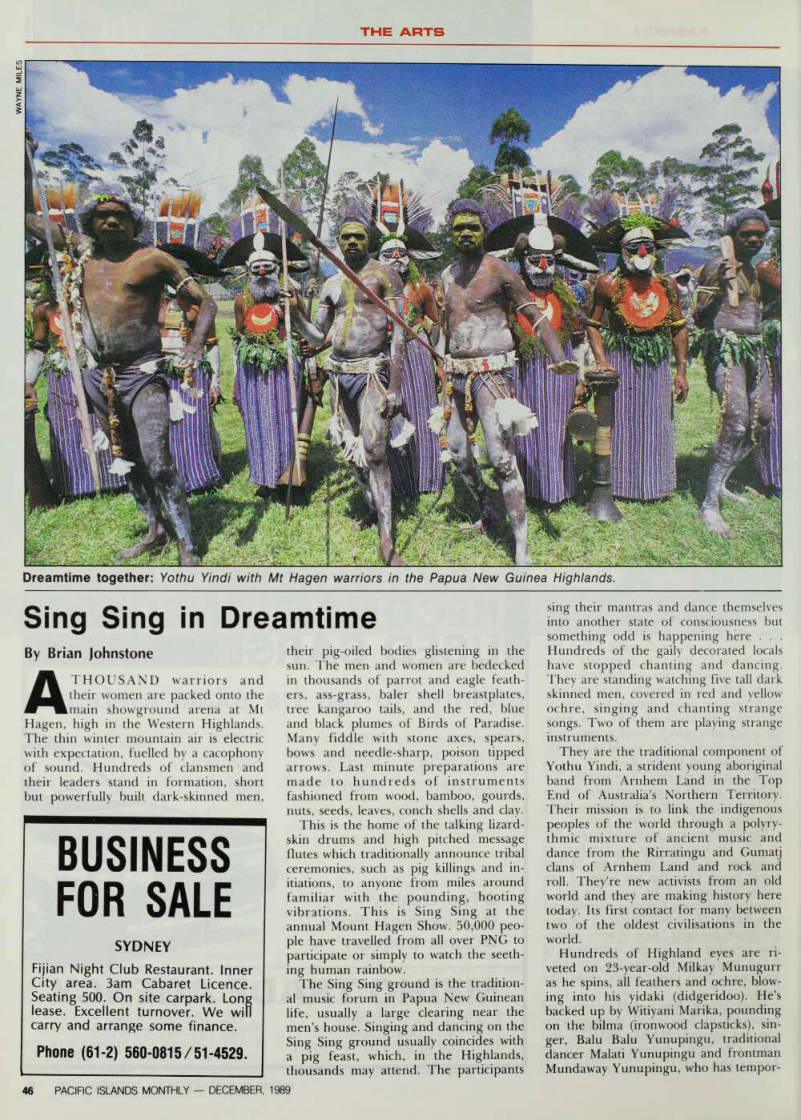
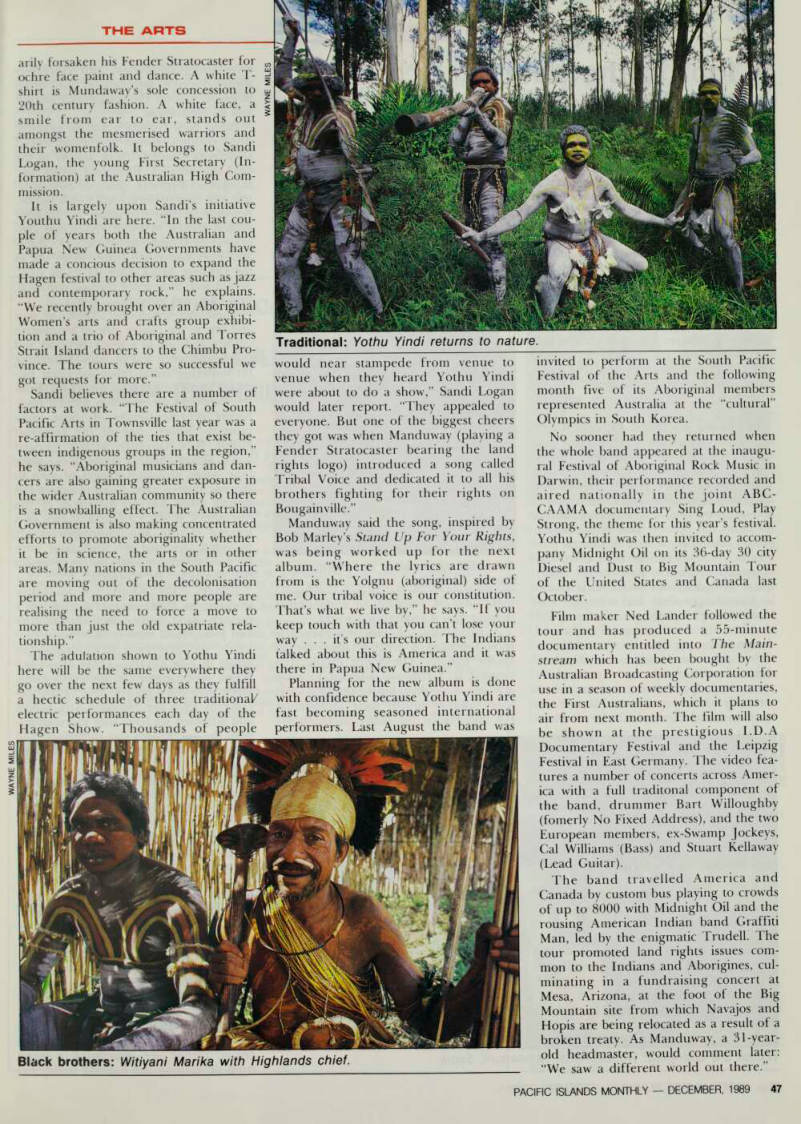
By Brian Johnstone
A THOUSAND warriors and their women are packed onto the main showground arena at Mt Hagen, high in the Western Highlands.
The thin winter mountain air is electric
with expectation, fuelled by a cacophony
of sound. Hundreds of clansmen and their leaders stand in formation, short but powerfully built dark-skinned men,
their pig-oiled bodies glistening in the sun. The men and women are bedecked in thousands of parrot and eagle feath ers, ass-grass, baler shell breastplates, tree kangaroo tails, and the red, blue and black plumes of Birds of Paradise.
Many fiddle with stone axes, spears,
bows and needle-sharp, poison tipped
arrows. Last minute preparations are made to hundreds of instruments fashioned from wood, bamboo, gourds, nuts, seeds, leaves, conch shells and clay.
This is the home of the talking lizard skin drums and high pitched message flutes which traditionally announce tribal ceremonies, such as pig killings and in itiations, to anyone from miles around familiar with the pounding, hooting vibrations. This is Sing Sing at the annual Mount Hagen Show. 50,000 peo ple have travelled from all over PNG to participate or simply to watch the seeth ing human rainbow.
The Sing Sing ground is the tradition al music forum in Papua New Guinean life, usually a large clearing near the men’s house. Singing and dancing on the
Sing Sing ground usually coincides with
a pig feast, which, in the Highlands, thousands may attend. The participants
sing their mantras and dance themselves into another state of consciousness but something odd is happening here . . .
Hundreds of the gaily decorated locals
have stopped chanting and dancing.
They are standing watching five tall dark skinned men, covered in red and yellow ochre, singing and chanting strange songs. Two of them are playing strange instruments.
They are the traditional component of Yothu Yindi, a strident young aboriginal band from Arnhem Land in the Top End of Australia’s Northern Territory.
Their mission is to link the indigenous peoples of the world through a polyry thmic mixture of ancient music and dance from the Rirratingu and Gumatj clans of Arnhem Land and rock and roll. They’re new activists from an old world and they are making history here today. Its first contact for many between two of the oldest civilisations in the world.
Hundreds of Highland eyes are ri veted on 23-year-old Milkay Munugurr as he spins, all feathers and ochre, blow ing into his yidaki (didgeridoo). He’s
backed up by Witiyani Marika, pounding
on the bilma (ironwood clapsticks), sin ger, Balu Balu Yunupingu, traditional dancer Malati Yunupingu and frontman Mundaway Yunupingu, who has tempor
Dreamtime together: Yothu Yindi with Mt Hagen warriors in the Papua New Guinea Highlands.
arily forsaken his Fender Stratocaster for ochre face paint and dance. A white T shirt is Mundaway’s sole concession to 20th century fashion. A white face, a smile from ear to ear, stands out amongst the mesmerised warriors and their womenfolk. It belongs to Sandi Logan, the young First Secretary (In formation) at the Australian High Com mission.
It is largely upon Sandi’s initiative Youthu Yindi are here. “In the last cou ple of years both the Australian and Papua New Guinea Governments have made a concious decision to expand the Hagen festival to other areas such as jazz and contemporary rock,” he explains.
“We recently brought over an Aboriginal
Women’s arts and crafts group exhibi tion and a trio of Aboriginal and Torres Strait Island dancers to the Chimbu Pro vince. The tours were so successful we got requests for more.”
Sandi believes there are a number of factors at work. “The Festival of South Pacific Arts in Townsville last year was a re-affirmation of the ties that exist be tween indigenous groups in the region,” he says. “Aboriginal musicians and dan cers are also gaining greater exposure in the wider Australian community so there is a snowballing effect. The Australian Government is also making concentrated efforts to promote aboriginality whether it be in science, the arts or in other areas. Many nations in the South Pacific are moving out of the decolonisation period and more and more people are realising the need to force a move to more than just the old expatriate rela tionship.”
The adulation shown to Yothu Yindi here will be the same everywhere they go over the next few days as they fulfill a hectic schedule of three traditional/ electric performances each day of the Hagen Show. “Thousands of people
would near stampede from venue to venue when they heard Yothu Yindi were about to do a show,” Sandi Logan would later report. “They appealed to everyone. But one of the biggest cheers they got was when Manduway (playing a Fender Stratocaster bearing the land rights logo) introduced a song called Tribal Voice and dedicated it to all his brothers fighting for their rights on
Bougainville.”
Manduway said the song, inspired by Bob Marley’s Stand Up For Your Rights, was being worked up for the next album. “Where the lyrics are drawn from is the Yolgnu (aboriginal) side of me. Our tribal voice is our constitution.
That’s what we live by,” he says. “If you keep touch with that you can’t lose your way . . . it's our direction. The Indians talked about this is America and it was there in Papua New Guinea.”
Planning for the new album is done with confidence because Yothu Yindi are fast becoming seasoned international performers. Last August the band was
invited to perform at the South Pacific Festival of the Arts and the following month five of its Aboriginal members represented Australia at the “cultural”
Olympics in South Korea.
No sooner had they returned when the whole band appeared at the inaugu ral Festival of Aboriginal Rock Music in Darwin, their performance recorded and aired nationally in the joint ABC CAAMA documentary Sing Loud, Play Strong, the theme for this year’s festival.
Yothu Yindi was then invited to accom pany Midnight Oil on its 36-day 30 city Diesel and Dust to Big Mountain Tour of the United States and Canada last October.
Film maker Ned Lander followed the tour and has produced a 55-minute documentary entitled into The Main stream which has been bought by the Australian Broadcasting Corporation for use in a season of weekly documentaries, the First Australians, which it plans to air from next month. The film will also be shown at the prestigious I.D.A Documentary Festival and the Leipzig Festival in East Germany. The video fea tures a number of concerts across Amer ica with a full traditonal component of the band, drummer Bart Willoughby (fomerly No Fixed Address), and the two European members, ex-Swamp Jockeys, Cal Williams (Bass) and Stuart Kellaway (Lead Guitar).
The band travelled America and Canada by custom bus playing to crowds of up to 8000 with Midnight Oil and the rousing American Indian band Graffiti Man, led by the enigmatic Trudell. The tour promoted land rights issues com mon to the Indians and Aborigines, cul minating in a fundraising concert at Mesa, Arizona, at the foot of the Big Mountain site from which Navajos and Hopis are being relocated as a result of a broken treaty. As Manduway, a 31-year old headmaster, would comment later: “We saw a different world out there.”
Black brothers: Witiyani Marika with Highlands chief.
Wayne Miles
Traditional: Yothu Yindi returns to nature.
Advertisements & other items, p. 46 (1 item)
Business
FOR SALE
SYDNEY
Fijian Night Club Restaurant. Inner City area. 3am Cabaret Licence.
Seating 500. On site carpark. Long lease. Excellent turnover. We wiM carry and arrange some finance.
Phone (61-2) 560-0815/51-4529.
Liz Thomson
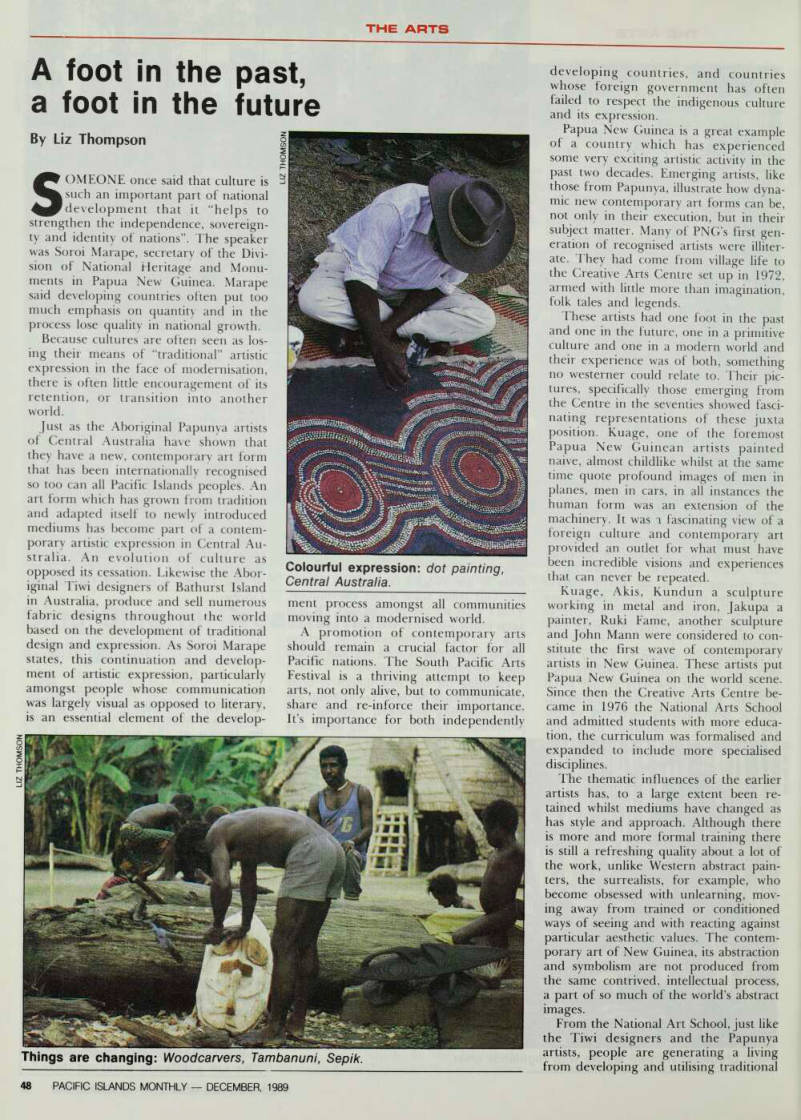
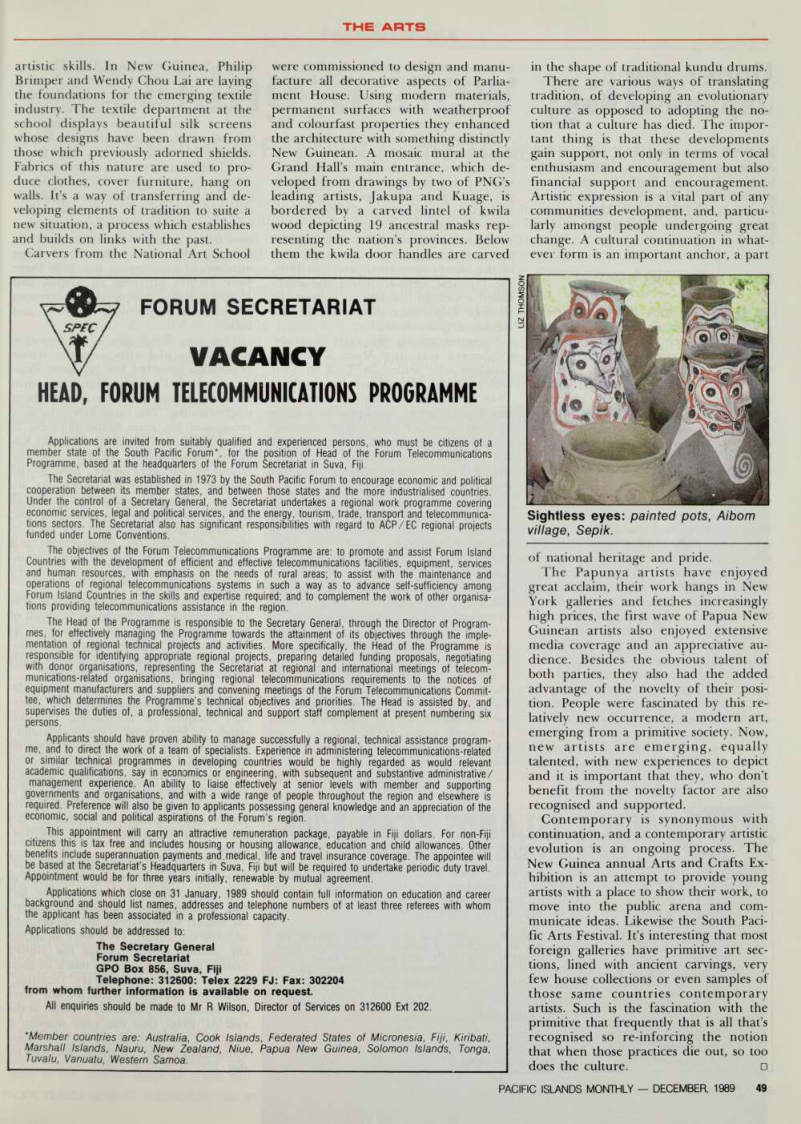
A foot in the past, a foot in the future
By Liz Thompson
SOMEONE once said that culture is such an important part of national development that it “helps to strengthen the independence, sovereign ty and identity of nations”. The speaker was Soroi Marape, secretary of the Divi sion of National Heritage and Monu ments in Papua New Guinea. Marape said developing countries often put too much emphasis on quantity and in the process lose quality in national growth.
Because cultures are often seen as los ing their means of “traditional” artistic expression in the face of modernisation, there is often little encouragement of its retention, or transition into another world.
Just as the Aboriginal Papunya artists of Central Australia have shown that they have a new, contemporary art form that has been internationally recognised so too can all Pacific Islands peoples. An art form which has grown from tradition and adapted itself to newly introduced mediums has become part of a contem porary artistic expression in Central Au stralia. An evolution of culture as opposed its cessation. Likewise the Abor iginal Tiwi designers of Bathurst Island in Australia, produce and sell numerous fabric designs throughout the world based on the development of traditional design and expression. As Soroi Marape states, this continuation and develop ment of artistic expression, particularly amongst people whose communication was largely visual as opposed to literary, is an essential element of the develop-
ment process amongst all communities moving into a modernised world, A promotion of contemporary arts should remain a crucial factor for all Pacific nations. The South Pacific Arts Festival is a thriving attempt to keep arts, not only alive, but to communicate, share and re-inforce their importance, It’s importance for both independently
developing countries, and countries whose foreign government has often failed to respect the indigenous culture and its expression.
Papua New Guinea is a great example of a country which has experienced some very exciting artistic activity in the past two decades. Emerging artists, like those from Papunya, illustrate how dyna mic new contemporary art forms can be, not only in their execution, but in their subject matter. Many of PNG’s first gen eration of recognised artists were illiter ate. They had come from village life to the Creative Arts Centre set up in 1972, armed with little more than imagination, folk tales and legends.
These artists had one foot in the past and one in the future, one in a primitive culture and one in a modern world and their experience was of both, something no westerner could relate to. Their pic tures, specifically those emerging from the Centre in the seventies showed fasci nating representations of these juxta position. Kuage, one of the foremost Papua New Guinean artists painted naive, almost childlike whilst at the same time quote profound images of men in planes, men in cars, in all instances the human form was an extension of the machinery. It was a fascinating view of a foreign culture and contemporary art provided an outlet for what must have been incredible visions and experiences that can never be repeated.
Kuage, Akis, Kundun a sculpture working in metal and iron, Jakupa a painter, Ruki Fame, another sculpture and John Mann were considered to con stitute the first wave of contemporary artists in New Guinea. These artists put Papua New Guinea on the world scene.
Since then the Creative Arts Centre be came in 1976 the National Arts School and admitted students with more educa tion, the curriculum was formalised and expanded to include more specialised
disciplines.
The thematic influences of the earlier artists has, to a large extent been re tained whilst mediums have changed as has style and approach. Although there is more and more formal training there is still a refreshing quality about a lot of the work, unlike Western abstract pain ters, the surrealists, for example, who become obsessed with unlearning, mov ing away from trained or conditioned ways of seeing and with reacting against particular aesthetic values. The contem porary art of New Guinea, its abstraction and symbolism are not produced from the same contrived, intellectual process, a part of so much of the world’s abstract
images.
From the National Art School, just like the Tiwi designers and the Papunya
artists, people are generating a living
from developing and utilising traditional
Liz Thomson
Things are changing: Woodcarvers, Tambanuni, Sepik.
Colourful expression: dot painting, Central Australia.
artistic skills. In New Guinea, Philip Brimper and Wendy Chou Lai are laying the foundations for the emerging textile industry. The textile department at the school displays beautiful silk screens whose designs have been drawn from those which previously adorned shields.
Fabrics of this nature are used to pro duce clothes, cover furniture, hang on walls. It’s a way of transferring and de veloping elements of tradition to suite a new situation, a process which establishes and builds on links with the past.
Carvers from the National Art School
were commissioned to design and manu facture all decorative aspects of Parlia ment House. Using modern materials, permanent surfaces with weatherproof and colourfast properties they enhanced the architecture with something distinctly New Guinean. A mosaic mural at the Grand Hall’s main entrance, which de veloped from drawings by two of PNG’s leading artists, Jakupa and Kuage, is bordered by a carved lintel of kwila wood depicting 19 ancestral masks rep resenting the nation’s provinces. Below them the kwila door handles are carved
in the shape of traditional kundu drums.
There are various ways of translating tradition, of developing an evolutionary culture as opposed to adopting the no tion that a culture has died. The impor tant thing is that these developments gain support, not only in terms of vocal enthusiasm and encouragement but also financial support and encouragement.
Artistic expression is a vital part of any
communities development, and, particu
larly amongst people undergoing great change. A cultural continuation in what ever form is an important anchor, a part
of national heritage and pride.
The Papunya artists have enjoyed great acclaim, their work hangs in New York galleries and fetches increasingly high prices, the first wave of Papua New Guinean artists also enjoyed extensive media coverage and an appreciative au dience. Besides the obvious talent of both parties, they also had the added advantage of the novelty of their posi tion. People were fascinated by this re latively new occurrence, a modern art,
emerging from a primitive society. Now,
new artists are emerging, equally talented, with new experiences to depict and it is important that they, who don’t benefit from the novelty factor are also
recognised and supported.
Contemporary is synonymous with continuation, and a contemporary artistic evolution is an ongoing process. The New Guinea annual Arts and Crafts Ex hibition is an attempt to provide young artists with a place to show their work, to move into the public arena and com municate ideas. Likewise the South Paci fic Arts Festival. It’s interesting that most
foreign galleries have primitive art sec
tions, lined with ancient carvings, very few house collections or even samples of those same countries contemporary artists. Such is the fascination with the primitive that frequently that is all that’s recognised so re-inforcing the notion that when those practices die out, so too does the culture. □
Sightless eyes: painted pots, Aibom village, Sepik.
Liz Thomson
Advertisements & other items, p. 49 (1 item)
Head, Forum Telecommunications Programme
FORUM SECRETARIAT
\ SPFC /
VACANCY
HEAD, FORUM TELECOMMUNICATIONS PROGRAMME
Applications are invited from suitably qualified and experienced persons, who must be citizens of a member state of the South Pacific Forum*, for the position of Head of the Forum Telecommunications Programme, based at the headquarters of the Forum Secretariat in Suva, Fiji.
The Secretariat was established in 1973 by the South Pacific Forum to encourage economic and political cooperation between its member states, and between those states and the more industrialised countries.
Under the control of a Secretary General, the Secretariat undertakes a regional work programme covering economic services, legal and political services, and the energy, tourism, trade, transport and telecommunications sectors. The Secretariat also has significant responsibilities with regard to AGP/EC regional projects funded under Lome Conventions.
The objectives of the Forum Telecommunications Programme are: to promote and assist Forum Island Countries with the development of efficient and effective telecommunications facilities, equipment, services and human resources, with emphasis on the needs of rural areas; to assist with the maintenance and operations of regional telecommunications systems in such a way as to advance self-sufficiency among Forum Island Countries in the skills and expertise required; and to complement the work of other organisations providing telecommunications assistance in the region.
The Head of the Programme is responsible to the Secretary General, through the Director of Programmes, for effectively managing the Programme towards the attainment of its objectives through the implementation of regional technical projects and activities. More specifically, the Head of the Programme is responsible for identifying appropriate regional projects, preparing detailed funding proposals, negotiating with donor organisations, representing the Secretariat at regional and international meetings of telecommunications-related organisations, bringing regional telecommunications requirements to the notices of equipment manufacturers and suppliers and convening meetings of the Forum Telecommunications Committee, which determines the Programme’s technical objectives and priorities. The Head is assisted by, and supervises the duties of, a professional, technical and support staff complement at present numbering six persons.
Applicants should have proven ability to manage successfully a regional, technical assistance programme, and to direct the work of a team of specialists. Experience in administering telecommunications-related or similar technical programmes in developing countries would be highly regarded as would relevant academic qualifications, say in economics or engineering, with subsequent and substantive administrative/ management experience. An ability to liaise effectively at senior levels with member and supporting governments and organisations, and with a wide range of people throughout the region and elsewhere is required. Preference will also be given to applicants possessing general knowledge and an appreciation of the economic, social and political aspirations of the Forum’s region.
This appointment will carry an attractive remuneration package, payable in Fiji dollars. For non-Fiji citizens this is tax free and includes housing or housing allowance, education and child allowances. Other benefits include superannuation payments and,medical, life and travel insurance coverage. The appointee will be based at the Secretariat’s Headquarters in Suva, Fiji but will be required to undertake periodic duty travel.
Appointment would be for three years initially, renewable by mutual agreement.
Applications which close on 31 January, 1989 should contain full information on education and career background and should list names, addresses and telephone numbers of at least three referees with whom the applicant has been associated in a professional capacity.
Applications should be addressed to: The Secretary General Forum Secretariat GPO Box 856, Suva, Fiji Telephone: 312600; Telex 2229 FJ: Fax: 302204 from whom further information is available on request.
All enquiries should be made to Mr R Wilson, Director of Services on 312600 Ext 202. *Member countries are: Australia, Cook Islands, Federated States of Micronesia, Fiji, Kiribati, Marshall Islands, Nauru, New Zealand, Niue, Papua New Guinea, Solomon Islands, Tonga, Tuvalu, Vanuatu, Western Samoa.
Japanese flag
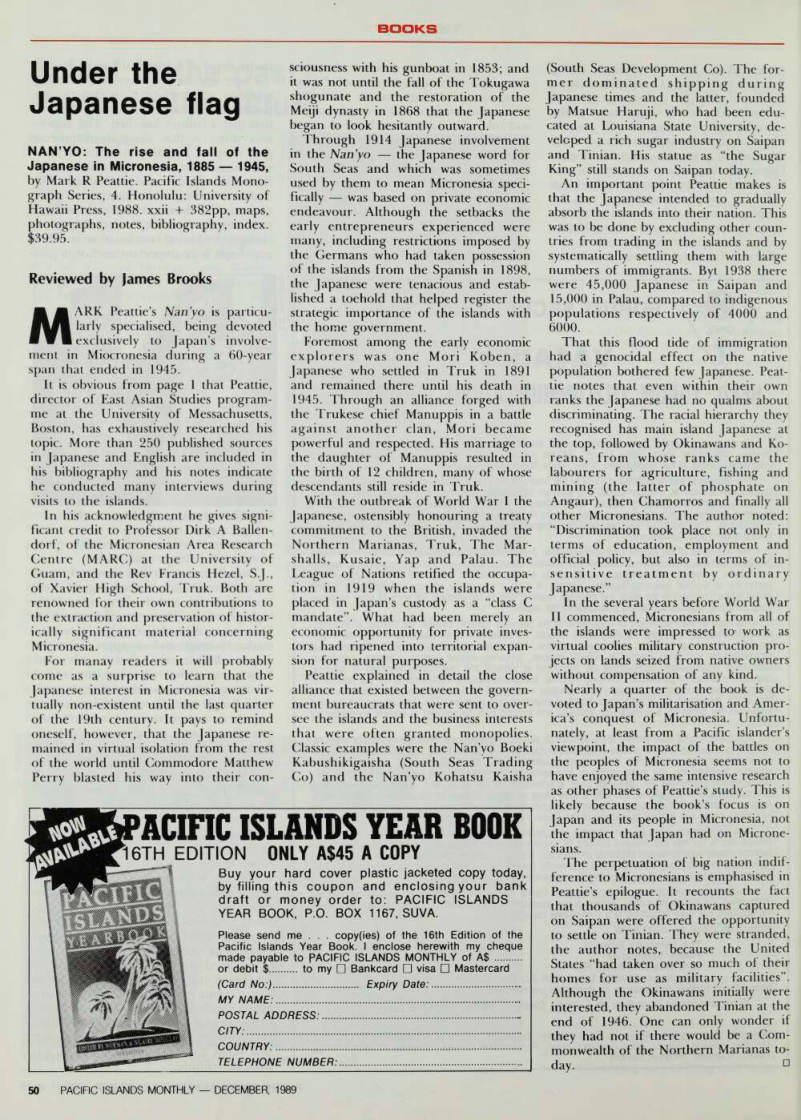
Books
Under the Japanese flag
NAN’YO: The rise and fall of the Japanese in Micronesia, 1885 1945, by Mark R Peattie. Pacific Islands Mono graph Series, 4. Honolulu: University of Hawaii Press, 1988. xxii + 382 pp, maps, photographs, notes, bibliography, index. $39.95.
Reviewed by James Brooks MARK Peattie’s Nan’yo is particu larly specialised, being devoted exclusively to Japan’s involve ment in Miocronesia during a 60-year span that ended in 1945.
It is obvious from page 1 that Peattie, director of East Asian Studies program me at the University of Messachusetts, Boston, has exhaustively researched his topic. More than 250 published sources in Japanese and English are included in his bibliography and his notes indicate he conducted many interviews during visits to the islands.
In his acknowledgment he gives signi ficant credit to Professor Dirk A Ballen dorf, of the Micronesian Area Research Centre (MARC) at the University of Guam, and the Rev Francis Hezel, S.J., of Xavier High School, Truk. Both are renowned for their own contributions to the extraction and preservation of histor
ically significant material concerning
Micronesia.
For manay readers it will probably come as a surprise to learn that the Japanese interest in Micronesia was vir tually non-existent until the last quarter of the 19th century. It pays to remind oneself, however, that the Japanese re mained in virtual isolation from the rest of the world until Commodore Matthew Perry blasted his way into their con
sciousness with his gunboat in 1853; and it was not until the fall of the Tokugawa shogunate and the restoration of the Meiji dynasty in 1868 that the Japanese began to look hesitantly outward.
Through 1914 Japanese involvement in the Nan’yo the Japanese word for South Seas and which was sometimes used by them to mean Micronesia speci fically was based on private economic endeavour. Although the setbacks the
early entrepreneurs experienced were
many, including restrictions imposed by
the Germans who had taken possession of the islands from the Spanish in 1898, the Japanese were tenacious and estab lished a toehold that helped register the strategic importance of the islands with the home government.
Foremost among the early economic explorers was one Mori Koben, a Japanese who settled in Truk in 1891 and remained there until his death in 1945. Through an alliance forged with the Trukese chief Manuppis in a battle against another clan, Mori became
powerful and respected. His marriage to
the daughter of Manuppis resulted in the birth of 12 children, many of whose descendants still reside in Truk.
With the outbreak of World War I the
Japanese, ostensibly honouring a treaty
commitment to the British, invaded the Northern Marianas, Truk, The Mar shalls, Kusaie, Yap and Palau. The League of Nations refilled the occupa tion in 1919 when the islands were placed in Japan’s custody as a “class C mandate”. What had been merely an economic opportunity for private inves tors had ripened into territorial expan sion for natural purposes.
Peattie explained in detail the close alliance that existed between the govern ment bureaucrats that were sent to over see the islands and the business interests that were often granted monopolies.
Classic examples were the Nan’yo Boeki
Kabushikigaisha (South Seas Trading
Co) and the Nan’yo Kohatsu Kaisha
(South Seas Development Co). The for
mer dominated shipping during
Japanese times and the latter, founded by Matsue Haruji, who had been edu cated at Louisiana State University, de veloped a rich sugar industry on Saipan and Tinian. His statue as “the Sugar
King” still stands on Saipan today.
An important point Peattie makes is that the Japanese intended to gradually absorb the islands into their nation. This was to be done by excluding other coun tries from trading in the islands and by
systematically settling them with large
numbers of immigrants. Byt 1938 there were 45,000 Japanese in Saipan and 15,000 in Palau, compared to indigenous populations respectively of 4000 and 6000.
That this flood tide of immigration had a genocidal effect on the native population bothered few Japanese. Peat tie notes that even within their own ranks the Japanese had no qualms about
discriminating. The racial hierarchy they
recognised has main island Japanese at the top, followed by Okinawans and Ko reans, from whose ranks came the labourers for agriculture, fishing and mining (the latter of phosphate on Angaur), then Chamorros and finally all other Micronesians. The author noted: “Discrimination took place not only in terms of education, employment and official policy, but also in terms of in
sensitive treatment by ordinary
Japanese.”
In the several years before World War II commenced, Micronesians from all of the islands were impressed to work as virtual coolies military construction pro jects on lands seized from native owners without compensation of any kind.
Nearly a quarter of the book is de voted to Japan’s militarisation and Amer ica’s conquest of Micronesia. Unfortu nately, at least from a Pacific islander’s viewpoint, the impact of the battles on the peoples of Micronesia seems not to have enjoyed the same intensive research as other phases of Peattie’s study. This is likely because the book’s focus is on Japan and its people in Micronesia, not the impact that Japan had on Microne sians.
The perpetuation of big nation indif ference to Micronesians is emphasised in Peattie’s epilogue. It recounts the fact that thousands of Okinawans captured on Saipan were offered the opportunity to settle on Tinian. They were stranded, the author notes, because the United States “had taken over so much of their homes for use as military facilities”.
Although the Okinawans initially were interested, they abandoned Tinian at the end of 1946. One can only wonder if they had not if there would be a Com monwealth of the Northern Marianas to day. D
Advertisements & other items, p. 50 (1 item)
Acific Islands Year Book
16TH EDITION ONLY As4s A COPY
Buy your hard cover plastic jacketed copy today, by filling this coupon and enclosing your bank draft or money order to: PACIFIC ISLANDS
YEAR BOOK, P.O. BOX 1167, SUVA.
Please send me . . . copy(ies) of the 16th Edition of the Pacific Islands Year Book. I enclose herewith my cheque made payable to PACIFIC ISLANDS MONTHLY of A$ or debit $ to my □ Bankcard □ visa □ Mastercard (Card No:) Expiry Date:
MY NAME:
POSTAL ADDRESS: . -
CITY:
COUNTRY:
TELEPHONE NUMBER:
Taking a new path
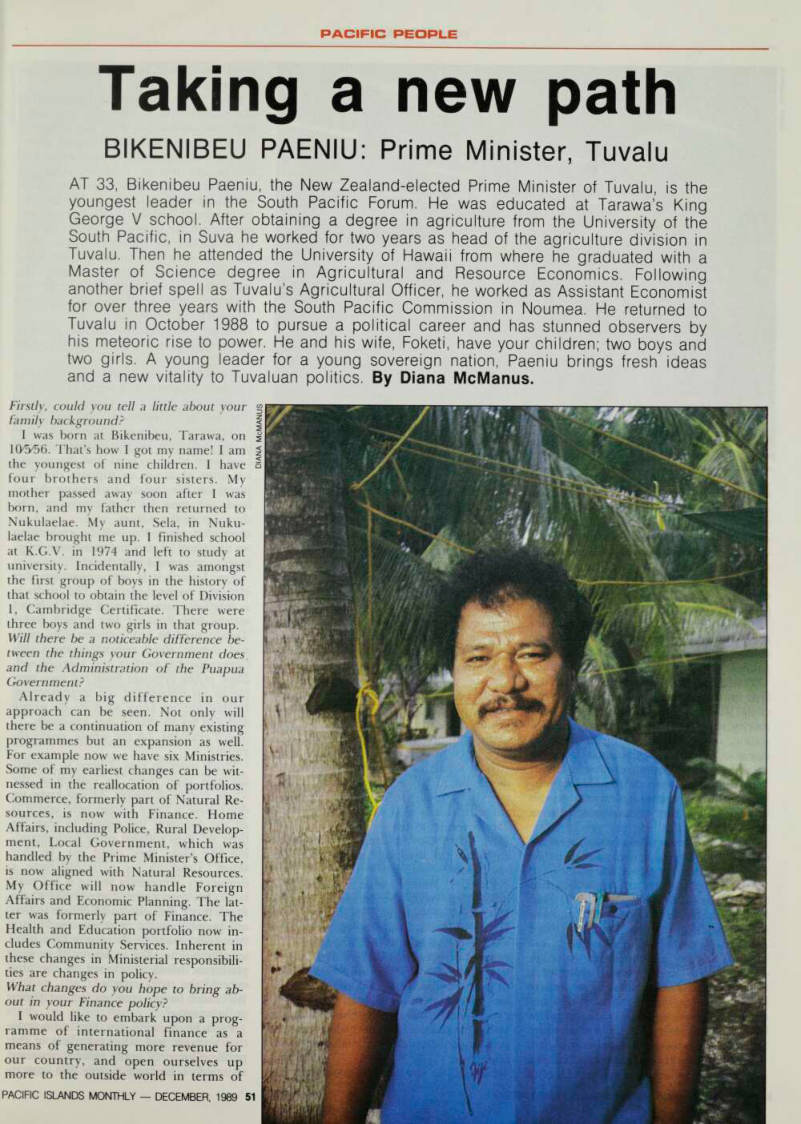
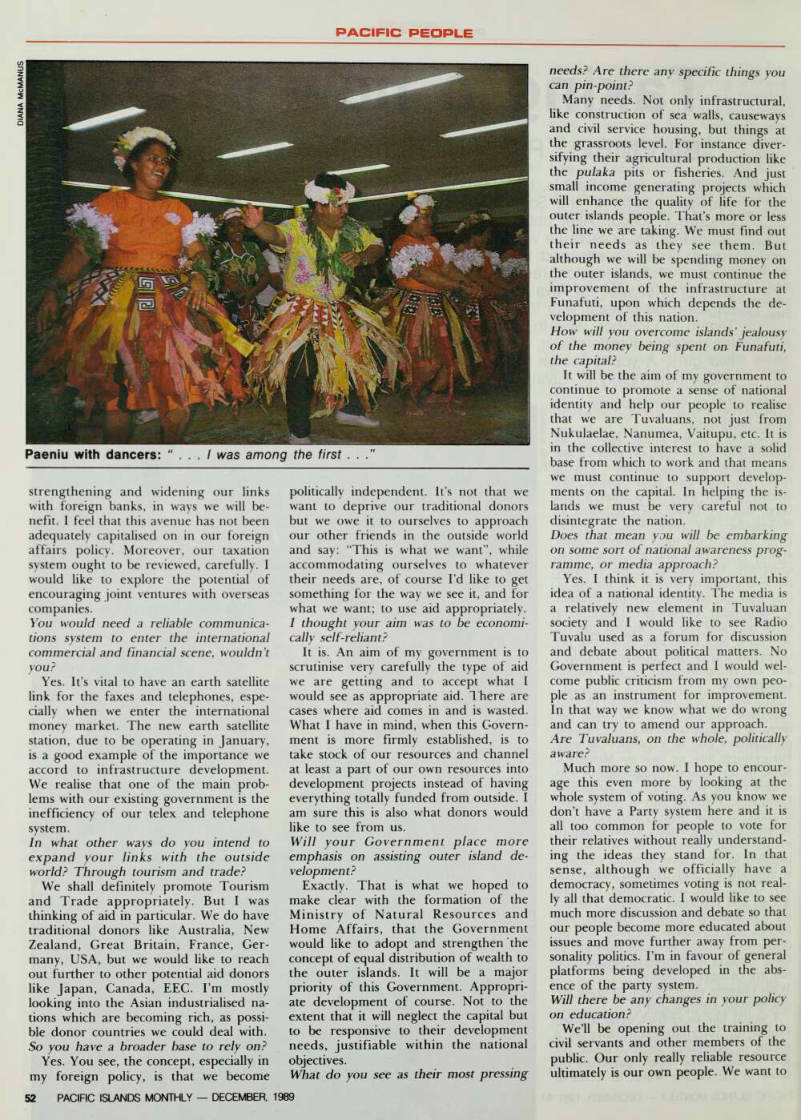
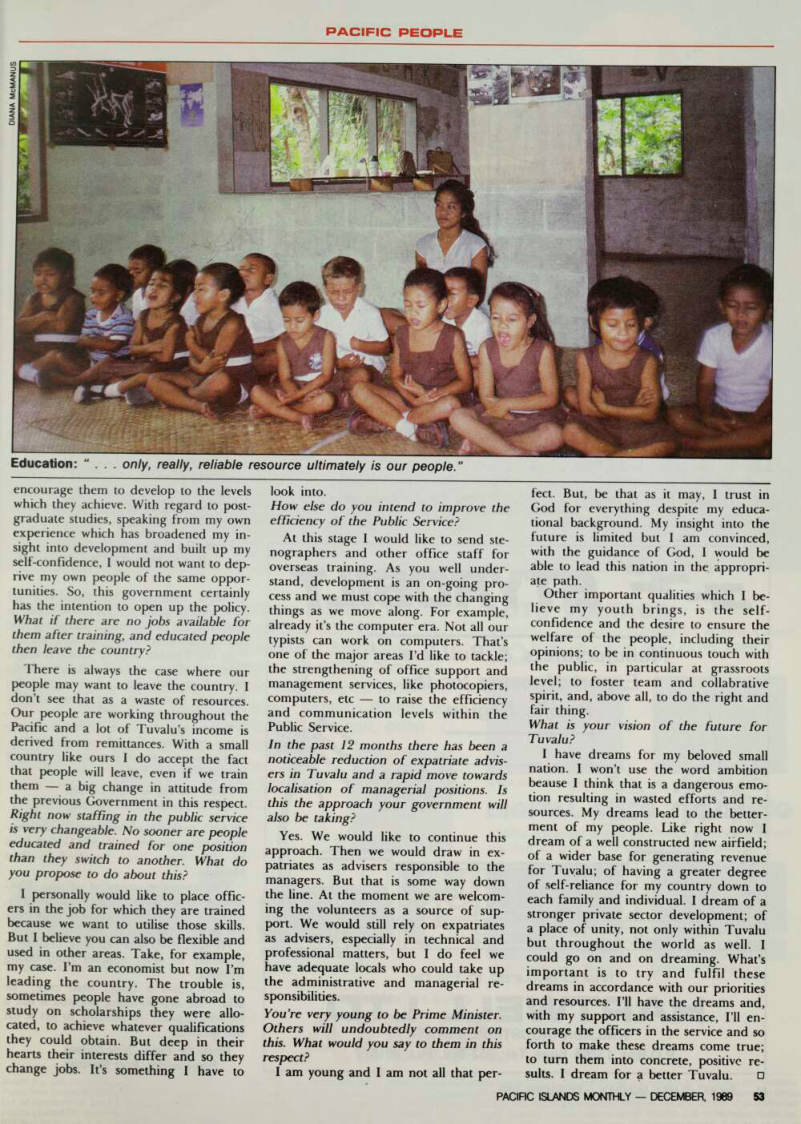
Pacific People
BIKENIBEU PAENIU: Prime Minister, Tuvalu
AT 33, Bikenibeu Paeniu, the New Zealand-elected Prime Minister of Tuvalu, is the youngest leader in the South Pacific Forum. He was educated at Tarawa's King George V school. After obtaining a degree in agriculture from the University of the South Pacific, in Suva he worked for two years as head of the agriculture division in Tuvalu. Then he attended the University of Hawaii from where he graduated with a Master of Science degree in Agricultural and Resource Economics. Following another brief spell as Tuvalu’s Agricultural Officer, he worked as Assistant Economist for over three years with the South Pacific Commission in Noumea. He returned to Tuvalu in October 1988 to pursue a political career and has stunned observers by his meteoric rise to power. He and his wife, Foketi, have your children; two boys and two girls. A young leader for a young sovereign nation, Paeniu brings fresh ideas
and a new vitality to Tuvaluan politics.
Firstly, could you tell a little about your
family background?
I was born at Bikenibeu, Tarawa, on 104y56. That’s how I got my name! I am the youngest of nine children. I have four brothers and four sisters. My mother passed away soon after I was born, and my father then returned to Nukulaelae. My aunt, Sela, in Nuku laelae brought me up. I finished school at K.G.V. in 1974 and left to study at university. Incidentally, I was amongst the first group of boys in the history of that school to obtain the level of Division 1, Cambridge Certificate. There were three boys and two girls in that group.
Will there be a noticeable difference be tween the things your Government does and the Administration of the Puapua Government?
Already a big difference in our approach can be seen. Not only will there be a continuation of many existing programmes but an expansion as well.
For example now we have six Ministries.
Some of my earliest changes can be wit nessed in the reallocation of portfolios.
Commerce, formerly part of Natural Re sources, is now with Finance. Home Affairs, including Police, Rural Develop ment, Local Government, which was handled by the Prime Minister’s Office, is now aligned with Natural Resources.
My Office will now handle Foreign Affairs and Economic Planning. The lat ter was formerly part of Finance. The Health and Education portfolio now in cludes Community Services. Inherent in these changes in Ministerial responsibili ties are changes in policy.
What changes do you hope to bring ab out in your Finance policy?
I would like to embark upon a prog ramme of international finance as a means of generating more revenue for our country, and open ourselves up more to the outside world in terms of
By Diana McManus.
Diana Mcmanus
strengthening and widening our links with foreign banks, in ways we will be nefit. I feel that this avenue has not been
adequately capitalised on in our foreign
affairs policy. Moreover, our taxation system ought to be reviewed, carefully. I would like to explore the potential of encouraging joint ventures with overseas
companies.
You would need a reliable communica tions system to enter the international commercial and financial scene, wouldn’t
you?
Yes. It’s vital to have an earth satellite link for the faxes and telephones, espe cially when we enter the international money market. The new earth satellite station, due to be operating in January, is a good example of the importance we accord to infrastructure development.
We realise that one of the main prob lems with our existing government is the inefficiency of our telex and telephone system.
In what other ways do you intend to expand your links with the outside world? Through tourism and trade?
We shall definitely promote Tourism and Trade appropriately. But I was thinking of aid in particular. We do have traditional donors like Australia, New Zealand, Great Britain, France, Ger many, USA, but we would like to reach out further to other potential aid donors like Japan, Canada, EEC. I’m mostly looking into the Asian industrialised na tions which are becoming rich, as possi ble donor countries we could deal with.
So you have a broader base to rely on?
Yes. You see, the concept, especially in my foreign policy, is that we become
politically independent. It’s not that we want to deprive our traditional donors but we owe it to ourselves to approach our other friends in the outside world and say: “This is what we want”, while accommodating ourselves to whatever their needs are, of course I’d like to get something for the way we see it, and for what we want; to use aid appropriately.
I thought your aim was to be economi
cally self-reliant?
It is. An aim of my government is to scrutinise very carefully the type of aid we are getting and to accept what I would see as appropriate aid. There are cases where aid comes in and is wasted.
What I have in mind, when this Govern ment is more firmly established, is to take stock of our resources and channel at least a part of our own resources into
development projects instead of having
everything totally funded from outside. I am sure this is also what donors would like to see from us.
Will your Government place more emphasis on assisting outer island de
velopment?
Exactly. That is what we hoped to make clear with the formation of the Ministry of Natural Resources and Home Affairs, that the Government would like to adopt and strengthen the concept of equal distribution of wealth to the outer islands. It will be a major priority of this Government. Appropri ate development of course. Not to the extent that it will neglect the capital but to be responsive to their development needs, justifiable within the national
objectives.
What do you see as their most pressing
needs? Are there any specific things you
can pin-point?
Many needs. Not only infrastructural, like construction of sea walls, causeways and civil service housing, but things at the grassroots level. For instance diver sifying their agricultural production like the pulaka pits or fisheries. And just small income generating projects which will enhance the quality of life for the outer islands people. That’s more or less the line we are taking. We must find out their needs as they see them. But although we will be spending money on the outer islands, we must continue the improvement of the infrastructure at Funafuti, upon which depends the de velopment of this nation.
How will you overcome islands’ jealousy of the money being spent on- Funafuti,
the capital?
It will be the aim of my government to continue to promote a sense of national identity and help our people to realise that we are Tuvaluans, not just from Nukulaelae, Nanumea, Vaitupu, etc. It is in the collective interest to have a solid base from which to work and that means we must continue to support develop ments on the capital. In helping the is lands we must be very careful not to disintegrate the nation.
Does that mean you will be embarking on some sort of national awareness prog ramme, or media approach?
Yes. I think it is very important, this idea of a national identity. The media is a relatively new element in Tuvaluan society and I would like to see Radio Tuvalu used as a forum for discussion and debate about political matters. No Government is perfect and I would wel come public criticism from my own peo ple as an instrument for improvement.
In that way we know what we do wrong and can try to amend our approach.
Are Tuvaluans, on the whole, politically aware?
Much more so now. I hope to encour age this even more by looking at the whole system of voting. As you know we don’t have a Party system here and it is all too common for people to vote for their relatives without really understand ing the ideas they stand for. In that sense, although we officially have a democracy, sometimes voting is not real ly all that democratic. I would like to see much more discussion and debate so that our people become more educated about issues and move further away from per sonality politics. I’m in favour of general
platforms being developed in the abs
ence of the party system.
Will there be any changes in your policy on education?
We’ll be opening out the training to civil servants and other members of the
public. Our only really reliable resource
ultimately is our own people. We want to
Paeniu with dancers: “... I was among the first . . .”
encourage them to develop to the levels which they achieve. With regard to post graduate studies, speaking from my own experience which has broadened my in sight into development and built up my self-confidence, I would not want to dep rive my own people of the same oppor tunities. So, this government certainly has the intention to open up the policy.
What if there are no jobs available for them after training, and educated people then leave the country?
There is always the case where our people may want to leave the country. I don’t see that as a waste of resources.
Our people are working throughout the
Pacific and a lot of Tuvalu’s income is derived from remittances. With a small country like ours I do accept the fact that people will leave, even if we train them a big change in attitude from the previous Government in this respect.
Right now staffing in the public service is very changeable. No sooner are people educated and trained for one position than they switch to another. What do you propose to do about this?
I personally would like to place offic ers in the job for which they are trained because we want to utilise those skills.
But I believe you can also be flexible and used in other areas. Take, for example, my case. I’m an economist but now I’m leading the country. The trouble is, sometimes people have gone abroad to
study on scholarships they were allo
cated, to achieve whatever qualifications they could obtain. But deep in their hearts their interests differ and so they change jobs. It’s something 1 have to
look into.
How else do you intend to improve the efficiency of the Public Service?
At this stage I would like to send ste nographers and other office staff for overseas training. As you well under stand, development is an on-going pro cess and we must cope with the changing things as we move along. For example, already it’s the computer era. Not all our typists can work on computers. That’s one of the major areas I’d like to tackle; the strengthening of office support and management services, like photocopiers, computers, etc to raise the efficiency and communication levels within the Public Service.
In the past 12 months there has been a noticeable reduction of expatriate advis ers in Tuvalu and a rapid move towards localisation of managerial positions. Is this the approach your government will also be taking?
Yes. We would like to continue this approach. Then we would draw in ex patriates as advisers responsible to the managers. But that is some way down the line. At the moment we are welcom ing the volunteers as a source of sup port. We would still rely on expatriates as advisers, especially in technical and professional matters, but 1 do feel we have adequate locals who could take up the administrative and managerial re
sponsibilities.
You ’re very young to be Prime Minister.
Others will undoubtedly comment on this. What would you say to them in this respect?
I am young and I am not all that per
feet. But, be that as it may, I trust in God for everything despite my educa tional background. My insight into the future is limited but 1 am convinced, with the guidance of God, I would be able to lead this nation in the appropri ate path.
Other important qualities which I be lieve my youth brings, is the self confidence and the desire to ensure the welfare of the people, including their opinions; to be in continuous touch with the public, in particular at grassroots level; to foster team and collabrative spirit, and, above all, to do the right and
fair thing.
What is your vision of the future for Tuvalu?
I have dreams for my beloved small nation. I won’t use the word ambition beause I think that is a dangerous emo tion resulting in wasted efforts and re sources. My dreams lead to the better ment of my people. Like right now I dream of a well constructed new airfield; of a wider base for generating revenue for Tuvalu; of having a greater degree of self-reliance for my country down to each family and individual. 1 dream of a stronger private sector development; of a place of unity, not only within Tuvalu but throughout the world as well. I could go on and on dreaming. What’s important is to try and fulfil these dreams in accordance with our priorities and resources. I’ll have the dreams and, with my support and assistance, I’ll en courage the officers in the service and so forth to make these dreams come true; to turn them into concrete, positive re sults. I dream for a better Tuvalu. □
Diana Mcmanus
Education: "... only, really, reliable resource ultimately is our people."
Island Press
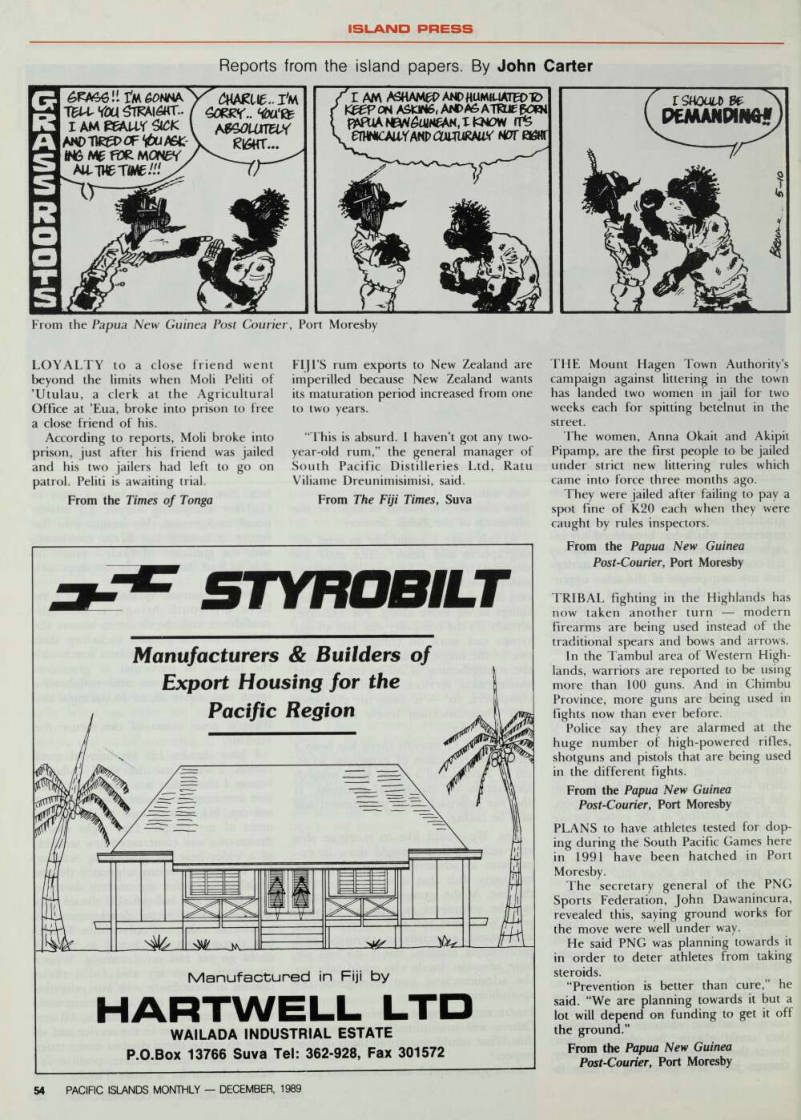
Reports from the island papers. By John Carter
From the Papua New Guinea Post Courier, Port Moresby
LOYALTY to a close friend went beyond the limits when Moli Peliti of ’Utulau, a clerk at the Agricultural Office at ’Eua, broke into prison to free a close friend of his.
According to reports, Moli broke into prison, just after his friend was jailed and his two jailers had left to go on patrol. Peliti is awaiting trial.
From the Times of Tonga
FIJI’S rum exports to New Zealand are imperilled because New Zealand wants its maturation period increased from one to two years.
“This is absurd. I haven’t got any two year-old rum,” the general manager of South Pacific Distilleries Ltd, Ratu Viliame Dreunimisimisi, said.
From The Fiji Times, Suva
THE Mount Hagen Town Authority’s campaign against littering in the town has landed two women in jail for two weeks each for spitting betelnut in the street.
The women, Anna Okait and Akipit Pipamp, are the first people to be jailed under strict new littering rules which came into force three months ago.
They were jailed after failing to pay a spot fine of K2O each when they were
caught by rules inspectors.
From the Papua New Guinea Post-Courier, Port Moresby TRIBAL fighting in the Highlands has now taken another turn modern firearms are being used instead of the traditional spears and bows and arrows.
In the Tambul area of Western High lands, warriors are reported to be using more than 100 guns. And in Chimbu Province, more guns are being used in fights now than ever before.
Police say they are alarmed at the huge number of high-powered rifles, shotguns and pistols that are being used in the different fights.
From the Papua New Guinea Post-Courier, Port Moresby PLANS to have athletes tested for dop ing during the South Pacific Games here in 1991 have been hatched in Port
Moresby.
The secretary general of the PNG Sports Federation, John Dawanincura, revealed this, saying ground works for the move were well under way.
He said PNG was planning towards it in order to deter athletes from taking steroids.
“Prevention is better than cure,” he said. “We are planning towards it but a lot will depend on funding to get it off
the ground.”
From the Papua New Guinea Post-Courier, Port Moresby
Advertisements & other items, pp. 54-56 (1 item)
Styrobilt
Manufacturers & Builders of Export Housing for the Pacific Region II Manufactured in Fiji by
HARTWELL LTD
WAILADA INDUSTRIAL ESTATE
P.0.80x 13766 Suva Tel; 362-928, Fax 301572
* I
ere
A t
DIGITAL
i E 505 DIGITAL
MADE IN JAPAN .
PAL / MtSECAM
HV-G505 DIGITAL
The AIWA HV-E505 Digital delivers beautiful video images in a wide range of operating conditions. With long experience in digital technology, AIWA has created a digital auto tracking system that ensures greater tracking accuracy. This accuracy is assured, even in areas with unstable power supply, thanks to Auto Voltage circuitry. The result is a clean, crisp picture you can depend on. Plus, line
recording, fully automatic functioning,
and remote control make the HV-E505 Digital an excellent choice in a recording video deck.
HV-GBO DIGITAL
Video Cassette Recorder
HV-63CDB DIGITAL
Video Cassette Player
AUTO VOLTAGE
Worldwide power supply compatibility assures a stable picture, especially in areas where electric power is not always stable. m AIWA Auto Voltage No auto voltage
DIGITAL AUTO TRACKING
AlWA’s advanced digital technology assures optimum tracking accuracy for a sharper, clearer picture.
AIWA Digital Auto Tracking Conventional Tracking Digital Audios Video
AIWA
Mobex Pty., Ltd. Unit 1,70 Gibbes Street Chatswood N.S.W. 2067 AUSTRALIA PHONE: 001-61-2-4066277/Oceania Indent Agency (P.N.G.) Pty., Ltd. Ago St., Gordon Box 5518, Boroko, Port Moresby, Papua New Guinea PHONE; 256411/The Sound Centre Ltd. P.O. Box 434 Port Vila, Vanuatu PHONE: 2035/P. Hargovind Bros. 190 Renwick Road P.O. Box 409 Suva Fiji PHONE: 24350/Octavium Group Ltd. 33 Constellation Drive Mairangi Bay, Auckland 10 NEW ZEALAND PHONE: 001-64-9-479-1272/Hifivox 19 av. Foch B.P. 1458 NOUMEA Nouvelle-Caledonie PHONE: 001-687-27.24.66/Harvest Pacific Limited P.O. Box 517, Honiara, Solomon Islands PHONE: 131/Fare-Hi-Fi Stereo Rue de Marechal Foch P.O. Box 269, Papeete Tahiti R.C. 6604 A TAHITI PHONE; 2.48.14/Micropac Audio, Inc.
Dfl Bau 7A7Q Aoono OCO-in DUAkIC. J7<l (mn< >l-70 000-710- * A.. 1,. c Ol 0.!.._»- D nr\ D— no ri 4 O 1, l-l ~1 Ikl A. P—. n .Uli- t K I
Winning a Thousand Lakes
■ M.MIU'Ui'
' ■ ’’9&S& Jlf4nS\ ★The Mitsubishi Galant takes overall honours at the Rally of 1,000 Lakes, Finland, 9th round of the WRC.
On winding gravel trails in the forests of Finland, one of the fastest rallies of the World Rally Championship provides the ultimate test of man and machine. To all its entrants, it is an extremely challenging event.
For Mitsubishi Motors, the 1989 Rally of 1,000 Lakes was exhilarating from start to finish, and immensely satisfying. They not only won this high-flying round of the World Rally Championship outright, but also proved the remarkable capabilities of the Mitsubishi Galant. Just what they set out to do.
Mitsubishi regards motor sports events as the ideal testing ground for the advanced technology they pioneer. Under the extreme rigours of competition, they are able to scrutinize and refine their innovative concepts for use in everyday driving. Their Organic Performance is one such concept. The vehic is regarded as a single organism in normally separate systems operate t provide the motorist with a safer, yqO&ore' SjyWM99O dynamic ride. In fact, every detail d the smallest dial is designed to enhance vehicle’s response to the driver’s command.
By attaining this level of communication between driver and vehicle, the dream of high-speed, high-safety driving comes closer to reality. And Organic Performance forges a conceptual link between the forests of Finland MITSUBISHI and the highways of the future. MOTORS
TheOrganiC Performance.
W Nature, Technology, and Human Emotion.
AMERICAN SAMOA: MORRIS SCANLAN SERVICE INC. P.O Box 367, Pago Pago, Tel. 633-5520/AUSTRALIA; MITSUBISHI MOTORS AUSTRALIA LTD. Box 1284, South Road, Clovelty Park, South Australia 5042, Tel (08) 275-7223/FIJI: NIVIS MOTOR & MACHINERY CO.. LTD. G.P O Box 150, Suva, Tel 383411 /FRENCH POLYNESIA (TAHITI): ETS-BREDIN FRERES ET FILS P 0 Box 21 , Papeete, Tahiti, Tel 4-202-58/NEW CALEDONIA: SOCIETE D'IMPORTATION D AUTO DU PACIFIQUE SUDS.A. B.P 438 Rond Point du Pacifique. Noumea, Tel 274144/NEW ZEALAND: MITSUBISHI MOTORS NEW ZEALAND LTD. Todd Park, Heriot Drive, Private Bag, Porirua, Tel 370-109/ NORFOLK ISLAND: BORRYS LTD. PO Box 169, Norfolk Island, Tel 2114/PAPUA NEW GUINEA: TOBA PTY. LTD. PO Box 503, Port Moresby, Tel. 21-7874/SOLOMON ISLANDS: HARVEST PACIFIC LTD. G.P O Box 88, Honiara, Guadalcanal. Tel 30128/TONGA; SITANI MAPI CO., LTD. PO. Box 83, Nuku'ALOFA, Tel. 21-044/VANUATU: SOCOMETRA B P 06 Route de Lagon, Port-Vila, Tel. 2314/WESTERN SAMOA: A M. MACDONALD HOLDINGS LTD PO Box 576, Apia, Tel. 22022/SAIPAN/POHNPEI/MAJURO/KOSRAE/TRUK/YAP/BELAU: MICRONESIAN MOTORS, INC. 997 South Manne Drive, Tamuning, Guam 96911, Tel. 646-6827