More than a birthday
pp. 14-15 · Read in the full issue
The Region
Fiji
By Jale Moala
THE last planeload of visitors had just landed when the tall, imposing figure of Ratu Sir Kamisese Mara strode across the village square, hands swinging lazily by his sides. He took his time, listening to the sounds of the vil lage. All around him, a thousand people watched their paramount chief approach, and with awe, sank slowly to the ground to sit with respect.
Installed nearly 20 years ago as para mount chief of the sprawling Lau Group of islands in Eastern Fiji, Mara has be come the most influential man in the country, having led Fiji for 23 years from before independence to after the coup. As he walked across the village square to meet his guests, many more people were working at home to prepare for his 70th birthday feast, the biggest birthday celebration in Fiji at any time.
That was Friday, May 11. On Satur day, the main event of this big birthday bash culminated with a big feast and en ded a week-long celebration of dances,
arts and craft, food crop competitions and sports. His special guests comprised
diplomats and key businesspeople and
executives. The whole Lau Group was represented. His village of Tubou, the biggest in Fiji with a population of more than a thousand, straigned its resources to accommodate the newcomers who more than doubled the population.
Mara marked his birthday by inviting
the Deputy Editor of The Fiji Times, Mosese Velia, (“I was woken by a mes senger,”) for an exclusive interview. The past 70 years were generally good. Mara served his country as a prominent public servant and for the last 23 years as Chief Minister from 1967 to 1970 and then Prime Minister after independence from 1970 onwards. Says one observer: “Ratu mara has many admirable qualities and his achievements and contributions in many areas in leading this country for such a long period are beyond dispute.”
But, as told Velia that morning in Tubou, there was one dream Mara failed to fulfil; Fiji’s Indian community had re jected his concept of multiracialism.
“This is one of the biggest regrets of my
life,” he said. “If only the Indian com munity had kept faith with me in the 1987 general elections Fiji would have continued to run more smoothly and made greater progress socially, economi
cally and politically.” Mara was referring
to the fall of his Fijian-dominated Alliance Government in the 1987 general elections. An Indian-dominated Coalition party, led by former civil servant Dr Timoci Bavadra, took power only to be ousted by the Pacific’s first military coup a month later.
Throughout his terms of leadership Mara has been conscious of his growing international image. Any attempt to knock it, particularly by the press, often received hostile reactions. In general, the man’s accessibility to the press, or lack of it, has often been compared to media friendly prime ministers like Lange.
The interview with Velia was again an opportunity to launch an attack against the press. “That’s another big regret of mine we have an uncontrolled and irresponsible press,” said Mara. “In all the years I have been a victim of con tinuous and prolonged campaign of de nigration and personal vilification by a press that lacks balance, professionalism and a sense of responsibility. You people
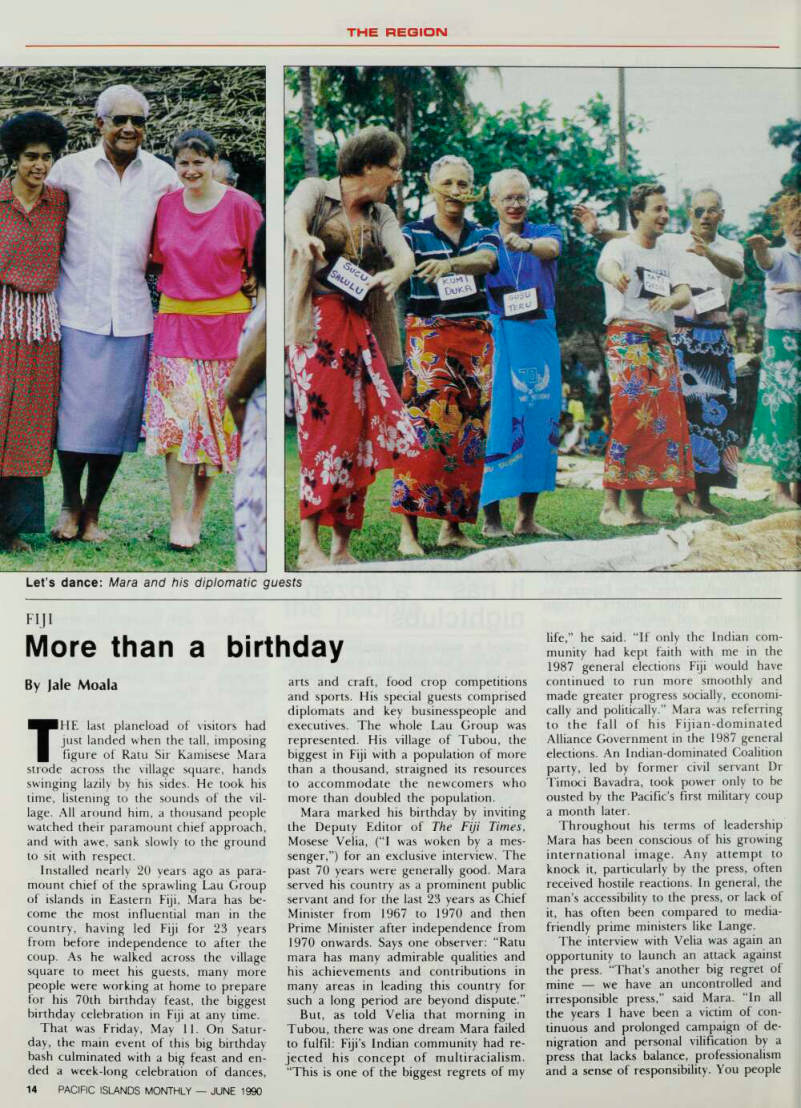
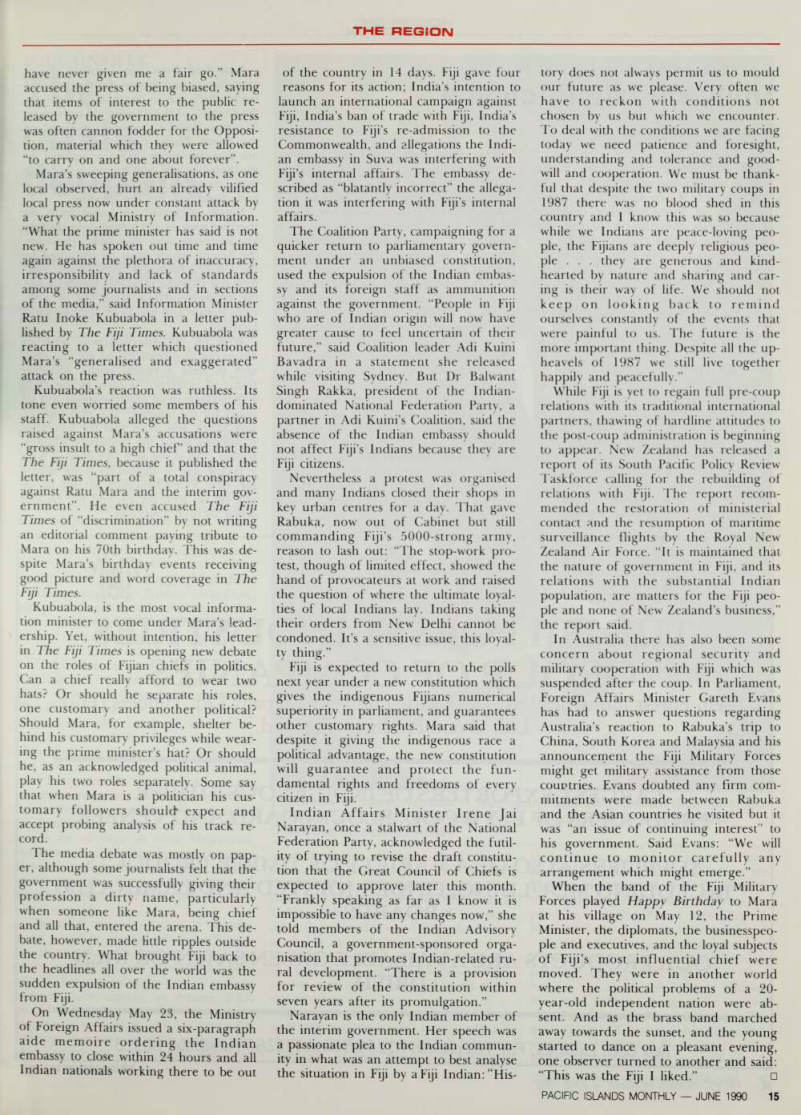
Let’s dance: Mara and his diplomatic guests
have never given me a fair go.” Mara accused the press of being biased, saying that items of interest to the public re leased by the government to the press was often cannon fodder for the Opposi tion, material which they were allowed “to carry on and one about forever”.
Mara’s sweeping generalisations, as one local observed, hurt an already vilified local press now under constant attack by a very vocal Ministry of Information.
“What the prime minister has said is not new. He has spoken out time and time
again against the plethora of inaccuracy,
irresponsibility and lack of standards among some journalists and in sections of the media,” said Information Minister Ratu Inoke Kubuabola in a letter pub lished by The Fiji Times. Kubuabola was reacting to a letter which questioned
Mara’s “generalised and exaggerated”
attack on the press.
Kubuabola’s reaction was ruthless. Its tone even worried some members of his staff. Kubuabola alleged the questions raised against Mara’s accusations were “gross insult to a high chief’ and that the The Fiji Times, because it published the letter, was “part of a total conspiracy against Ratu Mara and the interim gov ernment”. He even accused The Fiji Times of “discrimination” by not writing an editorial comment paying tribute to Mara on his 70th birthday. This was de
spite Mara’s birthday events receiving
good picture and word coverage in The
Fiji Times.
Kubuabola, is the most vocal informa tion minister to come under Mara’s lead ership. Yet, without intention, his letter in The Fiji Times is opening new debate on the roles of Fijian chiefs in politics.
Can a chief really afford to wear two hats? Or should he separate his roles, one customary and another political?
Should Mara, for example, shelter be hind his customary privileges while wear ing the prime minister’s hat? Or should he, as an acknowledged political animal, play his two roles separately. Some say that when Mara is a politician his cus tomary followers should* expect and accept probing analysis of his track re cord.
The media debate was mostly on pap er, although some journalists felt that the government was successfully giving their profession a dirty name, particularly when someone like Mara, being chief and all that, entered the arena. This de bate, however, made little ripples outside the country. What brought Fiji back to the headlines all over the world was the sudden expulsion of the Indian embassy
from Fiji.
On Wednesday May 23, the Ministry of Foreign Affairs issued a six-paragraph aide memoire ordering the Indian embassy to close within 24 hours and all Indian nationals working there to be out
of the country in 14 days. Fiji gave four reasons for its action; India’s intention to launch an international campaign against Fiji, India’s ban of trade with Fiji, India’s resistance to Fiji’s re-admission to the Commonwealth, and allegations the Indi an embassy in Suva was interfering with Fiji’s internal affairs. The embassy de scribed as “blatantly incorrect” the allega tion it was interfering with Fiji’s internal affairs.
The Coalition Party, campaigning for a quicker return to parliamentary govern ment under an unbiased constitution, used the expulsion of the Indian embas sy and its foreign staff as ammunition
against the government. “People in Fiji
who are of Indian origin will now have greater cause to feel uncertain of their future,” said Coalition leader Adi Kuini Bavadra in a statement she released while visiting Sydney. But Dr Balwant Singh Rakka, president of the Indian dominated National Federation Party, a partner in Adi Kuini’s Coalition, said the absence of the Indian embassy should not affect Fiji’s Indians because they are
Fiji citizens.
Nevertheless a protest was organised and many Indians closed their shops in key urban centres for a day. That gave Rabuka, now out of Cabinet but still
commanding Fiji’s 5000-strong army,
reason to lash out: “The stop-work pro test, though of limited effect, showed the hand of provocateurs at work and raised the question of where the ultimate loyal ties of local Indians lay. Indians taking their orders from New Delhi cannot be condoned. It’s a sensitive issue, this loyal
ty thing.”
Fiji is expected to return to the polls next year under a new constitution which
gives the indigenous Fijians numerical
superiority in parliament, and guarantees other customary rights. Mara said that despite it giving the indigenous race a political advantage, the new constitution will guarantee and protect the fun damental rights and freedoms of every citizen in Fiji.
Indian Affairs Minister Irene Jai Narayan, once a stalwart of the National Federation Party, acknowledged the futil ity of trying to revise the draft constitu tion that the Great Council of Chiefs is expected to approve later this month.
“Frankly speaking as far as I know it is impossible to have any changes now,” she told members of the Indian Advisory Council, a government-sponsored orga nisation that promotes Indian-related ru ral development. “There is a provision for review of the constitution within seven years after its promulgation.”
Narayan is the only Indian member of the interim government. Her speech was a passionate plea to the Indian commun ity in what was an attempt to best analyse the situation in Fiji by a Fiji Indian; “His
tory does not always permit us to mould our future as we please. Very often we have to reckon with conditions not chosen by us but which we encounter.
To deal with the conditions we are facing today we need patience and foresight, understanding and tolerance and good will and cooperation. We must be thank ful that despite the two military coups in 1987 there was no blood shed in this country and I know this was so because while we Indians are peace-loving peo ple, the Fijians are deeply religious peo ple . . . they are generous and kind hearted by nature and sharing and car ing is their way of life. We should not keep on looking back to remind ourselves constantly of the events that were painful to us. The future is the more important thing. Despite all the up heavels of 1987 we still live together
happily and peacefully.”
While Fiji is yet to regain full pre-coup relations with its traditional international partners, thawing of hardline attitudes to the post-coup administration is beginning to appear. New Zealand has released a report of its South Pacific Policy Review Taskforce calling for the rebuilding of relations with Fiji. The report recom mended the restoration of ministerial contact and the resumption of maritime
surveillance flights by the Royal New
Zealand Air Force. “It is maintained that the nature of government in Fiji, and its relations with the substantial Indian population, are matters for the Fiji peo ple and none of New Zealand’s business,” the report said.
In Australia there has also been some concern about regional security and
military cooperation with Fiji which was
suspended after the coup. In Parliament, Foreign Affairs Minister Gareth Evans has had to answer questions regarding Australia’s reaction to Rabuka’s trip to China, South Korea and Malaysia and his announcement the Fiji Military Forces might get military assistance from those countries. Evans doubted any firm com mitments were made between Rabuka and the Asian countries he visited but it was “an issue of continuing interest” to his government. Said Evans: “We will continue to monitor carefully any
arrangement which might emerge.”
When the band of the Fiji Military Forces played Happy Birthday to Mara at his village on May 12, the Prime Minister, the diplomats, the businesspeo ple and executives, and the loyal subjects of Fiji’s most influential chief were moved. They were in another world where the political problems of a 20year-old independent nation were ab sent. And as the brass band marched away towards the sunset, and the young started to dance on a pleasant evening, one observer turned to another and said: “This was the Fiji I liked.” □