A town like Papeete
pp. 8-13 · Read in the full issue
Cover Stories
• Cover Stories
There is no other place like this
By Karen Mangnall
The French President Francois Mitter and, his Prime Minister Michel Rocard and eight, count them, eight French Cabinet Ministers. Outrigger canoe teams from New Zealand, dancers from California and the Pacific Islands.
You didn’t manage to make it? well, you probably wouldn’t afford it. And Papeete is beginning to wonder whether it can afford it, too. A town of 25,000 spending USS2OM on a birthday party with tourism sliding downhill, a 90 per
DID you get to the party in Pape ete last month? Papeete, capital of French Polynesia, the pearl of the Pacific, the island of love, entred its second century as a town.
The 100th birthday party was stupendous. Five weeks of dancing, sing
ing, eating, drinking, sports, music and
cultural exhibitions. All the best people were there.
cent trade deficit, an estimated USSBO million territorial debt rising by US$5 million a month and 10,000 mainly young Tahitians jobless.
“It’s true,” said a local businessman.
“Everybody fears for the future.” * * * When President Mitterand inaugu rated Papeete’s new USSI4.SM Town Hall, his words were captured in the ceremony of Apora’a Parau and placed forever in a closed umete, or carved
Karen Mangnall
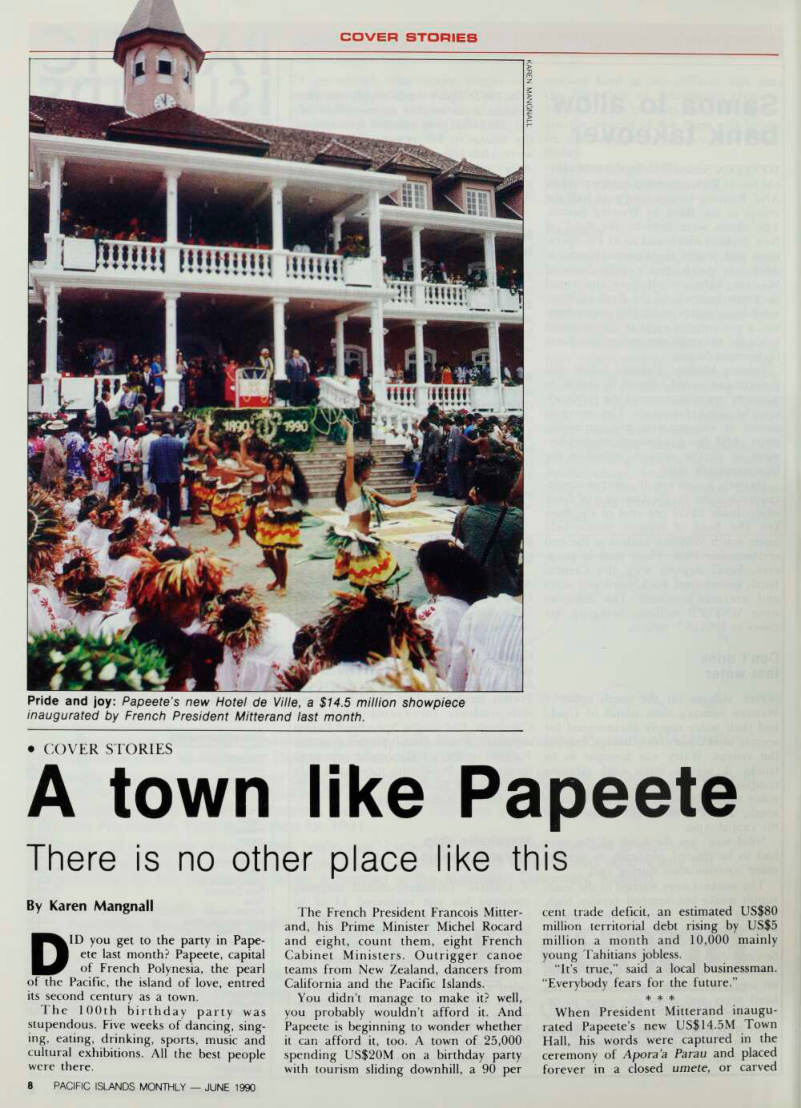
Pride and joy: Papeete’s new Hotel de Ville, a $14.5 million showpiece inaugurated by French President Mitterand last month.
chest.
“While we look at the beauty of your islands, we can also dream of their de velopment. But your greatest wealth, af ter your people, is beauty. Nature. You must master nature while respecting it, and you must not allow, in any shape or form, the destruction of your natural heritage which is not only an immense source of potential wealth for you, but for the whole of humanity.
“I await the day when Papeete, Tahiti and French Polynesia take their rightful place among the nations of the South Pacific . . . forward as equals among all the other peoples of this vast ocean.”
The umete joined his words with those of Mayor Jean Juventin: “Papeete has been the melting pot of the cultural progress which today ce ments Polynesian firmly to the 21st cen tury.
“Our capital, economic, administrative and political centre, has been the magnet
which lures and holds people. It’s been the engineroom of Polynesia’s expansion.
Papeete’s history is merged with that of
French Polynesia.”
* * * The town is a tidal estuary of human ity, only 25,000 actually live in Papeete but each weekday twice as many pour in to work. Tahiti has about 60,000 cars, not counting commercial vehicles, and the übiquitous Vespas.
The distant rumble begins about 5.30 each morning. By rush hour it’s nose-to tail along the Boulevard Pomare. Pape ete is the only Pacific Island country where you can sit for an hour in a traffic jam, to make a trip of a few kilometres.
A brown haze coalesces above the main routes.
A French military census in 1847 re corded Papeete as having 1444 residents, 1045 chickens, 834 pigs and 102 horses. A decade later, the French Gov ernor ordered: “It is forbidden to gallop horses between Camp Uranie and Papeava bridge.” Offenders were liable for a 20 franc fine and any civil dam ages.
In Papeete, the way you drive is a cultural statement. “There’s a speed limit in Tahiti of 60km,” says one local. “But that’s not fast enough, so everybody does 90km an hour and still someone is pas sing you.” It’s the same on the motorway link, where the limit’s higher. Every day the two newspapers fill a column each with road accidents and deaths.
“Did you count how many traffic lights they’ve got?” asked an official Fijian visi tor. “How many in Suva? Three? And one of those is a pedestrian crossing
light.”
Once you’ve made it into Papeete, you park. “They have parking metres in Papeete,” says our motoring expert.
“They’re beautiful parking metres: you can hang your fish on it or dry your shirt on it. But there’s no money in it.”
The traffic levels out from about 9am, hits a mini peak over the lunch hour, and tapers off mid-afternoon. Whatever the time of day, the main preoccupation is people watching. The best place is sit ting in one of the many sidewalk cafes, lingering over a coffee, juice or local Hinano beer. But the second best place is behind the driving wheel. Every driv er’s head is turned to check out who’s checking them out from the sidewalk.
Prang city.
Even the relatively high price of petrol about US9Bc4itre doesn’t discourage locals from hopping in the car to go 200 metres down the road to the shops. In 1865, the French Assemblyman George Perrin noted: “In this country, the Euro peans don’t take three steps on foot.”
At 4pm, the rumble begins again as the shopkeepers, clerks, bureaucrats, bank tellers and office workers head
home to their villas in Pirae or Punaania, or their lodgings in Faa’a. As the roar bounces off the waterfront buildings, and the oily haze filters up into the tree canopies, it wakes the old men who’ve slept the day away on a park bench in the shade of a banyan. They straighten their baseball caps and sit a bit dopily, backs to the traffic, quietly watching the ocean turn silver at dusk. ♦ * * The map of Papeete is an anatomy of Tahiti’s power, wealth and race. Along the Pomare are the highrise shops and office complexes, the bastions of the Chinese and the demis, descendnats of the Tahitians who married into Euro
pean capital.
Behind are the government buildings,
where the predominantly European
bureaucrats multiply their tasks and budgets. Their business is recycling the US$5 million in direct French subsidies each month into wages, construction and services; the parasite industries of aid
dependence.
Even two or three blocks behind the wealthy waterfront face, the elegant, solid concrete buildings leach quickly into battered, two storey wooden shops with crowded apartments above, washing hanging on the balconies.
And then back to the foothills are the modest houses, and the pockets of slum accommodation, dotted with the local minimarkets. The population here is
overwhelmingly Tahitian.
The average family has five children.
“There’s a subsidy of US$5O per month for each child until the age of 18,” says one observer. “If your rent is US$6OO a month and the car payment is US$5OO, then there’s every incentive for low income families to have more chil dren to get a little extra to pay off the
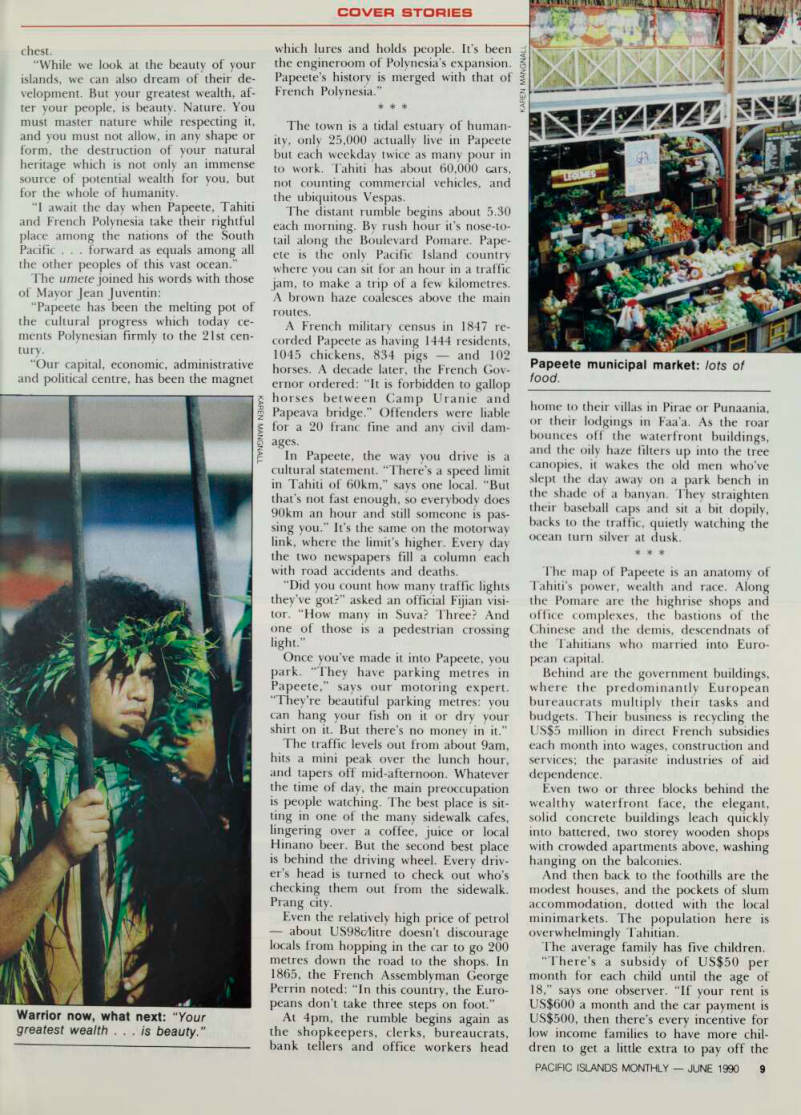
Warrior now, what next: "Your greatest wealth...is beauty."
Karen Mangnall
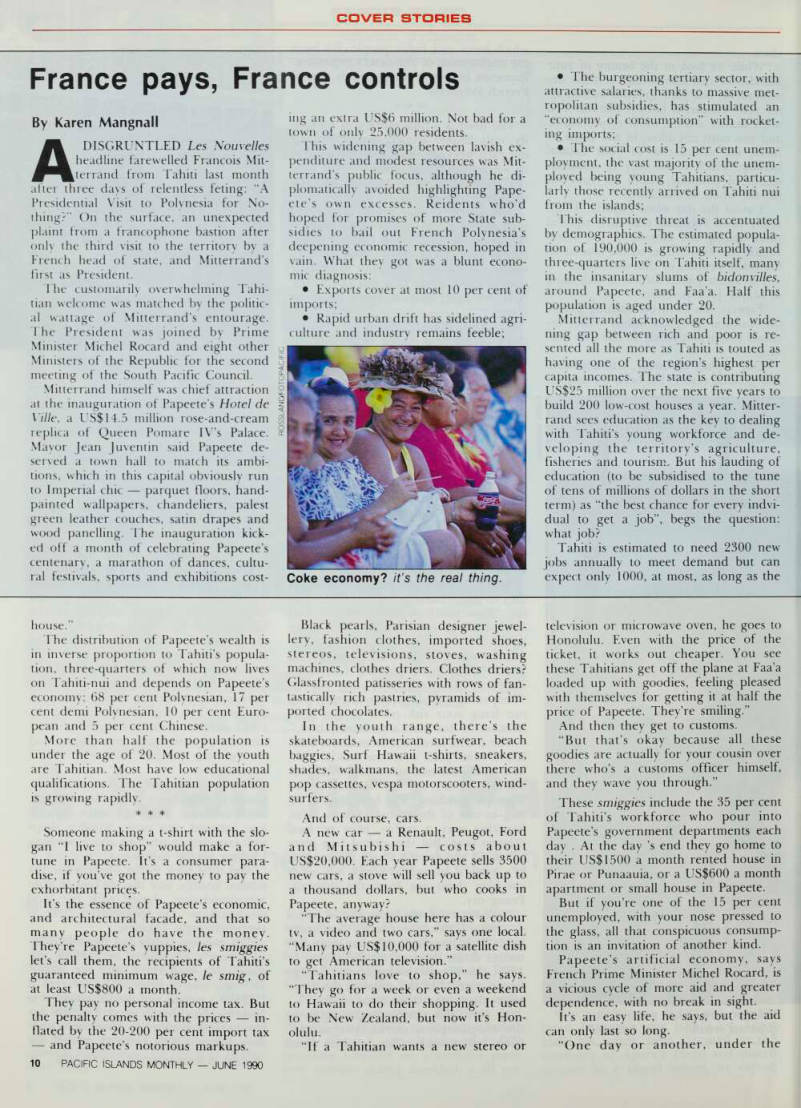
Papeete municipal market: lots of food.
Karen Mangnall
house.”
The distribution of Papeete’s wealth is in inverse proportion to Tahiti’s popula tion, three-quarters of which now lives on Tahiti-nui and depends on Papeete’s economy: 68 per cent Polynesian, 17 per cent demi Polynesian, 10 per cent Euro pean and 5 per cent Chinese.
More than half the population is under the age of 20. Most of the youth are Tahitian. Most have low educational
qualifications. The Tahitian population
is growing rapidly.
Someone making a t-shirt with the slo gan “I live to shop” would make a for tune in Papeete. It’s a consumer para dise, if you’ve got the money to pay the
exhorbitant prices.
It’s the essence of Papeete’s economic, and architectural facade, and that so many people do have the money.
They’re Papeete’s yuppies, les smiggies
let’s call them, the recipients of Tahiti’s guaranteed minimum wage, le smig, of at least US$BOO a month.
They pay no personal income tax. But the penalty comes with the prices in flated by the 20-200 per cent import tax and Papeete’s notorious markups.
Black pearls, Parisian designer jewel lery, fashion clothes, imported shoes, stereos, televisions, stoves, washing machines, clothes driers. Clothes driers?
Glassfronted patisseries with rows of fan
tastically rich pastries, pyramids of im
ported chocolates.
In the youth range, there’s the skateboards, American surfwear, beach baggies, Surf Hawaii t-shirts, sneakers, shades, Walkmans, the latest American pop cassettes, vespa motorscooters, wind surfers.
And of course, cars.
A new car a Renault, Peugot, Ford and Mitsubishi costs about USS2O,OOO. Each year Papeete sells 3500 new cars, a stove will sell you back up to a thousand dollars, but who cooks in Papeete, anyway?
“The average house here has a colour tv, a video and two cars,” says one local.
“Many pay USSIO,OOO for a satellite dish to get American television.”
“Tahitians love to shop,” he says.
“They go for a week or even a weekend to Hawaii to do their shopping. It used to be New Zealand, but now it’s Hon olulu.
“If a Tahitian wants a new stereo or
television or microwave oven, he goes to Honolulu. Even with the price of the ticket, it works out cheaper. You see these Tahitians get off the plane at Faa’a
loaded up with goodies, feeling pleased
with themselves for getting it at half the
price of Papeete. They’re smiling.”
And then they get to customs.
“But that’s okay because all these goodies are actually for your cousin over there who’s a customs officer himself, and they wave you through.”
These smiggies include the 35 per cent of Tahiti’s workforce who pour into Papeete’s government departments each day . At the day’s end they go home to their USSISOO a month rented house in Pirae or Punaauia, or a USS6OO a month apartment or small house in Papeete.
But if you’re one of the 15 per cent unemployed, with your nose pressed to the glass, all that conspicuous consump tion is an invitation of another kind.
Papeete’s artificial economy, says French Prime Minister Michel Rocard, is a vicious cycle of more aid and greater dependence, with no break in sight.
It’s an easy life, he says, but the aid can only last so long.
“One day or another, under the
weight of inequality and its accumulated violence, there s going to be an explosion, he said.
Like the one in October 1987, when all the tensions of Tahiti s growing social mequahties, came together during a dockworkers’ strike. In central Papeete, near the market, one empty shell of a
shop stands as the sole reminder of the night of burning, looting and rioting which left Papeete looking like a war zone, The outburst destroyed eight build ings, damaged more than 100 others at a cost of US$5O million, Tahiti’s consumption-based economy,
warns President Francois Mitterand, can not redistribute wealth fairly. Papeete’s politicians should urgently consider tax
ing income, slowing down the spend,
spend, spend of the smiggies, and en couraging investment in productive acti vities. Low cost housing and job training schemes are short term measures. What Papeete needs is jobs.
But Territorial President Alexandre Leontieff is preparing for a tough elec tion in March so the tax debate is off until next year, if ever. Meanwhile, Papeete will soon get something new to spend money on lotto. Leontieff ex pects Tahitians will spend US$lO million on it annually. * * * A parable of neocolonial consumerism.
“Most of our cars are from Europe so they have yellow fog headlights. We have no fog here. And when it rains, as it does in Papeete, it’s very hard to see at
night with these yellow fog lights.”
* * ♦ Papeete is a Chinese kind of town. Ab out 100 Chinese labourers came to the town in the late 1860 s when the Ati maono cotton plantation went bust. They
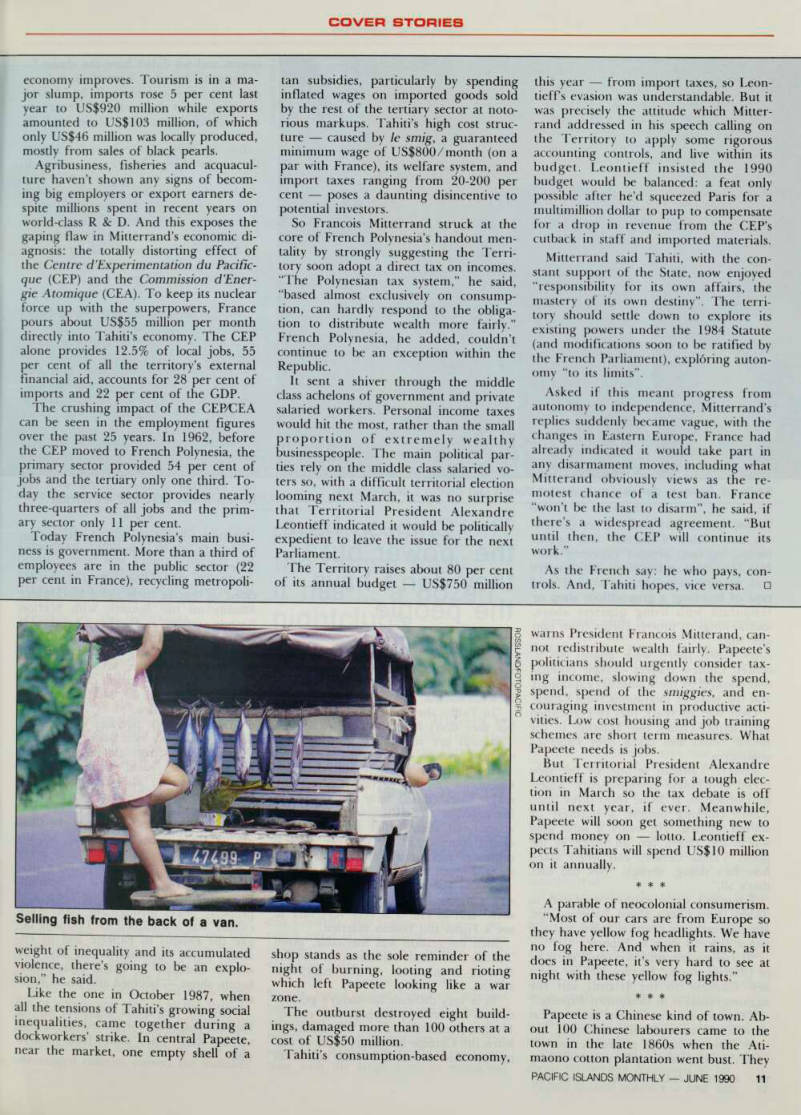
Selling fish from the back of a van.
started as peddlars and market garden ers but within a decade had begun buying up land around Papeete’s mar ket. They became butchers, shopkeepers and restauranteurs and erected a new type of building: a groundfloor shop or restaurant with living quarters above, and awnings to protect clients from rain and sun.
By 1900, there were almost 80 li cenced Chinese traders their popula tion boosted by the California expulsions and the wave of migrations from China.
Over the last years, they’ve Frenchfied their names (count the Yongues in the phone book) and taken over Papeete’s commerce.
Robert Tanseau is one of the new breed of Chinese entrepreneurs. Amer ican educated, at 38 he owns three Shop Tahiti clothing outlets, a business he started himself. He wears a solid gold watch and chain, has an office in the plush Valma Centre, and when asked how he’s doing, shrugs: “Not too bad, that’s all.”
Tonseau’s grandmother migrated to
Tahiti from China about 70 years ago.
His parents were born in Tahiti and still run a grocer’s shop in Papeete.
“If you go around town you’ll see a lot of Chinese stores,” he says. “There are a few Chinese in the islands but the agglomeration is in downtown Papeete.”
Tanseau says the Chinese make up at most 6 per cent of the population, but they hold a lot of economic power: “They’re very hard workers and work on
The Chinese have the power but they don’t have the people
a family basis.”
Despite the inevitable jealousy such success brings, Tangseau doubts it will ever cause racial conflict like in Fiji or New Caledonia.
“In Tahiti, the Chinese have the power but they don’t have the people. So that Tahitians are still living in their own country because they’re a majority.”
He attributes racial hostility in New Caledonia and Fiji to the fact that the major races “didn’t have the chance to live together”. The Chinese in Tahiti had abandoned their belief in living as a closed community: the younger genera tion was mixing more with the other races, French and Polynesian.
“Today you see a lot of Chinese living well with the French or Polynesians,” he says. “But in Fiji, it is very very rare to see a Fijian and Indian married.”
Such integration was inevitable, given Tahiti’s Polynesian cultural roots and the French dominance of the education system.
“It is very difficult for today’s genera tion to understand the past very clearly.
My generation didn’t get the chance to learn the Chinese language, roots or cul ture because it was a French education
system and we didn’t have the choice.”
Tanseau describes himself as Polyne sian with Chinese thinking. “The Chinese thinking makes the whole difference: it’s more detailed than the Polynesians,” he says.
But the Polynesian culture has taught the hardworking Chinese “happiness of living”.
The older Chinese generation didn’t know how to enjoy life because of their sheer drive for survival, Tanseau says.
“But the Polynesians, being in their own land, enjoy living more. Integration is very good. The more integration you have, the more life goes easy.” * * ♦ Some occasional observations on Pape ete from its connoisseurs: “It has to be one of the most subsi dised places in the world. There’s not much prostitution here, they give that for free. But there’s a prostitution men tality; how much money will you give me for this? How much money will France give me?” And: “The French and Tahitians are very similar in some ways. Papeete combines some of the worst characteristics: you put the Tahitian attitude of flu with the French laisser faire and it’s terrible. * ♦ * Hollywood and the nuclear bomb can be considered the parents of modern Papeete.
In 1961, Hollywood’s MGM studio de cided to remake their 1930 s blockbuster Mutiny on the Bounty, with Marlon Brando starring as Fletcher Christian. It coincided with the opening of Tahiti’s new international airport at Faa’a and by November that year, MGM had more than 100 staff on location. Hundreds of Tahitians were on the MGM payroll as extras or technicians.
The unheard of payrates knocked the bottom out of the local labour market. “I used to get my trees aluminium-banded for five francs each,” complained one plantation owner. “Now I offer 10 or 20 francs but nobody’s interested. They’re working for MGM.”
Production squables dragged the film ing on for a year. By the end, MGM’s largesse had filtered into virtually every Tahitian home. The filming and a new burst of tourist had placed a premium on accommodation, pushing rents and property prices through the roof. Agri culture was abandoned as Tahitians be gan the exodus to Papeete and its en virons which continues to this day. The service industry cafes, restaurants, hotels, shops boomed and prices rock eted.
Then the film crews departed, leaving Papeete desperate for something to take up the slack. They didn’t have long to wait.
Smile: A Papeete dance group leader during last month’s celebrations.
Karen Mangnall
In 1963, President Charles De Gaul announced Tahiti, and Mururoa in par ticular, would host France’s nuclear test programme. Local politicians had barely drawn breath to object when Papeete was flooded with 5000 soldiers, Foreign Legionnaires, and technicians.
There were no houses ready for them so they set up tents and then moved into hastily built shacks with no sanitation.
Out of 35 acres of reclaimed coral reef, they created the Port of Papeete, a white claw dominating the town’s harbour.
The expansion drew a huge workforce from the outer islands and a new wave of business people came out from France to cash in on the service industry boom.
Papeete’s population exploded to 15,000 people, creating insurmountable problems for the municipal council. * * ♦ The arrival of the Contra d’Experi mentation du Pacifique (CEP), polarised politics. At first the opponents of nuclear testing, Pouvanaa’s fellow activists for in ternal economy, were in the ascendant.
Through the 19705, the pendulum swung over to Pouvanaaa’s nominal suc cessors whose agenda focussed on tap ping into the massive French subsidies to mitigate rather than oppose the socio economic impact of the CEP.
In 1977, Jean Juventin led Pupu Here Aia to a sweeping victory in the Papeete municipal elections and the new majority settled down to old preoccupations: “Reconcile the town with its more dis advantaged citizens, correct the mistakes
Ponpp+Q
' Imcuaco
fho
Lmc J •
It HP Q Q Ho7on
Il . ' ' D Uuz.Um
niClhtClUbS
created by massive urbanisation, invent a new lifestyle and social interaction, renew the old and rundown areas, ease traffic flows and encourage a true collaboration with the town’s residents.”
The formula, actually delivered by Juventin at the May 16, 1990 Town Hall opening, has been a constant throughout
Papeete’s history.
Back in the 1880 s, after King Pomare V finally ceded Tahiti to France, the Col ony’s General Council complained no thing was being done to help the chiefs of Pare to cope with the huge technical and financial demands of Papeete, a port of some 3000 residents, On May 20, 1890, Papeete became a French Commune or municipality and the leader of the General Council, Fran cois Cardella, also became mayor set ting a trend of cross-fertilisation between territorial and municipal politics which continues today.
In 1891, a fellow councillor, Victor Raoulx, railed against Papeete’s “infested hovels”, its “piles of excrement” breeding infections, and the danger to public health by having abattoirs within the township. Raoulx caustically drew a con trast with the large sums of municipal
funds devoted to entertainment and dances.
In 1950, Robert Auzelle drew up Papeete’s first town plan while deploring its overcrowded and rundown buildings, built on swamy ground often soaked with excrement because of bad sanitation sys tems.
Last month, Juventin said: “Only 100 years ago, Papeete was mere swampland.
A century has not been long enough to overcome this great handicap.”
The priorities? A new sewage system, a new road flanking the town to relieve traffic congestion, and a five-year State sponsored programme to replace the bidonvilles, or slum areas, with low-cost
housing.
♦ ♦ ♦ Says a local politician on the problems
of independence:
“Our problem is we live beyond our means. But it’s done. There’s nothing we can do about it. It’s just too bad we’ve become a totally subsidised country. It’s too late to say we wish it wasn’t like this.
“The average Tahitian family is very, very materialistic. We cannot ask them to forget their video, their colour tv, their cars. If we ask people to sacrifice their material standard of living, to go back 20 years, there would be a riot.
“What we must do is prevent the infla tion of this materialistic mentality. But it’s true, we must stop somewhere.” * * ♦ Everyday when you open the newspap er, at every festival or public ceremony, they’re there. Les Miss. The beauty queens. Dozens of them. Virtually every company worth its promotions budget sponsors a Miss.
The French sailors on R & R like to have their photos taken beside a Miss.
“You see her,” points one, a white line between his sunburn and new crew-nut.
“That’s a Miss Tahiti. I’m Mr Tahiti.”
And rushes off with his instamatic.
“I’ve never been chased as hard or as deliberately by women as I have since I got here,” says a New Zealander posted to Papeete by his company. “It’s practi cally the national sport here. I’ve heard it described like that as a joke, but it’s
actually true.”
Papeete makes the chase easy. It has more than a dozen nightclubs not to mention the late-night bistros, bars and restaurants. Then there’s the stroll. On an evening, you wander along the Boule vard Pomare, or to eat at dozens of roulottes, food vans, lined up with their neon singls along the waterfront.
It’s a ritual almost as old as Papeete, writers earlier this century described it, only half jokingly, as the meat market.
Papeete has had 15 Aids deaths, with about 80 carriers diagnosed so far. D
Papeete backstreets: away from the glitter of the commercial facade.