The hope of the small airlines
pp. 43-45 · Read in the full issue

WHENEVER you talk about transport in the South Pacific and aviation in particular the same old problem keeps coming up: how to develop national organisations, in this case airlines, which are more than picking up the crumbs from the major operators.
Fortunately, it is possible to report that
some progress has been made even in the two years since Pacific Islands Monthly last published a special report on transport in the region. Then we dis cussed a paper delivered at a conference in Hobart in mid-1988 by Dr Christ opher Kissling, a fellow in human geography at the Australian National University’s Research School in Pacific
Studies.
Dr Kissling’s theme was that one ol the most useful contributions Australia and New Zealand could make to South Pacific development would be to allow island airlines to fly with full traffic rights across the Tasman Sea, the mosl lucrative aviation sector in the region and one largely dominated by Air New Zealand and Qantas. While these carriers have fifth-freedom rights in the islands (which allow them to, say, pick up pas sengers in Fiji or Tahiti to take them to North America), most Pacific airlines have only terminating rights in the two
developed countries.
There is still a long way to go before, for example, Solomon Airlines can fly to Brisbane, pick up passengers there and continue on to Wellington; or Papua New' Guinea’s national airline operate Port Moresby-Sydney-Christchurch; or
Polynesian Airlines having all rights on
an Apia-Auckland-Melbourne service. Dr Kissling’s argument was that tourism is one of the few sectors of island econo mies with substantial growth prospects, and unless the small nations of the South Pacific themselves control aviation and tourist infrastructure, much of the
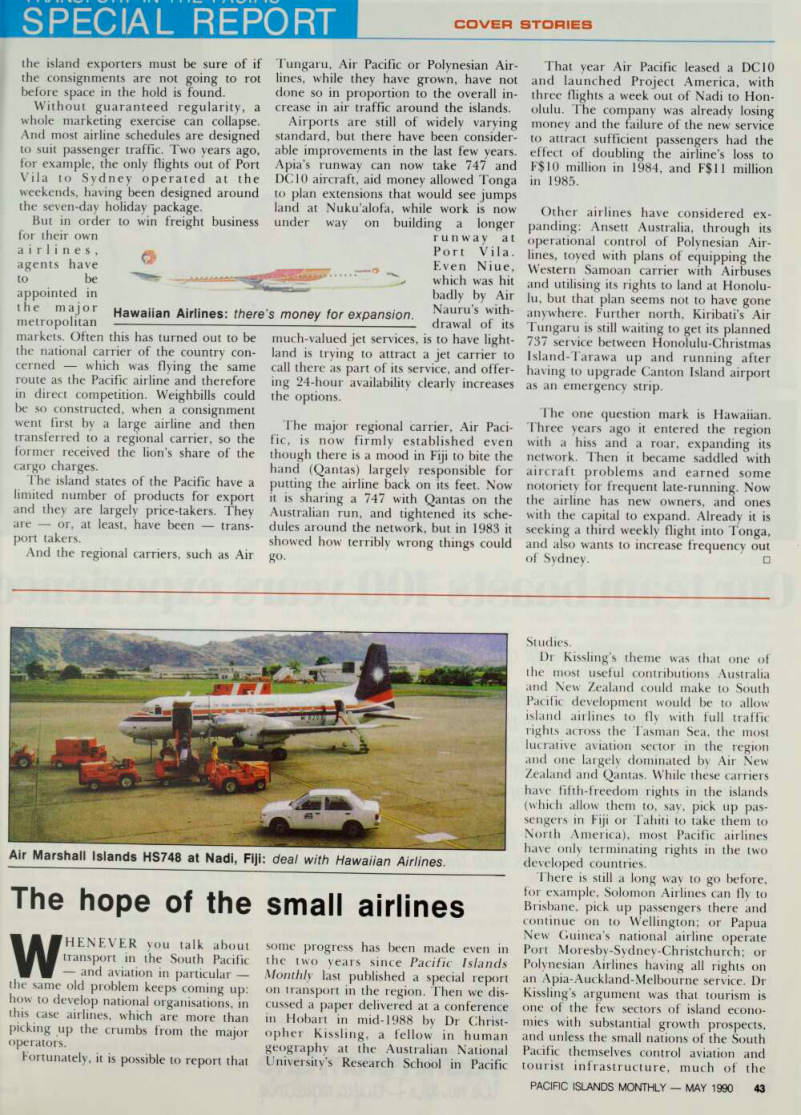
Air Marshall Islands HS748 at Nadi, Fiji: deal with Hawaiian Airlines.
money spent by tourists will not stay long in the island communities.
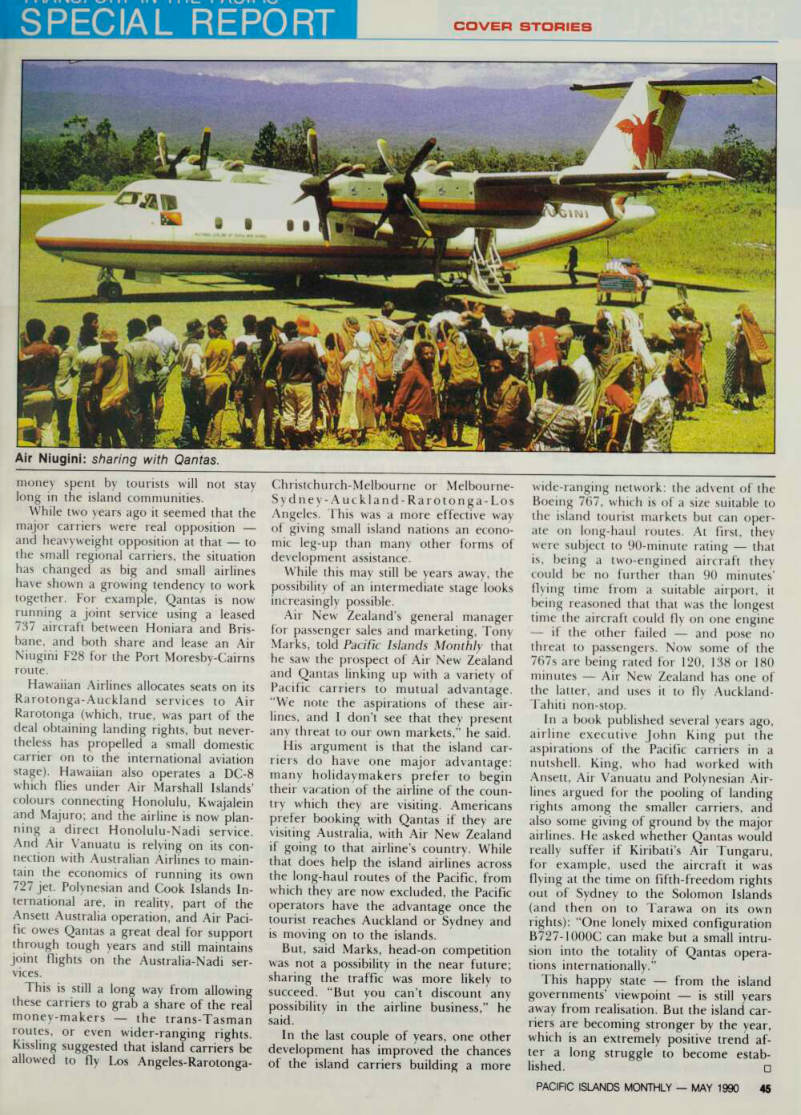
While two years ago it seemed that the major carriers were real opposition and heavyweight opposition at that to the small regional carriers, the situation has changed as big and small airlines have shown a growing tendency to work together. For example, Qantas is now runmng a joint service using a leased 7.37 aircraft between Honiara and Brisbane, and both share and lease an Air Niugini F2B for the Port Moresby-Cairns
ro if-
Hawaiian Airlines a locates seats on its Karotonga-Auckland services to Air Rarotonga (which true, was part of the deal obtaining landing rights, but nevertheless has propelled a small domestic carrier on to the international aviation Hawaila l n al A so operates a DC-8 which flies under Air Marshall Islands’
CO Honolulu, Kwajalein an . ajuro, and the airline is now plan- A 1"? d w eCt Honolu u ; Nadl service, And Air Vanuatu is relying on its connection with Australian Airlines to main- SS - the economics of running its own 27 jet. Polynesian and Cook Islands Inernational are, m reality, part of the Ansett Australia operation, and Air Padtic owes Qantas a great deal for support through tough years and still maintains joint mgms on the Australia-Nadi ser- . ... . „ . inis is still a long way from allowing these carriers to grab a share of the real money ma ers the trans-Tasman outes, or even wider-ranging rights. isslmg suggested that island carriers be allowed to fly Los Angeles-Rarotonga-
Christchurch-Melbourne or Melbourne-
Sydney-Auckland-Rarotonga-Los
Angeles. This was a more effective way of giving small island nations an economic leg-up than many other forms of
development assistance.
While this may still be years away, the possibility of an intermediate stage looks
increasingly possible.
Air New Zealand’s general manager for passenger sales and marketing, Tony Marks, told Pacific Islands Monthly that he saw the prospect of Air New Zealand and Qantas linking up with a variety of Pacific carriers to mutual advantage.
“We note the aspirations of these airlines, and I don’t see that they present any threat to our own markets,” he said.
His argument is that the island carriers do have one major advantage:
many holidaymakers prefer to begin
their vacation of the airline of the country which they are visiting. Americans prefer booking with Qantas if they are visiting Australia, with Air New Zealand if going to that airline’s country. While that does help the island airlines across the long-haul routes of the Pacific, from which they are now excluded, the Pacific operators have the advantage once the tourist reaches Auckland or Sydney and is moving on to the islands.
But, said Marks, head-on competition was not a possibility in the near future; sharing the traffic was more likely to succeed. “But you can’t discount any possibility in the airline business,” he said.
In the last couple of years, one other development has improved the chances of the island carriers building a more
wide-ranging network: the advent of the Boeing 767, which is of a size suitable to the island tourist markets but can oper ate on long-haul routes. At first, they were subject to 90-minute rating that is, being a two-engined aircraft they could be no further than 90 minutes’ flying time from a suitable airport, it being reasoned that that was the longest time the aircraft could fly on one engine if the other failed and pose no threat to passengers. Now some of the 767 s are being rated for 120, 138 or 180 minutes Air New Zealand has one of the latter, and uses it to fly Auckland- Tahiti non-stop.
In a book published several years ago, airline executive John King put the aspirations of the Pacific carriers in a nutshell. King, who had worked with Ansett, Air Vanuatu and Polynesian Air lines argued for the pooling of landing rights among the smaller carriers, and also some giving of ground by the major airlines. He asked whether Qantas would really suffer if Kiribati’s Air Tungaru, for example, used the aircraft it was flying at the time on fifth-freedom rights out of Sydney to the Solomon Islands (and then on to Tarawa on its own rights): “One lonely mixed configuration 8727-1000 C can make but a small intru sion into the totality of Qantas opera
tions internationally.”
This happy state from the island governments’ viewpoint is still years away from realisation. But the island car riers are becoming stronger by the year, which is an extremely positive trend af ter a long struggle to become estab lished. □
Air Niugini: sharing with Qantas.