Signs of change
pp. 46-49 · Read in the full issue

MUCH of the frustration experi enced by those who, in the past, have wanted to see a more rapid growth of tourism in the South Pacific islands has arisen from the fact that most of the region’s promotion has been in the hands of a few major airlines and that really means Qantas and Air New Zealand. Because, unlike regional carriers, their route network stretched out to encompass Asia, North America and Europe (where the majority of the world’s tourist traffic is generated) they could tell the potential traveller about the delights of the South Seas.
The problem was that, for most of the time, the airlines concentrated on prom oting their own countries. That was understandable and natural, and both Australia and New Zealand have built formidable tourist infrastructures at least by southern Pacific standards. With these airlines, the islands tended to be an
afterthought if they were promoted at
all.
Now, there are signs of change, with both Qantas and Air New Zealand plac ing greater emphasis on the whole re gion as a destination for long-haul traf fic. Both airlines recognise that if peo ple come this far they frequently want to sample more than one destination while they are at it. When one is spend ing many thousands of dollars on a holi day, the cost of throwing in one or two stopovers and short detours is not a ma jor factor.
Tony Marks, who runs passenger marketing at Air New Zealand in Auck land, said that the airline was targetting the person in Holland and Chicago who
had dreamed of visiting places such as Tahiti or the Cook Islands (especially in the northern winter) and getting them to combine a holiday on a palm tree-lined beach in the islands with a visit to Au stralia anchor New Zealand.
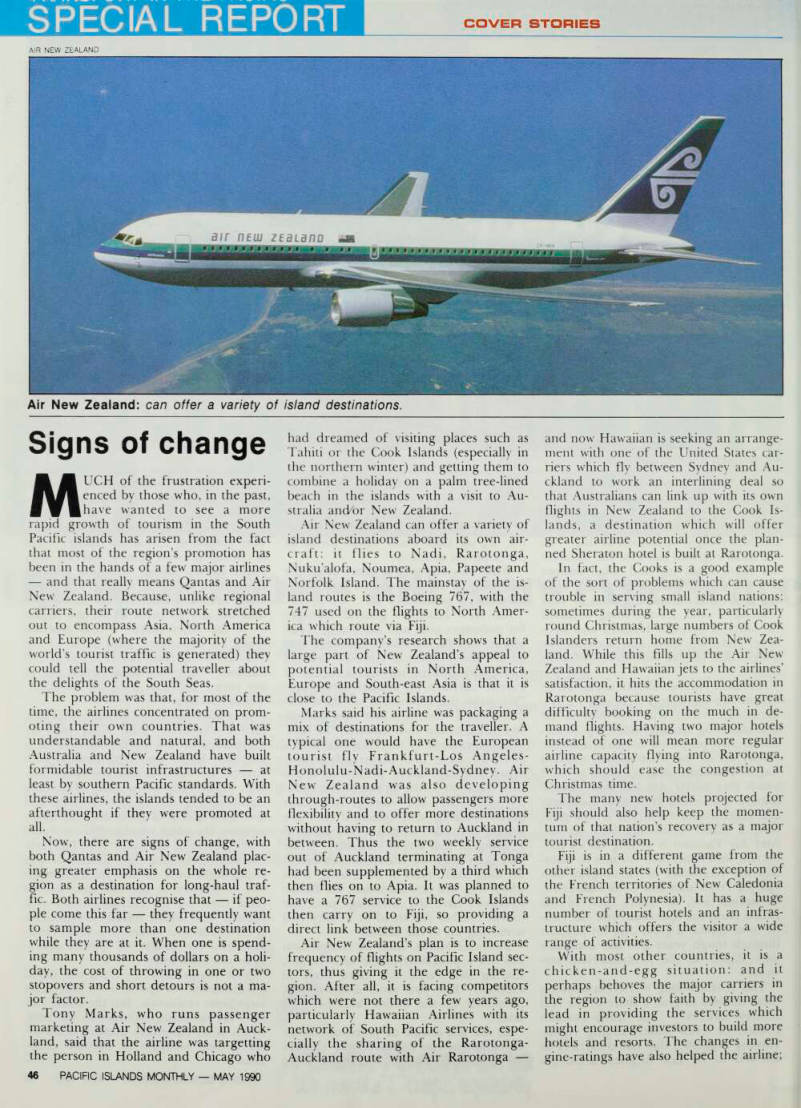
Air New Zealand can offer a variety of island destinations aboard its own air craft: it flies to Nadi, Rarotonga, Nukualofa, Noumea, Apia, Papeete and Norfolk Island. The mainstay of the is land routes is the Boeing 767, with the 747 used on the flights to North Amer ica which route via Fiji.
The company’s research shows that a large part of New Zealand’s appeal to potential tourists in North America, Europe and South-east Asia is that it is close to the Pacific Islands.
Marks said his airline was packaging a mix of destinations for the traveller. A typical one would have the European
tourist fly Frankfurt-Los Angeles-
Honolulu-Nadi-Auckland-Sydney. Air
New Zealand was also developing through-routes to allow passengers more flexibility and to offer more destinations without having to return to Auckland in between. Thus the two weekly service out of Auckland terminating at Tonga had been supplemented by a third which then flies on to Apia. It was planned to have a 767 service to the Cook Islands then carry on to Fiji, so providing a direct link between those countries.
Air New Zealand’s plan is to increase frequency of flights on Pacific Island sec tors, thus giving it the edge in the re gion. After all, it is facing competitors which were not there a few years ago, particularly Hawaiian Airlines with its network of South Pacific services, espe cially the sharing of the Rarotonga- Auckland route with Air Rarotonga
and now Hawaiian is seeking an arrange ment with one of the United States car riers which fly between Sydney and Au ckland to work an interlining deal so that Australians can link up with its own flights in New Zealand to the Cook Is lands, a destination which will offer greater airline potential once the plan ned Sheraton hotel is built at Rarotonga.
In fact, the Cooks is a good example of the sort of problems which can cause trouble in serving small island nations: sometimes during the year, particularly round Christmas, large numbers of Cook Islanders return home from New Zea land. While this fills up the Air New Zealand and Hawaiian jets to the airlines’ satisfaction, it hits the accommodation in Rarotonga because tourists have great difficulty booking on the much in de
mand flights. Having two major hotels
instead of one will mean more regular
airline capacity flying into Rarotonga,
which should ease the congestion at Christmas time.
The many new hotels projected for Fiji should also help keep the momen tum of that nation’s recovery as a major tourist destination.
Fiji is in a different game from the other island states (with the exception of the French territories of New Caledonia and French Polynesia). It has a huge number of tourist hotels and an infras tructure which offers the visitor a wide range of activities.
With most other countries, it is a chicken-and-egg situation: and it perhaps behoves the major carriers in the region to show faith by giving the lead in providing the services which might encourage investors to build more hotels and resorts. The changes in en gine-ratings have also helped the airline;
Air New Zealand: can offer a variety of island destinations.
it has 767 s which can be three hours from an airport under the two-engine safety system, so allowing them to use the smaller jets on the long-hauls. Filling the seats on a 767 is far less a challenge than with a 747 jumbo, an important factor on low-density Pacific routes.
Air New Zealand can see itself increas ing services to Fiji by a significant de gree, said Marks. Nadi could soon be come a mini-hub for the airline’s opera tions in the South Pacific.
The Auckland-based carrier is also looking to step up the number of its jets passing through Papeete, thus picking up some of the traffic lost to Continental when it withdrew from the country, and from Qantas which has reduced the number of flights (although the Austra lian airline says that there is, in fact, greater capacity than before; Qantas has increased the number of direct Sydney- Los Angeles flights, thus removing many
through-travellers who formerly
travelled by way of the Sydney-Papeete- Los Angeles route).
But not just Tahiti to America: Air New Zealand, trying to read what the future will bring, expects increasing traf fic out of South America, and the likeli hood that continent will become the next great tourism growth area of the world.
At the moment Aerolineas Argentinas flies over the South Pole to Auckland and LAN-Chile flies Santiago-Papeete,
but eventually flights could originate
from along the whole west coast of South America. Air New Zealand itself has periodically looked at extending its network to encompass Latin America; the current problem is lack of equip ment. This aircraft shortage has hit all the major world airlines and each is forced to utilise what aeroplanes they do have on the routes where they can make the most money. Similarly, Qantas has sat on its hands in terms of new destina tions in the Pacific for the same reason.
Qantas, while still focussing on Austra lia as the prime destination for tourists who board its aircraft, agrees that prom oting the region is now an important
part ot its publicity campaign. As Austra lia captures only two per cent of the world’s long-haul tourist market, there is plenty of potential for growth.
Its services to the Pacific consist of: Sydney and Brisbane to Port Moresby; a jointly-operated 737 service with Solo mon Airlines running Honiara-Brisbane; Sydney to Nadi both with its own jets stopping over while on the North Amer ican service and joint services with Air Pacific; two services a week to Tahiti, and the scheduling of many of its jets via Honolulu which is a significant hub for Qantas.
“Qantas does not want to lose its focus on the Pacific,” said the airline’s regional director, South-west Pacific, Greg Haywood. Where the airline has decided not to run its jets such as picking up existing rights to land at Port Vila, Vanuatu, it is because of restraints on the number of aircraft the airline has at
its disposal.
Most of the airline’s business in the region is tourism-based, except for the Papua New Guinea route. A few highly motivated tourists from Europe or North America make the trip to Port Moresby, but mostly its business people or expatri ate residents going back and forth to Australia. But if Papua New Guinea can solve some of its problems the high cost of moving around the country, the shor tage of good accommodation and, more than anything, the serious and de teriorating law and order situation then Haywood sees it becoming one of the most exciting tourist developments in the region. □
rocal rights and fly their own nationals in on holiday.
There have been three Air Vanuatus.
The first, founded about three years ago, was operated by Australia’s Ansett Airlines; it owned 60 per cent of Air Vanuatu, the Government in Port Vila the remaining 40 per cent. The service from Australia was initially operated with either DC-9 or Boeing 737-200 air craft. By and large, it was judged to be a reasonable success and gave the Vanuatu tourist industry its first major influx of foreign tourists, and established what continued to be a popular niche destina tion in the region. And it has meant that Vanuatu now has a tourism infrastruc ture well in advance of developments in some other small Pacific island states.
But Ansett pulled out of the deal after five years, although it continued to fly into Port Vila under its own colours us
ing Qantas landing rights. The Vanuatu
Government then looked around for someone to take over management of the national airline, even though it had no aircraft of its own. But Air Vanuatu No. 2 got nowhere: the Hong Kong company which tried to take over the operation never managed to bring it all together.
Air Vanuatu No. 3 came out of a re port from accountants Coopers and Lyb rand, who were commissioned by the Government to recommend what action it should take to establish its own carrier.
The accountants advised that the coun try should find a “big brother”, an air line which could provide an aircraft on a part-time basis so that Air Vanuatu was not faced with both buying a jet and keeping it operating seven days a week, a task impossible in the initial stages.
The search for the right airline nar rowed down quite quickly to Australian Airlines, the government-owned domes tic carrier based in Sydney. Initially it provided a 727 aircraft on charter once a week for a Sydney-Port Vila service so that Vanuatu could revive its own air
operations with minimal delay.
Eventually, with As 6 million (U 554.56 million) in Australian aid money, Air Vanuatu was able to buy its own 727 for a total cost of US$9,7 million. In June 1989 services were expanded to include Melbourne, then Brisbane and now Au ckland. Ansett withdrew its own Vanuatu
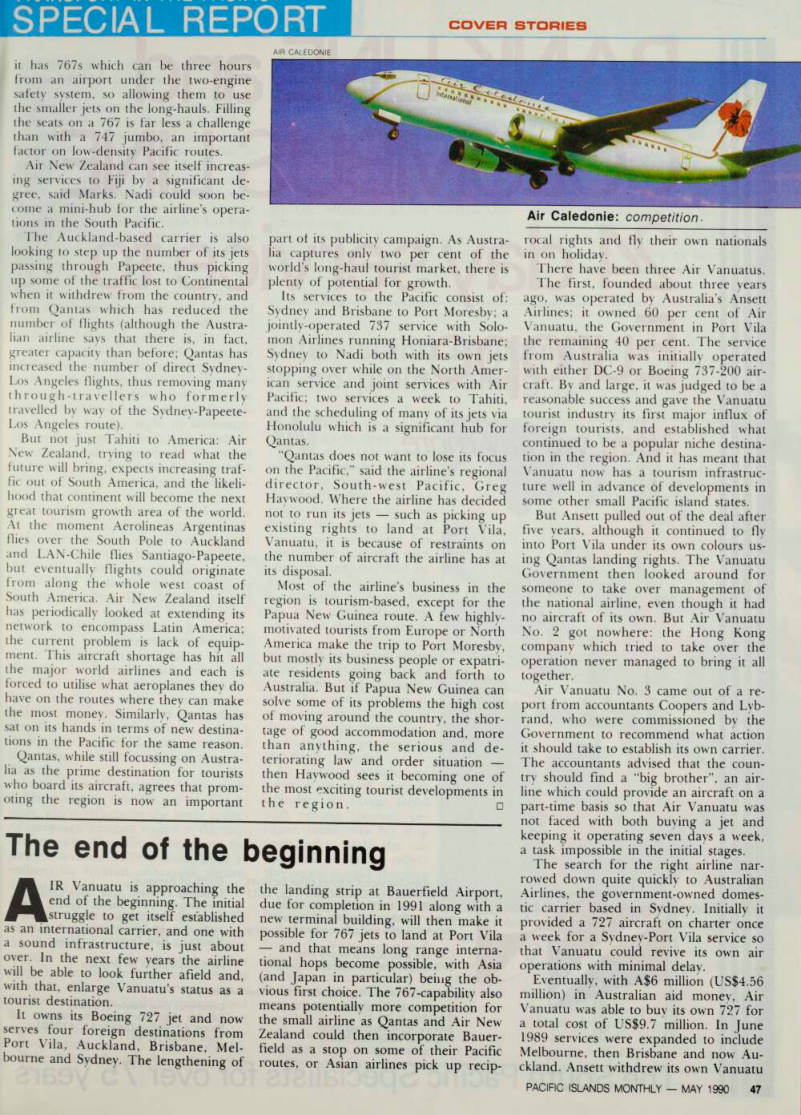
Air Caledonie: competition .
operations about that time, the Qantas rights remaining vacant in the mean while.
The jet is painted in Air Vanuatu col ours, but leased to Australian Airlines four days a week for use on domestic routes which means the airliner is operating at an economic level, whereas without a lease-back it would spend ex pensive time sitting on the tarmac at Bauerfield. It also means that when the aircraft is out of service (which has hap pened only once) Australian Airlines supplies a replacement. Aircrew can also be supplied from Australian to cover sickness or leave, which means that Air Vanuatu can maintain lean staff levels.
The Australian carrier has also promised to keep the Vanuatu company advised of its forward fleet planning.
Air Vanuatu takes over the aircraft at Melbourne on Saturday morning, flies it to Port Vila via Brisbane. Then it makes a return trip to Sydney, and works the Sydney-Auckland route on Sunday, re turning on Sunday night to Melbourne (again by way of Brisbane). On Wednes day the aircraft is position by Australian in Sydney, where the Air Vanuatu crew pick it up for a return Sydney-Brisbane- Port Vila flight.
The main competition out of Australia is now Air Caledonie International; which flies via Noumea to Port Vila four times a week with a Boeing 737-300 jet.
Air Pacific links Vila with Fiji.
Air New Zealand also has rights to operate into Port Vila, but has chosen not to exercise them. Air Vanuatu’s Au ckland service, which started in Novem ber, is still having trouble breaking out above a 50 per cent load factor so it is thought the New Zealand airline will wait and watch how the route goes be fore committing itself. It now acts as general sales agent in New Zealand for the Port Vila-based airline, and has undertaken to give 12 months’ notice of it starting a service in opposition to Air Vanuatu.
On its Australian routes, Air Vanuatu is filling slightly over 70 per cent of its seats, which reflects on the lively public ity campaign Vanuatu waged in the mar ket last year. Now the Government has pledged another Vt2oo million (US$l.3B million) for tourism promotion abroad, the money to be channelled through the airline.
Air Vanuatu’s managing director, Pe ter Roberts, told Pacific Islands Monthly the airline was working well; after nine months, the airline has trained a cabin crew made up entirely of Vanuatu nationals, although the aircrew are either Australian or New Zealand citizens (and the aircraft remains on the Australian register, which means it has to be main tained to that country’s high standards).
Roberts stayed with the airline after
being part of the Coopers & Lybrand team; he formerly spent 13 years with
Qantas, working successively in planning,
economics and accounting with that air line. While there he was also involved at the time Qantas had connections with Air Pacific and Air Niugini.
“By the end of this year we’ll have the full infrastructure of a competent air line,” said Roberts. This would include separate offices in all the foreign des tination cities.
Now, he said, Vanuatu had to begin thinking about more hotel rooms. Port Vila has about 550 rooms, not all of in
ternational standard, and these could cope with the 36,000 visitors a year now currently projected. “Next year is what concerns us,” said Roberts. “Hotels are the restricting factor.”
Air Vanuatu’s plans include the possi bility of a third weekly service to Sydney, and Asia is the next obvious area once the airport can take 767 aircraft. The easiest method to cope with the problem short-term is for the three major hotels to add more rooms, but in the longer term Vanuatu is going to have to look for new hotel players coming to town. □