Ministry Of Information, Fiji
pp. 41-43 · Read in the full issue

Power but no glory
FOR an example of how not to go about building a transport system in the South Pacific, look no furth er than Air Nauru. Its history exempli fies the dangers faced by underde veloped countries which think that a national airline is a sign of political man hood.
Nauru, with only 8000 people but loads of money from phosphate royal ties, tried to do it in style, It equipped with Boeing 737 jets, then sent them off in all directions. By 1985, Air Nauru’s destination roster was an impressive one:
Singapore, Manila, Hong Kong, Taipei,
Okinawa, Kagoshima, Guam, Koror, Saipan, Truk, Ponape, Majuro, Honolu lu, Tarawa, Papeete, Rarotonga, Niue, Nadi, Suva, Nukualofa, Port Vila, Hon iara, Auckland, Noumea, Sydney and Melbourne.
How much Air Nauru lost no one out side the government on Nauru itself knows, but it has been estimated in the several millions. Similarly, the govern ment-owned shipping line is another hole through which money continues to pour.
The crunch for the airline was the de cision by the New Zealand civil aviation authorities to withdraw its air certifica tion on safety grounds after most of its more experienced pilots went on strike, a decision promptly followed by the Au stralian authorities.
Air Nauru is back in the air, but with a highly circumscribed network: just
Tarawa, Honiara, Fiji, Noumea, Auck land, Sydney and Melbourne. The gov ernment had come to the realisation that it could no longer afford to keep pour ing funds into the operation.
The story is a prime example of how regional airlines need to tailor their plans to the rather harsh economic reali ties of flying long distances between countries with extremely small popula tions.
On the other hand, the island states have to bite the bullet.
They cannot leave control of their communications to outsiders. Apart from passengers, there is an acute shortage of cargo capacity on many sectors. Air Mar shall Islands, which used a 748 jet prop on the Nadi-Funafuti-Tarawa-Majuro route has often had to off-load even priority items such as mail in order to devote the permitted weight to passen ger demand. With the major carriers flying the long-distance trunk routes,
there will always been preference given
to freight booked for the entire journey; better to carry a pallet in the hold all the way from Sydney to Los Angeles than use the space only so far as Nadi or Pago Pago, especially when there might not be any cargo available for pick-up at an is land stop-over.
With flights to the islands, there is heavy demand for carriage of fresh and perishable food to the markets in Sydney and Auckland (and, increasingly, Hon olulu and Los Angeles) this is space
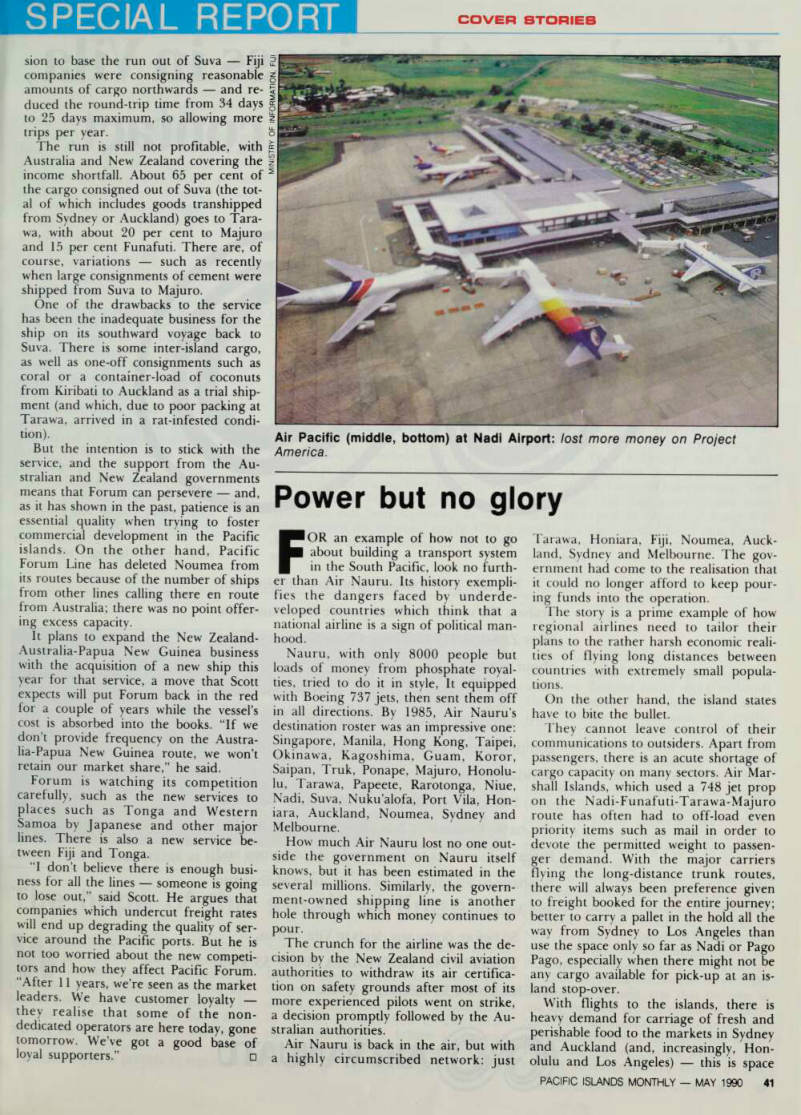
Air Pacific (middle, bottom) at Nadi Airport: lost more money on Project America.
Ministry Of Information, Fiji
the island exporters must be sure of if the consignments are not going to rot before space in the hold is found.
Without guaranteed regularity, a whole marketing exercise can collapse.
And most airline schedules are designed to suit passenger traffic. Two years ago, for example, the only flights out of Port Vila to Sydney operated at the weekends, having been designed around
the seven-day holiday package.
But in order to win freight business
for their own airlines, agents have to be appointed in the maj o r metropolitan
markets. Often this has turned out to be the national carrier of the country con cerned which was flying the same route as the Pacific airline and therefore in direct competition. Weighbills could be so constructed, when a consignment went first by a large airline and then transferred to a regional carrier, so the former received the lion’s share of the
cargo charges.
The island states of the Pacific have a limited number of products for export
and they are largely price-takers. They
are or, at least, have been trans port takers.
And the regional carriers, such as Air
Tungaru, Air Pacific or Polynesian Air lines, while they have grown, have not done so in proportion to the overall in crease in air traffic around the islands.
Airports are still of widely varying
standard, but there have been consider able improvements in the last few years.
Apia’s runway can now take 747 and DC 10 aircraft, aid money allowed Tonga to plan extensions that would see jumps land at Nukualofa, while work is now under way on building a longer
runway at Port Vila.
Even Niue, which was hit
badly by Air
Nauru’s with drawal of its
much-valued jet services, is to have light land is trying to attract a jet carrier to call there as part of its service, and offer
ing 24-hour availability clearly increases
the options.
The major regional carrier, Air Paci fic, is now firmly established even though there is a mood in Fiji to bite the hand (Qantas) largely responsible for putting the airline back on its feet. Now it is sharing a 747 with Qantas on the Australian run, and tightened its sche dules around the network, but in 1983 it showed how terribly wrong things could go-
That year Air Pacific leased a DC 10 and launched Project America, with three flights a week out of Nadi to Hon olulu. The company was already losing money and the failure of the new service to attract sufficient passengers had the effect of doubling the airline’s loss to Fslo million in 1984, and Fsll million in 1985.
Other airlines have considered ex panding: Ansett Australia, through its operational control of Polynesian Air lines, toyed with plans of equipping the Western Samoan carrier with Airbuses and utilising its rights to land at Honolu lu, but that plan seems not to have gone anywhere. Further north, Kiribati’s Air Tungaru is still waiting to get its planned 737 service between Honolulu-Christmas Island-Tarawa up and running after having to upgrade Canton Island airport as an emergency strip.
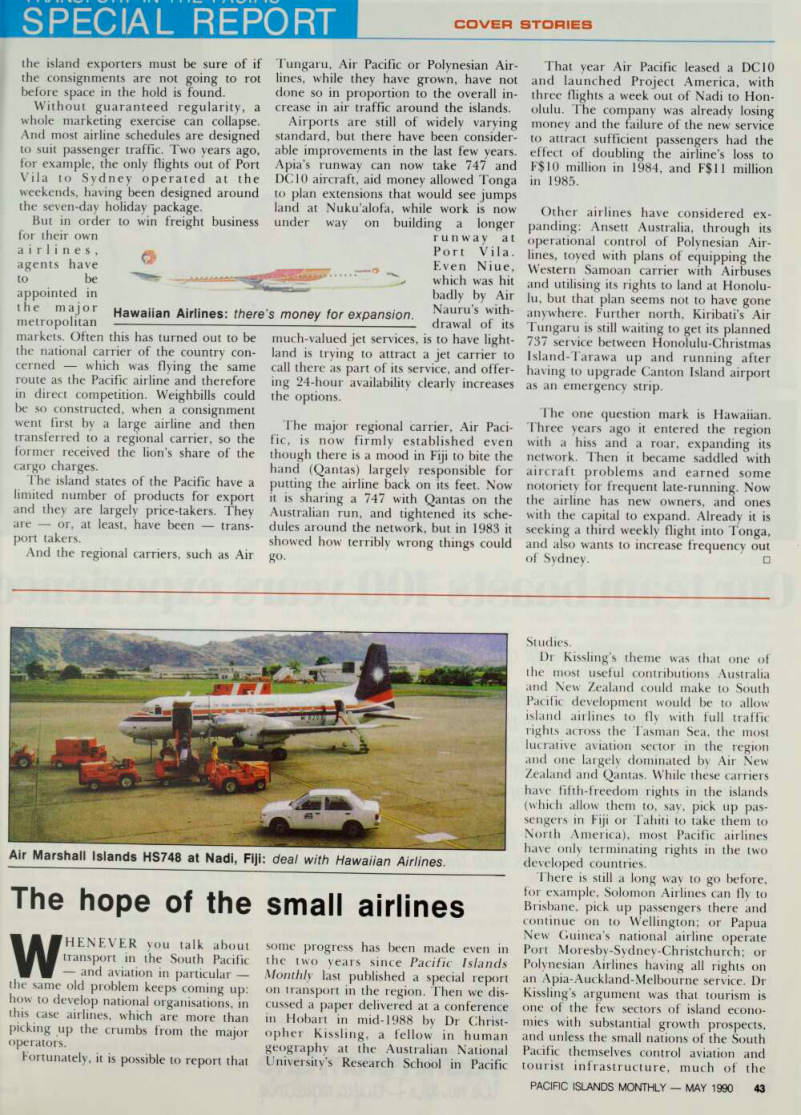
The one question mark is Hawaiian.
Three years ago it entered the region with a hiss and a roar, expanding its network. Then it became saddled with aircraft problems and earned some
notoriety for frequent late-running. Now
the airline has new owners, and ones with the capital to expand. Already it is seeking a third weekly flight into Tonga, and also wants to increase frequency out of Sydney. □
Hawaiian Airlines: there’s money for expansion.