Forum Line shows how things can work
pp. 39-41 · Read in the full issue
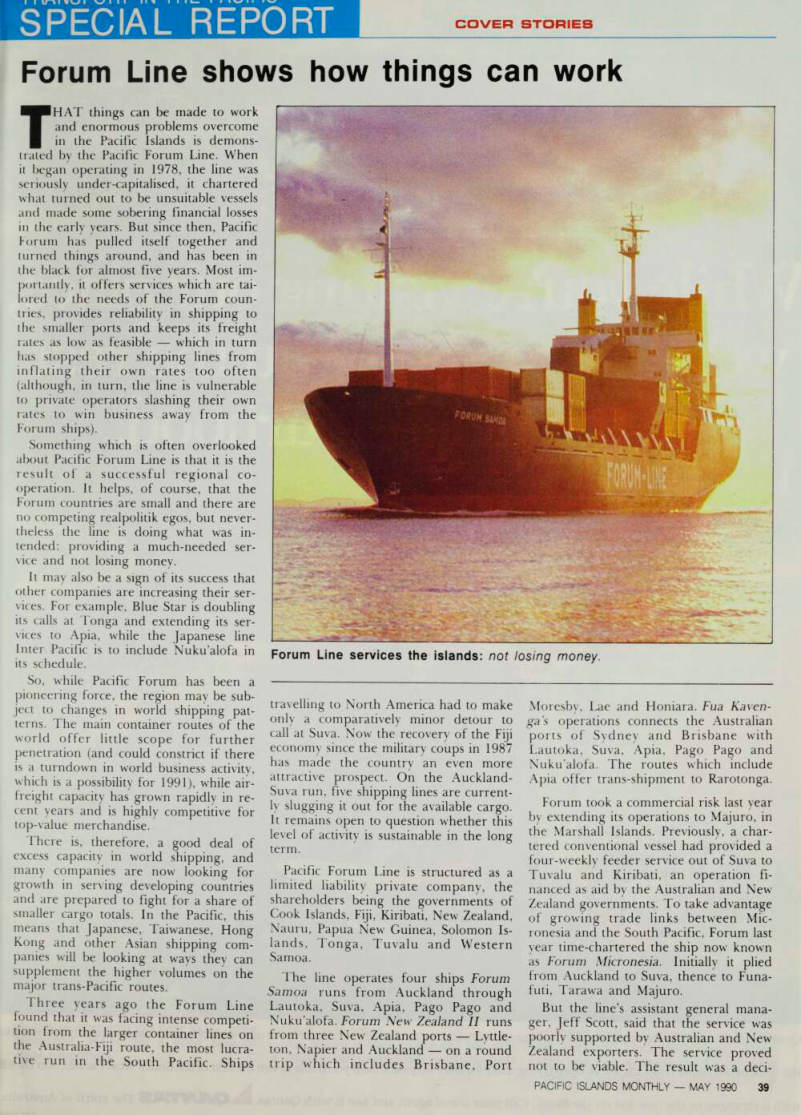
THAT things can be made to work and enormous problems overcome in the Pacific Islands is demons trated by the Pacific Forum Line. When it began operating in 1978, the line was seriously under-capitalised, it chartered what turned out to be unsuitable vessels and made some sobering financial losses in the early years. But since then, Pacific Forum has pulled itself together and turned things around, and has been in the black for almost five years. Most im portantly, it offers services which are tai lored to the needs of the Forum coun tries, provides reliability in shipping to the smaller ports and keeps its freight rates as low as feasible which in turn has stopped other shipping lines from inflating their own rates too often (although, in turn, the line is vulnerable to private operators slashing their own rates to win business away from the Forum ships).
Something which is often overlooked about Pacific Forum Line is that it is the result of a successful regional co operation. It helps, of course, that the Forum countries are small and there are no competing realpolitik egos, but never theless the line is doing what was in tended; providing a much-needed ser vice and not losing money.
It may also be a sign of its success that other companies are increasing their ser vices. For example, Blue Star is doubling its calls at Tonga and extending its ser vices to Apia, while the Japanese line Inter Pacific is to include Nukualofa in its schedule.
So, while Pacific Forum has been a pioneering force, the region may be sub ject to changes in world shipping pat terns. The main container routes of the world offer little scope for further penetration (and could constrict if there is a turndown in world business activity, which is a possibility for 1991), while air freight capacity has grown rapidly in re cent years and is highly competitive for top-value merchandise.
There is, therefore, a good deal of excess capacity in world shipping, and many companies are now looking for growth in serving developing countries and are prepared to fight for a share of smaller cargo totals. In the Pacific, this means that Japanese, Taiwanese, Hong Kong and other Asian shipping com panies will be looking at ways they can supplement the higher volumes on the major trans-Pacific routes.
Three years ago the Forum Line found that it was facing intense competi tion from the larger container lines on the Australia-Fiji route, the most lucra tive run in the South Pacific. Ships
travelling to North America had to make only a comparatively minor detour to call at Suva. Now the recovery of the Fiji economy since the military coups in 1987 has made the country an even more attractive prospect. On the Auckland- Suva run, five shipping lines are current ly slugging it out for the available cargo.
It remains open to question whether this level of activity is sustainable in the long term.
Pacific Forum Line is structured as a limited liability private company, the shareholders being the governments of Cook Islands, Fiji, Kiribati, New Zealand, Nauru, Papua New Guinea, Solomon Is lands, Tonga, Tuvalu and Western Samoa.
The line operates four ships Forum Samoa runs from Auckland through Lautoka, Suva, Apia, Pago Pago and Nukualofa. Forum New Zealand II runs from three New Zealand ports Lyttle ton, Napier and Auckland on a round trip which includes Brisbane, Port
Moresby, Lae and Honiara. Fua Kaven ga’s operations connects the Australian ports of Sydney and Brisbane with Lautoka, Suva, Apia, Pago Pago and Nukualofa. The routes which include Apia offer trans-shipment to Rarotonga.
Forum took a commercial risk last year by extending its operations to Majuro, in the Marshall Islands. Previously, a char tered conventional vessel had provided a four-weekly feeder service out of Suva to Tuvalu and Kiribati, an operation fi nanced as aid by the Australian and New Zealand governments. To take advantage of growing trade links between Mic ronesia and the South Pacific, Forum last year time-chartered the ship now known as Forum Micronesia. Initially it plied from Auckland to Suva, thence to Funa futi, Tarawa and Majuro.
But the line’s assistant general mana ger, Jeff Scott, said that the service was
poorly supported by Australian and New
Zealand exporters. The service proved not to be viable. The result was a deci
Forum Line services the islands: not losing money.
sion to base the run out of Suva Fiji companies were consigning reasonable amounts of cargo northwards and re duced the round-trip time from 34 days to 25 days maximum, so allowing more trips per year.
The run is still not profitable, with Australia and New Zealand covering the income shortfall. About 65 per cent of the cargo consigned out of Suva (the tot al of which includes goods transhipped from Sydney or Auckland) goes to Tara wa, with about 20 per cent to Majuro and 15 per cent Funafuti. There are, of course, variations such as recently when large consignments of cement were shipped from Suva to Majuro.
One of the drawbacks to the service has been the inadequate business for the ship on its southward voyage back to Suva. There is some inter-island cargo, as well as one-off consignments such as coral or a container-load of coconuts from Kiribati to Auckland as a trial ship ment (and which, due to poor packing at Tarawa, arrived in a rat-infested condi tion).
But the intention is to stick with the service, and the support from the Au stralian and New Zealand governments means that Forum can persevere and, as it has shown in the past, patience is an essential quality when trying to foster commercial development in the Pacific islands. On the other hand, Pacific Forum Line has deleted Noumea from its routes because of the number of ships from other lines calling there en route from Australia; there was no point offer
ing excess capacity.
It plans to expand the New Zealand- Australia-Papua New Guinea business with the acquisition of a new ship this year for that service, a move that Scott expects will put Forum back in the red for a couple of years while the vessel’s cost is absorbed into the books. “If we don’t provide frequency on the Austra lia-Papua New Guinea route, we won’t retain our market share,” he said.
Forum is watching its competition carefully, such as the new services to places such as Tonga and Western
Samoa by Japanese and other major
lines. There is also a new service be
tween Fiji and Tonga.
“I don’t believe there is enough busi ness for all the lines someone is going to lose out,” said Scott. He argues that companies which undercut freight rates will end up degrading the quality of ser vice around the Pacific ports. But he is not too worried about the new competi tors and how they affect Pacific Forum.
“After 11 years, we’re seen as the market leaders. We have customer loyalty they realise that some of the non dedicated operators are here today, gone tomorrow. We’ve got a good base of loyal supporters.” □