Adding colour to life in Rarotonga
pp. 21-22 · Read in the full issue
The Arts
By Angela McCarthy
TO walk into Akaoa Art Studio is a visual experience in contemporary Pacific art and design. Bold col
ourful wallhangings, paintings, bonecarv
ings and painted clothing lie or hang everywhere. No other outlet in the Cook Islands has such variety.
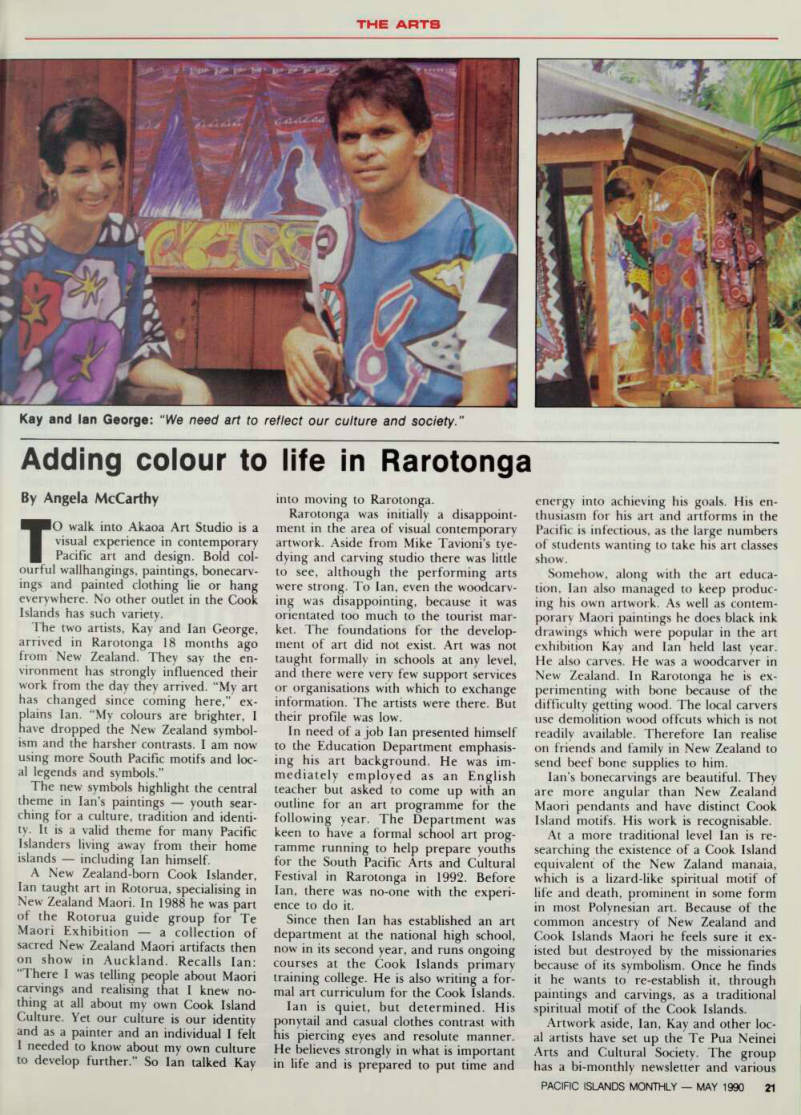
The two artists, Kay and lan George, arrived in Rarotonga 18 months ago from New Zealand. They say the en vironment has strongly influenced their work from the day they arrived. “My art has changed since coming here,” ex plains lan. “My colours are brighter, I have dropped the New Zealand symbol ism and the harsher contrasts. I am now using more South Pacific motifs and loc al legends and symbols.”
The new symbols highlight the central theme in lan’s paintings youth sear ching for a culture, tradition and identi ty. It is a valid theme for many Pacific Islanders living away from their home islands including lan himself.
A New Zealand-born Cook Islander, lan taught art in Rotorua, specialising in New Zealand Maori. In 1988 he was part of the Rotorua guide group for Te Maori Exhibition a collection of sacred New Zealand Maori artifacts then on show in Auckland. Recalls lan: “There I was telling people about Maori carvings and realising that I knew no thing at all about my own Cook Island Culture. Yet our culture is our identity and as a painter and an individual I felt I needed to know about my own culture to develop further.” So lan talked Kay
into moving to Rarotonga.
Rarotonga was initially a disappoint ment in the area of visual contemporary artwork. Aside from Mike Tavioni’s tye dying and carving studio there was little to see, although the performing arts were strong. To lan, even the woodcarv ing was disappointing, because it was orientated too much to the tourist mar ket. The foundations for the develop ment of art did not exist. Art was not taught formally in schools at any level, and there were very few support services or organisations with which to exchange information. The artists were there. But their profile was low.
In need of a job lan presented himself to the Education Department emphasis ing his art background. He was im
mediately employed as an English
teacher but asked to come up with an outline for an art programme for the following year. The Department was keen to have a formal school art prog
ramme running to help prepare youths
for the South Pacific Arts and Cultural Festival in Rarotonga in 1992. Before lan, there was no-one with the experi ence to do it.
Since then lan has established an art department at the national high school, now in its second year, and runs ongoing courses at the Cook Islands primary training college. He is also writing a for mal art curriculum for the Cook Islands. lan is quiet, but determined. His ponytail and casual clothes contrast with his piercing eyes and resolute manner.
He believes strongly in what is important in life and is prepared to put time and
energy into achieving his goals. His en thusiasm for his art and artforms in the Pacific is infectious, as the large numbers of students wanting to take his art classes show.
Somehow, along with the art educa tion, lan also managed to keep produc ing his own artwork. As well as contem porary Maori paintings he does black ink drawings which were popular in the art exhibition Kay and lan held last year.
He also carves. He was a woodcarver in New Zealand. In Rarotonga he is ex perimenting with bone because of the difficulty getting wood. The local carvers use demolition wood offcuts which is not readily available. Therefore lan realise on friends and family in New Zealand to send beef bone supplies to him. lan’s bonecarvings are beautiful. They are more angular than New Zealand Maori pendants and have distinct Cook Island motifs. His work is recognisable.
At a more traditional level lan is re searching the existence of a Cook Island equivalent of the New Zaland manaia, which is a lizard-like spiritual motif of life and death, prominent in some form in most Polynesian art. Because of the common ancestry of New Zealand and Cook Islands Maori he feels sure it ex isted but destroyed by the missionaries because of its symbolism. Once he finds it he wants to re-establish it, through paintings and carvings, as a traditional spiritual motif of the Cook Islands.
Artwork aside, lan, Kay and other loc al artists have set up the Te Pua Neinei Arts and Cultural Society. The group has a bi-monthly newsletter and various
Kay and lan George: “We need art to reflect our culture and society.”
events that culminated last year in the first collective Cook Islands, art exhibi tion. The Georges felt a group was needed to pull all the artists together for motivation, moral support and help with materials. lan is pleased with his achievements and feels he has learnt a lot in Raroton ga; “Art is part of culture so we need art to reflect our culture and society. It hasn’t been happening enough here.
What’s more I feel I can call myself a Cook Islander now. I am living the cul ture and although I find it static at times the fact that I am involved in causing change makes me feel I belong.”
Kay, too, feels that she has gained from the move to the Cook Islands. She feels her love for painting bright colours and bold design are more in tune with the Pacific than the more sophisticated Sydney scene where she first began painting seriously. There, she says, the city felt so gloomy that she started using bright designs to add brightness.
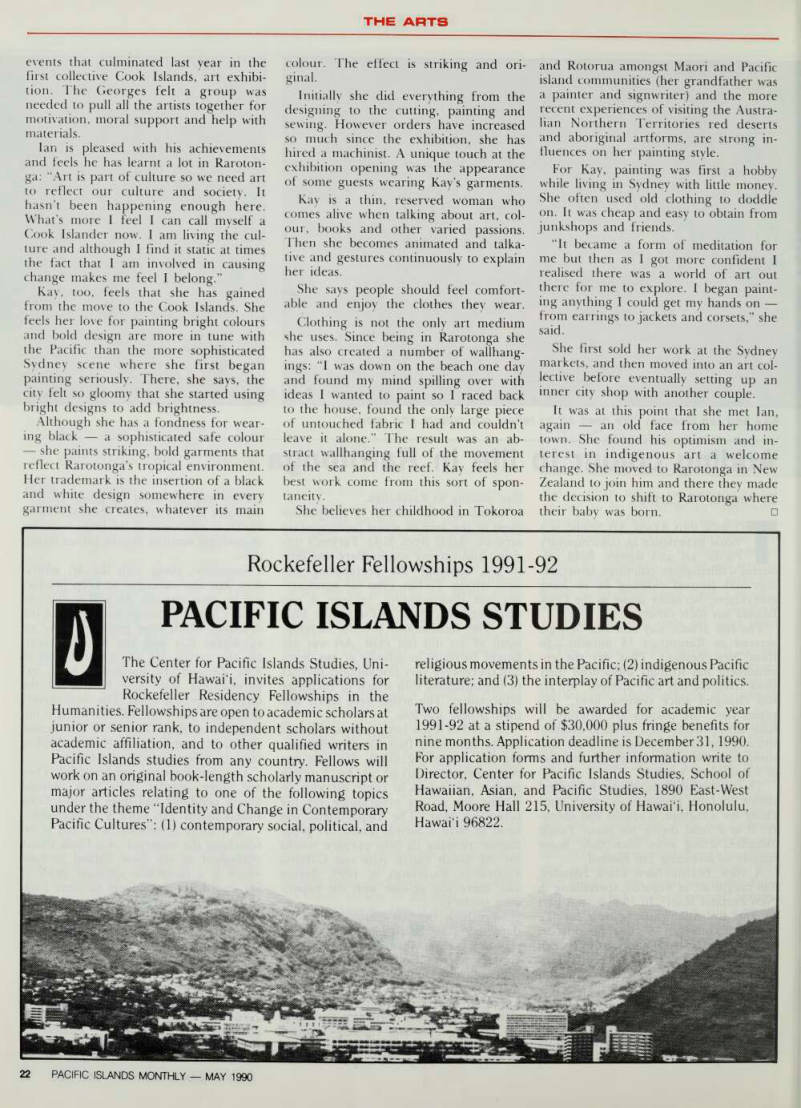
Although she has a fondness for wear ing black a sophisticated safe colour she paints striking, bold garments that reflect Rarotonga’s tropical environment.
Her trademark is the insertion of a black and white design somewhere in every garment she creates, whatever its main
colour. The effect is striking and ori ginal.
Initially she did everything from the
designing to the cutting, painting and
sewing. However orders have increased so much since the exhibition, she has hired a machinist. A unique touch at the exhibition opening was the appearance of some guests wearing Kay’s garments.
Kay is a thin, reserved woman who comes alive when talking about art, col our, books and other varied passions.
Then she becomes animated and talka tive and gestures continuously to explain her ideas.
She says people should feel comfort able and enjoy the clothes they wear.
Clothing is not the only art medium she uses. Since being in Rarotonga she has also created a number of wallhang ings: “I was down on the beach one day and found my mind spilling over with ideas I wanted to paint so I raced back to the house, found the only large piece of untouched fabric I had and couldn’t leave it alone.” The result was an ab stract wallhanging full of the movement of the sea and the reef. Kay feels her best work come from this sort of spon
taneity.
She believes her childhood in Tokoroa
and Rotorua amongst Maori and Pacific island communities (her grandfather was a painter and signwriter) and the more recent experiences of visiting the Austra lian Northern Territories red deserts and aboriginal artforms, are strong in fluences on her painting style.
For Kay, painting was first a hobby while living in Sydney with little money.
She often used old clothing to doddle on. It was cheap and easy to obtain from junkshops and friends.
“It became a form of meditation for me but then as I got more confident I realised there was a world of art out there for me to explore. I began paint ing anything I could get my hands on from earrings to jackets and corsets,” she said.
She first sold her work at the Sydney markets, and then moved into an art col lective before eventually setting up an inner city shop with another couple.
It was at this point that she met lan, again an old face from her home town. She found his optimism and in terest in indigenous art a welcome change. She moved to Rarotonga in New Zealand to join him and there they made the decision to shift to Rarotonga where their baby was born. □