Grim news on nerve gas
p. 20 · Read in the full issue
Johnston Atoll
“We plan to begin toxic operations in April or May."
“There are both persistent and non-persistent nerve agents.”
“The explosives and chemicals burn clean."
THE vocabulary is appropriately
grim as the spokespeople of the
Pentagon describe the planned
destruction of chemical weapons on America’s Johnston Atoll, some 1000 miles west-south-west of Honolulu.
A massive amount of chemical weapons, including 400 tons of lethal nerve gas, will be destroyed on Johnston, a process which may go on for years. It is good news, in terms of armament re duction and in reducing East-West ten sions. It is particularly good news for Germany, where the nerve gas used to be stored. (There may have been some politics involved; President Bush likes the conservative German Chancellor Helmut Kohl, who faces an election soon, and whose people dislike the American chemical weapons). And it is clearly better for a nation to be using the Pacific to destroy weapons rather than to test them (as the French do), but the whole process is still pretty scary.
Johnston Atoll has long been a one purpose island, a highly restricted Un ited States Army facility where chemical weapons are stored but it formerly play ed its role silently. More recently, not ably as the United States Government announced that it was moving large amounts of chemical weapons out of Germany, its role became more obvious.
The Lt. Colonel at the Pentagon would not, understandably, divulge to Pacific Islands Monthly the route of the nerve gas from the German North Sea port of Nordenham to Johnston Atoll; presumably the proprietors of the Suez and the Panama canals would just as
soon not have that particular business, so maybe the sea voyage will be a long one.
Nor would he talk about the timing of the move, but he and his colleagues were remarkably open about everything else.
There are 100,000 units in this collec tion of nerve gas, mostly in artillery shells; the gas comes in two forms. First, there is the non-persistent type, GB or Sarin, which is mixed with a liquid like water. “It dissipates in a matter of hours.” (The enemy was supposed to breath it, with death following quickly).
Then there is the persistent form, VX, which is mixed with a liquid that looks like oil for your car engine. “It dissipates in a matter of days.” (It was supposed to penetrate the enemy’s skin).
In addition to the nerve gas which will arrive on the island later this year, there is a substantial stockpile of other chemic al weapons. Some of them have been there since about 1960 when another World War II enemy of the United States, Japan, persuaded Uncle Sam to remove the material from Okinawa and from Japan. The Army will start des troying these stockpiles while the nerve gas makes its way to the atoll.
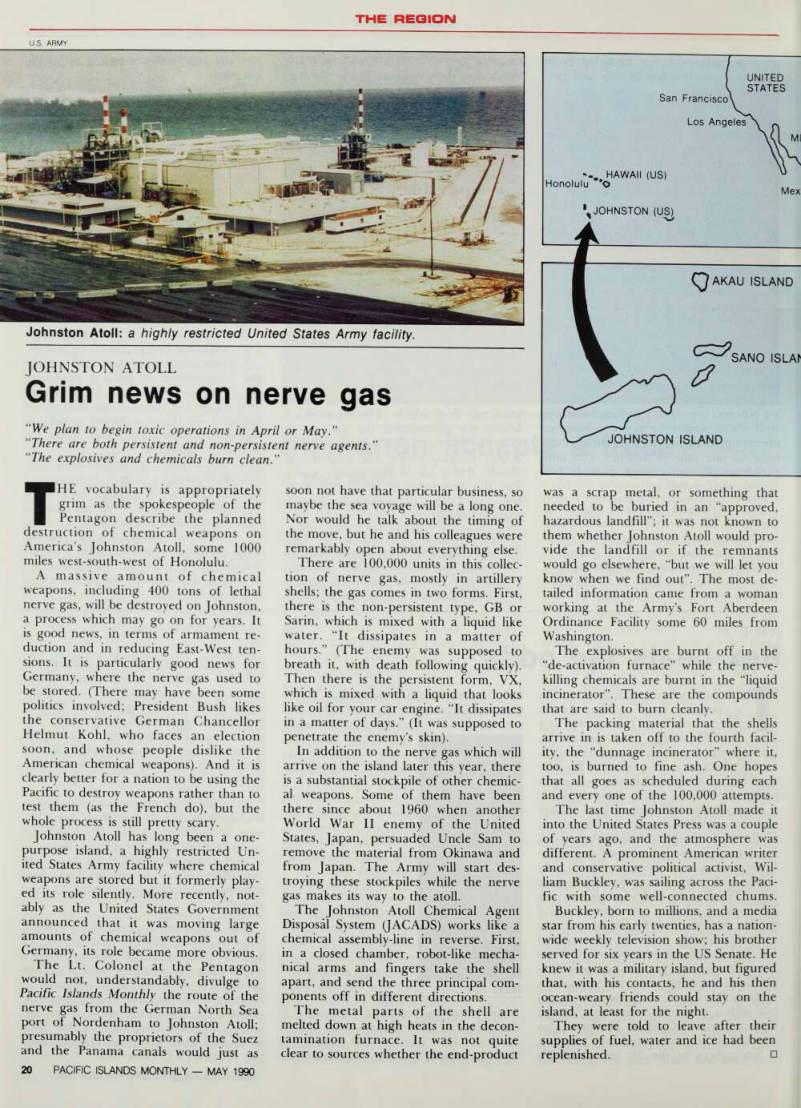
The Johnston Atoll Chemical Agent Disposal System (JACADS) works like a chemical assembly-line in reverse. First, in a closed chamber, robot-like mecha nical arms and fingers take the shell apart, and send the three principal com ponents off in different directions.
The metal parts of the shell are melted down at high heats in the decon tamination furnace. It was not quite clear to sources whether the end-product
was a scrap metal, or something that needed to be buried in an “approved, hazardous landfill”; it was not known to them whether Johnston Atoll would pro vide the landfill or if the remnants would go elsewhere, “but we will let you know when we find out”. The most de tailed information came from a woman working at the Army’s Fort Aberdeen Ordinance Facility some 60 miles from
Washington.
The explosives are burnt off in the “de-activation furnace” while the nerve killing chemicals are burnt in the “liquid incinerator”. These are the compounds that are said to burn cleanly.
The packing material that the shells arrive in is taken off to the fourth facil ity, the “dunnage incinerator” where it, too, is burned to fine ash. One hopes that all goes as scheduled during each and every one of the 100,000 attempts.
The last time Johnston Atoll made it into the United States Press was a couple of years ago, and the atmosphere was different. A prominent American writer and conservative political activist, Wil liam Buckley, was sailing across the Paci fic with some well-connected chums.
Buckley, born to millions, and a media star from his early twenties, has a nation wide weekly television show; his brother served for six years in the US Senate. He knew it was a military island, but figured that, with his contacts, he and his then ocean-weary friends could stay on the island, at least for the night.
They were told to leave after their supplies of fuel, water and ice had been replenished. □
Johnston Atoll: a highly restricted United States Army facility.