The right of the unborn
pp. 23-24 · Read in the full issue
Guam’s struggle with its new abortion law has renewed debate on women’s right
By David North
UAM enacted what is said to be ■ ■ the toughest anti-abortion law under United States flag in March, and proceeded to get into lots of trouble. The bill was passed unanimously by the 21-member Territorial Senate and then was signed into law by Governor
Joseph Ada, a Republican, despite advice
from his own Attorney-General, Eli zabeth Barrett-Andersen, that it was con trary to the US Constitution.
The law makes it a felony to perform an abortion, a misdemeanor (i.e. a lesser offence) to experience one, and, signifi cantly, a crime to even suggest to a woman that she has the option of having
an abortion. The only cir cumstances under which an abortion is legal is if: • the pregnant woman’s life is in danger; and • the proposed abortion is approved by two physicians working under the supervision of a territorial agency.
The drastic anti-abortion provisions would have been controversial enough but what really brought wrath down on the island was the ban on abortion information. This was seen as an attack on free dom of speech and of the Press, both of which are en shrined in America’s 200-year old Bill of Rights, a section of the Constitution. In the up roar that followed the enact ment of the bill the following
happened:
• a suit was filed in federal district court to suspend the law until a full hearing could be conducted; the re quested suspension (a temporary res training order) was granted immediately; • a New York lawyer, who flew to Guam to fight the bill, invited arrest by reading the section of the Honolulu tele phone book listing abortion clinics, thereby providing information on abor tions; she was duly indicted, setting up another challenge to the new law, this time in the Guam Superior Court; • a strategically-placed member of the U.S. House of Representatives, George Miller (Democrat California) announced that he was withdrawing his support of Commonwealth status for Guam until the freedom of speech issue
was resolved; he is the ranking Democrat on the House Committee on Interior and Territorial Affairs, and a long-time supporter of Guam’s interests; • most of the American Press coverage was negative, focussed, as one would expect under the circumstances, on the freedom of speech issue; and • the office of the island Congressman, Ben Blaz (Republican) spent almost all of its time in the following weeks
trying to control the damage to the Commonwealth bill. The Congressman took to the Floor of the House to plead with his colleagues not to “relegate us to darkness [because of the abortion bill] . . . it would be tantamount to spanking us and telling us to go to our room and languish through to another quarter of a century of benign neglect ... we have been in our room for almost 100 years
already.”
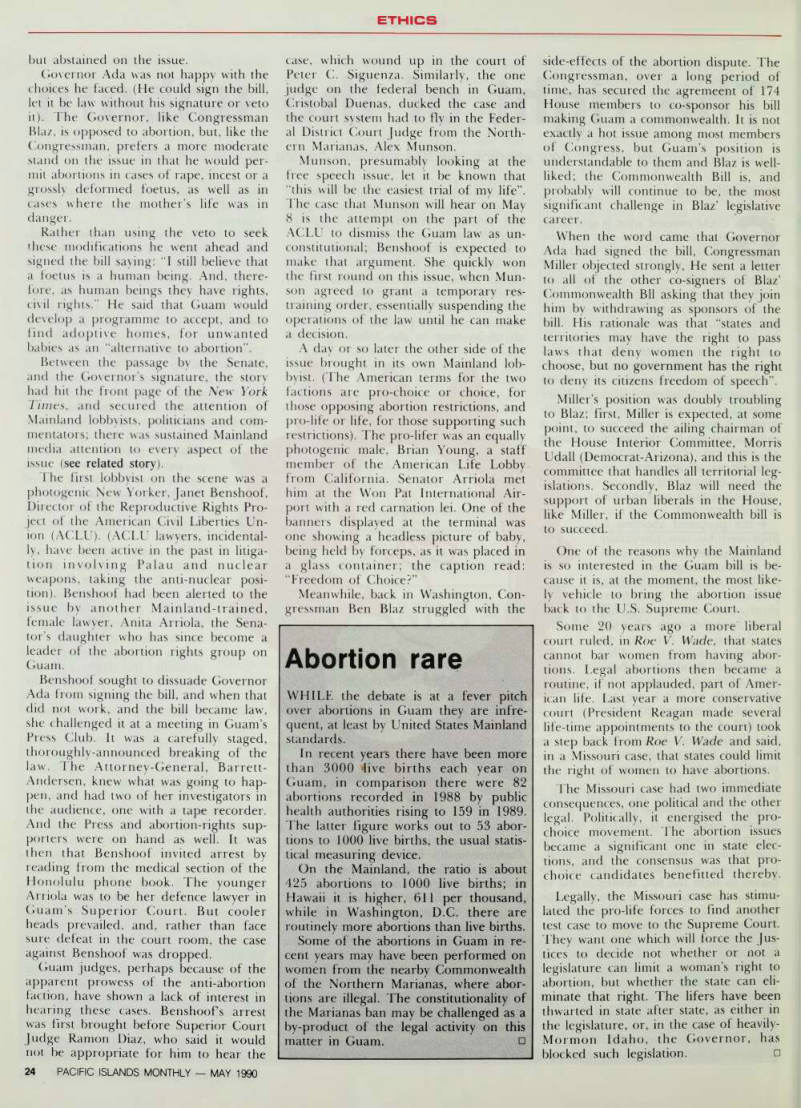
While abortions do not happen fre quently on Guam (see box) there is strong sentiment against it in many quar ters. The traditional Chamorro Families (the island’s indigenous establishment)
disapprove of it, as does the outspoken
Catholic Archbishop Anthony S.
Apuron.
The latter threatened to excommuni cate any member of the Senate who did not vote against abortion, and since 20 of the 21 members are Catholics, it apparently made an impression. (In New York State, meanwhile, the equally Catholic Governor, Mario Cuomo, a Democratic presidential possibility, gracefully shrugs off comparable threats from his bishop on the same issue).
It was in this setting that a member of the Democratic majority of the Guam Senate, Elizabeth Arriola, introduced the bill that later became law. (One of the unrecognised ironies of the story is that
Guam Senate has a higher proportion of women than can be found in all but one of the Mainland state legisla tures; eight of the Guam Senators, or 38 per cent, are women).
No matter what one may think, of the abortion provi sions of the bill, the Senator’s bill contained a couple of bob by-traps; first, as the Attor ney-General noted, the attack on freedom of speech was clearly unconstitutional, and secondly, the drafters of the legislation failed to include the one-sentence safety device that is normally found in Amer ican legislation. That is the “separability” section which simply says that if one part of the legislation is found uncon stitutional, the rest of it is to be separated, and allowed
to continue to function. There is no such sentence in the bill and if the ban on advice about abortions is regarded as un constitutional, the whole act collapses.
While the members of the Senate
ignored these built-in problems they did
adopt an amendment which will give the voters of Guam a chance to vote on the issue. A majority of those voting on this issue on November 6 can, if they chose, kill the bill. While there was no partisan squabbling on the substance of the law, or its ban on abortion information, there was on the question of the referendum.
The Republican minority in the Senate did not want the November vote, but the Democratic majority wanted it, and got it. Senator Arriola did not want the vote,
but abstained on the issue.
Governor Ada was not happy with the choices he faced. (He could sign the bill, let it be law without his signature or veto it). The Governor, like Congressman Blaz, is opposed to abortion, but, like the Congressman, prefers a more moderate stand on the issue in that he would per mit abortions in cases of rape, incest or a grossly deformed foetus, as well as in cases where the mother’s life was in
danger.
Rather than using the veto to seek these modifications he went ahead and signed the bill saying: “I still believe that a foetus is a human being. And, there fore, as human beings they have rights, civil rights.” He said that Guam would develop a programme to accept, and to find adoptive homes, for unwanted babies as an "alternative to abortion”.
Between the passage by the Senate, and the Governor’s signature, the story had hit the front page of the New York Times, and secured the attention of Mainland lobbyists, politicians and com mentators; there was sustained Mainland media attention to every aspect of the issue (see related story).
The first lobbyist on the scene was a photogenic New Yorker, Janet Benshoof, Director of the Reproductive Rights Pro ject of the American Civil Liberties Un ion (ACLU). (ACLU lawyers, incidental ly, have been active in the past in litiga tion involving Palau and nuclear weapons, taking the anti-nuclear posi tion). Benshoof had been alerted to the issue by another Mainland-trained, female lawyer, Anita Arriola, the Sena tor’s daughter who has since become a leader of the abortion rights group on Guam.
Benshoof sought to dissuade Governor Ada from signing the bill, and when that did not work, and the bill became law, she challenged it at a meeting in Guam’s Press Club. It was a carefully staged,
thoroughly-announced breaking of the
law. The Attorney-General, Barrett- Andersen, knew what was going to hap pen, and had two of her investigators in the audience, one with a tape recorder.
And the Press and abortion-rights sup porters were on hand as well. It was then that Benshoof invited arrest by reading from the medical section of the Honolulu phone book. The younger Arriola was to be her defence lawyer in Guam’s Superior Court. But cooler heads prevailed, and, rather than face sure defeat in the court room, the case
against Benshoof was dropped.
Guam judges, perhaps because of the apparent prowess of the anti-abortion faction, have shown a lack of interest in hearing these cases. Benshoofs arrest was first brought before Superior Court Judge Ramon Diaz, who said it would not be appropriate for him to hear the
case, which wound up in the court of Peter C. Siguenza. Similarly, the one judge on the federal bench in Guam, Cristobal Duenas, ducked the case and the court system had to fly in the Feder al District Court Judge from the North ern Marianas, Alex Munson.
Munson, presumably looking at the free speech issue, let it be known that “this will be the easiest trial of my life”.
The case that Munson will hear on May 8 is the attempt on the part of the ACLU to dismiss the Guam law as un constitutional; Benshoof is expected to make that argument. She quickly won the first round on this issue, when Mun son agreed to grant a temporary res
training order, essentially suspending the
operations of the law until he can make a decision.
A day or so later the other side of the issue brought in its own Mainland lob byist. (The American terms for the two factions are pro-choice or choice, for those opposing abortion restrictions, and pro-life or life, for those supporting such restrictions). The pro-lifer was an equally photogenic male, Brian Young, a staff member of the American Life Lobby from California. Senator Arriola met him at the Won Pat International Air port with a red carnation lei. One of the banners displayed at the terminal was one showing a headless picture of baby, being held by forceps, as it was placed in a glass container; the caption read: “Freedom of Choice?”
Meanwhile, back in Washington, Con gressman Ben Blaz struggled with the
side-effects of the abortion dispute. The
Congressman, over a long period of
time, has secured the agremeent of 174 House members to co-sponsor his bill making Guam a commonwealth. It is not exactly a hot issue among most members of Congress, but Guam’s position is understandable to them and Blaz is well liked; the Commonwealth Bill is, and probably will continue to be, the most
significant challenge in Blaz’ legislative
career.
When the word came that Governor Ada had signed the bill, Congressman Miller objected strongly, He sent a letter to all of the other co-signers of Blaz’
Commonwealth 81l asking that they join
him by withdrawing as sponsors of the bill. His rationale was that “states and territories may have the right to pass laws that deny women the right to choose, but no government has the right to deny its citizens freedom of speech”.
Miller’s position was doubly troubling
to Blaz; first, Miller is expected, at some point, to succeed the ailing chairman of the House Interior Committee, Morris Udall (Democrat-Arizona), and this is the committee that handles all territorial leg islations. Secondly, Blaz will need the support of urban liberals in the House, like Miller, if the Commonwealth bill is to succeed.
One of the reasons why the Mainland is so interested in the Guam bill is be cause it is, at the moment, the most like ly vehicle to bring the abortion issue back to the U.S. Supreme Court.
Some 20 years ago a more liberal court ruled, in Roe V. Wade, that states cannot bar women from having abor tions. Legal abortions then became a routine, if not applauded, part of Amer ican life. Last year a more conservative court (President Reagan made several life-time appointments to the court) took a step back from Roe V. Wade and said, in a Missouri case, that states could limit the right of women to have abortions.
The Missouri case had two immediate consequences, one political and the other
legal. Politically, it energised the pro
choice movement. The abortion issues became a significant one in state elec tions, and the consensus was that pro choice candidates benefitted thereby.
Legally, the Missouri case has stimu lated the pro-life forces to find another test case to move to the Supreme Court.
They want one which will force the Jus tices to decide not whether or not a legislature can limit a woman’s right to abortion, but whether the state can eli minate that right. The lifers have been thwarted in state after state, as either in the legislature, or, in the case of heavily- Mormon Idaho, the Governor, has blocked such legislation. □